



Abstract
In this study, a recently developed electron-beam polishing process was adopted to improve the surface quality of grooved SM45C mold steel plates. A large electron beam with a maximum diameter of 60 mm was used to instantly melt and evaporate the metal surface in a few microseconds to observe its effect on surface hardness, surface roughness, water repellency, and microstructure variation. The effects of the groove depth and width on the plate were also experimentally observed. The surface polished by the electron beam became smoother, but as the groove depth increased, the effect of the large-electron-beam polishing decreased. Although the surface hardness dropped by approximately 20% on the re-solidified layer, the contact angle increased after the electron-beam irradiation. The microstructure variation on the polished surface was also examined.
Keywords
Introduction
Surface finishing comprises a broad range of industrial processes that alter a surface to achieve a certain property. It is often the final process that determines the quality of products after traditional and non-traditional machining. Polishing techniques for metals depend on the type of metal being polished and the desired outcome. 1 However, for complex products, conventional polishing methods have usually been based on manual operation, which is time consuming and costly. Thus, there is the need to improve the efficiency of conventional polishing processes. Recently, large-electron-beam polishing (LEBP) has been proposed as a new polishing method for complex metal surfaces.2–7 In this process, the surface created by other processes, such as electrical-discharge machining and milling, is smoothed by a large-scale electron beam.
SM45C mold steel, which is the subject of this paper, falls into the class of medium-carbon steels. It has been used extensively in the automotive, machinery, and electronics industries. Recently, the geometry of components used in these industries has become more complex, so the cost and duration of the polishing process has gradually increased. These components are good candidates for LEBP, but the interaction of the large electron beam with common steels, including the SM45C, has not been reported in the literature.
In this study, LEBP was used on grooved SM45C mold steel plates. The changes in surface roughness, water repellency, and surface hardness were experimentally observed to evaluate the performance of the LEBP process for medium-carbon steels. The effects of the groove depth and width on the SM45C mold steel plate for LEBP were also experimentally observed. The microstructure of the re-solidified layer of the grooved SM45C mold steel plate was analyzed using scanning electron microscopy (SEM), and the resulting contact angle after LEBP was analyzed.
Experimental set-up
A Pika electron-beam surface-finishing machine manufactured by Sodick was used to perform the experiments. The surface modification conditions for the grooved SM45C mold steel plate are summarized in Table 1. The LEBP irradiation time of one pulse was only 2 µs, and the diameter of the electron beam was 60 mm. The surface modifications were investigated while changing the number of times the electron beam was pulsed on the sample.
LEBP conditions.
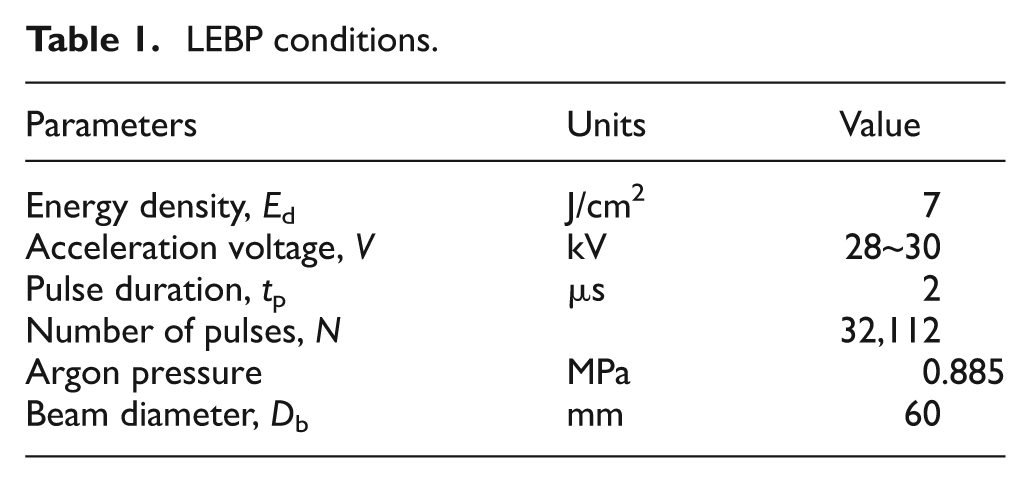
The grooved SM45C mold steel plate samples were prepared using a mechanical milling process, as shown in Figure 1(a). Slots 5 mm and 10 mm deep were machined at 2100 r/min. The top surfaces were milled at 750 r/min. The original roughness was around 2 µm. Then, electron-beam irradiation was carried out using either 32 or 112 pulses, as shown in Figure 1(b).

(a) Grooved SM45C plate sample, and (b) electron-beam polishing routine.
The irradiated sample was characterized after the electron-beam irradiation using various analytical techniques. The surface morphology was monitored by a white interferometer, and SEM was used to examine the thin, re-solidified layer of the irradiated surface.
Results and discussion
Figure 2 shows the change in the surface morphology after electron-beam irradiation using an energy density of 7.0 J/cm2. The surface roughness decreased as the number of electron-beam pulses increased. The surface roughness decreased by 40.1% for 32 electron-beam pulses and by 50.1% for 112 electron-beam pulses compared with the base case without irradiation.
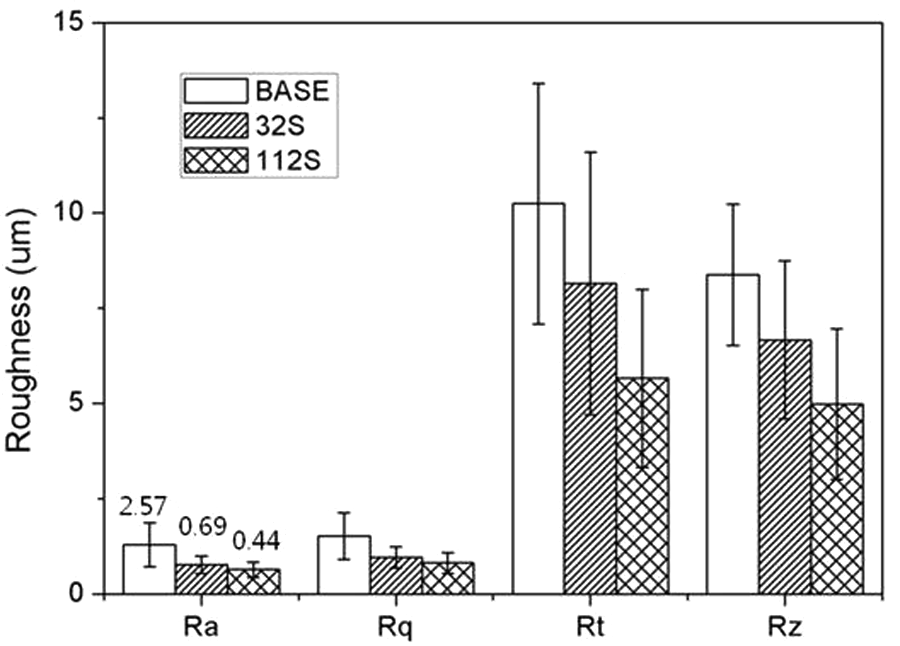
Comparison between the polished and machined surfaces.
Figure 3 shows the variation in the surface profile on the irradiated surface according to the number of electron-beam pulses. For an energy density of 7.0 J/cm2, the surface became slightly smoother as small milling scratches disappeared. Therefore, a desired surface roughness can be achieved by adjusting the number of electron-beam pulses.
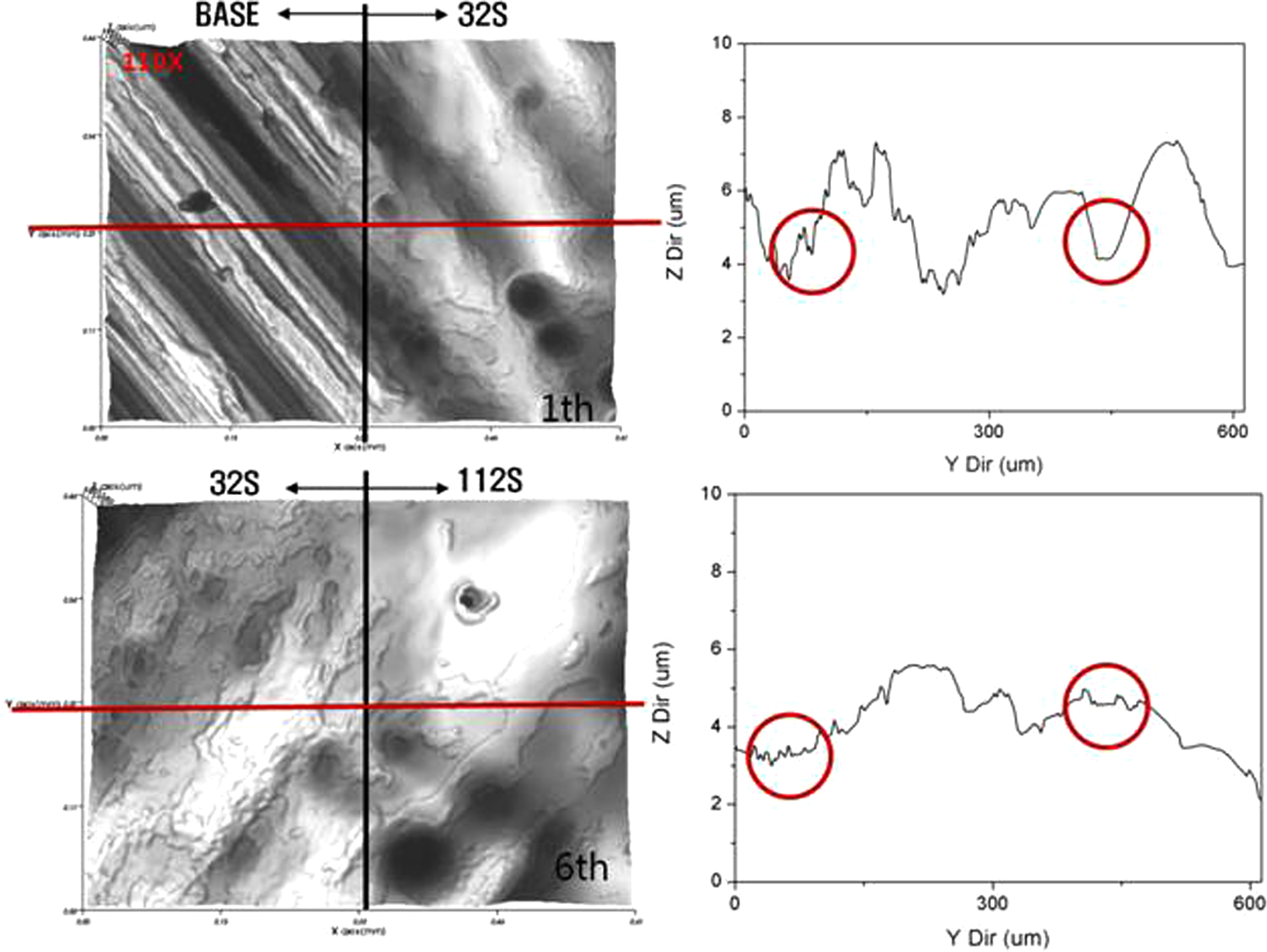
Surface profiles of the irradiated surface.
Because the electrons move in a spiral motion owing to the applied Lorentz forces, the effect of electron-beam polishing differs depending on the shape of the grooves. Two different slots were fabricated on the SM45C mold steel plates. Figure 4 shows the variation in the surface roughness after the electron-beam irradiation on grooves that were 5 mm and 10 mm deep. The improvement in the surface roughness of the 5 mm groove was much greater than that for the 10 mm groove. As deeper grooves distort the electron trajectories, the polishing effect decreases.
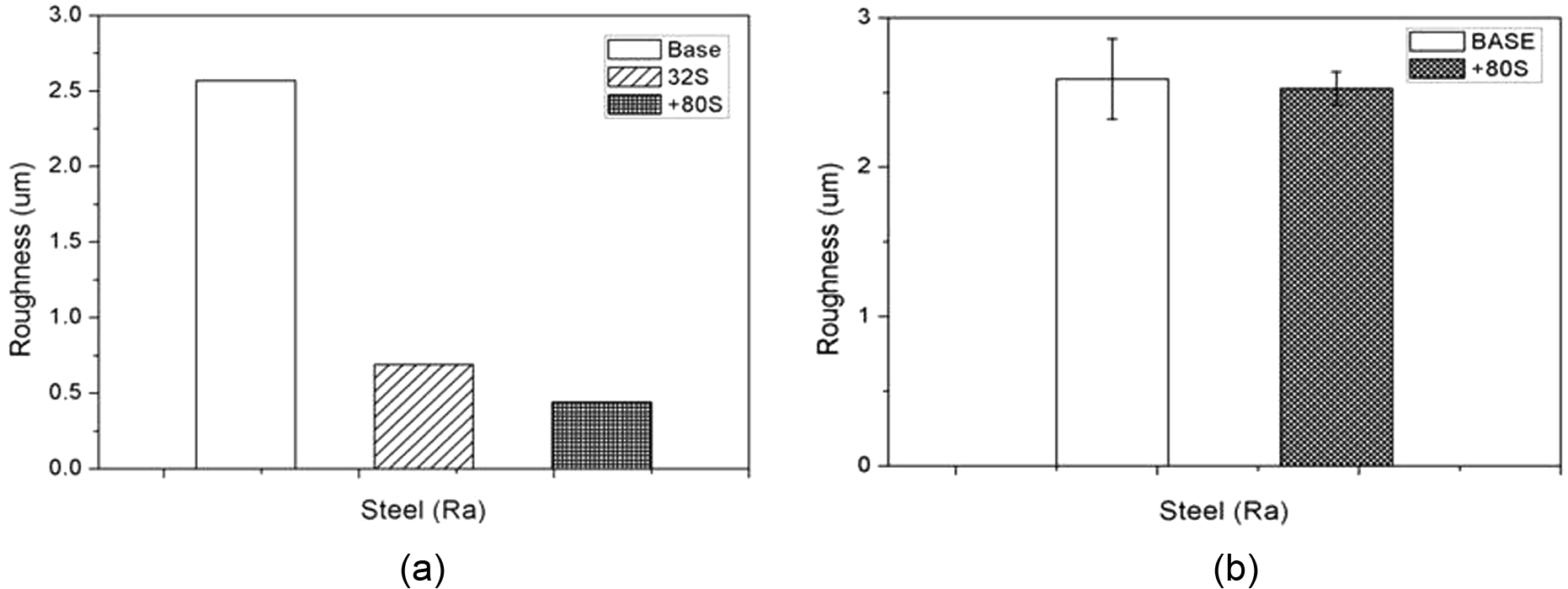
Surface roughness variation for (a) 5 mm, and (b) 10 mm grooves.
The irradiated surface was investigated to evaluate the change in the microstructure of the SM45C mold steel plate. As the pulse duration was only a few microseconds during the LEBP, material removal due to melting and evaporation only occurred near the surface. We evaluated the surface hardness, metallographic change, and surface wettability to quantify the effect of the electron-beam irradiation.
Figure 5 shows the variation in hardness of the SM45C surface after electron-beam radiation using an energy density of 7.0 J/cm2. The surface hardness decreased by 219 Hv for the case with more laser pulses. The surface hardness dropped by 5.6% for 32 pulses and 19.4% for 112 pulses.
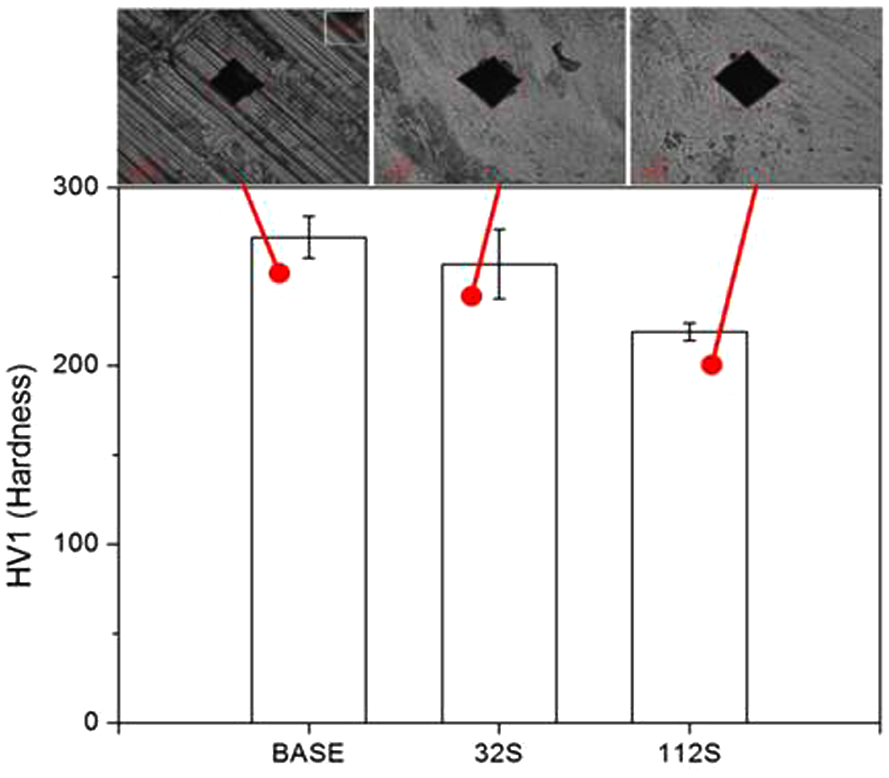
Hardness variation with number of electron-beam pulses.
A metallographic analysis was also performed to evaluate the surface microstructure before and after the electron-beam irradiation. The metallographic sample was prepared using a diamond saw and mechanical polishing and etched with a 5% HNO3/95% ethyl alcohol solution for 10 s. Figure 6 shows the change in the surface morphology after the electron-beam irradiation. The thickness of the crystallized layer of the SM45C sample was 7–10 µm after 112 electron-beam pulses.
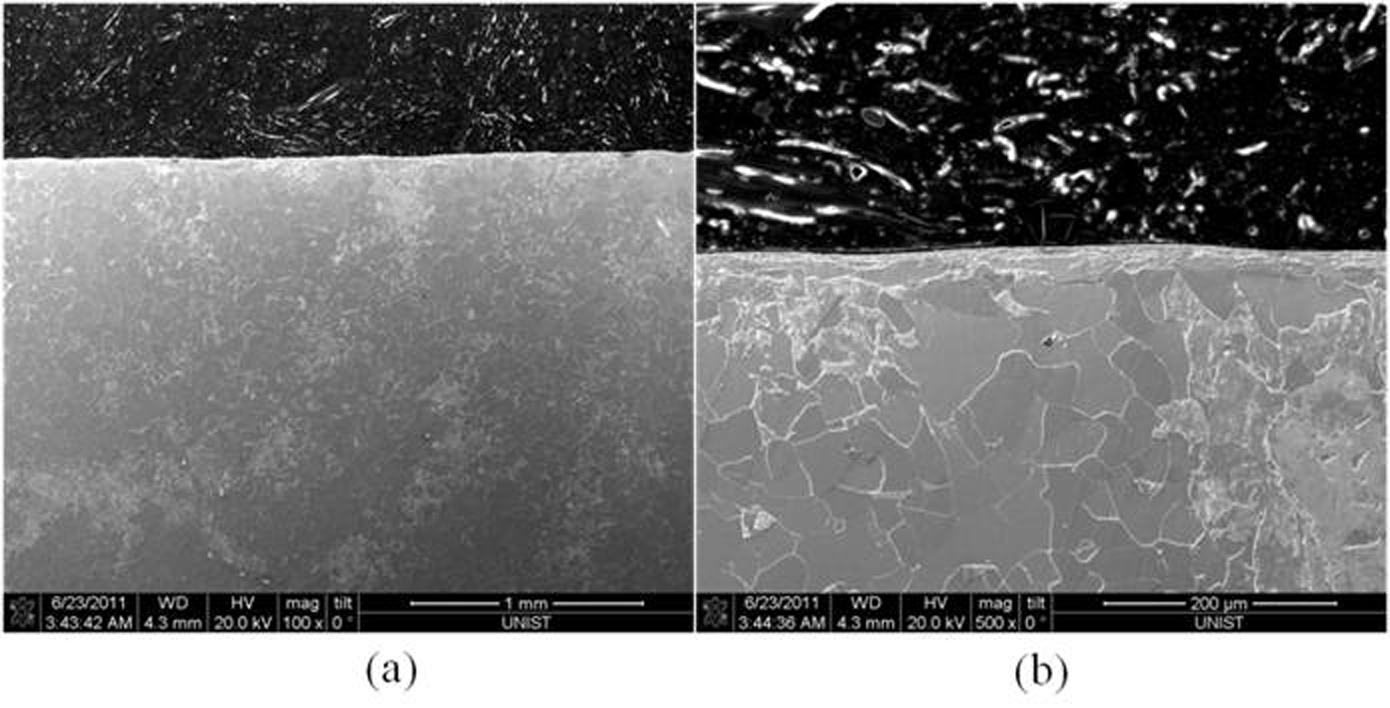
SEM images of the microstructure of the irradiated sample at (a) 100 × and (b) 500 × magnification.
Energy-dispersive X-ray spectroscopy (EDX) spectra of the sample surfaces were quite similar regardless of the location on the samples, except for the surface of the re-solidified layers. On the surface of the re-solidified layers, oxidation and carbon concentration occurred, as shown in Figure 7, because the material-matrix formation adjacent to the surface varied owing to the melting and evaporation.
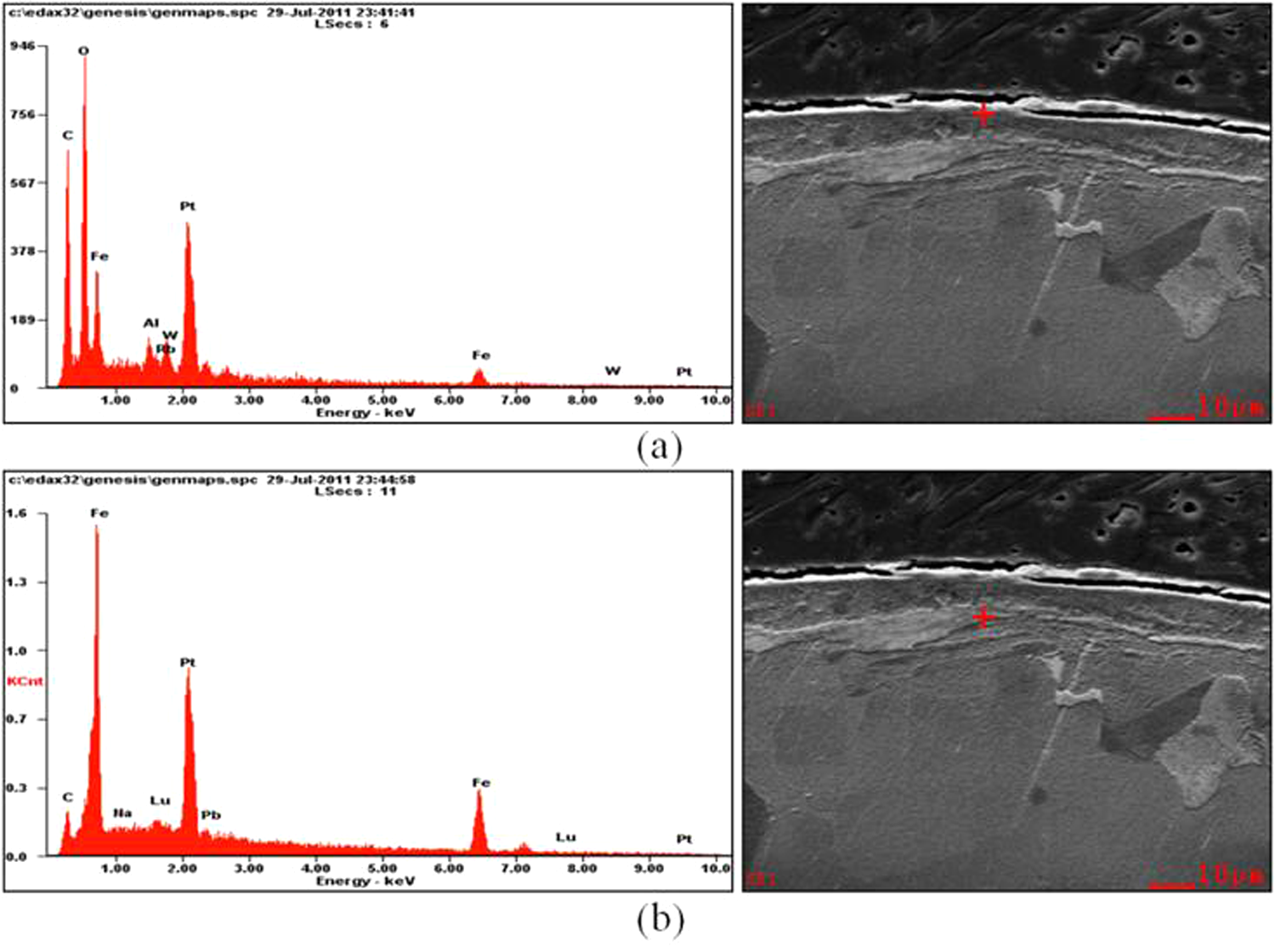
EDX spectra of (a) irradiated thin re-solidified layer, and (b) non-irradiated region.
The contact angle of a water droplet on the surface was also tested to evaluate the variation in wettability due to the electron-beam irradiation. A water drop 2 mm in diameter was placed on the SM45C mold steel plate surface before and after the electron-beam irradiation. The shape of the water drop was measured after 30 s. The contact angle was calculated from its radius and height. Figure 8 shows the variation in the contact angle with respect to the number of electron-beam pulses. The contact angle of irradiated surfaces was higher than that of the initial surface regardless of the number of pulses. However, the contact angle after 32 pulses was higher than that after 112 pulses. This may be due to the variation in the microscale surface profile caused by the electron-beam irradiation.
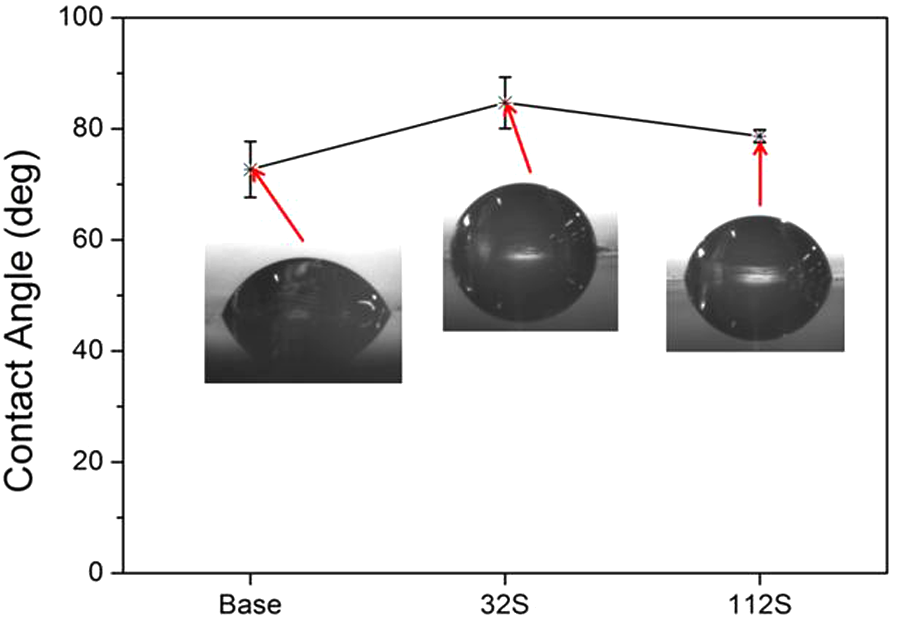
Contact angle variation according to electron-beam pulses.
Conclusion
LEBP was performed on grooved SM45C mold steel plates to observe its effect on the surface hardness, surface roughness, water repellency, and microstructure variation in medium-carbon steel. The effects of the groove depth and width were also experimentally observed. LEBP proved to be an interesting alternative to polishing a complex mold. The roughness of the irradiated surface of the grooved SM45C mold steel plate was improved by 50.1%. However, as the groove depth increased, the effect of the LEBP decreased. Although the surface hardness dropped by approximately 20% on the re-solidified layer, the contact angle increased after the electron-beam irradiation. The microstructure of the re-solidified layer of the grooved SM45C mold steel plate was examined using SEM.
Footnotes
This work was partly supported by the Development of High Speed Ecological Finishing process for precision and micro pattern products (No. 20100110038656) and Human Resources Development of the Korea Institute of Energy Technology Evaluation and Planning (KETEP) grant funded by the Korea government Ministry of Knowledge Economy (No. 20114030200010).