




Abstract
This article analyses how managers and officials within public agencies perceive the accountability function of stakeholder bodies. Many agencies have established formal accountability relationships with societal stakeholders by introducing stakeholder bodies, such as client councils and user panels. The academic literature has however debated whether and how stakeholder bodies can reflect a full accountability mechanism. Based on original qualitative interviews with 25 representatives from nine Dutch agencies, this study distinguishes five different perspectives that agency managers and officials have about the accountability function of stakeholder bodies: a control perspective, an institutional perspective, a managerial perspective, learning perspective, and a reputational perspective. Agency managers or officials do not often describe stakeholder bodies as a form of accountability, but their experiences and perceptions include elements of accountability. Rather than strengthening control and scrutiny, stakeholder bodies are perceived as an accountability mechanism that relates to a mixture of agency demands and motives.
Introduction
Across the public sector, stakeholder involvement has become an important aspect of the governance structures of public agencies. Many agencies have institutionalized relationships with their most important stakeholders by the means of client councils, user panels, and other forms of stakeholder bodies. These stakeholder bodies are often suggested to stimulate stakeholder participation and consultation in bureaucratic policy-making (Braun and Busuioc, 2020; Péréz-Duran, 2019), but they can further be a relevant contribution for accountability purposes (Bovens, 2007; Sørensen and Torfing, 2021). Public administration scholarship often considers stakeholder bodies as an accountability innovation that provides societal stakeholders a greater role and influence in the accountability landscape of public agencies (Schillemans, 2011; Scott, 2000; Willems and Van Dooren, 2012). In various public sector reforms, stakeholder bodies have been presented as an attempt to strengthen agency accountability (Brummel, 2022; Mattei et al., 2018).
Yet, an empirical question remains whether stakeholder bodies can actually fulfil an accountability function (cf. Bovens, 2007). Often, these panels and councils lack formal judgment and sanctioning possibilities (Hansen et al., 2022; Lindén, 2015). Meanwhile, others suggest that stakeholders can be a relevant “fire alarm” within the broader accountability environment of agencies (Byrkjeflot et al., 2014; Meijer, 2007; Schillemans, 2008) and that they represent an alternative and horizontal form of accountability that differs from traditional and hierarchical conceptions of accountability.
Within the accountability literature, a subsequent question has been whether and how stakeholder bodies can be a relevant accountability mechanism to public agencies. There are many different expectations on the relevance of stakeholder bodies in holding agencies accountable. Rather than strengthening control, Schillemans (2011), for instance, has argued that stakeholder bodies can facilitate accountability processes that stimulate organisational learning (see also Greiling and Halachmi, 2014; Schillemans and Smulders, 2015). According to Koop (2014), stakeholder bodies can be a form of accountability to which agencies voluntarily adhere because of shared moral and professional norms within their organisational environment. The accountability function of stakeholder bodies can further be of instrumental relevance to public agencies, for example, by contributing to effective policy coordination and implementation (Karsten, 2015; Papadopoulos, 2010). Additionally, stakeholder bodies might reflect a reputational tool by which means agencies show their accountability ties with stakeholders and, as such, try to strengthen their legitimacy across multiple audiences (Bertelli and Busuioc, 2021; Busuioc and Rimkutė, 2020; De Boer, 2021).
Against the background of these debates, the individual perceptions of agency managers and officials can be crucial for the actual accountability function of stakeholder bodies. Do agency managers and officials perceive these bodies as a relevant accountability mechanism, and why do they consider these bodies as important? Many authors have emphasized a subjective and “felt” element of accountability, suggesting that individual perceptions of accountability, as well as individual motivations and considerations, can be crucial for actual accountability outcomes (Acar et al., 2008; Busuioc and Lodge, 2016; Karsten, 2015; Yang, 2014). These accountability perceptions can impact individual behaviours and decisions, and can ultimately affect organisational outcomes (Overman and Schillemans, 2022). As Sinclair (1995: 220) for instance argues in her seminal work on public sector accountability: “efforts to improve accountability would be informed by an understanding of the diversity of ways in which managers construct, hold and enact a sense of being accountable.”
Therefore, this study seeks to answer how individual agency managers and officials perceive the accountability function of stakeholder bodies. The study draws on original qualitative interviews with N = 25 agency representatives from nine different independent administrative bodies or so-called ZBOs (zelfstandige bestuursorganen in Dutch) in the Netherlands about their experiences with stakeholder bodies. ZBOs are legally independent entities with limited ministerial responsibility and high managerial autonomy (De Kruijf and Van Thiel, 2018). Since the 2000s, various ZBOs have implemented new arrangements to strengthen their accountability vis-á-vis stakeholders and society at large (Koop, 2014; Yesilkagit, 2004). From an international-comparative perspective, societal stakeholders are highly relevant within the accountability environment of Dutch agencies (Schillemans et al., 2022). Within this empirical context, this study can shed a light on how Dutch agency managers and officials shape their perceptions of the relevance of stakeholder bodies as an accountability mechanism.
By doing so, this study aims to contribute to the public administration literature on the role and relevance of stakeholder bodies for agency accountability. This study makes three contributions. First, its theoretical contribution is to develop a integrative theoretical framework that connects different perspectives on the relevance of stakeholder bodies as an accountability mechanism, based on the existing accountability literature. In recent years, a range of different perspectives has entered the scene that can be helpful in explaining and theorizing accountability behaviour of public agencies in non-hierarchical settings (Busuioc and Lodge, 2016; Maggetti and Papadopoulos, 2018; Karsten, 2015; Koop, 2014; Olsen, 2013; Schillemans, 2011). Building on these different insights, this study presents a multi-faceted theoretical understanding of the accountability function of stakeholder bodies. Second, this study offers an empirical contribution by investigating how agency managers and officials perceive the accountability function of stakeholders bodies. As argued above, the accountability function of stakeholder bodies is disputed. As individual perceptions of accountability might mediate the actual functioning of accountability, studying these perceptions is relevant for our understanding of whether and when accountability does work (cf. Overman and Schillemans, 2022). Third, this study has practical relevance. The creation of agencies in the public sector has led to concerns related to the accountability of these entities (Bovens, 2007; Scott, 2000; Papadopoulos, 2023). In multiple countries and policy sectors, there is a growing tendency in to involve and engage stakeholders within the formal accountability structures of agencies, in order to improve agency accountability. This study aims to draw lessons based on the Dutch experience with stakeholder bodies that can inform practices of stakeholder involvement in agency accountability in other settings.
This study proceeds as follows. It first develops a theoretical framework that discusses different perspectives on the accountability function of stakeholder bodies and that guides the empirical research. This will be followed by a discussion of the research context and research approach of this study. In the remaining, the empirical findings of this study will be presented, focusing on both the aspects and functions of accountability that respondents relate to stakeholder bodies. This study will end with a conclusion and discussion.
Theory
Accountability, social accountability, and stakeholder bodies
The accountability of agencies is an important topic in the academic literature (see e.g. De Boer, 2022; Lægreid and Rykkja, 2022; Maggetti and Papadopoulos, 2022; Van de Sande et al., 2021). Following Bovens’ (2007) conceptualization of accountability, accountability can be defined as an relationship between an account-giver and an account-holder, in which an account-giver renders information to an account-holder and this account-holder can ask questions and pass judgement on the account-giver’s conduct (Bovens, 2007: 450). According to Bovens (2007), accountability consists of three important elements: information provision, debate, and potential consequences.
Many studies have shown that accountability has become multidirectional; agencies are not only accountable upward to central government but are also increasingly faced with the expectations and judgements of various societal stakeholders (Hansen et al., 2022; Willems and Van Dooren, 2012). As Papadopoulos (2023: 25) argues, “accountability also moves” downwards” to become “proximate” with target populations in the role of accountability forums.” These stakeholder-oriented forms of accountability are commonly referred to as “social accountability.” Social accountability reflects a range of accountability practices that can be directed to general and non-specific audiences and to more specific audiences within society (Sørensen and Torfing, 2021). On the one hand, social accountability has been fostered by increased transparency (Meijer, 2007; Meijer and Schillemans, 2009). Many agencies have committed themselves to account-giving practices, for instance via websites, press releases, or social media (De Boer, 2021). These practices are generally directed to wider and unspecified audiences, i.e. the “public at large” (Willems and Van Dooren, 2012).
On the other hand, specific stakeholders can be involved and represented within the formal accountability structures of agencies (Brummel, 2021, 2022). These types of arrangements are established in multiple policy domains and contexts and in different countries and jurisdictions, including the European Union, several European countries and the United States (Arras and Braun, 2018; Busuioc and Jevnaker, 2022; Moffitt, 2010; Pierre, 2009; Verschuere et al., 2006). Stakeholder bodies represent a more institutionalized form of stakeholder involvement and can be defined as “permanent entities within [an] agency where a substantial number of the members are stakeholders, which meet on a regular basis” (Arras and Braun, 2018: 1261). Stakeholder bodies can consist of a mix of mandatory and voluntary elements. They are a mandatory instrument for agencies in some jurisdictions, but agencies can also install stakeholder bodies on a voluntary base (Bovens, 2007; De Boer, 2021; Koop, 2014).
Across public organisations, there are major differences which stakeholders are involved in stakeholder bodies, largely depending upon an agency’s stakeholder environment. For example, De Boer (2021) refers to “interest groups, clients and users, professional peers and regulates” as important stakeholder groups of public sector organisations (see also Koop, 2014). This diversity of stakeholders is further reflected in the variety of names under which these stakeholder bodies are known. Predominantly, in domains as social services and health care, stakeholder bodies consist of clients and/or client representatives and go under names such as “client councils”, “client panels” and “patient panels” (Brummel, 2021; Meijer and Schillemans, 2009; Pierre, 2009). In other domains, stakeholder bodies are more diverse in nature, also including interest groups, regulated companies, labour unions, user organisations, civil society organisations and other external stakeholders; and are often known as “user bodies”, “stakeholder councils”, “boards of stakeholders/users” or “consultative forums” (Busuioc and Jevnaker, 2022; Lindén, 2015; Schillemans, 2011). “Advisory bodies” and “advisory committees” are further examples of how non-state stakeholders can be involved within formal structures of agencies, and these bodies often include a wide range of actors (Moffitt, 2010).
Stakeholder bodies from an accountability perspective
Can stakeholder bodies be a relevant “accountability forum” for public agencies (Bovens, 2007: 450)? In the public administration literature, there has been debate whether stakeholder bodies reflect a full accountability mechanism (Bovens, 2007; Brummel, 2021; Lindén, 2015). Stakeholder-oriented forms of accountability are different from the more traditional and vertical modes of accountability, in which a subordinate is formally accountable to a hierarchical superior (Acar et al., 2008; Gailmard, 2014; Maggetti and Papadopoulos, 2018). Hierarchical accountability is based on the principle of ownership (Mulgan, 2003) and puts on strong emphasis on external control (Acar et al., 2008), and its logic has been reflected in the dominant principal-agent framework to accountability (Schillemans, 2011). In social forms of accountability, public agencies often do not have a formal obligation to be accountable to societal stakeholders. Furthermore, it remains an empirical question whether stakeholder bodies include all three elements or phases of accountability that Bovens (2007) has analytically distinguished (see also Klenk, 2015; Meijer, 2007). Importantly, stakeholder bodies often lack the formal opportunities to judge and sanction agency behaviour (Lindén, 2015; Schillemans, 2008).
However, as Meijer (2007: 168–169) for example argues, stakeholder panels and councils include elements of accountability, although these elements can be very informal in nature. For public organisations, there might be an informal or felt obligation for account-giving to stakeholders (Meijer and Schillemans, 2009). The accountability relationships between agencies and stakeholders are then based on a principle of affected interests, instead of hierarchical ownership (Mulgan, 2003). Stakeholder bodies tend to have granted access to information and provide a venue for debate between agency leaders and stakeholders. In the absence of formal sanctions, they are associated with informal or indirect consequences, for instance, through voice, public appraisal, or naming and shaming (De Boer, 2021; Meijer, 2007).
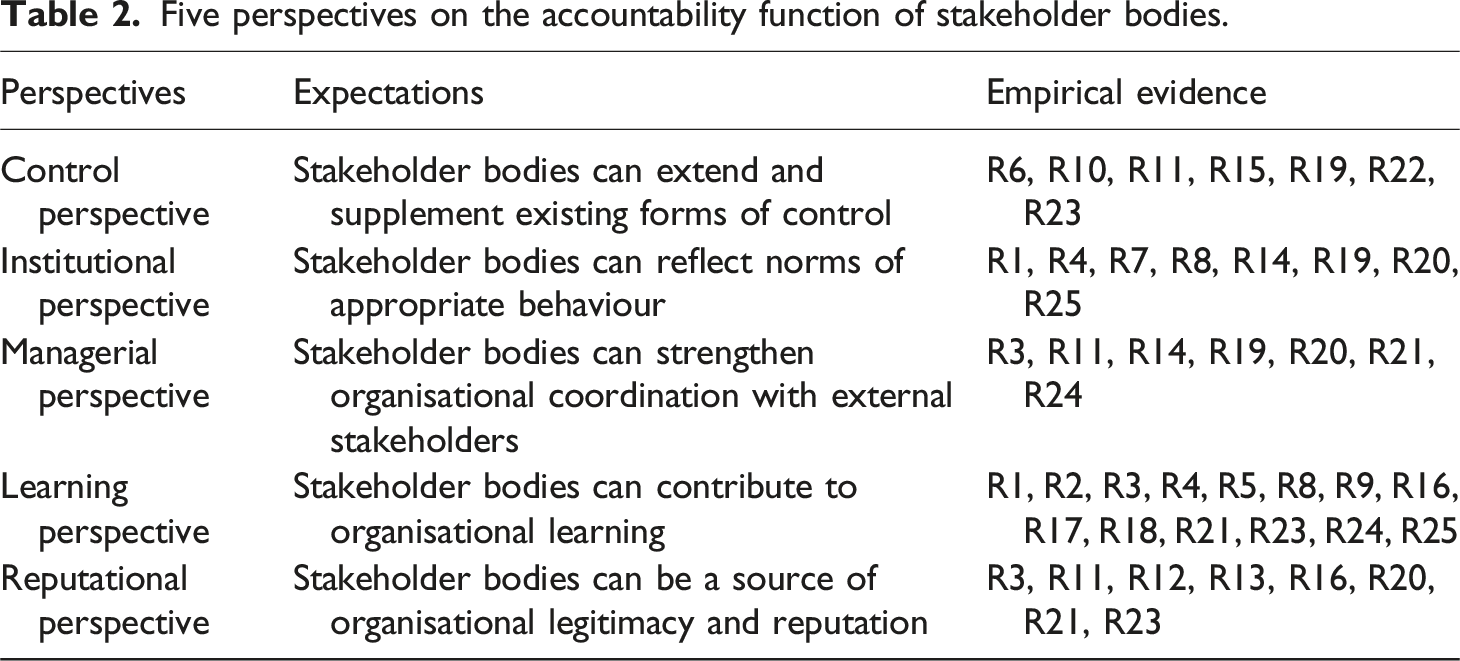
Within the literature on social accountability, there are several perspectives on how stakeholder bodies can be a relevant (or meaningful) accountability mechanism. Based on this body of literature, this study differentiates five perspectives. First of all, there is a control perspective that stresses the importance of stakeholder bodies for controlling agencies. Because hierarchical accountability is not always an effective control mechanism, stakeholder bodies are particularly relevant within a “hybrid” framework of accountability, in which hierarchical and societal modes of accountability reinforce each other (Goetz and Jenkins, 2001; Reddick et al., 2020; Willems and Van Dooren, 2012). Stakeholdesrs can contribute to departmental control by providing a form of “fire-alarm oversight” that informs political principals about the functioning and the potential failures of public agencies (McCubbins and Schwartz, 1984).
Rather than control, social forms of accountability, such as stakeholder bodies, might however be more important for different functions within the accountability landscape of agencies. According to an institutional perspective, stakeholder bodies might reflect a “logic of appropriateness” (March and Olsen, 2011), whereby agencies render an account vis-à-vis stakeholders because they consider it to be rightful and expected (Koop, 2014). Public agencies can experience a strong moral obligation (instead of a formal obligation) to be accountable to their stakeholders (Byrkjeflot et al., 2014). Stakeholders can claim legitimate and moral authority to hold public agencies accountable because of their affected interests (Maggetti and Papadopoulos, 2022; Mulgan, 2003; Overman and Schillemans, 2022). Public officials often feel a strong intrinsic motivation to be not only accountable to their hierarchical superiors, but also to be responsive to affected citizens and stakeholders (Sinclair, 1995).
Stakeholder bodies can also be a relevant accountability mechanism from a managerial perspective, because they contribute to an effective implementation of agency’s policies and an efficient collaboration between agencies and stakeholders. For example, stakeholder bodies might serve agencies’ informational needs and can be a platform for facilitating and monitoring stakeholder compliance (Arras and Braun, 2018). If agencies collaborate with specific stakeholders, for instance, through networks and/or partnerships, these stakeholders become important actors within an agency’s environment that have key resources and expertise that are relevant for policy implementation (De Boer, 2022). “Peer accountability,” i.e. agencies use accountability to inform their collaborative network partners and discuss policies and programs with them (Papadopoulos, 2010: 1040), can be an important tool for effective relationship management. From this perspective, stakeholder bodies are also of instrumental value because they can function as an instrument for stimulating organisational effectiveness (see Christensen et al., 2020; March and Olsen, 2011).
Stakeholder bodies can be valuable from a learning perspective, whereby they function as “a regular mechanism to confront administrators with information about their own functioning and forces them to reflect on the successes and failures of their past policy” (Bovens, 2007: 464). Stakeholders often have relevant knowledge of a policy field or first-hand experience with the effects of agency’s policies, and their views and opinions can thus be relevant for improving organisational services and performance (Greiling and Halachmi, 2014; Schillemans and Smulders, 2015). Learning motives can be based upon norms of appropriateness, because it is considered to be appropriate to learn and obtain feedback from stakeholders (Karsten, 2015). Yet, learning motivations can further reflect an instrumental logic, because organisational learning can be a means towards organisational improvement (De Boer, 2021).
Finally, a reputational perspective emphasizes that stakeholder bodies can be a tool for managing and building long-term constituencies and for cultivating a good reputation among various audiences (Busuioc and Lodge, 2016; Busuioc and Rimkutė, 2020; Carpenter and Krause, 2012). Many public agencies pursue to maintain good relationships with most important stakeholders and are concerned about a negative reputation among dissatisfied clients and/or stakeholders (Klenk, 2015; Meijer and Schillemans, 2009). Stakeholder bodies might contribute to coalition formation with stakeholders, by which means agencies strive to increase external support among a broad range of societal actors. As such, agencies can convey an image of “a reputable actor in the eyes of one’s audience(s), conveying the impression of competently performing one's (accountability) roles, thereby generating reputational benefits” (Busuioc and Lodge, 2016: 247). Wood (2015), for example, argues that strengthening agency accountability vis-à-vis external stakeholders can be crucial for maintaining organisational legitimacy. Stakeholder bodies can stimulate greater organisational autonomy because it legitimizes organisational conduct and might delegitimize the formal control from political authorities (Bertelli and Busuioc, 2021; De Boer, 2021). Although a strong reputation can be a strategic asset, reputation-seeking behaviour can also reflect an intrinsic value because agencies can consider it as appropriate and socially desirable to act in accordance with audience expectations (Busuioc and Lodge, 2016: 250).
Research context and case selection
This study focusses on the accountability function of stakeholder bodies within the context of Dutch independent administrative bodies or so-called ZBOs. ZBOs are legally independent entities that are based on statutes under public or private law and that have a relatively high degree of managerial autonomy (type II agencies, see Yesilkagit and Van Thiel, 2012). They can be compared to, for example, the Non-Departmental Public Bodies (NDPBs) in the United Kingdom, the French public establishments, or the Australian statutory authorities (Van Thiel, 2022; Verhoest et al., 2012). There is substantial variance between ZBOs in terms of task portfolio, organisational structure, and size, but exemplarily is that ZBOs are able to make legally binding decisions (De Kruijf and Van Thiel, 2018).
Historically, agencies have an important place in the administrative tradition of the Netherlands. During the 1980s and 1990s, the number of ZBOs strongly increased (Yesilkagit and Van Thiel, 2012: 180). In recent years, there have been several political attempts to reduce the number of ZBOs because of concerns about their limited ministerial responsibility and an assumed lack of political control. Despite these attempts, ZBOs however still remain a dominant feature of the Dutch administrative state (Dekkers et al., 2021). The exact number of ZBOs has always been subject to a definitional dispute, because several ZBOs reflect clusters of multiple organisations with a similar task. Other organisations are “parttime ZBOs” and, therefore, their ZBO status reflects only a minor part of their task portfolio (Van Thiel and Verheij, 2017). Recent numbers suggest that are approximately 90–100 ZBOs in the Netherlands, excluding organisational clusters (Dekkers et al., 2021).
Dutch ZBOs offer a relevant research context for this study’s purposes. First, the ministerial responsibility of ZBOs is restricted – given the fact that ZBOs are often criticized for their limited accountability, they are more likely to consider accountability to stakeholders as important (Schillemans, 2008). Second, the involvement of societal actors and stakeholders in executive governance have been traditionally strong in the Netherlands (Dekkers et al., 2021; Yesilkagit and Van Thiel, 2012). Particularly in the 2000s, attention-grabbing accountability innovations have taken place within several ZBOs that have stimulated greater horizontal and social accountability (Koop, 2014; Yesilkagit, 2004). The accountability landscape of Dutch agencies is very horizontal and society-oriented in nature, also compared to agencies in other European countries, such as Norway, Switzerland, and the United Kingdom (Schillemans et al., 2022). Third, there is substantial variation with regards to how stakeholder bodies are institutionalized within ZBOs. Because ZBOs strongly vary in terms of size, salience, and task portfolio (De Kruijf and Van Thiel, 2018), ZBOs deal with a range of different types of users, clients and affected stakeholders. There are further differences between ZBOs with regards to the legal base of stakeholder bodies: some ZBOs have introduced stakeholder panels and bodies based on statutory responsibilities, while for others, stakeholder bodies are self-imposed in nature (Dekkers et al., 2021). Taken this together, Dutch ZBOs offer a relevant plausibility probe for exploring the different ways in which the accountability function of stakeholder bodies is constructed within agencies.
List of organisations, main tasks, stakeholder bodies and stakeholder groups.
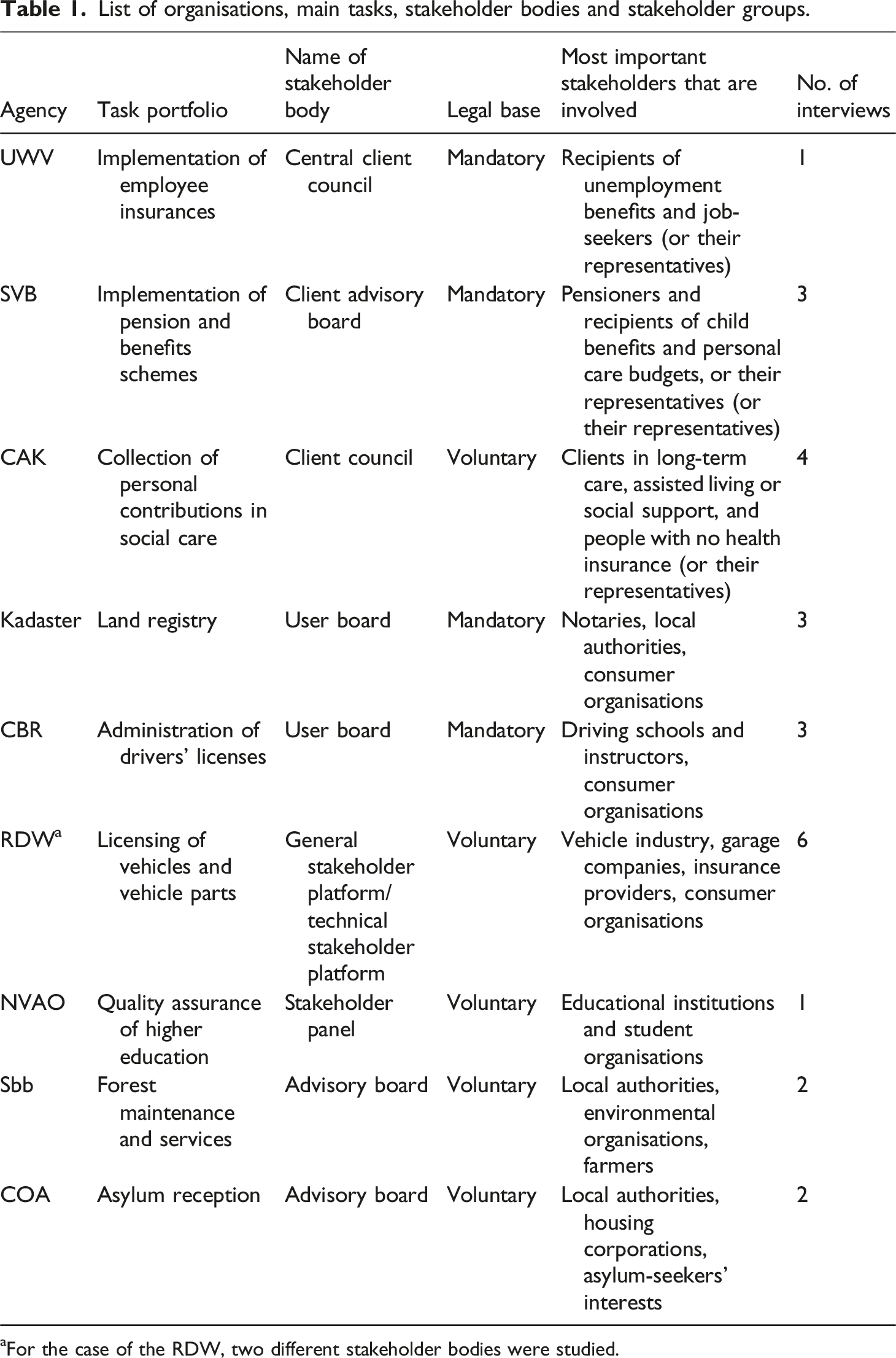
aFor the case of the RDW, two different stakeholder bodies were studied.
Research approach
This study is based upon a qualitative research design with original interviews with N = 25 agency representatives on stakeholder bodies within their agencies. The aim of the study is to better understand how agency representatives interpret the accountability function of stakeholder bodies by focusing on how they describe the role of stakeholder bodies within their own words and based upon their own experiences. Qualitative research is considered to be a suitable method “for probing the meaning of accountability as constructed or experienced by actors in their daily life” (Yang, 2014: 166; see also Sinclair, 1995).
Respondents were individual agency representatives with personal and first-hand experiences with stakeholder bodies. Respondents include, among others, CEOs, COOs, division heads, and senior managers and officials of public agencies. For some agencies, chairpersons and/or support staff of stakeholder bodies were further interviewed. Respondents were purposefully approached for an interview because of their experiential expertise about this study’s object. They were identified based on public information on agency’s websites and/or after consultation with the agency’s secretary. Respondents’ contact information was obtained via a contact person (often the secretary) and respondents were approached for an interview by e-mail and/or phone calls. The aim was to recruit at least two respondents for each agency, although this was not possible for two cases due to reasons of data accessibility (see Table 1). Interviews range between 30 and 75 min and were held between March 2020 and January 2021. Because of the coronavirus crisis and social distancing restrictions at the time of data collection, all interviews were conducted online or by phone.
Interviews were semi-structured in nature. During each interview, respondents were asked questions about the actual functioning of stakeholder bodies (e.g., How often do you meet? When was the last meeting? Who participates in these meetings?), but also about their own beliefs, perceptions and experiences (e.g., Why do you think that the stakeholder body is important? How does the stakeholder body contribute to your organisation? What are the requirements for a good member of such a board or panel? What are important challenges for the stakeholder body in the future?). Follow-up questions were asked in order to clarify respondents’ answers and to collect further elaboration and/or illustrative examples to their answers (e.g., Do you have a concrete example of this?). At the end of each interview, respondents were provided the opportunity to address issues that were not discussed earlier during the interview. All interview materials were fully recorded (after respondent’s permission) and transcribed. A translated version of the interview guide is available in Appendix I.
For the coding process, the theoretical framework (see Theory section) was the main starting point. The coding process involves both the coding of perceived elements of accountability in stakeholder bodies as well as respondents’ perspectives on the relevance of stakeholder bodies. First, the coding of accountability elements was based on Bovens’ (2007) conceptualization of the different phases of accountability: information provision, debate, and consequences. Additionally, a code was assigned to fragments where respondents refer to the term ‘accountability’ in their descriptions of the functioning of stakeholder bodies. For the coding of accountability perspectives, interview fragments were coded and classified in accordance with the five perspectives that derived from the theoretical framework. These perspectives were used as broad categories – to minimize potential biases in the categorization of interview materials, a coding heuristic has been developed in which key concepts, topics and words were listed that could reflect the various perspectives on the accountability function of stakeholder bodies. This scheme was inspired by the study’s theoretical framework and has been refined and updated during the coding process. For a first subset of the interviews (n = 6), this coding approach has further been discussed with two academic colleagues in order to reflect upon potential biases and to refine the author’s own interpretations of the interview materials. A final version of the coding heuristic, translated to English, can be found in Appendix II.
As a member check of findings, the initial findings from the interviews have been discussed with N = 14 participants from various agencies (including agency-CEOs and high-level agency representatives) during two focus group sessions in June 2022. As part of these focus groups, a summary of the study’s results was presented, and participants were invited to reflect upon the most important findings and discuss these findings with each other. Neither of these participants have taken part in the interview study, and some participants were employed at agencies that were not part of this study’s sample. As such, the focus groups allow for a member check but also for an investigation whether the interview findings are shared and recognized among a broader set of representatives from different ZBOs. The focus group discussions largely confirm the findings and patterns from the qualitative interviews, but also leads to a refinement of one of the perspectives in this study (the control perspective) after it raises critical debate and reflection within both focus groups.
To ensure confidentiality for respondents, respondent numbers are used in the text when referring to the interview materials and using direct quotes from the interviews. All quotes used in this article were translated from Dutch to English by the author.
Results
Stakeholder bodies and accountability elements
Do stakeholder bodies function as an accountability tool? A first observation from the interviews is that respondents hold somewhat different views about whether stakeholder bodies can be classified as a form of accountability. Some respondents specifically refer to stakeholder bodies as a “form of horizontal accountability” (R4, R16), while several interviewees indicate that stakeholder bodies do not have an accountability function. As a public official (R1) for instance states, “it might have a bit of evaluation, perhaps, but it is much more focused on the future than that you say: hey, that’s about, well, some kind of accountability or whatever.” Stakeholder involvement seems to be sometimes considered in the light of a narrow interpretation of accountability (see also Schillemans, 2015), in which the concept is interpreted as a formal principal-agent mechanism rather than as a social relationship. Some respondents clearly separate stakeholder bodies from other entities to whom they are (formally) accountable, such as a parent department and/or a supervisory board (R10, R17). As R18 (agency head) argues: “We do tell them what we have done, but it is not the case that we need their approval. (…) That more formal role, that we have to be accountable, and we have to get approval, that is really the role of the parent department.”
Although many respondents do not discuss stakeholder bodies in terms of accountability, their perceptions contain several elements of accountability. In practice, stakeholder bodies are said to function as an “information platform” (R23, chairperson) or a “kind of reporting body” (R20, public official) in which the organisation provides information about important policies and decisions to its main stakeholders. Agencies do not only provide information to their stakeholders about what they are doing, but also “explain why [they] are doing it” (R19, public official). Although most respondents describe the relationships between agencies and stakeholders as “harmonious” (R8), “constructive” (R22) and “positive” (R24), various respondents suggest that stakeholder councils do critically monitor organisational conduct and ask critical questions if needed (R5, R7, R11, R14, R15). Respondents further provide examples in which stakeholders’ opinions and evaluations were considered as highly important, also in the absence of formal judgment and sanctioning possibilities (R3; R4; R9; R12; R21). For some agencies, stakeholders can give a formal advice about new policies, such as new tariff proposals. As R12 (agency manager) explains, “because we only get our turnover from our customers, so our customers have an important role in approving our tariffs … or, at least, they are given the opportunity to give a highly important advice on this subject.” Some respondents however argue that the actual impact (or consequences) from stakeholder bodies on agencies remains unclear or limited (R8, R17). In sum, the interviews indicate that accountability elements are present in stakeholder bodies and that stakeholder bodies can have an accountability function, although these mechanisms might not always be perceived as a form of accountability.
Five perspectives on the accountability function of stakeholder bodies.
A control perspective
Stakeholder bodies might be a potential tool for control and oversight. However, multiple respondents consider the direct control function of stakeholder bodies to be minimal or even non-existent (R1, R2, R5, R9). As R5 (public official) for instance explains, “[The client council] does not really take a very controlling role. It is always a bit of searching, […] They function more as an advisory body with us, I would say.” The control function of stakeholder bodies is often hampered, because stakeholder bodies can become “invisible within the wider organisation” (R8, public official) while their “impact is often unclear and less concrete” (R17, public official). According to an agency-CEO (R9), it is also a question whether stakeholder bodies should function as a control mechanism: “They do not have a control function and they shouldn’t have it either, because we already have many institutions that control us”. Only two respondents (R11, R15) explicitly consider stakeholder bodies as a tool for control, particularly because the stakeholder council is a mandatory arrangement. As R15 (chairperson) argues, it is highly relevant that the stakeholder board is a legal instrument, rather than “something without obligation”. From a control perspective, stakeholder bodies are however generally considered as a weak form of accountability.
Following this perspective, stakeholder bodies can however still play a role as “accountability trigger” (cf. Jacobs and Schillemans, 2016) stimulating other accountability processes, including departmental accountability. Stakeholder bodies provide the parent department with relevant information about the functioning of agencies (R15; R19; R22). As such, they can be a “fire alarm” for departmental accountability (McCubbins and Schwartz, 1984). As R10 (public official) for example states, “As a client platform, they can go to the ministry. And, of course, that gives them the opportunity to put something on the political agenda.”
Furthermore, stakeholder bodies can address other institutions, such as Parliament and political parties (R23) and the Ombudsmen (R6). R6 (chairperson) explains: “We have discussed and stated their most far-reaching means, our options if our objectives are not achieved. And the ombudsman is then one of them.” According to R6, this function is most relevant under specific circumstances, such as policy conflicts and media incidents.
An institutional perspective
From an institutional perspective, stakeholder bodies can reflect an accountability practice that is in accordance with norms of appropriateness. Agencies involve and interact with societal stakeholders because they consider it as fair and appropriate behaviour and because it is expected from their environment.
Although stakeholder bodies might not always be perceived as a formal accountability instrument, several respondents experience at least an informal obligation to be accountable towards their societal stakeholders. As R2 (agency manager) also explains: “I do not have to a give an account to them [stakeholder platform]. But I do find it professional to indicate what I have done with their advice. They cannot hold me accountable, but I do feel a moral obligation to deal with their advice in a very professional manner.” Elements of accountability, such as information provision and debate, are important from an institutional perspective. Multiple respondents stress the importance of listening carefully to stakeholders, “particularly if you work with a vulnerable group of clients” (R4; R7) and because “it nicely fits with the Dutch polder culture, that everybody is allowed to have his or her opinion on important matters” (R19). And R14 (public official) argues: “Because you have an increasingly open and transparent society, it makes that you just say: hey, we really want to hear your opinion. We already do that, but maybe we'll do that more often”. As such, involving stakeholders in accountability practices is portraited as “natural, rightful, expected, and legitimate” (March and Olsen, 2011: 478; see also Koop, 2014).
Additionally, public officials mention to consider it appropriate that stakeholder bodies represent a good and balanced mix of stakeholders, including not only private companies, but also civil society organisations, “because they can represent the citizens in some way” (R20, public official). It is however difficult to find a proper representation of all stakeholder interests (R6, R25). Several groups of stakeholders and clients are underrepresented in stakeholder bodies and “it is often hard to find the right people” (R25, public official). From an institutional perspective, this can be challenge, as a balanced representation of stakeholders is often considered to reflect an appropriate norm. Potentially, this can negatively affect agency officials’ felt accountability towards stakeholder bodies.
A managerial perspective
For multiple respondents, stakeholder bodies is an important coordination mechanism with external stakeholders. As R21 (agency manager) discuss the relevance of stakeholder bodies for external coordination and collaboration: “If you want to maintain good relationships with your stakeholders, then you have to take time for these kind of things”. Information provision and debate are important aspects of accountability that can be supportive to effective coordination with stakeholders, as R14 (public official) for example explains: “we are increasingly collaborating with stakeholders in chains. So, everyone benefits from sharing clear and transparent information because you work together.” Stakeholder bodies provide further opportunities to inform stakeholders about new and relevant policy developments. As such, stakeholders are better prepared for the implementation of new legislation – involving and consulting stakeholders can stimulate their compliance with these new rules (R3, R20). As R20 (public official) further explains, “What you do, you need to do with these stakeholders; you need to have some administrative capacity to get all stakeholders ‘on board’.” Justification and explanation to external stakeholders can therefore be crucial. As R24 (agency manager) argues: “If you explain things, you can come very close to each other. But if you do not explain it, things can go wrong.”
Stakeholder bodies further provide external stakeholders with a direct access to public agencies, while they enable agencies to have regular and frequent contacts with their most important stakeholders (R19, public official). As R11 (public official) also explains, “having those contacts with stakeholders is just incredibly valuable. (…) With a user board, you now just have a contact file that you can use and that makes it always easier”. As public agencies often cooperate with various stakeholders, the coordination function of stakeholder bodies has become increasingly important. Frequent meetings with stakeholders are a potential source for “de-escalation” (R21, agency manager), as “it is better to talk with each other, rather than about each other” (R24, agency manager). These findings underline the importance of “effectiveness motivations” (De Boer, 2022) for understanding the adaption of stakeholder bodies in general, as well as an accountability practice (see also Arras and Braun, 2018).
From a managerial perspective, a potential challenge reflects the limited interest and involvement of stakeholders within stakeholder bodies (R12, R13, R15, R20). Formal stakeholder meetings are not always “effective” (R12, agency manager) and, as R20 (public official) argues, “many issues are not that relevant to all stakeholders. You should find topics that are really relevant for everyone or for most parties sitting at the table. That is sometimes difficult.”
A learning perspective
Multiple respondents consider stakeholder bodies as a learning tool. According to various respondents, stakeholder bodies can provide an alternative form of accountability that is more reflective and learning-oriented in nature, for instance, by formulating lessons with regards to the quality of public services and stakeholder experiences with the organisation (R4, R16, R23). As accountability is a retrospective process (Bovens, 2007), retrospective elements are important for the learning function of stakeholder bodies. R25 (public official) considers a client council as “a mirror that shows us what the effects of our services are… when does it not go well and when can it work better?”. As such, “it helps for keeping the human aspect of your services in mind”. For others, stakeholder meetings have a “sounding board function” (R3, agency manager; R24, agency manager) or a “thermostat function” (R21, agency manger), in which the organisation discusses important policy developments with stakeholders and stakeholders can provide relevant feedback. Stakeholder bodies further inform agencies about external developments, for instance, how organisational decisions are perceived by external actors (R2, agency manager). Stakeholder bodies are meaningful from a learning perspective because stakeholders can provide different perspectives, as R5 (public official) further explains: “I notice that they have a slightly different perspective than we have. Because they have a client perspective. Especially in the field of communication, I notice that they come up with ideas and those ideas are then also adopted. They can come up with ideas that we think of... we hadn't thought of that yet...”
These experiences reflect Schillemans’ (2011) learning perspective to accountability. From a learning perspective, the accountability function of stakeholder bodies can also be hampered. According to some respondents, stakeholder bodies are not a learning tool, because “(the) group of stakeholders lacks the knowledge to come with surprising insights” (R7) or “because we are only sending information, rather than really discussing it with our stakeholders” (R13). The absence of accountability elements, such as debate and the application of consequences, can then hinder the learning function of stakeholder bodies. Whereas stakeholder expertise contributes to organisational learning, a (perceived) lack of knowledge and engagement may hinder the learning potential of stakeholder bodies. The perceived expertise of stakeholders is thus crucial for stimulating learning by accountability (cf. Overman and Schillemans, 2022).
A reputational perspective
A reputational perspective considers stakeholder bodies as a source for public agencies to cultivate their organisational reputation and legitimacy among their most important stakeholders. For various respondents, frequent consultations with societal stakeholders serve as an attempt to create greater support for agency’s major decisions (R3, R12, R16). Stakeholder bodies might further influence stakeholder perceptions about the willingness of agencies to listen to the feedback from stakeholders and stakeholder concerns. The chairperson of a stakeholder body (R23) notes that the agency always mentions the role and importance of its stakeholder platform in its annual report, “full of proud”. And R20 (public official) suggests: “With our stakeholder platform, stakeholders can never say that we do not pay attention to them”. For R21 (agency manager), stakeholder meetings are also a form of “impressions management” by showing to the wider set of stakeholders that stakeholder representatives have been consulted about important matters, while you “also give these parties arguments to convince their constituencies of a certain new policy.”
Additionally, stakeholder bodies might help agencies for legitimizing their conduct towards the parent department, although this function is often not explicitly discussed. Still, one respondent (R11, public official) mentions that her agency informs the minister on an annual base with an overview of formal feedback from the user board and how the agency has dealt with these suggestions, and “it is a pity for us if that list is incomplete.” As a quote of R16 (agency-CEO) further illustrates: “For us, [a stakeholder board] is really a proof towards the minister: look, stakeholders have been invited to talk, this is what they think. It is really a governance buzzword, that helps a lot.” As such, stakeholder bodies can be a strategic tool contributing to the credibility and authority of public agencies (see also Karsten, 2015) and they might even challenge other forms of accountability, rather than strengthening accountability.
Conclusion and discussion
What is the relevance of stakeholder bodies for agency accountability? Stakeholder involvement is often presented as a form of accountability, but it remains largely unclear whether and how public officials also construct a sense of accountability towards these stakeholder groups. This study discusses how managers and officials within public agencies perceive the accountability function of stakeholder bodies. Based on original qualitative interviews with N = 25 agency representatives from nine different Dutch ZBOs, this study provides a diverse picture of the different ways in which agency members and officials perceive and describe the role of stakeholder bodies within the broader accountability environment of public agencies.
In the first place, agency representatives do not often refer to stakeholder bodies as a form of “accountability”. This might be related to the fact that stakeholder bodies are also associated with a range of other functions, such as strengthening participation, consultation, and/or responsiveness (Arras and Braun, 2018; Busuioc and Jevnaker, 2022; Moffitt, 2010). Public managers and officials might further use a rather strict interpretation of the word “accountability,” in which the term is restricted to a set of formal obligations to which agencies have to adhere (Schillemans, 2015). Accountability is then narrowed down to the hierarchical and departmental forms of accountability that are still perceived as the most important and influential type of accountability (Schillemans et al., 2022).
Meanwhile, the empirical findings suggest that multiple agency representatives associate stakeholder bodies with several aspects of accountability. Although respondents do not often refer to stakeholder bodies as a form of accountability, their experiences and perspectives do include accountability elements, such as information provision, debate, and, to a lesser extent, the possibility of consequences. In some instances, stakeholder bodies can trigger other forms of accountability and function as a form of “fire alarm oversight” within the broader accountability environment. There is also an important element of “felt accountability” associated with stakeholder bodies (cf. Overman and Schillemans, 2022): agency managers and officials do report to feel a strong sense of accountability towards their stakeholders, even in the absence of actual accountability processes.
Furthermore, the accountability function is stakeholder bodies is associated with different purposes rather than control and answerability (Acar et al., 2008; Karsten, 2015; Koop, 2014). Agency representatives do not perceive stakeholder bodies as a source of control. This is in line with earlier research that argues that these horizontal arrangements are limited as a control mechanism (Lindén, 2015; Schillemans, 2011). For agency managers and officials, stakeholder bodies are mostly relevant for moral and professional norms, organisational learning, external coordination with stakeholders, and/or organisational reputation. Although these functions are not exclusively linked to accountability, several respondents indicate how different aspects of accountability are important for these roles and functions of stakeholder bodies. These accountability functions of stakeholder bodies can further be challenged. Respondents also share experiences when stakeholder bodies can obstruct meaningful accountability processes, because of limited stakeholder representation, information gaps, or a lack of influence.
Yet, this study also comes with some caveats. First, the empirical findings might be related to this study’s empirical context. Administrative tradition can be important for differences in the accountability landscapes of agencies (Bach et al., 2017; Schillemans et al., 2022; Yesilkagit, 2004). The Dutch administrative state has a strong consociational and corporatist tradition, and this has been reflected in the involvement of societal actors in policy-making and implementation (Lijphart, 1969). Stakeholder bodies can be considered as part of this tradition of a “corporatist-consensual model of deliberation with interest groups and pragmatic compromise” (Kickert, 2003: 127). When administrative concentration and centralized control are more dominant within an administrative system, the accountability function of stakeholder bodies might be perceived as more symbolic and less relevant (Schillemans et al., 2022). An important question remains whether these findings are transferable beyond the Dutch context.
Second, organisational characteristics, such as policy task, size, and age, can further account for different perceptions of the accountability function of stakeholder bodies. This study focusses on the stakeholder bodies of a small but diverse subset of nine Dutch ZBOs – it is therefore unclear whether and how organisational factors impact individual perspectives on the accountability function of stakeholder bodies. In the public administration literature, the salience of an agency’s task portfolio has, for example, been associated with a range of different organisational outcomes, also related to stakeholder engagement of agencies (Brummel, 2022; Koop, 2014). Under specific circumstances, some functions of accountability might be more important for agency representatives. Stakeholder bodies can be particularly relevant for reputation management when an agency has been faced with reputational threats, such as negative media publicity or crises (Busuioc and Lodge, 2016; De Boer, 2021), while trust-based relationships between agencies and stakeholders might, for example, contribute to perceptions of organisational learning (Schillemans and Smulders, 2015). Similarly, individual characteristics of agency representatives, such as tenure, position, and personal background, can be important for how they perceive the accountability function of stakeholder bodies.
Keeping these limitations in mind, this study makes a novel contribution to the literature on the role of stakeholder bodies in accountability. By focusing on individual’s perspectives and perceptions on stakeholder bodies, this study illustrates the relevance of different theoretical approaches to understanding accountability in non-hierarchical settings. Traditionally, principal-agent theory has been a dominant theoretical framework within the study of public accountability (Bovens, 2007; Gailmard, 2014). New and horizontal forms of accountability, such as stakeholder bodies, are however suggested to stand in contrast with important aspects of a principal-agent understanding of accountability (Maggetti and Papadopoulos, 2018: 176–177). Without formal hierarchy and control, this study’s findings illustrate how other aspects of an accountability relationship can be important for how individuals within public agencies shape their conceptions of accountability. This study does however not find a dominant mechanism that explains the relevance of stakeholder-oriented forms of accountability for agencies. Rather, this study maps a diversity of perspectives among agency representatives about the accountability function of stakeholder bodies.
Interestingly, these different perspectives on the accountability function of stakeholder bodies are not competing but complementary – the findings show that respondents often combine elements of multiple perspectives. This can also be explained by the fact that there is some theoretical overlap between the different perspectives. Reputational considerations can reflect both a logic of appropriateness and a logic of consequences (Busuioc and Lodge, 2016), while learning can be instrumental for organisational improvement and effectiveness, but can also be an appropriate practice in itself (De Boer, 2021). For horizontal and societal modes of accountability, a combination of different theories would therefore be most useful to better understand their functioning in practice.
These findings have practical implications too. This study’s results suggest that stakeholder bodies might be a limited contribution to the accountability landscape of agencies in the light of “traditional” accountability functions, such as controlling and scrutinizing public agencies. Based on the perspectives of agency representatives, stakeholder bodies can however be a meaningful accountability mechanism for different organisational functions and purposes. The different accountability perspectives suggest that agency managers and officials experience stakeholder bodies as an important accountability mechanism that is in line with their moral and professional norms and that contributes to effective policy implementation through aspects of coordination, learning, and reputation management. This suggests that agency representatives perceive stakeholder bodies as a valuable accountability instrument beyond reasons of control.
This broader understanding of accountability also comes with new questions. For instance, as Bertelli and Busuioc (2021) argue, stakeholder bodies can reflect a strategic attempt of public agencies for increasing autonomy and avoiding more demanding forms of accountability (see also De Boer, 2021; Karsten, 2015). When the control aspect of accountability is limited, there is a risk that accountability turns into a marketing instrument in the hands of public agencies (Acar et al., 2008: 18). As such, the actual impact of stakeholder bodies on the accountability of agencies can be highly divergent in practice: their presence within the governance structures of agencies represents both opportunities and challenges to accountability in modern governance.
Supplemental Material
Supplemental Material - Stakeholder involvement as a form of accountability? Perspectives on the accountability function of stakeholder bodies in Dutch public agencies
Supplemental Material for Stakeholder involvement as a form of accountability? Perspectives on the accountability function of stakeholder bodies in Dutch public agencies by Lars Brummel in Public Policy and Administration.
Footnotes
Acknowledgements
An earlier version of this article has been presented at the workshop “Democratic legitimacy and accountability in collaborative governance arrangements” at the Transatlantic Dialogue (TAD16) in Roskilde (June 9 – 11, 2022). I thank the workshop participants for their valuable comments. I further thank Thomas Schillemans and Sjors Overman for their generous feedback.
Declaration of conflicting interests
The author(s) declared no potential conflicts of interest with respect to the research, authorship, and/or publication of this article.
Funding
The author(s) disclosed receipt of the following financial support for the research, authorship, and/or publication of this article: This work was supported by the Nederlandse Organisatie voor Wetenschappelijk Onderzoek (452-14-008).

Supplemental Material
Supplemental material for this article is available online.
References
Supplementary Material
Please find the following supplemental material available below.
For Open Access articles published under a Creative Commons License, all supplemental material carries the same license as the article it is associated with.
For non-Open Access articles published, all supplemental material carries a non-exclusive license, and permission requests for re-use of supplemental material or any part of supplemental material shall be sent directly to the copyright owner as specified in the copyright notice associated with the article.
