




Abstract
This paper develops and applies the concept of accountability styles for analyzing and comparing accountability practices in different countries. This is relevant as there is considerable scholarship on public sector accountability but only very few comparative studies. Extant studies have shown that national styles of accountability are both marked by convergence as well as the resilience of national differences. The concept of accountability style is adopted to describe and interpret how and why accountability practices differ between administrative systems. It does so by analyzing practices of accountability of public sector agencies in four European democracies with different state traditions: the Netherlands, Norway, Switzerland and the UK. These countries vary with regards to state strength (interventionist propensity) and administrative concentration (high or low centralization). The analysis focuses on the accountability of arms’ length agencies which lends itself for comparisons across counties. The paper shows that the national political-administrative context crucially shapes practices of accountability and accountability regimes of agencies. The Norwegian accountability style is characterized as ‘centralized and convenient’. The UK-style is equally centralized yet not so convenient as it incurs high accountability-process costs on agencies. Switzerland is marked by limited hierarchical accountability. And the Dutch accountability style is comparatively ‘broad and informal’. State strength and administrative concentration explain some of the variance while historical legacies explain additional national variations.
Keywords
Accountability is a key issue in contemporary public administration, as governments have delegated many tasks to lower-level bodies (Bovens, 2007; Thomann et al., 2018; Willems and Van Dooren, 2012). While there is a burgeoning literature on accountability in public administration, there is very little comparative scholarship. Most research has been conducted in stand-alone studies (Brandsma, 2014; Yang, 2012). A large part of the literature is of a conceptual nature, aiming to define a minimal conceptual consensus (Bovens, 2007; Willems and Van Dooren, 2012) or an understanding of the varying meanings individuals attach to accountability (Overman et al., 2021; Sinclair, 1995). On that basis, typologies have been construed that help to understand the conflictual logics of accountability with which decision-makers cope. Scholars for instance distinguish political from administrative, legal and professional accountability (Romzek and Dubnick, 1987; Thomann et al., 2018) or distinguish between accountability for financial issues, compliance with standards and policy-outcomes (Behn, 2001). Beyond that, there are generic theories that help explain the dynamics of accountability, such as most notably the principal-agent framework (Strøm et al., 2006), institutional theory (Olsen, 2017), but also reputational approaches to accountability (Busuioc and Lodge, 2017). These studies have many merits, yet they do not address the question how accountability may differ between administrative contexts.
The few extant comparative accountability studies in Europe suggest this is a gap in the literature in need of scholarly attention. These studies show that accountability practices differ considerably between European countries, even when they belong to the same ‘family’ of administrative systems (Bach et al., 2017), have adopted comparable governance reforms (Christensen and Lægreid, 2017), or when formal characteristics and policy reforms are taken into account (Overman et al., 2015). These studies clearly show that national practices of accountability differ, yet offer limited theoretical understanding of how they differ. This severely limits our understanding of national variations in public administration accountability.
This paper aims to address this gap in the literature by exploring the distinctive politico-administrative ‘accountability styles’ in European states. The study narrows this question down to the accountability of semi-autonomous agencies (Verhoest et al., 2012). This is relevant, as they do the lion’s share of the governments’ work at an arms’ length distance (Pollitt et al., 2004). This is also conducive of a comparative and quantitative approach, as agencies were already the subject of earlier comparative studies. It is also feasible, as agencies perform comparable functions in different countries and there are classifications available that allow for comparisons (Verhoest et al., 2012). The research question is: how do the accountability styles of agencies in European countries compare and how can differences be interpreted?
The question is answered on the basis of survey data analysing the accountability styles of public agencies in four European democracies with different state traditions: the Netherlands, Norway, Switzerland and the UK. We will show that national accountability styles do indeed differ. On the one hand, these differences are related to administrative traditions of organizational concentration (Kuhlmann and Wollmann, 2019) and state strength (Katzenstein, 1978). On the other hand, some differences are the product of specific institutional historical legacies.
The main aims of this article are to: (i) develop the concept of ‘accountability style’ by reaching beyond traditional seams of scholarship and drawing-upon insights from comparative policy- and political leadership (Richardson, 1982; Connor and Becker, 2003); and (ii) demonstrate the analytical value of this concept through comparative, quantitative research, which helps to understand how accountability styles of agencies differ between European countries. After developing the components of accountability styles, the paper will show how these differ in the countries studied. The results section will first relate accountability styles to administrative concentration and state strength and will then commence to typify the national variations, as ‘centralized and convenient’ (Norway), ‘centralized and not-so convenient’ (UK), ‘limited vertical accountability’ (Switzerland), and ‘broad and informal’ (the Netherlands).
Accountability styles
Accountability is a core value in democratic governance that has so far failed to reach an unequivocal meaning. Many scholars agree to a minimal conceptual consensus but, on that basis, a large variation of further conceptualizations, typologies and theories exist. In a minimal sense, accountability is mostly seen as a relational process, in which an account-giver provides information about its conduct and performance to an account-holder, who makes an assessment of this account and may respond with sanctions or rewards. This entails the existence of three consecutive phases in accountability processes: an information phase, a debating phase and a consequences phase (Bovens, 2007). Almost half of the empirical studies of accountability formulate baseline definitions in line with this minimal conceptual consensus (Brandsma, 2014: 6). In conjunction with that, several scholars have studied accountability through a prism of four leading questions: who is accountable to whom, for what and how? (Goodin, 2003; Aleksovska et al., 2020). The relational core of these definitions is helpful to identify the webs of accountability that surround power-holders.
These relatively simple constitutive elements of accountability do not yield much understanding of what they mean on an individual level and how they may vary across contexts. Empirical studies often find that public agencies as account-givers operate in settings where they are effectively held accountable by multiple account-holders (Romzek and Dubnick, 1987; Thomann et al., 2018; Willems and Van Dooren, 2012). A range of generic typologies is available to flesh out divergent practices and meanings of accountability. The most important is Romzek and Dubnick’s (1987; see also Sinclair, 1995; Christensen and Lægreid, 2017) distinction between administrative, legal, hierarchical, and political accountability. In addition, scholars have pointed at differences between accountability emanating from politics, bureaucracies, professions, and markets (Klingner et al., 2002; Thomann et al., 2018) and accountability for finances, compliance and policy-outcomes (Behn, 2001). The upshot of such typologies is that formal norms and institutional practices of accountability in effect vary considerably, obfuscating what is meant and understood by ‘accountability’. Also, individuals have their personal understandings and beliefs about accountability. Sinclair (1995) distinguished between a structural discourse on accountability, where individuals will talk about how important sound financial accountability or democratic accountability are, and a personal discourse, where they may have quite different professional but also personal experiences with accountability. As a result, accountability can become an elusive ‘magic’ concept (Pollitt and Hupe, 2011) with chameleonesque qualities (Sinclair, 1995). Recent research on felt accountability revisits the individuals’ personal experience; now building on behavioral sciences (Overman et al., 2021).
In this study we follow the minimal conceptual consensus and study how heads of agencies in four countries are accountable to whom and how. This approach is helpful for comparative purposes and will demonstrate similarities and differences in accountability across the different countries. We must however be careful in interpreting how these are understood by these heads in agencies, as explained above.
Accountability styles
Through the prism of the minimal conceptual consensus, accountability in public administration involves the sum total of 1) all who’s, who are accountable to 2) all whom’s, for 3) all what’s through 4) all how’s. Applying this scheme in a study would produce a problematically complex four-dimensional model of accountability styles. In this paper, the ‘who’ and ‘for what’ are kept constant. The study focuses on agencies (the ‘who’), as they are integral to the government’s work (Pollitt et al., 2004) and lend themselves for comparative analyses (Overman et al., 2015). Even though variation exists internationally, a consensus has emerged over the definition of what classifies as a semi-autonomous agency (Van Thiel, 2012). These organizations carry out public tasks, are structurally disaggregated from the government and operate under more businesslike conditions as compared to government (ibid, p. 18; Talbot, 2004). Such agencies have been created for various reasons, including a potential rise in efficiency and citizen satisfaction (Overman et al., 2015). As such, the organizational form fitted well into the New Public Management of the latter part of the 20th century. The delegation of public tasks became widespread, globally, and led to a situation where, in some countries, more public money is spent through these types of organizations, than through the central government and sometimes more people are employed through semi-autonomous agencies than through central government (Pollitt et al., 2004).
The study further focuses on substantive policy issues (and not financial management or legal compliance) and thus keeps the ‘for what’ constant. We study the accountability style for substantive policy issues of agencies, dissecting to whom they feel accountable for those decisions and how their main accountability relationship is effectuated. The notion of ‘accountability styles’ is inspired by studies of national policy styles or leadership styles (Connor and Becker, 2003; Richardson, 1982). The concept of ‘style’ is used to compare countries with a concept that integrates relevant aspects of a phenomenon without immediate explanatory consequences.
The first element of an accountability style is the overall accountability regime in which an agency operates. The lead question is, to whom are agencies accountable for substantive policy decisions? In the past years, many empirical studies have shown that organizations in public administration almost invariably are or feel accountable to a broad range of formal and informal account-holders (Romzek and Dubnick, 1987; Thomann et al., 2018; Willems and Van Dooren, 2012). Scholars often distinguish vertical, diagonal and horizontal accountability (Bovens, 2007). Vertical accountability refers to forms of accountability in which an agency is held accountable hierarchically superior account-holders. An agency for instance accounts to its ‘parent-department’, the Cabinet or Parliament. Diagonal accountability refers to forms of accountability in which the agency accounts to bodies working independently from hierarchical superiors yet with authority. Inspectorates, supreme audit institutions and ombudsmen are examples of diagonal accountability. Horizontal accountability refers to social forms of accountability in which the agency is or feels accountable to for instance peers, partners, media, or clients (cf. Brummel, 2021). The sum of all those accountability relationships is its ‘accountability regime’ (Scott, 2000: 55).
The second element of accountability styles are the actual accountability practices evolving between agencies and central governments as their principal account-holders. Following Bovens (2007), we focus on the three phases of accountability. The information phase refers to how the agency informs its parent-department about its conduct. Information can be provided in numerous ways, for instance through periodic reports, informal briefings, or as written responses to formal queries. The debating phase relates to the ensuing exchange between account-giver and account-holder. The debating phase is crucial as the provided information is assessed and judged in light of norms and expectations. One can distinguish between formal and informal contacts and between top-level and lower level contacts. In the consequences phase, parent-departments may (threaten to) use available sanctions, both formal as well as informal, in order to correct or reward the agency. In principle, both positive and negative consequences are possible, although in practice and popular imagination the latter prevail.
Together the accountability regime and principal accountability practices constitute accountability styles that are likely to vary between countries. The next section hypothesizes how they may vary.
Comparing accountability styles
Accountability styles can be expected to ‘fit’ within administrative traditions. Administrative systems vary in a large number of ways. The growing body of comparative public administration groups countries in ideal-typical families, drawing on such diverse factors as administrative traditions, culture, legal systems, state-structures, and societal interactions. Kuhlmann and Wollmann (2019) identify five main European groups: Continental European Napoleonic countries, Continental European federal countries, Nordic countries, Anglo Saxon countries and Central Eastern and South Eastern European countries. This typology aggregates various salient features (cf Greve et al., 2016), two of which seem acutely relevant for the study of accountability: administrative structures (concentration) and state strength.
Administrative concentration refers to the general structures of bureaucracy within the state (Verhoest et al., 2012). Some states have relatively centralized administrative structures (unicentric) with which they coordinate policies, while others have more dispersed and multifaceted (polycentric) systems (Jensen, 2017). This distinction is theoretically relevant for the accountability regimes of agencies. It can be expected that administrative concentration is related to simple, unicentric systems of accountability, in which the formal accountability relationship between agencies and central governments are particularly prominent. This would then be associated with strong vertical accountability relations that make it easy to exert central control. Diagonal and horizontal accountability are then most likely much weaker. Conversely, administrative deconcentration implies situations of “multiple-principals” and is likely to feature ‘dispersed’ or ‘multilevel’ accountability regimes (Romzek and Dubnick, 1987; Thomann et al., 2018; Willems and Van Dooren, 2012). This would imply that a large set of account-holders is perceived as relevant by agency heads, including not only vertical accountability but also diagonal accountability to regulators or ombudsmen and horizontal accountability to citizens and societal organizations.
All in all, thus, the first hypothesis (H1) is that administrative concentration (in a country) is associated with more vertically oriented accountability regimes of agencies.
The second relevant element of administrative tradition is state strength, as originally described by Katzenstein (1978). His typology of weak and strong states – whose scope is limited to democratic countries – refers to the division of labour between state and society (Hill and Varone, 2014: 102). Strong states are more interventionist, exert more control, and “steer” society to a greater degree, while weak states intervene much less and do not place themselves above society. In strong states, decision-making powers are concentrated and the state bureaucracy is largely autonomous from societal organizations (Atkinson and Coleman, 1989). Strong states need not necessarily be bigger, yet state intervention and public policies are largely legitimated in society and state power is used more authoritatively (Hill and Varone, 2014: 85). Weak states on the other hand are less interventionist and cooperate more with other organizations.
Accountability styles can be expected to be shaped by state strength and it may in particular affect the intensity of account-holding practices of parent-departments. In strong states, parent-departments are more likely to play a demanding and interventionist role in relation to its agencies. It can be expected that central governments in strong states demand more accountability information (information phase) and engage more frequently and actively in accountability meetings with agencies (debating phase). They can also be expected to be more likely to use available sanctions to steer or correct agencies (consequences phase). Weak states, on the other hand, will be much more hesitant in demanding accountability information and particularly in the use of corrective measures.
Our second hypothesis (H2) is that the strength of states is positively associated with the intensity of accountability. That is: frequencies of reporting and debating are expected to be higher and it is perceived as more likely that sanctions are used.
The two hypotheses suggest a strong relationship between systemic features and accountability styles. Extant comparative accountability studies lend some support to this assumption, and they call for the type of theorization conducted here, yet they also caution that accountability may differ even more strongly based on contingent national factors, even between relatively comparable countries.
The book by Christensen and Lægreid (2017) summarizes the findings from possibly the largest comparative study of accountability, focused on welfare state reforms in Denmark, Germany and Norway. The authors discuss a series of comparable governance reforms across countries which at the outset was expected to lead to a harmonization of accountability. For instance, these countries have all introduced quantified performance standards as basis for accountability and they have also granted agencies more formal decision-making autonomy. The similarity of those reforms could be expected to harmonize accountability styles in those countries. However, on the basis of several underlying studies, the authors conclude that: “in many cases, the new reforms build on old reforms, leading to even more complex and mixed relations between public sector organizations, on the one hand, and government and parliament, on the other (…) Often, the relationship between different administrative reforms in the welfare state and accountability relations are rather blurred and not straightforward” (Christensen and Lægreid, 2017: 9).
Overman et al. (2015) aimed to disentangle such complexities by focusing on the relationship between reform trajectories and accountability. The authors find that national reforms are indeed related to accountability. However, they also find important differences between the countries eschewing their theoretical analyses. They conclude that agencies in culturally comparable countries may still have quite different accountability styles. In their words: “Country was a good predictor of the agency’s accountability regime” and future research should “shed more light on the particular mechanisms” (Overman et al., 2015: 1117). Bach et al. (2017) followed this up, by looking specifically at the role of the Rechtsstaat as a contextual variable of accountability practices. In a comparative study, they find that “nation specific characteristics seem more important” (p. 765) than the Rechtsstaat; and that there are: “substantial differences between countries with regard to patterns of accountability” (p. 776).
These comparative studies suggest that accountability styles may still differ considerably between countries belonging to the same ‘family’ of administrative traditions, in ways predicated on historical institutional legacies. It is difficult at this point to hypothesize those differences. We therefore conclude with the general expectation that accountability styles can be expected to differ considerably between theoretically comparable countries, even when there are important similarities, as hypothesized above.
Methodology
Case selection
Comparing four countries.
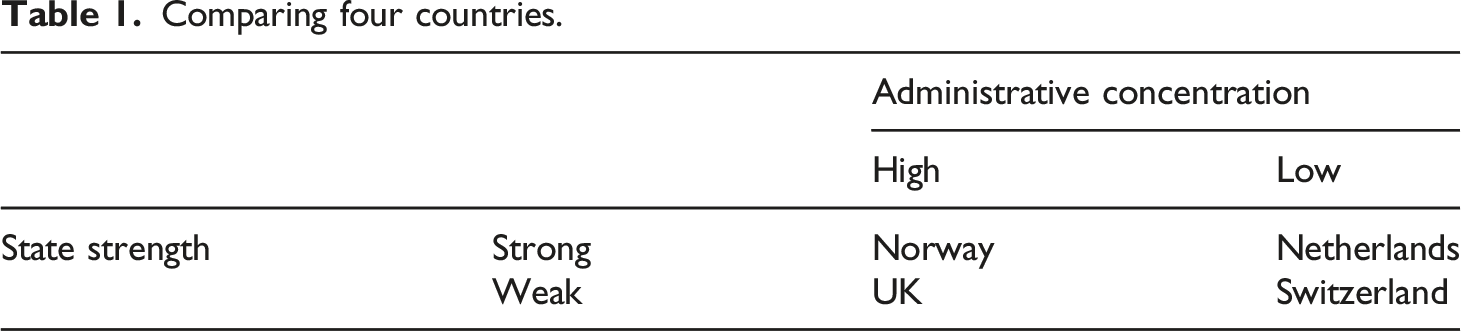
Administrative concentration: The UK and Norway are relatively centralized states while Switzerland and the Netherlands are much less centralized. In the UK, bureaucracy has ‘traditionally developed under the spell of the political domain’ (Kuhlmann and Wollmann, 2019: 22). Thus, the civil service is more tightly controlled, more centralized, than in other European countries. The level of control of the prime minister over government and government over Parliament is exceptional and this sets the UK apart (Hill and Varone, 2014: 87). The Norwegian system is also seen as highly centralized, although it in effect may act more decentralized (Kuhlmann and Wollmann, 2019: 21). It is strongly rule-based, structure-driven, with continuing Weberian features (Christensen and Lægreid, 2009: 959–960). Switzerland, as one of the continental European federal models, is characterized by subnational decentralization, subsidiarity, and a relatively weak central bureaucracy (Kuhlmann and Wollmann, 2019: 20). The Netherlands is also historically fragmented and governance structures are marked by numerous interlinkages with societal actors (Andeweg and Irwin, 2014).
State strength: According to the Katzenstein-typology, the UK and Switzerland are both seen as weak states (Atkinson and Coleman, 1989). In these countries, the state does not place itself strongly above society and the state is relatively hesitant to intervene. Norway on the other hand is understood as a strong state, although it is said to become weaker over time (Pierre and Peters, 2020: 139). The Netherlands is also seen as a strong state (Van Waarden, 1992). In both “Nordic countries” (Kuhlmann and Wollmann, 2019) cooperative relations between governmental actors (Norway) or with societal actors (Netherlands) go together with a relatively strong interventionist governmental role.
Participants
We selected agencies with public tasks operating at arms’ length of a parent-department in the four countries. We selected all of the agencies that can be classified as an internally autonomous agency without legal personality or as an autonomous agency with legal personality (cf. type 1 and 2 in the classification by Van Thiel, 2012). Country-specific appearances of type 1 agencies in the selected countries include, for example, Next Steps Agencies (UK), agentschappen (NL), state agencies (N), and Bundesämte (CH). Type 2 agencies are known locally as Non-Departmental Public Bodies (UK), zelfstandige bestuursorganen (NL), and Anstalt or Stiftung (CH).
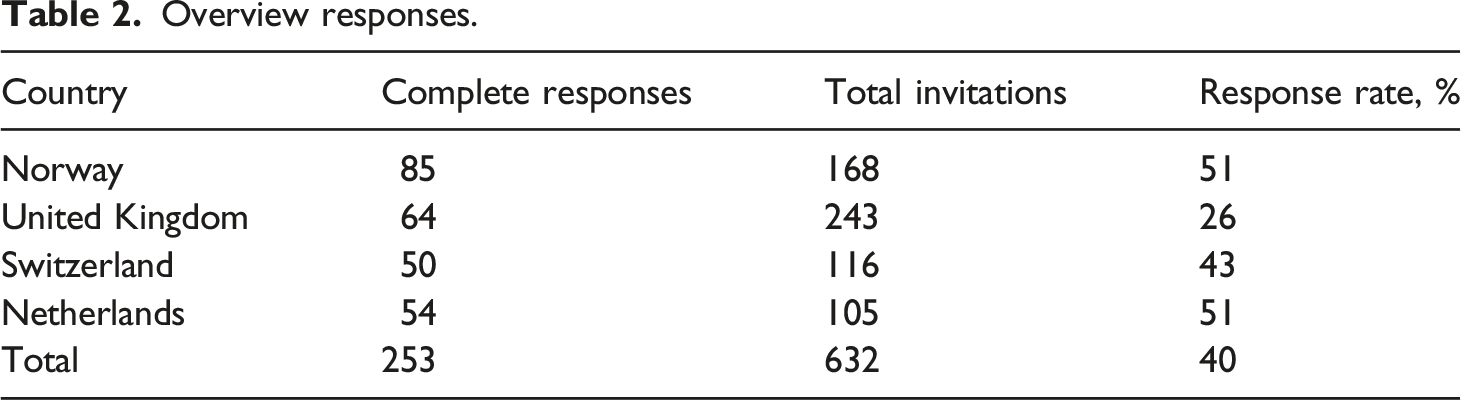
Overview responses.
Variables: Accountability styles
The main variables used in this paper are the two elements of accountability styles: accountability regime and accountability practices. Supplementary Appendix 2 provides a specified overview of items, including descriptive statistics.
The accountability regime was measured by asking all respondents to indicate the degree to which three sets of ‘account-holders’ are relevant to them when they take important policy-decisions. We identified six types of vertical account-holders: 1) parent department, 2) Cabinet, 3) coordinating departments, 4) non-coordinating departments, 5) other agencies, 6) supranational bodies.
We identified six types of diagonal account-holders: 1) board, 2) inspection or regulatory body, 3) court of audit, 4) ombudsman, 5) evaluation committee, 6) courts.
And six types of horizontal account-holders: 1) expert body, 2) client body, 3) interest groups, 4 civil society organizations, 5) unions, 6) news media.
Accountability practices were studied with three scales derived from Brandsma’s (2014) accountability cube. The information phase measures the frequencies with which agencies report to their parent department through various means: i) reports, ii) evaluations, iii) audits, iv) in writing on request, v) informal communication). The debating phase measures the frequencies with which parent-departments and agencies meet relating to substantive policy issues through various means (i) formal and ii) informal meetings, at the iii) highest level of the organization and iv) lower). The consequences phase was measured by asking about the likelihood of use of various types of sanctions (i) budgetary measures, ii)grant or reduce tasks, iii) issue binding directives, iv) grant or reduce autonomy, v) appoint or dismiss staff (incl. executives), vi) issue public praise or reprimands, vii) career-repercussions).
Variables: Organizations and respondents
In addition to three main variables, the survey contained data on the organizations and individual respondents, in part derived from external sources.
Organizational autonomy is an important organizational factor. If, for instance, agencies in some countries would be much more (or less) autonomous than in other countries, this could be a predictor of variance in accountability styles. To be able to control for autonomy, the survey incorporated two scales on organizational autonomy (cf Verhoest et al., 2012). We focused on financial autonomy (such as the ability to set tariffs or take loans) and policy autonomy (such as setting overall goals or identifying target groups). See Supplementary Appendix 2 for the specific items used.
In addition to these key variables, the dataset contains further information about the agencies: 1) type of task, 2) the policy field, 3) legal status and 4) size in FTEs.
Additionally the survey also contained information about respondents, relating to their 1) gender, 2) age, 3) education, and 4) career-history.
In the analysis we focus on country-level differences in accountability styles. There is also variation within and across countries which is explored elsewhere (suprr. ref).
Analysis
The accountability styles of the four countries were analyzed with a one-way MANOVA, which is a suitable analysis to compare groups on multiple dependent variables. The analysis controls for the main effects of size, type, and task for the four countries. The MANOVA shows clear overall effects of country, with Wilk’s Λ = 0.518; F (15; 635.33) = 11.386; p < 0.001; partial η^2 = 0.197. Supplementary Appendix 1 shows how the countries compare on the different elements of their accountability styles.
The MANOVA shows how the countries quantitatively compare on aggregated levels on the main variables relating to accountability and autonomy. Further bivariate correlations were used to assess the what extent specific items, such as types of salient account-holders or specific decisions on which agencies can be autonomous, stood out qualitatively between the countries. This analysis was conducted on the full sample of seven countries to prevent selection-bias. There was only one dimension where this analysis departed from the findings from the MANOVA (pertaining to the information phase of accountability for Norway). We report the more conservative findings in this article.
Results
Overarching comparison
How do the accountability styles for agencies compare across the four countries?
The table below provides a visualization of the accountability regimes and accountability practices in the countries, signifying where aspects of national accountability regimes are significantly stronger (marked ‘+’) or significantly weaker (marked ‘−’). Even at a cursory glance it is clear that there is quite some variation.
We hypothesized (H1) that the accountability regimes of agencies in administratively concentrated states (Norway and UK) would be marked by strong vertical accountability, while in administratively deconcentrated states (Netherlands and Switzerland) there would be much stronger forms of diagonal and horizontal accountability. The country results mostly support this hypothesis (cf. Supplementary Appendix 1; 2). Both in Norway and in the UK, vertical accountability is significantly stronger than in the other countries. In Norway, the accountability to parent departments (p = 0.020) is perceived as quite high, while in the UK other government departments (p = 0.041) are also seen as important, vertical account-holders for agencies. The results for the Netherlands also support H1. Here, diagonal accountability is relatively strong via mostly the Ombudsman (p = 0.003) and evaluation committees (p = 0.001). Horizontal accountability is also more prominent in the Netherlands via strong interest groups (p = 0.038) and civil society organizations (p = 0.017). The results for Switzerland do not fully support the hypothesis, however. We find, as expected, vertical accountability to be relatively weak. Four out of six types of vertical accountability, including the principal accountability relationship to the parent department (p = 0.000), are significantly lower than elsewhere. However, different from the Netherlands, here we do not see stronger forms of diagonal or horizontal accountability. All in all, thus, the results mostly confirm the hypothesized relationship between administrative (de)concentration and the structure of accountability regimes, with a partial exception for Switzerland.
Comparative accountability styles.
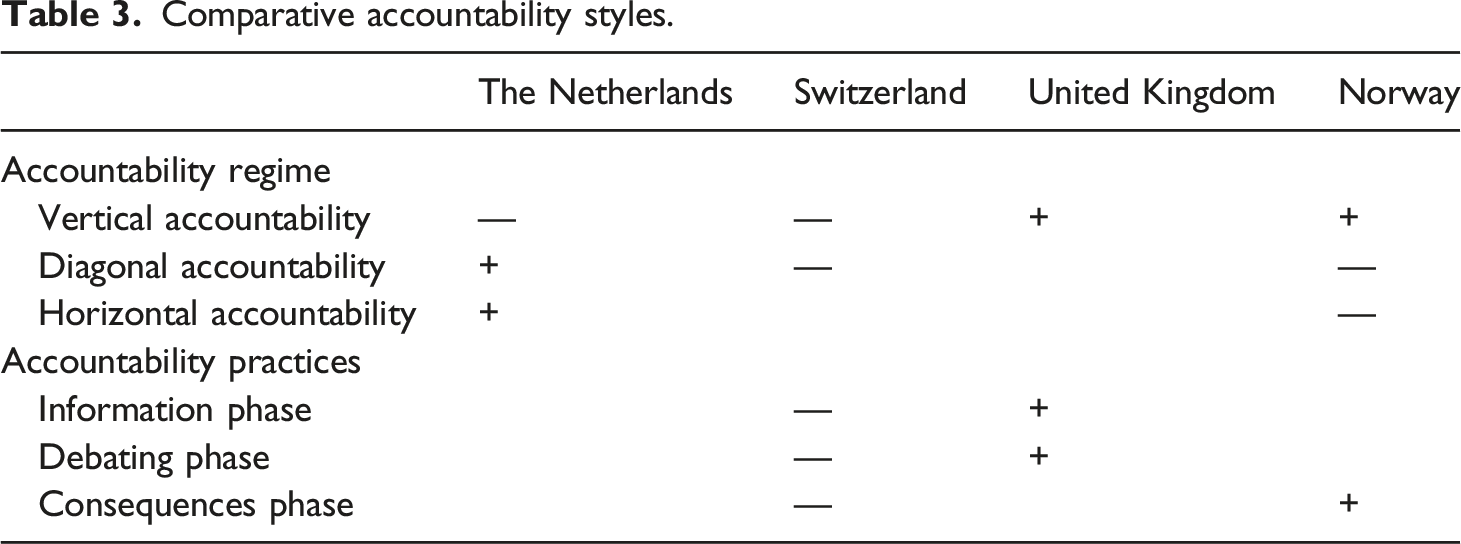
Beyond the two hypotheses, we expected that there would be more variations between the countries, based on historical legacies, as suggested by extant comparative accountability studies (notably Bach at al 2016). The overarching results suggest that there are indeed numerous additional differences between the countries. These will be explored in the subsequent sections where we typify the accountability styles of the four countries.
Norwegian accountability style: Centralized yet convenient
The table below provides a more fine-grained overview of the results in Norway.
Accountability style Norway at a glance.
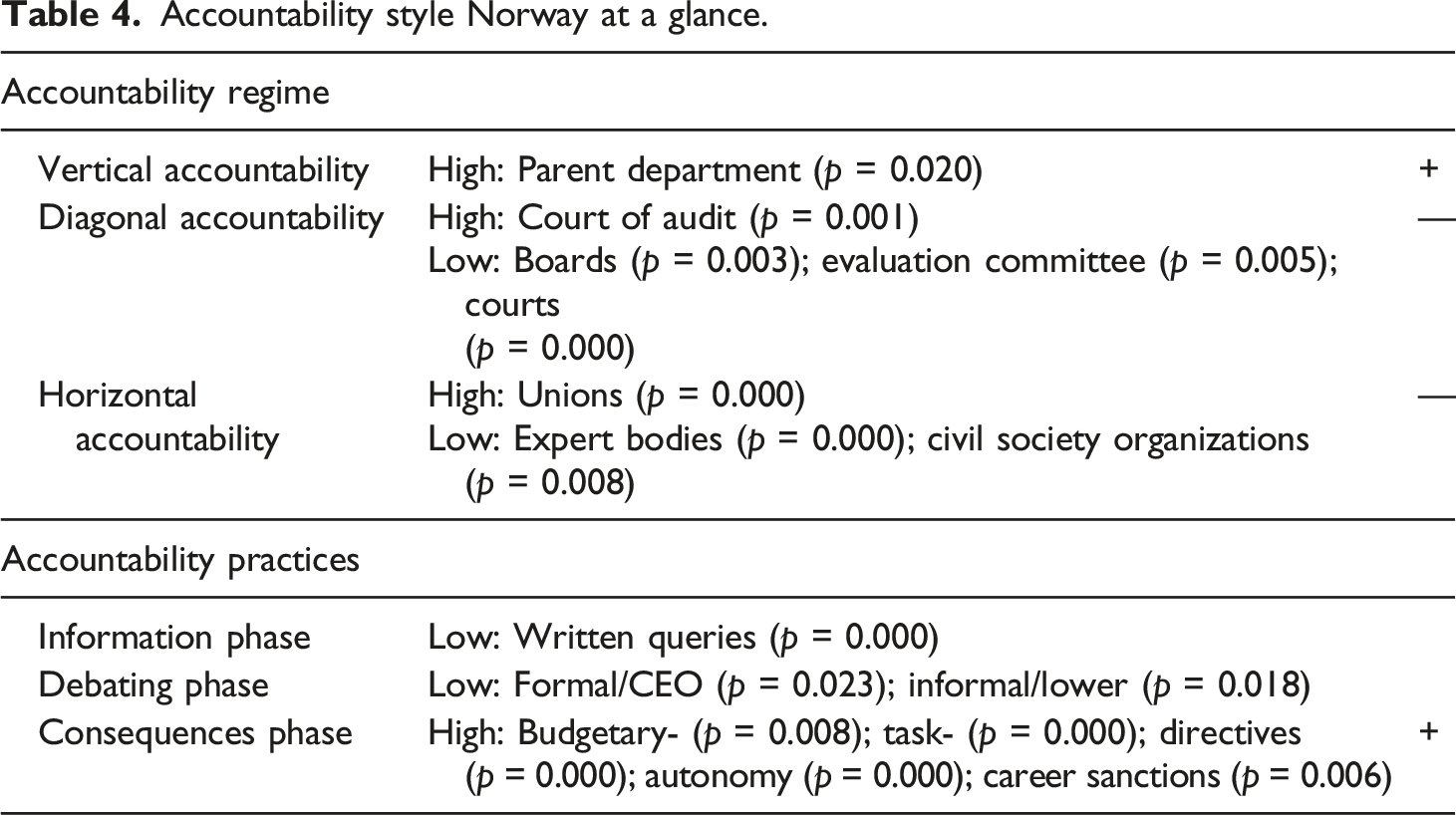
The accountability relationship between agencies and parent-departments in Norway strongly revolves around the perceived likelihood of positive or negative sanctions. Despite the pivotal position of the parent-department, Norwegian agencies report somewhat less to their parent-departments. This holds across all investigated forms of reporting and specifically for written responses after queries. The same goes for the debating phase. The exchange between ministry and agency is mostly conducted informally at different levels. All of this suggests a relatively relaxed, convenient and low-cost interaction between parent-department and agencies with relatively less reporting and meeting. However, parent-departments take a strong stance in the consequences phase. They more credibly suggest that poor performance may have implications for budgets, promotions, and tasks. 3 Also, central government in Norway seems more ready to issue binding directives.
All in all, the Norwegian case stands out by centralization. The parent-department has a strong account-holding position, grants relatively little autonomy and credibly flags its sanctioning powers. Simultaneously, however, agencies report and meet less with their parent-department than elsewhere. This makes this centralized system relatively convenient as it incurs lower accountability transaction costs.
UK accountability style: Centralized and not-so convenient
UK accountability style at a glance.
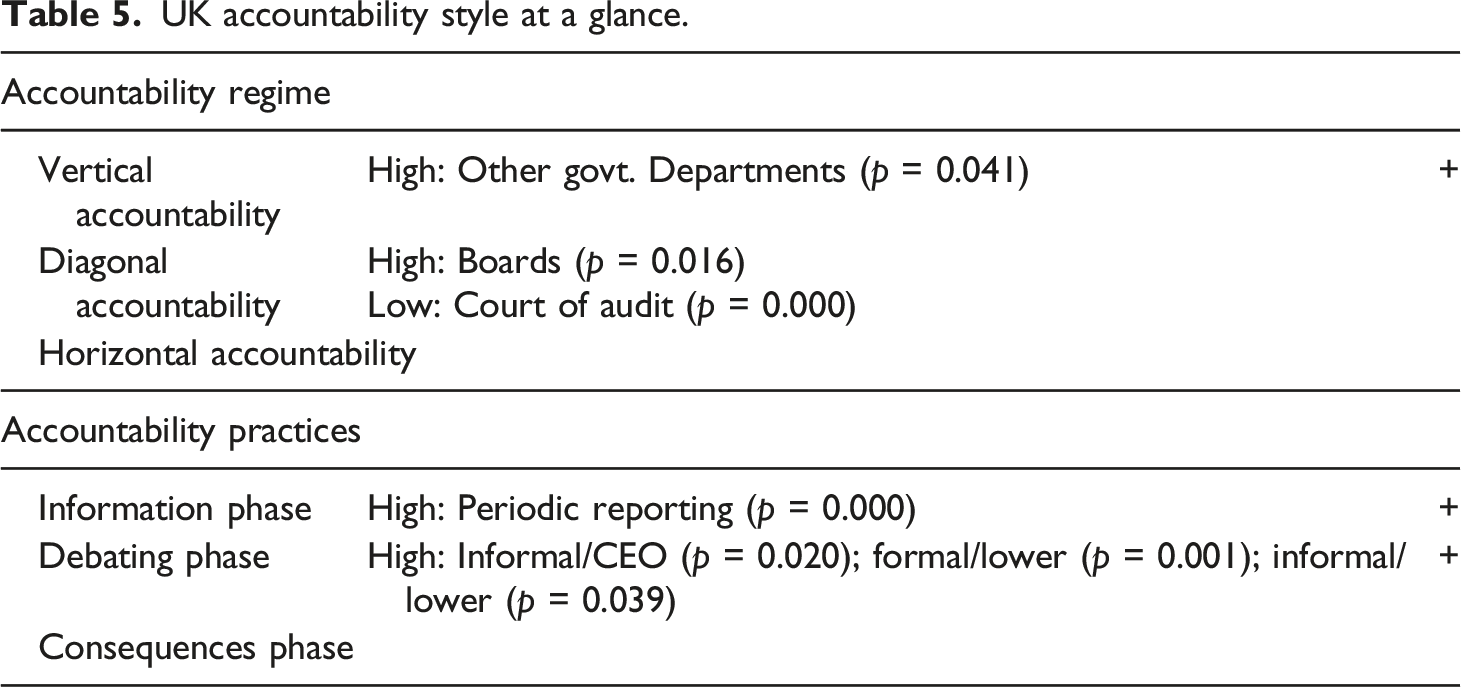
The accountability relationship between agencies and parent departments is the opposite from Norway: there are high levels of reporting and meeting in combination with a low likelihood of sanctioning. In the information phase, UK-agencies report significantly more often to their parent-departments. Formal reporting is dominant in the information giving stage, with more periodic reporting and formal evaluations. The high level of reporting is intuitively reminiscent of the idea of the ‘audit society’, originating from the UK (Power, 1997). In the debating phase, the UK case stands out even more strongly. Agencies report more meetings with their parent-department. Somewhat surprisingly, perhaps, the UK comes out marginally below the cross-national average in the consequences phase. The intensive accountability-process does not translate to strong perceptions of sanctioning. Compared to Norway as the other centralized country in our sample, the UK’s accountability style focuses mostly on the information and debating phase of accountability.
As in Norway, our results suggest a relatively centralized style of accountability. In contrast, however, the accountability style in the UK seems much less convenient. UK-agencies have to cope with more than one hierarchical principal, report more frequently and meet more often with their principals than in the other countries. The accountability process in the UK thus involves much higher transaction costs.
Swiss accountability style: Limited vertical accountability
Swiss accountability style at a glance.
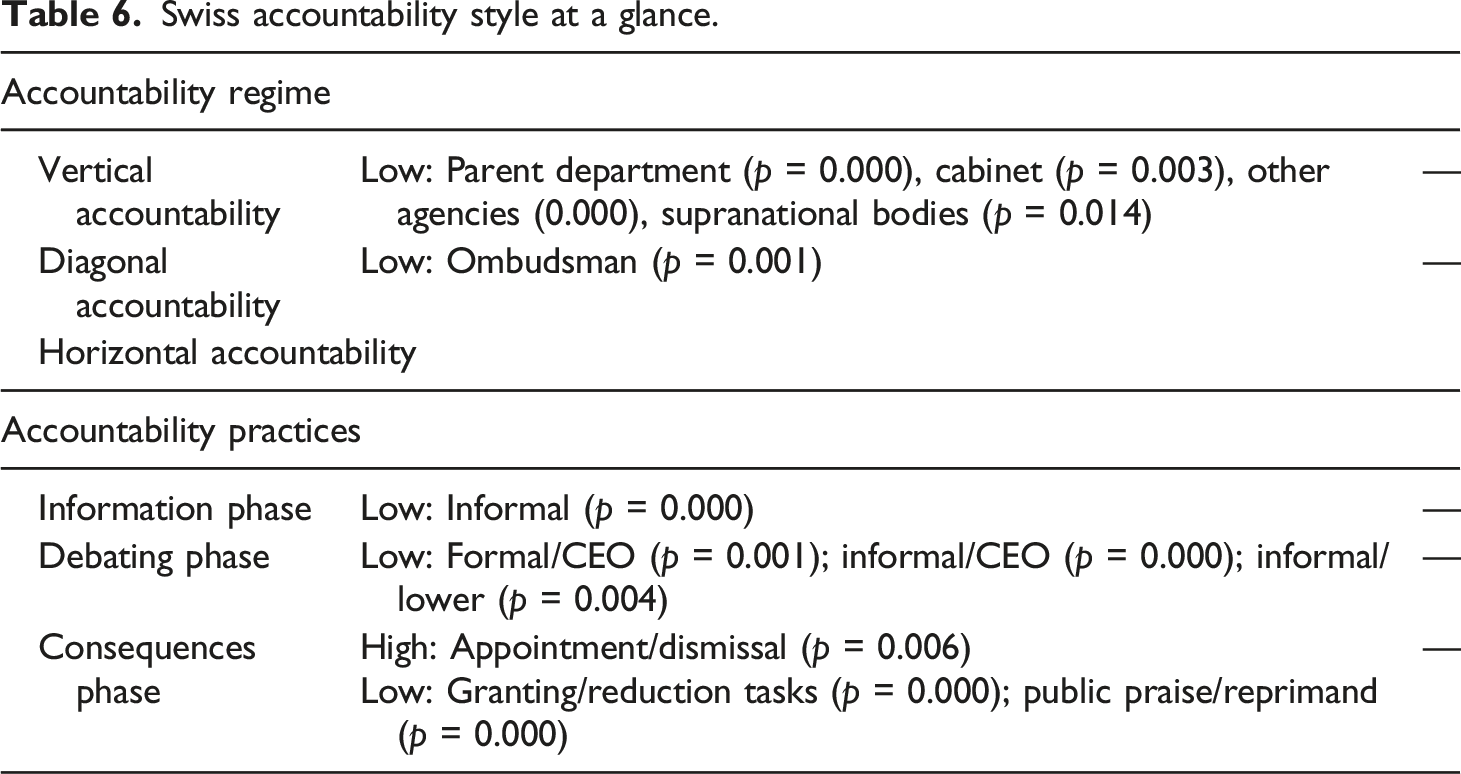
This impression is further reinforced when we look at the three stages of accountability, where Swiss agencies differ significantly from all others. In the information phase, the means for the frequency of information provision to central government are lower for all types. The strongest deviation from the general pattern regards informal information provision. It is striking to remark that on this indicator Switzerland ranks clearly lower than the average, notwithstanding the presence of dense informal governance networks (Sciarini et al., 2015). A similar picture evolves when we focus on the debating phase and the consequences phase: several individual elements seem less or more important, yet the overall finding is that vertical accountability is less pronounced here than elsewhere. Given the lower reported significance of the principal, it is not surprising that the ensuing accountability practices are also more limited.
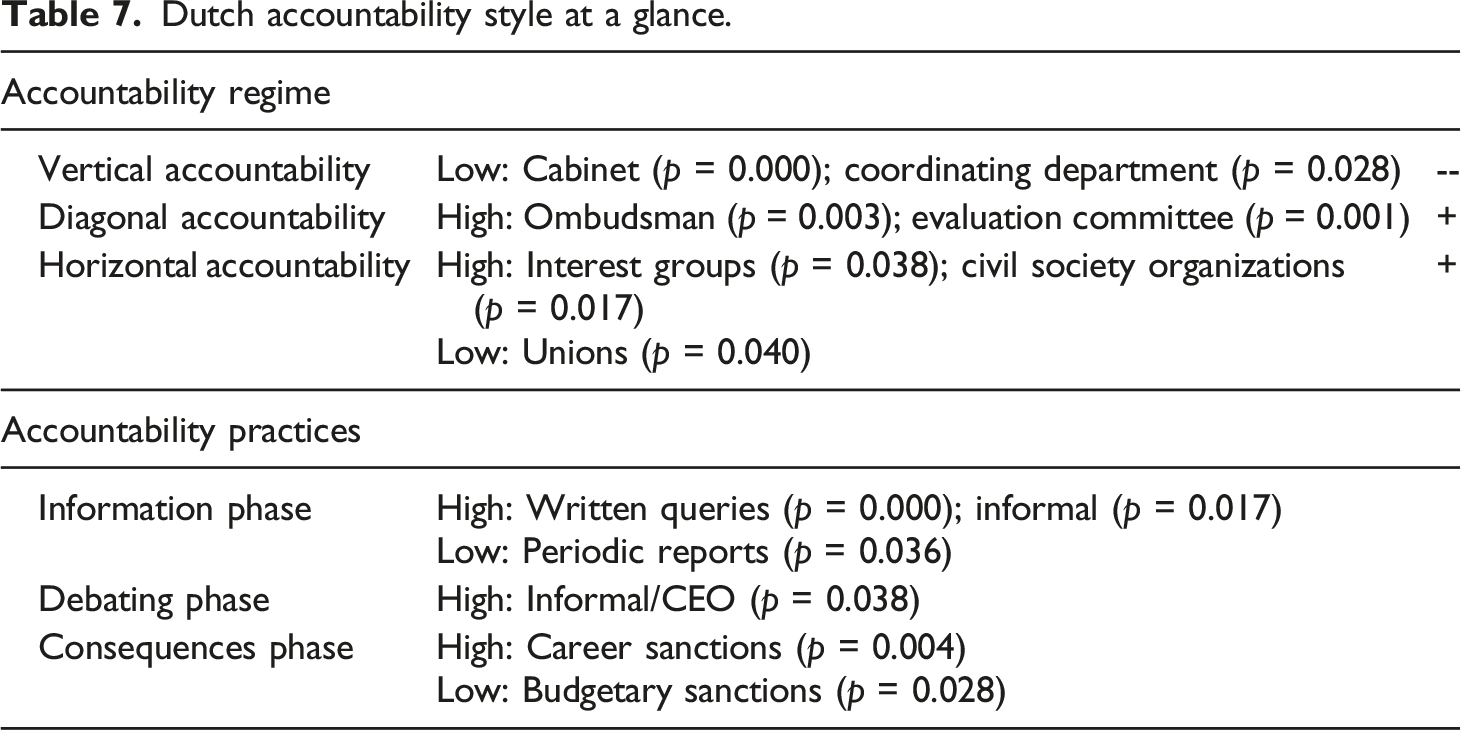
Dutch accountability style at a glance.
Dutch accountability style: Broad and informal
As in all other countries, the parent-department is also in the Netherlands the major account-holder in the accountability regime of agencies. The level of coordination within central government is traditionally low in the Netherlands. As in Norway, the prime minister is ‘only’ the primus inter pares and chair of the cabinet while all ministers, and effectively their ministries, are responsible for their own agencies. All agencies are ‘owned’ by ‘their’ parent-department (Yesilkagit and Van Thiel, 2012). The relatively limited central coordination is mirrored by the finding that the other departments are significantly less relevant in the Netherlands. Vertical accountability is important in the Dutch context yet mainly channeled through the parent-department. In addition, almost all forms of diagonal accountability are somewhat more relevant in the Netherlands than in other countries. Notably the national ombudsman and periodic evaluation committees are seen as significantly more relevant. The Dutch accountability style thus features additional authoritative forms of diagonal accountability beyond hierarchy. Horizontal accountability is also somewhat more relevant in the Netherlands. This holds particularly for civil society organizations and interest groups.
In the information phase of accountability
In our sample, the Dutch case is theoretically most different from the UK. We have moved from a weak to a strong state and from a centralized to a deconcentrated administrative system. The emerging styles of accountability are accordingly quite different. The Netherlands traditionally stand out as a system of divided rule, inclusive of many interests and with a fragmented yet centrally organized administrative system. Societal actors are incorporated in informal processes of governance (Andeweg and Irwin, 2014). This is mirrored in the accountability style we found in the Netherlands, in which informal forms of accountability are important and diagonal checks and balances and societal stakeholders are relatively strong.
Conclusions and reflections
This paper aimed to make a contribution to the comparative study of accountability in public administration. Earlier studies have provided important generic typologies and theories but have also shown also that national variations in accountability are recalcitrant and have defied a full theoretical understanding (Bach et al., 2017; Christensen and Lægreid, 2017; Overman et al., 2015). This paper developed the concept of accountability styles for agencies, based on the structure of their broader accountability regimes and the accountability processes reported to exist with their parent departments. The study suggests that accountability styles are mostly related to administrative concentration (H1) and somewhat less to state strength (H2). Additionally, the paper has shown more specific variations in national accountability styles, in line with historical legacies.
The Norwegian style can be typified as centralized yet convenient, with a strong account-holding role for central government and relatively moderate transaction costs for agencies. The UK accountability style is also centralized yet not so-convenient. The agencies in the UK are held accountable by several salient hierarchical bodies and transaction costs of reporting and meeting seem relatively high. The Swiss case is marked by limited vertical accountability. Although central government departments here, as elsewhere, are pivotal, the ‘weight’ of reporting, meeting and sanctioning is lower. The Dutch case to conclude stands out as broad and informal. It is marked by a relatively high prominence of diagonal and horizontal forms of accountability and an apparent preference for informal forms of reporting, meeting, and sanctioning.
The paper is based on survey data which, as all methods, has limitations. To begin with, the survey is based on perception data, which implies that we are reporting the perceptions of accountability practices. Our respondents as heads of the agencies would be the most important to assess external accountability of the organization. However, the leaders’ perception is not necessarily representative of all practices in the organization. As such, there is some inevitable respondent-perception bias in our results. This could be addressed in follow-up research by surveying lower ranking officials and by adding interviews. This would inevitably also come with limitations, as representative interviews in our sample would require an exceptionally big research effort, given the large number of agencies addressed (N = 632). Secondly, cross-national comparisons of survey-data must always be read with some care, as the connotations of survey items may vary between countries. Also, salient national events at the time of surveying may have effects, as was indicated in the interpretation of the Dutch and Norwegian results. Finally, although we used the Van Thiel (2012) typology to sample agencies, comparability cannot possibly be perfect. The formal-legal and societal status of agencies may vary between countries in ways that we could not capture. In that sense, methodological decisions may have some effects on the outcomes.
Having said that, the empirical results make theoretical sense and help pave the way for comparative understandings of accountability styles in Europe. Both state strength and administrative concentration helped to draft a comparative framework within which more fine-grained differences can be understood. One of the strengths is, we believe, that our approach helps to bridge the levels of abstraction from generic typologies of administrative traditions, as described by Kuhlmann and Wollmann (2019), to more specified styles of accountability. On the one hand we have seen that key features of administrative traditions, such as the interventionism of strong ‘Nordic states’ (Norway and Netherlands) or the centralization of the Westminster system are closely aligned to accountability styles. On the other hand, the study also shows that additional factors are necessary for a complete picture of a national accountability style, such as for instance the strong audit culture in the UK or the role of unions in the other countries. All of this suggests that general administrative traditions can serve as an important first lens with which to analyze administrative phenomena, such as accountability, while additional case-specific and sometimes historically contingent factors are needed to explain further variance (cf. Kuhlmann et al., 2021: 569–70). The main theoretical contribution of this paper then is to show the relevance of a comparative approach, drawing on both systemic elements of administrative traditions and nationally varying institutional variance.
Future studies of accountability styles could broaden and deepen the analyses provided here. Research can be broadened, by adding more countries to the comparison or focusing on different entities, for instance local governments or non-profit partners. This would help to uncover whether the accountability styles developed hold more broadly and, thus, whether they represent national accountability styles. Also, more depth can be given to the conceptual reach of accountability styles, for instance by adding financial accountability or organizational autonomy as further variables (see Supplementary Appendix 1). Future studies can also deepen the analyses, for instance by focusing on cases or adding qualitative data. This would be helpful in more fully understanding the practices and meanings that lie beneath statistical differences. In the end that would be of key relevance for future research, as the same accountability practices can be understood quite differently by different actors (Romzek and Dubnick, 1987; Sinclair, 1995; Overman et al., 2021).
Supplemental Material
Supplemental Material - Public sector accountability styles in Europe comparing accountability and control of agencies in the Netherlands, Norway, Switzerland and the UK
Supplemental Material for Public sector accountability styles in Europe comparing accountability and control of agencies in the Netherlands, Norway, Switzerland and the UK by Thomas Schillemans, Sjors Overman, Matthew Flinders, Per Laegreid, Martino Maggetti, Yannis Papadopoulos, Matthew Wood in Public Policy and Administration
Footnotes
Acknowledgements
The authors first thank Maj Grove Jeppesen (Utrecht University), and then Daniel Bailey (University of Sheffield), Martin Moos (Aarhus University), Annbjørg Ryssdal (University of Bergen), Antonia Sattlegger (Utrecht University), Manuel Quaden (Utrecht University), Amanda Waldenström (University of Gothenburg), and Ella Weisbrot (Australian National University) for their excellent research assistance.
Declaration of conflicting interests
The author(s) declared no potential conflicts of interest with respect to the research, authorship, and/or publication of this article.
Funding
The author(s) disclosed receipt of the following financial support for the research, authorship, and/or publication of this article: This work was supported by NWO, the Netherlands Organization for Scientific Research, NWO Vidi Grant “Calibrating Public Accountability”: NWO Vidi 452-14-008.

Supplemental Material
Supplemental material for this article is available online.
Notes
References
Supplementary Material
Please find the following supplemental material available below.
For Open Access articles published under a Creative Commons License, all supplemental material carries the same license as the article it is associated with.
For non-Open Access articles published, all supplemental material carries a non-exclusive license, and permission requests for re-use of supplemental material or any part of supplemental material shall be sent directly to the copyright owner as specified in the copyright notice associated with the article.
