



Abstract
This paper critically examines the influence of neoliberal policies on the direction of Australian universities in recent years. By examining publicly available sources, including media, court, and parliamentary reports, we contend that the internationalization of higher education in Australia is a strategic response to these neoliberal policies, which have reduced government funding for the sector. However, the excessive application of neoliberalism in funding and cost management of universities has led to notable issues, such as a persistent decline in service quality, unfair treatment of international students, and insufficient pay for casual academics. The paper concludes with recommendations for policy improvements.
Introduction
It is undeniable that higher education has significantly shaped technological innovation, economic growth, cultural development, and social progress over the last two centuries in both developed and developing countries (Halaweh, 2019; Moscardini et al., 2022). Despite the emerging of China, the ASEAN countries and India has transformed these regions as the engine of global production of cars, computers, cloths, computers and other products, the markets of higher education services for international students are still dominated by Anglos Saxon countries such as the UK, the USA, Canada, Australia and New Zealand (Hunter, 2019; Sohaee, 2023). This fact drives policy makers in those nations to strategically position the internationalization of higher education as a priority sector. As Hughes (2008) highlighted, the role of internationalization of higher education is central to making a better global order as this sector promotes growth in mutual understanding, the migration of skilled labor, revenue generation and capacity building. Historically a common feature of higher education is a strong transnational dimension (Gunn and Mintrom, 2013). Equally, lower costs associated with international travel fares and the increased appreciation of international higher education have pushed the growth of international education and businesses related to that industry in both developed and emerging economies (Stromquist, 2017; Wildavsky, 2010). In 2001, there were 2.1 million students enrolled in universities worldwide. This number increased to six million by 2010 and reached 5.1 million in 2016. It is projected to rise to 10 million by 2030 (IIE, 2024).
The internationalization of higher education in recent years is also a strategic response of universities to neoliberal policies that have reduced government funding for the sector in the UK, Australia, USA and other countries (Rosser, 2015). Neoliberal policies are characterized by (a) enhancing the managerial, financial, and academic autonomy of higher education institutions; (b) promoting competition among universities; (c) improving accountability for the use of public funds based on private sector principles; and (d) implementing new reporting and monitoring systems in accordance with private sector practices ((Rosser, 2015; Parker, 2023). Despite these features have positive implications, such a trend has some consequences: • A decline in quality of higher education services (Altbach et al., 2009). • Excessive use of financial and quantitative indicators in evaluating research quality (Kallio and Grossi, 2017). • Low teacher-to-student ratio (Parker, 2013; Parker et al., 2023).
Undoubtedly, if these consequences remain uncontrolled, these issues jeopardize the sustainability of this sector both within the country and beyond. From this standpoint, the aim of this paper is to critically examine the influence of neoliberal policies on the trajectory of Australian universities in recent years. The paper progresses through the following sections: the role of higher education in the Australian economy, the recent implications of neoliberalism on higher education in the country and concludes with recommendations for policymakers.
Australian context: A key export
International students in Australia.
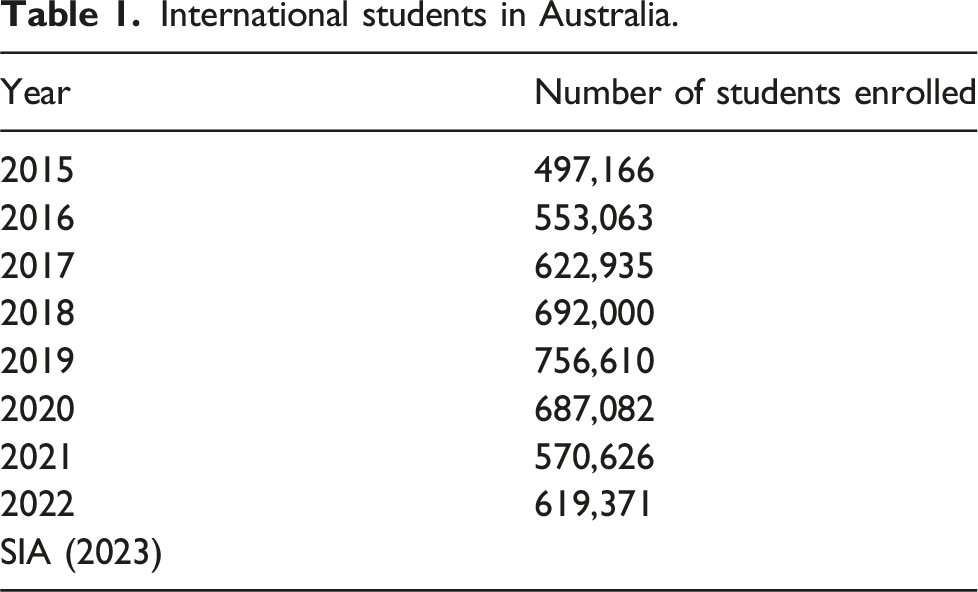
The internationalization of higher education is a crucial pillar of the Australian economy, especially in light of the downturn in mining exports. By 2025, China, India, Vietnam, Thailand, Nepal, Malaysia, Brazil, and South Korea are projected to be the leading sources of international students (Deloitte, 2015). However, if this sector is not effectively managed, it could jeopardize Australia’s future economic stability, particularly as emerging nations like Malaysia, Singapore, China, and Vietnam further develop their own higher education systems (Ministry of Education, 2019).
With the growing internationalization of higher education, many countries have seen an increase in neoliberal policies related to funding and resource allocation of universities. University culture has progressively embraced financial management practices, austerity measures, and market-driven strategies, demonstrating the influence of neoliberalism and New Public Management [NPM] (Parker, 2012; Parker et al., 2023). As the labor market favouring practical skills, applied knowledge, and expertise - traditional critical, humanistic, and theoretical disciplines are increasingly considered irrelevant and receive less funding (Small, 2013). Consequently, skills-focused education is now seen as the most desirable outcome of university education, while the labor market aligns with neoliberal values of individual success and productivity (Parker et al., 2023; Shore and Wright, 2015). Therefore, to maintain the civil roles of the university sector in fostering global community, international relationships, the common good, including global peace and well-being addressing the challenge is necessary (Stromquist, 2017; Hughes, 2008).
Implications and recent serious threats to sustainable higher education
In Australia, the internationalization of higher education is a strategic response by universities to neoliberal policies, which are marked by reduced public funding for services such as education and healthcare. This trend is undeniably a core element of neoliberal policies, which include institutional and regulatory reforms for public sector organizations (Massey, 2018). Under neoliberalism, university research is increasingly governed by government performance measurement systems, such as the Research Assessment Exercise (RAE) in the UK, Performance-Based Research Fund (PBRF) rankings in New Zealand, and the Excellence in Research for Australia (ERA) scheme (Parker, 2013). The core principle of neoliberalism in higher education is to view academics primarily as intellectual labourers, which has led to a shift from traditional academic values in teaching and research to a focus on commercial and financial metrics, treating students as consumers (Pitman, 2014). Pitman’s paper identifies several significant problems arising from the neoliberal approach to higher education that could threaten the sector’s long-term sustainability. Despite the Australian government’s confidence in the continued demand for its higher education sector from international students, these issues pose serious risks to the sector’s ability to deliver high-quality teaching and research for both domestic and international students.
A continued decline in the quality of teaching and research
The swift ascent of Australia as a premier destination for international students has been accompanied by substantial drawbacks, notably a persistent deterioration in the quality of teaching standards within Australian higher education institutions (ABC, 2019). Academics indicate that they are under pressure to reduce their teaching and assessment standards to attract more international students. Educators who fail too many students risk being branded as unsuccessful and could face job loss. Furthermore, an ABC’s (2019) report shows that more than 50% of international students have not undergone formal English proficiency tests like TOEFL or IELTS, which were once mandatory (Virender, 2019). If these trends continue, the higher education system could suffer significant consequences, compromising the quality of education and research available to both local and international students.
A study by Pitmans (2014) highlights a range of concerning effects from neoliberal-based higher education reforms in Australia between 2008 and 2014. The research found that these reforms shifted the focus of educational quality from traditional academic standards to market competition and efficiency. As a result, students are increasingly perceived as customers rather than learners (Pitman, 2014). This shift, where financial metrics replace academic values in teaching and research, is consistent a subsequent study that the rising employment inflexibility and workload pressures in university performance management systems that overlook academic values (Christopher and Leung, 2015).
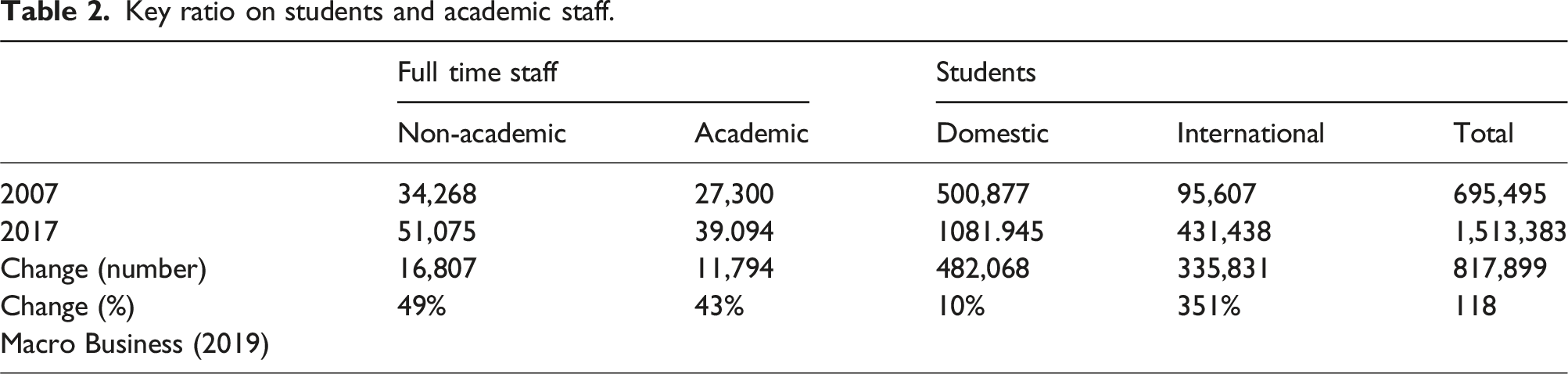
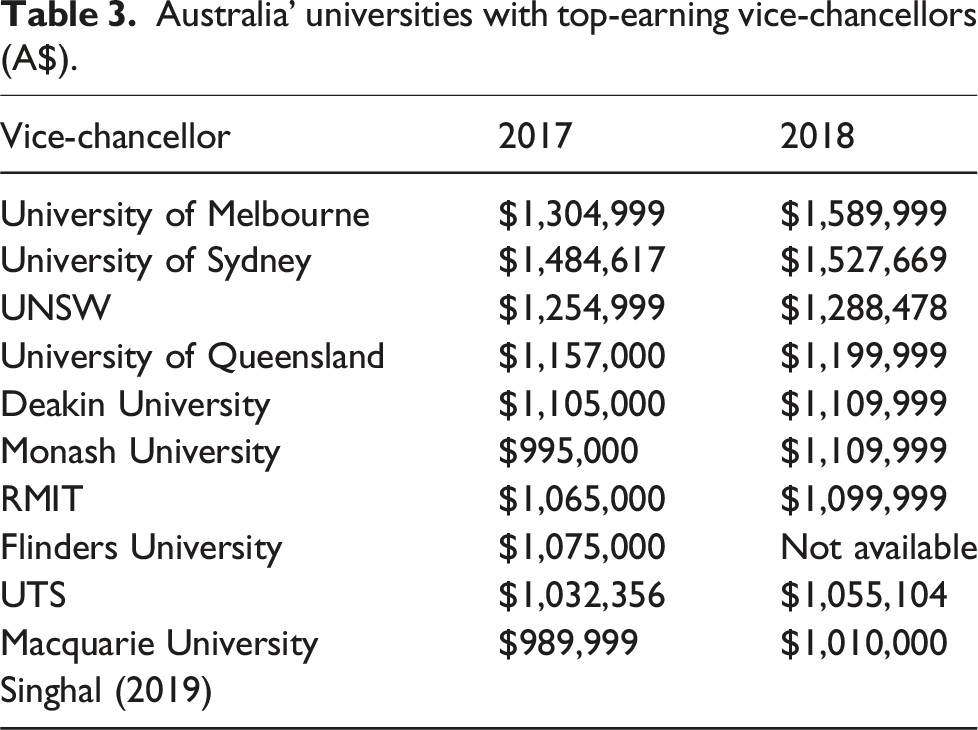
Increased allocation of resources to non-academic activities
Key ratio on students and academic staff.
Australia' universities with top-earning vice-chancellors (A$).
Unfair treatment to international students
Under neoliberal principles, universities are driven by the imperative to maximize revenue and secure financial surpluses at any expense. As a result, international students often become prime targets for elevated tuition fees, discriminatory practices by employers and reduced wages in the job market or for part-time work. Zheng (2019) reports that from 2015 to 2019, tuition fees for international students at the University of Melbourne surged at a rate 3.5 times faster than inflation (5.17%) and 2.6 times faster than fees for domestic students. This trend is prevalent across Australian universities. Additionally, there is substantial evidence of exploitation by housing and accommodation agents, with international students falling victim to fraudulent practices such as property swapping and illegal evictions (Evans, 2016). Furthermore, a 2017 study reveals that 25% of international students surveyed earned $12 per hour or less, while 43% were paid $15 per hour or below, both well under the minimum wage standard (Berg and Farbenblum, 2017). These issues present significant challenges to the long-term sustainability of Australia’s higher education sector.
Underpaid casual academics
In a neoliberal framework, universities prioritize revenue generation as a central strategic objective. As a result, casual academic staff often become vulnerable targets, with their salaries reduced below standard levels through various accounting and contract manipulations. The National Tertiary Education Union (NTEU) reports that thousands of casual academic staff at Australian universities received a total of $400 million in substandard salaries from 2019 to 2024 (Daily Australia, 2024). The report indicates that 131,471 employees across 30 public tertiary institutions (PTNs) were affected (Daily Australia, 2024). Additionally, the Australian Parliament (2024) released findings on the unfair treatment of casual university staff, based on a survey of 140 casual employees from a major public university. The survey also shows: • 63 percent (63%) of staff had been under unpaid for work in 2020. • Seventy-one (71 %) of staff had to work on public holidays or outside normal business hours without penalty rates. • Thirty-two (32 %) of staff have been instructed to fill in time sheets inaccurately. • Fourt three (43 %) of staff had been instructed to alter their marking practices to speed up the process. • Fouty nine (49 %) of staff feared repercussions if they asked to be paid for all hours worked.
Recently, the Australian Fair Work Ombudsman mandated that a public university in Melbourne pay A$74,590 in penalties for retaliating against two casual academics who exercised their rights by lodging complaints or inquiries about their employment (The Fair Work Ombudsman, 2024). Reports of underpaid casual staff in Australia are expected to increase in the future (Cassidy, 2023). These developments underscore the criticism that the widespread underpayment of casual academics is a direct consequence of neoliberal policies, which have significantly disadvantaged casual staff, particularly women (Angervall and Beach, 2017).
Overreliance on China
Australia is increasing relied on China as the main single source of international students. Chinese students are by far the largest cohort of foreign students enrolled at Australian universities. For example, there are 150,000 Chinese students enrolled in Australia higher education institutions in 2023, a huge jump from 85,000 students in 2013 (ADE, 2024). This cohort has expanded rapidly in recent years, at an average rate of 11% annually since 2002, and injected US$6.9 billion into university coffers in the 2016-17 financial year alone — an increase from the US$5.5 billion of 2 years prior (Lyall, 2018).
It is undeniable that an overreliance on China exposes Australian universities to significant geopolitical risks. As ICEF Monitor (2018a) cautioned, “It is not hard to imagine how much worse the situation would be if international student numbers were to decline in the higher education sector.” Professor Ian Jacob from the University of New South Wales has warned that the number of Chinese students studying in Australia is expected to decrease over the next decade, due to China’s investment in advancing and modernizing its own higher education system (Baker, 2019). Therefore, maintaining a diverse student demographic from various countries is crucial for mitigating the potential long-term impacts of such issues for host countries, including Australia.
Concluding thought
As higher education increasingly becomes a crucial export sector in advanced economies such as Australia, ensuring its sustainability is vital for national economic health. This paper examines how reductions in federal funding for education and health have compelled Australian universities to adopt commercial strategies and revenue-focused performance metrics. The impact of these policies is evident in several key areas: (a) a deterioration in the quality of teaching and research programs, (b) a rising concentration of resources on non-academic roles and activities, (c) inequitable treatment of international students, and (d) an excessive reliance on China as a primary source of international students. These trends illustrate a shift from prioritizing educational quality to focusing on revenue generation. Thus, we propose several recommendations to enhance policy development within this domain: • Enhance regulation and support: The government should institute more stringent and pragmatic regulations, coupled with targeted financial support, to elevate and sustain the quality of teaching and research. This strategy would serve as a counterbalance to the effects of deregulation and liberalization that have shaped the sector over the past 20 years. • Diversify international student markets: To mitigate dependence on China, the Australian government, in collaboration with countries like the US and the UK, should actively seek to attract international students from emerging markets such as India, ASEAN nations, and Arab countries. This diversification would help manage geopolitical risks and provide stability to the sector. • Incentivize international expansion: Australia and other host countries should offer incentives, such as tax benefits, to universities that establish and operate international campuses. These measures would promote the global expansion of transnational education providers, thereby boosting the sector’s international engagement.
Neglecting to address the unintended repercussions of neoliberal policies on higher education not only jeopardizes the sector’s capacity to generate export revenue in Australia but also impedes its broader roles in advancing the global order, fostering mutual understanding, facilitating skilled labor exchange, driving social transformation, and building institutional capacity. This issue is equally significant on an international level.
Footnotes
Declaration of conflicting interests
The author(s) declared no potential conflicts of interest with respect to the research, authorship, and/or publication of this article.
Funding
The author(s) received no financial support for the research, authorship, and/or publication of this article.
