




Abstract
Considering the role played by Higher Education Institutions (HEIs) and Cultural and Creative Industries (CCIs), we recognize that more knowledge is needed to provide a better understanding of their relationship, collaborations and work in relation to sustainable development. The aim of this article is to highlight why and how Higher Education (HE) is key to CCIs’sustainable development. Academic research in this specific field is scarce and we aim at soliciting more attention towards this niche research sector, given the potential positive spillovers that it could originate. Through retracing the arising of interest towards the CCIs in general and recently towards sustainability issues linked to the CCIs facing the challenge of Sustainable Development Goals (SDGs), we show how these matters are inextricably associated to the essential role played by HE and HEIs. Thanks to the strong link between HEIs and CCIs’ sustainable development, we can expect that a sort of mimetic isomorphism process will happen in the coming years, with a choice of a strategy of imitation instead of differentiation.
Keywords
Introduction
In the last decade, the relevance of the universities’ “third mission” has been growing (Etzkowitz, 2008; Leydesdorff and Meyer, 2006). Knowledge transfer processes have shifted towards a more active academic engagement in economic and social development. In this context, the concept of the “entrepreneurial university” has emerged (Hytti, 2021), and a close relationship between the dynamics of Higher Education Institutions (HEIs) - Industry collaborations and regional governance and development has been observed (Lazzeroni and Piccaluga, 2015). This has also been explored in the context of creative and cultural industries (CCIs) and the creative campus (Comunian and Gilmore, 2016).
Concurrently, we are recently assisting to the emergence of a new research area that is being prioritised in debates and policy initiatives worldwide: sustainability and Sustainable Development Goals (SDGs). Starting from the seminal report “Our Common Future”, which was released in 1987 by the World Commission on Environment and Development, the term “sustainable” has become more and more popular (WCED, 1987). Sustainability has become one of the main pivotal subjects of all the debates at national and international levels. Climate change, resource scarcity and social inequality are leading a revolution in companies’ behaviour and consumers’ habits. Consequently, in recent years HEIs have launched successful education programs for training students to become responsible leaders. Environment and social sustainability goals are now considered strategic competitive drivers.
CCIs are not excluded from this challenge; indeed, these industries are among the pivotal actors that could provide original and unexpected solutions, thanks to their unique creativity, skills, and talent (Amabile, 1988), which can be transferred to other related industrial sectors.
The seminal definition of CCIs was provided by the Department for Culture, Media and Sport Creative Task Force in the UK as “those industries which have their origin in individual creativity, skill and talent and which have a potential for wealth and job creation through the generation and exploitation of intellectual property” (DCMS, 1998 and 2001: 5). Starting from this definition and the first initiatives carried out in the UK, a new line of research has emerged with many studies regularly underlining the unique contribution to economic growth, social and cultural development and organisational design brought by the CCIs. The information and communication technologies revolution and the digital age have also accelerated this process (Benghozi et al., 2021; Salvador and Benghozi, 2021).
Considering the role played by HEIs and CCIs, we recognize that more knowledge is needed to provide a better understanding of their relationship, collaborations and work in relation to sustainable development.
In this context, sustainable solutions and greener production and consumption practices are being to be implemented by several sectors of the CCIs (EIF-KEA, 2021). Like other industrial sectors, also the CCIs are adopting sustainable practices to green their value chain: as highlighted by a recent report of EIF-KEA (2021), CCIs are rethinking ways cultural products and services are produced and consumed by adopting more sustainable practices. Overall, we see a significant shift - especially after the 2008 global financial crisis - towards creative-social economies (Comunian et al., 2020) and towards engagement with environmental issues (Oakley and Banks, 2020). For example, recycled materials are more used in production processes; plastic bottles are replaced by more eco-friendly solutions during cultural events; saving energy lighting systems are implemented in museums and other cultural spaces; certifications like the Creative Green Certification explicitly designed for the arts and CCIs by Julie’s Bicycle 1 are more and more diffused; the fashion industry is implementing eco-friendly practices in the production system and thinking about extensive products’ lifecycle (cf. EIF-KEA, 2021). Finally, collective movements are emerging to engage artists and creators to take a stand on climate change and ecological emergencies to increase environmental consciousness towards more sustainable production and consumption choices (EIF-KEA, 2021).
Looking specifically at higher education (HE) and the knowledge it develops, they are potentially connected with all the 17 SDGs (United Nations General Assembly, 2015) but some are even more interconnected and strongly relevant for the specific area of interaction between HE and CCIs (Duxbury et al., 2016; Comunian et al., 2023). The connection between CCIs and SDGs spans across a range of topics – set often with the development of sustainable cities and communities (11) – but, in our opinion, there are three main pillars that deserve further exploration. The first one is related to the connection between HEIs, CCIs and sustainable economic growth: this relates to the need to engage with ideas of decent work and economic growth (8) but also improving industry innovation and infrastructure (9) and engage with responsible consumption and production (12). The second one is linked to the connection between HEIs, CCIs and societal agendas for development, with particular attention to the importance of quality education (4), gender equality (5) and reduced inequalities (10). The third one is related to the connection between HEIs, CCIs and environmental agendas, including climate action (13) affordable and clean energy (7) and the protection of life on land (15) and below water (14).
Therefore, the articles and case-studies included in the Special Issue of Industry & Higher Education (February 2024) about “Cultural and creative industries and the challenge of sustainable development: opportunities for higher education, businesses and communities” are devoted at investigating the overlap and connections between HE, CCIs and sustainable development as illustrated in Figure 1. We particularly consider how there is research that explores the relationships between CCIs and SDGs (overlap 1 in the Figure) and there are studies looking at connections between HE and SDGs (2) and CCIs and HE (3). However, more research is needed to address together the potential that collaborations, coordination and support, running through all three areas (CCIs, HE and SDGs) could generate. More policy and research need to expand and explore the area identified with (4) in Figure 1. To facilitate the understanding and introducing the topic, the aim of this article is to highlight why and how HE is key to CCIs’sustainable development. The overlap and connections between HE, CCIs and sustainable development. Source: authors’ own elaboration.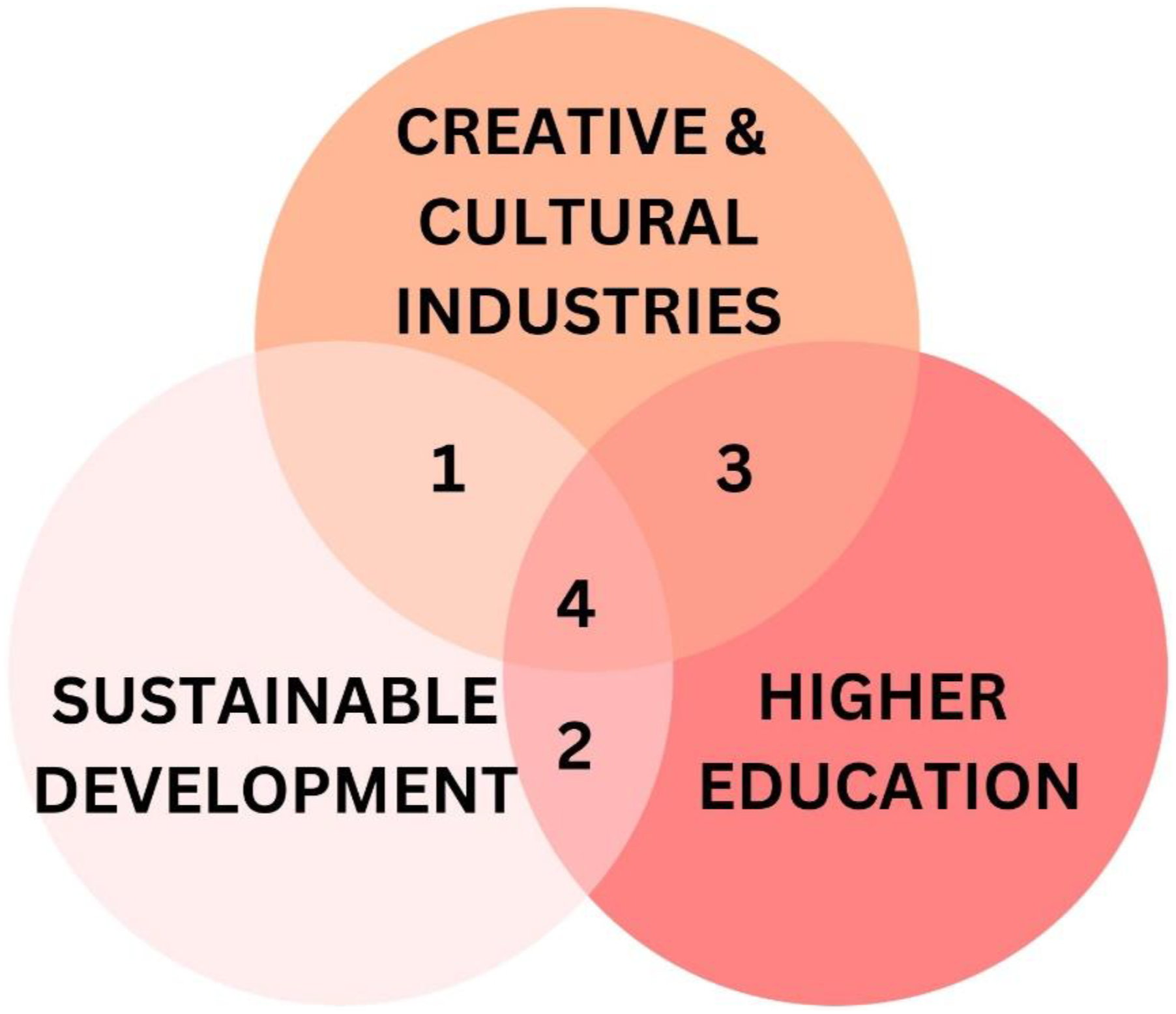
The article is structured as follows: the first Section is dedicated to presenting the CCIs’ evolving interest and focus in the academic and grey literature as well as the core role played by these industries facing the challenge of SDGs; the second Section highlights the pivotal link between HEIs and CCIs, considering SDGs, through references to the content of the Special Issue (2024) of Industry & Higher Education Journal. The last Section provides some concluding remarks and avenues for future research.
Cultural and creative industries and the challenge of sustainable development
CCIs have for long been neglected by policymakers and in the academic literature despite their growing economic contribution: a recent systematic literature review of creative industries highlighted that the field is in its infancy, multifaceted and fragmented, and has been dominated by the contributions of few researchers (Dharmani et al., 2021). At European Union (EU) level, for example, the EU treaties took into consideration “Culture” as a field of action very late (Bruell, 2013): the Maastricht Treaty of 1992 adopted article 128 about Culture, then included in the Lisbon Treaty as article 167. Several programs supporting cultural cooperation, mobility of artists, creation of networks between the EU country members appeared in the ‘90s and other initiatives like the promotion of the Capitals of Culture have been introduced. With the “Creative Europe programme (2014–2020)” the economic impact and the objective of economic growth become more prevalent. This aspect is linked to the growing awareness of the role that culture, but also CCIs in general, can play at EU level (and beyond) for economic development.
Generally speaking, an increased interest towards the CCIs can be observed in recent years (Salvador and Benghozi, 2023; UNCTAD, 2010). While in the past the scientific literature focused mostly on the role of the creative class and the management of talents (Scott, 2006; Florida, 2002; Caves, 2000), attention then shifted towards the establishment of creative atmosphere, networks, CCIs’ clusters as well as creative cities seen as regional development strategies (UNCTAD, 2010; Comunian et al., 2010; Crossick, 2006). Furthermore, more recently, researchers focused explicitly on CCIs’ business models, value chains, innovation and R&D strategies (Salvador et al., 2019; Benghozi and Lyubareva, 2014; Benghozi and Salvador, 2016; Brandellero and Kloosterman, 2010; Miles and Green, 2008) and HE and the creative economy relationship beyond the creative campus (Comunian and Gilmore, 2016).
Opportunities of economic wealth, growth and jobs creation at local level fostered by the CCIs were finally identified as main key factors (Piergiovanni et al., 2012; Henry and De Bruin, 2011; Green Paper, 2010; Florida, 2002). CCIs are thus recognised as strategic actors that may help also in the attainment of various SDGs (Dharmani et al., 2021; Scott, 2006).
The interest towards the CCIs has also been strengthened and renewed by the Internet and information and communication technologies (ICTs) revolution. It is well acknowledged that the digital revolution had a disruptive effect on the traditional model of the various CCIs: the music industry (Moreau, 2013; Benghozi et al., 2021) is one of the most representative examples, while the publishing or the cinema industries were also profoundly affected (Salvador and Benghozi, 2021; Salvador et al., 2019). Notwithstanding, the emergence of dominant economic actors like the GAFA (Google, Apple, Facebook and Amazon) has been supported also by the use and worth of cultural and creative contents: the knowledge and innovative economy is fostered also by “creative” processes (Cohendet and Simon, 2007).
Given this context, the scientific and the grey literature about the CCIs is growing and both qualitative and quantitative studies are emerging as well as Special Issues of scientific journals 2 . Additionally, several local governments are increasingly calling for public reports to consider and support future policy strategy guidelines 3 . European projects financing scientific research collaborations at international level are also increasing in the latest years 4 .
Notwithstanding this interest, it is difficult to find a univocal classification as well as definition of what the CCIs are at the national and international levels, with consequent difficulties of comparative studies among different countries (Salvador and Benghozi, 2023). Last but not least, CCIs include various industries, ranging from secular industries like book publishing and cinema to more recent ones like video games, as well as different sectors like tourism, gastronomy or even software. This heterogeneity can be seen as a strength, but it can also make difficult to identify suitable methodologies of investigation as well as formulate and generalise policy suggestions to the overall CCIs’ sectors. For example, as highlighted by Benghozi and Salvador (2016), R&D activities may be undertaken by CCIs’ companies without defining them formally as effective R&D activities. Innovation in CCIs is usually considered as a tool to develop new creative content and CCIs are generally associated with various forms of “hidden innovation”, difficult to measure with traditional indicators. This context generates difficulties for researchers in collecting data, and it explains why academic papers focused on the CCIs often utilise qualitative methodologies, with findings coming from interviews, focus groups, and questionnaires as primary sources of analysis.
Considering their broad scope and influence, CCIs are attracting attention not only for their general contribution to economic growth and jobs’ creation, but recently also as a means for specifically fostering sustainable development (Wu and Lin, 2021). However, on the one hand, Sokol and Mempel-Sniezyk (2022) recently focused on Poland and revealed the strong relationship between sustainable development and three dimensions of creative capital, meaning talent, technology and culture. On the other hand, Pratt (2022) highlighted challenges and problems linked to the relationship between the environment and culture. He argues that the impact of cultural consumption on the environment is expected to become more severe and visible in the coming years, while digitisation and digital content consumption are raising new issues for sustainability and the cultural economy. Nonetheless, sustainable development means also assuring decent work, quality education, gender equality and reduced inequalities…in short, all the 17 SDGs are potentially involved and bring new challenges for the CCIs, that could become strategic and essential actors in the attainment of SDGs.
To this aim, a recent UNESCO (2022) report highlights the potential usefulness of culture for fostering sustainable development planning mechanisms – with a great emphasis on its contribution to the social dimension of sustainable development – but also the necessity to accelerate the CCIs’ transition towards sustainable production and consumption 5 facing climate change and environmental impact (Kamara, 2022). This report underlines the lack of enough efforts for valorising the CCIs in adopting new sustainable models in the fight against climate change. Also the European Commission has recently highlighted the cultural dimension of sustainable development, with a leading role played by culture and creativity: it reminds that 2021 was declared “the international year of creative economy for sustainable development” (COM, 2022).
Comunian et al. (2023) present a series of interesting examples of twenty-five collaborative projects across Africa that are all connected with SDGs while involving a range of creative practitioners and academics, delivering creative performances, products, training and more. In the report, they reflect on the fact that while some SDGs were more popular (Decent Work and Economic Growth, Quality Education, Responsible Production and Consumption, Industry, Innovation and Infrastructure), the project engaged with almost all of them. It seems thus that matters about sustainable development and SDGs have become one of the main challenges that also the CCIs are facing in the next future. The Special Issue of Industry & Higher Education (February 2024) about “Cultural and creative industries and the challenge of sustainable development: opportunities for higher education, businesses and communities”, edited by Salvador E. and Comunian R., aims at providing some first contributions towards this goal through original papers and case-studies for advancing knowledge in the academic literature.
Higher education (institutions), cultural and creative industries and sustainability
Generally speaking, “education” has a crucial role in transmitting values, helping understanding the causes and impacts of human actions and raising awareness towards responsible behaviour. This could be, of course, the case also for sustainability matters, as recently underlined by Séraphin and Chaney (2023) for the tourism industry and by Sokol and Mempel-Sniezyk (2022) for the role played by creativity in fostering sustainable development. Culture is most often associated with education and, consequently, mobilised for educational purposes (UNESCO, 2022; Kamara, 2022). Education also has an influence in shaping creative workers’ career and providing opportunities or barriers to sustainable creative careers (De Bernard et al., 2024). HEIs also play a central role: Comunian and Faggian (2014) highlighted that in specific CCIs’ sectors, such as in the case of music, the institution from which the student graduates dramatically influences his or her employment outcome.
Recent research has shown the importance of HE in contributing more broadly to the creative economy (Comunian and Gilmore, 2016; Atkinson and Easthope, 2008). Creative HEIs can foster the formation of creative and cultural ecosystems at local level by attracting and retaining graduates and by developing networks for career opportunities (England and Comunian, 2016; Dent et al., 2024; Kim and Comunian, 2024).
Among others, education also contributes to reducing social inequalities and fostering growth and technological and innovative progress. Thus, educational programmes can accelerate sustainable development, and creativity may play a key role: the regeneration of urbal centres can be encouraged by cultural activities and creative industries development (Sokol and Mempel-Sniezyk, 2022). Sokol and Mempel-Sniezyk (2022) argued about the link between creative capital and formal education. Some researchers underline the necessity of several years of formal education for acquiring specific specialist knowledge needed for producing creative products, while others highlight more the role played by territorial, family and organisational conditions than the completion of formal education.
Furthermore, the recent NESTA report (2023) about the state of creativity, argued about “time to prioritise creative education” and it highlighted the growing importance of creative (digital) skills in the workforce: originality, creative solutions, creative problem-solving capacities facing the challenges of new skills-intensive jobs, are more and more demanded on the marketplace. However, as highlighted by some of the case studies in the present Special Issue and by the work of the All-Party Parliamentary Group for Creative Diversity in the UK (Comunian et al., 2023), challenges of social exclusion and equity still need to be addressed and HEIs need to make sure creative skills remain accessible to all to ensure a diversity of content producers and voices being represented across CCIs’ products and services.
Recent research focused on the UK has demonstrated the vital contribution of creative HE: highly skilled roles are employed by the creative workforce that has a degree or higher-level qualification, and the percentages for creative occupations are higher than for the UK workforce in general (Giles and Carey, 2023). The pivotal role played by HE has also been demonstrated by De Bernard et al. (2024) in an analysis focused on the careers of UK theatre workers. The authors considered how HE shapes and influences the latter and how it connects with opportunities and barriers to the sustainability of creative careers. The nature of the relationship between HE and creative workers goes well beyond the natural role as training institutions of HEIs: following De Bernard et al. (2024) findings, UK theatre careers are thus severely shaped by their relationship with HE in terms of trajectory and sustainability.
Cappelen and Strandgaard-Pedersen (2024) also underline a very specific and unexpected role played by HEIs, that goes well beyond their traditional role of producing and diffusing knowledge: the authors focus on the original collaboration between culinary movements and HE for sustainable development. The food industry is attracting an increased attention in recent years, considering sustainability matters, health requirements, security problems and so on, but till now the relationship between HE and the gastronomic sector has been under investigated. The authors aim at advancing our knowledge about HE and culinary movements collaboration through focusing on how culinary movements interact with HEIs when promoting sustainable development. Through investigating three culinary movements (Slow Food, New Nordic Cuisine and New Anatolian Cuisine), Cappelen and Strandgaard-Pedersen (2024) identified four types of interactions: “formal collaboration” on dedicated research projects, “imitative practices” through emulating successful HEIs’ models, “enlisting academics” through collaborating with academic scientists, and “emulating academic events” through adopting the HEIs’ conference and events models for building networks and fostering sustainable food practices.
Dent et al. (2024) focus on the relationships and collaborations between HEIs and CCIs within a particular geographical location, another specific field of research that is under investigated. They focus on two small-sized cities based in the UK, Dundee (Scotland) and Chatham (England), and they look at resources necessary for developing sustainable creative economies in these geographical areas. These authors highlighted the key benefits of HEIs-CCIs co-location and integration at local level, in terms of attraction of creative human capital, retention of students, workers and start-ups, and creation and dissemination of opportunities and partnerships for local individuals and communities. Interconnections and interdependencies between HEIs and CCIs are thus pivotal for the sustainable development of creative economies and the creation of cultural and creative ecosystems at local level.
Along this line and looking specifically at the role that HE can play in developing local economies, Kim and Comunian (2024) focus on the specific role played by HE in a peripheral and under-investigated country: Kazakhstan. They reflect on the complex interconnections between creative and cultural HEIs and the capital cities of Astana (the new capital city) and Almaty (the old one). This paper offers an original exploration of the central role HE plays in the top-down strategic development of a new political and creative and cultural capital city, but also what challenges these kinds of policies can face. This original example proves that creative and cultural HE development cannot happen in isolation but needs to be planned and carried out as part of the wider development of a cultural and creative ecosystem. This means reinforcing the local creative and cultural economy and attracting and retaining creative and cultural human capital through a migration movement. Obviously, this requires a long-term strategy and vision for building networks and developing knowledge, as well as interaction with top-down initiatives to create a stable cultural and creative ecosystem.
In conclusion, these examples – focused on different CCIs’ sectors and various geographical areas – underline the strong link between HEIs and CCIs and they show how HE is actually an essential element for CCIs’ sustainable development.
Discussion and some concluding remarks
This article aimed at highlighting the importance of HE for CCIs’ sustainable development. Academic research in this specific field is scarce and we aimed at soliciting more attention towards this niche research sector, given the potential positive spillovers that it could originate.
Through retracing the arising of interest towards the CCIs in general and recently towards sustainability issues linked to the CCIs, we showed how these matters are inextricably associated to the essential role played by HE and HEIs. One could say that the important role played by HE can be taken for granted, but in reality, this requires a deeper understanding of the concrete relationships and interrelationships arising from the link that unites and influences both these parties.
In recent years, we have witnessed the growing importance of the role of HEIs in local and regional development through the dissemination and valorisation of research results, knowledge and activities beyond academic boundaries - the so-called third mission (Carree et al., 2014). This originated a closer relationship between the dynamics of HEIs-Industry collaborations and regional development (Lazzeroni and Piccaluga, 2015). HEIs attract and retain talents and skilled human capital to a dedicated city, and this creates further positive spillover effects such as start-ups creation and knowledge exchanges between different actors at local level (cf the triple helix model). We could, therefore, assist in the rising of ‘a so-called “milieu”, or co-location effect’ as underlined by Goldstein and Glaser (2012, p. 159): HEIs catch and train scientists and engineers that sometimes become (or have relationships with) successful entrepreneurs, consequently generating positive economic spillovers at local level, wealth and jobs creation. The region that hosts one or more HEIs is therefore characterised by a concentration of highly educated people (i.e., professors and researchers) as well as entrepreneurs located not far.
Given this context, we focused on the specific link between HEIs and CCIs, that are attracting more and more interest in the latest years, but remain difficult to investigate and analyse. Our focus was on the link between these actors for sustainable development: we identified three main pillars of investigation. The first one - related to the connection between HEIs, CCIs and sustainable economic growth - and the second one - linked to the connection between HEIs, CCIs and societal agendas for development - have been deeply explored through the original contributions included in the present Special Issue. The third one - related to the connection between HEIs, CCIs and environmental agendas - remains a subject for further research.
Through this introductory theoretical article, we hope to solicit the interest of readers in going further and exploring in detail the content of all the contributions included in the present Special Issue: they all focus on under-explored areas, and they all bring added value to the scientific literature through original focus, methodologies and findings.
In conclusion, it is essential to strengthen the relationships at local level between HEIs and cultural and creative ecosystems and look at their future evolution: the development of sustainable creative economies and cultural and creative ecosystems in the two small-sized cities of Dundee (Scotland) and Chatham (England) (Dent et al., 2024), as well as the development of a new political and cultural capital city (Astana) in Kazakhstan (Kim and Comunian, 2024) are exemplary evidence. Considering that HEIs are deeply intertwined with and often influence and/or define the theatre creatives’ work life, more extensive attention in creative economy research and policymaking about the effective role and influence played by HEIs is necessary, as highlighted by De Bernard et al. (2024). Last but not least, original and unexpected forms of collaboration arising between HEIs and CCIs are worth exploring: they could reveal unusual practices, like the interactions described by Cappelen and Strandgaard-Pedersen (2024) between HEIs and culinary movements facing sustainable change.
And following the findings by Cappelen and Strandgaard-Pedersen (2024), we can even predict that an imitative behaviour will prevail in the next future. Thanks to the strong link between HEIs and CCIs’ sustainable development, we can expect that a sort of mimetic isomorphism process will happen in the coming years, meaning a constraining process that forces one unit in a population to resemble other units that face the same set of environmental conditions (DiMaggio and Powell, 1983; Hannan and Freeman, 1989). We can say that given the problems of survival in a changed environment and the general uncertainty and lack of past experience on how to face the challenges of SDGs, a choice of a strategy of imitation instead of differentiation will be the most suitable as a starting point. At the end of the day, this may suggest that imitation is less risky than differentiation.
Footnotes
Acknowledgments
The authors acknowledge the Research Visiting period (April 2023) of Prof. Elisa Salvador at King's College, London (UK), Department of Culture, Media and Creative Industries. This research visiting period enabled the authors to significantly advance the content of the present article during face-to-face exchanges and work meetings at King's College, London.
Declaration of conflicting interests
The author(s) declared no potential conflicts of interest with respect to the research, authorship, and/or publication of this article.
Funding
The author(s) received no financial support for the research, authorship, and/or publication of this article.
