




Abstract
Universities are increasingly recognized for playing a proactive role in supporting culture and creativity-led regional development. Meanwhile, they are also expected to distinguish themselves in their core activities via mission differentiation. Often these two demands are pitched against each other while little attention has been paid to the way universities can manage them. Drawing on a case study involving 29 semi-structured interviews carried out with key actors, this article examines the way a public university located in a peripheral region in the Netherlands navigated such a complex institutional environment. The findings suggest that the university formulated a hybrid response strategy, engaging in both institutional demands simultaneously while prioritizing collaboration with cultural and creative industries and talent attraction over other sub-demands. More importantly, the authors demonstrate that organizational identity, which itself is influenced by peripheral characteristics as well as other institutional factors, plays a significant role in the formulation of a hybrid response strategy. They therefore argue that universities’ contribution to culture and creativity-led regional development is not only dependent on their resource capacity – as is often suggested in the literature – but also on how they envision their organizational identity; that is, the type of institutional profiling they want to pursue.
Keywords
Creativity and culture have recently become increasingly influential tenets of regional development strategies and sources of innovation (Markusen and Gadwa, 2010). The notion that creativity and culture can be utilized as an instrument through which economic growth can be spurred and societal challenges can be addressed has rapidly resonated with urban planners (Bonakdar and Audirac, 2020), innovation policymakers and regional policymakers alike (Montalto et al., 2019). Despite their widespread use in academic and policy circles, both terms remain highly contested; there has not been a universal single definition of creativity and culture. Depending on the context in which they have been employed, they may imply quite different conceptualizations (i.e., creativity as a problem-solving process, creativity in the form of artistic expression, organizational creativity, etc.).
Runco and Jaeger (2012) argued that, even though various scholars had elaborated on related concepts such as originality and novelty, it was not until the 1950s that a proper definition of creativity itself emerged. Indeed, Stein (1953: p. 311) provided the first definition: “The creative work is a novel work that is accepted as tenable or useful or satisfying by a group in some point in time.” He further argued that creativity might emerge out of “a reintegration of already existing materials or knowledge but when it is completed it contains elements that are new” (Stein, 1953: 311). Artistic creativity is one outcome of multiple interpretations of Stein’s definition and refers to the expression of creativity in the domain of arts, manifesting through a product that is novel, efficient and perceptible (Chemi, 2017; Niu and Steinberg, 2001). It is the kind of creativity that has been employed throughout this paper. More specifically, when we discuss creativity-led regional development, we refer to strategies driven by artistic creativity and universities’ contribution to them. Likewise, we conceptualize culture in its aesthetic and artistic form. As such, we refer to cultural investment (e.g., urban regeneration projects) and arts driven local development strategies (see Miles and Paddison, 2005) as well as universities’ engagement with them.
Over the past decades, various regional development strategies incorporating culture and creativity have emerged: culture for tourism promotion, culture for urban regeneration, cultural and creative industries (CCI), culture for attracting talent, namely the creative class, and culture for the well-being of local residents (Sacco et al., 2014). Although these strategies are based on two different yet interrelated concepts of culture and creativity, they have been used interchangeably (Throsby, 2010). In order to accommodate all these different strategies under one framework, hereafter we refer to them as culture-led regional development (CRD). In tandem with these emerging strategies, demands on universities to contribute into CRD have likewise become diversified. Previously, universities were primarily expected to attract talent and engage in various collaborations with cultural and creative industries. More recent demands, however, require them also to contribute to culture-led urban regeneration, cultural tourism and the well-being of local residents. Higher education institutions, especially those located in peripheral regions, are under pressure to live up to all these expectations (Collins and Cunningham, 2017).
The literature on the nexus of universities and CRD has largely focused on universities’ contribution to cultural and creative industries (e.g., Powell, 2007) and mainly on linkages with their host cities through creative graduates (e.g., Comunian and Faggian, 2011). Another (indirect) commonly found contribution is talent attraction (e.g., Cadorin et al., 2017). However, universities are organizations that possess a broad spectrum of knowledge capacity which can be and has already been mobilized for the remaining CRD strategies as well (e.g., Cross and Pickering, 2008). While universities have the ability to assume a proactive role in supporting all strategies simultaneously, the resource constraints they face and internal organizational dynamics might influence them to make strategic decisions and be selective.
Universities are based in complex institutional environments in which they are held accountable for multiple demands such as mission differentiation (Van Vught, 2008). In addition to playing an active role in the regional development of their localities, they are also required to differentiate their organizational identity and programs from their peers nationally and internationally. Enders and de Boer (2009: 160) argue that such proliferation of demands has resulted in ‘mission stretch’, whereby universities are increasingly expected to act in multiple domains. Such a situation, characterized as institutional complexity entailing conflicting demands, can be difficult to navigate (Greenwood et al., 2011). The conflict relates to the long-standing dilemma of whether a university should aim to be world-class or regionally relevant, two options that might require fundamentally different organizational arrangements. In this respect, how such universities – particularly those in peripheral regions – decide on which CRD models to support and what kind of organizational responses they should formulate to meet various demands has so far been little understood. In this paper, we aim to contribute to these debates. Therefore, we ask the following research question: when facing the conflicting institutional demands of contribution to culture and creativity-led regional development and mission differentiation, what type of organizational responses do universities located in peripheral regions formulate? We first present the characteristics of CRD models and peripheries and reflect on the different missions of universities. We then mobilize a literature on conflicting institutional demands to highlight the factors affecting the way organizations navigate complex institutional environments. Following that, we present a case study of a public research university in the Netherlands, which is located in a peripheral region and has recently undergone such a process. Our analysis demonstrates that internal dynamics and external place-specific factors make it difficult and risky for the university to ignore satisfying any of the demands, which in turn leads to the formulation of a hybrid response strategy to engage – at least partially – in contributing to CRD and mission differentiation simultaneously. We conclude by arguing that the contribution of universities in peripheral regions to CRD is not only dependent on their resource capacity (i.e., relevant human capital and physical infrastructure) but also how they envision their organizational identity – that is, the type of institutional profiling they want to pursue.
CRD strategies, peripheries and universities
Type of CRD strategies
One of the original CRD strategies, dating back as early as the 1960s, is culture for tourism promotion (Scott, 2004). While not framed under the cultural economy concept back then, exploiting the cultural potential of cities to attract tourists into areas that were stagnating was seen as a promising strategy (Richards, 1996). In this strategy, commonly referred to as ‘cultural tourism’, the aim is to attract both domestic and foreign tourists who are interested in the lifestyle, arts, cuisine and cultural heritage of local residents (OECD, 2009). International visitors to the Andalusian city of Seville for the purpose of either enjoying flamenco dance/music or taking a course to learn it is a well-known example of cultural tourism (Aoyama, 2009).
From the 1980s onwards, another strategy gained traction: culture for urban regeneration (Graham et al., 2000). Initiatives rooted in this strategy aim to transform, usually, one neighborhood of an urban area into an artistic and cultural center to attract foreign investment and a variety of corporations, and, to a lesser extent, tourists (Scott, 2004). This has been pursued mostly through big investments in the physical infrastructure of cultural and artistic scenery. Newcastle–Gateshead (Quayside Neighborhood) in the UK and Bilbao (Guggenheim Museum) in Spain are two successful culture-led urban regeneration projects that are commonly referred to in academic and policy spheres (Bailey et al., 2004; Plaza, 2006).
In the early 1990s, a shift of focus in CRD strategies commenced. This shift turned attention from place branding to local tangible and intangible products – namely cultural and creative industries. Scott (2004: 465) characterizes it as a new model “directed less to the selling of places in the narrow sense than to the physical export of local cultural products to markets all over the world”. Cultural and creative industries are defined as ‘activities whose principal purpose is production or reproduction, promotion, distribution or commercialization of goods, services and activities of a cultural, artistic or heritage-related nature’ (UNESCO, 2015: 11). They cover various sectors ranging from advertising and gaming to performing arts, film and architecture. Among them, the video game industry, which draws heavily on artistic creativity (Aoyama and Izushi, 2003), has been the exemplary sector around which a specific ecosystem has emerged in different places (Lehtonen et al., 2020).
By the early 2000s, Florida’s (2002) concept of the creative class appeared in CRD debates. Briefly and in a rather simplified manner, the theory suggests that highly skilled individuals, namely the creative class who engage in cultural and creative labor, prefer locations that provide them with the 3Ts – (a high level of) technological development, (a high concentration of) talent and tolerance (towards all aspects of an individual’s life) (Florida, 2002). The strategy implies that attracting the creative class is the underlying element in innovation, competitiveness and CRD. Despite the criticism that there is a lack of strong empirical evidence (Hoyman and Faricy, 2009) and a lack of sociological basis to use the term ‘class’ in reference to a heterogeneous group of highly skilled individuals (Sacco et al., 2014), creative class strategy has rapidly permeated the regional policy field, including the peripheries (Petrov, 2007). The ‘Fresh Talent Initiative’, which aimed to attract talented university graduates to regions of Scotland and ran between 2004 and 2008, is an example of a government strategy primarily built on the concept of the creative class (Houston et al., 2008).
One last strategy that has recently emerged as a reaction to the challenges brought by previous strategies is culture for the well-being of local residents. The previous four CRD strategies have resulted in significant socioeconomic challenges, ranging from gentrification and rent-seeking behavior to overcrowded cities and pressure on public services (Sacco et al., 2014). This has renewed the interest in culture for the benefit of citizens and put the focus on the well-being of local residents themselves. Increasing the active cultural participation of local residents is an important aim of this particular strategy. The underlying logic is that an increase in cultural participation can result in an increase in individuals’ well-being, skills and creativity, which then transform them from simply cultural consumers into be cultural producers as well (Sacco et al., 2014). Music concerts, exhibitions, theaters, museums and cinema are among the events and facilities through which cultural participation takes place and have a positive impact on the well-being of those who attend them (Grossi et al., 2012).
Characteristics of peripheries and the different missions of universities
Studies delving into the CRD have traditionally focused on core regions and cities over the past decades (e.g., Bayliss, 2007; Cox and O’Brien, 2012). Nevertheless, there has recently been a gradually growing body of work exploring CRD in peripheral regions and demonstrating that it can lead to path creation in such regions (Petrov, 2007), but that this is a complex process largely influenced by place-specific factors such as interaction between individual and organizational actors (Comunian, 2011). An efficient coordination between different organizations, including universities, working towards a common vision, which has recently been framed under the term place leadership, therefore becomes a catalyst in driving regional development in these areas (Sotarauta et al., 2021).
Although peripheral regions have lately received more attention in the innovation and regional development literature in general, there is still not a consensus on what the term “periphery” refers to. Eder’s (2019: 131) literature review reveals that the term has been associated with a number of characteristics, such as (a) lack of economic activity, (b) lack of human capital, (c) low innovation rate, (d) lack of support infrastructure, (e) the dominance of traditional industries (f) no metropolitan influence, (g) few job opportunities and (h) lack of diverse private enterprises. A periphery can be an entire country as well as a sub-region within a country. In general, most scholars have perceived a sub-region within a country as a periphery compared to the other regions in that country (Eder, 2019); this is also how we conceptualize it in this study. We argue that a peripheral region is a subregion in a country, possessing at least one of the aforementioned weaknesses associated with peripheries and whose peripherality is relative to the other subregions within the same country. Because of varying weaknesses, universities in such regions are expected to play a more proactive role to contribute to innovation and regional development. Likewise, due to these weaknesses, policymakers have increasingly perceived CRD as a means by which such regions can be economically and socially revived.
Universities are able to play a significant role in all of the five CRD models: hosting museums and/or collaborating with them, mobilizing their resources to guide urban regeneration projects, collaborating with firms in cultural and creative industries, attracting and retaining talent through their science parks and incubators, and developing solutions to societal challenges such as aging and climate change by incorporating cultural elements and creativity. Although they are being pushed to be ‘omniversities’ that act in multiple domains (Bassett 2020), it is likely that higher education institutions will find playing all these roles simultaneously quite challenging. Besides, depending on where they are located, some universities might not be able to offer these benefits due to factors related to changing national funding regulations (e.g., a 50% budget cut for arts and design courses in the UK (The Art Newspaper, 2021)).
Although their two main missions have traditionally been teaching and research, universities have, since early 1980s, been conceptualized as important actors in contributing to the innovation process – later termed their third mission (Laredo, 2007; Sormani et al., 2021). From the early 1980s until the late 2000s, the third mission was largely associated with technology transfer, incubators, start-ups and spin-offs (Cinar and Benneworth, 2021). Since the late 2000s, however, expectations of universities have evolved. In addition to demands related to technological innovation, they have been expected to assume more of a developmental role in their regions (Uyarra, 2010), moving beyond collaboration with industry to accommodate engagement with other societal stakeholders and delivering social and cultural value as well (Arbo and Benneworth, 2007).
Whilst expectations concerning the third mission have become diverse and multiple, demands relating to the first two missions have not disappeared. On the contrary, universities have also been expected to increase the quality of their teaching and research (Enders and De Boer, 2009) and to position themselves distinctively in a competitive higher education landscape through mission differentiation (Van Vught, 2008). These multiple institutional demands within the realms of the first, second and third missions may conflict, which seems to indicate a prima facie case that universities may face a two-layered organizational conundrum: how to respond to demands regarding the contribution to CRD and mission differentiation and, in particular, which CRD strategies to prioritize. Insights from institutional theory on conflicting institutional demands can help us delve into this process.
Sources and process of conflicting institutional demands
Institutional demands from multiple actors may exert incompatible templates on organizational arrangements. Oliver (1991) argues that, when none of the demands can be neglected, organizations follow a compromise strategy whereby they try to satisfy all demands at least partially. Pache and Santos (2010) propose the following dimensions to better understand the sources and processes of conflicting institutional demands: (a) type of field (fragmented vs unified); (b) degree of centralization (highly centralized, moderately centralized, decentralized); (c) nature of demands (goal-level vs means-level); and (d) internal representation (group dynamics). They argue that conflicting institutional demands are more likely to arise in fields that are fragmented. ‘Fragmentation’ here refers to the existence of multiple actors in a field, their respective logics and their activities, which may not necessarily be concerted (Meyer et al., 1987). Some fields entailing organizations that depend on and are accountable to multiple actors in decision-making are highly fragmented, while other fields in which organizations rely on only a few constituents in shaping their activities are unified (Pache and Santos, 2010).
Pache and Santos (2010: 457) further argue that centralization ‘characterizes a field’s power structure and accounts for the presence of dominant actors at the field level that support and enforce prevailing logics’. These powerful actors can exert influence on organizations through resource-dependent relationships and by reinforcing/questioning their legitimacy. They range from regulatory authorities (Holm, 1995) to funding providers (Ruef and Scott, 1998) and more. Highly centralized fields usually entail one central actor whose authority is formally, socially and culturally recognized by other organizations in the field (Meyer et al., 1987). Such actors have the necessary attributes to resolve disagreements between other organizations and exert relatively coherent demands (Pache and Santos, 2010). On the contrary, decentralized fields lack dominant actors that can resolve tensions, the pressure on demands are weak and institutional prescriptions can be challenged or ignored as the sources of the demands have little authority to enforce them (Pache and Santos, 2010). In between lies the moderately centralized fields that are the most institutionally complex due to the ‘…competing influence of multiple and misaligned players whose influence is not dominant yet is potent enough to be imposed on organisations’ (Pache and Santos, 2010: 458).
The intensity of conflicting institutional demands experienced by organizations also depends on their nature. More precisely, the conflict can be experienced by organizations at the goal level, exerting influence on what goals an organization should pursue, or at the means level, determining the kind of organizational arrangements needed to meet the demands (Oliver, 1991). Goal-level conflicts increase the intensity of tensions whereas means-level conflicts tend to be more open to negotiation (Pache and Santos, 2010).
Lastly, the way organizations respond to conflicting demands are also affected by the internal representation of these demands (Pache and Santos, 2010). Internal representation depends on whether organizational members have been socialized into a logic mirroring any of the demands (Friedland and Alford, 1991) and ‘the extent to which the different sides of the conflict are represented internally’ (Pache and Santos, 2010: 461). When conflicting institutional demands are only externally represented and do not necessarily find resonance among members, organizations display a reluctant and disinterested commitment (Greenwood and Hinings, 1996). When only one of the conflicting demands is internally represented, organizational members explicitly adhere to one side of the conflict and defend it (Pache and Santos, 2010). In situations in which both conflicting demands are internally represented, member groups compete with each other and mobilize resources to assure that their organization responds to the demands in the way they favor (Greenwood and Hinings, 1996).
Introduction to the case study and methods
We use this framework to address the research question and then adopt a qualitative exploratory approach using a single case study to elaborate on a circumstance of conflicting institutional demands on a public university located in a peripheral region. For the various reasons we detail in the next paragraph, we selected the University of Twente (UT) in the Netherlands to do this.
UT is one of the four public technical universities in the Netherlands. It was found in 1961 and is located in Twente Region, the eastern part of the country bordering Germany. The region has approximately 630,000 inhabitants. Enschede is the major city and is where UT is located. Compared to the innovation heartlands of the Netherlands, particularly the Randstad conurbation including major central and western cities, Twente is characterized as a peripheral region in the Dutch context (Benneworth and Pinheiro, 2017). The lack of an airport and a relatively long distance to the main airport in the Netherlands, Amsterdam Schipol (173 km from Enschede, two hours by train), a lack of large multinationals and the absence of metropolitan influence add to this peripherality, making Twente one of the few peripheral regions in the Dutch context.
Until the 1960s, the textile sector dominated the industrial structure, then accounting for a significant proportion of jobs in the region. With the gradual decline of the textile industry, the region has structured its economic activities around information and communications technology (ICT) and services over the past decades. Regional and national authorities aim to provide further diversification via the cultural and creative economy.
Since its establishment, the university has had a close relationship with the region, frequently interacting with industry and other regional stakeholders. Similar to many regions across the world, the culture and creativity discourse in relation to innovation and regional development has started to prevail here, partly due to national and regional aspirations. Universities are expected to assume a proactive role in realizing these aspirations. Meanwhile, Dutch higher education policy has likewise been quite dynamic, particularly since 2010, formulating several demands on universities, one of which is to differentiate their mission (Capano, 2018). Significant emphasis has also been placed on excellence, with the Dutch Ministry of Education, Culture and Science allocating 60 million euros to encourage the establishment of excellence in degree programs and thus increase the quality of teaching (Leest and Wolbers, 2021). UT has recently been under immense pressure economically, socially and politically (see subsequent sections for further details) to satisfy such demands, which makes it a highly relevant and suitable case for examination.
To gather information on how UT has responded to these conflicting demands, we developed an interview questionnaire. In order not to reflect our theoretical approach in the interview questions and to remain as unbiased as possible, we did not build the questions around the concepts of institutional complexity or conflicting institutional demands. Rather, we asked how the university had responded to various external demands. The questionnaire included such questions as (i) ‘How has the university responded to the sub-demands of CRD and mission differentiation (e.g., in what way does UT contribute to cultural tourism)? To what extent does UT differentiate itself from other universities in the Netherlands and Europe?)’ (ii) ‘How do regional policymakers perceive the contribution to the sub-demands of CRD (e.g., how do you characterize UT’s engagement with cultural and creative industries)?’; and, at a later stage, on the emergence of insights from the ongoing interviews, (c) ‘Why is there a prioritization of some sub-demands over others (e.g., why do you think UT invests more in collaborating with cultural and creative industries than cultural tourism)?’. The questionnaire was sent to three scholars for their expert opinions. These were academics with different expertise; one with a background in cultural and creativity studies, one in the field of higher education and the other from the discipline of regional studies. On receipt of their opinions, we partly revised the interview questions.
We then proceeded to identify relevant informants. As we needed informants with very specific knowledge and experience, we administered criterion sampling. We had four criteria with the aim of identifying: • UT employees (academic, administrative, support/technical personnel) with experience/expertise in (the study of) arts, cultural studies, creativity studies, creative economy/creative cities or engagement with cultural projects; • UT employees (academic) with experience/expertise in higher education studies, especially in differentiation strategy, higher education policy and university–industry collaboration; • UT employees (academics) with experience/expertise in regional development/urban studies; and • current or previous UT top management and executive board members who were generally engaged in various decision-making processes.
Overview of interviews and interviewees.
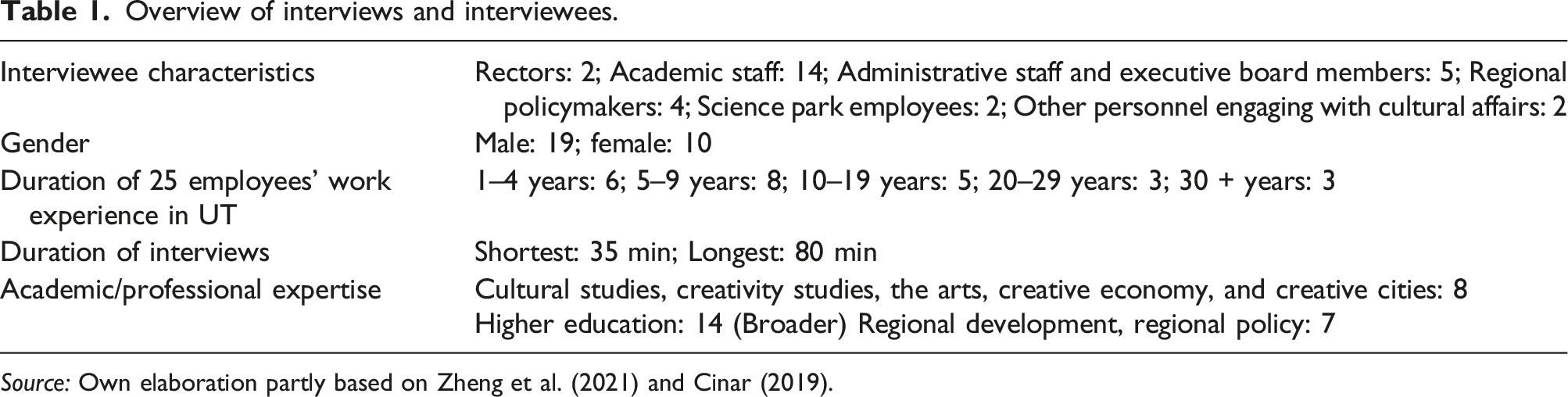
Source: Own elaboration partly based on Zheng et al. (2021) and Cinar (2019).
We conducted semi-structured interviews because they allow questions starting with ‘why’ or ‘how’ as well as prompts and probing inquiries after the main question has been asked (Warren, 2021). The interviews were transcribed with a verbatim oral approach, whereby pauses, laughter and filler words were also noted. We then mobilized open coding to form meaningful codes and categories from the data in an interpretive manner (Strauss, 1987). Following this, we administered a directed content analysis which, through its deductive features, enables researchers to start with an existing theory in forming codes and categories (Hsieh and Shannon, 2005) – the institutional complexity perspective in our case. In addition, relevant documents such as the strategic plan of UT, website content and culture and creativity related national and regional policy documents were also reviewed in order to better understand the institutional environment.
Institutional environment of UT and emergence of conflicting demands
Actors within the institutional environment
UT is located in an institutional environment, which is composed of several organizational actors with varying degrees of power and influence. These actors range from Dutch government ministries (mainly the Ministry of Education, Culture and Science and the Ministry of Economic Affairs and Climate Policy) and regional authorities (Overijssel Province and Regio Twente) to firms, municipalities and broader societal groups (i.e., non-governmental organizations (NGOs)). These actors have had several expectations of UT related to regional development: one such expectation lies within the realm of the culture and creativity driven regional contribution. Furthermore, the city of Enschede also hosts two other higher education institutions, the Saxion University of Applied Sciences and ArteZ University of the Arts, with which UT occasionally collaborates.
Emergence of CRD-related demands
In 2011, the Dutch government designated cultural and creative industries (CCI) as one of the top nine sectors in its national enterprise policy, providing further funding for innovation and regional development related initiatives for CCI, and placed paramount importance on the role of knowledge institutes in supporting them (MEAII, 2011). Since then, the discourse on culture and creativity led innovation and regional development has grown at the national level and new organizational units have been formed (e.g., the Dutch Creative Council in 2012). Expectations that universities should play a proactive role in fostering creative industries within their geographical vicinities have increasingly been articulated: ‘In order to exploit the power of the creative industry to our advantage, we need to get the education sector, knowledge institutions and the authorities working with the creative sector […] The aim is for that sector to turn the Netherlands into the most creative economy of Europe by 2020.’ (MECS, 2016: 30).
Nevertheless, the political discourse on the role of culture in innovation and regional development has already gone beyond CCIs. In 2013, the policy memorandum entitled Culture Moves: The Meaning of Culture in a Changing Society started a debate on the meaning and value of culture for the Dutch territories (MECS, 2013). Driven by the motivation to mobilize culture to tackle complex societal challenges, the scope of Dutch cultural policy has been widened to encompass social and artistic value in addition to economic value. Following these debates, the Dutch government set six priority areas within the cultural policy to strike a balance between the artistic, social and economic spheres: (a) cultural education and participation in cultural life; (b) talent development; (c) the creative industries; (d) digitization; (e) entrepreneurship; and (f) internationalization, regionalization and urbanization (MECS, 2016: 29).
In parallel with the national cultural policy, there has been a similar dynamism at regional and local levels. To illustrate, the Enschede municipality has drafted a vision to profile the city as a “technological, innovative and creative city” (Enschede Municipality, 2020). Furthermore, the regional government of Overijssel province has published a cultural policy document highlighting the need to harness the potential of culture and creativity. The policy entails four objectives: (a) preserving the cultural heritage; (b) fostering a strong cultural infrastructure and offer; (c) increasing cultural participation and investing in talent development; and (d) establishing a strong library network (Overijssel Province, 2016: 11). The strategy is designed to be “future-proof” (translated), meaning that within the cultural sphere “activities and organizations are able to adapt in a rapidly changing society” (translated) (Overijssel Province, 2016: 11). The cultural sector, NGOs and universities are among those organizations expected to adapt. The policy documents and interviewees suggest that there has been a strong interest since 2010 in, as an interviewee expressed it, ‘push[ing] universities to align with these expectations to realize national, regional and local aspirations’.
Emergence of demands relating to mission differentiation
The foundations of another institutional demand, mission differentiation, were laid down during the 2010s by the Veerman Committee. Following its analysis of the Dutch higher education system, the committee arrived at the following diagnosis: (a) the profile of degree programs and universities are too similar; (b) the system does not serve fully the different needs of the labour market and students; (c) there is little investment in talent generation; and (d) the quality of education and research is not at the desired level (Veerman Committee, 2010). Accordingly, the committee made the following recommendations: (a) multi-level differentiation in degree programs, university profiles, and overall structure of the higher education system; (b) greater specialization in teaching and research; (c) an increase in the quality of education and research; and (d) greater focus on talent generation and attraction at both national and international levels (Veerman Committee, 2010). Based on this differentiation policy, performance and mission-based funding agreements were signed between universities and the Ministry in December 2011. Through these agreements, universities agreed to greater differentiation and stronger institutional profiling (De Boer et al., 2015). As one interviewee stated, ‘mission differentiation and institutional profiling has been very important in determining university strategies’.
Characteristics of conflicting institutional demands and UT’s organizational responses
Higher education as an increasingly fragmented and moderately centralized field
Traditionally, the main external stakeholders of universities were education and research related ministries and agencies and the broader public. Since the early 1980s, universities have increasingly focused on entrepreneurship, licenses and start-ups, and intensified collaboration with industry, thus raising the number of relevant stakeholders. This has been the case for UT among many others. From the early 1980s, UT has pursued an entrepreneurial university profile (Cinar and Benneworth, 2021). During this period, new actors including firms, industrial groups and the science park have emerged. The influence of these new stakeholders on UT has been significant, shaping the direction of its third mission activities. Since 2010, UT’s engagement with regional actors has also grown, while entrepreneurship and innovation have continued to be a solid component of its institutional profiling. Regional actors have also been articulating their expectations of UT and several partnerships have developed. This has created a new wave of relevant stakeholders in addition to industry: the municipalities, regional development agencies, provincial government, regional cooperatives and NGOs. Currently, the primary actors influencing UT are the Ministry of Education, Culture and Science, the Ministry of Economic Affairs and Climate Policy, Overijssel Province, Regio Twente, Enschede municipality, the Kennispark (a science and technology park), regional industry and citizens. As an interviewee argued, ‘there is no full coordination among these actors’ and their expectations and priorities differ significantly, which leaves the field of which UT is part – higher education – fragmented.
The actors have varying relationships with UT on political, social and economic bases. Ministries provide the policy objectives for directionality and extra public funding in return for the pursuit and achievement of these objectives. They further stipulate rules, determined mutually in performance-based agreements, for the receipt of such extra funding. Therefore, the power of these actors and the basis of their relationship with UT are primarily political and economic. Industry is the source of a significant amount of the external income UT is increasingly expected to generate. The influence of industry on UT is strong and the character of the relationship is mainly economic. Regional actors such as the provincial government, the municipalities and the regional development agency have fewer economic resources to offer, but their political power, though much less than that of the ministries, and the representative nature of their agency can be strong enough to occasionally mobilize dynamics within UT, as reported by several interviewees. They can question the regional relevance of UT in a rather peripheral location. Thus, the basis of such relationships are political, social and, to a lesser extent, economic. Lastly, other societal groups, such as NGOs and citizens offer very limited economic resources but their power lies in the social realm: ‘When they feel their interests are not represented within the university, they can question the legitimacy of the public status of the UT’ – as noted by an interviewee – which may compel UT to take internal actions to reclaim its legitimacy and public relevance. In this respect, such relationships are mainly based on social contracts.
Overall, all these actors have some kind of power that they can exert to influence UT, but none of them is a sufficiently dominant force alone to mediate the complex relationships, which makes the field moderately centralized.
Nature of demands: means-level pressures
As a public university, UT has traditionally engaged with regional actors to a considerable extent in order to meet their expectations and co-shape the regional development trajectory. One recent example is its involvement in the Agenda Voor Twente, a multistakeholder consortium involving relevant partners including UT in the formulation of public policies to shape the regional development trajectory of Twente. Contribution to CRD is an expectation that is fundamentally about assisting regional development and is not an unfamiliar demand at the meso level. Regional engagement is already ingrained in UT’s organizational identity. We therefore, argue that the nature of this particular institutional demand lies at the means level.
Being a public university has required UT to develop economic and political ties with the different segments of the Dutch government. Institutional profiling related demands have occasionally emerged in the past in different forms and ‘it is already UT’s goal to differentiate itself within the higher education landscape both nationally and globally’, as articulated by interviewees. In fact, ‘the differentiation process is seen as part of re-constructing organizational identity’. In this sense, the recent mission differentiation related demands are not novel to UT either and their nature also lies at the means level. There is a difference in this case though: the scope of both demands is much broader, which means that there are important negotiations to be made.
An unbalanced internal representation of the demands
Mission differentiation is a kind of institutional demand that interests many organizational members in UT. It is, as an interviewee commented, ‘at the very core of constructing organizational identity process’. As such, this particular demand was largely represented internally within UT. The majority of the organizational members seemed to have been socialized into technology-oriented logic. In other words, their academic background, interests and professional comfort zones lay in UT adopting a technology-oriented institutional profiling. As a result, mission differentiation was largely represented and shaped by such organizational members.
Contribution to CRD, on the other hand, is a type of institutional demand that would primarily interest organizational members socialized into cultural and creativity science oriented logic. Although such members do exist in UT, they do not constitute a significant majority. UT does not have a department of culture, or a cultural studies related research center, departmental chair or degree program. Cultural and creativity science oriented members are mainly located in the departments of Communication Science, and Design, Production and Management. Their internal influence is limited. Even though some of them express discontent with UT’s growing technological institutional profiling, they do not necessarily engage in competing with the technology-oriented members. Interviewees identified two main reasons for this: (a) technology-oriented members constitute a group that is too big to compete with, and (b) cultural and creativity science oriented members have also developed socialization with regard to technological institutional profiling over the years, which has given them the ability to adapt to a changing organizational environment. Ultimately, what we observe is an unbalanced internal representation of the two demands in UT with minimal to no competition between the groups.
Compromise as a hybrid organizational response
Both of the institutional demands have permeated UT at a time when it already accommodated significant discussions about its organizational identity and the kind of vision it should adopt. The technology-oriented actors have perceived the mission differentiation as an institutional demand that grants legitimacy to their future vision of UT and as an opportunity through which this vision can be manifested. The basis of this vision was that UT should embrace its roots; that is, as an interviewee expressed it, ‘situating itself as a research-intensive technical university with digital technologies at the core of organizational identity’. The fact that this particular demand emerged from the Dutch government and was further formalized through performance agreements facilitated their cause. However, the scope of mission differentiation was quite broad and it was clear that, despite the great mobilization of organizational dynamics, some subordinate demands within mission differentiation might not be fully met. A compromise thus emerged as a natural strategy. As a response, UT has defined itself as a research-intensive technical university with technology at the core of its identity, as branded in its Vision 2030: ‘We are a university of technology’(University Twente (UT), 2020a, 2020b: 9). While UT has been able to distinguish itself to a great extent globally and partly at the national level with this strategy, it is not clear how its institutional profiling differs from that of the other technical universities in the country, Eindhoven University of Technology (TUe) and Delft University of Technology (TUDelft). To illustrate, psychology degree programs and research are clustered in both UT and TUe with a focus on the same theme, the psychology of human–technology interaction. Furthermore, we can identify several commonalities in the research clusters of UT and TUDelft (such as the use of sensors and robots in health technology as a main theme within the medical sciences research cluster). In this regard, differentiation in university profile and degree programs has so far only partly been realized.
There are, however, contextual and regional factors that, while allowing other technical universities to distinguish themselves, prevent UT from achieving full differentiation and developing a fully distinct identity. TuDelft is located in the city of Delft, part of the Rotterdam–Delft–The Hague metropolitan area. It receives significant investments from maritime industries, the Dutch defense industry and many multinational enterprises. Such an environment allows TUDelft to differentiate itself via such clusters among the technical universities. Likewise, TUe is located in the city of Eindhoven, which is part of Brabandstad metropolitan area involving such cities as Eindhoven and Tilburg. In particular, the city-region, Eindhoven, includes a fruitful innovation ecosystem known as Brainport Eindhoven. It is one of the most innovative and economically dynamic regions of the country and is also known as the Dutch capital of design and creativity thanks to strong collaboration with industrial giants such as Philips and the hosting of the annual Dutch Design Week, one of the biggest design events in Europe. Thus TUe hasbeen able to distinguish itself from TUDelft and UT along these lines. By comparison, UT is located in a rather institutionally thin environment, geographically remote from the country’s economic heartlands. The region’s ‘global connectedness is not equally developed and lacks a leading industrial sector’, an interviewee commented. This makes it rather difficult for UT to develop an organizational identity based on regional strengths and so to distinguish itself from the other institutions.
As for increasing the quality of teaching and research, UT’s efforts lie in keeping student numbers at around 10,000–12,000 to maintain the student–academic ratio, and in increasing the number of international students and academic staff. In addition, UT has recently introduced a new teaching model, the Twente Education Model, which divides a Bachelor’s degree into 12 thematic modules (15 credits each) to increase interdisciplinarity and mobilize the presumably newly synthesized student knowledge to help tackle regional complex societal challenges (UT, 2020a, 2020b).
Subordinate demands related to mission differentiation and the extent of organizational responses.

UT’s response to the demand of contribution to CRD follows a similar strategy as that in response to the mission differentiation. There are some subordinate demands on which more emphasis has been placed while others have received less attention. Mobilizing culture for tourism promotion, for instance, has not led to the development of an institution-wide strategy. The response to this particular demand is highly dependent on individual academic initiatives. One example of this is the collaboration between academic staff and a local museum on how to increase the number of domestic and international tourists. Although the museum expected the collaboration to take place in many areas, the contribution from the academic staff, according to an interviewee, ‘was reduced to automated text recognition to produce transcripts of archive files’, which demonstrates that the contribution was characterized by its relevance to the UT’s organizational identity. Similarly, contributions to culture-led urban regeneration processes materialize when such processes accommodate transition to smart city and/or smart region topics. Moreover, there seems to be an assumption within UT, as pointed out by an academic, that ‘it is Saxion University of Applied Sciences and ArteZ that should contribute to cultural tourism and culture and art driven urban regeneration in the region’.
Collaboration with cultural and creative industries and attracting the creative class are the two subordinate demands that have received most attention. There are two reasons for this, as expressed by many interviewees: (a) collaboration with cultural and creative industries fits very well with the entrepreneurial spirit ingrained in the organizational identity since early 1980s, and (b) attracting the creative class overlaps with the talent demands of mission differentiation. There is a wide array of institutional support mechanisms established to encourage academics and students to contribute into these two areas. Kennispark provides the needed support to form linkages with firms in the creative and cultural industry and for the establishment of start-ups and spin-offs within this sector. In addition, UT seems to have a strategy to attract the creative class to the region by recruiting international students, including in design-related degree programs at different levels.
The support to mobilize culture for the well-being of residents also lacks an institution-wide strategy but there is a growing dynamism in this area. UT has increased the number of cultural and art events that are open to the public. In addition, at the time of writing, it was making preparations to move some of these events and other related activities to the city center so that they become more accessible to the public. In sum, we observe a similar compromise strategy to prioritize some subordinate demands over others and shape the expected organizational response around the prioritized sub-demands.
Culture-led regional contribution related subordinate demands and the extent of organizational responses.

Discussion and conclusion
In this paper we explore how a public university located in a peripheral region has responded to the conflicting demands of contribution to CRD and mission differentiation. Our study revealed that, when neither of the demands could be ignored, the university engaged in a hybrid response strategy to satisfy subordinate elements of both institutional demands with a varying degree of organizational support. Organizational identity played an important role in the formulation of a hybrid response strategy, a finding that concurs with previous studies which have highlighted its significance in navigating complex institutional environments (e.g., Kodeih and Greenwood, 2014). However, unlike those studies, we further demonstrate that organizational identity and responses to CRD pressures are influenced by place as well as the broader institutional environment. In particular, we observe three factors at play: (i) the peripheral character of the region and the national higher education landscape; (ii) the lack of place leadership; and (iii) interpretive flexibility and the use of culture and creativity.
The first issue relates to the peripherality of the Twente region compared to other more affluent parts of the Netherlands and the composition of Dutch higher education landscape. In order to catch up with the more successful regions of the country, the regional authorities and other actors have resorted to two particular drivers of regional development: technology and creativity and culture. This has substantially influenced UT, leading to a strong emphasis on the technological core of organizational identity and a prioritization of creativity over culture due to this technological leaning. Both the region and UT monitor developments in other places and universities with a similar profile in order to strengthen links with them. Interestingly, this monitoring is not geared towards implementing the one-size-fits-all regional development strategies that have been quite common in peripheral regions over the past decades (Todtling and Trippl, 2005), but rather is an attempt by the region and UT to position themselves closely with the other two regions and universities that possess (perceived) similar characteristics while achieving a distinct identity simultaneously. In terms of higher education, this is illustrated by UT becoming a member of 4TU – a federation of Dutch technical universities aiming to increase mutual collaboration. These developments suggest that regional actors and organizations, despite being in a periphery and the absence of concerted efforts regarding CRD, are still able to exert influence on the organizational identity of a public university.
Secondly, and on a related note, while regional actors and organizations have established a vision regarding CRD, neither has so far mobilized their agency to coordinate the related activities. There is an absence of place leadership, under which such an agency can be mobilized to ensure concerted efforts and avoid fragmentation between different actors (Sotarauta, 2018). This is exemplified by UT’s perception of the distribution of roles among other universities in the region. There is an assumption that Saxion University of Applied Sciences and ArteZ are mainly responsible for meeting cultural tourism and culture-led urban regeneration sub-demands; however, there has not been a meeting or platform through which such a distribution of roles was decided and communicated. This is an outcome of what Sotarauta (2018: 195) characterizes as the “mobilization trap”, albeit in a slightly different form: regional actors may establish a common vision and each may still work towards contributing to it and yet none may show a strong interest in taking action to coordinate and monitor the related efforts.
Thirdly, the prioritization of the creativity dimension over culture stems also from a proliferation of sub-demands, which have become too many to be met simultaneously, within CRD over the past decades. This relates to a global trend – the broadening scope of cultural policy in which culture and creativity have been used interchangeably with interpretive flexibility (Throsby, 2010). This trend provides legitimacy for regional actors and organizations to prioritize some sub-demands, such as creativity over culture, and yet enables them to argue that they are working towards culture-led regional development. Considering that Dutch policymakers and universities have a long tradition of encouraging university–SME collaboration – for example, via the Innovation Alliance program (Van Vlieth and Horvath, 2004) and Science Based Business elective courses (Jousma, 2006) – this tendency to prioritize certain sub-demands is further supported by the broader institutional environment. Thus two particular sub-demands, collaboration with cultural and creative industries and talent attraction, have received the most attention and organizational effort. We therefore contend that greater nuance and specificity are needed in both the formulation and the articulation of CRD policy demands if regional actors, including universities, are expected to contribute to both culture and creativity.
Lastly, our research is an intensive single case study of a technical and research university located in a peripheral region in Western Europe. The factors affecting its responses to an institutionally complex situation may inform similar universities in the Netherlands, Europe and the rest of the world. However, there might also be other factors influencing universities’ contribution to CRD in comprehensive universities as well as higher education institutions located in core regions. CRD-related expectations, for instance, might have to be situated against other potentially conflicting demands on universities. While the factors at play in other contexts and geographies may be different, the main implications of our findings for other universities are the significance of context sensitivity and organizational identity. We therefore conclude by arguing that future studies should pay greater attention to these two particular dimensions in order to better understand how universities respond to the demand to contribute to culture and creativity led regional development.
Footnotes
Declaration of conflicting interests
The author(s) declared no potential conflicts of interest with respect to the research, authorship, and/or publication of this article.
Funding
The author(s) disclosed receipt of the following financial support for the research, authorship, and/or publication of this article: The research in this paper was supported by funding from the European Commission’s Horizon 2020 Framework Programme, H2020 Research and Innovation Programme (Marie Skłodowska-Curie Actions) grant agreement No 722295.
