




Abstract
This study analyzes the predictive factors influencing the entrepreneurial intentions of students at higher education institutions (HEIs) in a peripheral European region. The study includes a sample of 594 students and uses structural equation models for data analysis. The results show that the attitude to behavior and perceived behavioral control positively influence entrepreneurial intention. Furthermore, subjective norms positively impact the attitude to behavior and perceived behavioral control. ‘Closer’ valuation (i.e., of family, friends, etc) influences attitude to behavior and social valuation positively impacts subjective norms. This research contributes to the literature on entrepreneurial intention as it complements the Theory of Planned Behavior (TPB) with two environmental factors: closer valuation and social valuation. This is important because it provides evidence of whether the environment of the country in question influences entrepreneurial intention and indicates the need for investment in entrepreneurship education. Consequently, the study contributes to the literature by identifying educational factors that may influence students to become entrepreneurs in a peripheral European region. Further, this paper tests the relationship between the attitude towards behavior and subjective norms, perceived behavioral control and subjective norms, something not proposed in the original TPB model.
Keywords
Introduction
Entrepreneurship has been frequently studied over the years, with entrepreneurial actions and innovation identified as sources that stimulate and increase socio-economic growth. Entrepreneurship has been identified as important for the creation of new companies (Heilmaier and Ling, 2021; Lopes et al., 2018a; Omar et al., 2019) and education on entrepreneurship is becoming increasingly important in giving rise to new entrepreneurial development opportunities. In this context, academic–industry relations and cooperation are crucial; the greater the interaction, the greater the probability of creating innovative and marketable products or services. Increased innovation can cause entrepreneurship to increase as well. A respective increase in academic–industry cooperation, innovation and entrepreneurship in general leads to the socio-economic development of regions (Lopes and Lussuamo, 2021; Sanadgol and Dadfar, 2020). Recently, policymakers have been implementing policies to encourage entrepreneurship and scientific activities in an effort to make their regions more competitive (Carey and Matlay, 2011; Egerová et al., 2017; Nwajiuba et al., 2020; Sirelkhatim and Gangi, 2015).
The incentives provided by policymakers aim, among other things, to increase the quality of education on entrepreneurship, so empowering students with the necessary skills to become entrepreneurs. Entrepreneurial intention is considered a key element in creating a company (Al Mamun et al., 2016; Mamun et al., 2017).
With regard to entrepreneurial intention, identifying opportunities is crucial to an understanding of all the steps that lead to new company creation. Entrepreneurial intention is the first step in entrepreneurial behavior (Krueger and Carsrud, 1993; Molaei et al., 2014) and it explains entrepreneurship as well as the process of how the individual becomes an entrepreneur, consequently creating a new company and a job for themselves while generating more occupations for others. Entrepreneurial intention is the indicator of business activities, being composed of environmental and personal interactions, characteristics and competencies (Keat et al., 2011; Mamun et al., 2017). In this context, and given its relevance, it is important to study entrepreneurial intention to understand where starting a business is born and how it moves from idea to practice (Al Mamun et al., 2016).
Recent research has considered the environmental factors that may explain the changes in entrepreneurial activity in regions. However, as a rule, cognitive models are not considered in studies (Liñán et al., 2011). According to Liñán et al. (2011), further studies are needed to understand the values perceived in each region and to determine the motivations for an individual to start a new business. Some studies suggest that it is important to understand the key processes involved in entrepreneurship and social cognitive categories such as motivation, context, person and cognition, as these need to be considered in future studies (Liñán et al., 2011; Lopes et al., 2020; Mitchell et al., 2007). Furthermore, they recommend that the methodology used should be replicated for different samples and countries in different universities and contexts, thus deepening knowledge of the phenomenon and the differences in entrepreneurial intention between regions/countries. In this framework, and considering the gap identified in the literature, this research analyzes the predictive factors that influence students’ entrepreneurial intentions at higher education institutions (HEIs) in Portugal.
Similar to the study by Liñán et al. (2011), the empirical results of which confirmed that the appreciation of entrepreneurship in the Spanish regions of Catalonia and Andalusia helped to explain regional differences at the level of entrepreneurial intention. Considering the transformation performance of these regions (Schwab and Zahidi, 2020) and the differences involving entrepreneurial behavior, attitudes and entrepreneurial framework conditions (Bosma et al., 2021), we believe it makes sense to extend the study to the Portuguese territory.
Portugal is located in a peripheral region of Europe. Moreover, a peripheral region usually implies a low economic and social development level, which in turn implies a possible lack of political and socio-economic connections. Such regions may suffer insufficiencies concerning services of general interest, either due to a change in the technology of service provision or geographical distance (Gómez et al., 2021). Peripheral regions typically have low levels of education and science, resulting in a low level of human capital. Compared to more developed countries, the population of peripheral regions has lower income, a lower level of infrastructure, limited availability of territorial resources and an insufficient number of local policymakers (Gomes et al., 2021a; Lewandowska et al., 2021).
The present research adopts a quantitative methodology based on a sample of 594 students from HEIs in Portugal. Using structural equation models, we analyze the interrelationships between various factors, such as environmental and motivational factors, and how they influence entrepreneurial intention. This research adds new to the literature on entrepreneurial intention as it complements the Theory of Planned Behavior (TPB) with two environmental factors: closer valuation and social valuation. By studying whether subjective norms, perceived behavioral control (PBC) and attitude to behavior impact Portuguese students’ entrepreneurial intentions, one may verify which items need to be reinforced to encourage entrepreneurship in the country. Another innovation of this article is the provision of external environmental factors, such as closer valuation and social valuation, aiming to verify whether the country and its people can influence students' entrepreneurial intention. This is important as it can provide evidence as to whether the country influences entrepreneurial intention and indicates the need for investment in entrepreneurship education. The study further contributes to the literature by identifying educational factors that may influence students to become entrepreneurs in a peripheral region of Europe. Further, this paper tests the relationship between the attitude towards behavior and subjective norms, perceived behavioral control, and subjective norms, something not proposed in the original TPB model.
The article is divided into seven sections, including this introductory one in which the framing, problem and objective of the study have been set out. In the next section, a review of the literature on academic entrepreneurship is presented. In the third section, hypotheses based on the literature are formulated and the research model elaborated. The fourth section explains the methodology, with details of the entire data collection process and the statistical approach adopted. In the fifth section, we can see the results of the processing of the collected data. In the sixth section, the results are discussed against the literature. Finally, we present the main conclusions of the study, together with its practical implications and its limitations, and suggest future lines for investigation.
Theoretical foundation
Academic entrepreneurial intentions
Political and academic decision-makers see academic entrepreneurship as a fundamental element for the socio-economic development of regions and society’s knowledge (Davey et al., 2015; Perkmann et al., 2013; Rothaermel et al., 2007). Thus, policymakers worldwide have implemented policies to encourage academic entrepreneurship, which translates into creating new businesses (Ju and Zhou, 2020; Lopes et al., 2018b).
The initial stage of creating a new business is termed ‘entrepreneurial intention’, for which there are various definitions in the literature. Entrepreneurial intentions consist of an individual’s willingness to develop an enterprise (Fitzsimmons and Douglas, 2011; Schjoedt and Shaver, 2007). Likewise, entrepreneurial intentions may be perceived as planning and implementing business ideas, which are driven by a mental process (Gupta and Bhawe, 2007; Mustafa et al., 2016). Another definition of entrepreneurial intentions matches the attitudes of potential entrepreneurs regarding the opening of their own business, being a fundamental variable in predicting effective entrepreneurial actions (Boyd and Vozikis, 1994; Ju and Zhou, 2020). For the present research, we consider entrepreneurial intention as the intention of an HEI student aspiring to be an entrepreneur in a professional career.
Entrepreneurial intentions have a significant impact on the region in which they occur. In this context, HEIs are increasingly recognized for activities related to entrepreneurship and economic development – activities that form part of their “third mission”, now added to the other two HEI missions of education and research (Etzkowitz et al., 2000; Lopes et al., 2018b; Rasmussen et al., 2006). With respect to the third mission, HEIs are expected to inspire creative thinking and to develop entrepreneurial attitudes and stimulate entrepreneurial intentions among their students. It can be argues that education about entrepreneurship is relevant in the development of entrepreneurial attitudes and as a stimulus to entrepreneurship in general (Kuehn, 2008; Wach and Wojciechowski, 2016).
Important cognitive factors such as closer and social valuation have to be considered when looking to entrepreneurial attitudes. Closer valuation relates to expectations from relatives and other significant persons that may influence one’s response to entrepreneurial intention (Liñán et al., 2011; Nieuwenhuizen, 2016). On the other hand, social valuation refers to explicit societies or groups responsible for developing personal skills or qualities that can impact how an individual views entrepreneurship (Liñán et al., 2011). Social valuation has a wide degree of acceptance across cultures (Scrivner et al., 2021).
Moreover, social valuation augments the ability of individuals to participate in the search for, discovery of and exploitation of entrepreneurial opportunities (Malebana, 2014b), and is related to the peripheral environment (which may include government policies and programs that support entrepreneurship) and a culture that pays attention to entrepreneurship (Nieuwenhuizen, 2016). According to Scrivner et al. (2021), the human brain seems to be furnished with a composite psychology of social valuation and a collection of emotions to recalibrate the internal depictions of social value in the mind of the individual or others, and the valuation is closely associated with the degree to which an individual negatively or positively impacts the capability of the valuer.
Entrepreneurial behavior
With regard to the study of entrepreneurial intentions, two main streams are apparent in the literature. The first relates to social psychology and the second to entrepreneurship (Liñán and Fayolle, 2015). Authors such as Ajzen and Fishbein (1980) and Bandura (1997) have contributed to the body of knowledge in the first stream. These authors aimed to study behaviors and to clarify the mental process that leads individuals' beliefs and attitudes into effective actions. Another important contribution in the first stream is the development of the TPB by Ajzen (1991). The TPB has become one of the most frequently applied social psychology theories (Ajzen, 2020; Liñán and Fayolle, 2015). According to the TPB, behavioral intentions are based on three factors: (1) the attitude towards a certain behavior; (2) the perceived behavioral control, sometimes also called viability; and (3) the social norms that shape the perception of this behavior. The first two factors represent the convenience and the desired occurrence of the behaviour, while the third factor portrays the self-perception of the ability to control behavior, which is regularly called self-efficacy (Ajzen, 2011; Wach and Wojciechowski, 2016). Furthermore, a closer social evaluation of entrepreneurship in the context of the TPB to examine entrepreneurial intentions among university students helps to ascertain the entrepreneurial intention of a particular region or country, taking into account the possible contributions of the conditions, culture and social valuation associated with the promotion of entrepreneurship (Apasieva et al., 2021; Kautonen et al., 2013; Liñán et al., 2011, 2013; Lopes et al., 2021; Martins and Perez, 2020).
The second stream is directly related to entrepreneurship (Gieure et al., 2019; Bird, 1988; Roy et al., 2017; Shapero, 1984; Shapero and Sokol, 1982). Authors define a person’s entrepreneurial intention as a self-recognized conviction that they want to create and establish a new venture and consciously planning and putting it into practice in the future (Gieure et al., 2019; Thompson, 2009). In this stream, the Entrepreneurial Event Model (EEM) is emphasized, and is often referred to in the literature as Shapero’s Entrepreneurial Event (SEE). The SEE emerged from a study by Shapero (1975) and was further developed by Shapero and other authors. In turn, Krueger (1993) contributed significantly to the development of the EEM by introducing external factors to the original model; occasionally, therefore, the EEM or SEE is also mentioned in the literature as the Shapero-Krueger model (Krueger et al., 2000).
The EEM argues that entrepreneurship can happen when an event (for example, loss of employment) intervenes and forces the individual into responsive action. The credibility of a behaviour is equally important to entrepreneurial intentions; credibility refers to the viability and desirability factors that shape entrepreneurial intentions. In summary, a given entrepreneurial intention is shaped in a broader context, involving various behavioral and personal factors (Elfving et al., 2009; Wach and Wojciechowski, 2016).
Hypothesis development
Motivational factors
The TPB is the theory that is best-suited to explain behavior and entrepreneurial intention (Lopes et al., 2021; Tornikoski and Maalaoui, 2019). According to the TPB, behind an individual’s decision to create a new company in a given market are three motivational factors: 1) attitude towards the behavior; 2) PBC; and 3) subjective norms (Ajzen, 1991; Liñán et al., 2011). In general, academics agree that attitude towards behavior and PBC are antecedents of entrepreneurial intentions (Morales-Alonso et al., 2016) and subjective norms (Ajzen, 1991; Gomes et al., 2021b; Lu et al., 2021).
The first factor, attitude towards the behavior, assesses the degree of compliance with a particular behavior. In the context of this research, this factor reflects the attractiveness of being an entrepreneur for a particular individual (Kyvik, 2018). This factor has critical relevance to entrepreneurial intention. As favorable as the viability and social support may be, a lack of desire to become an entrepreneur automatically implies a lower intention of becoming one (Morales-Alonso et al., 2016). Previous studies have pointed out that attitude towards the behavior is the most relevant of the three factors in the TPB (Engle et al., 2010; Gird and Bagraim, 2008; Liñán et al., 2011; Lortie and Castogiovanni, 2015; Malebana, 2014a; Urban, 2014; Urban and Chantson, 2019). Thus, we expect that the results will indicate that the personal impacts resulting from individuals' behavioral beliefs will be positive, and the levels of business intentions will rise.
Other authors argue that there are further important aspects of entrepreneurial motivation, such as activation, selection-direction, preparedness of response, or the level of aspirations (Carsrud and Brännback, 2011; Lopes et al., 2021). Cognitive dissonance and risk, or work motivation, can also be assumed as sources of motivation for entrepreneurship. Motivation can still be seen as the nucleus of biological, cognitive and social regulation. On the other hand, reciprocity exists where attitudes influence behaviors and behaviors influence attitudes (Carsrud and Brännback, 2011; Gomes et al., 2021a). • H1: Attitude towards the behavior has a positive impact on entrepreneurial intention.
The second factor, PBC, concerns the feasibility of realizing the behavior. PBC is further defined as beliefs about the factors understood that hinder or facilitate the realization of the behavior (Ajzen, 2002; Morales-Alonso et al., 2016; Urban and Chantson, 2019). As a rule, it includes the ability to overcome setbacks, intellectual capacity, skill assessments and dealing effectively with barriers (Gieure et al., 2019). When individuals have a very high degree of perceived control over their behavior, this strengthens the intention to take the necessary measures to achieve their goals, thereby increasing perseverance and effort. In this context, the intention completely mediates the effect of PBC (Ajzen, 1991; Urban and Chantson, 2019). As a rule, individuals prefer to adopt behaviors that they believe in, as they will dominate and control them (Gieure et al., 2019). • H2: Perceived behavioral control has a positive impact on entrepreneurial intention.
The third and final factor, subjective norms, consists of what an individual understands about the beliefs and expectations of people who influence their life (examples: family, friends, colleagues, mentors or models), as well as the creation of a company (Ajzen, 2001; Krueger et al., 2000; Urban and Chantson, 2019). In some studies, PBC has a diminutive influence on entrepreneurial intent (Autio and Acs, 2010; Krueger et al., 2000; Liñán et al., 2013; Miralles et al., 2017). On the other hand, some studies claim that subjective norms can affect attitude towards the behavior (Kolvereid and Isaksen, 2006; Liñán and Chen, 2009; Liñán et al., 2011). Although society’s entrepreneurial values influence the perceptions and beliefs of a certain individual, the social norms of friends, family and other relationships can also exert their influence. These standards may still affect PBC (Benavides-Espinosa and Roig-Dobón, 2011; Gieure et al., 2019). • H3: Subjective norms positively influence (a) attitude towards the behavior and (b) perceived behavioral control.
Environmental factors
In addition to motivational factors, environmental factors, composed of a wide range of factors including technological, political, social, demographic, economic and cultural, emerge in the literature as influencing entrepreneurial intention (Luthje and Franke, 2003; Sesen, 2013). In this context, academics studying entrepreneurship have highlighted cultural variations in the different business behaviors between regions and countries (Davidsson, 1995; Hayton et al., 2017; Mueller and Thomas, 2001). Culture can be understood as a set of rules, ideals and values that a particular group has in common. Thus, cultural values can influence entrepreneurship in a region, and may stimulate positive attitudes towards the creation of companies. Cognitive social capital arises from ideas and mental processes that are influenced by ideology and culture, which in turn create values, trust and beliefs that must be properly taken into account when creating a new business (Davidsson, 1995; Liñán et al., 2011; Nahapiet and Ghoshal, 1998).
Still, concerning cognitive social capital, strong ties with friends or family will also impact the creation of value, shared narratives, languages and trust. In this manner, closer valuation (the evaluation of people important to the individual about entrepreneurship) influences the development of favorable entrepreneurial perceptions concerning the creation of a company (Kim et al., 2006; Scherer et al., 1991). Therefore, the expectations of friends and family and others important to the individual relate to attitude towards the behavior and subjective norms but not to PBC (Liñán et al., 2011; Urban and Chantson, 2019).
That said, the perception of the environment and positions regarding the environment play an essential role in creating entrepreneurial intention (Ao and Liu, 2015; Jack and Anderson, 2002). Individuals can be driven or hindered because their entrepreneurial intention is affected by situational factors, and situational factors are correlated with individuals' own experiences. Therefore, the environment can stimulate entrepreneurship and may affect individuals' behaviors and attitudes (Hisrich, 1990). If the environment supports entrepreneurship individuals are more likely to carry out entrepreneurial activities, as they will tend to believe that the environment is authorizing their choice to become an entrepreneur (Liñán, 2008).
On the other hand, social and cultural antecedent factors can prevent young people from becoming entrepreneurs (Ao and Liu, 2015; Fatoki, 2010; Takyiasiedu, 1993). The values resulting from the inclusion of an individual in a given society, or group, shape the development of personality traits and skills, thus determining normative perceptions and the capacity for entrepreneurial activity. Therefore, the social valuation of entrepreneurship has a fundamental role in a potential entrepreneur’s behavior (Liñán et al., 2011; Thomas and Mueller, 2000; Zahra et al., 2017). • H4: Closer valuation has a positive impact on (a) Attitude towards the behavior and (b) subjective norms. • H5: Social valuation has a positive impact on (a) subjective norms and no impact on (b) perceived behavioral control
Figure 1 provides a summary of the research model and its hypotheses. The research model and its hypotheses.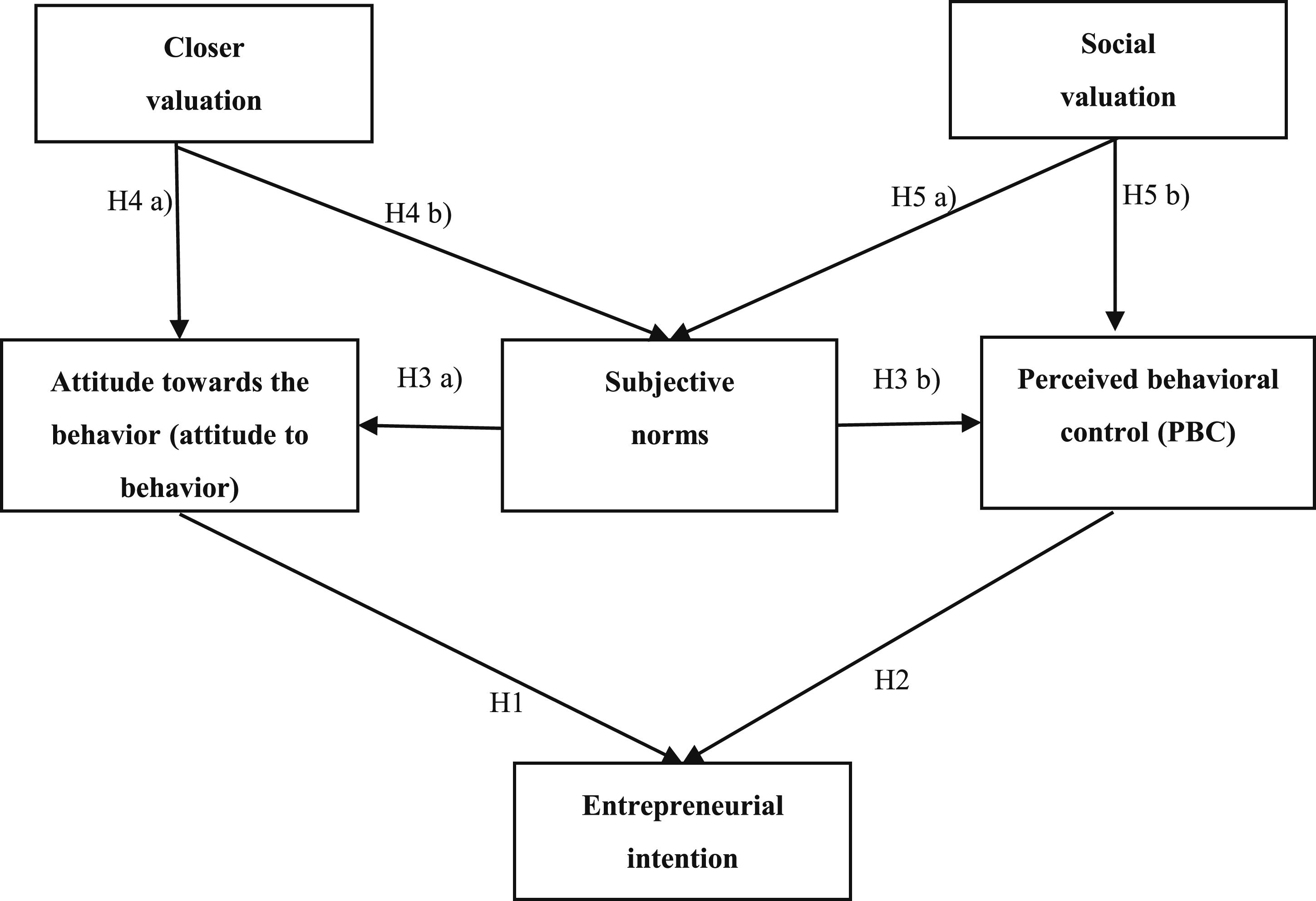
Methodology
Methodology and sample
Academics and policymakers view entrepreneurial intention and entrepreneurship as a source of socio-economic growth. This study examines entrepreneurial intention in higher education in Portugal. The questionnaire distributed to higher education students was based on the scales used by Liñán et al. (2011) and Lopes et al. (2020). The questionnaire used 7-point Likert scale questions, where 1 corresponded to “total disagreement” and 7 to “total agreement”. The first part of the questionnaire presented the four constructs related to the TPB (motivational factors – attitude towards the behavior, PBC, subjective norms – and entrepreneurial intention), represented by 20 variables.
To collect a significant number of responses, the questionnaire was sent by email directly to the HEIs for forwarding to their students. To check the adequacy of the sample size a priori, the G * Power software was used with the following criteria: effect size (f2) of 0.15; significance level (α) of 0.05; 0.95 test power (Hair et al., 2017). Given these criteria, the minimum a priori sample would be 107 responses. However, this goal was exceeded with the collection of 594 valid responses from 43 HEIs in Portugal over 17 months (2017/2018). Of the 594 responses, 56.1% were students in the first cycle of studies (undergraduate), divided evenly over the 3 years, with the last year having slightly more responses than the first 2 years. Students in the second cycle of studies (Master’s) accounted for 31.1% of the answers, and those taking higher professional/technical courses accounted for 6.7%. Finally, students in the third cycle of studies (doctorate) accounted for 6.1%. Ages varied from 18 to 68, with an average of 27.3.
A structural equation model was used to examine the relationships between the constructs (Zhang et al., 2015; Nunnally, 1978). In social sciences, the application of a structural equation model enables the effective development of analysis and confronts theory with practice, which not only results in the optimization of theoretical models but leads to the optimization of tools used in the diagnosis of reality (Tarka, 2018). Finally, in the first phase, the data collected were organized in Microsoft Excel 2016. In a second phase, the results were imported into Amos software (v.22, SPSS, from IBM, Chicago, IL), where the structural equation modelling tested the relationships of the proposed model (Figure 1).
Results
A two-step strategy was used to adjust the model. First, the measurement model was adjusted and then the structural model was adjusted.
Measurement model
Initially, there were no outliers from the Mahalanobis distances and the respective significance values (p1 and p2 < 0.001). Then, the normality of the data was verified through skewness and kurtosis values (Kline, 2015; Marôco, 2014). As all variables presented skewness values below 3 and kurtosis values below 7, the normality of the data was assumed. The mean of each variable’s responses varied between 2.93 and 5.56, with a standard deviation of 1.37 and 2.01 and a standard error of the mean below 0.1.
Convergent validity and Cronbach’s alpha.
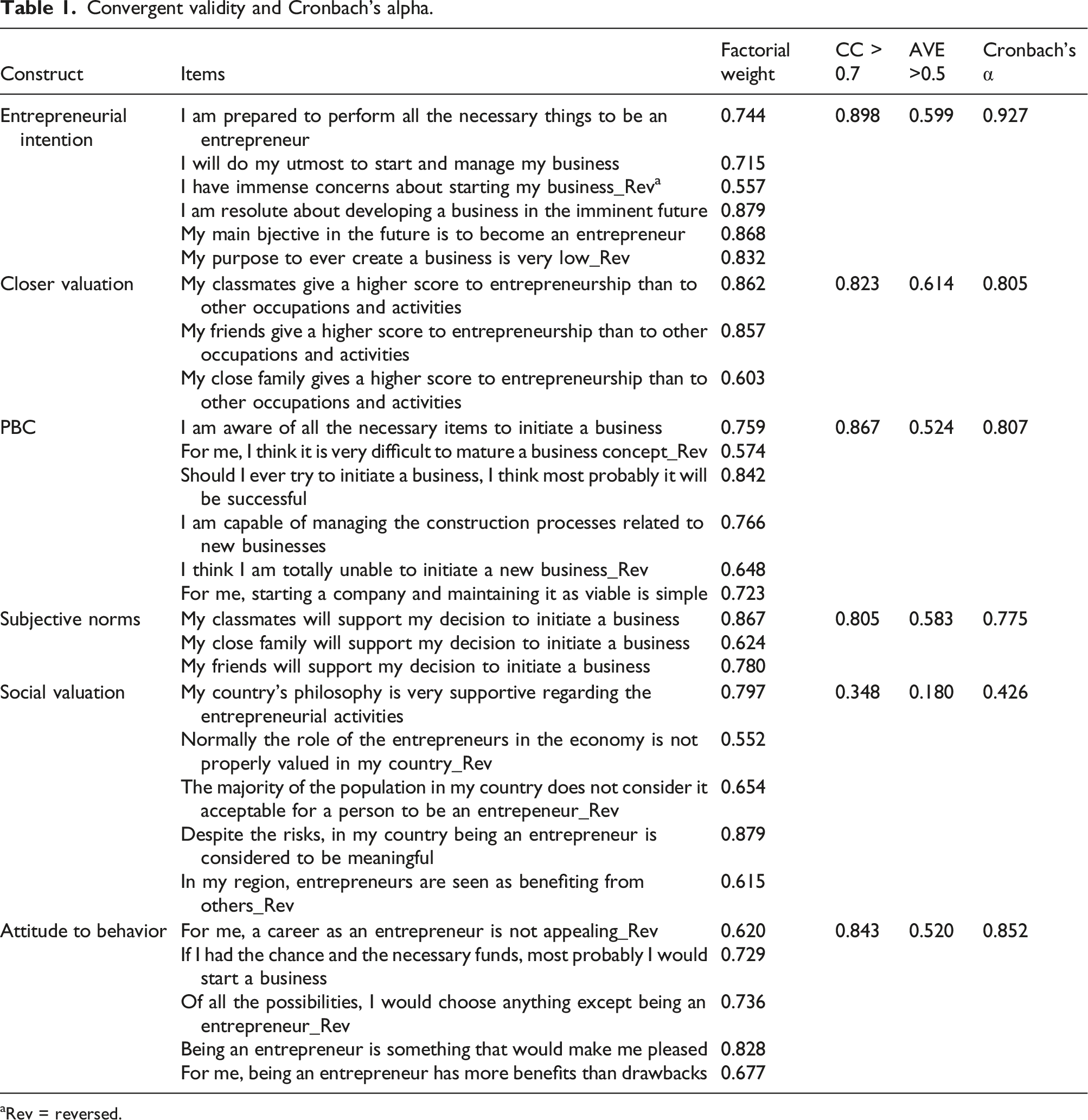
Rev = reversed.
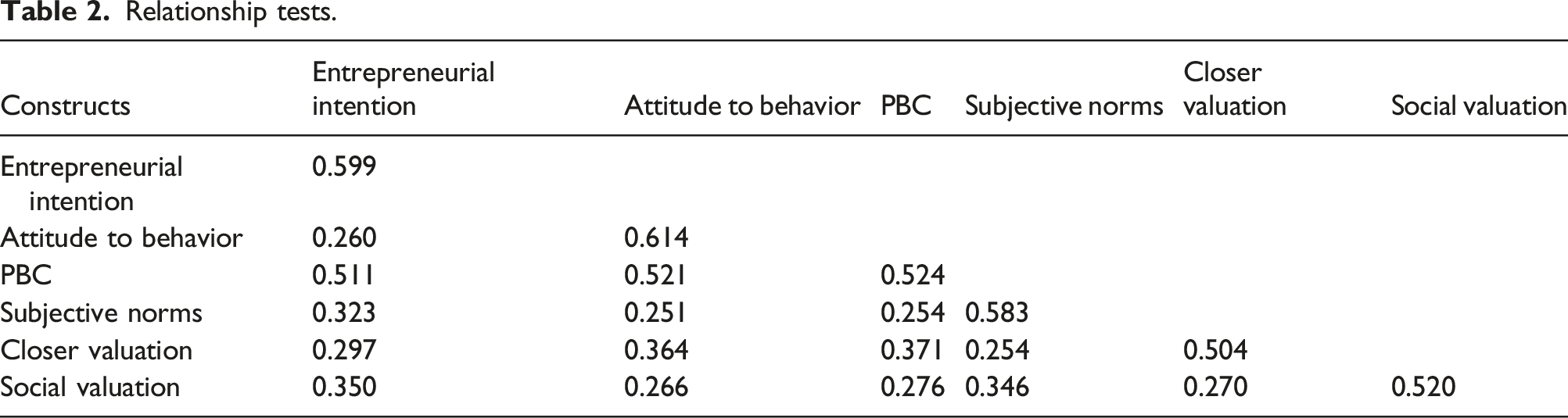
These measures are considered adequate for values of CC > 0.7 and AVE > 0.5 (Marôco and Garcia-Marques, 2006). Apart from the social valuation factor, all other factors presented factorial loads above 0.5, with CC greater than 0.7 and AVE greater than 0.5 (an indicator of adequate convergent validity). On the other hand, the Cronbach’s alpha coefficient was assessed using the reliability of all factors, and values greater than 0.7 are considered to show acceptable reliability (Marôco and Garcia-Marques, 2006). Finally, the quality of adjustment was assessed, χ2, the quotient
Relationship tests.
Structural model and hypotheses testing
After validating the measurement model, the structural model and its respective hypotheses were evaluated. The relationships of the eight hypotheses were tested in AMOS. The fit indices of the structural model were acceptable (Marôco, 2014). Thus, the model has a reasonably good fit with the covariance variance structure of the 28 items analyzed: χ2 = 885,795; χ2/df = 2.83; GFI = 0.901; CFI = 0.927; TLI = 0.912; RMSEA = 0.056 and the 90% CI (RMSEA) = [0.052; 0.01]; SRMR = 0.0779. The proportion of the variance, the R2 of the model, is 87%, reinforcing that the model’s antecedent factors explain 87% of the entrepreneurial intention construct.
In light of the results obtained, eight of the seven hypotheses were supported (Figure 2). Structural model and hypotheses tests.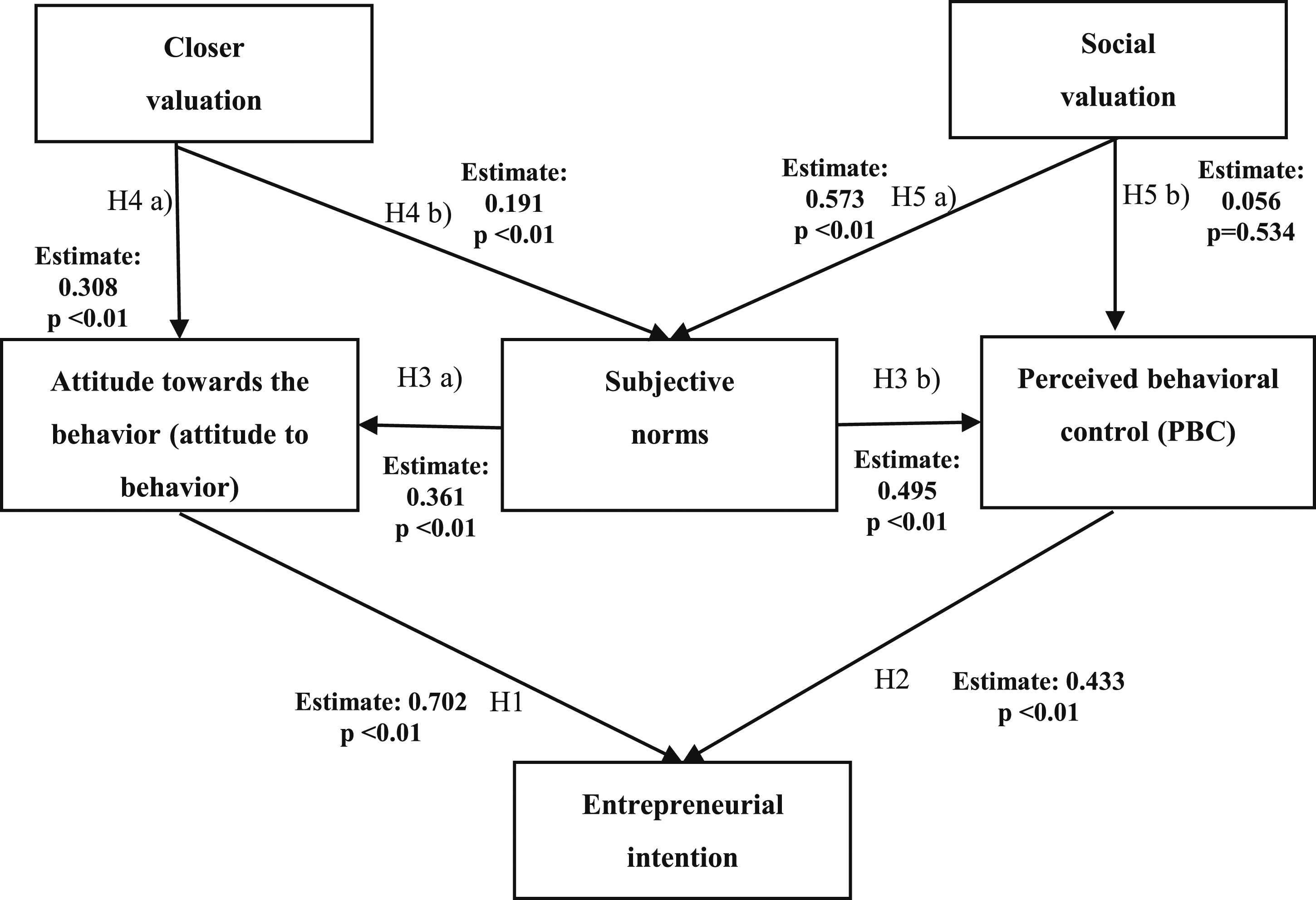
Hypothesis H1, to test whether attitude towards behavior positively influences entrepreneurial intention, is supported (β = 0.702; p < .01). Hypothesis H2, to test whether PBC positively impacts entrepreneurial intention, is supported (β = 0.433; p < .01). Hypothesis H3a), proposed to assess whether subjective norms positively impact attitude towards behavior is supported (β = 0.361; p < .01). Hypothesis H3b), to test whether subjective norms positively impact PBC, is supported (β = 0.495; p < .01). Hypothesis H4a), to test whether closer valuation positively impacts attitude towards behavior, is supported (β = 0.308; p < .01). Hypothesis H4b), proposed to verify whether a closer evaluation positively impacts subjective norms, is supported (β = 0.191; p < .01). Hypothesis H5a), proposing a positive relationship between social valuation and subjective norms, is supported (β = 0.573; p < .01). Finally, hypothesis H5b), aiming to verify whether or not social valuation has a positive impact on PBC, is supported ((β = 0.573; p < .001).
Discussion
This research, conducted using a sample consisting of 594 students from Portuguese HEIs, aimed to identify the predictors of students' entrepreneurial intention in a peripheral European region. The results indicate that the HEIs at which the surveyed students were studying were fulfilling the third mission of HEIs with respect to encouraging entrepreneurial activity (Etzkowitz et al., 2000; Lopes et al., 2018b). To verify entrepreneurial intention, the TPB was adopted (Ajzen, 1991) as the most suitable theory for explaining behavior and entrepreneurial intention (Tornikoski and Maalaoui, 2019). As noted above, all hypotheses were supported. Thus, concerning H1, attitude towards behavior was found to positively influence entrepreneurial intention, indicating that for these students becoming an entrepreneur seemed attractive and a potential career choice – this finding is corroborated by the findings of Kyvik (2018). This means that there is an attitude towards a more entrepreneurial behavior and a more positive attitude towards the intention of engagement.
With regard to H2, PBC was found to be a crucial factor for this sample of students with regard to the intention to undertake an entrepreneurial career. This indicates that the students were willing to start a business in the future, tended not to think it would be difficult to start a business, and considered that they had the knowledge to do so (Ajzen, 1991; Urban and Chantson, 2019). This finding points to the importance of academic education and investment by universities in entrepreneurship (Davey et al., 2015; Ju and Zhou, 2020; Lopes et al., 2018b).
As for hypotheses H3a) and H3b), the results indicate that subjective norms also influence the attitude to behavior and PBC of students, thus demonstrating that the beliefs and expectations of people close to the students, such as family members, friends, colleagues and mentors, could impact their decision to undertake an entrepreneurial activity (Ajzen, 1991; Krueger et al., 2000; Urban and Chantson, 2019). The results relating to these two hypotheses are consistent with the findings of several previous studies that subjective norms impact the attitude to behavior and PBC (Benavides-Espinosa and Roig-Dobón, 2011; Gieure et al., 2019; Kolvereid and Isaksen, 2006; Liñán and Chen, 2009; Liñán et al., 2011). The findings reinforce the importance that universities and their professors may have in providing incentives for entrepreneurship, given that many students may regard their professors as mentors and take their advice with reference to certain decisions. Consequently, education in and the propagation of entrepreneurship in universities can have the potential to awaken a student’s intention to undertake an entrepreneurial activity. Thus the motivational factors proposed by the TPB were once again supported in this sample of students as influencing entrepreneurial intention – a finding supported by the results of various previous studies (Ajzen, 1991; Liñán et al., 2011; Lopes et al., 2018b).
Environmental factors were tested with hypotheses H4a) and H4b). The results show that closer valuation influences attitude to behavior and subjective norms. Thus factors such as the country’s culture, the role of the entrepreneur in the economy, the value friends attach to entrepreneurship, how much entrepreneurship is valued in the culture of the country, and the associated risks were taken into account by these students in relation to adopting an entrepreneurial behavior. Reference models, portrayed by the subjective norms, can encourage entrepreneurial intention, as previously argued by Davidsson (1995) and Liñán et al. (2011). These are two novel hypotheses that have been little tested in the literature.
The results for H5a), which proposed a positive relationship between social valuation and subjective norms, demonstrate that if family, friends and colleagues place greater value on entrepreneurship than on other career options, this may impact subjective standards. This relationship may be significant, since these family members and friends are the same people who represent the subjective norms and thus support the student’s intention to undertake entrepreneurial activity. Finally, concerning hypothesis H5b), it was found that social valuation did not have a positive impact on PBC, thus indicating that the people with whom the student relates and the environment in which he or she is located do not influence a favorable behavior towards entrepreneurial intention – a finding that is not consistent with that of Liñán et al. (2011). Thus we find that social norms positively impact the attitude to behavior, but have no impact on PBC.
The results therefore indicate that motivational and environmental factors influenced these Portuguese students' entrepreneurial intention, either directly or indirectly. This reinforces the argument that teaching programs should consider adding new knowledge to curricula to involve students in more actions that may awaken entrepreneurial interests, encouraging them to develop entrepreneurial intention. Similarly, if students are not part of a circle that values entrepreneurship, the university has an even more important role in stimulating entrepreneurship. Identifying the factors that will contribute to the development of entrepreneurial intention and encouraging them may be crucial in enabling students to realize their entrepreneurial potential. Determining for the students to become an entrepreneur in the future.
Conclusions, implications and future research
This study sought analyze the predictive factors influencing students' entrepreneurial intention at HEIs in Portugal, a peripheral European region. It is concluded that attitude to behavior and PBC positively impact entrepreneurial intention, and that subjective norms positively impact attitude to behavior and PBC. The results show that those whose surroundings (culture and social contacts) place greater value on entrepreneurship have a more positive attitude towards entrepreneurship, and perceive that they have the skills to start a business more often than those whose surroundings have a more negative attitude towards entrepreneurship. Concerning PBC, it was found that some students had a plan regarding their intention to undertake entrepreneurship and considered themselves ready to do so. Regarding subjective norms, it seems that third parties, such as family, friends and colleagues, may have influenced the intention to undertake.
It was also observed that closer valuation impacted attitude to behavior and subjective norms. These results indicate that the country’s culture and people who are close to the student may encourage their entrepreneurial intention. Thus an entrepreneurial culture in a country is important for the development of entrepreneurial activity. The results also indicate that social evaluation positively impacts subjective norms, reinforcing that, if the country has an entrepreneurial culture and values, it tends to motivate the population and influence entrepreneurial intention via subjective norms. Finally, a positive relationship between social valuation and PBC was not confirmed, indicating that the country, in this case, Portugal, tended not to influence entrepreneurial behavior. This result might alert the country to invest more in education for entrepreneurship and to encourage more entrepreneurial behavior in students.
As for its theoretical contribution, this study contributes to the literature on entrepreneurial intention mainly by complementing the Theory of Planned Behavior with two environmental factors; closer valuation and social valuation, thus expanding the model proposed by Ajzen (1991) and Liñán et al. (2011). The study also contributes by replicating in a different context (Portugal, a peripheral European region) the model proposed by Liñán et al. (2011) and applied in Spain. A further contribution to the literature lies in the study’s identification of what factors may influence Portuguese students' development of entrepreneurial intention. This study also adds to the use of the TPB as the most appropriate theory for explaining entrepreneurial behavior (Tornikoski and Maalaoui, 2019). An innovation in this research was the testing of the relationship between attitude towards behavior and subjective norms and PBC and subjective norms – something not proposed in the original TPB model (Ajzen, 1991; Barbera and Ajzen, 2021).
In practical terms, this research confirms that the TPB can explain the Portuguese students' entrepreneurial intention and that environmental factors such as closer valuation and social valuation can impact the adoption of entrepreneurial intention. The results indicate that subjective norms may encourage entrepreneurial behavior: thus universities should encourage education on entrepreneurship, conduct lectures with entrepreneurs, and create and develop mentoring processes for students with reference models to stimulate their’ entrepreneurial potential.
As for the study limitations, the use of non-probabilistic sampling for convenience should be noted. The subjective norm construct had a lower value than expected in the validation indexes, which indicates that the items that make up this factor could be adjusted in the future. Thus, future research might replicate this model in other regions and countries, thus contributing to its validation process and its respective constructs. The model could be replicated to analyze entrepreneurial intention in specific regions in Portugal to verify whether in certain regions environmental and individual factors tend to have a greater impact on entrepreneurial intention – this would enable comparative studies to be carried out. Future research might also use differentiated samples, by focusing on students in management, engineering, technology, or other disciplines and taking account of whether the university has an innovation hub or an entrepreneurship discipline that might impact students' entrepreneurial intention. Control variables might also be applied, such as autonomous work experience, work experience for others, gender, age or country of origin, thus establishing comparisons between them to verify influences on entrepreneurial intention. Additional studies should be undertaken to test the direct effect of subjective norms on entrepreneurial intention. We recommend analyzing the effects in Portugal of practice-oriented education (polytechnics) versus theory-oriented education (universities) on entrepreneurial intention in parallel with the TPB. Other studies might also verify the differences in entrepreneurial intention between students in private and public educational institutions in parallel with the TPB. A further suggestion is to analyze differences between students in entrepreneurship education and those not in entrepreneurship education. Finally, for future research, the environmental factors of closer valuation and social valuation can be used as moderating variables between the attitude to behavior, PBC and subjective norms and the intention to undertake an entrepreneurial activity, testing whether the relationship becomes stronger with the insertion of this moderator.
Footnotes
Declaration of conflicting interests
The author(s) declared no potential conflicts of interest with respect to the research, authorship, and/or publication of this article.
Funding
The author(s) disclosed receipt of the following financial support for the research, authorship, and/or publication of this article: This work is supported by national funds through the FCT – Portuguese Foundation for Science and Technology under the project UIDB/04630/2020.
