




Abstract
The role of disability in producing disadvantage in employers’ hiring assessments was explored in a factorial survey, where a random sample of Norwegian employers (n = 1341) evaluated fictional job-seeker profiles. The results revealed that including an impairment description in a job-seeker profile significantly decreased the likelihood that employers would want to hire a candidate. The degree of disadvantage varied with the type of impairment. Being eligible for a wage subsidy scheme improved employers’ assessments of candidates while including information about other types of support measures did not. Furthermore, when an impairment description was introduced into a job-seeker profile, other crucial characteristics of the job seeker lost some or all of their impact on employers’ assessment scores. These findings are interpreted as disability becoming a ‘master status’ when employers make hiring assessments.
Keywords
Introduction
Disabled people continue to have a marginalised position in labour markets across the globe, with their employment levels falling far below those of people without disabilities. Across OECD countries, disabled people are found to have an average employment rate 27 percentage points lower than that of non-disabled people (OECD, 2022). The introduction of discrimination protection laws and high investments in active labour market policies in many welfare state settings has not led to the anticipated improvement in employment rates. This makes the employment gap and solutions an ongoing puzzle and policy challenge in these settings. Although 182 Member States have ratified the United Nations Convention on the Rights of People with Disabilities (CRPD), where equal access to employment is one of the explicit goals, a consistent gap between ideals and reality continues to exist.
Although the reasons behind this employment gap are complex and multifaceted, it is well recognised that employers, as gatekeepers, play an important role in facilitating access to employment for disabled people. The important role of the demand side has increasingly gained attention in the literature. Previous studies have found that a gap exists between employers’ expressed attitudes towards disabled people, which tend to be positive, and their actual hiring practices (Burke et al., 2013; Ju et al., 2013; Stuart, 2006). Research on disabled job seekers tells stories of discrimination in recruitment processes (Baldwin and Marcus, 2006; Chhabra, 2021; Thornicroft et al., 2009; Vedeler, 2014), which have been confirmed by correspondence experiments documenting that disclosing an impairment in a job application, even for jobs where the impairment is unlikely to affect productivity, leads to reduced chances of being called back for an interview (Ameri et al., 2018; Baert, 2016, 2017; Bellemare et al., 2018; Bjørnshagen, 2021; Bjørnshagen and Ugreninov, 2021; Hipes et al., 2016; Krogh and Breedgaard, 2022; Ravaud et al., 1992). These studies have documented that disability has a large adverse impact on the chance of exercising agency in different labour markets and that employer reluctance to hire disabled people represents significant barriers to this group’s equal access to employment.
Although such correspondence studies are the best available method for documenting the recruitment behaviour of employers, and they have high external validity, the method still lacks the flexibility to explore additional factors that influence employers’ hiring assessments. Usually, only one or a few manipulations are applied in each study due to obvious cost and time concerns. Factors other than disability that can moderate or enhance the level of discrimination exhibited by employers are rarely included. It is also resource demanding to compare different types of disabilities within the same research design, time frame and labour market context.
The overall aim of this article is to explore the centrality of disability in producing disadvantages in employers’ hiring assessments by using a factorial survey (FS) experiment on a sample of Norwegian employers (n = 1341). The factorial survey allows for a multidimensional approach to the study of employer attitudes, where several individual characteristics of the job seeker and information about different types of support measures can be investigated simultaneously. This makes this study a novel contribution to the literature on employers’ hiring attitudes towards disabled people, which presents not only the question of (a) whether impairment impacts employers’ hiring assessments but also how (b) type of impairment, (c) publicly financed support measures and (d) other individual characteristics of the job seeker impact employers’ hiring assessments of disabled people, compared with their assessment of job seekers without a disclosed disability. Relying on a relational understanding of disability (Shakespeare, 2014), in which disability is viewed as a product of an interaction between the impairment and the environment, a comparison is made of the presence of disabling tendencies in employers’ evaluations of different types of impairments and how information about support measures and other characteristics of the job seeker influences these assessments.
The Norwegian labour market is an interesting case for studying disability employment for two reasons. First, Norway is known for its low unemployment rate among the general population and its well-functioning labour market. Second, Norway has high expenditures on active labour market policies and generous support measures designed to facilitate disabled people into employment and compensate employers for making workplace adjustments. Despite these seemingly good conditions, disabled people in Norway continue to have a low and stable employment rate, which has been characterised as ‘mediocre’ in comparison with other OECD countries (Tøssebro and Wik, 2015: 9). In 2021, 37.5% of self-reported disabled people in Norway were employed, compared with 78.4% among the general population (Statistics Norway, 2022). In reference to this paradox, the OECD (2006: 14) reported that the ‘main challenge for Norway is to understand why the existing frameworks, which look good, are not delivering’.
Literature review, theory and hypotheses
Empirically, it is well documented that disclosing a disability when applying for a job leads to high levels of discrimination across the labour market context (Ameri et al., 2018; Baert, 2016, 2017; Bellemare et al., 2018; Bjørnshagen, 2021; Bjørnshagen and Ugreninov, 2021; Hipes et al., 2016; Krogh and Breedgaard, 2022; Ravaud et al., 1992). Theoretically, this hiring discrimination has been explained with concepts borrowed from traditional feminist organisational critiques. Foster and Wass (2013) found in their exploration of the concepts of ideal worker and organisational misfit that today’s modern jobs are designed around ideal, non-disabled workers, which serves to disadvantage people with impairments in modern work organisations. Inspired by Acker’s (1990) theory of abstract jobs, which are jobs designed for the ‘disembodied worker’ that effectively disadvantage women, Foster and Wass (2013: 709, emphasis in original) argue that impaired people also are ‘effectively disabled as a consequence of dominant organisational ideas’. This is because people with impairments often do not fit standardised and predefined job descriptions, which effectively disqualifies or disables them from many jobs. A recent study also found that employers’ ideal worker is not only a good person–job fit, but also a good ‘fit’ socially, which a job seeker in a wheelchair was assessed by the employers as less likely to be (Østerud, 2022). Østerud’s (2022) follow-up interviews after a Norwegian correspondence experiment revealed that these were the main reasons why employers had a smaller likelihood of inviting the wheelchair user to a job interview than non-disabled candidates.
Based on this ideal worker perspective and numerous empirical studies, it is clear that people with disabilities face discrimination in recruitment situations. Hence, this study expects to find that:
H1: Employers will, in a factorial survey, assess job seekers with an impairment as less likely to be hired compared with job seekers without an impairment.
However, an important aim of this study is to further elaborate on the ideal worker perspective by testing additional hypotheses, namely: whether the degree of perceived misfit varies with type of impairment, if public support measures can compensate for the perceived misfit produced when a job seeker discloses an impairment and to what extent disability is a master status that triggers employers’ perceived misfit of the candidates.
Indeed, it has been suggested that the level of discrimination depends on the type of impairment (Andersson et al., 2015; Chhabra, 2021). Some have even suggested that a hierarchy exists in people’s general perception of disabled people (Deal, 2003), although this has only briefly been explored from the perspective of employers making hiring assessments. One Swedish study compared employers’ attitudes towards different types of disabilities in a factorial survey experiment. The researchers found that employers were less inclined to hire persons with intellectual, cognitive, or psychiatric disabilities and more inclined to hire persons with physical disabilities (Andersson et al., 2015). However, the sample size of this study was small (212 employers), and people with sensory impairments and non-disabled people were excluded from the research design.
Other studies have focused on how the type of impairment affects the likelihood of being employed. Although these studies do not measure employers’ hiring attitudes, they could reflect the barriers that the different groups face in finding employment. From these studies, it is evident that those with hearing impairment have the highest likelihood of being employed, whereas respondents with psychological and intellectual disabilities are least likely to be so (Boman et al., 2015; Tøssebro, 2012). Based on a previous vignette study on employers’ attitudes and reports of different groups’ employment levels, it is expected that:
H2: Employers’ (a) hiring assessments of disabled candidates are impacted by the type of impairment, and they are (b) least inclined to hire persons with intellectual or psychiatric disabilities.
Disability legislation in many welfare settings demands that employers make reasonable workplace adjustments to accommodate disabled employees. Many welfare states, including Norway, have introduced support measures designed to compensate employers for the costs of making workplace adjustments. As research shows that employers fear economic and social burdens attached to hiring disabled people (Falkum, 2012), measuring employers’ attitudes towards disabled people could therefore be more accurately done when simultaneously presenting information about available support measures. This can especially be so in a Norwegian context, where a compressed wage structure and high level of productivity have been suggested to increase employer reluctancy towards hiring disabled people (Halvorsen et al., 2016; Hauge, 2021).
Foster and Wass (2013) demonstrated how employers in general show resistance to imposing such flexibility within their organisations. They argue that whenever an adjustment is required to perform a job, this ‘variation to the standardised criteria would inevitably conflict with established organisational logic’ (Foster and Wass, 2013: 709). This is supported by the available evidence that finds weak or no effects of such support measures on employers’ hiring assessments and recruitment behaviour. In a correspondence study, Baert (2016) found that mentioning entitlement to a 20–40% wage subsidy did not affect employers’ call-back rate for an interview when disabled candidates applied for jobs. A Danish vignette experiment found that informing employers about the opportunity to apply for financial compensation slightly increased employers’ intention to hire a wheelchair user, but the effect was small (Shamshiri-Petersen and Krogh, 2020). Further, several evaluation studies in Norway have found that support measures designed to increase disability employment have primarily been used for already-employed employees, not for recruiting new candidates with impairments (Amundsveen and Solvoll, 2003; Econ, 2008; Rambøll, 2008). Thus, it is plausible that:
H3: Introducing support measures into vignette descriptions of job seekers with a disclosed impairment has limited or no effect on employers’ hiring assessments of these candidates.
The concept of master status is useful in analysing employers’ hiring assessments of stigmatised groups. It suggests that a stigmatised trait of a person can end up dominating an employer’s perception of a job-seeker candidate. Other important traits of the job seeker, such as skills, prior work experience and educational attainments, can become overshadowed by the stigmatised trait. Focusing primarily on positive status positions, which can dominate other traits of an individual, Hughes (1945) initially introduced the term and conceptualised it as a status position that in most social situations would dominate all others. Becker (1963) brought the term into the study of deviance and described it as a trait to which most other identities are subordinate.
One important feature of the concept is that master status can lead to inconsistencies when unexpected combinations of statuses appear (Hughes, 1945). Examples of this can occur when a disabled person makes an unexpected occupational choice, such as a hairdresser who uses a wheelchair, a blind physiotherapist or a professional actor with an intellectual disability. The employer receiving job applications from these professionals would have to make an assessment of which dominant status to rely on – the professional status or the devalued disability status. As discrimination against disabled people is well documented, even in jobs in which the disability is unlikely to affect productivity, it is likely that in the professional world, employer withdrawal is not an unusual occurrence when such unexpected combinations occur.
To this author’s best knowledge, no previous study has introduced the concept of master status to the study of employers’ hiring attitudes towards disabled job seekers. However, a US correspondence study explored the effect of experience on employers’ hiring discrimination against disabled job seekers. The study revealed that the disability gap in employer interest was concentrated among more experienced applicants, indicating that higher qualifications do not erase the labour market disadvantages associated with disability but rather increase it (Ameri et al., 2018). From a master status perspective, this can be perceived as the disability status dominating other important features of the job seeker. Following the theoretical idea of disability being a master status and this previous correspondence study, it can be expected that:
H4: The positive or negative impact of other individual traits of a job seeker on employers’ hiring assessment in a factorial survey will decrease when an impairment description is introduced to the vignette.
Research design
A factorial survey (FS), as described by Auspurg and Hinz (2015), was the chosen method for this study. The FS involves presenting fictive descriptions (called ‘vignettes’) of hypothetical situations to respondents, which they are then asked to evaluate. Vignette characteristics (called ‘dimensions’, which vary in ‘levels’) are simultaneously manipulated in the vignettes. This makes it possible to identify how specific characteristics, or combinations of these, impact respondents’ assessments of the vignettes, while controlling for confounding influences.
The FS is a well-established method within studies of attitudes, including studies focusing on employers’ hiring preferences and how these are affected by the different characteristics of the job seeker (see McDonald, 2019 for an overview). The method can provide valuable insights into respondents’ decision-making without relying on their own memory recall and has thus been characterised as particularly suitable for analysing the effect of signals on employers’ hiring judgements (McDonald, 2019; Wallander, 2009). One of the method’s main advantages is that when well designed, it can decrease social desirability bias (Auspurg and Hinz, 2015; McDonald, 2019; Wallander, 2009). Although aware that they are participating in a survey, the respondents are likely to be less aware of the many manipulations integrated into the vignettes. A second advantage is the multidimensionality of the approach. The researcher can manipulate several dimensions at once and take into account that people’s assessments often are based on various attributes of the situation, not only single dimensions (Auspurg and Hinz, 2015). This is in contrast to field experiments, such as correspondence studies, in which it is only feasible to include one or very few manipulations in each study. However, an apparent weakness of the FS approach is that it can be difficult to generalise participants’ evaluations of vignette descriptions to their practices in real-life situations. The method’s external validity has, therefore, been questioned (McDonald, 2019), and this needs to be taken into consideration when interpreting the results from an FS.
Construction of vignette design
In this study’s FS, each employer participating in the survey was given nine job-seeker descriptions (vignettes) to evaluate. Seven job-seeker characteristics (dimensions) were simultaneously manipulated in the vignette text: age, gender, education, work experience, disability, support measure and part-time work. These dimensions included information about the job seeker commonly presented to employers in a job-seeking process, as well as disability-related characteristics believed to influence employers’ assessments of the candidates. Table 1 presents an overview of the seven dimensions included in the design, with a full description of their levels.
Dimensions and levels of vignettes.
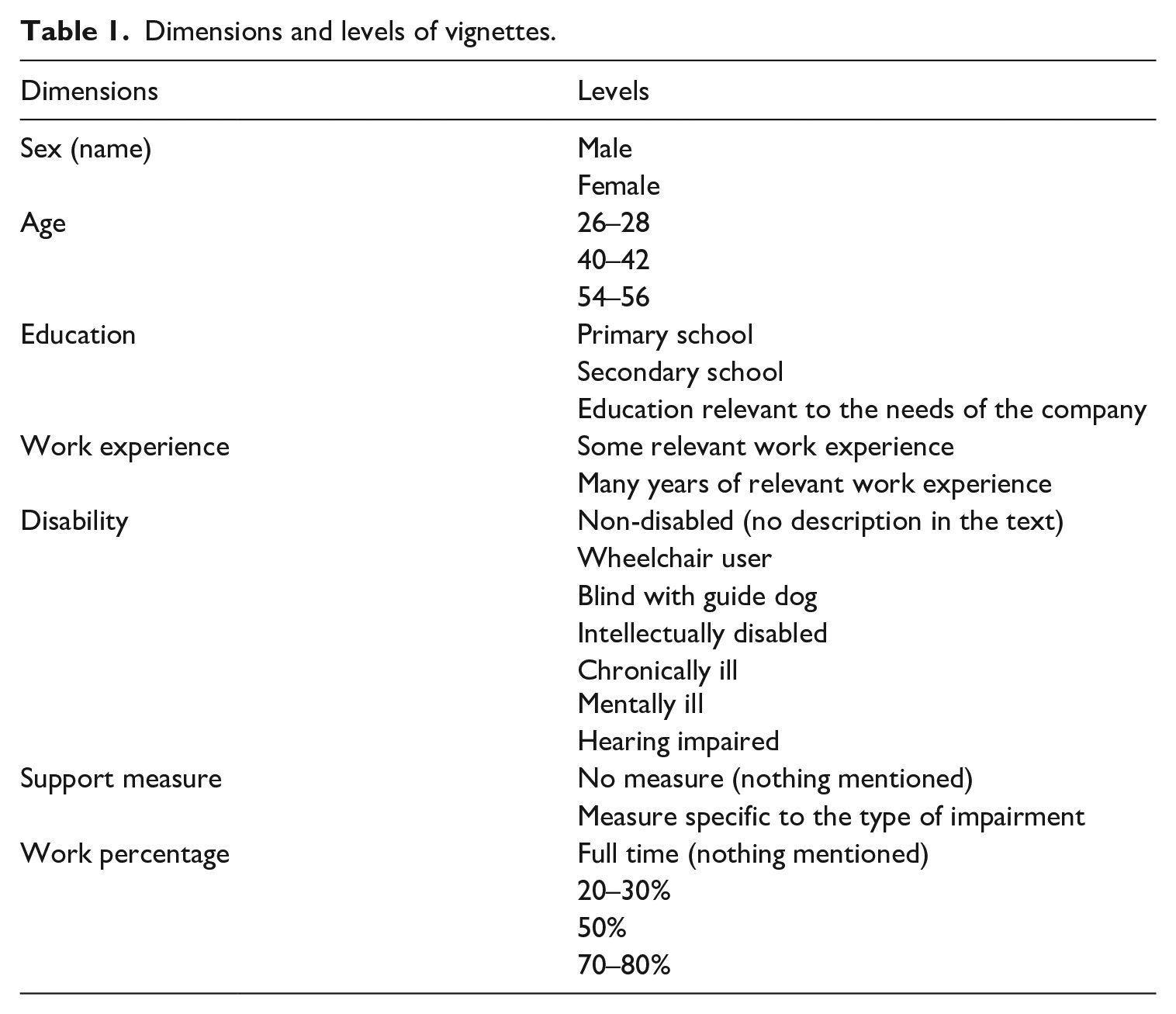
All vignettes were constructed using a randomly chosen level of the dimensions of sex, age, education and work experience. However, the vignettes had a chosen level of the dimension of disability. Instead of letting this dimension randomly vary, a choice was made to introduce all employers to five vignettes that included an impairment description and four vignettes without any impairment description. The order in which these were presented remained random. A choice was further made to present all types of impairment descriptions once to all employers, except for mental and chronic illness: given the very similar descriptions made for these two impairments, each employer was asked to evaluate a vignette describing either a mental or a chronic illness. Which of these two were given to each employer was randomly selected. The vignettes describing an intellectual disability were also randomly varied between using the terms ‘Down’s syndrome’ or ‘intellectual disability’. This, however, did not make any significant difference in employers’ evaluation of the vignettes, and these two stimuli were maintained as one category in all analyses of the data.
The choice to present descriptions of each type of impairment once to every employer was done to avoid employers receiving too many impairment descriptions to evaluate. If the disability dimension had varied randomly then the vignettes would on average include a disability description in six out of seven times, and employers would also have been presented with the same types of impairments repeatedly. This might have annoyed the respondents and decreased the overall quality of the design. A full description of all the different types of impairments included in the design can be found in Table 2.
Full description of the different types of disabilities.
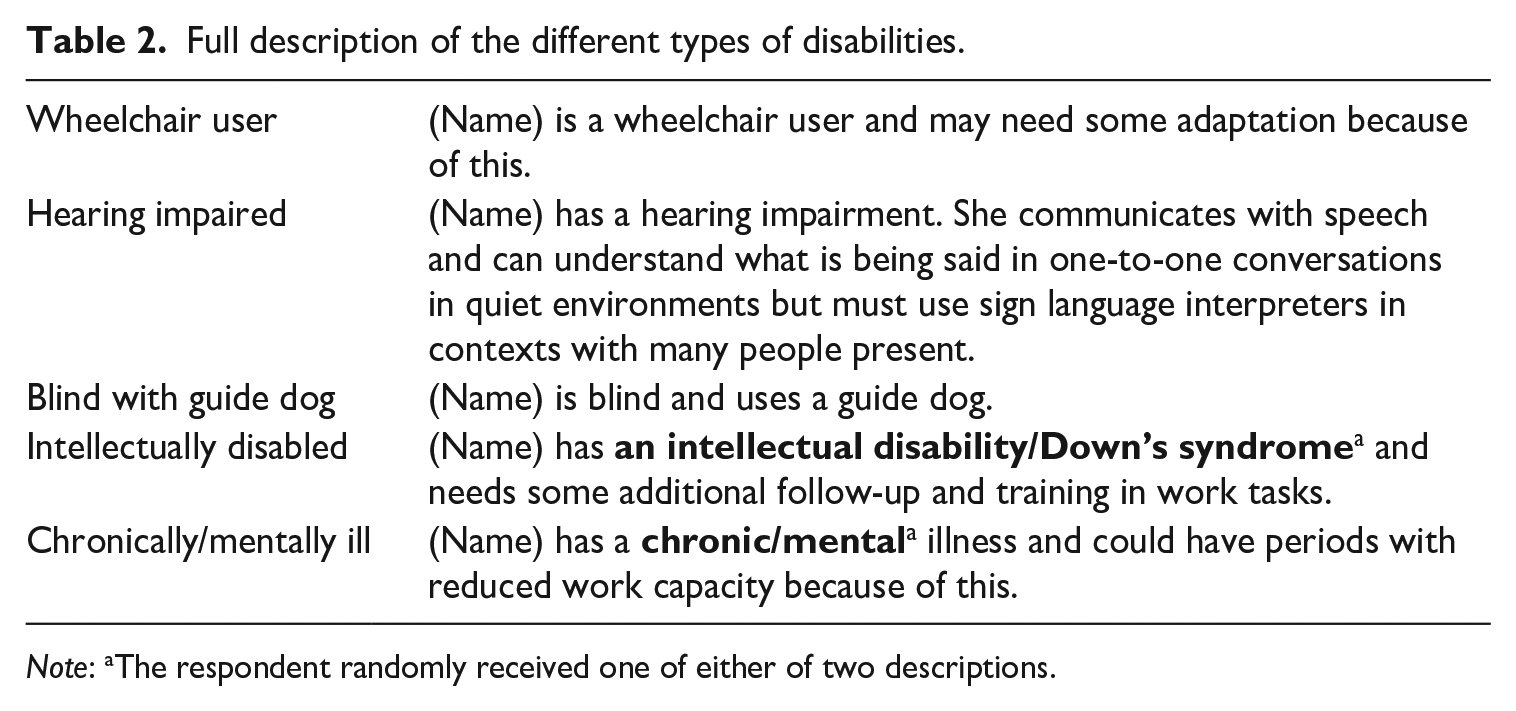
Note: aThe respondent randomly received one of either of two descriptions.
The next dimension, support measure, was only included in vignettes with an impairment description. This was done to avoid illogical vignette combinations. This support measure dimension had two levels: an impairment-specific support measure or no support measure, which were randomly selected. For a full description of the impairment-specific support measures, see Table 3.
Full description of support measures specific to type of disability.
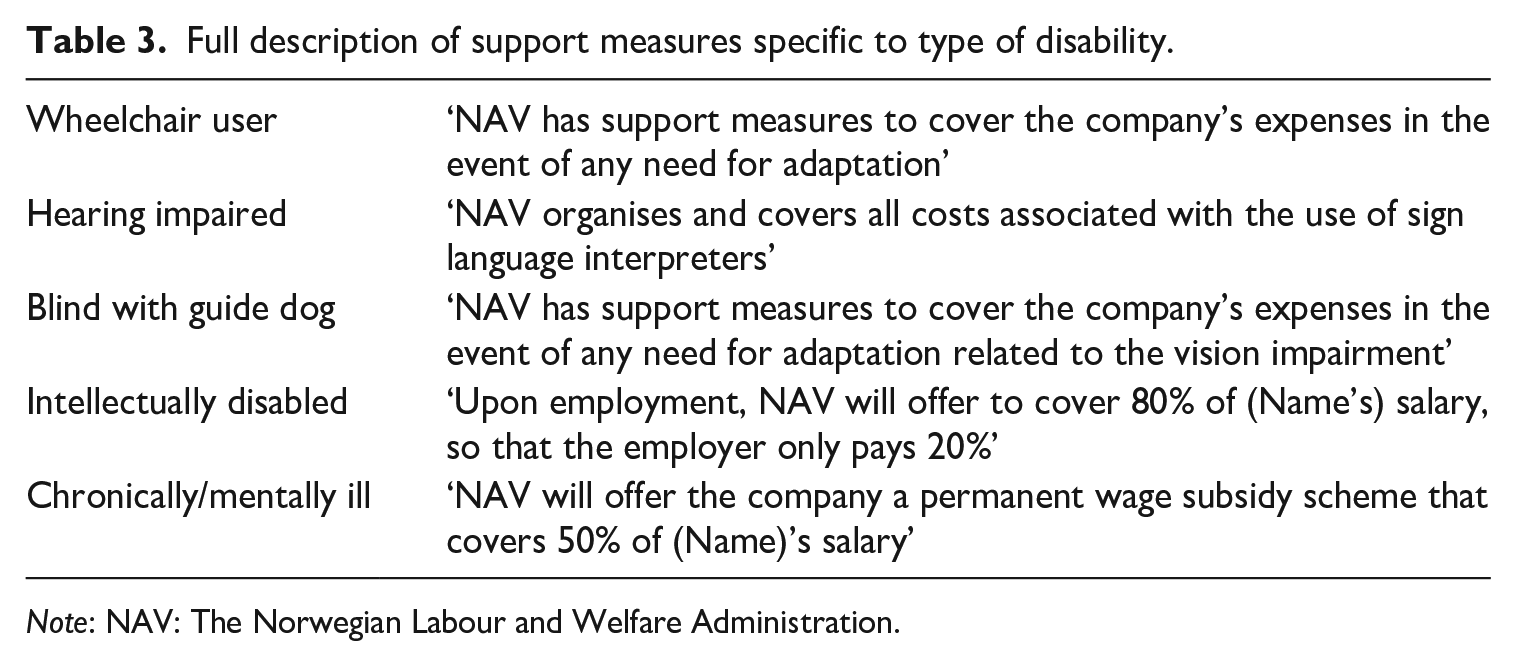
Note: NAV: The Norwegian Labour and Welfare Administration.
The last dimension, part-time work, had four levels. All vignettes had a 50% chance of receiving no stimuli at all, and a 50% chance of being described with one of the three levels of part-time work (either 20–30%, 50% or 70–80%, randomly selected).
All the described dimensions resulted in a vignette universe of 2160 possible combinations. Two examples of vignette combinations are described below:
When being introduced to the vignettes, the employers were asked to give ‘an honest assessment of nine different job-seeker candidates’. They were asked to ‘Imagine that your company needs new employees: How likely is it that the following job-seeker candidates would be hired in the company? Assume that all job seekers are highly motivated to do a good job for your business.’ Each vignette was presented along with a scale from 0 to 10 where employers did their assessments, where 0 was ‘hiring very unlikely’ and 10 was ‘hiring very likely’.
Collecting the data
The research project was approved in advance by the Norwegian National Committee for Research Ethics in the Social Sciences and the Humanities (NESH).
The survey was conducted between November 2019 and April 2020. It was sent out to a stratified random sample of Norwegian employers. Two selection criteria were applied: sector and company size. In total, 15,000 companies were randomly selected from the Norwegian Brønnøysund Register: 5000 public companies, 5000 private companies with 6–19 employees and 5000 private companies with 20 or more employees. Companies with fewer than six employees were excluded from the sampling, as the focus of the study was on companies with higher levels of recruitment needs and with better opportunities to make individual adjustments to the job description.
A printed invitation for participation was initially sent to the selected employers via postal mail, which was addressed to the manager of the company. In the letter, a link was provided to a site where participants could log in and complete the survey online. Very few employers responded to this recruitment approach. Those who did not respond and who were registered with a phone number in the Brønnøysund Register received an SMS with a second invitation, followed by a phone call. Those with registered email addresses also received an email invitation. In total, 2087 of the selected companies turned out to be inactive, and among the rest, a total of 1480 chose to participate, giving the survey a final response rate of 11.5%. Owing to partial non-response, a total of 11,939 vignettes were evaluated by 1341 of the employers participating. Although the response rate has to be considered low, it is within what was expected and within the range of previous employer surveys (Baruch and Holtom, 2008; Damelang et al., 2019).
A non-response analysis was conducted, where the final sample was compared with its control group (all 15,000 companies invited to the survey) on a few key variables: industry (using the Standard Industrial Classification), company size (fewer than 20 employees/20 employees or more) and sector (private/public). An overall good representation of all branches was found in the sample, with only two substantial imbalances: an over-representation of ‘human health and social work activities’ of 8% and under-representation of ‘wholesale and retail trade’ of –5%. Further, there was an over-representation of the public sector by 10% and an equal under-representation of smaller private businesses. Hence, constructing a weighted scale for the data analyses was considered necessary. The weighted scale was constructed using the three key variables described above: industry, sector and company size. Under-represented businesses, in comparison to the control group (the 15,000 companies initially invited to the survey), on these three variables were weighted up, and over-represented businesses were weighted down. Although not included in the weighted scale, a check was also done on geographical representation, which was considered good.
Our research design did not match type of impairment with type of employer, as is common in correspondence study designs, to ensure that the impairment does not impact productivity in the specific job the employers are offering. This choice was made for theoretical and practical reasons: according to the ideal worker perspective, modern work organisations effectively disqualify impaired persons from many jobs because of restricting work environments and job descriptions. Defining which job a person can and cannot perform based on his or her type of impairment is therefore difficult, if not impossible, within such a theoretical framework. The practical reason for the choice was the preference to compare employers’ assessments of six different types of impairments within the same research design. The traditional matching of impairment and type of job was then made difficult because of the very different nature of each impairment and the different types of jobs that would need to be selected for each type of impairment to reduce any chance of the impairment impacting productivity in the job.
A choice was therefore made to include employers from all types of industries and let each type of employer evaluate all types of impairments. To reduce confounding influences due to differences in companies’ flexibility to make individual accommodations and adjust job descriptions, the choice was to instead control for type of industry when analysing the data. For the same reason, smaller companies (fewer than six employees) were not invited to participate in the survey.
Data analysis
Employers’ assessments of job-seeker vignettes are not independent of each other but rather nested within each respondent. Owing to this hierarchical structure, a choice was made to employ two-level linear regression analyses. Specifically, random-intercept models were created as recommended by Auspurg and Hinz (2015), using Stata 17 software as described by Mehmetoglu and Jakobsen (2022: 242–267). When interpreting the results, a choice was made to compute predictive margins and marginal effects, as described by Williams (2012).
The study aims to focus on disabled people’s access to competitive employment, and a choice was therefore also made to exclude sheltered workplaces (in total 66 employers) from all the analyses.
The two variables of disability and support measure were merged into one variable with 13 levels for the purpose of data analyses, where each of the six different types of disability was presented with and without a publicly funded support measure on separate levels. The education variable was recoded into two categories (0 = education relevant to the needs of the company, 1 = primary/secondary school). All other variables included in the models were maintained in their original form without any recoding.
The dependent variable in all models was employers’ assessment of the job-seeking candidates on a scale of 0 (‘hiring highly unlikely’) to 10 (‘hiring highly likely’). This scale will hereafter be referred to as the employers’ hiring assessment scale. The different dimensions (presented in Table 1) were treated as variables at level 1. At level 2, two additional controls were introduced: company size/sector (private with fewer than 20 employees/private with 20 employees or more/public) and type of industry (according to the Standard Industrial Classification).
A baseline model (see the online supplementary Appendix 1) was created, in which all variables were included in a model without using any interaction terms. This model was used to answer Hypotheses 1–3. First, the average predictive margins of employers’ assessments of non-disabled and disabled job seekers were computed (Figure 1). These reflect the expected scores on the hiring assessment scale of job seekers with and without a type of disability according to the employers’ ratings. Second, the average marginal effects of employers’ assessment of candidates with different types of disabilities, both with and without a support measure introduced to the vignette, using the assessment of non-disabled candidates as the reference category were computed (Figure 2). These reflect the change in the expected hiring assessment score produced when a type of disability and support measure were introduced to the vignettes. They can therefore be interpreted as the assessment gap in employer interest between non-disabled and disabled candidates.
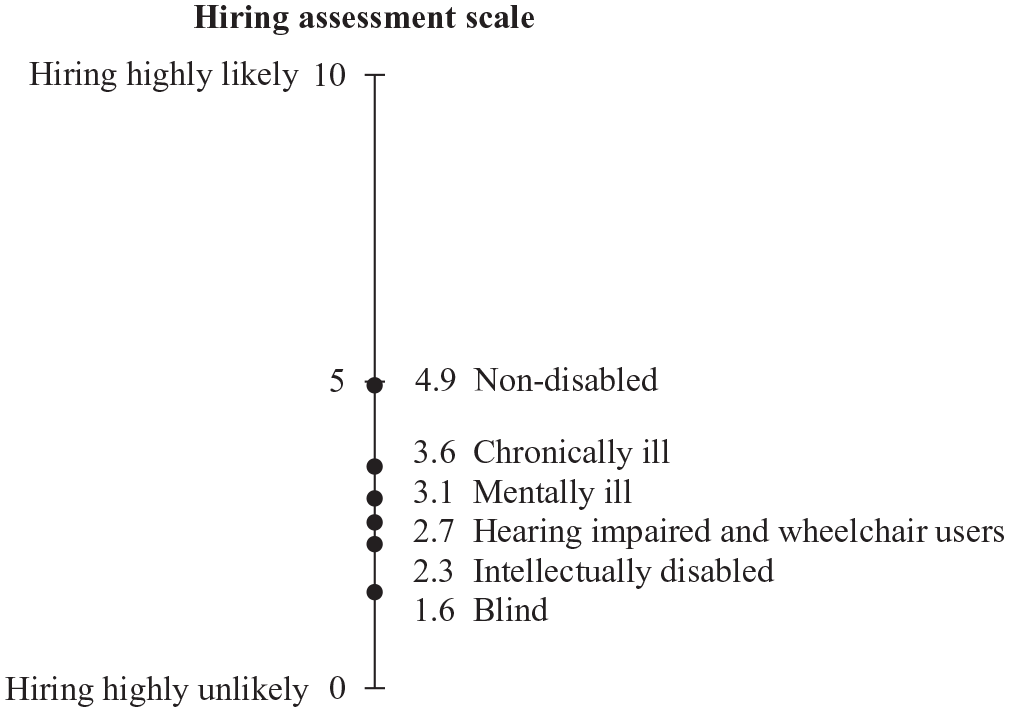
The effect of disability on employers’ hiring assessments; random-intercept model, predictive margins.
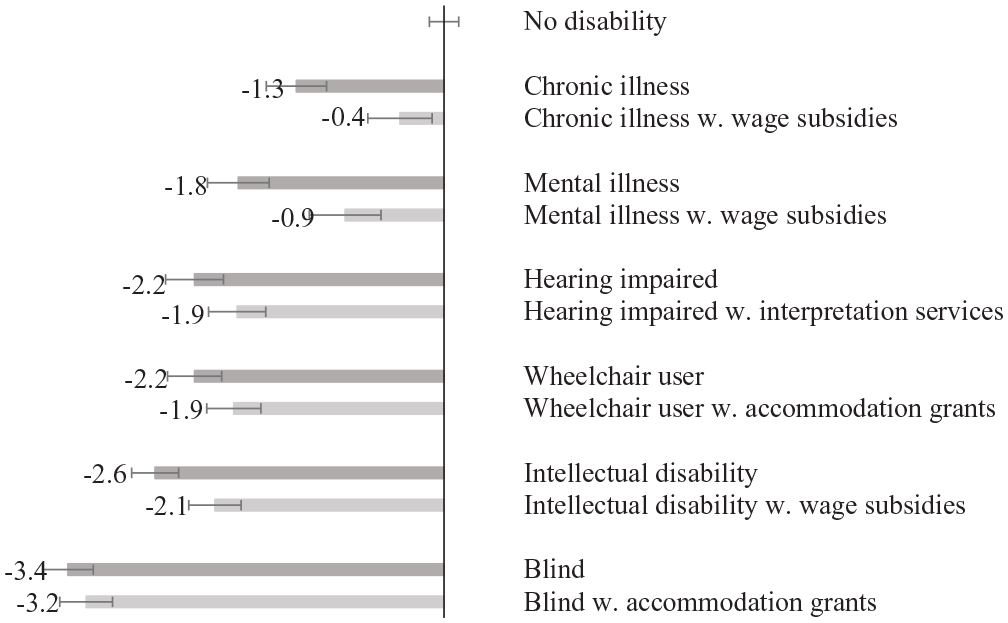
The effect of disability and support measures on employers’ hiring assessments; random-intercept model, marginal effects.
To address Hypothesis 4, five additional models were constructed with one interaction term included in each of these. An interaction term was added between disability and gender in Model 1, disability and age in Model 2, disability and education in Model 3, disability and work experience in Model 4 and disability and work percentage in Model 5. This allowed for the exploration of whether the impacts of each of these job-seeker characteristics on employers’ hiring assessment scores were different or similar for non-disabled and disabled candidates. Following the theoretical concept of master status, the impact of other job-seeker characteristics would be weaker for disabled than for non-disabled candidates, as the described impairment would overshadow the other characteristics and qualifications of these job seekers.
As it would be difficult to present all information from Models 1–5 in tables and interpret it in a meaningful way within the space limits of this article, only the most relevant findings from these models are presented in Table 4 as average marginal effects at representative values. These numbers represent the change produced in the average expected assessment score of job seekers with and without a type of disability, as the level of each chosen dimension (gender, age, education, work experience or work percentage) was changed from its reference level.
The effect of gender, age, education, work experience and part-time work on employers’ assessment of job seekers with and without a disclosed impairment; random-intercept models, marginal effects.
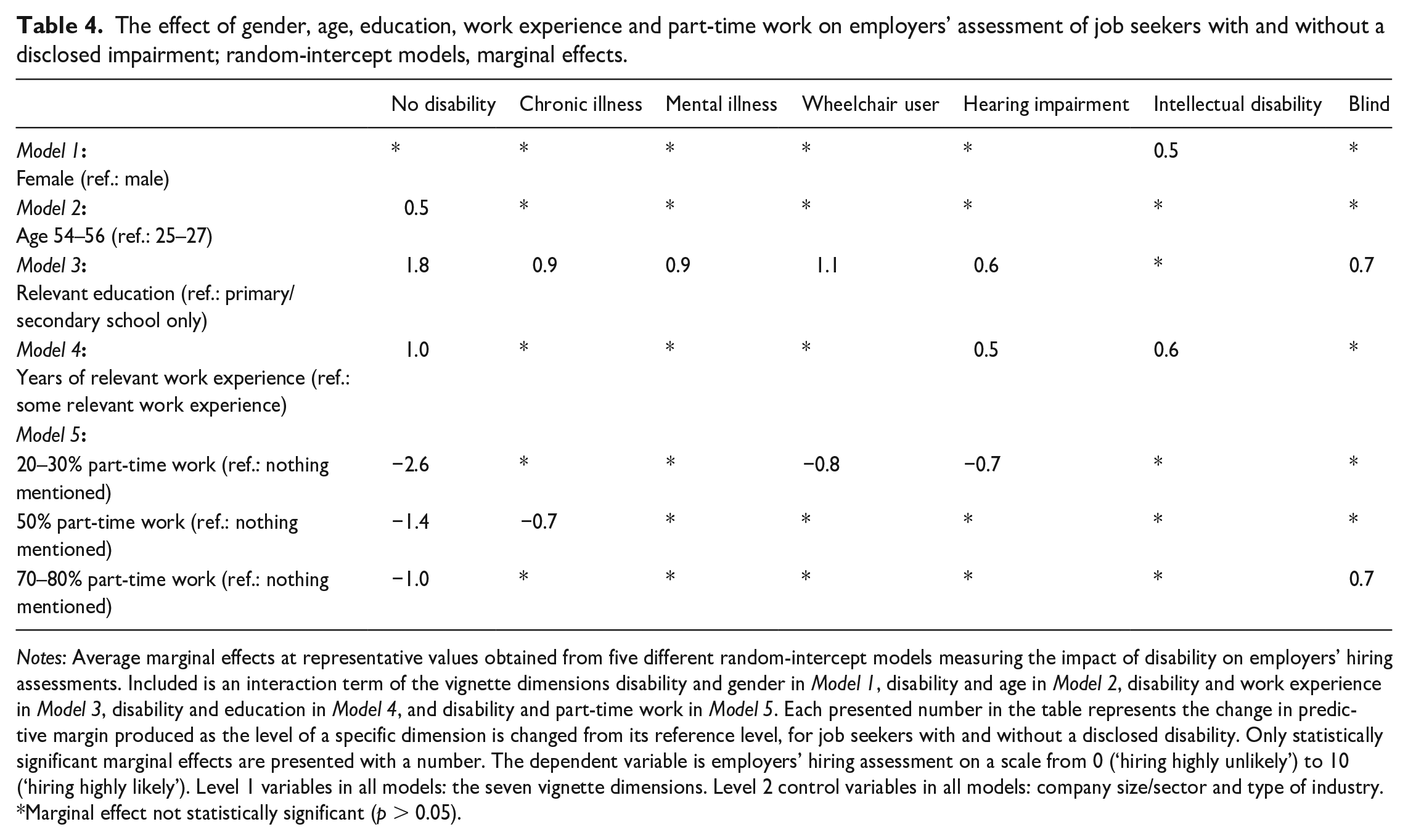
Notes: Average marginal effects at representative values obtained from five different random-intercept models measuring the impact of disability on employers’ hiring assessments. Included is an interaction term of the vignette dimensions disability and gender in Model 1, disability and age in Model 2, disability and work experience in Model 3, disability and education in Model 4, and disability and part-time work in Model 5. Each presented number in the table represents the change in predictive margin produced as the level of a specific dimension is changed from its reference level, for job seekers with and without a disclosed disability. Only statistically significant marginal effects are presented with a number. The dependent variable is employers’ hiring assessment on a scale from 0 (‘hiring highly unlikely’) to 10 (‘hiring highly likely’). Level 1 variables in all models: the seven vignette dimensions. Level 2 control variables in all models: company size/sector and type of industry. *Marginal effect not statistically significant (p > 0.05).
Results
The results from the baseline model support the first hypothesis: disabled job seekers were assessed as less employable than non-disabled job seekers. Non-disabled job seekers had a predicted score of 4.9 on the hiring assessment scale, which can be read as on average moderately likely to be hired. However, job seekers with a disclosed impairment had on average a predicted score 2.6 points lower than this.
We also found significant differences between the average predicted score of job seekers with different types of disabilities, as predicted by Hypothesis 2a. However, intellectually disabled and mentally ill were not assessed as the least employable, as predicted by Hypothesis 2b. The results presented in Figures 1 and 2 reveal that blind people were assessed by the employers as the least employable. They were assessed significantly lower than all the other types of disabilities included in the research design. Assessed as the second least employable were intellectually disabled candidates, followed by hearing impaired and wheelchair users. Further, the results reveal that chronically ill were assessed as the most employable, followed by mentally ill. While no significant difference in predictive margin was found between chronically and mentally ill, the results show that chronically ill were on average assessed significantly higher on the assessment scale than all the other types of disabilities.
The third hypothesis was also supported by the results. Introducing support measures into vignette descriptions of disabled job seekers had limited or no effect on their predicted hiring assessment scores. Figure 2 shows that wage subsidy schemes were the only introduced support measure that caused a significant improvement in the assessment scores of disabled candidates, whereas accommodation grants and sign language interpretation services did not significantly improve their scores. A 50% wage subsidy scheme yielded a 0.9-point increase in average score of chronically and mentally ill. Introducing an 80% wage subsidy to vignettes describing an intellectual disability caused a smaller significant increase of 0.5 points.
The fourth hypothesis suggests that the impact of other individual characteristics would be lower among disabled people. The results shown in Table 4 support this. Each row in this table presents the results from one of the five additional models created, where an interaction term between disability and another job-seeker characteristic was added in each model. The table columns represent groups of job seekers: non-disabled people and people with different types of impairments. The figures in the table represent the change produced in the average predicted hiring assessment score, as the level of the described dimension was changed from its reference level, for job seekers with and without a type of disability separately. When no significant difference in predicted score between the test and reference group was found, an asterisk is presented. The results show that among non-disabled job seekers, all job-seeker characteristics in the vignette text, except gender, had a significant impact on employers’ assessment of them. However, for disabled job seekers, the outcome was different: the other job-seeker characteristics had less or no impact on employers’ assessment of them. This was most evident in Models 3–5: having more relevant education, more work experience, or wanting to work part-time produced on average a considerable change in employers’ hiring assessment score of non-disabled job seekers, while among disabled job seekers, these characteristics had clearly less impact or no impact at all.
Discussion
This study finds that disabled job seekers were on average assessed by Norwegian employers as less employable than non-disabled job seekers, and that the degree of disadvantage varied with the type of impairment being disclosed. Although this study does not give any answer as to why this is so, previous research has shown that increased job complexity within modern work organisations, with a variety of tasks and roles designed into predefined and inflexible job descriptions, disadvantage people with impairments (Foster and Wass, 2013). Further, a perceived lack of social fit has been found to explain employers’ lower interest in disabled candidates when inviting applicants to job interviews (Østerud, 2022). Based on the present study’s findings, it is plausible that the degree of perceived organisational, job and social misfit vary with the type of impairment of the candidate when employers make their hiring assessments.
However, the hierarchy that emerged between different types of disabilities was unexpected. This study initially predicted that the degree of employment marginalisation, as measured in employment rates, would be reflected in employers’ hiring attitudes. Nevertheless, the findings indicate no direct link between employers’ hiring attitudes and the employment levels of each group. Although people with intellectual and psychiatric disabilities are considered the most marginalised groups in employment due to their very low employment rates (Boman et al., 2015; Tøssebro, 2012), this study suggests that it is the blind job seekers who face the highest degree of employment barriers among the types of impairments included in this study. It was not unexpected to find a high level of discrimination against blind job seekers (Chhabra, 2021), but the bottom-of-the-ladder score was unexpected due to their higher employment levels in comparison with other groups.
This mismatch between employers’ hiring attitudes towards different groups and their employment levels suggests that factors other than employers’ hiring attitudes contribute to the explanation of each group’s employment levels. Previous studies have provided some suggestions. One study identifies structural factors within the Norwegian educational and welfare system as important in explaining people with intellectual disabilities’ marginalised position in employment (Wendelborg and Tøssebro, 2018). Others have explored the importance of social and family networks in gaining employment for people with intellectual disabilities (Hardonk and Ingvardsdóttir, 2021; Petner-Arrey et al., 2016) and identified weak ties as essential in finding employment for people who use augmentative and alternative communication (Carey et al., 2004). It has also been suggested that some disabled people meet obstacles in network building, which can help explain their low employment rates (Langford et al., 2013). A third plausible explanation is the timing of the onset of impairment. We know that disabled people are more likely to be employed if the impairment occurred after having entered the labour market: to keep one’s current job when an impairment occurs is easier than gaining employment after the onset of an impairment (Molden et al., 2009). Hearing impairment, as an example, often occurs later in life, which can explain this group’s higher employment levels compared with other types of disabilities, despite not being assessed by employers as very attractive to hire in the factorial survey presented by this study.
In the third hypothesis, there was an expectation that public support measures would have limited or no effect on employers’ hiring assessments, which was supported by the results. Notably, only wage subsidy schemes had a significant impact on employers’ hiring assessment scores. The effect of wage subsidy schemes depended on the type of disability: a 50% wage subsidy scheme for people with chronic and mental illnesses had a stronger overall effect on their assessment scores than was found when introducing an 80% wage subsidy scheme to the vignettes of intellectually disabled job seekers. The ideal worker perspective would explain this difference in effect with employers’ stronger perceived job, organisational or social ‘misfit’ towards job seekers with intellectual disabilities. A wage subsidy scheme does not necessarily compensate for such barriers, even when offering to cover 80% of salary costs. Following the master status concept, these findings also suggest that disability as a master status can explain the lack of effect found when including information about support measures. A disability might overshadow the otherwise positive effect that accommodation grants, sign language interpretation services or a wage subsidy scheme were intended to have on employers’ hiring attitudes.
This leads to a complementary explanation to the ideal worker perspective in explaining disability discrimination in hiring in general: that disability becomes a master status when facing employers making hiring assessments. In the choice between focusing on competing statuses, the findings support the idea that employers let the disability dominate over other qualifications of the job seeker in their assessments of the vignettes. The most notable finding was that the level of education and work experience, which are important factors through which job seekers in general seek to increase their attractiveness in the job market, lost some or all of their impact on employers’ assessment scores when an impairment description was introduced to the vignette text. These findings are in line with previous findings from a US correspondence study that found that the negative effect of disability was concentrated among the most experienced candidates (Ameri et al., 2018). Interestingly, in the present study, this is the case for all types of disabilities – from the chronically ill, who are ranked the highest, to the blind candidates, who ranked the lowest on the hiring assessment scale. In the trade-off between considering the candidates’ qualifications and experience versus their described disability, it was the devalued disability status that ended up dominating. As with stigma, the result of these processes is suggested to be that ‘we exercise varieties of discrimination, through which we effectively, if often unthinkingly, reduce his life chances’ (Goffman, 1963: 5).
Study limitations
A factorial survey approach to the study of employers’ attitudes has many benefits such as flexibility, large samples and high internal validity. However, it is important to be aware of the limitations of this approach. It is not certain that the results from employers’ assessments of job-seeker profiles in a factorial survey transfer to their assessments in making real-life decisions about which candidates to invite to job interviews and, eventually, which one to hire. In a real-life setting, the employer would have access to additional information about the candidate on which to base their judgements. This weakness could have potentially resulted in an overestimation of the impact of disability on employers’ assessments. However, although the method, when well designed, is said to decrease social desirability bias, it is likely that employers have been aware that they were participating in a study on disability recruitment. This could have resulted in an underestimation of the impact of disability on their assessments, as a certain impact of social desirability bias on the results can then be assumed. Claiming that hiring is likely in a factorial survey is less binding for employers than hiring in practice. The risk of low external validity, as well as social desirability bias, was therefore present in this study. However, the aim of the study has not been to measure the exact assessment gap between people with and without disabilities but to explore the tendencies and differences between different types of disabilities, as well as the impact of adding information about public support measures. This design, arguably, proves to be well suited for these aims, despite the presented limitations. The results must, however, be considered employers’ preferences within a certain context, rather than results that measure their actual recruitment behaviour (McDonald, 2019). The results must also be interpreted in light of other studies that have used methods with higher external validity, such as correspondence experiments, which have recently been conducted in Norway with results that correspond to the findings in the present study (Bjørnshagen, 2021; Bjørnshagen and Ugreninov, 2021), as well as a recent qualitative study (Østerud, 2022). These studies can, arguably, complement each other’s weaknesses and make important contributions to the research field.
Conclusions
This study provides support to previous studies that have concluded that people with disabilities face great demand-side barriers and discrimination when applying for jobs. The findings contribute to the research field, with empirical findings suggesting that the extent of these barriers varies with the type of impairment of the job seeker.
The theoretical aim of this study has been to elaborate the ideal worker perspective through exploring factors impacting employers’ assessment of ‘fit’ of candidates with disabilities; namely, public support measures and disability as a master status. Findings suggest that public support measures are not sufficient in compensating for employers’ perceived lack-of-fit when the candidate discloses an impairment: only wage subsidy schemes had a limited impact on employers’ assessments of the candidates. Introducing the concept of master status, with empirical findings supporting its relevance further, suggests that employers do not make individual assessments of all characteristics when the candidate discloses an impairment, but rather let the disability dominate the hiring assessment made. A disability master status is by this study suggested to trigger assessments of misfit, which disqualifies candidates with impairments from many jobs regardless of the other qualifications they might be described with.
One question raised by these findings is whether the disability disadvantage documented by this and previous studies is to the same extent present in all types of recruitment. As no direct link between employers’ hiring attitudes and each group’s employment level is found, it is relevant to ask what explains the access to employment for groups of disabled people whom employers, on average, claim they are very unlikely to hire. Future research should explore this further and focus on the different strategies disabled people use to successfully access jobs despite documented barriers and discrimination. It is also relevant to ask which jobs or segments of the labour market they have access to and the means (such as network recruitment, for example) by which they gain access.
Although there is a strong global policy consensus about the need for increased employment integration of people with disabilities as well as international and national legislation promoting equal opportunities and reasonable accommodations, the Norwegian case presented in this article suggests that there is a long way to go before people with disabilities have the same opportunities in the labour market as their non-disabled peers. Further, support measures designed to assist disabled people in employment are suggested to have limited or no effect on Norwegian employers’ willingness to hire disabled people, and additional research is needed to explain why this is so.
Supplemental Material
sj-pdf-1-wes-10.1177_09500170231175776 – Supplemental material for Exploring Disability Disadvantage in Hiring: A Factorial Survey among Norwegian Employers
Supplemental material, sj-pdf-1-wes-10.1177_09500170231175776 for Exploring Disability Disadvantage in Hiring: A Factorial Survey among Norwegian Employers by Stine Berre in Work, Employment and Society
Footnotes
Funding
The author disclosed receipt of the following financial support for the research, authorship, and/or publication of this article: This study is funded by the Research Council of Norway. Project ID: 273259.

Supplementary material
The supplementary material is available online with the article.
References
Supplementary Material
Please find the following supplemental material available below.
For Open Access articles published under a Creative Commons License, all supplemental material carries the same license as the article it is associated with.
For non-Open Access articles published, all supplemental material carries a non-exclusive license, and permission requests for re-use of supplemental material or any part of supplemental material shall be sent directly to the copyright owner as specified in the copyright notice associated with the article.
