



Abstract
Labour market stratification and discrimination of disabled people remains a less researched topic compared to other minorities despite being a notably disadvantaged group. This article explores the employer side of discrimination against disabled jobseekers by using a field experiment conducted in Norway as its point of departure. Through qualitative follow-up interviews, this article investigates employers’ assessments of equally qualified mobility-impaired candidates in a field experiment. The article employs the theoretical perspective of the ideal worker to shed light on how employers evaluate disabled jobseekers against an able-bodied ideal. Although previous literature on disability and the ideal worker has shown the imperative of asserting productivity, the findings in the current article reveal a stronger emphasis on social considerations as grounds for exclusion. The findings show how tacit constructions of the ideal worker not only relate to productivity but also to the creation of the socially integrated workplace.
Introduction
Discrimination against minorities is a topic of long-standing interest in labour market research within sociology and adjacent fields. However, disability disadvantage in the labour market remains an area that has received less attention compared with other minority groups (Barnes and Mercer, 2005; Jones and Wass, 2013). This is despite the fact of disabled people’s marginalised employment conditions (Foster and Scott, 2015). Disabled people have been routinely shown to face considerable disadvantages, such as significantly lower employment rates than the general population (OECD, 2010), higher rates of ill-treatment at work (Fevre et al., 2013) and lower pay and job security (Schur et al., 2013). The employment gap between disabled and nondisabled people is much debated in disability research, and the reasons for this gap are not yet fully understood. This gap is a persistent global problem, despite extensive investment in active labour market policies, rehabilitation and occupational health (Geiger et al., 2017), thus remaining somewhat of a puzzle.
An important piece of this puzzle may be found on the employer side. Employers play a crucial role in labour market integration because they are gatekeepers – individuals or groups in power – ‘making the decision between in or out’ (Lewin, 1947: 145). Therefore, employers’ understanding of disability and their evaluations of disabled jobseekers are likely to influence hiring practices. The literature reveals both favourable and unfavourable employer attitudes towards disabled people and a gap between generally positive attitudes and more negative hiring intentions (Burke et al., 2013; Ju et al., 2013). This highlights the importance of investigating the process of evaluating disabled jobseekers, an area in which the present literature is scarce (Bredgaard and Salado-Rasmussen, 2020).
The present article draws on unique qualitative interview material of Norwegian employers to investigate reasons for excluding a disabled person with a mobility impairment in the first selection stage of a real hiring process. Its point of departure is a field experiment conducted in Norway in which pairs of fictitious applications – where one applicant disclosed a disability – were sent in response to authentic job advertisements. Such field experiments have mostly been used to study ethnic discrimination (e.g. Ahmad, 2020; McGinnity and Lunn, 2011). In recent years, however, this method has been used to test for disability discrimination, resulting in a small but increasing number of correspondence studies that show the disadvantaging effect of disclosing a disability (Ameri et al., 2018; Baert, 2014; Baert et al., 2016; Bellemare et al., 2018; Bjørnshagen, 2021; Hipes et al., 2016). The findings from the experiment confirm the previous findings, showing a clear preference for candidates who do not disclose a disability (Bjørnshagen and Ugreninov, 2021). Although correspondence studies show the prevalence of discrimination, they say nothing about why it occurs. The current article sets out to investigate the reasons employers give for their preferences and behaviour through follow-up interviews. Such field experiment follow-up interviews have previously been conducted in relation to ethnicity (Birkelund et al., 2020; Midtbøen, 2014) but never in relation to disability. A notable advantage of this design is that the interviewer has valuable behavioural information about the employer’s response in the field experiment when carrying out the research interview, hence sidestepping some of the pitfalls of potential social desirability bias.
Through an understanding of disability as a relational phenomenon arising from the interactions between the impairment and the environment (Shakespeare, 2014), the present article shows disabling tendencies in the evaluation of jobseekers with mobility impairments. The article investigates why employers have chosen to discriminate against a qualified candidate, shedding light on the mechanisms contributing to disability discrimination. The objective is to offer insights into how employers evaluate disabled jobseekers in the selection of candidates for an interview offer, utilising the theoretical perspective of the ideal worker (Acker, 1990). Conceptualisations of the ideal worker often constitute this individual in terms of productivity (Foster and Wass, 2013; Jammaers et al., 2016). The current article demonstrates, however, that employers’ tacit constructions of the ideal worker are not limited to evaluations concerning productivity, but also to evaluations of the candidate’s potential to socially commit to the workplace.
The notion of the ideal worker and the evaluation of disabled jobseekers
The research on disabled people’s experience with jobseeking shows how prejudice, stigma and discrimination are repeatedly identified as a reason for struggling to get access to work. This is a widespread problem in multiple national contexts (Chhabra, 2020; Coleman-Fountain et al., 2017) and has led to treatment of disabled people as ‘matter out of place’ (Douglas, 2002; Vedeler, 2014). However, there is a paucity of studies investigating disability, hiring and discrimination, especially from the employer’s perspective (Bredgaard and Salado-Rasmussen, 2020). The current article seeks to address this gap by investigating the employer side; here, by utilising the notion of the ideal worker.
Feminist sociologists have put forth the notion of an ideal or standard worker as a mechanism that produces structural and enduring gender inequalities (Acker, 1990). This ideal worker is an abstract and, at first, seemingly genderless individual, but who on closer inspection bears the social characteristics of a man (Acker, 1992). This individual is a devoted employee without outside responsibilities impinging on the job, such as care work, and is ‘always ready, willing and able to work’ (Cooper, 2000: 395). Although Acker (2006: 445) is hesitant to conclude that disability is as ‘thoroughly embedded in organising processes as gender, race or class’, Foster and Wass (2013: 710) are critical towards the neglect of disability as a form of stratification, arguing that it is the ‘abstract measurements of efficiency and productivity, of job design and “ideal” worker behaviour that make up part of established organisational logic and management ideology which excludes people with impairments’. Several scholars have since utilised this perspective to understand the marginalised position of disabled workers. Concepts of the ideal worker create a narrow space for acceptable identity construction (Jammaers and Zanoni, 2020; Jammaers et al., 2016), bringing about recruitment procedures (Scholz, 2020), workspaces (Van Laer et al., 2020) and labour market programmes (Scholz and Ingold, 2021) that lean on ableist notions, taking ableness, flexibility and adaptability for granted. As such, Randle and Hardy (2016) argue that this creates qualitatively different challenges for disabled people than for other marginalised groups. The literature on the ideal worker draws attention to an imperative to be productive, efficient and available. Foster (2007) argues that capitalist societies that place central value on wage labour have historically oppressed disabled people by undervaluing them as being less productive. Jammaers et al. (2016) point to the hegemony of the ableist discourse of disability as lower productivity and as something disabled employees need to position themselves against.
Although ideal worker conceptions highlighting productivity are certainly a marginalising component of jobseeker evaluations for disabled people, the present article will demonstrate that employers not only evaluate potential employees based on their capacity for productivity, but also based on their potential social contribution (Rivera, 2012). Leaning on the influence of social psychological research, this article understands the concept of the ideal worker as also relating to social ideals. Human beings have been shown to favour people we see as similar to ourselves, which is a central contribution from social psychological research on stereotypes and prejudice that can be traced back to the seminal work by Allport (1958). Disabled people risk being stereotyped based on their disability status, hence impacting the impression of their personal characteristics (Stone and Colella, 1996). Psychological research confirms consistent and pervasive stereotypes that serve to define disabled people as a group of individuals who are dependent, passive and weak (Nario-Redmond, 2010). Social cohesion concerns can lead to disabled people being rejected based on these prejudiced impressions and their lack of ‘fit’ with the organisational culture (Coverdill and Finlay, 1998). An emphasis on cohesion in a recruitment setting may favour candidates who are perceived as more socially competent, hence focusing less on productivity-related characteristics (Björklund et al., 2012). Greenwald and Pettigrew (2014) suggest that discrimination in contemporary society is not so much based on overt hostility but rather on in-group favouritism, preferring people similar to oneself. This tendency to seek social cohesion implies that employers not only evaluate candidates’ potential work task performance, but also as potential members of the social group.
In modern capitalist societies, the stressed importance of wage labour also generates nonfinancial reasons for employment (van der Wel and Halvorsen, 2014). Workplaces are crucial social arenas, and this can create incentives to evaluate the social potential of whom you invite to work with you (Rivera, 2012, 2020). The current article makes the argument that these social evaluation tendencies also contribute to employers’ constructions of the ideal worker. Acker (1990: 149) argues that the abstracted ideal worker is a committed individual who ‘exists only for the work’. The commitment, dedication and flexibility that is emphasised in the ideal worker concept can also be interpreted as having a social component. This component also favours individuals who have the capacity to fully dedicate themselves to the workplace by also assuming a social role, in addition to a productive role. Given our tendency for in-group favouritism, the employers’ abstracted image of this socially integrated worker will likely be constructed with people belonging to an in-group in mind, marginalising minorities who the employers imagine will have a more difficult time naturally fitting into the group and existing social practices. These social practices can be constructed and sustained in a way that presupposes ableness.
Pointing out how these ideal worker notions impact the evaluation of jobseekers highlights how stereotypes, organisational practices and managerial attitudes represent important contextual barriers that limit disabled people’s work opportunities (Robert and Harlan, 2006). Applying this theoretical framework to recruitment evaluation can provide insight into a central mechanism of marginalisation for disabled people.
Methods
As mentioned, the current article uses a field experiment that was conducted in Norway as its point of departure. In the experiment, 600 pairs of fictitious job applications were sent in response to real job ads. Each pair had common Norwegian names and roughly similar resumés and cover letters. Applicant gender was randomised, but the pair always had the same gender. The only significant difference was that one of them disclosed a disability in the cover letter, in which the applicant explained that they had a congenital back injury and were a wheelchair user. Being a wheelchair user was not relevant to the core tasks in the selected positions. The call-back ratio from the field experiment was 1.93, meaning that the wheelchair user applicant received approximately half as many interview invitations as the nondisabled applicant (Bjørnshagen and Ugreninov, 2021).
From the total sample of 145 employers in the field experiment who gave an interview offer to at least one candidate, 70 employers were contacted to request participation in a qualitative follow-up study. The sampling was done strategically to achieve a balance between employers who invited both or only one candidate. In total, 18 employers agreed to take part in the study. In the interview sample, eight employers invited both candidates to an interview, two only invited the disabled candidate and eight only invited the nondisabled candidate. The sample consists primarily of general managers, but four interviews were conducted with an HR manager. Table 1 lists the industries and positions from the field experiment. All the enterprises came from the private or nonprofit sectors because application portals in the public sector requiring the registration of applicant profiles made it unsuitable for the field experiment. IT is overrepresented in the sample because this sector had a high call-back rate in the field experiment because of the high demand for personnel.
Overview of participants.
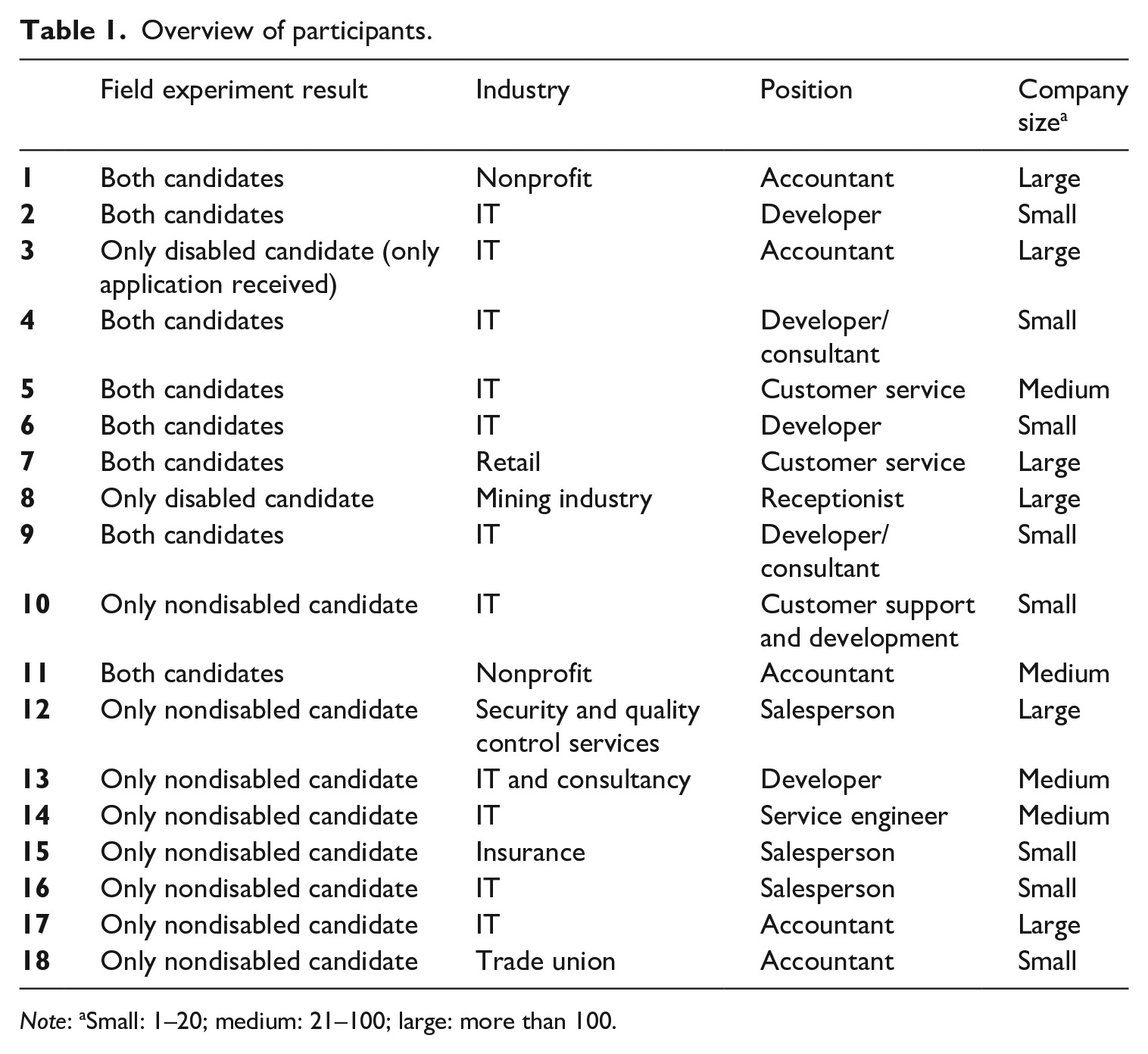
Note: aSmall: 1–20; medium: 21–100; large: more than 100.
The interviews were semistructured, and the main topics were the recruitment process, the field experiment outcome, their impressions of disabled workers, work inclusion policies and corporate social responsibility (CSR) and their experience with the public employment service. The job ad and resumé from the fictitious candidates were brought to each interview, and the field experiment outcome was revealed, giving the employers the opportunity to reflect on their interview offer decisions. Although the field experiment only used a wheelchair user applicant to measure discrimination, the interviews focused on disability in a wider sense, deliberately opening up reflections on multiple types of impairments.
The research project was reviewed in advance by the Norwegian National Committee for Research Ethics in the Social Sciences and the Humanities (NESH) and the Norwegian Centre for Research Data. Field experiments pose ethical issues, most notably the lack of informed consent. However, they provide a design for detecting direct discrimination in real recruitment settings in a way that would otherwise be unattainable (Pager, 2007). The review statement from the NESH sets out that the potential knowledge gain and lack of alternative methods are well-founded reasons for waiving of the informed consent requirement; they also point out that the qualitative follow-up design provides employers with an important opportunity to voice their explanations (NESH, 2018). All invited participants were given the same written debriefing on how and why the experiment had been conducted before agreeing to an interview. This information could have made more inclusive employers more inclined to agree to participate. Therefore, the sample would be expected to be more positive towards disabled employees than average, despite strategic sampling. However, the aim of the qualitative inquiry was not to generalise to the population but instead to illuminate mechanisms of discrimination.
Twelve interviews were conducted in person, and six were conducted by telephone. The interviews were conducted by the author between June 2019 and February 2020 and were all digitally recorded and transcribed. The interviews were conducted in Norwegian, and the selected quotes were translated into English by the author and assessed by a professional language editing service. The interviewees were given pseudonyms to ensure their anonymity.
The analysis of the interviews consisted of rounds of initial and axial coding (Saldaña, 2016) to uncover the key generative mechanisms that might explain the occurrence of the phenomenon in question (Hoddy, 2019). First, a round of open coding was completed in which all the material was coded line by line. The focus was then narrowed, and the second round of axial coding was conducted to determine the key driving motivations for differential treatment, here reassembling codes from the first stage into the overarching categories. Finally, two main approaches towards hiring were identified, emphasising either a productive ideal or social ideal. These approaches were interpreted in light of the ideal worker, drawing attention to how employer conceptions of an ideal or standard worker led to their evaluation of the candidate. The behavioural aspect of the field experiment result was utilised in the analysis; however, because the aim was to uncover ‘rough trends or broken patterns’ in the data (Fletcher, 2017: 185), it became clear that the discourse patterns did not necessarily match behaviour patterns. This means that both discriminating and nondiscriminating employers conveyed inclusionary and exclusionary considerations in their accounts. Hence, the findings are organised and presented around identified patterns in the employers’ reasoning rather than their actions – while still providing information about the field experiment outcome to explicate the particular cases.
Findings
The analysis revealed two main evaluative approaches. In the first approach – productivity considerations – the applicants were evaluated against the formal qualifications and their productive potential to perform the work tasks. In the second approach – social considerations – the candidate was evaluated against the social aspects of the job, focusing on the social setting the candidate would potentially be a part of. All the employers engaged in both approaches, but one approach was typically more dominant.
Productivity considerations: Emphasising the ideals related to the performance of work tasks
In the productivity considerations approach, an individualistic meritocratic norm guided the selection. Employers who emphasised this approach said that they strived to ensure the applicants would be treated fairly based on job-relevant criteria, here focusing on qualifications and the capacity to perform work tasks. Quite a large proportion of employers with this perspective had called in both applicants. They said that being a wheelchair user was not relevant for the work in question; instead, they valued the competence the applicants demonstrated in their resumé. Christina, a manager in the IT industry, stated the following: [. . .] in my industry you’re so utterly reliant on your professional competence. We’re looking for the best candidates, and then being disabled is not important in itself. (Christina, called in both candidates)
Some of the managers said that applicant attributes that do not affect competence and productivity are irrelevant for their selection decisions. Being a wheelchair user was deemed irrelevant for the work tasks, given that the positions applied for were seated desk jobs. One manager emphasised this in the following way: If you are in a wheelchair or not, that does not . . . In our workplace, we work with our hands and our head, so it really has no practical significance for working with us. (Rasmus, called in both candidates)
This quote demonstrates how the seated nature of the job means that the discrepancy between the wheelchair user and their colleagues would be negligible when performing job tasks and, thus, did not activate a strong mismatch between their image of the ideal productive worker and disabled worker. However, as soon as the employer’s image of their ideal worker started to differ more from that of the wheelchair user, productivity concerns become more prominent. Although a preponderance of interview statements expressed that being a wheelchair user was not relevant to their evaluation of productivity, there were a few instances of concerns about wheelchair users being able to fulfil the productivity ideal. One employer who had only called in the nondisabled applicant voiced these concerns. In this case, the position was a business-to-business salesperson who would have to follow up with customers in the retail industry by driving out to meet these customers. The manager was surprised when confronted with the result of the field experiment because he did not regard himself as a prejudiced person but imagined that productivity concerns could have come into play. He said the following: I think that a person with an impairment in the form of a wheelchair, in relation to certain work tasks, would not work unfortunately. Because we, and we know that many people with a disability drive a customised car and that it works fine, but because of the competitive situation out in the market, we’re extremely dependent on being efficient. We measure all employees on quality, where having a disability will not necessarily be a disadvantage, but in relation to efficiency, how long will it take from we park the car outside until we’re inside the store, have done certain measurements and are back out. [. . .] And obviously now I’m speaking from a place of ignorance, that a person in a wheelchair will not get out of a car as quickly, into a shopping centre, through a store and back into the car to write a report. (Frank, only called in the nondisabled candidate)
This position was different from a pure desk job, activating a stronger mismatch between the ideal worker and the wheelchair user and requiring more imagination to perform the tasks differently. The interview excerpt illustrates how the productive ideal worker was disembodied and seen in relation to an imagined ‘standard’ employee.
Another employer who also had reservations about the disabled candidate because of the need to go out of house, was Johanna. She advertised for an IT developer position and called in only the nondisabled candidate, partly because they needed a developer who could visit customers. She imagined that inaccessibility would make this problematic, despite the customer companies she mentioned being large corporations where it would not be unreasonable to expect accessibility. The key problem cited, however, was a small flight of stairs, which made it difficult for a wheelchair user to access the office. When asked about the possibility of making it accessible, she said that they had made inquiries to the building owner on one occasion, but this had not led to anything: ‘You know how it is with these things, it takes a while before anything is done about it’. Thus, the potential hire of this person was imagined to be more trouble than it is worth, in terms of what this individual might contribute to the workplace. It also exemplifies how inaccessibility is treated as a legitimate reason for rejection, without looking into whether it could be rectified to give the candidate a chance.
How the discrepancy between the ideal worker and disabled worker creates doubts is evident when employers are asked about other types of impairments. An impairment hierarchy emerges, where stable mobility impairments rank above other types of impairments, such as sensory impairments or mental health problems. This was apparent both in the way the managers compared other impairments with being a wheelchair user and in response to direct questions about other types of impairments. This could be because of a reduced discrepancy in the performance of the work tasks and fewer imagined threats to productivity. When the impairment required the employer to envisage ways of performing the tasks other than the standard way, they became sceptical. One manager in the IT industry who had called in both candidates stated the following: There’s obviously a big difference between being a wheelchair user and being blind. Or deaf. That would be much more difficult. Because we go around talking to each other all the time. Then suddenly everyone would have to communicate with each other in new ways. That wouldn’t be easy. Interviewer: What about mental impairments? How would you consider that? They’re harder to detect. It’s sort of mean to treat people differently, but it’s an impairment that would be hard for us as a small business to have to spend time on, to put it bluntly. (Otto, called in both candidates)
Impairments needing what the employers imagined would be substantial accommodations or resources, such as time and manager attention, were viewed less favourably. Although some managers utilising this approach did mention the attributes associated with the productive advantages of being disabled, this was not very prominent. The most frequently mentioned productive advantage was tied to autistic people in relation to certain tasks, such as testing, in the IT industry. The dominant impression left by this approach was nonetheless that if the impairment did not evoke a strong mismatch in the way the work tasks were usually performed, it was deemed irrelevant. When it did, the employers expressed productivity concerns and legitimised discrimination based on this criterion. Being a wheelchair user was mostly assessed as a neutral attribute, meaning that the explanations for differential treatment in the experiment did not primarily rely on productivity-related assessments, but rather – as the next section shows – on social considerations.
Social considerations: Emphasising ideals related to fitting in and social contributions
Several employers emphasised social ideals in their recruitment decisions; this means that they evaluated the candidate based on their view of how the candidate would fit into the group. In this approach, fit with the social environment in the organisation is a key factor. Among the discriminating employers, these social considerations were the most explicit disability-related reason for discrimination. Social considerations also caused most of the hesitancy expressed by the employers who called in both candidates but nonetheless voiced certain potential issues.
Nils was an employer who voiced clear, socially founded reasons for not calling in the wheelchair user. He worked in a company in the IT industry with fewer than five employees and emphasised that the person they hired had to fit into their small working environment. He mentioned that they frequently took trips involving fuzzy boundaries between work and leisure, where he thought it would be difficult to include a wheelchair user: Since we’re so small, we have these gatherings every two or three months, where we visit our cabins and country houses and such. One of them is on an island and we have to jump ashore onto rocks to get there. And I have a cabin in the mountains, where we go skiing and use the sauna, etc. And we have one down in Tuscany and that. So, we thought it would be tricky to have someone in a wheelchair. So that was really the only reason for not calling him in, because my first thought was that it looked good. (Nils, only called in the nondisabled candidate)
This reasoning had less to do with accessibility and more to do with striving for social cohesion. Nils emphasised that getting to know each other and being alike was an important quality in coworkers. He did not disregard the applicant’s competence, but the deciding factor was related to fitting in and sharing colleagues’ interests and activities. His account reveals that it is not enough to do the work tasks – you must also fit in, which seems especially important in small organisations. This perceived limitation to participating in established social practices overpowered the impression of qualifications to do the job.
Nils was not the only employer who referred to accessibility outside the immediate workplace as a barrier for social participation. A few of the other interviewees also mentioned this as a potential disadvantage, as exemplified by the following interview excerpt: I think that it’s an extra burden. When you’re going on a trip, you have to adapt things for them. There’s quite a lot that needs to be taken care of when you take in someone in a wheelchair. (Johanna, only called in the nondisabled candidate)
Otto, a manager for an IT firm that called in both candidates, expressed the same concern. In the end, they decided to call in the disabled candidate, acknowledging that attending work trips was not crucial for doing the job. His account does, however, demonstrate that he saw accommodating accessibility on trips as something that conflicted with the interests of the group and established social practices: Okay, how will we do it when it comes to our annual trips in Europe? Hmm. That will actually be a problem. Definitely. [. . .] So okay, this will mean a lot more work, I thought. But we would just have to make do in a way. To put it very bluntly, if we can’t bring her along on this trip, then we would just go somewhere else, or she would just have to figure it out . . . I want her to get the job she wants, and then she would just have to skip the trip. If it makes the trip much worse for the other 13 people, then the other 13 should go before her. (Otto, called in both candidates)
An employer who emphasised social considerations in a different manner than related to accessibility was Marius, a manager looking for someone to fill a sales position, which would require selling insurance over the phone. In the field experiment, he only called in the nondisabled candidate. He said that he imagined that a wheelchair user could be tougher and more resilient than other people but that he became hesitant when he reflected on how this person would fit into their working environment. He said the following: I’m afraid that they could be a cripple who doesn’t contribute and that they draw energy from the group instead in a way. But I couldn’t really know that before I’d interviewed her though. (Marius, only called in the nondisabled candidate)
He acknowledged that his judgement was based on scarce information, but it was nonetheless the factor that tipped the scales enough to not call the disabled candidate in. The fact that he used the Norwegian equivalent of the word ‘cripple’, which is considered offensive when referring to physically impaired people (Sherry and Walker, 2020), further demonstrates an insensitive attitude. Marius was the interviewee who showed the most distinct display of stereotypes and the only employer who really demonstrated overt prejudice as a basis for discrimination. However, in two other interviews where the managers had called in both candidates, the interviewees referred to stories about disabled people who had worked for them through the public employment service; both echoed a sentiment of lack of fit. The employers described these candidates as demanding and difficult to work with, displaying an attitude of entitlement (Kaye et al., 2011). Rasmus, a manager in a medium-sized IT company, said the following about a temporary employee they took on through a wage subsidy scheme and who was mobility and visually impaired: He was in the public employment system and because of this he became aware of his challenges in a way that I think was negative. There was a lot of fuss about nothing. [. . .] So, he just didn’t fit into the group, culturally, with people who are used to getting by on their own and not complaining as much, and they kind of got someone the opposite of that. And that was, that is a challenge. (Rasmus, called in both candidates)
Rasmus mentioned this story quite early in the interview, indicating his hesitancy about hiring disabled people. However, he called in both candidates such that this experience was not generalised to the degree that it impacted the initial selection decision.
Overall, these findings emphasise that some employers do not consider disabled people to be equally equipped to participate socially because of an inaccessible world, a lack of cultural fit and/or a perceived lack of social aptitude. The findings indicate how employers’ constructions of an ideal worker incorporate a social component related to ideas about fitting into the organisation, hence demonstrating exclusionary potential.
Discussion and conclusion
The current article has shown how employers evaluate disabled job applicants along two separate dimensions: productivity and social considerations. The findings demonstrate employers’ tacit constructions of the ideal worker in their recruitment evaluations, painting an image of an individual who is both productive and socially integrated. The employers’ accounts highlighted here demonstrate poor knowledge of what disabled people can do, a lack of awareness of antidiscrimination legislation and prejudiced attitudes. Accordingly, these findings support previous research in which disabled people’s accounts reveal employer prejudice and discrimination (e.g. Chhabra, 2020; Vedeler, 2014). Moreover, drawing on the understanding of disability as a relational phenomenon (Shakespeare, 2014), the accounts show how people with mobility impairments are disabled by contextual factors, such as a lack of accessibility in society and employer attitudes. Interestingly, the findings also demonstrate how accessibility and ableist attitudes are related when employers legitimise discrimination based on inaccessible public spaces.
The findings make clear that the concept of the ideal worker includes two main components: productivity and social integration. The candidates must demonstrate both fit and skill (Coverdill and Finlay, 1998). The productivity component encompasses a worker who fits with the ‘standard’ way of doing the work tasks in a way that demonstrates productivity, reliability and efficiency. The ideal productive worker can enter the position and perform the work tasks in line with established practices for the position in question. The findings show the exclusionary potential of the mismatch between the image of the ideal productive worker and disabled jobseeker and how the degree of perceived mismatch creates an impairment hierarchy (Deal, 2003). This is illustrated by how the applicants for seated desk jobs evoked less scepticism than for jobs that required more movement, and the negative attitudes towards sensory impairments that would alter the way the tasks would be carried out. Most of the employers showed that they saw little discrepancy between the ideal productive worker and the wheelchair user because the positions in question were desk jobs where they worked with their hands and heads. Furthermore, they imagined that wheelchair users would be stable and reliable compared with people with mental health problems, which many of the employers saw as a greater threat to the productivity ideal because of potential inconsistent attendance. This is in line with previous research showing an employer preference for people with physical mobility impairments over those with mental impairments (Andersson et al., 2015; Hipes et al., 2016). The ideal worker could serve as a framework for understanding this preference pattern in the devaluation of impairments that serve to challenge the way work tasks are performed. An employability-impairment hierarchy could influence employment possibilities, and research shows that the impairment type is strongly associated with employment outcomes (Boman et al., 2015). Even though wheelchair users are seen as closer to the ideal productive worker for these types of jobs than people with other impairments, some employers still voiced concerns regarding out-of-house work tasks and accessibility accommodation. This shows that even though productivity concerns were not very common in the present interview material, they remain a threat, depending on contextual factors such as accessibility, assigned work tasks and employer flexibility and willingness to accommodate.
A key contribution of the current article is the insight that the inclusion of disabled people is not merely an economic question, but also a social and relational question. In the data material, negative considerations were most often related to social ideals rather than productivity ideals. The present article shows the need to affirm capabilities beyond productivity. Applicants must convince employers that they can fit into the work group and organisation and take part in established social practices. The ideal worker is always ready to work but is also able and willing to help create a socially integrated workplace. The employers demonstrated how they constructed an ideal worker as someone who can dedicate themselves to the productive but also to the social aspects of work. This could be a partial explanation for the gap between positive attitudes and hiring behaviour and intentions (Burke et al., 2013; Ju et al., 2013). It is not sufficient to be evaluated as qualified for the job when the employer seeks someone who must also fit in.
The significance of social considerations also illustrates the social impact of the physical environment, showing how an inaccessible world can contribute to in-group favouritism at the workplace level. Universal design is needed not only in the workplace – but in society in general – to promote labour market participation for people with mobility impairments. Employers do not only worry about accessibility to the workplace building, but they also question whether it would be possible to include the person in team-building events, company trips and other events outside the workplace. Added responsibility is a factor they considered to be a potential extra burden, reinforcing the impression of the disabled person as someone in need of extra care (Mik-Meyer, 2016) because the physical space would not enable independence. In this way, the physical environment has tangible social consequences and contributes to a type of structural discrimination (Link and Phelan, 2001).
Although the current article has some novel theoretical and practical contributions, a notable limitation is worth mentioning. The interview-based design makes it unsuitable for investigating implicit attitudes because it relies on accounts of conscious thoughts and actions, making this an area in need of more research. This limitation could have played a role in cases where the employers could not remember consciously deciding against calling in the wheelchair user, of which there were a few. However, the study design, combining behavioural and interview data, has made it possible to uncover specific considerations related to actual discriminatory decisions that would have been hard to obtain in an interview setting discussing only hypothetical cases.
Theoretically, the current article can expand our understanding of the notion of the ideal worker. The significance of social considerations reveals how the ideal worker is also someone capable of committing to the workplace, its culture and social gatherings. This commitment is something that employers doubt a wheelchair user will be equally capable of, partly because they do not expect the world to be accessible and because of stereotypes of social aptitude. Norway is a country where the commitment to work is very high (van der Wel and Halvorsen, 2014); this means that participation in paid employment is considered a key part of people’s lives. In evaluating potential candidates, employers look for someone who can demonstrate dedication and social integration (Rivera, 2012). Thus, the ideal worker subsumes multiple qualities that centre around two fundamental abilities – productivity and social integration – both of which involve commitment and devotion to the workplace. The employers prefer not being forced to envision new ways of carrying out work tasks, but the current article demonstrates that this is also often the case when it comes to new ways of socialising. The marginalisation of disabled people in work organisations as ‘outsiders’ has been shown in previous studies (Robert and Harlan, 2006), demonstrating prejudiced attitudes resulting in social friction. Acker (1990: 153) claims that in work organisations, women’s bodies are ‘ruled out of order’ and that the symbolic expression of masculinity allows and encourages informal bonding that excludes women. In the same way, informal bonding practices that take ableness for granted may rule the disabled person’s body out of order.
The practical contribution of the present article is the demonstration of discrimination against disabled people in hiring situations, revealing how differential treatment is justified. The employers failed to recognise differential treatment as discrimination but instead saw their actions as a legitimate rejection based on ideal worker notions related to productivity and social integration. These results provide insights into the rationales of employers who are considering disabled jobseekers, showing how productivity considerations bring about a ranking of impairments in terms of negativity and how social considerations evoke personality-based stereotypes and a desire for social cohesion. The current article not only contributes to the body of literature revealing how employers perpetuate structural inequalities that affect disabled people’s employment opportunities, but more importantly, it also provides insights that may help employers identify and evaluate their own practices and, thus, become more attentive to making fairer recruitment evaluations. In this lies the recognition of the relational nature of disability and the contextual influence of employer conceptions of what an employee should be.
Footnotes
Acknowledgements
I would like to thank Janikke Solstad Vedeler, Kjetil van der Wel, the anonymous reviewers and the associate editor in charge of my submission for constructive and valuable feedback on my manuscript.
Funding
The author disclosed receipt of the following financial support for the research, authorship, and/or publication of this article: The research was conducted as a part of the HIRE project at NOVA – Norwegian Social Research, Oslo Metropolitan University, funded by The Research Council of Norway (grant number: 273745).
