




Abstract
Organisational fit represents a crucial criterion in the hiring process. This article aims to understand how employers and external recruitment consultants define and apply organisational fit in professional labour markets, such as engineering, marketing and finance. It also investigates how the use of organisational fit in hiring can lead to social bias within these labour markets. It relies on semi-structured interviews with 47 external recruitment consultants who assist employers in these sectors. The article draws on Relational Inequality Theory to demonstrate how hiring managers and consultants use organisational fit to create and justify boundaries between acceptable and unacceptable candidates. Claim-making supports the rationalisation and legitimisation in the exclusion of groups of candidates. The article critically informs human resource management, business and psychology literature that perceive organisational fit as a largely benign criterion for recruitment. It also extends sociological and critical management literature by delineating three main exclusionary mechanisms in matching candidates for organisational fit.
Keywords
Introduction
Despite wide-ranging efforts to improve diversity within the workplace, there is a wealth of evidence suggesting that social exclusion remains pervasive and structural within the labour market (e.g. Heath and Di Stasio, 2019; Pager and Shepherd, 2008). Within the study of labour markets, employer bias against a member of social groups (e.g. ethnicity, gender, or social class) leading to social exclusion has received considerable attention (see Pager and Karafin, 2009).
Organisational fit is a crucial selection criterion in hiring decisions (Chatman, 1991; Kristof-Brown and Billsberry, 2013). To be hired, a candidate must fit in and get on with other people within the organisational environment. Defined broadly, organisational fit, or person–organisation fit (P–O), is the compatibility between workers and their organisations (Kristof, 1996), often seen as part of the compatibility between the person and their work environment (or PE fit). Within the hiring process, the chemistry between the candidate’s personality and the organisation is understood to depend on the extent to which applicants share specific characteristics, such as values, culture and interests with the hiring organisation and its employees (Adkins et al., 1994). Much business, human resource management (HRM) and psychology literature has fixated on providing insights to improve matching to organisational fit when hiring, as cultural congruence between an organisation and candidates’ characteristics has been found to have significant benefits for both the organisation and the worker (Hoffman and Woehr, 2006). Sociological and critical management studies have observed that matching to organisational fit can lead to homosocial reproduction, including forms of cultural matching linked to assessors’ social backgrounds (Rivera, 2012a, 2012b, 2015). Despite its importance as an accepted hiring criterion, a systematic account of the exclusionary effects of the use of organisational fit in hiring is missing. Also, not much is known about the processes of how organisational fit can lead to bias within the hiring process.
This article investigates recruiters’ understanding and experience of hiring bias through the organisational fit criteria. According to recruitment consultants, how do employers and those assisting them define and apply organisational fit in professional sectors such as engineering, marketing and finance? And, according to them, how may this lead to exclusion of particular individuals and groups within the hiring process? The study relies on semi-structured interviews with 47 external recruitment consultants in the south of England. Their experiences of the hiring process offer insights into the construction of organisational fit as well as their own role in constructing organisational fit criteria. The study uses Relational Inequality Theory (RIT) to conceptualise the assessment of organisational fit as a specific instance of claims-making over organisational resources (Avent-Holt and Tomaskovic-Devey, 2014), which according to the theory is a key mechanism that facilitates organisational inequality. RIT is increasingly used by workplace research, in particular, to understand earning differences. Relational power between actors within workplaces has also been insightful in understanding race and gender discrimination within workplaces (Roscigno et al., 2007). Workplace divisions of labour are created and legitimated through categorical distinctions (e.g. gender, class, education), which can become resources that actors within the hiring process can use in claiming who should have access to the organisation. Here, it considers organisations to support ‘inequality regimes’, which the actors within it construct. Accepting RIT’s premise that categorisation is a fundamental component of relational inequalities, categorical distinctions are created and recreated in ways that generate inequalities in access to resources, rewards and respect. The study demonstrates that exclusion through organisational fit depends on active boundary work by employers and recruiters in relation to who is considered an acceptable candidate. Organisational fit can be used against candidates, or groups of candidates, once claims about the nature of an organisation’s culture, made by those in powerful positions, are accepted.
The study shows that, in three different moments during the hiring process, discursive arguments about why certain applicants are more deserving of certain positions can lead to exclusionary practices as understood by recruitment consultants. It highlights that the process of claims-making, during which exclusion through the use of organisational fit occurs, is embedded in social relations and so reflects the power and status dynamics between candidates, recruiters and hiring managers. The study contributes to two kinds of literature. First, it challenges the mainstream view within HRM and the psychological literature in which organisational fit is seen as a benign criterion for recruitment. In contrast, the study shows that it supports and legitimises biased labour market outcomes. It also advances the sociological-informed literature on exclusion in labour markets by elucidating the main mechanisms or processes by which inequality of opportunity is reproduced through the use of organisational fit criteria.
Power and inequality within the hiring process
A large literature continues to demonstrate that the labour market remains unequal in opportunities and is subject to various non-meritocratic forces. Many point out that the hiring process is frayed with power dynamics and imbalances (Bozionelos, 2005; Moss and Tilly, 2001) leading to unequal outcomes and opportunities such as being excluded to apply, not being short-listed for positions or made job offers (Amis et al., 2020). Acker (2006: 443) argues that disparities and control over goals, resources and outcomes, decision making, opportunities and securities drive organisations’ inequality regimes, through which inequalities in class, gender and race are maintained. These structural barriers shape the social embedding of the hiring process, which affects the screening and hiring criteria as well as organisations’ hiring procedures (Bills et al., 2017). Tilly (1998) emphasises that durable inequality is caused by actors within organisations and their ‘efforts to secure access to valued resources by distinguishing between insiders and outsiders’ (p.11). Drawing on labour process theory, Halpin and Smith (2019) argue that, broadly defined, the recruitment process represents a strategic tool for employers to construct a workforce who will consent to their objectives. They explain: Employers hold tenacious categories that they use to parse ideal workers; they then try to actualize these through the extensive and intensive phase of the recruitment process. Simultaneously, workers increasingly (because of destabilized labor markets) try to embody these ideals. Coupled, these mechanisms constitute an overarching apparatus of control over the workplace. (Halpin and Smith, 2019: 724)
Sociologists have both theorised and empirically shown that actors construct and use shared meaning to legitimise material and non-material resource distributions and (re)produce inequality within organisations (Ridgeway and Erickson, 2000; Tilly, 1998). RIT explains how workplaces become contexts in which inequality regimes are constructed (Avent-Holt and Tomaskovic-Devey, 2014; Tomaskovic-Devey and Avent-Holt, 2019). 1 Organisations contain resources that people may make claims on. Through collective or discursive power, they create categorical distinction, which makes certain individuals and groups less deserving. One key means to do so is relational claims-making, in which actors construct and use shared meanings to mobilise claims to justify an individual’s or group’s resources, rewards and respect. Through categorical mobilisation around claims over organisational practices, inequalities can be maintained if accepted by others (Tomaskovic-Devey and Avent-Holt, 2019: 58). Control of who can enter these organisations, and positions within them, is an essential means by which inequality can be reproduced. Claims-making is relational in the sense that it is a ‘discursive articulation of why one actor is more deserving of organisational resources than others’ (Tomaskovic-Devey and Avent-Holt, 2019: 13).
Social exclusion in the labour market
Within the sociological literature, there exists an abundance of evidence that individuals or groups of individuals are treated differently or have a reduced chance of being hired on the basis of an ascribed or perceived trait such as social class position (Jackson, 2009), ethnicity (Heath and Di Stasio, 2019), sexuality (Tilcsik, 2011), age (Lössbroek et al., 2021), employment history (Pedulla, 2016), aesthetic qualities (Warhurst and Nickson, 2020), parental status (Correll et al., 2007) and more.
The literature offers various mechanisms through which exclusion happens, either consciously or unconsciously within organisations. Descriptive and prescriptive stereotypes may influence the hiring processes (Gorman, 2005; Reskin, 2000). Employer bias can also lead to homosocial reproduction in which the hiring process will exclude certain candidates even if diversity policies are in place. Many have found that gender, ethnicity and cultural similarities regularly drive matching processes (Gorman, 2005; Moss and Tilly, 2001; Woodson, 2015). Those who evaluate candidates tend to hire those that are similar to themselves (Elliott and Smith, 2004; Rivera, 2012b). During the last decade, many new insights about recruiting on cultural similarity have been found, especially for the elite labour market. Lauren Rivera’s pioneering study (Rivera, 2012a, 2012b, 2015), on US elite professional service firms, provides important insights into how cultural similarities between assessors, candidates and organisations still shape the hiring decisions within their recruitment practices, reinforcing societal inequalities. Employers in the study selected candidates who were competent and culturally similar to themselves (Rivera, 2012b). Cook et al. (2012) observed that London’s elite legal firms recruit actively on cultural capital, leading to the reproduction of a homologous City culture and advantage for upper-middle-class candidates with private schooling and elite university backgrounds. Ashley and Empson (2017) report on the recruitment practices of six elite legal, accounting, investment banking and consulting firms that excluded candidates who had different cultural or social profiles from themselves, using educational, social and aesthetical characteristics and social capital to demarcate desirable candidates. The authors concluded that ‘organizations rather than occupations are nowadays the key actors in the process of social exclusion from the professions’ (p. 213).
Organisational fit in hiring
The idea that organisations hire based not only on expected productivity but also on desired cultural complementarity has received increasing attention since the late 1980s. In particular, in personal psychology and HRM studies, a more nuanced and complex set of criteria was observed in hiring behaviour. Many employers were found to select candidates based not only on knowledge, skills and abilities (KSA), but also on how candidates match the employing organisation’s strategies, values, norms and culture. Over time, this P–O fit has been widely found to influence hiring decisions (Chatman, 1991; Chuang and Sackett, 2005) and the topic of P–O fit became an active area of research within psychology and HRM studies (see Barrick and Parks-Leduc (2019) for an overview of psychological literature). Organisational fit has been found to result in greater job performance, job satisfaction and organisational commitment (Hoffman and Woehr, 2006). Applicants who perceive higher overall levels of P–O fit are more likely to be attracted to and accept offers from that organisation (Chapman et al., 2005; Uggerslev et al., 2012). Employees tend to be attracted to organisations that share similar values and goals to themselves (Cable and Judge, 1997). For these reasons, the literature strongly advises employers to optimise the congruence between their organisation and employees by adjusting recruitment and hiring strategies to ensure that employees share similar qualities and are suitable for the organisation (Boon et al., 2011).
Most studies within this business and psychology literature tend to dedicate themselves to examining P–O fit to improve the matching process; that is, attracting and hiring candidates who are productive, satisfied or work well with managers, co-workers, customers and stakeholders. It sees P–O as a rather unproblematic congruence between the organisation and candidates’ characteristics. The requirement for organisational fit within the hiring process is rational and part of the consensual matchmaking between workers and employers that defines the modern professional labour market. According to Schneider’s influential Attraction-Selection-Attrition model (e.g. Schneider et al., 1995), organisations naturally attract people who have many characteristics in common with them and legitimately end up relatively homogeneous.
Evidence from more sociologically informed studies suggests that the inclusion of organisational fit criteria can work against certain groups (McDonald et al., 2022; Pedulla, 2020). Coverdill and Finlay’s (1998) study on US headhunters found that organisational fit was used to discriminate on predominantly demographic and physical traits in the recruitment for white-collar jobs. Handy and Rowlands (2017) discovered gendered hiring practices within the New Zealand film industry, in which the assessment of team fit worked against some female candidates and, in particular, women with children. Rivera found that to evaluate organisational fit, assessors used ‘a firm’s existing employee base in leisure pursuits, background, and self-presentation’ (Rivera, 2012b: 1007) to match candidates as well as their sense of personal rapport with them (see also Rivera and Tilcsik, 2016). In contrast, in a qualitative study of 42 US manufacturing firms, Hora (2020) found that employers include a much wider range of applicant attributes than those associated with class distinctions to select on organisational fit, including inter-personal competencies, personality and dispositional traits.
For mainstream psychology and HRM literature, the problems associated with the concept of P–O fit are largely technical in nature. It does not critically assess how power dynamics and existing inequalities of opportunities relate to organisational fit criteria. The sociological and critical management literature has been much more attuned to power differences, but has not fully delineated the hiring processes of how the drive for organisational fit drives exclusion and bias in the hiring process, especially based on factors other than social class.
Establishing organisational fit is ultimately a form of evaluation. Lamont (2012: 206) stresses that evaluation involves categorisation (‘determining in which group the entity [. . .] under consideration belongs’) and legitimation (‘recognition by oneself and others of the value of an entity’). Those in the position to make hiring evaluations, categorise candidates on acceptability. The aim of the study is to investigate how the discursive arguments relating to why certain actors are more deserving to enter an organisation’s assessment for organisational fit and how, and why, this may lead to forms of social exclusion. This article uses the experiences of external recruitment consultants as active participants in the assessment of social fit to answer the following research questions:
How is organisational fit defined and applied according to external recruitment consultants?
What are the socially biased effects of the use of organisational fit in hiring from their viewpoint?
Methodology
This article relies on qualitative interview data from a research project on recruitment and selection in the skilled labour market, to analyse how organisational fit is defined and used in hiring. The study draws on interviews with 47 recruitment consultants working for 45 different recruitment consultancies based in England, predominantly in the London area. Intermediates, such as recruitment consultants, can reduce transaction costs for the employer and jobseeker. They can shorten the job search by providing labour market intelligence based on their experience and knowledge of industries and pools of labour (Benner, 2003). Almost invariably, when hired, they are engaged in attracting candidates and are often involved in screening candidates and supporting the selection process. Employers who use external recruitment consultants frequently call on the assistance of multiple recruitment consultancy firms. In many cases, only firms that have supplied a successful placement receive financial remuneration.
The choice to interview recruitment consultants as opposed to those who make actual recruitment and selection decisions (i.e. employers) was deliberate. Most labour market researchers do not have access to directly observe the hiring decision process. Any indirect approach is incomplete and partial. Nonetheless, recruitment consultants offer a useful perspective. They tend to deal with a large number of organisations. As a result, they gain an insider’s view of the recruitment and selection process across the sectors they work in, as opposed to a single organisation. Labour market intermediaries such as recruitment consultants are increasingly involved in areas of HR and labour market decision making including recruitment (Bonet et al., 2013). The views and experiences of recruitment consultants remain surprisingly underused within the existing studies of the hiring process and could produce insights that are not discovered by employer-based studies. This is not to say that recruitment consultants are objective observers. They are themselves active participants in the hiring process and have their own positionality, vantage points and interests. We cannot equate their views with what employers think and do. These data, therefore, do not offer a measure of employers’ discriminatory actions. Yet they do reveal how recruiters perceive the selection process and employers’ efforts (or lack thereof) to create a diverse workforce. In other words, the data can reveal the behaviour of employers as perceived by consultants as well as offer consultants’ reflections on their role in the process.
The consultants were identified with the help of the professional social media website LinkedIn and the websites of recruitment companies. Consultants were approached via email. The focus on consultants working in the skilled labour market for this project was due to the assumption from the HRM literature regarding the relative meritocratic nature of professional labour markets and the benign role of organisational fit. The sample consists of a mix of sectors that employ skilled workers and comprises consultants recruiting for positions in marketing (N=10), finance (N=10), the public sector (N=9), engineering (N=9), management consultancy (N=5) and law (N=4). These large sectors within the UK’s skilled labour market represent considerable differences in terms of the type of skills used at work (e.g. soft vs hard skills). The participants were selected and recruited purposefully to allow a balance in gender (22 female and 25 male) and years of experience in recruitment (ranging from one year to over 30 years).
Most of the interviews were conducted face-to-face at the interviewees’ workplaces or in nearby cafes. A small number of interviews were undertaken via telephone (N=6). The interviews were held between January 2018 and December 2019. One semi-structured interview with each participant was conducted in a setting chosen by the interviewee. The duration of the interviews was between 30 minutes and more than two hours, with the majority lasting for more than an hour. The interviews covered what employers look for, hiring procedures, how decisions are made, the importance of particular recruitment tools and the role of the sector in the process. Specific pertinent questions related to the importance of organisational fit and the methods recruiters applied in determining these fit criteria. All the participants were assigned pseudonyms.
After all the transcripts were read, they were thematically coded using the NVivo 12 software package. The data analysis was both inductive and deductive and consisted of two rounds. In the first round, a priori codes were established previously relating to organisational fit (e.g. ‘criteria and requirements’, the ‘application of fit’ and the ‘definition of organisational fit’). Inductive codes were constructed from instances during which consultants revealed forms of exclusion. Exclusion and discrimination were not explicit topic questions, but follow-up questions were posed when consultants talked about exclusion, inequality of opportunity, or bias to clarify or elaborate on these areas.
In the second round, the data were hand-coded to analyse how the organisational fit was used and by whom. The analysis focused on exploring the mechanisms behind exclusion and categorisation. Here it created inductive codes identifying moments during which exclusion would take place (e.g. ‘at the setting of criteria’, ‘at selection’). In this round, theoretical codes of claims making, as understood by RIT, were also created. Claims-making is the interactional process through which exclusion from organisational resources, in this case ‘jobs’, unfold (Tomaskovic-Devey and Avent-Holt, 2019). In the analysis, there were many instances where recruiters described that claims were within the organisational fit matching process that were biased towards particular groups. In the narratives of consultants, both employers and consultants relied on the shared meaning of organisational fit to mobilise claims to justify their choices. Organisational fit could then be seen as a legitimate cultural frame through which actors can articulate who is deserving of becoming part of an organisation and who is not. The data relating to the claims that stakeholders used in the assessment of social fit clustered around three phases (or moments) within the recruitment, which became the framework that structures the findings. We distinguish the briefing meeting, the candidate search and the interview process as moments in which distinct mechanisms are at play to exclude candidates. These are (1) at the setting of criteria, (2) at the recruitment of candidates and (3) at the point of selection. Each of the three mechanisms relies on different types of claims of organisational fit that exclude and close off opportunities to particular social groups.
Findings
Among the recruitment consultants, the consensus was strong that organisational fit was a critical criterion in the hiring processes of organisations they were involved in. Organisational fit represented for recruiters a crucial match that employers will not compromise on. Yet, unlike technical fit, organisational fit criteria were implied and not made explicit, neither in the formal job description nor in the brief that recruiters received from their clients before they commenced the search. Only in a minority of cases was the organisational fit actively discussed and outlined, but never formalised: It [organisational fit] is not something that you can really write down on a job specification. So, it is always a bit of a dialogue [. . .] It is very much our job to be quite, as much as we can, emotionally intelligent and gauge what kind of personalities will fit. (Matilda, Management Consultants)
Organisational fit is open to interpretation and definition within the organisations that consultants work for, and offers employers great opportunities to shape the criteria according to their interests. Just as job applications are claims of competence in doing the job (Tomaskovic-Devey, 2014: 56), those with hiring authority produce claims on what candidates are acceptable as opposed to suitable. Judgements on who should be able to join an organisation are based on discursive arguments about why certain actors are more deserving of certain positions. The relative power of hiring managers compared with other actors, such as recruitment or HRM consultants, positions them well to make claims around who fits and who does not. Yet recruitment consultants are also agents that produce claims on their expertise relating to what employers need, again in accordance with their interests. When hiring managers recognise their claim, they may reap the rewards of their candidate being selected. Both the hiring manager and recruiter create boundaries between ‘acceptable’ and ‘unacceptable’ and justify these with claims of organisational fit. I will demonstrate how, in the experience of recruiters, this process can support exclusion within organisations through three different mechanisms, expressed in three different moments (covered in chronological order), within the hiring process.
Exclusion at the setting of criteria
Within the narratives of recruiters, the way employers make claims to define and use organisational fit has consequences for the type of candidates recruited and which candidates will ultimately be selected. No guidelines or legal requirements exist for how organisations should assess organisational fit. As a consequence, it is defined according to the personal experiences, expectations and preferences of those involved, resulting in heterogeneous definitions of organisational fit. The freedom of definition for employers makes it possible for organisational fit requirements to conform to the expectations and biases of the evaluators or those assisting them (e.g. external recruiters).
Organisational fit opens up a range of opportunities for those making hiring decisions to exclude candidates based on biases towards specific groups or types of candidates. It leaves hiring managers open to hiring on gut feeling, making hiring decisions confirming their biases in the name of organisational fit. As Waldinger and Lichter (2003: 144) remind us: ‘employers discriminate in favor of those workers seen as most likely to get the job done on the employer’s terms’ [emphasis added].
This occurs when the hiring manager outlines the recruitment and selection criteria and requirements within the briefing meeting with recruiters. When recruiters meet employers to discuss the job opening, in the majority of cases both agree on a number of job criteria and specifications. Depending on the organisation and the sector, most of the conversation is dedicated to the suitability in relation to skills, knowledge and qualifications needed to perform the role. As stated before, often criteria around organisational fit are not discussed in much detail. When it comes up, employers create boundaries, not solely around competence, but to determine whether applicants may perform as envisioned by employers. A key example of this is age. Recruiters occasionally experienced employers directly favouring younger workers: ‘They will tell you they won’t take people over a certain age as well. It is quite ruthless’ (Ewan, Engineering). This is also found in other studies (e.g. Moore, 2009). Nevertheless, in most cases, exclusion on age had to be justified with claims in which organisational culture is defined and with which recruiters were forced to engage: We will be briefed, not so much on ‘We want somebody that’s under the age of 30’, but if you get a brief for like an exec-level job that is normally like two years’ experience, then you should expect that person to be in their early 20s. If you submitted somebody in their early 30s [. . .] they’re qualified to do the job, you’ll know, but they’re 10 years older than their peer group, it’s not going to sit well, so it’s not good for the team sort of culture and environment invariably and they will be, I guess, rejected on that basis. (Tom, Digital Marketing)
The briefing conversation is an interactive process in which consultants can widen or narrow the recruitment criteria and selection based on their view of the availability of profiles within the market. Yet, according to recruitment consultants, categorical distinctions of social suitability relating to organisation culture were already set at this point. Recruiters accept this construction of organisational culture in most cases and so a shared meaning of organisational fit leads to the exclusion of (groups of) candidates.
Exclusion at the recruitment of candidates
Recruiters are active participants within the recruitment process themselves and may use organisational fit to exclude candidates through the use of claims-making based on organisational fit. Recruiters tend to be remunerated by the employer only if their candidates are selected. In other words, recruiters are financially driven by the incentive to make a successful match. As a result, recruitment consultants tried to predict, interpret and work within what they think hiring managers will, or do, want (Coverdill and Finlay, 1998). Their decisions regarding organisational fit were aligned with the perceived connection with hiring as opposed to the culture of the organisation: So if I have a manager who really appreciates people with a sense of humour, just because they find it makes work life more enjoyable, and then you have someone who’s quite an entertaining, charismatic person, you know it’s more likely that might be something they will select a candidate based on, as well as their experience. (Ella, Social Work)
Recruiters used the concept of personality to talk about how well a candidate would fare socially within a team or organisation. Frequently, personality was defined as sociability and placed along an introvert–extrovert continuum. According to recruiters, employers desired candidates who were outgoing, talkative, energetic or naturally inclined to interact, while others found calmer, quieter and less outgoing individuals preferable: You could get a client that maybe says that we’re an open-plan office; we all integrate with each other. So somebody who is just interested in coming and sitting in the corner all day doing design calculations and not interacting with anybody isn’t going to fit in that well. (Marcus, Engineering)
In these cases, claims of social fit are legitimated by how the culture is discursively positioned by the recruiter themselves. Relational claims-making uses categorisation within the workplace to distinguish between the productive and unproductive, the competent and incompetent, or in this case, socially adjusted and unadjusted. Often, these criteria of sociability relate to how well candidates match the personal or social characteristics of the existing workforce. This selection based on homophily is implicitly justified by anticipated job satisfaction or co-worker productivity (also found by Rivera, 2012b): So, I had a job at [name of company], and I know they’re very quiet. They sit down, they get on with the work, and I had an interview with a lady who could do the job. She was very bubbly, but she was like, hi, how are you doing, and I’m like she’s going to piss someone off. I was like there’s no way she’s going to fit in at work, but she had all the skills. (Grace, Finance) Perhaps they already have a really, really, kind of, loud, noisy, lively team, and they feel that they might benefit from someone who is a bit quieter. (Esme, Marketing)
So organisational fit is not necessarily centred around the question of what social profile would allow a potential recruit to be most productive, but rather how a match may impact others’ work and productivity and, to some extent, how their personalities, interests and lifestyles are positively evaluated (McDonald et al., 2022). Aesthetic judgements based on, for instance, physical appearance can also be part of the organisational fit assessment (Warhurst and Nickson, 2020). Here, the organisational fit is shaped along the lines of impression management: how candidates present themselves, how they dress, talk and connect with others: Again, yeah, obviously, some of the companies we recruit for, they’re very, very corporate, they’re very polished. Obviously, if you meet someone and they’re quite presentable they’re quite into that, they’re going to get on quite well. As opposed to some people that, you know, that wouldn’t be their kind of, you know, that’s not there. They’re not prim polished. (Alice, Law)
In other cases, organisational commitment and work expectations are framed as organisational fit. The claims of expected productivity or agreeability make certain candidates more deserving of access to an organisation. Recruiters observe that employers have experience with certain types of candidates, and these are translated into distinct ideas of what social profile would fit their organisation, leading to risk-averse judgements, which reproduce the status quo: If I meet people from finance, they’re going to be very different from entertainment, they just are. Personality-wise, how they come across, the language they use, the experience they’ve had, it’s just very, very different [. . .] So, I’ll unlikely think about putting someone forward outside of industry unless they kind of really stand out for some reason. (Tristram, Marketing)
Recruiters do not always have the time to get to know a client’s organisation and their understanding of the organisational fit may be limited and impressionistic. With the candidates they put forward towards hiring managers, recruiters make claims on their suitability based on their declared understanding of the market as well as organisational needs. These claims can be legitimised and accepted by other actors in the organisation, most notably the hiring manager. Yet, recruiters’ assessment of organisational fit can be driven by the need to make a match rather than offer equal opportunities to all applicants.
Exclusion at the point of selection
A third moment in which organisational fit leads to exclusion is within the process of selection. Recruiters do not tend to assist in the selection process but were able to offer experiences in which they felt that hiring managers excluded candidates based on candidates’ social characteristics. They can in particular reflect on the claim made by employers supporting their decisions.
Gender selection is a key area in which claims-making around organisational fit shapes and justifies exclusion (Gorman, 2005). Organisational fit criteria do not explicitly reject men or women, but categories of acceptability are defined in a gendered way and, as such, can be used to justify hiring decisions: I was recruiting for a finance manager in the retail fashion company, and the guy that I had ticked literally every single box on the specification. He worked in a similar size firm; he knew a lot of suppliers. If he didn’t get the job, I just couldn’t understand why. [. . .] After doing a bit of digging, later on, I found out that their team was all women. They had a cupcake-making competition on a Friday. They went for lunches and drinks and cocktails on Tuesday evenings, and the guy that I was sending was quite a bolshy Italian guy. They kind of said, ‘We’re not really allowed to say we wanted a woman. But a woman would fit fantastically in our team. We’re not being sexist.’ (Sebastian, Finance)
Other recruiters experienced similar tactics to exclude workers from other ethnicities, supporting the evidence of racial bias in hiring, although it is often observed during the recruitment phase (Heath and Di Stasio, 2019): I had this brokerage house client [name of company], there was a white man interviewing. And then there was my candidate who is an Asian woman and wears a full headscarf, and he said: ‘I don’t know if she’s going to fit culturally because I don’t know how she’s going to work with the brokers because of the fact that she wears a full head scarf’. So, that’s why we’re not going to hire her. So, it happens a lot. (Marie, Finance)
As companies cannot formally reject based on ascribed characteristics, employers will still rely on their definition of organisational fit without necessarily having to outline or defend their understanding of the organisational culture. As a result, exclusion based on cultural and social characteristics can occur unchallenged: It [cultural fit] doesn’t tend to be discussed, it tends to be implied. And when we use cultural – this person is really not going to fit in, it can apply to so many different things. Over the years, I’ve come across cultural fit being used to exclude a pregnant solicitor from a role because she wasn’t going to be a good fit. (Ralph, Law)
The legitimacy of claims in organisations is tied to the relational power and status of actors. Successful claims-making is an operation of symbolic power or the interactional capacity of actors to define the situation (Tomaskovic-Devey and Avent-Holt, 2019: 168). Claims around organisational fit derive their legitimacy from the hierarchical status of a hiring manager who has the symbolic power to define it based on their self-declared understanding and experience of the organisational culture (Tomaskovic-Devey and Avent-Holt, 2019: 166). The extent to which organisational fit can be used for claims around acceptability is demonstrated by Lara, a recruiter in the insurance industry. She explains how exclusion based on aesthetic reasons, in this case, perceptions of beauty and ugliness, can be accepted as long as explicit claims around organisational fit are not questioned: It is a very superficial market [. . .] I got a girl at second stage interview, and they didn’t choose her, way more qualified than the rest of them. I know exactly why they didn’t choose her, and I actually had to call them up and be like, I don’t know what’s going on here, but I know she interviewed, and I know she was very keen about the job. So, they said it was about team fit, and I’m like, no, and I did make them give her a second interview because I was like this isn’t acceptable. Just because she’s slightly overweight, because they don’t do that with the men, just the women.
Regarding the above example, one may argue that organisational fit merely functions as an excuse for this recruiter. The assessor’s claim was not that less attractive employees are misaligned with the company’s culture, but it does demonstrate that claims around organisational fit tend to be used to legitimate exclusion. Its undefined nature relieves them of the responsibility of having to elaborate on, or refer to, formalised criteria. In this particular case, the claim was challenged and not deemed persuasive, only after a recruiter had observed an exclusionary hiring pattern. Claims can be recognised or rejected, and negotiation, struggle and contestation over the legitimacy of a given claim can ensue (Tomaskovic-Devey and Avent-Holt, 2019: 57, 164). Powerful and persuasive actors can make more ambitious claims and receive more respect. Yet as we have seen, the power dynamic is uneven between employer and recruiter. It can be difficult for recruiters to challenge their clients’ claims, in particular if their commission depends on whether they place a candidate. In addition, the employer’s asserted understanding of their own organisational culture forms a robust base for making these claims through boundaries for what is acceptable and unacceptable.
Discussion
The findings highlight how, within the experience of recruiters, organisational fit is used to exclude candidates on a wide range of social and personal characteristics, not necessarily driven by shared cultural similarities or interpersonal attraction. The findings show matching on organisational fit opens up biases against particular genders, ethnicities, older workers and those with different personalities or work backgrounds. Compared with job fit claims (e.g. skills, knowledge and work experience), claims of organisational fit currently provide more freedom to exclude and close off opportunities to particular social groups. Whereas skill-based criteria may be increasingly rationalised and scientifically approached, organisational fit leaves open ways for bias to shape hiring outcomes. Although some recruiters deem the fluid nature of organisational fit problematic, most accept that it is an employer’s prerogative to exclude candidates on this basis. In addition, recruitment consultants themselves make claims using categorical demarcations that exclude candidates based on social characteristics or personal non-meritocratic criteria.
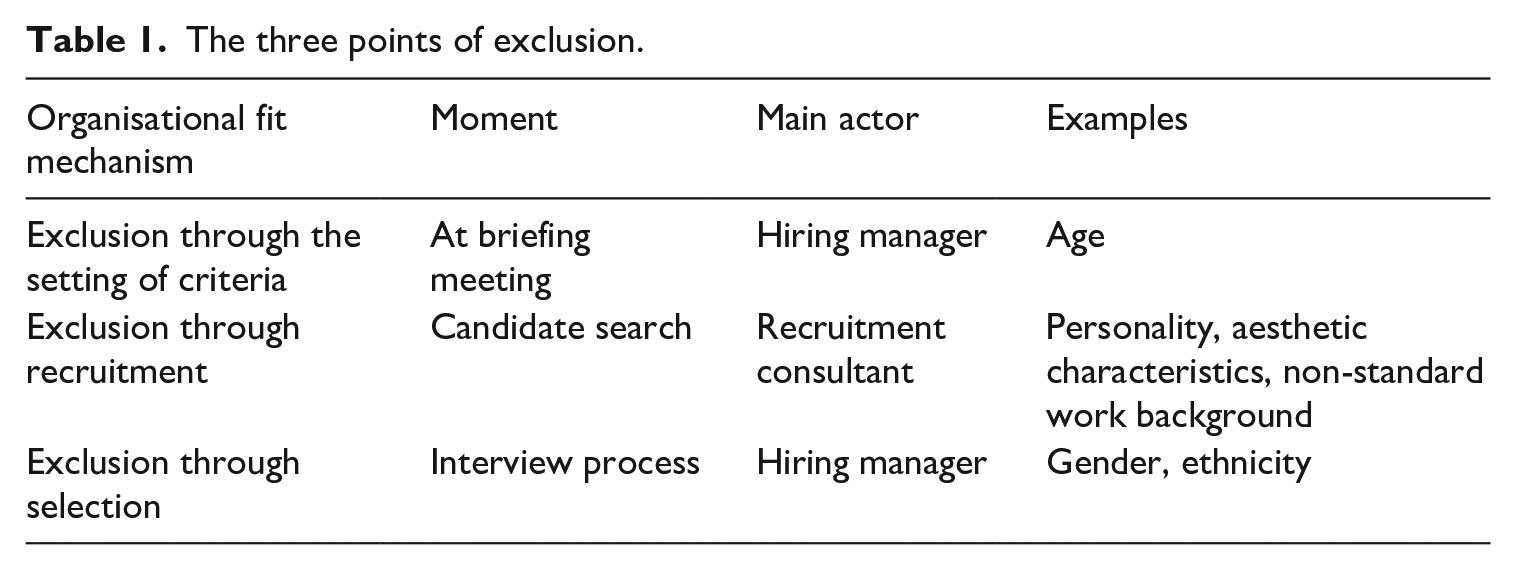
The study outlines three different moments during which conceptualisations of organisational fit can lead to exclusion according to recruiters. The first is by hiring managers, often at the start of recruitment, when they brief recruiters on the recruitment criteria and requirements. We cannot be sure from the data, but this may also happen when internal recruiters search for candidates. The second is when recruitment consultants try to predict, interpret and work within what they think hiring managers will or do want. The third is the point of selection at which hiring managers can, again, dismiss potentially suitable candidates by claiming an organisational fit mismatch. Table 1 summarises these three points of exclusion and the main actors involved, as well as examples of the most relevant social fit criteria for each form of exclusion.
The three points of exclusion.
This article makes two key contributions to the literature. Despite increasing sophistication within recruitment methodologies to assess capabilities and personality types, the recruitment process for high-skill occupations remains a battleground in which employers can allow their biases and prejudices to shape labour market outcomes. This can counteract any organisational aims for diversity leading to homophily in hiring. The mainstream literature in HRM and occupational psychology has shown it to be greatly significant in the hiring process in modern organisations. Yet, too often, organisational fit is understood as a rational, transparent and stable set of criteria applied within the broader recruitment and selection process. Too often, within the HRM and psychological literature, organisational fit is seen as a benign criterion for recruitment, whereas this study shows that it could actively contribute towards exclusion within the labour market. From this study, it is clear that organisational fit criteria are rarely made explicit, codified or shaped into formal hiring criteria. Both employers and recruiters define their organisational cultural characteristics through their understanding, viewpoints and interests. Relevant organisational culture differences undoubtedly shape workers’ performance, productivity, job satisfaction and ability to work effectively with others. However, the current HRM literature needs to be much more critical of P–O fit and should look beyond its potential productivity-related benefits. Without any transparency or formalisation, organisational fit will continue to allow the reproduction of unequal opportunities within the labour market.
The second contribution is to the extant sociological and critical management literature on organisational fit. Like other studies (e.g. Hora, 2020; Rivera, 2015), the findings confirm that ascribed social categories are of critical importance within the definition of the application of organisational fit within the hiring process for professional roles. The study confirms the active role of external recruiters in constructing organisational fit criteria (Coverdill and Finlay, 1998). In accordance with Hora (2020), employers of professional workers recruit on characteristics far beyond class-based commonality, which perhaps is most heightened at the elite level. 2 The study also highlights the importance of process in the exclusionary role of organisational fit. It determines that the exclusionary effects of the use of organisational fit in hiring are structural and distributed over three different points, in each of which different actors there are opportunities for social biases to manifest. The study also extends on Relation Inequality Theory by using its theoretical building blocks to further our understanding of the hiring process. Claims about organisational fit become inequality-generating mechanisms when they are treated as legitimate (Tomaskovic-Devey and Avent-Holt, 2019: 163). Forms of claims-making are needed to rationalise and legitimise the evaluation of candidates on organisational fit criteria. The opportunity and success of the actors’ relational claims-making co-determine what profiles are deemed acceptable and unacceptable. A renewed conceptualisation should stress not only the perceived organisation culture or characteristics this type of fit refers to but also the discursive and cultural processes whereby actors can maintain control over the workplace. Within professional work, organisational fit constitutes a dichotomy between (a) considerable efforts to formalise the often data-driven hiring process, and (b) the desire by employers, and recruiters, to circumvent this formalisation to implement fit criteria, including those driven by personal preferences, prejudices and beliefs.
Conclusion
Hiring practices shape unequal outcomes and opportunities (Amis et al., 2020; Baron, 1984). Organisations function as inequality regimes in which multiple actors with various levels of resources and powers grant access to an organisation. The relative power of organisational stakeholders, such as hiring managers, positions them well to make claims about who ‘fits’ and who does not (Avent-Holt and Tomaskovic-Devey, 2014; Tomaskovic-Devey and Avent-Holt, 2019). The concept of P–O fit within the mainstream academic literature does not adequately capture how power relations ultimately shape the claims-making through which organisational fit is often expressed.
The study also has practical implications supporting existing measures and schemes to improve diversity and inclusion in organisations. The findings show that there are at least three points in the hiring process that would need greater scrutiny in how organisational fit is used. Making the assumptions and presumed characteristics of organisation culture explicit and involving a more diverse hiring panel may help counteract bias against particular groups and individuals. Hiring outcome metrics are useful to ensure diversity, equity and inclusion. Yet process metrics that can include demographic data of candidates may be able to reveal bias in how people are evaluated and what meaningful looks like; for instance, training reviewers to identify and interrupt bias (Williams and Dolkas, 2022).
Footnotes
Acknowledgements
The author would like to thank Professor Rachel Cohen for her helpful comments on an earlier version of the article as well as Professor Alexandra Beauregard along with the three reviewers for their comments, suggestions and support.
Funding
The author received no financial support for the research, authorship, and/or publication of this article.
