




Abstract
Scholars have researched the ‘wildness’ or ‘tameness’ of public screens for staging image events. This study argues that in non-democratic contexts, public screens are not totally wild or tame but are constrained by institutional limits, straddling the tame and the wild. In networked public screens, activists should keep a careful balance between tameness and wildness, staging ‘interactive’ image events to conduct bottom–up social mobilization to pressure the local state while avoiding being perceived as a threat. Through a case study of environmental activism in China, we identified two interactive strategies that were organized around image events. One was a visible interaction through which activists manipulated the mediated visibility of environmental problems by constructing image events. The other was an invisible interplay through which states and non-governmental organizations (NGOs) engaged in closed-door negotiations to solve the problems exposed, without relinquishing the potential for social mobilization by constructing image events. These two forms of interactions, visible and invisible, form a circuit and are interconvertible in specific situations. With the shrinking of institutional space, invisible interaction is becoming the dominant mode of interaction with the state. The formation of such an interactive circuit has largely constrained the power of environmental images in social mobilization.
Keywords
The visual turn in the social sciences and humanities has drawn attention to the crucial role that the visual dimension plays in contentious politics. 1 One stream of this research focuses on public screens, panmediated networks, and image events. In what is a pictorial era, the proliferation of panmediated networks has enabled the rise of public screens, especially networked public screens, for the circulation of images. 2 Image events, understood as staged acts of protests performed to attract mediated attention, have become one of the modular forms of contentious politics. 3
Most related studies have explored the ‘wildness’ of public screens and of the image events staged through these screens. These studies have paid particular attention to the subversive nature of wild public screens in challenging the power hierarchy. The interplay of creative users and the technical affordances of digital platforms have enabled striking and sometimes violent protest scenes to go viral, bypassing the censorship system and attracting public attention on all scales. 4 In contrast, scholars such as Joshua Ewalt et al. have argued that in addition to the wild public screens on which these ‘iconic image events’ are staged, public screens and image events can be ‘tame’, with protesters able to capture commonly found expressions of protest to produce banal and gentle images. 5 In later discussions, Elizabeth Brunner and Kevin DeLuca agreed that both tameness and wildness may well co-exist in certain campaigns. 6
These discussions have inspired us to think deeply about how non-state actors manipulate the wildness and tameness of protest content and tactics to interact strategically with the state in the process of constructing image events and circulating them through public screens. This study focuses on how image events are constructed strategically by non-governmental organizations (NGOs) in China and how images can serve as a mechanism for state–society interaction. Regarding China’s environmental image events, DeLuca and his co-authors focused primarily on unusual protests and demonstrations, thereby highlighting the wildness of public screens and image events. 7 However, wildness is just one of the facets of China’s public screens and image events. As studies of China’s civil society and NGOs have suggested, China’s NGOs differ from their counterparts in democratic contexts in the limited autonomy they enjoy and in the significant institutional constraints that are imposed by the authoritarian leadership. 8 With the institutional space for tolerating protest events shrinking, 9 NGOs must consider both social mobilization and political tolerance. Image events created by NGOs are often neither totally wild nor totally tame but straddle the two, moving along the spectrum depending on the state’s reaction. In such an interactive process, NGOs should try to construct image events strategically by appropriating visual devices and strategies to put pressure on the state without radical confrontation. This is another facet of China’s environmental image events circulating through public screens, which remains less explored. 10 Important questions therefore remain, given the escalation of institutional control in contemporary China. How can NGOs achieve this balance? How can they make strategic use of visual rhetoric to construct image events that fall between wild and tame, effectively navigate the delicate balance between mobilizing citizens and avoid radical confrontation, and exert moderate pressure on a state to obtain a reaction?
In this study, taking GH as an example, we explore the ‘interactiveness’ of public screens and image events, calling for attention to be paid to the visualization of state–society interaction. We submit that constructing an image event is an important way for NGOs to interact with the state in an increasingly pictorial era. By conceptualizing image events as a mechanism for state–NGO interaction and demonstrating the circuit of visible/invisible interactions, this study advances our understanding of the interactiveness of public screens and image events and deepens the discussion of the strategies behind state–society interaction. Because less attention has been paid in the literature to the visual dimension of state–society interaction, 11 this study also opens up a research agenda for their visualization.
Literature review
A well-established thread of the literature has unpacked how the visual dimension can be appropriated for the organization, mobilization, and diffusion of social movements and activism. Scholars have argued that visuality can be a key site of struggle for contentious politics, since visual elements can have the power to arouse emotionality through visual argument and rhetoric. 12
Image events, panmediated networks, and public screens
One of the scholarly traditions in visualizing social movements is research into the construction of an image event and its circulation on public screens. 13 It has been argued that both public activities and the public are now enabled by the increasingly digitalized public screens facilitated by the new media matrix. 14 The public screen is a concept that captures technological transformation and its impact on the public space. The notion of public screens differs from that of the public sphere, the latter of which privileges critical-rational debate by linguistic means. In contrast, public screens attach importance to irrationality and the non-linguistic elements of communication. Scholars argue that critique and public deliberation happen not only through linguistic vehicles and rational communication but also through non-linguistic means, especially the use of pictures, images, and spectacle. 15 The emergence of panmediated networks, which connect people and ‘objects via online platforms which can transmit a wide array of information, including images, and do so ceaselessly at great speeds’, 16 has enabled the rise of networked public screens. Briefly, the notion of networked public screens refers to the particular spaces that afford the opportunity for the multidirectional flows and circulations of the networked mediascape, especially that of image and spectacle, between different screen nodes. 17 Such digitalized public screens consist of multiple types of mediated screens, such as televisual, computerized and even telephonic screens, and are full of remediation and hypermediacy dynamics across media platforms. 18
Networked public screens have become the sites for staging image events. DeLuca developed the concept of image events to denote a form of protest event in a pictorial era. 19 Image events were originally defined as staged acts and practices of protest carried out to attract mass media attention. 20 DeLuca and his co-authors used the concept of image event to emphasize ‘the image as event’, arguing that ‘an image is exactly an event—irreplaceable and irreversible’. 21 Image events have two basic characteristics. First, the notion of image events acknowledges the power of the image in constructing social reality. An image is not a mere reflection and representation of social reality but can be a constitutive force in building a social reality. Second, in addition to visual and affective power, images possess argumentative power. An image event is a postmodern form of argument, having the power to deliver ideas and shape public opinion. As suggested, ‘images are capable of operating as claims-making, reason-giving, opinion-shaping communication and [are] therefore instrumental to the practice of public argument’. 22 Because of these capabilities, constructing image events is a strategy used by protestors. 23 In the digital age, by using panmediated networks, activists and protestors strategically construct image events using wildness to attract the attention not only of the mass media but also of all kinds of social media, shaping wild public screens for protesting. 24 Such a form of networked image events works mainly through panmediated networks and can be a remedy for the ignorance shown by traditional mass media. 25
Studies have paid particular attention to how activists leverage the affordances of the new media matrix to construct image events, shaping wild public screens that show the transformative power of circulating protest information and avoiding censorship and surveillance. 26 As suggested, ‘wild public screens refer not only to the content, but also the tactics (regardless of their immediate success) and the tangled tendrils of relationships that tie users together in conversations no longer solely driven by corporate, government, and mass media hierarchies’. 27 In this sense, the concept of wild public screens emphasizes (a) the wildness of content – the striking, iconic, and sometimes even violent protest images; and (b) the wildness of circulation – the viral circulation of images enabled by the power of technological affordances and the creativity of citizens. Wildness is viewed as a subversive tactic for overthrowing domination by the governmental, corporate and mass media. 28 In contrast, based on their observations of other protest events, Ewalt et al. argued that public screens can also be tame, as some of the images produced by protestors are banal and deal with the commonplace of contentious politics. Accordingly, the notion of tame public screens does not only ‘register tameness in circulation, but also in subject matter’. To elaborate, the tameness of public screens emphasizes (a) the tameness of content – banal and gentle protest images; and (b) the tameness in circulation – the capacity of citizens to construct their own media ecologies to circulate banal protest images on a small scale but still catch public attention. 29 In later discussions, DeLuca and his co-authors argued that both wildness and tameness coexist in specific image events of protests. 30
Visualizing state–NGO interaction
In non-democratic contexts, both wildness and tameness have situated implications and can be interpreted as strategies purposely deployed by activists to manipulate the parameters of images to sustain goal-oriented interaction with the state. This study submits that in non-democratic contexts, public screens are not totally wild or tame but that they straddle the tame and the wild, as a result of the institutional constraints imposed. Activists should keep a subtle balance between tameness and wildness, considering both social mobilization and political tolerance. Therefore, this study focuses on the interactiveness of public screens and image events, exploring the strategic construction of ‘interactive’ image events in the dealings between states, NGOs, and movement activists to achieve advocacy goals without radical confrontation. The term interactiveness is used here to underscore the non-confrontational or soft-confrontational nature of this specific form of state–society interaction through image events and public screens, as informed by relevant studies. 31 It can thus help to answer the question of how domestic Chinese NGOs achieve their goals.
The way in which NGOs interact with states has given rise to much critical debate among scholars. 32 In the Chinese context, scholars have identified different interactive relationships between the state and society. 33 However, these studies have paid little attention to the visual dimension and the potential of the visual as an interactive strategy. Here, by using the notion of interactive image events, we argue that image events can be used as an interactive strategy between the state and NGOs to advance environmental governance. Image events can be manipulated in terms of visual strategy and scale of circulation to exert public pressure on targeted governmental agencies while avoiding radical confrontation with the state. As Robert Cox suggested, 34 to carry out an effective advocacy campaign, NGOs should be able to identify the key audiences and categorize them as primary and secondary. The primary audience is the target of the campaign, which will respond to activists’ appeals. In China’s environmental realm, government bodies at various levels are usually the primary audiences. Potential supporters – the public, opinion leaders, and the news media – constitute secondary audiences. More often than not, the pattern of state–society interaction is to first mobilize secondary audiences to gain public attention and shape opinion and then to leverage that public attention as the pivotal bargaining counter to push the relevant authorities, especially local governments, to respond to controversial public issues. 35
Regarding the specific visual form of state–NGO interaction through image events, NGOs should manipulate the visuality (content) and visibility (circulation) of the events to sustain the interaction. First, attention should be paid to the visuality of image events. According to Cox, 36 as a form of symbolic act based on visual means, ‘visual rhetoric is both pragmatically—to persuade—and constitutively, to construct or challenge a particular “seeing” of nature or what constitutes an environmental problem’. Movement activists should manipulate visuality, controlling what is to be seen by strategically arranging visual devices and strategies to problematize environmental issues and prompt social mobilization. 37 For image events in the digital era, it is of course important that this manipulation does not involve exploiting the malleability of digital images to threaten the authenticity of the reality being documented. 38
Second, attention should be paid to the visibility of image events. Movement actors exploit technical logic, such as the hashtag mechanism, to manipulate the construction and circulation of image events. 39 Scholars have also identified a set of creative measures adopted by protestors when constructing image events under digital surveillance. 40 By manipulating visuality and visibility, movement actors can subtly put pressure on the state at various levels in non-democratic contexts while avoiding direct confrontation.
By manipulating the visuality and visibility of image events, we submit that NGOs can make full use of the interactiveness of public screens and image events, carrying out two types of image-driven interactions with the state in which image events are used as mediators. One type is visible interaction, in which NGOs increase the visibility of environmental problems by constructing image events on networked public screens. At the same time, they manipulate the visuality of image events strategically to ensure that these image events do not lead to radical confrontation but that they arouse public attention and put moderate pressure on the relevant governmental bodies. The other is invisible interaction with the state through networked ‘institutionalized’ screens. To clarify, networked institutionalized screens refer to a type of networked screen enabled by the new media matrix but institutionalized for internal communication between NGOs and governments. These networked institutionalized screens can be viewed as one form of institutional channel established on social media networks by governments, which indicates a trend towards the institutionalization of social movements and advocacy efforts. 41 NGOs can use images that problematize environmental issues to proactively communicate with the relevant governmental bodies through these institutionalized screens.
These two types of visual interactions form a circuit that visualizes state–society interaction. They are interchangeable: given different government reactions, NGOs can decide which mode to adopt. If the relevant governments are actively involved in invisible interaction and react to the appeals of NGOs, those NGOs will choose to ensure the invisibility of the environmental issues; if governmental bodies offer no response, NGOs can construct an image event that increases the visibility of the environmental issues and pushes the government to make changes.
China’s environmental activism
Before turning to our case study, we must provide some background to China’s environmental activism. Facing intensive environmental problems, the central government realized that the state apparatus has limited administrative resources to devote to environmental governance. 42 Based on a top–down network of environmental protection bureaus, the government established a multi-layered but decentralized governance system to set out and then assess local officials’ environmental protection performance. Within this system, local governments and officials are mostly responsible for local environmental protection, despite their limited authority and resources. 43
The Chinese authorities have also allowed environmental NGOs (ENGOs) and citizens to become involved in environmental governance, to ease the burden of environmental protection, and avoid any potential social instability caused by environmental disputes. 44 ENGOs can leverage the media system to construct a green public sphere for environmental debate. 45 The proliferation of new communication technologies has allowed ENGOs to exploit the technical affordances of social media platforms and ‘civic tech’ strategically to facilitate advocacy campaigning and civic engagement. 46 However, unlike their counterparts in Western societies, Chinese ENGOs more often than not adopt non-confrontational or soft-confrontational stances towards the authorities. 47
In response to the Chinese government’s recent tightening control over civil society and the Internet, NGOs have attempted to adjust their advocacy practices. Some have endeavoured to sustain their distance from the political power, adopting strategies that straddle the demarcation of confrontation and non-confrontation, but they have still had to, more or less, soften their advocacy practices. 48 Other NGOs have undergone a depoliticization process and significantly altered their advocacy strategies. 49 The ways in which activists use the new communication technologies to stage environmental campaigns have also been transformed. In the early stages, mobile phones and social media played an important role in assisting the mobilization and organization of offline protests. Today in China, it is less common for people to mobilize and organize large-scale offline social movements. Rather, as digital technologies have evolved, ENGOs have created new modes of online environmental activism. 50 The staging of image events on social media has become one form of localized environmental advocacy campaigning adopted by environmental activists. 51
The case and methods
To reduce and prevent water pollution in G Province, since April 2011, a locally based grassroots ENGO, which we name GH, has run an image-oriented environmental advocacy campaign on Weibo and WeChat, China’s most popular social media. As part of the campaign, GH calls on concerned local residents to join as volunteers and encourages them to regularly monitor and test the water conditions in the local rivers, especially where chemical plants are located. Using mobile phones, the volunteers record test results and water conditions in these areas and then post the images on Weibo via their personal accounts. These environmental volunteers are called River Watchers. GH is a typical case because of two features of its decade-long campaign of River Watchers. First, the campaign provides a good demonstration of the role of panmediated networks for facilitating the construction of image events. In its earlier years, the campaign mainly relied on social media networks such as Weibo in China. In 2019, amid a migration of social media users from Weibo to WeChat, GH developed a WeChat mini-program called Xunhebao (巡河宝, roughly translated as ‘river patrol device’) to serve as an easy-to-use tool to attract and organize more citizens to participate in the activities. Currently, the ENGO has more than 400,000 registered volunteers on Xunhebao. Second, its campaign is a typical example of the interactiveness of public screens and image events. GH has carried out advocacy through interactive image events. To date, it has created several successful image events on social media that have attracted not only wide public attention on social media platforms but also much attention from many mass media outlets in China. GH provides volunteers with a toolkit handbook of visual social media posting tactics, which helps them avoid potential political risks and ensure the interactiveness of the released information.
This case study relies on the data collected from two rounds of fieldwork conducted in multiple cities of G Province in December 2018 and September 2022. To understand how River Watchers obtained first-hand information about water pollution, during the first rounds of fieldwork the first author visited a monitoring spot with volunteer Zhang and observed how River Watchers routinely test the quality of the river water. In addition, we conducted 23 in-depth interviews with 20 interviewees face-to-face and via online phone calls in Mandarin, with each one typically lasting approximately 45 to 60 minutes. Follow-up questions and parts of the visual data were exchanged with the interviewees via WeChat instant messages. Demographic information about the interviewees is provided in Table 1.
List of interviewees.
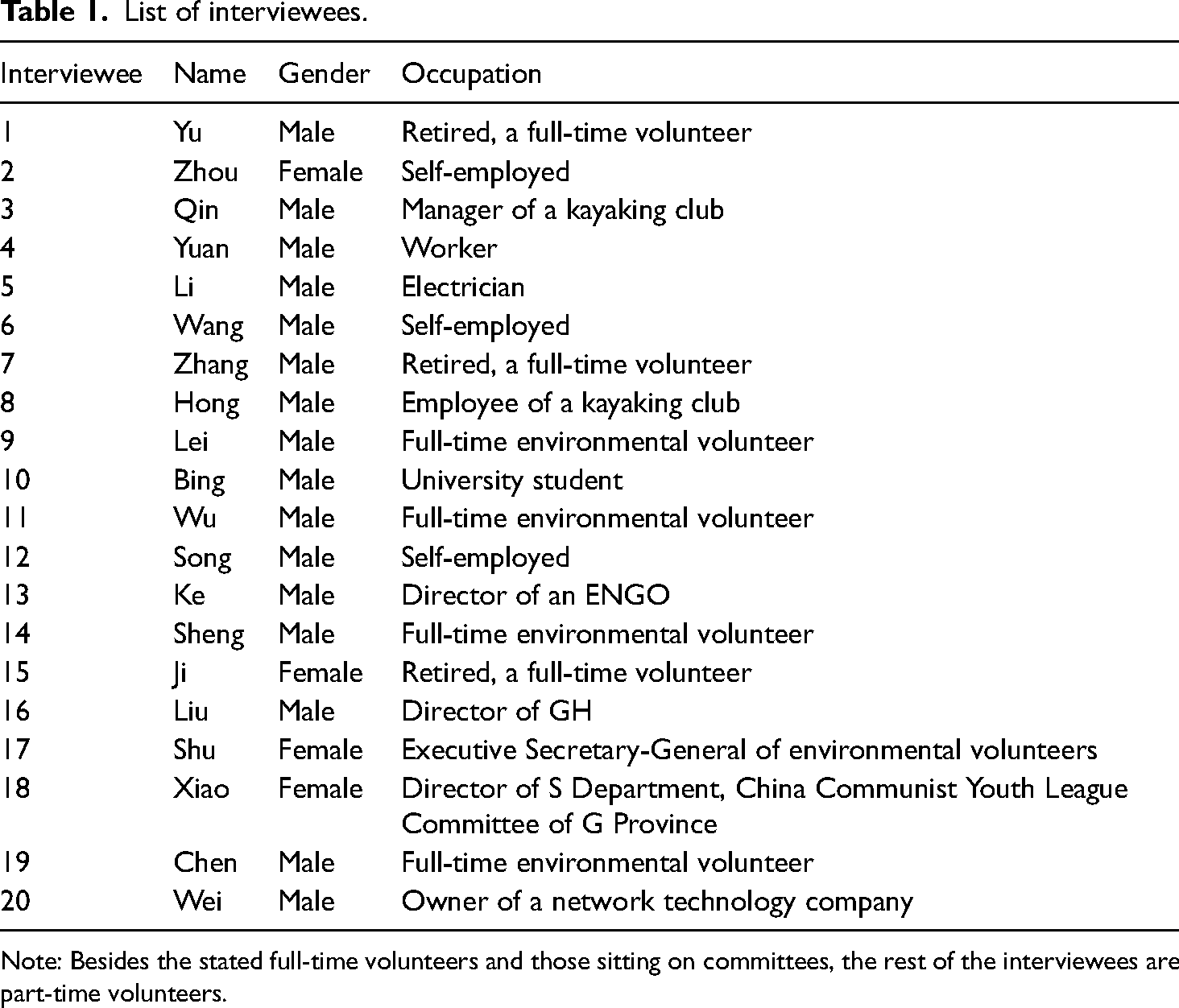
Note: Besides the stated full-time volunteers and those sitting on committees, the rest of the interviewees are part-time volunteers.
Several studies have explored the case of GH by focusing on its datafied project and its strategy of ‘soft confrontation’. 52 In contrast, this study focuses on the visual aspect of its campaign from the perspective of image events. The rest of the article explores how this ENGO and its volunteers created and sustained image events by leveraging the technological logic of social media. We also explore the visual rhetoric that facilitated the visual campaign through social media and how image events were used to sustain a form of visual interaction with the local authority.
Panmediated campaigns, images, and scientific data
To sustain its campaign, GH sought to persuade citizens to act as volunteers in monitoring water pollution. As citizen-witnesses the volunteers use their cameras, generating pollution images and data, and posting on Weibo to stage image events. In this process, the ENGO strategically set out technical guidelines to help citizen participants communicate using the Weibo platform and the WeChat mini-program Xunhebao.
River Watchers and citizen camera-witnessing
In the campaign, GH initially created River Watchers as a collective identity to maintain long-term performance and strengthen solidarity. River Watchers use the practice of camera-witnessing. The process of recording and posting images of local water pollution by mobile phone in this campaign can be called ‘citizen camera-witnessing’. 53 The term was originally used to describe political activists risking their lives to produce incontrovertible visual evidence that would mobilize global public support against unjust events. Although the water protection campaign is largely non-confrontational, it encourages participants to play the role of witnesses and use visual images to direct public attention to an environmental issue. Interviewees frequently cited ‘evidence’ to describe the role that images play in this campaign. As Li stressed, ‘I mean that I provide evidence of pollution through photos and videos. Water quality could vary over time. . . . This is also why I emphasize the time of recording. I think it records the state of the moment.’
Generating pollution data have also become indispensable in the ENGO’s pursuit of environmental justice. GH adopts a kind of crowdsourcing and participatory mechanism to aggregate pollution data on social media. According to the interviews, all of the data that the volunteers produce are in, or close to, real time, which ensures that the information circulates at speed online. Although this crowdsourcing and participatory mechanism faces the issue that similar data are repeated multiple times, encouraging public involvement is essential in the fight for environmental justice.
Weibo and Xunhebao
GH provides its volunteers with a specific format for documenting and posting information on Weibo and the WeChat mini-program. According to the River Watchers’ Handbook, a standard Weibo post should attach the hashtag #RiverWatchers, use the global positioning system to show the monitoring location, indicate the observation time, and record the amount, colour, smell and pH value of the water as well as whether there are bubbles or objects floating in the river. At the end of the post, volunteers should use the @ symbol to link to the official River Watchers Weibo account and other related accounts. The uploaded images are required to show two kinds of content: water quality and river surroundings.
In its WeChat mini-program Xunhebao, GH designed a series of functions to generate visual data and mobilize its volunteers’ enthusiasm for water resource protection. This mini-program can also be linked to WeChat Moments and Weibo, thus having the potential to trigger image events. Compared with Weibo, the format of postings in Xunhebao is similar but the content is simpler. In an interview, Liu, the initiator of GH, emphasized that the purpose of standardizing the posting procedure in Xunhebao is to lower the threshold of public engagement. Apart from volunteers, local government officials also use Xunhebao to obtain pollution information. For GH, Xunhebao is a convenient way to manage its large number of volunteers and run various activities.
It is notable that technology constrains image events even as it enables their staging. On the one hand, technology has facilitated the circulation of images. Personal social networks contribute by spreading the campaign’s messages and recruiting volunteers. Most of the interviewees noted that they often send pollution information to people in their personal networks via social media, especially WeChat groups. For example, Zhou mentioned that she always calls for help from her friends and other volunteers to circulate the information she posts, and she believes that this helps to solve problems productively. On the other hand, as Chinese social media are subject to a strong censorship regime, it is evident that GH requires its volunteers to maintain a neutral and objective stance when exposing information about water pollution on social media. In this sense, privileging scientific data helps the Weibo posts bypass the online filter system and keep the campaign going on social media for longer.
Visual rhetoric and emotional mobilization
By creating a collective River Watchers identity, routinely practising camera-witnessing, and articulating the technological logic, GH effectively stages image events on social media to evoke public emotions. These images amplify the severity of the issues, juxtapose incongruous elements, and construct the relationship between human beings and nature. By creating a visual impact, the images provoke a series of emotions – such as despair, anger, sympathy, and hope – to attract more public attention. The River Watchers excel at exploiting the power of images to persuade the general public to engage with the visual campaign while pressuring the government in a powerful but non-confrontational way. This section focuses on analysing image events from a rhetorical perspective to explore how the River Watchers have sustained a form of soft confrontation. 54
Visual strategies for mobilization
GH uses two visual strategies to mobilize the public in exposing environmental pollution. One strategy is to provide audiences with a kind of visual pleasure using images of scenery to arouse citizens’ love of nature and recruit fellow campaigners. For example, Yu, a senior citizen who joined the campaign after retiring, posts beautiful images of the rivers he routinely patrols, adding poetic descriptions. To portray the beauty of nature, Yu presents images of a clean river, a bouquet of lotus flowers, a magnificent bridge, a pavilion built on the lake and so on. In his opinion, the images he captures ‘awaken the awareness of more people [of the need] to act and protect our beautiful homeland . . . [they] tell people that the life we have is beautiful and that we should cherish our natural resources and protect the environment’.
Pictures of scenery have also been used to recruit campaign members and obtain social support. According to Zhou, images of beautiful views of the local environment showcase the significant social changes made by the River Watchers. By reflecting the changes to the local environment, the images offer potential participants a sense of what they could accomplish by joining the campaign. In this sense, the pictures of the scenery actually deliver to the public the campaign’s message that ‘engagement brings change’ and prove that people can have an influence on environmental issues.
River Watchers also routinely adopt another visual strategy: creating ‘visual condensation symbols’ in their images. For example, Yuan provided us with a screenshot of one of his Weibo posts (see Figure 1) to show his creativity in expressing an environmental issue. His post is accompanied by three photographs of a little boy. In one of these photographs, against the background of a dark night, the boy is holding the result of a test of water quality. The little boy functions as a visual condensation symbol that calls for participation in environmental preservation. Here, a visual condensation symbol can be understood as a spoken act that takes the form of an image to generate meaning and make an argument, evoking concern over a specific event or situation in a particular context. 55 In this case, the image of the little boy is deployed as a visual condensation symbol of people’s anxiety about local water pollution and a justification for the need for grassroots participation.
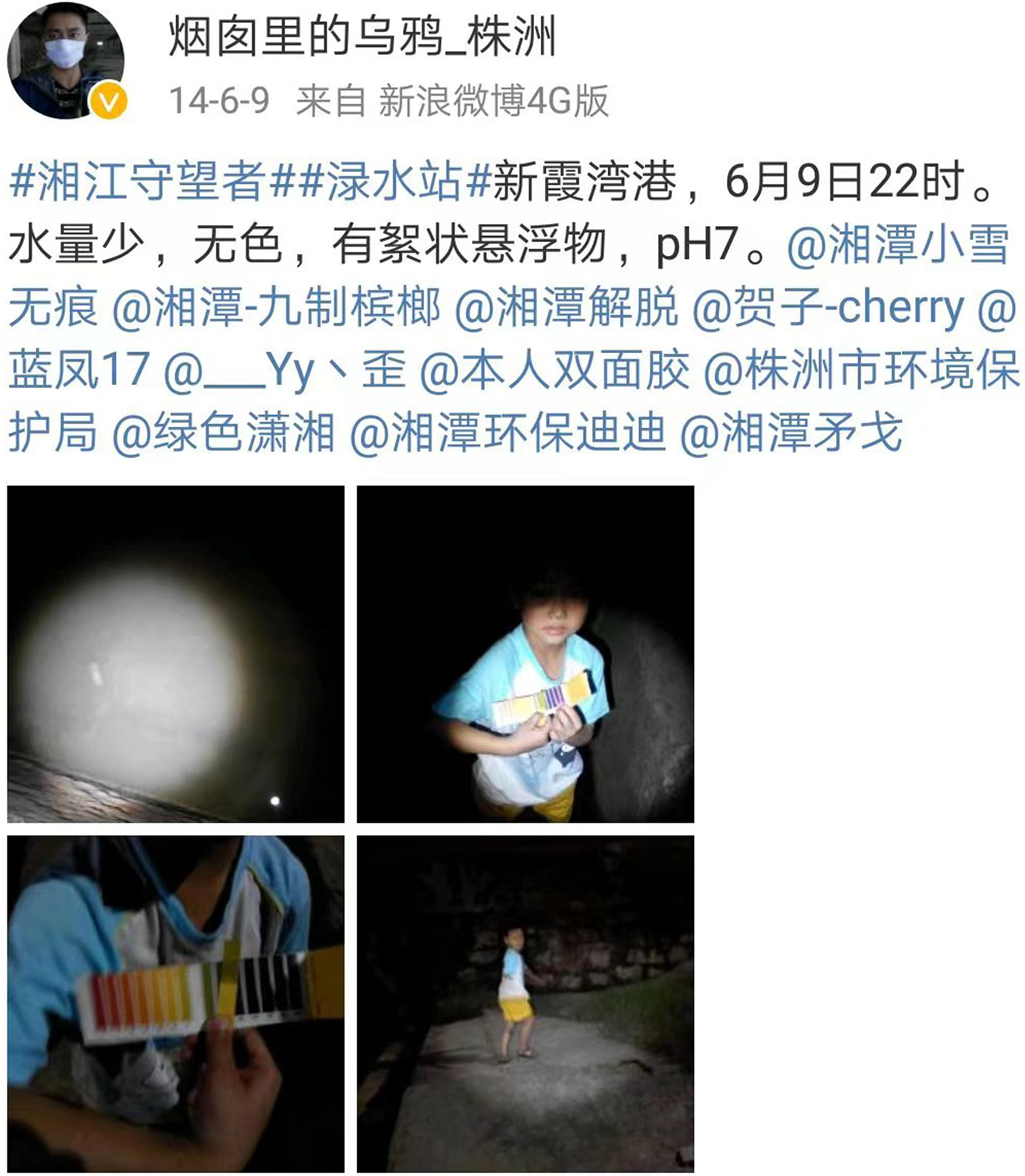
A screenshot of Yuan's Weibo post.
According to Finis Dunaway, 56 children have long served as popular emotional symbols to visualize the invisible dangers or threats that environmentalists campaign against. Children are universally understood to be innocent and vulnerable. When a little boy becomes a key visual motif in an image, it explicitly delivers a message that all groups of citizens are equally vulnerable in the face of environmental pollution. Children are also a reference to the future of humanity. In China, a well-known saying is that ‘children are the flowers of the motherland’. Connecting a child to the environmental issue in the images tells audiences that protecting the environment is equivalent to protecting our children and our future. This link not only evokes a sense of urgency about environmental protection but also the empathy and concern of parents when they see a child involved in environmental issues. Yuan's photographs of the little boy are also an invitation to encourage more children to engage in the campaign. Yuan explicitly told the media that he was encouraging his son to become an environmental volunteer in the future and hoped that the boy would continue his efforts to protect the environment.
Visual strategies for problematization
In addition to mobilizing social participation, River Watchers exploit visual rhetoric to turn environmental damage into an issue. The group emphasizes the importance of the objectivity and authenticity of the information it supplies in gaining public support and trust. Meanwhile, River Watchers do not limit their activities to simply documenting environmental issues; rather, they seek to create images with a highly selective view that emphasizes some parts of reality and excludes others. This means coping with the subtle boundaries between the malleability and authenticity of digital images in everyday practice.
The most important principle in maintaining the authenticity of images is ‘no manipulation’. In the era of digital photography, with the technical capacity widely embedded in smartphones, even amateur photographers are able to easily alter their work. 57 However, in the context of environmental issues, visual manipulation is viewed as a kind of deceit rather than as an enhancement of reality. As Lei stated, ‘Environmental issues are not like other stuff, you cannot edit.’ It is considered unacceptable to modify the colour of the water to exaggerate the seriousness of water pollution. Doing so could lose the audience’s trust and negatively affect the campaign’s reputation. The interviewees argued that ‘what is posted should be authentic, there is no rumour or drama in it’, and that sharing images without using any filters was intended to ‘show the original colours of the water’ and ‘objectively reveal the issues through the photos’.
Nonetheless, in the search for visual impact, River Watchers have sometimes deliberately captured images in ways that amplify certain aspects of pollution sites. In the interviews, it was apparent that River Watchers regularly adopt two ways of highlighting key points in the images. One is to choose a special aspect to frame the image, and the other is to adjust the composition by cutting and cropping. As Yu, a senior River Watcher, put it, ‘In my photos, I mainly rely on the selected aspect and composition to illustrate the issues.’ During our fieldwork, River Watcher Qin provided a photograph of a dead fish (see Figure 2) to illustrate how he deliberately emphasizes a part of reality to make his image look ‘better’; in other words, to have more visual impact. Using a low angle and a close-up, Qin emphasized the aspect of the dead fish to highlight the environmental issue. Through the image, he attempted to connect the fish’s death to water pollution so as to warn of the damage to local people’s health caused by pollution. The dead fish was intended to raise people’s concern about the quality of the local drinking water.
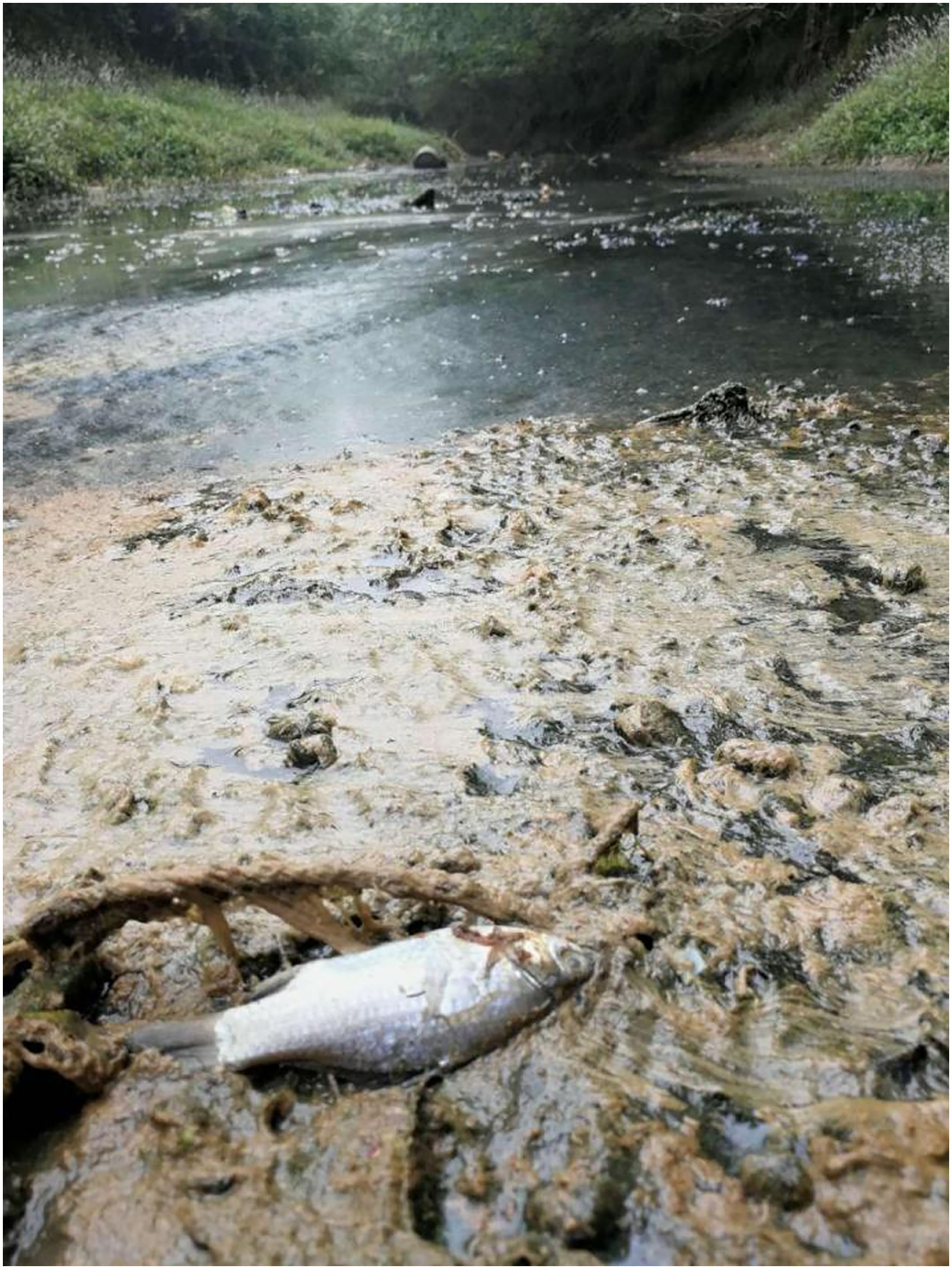
Photograph of a dead fish.
Interactive image events
Based on visual strategies, some of the images produced in the River Watchers campaign were transformed with the assistance of panmediated networks into image events, attracting public attention and coverage by mass media.
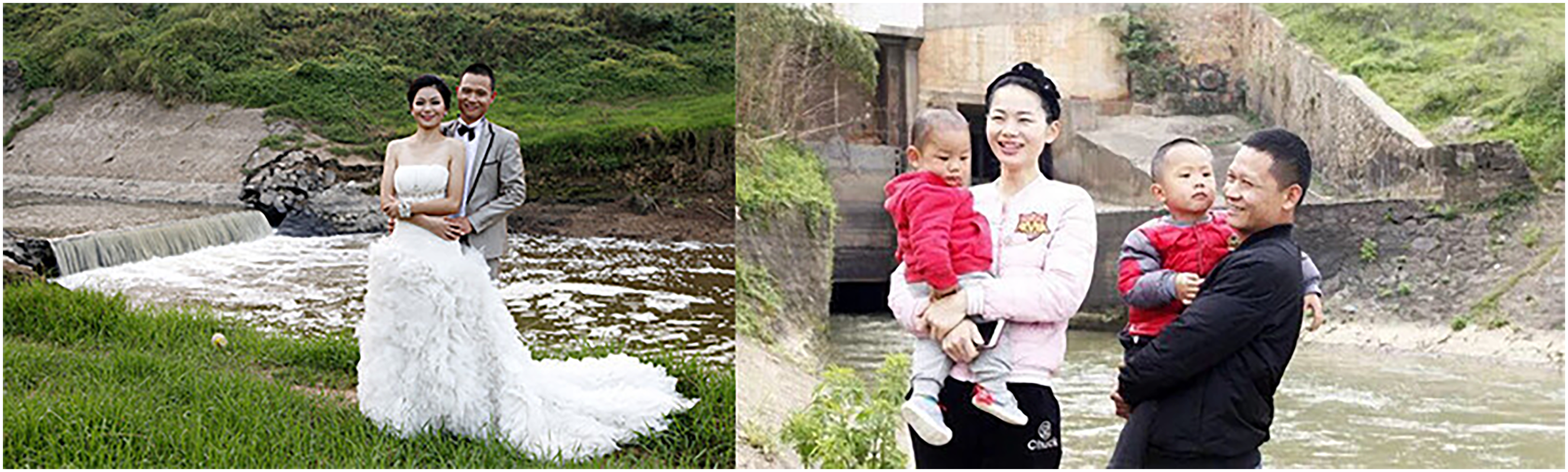
Two example image events are rather typical: a wedding ritual by the river (see Figure 3) and a mourning of ‘mother river’ (Figure 4). In these two image events, the River Watchers adopted a visual strategy of juxtaposing opposed symbols to arouse the public’s attention. In September 2013, to help his friend take more arresting wedding photographs, Wu suggested that the young couple take their wedding photographs next to the polluted river that they had monitored regularly since joining the campaign. The bridegroom Song was also a River Watcher and he liked the idea. In the wedding photographs, two contrasting elements – a wedding ritual and a polluted river – combine ironically to construct a spectacular image. The photographs show the young couple (the most important part of the wedding ritual) in the foreground of the image. Simultaneously, in the background, an outfall is discharging sewage into the river, creating numerous white bubbles.
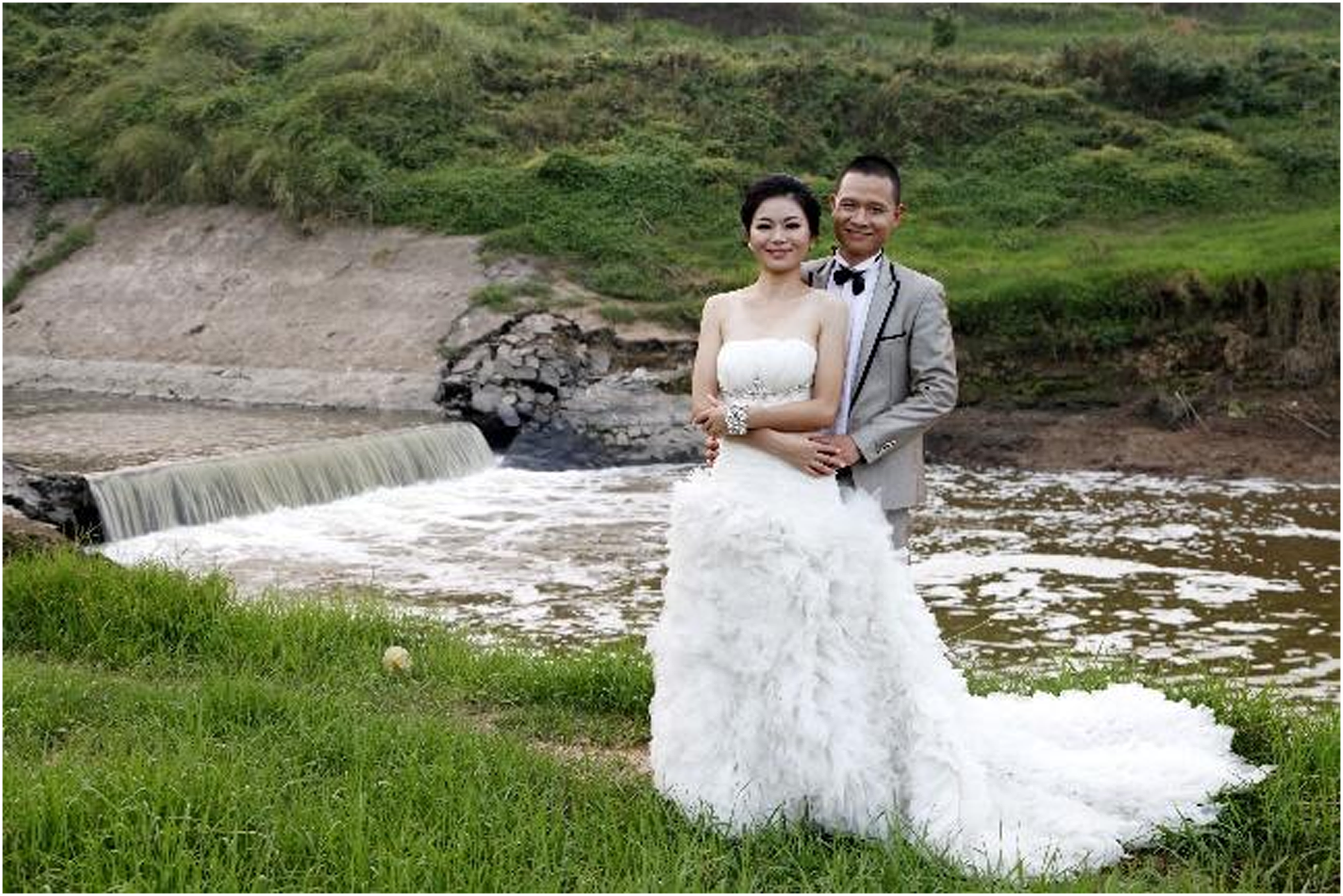
One of the wedding photographs taken next to the polluted river.
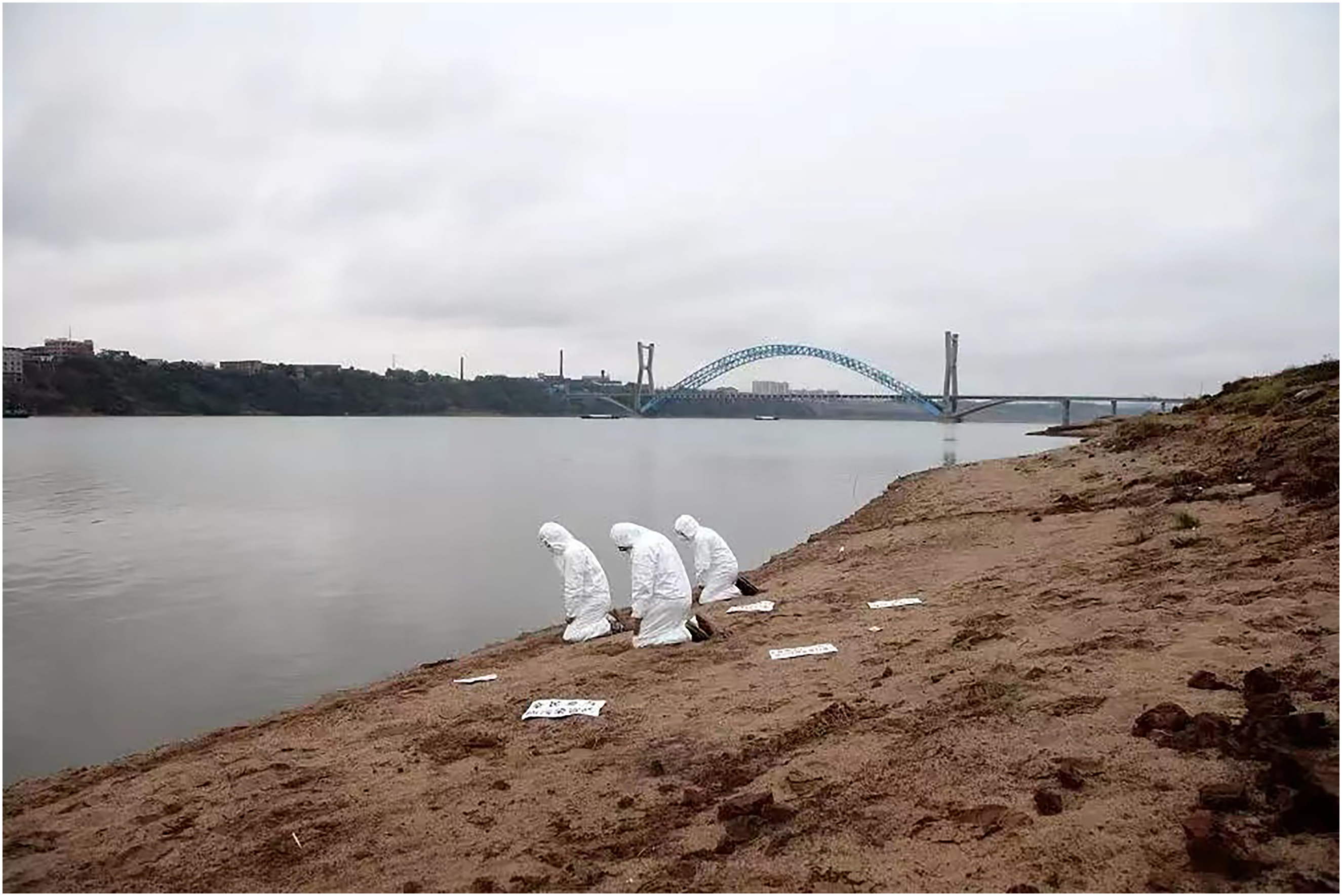
Photo of people praying to and mourning for the Xiangjiang River.
According to Jonah Rice, 58 oppositional elements consist of conflicting styles, generic violations, juxtaposition, paradox, irony, contrasting ornamentation and other contradictory ideas. The set of wedding photographs successfully constructs a contrast by juxtaposing the sacred and the profane. A white wedding dress is commonly understood to have a sacred meaning, and the polluted river water obviously represents the dirty and profane. In the conventional cultural ritual, wedding photographs are supposed to be perfect and taken in a beautiful setting; everything related to the wedding ritual is about happiness and excitement. In contrast, pollution always causes a series of negative feelings, such as anger, discomfort, and frustration.
There is no doubt that this polarization successfully triggered public affective resonance about local water pollution. The wedding photographs next to the polluted river went viral on Chinese social media in a very short time. On Weibo, not only regular users but also some influencers with major followings, such as Deng Fei, reposted the photographs. Soon, they also hit the headlines of many mainstream domestic media outlets, including the state-run China Central Television and People’s Daily. This set of photographs successfully attracted public attention and sparked national debate by converting a personal experience into a public event.
Given the success of the wedding photographs, the Watchers of the Xiangjiang River organized another image event in November 2014. They took photos of a group of people praying to and mourning the Xiangjiang River. The mourners wore white chemical protection suits, which look like Chinese mourning clothes. With the Xiangjiang River as the background, they stood in silent mourning, raised their hands in prayer, or prostrated themselves on the ground. In this way, they hoped to encourage people to stop polluting the Xiangjiang River. Similar to the wedding photographs, this image event successfully attracted the attention of social media users and mass media outlets in China. The event received more than 300,000 reads on WeChat and finally triggered a government reaction.
An interactive circuit
By showing the images and attracting public attention on social media, the River Watchers demonstrated two forms of interaction with the local governments that they were targeting, gaining the leverage needed to converse with and to question local officials through both visible and invisible channels. With the shrinking of institutional space over the past decade, River Watchers have adjusted their interactive strategies, focusing on invisible interaction more often than ever before. They transformed the visible interaction staging on the networked public screen into invisible interaction with local states by using the networked institutionalized screen.
Visible interaction
The visible interaction between NGOs and local authorities should be understood as a two-step process. The first step is the staging of image events to mobilize social attention and participation to put pressure on the authorities. These are examined in the previous section. The second step of visible interaction is symbolic recognition through images. After staging image events on social media, if the environmental issue that was exposed had been addressed by the local government, GH often acknowledged the performance of the local state in the form of image recognition. This sort of visible interaction is a symbolic act that appropriates the visual strategy of past–present comparison in an environmental situation and recognizes the local government’s performance in reacting to the appeals. Some River Watchers frequently use visual comparison as a tactic to construct a visible form of symbolic interaction with the local state. Some volunteers who have been monitoring the water quality of the same river for a long time presented the changes in quality over a certain timespan by combining images of the past and the present. For instance, in an interview, Li called such a combination of images ‘data collection’ to ‘showcase on Weibo the changes in water pollution over time’. This visual comparison demonstrated ‘what the original appearance of the pollution was, how it had changed afterward, and what the river looked like when the pollution was stopped’ and acknowledged the government’s performance of its duties to the environment.
Another example of visible interaction is the comparison of the wedding photographs in 2013 and 2018. Wu invited the bridegroom and his family to take another set of family photographs at the same place in April 2018. On his public WeChat account, Wu put the two sets of images together (Figure 5) and in the commentary underlined the changes that had occurred in both people’s lives and the state of the river. In the interview, Wu explained why he made the comparison: In the wedding photos it was only [the groom] and his wife who were standing next to the outfall, and now the family has four members. It’s not just this family; the outfall has also had a big change. It was full of black water and white bubbles, but it is clear now. That all happened in five years.
Wedding photograph taken in September 2013 (left) and photo of the same couple in April 2018 with their two sons (right).
Invisible interaction
In recent years, with shrinking institutional space for environmental advocacy, GH has gradually transformed its strategies for interacting with local government officials. Seizing the political opportunity of the top–down establishment and promotion of a river chief system (河长制) since 2016, 59 the ENGO has collaborated with the local government to create a form of double tracking of the river chief system. In this double-track system, for a specific river, there are two river managers, one nominated by the local government and the other a GH volunteer. The local government agreed to support this grassroots river manager financially through its outsourcing service. Under this form of cooperation, both sides have established an institutional channel through which to interact. They established a WeChat group composed of the relevant local government officials, the official river manager, the grassroots river manager, and some grassroots River Watchers. The WeChat group can be viewed as a networked institutionalized screen established on the basis of the institutional construct of a double-track river chief system. It is an internal channel that confines the circulation of images of environmental pollution to a limited audience. According to our interviewees, with the shrinking of institutional space, reporting issues directly to the relevant officials using this networked institutional screen rather than social media has become the primary choice of active volunteers. It seems that the local government officials are also willing to deal with the issues in this way because extensive online exposure of the environmental issues could negatively influence their promotion prospects. Zhang, a well-known local environmental activist and a senior River Watcher, commented that the informal communication channel ‘is a faster way to resolve an issue’.
It should be pointed out that visible and invisible interactions are interchangeable in sustaining the soft form of confrontation. Although the institutional space for visible interaction has been shrinking, if local officials cannot properly settle the environmental issues that River Watchers report through networked institutionalized screens, the group is prepared to stage image events on public screens to start a form of visible interaction. Wu, one of the interviewees, shared his experience of negotiations with local officials: We might send the photos directly to the head of the local environmental department or the leaders of the local government when we find pollution issues. They usually want to resolve the issues immediately, so it is unnecessary to spread the information online. It could get them into trouble if my post ranks in the public opinion monitoring system. These things can make them very stressed. They always say that I can send any issues to them directly, and it won’t be too late to post the issues online if they can’t figure the issues out or give me feedback within 24 hours.
Discussion and conclusion
Through a case study of GH's environmental activism, this study explores how an ENGO staged image events to promote environmental protection in China. By appropriating visual rhetoric, the ENGO used image events to prompt social mobilization and ensure that environmental issues became a problem requiring a solution, thus putting pressure on local government officials. Staging image events has become one way for ENGOs to strategically interact with local governments to address environmental issues and enhance environmental governance. We argue that public screens and image events are neither completely wild nor completely tame. On the contrary, in authoritarian contexts, environmental activists have to carefully sustain an interactive image event that balances tameness and wildness to ensure bottom–up social mobilization to put pressure on local governmental officials while avoiding being viewed as a threat.
This study advances the literature in several ways. First, by engaging with the literature on image events, we introduce the notion of an interactive image event to capture the intermediate role of image events in mediating state–society interaction. Based on this concept, our study also specifies two forms of visual interactions that are organized around image events. One is visible interaction on networked public screens, in which environmental activists manipulate the mediated visibility of environmental issues by constructing image events to put pressure on local states. The other is the invisible form of interaction, in which local government officials and ENGOs interact through an institutionalized channel – a networked institutionalized screen – to solve the problem revealed in images. These two types of interactions constitute a circuit and are interconvertible in specific situations. By staging image events, environmental activists often interact visibly with the local state, both by pushing government bodies to react and by recognizing a local government’s positive response. In recent years, with the shrinking of institutional space, an institutionalized channel – the double-track river chief system – has been established. Against this backdrop, invisible interaction on networked institutionalized screens has become the dominant mode for NGOs to interact with local governmental officials. The formation of such an interactive circuit has largely confined the power of environmental images to social mobilization with constraints. As a result, the networked institutionalized screen has largely reshaped the visual culture of environmental activism in China. These findings align with those of other emerging studies on the adaptation of domestic Chinese NGOs in their relationship with the state and their advocacy strategies to an increasingly constrained institutional context. 60
These findings highlight the interactiveness of image events, forming a dialogue with discussions on the wildness and tameness of image events and public screens. 61 Our findings also suggest that image events are conditioned by the institutional environment. Studies have suggested that the institutional constraints of social media significantly shape the staging of image events, 62 for which our study further highlights the role of the environmental governance structure. Before 2016, the dominant mode of interaction was visible interaction on public screens; since 2016, through institutional arrangements such as the river chief system, 63 NGOs and local officials have created a form of institutionalized screen on social media networks to exchange images behind closed doors. These findings enrich the literature on image events and public screens by calling attention to the involvement of political power in shaping the contours of image events and networked screens. The notion of networked institutionalized screens may inspire future research into the institutionalization of NGOs’ visual advocacy through images and networked screens in other contexts.
Furthermore, we draw attention to the visual aspects of state–society interaction, especially the less-explored visual mechanisms that enable and sustain state–NGO interaction. Studies have outlined the different modes through which the state and society interact, 64 but in softly confrontational image events 65 it is these visual mechanisms that make state–society interaction possible. When staging image events, NGOs should know how to appropriate different visual strategies to mobilize civil society and problematize environmental issues. As this study’s findings show, creating images of scenery and using visual condensation symbols are two strategies used by NGOs to mobilize social participation. Meanwhile, to problematize specific environmental issues, NGOs also use a set of visual strategies. While taking ‘no manipulation’ as the primary principle, they seek to amplify a certain part of the image by framing it from a particular angle or adjusting the composition by cutting and cropping, and to attract public attention by juxtaposing contrasting symbols. With these strategies, NGOs are able to mobilize civil society, increase the visibility of environmental problems and put pressure on local government officials. All of these visual strategies have helped NGOs in their efforts to de-politicize their campaigns and soften their resistance. Future research should deepen the discussion of the visual mechanisms behind other types of interactions, such as direct contention.
The interactive image events and the visual mechanisms behind them are identified in this study based on environmental issues in the Chinese context. Similar patterns may be found in other issues, such as feminist politics and disability issues in China, and the generalizability of our analytical framework should be explored in future research. As for democratic countries, many scholars have discussed the institutionalization of social movements over the past decades. 66 There may be similar visual phenomena of interactive image events in other contexts in which there is a hybridization of cooperation and confrontation. The framework presented here may inspire similar explorations of these contexts.
