



Abstract
In the realm of global environmental governance, accountability has been key to the debate concerning pervasive environmental deterioration. Among the factors underlying this deterioration, a perceived challenge is the lack of clear mechanisms for identifying to whom the actors in environmental governance in general, and in other sectors, for example, hydropower, agricultural land, mining, and infrastructure in particular, are accountable to for their actions. To investigate the challenge of this situation, this article explores the ways in which the protest movements of grass-roots communities and non-governmental organizations endeavour to hold government and foreign corporations accountable for the actions they have taken which have contributed to environmental degradation in Cambodia. Drawing on two case studies, this article argues that these protest movements have played an increasing role in requiring environmental accountability from both government and corporations.
Keywords
1. Introduction
In global environmental governance, accountability has been scrutinised as a key consideration to clarify in the complex web of responsibility for environmental deterioration by various local and international actors in the era of economic liberalisation and globalisation (Lemos and Agrawal, 2006). Scholars define accountability as “the requirement that an individual give reasons for his or her action” (Chew and Greer, 1997: 293). This is not limited to individuals but also to the actions of institutions or organisations. Another scholar suggests that accountability is pertinent to institutions in which an agent or a group of agents is accorded the ability to question, direct, sanction, or constrain the actions of another (institutions or entities) – where those actions are involved in the use of public power or authority within a system of governance (Macdonald, 2014). Another view of accountability holds that it is the processes of oversight and constraint on the exercise of power bestowed by citizens onto authorities (Mason, 2005). Society should have the right and capacity to (i) compel office or power holders to give reasons for their actions and (ii) sanction them as necessary by several means including legal challenges, protests, withdrawal of electoral support, and so on (Flinders, 2001; Mason, 2005). Although these concepts focus on public office holders or states, the private sector should have similar levels of responsibility and accountability in their activities. Given their impacts on civil society, both public and private sectors ought to be have the responsibility to justify their actions or be sanctioned by society if they fail to do so. Within these understandings of accountability, environmental accountability in particular can be seen as the ways in which environmental office holders (e.g. states) and the private sector are responsible for and need to justify their actions to the larger public. For actions that cause (negative) impacts on the environment, they should therefore be under the scrutiny of and threat of sanctioning by society.
Recently, debates have been increasing in academic circles regarding how best to ensure environmental accountability by domestic and transnational actors, including states/governments and transnational corporations and organisations (Dauvergne and LeBaron, 2014; Ford, 2003; Grabosky, 2013). This is particularly relevant given the fact that these domestic and transnational actors appeared to have caused a wide range of adverse environmental impacts in the era of globalisation (Mason, 2005). To resist and sanction stakeholders who cause these adverse impacts, grass-roots communities, environmental organisations, and social networks have organised movements to demand accountability from governments, transnational actors, and transnational corporations within the arena of global environmental governance (Ford, 2003). However, the ways in which these movements hold concerned actors accountable for their environmental impacts and to whom these offending stakeholders are accountable, given their different types of power and ambiguous roles, have not been well defined in environmental governance and movements (Lemos and Agrawal, 2006; Mason, 2005).
This article addresses the aforementioned questions by examining existing strategies for holding the government and transnational corporations accountable for the environmental concerns of the affected communities and non-governmental organisations (NGOs). The environmental concerns under consideration in this study are broadly inclusive of land, biodiversity, water, and forest, which are all sources of livelihoods for affected communities. These environmental concerns are reflected in the struggle of the poor for environmental justice, namely the fair distribution of environmental burdens and benefits that ultimately could contribute to environmental sustainability of the economy. The economy here refers to the livelihoods of the poor communities, according to Martinez-Alier (2002). While environmental justice shares similar elements to environmental accountability, the latter is the focus throughout this text.
The article draws on two cases, the sugarcane plantation and the Stung Cheay Areng dam project in Cambodia. These two cases were selected due to their persistent protests over time orchestrated against both the government and corporations, and because they are regarded by experts and NGOs as good examples of other movements also occurring within the country. For the sugarcane plantation, the movement has been more than a decade, and since 2014 for the case of Cheay Areng dam. Based on these two cases, this article seeks to understand how protest movements shape government and corporate environmental accountability and to define the mechanisms for holding the government and corporations accountable for environmental issues caused by their malpractices. The article employs a comparative case studies approach to understand the patterns of protest movements and to postulate the mechanisms of holding both the government and corporations accountable to grass-roots communities. In so doing, I conducted thirty interviews with key informants and activists involved in the cases during my fieldwork from 2013 to 2014, again in early 2017, and I also joined a workshop in October 2017 with activists and community members from the two cases in order to collect relevant information for discussion and synthesis as well as to get the necessary validation of the draft paper I had written subsequent to the field interviews. In addition, a review of relevant works and news on environmental movements in Cambodia was also conducted and cited in support of my arguments. This article argues that certain protest movements are having an influence, gradually compelling not only the government but also corporations to take responsibility for their environmental decisions and actions.
This article begins with a review of relevant theoretical concepts of environmental movements and responses by the government and corporations. In the second section, the article illuminates how Cambodia’s contemporary political and economic liberalisation induced adverse impacts on the environment, which then resulted in the emergence of protest movements. The third section illustrates two specific cases of protest movements that were provoked by adverse socio-economic and environmental change. Finally, the article explores the mechanisms of environmental accountability to be employed by the government and corporations.
2. Social Movements and Environmental Accountability
This section conceptualises how social movements hold the government and corporations accountable for environmental impacts. It postulates that environmental movements initially tend to target the government in the hopes that the government will in turn hold corporations accountable for their environmental harm. But in order to do so, the government first has to reform and re-adjust policies to ensure that its concerned institutions will be held to account for their policy implementation and regulatory enforcement.
2.1. Demand for Environmental Accountability
Understood as a collective challenge by a group of people or organisations with a common purpose, interests, and solidarity for sustained interaction with opponents, individuals, and authorities (Tarrow, 1994), social movements have ripple effects on politics, institutions, economy, society, and culture. These effects – regarded as their outcomes or consequences – have recently been examined by various scholars (Giugni, 1999; Marx and McAdam, 1994; Soule, 2009, 2012). Influenced by classical social movement concepts, which address socio-economic status, class, labour, race, religious issues, and so on within the past decades, a growing theoretical literature on new social movements has turned to address contemporary issues including globalisation, gender, homosexuality, same-sex marriage, nuclear weapons, war, land mines, natural resource management, climate change, fair trade, indigenous communities, environmental degradation, among others. The emerging social movements have striven to address adverse changes caused not only by government policies and related decisions but also unethical practices of (transnational) corporations. With the emergence of these contemporary issues, concepts like the environmental movements and transnational advocacy networks (TANs) of Keck and Sikkink (1999) emerged in the early 1970s.
Although derived from new social movements, the environmental movement is often defined and conceptualised differently (Connelly and Smith, 2012). Generally speaking, it is a network of people and organisations that engage collective actions for environmental protection, conservation, and preservation (Connelly and Smith, 2012; Mihaylov and Perkins, 2015; Rootes, 1999). These movements evolved from a range of non-institutional groups to formal organisations, such as green parties, Greenpeace, environmental NGOs, and other networks (Rootes, 1999). In the era of globalisation, in which environmental degradation has widely spread across the world by international and transnational actors, networks of environmental movements have developed. “Environmental networks” represent a range of NGOs, environmental pressure groups, and associations (Saunders, 2012). These networks of environmentalists or movement organisations have drawn scholarly attention specifically in the domain of international relations and politics (Rohrschneider and Dalton, 2002). Scholars have struggled to define a framework that deals with both local and international environmental issues caused by domestic and international corporations and organisations (Pellow, 2007).
Influenced by resource mobilisation theories (Edwards and McCarthy, 2004; McCarthy and Zald, 1977) and new social movements (Dalton et al., 1990), TANs of Keck and Sikkink (1998, 1999) are considered as a network approach used to affect the success of environmental movements or advocacy work. A number of scholars have endorsed TANs as a significant framework for impacting the success of movements (Shawki, 2011; Smith, 2004). TANs encompass “those actors working internationally on an issue, who are bound together by shared values, a common discourse, and dense exchange of information and services” (Keck and Sikkink, 1999: 89). Of the four TANs’ characteristics, leverage politics, which is the capability to enrol powerful actors to affect a situation with weaker networking, has important implications for successful movements (Shawki, 2011). The process of enrolment involves empowering or giving voice to domestic movements by leveraging assistance from international entities. One of the premises of TANs is the ‘boomerang and bounce back’ approach (Keck and Sikkink, 1999). In this approach, as just described, domestic actors/activists who are unable to influence their national government seek international alliances in order to broadcast their grievances or demands to international communities. Actors in international communities then employ various tactics, including but not limited to protest, petition, lobbying, and advocacy, to leverage domestic governments to address domestic activists’ grievances.
Influenced by TANs and environmental movements, environmental NGOs in particular have targeted a number of transnational corporations and governments for accountability on their environmental impacts (Ford, 2003). Movements of affected communities (including indigenous communities) and NGOs have become influential in holding not only the government but also transnational businesses accountable for their actions. To this end, they have employed a range of tactics and strategies (Ford, 2003). Internationally, as TANs suggest, NGOs and other organisations have advocated for binding agreements to limit environmental deterioration caused by transnational corporations. Codes of conduct and other modes of corporate responsibility are understood as by-products of the NGOs’ efforts (Grabosky, 2013; Graham and Woods, 2006). In other circumstance, in tandem with NGOs, corporations have been known to hold the government or state accountable for establishing or maintaining environmental standards (Graham and Woods, 2006). While environmental movement networks target the government or state, in the hopes of it holding corporations accountable through regulatory enforcement for their adverse impacts, there has been very limited discussion on how a government accedes to address the demands of movements.
2.2. Government and Corporate Accountability for Environmental Issues
Governments in developing countries, particularly those that are more open to foreign direct investment (FDI), have to be accountable to their own policies and decisions prior to seeking accountability from corporations. But there is very limited literature or theoretical frameworks to help explain how the government or corporations should be accountable to NGOs and other organisations. For example, although Soule and her collaborators have confirmed that movements target the state or government in hopes that it will regulate corporations to address the concerns of the movements, they fail to address how the government should impose relevant regulations (Schneiberg and Soule, 2005; Soule, 2009, 2012). To fulfil this, and to borrow from Ayres and Braithwaite’s (1992) regulatory enforcement strategies, this study postulates that the government can regulate corporations by leveraging levels of pressure, from persuasion, warnings, monetary fines, criminal complaints, and suspension of licences, to the revocation of licences, in order to compel corporations to address the demands of the concerned NGOs and communities. These types of regulatory enforcement play an important role in encouraging corporations to address the demand for environmental accountability by NGOs and communities (Bell, 2002). For example, Olzak and Soule (2009) argue that environmental protests have a significant impact on environmental legislation, which is the main mechanism a government can use to regulate businesses. It should be noted that many environmental movements have emerged as a result of the adverse impact of poor policy implementation by government (Cai, 2010). To cope with the demands of these movements, governments have to adjust or change their policies (Walker et al., 2008) to re-regulate their own regulatory institutions.
As noted above, movements of NGOs and communities can work to influence corporations through two approaches: targeting the government to regulate corporations (Olzak and Soule, 2009; Schneiberg and Soule, 2005; Soule, 2009) and directly targeting corporations (Baron, 2003; Dauvergne and LeBaron, 2014; Soule, 2009). If NGOs and community movements successfully influence the government to regulate corporations, one way for the corporations to concede is to comply with the government’s regulatory enforcement. If NGOs and community movements successfully directly threaten corporations’ image and revenue, one way for the corporations to concede is to adjust their policies or self-regulate in order to address the movements’ demands (King, 2008).
Compliance is a process of conforming to specific rules, policies, regulations, and standards (Young, 2016b). Compliance with regulations is measured by the extent to which those who are being regulated adhere to the requirements of a given set of regulations (May and Wood, 2003). In regulatory theory, there are several types of regulations, all defined differently by various authors (Levi-Faur, 2011). In addition to regulatory compliance, corporations may change their policies by self-regulating to directly address the concerns of aggrieved communities or stakeholders (Young, 2016b). Self-regulation is an approach made by corporations to establish codes of conduct without the direct coercive intervention of the state/government or other external agencies (such as NGOs). Codes of conduct can be issued by individual corporations, industry associations, or by other groups of stakeholders. Codes of conduct may include, but are not limited to, environmental and social standards of investment (Graham and Woods, 2006) which can then be accessed or referenced by affected communities.
3. Cambodia’s Economic and Political Liberalisation and Its Impacts on Environment
Since 1979, Cambodia’s political and economic systems have transformed over time from civil war to peace, from a planned economy to a free market approach, and from authoritarianism to a developing democracy (Hughes, 2003; Levitsky and Way, 2010). In late 1978 and early 1979, Vietnamese soldiers invaded and liberated Cambodia, forcing the Khmer Rouge government and many of its followers to Cambodia’s border with Thailand. Vietnam then installed a government known as the People’s Republic of Kampuchea (PRK) (Chandler, 2008), which was known as a communist regime, but a different, less extreme type of communism than that of the Khmer Rouge. Although the PRK controlled most of the Cambodian territory, the civil war remained rampant in Cambodia until the Khmer Rouge were forced to join the government of Phnom Penh in 1998. Constitutional reforms following the 1991 Paris Agreements transformed Cambodia from a one-party system to a multiparty liberal democracy. In 1993, the first election was held, in which the royalist party (Front uni national pour un Cambodge indépendant, neutre, pacifique, et coopératif [FUNCINPEC]) won the majority of votes, followed by Cambodia People’s Party (CPP). Prince Norodom Ranariddh of FUNCINPEC became the first Prime Minister (PM) and Hun Sen of CPP the second, although CPP exercised much power at the grass-roots level. After the coup d’état organised by Hun Sen of CPP against the first PM in 1997, Hun Sen won the majority of votes in the election in 1998, 2004, 2008, 2013, and 2018 and as of this writing continues to serve as PM. From 1998 to 2013, Cambodia is considered a hybrid democracy but, from 2014 until the 2018 elections, its political system become an electoral authoritarian type (Morgenbesser, 2019; Young and Un, 2018). The survival of Hun Sen’s regime has been possible because of entrenched patrimonial networks that reap benefits from Hun Sen’s hold on power and in turn support his continued rule in government (Peou, 2001). The networks are formed widely, not only among local elites and officials but also between local elites and officials with foreign investors involved in natural resource extractions (Young, 2017).
Looking at the same period from an economic perspective, during the PRK period, from 1979 to 1989, a boycott precluded aid from Western countries while the regime was struggling to rebuild the Cambodian state and society (Hughes, 2003). In that period, the Cambodian economy was based on agriculture. The system of cooperative agriculture promoted by the socialist government relied on work units called krom samaki in Khmer or “solidarity group” in English. Some exports resumed after 1979; for example, agricultural products, including rubber, cotton, and fish were exported to the Soviet Bloc. At the time, Cambodia’s gross domestic product per capita was less than USD 100 per year (Ebihara, 1987). A majority of enterprises were state-owned but were often used as a means to legally gain access to material resources for personal profit-making (Hughes, 2003).
In 1993, in conjunction with the UN-sponsored elections, Cambodia started to open its economy to the world. Several policies and regulations, including the 1994 Law on Investment, were enacted to attract foreign investors. A strong manufacturing (garment) sector developed because Cambodia was granted ‘most favourable nation’ status by the European Union (EU) and the United States in 1996 and 1998, respectively. From 2004 to 2007, Cambodia maintained a double-digit economic growth of roughly 10 per cent. After the global economic crisis in 2008, Cambodia has maintained about a 7 per cent growth rate until the present. With this significant and sustained growth, poverty declined from 53.2 per cent in 2004 to 38.8 per cent in 2008, and then plunged to 20.5 per cent in 2011, 1 according to the World Bank (2017). In 2003, to attract and facilitate greater foreign investment in Cambodia, the government passed an amendment to the Law on Investment. Since then, an increasing inflow of foreign investment has skyrocketed from USD 242 million in 2001 to USD 1,891 million in 2008. However, as a consequence of the global economic crisis in 2008, foreign capital declined to USD 539 million in 2009, then exponentially recovered to USD 782 million in 2010, USD 901 million in 2011, USD 2.9 billion in 2012, USD 3.9 billion in 2014, and USD 3.6 billion in 2016, according to the Cambodia Investment Board (CIB) (2018). Of this amount, China’s investment has been ranked in the top of the list, up to 29 per cent of the total FDI in 2016 (CIB, 2018).
The trend of FDI in agriculture and related natural resources in Cambodia has increased substantially from USD 12 million in 2004 to USD 446 million in 2009 (CDC, 2010). The increasing inflow of FDI in agriculture in this period is based on the government’s issuing of a sub-decree on economic land concessions (ELCs) in 2005 (RGC, 2005), which aims to attract FDI for economic development, local employment, and poverty reduction. As of late 2012, at least 2.6 million hectares of land have been granted to private corporations (both foreign and domestic investors, including joint ventures) under the ELC scheme (ADHOC, 2013). The most popular mode and entry point of these foreign investments in agricultural land and other natural resources are joint ventures between the foreign investors/corporations and local politico-commercial elites (Young, 2017). With this type of investment and partnership, and given the ambiguous regulatory enforcement by the concerned regulatory institutions, many of these investments have been accused of having a detrimental impact on poor local and indigenous communities, violating basic human rights, and negatively impacting the natural resources and environment of these communities (Schoenberger, 2017; Young, 2016b, 2017). Given these unfavourable impacts, the affected communities and aggrieved organisations (NGOs) have developed movements to demand accountability from the government and corporations. In Cambodia, several studies have been conducted into the protest movements of these communities, but they do not provide any clear mechanisms of how the targets are accountable to the grass-roots communities and NGOs. For instance, Marston and Hoeur (2015) investigate grass-roots mobilisations pertaining to plans for a reservoir in the floodplain of Cambodia; they suggest that the aggrieved villagers/protesters take their grievances to the polls, voting for either the opposition or ruling parties, in order to protect their common interests. These findings appear to corroborate with land policy reforms and especially the moratorium on land concession after the 2013 elections (to be discussed in the following sections). Parnell (2015) looks at the protests of environmental groups in Prey Lang in Cambodia and places the dynamics of such movements within a social change context, rather than explaining the mechanisms of holding the stakeholders accountable to maintain the intact forest or natural resources in the area. Focused on the Areng case, Milne (2017) suggests how resistance by the grass-roots overcame the divisive tactics of the ruling party, such as deporting the charismatic leader (a foreigner) of Mother Nature and jailing an indigenous activist of the Chong community. These repressive measures are regarded as interactions between the targets and grass-roots communities, but the author, given her interests in the latter issue, did not to look into how such interactions may exert influence on the government and corporate environmental accountability. My study will fill this gap of literature by exploring the mechanisms that hold corporations and state accountable to the environmental deterioration in the country.
4. Demands for Government and Corporate Environmental Accountability
Since the early 2000s, somewhere around 770,000 people (including indigenous communities) are believed to have encountered land conflicts (ADHOC, 2014). This has resulted in social conflict and injustice, deterioration of natural resources, landlessness, and other socio-economic issues (Milne and Mahanty, 2015; Milne et al., 2015; Young, 2016a), which then provoked countermovements by a number of affected grass-roots communities. Supported by international and local NGOs, local grass-roots community movements have demanded that the government and its institutions, corporations, and other stakeholders address the adverse impacts of their investments. Although the number of Civil Society Organisations (CSOs), especially NGOs, has increased markedly from just a few in the early 1990s to more than 3,492 in 2010 (CCC, 2012), they remain weak (Un, 2006) and are not considered very influential. As can be seen in Table 1, protests by communities whose livelihoods are based on natural resources targeting government and corporations flourished throughout the country.
Protests over Land and Natural Resources Induced by ELCs (2007–2013).
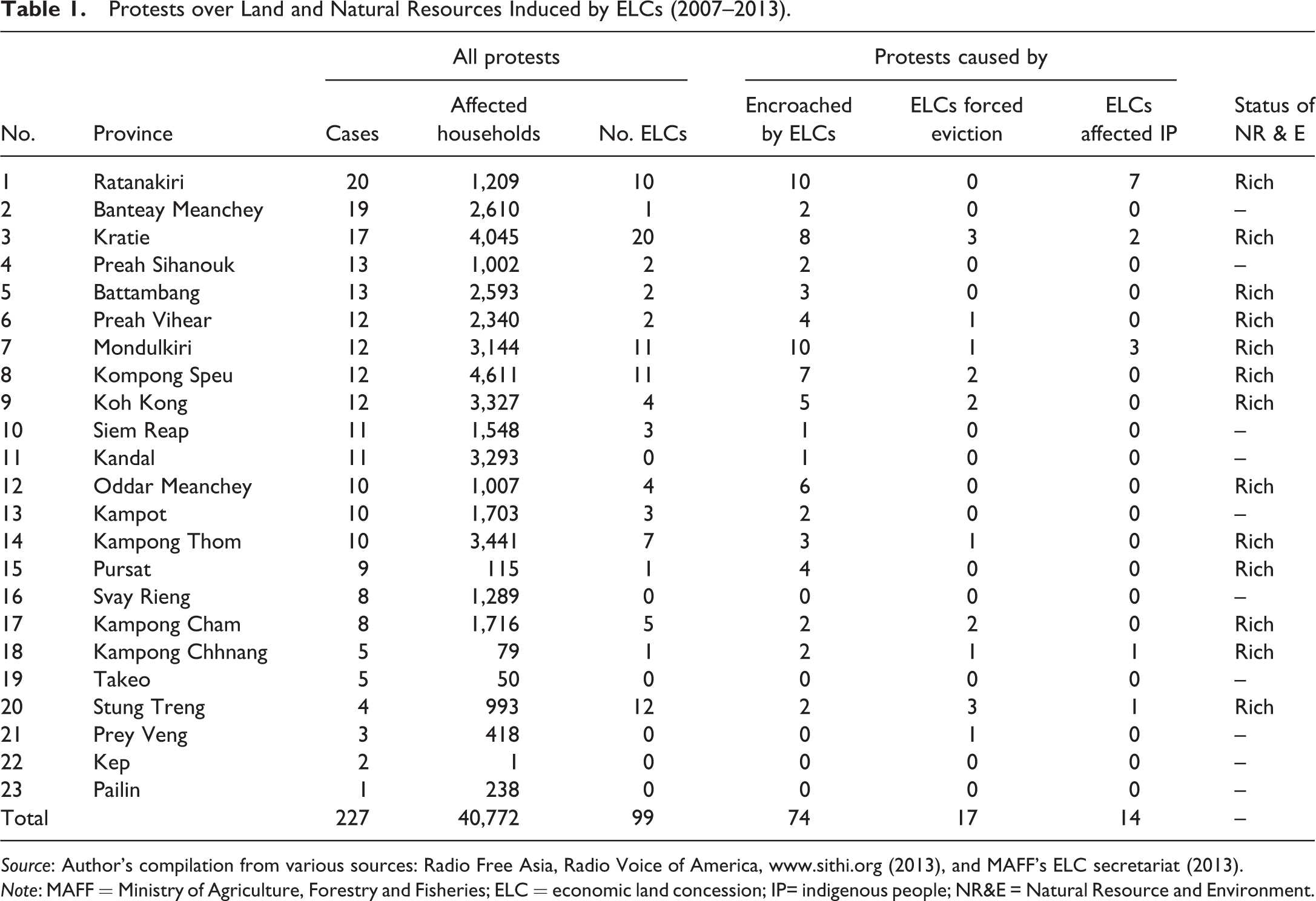
Source: Author’s compilation from various sources: Radio Free Asia, Radio Voice of America, www.sithi.org (2013), and MAFF’s ELC secretariat (2013).
Note: MAFF = Ministry of Agriculture, Forestry and Fisheries; ELC = economic land concession; IP= indigenous people; NR&E = Natural Resource and Environment.
The majority of protests and disputes presented in Table 1 erupted after the arrival of ELCs. Prior to the government’s granting of ELCs, there were not many documented land disputes or protests. The arrival of ELCs triggered serious disputes between the affected communities, the government, and ELC corporations over land and natural resource ownership and environmental protection. As reflected in Table 1, there were over 99 cases of land disputes and protests between ELC corporations and the affected communities in several provinces during 2007–2013, with 74 (74 per cent) of the 99 protest movements by local communities induced by ELCs. This represents almost 50 per cent of the total identified protests in Cambodia. Compared to other protests, ELC corporations caused a larger scale of disputes and protests, with thousands of families affected by the ELCs in Ratanakiri, Stung Treng, Koh Kong, Kampong Thom, Preah Vihear, Pursat, Mondulkiri, and Kratie provinces, all places where natural resources are abundance. The aims of the corporations appear to have been to exploit resources rather than to facilitate or enhance agricultural land development. Milne (2015) and Young (2017) suggest how ELCs are involved in logging for quick rent extraction rather than long-term investments, such as tree planation and agricultural activities.
5. Environmental Accountability of the Government: Re-Enforcing Regulations
One of several effects of the advocacy by grass-roots communities’ and NGOs’ involved in countermovements has been a change in government policies similar to Polanyi (1944) where there is a double-movement when neo-liberalised or market policies dispossess the communities’ properties or access to common resources. In 2012, after rampant local movements and continuous advocacy by NGOs, the government issued a moratorium on ELCs (Subedi, 2012). The aim of the moratorium was to postpone allocating new ELCs, to re-enforce related regulations including environmental impact assessment and ELCs sub-decrees, with the goal of effectively regulating corporations and strengthening responsible ministries and institutions to be accountable to the affected communities and society. In this moratorium, relevant governmental institutions were specifically ordered to re-enforce ELCs sub-decrees so as to address adverse social and environmental impacts. A paragraph from the moratorium reads: All ministries, institutions, and authorities must implement government’s policy regarding land concessions, and they must ensure that land concessions do not affect communal land or the daily life of the community…Those companies that have already received licenses from government, but have failed to honor their contracts by cutting down the forest instead of developing their concessions, encroached on the land of the people, operated businesses other than for the license granted, abused villagers, or abused communal land will have their contracts revoked…
2
5.1. Stung Cheay Areng Valley
Stung Cheay Areng valley is known as a biodiversity jewel of Southeast Asia. 4 In early 2014, the government of Cambodia granted a concession for hydropower development to a Chinese company, Sinohydro, to explore the feasibility of building a dam. According to an expert, there were two other companies that had previously explored the possibility but did not proceed with any plans. This could be because of huge adverse impacts anticipated and every low rate of return: revenue in terms of cost-benefit calculation. In spite of this, Sinohydro appears to commit to develop the project further by bringing their experts and machines: tractor and excavators into the area. If this development project is to proceed, it would force more than 1,300 Chong indigenous peoples to abandon their ancestral lands and would flood a 9,500-hectare area that is home to some thirty globally endangered animal species (Peter and Narim, 2015). In addition to the destruction of land and local forest, the dam would block the flow of the river and destroy the downstream habitat for wild fish that is crucial to the local economy, and also critically endangered biodiversity of global significance. The dam would also alter the natural seasonal flow variation of the Stung Cheay Areng, which local communities depend upon to nourish over 600 hectares of rice paddies with nutrient-rich waters, according to International River (NGOs).
With unfavourable impacts foreseen, the Chong indigenous communities in Cheay Areng valley, with the strong support of Mother Nature and other NGOs, have been protesting and advocating against the dam project proposed by Sinohydro. The purpose of this local movement is to put pressure on the government to call for the abandonment of the dam project, given the highly adverse impacts of the dam on the rich biodiversity and natural environment in this very large national park of Cambodia. Since 2012, the community and NGOs have been using various means to apply pressure. The NGOs have striven (i) to empower the Chong communities to advocate for a decision by the government, (ii) to mobilise participation of various youth groups from non-political party affiliation, opposition and ruling parties to visit and get to know the importance of the Cheay Areng valley, (iii) to patrol illegal encroachment in various forms, such as logging high-demand rosewood and other timber, as well as illegal hunting, and (iv) to draw the attention of international stakeholders and scientists to study the area. An important element of the approach was to represent themselves in a way that avoided the risk of being alleged by the government or the ruling party as part of any political opposition movements. Through this approach, they were able to maintain a position of neutrality in the identity or self-presentation of their movements in relation to both the opposition and the ruling party. Although this does not produce an immediate result, it maintains community’s identity which is a key to bargaining power vis-à-vis the government.
Nonetheless, in response to this movement, the government and local authorities, especially the provincial office of Koh Kong, threatened the communities and activists. Cambodian activists have often been arrested and spuriously charged. These activists were frequently accused of being secessionists, a typical accusation in Cambodia, and of instigating movements against the government. A movement leader and outspoken Spanish activist, the co-founder of Mother Nature (NGO), was deported from Cambodia (Teehan and Ponniah, 2015). Despite the repressive behaviour of the government, the movements of Chong communities and NGOs have been satisfied with the results of their efforts. The Cheay Areng valley has attracted visitors from various youth movements, which has in turn drawn the attention of international stakeholders, but also the heart of the Cambodian population. With news spreading and the strength of the environmental movement growing, the proposed dam has thus far been adjourned (Young, 2016a). The government, especially the PM, has claimed that dam construction in the Cheay Areng valley cannot proceed without proper feasibility and environmental impact assessments. In a speech, the PM went so far as to claim that the dam construction decision is up to the community in Cheay Areng valley (Peter and Narim, 2015). Although the communities are divided and organised in a very complex way, due in part to the lack of coordination by the NGOs activists, the community members who have persistently resisted the dam construction consider the PM speech to be a promising diplomatic statement. Nevertheless, the communities remain cautious and continue monitoring both government and corporate activities vis-à-vis dam construction in the Cheay Areng valley. Although the government has pledged a no construction decision as of this writing, the movement carries on, with the intention of making sure the government holds to its stated commitment to the community and the environment. Although this has suggested that Cheay Areng valley remains under threat, the suspension (of construction) manifested an achievement of the movements which hold the government accountable to their decisions, reconsidering critically about the adverse environmental and livelihoods impacts on the communities if the construction is to proceed.
6. Demand for Corporate Environmental Accountability as an End Goal
Protest movements of affected communities and NGOs have shifted their target considerably, from a focus on the government to corporations directly. Adjusting their goal to directly influence corporations has often been a result of instances where corporations held power over actors in the local government, and therefore limited the ability of the government to act or be influenced by protest movements to effect change. As exhibited in the case of a joint movement against sugar industry in three locations: Koh Kong, Kampong Speu, and Oddar Meanchey province, below, environmentally accountability of corporations is an ultimate goal of protest movements, but intervention of the government is still necessarily important to ensure corporations are held to account. On the one hand, this approach is considered to be more affective, and by targeting the corporation helps the movements to get rid of the government’s suppression and to avoid the allegation of being labelled as anti-government movements, which might be provoked by the opposition movements, on the other.
6.1. Protests and Environmental Accountability of the Sugar Industry
From 2006 to date, civil society organisations, including sugarcane agricultural communities, have mobilised against large-scale sugarcane plantations in Koh Kong, Kampong Speu, and Oddar Meanchey provinces. These three provinces are selected for study as they share a similar agricultural sector (sugar industry) which tends to be backed by the same powerful investors (including the Cambodian senator of the ruling party) and various other multi-national corporations, such as MitrPhol Sugar from Thailand (one of the sugar suppliers of Coca-Cola). These plantations and sugar processing factories have caused adverse environmental and socio-economic impacts on the communities living in and around the plantation and factory areas. The affected communities from the three locations have united a joint movement, with coordination of NGOs and especially the clean sugar campaign, against the sugar industry. To hold these corporations and the government accountable for these adverse environmental impacts, the local communities, with strong support from NGOs, have enacted domestic and international movement strategies.
Initially, the affected communities and NGOs employed domestic influencing strategies, including peaceful protest, petitions, local networking, and filing complaints to the local court, to put pressure on the government to regulate the sugarcane corporations and address the detrimental impacts. The government’s response was to negotiate with the sugarcane corporations to offer cash compensation, but this approach was considered unfair by the community, given that cash cannot compensate for lost land, livelihoods, and environmental damage. The government also failed to strictly regulate the sugarcane corporations for their adverse activities. Meanwhile, in collaboration with the corporations, the government repressed the movement activities of the sugarcane-affected communities and NGOs. The repressive activities included violently cracking down on non-violent protest in Koh Kong, violently vandalising farmers’ properties, the arrest and imprisonment of activists in Oddar Meanchey province, and intimidation of protestors in Kampong Speu. It is important to note in this context that a powerful CPP senator was an investor in the sugarcane corporations. The repressive behaviour did not prove effective in hampering the movements, and instead sparked them to become stronger, with the assistance and networking of NGOs. The aims of the movement were to put a stop to the repression and to leverage international pressure on the government and sugarcane companies in Cambodia.
After ineffectual domestic influencing strategies, the network of sugarcane-affected communities and NGOs, influenced by TANs, staged international supply chain movement approaches, including complaining to the investors in the country of origin (Thailand), in court to the sugar buyer corporations (United Kingdom), and finally to the EU’s Everything But Arms (EBA). In the meantime, the communities in Kampong Speu also filed a complaint against ANZ bank in Cambodia and in Australia, alleging that they were financial investors in the sugarcane corporations in Cambodia. At the time of this study, ANZ has denied the complaint and has taken no responsibility, since the sugarcane corporations have already repaid the loan.
This shift in strategy by the movements resulted in increasing pressure directly on the sugar corporations and indirectly on the government. Complaining to the UK court and eventually the human right commission in Thailand exerted direct pressure on sugarcane corporations in Cambodia, even though it did not yield any significant results at the international juridical level. Complaining to the EU’s EBA leveraged extra pressure on both the government and the sugar corporations, and the EU’s parliament officially commented to the Cambodian government regarding the allegation and adverse impacts, but there were no clear direct results on the Cambodian government because of these actions. However, the international influencing strategies of the sugarcane-affected communities and NGOs did result in changing the behaviour of the sugarcane corporations in Koh Kong and Kampong Speu. For instance, in Koh Kong, the sugarcane corporations established a corporate social responsibility (CSR), eliminating child labour and mitigating some environmental issues. Although limited, this still represents an important degree of self-regulation on the part of the sugarcane corporations. For example, to address the environmental concerns of the communities, the corporations stopped clearing some sacred forest areas. To address the water contamination, the corporations and the provincial environmental departments dug new ponds to re-regulate the polluted water before discharging. To ensure long-term accountability for environmental impacts, the sugarcane corporations conducted environmental impact assessments and developed environmental management and mitigation plans in and surrounding the sugarcane processing factory compound (Young, 2015).
In Kampong Speu, the sugarcane corporations have worked to address not only the environmental impacts but also to adopt CSR in an effort to harmonise their business with the surrounding communities. School construction, education, rural road improvements, job creation, good working conditions, and enduring environmentally friendly sugar processing factories have been observed in and around the plantation areas. To reduce the hazardous wastes, the sugarcane corporations built several ponds to store and treat the harmful waste, so that it can be turned into useable water and non-toxic waste. In addition, the non-toxic waste is now also being converted to bio-fertilisers for re-use at sugarcane plantations and for local farmers’ growing fields. In Oddar Meanchey, the sugarcane corporations withdrew their investments and returned the three concession areas, including the forestland, to the government (Pye, 2015). Although this has been considered a success by the community movements, the sugarcane corporations still need to be held accountable for their previous activities that have had negative, ongoing impacts on the forest and communities in Oddar Meanchey. In addition, the land returned by the corporation is still controlled by The Ministry of Agriculture, Forestry and Fisheries and has yet to be returned to the affected communities.
So although these movements against the sugarcane corporations have yielded results, it is not yet to the satisfaction of the communities and NGOs. The sugarcane corporations and the government have adjusted their behaviour, but this doesn’t necessarily mean that the government is truly accountable to the grass-roots communities and NGOs. However, among the results, the movements have influenced the corporations in Koh Kong and Kampong Speu to behave in a more corporately accountable way and have forced the sugarcane corporations in Oddar Meanchey to return lands to the government and leave the country.
7. Who Is Accountable to Whom, and How?
Evidence suggests that mechanisms and strategies used to hold government and corporations accountable for their activities are having an influence on the ongoing choice of tactics by protest movements. To ensure a general level of environmental accountability, protest movements initially set influencing strategies to target the government as an intermediary actor. Protests were organised by directly affected communities, with the support of other concerned or impacted groups (NGOs in particular). In essence, the intention was to ensure that not only would the government be accountable for its decision and policy implementation but also that it would regulate the corporations to be environmentally accountable to the affected communities and society as a whole. Within Cambodia’s current authoritarian context, it is unlikely that the government will acknowledge the malpractice or adverse consequences of their policy decisions, for example, the ELCs, regardless of how predatory or criminal the results of the policies. Therefore, there is no other way to hold government accountable than pressuring the government to re-correct the policy implementation.
When environmental accountability becomes a national interest, as in the case of Cheay Areng, the government is the primary target of the protest movements rather than corporations or any one individual. With the continuous involvement of national youth groups with various political agendas and with the ongoing interest of environmentalists and indirect beneficiaries (Chong communities), exploitation of Cheay Areng for various development projects, including the aforementioned dam construction, has been postponed by the government and is being closely watched by environmental groups. Protest movements of these groups have been effective because of their ability to leverage environmental accountability on the government as a national interest. The government is thus forced to be the first tier of environmental accountability, which subsequently holds corporations accountable for environment protection. The only tools the government currently has to hold the corporation accountable for environmental impacts are policy adjustment and regulatory enforcement.
With significant involvement of the government, protest movements of the aggrieved communities and NGOs have also held individual corporations accountable for environmental damages. In the sugarcane case, although movements of the impacted communities and NGOs turned to directly influence the corporations, the government remained an important actor. The protest movements went beyond domestic movement strategies to effect change because of the limitations caused by strong political ties between the sugarcane corporations and a powerful politician in the government. The protest movements therefore changed tactics and staged an international supply chain approach. The aim of this approach is to leverage influence on the various stakeholders in each stage of the supply chain, in order to put pressure on the corporations to be environmentally accountable to affected communities, as in TANs. To a degree, the international movement has altered the economic interests of individual corporations but also the interests of the government, who benefited from the favourable policies of the EU (EBA). Recently, EU has threatened to withdraw or suspend Cambodia from its EBA beneficiary countries. The reason behind this could be due in part to NGOs’ transnational movements as well as the opposition party’s lobby to put pressure on the Cambodia’s government, among other factors, in the hopes of restoring Cambodia’s democracy.
Even though the movements targeted the individual corporations directly, they also indirectly influenced the government to intervene. The achievements of the movement groups, especially in mitigating environmental impacts in and around the sugarcane plantations, were in the end possible because of the government’s negotiations with the sugarcane corporations in Koh Kong and Kampong Speu on the one hand, and the regulatory re-enforcement of the government (the revocation of the sugarcane plantation in Oddar Meanchey), on the other. In part as a result of the relatively strong pressure on buyer corporations in the United Kingdom, the sugarcane corporations in Koh Kong and Kampong Speu re-regulated themselves by adopting corporate social and environmental accountability in order to harmonise their investment activities with the directly affected communities. Compared to Cheay Areng communities, the protest movements targeting the corporations in the sugarcane case did not mobilise national interest, as their situation was more narrowly defined by the interests of the individual corporations and the affected communities. Given this reason, mobilising participation in the movement has been limited to the directly affected communities and NGOs. Whereas in Cheay Areng valley, not only the directly affected communities but also environmentalists and various youth groups from throughout the country participated in the movement.
As the evidence suggests, when considering accountability, the government is an intermediary actor and corporations are the end goal. Both actors need to be accountable to society in general and to the affected communities in particular. They can be held to account for environment damages through strong and influential protest movements by the third actors in this context: affected communities and civil society. Through various forms of protest movements, civil society and affected communities can influence the government to be accountable for its adverse environmental impact policies as a pre-condition to ensure corporate environmental accountability. To achieve environmental accountability, the government has to adjust its environmental policies and re-enforce existing regulations to strengthen its institutional practices. To be environmentally accountable to the government, and especially to affected communities, corporations have to comply with the government as well as the demands of the affected communities. Simultaneously, the corporations need to self-regulate by adopting social and environmental accountability measures, in order to ensure long-term and sustainable business in Cambodia.
8. Conclusion
This article has demonstrated that in the area of environmental accountability, the questions of who is accountable to whom, what accountability should look like once ascribed, and how it can be effected remain contested in the studies of global environmental governance and social movements. The article identified how the environmental protests of social movement organisations have shaped the environmental accountability of both the government and corporations. It then highlighted ways that the contemporary economic and political liberalisation policies in Cambodia have induced adverse impacts on the environment of grass-roots communities. This then provoked resistance in the affected communities and of concerned NGOs, who demanded better environmental accountability from the government and corporations. To illustrate how protest movements can hold government and corporations accountable to their actions, two cases of communities and NGOs’ movements were discussed.
The first case demonstrates how protest movements of grass-roots communities and NGOs held the government accountable for environmental deterioration as well as rights violations and dispossession of communities’ access to resources, in Cheay Areng, where a hydropower dam was proposed by a Chinese company. Given that the hydropower company had not yet operated its activities in the proposed area, the movements aimed their efforts at the government to withhold the dam project. Being held accountable for a decision which would have induced nationally recognised negative environmental impacts, the government suspended the operation of the Chinese company and reconsidered the potential impacts. The second case looked at the protest movements of affected communities and NGOs that initially targeted the government in the hopes that it would regulate sugarcane corporations for their unfavourable environmental impacts. The movements later turned to direct influence on the corporations, since the government’s power to act was undermined by the corporations’ influence on government officials. This problem is common in Cambodia, where mutual interests between the corporations and government overlap. As a result of pressure generated on an international level, the corporations were inclined to resolve environmental impacts, such as returning land, providing cash compensation, conserving forestland, mitigating water contamination, soil erosion, and so on, as demanded by the affected communities and NGOs. As noted, these mitigations by the corporations for their adverse environmental impacts were ultimately made possible by actions of the government, to mediate and re-enforce regulations. The corporations then complied with the environmental regulations and government policies. To assure improved relations with workers and within the broader local context, corporations also took on longer term accountability by self-regulating to adopt corporate social and environmental responsibility and codes of conduct (CSR).
In sum, the article argues that protest movements of affected communities and NGOs are influential in holding both the government and corporations accountable for negative environmental impacts. In developing countries such as Cambodia, the role of the government, in an intermediary capacity, remains momentous. The government needs to adjust its policies and strengthen its regulatory enforcement institutions in order to account for environmental issues alleged by affected communities and NGOs. Government accountability is considered an extremely important entry point to corporate environmental accountability. But despite the important role of the government, ultimately it is the corporations themselves that have to be held accountable for their environmental impact activities, whether by government regulations or punitive measures, the pressure locally or internationally effected by protest movements, or more often a combination of factors that force corporations to take the necessary steps towards environmental accountability.
Footnotes
Acknowledgements
The author would like to thank Chiang Mai University School of Public Policy for the support at the initial stage of writing this article, and the editors as well as the anonymous reviewers of the journal for their valuable comments.
Declaration of conflicting interests
The author(s) declared no potential conflicts of interest with respect to the research, authorship, and/or publication of this article.
Funding
The author(s) disclosed receipt of the following financial support for the research, authorship and/or publication of this article: The authors received financial support for the research and finalisation of the article for publication from the European Research Council funded project entitled PHOTODEMOS (Citizens of photography: The camera and the political Imagination), grant no. 695283, at the University College London.