






Abstract
Ukraine has one of Europe's fastest growing HIV rates and in 2003–2012 was one of the largest recipients of funding from the Global Fund to Fight AIDS, Tuberculosis and Malaria (GF). Doctoral research recently completed by the author investigates the conduct and practice of international and national nongovernmental organisations (NGOs) as Principal Recipients (PRs) of GF grants in Ukraine from 2003 to 2012. An ethnographic enquiry including 50 participant interviews was conducted in three oblasts in Ukraine, and in its capital, Kyiv. The paper presents some of the findings that emerged from the analysis. Discussing the PR NGOs roles and practices in delivering HIV prevention programmes funded by GF, the author argues that the anticipated benefits of NGO partnerships between PR NGOs and their Sub-Recipients (SRs) have not been achieved. Rather, PRs acted as donors and ran highly discretionary policies in channelling GF funding to SRs that installed competition and vertical relations between NGO-grantors and NGO-grantees. The outcome was a servile civil society that is dependent on external funding and is unable to genuinely represent their communities. With an anticipated GF phasing out from Ukraine, there is a critical lack of advocacy potential of the civil society to articulate and defend the needs of PLHIV when transferring HIV services into state funding.
Keywords
“We ourselves have nurtured a dragon…. we ourselves have fallen into inferior position, we turned from leaders – the Third sector – to (perform) functions of service personnel”.
Anonymous respondent, Ukraine
Background
A focus on civil society is an important principle of the Global Fund to Fight AIDS, Tuberculosis and Malaria (GF) 1 – the “main international health donor” (GFATM 2001). As a requirement for countries’ eligibility to receive funding, the GF puts a condition to engage civil society and those affected by the diseases in service provision (Rivers, 2005). The engagement of NGOs is predicated on the special nature of GF programmes, which perceive them as having better access to marginalised and vulnerable groups such as women and girls, men who have sex with men, transgenders, sex workers, and people who inject drugs, in comparison with slow and bureaucratised processes in state health care.
The following abbreviations are used in the paper: AIDS – acquired immunodeficiency syndromeCCM – country coordinating mechanismEECA – Eastern Europe and Central AsiaGFATM – the Global Fund to Fight AIDS, Tuberculosis and MalariaGF – same as aboveGONGO – government-organised NGOHIV – human immunodeficiency virusIDUs – injecting drug usersINGO – international nongovernmental organisationMARP – most-at-risk populationM&E – monitoring and evaluationMOH – Ministry of HealthMSM – men having sex with menNGO – nongovernmental organisationOIG – Office of the Inspector General of the GFPLHIV – people living with HIVPR – principal recipient of GF fundingPWIDs – people who inject drugsR1 – round 1 of Global Fund (2003–2008)SR – sub-recipient of GF fundingUNAIDS – Joint United Nations Program on HIV/AIDSUNDP – United Nations Development ProgrammeVCT – voluntary counselling and testingWHO – World Health Organization
Ukraine had developed the most severe epidemic in EECA (Kruglov et al., 2008) and was one of the largest recipients of GF funding. In 2003, it received its first R1 HIV grant of 99.12 million USD to implement a government health care-centred programme. The Principal Recipients (PRs) were the Ministry of Health (70% of the grant), United Nations Development Programme (UNDP) (10% of the grant), and the ‘Ukrainian Fund against HIV/AIDS’, a “GONGO reporting to the Cabinet of Ministers” (Brusati, 2003, p. 14), responsible for 20% of the grant. Implementation stalled soon after it started due to lack of capacity to absorb massive GF funding. In January 2004, the GF suspended the funding and transferred R1 grant to an international NGO, ‘International HIV/AIDS Alliance’, a charity registered in the UK. An anticipated outcome of the GF decision was a robust and effective delivery of HIV services. This expectation was rooted in the GF's perception of civil society organisations as “essential, successful and high-performing implementers of Global Fund grants and that direct financing to civil society PRs can improve the speed of finance and add additional capacity” (GFATM, 2007). The perceived strength of NGO partnership relationships’ among the Alliance and other NGOs was considered “key to the success of the GF programme” (Drew, 2005, p. 5). The next R6 grant (2007–2012) continued with its local NGO subsidiary, Alliance-Ukraine, and a national NGO ‘All-Ukrainian Network of PLHIV’ (Network) as the second PR. GF Inspector General noted that lack of national ownership with minimal government support carried a risk of the GF programme being a ‘stand-alone’ project (OIG, 2008).
This paper draws on the evidence that was obtained in the course of a doctoral research conducted by the author on the GF programmes in Ukraine (McGill, 2015). The study investigated the conduct and practices of two PR NGOs as implementers of GF programme, originally geared at state health care system. The study situated analysis of NGOs delivering HIV services into a broader socio-political context of ‘Third Sector’ in Ukraine, which has been largely supported through external funding. The study was informed by the author's first-hand experience with civil society in EECA where she closely witnessed as well as participated in NGO development, and later worked in aid programmes on HIV/AIDS. The present paper brings in new, country-specific evidence, confirming and expanding the existing views on developed countries’ NGOs acting as donors in aid programmes.
The point of departure for the analysis of NGO relations during the GF implementation was determined on the basis of literature sources on the roles of NGOs in development. Important assumptions in literature included the following:
- Following Ibrahim and Hulme (2010), NGOs typically exercise three primary roles, namely: advocacy, policy change and service delivery. - Rich-country NGOs operate as donors with respect to NGOs and even to the state in poor countries.
Dilemmas of external NGOs
Much of the global discourse on AIDS and NGOs is acknowledged as having developed along the lines of a ‘North–South‘ relationship (Boone & Batsell, 2001). Nelson suggested a ‘North–South divide’ across NGOs, corresponding roughly to developed versus less developed countries (Nelson, 2002). Engberg-Pedersen (2008) argued that development NGOs in rich countries have been operating as donor agencies with respect to CSOs and even to state in poor countries: “They have unilaterally decided where, with whom and regarding what they want to work”, while “the concern with raising money and the various ideological commitments have pushed them towards service delivery” (Engberg-Pedersen, 2008, p. 1). Shumate, Fulk, and Monge (2005, p. 488) described the 1990s as “an era of great success for HIV–AIDS INGOs”, manifested in increased aid funding. They identified exchange of ideas, promotion of member interests, coordination and regulation of member activities, education and public awareness, research and information gathering, and humanitarian activities among the INGO activities and suggested that INGOs typically work “within the ‘status quo’” to provide services and to advocate for their members (Shumate et al., 2005, p. 486). Risse (2006) noted frequent accusations of INGOs for lacking legitimacy and suggested that the issue was linked to INGOs’ internal accountability: “if we compare ‘INGOs’ to democratic states, they certainly lack internal accountability” (Risse, 2006, p. 190). Smith, Pagnucco, and Lopez (1998) noted that most transnationally operating NGOs were accountable to a rather small group of members and to those who fund them, mostly private foundations, or public agencies.
The duality of service delivery and advocacy roles of NGOs
Ibrahim and Hulme (2010) in their analysis of civil society roles in poverty reduction distinguish three main roles perceived of NGOs, which in the context of HIV/AIDS NGOs appear like the following:
Advocacy – defending the rights of people living with HIV/AIDS, pushing for structural and system change, better access for people in risk groups to medical services; Policy change – lobbying changes in government laws and regulations related to access to medical services, anti-discrimination laws, etc.; and Service delivery – provision of basic services, including provision of HIV prevention interventions.
Of these three roles, it is advocacy and service delivery roles that often appear in juxtaposition when discussing the context of NGO implementing aid programmes. In particular, the dual role of NGOs as implementers and civil society advocates is widely discussed in the example of GF programmes. On the one side, Harmer et al. (2012) note that an important outcome of the GF grants has been the increased professionalisation of civil society organisations (CSOs) 2 through adopting adequate project management, accounting, grant management, and other practices, which has also been reported by Kapilashrami and O‘Brien (2012). This is believed to have led to an increase in government officials’ respect for CSOs, helped to build trust, and challenged government stereotypes of CSO organisational capacity.
This paper uses the terms ‘civil society organisations‘ (CSOs) and ‘nongovernmental organisations‘ (NGOs) as they appear quoted in various sources. Both terms are used interchangeably in context of Ukraine.
Donor publications in Ukraine expressed concerns over the duality of NGOs roles as implementers and advocates, mentioning posed risks to NGOs becoming less independent, as they needed to engage with government during GF programmes delivery. UNAIDS warned that “as organizations such as the Network focus on implementation of large programmes and services as the PR for GF grants, they risk undermining their role as effective and independent advocates on behalf of civil society.” (UNAIDS, 2007, p. 31)
Discussion about GF programmes in Ukraine would be incomplete without recalling the broader context of aid programmes in EECA region where support for civil society was seen by donors as “crucial to the post-communist political transformation and a panacea for problems from corruption and lack of accountability to service delivery needs” (Lopes 2012, p. 1). While support to local NGOs was a “talisman of international development organisations” (Atlani-Duault, 2007, p. 14), support for civil society in the post-communist world was particularly high on aid agencies’ agenda. Henderson (2003) observed how Western countries’ political agenda shifted after the fall of communism – after decades of promoting economic and social development in the developing world, they moved to directly ‘promoting democracy’ in post-communist states. This shift represented “a substantial foreign policy experiment” (Henderson, 2003, p. 3). Aid programmes to post-communist states were manifested by an influx of ‘transnational advocates’ (Hrycak, 2007) – international NGOs (INGOs) – and their funders. Increased contact with ‘transnational advocates’ often resulted in producing ‘vertical organisations’ that were “more interested in pleasing foreign donors, than paying attention to what people need and what they say” (Fioramonti & Heinrich, 2007, p. 25), “parroting the phrases donors expect in order to win grants” (Hrycak, 2011, p. 261), and were often “more firmly rooted in transnational networks than in their own societies” (Wedel, 2001, p. 114).
In HIV/AIDS sector in Ukraine, external NGOs have played a significant role. The decisions to suspend R1 grant and to appoint an INGO to implement its programme “were ultimately the Global Fund's decisions” (Drew & Malkin, 2005, p. 3) that demonstrated a preference for external organisations. In doing this, the GF appeared to follow a traditional aid approach, described by Carothers (1999) as an ‘external project’ method, in which an external organisation runs all aspects of implementation work, uses external consultants to assess the needs of the recipient country and designs the projects to meet those needs. In Ukraine and other former Soviet states, ‘external project’ approach was predominant in aid programmes’ delivery. Zhukova (2013) places a discussion of HIV/AIDS in Ukraine in context of ‘transnational governmentality’ and names the direction of funding as a major determinant of the “NGOisation of the HIV/AIDS sector in Ukraine” (Zhukova, 2013, p. 96).
Having been appointed a PR, International HIV/AIDS Alliance declared itself “the largest NGO in Ukraine. Its current size stems primarily from the appointment […] of the UK-based International HIV/AIDS Alliance as Principal Recipient of the country's Round 1 HIV/AIDS grant” (Alliance, 2009, p. 35). The fact that an organisation posed as the largest national NGO merely because it was a subsidiary of a foreign NGO and a recipient of GF funds bears important implications for the civil society dealing with HIV in Ukraine. Concerns were voiced that GF preferences for “using well-established international NGO rather than local organisations has hindered opportunities to strengthen the latter's capacity” (UNAIDS ASAP, 2009, p. 44).
Ukraine's original GF country programme, designed to deliver the services by state healthcare, faced serious challenges, when it was transferred to an INGO. With the MOH as an implementer, the main bulk of services were to be delivered by state health-care workers, with NGOs assisting in referral, as well as in care and support. With a transfer of GF funding to an INGO, the perceived division of roles between state health sector and NGOs ceased to exist. PR needed to engage with healthcare sector, in order to implement the programme. The system was adopted to distribute GF funding to Sub-Recipients (SRs) – local NGOs – that would then hire state health workers to work in mobile clinics and other settings fully or partly operated by NGOs (APMG, 2009). This paper focuses on the perceived roles and relations that appeared in PR NGOs channelling funding to SR NGOs in the regions during GF R1-R6 and the impact that had on civil society working in HIV.
Methods
The author's research was positioned within the broad topic of aid effectiveness and examined how the GF aid delivery model manifested itself on the ground in Ukraine. Research aimed to question, following Easterly and Williamson (n.d, p. 6) whether the GF performed the way it said it would – as it is the “key question in the aid effectiveness debate”. To study complex transnational processes of aid organisations, the need was crucial to establish a ‘critical space’ that would allow a broader scope of views to be reflected, including those that may not necessarily be positive accounts. In line with a significant body of research of aid programmes in post-communist countries represented in works by Atlani-Duault (2007), Carothers (1999), Owczarzak (2009), Wedel (2001) and others, a critical ethnographic enquiry was chosen as the research approach. Taking into account the author's familiarity and experience with aid programmes, the advantage of this approach was seen, following Hammersley (1985, p. 152) in enabling the researcher “to document the culture – the perspective and practices – of the people in these settings”. The enquiry incorporated the views of a wide spectrum of the study participants, many of whom participated in HIV service delivery, and integrated other evidence leading to the findings, some of which are presented in this paper. Primary data were collected in capital Kyiv and in three regions of Ukraine through 50 in-depth, semi-structured, face-to-face interviews with purposively selected participants with experience in GF programmes. Overwhelming majority of the participants had five or more years of experience with GF programmes (see Figure 1):

Participants’ experience with GF programmes.
Respondents were national and regional government stakeholders, NGO heads and staff, and state health services providers. Figure 2 illustrates the sector distribution of respondents by their self-identification:
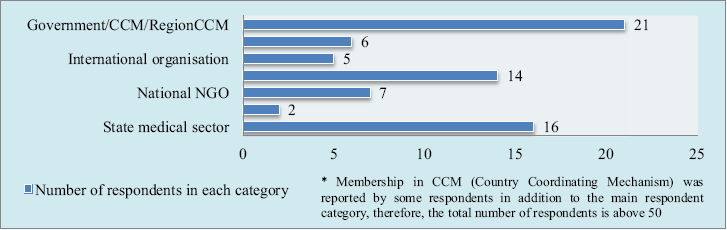
Self-identification of respondents*.
An Interview Guide was developed that structured enquiry into the following issues, among others:
- PR NGOs’ roles and relations with other actors in GF programmes; - Organisation of HIV prevention services (funding distribution, choice of SRs, etc); - Decision making practices of PRs in funding SR NGOs.
The interviews were transcribed verbatim, coded and analysed using thematic content analysis. Analysis included generation of matrix-based themes from the interviews and theoretical coding in which open codes and themes were compared to generate an analytic schema and to interpret the findings.
Secondary data included published literature sources and country documents on HIV prevention and GF programmes in Ukraine. Analysis synthesised both findings from document analysis and data emerging from interviews. Textual evidence, including direct quotes from participants, was used widely in writing. Regional or sector identities are not disclosed, and quotes are presented using the numbers to protect participants’ anonymity.
An evaluation of the entire scope of GF programmes in Ukraine was outside the purview of this enquiry that critically examined the GF aid delivery model and its effects on HIV prevention services during GF R1 and R6 grants (2003–2012) as they were perceived ‘on the ground’ by GF programme participants. No attempt was made of extrapolating data from several regions to the whole country. By analysing the roles, policies, relations and practices as they are perceived by participants, the study points to certain problematic consequences of GF programme implementation and seeks to raise more interest in the topic in the hope of generating a systemic look into the whole impact of GF-funded interventions on Ukraine's national HIV/AIDS response.
Results
In an early pledge formulated at the Genoa summit of donors, the GF committed itself that “local partners, including NGOs, … will be instrumental in the successful operation of the Fund” (G8 Genoa, 2001), and since then has articulated a strong focus on civil society organisations to implement its programmes (GFATM, 2007). The GF 2004 decision to transfer implementation in Ukraine to an INGO was deeply rooted in these beliefs.
As noted above, Ukraine's original GF country programme, geared at state health care system, faced serious challenges, when it was transferred to an INGO. In Ukraine, as in other post-Soviet states, the public sector was the only one “to provide services needed to the fullest extent” (UNAIDS, 2007, p. 39), and only state-licensed medics were legally authorised to provide health services. With the government as a whole sidelined by the R1 transfer to an INGO, as noted above, the need for PRs to engage with state health care system in order to deliver the GF programme was imminent.
Based on the data generated from interviews, GF's focus on NGOs to deliver its programmes had a fundamental impact on channelling of GF funding, NGO relationships, NGO decision making practices, both at the country level and in the regions of Ukraine.
Channelling GF funding: Divide and rule
As was mentioned before, to implement the programme, the PR (Alliance) needed to develop a working mechanism to engage with state healthcare. The decision was found to channel GF funding to Sub-Recipients (SRs) – local NGOs, which would then hire licensed health workers from local state health institutions. PR chose two ways to channel GF funds for HIV service delivery: (1) by providing direct grants to NGOs and government departments by competitive tendering for new partners and direct granting to existing partners; and (2) by indirect granting (sub-grants) to local NGOs through other national NGO recipients. (Drew, 2005)
In R1, different granting procedures were applied to different NGO SRs: while new partners were issued grants through a competitive tendering process, existing partners and partners with ‘unique capacities’ were issued direct contracts. Among concerns regarding the tendering process were inadequate time for submission and perceptions of some tenders as “tailored to specific organizations” (Drew, 2005, pp. 5–6).
In R6 of GF, distinctions and classifications between different SRs became even more apparent. PR staff manual on grant-making classified SRs according to the amounts of GF funding received (below 50,000 Euros; between 50,000 and 300,000 Euros; and above 300,000 Euros) by the scale of activities (local, national and intermediary) and by status.
The ‘status’ classification in particular reveals PRs’ high degree of discretion. As outlined in Alliance manual, SRs were divided into several categories, taking into account whether they were new or existing partners of the Alliance or whether they possessed a unique capacity to implement HIV/AIDS programmatic activities in Ukraine. While the first two categories could receive money under an open call for proposals, SRs with a unique capacity followed a closed call for proposals and received GF funding as the only participant of such a closed call. Allowing some SRs to bypass the competition suggests double standards. Criteria for being classed as ‘unique’ appeared vague and included: “having exclusive capacity and experience in implementing the supported programmatic activity, not possessed by other organisations”; being “the only visible SR with an outstanding record in the specific area of programmatic activity”; or being “a favoured implementer of the specific programmatic activities” (Alliance, 2007, p. 6), all of which suggest a high level of PR discretion in making the selection.
Existence of the above classifications suggests that the perceived strength of PR NGOs as having close links with other NGOs in Ukraine did not appear in practice. Being put in charge of GF funding allowed PRs to become arbiters in money matters over other NGOs, and it had a profound effect on the nature of the relationships between them as noted in an R1 evaluation study: “where financial relationships exist, interactions may be financially motivated or interpreted as such” (Drew, 2005, pp. 14–15). Another GF-focused study in Ukraine suggested that, in distribution of GF funding to SRs, “personal connections with Principal Recipient staff are believed to increase the chance of receiving a grant” (Semigina et al., 2008, p. 6).
When asked about experience with PRs, participants reported grant procedures being difficult and dependent on personal connections:
Alliance has established priorities and pre-determined organisations that will get funding. The grant competitions are so difficult that without special training it's impossible to even fill in the application. As a result, only ‘known‘ NGOs can win. (012:454)
NGO heads began entering into closer relations with Alliance managers to achieve preferential treatment for their NGOs. (046: 192–194)
In the context of the nascent civil society in Ukraine, the power and control that PR NGOs gained from being in charge of massive funding was a threat to the fragile local NGO partnerships. The lack of a unified approach to funding and varied PR standards as applied to the SRs had important implications for access to services in regions, sustainability of services, as well as for relations between NGOs, and NGOs relations with the state.
PRs NGOs and their perceived roles
Size matters: “big” PRs
The narratives of PRs NGOs in relation to their roles as GF implementers had to do with them being ‘the largest’ NGOs in Ukraine. From 2004, the International HIV/AIDS Alliance in Ukraine continuously claimed to be “the largest NGO in Ukraine” (Alliance, 2009, p. 35). In 2008, after becoming a PR of a R6 grant, the ‘Network’ similarly posed as “the most powerful HIV service organization in the country” (Network 2008, p.11).
Similarly, participants referred to PR NGOs roles as ‘big’ (009: 76), ‘quite significant’ (008: 35), and ‘key’ (002: 264).
PRs were also viewed as NGO ‘openers’ because they “supported the creation of NGOs.” (007: 164–167).
PRs as donors/money distributors/rule-setters
Among the PR roles associated with GF money management, participants reflected the following:
(a) Grant administrators, redistributing GF money:
[The PRs] are more like money distributors. (034: 132–133).
The Alliance is simply a funds-receiving and redistributing organisation – no more and no less. (026: 517–518);
The Alliance is more like a managerial structure… They are a transmission mechanism for GF money to implementers in country who have expertise and who can conduct practical activities in the area of HIV. (001: 390–400)
(b) As donors. In this capacity, participants reflected that an INGO (Alliance) often presented itself as owner of the GF grant or even “as the GF itself” (013: 249):
In terms of publicity, you would often get the impression in the field that this was the Alliance grant… and Alliance was giving grants to sub-grantees. The Alliance logo was always present everywhere […] This was the impression that the Alliance wanted to give, that it was an Alliance thing. It really saw itself less as an organisation managing the grant and more as a main contractor, which was giving contracts as a donor. (049: 427–447)
(c) Rule-setters for the [GF] programmes:
The Alliance's role as a Principal Recipient…it was very much to set the rules. (049:320–321)
By setting standards, PRs had a power to determine where the money will flow:
[PRs] offered some standards and then, if the region accepted those standards and approved of their policies, the money would come to that region. (030: 323–328).
The interview evidence resonates with document analysis, outlined above, that revealed similar concerns about high PR discretion in awarding GF funding.
(d) PRs as policy enablers:
Because PRs were setting rules and policies, they were also policy enablers as seen by participants. In this role, PRs appeared to be influencing state policy. This ability was perceived differently by participants, reflecting sector differences among them. Participants from state sector were concerned that PR NGOs acted as policy makers:
Unfortunately, AIDS state policy in Ukraine is created not by the state, but by the GF recipients. (013:530)
The same person acts as the Alliance representative in […] region, and as head of the regional health department. It's a complete merger. (016: 156)
Evolving relations of PR NGOs with other NGOs: The language of power and a “culture of fear”
Despite the declared NGO ‘partnership’, patterns of inequality began to appear after the GF R1 grant transfer, manifesting a shift of inter-organisational relations (Drew, 2005). In these relations, the Alliance was seen acting ‘as a donor’ with the financial support going from the Alliance to the [other NGO] organisations: “The possibility that organizations might receive funds from the Alliance affected the nature of the relationship between the organizations” (Drew, 2005, pp. 14–15).
Participants reflected on the changing nature of the relationships between PR NGOs and other NGOs as GF implementation progressed:
They [the Alliance] began saying in all the meetings that they represented the entire NGO community of Ukraine. And when somebody visited Ukraine, they did not invite anybody, they just met with those people themselves. It gave the impression that they were the only NGO in Ukraine. (047: 205–209)
Considerable money was thrown [around] to develop the NGO potential in HIV/AIDS [sector] to assume leadership position. Alliance's own leadership potential was quite high then. It assumed collegial relationships with other NGOs, at least declaratively. They were quite communicable, open, and relations were built on two-way communication. Somewhere around 2005, it began to change. For us, local organisations, this appeared as the dictatorship of the Alliance, in them asserting pressure on organisations. Their monitoring visits – initially meant as a mechanism to work out a common decision through dialogue – began more to resemble inspections… with a seemingly accusatory tone… but because the Alliance did not officially announce its inspection policy in its relations with NGOs, it looked as an unspoken policy… there appeared to be double standards in the Alliance's work. (045: 145–176)
In later GF Rounds, relations between PR NGOs and other NGOs became strictly vertical and contract-based. Participants referred to PRs as ‘powerful and monopolies’:
Alliance [is] too powerful. (016: 129) PRs have all the main management levers (041: 415), “a monopoly and there is no alternative”. (016: 145–146) PRs were also described as ‘bureaucratic machines’:
The Alliance and Network are by status charitable organisations, but de facto they are almost like corporations… that are indeed in charge of big money… and because these GF procedures and all that GF bureaucracy are so important, they cannot, even if they wanted, to be anything else but bureaucratic machines… (028: 380–385)
Or as ‘businesses’, and not an NGO:
The fact that they were so well-resourced and that they have lots of highly educated professional people working for them… gives them the impression of being less like a traditional NGO and less of – at least in management practices – but someone who is very sleek and very business-orientated, very good at PR. (049: 459–464)
‘Network’ was also seen as controlling:
In the early days, they were possibly considered rather inexperienced as a major grant manager, but lately, they have been getting much more experience. It sounded like they were starting to act a little more like the Alliance in terms of having quite a lot of control over some aspects of the grants – and over which NGOs would receive the funding and what they would do… (049: 451–456)
As GF programmes proliferated, a growing dependency of SR NGOs on PRs became more visible. One country report acknowledged “a widening rift between the powerful national organisations and smaller regional NGOs” (Druce, Gittins, & Skotarenko, 2008, p. 10), while Spicer et al. (2011) observed “a culture of fear derived from concerns for personal safety but also risk of losing donor largesse” among the representatives of CSOs in Ukraine (Spicer et al., 2011, p. 1751). Participants spoke on the evolution of relations between the PR NGOs and SR NGOs in regions. PRs were perceived as managers, exercising power and control, and SR NGOs as passive recipients, accepting submissive roles:
The Principal Recipients were on the day-to-day managing regardless of what other actors said or thought. Once the proposal had been legitimised through the CCM, there was little input from other actors. The two NGO Principal recipients – they were enormously powerful – and they were controlling and managing a vast sum of money. (049: 310–316)
Civil society cannot influence them [PRs] anymore. They are way too powerful now to pay attention to the outbursts of public discontent on behalf of civil society organisations that are trying to challenge this or that decision or direction of the Global Fund's work. If somebody wants to say that a Principal Recipient has done something wrong, this has to be said not by one organisation, and not even by a coalition of organisations, but by the thousands of patients of this organisation. But because all these patients are left dependant on the PR's, and their health and even life depend on whether PRs provide treatment to AIDS centres, or to methadone sites, they feel dependent in this situation and will never speak out. (044:309–320)
Participants described PR–SR relations using terms such as ‘obedient’, ‘conformist’, and ‘servile’ to describe SRs, while a term ‘not collaborative’ described PRs:
The final transformation – a switch towards total conformity from NGOs. In the second year [of R1], GF already had potential and experience. We, the NGO community, were the key experts in the field; we needed to participate in policy making, in research on HIV prevention, where our expertise lay. But there were many NGO leaders who believed they were directly dependent on the Alliance – it transformed into a director, not an implementer, as it originally was meant to be – equal to us partner. As a result, the Alliance became experts on everything – on prevention, on policy, and we – NGOs – became implementers. As a result, Ukraine and the NGO community lost a powerful collective capacity that was there before… We became reporting machines. Sooner or later, we would ask ourselves, ‘How did it happen that we grew a dragon among ourselves?‘ We fell into an inferior position, and moved from being leaders of the Third sector to servile implementers. (046: 308–344)
Participants report that PR funding cycles had an effect on organisations becoming submissive:
They [the Alliance] only have a one-year grant cycle. It is not convenient. Because there is no predictability. You never know if you are going to win a project next year or not. Theoretically, you suppose that because you worked well, you can receive another project. But you never know for sure… This always brings in strain. (021: 160–164)
You cannot criticise the Alliance. It is hard to criticise the principal recipients and continue receiving money. (028: 429–432)
Increased competition between local NGOs
Practices of PRs channelling GF funding, which were described in previous sections, affected the way NGOs viewed each other. Participants reported increasing competition and a focus on winning the grant, not clients. There was no unified view on competition. Few implementers thought of a grant competition as ‘positive’:
The way the [GF] money is distributed in the regions, is by organising grant competitions. If we talk about competitions, the best always wins. So in this sense, the competitive system is good, because it allows donors to ensure the necessary quality of work. At the same time, if an NGO understands that another NGO is breathing down its back, it will improve the quality of work. And therefore competition is necessary… It keeps NGOs ‘toned‘, and it gives donors the instruments needed to determine the quality of NGO work and remove the NGOs that do not conform to these criteria. (024: 119–134)
However, a large number of participants saw competition as negative because it impeded cooperation and made NGOs compete with each other instead of finding more clients.
It was a policy imposed by PRs. But we should not compete among each other, but must work together. (017: 89–90)
Discussion
Servile NGO sector: Implementers, not advocates
While the GF programmes’ value was acknowledged by interviewees, perceptions varied of their outcomes on civil society. As noted above, the decision to transfer funding from a state-centred programme to an INGO was GF's decision. While in many other Eastern European countries, for HIV NGOs, the need to secure funding occurred “on the landscape of political and moral messages regarding HIV and the need to serve their clients” (Owczarzak, 2009, p. 422), Ukraine's NGO context was profoundly altered by the GF entry. Not only was there little domestic discussion about the political and moral messages important to HIV prevention, the fact that funding was given directly to the INGO by the GF demonstrated that this NGO did not emerge or develop from within civil society in Ukraine. Nor was its recipient status a result of a wide national initiative; rather it was a GF-appointed advocate. GF selected an international NGO and its subsidiary, without a competition and for many years, as PR to run its programmes. Ukraine's local NGOs, however, were co-opted competitively through PR-controlled grant contracts and were used opportunistically to deliver services and generate coverage data.
The outcomes of the GF decision to transfer a government-focused grant to an INGO disadvantaged Ukraine's emerging civil society dealing with HIV/AIDS. The observed results in Ukraine are consistent with the critiques of Sampson (2003) and Hrycak (2007) that ‘external projects’ sideline bona fide grass roots organisations and implant ‘transnational advocates’ – INGOs with pre-set external agendas. Based on the available evidence, an unanticipated outcome of the GF programme transfer to an INGO and its linking organisations was to impair the advocacy potential of Ukraine's ‘Third sector’. This GF decision, as predicted by UNAIDS, hindered opportunities to strengthen the local organisations advocacy capacity. Analysis of primary and secondary data confirmed weakening of the NGO sector in Ukraine after the GF R1 transfer to an INGO, manifested in both PRs positioning as ‘largest NGOs in Ukraine’ and in their ultimate assertion in the role of donors in distributing GF funding. The ‘donor-like’ role of PRs, first observed in R1, led to “a shift of inter-organisational relations” (Drew, 2005). In R6, dependency of local NGOs on PRs deepened.
As shown above, Ukrainian civil society sector was co-opted through competitive and PR-controlled channelling of funds, producing a servile NGO community. PR NGOs, acting as donors, ran highly discretionary policies of Sub-Recipient funding, by which they classified SR NGOs as possessing “a unique capacity” or “exclusive capacity and experience”, as “favoured implementers” and so on (Alliance, 2007, p. 6). The use of ‘established’ NGOs appears to be consistent with the need to spend money quickly – a ‘short-termism‘ approach – characterised “by the need for urgency and meeting challenging deadlines”, and “a constant tension between following procedures correctly and getting things done on time” (Drew, 2005, p. 11). Participants reported that local NGOs were forced to compete with each other and turned into passive recipients of GF sub-grants, with a limited ability to advocate for issues beyond the scope of GF programmes. Local NGOs, instead of looking out to better serve their constituencies, had to endure a permanent competition among themselves for “donor largesse” (Spicer et al., 2011, p. 1751), and succumbed to vertical, contract-based relations established between NGO-grantors and NGO-grantees, with a wide-spread “culture of fear” (p. 1751) about future funding. With GF the largest HIV funder in most regions, the only alternative for regional NGOs was ‘get a GF grant or perish’.
This contradicts the initial GF assumption that PR NGOs would be capitalizing on the existing NGO networks. Instead, regional grass roots NGOs lost the voice to articulate where the real needs lay, and turned, in the words of one participant, “from being leaders of the Third sector into servile implementers”. Advocating for broader policy issues or for re-programming GF funding to meet the actual needs in their regions would have threatened their own funding. Lack of broader civil society engagement with government compromises its capacity to advocate scaling up future domestic HIV funding in case of donor exit. The task of protecting the rights of communities vulnerable to HIV won't be easy for the weakened ‘Third sector’ in Ukraine.
Conclusion
The GF focus on NGOs to deliver its programmes had clashed with some pre-existing conditions of civil society in Ukraine, already affected by externally-funded NGO promotion and ‘NGOisation’ of its HIV/AIDS sector. These pre-conditions were further exacerbated after the GF R1 grant transfer. By selecting an INGO and its subsidiary as PRs to run its programmes for many years and without competition, GF demonstrated a preference for external organisations. Ukraine's own NGOs, however, were co-opted competitively through PR-controlled channelling of GF funds to Sub-Recipients that were used opportunistically to deliver services.
While the findings of the study may challenge initial GF assumptions about the strength of existing NGO partnerships as key to its programmes success in Ukraine, they support the existing views on external NGOs acting as donors to other civil society actors in recipient countries. The delivery of GF programmes brought in and institutionalised multiple divisions among NGOs that had adverse effects on relations of civil society with the state. In context of democracy, the race for grants enabled by massive channelling of GF funding had a detrimental effect and corrupted Ukraine's nascent HIV/AIDS civil society. Funds channelling by two PR NGOs was often based on double standards and not perceived as fair by study participants. The ability of NGOs to advocate for issues broader than GF programme delivery was severely impaired.
A persistent GF focus on NGOs delivering HIV services had an adverse effect on Ukraine's ownership of HIV prevention and threatens its sustainability. For years, HIV/AIDS programmes in many EECA countries, including Ukraine, have been heavily, or exclusively, reliant on GF funding. With an anticipated GF phasing out of EECA region, and transition of HIV programmes into state funding, the risks are high that the NGO-run services currently funded by GF will not be funded by the state (McGill, 2014). A GF exit from Ukraine would come at the worst possible time. The country is in dire economic straits and racked by military conflict in the East. Funding for HIV prevention and treatment would compete with modernizing the military and maintaining public electricity and heating systems. According to some estimates, national HIV prevention budget in Ukraine was already slashed by 71 percent in 2014 amid political and economic upheaval (Stracansky, 2014).
While the GF exit may render many of the previously funded NGOs as non-existent, lack of a strong civil society to advocate the needs of PLHIV will be especially alarming as current crisis continues and HIV vulnerabilities increase. Ironically, for Ukraine, if little state funding is available for HIV, donor community would need to mobilise more funding and INGOs may need to be brought in again to assist the country's ailing populations in its humanitarian crisis.