




Abstract
This article shares several co-created stories of play that we have named ‘Play Tales’. These are about our experiences of researching ‘childhoodnature play’ (playing in a place with more-than-human nature) in an urban forest school in London, England. The article offers insights about the emergence of childhoodnature play. We found out that play changes with the seasons, involves a mix of home, digital, school and outdoor worlds and you know you’re playing because of how you feel. Researching together takes time and space but it is important to work together in research because there are some things only children know.
An introduction – this is the start
This article is written about our inquiry into play in our forest school. We (Wonderboy, Miss Daisy, Zak, Donut, Fatima, Fairy, Tinkerbell and Stickman) are all children from a Primary School in London who went to forest school. A forest school is where people go outside and you can play there and learn things 1 . Hannah is from the University of Bath and she came to forest school to research with us as part of her PhD. Together, we did some research finding out about relationships with ‘nature’ 2 like animals, plants and weather and how we play together. This article is about the research and what we found out. There are notes at the bottom of the page that have been written by Hannah and they give more detail or share some other books and articles. You can read them if you want to learn more about some of the ideas but you don’t need to read them. 3
We are writing this article together. 4 We are writing this sitting at a table in our school hall. There are four of us here now and the rest of the class are in our classroom. When we have done our section, the other four will come. It has taken us 4 weeks to write, and sometimes we meet in our old Early Years classroom. We are doing drawings and telling stories about what we played at forest school. We call these stories ‘Play Tales’ (Hogarth, 2023). Hannah has her laptop and is writing things we say and asks us questions. Then she puts it together and reads it out to us so we can change it if we want. 5 Most of the article is written from ideas by all of us. We usually agree on what we want to say but sometimes Hannah writes down who says each thing, if we want people to know who said it.
Who ‘we’ are
We would like to introduce ourselves. Here we are:
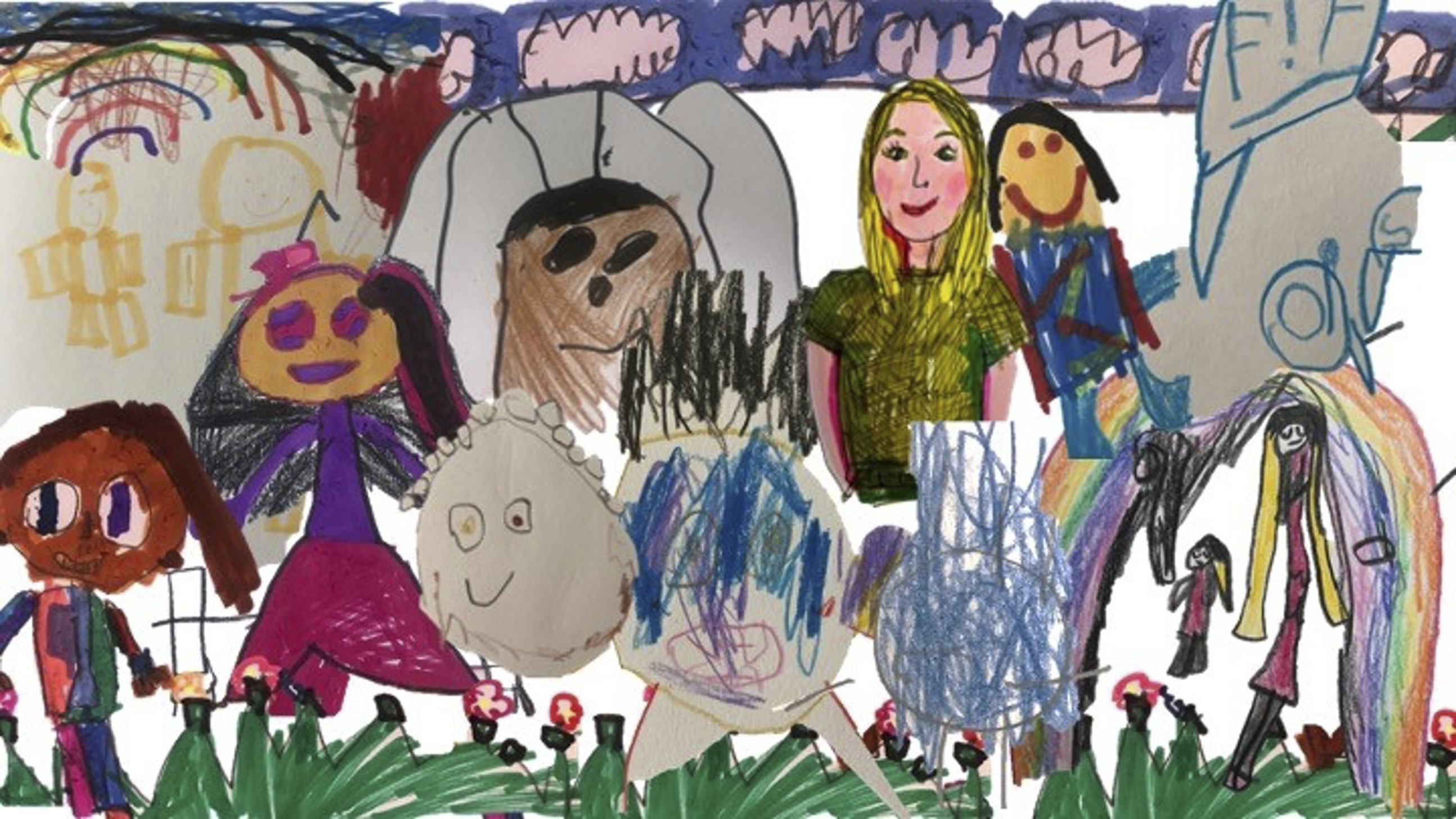
This (Figure 1) is a collage that we made from self-portraits. This is how we wanted to show who ‘we’ are. In this paper, we write together as ‘we’. Most of us have chosen pseudonyms
7
– these are made up names. Our names are Wonderboy, Miss Daisy, Zak, Donut, Fatima, Fairy, Tinkerbell and Stickman. Some of us are 5 years old and some of us are 6 years old and we are now in Year 2. (Apart from Hannah who is 43 years old and is in Year 4 of her university
8
). We live in London
9
and go to a primary school that is big and tall. We first met when we (the children) were in Reception and Hannah came to forest school to do research, which is in a park near to our school.
10
Hannah talked to our teachers about it and then they talked to our Mums and Dads. They got forms to say if we wanted to be researchers and if they were happy for us to do it. Collage of self-portraits by the co-authors
6
that contains several self-portraits drawn. They have been drawn using felt tip pens and colouring pencils. They are all very different in style. There are clouds in the sky, a rainbow and flowers along the grass at the bottom.
Becoming co-researchers
The word ‘co-researchers’ means people who find things out together. We, the children at the forest school, were invited to be ‘co-researchers’, which means we could choose what questions we asked, what we would focus our research on and how we would research. Hannah already decided it was going to be about forest school. The inquiry was about playing with and in nonhuman nature and how play happens
11
. Hannah always says that play is serious and important
12
. Play is a very important part of how we learn and how we live. Children love playing and that is why it is important for children to get involved with the research
13
. We believe adults can learn about things from children and children can learn about things from adults.
There are some differences between adults and children and we needed to be careful about this in the research.
When we were researching together, we could always decide if we wanted to research or if we just wanted to play. We could also decide if we wanted to write this article or just stay in our classroom. We all wanted to write this together because we like thinking about forest school. It’s not really work because we really want to do it. Figure 2 is a picture by Fairy of her drawing her friend Tinkerbell playing in the hammock. A drawing of me, Fairy, researching Tinkerbell playing in the hammock.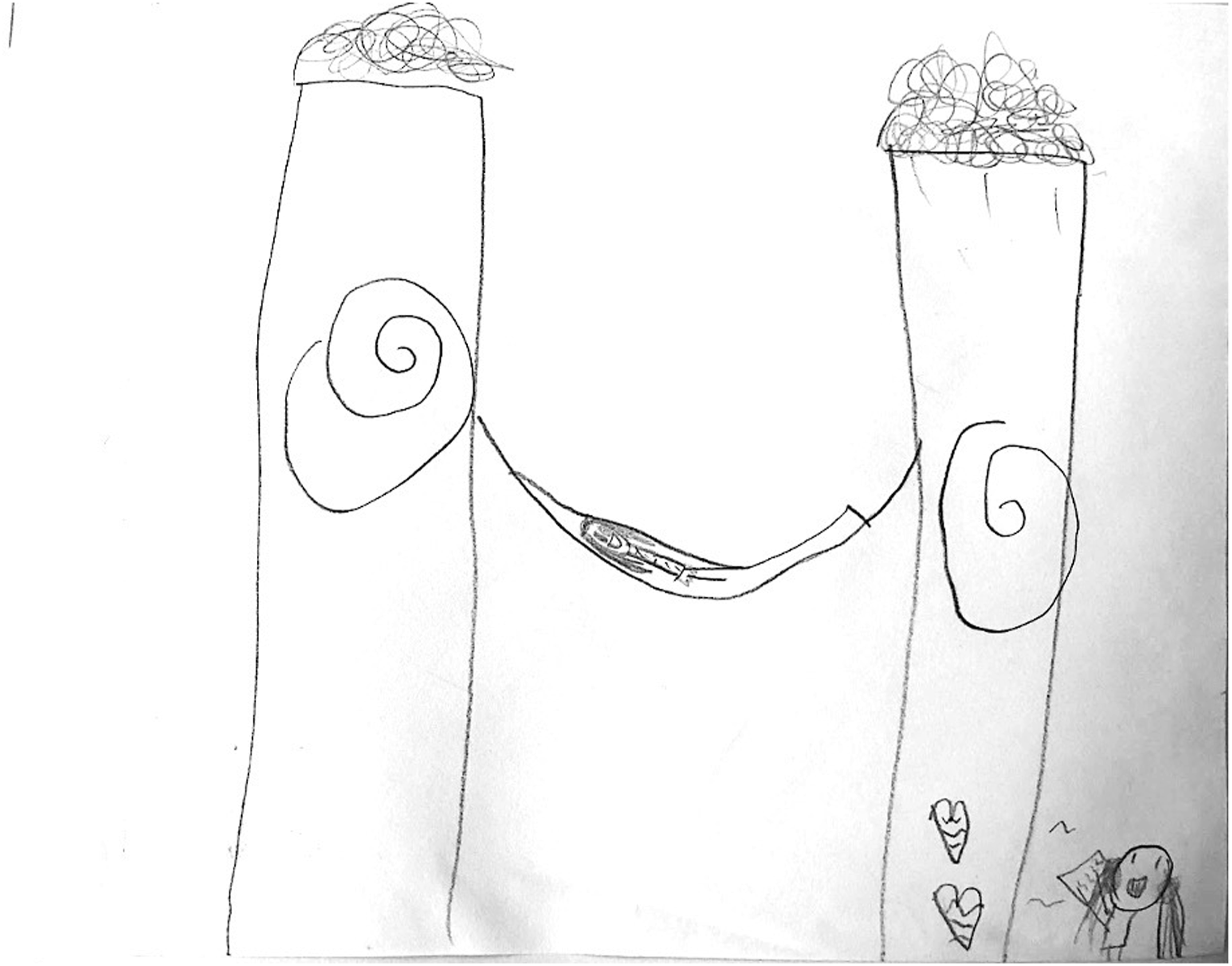
Our inquiry: Childhoodnature play in an urban forest school
What was the research about?
Our research was about forest school and how we played there with ‘nature’. A forest school is a place where you go outside to play and you learn about nature, you make things, you play games and you make food on a campfire. The two main questions that we were thinking about were: 1. How does play happen when we are in forest school? 2. What sorts of relationships between humans and nature (animals, plants, weather) does playing make possible?
Play is often written about from an adult point of view, especially when we are looking at play in schools or education. Adults like to think about what children learn when they play, or what skills they gain. Skills like learning to jump, run, roll or how to be friends with other people and how to be patient and take turns. Adults might also think about the ways in which play is a break from real learning, or to relax and have fun. These things are all really important but they might not tell you about why play is important to children or how play can be lots of things all at once. Play means different things to all of us. To some of us it means waiting, to others it is laughing, to some it is playing games and to some it is eating food! Play is something that you enjoy doing and is a kind of happiness that you feel inside. 14
Part of our research is about our relationship with ‘nature’ and how play happens when we are playing outside in a ‘natural’ space. ‘Nature’ is a word that we all have different ideas about. Hannah asks us ‘what is ‘nature’?
What do we do at forest school?
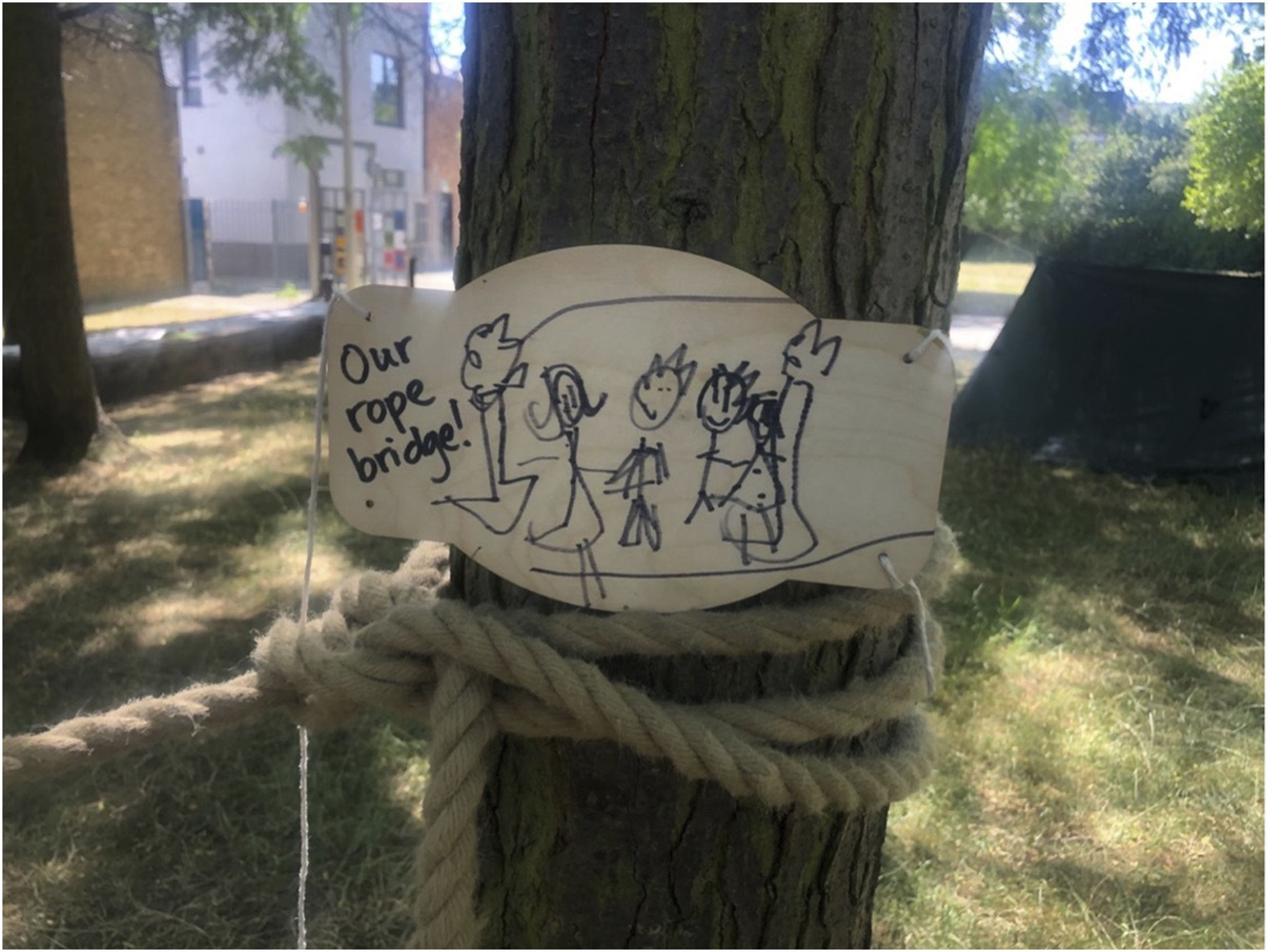
We went on walks to look for plants and animals and we had things to play on like a hammock, a tent and a rope bridge (see Figure 3). Our forest school leader would play games with us like ‘Swampy, Swampy’ and ‘What’s the Time Mr Wolf?’. In Swampy, Swampy, you have to run across a swamp without getting caught by Chompy, Chompy, the swamp monster that Ro would pretend to be. In ‘What’s the Time, Mr Wolf’ you ask the wolf what time it is and if he said ‘2 o’clock’ you have to take two footsteps, sneaking up behind them. If the wolf says ‘it’s dinner time’, then you have to run and he will chase you and try to eat you. We also made things, like a hedgehog out of a bit of wood, or crowns out of flowers or binoculars out of toilet rolls so we could look at the birds. We made a fire and we cooked food on it like popcorn, apples and cheese.
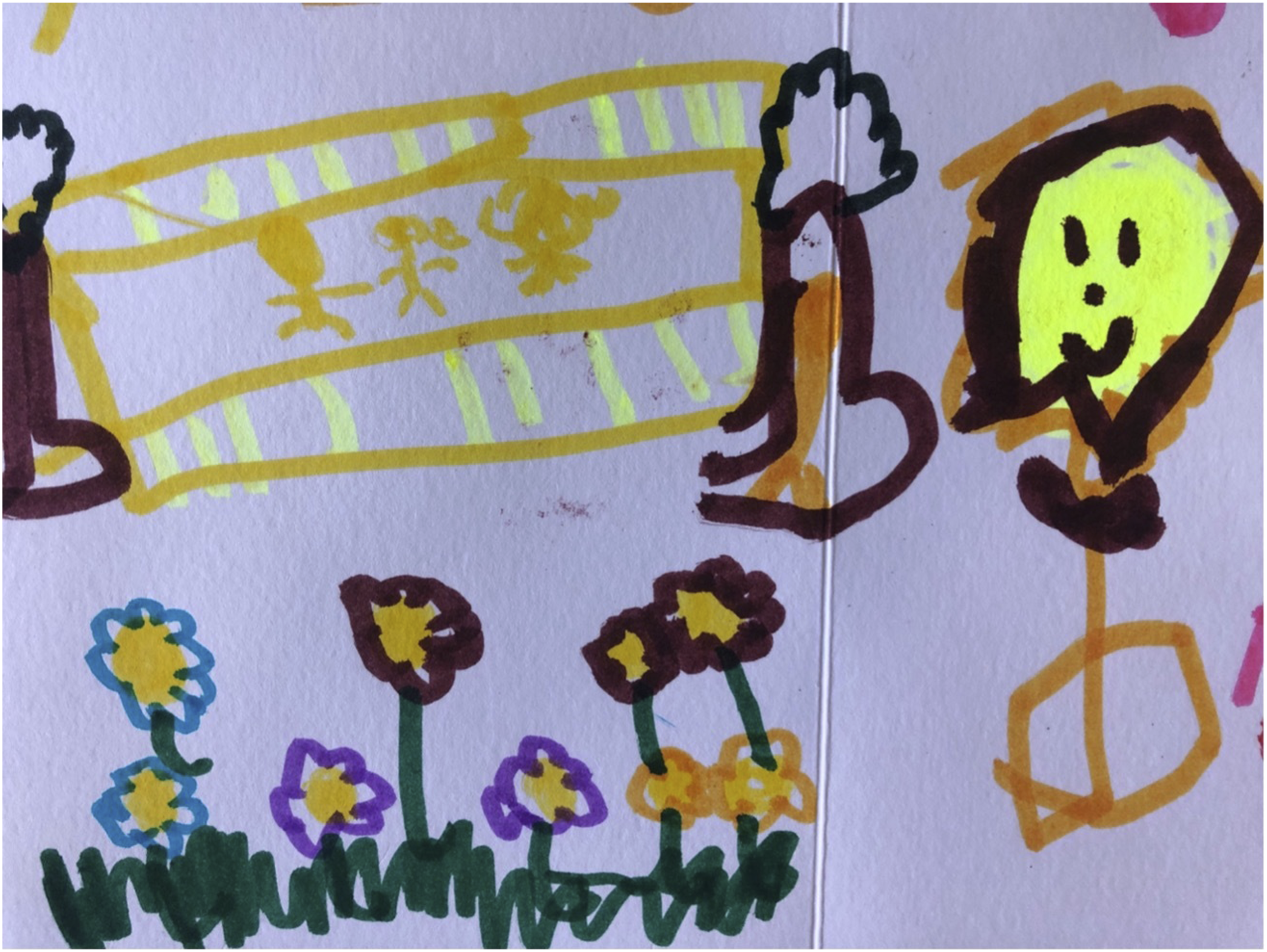
Researching playing on the rope bridge and the flowers, by Tinkerbell.
Where did we do the research?
We went to forest school on Wednesdays every week for the whole of Reception (September – July). Forest school is in a small urban park next to our school and most of us live in the flats around the park. It is right in the middle of London. The forest school leader was Ro and the other one was Heath. Our teachers and Hannah were also at forest school with us. 16
How did we do the research?
We had lots of different parts to the research and we did different things like drawings, playing games, going on walks, telling stories. Some of them were Hannah’s ideas, like she brought cameras to the woods for us to wear and she brought a big book for us to draw in. Some of them were our ideas like we wanted to show everybody our forest school so we made an exhibition. Sometimes we just played and then afterwards we talked about the play and other times we watched other people play.
Playing together
One of our main ways to inquire together was through ‘shared play’ (Hogarth, 2018). This is where we play together and then we talk about our play or we do drawings of our play. We were mainly playing, all the time. We made things, we cooked, we made fires, we did lots of running and we played games. Our favourite things to play was rope swing, swinging in the hammock and the hiding game, where everybody had to hide.
We learned different ways to play together by ‘hanging out’ (Somerville and Powell, 2019) with each other in the park. 18
Collaborative research journal
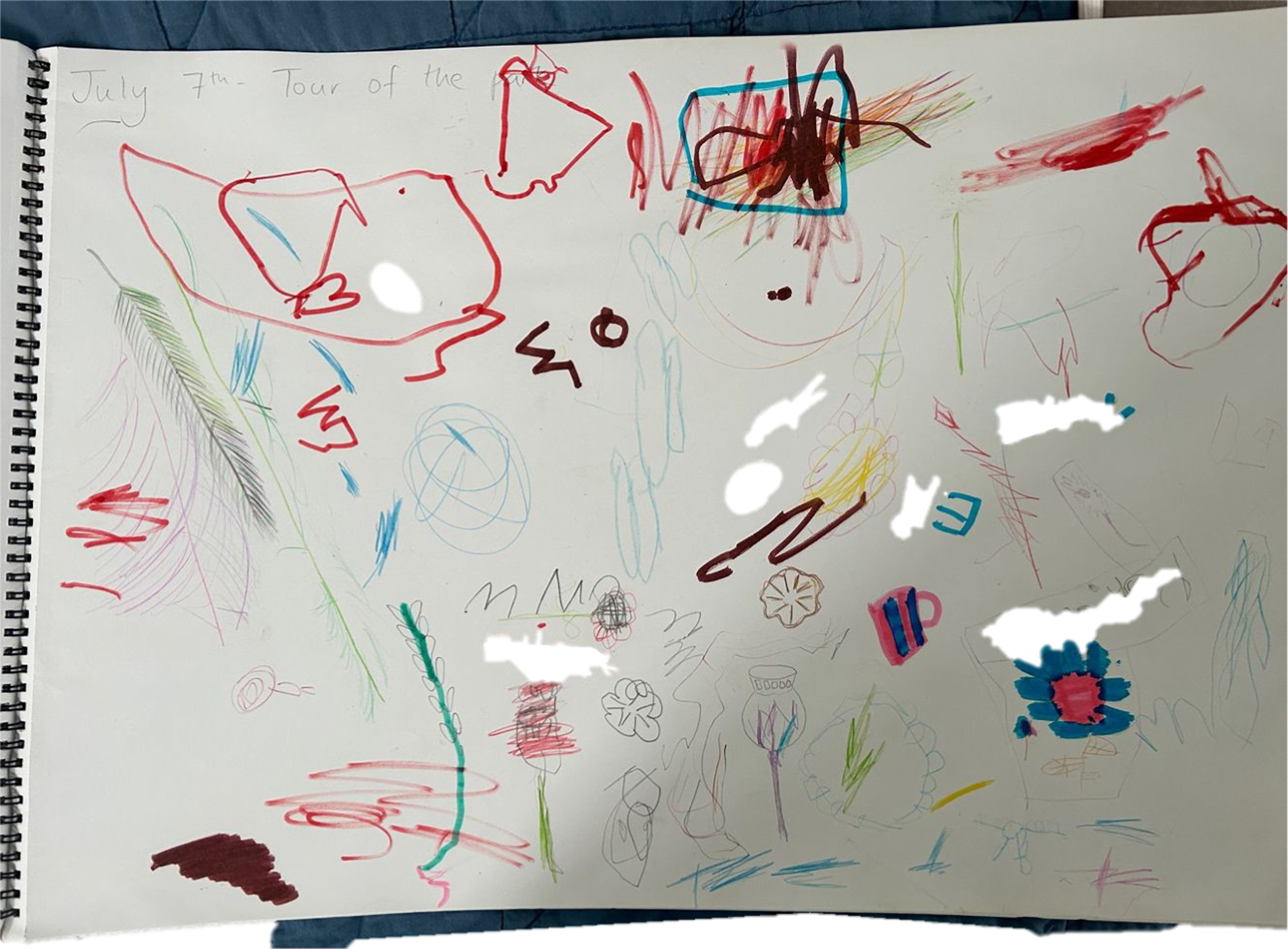
We had a big, black book (a ‘collaborative research journal’) that we could draw and write in. We used this for when we were drawing and we drew what we played. Sometimes we put in pictures of leaves or marks with sticks. We could put in anything we wanted to. Our teachers would sometimes write things down for us too. We like drawing in the journal, for some of us this was playing, not researching. The images in Figures 4 and 5 are from our journal where lots of us did some drawing. You can see even the rain did some drawing because it has melted the colours. We would sometimes talk about our drawings and they would be a story, but we also did drawings of the things we saw at forest school, like a worm, a flower, a feather.
19
A page from the journal where rain has participated in creating marks.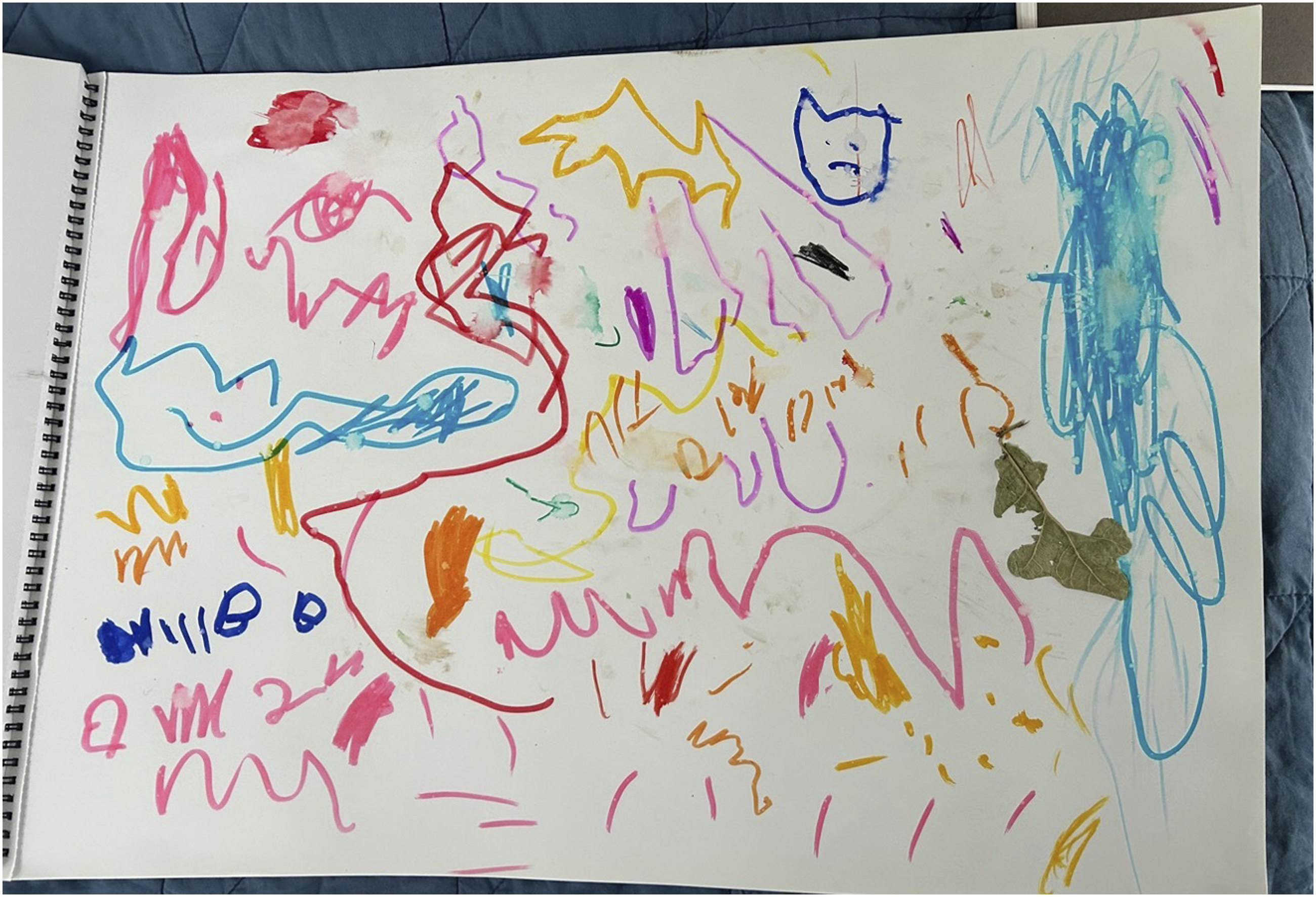
Drawings and paintings
Sometimes in forest school or in our classroom, we did drawings and paintings about what we played at forest school. While we painted we would talk about some of the things we remembered and our drawings were our memories. Sometimes Hannah would write them down in her notebook and sometimes she would ask us questions about our drawings. It is nice to look at the drawings now because they help us remember. We used the drawings to help us tell stories about our play. Figure 6 shows two of us hiding in a tent. We loved the tent for hiding in and chasing through it. Sometimes you could go and sit in there if you wanted to be quiet too. Hiding in the tent, by Fairy. A felt tip pen drawing showing two children (Fairy and Tinkerbell) hiding in a tent.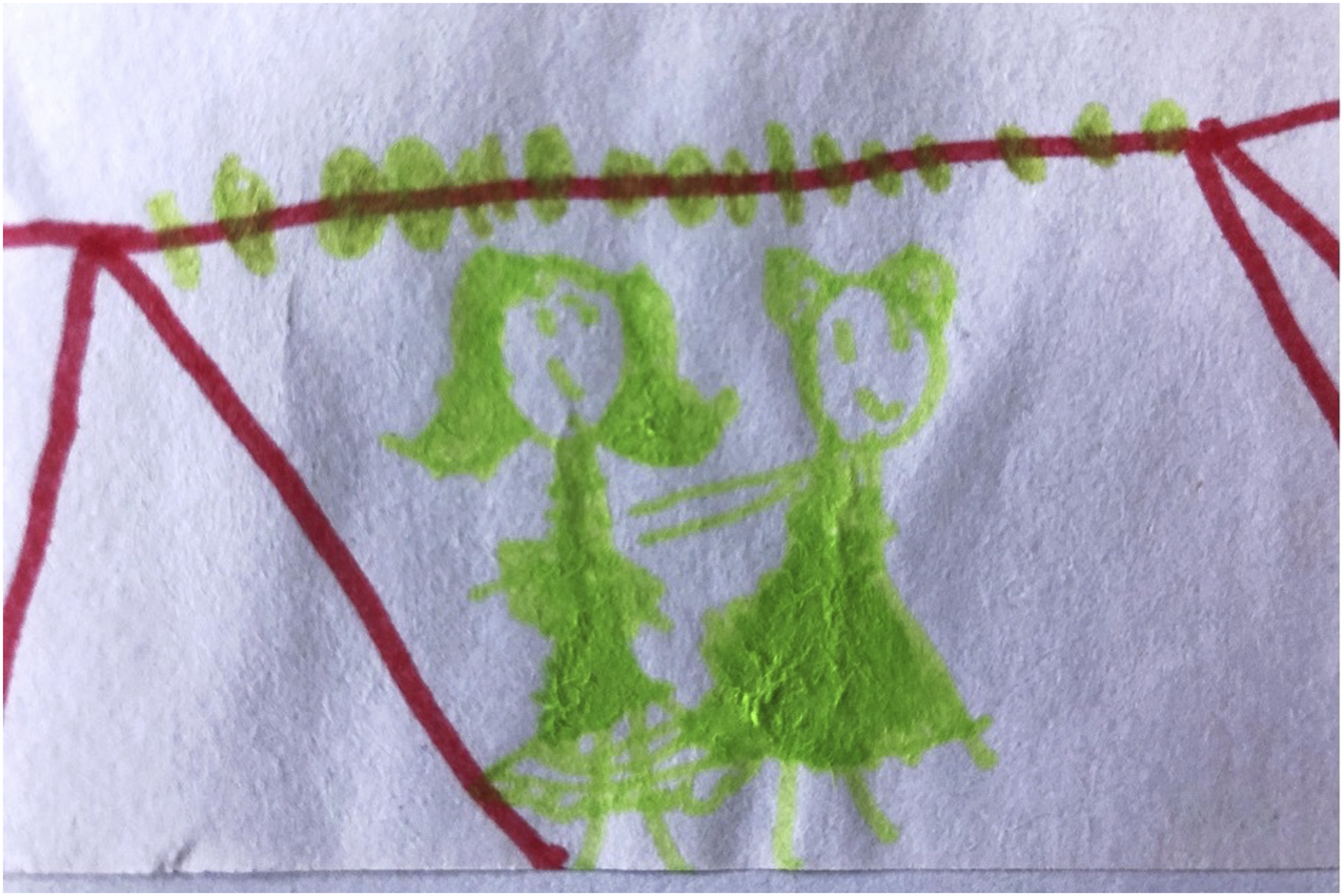
Drawing/talking/drawing/talking
As the weeks went on, Hannah started to ask us about our stories at the end of forest school and would draw what we were saying and then we could look at what we did. We always looked back to see what we did at forest school. We liked doing this so we started to do it every week. Here, in Figure 7, is one of the pages from the book where Hannah has drawn what we talked about. A page of our Collaborative Research Journal: Talk and Draw. A page showing line drawings in pencil of lots of different children playing, birds, stones, animals and plants. It also has words and short phrases that the children have said for example ‘I did a jump twist!’ and ‘PJ Masks!’ and ‘Don’t tread on the flowers!’.
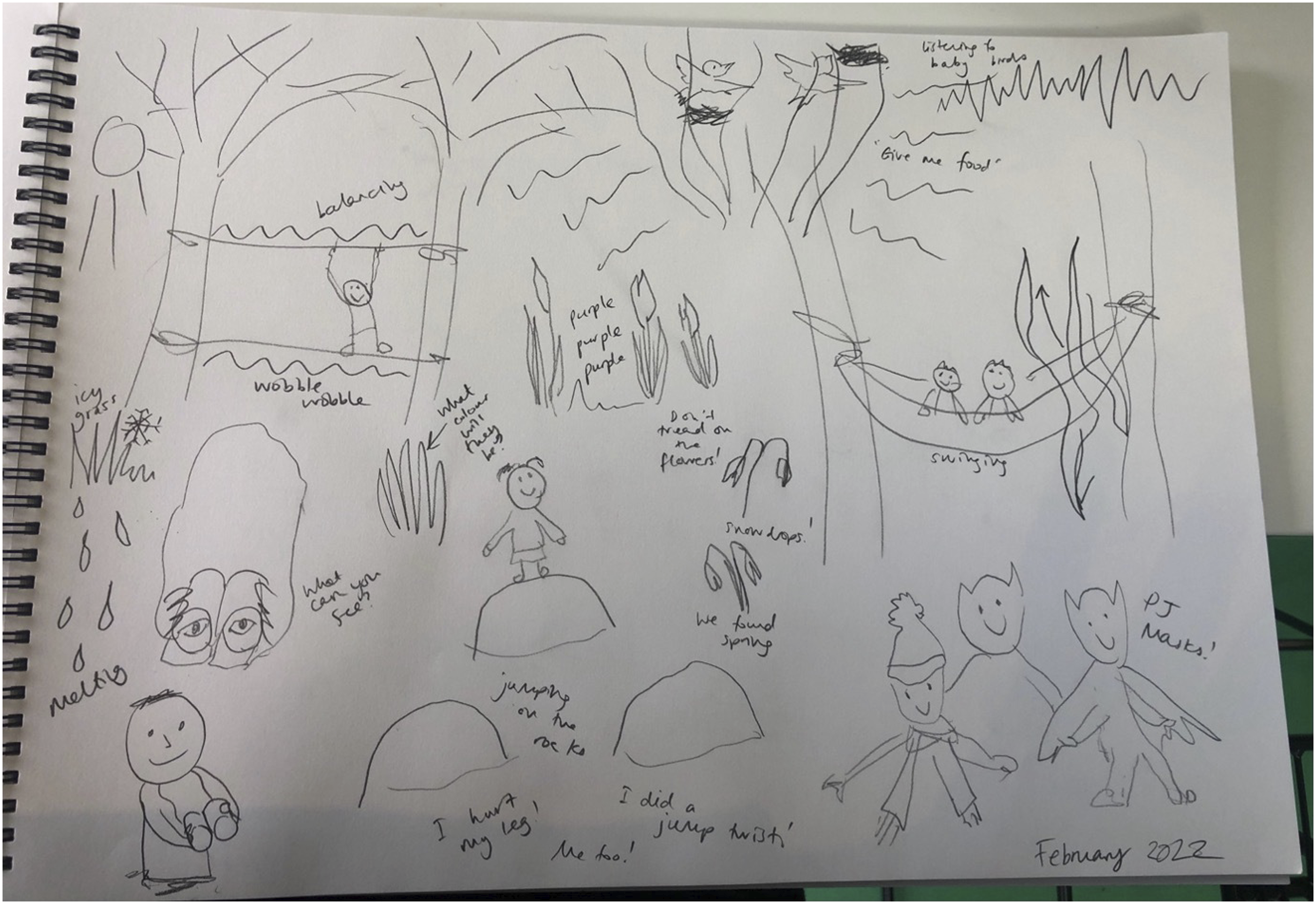
This drawing/talking/drawing/talking was a way in which we started to make up our stories of play that we went on to call ‘Play Tales’ because we retold them many times. We are looking at these pictures to give us ideas to write this article.
Play tales: How have we analysed our ‘data’?
Over the year, we started to write stories and tell other people about what we did at forest school. Hannah would tell stories of our play and these were called ‘Play Tales’ (Hogarth, 2024).
20
In the following section, we share some of these ‘Play Tales’.
Tree Spirits Come Alive! A co-created collage for a presentation at ECQI 2023 (Hogarth, 2023). We are sitting down and squishing clay in our hands to make it warm and soft. We roll the clay into a ball and put the clay on the tree and it sticks. We start to find things to put in the clay to make a face. We add grass, and a feather or a stone. They all look different, some have fluffy hair with the soft grass and some have prickly spiky hair. Some are smiling and some are mad. We give them names… Tallulah and Frida Princess Hatimal Joel and Jessie Spider Tree Spirit, Hulk and Lee These are our friends, the Tree Spirits. Magical tree spirits, what spell to bring you alive? The wind of the tress, it blows and blows until… it is alive! When we leave, the tree spirits come alive. They go around and wake everybody up – the birds, the squirrels, the trees and the leaves. They make the grass grow taller. They make the flowers come alive.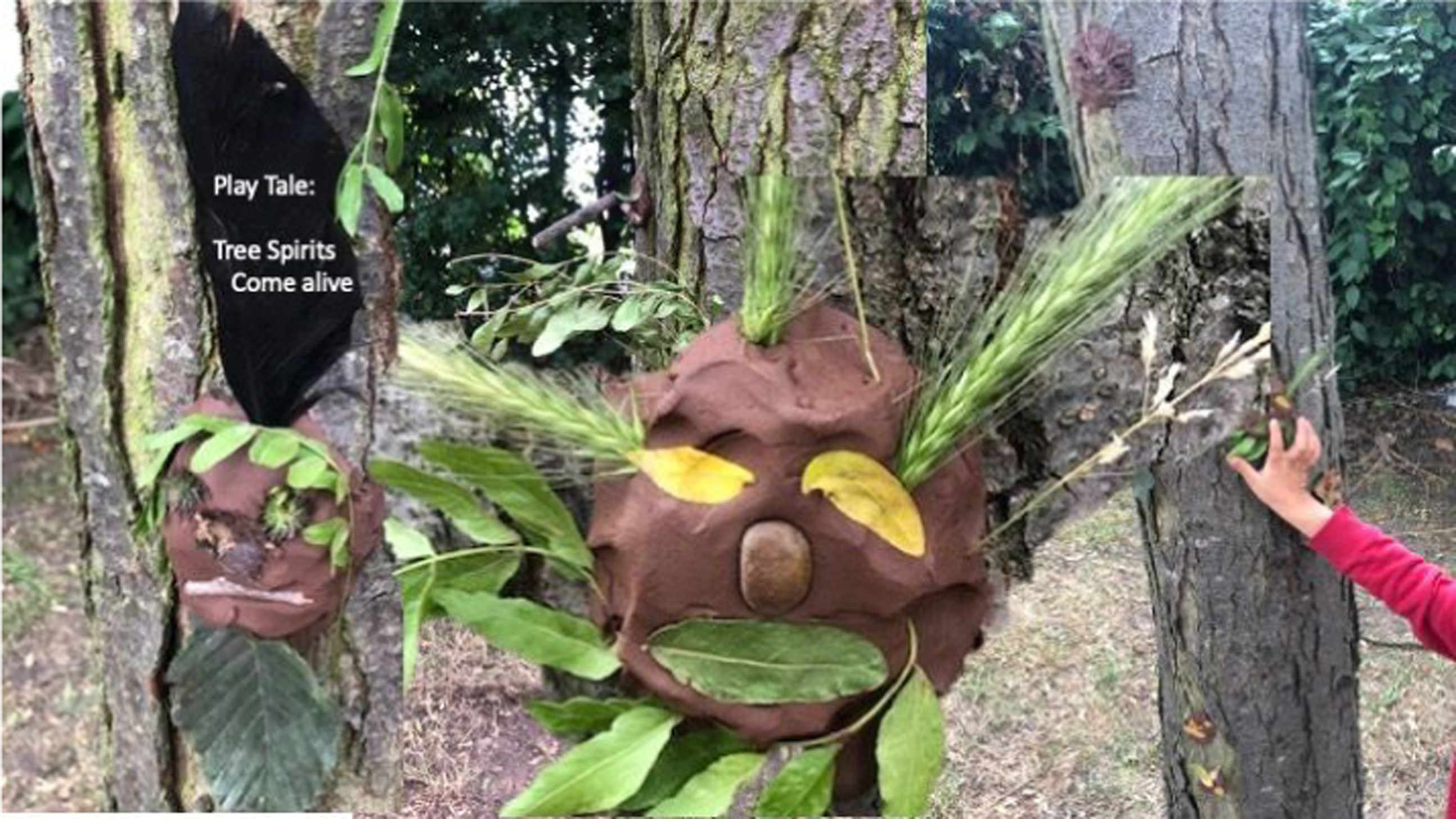
We enjoyed playing this. We made the tree spirits out of clay and then we found them things to make their hair and their eyes. We played ‘Tree Spirits’ and they came alive. A lot of our games were about pretending things. We pretended that things would happen and that is what we did. Children are good at pretending things.
Collage for the Play Tale: Ladybird, Ladybug (including an image from Miraculous, (Astruc and Zag, 2015). One day we found real ladybirds! They were tiny babies, they were black with tiny red bits on. We had never seen a ladybird like that before. Even our teacher had never seen a ladybird like that. Every week we went to see if they were still there and they were! We saw them and we were waiting for them to turn into a ladybird. We played Cat Noir and Ladybug (a Television show on Netflix)! It was so fun. Wonderboy was Cat Noir, and sometimes Donut was Cat Noir, and Fairy was Ladybug or sometimes Nala and Miss Jasmine. Evil Hawk Moth, he is the bad guy, was always different people but we used to tie rope around them and the tree. We tried to escape and then he got out of the rope and would chase us. We hid in the tent, but some akumas (butterflies) chased after us so we had to keep running. It was so fun.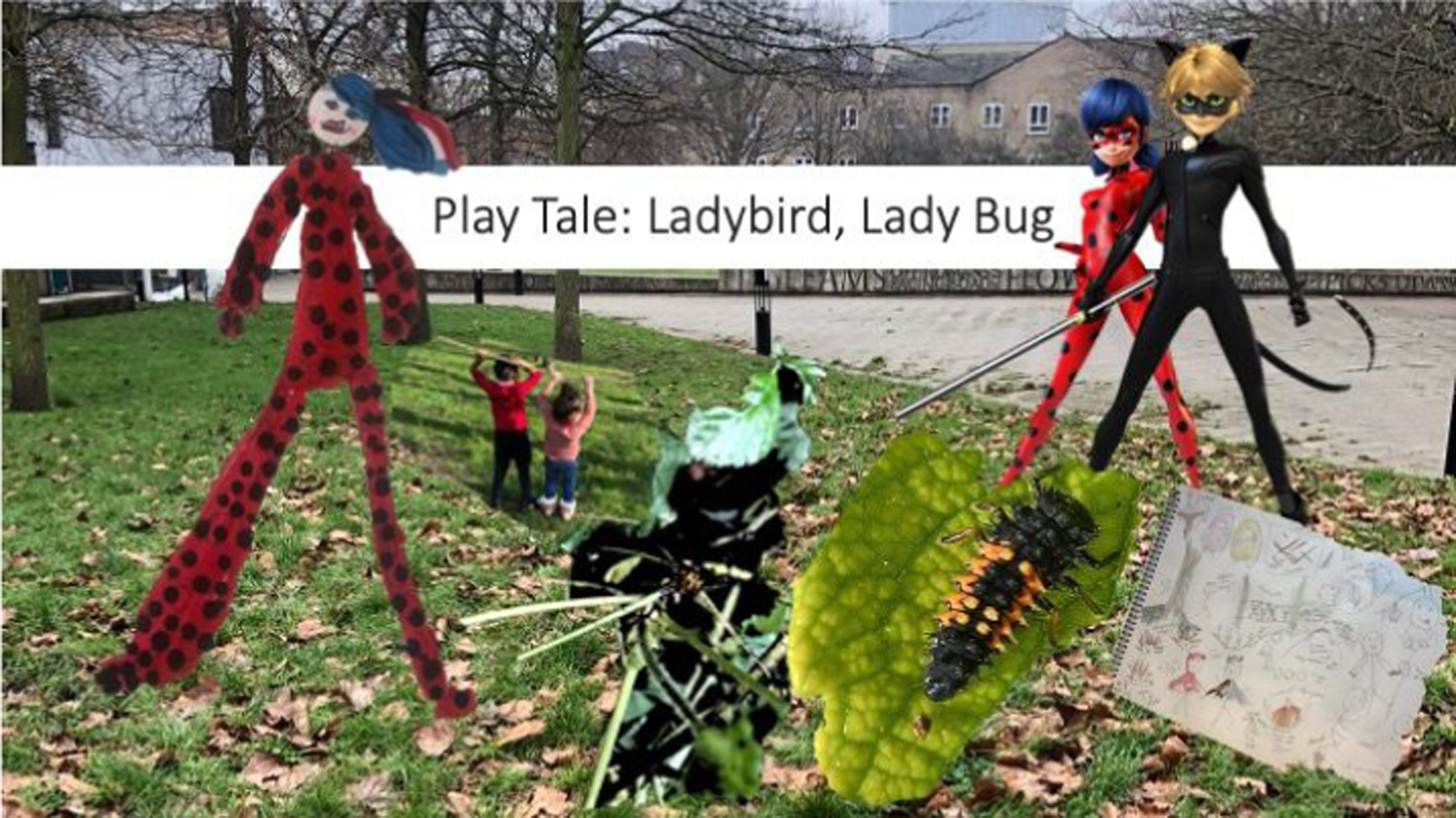
This story tells a story of noticing and coming to know another species. We noticed the ladybird larvae and went to see them every week. Then the grass was cut and they were gone. If we didn’t see the ladybirds we wouldn’t know that. The story also shows how many different characters from TV shows became our playmates. We pretended to be them, we took it in turns and we sometimes did the same things as on the television and sometimes different things.
A collage of magical leaves. First the leaves were green and then they turned yellow and then they fell down. The whole grass was yellow. We picked up the leaves and sprinkled them all over us. We kept picking them up and then they floated down onto the ground. And then, they just disappeared. It was a long time, but then we saw the tiny buds. We lay under the tree and saw the leaves when they came back. They were magic.
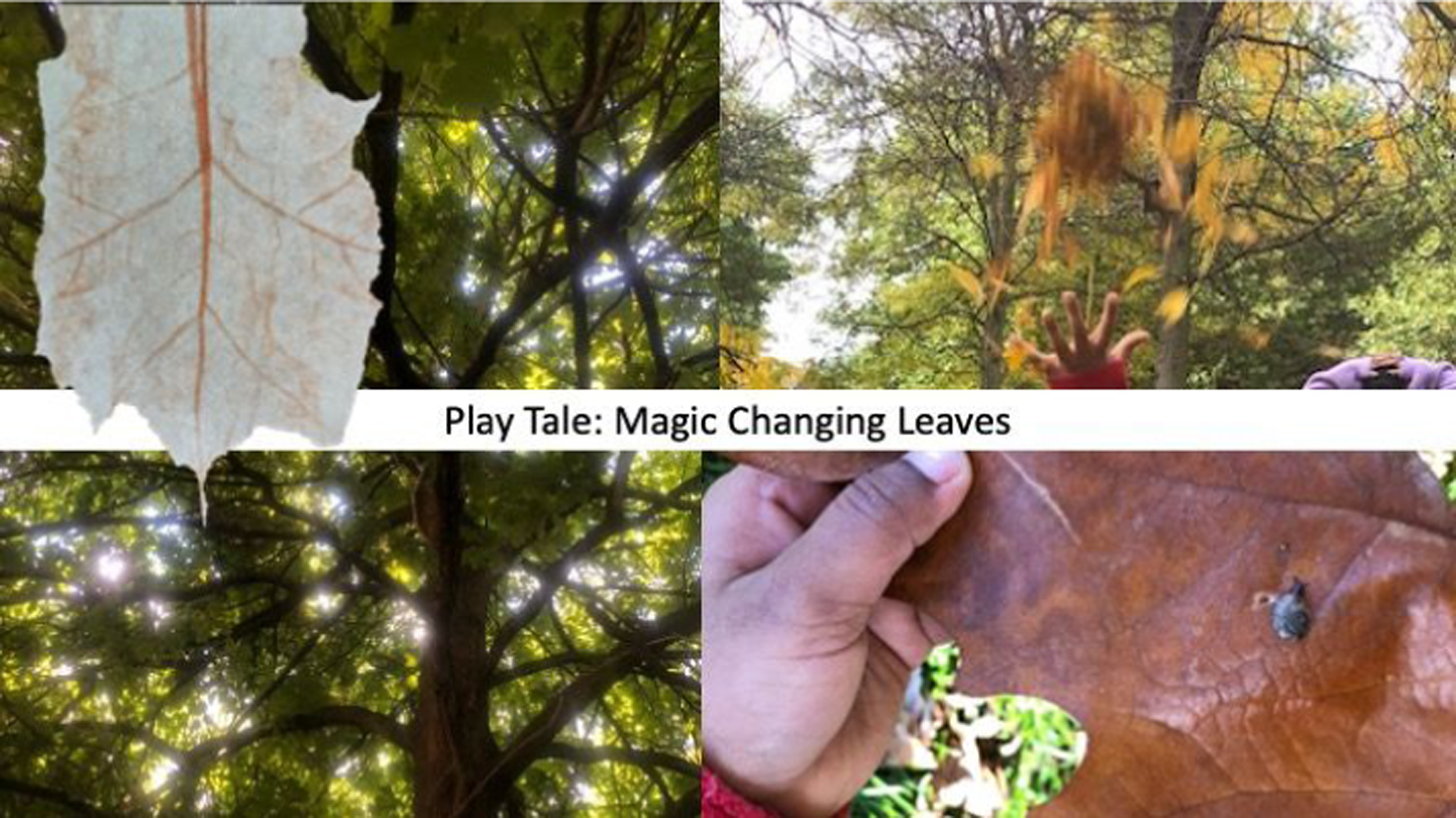
Over the year, it was not just children and the forest school teachers that we played with but other things as well. We played with ropes, a tent, a hammock. We like this story because it is about the leaves that we played with and how the leaves kept surprising us. We could not believe it when they disappeared.
When the doughnut came to Forest School, drawing by Miss Daisy. One of our favourite things was the wibbly wobbly bridge. We loved wobbling on the bridge. The bridge was made of two pieces of rope from one tree to another tree. We could hold on to the top with our hands and walk along the bottom with our feet. If too many people got on it, it would wibble and wobble and shake and some of us would fall off. One day, we were wibbling and wobbling on the bridge when a huge doughnut with sprinkles on came to the bridge. The doughnut jumped up and down and we fell off the rope bridge.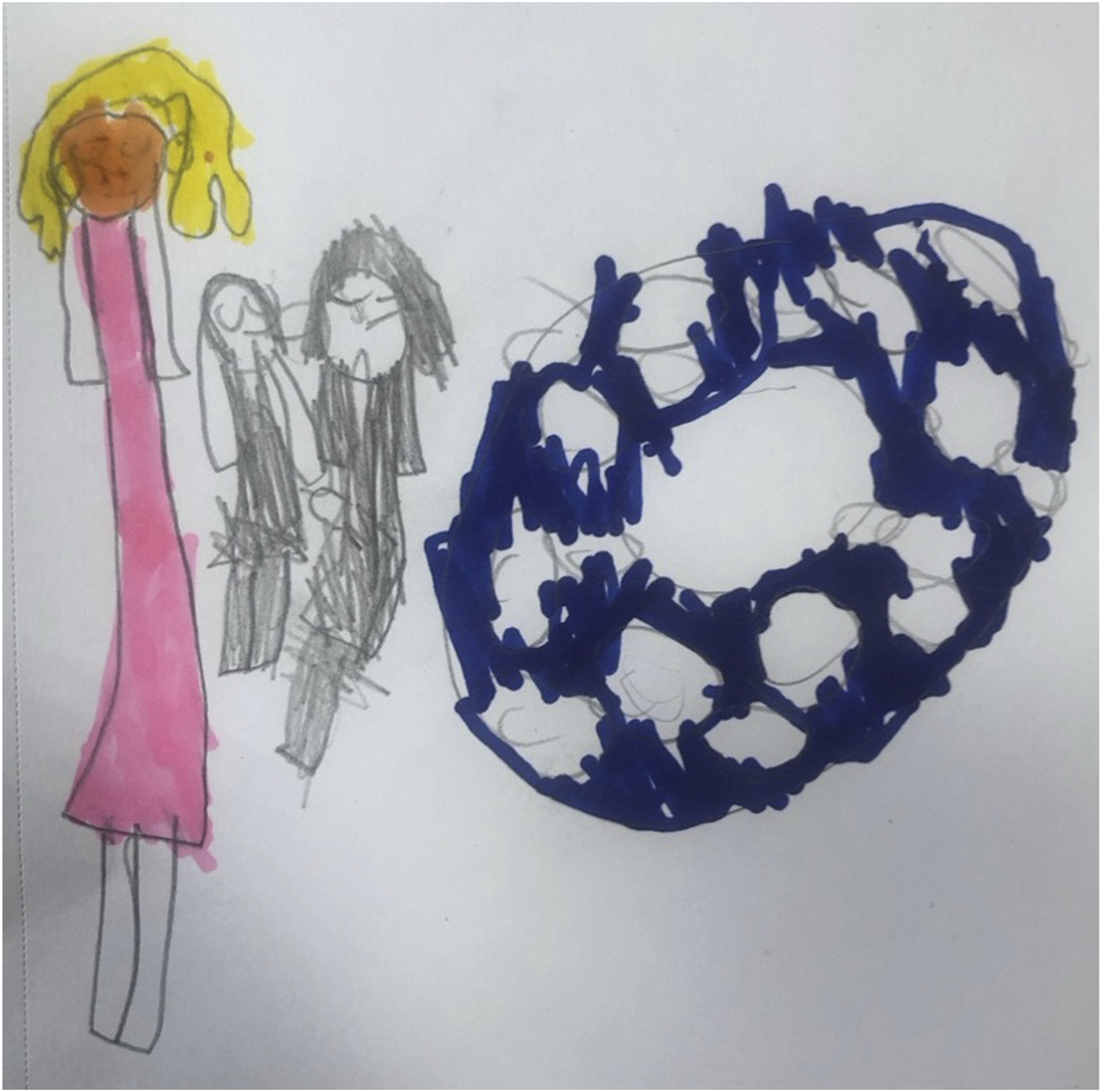
This play tale was created when we were writing this article together. Miss Daisy drew a picture of forest school and it had a big doughnut with sprinkles on in it (Figure 8). Miss Daisy said that the doughnut was going to eat everybody up. Hannah said that it was not to do with forest school but Miss Daisy reminded us that it was important to do things that are funny and that we can make things up. We have included it to remind that this research was about play and that our play can include all sorts of things. It reminds us that play is often silly and serious at the same time and almost always unexpected 22 .
Writing together in the same time and space
We have really enjoyed writing the article. It has been an interesting thing to do together because we listen to each other.
23
When we work together, we do it in our early years classroom. Hannah comes in and we have a table to do our drawings and she talks to us. She has a computer to write down things. We are writing together at the same time, a form of co-creation that was inspired by ‘Collaborative Writing Simultaneously’ (Cranham et al., 2024) 26 . This is where you talk and write together at the same time and then you read through or look at what you are writing together. We look at our pictures and drawings what we did and that makes us remember and then we laugh about what we did.
How do we value different forms of knowledge?
We all know about different things. We want to know about how it feels to touch the grass and to hear a baby bird ask for food.
27
We wanted to know the feeling of running around, playing chase, hiding in the long grass, rubbing chalk over the bark. We all did these things so we all have these feelings but they are different. We know things about forest school like the smell of the fire, some of our teachers did not know what it smelt like. We know what happens when we breathe out in the cold and we make smoke.
Some knowledge we don’t know about. Even the birds and the trees know about different things but we can’t always tell what they know.
Sharing our research
Our exhibition: Stories of play
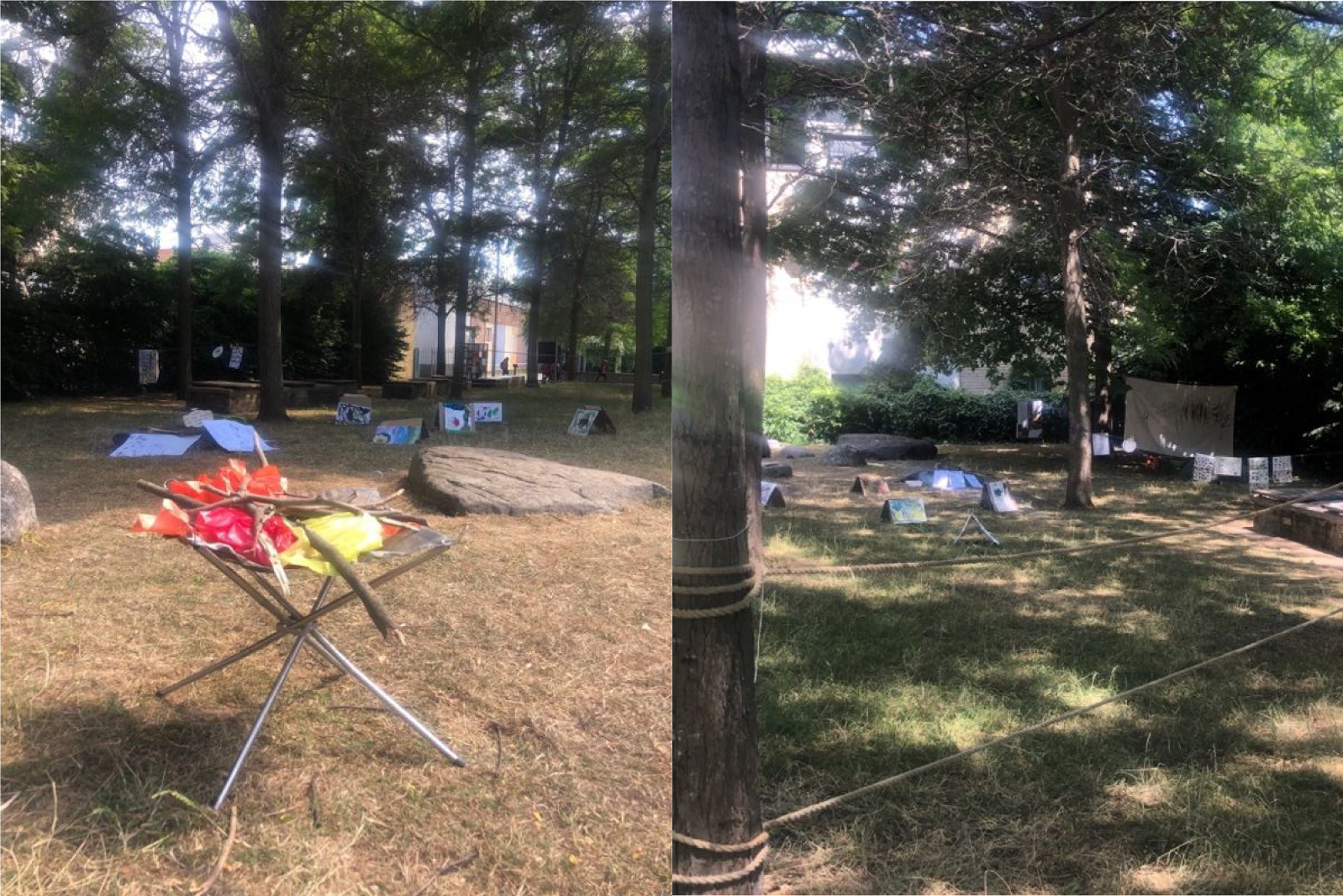
We wanted to tell other people about forest school and about our research. At the end of the year, in the summer, we made an exhibition in the urban park. We took all the classes around forest school and after school, our parents and guardians came to the park and we took it in turns to show them around our forest school. We displayed our paintings, had collages hanging from trees and showed where we played (see Figures 12 and 13).We made the fire out of red paper and sticks but we couldn’t have a real fire because that would be dangerous. Welcome to our Exhibition. Photographs taken of our exhibition.
28
Signs for our installations.
Collages for presentations
Hannah took our research to different places to tell them about what we were doing and sometimes she showed us things on a laptop that she was showing to other people at her school [University] and at conferences. We would choose the pictures for them and put the pictures together 29 . This was a way that we started to have images to go with the Play Tales (see the PowerPoint slides included in Figures 8-10).
What things are you still trying to work out how to do better in your research?
For our research, Hannah chose to focus on playing in forest school as this was the focus of her PhD. However, it would be great if the young people involved in the inquiry could make decisions about what to research, as suggested in the call for papers for this special issue.
Children like getting to answer questions but it is also important that children get to ask the questions as well. In the future, it would be good if the children could choose what the right questions are to ask 30 .
What messages have you got for schools and for school leaders and decision makers?
We all discussed things that we want people to know after reading our research. Here is a summary of our list: 1. We should look after the animals and the trees. We need them to be happy. 2. We wish we could go to forest school again! Forest school was the best place ever. 3. Play is the most important thing. We love doing random things. We love doing random. 4. Children use their imaginations, and this is what children do. 5. We always want to enjoy ourselves. We want this but adults do not always enjoy themselves. 6. We want to choose what we do. Sometimes we get to choose and sometimes grown-ups do the actual choosing.
Conclusions – this is where we finish!
We learned lots of things whilst we were playing and researching. Firstly, it takes a long time to get to know each other and to play together 31 . It takes a long time to get to know all the things about forest school. We have been doing this since we were in Reception and now we are in Year 2. It takes a long time to write this down because we all have different things to say. We found that being in a park every week for a year meant that our play changed with the seasons and every week we played with different playmates: leaves, grass, insects, birds, rain, trees, mud. Even though we play at forest school, we still pretend to be characters from video games and television shows; our play worlds are a mix of our home, digital, school and outdoor worlds. Children are great at using imaginations and that’s why adults need to ask children about how to play. Lots of different things can be play, you know from how you feel if you are playing.
Footnotes
Declaration of conflicting interests
The author(s) declared no potential conflicts of interest with respect to the research, authorship, and/or publication of this article.
Funding
The author(s) disclosed receipt of the following financial support for the research, authorship, and/or publication of this article: This work was supported by the University Research Studentship Award, University of Bath.
