




Abstract
This study examines how philanthropic foundations develop innovative approaches to grant-making by collaborating with social entrepreneurs who are embedded in marginalized communities. Traditionally, foundations award grants that meet predetermined strategic objectives that support their theories of change. However, this study explores an alternative approach known as participatory grant-making, in which philanthropic foundations cede control over strategy and finance by adopting an innovative approach that is based more on trust and collaboration. By analyzing in-depth interviews from 16 executives, directors, and social entrepreneurs in the United States, we demonstrate how participatory grant-making constitutes a social innovation that inverts traditional power dynamics in the philanthropic field by enhancing legitimacy, and thereby facilitating a more interconnected, inclusive, and equitable approach to solving social problems. This article demonstrates how the implementation of participatory grant-making programs can help to counter the increasing criticisms levied at traditional approaches to grant-making.
Keywords
Introduction
The most prominent method of addressing social problems in the United States is through philanthropy (Kashwan et al., 2019; Spicer et al., 2019), largely driven by grant-making foundations who provide funding aiming to resolve social problems strategically and professionally. However, recent studies have challenged the efficacy of traditional approaches to grant-making, highlighting several paradoxes in the logics and practices by which they function (Giridharadas, 2019; McGoey, 2015; Reich, 2016). This study explores an alternative approach to grant-making that is becoming increasingly prominent: participatory grant-making. Although participatory grant-making has existed since the 1960s, the processes, systems, operations, and ideology behind this innovative approach to grant-making remain largely unexplored. Nascent research (e.g., Calò et al., 2023) demonstrates how the development of trust, independence, and mutuality, through collaboration, leads to improved approaches to service delivery in nonprofits. This study builds on this by examining these factors in the context of the grant-making process. Participatory grant-making exists in a murky and often blurred definitional void (Husted et al., 2021); however, for the purposes of this study, we build on Gibson (2017) and define it as the process of grant-making that transfers power over strategy and finance to the people most affected by the issues that the donor seeks to resolve. We demonstrate how this approach engenders greater collaboration between philanthropic foundations and community-embedded social entrepreneurs. Similarly, according to Glasbeek et al. (2024, p. 384), social entrepreneurship is an “essentially contested concept”; however, a seminal definition is provided by Mair and Marti (2006) who define it as the “process[es] involving the innovative use and combination of resources to pursue opportunities to catalyze social change and/or address social needs” (p. 37). In this study, the social entrepreneurs are the actors in receipt of participatory grant funding and who then use it to address challenges within their communities by employing market-based approaches.
A participatory grant-making model places social entrepreneurs at the center of the decision-making process, empowering them to determine how grant funding is allocated, how resources are mobilized, and how social change is best enacted. In traditional grant-making decisions are made solely by the board, or trustees and foundation staff, and typically, the grantee is required to report regularly on their performance. Participatory grant-making diverges from such an approach by seeking to promote an increasingly collaborative, inclusive, and democratic approach to decision-making; one in which social entrepreneurs drive the decision-making processes on key issues surrounding finance and strategy (Husted et al., 2021). We build on this by analyzing how participatory grant-making processes diverge from those employed in traditional grant-making and, crucially, in what ways does participatory grant-making constitute a social innovation? By positioning participatory grant-making as a social innovation, we are able to demonstrate how it inverts the traditional power dynamics in the philanthropic field. Although participatory grant-making forms a small proportion of allocated social finance, it is practiced by a range of organizations, including community foundations, private foundations, and public grant-making agencies, most notably in the United States.
There are a range of approaches to participatory grant-making that often blur definitional boundaries. The most common attribute of any participatory approach is that they prioritize the resolution of social problems from the perspective of the individuals or communities experiencing such challenges (Gibson, 2018; Kilmurray, 2015). Hence, participatory grant-making is part of a broader ideological shift that recognizes that community members have a deeply engrained and emotional understanding of the social problems that afflict their region or locality. They are experts in their own needs, possessing valuable insights into how to address, tackle, and resolve the issues affecting them (Chatterjee et al., 2021; Khan et al., 2010), rather than simply being passive recipients of funding. The literature tends to focus on the role of foundations (McGoey, 2015; Reich, 2016) and generally, their tendency to fund social innovation, rather than adopting innovative philanthropic practices (Weber, 2023). More specifically, with several notable exceptions (e.g., Gibson, 2017, 2018; Hauger, 2023; Husted et al., 2021), there is little scholarship focusing on why foundations may choose to engage in innovative grant-making practices, and it is, therefore, this lacuna we seek to address.
Literature Review
Decision-Making in Elite Philanthropy
Philanthropic foundations are often characterized as “black boxes” (Reich, 2016, p. 69) with opaque and unaccountable decision-making processes. They strongly depend on the trust of the public, principally because of the separation between donors and the ultimate beneficiary (Bekkers, 2003). When designing strategies to solve social problems, philanthropists or foundation staff make certain assumptions about the most effective theory of change (Rogers, 2014) that may differ from those proposed by more proximal social entrepreneurs. As a result, foundations are often challenged for being “more about the pursuit of one’s own projects, a mechanism for the expression of one’s values or preferences, rather than a mechanism for redistribution of relief for the poor” (Reich, 2013, pp. 522–523). Critics argue that philanthropic foundations are profoundly undemocratic institution that place excessive power in the hands of elites by handing them control of cultural, social, and political priorities (Giridharadas, 2019; McGoey, 2015; Reich, 2016). This argument can be advanced by exploring three substantive criticisms. First, the foundation model, that is a major constituent of elite philanthropy, has been accused of being plutocratic (Formisano, 2015; Mills, 1956) in that the locus of decision-making power over the key issues of finance and strategy is held within elite circles (Gibson, 2017; McGoey, 2015; Reich, 2013) who, more often than not are “rich, white, old men . . . praising the activities of only a few individuals” (Von Schnurbein et al., 2021, p. 189). Therefore, from this perspective, philanthropy is a form of soft power (Cooke & Kumar, 2020) that has reduced the capacity of communities to manage their own economies and solve social problems within their communities (Stiglitz, 2009). This is because foundations tend to be unaccountable to the communities they seek to serve; and in the event their behavior is not in the public interest, there exists no governance mechanism to remove their leaders (Reich, 2016). Relatedly, endowed foundations are legally structured to exert the will of their benefactors, often in perpetuity, meaning their ability to adapt and innovate to new or evolving social problems can often be very limited.
The second criticism is that foundations sustain the very “injustices they wish to correct” (Arnove & Pinede, 2007, p. 389) and represents a “neoliberal response to the problems caused by neoliberalism” (Dey & Teasdale, 2016, p. 488). From this perspective, instead of reducing inequalities, elite philanthropy exacerbates inequalities by supporting existing institutions and practices (Odendahl, 1989) and by conforming to neoliberal logics, such as increased self-sufficiency and competition, that in turn shapes the development of the field (Kashwan et al., 2019). This is illustrated by foundations increasing support for philanthropic infrastructure (professional consultancy, investment practices, etc.) that are reflective of its preferences, tending to reinforce logics around markets, power, and finance (Spicer et al., 2019). In borrowing logics and practices from social enterprises, grant-making foundations “constructs a veneer of social justice and change that undermines the capacity for collective action on which democracy is based” (Spicer et al., 2019, p. 197). It has been observed that the growth in endowments of foundations often exceeds their disbursement rate, that over time, further increases the size of elite foundations (Duquette, 2017). Given these criticisms, there has been increasing scholarship focusing on the motivations and outcomes of elite philanthropy, that are critical of the perpetuation of “the economic, social and political hegemony of the super-rich, nationally and globally” (Maclean et al., 2021, p. 330) because elite philanthropy, “systematically privileges the interests and viewpoints of some groups while silencing and marginalizing others” (Levy et al., 2003, p. 93).
The third criticism is that foundations tend to fund organizations who have professionalized grant writing and reporting skills that the vast majority do not possess (Hwang & Powell, 2009; McGoey, 2015; Yang et al., 2021). This tends to marginalize huge numbers of small-scale charitable organizations and social enterprises who are often operating in communities that have the most complex social problems. The process is reflective of elite prejudices surrounding expertise and professionalization, rather than an accurate assessment of the veracity of the causes and is dependent on the social enterprises’ structural position within the broader grant “market” (Simpson, 2016). The nonprofit sector has expanded to address causes that were previously the purview of more informal groups (Hwang & Powell, 2009), and concurrently, there has been a growth in the number of support organizations, for example in the rapidly evolving area of philanthropic consultancy (Leslie et al., 2015).
The organizational form of the foundation may predict the propensity to engage in participatory grant-making. For example, the processes and practices of private endowed foundations are more likely to be flexible as there is less accountability in their practices (Reich, 2016) because of their endowed status; there are often no donors to please, nor any necessity to raise finance from institutions. However, the distinction between simple community engagement practices and real participatory approaches; the latter involves foundations ceding control over decision-making power over strategy and finance by foundations (Husted et al., 2021). Many foundations will have some form of engagement with beneficiaries, but few devolve real decision-making as applied in participatory grant-making programs.
Research has focused on the implications of funding both geographically and culturally distant causes (e.g., Chatterjee et al., 2021; Khan et al., 2010, 2023). In these circumstances, there is often contestation about who possesses power, and about how decisions are made between global and local stakeholders (Koehne et al., 2022). These works illustrate the significance of two factors. First, they highlight the significance of aligning values for successful social change initiatives through “categories of cooperative discernment and empathic projection” (Chatterjee et al., 2021, p. 11) that has the propensity to instill value such as pride, trust, knowledge, and engagement into projects (Maclean & Harvey, 2016). Second, firsthand experience of the problem and its root causes is critical in this process, as it enables social entrepreneurs to draw on their lived experiences, conferring legitimacy through “passion, understanding and commitment, [therefore] lending credibility to their problem specifications” (Price et al., 2023, p. 304), and illustrating that, “only the locally embedded really have the in-depth understanding of local contexts to be able to unpick the complexities and to anticipate the ramifications of attempted interventions” (Khan et al., 2010, p. 1431). Foundations often prioritize funding outcomes that address the symptoms of issues, rather than their causes (Thornton, 2017). A focus on such systems change requires solutions that are so deeply embedded that they can self-perpetuate (Misra & Guerrero, 2024). Therefore, this highlights the “power of self-organization by actors committed to the locality” (Maclean et al., 2013, p. 758) and explains why most traditional grant-making approaches seek to foster some form of community engagement (Barnes & Schmitz, 2016).
Participatory Grant-Making as a Social Innovation
Social innovations are defined as, innovations that have “the potential to improve either the quality or the quantity of life . . . innovations conducive to better education, better environmental quality and longer life expectancy [being] a few” (Pol & Ville, 2009, p. 881). However, there tends to be a preference in the literature to explore social innovations funded by foundations, rather than scholarship focusing on social innovations in philanthropic practices (Weber, 2023). In terms of the former, some studies have found that social innovations are more likely to occur whether the social entrepreneurs involved are legitimate and trusted actors (Price et al., 2023), while others have found that an attachment to a specific geography, or place, is a critical factor (Maclean et al., 2013; Vercher et al., 2023). However, there are several peripatetic instances of research that have identified the process of grant-making itself, as socially innovative (e.g., Gibson, 2017, 2018; Hauger, 2023; Husted et al., 2021). The process of grant-making by philanthropic foundations presents scope for innovation, especially for example, in relation to impact investing, but many of these serve only to reinforce and cement the existing power systems (Agrawal & Hockerts, 2021).
Participatory grant-making is a collaborative and relational process that has previously been identified as key features of social innovations (van Wijk et al., 2019; Ziegler, 2017). In this vein, Phillips et al. (2015) demonstrated how social innovations are not solely undertaken by individuals but rather are “an interactive process shaped by the collective sharing of knowledge between a range of organizations and institutions” (p. 447). This process of knowledge sharing takes place in “spaces of negotiation” (Battilana et al., 2015) in which a reciprocal understanding of the problem and the development of a proposed solution occur (Ometto et al., 2019). These ideas align the work of Lubberink et al. (2018) who identifies the core characteristics of social innovation as both knowledge management and stakeholder inclusion, that are more “responsive to . . . new insights, knowledge and changing stakeholder needs and values” (p. 53). As a result, participatory approaches with are increasingly collaborative and inclusive may lead to “co-creation and co-production approaches . . . in order to become collaborative partners that define, design, introduce, and drive solutions” (Hauger, 2023, p. 17). Therefore, participatory grant-making approaches seek to reconfigure social relations through the implementation and reconfiguration of traditional grant-making processes because “traditional financial practices have arguably marginalized many of the individuals and communities who may benefit the most from a variety of social innovations” (Moore et al., 2012, p. 116). The reconfiguration of the “taken for granted” process involved in traditional grant-making, whereby the grantee seeks funding based on a tender or call of some sort, requires changes in organizational design to facilitate the empowerment of other actors (Von Jacobi et al., 2023). This is a challenge for foundations that are designed, both ideologically, procedurally, and structurally, to maintain inherent power relations. Significant cultural and institutional barriers inhibit those who are afflicted by particular social problems from securing funding to overcome them.
Social innovation tends to be most successful in the nonprofit sector in areas neglected by both public and private sectors and when they are designed to address issues affecting groups that are either socially and politically excluded, such as indigenous populations or Lesbian, Gay, Bisexual, Transgender, and Queer community (LGBTQ) groups (Fougère et al., 2017; Galego et al., 2022). Recent work has illustrated that more collaborative governance arrangements in the nonprofit sector can lead to improved services because of better trust, the emergence of new learning dynamics and knowledgeable local leadership (Calò et al., 2023). Devolved governance arrangements are a central objective of participatory grant-making approaches as they seek to, “involve nontraditional actors in institutional sites beyond traditional elite arenas, with a more socially focused content than dominant approaches” (González & Healey, 2005, p. 2061) and in doing so, they seek the reorganization of formal governance rules, processes, and power relations (Gibson, 2017, 2018; Hauger, 2023; Vercher et al., 2023). This has the power to instill a new sense of ownership, collective identity, and passion for the social cause among community stakeholders (Peredo & Chrisman, 2006). Despite this, many innovative governance practices can be naïve, “bumping into the hard school of power relations, economic interests, financial constraints and complicated socio-psychological relationships between actors and institutions” (Galego et al., 2022, p. 266). However, place-based governance arrangements better harness the value conferred by place-based legitimacy (Borchgrevink, 2020; Khan et al., 2023; Kimmitt et al., 2023), while also improving community engagement because of improved trust in the initiatives (Bekkers, 2003; Smith & Stevens, 2010). This is important for foundations who need to present themselves as legitimate when acquiring and allocating resources (Navis & Glynn, 2011) because often, their identity is more a representation of their organizational values and/or unique competencies (Scherer, 2017) and unreflective of the community where the social problem is manifest. Therefore, devolved governance structures serve to facilitate stronger relationships with local communities because they create a shared territorial understanding of values and norms specific to the context (Vercher et al., 2023), this is described as their degree of cultural embeddedness by Zukin and Di Maggio (1990). Such embeddedness confers legitimacy that acts as an important strategic resource in philanthropic partnerships (Nicholls, 2010), particularly in deprived contexts (Kimmitt et al., 2023) and in communities with strong religious beliefs (Khan et al., 2023). This is supported by work that suggests projects with specific territorial affiliations, are likely to be socially innovative (McKeever et al., 2015; Moulaert, 2009; O’Connor et al., 2018; Price et al., 2023). Therefore, socially innovative governance arrangements are those that tend to be more horizontal, have strong procedural fairness and those that place locally embedded actors in positions of power (Moulaert, 2009).
Method
The sample for this study comprised 16 participants, 12 of whom were presidents, vice presidents, or senior employees of foundations, 1 was a president of a philanthropic membership organization (a convening organization for foundations), while 3 were founders or vice presidents of social enterprises who were in receipt of participatory grant-making funding, by other organizations in the sample, but who also obtained revenue commercially. These organizations served two categories of constituents, both customers and the beneficiaries of their activities (Battilana et al., 2015). In developing our sample, we adopted a snowball strategy based on networking and referral (Parker et al., 2019) but this required a great deal of prescreening that involved evaluating the appropriateness of each potential respondent based on their job role, area of expertise, and experience of participatory grant-making processes. This was crucial as we discovered that most foundations and their employees did not engage in practices considered to be truly participatory. For example, they did not relinquish control over aspects such as strategy and finance (Husted et al., 2021). The principal conduit for recruiting participants was the philanthropic membership organization and a leading foundation, who had previously implemented participatory approaches, to some extent, into their entire grant-making portfolio. A summary of the participants, who have been assigned pseudonyms to preserve their anonymity, including details of their role, job title, and level of seniority, can be viewed in Table 1. All participants we spoke to were associated with foundations headquartered in the United States . The United States was selected as the focus of the study because its philanthropic activities are imitated and envied (Bernholz et al., 2016) and it is the country that is often cited as being at the forefront of philanthropic innovations, spawned from parallel technological and commercial innovations (Weber, 2023).
Respondent Key.
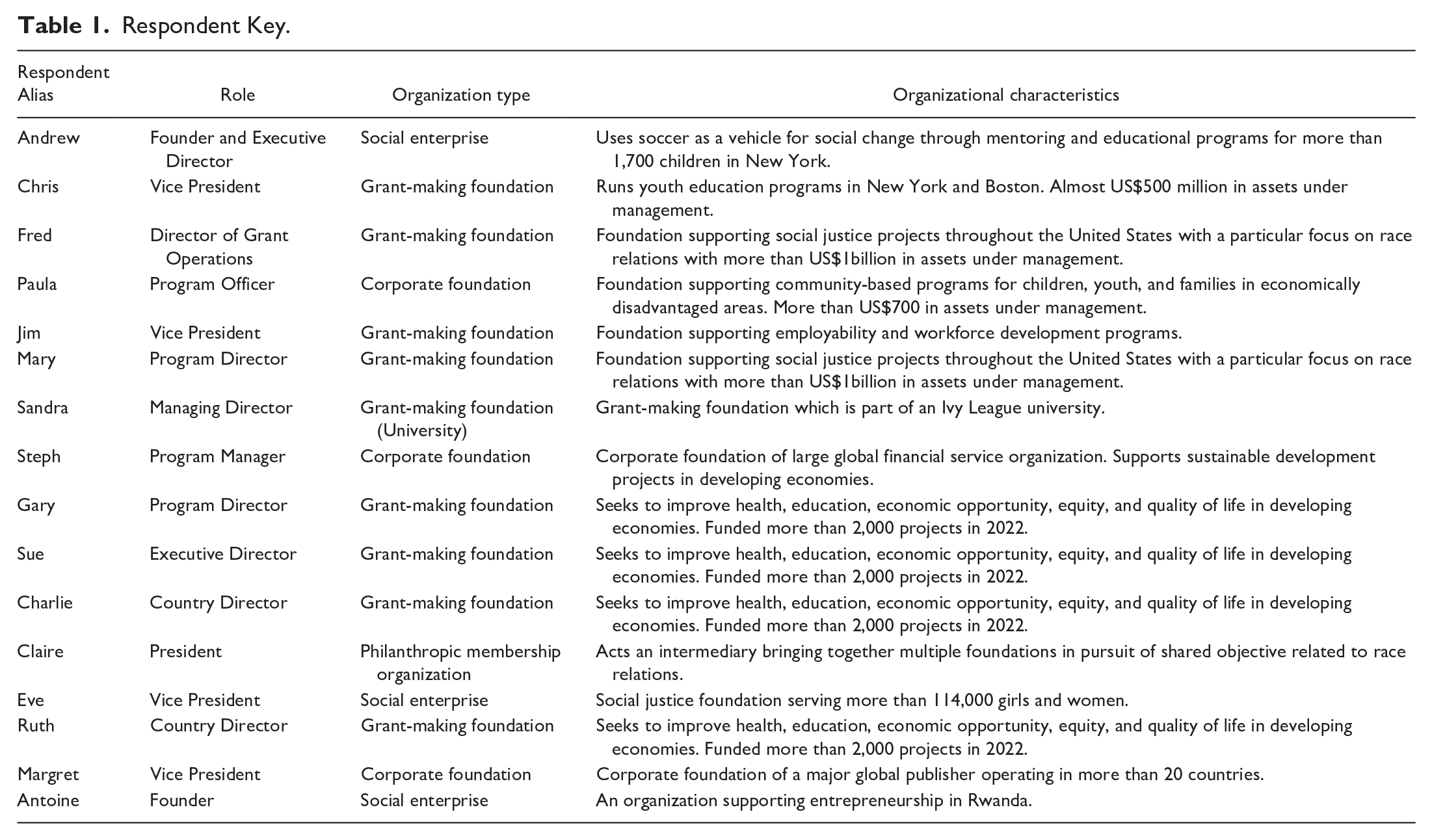
The foundations our respondents represented ranged in size; the largest had just over US$1 billion in assets under management (AUM) and the smallest, just US$17 million in AUM. As researchers, we were aware of the politically sensitive arena of elite philanthropy and the access difficulties that tend to constrain the study of “elite” actors (Harvey et al., 2020; Pettigrew, 1992). Those in positions of power do not generally invite potential critics to judge their behaviors and practices. However, the authors capitalized on their status as researchers with significant expertise and networks in the field of philanthropy to obtain the trust and confidence of the respondents (Rice, 2010).
Data were collected through semistructured interviews, each following a similar pattern. The interviews lasted between 40 and 90 minutes. They took place either in person in the offices of the organization, or, in three instances, online. They were structured logically into three parts: First, we asked participants about their own roles in the organization; then, we asked about their own professional background (their personal journey, life histories, lived experience, etc.). We then proceeded to ask about their knowledge of the grant-making process and then, if, why, and how their organization was implementing participatory grant-making. Finally, we asked for more specific details on the mechanics of the grant-making process and how it operated and the challenges and benefits they encountered. In one instance, there were five respondents in one interview. This was helpful as it allowed us to immediately verify the process of how participatory grant-making worked with all stakeholders able to remark on the same issue. The interviews were recorded and transcribed. The total corpus of data exceeded 105,000 words. We triangulated interview data with secondary sources including website materials, newspaper articles, annual reports, and associated financial statements to corroborate claims regarding the projects they participated in, their geographical scope and the financial data declared such as their AUM and expenditure. We used this secondary data for clarification, accuracy, and verification of the interview data collected.
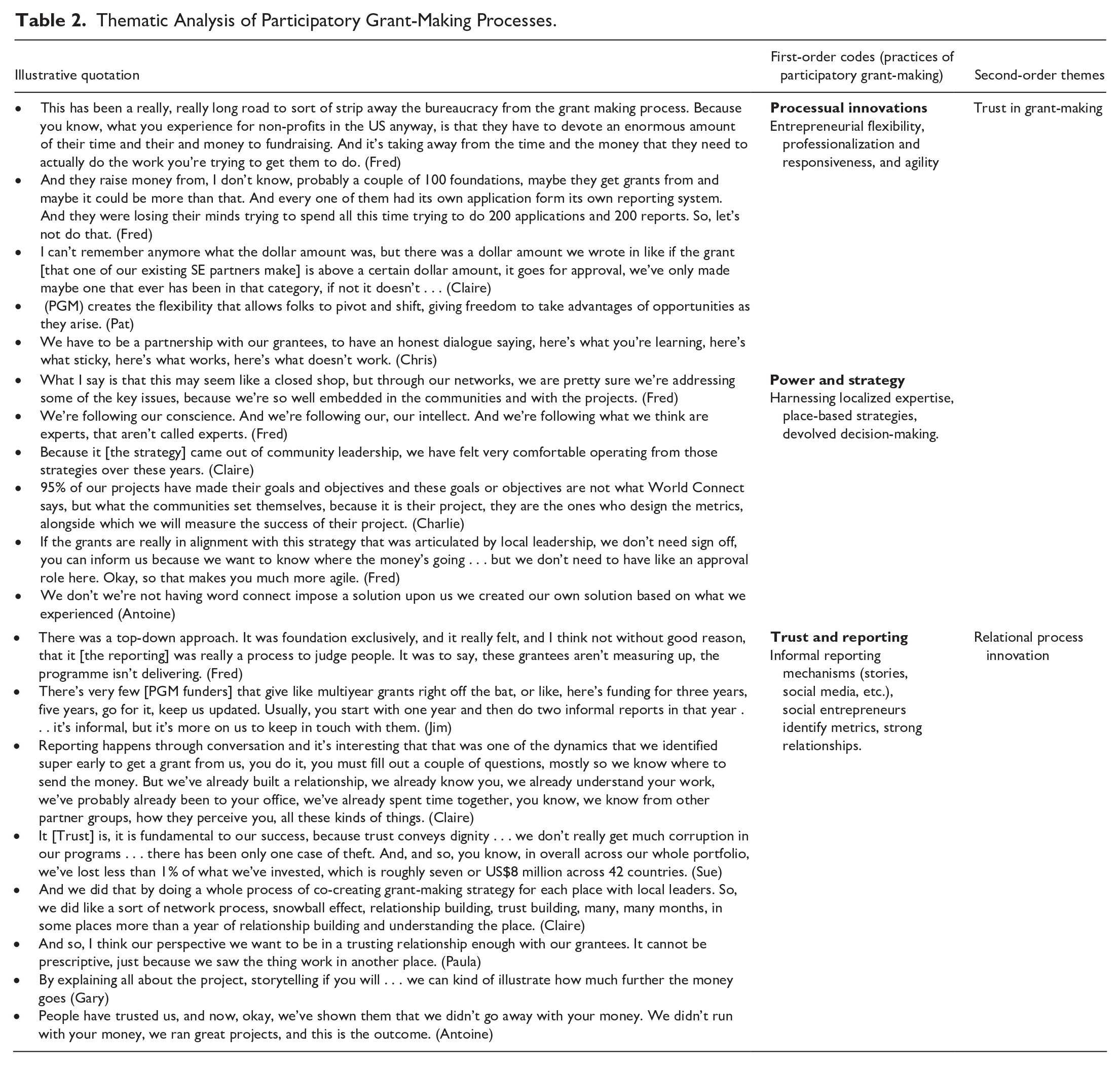
Our data analysis relied on an inductive-then-deductive analytical procedure (Fereday & Muir-Cochrane, 2006), that is particularly useful when analyzing topics or relationships not yet well explained in the literature (Kimmitt & Muñoz, 2018). First, using Nvivo, one author open coded the transcripts (Corbin & Strauss, 2015), analyzing and identifying the relational dimensions that represented the practices of participatory grant-making. Subsequently, utilizing the framework proposed by Gioia et al. (2012), two authors conducted an iterative analysis in tandem, during which they agreed on the emergent relational and processual dimensions, and were able to categorize them thematically to develop first-order codes. Following the approach of Saldana (2021), we developed codes from “words or short phrases that symbolically assign a summative, salient, essence-capturing, and/or evocative attribute for a portion of narrative” (p. 151). This involved identifying recurring themes such as processual innovations, power and strategy and trust and reporting. Following this, the same two authors were able to produce the second-order themes that framed the analysis. These themes, shown in Table 2, provide the framework for presenting our findings.
Thematic Analysis of Participatory Grant-Making Processes.
Findings
Processual Innovations
The respondents stated that one of the major benefits of participatory grant-making is that it facilitates a more innovative approach to solving social problems that manifested in several ways. The absence of foundation-driven metrics provides grantees with greater flexibility to align their work with the issues specific in a regional context, or, to adapt their enterprise to nascent changes in project conditions. This was explicated by Mary who confirmed how this, “creates the flexibility that allows folks to pivot and shift.” Andrew corroborates this by explaining that “we’ve got massive flexibility and leeway, we literally can do anything that is charitable. And that means we can pivot if we see a need, we can go off in any direction that we think.” Claire explains how funders devolve the control over finance in participatory grant-making projects to the community level, via social enterprises, that improves responsiveness in meeting local needs, “we don’t need sign off, you can inform us, because we want to know where the money’s going . . . but we don’t need to have an approval role . . . so that makes you much more agile.” This evidences how funding can be quickly targeted to address nascent issues or emerging problems. Fred explains how innovation in the process facilitates this:
If we choose to strip away all the baggage, and say, I’m going to give a million dollars to this organisation, and they’re a non-profit, they qualify, here’s the money . . . I can get the money to them tomorrow, and I have done that . . . we have a system in place now for a million dollars . . . I can put something in the system, get it approved internally, and get them a wire within 24 hours. And that is just unheard of, if you’re raising dollars from donors with all their messed-up metrics. That’s really a big difference between us and the others.
Participatory grant-making is presented as being more efficient, that, as Fred states, enables foundations to “strip away the bureaucracy from the grant-making process, taking away from the time and the money that they need to actually do the work you’re trying to get them to do.” This freedom improves the process, allowing the grantees greater flexibility to work in a more autonomous manner, as Claire remarked, “it was quite heart-warming to see how somebody reacts when they’re not tied up in these controls, in reports, measurements, benchmarks.”
Our respondents reflected on the advantages of this streamlined and flexible process, and how it facilitated more entrepreneurial flexibility to resolving social problems, as Mary confirms, “[we think] about what it means to create the pathways for folks to [use] entrepreneurship as a tool . . . to invest and support entrepreneurs of colour to be the leaders, creators, and employers, is how we believe that we can see change and getting to that point of economic inclusion.” As Paula illustrates, this is manifest less by a focus on “how the money is spent, and more focus on, are they doing the work that they said they’re going to do?” Eve outlines how foundations can support this process by “creating access to networks and finance” that entrepreneurs would otherwise not have access to. Related to these remarks is the requirement for professional grant writing skills and being embedded in appropriate networks to access opportunities for accessing finance, as Chris alludes to; “I’ve learned over the years that it depends on the size of the organization and how good a grant writer they have [as to whether they can win the grants],” he continues, “so if I’ve got a hundred million dollar foundation, they will have a full development department, right? They’ll have major donor people who are soliciting donations from wealthy people. They will have institutional people. They will have a foundation person.” In many cases, this is a barrier for social enterprises who often lack both expertise and access to professional skills and networks. As Claire observed, the lack of professional experience in grant writing “was the biggest learning curve when I started was because I was not in that foundation world.” Echoing this, Eve, comments that philanthropic networks in New York confer certain advantages, as opposed to those on the periphery [geographically and socially], “every time you write a proposal, it is easier in a philanthropic ecosystem such as New York, but presumably it’s much harder if you’re in the Midwest” because they lack access to greater pools of resources, expertise, and networks.
Power and Strategy
In recognizing that grantees are often better placed to determine their own priorities and funding requirements, effective participatory grant-making requires foundations to cede a degree of power and control over both strategy and finance to social entrepreneurs. Andrew reflects on instances where traditional grant-making imposed restrictions and/or demands that have, in his experience as a social entrepreneur, resulted in a moral dilemma as social enterprises are often put in the challenging position where they must decide between ethical principles and economic necessity, “on occasion I’ll get an individual funder that’s like, ‘hey, I really want to give you the funds and want you to do this’ and then you have to [consider whether you] want to take the money or not.” Hence, the locus of power in the traditional grant-making model is very much with the foundations. Mary reflects on this tensioning by asking “how [do] we create the opportunities for people to access power, and to be able to access those opportunities, and to be both more self-determined and community based?”
Participatory grant-making approaches provide social entrepreneurs freedom to craft their own innovative strategies that challenge the traditional top-down and plutocratic approaches of traditional grant-making, as Fred opines:
When people talk about experts in the field, they talk about the PhDs and so forth that are writing the books on this stuff. Very often they aren’t looking at it the right way. . . we think about experts, the people who are organising and doing. . . You must broaden your mind about this stuff.
Paula reinforces this point by acknowledging the importance of, “listening to our grantees, recognizing that they are the experts in their experience, and they are the experts in the [issues facing] communities that they’re serving. And so being able to bring in those voices is critical.” As this illustrates, participatory grant-making innovates by placing social entrepreneurs at the center of the process of driving social change and coordinating solutions to social problems.
Participatory grant-making engages the most marginalized groups in society by providing access to financial resources that are often beyond their reach. These approaches were described as challenging traditional power structures by recognizing racial inequalities. In Paula’s opinion, the catalyst for this was, “other issues that surfaced during the pandemic [. . .] you think of the murder of George Floyd and the Black Lives Matter movement.” Likewise, Claire acknowledged the impact this had on the black communities, “all of the research will show you, in all of our experiences, no matter where [or] what type of entrepreneur we have, if you’re an entrepreneur of colour, if you are a woman [or] if you come from a marginalised community, in this country, that you are going to be running into barriers at every stage.” These barriers manifest in the restriction of access to social finance. As Claire specifies, these constraints include “trying to get bank loans, all the way up to, you know, trying to access venture capital” but also a plethora of professionalized resources (e.g., experience, skills, and networks) that limit access to entrepreneurial opportunities.
A challenge that foundations face is how to devise effective strategies to solve extremely complex social problems. Traditionally, it is the foundations who devise the agenda and formulate the strategies for social change. In contrast, the central tenet of participatory grant-making is that social entrepreneurs are best placed to both understand the nature of the social problem and to devise more appropriate strategies because of their intimacy and knowledge of the issues. Fred explained the problem, “we were [previously] in our ivory towers, sort of making decisions about places we know nothing about.” We discovered the process of driving social change operates on a continuum. At one end, we have foundations who operate the traditional grant-making model and lead the approaches to social change and govern strategy. At the other end, there are foundations that adopt participatory grant-making approaches in which social entrepreneurs devise and execute the strategies for social change. In the middle are more collaborative and relational approaches that foundations and social entrepreneurs co-create strategies for social change. Claire explains this idea, “on the spectrum of fully participatory, where community members decide who gets the money, to fully nonparticipatory, or whatever you want to call that, where the foundations’ staff have all the power, we decided to kind of find a spot somewhere in the midpoint of that spectrum.” The reason for the variety of approaches was articulated by Paula,
I do think the hesitancy [to fully engage with participatory grant making] does come from the fact that philanthropy is all about money and power? And it’s like, “we don’t want to release control of that power,” but I feel like I’m starting to hear those conversations shift a little bit more. I can imagine that over time, there’ll be more conversations about participatory grant making, or just getting your community more involved in the decisions that you make.
The rationale for adopting more collaborative approaches was described by Fred, “there are things that affect the lives of people who have very different life experiences than we do. So, if we’re not formally creating systems that include those voices, I mean, we’re kidding ourselves?” he continued by acknowledging that traditional “top-down approaches . . . were really a process to judge people. It was to say, these grantees aren’t measuring up, the programme isn’t delivering.” According to Paula, participatory grant-making initiatives tend to be “more about dialogue, instead of some sort of judgment.” This explains why participatory grant-making is an important social innovation that delivers a more inclusive approach to grant-making by ceding [some] control over finance and the development of strategies to the social entrepreneurs who understand, first-hand, the requirements of their community and can devise actionable solutions to the complex social problems they face.
We found in delivering participatory grant-making programs, foundations would seek to retain a degree of control by embedding program officers in place-based networks. Paula explained how these officers are “involved in the community, so we see what’s going on, and try to be involved in all of the networks that the city has to offer.” In such a way these officers are recognized as part of the community, while also being able to safeguard the interests of the foundation. This demonstrates the diversity of participatory approaches foundations is engaging in to develop initiatives collaboratively, using both trusted staff and community-embedded social entrepreneurs.
Trust and Reporting
Traditional grant-making relies on accurate reporting mechanisms that ensure that the finance is being used effectively that it aligns with the desired strategic objectives, and that grantees are accountable for their actions. Andrew explained that grantees often need to provide at least “two formal reports every year.” In many cases, evaluation takes place at program level and the metrics are reported quantitatively. However, Fred explained the problems with these traditional grant-making methods of reporting,
When you start from that place, you get a lot of people telling you either very little, or the things they want you to hear, and so we got a garbage in, garbage out approach, kind of more judgement driven than learnings driven [. . .] because there’s so many external factors, it’s going to be very difficult to be causal. There are some foundations that really put the money and rigour into cause and effect. You know, you may have control studies and that sort of thing. So, yeah, we don’t do that.
Conversely, in participatory grant-making programs, Mary reflected on the increasingly innovative and trust-based methods of reporting such as “uplifting stories gathered from press releases and social media that our grantees are putting out, [that is] how we fully capture what’s happening across the portfolio and in the field.” This form of coverage can be influential as Jim explained, “some people, particularly on the foundation side, or the private donation side, like to hear the stories. . .” This was a point that was echoed by Chris, “storytelling can be very important to nonprofits throughout their history, but particularly when they’re trying to start out.” Likewise, Gary remarked “by explaining all about the project, storytelling if you will . . . we can kind of illustrate how much further the money goes.” Therefore, in participatory grant-making reporting still happens but the form in which it is collated is different and is starkly less formal and “conveys [more] dignity” (Sue). Advocates of participatory grant-making recognize that the gathering of stories through social media posts and press releases is a form of reporting that can be equally as valuable as more rigorous, statistical reporting.
Several respondents explained that the less formal reporting procedures in participatory grant-making initiatives were based on the collaborative trust-based relationships between funder and grantee. For example, Claire, who leads a large philanthropic membership organization, observed how,
reporting happens through conversation and it’s interesting that that was one of the dynamics that we identified to get a grant from us, you must fill out a couple of questions, mostly so we know where to send the money, but we’ve already built a relationship, we already know you, we already understand your work, we’ve probably already been to your office, we’ve already spent time together, we know from other partner groups how they perceive you, all these kinds of things.
Chris explains how information is garnered, “[we] spend a lot of time in the field visiting grantees, taking executive directors out to dinner so that there’s a feeling of comfort and ease.” However, several respondents recognized that more statistical metrics are helpful, not only for the foundation, but for the social enterprise. Fred explained how the metrics used to measure the success of a participatory grant-making project were co-created between the social entrepreneur and the foundation,
[the social entrepreneur] select[s] their metrics . . . they’re literally giving us numbers. We think success looks like this; we’re going to achieve this number and then when they report on it, they give us those actual numbers and they explain what they learned from it, these were the obstacles we ran into, or this thing just actually took off. And this is the reason why we think it took off.
Mary, Claire, Fred, Gary, and Jim all agreed that trust was a key aspect of the reporting mechanisms of participatory grant-making. As Claire explained, “there are huge amounts of reporting that is required, and that’s because in my view, funders don’t trust who they’re funding . . . not doing trust building first is where I think you get into the zone of doing a lot of harm.” She asserted that trust is achieved through developing strong relationships with community stakeholders and building a partnership between the social entrepreneur and participatory grant-making program officers, “we did a sort of network process, a snowball effect, relationship building, trust building, for many months, in some places for more than a year, to build relationships and understanding the place.” Fred stated how he believes “[the social entrepreneur], trusts us, and we trust them. They trust us that we’re not going to judge them . . . and we make a serious effort to communicate that to them, from the first day, to the middle, to the end.” Eve corroborates this, “for us, it’s all about trust. . . it is. I know that they will make very good use of these funds. I know that if it’s not working, or it starts to not work, that they’re going to talk to us.” Similarly, Mary recognized the importance of being “in a strong enough relationship with our grantees . . . to be in an honest dialogue” and Gary says this “mitigates risk by working through this trust network that we’ve built over time”. Eve also reflected on how trusting relationships are formed, “trust is something that comes when they see that you did what you said you’re going to do . . . [because] you can have the best strategies in the world, but unless you’ve got trust and legitimacy, it counts for nothing.” As Chris explained, “I am a firm believer in trust-based philanthropy, which to me means that I am transparent and open with my grantee partners so that they feel comfortable enough to tell me both their successes and their failures.” As we have shown, a crucial innovation in the participatory grant-making process is the creation of trusting partnerships between foundation staff and social entrepreneurs. This forms the basis of collaborative and trusting relationships that encourage open dialogue, honest communication, and provide scope for innovation and creativity.
Discussion
This study has demonstrated a diversity of approaches to what is collectively referred to as participatory grant-making. What these approaches have in common is that they all, to some extent, relinquish control over strategy and finance and devolve it to social entrepreneurs. The findings demonstrate the ways that participatory grant-making is innovative and crucially, how it deviates from models of traditional grant-making. In organizing our discussion, we focus on the two interrelated themes, illustrated in Table 2. The first focuses on the role of trust in grant-making. Participatory grant-making inverts the power dynamic between social entrepreneurs and foundations by ceding control over strategy and finance to the grantee, entrusting them to the deliver the social change. The second theme focuses on the changes in relational processes that facilitate or support mechanisms of trust; here, we refer to the innovative approaches taken by foundations to the award, reporting and in their engagement with social entrepreneurs.
Trust in Grant-Making
In participatory grant-making programs, the allocation of funding is often orchestrated by program officers operating several tiers below board level in the foundation hierarchy. They are entrusted with making decisions about how funds are utilized and have greater proximity to the social entrepreneur with whom they co-create a theory of social change. Fred considered this a crucial dimension of participatory grant-making because funding decisions were not made from “ivory towers” about places that they “know nothing about,” but by individuals who are long embedded and integrated in the communities they serve. Fred also highlighted how program managers “create systems” designed to integrate, facilitate, and accommodate marginalized communities in the grant-making process. This relational process innovation is a departure from the top-down processes inherent in traditional grant-making (Von Schnurbein et al., 2021) because decision-making is inverted, meaning more influence over strategy is devolved to the social entrepreneurs who tend to possess a more intimate knowledge and experience of the social issues they aim to address. Several authors (e.g., McGoey, 2015; Reich, 2016) have criticized the role of elites in philanthropy, a point confirmed by Paula who also identified the “top-down approaches” inherent in the system of traditional grant-making as a weakness. Our findings provide a solution to this issue by highlighting the value of a more collaborative trust-based approach.
A long-standing criticism of western societies is that they are fundamentally plutocratic (Formisano, 2015; Mills, 1956) and philanthropy has been singled out as an integral part of this system (Giridharadas, 2019; Reich, 2016). Supporting this assertion is scholarship that illustrates that it is overly bureaucratic (McGoey, 2015), reinforces existing power systems (Cooke & Kumar, 2020), and necessitates the increasing use of specialized professionals (Hwang & Powell, 2009; Yang et al., 2021). Participatory grant-making addresses these criticisms by devolving strategic decision-making to those with closer proximity and first-hand experience of the problem. The significance of this was championed by Paula who explained the importance of recognizing that experts are those with “first-hand experiences” and Fred, who agrees that the solution resides in the community with experts who are “organizing and doing.” This confirms the theory of Hauger (2023, p. 14) who frames this as accepting “the grantees have expertise and experiences that the grant maker does not have” while also building on Khan et al. (2010) who illustrated that proximity to the social problem is a crucial factor in understanding the complexities and organising effective inventions. It also extends the theory of Price et al. (2023) who identified the significance of lived experience, personal journeys, and life histories in making sense and coordinating solutions to social problems. By engaging social entrepreneurs who are embedded within the context, we illustrate how proximity to the social issues is crucial in devising effective strategies for social change.
Place-based and horizontal governance can facilitate greater trust and foster new learning dynamics through relational innovations (Calò et al., 2023). As strategies are devised by community-embedded social entrepreneurs, it is easier to establish what is most effective while developing a shared understanding of the strategy. This is important because in social projects, particularly in those with strong territorial affiliations, engendering support from volunteers and community stakeholders is crucial to their success (Borchgrevink, 2020; Khan et al., 2023), thus highlighting the “significance of place in the identification and implementation of social innovations” (Price et al., 2023, p. 306). We found that governance was shaped by those embedded in the context and that this generated support for their strategies and engendered trust in the projects. This is an example of how trust-based governance can disrupt dominant power relations inherent in formal accountability mechanisms. Claire remarked that this it was a process that was developed over time through “relationship building, trust building, for many months, in some places for more than a year” developing greater collaboration and providing a better understanding of the problems, the people, and the place.
Our findings support the recent work of Price et al. (2023), Kimmitt et al. (2023), and Vercher et al. (2023) and who all illustrated how engendering place-based legitimacy is crucial in the successful delivery of social innovations. One of the ways that foundations build place-based legitimacy is by partnering with social entrepreneurs who are embedded within marginalized communities, which thereby generate credibility and support for their projects. Echoing McKeever et al. (2015), O’Connor et al. (2018), and Nicholls (2010), we found that a collaborative commitment to the locality acts as a significant source of legitimacy and that this was a key feature of the governance of participatory grant-making approaches, that was more localized, with social entrepreneurs having a significant input into strategy. This builds on work from Maclean et al. (2013) who highlighted the importance of community engagement on the part of social innovators, and of Von Jacobi et al. (2023) who found that socially innovative organizational designs that “catalyze empowerment through a horizontal and co-creational organizational design” tend to generate greater social value (p. 1). Participatory grant-making inverts the power dynamic, re-orienting it toward an increasingly inclusive and fair approach driven by beneficiaries and social entrepreneurs who deal directly with social problems. As Mary states, the inversion of power “shift[s] those opportunities [and enables the solutions] to be both more self-determined and community based.” Claire agreed that including communities in decision-making is a way to prevent them “running into barriers at every stage.” Crucially, this shows how participatory grant-making extends the conclusions of Moulaert (2009) by demonstrating how changes in the power relations within systems of governance are a significant dimension of a social innovation.
Relational Process Innovation
Our data show how participatory grant-making provides a framework to support innovations in the grant-making process that provides scope for developing more creative, adaptable, flexible, and entrepreneurial approaches. The traditional grant-making process has been challenged for its lack of inclusivity and for being bureaucratic and highly professionalized (Hwang & Powell, 2009). Yang et al. (2021) inferred that the system of traditional grant-making can, in some instances, exclude marginalized communities who do not have the experience, credibility, or the technical abilities (e.g., access to technology, professional networks, or grant writing skills) to participate in the application process. Our findings demonstrate how this lack of access to critical resources can be a barrier to those most affected by social issues that require specialized expertise that are often lacking in marginalized communities who experience the most complex social problems (Levy et al., 2003; Maclean et al., 2021). Our respondents showed how participatory grant-making addresses these issues by simplifying the application process and by engaging directly with social entrepreneurs who are closely connected to beneficiaries.
Prior scholarship has identified the inherent characteristics of social innovation. We claim that participatory grant-making possess several of these, for example, it facilitates stakeholder inclusion (Lubberink et al., 2018) and engenders a more collaborative and relational partnerships (van Wijk et al., 2019; Ziegler, 2017). Echoing the work of Battilana et al. (2015), our findings show that participatory grant-making is a social innovation because it creates “spaces of negotiation,” for example in reporting “through conversation” (Claire) in an interactive process (Phillips et al., 2015). Building on Ometto et al. (2019), we show demonstrate how participatory grant-making fosters stronger connections between the foundation and social entrepreneurs, as evidenced by Mary, who said “in a strong enough relationship with our grantees . . . to be in an honest dialogue,” thereby including them as a fundamental part of the decision-making process (Peredo & Chrisman, 2006). This process is socially innovative because it facilitates the creation of relational spaces to co-create solutions (van Wijk et al., 2019; Ziegler, 2017) to problems that are characterized by complexity, for example, in the cases of race relations, economic development, or youth employment.
We found that participatory grant-making tended to focus much more on the creative and innovative ways that reporting can be conducted. Programme Director, Mary, opined, “how do we think about who gets to tell the stories? How do we think about those stories? What mental models are used to identify, you know, what success looks like.” Our study has demonstrated the crucial function of storytelling in the reporting processes of participatory grant-making projects. According to Maclean et al. (2013, p. 758), storytelling is often utilized by philanthropist as a “powerful proselytizing tool for recruiting new donors, breeding more philanthropy and engagement”. However, our study extends this by showing the innovative ways that storytelling can be used by social entrepreneurs as a method of reporting that generates legitimacy for them. Reporting in the form of storytelling is also beneficial to the foundation as it allows success to be reported in a more emotive way that resonates with donors and enhances the legitimacy of the foundation. These stories are especially useful for foundations who have been challenged for reinforcing elitist power systems (Cooke & Kumar, 2020). Reporting mechanisms that are rich with emotion and contextual nuance lead “actors to devote [more] time, effort, and resources to social innovation activities” (van Wijk et al., 2019, p. 893). As we have demonstrated, the streamlined, inclusive, and relational processes of participatory grant-making provide an outlet for marginalized communities to access resources that would traditionally have been beyond their reach. This means that solutions to social issues can be coordinated by the segments of society most affected, and resultingly, the process is more efficient, involves fewer stakeholders, and is less operationally complex.
Limitations and Pathways for Future Research
While this study is rigorous, the sample is limited and contextually bounded, as all of the foundations in the study were headquartered in the United States. As a result, there is opportunity to increase the sample size and to broaden the geographic scope of the study, providing the opportunity to assess the potential for participatory grant-making to be implemented by philanthropic foundations across the world. This would be especially relevant and impactful in the global south and emerging markets as existing research (e.g., Khan et al., 2023) has identified how nongovernmental organizations (NGOs) can be viewed with skepticism in developing economies.
This study also provides the foundation upon which future researchers could examine both the impact and the effectiveness of participatory grant-making programs on beneficiaries. This would provide scope to explore how participatory grant-making leads to better social outcomes and could be achieved by engaging directly with a larger sample of social entrepreneurs who have received and utilized participatory grant-making funds to implement their theory of social change.
Conclusions
In addressing our principal research question, we identified how participatory grant-making deviates from traditional grant-making and the ways that it is socially innovative. Our contribution resides in presenting participatory grant-making not as a universal alternative to the traditional grant-making, but as a differentiated, complementary approach to how social problems are identified and subsequently, how solutions are funded. Participatory grant-making enables grants to be secured with increasing flexibility meaning they are more rooted in the place-based networks, that increases legitimacy, builds trust, and enables greater responsiveness to change.
Participatory grant-making is not only a social innovation, but also a mechanism in the grant-making ecosystem that supports the production of further social innovations in the social economy. As our case demonstrates, participatory grant-making provides a novel, sustainable, and relational approach to social finance. Participatory grant-making is not oriented to resolve a specific social issue, but more focused on re-orienting the power dynamics that traditionally have acted as a barrier to effective social change. Crucially, participatory grant-making is a more sustainable approach to social change because of its collaborative and equitable approach, that is designed to engender a closer relationship between philanthropic foundations and grantees. Indeed, the novelty of participatory grant-making resides in its effectiveness in dissolving traditional power structures and uniting disparate stakeholder groups.
Footnotes
Data Availability Statement
The data are not publicly available due to ethical, legal, or other concerns.
Declaration of Conflicting Interests
The author(s) declared no potential conflicts of interest with respect to the research, authorship, and/or publication of this article.
Funding
The author(s) received no financial support for the research, authorship, and/or publication of this article.
Ethical Statement
The article complies with the NVSQ Code of ethics.
