




Abstract
Promotion and study of knowledge sharing among philanthropic foundations globally, led by western institutions and scholars, pays minimal attention to knowledge sharing undertaken by national and local foundations in non-western regions and countries. Yet such settings are often sites of extensive international (largely western-led), philanthropic investment, where interfoundation knowledge sharing may be especially valuable. This article reports research on knowledge sharing in 12 nationally based foundations, working locally in youth development in Jordan and Palestine (West Bank). Findings from case studies and interview data reveal a range of internal knowledge-sharing activities, linked to individual foundations’ program development and incorporating beneficiary perspectives. These developments contrast significantly with the lack of external knowledge sharing and the absence of invitations to share knowledge with international foundations, active in these countries. The implications of these findings for foundation philanthropy theory and practice, and for knowledge-sharing scholarship are considered and a continuing research agenda proposed.
Introduction
The institutional logics underpinning philanthropic foundations as knowledge-intensive organizations (Capozzi et al., 2003; Jung & Harrow, 2016), aiming to be “here for good,” also support the view of foundations as enabling, motivating, and exemplifying organization knowledge sharing. The growth and the value of knowledge sharing within and between philanthropic foundations is advocated increasingly among western practitioners and scholars (Association of German Foundations, 2018; Buteau & Glickman, 2018; Center for Effective Philanthropy, 2018; Møller Overgaard, 2019). Its rationales include enhancing innovation (Bahr, 2019), fostering peer dialogue (Ricciuti & Calò, 2018), and “advancing community systems – change field knowledge” (Kelly, 2018, p. 76). Across the international development (ID) spectrum, knowledge sharing’s importance is cited widely (Powell, 2006; OECD, 2009; OECD et al., 2015; Janus, 2016; Walsh & Lannon, 2020; World Bank, 2015). For Fallah and Addai (2017, p. 88) “knowledge may be the only resource that is not depleted; as we share it, we create more of it.”
Yet proactive western-led (North American and European) knowledge sharing’s advocacy among philanthropic foundations pays minimal attention to its expressions by national and local foundations in non-western regions and countries. Paradoxically, these locations often host extensive (largely western-led) foundations’ ID investment, where “how to act effectively in an environment of multiple ‘knowledges’” (Powell, 2006, p. 521), is likely critical. What therefore is known about the imperatives, opportunities, and barriers for knowledge sharing within nationally and locally based foundations, and between local and international foundations, in these latter settings? How and why might their approaches to knowledge sharing (subsequently identified as KS) differ from or mirror those of foundations in “developed” contexts?
These overarching research questions have guided a small-scale research project, aiming to redress these imbalances of scholarly attention. It produced exploratory study, during 2018 to 2020, of the nature, extent, and directions of organizational KS reported by selected nationally based foundations working in youth development in Jordan and Palestine (West Bank). This article reports and discusses this project’s findings, contrasting strong presence of these foundations’ intraorganizational KS including beneficiary focus, yet marked the absence of KS externally with neighboring international foundations.
The Research Context and Research Questions
The project’s Middle East research context exhibits growing, nationally based foundation philanthropy (Ibrahim & Sherif, 2008; Johnson, 2018; Kuttab & Sherif, 2010), alongside international foundations’ significance. The choice of geographical and philanthropic purpose context responds to Sergeeva and Andreeva’s (2016) case, that much empirical research on KS downplays contextual importance. This project concentrates on two adjacent Muslim-majority countries, both with predominantly Arab ethnic groupings (International Center for Not-for-Profit Law, 2018, 2020), where demographic, conflict, and postconflict education and employment issue–facing young people are particularly pressing, in combination with the demands of large refugee communities (Abu-Ras & Mohamed, 2018; Milton-Edwards, 2018; State of Palestine and UN Population Fund, 2016; UNHCR, 2018; World Population Review, 2020a, 2020b). Youth development, understood as philanthropic activities favoring support for young people, aged 15 to 30, including expanding capabilities and choices among marginalized youth (Causadias & Umaña-Taylor, 2018), is thus both a notably challenging arena of provision within which knowledge sharing may offer significant organizational value.
The research context also enabled consideration of Farouky’s (2016) suggestion that philanthropy ecosystem weaknesses in Arab regions include its lack of knowledge sharing; and Kuttab and Johnson’s (2015, p. 146) perspective, that in the Arab region, “despite the paucity of reliable philanthropic data and knowledge, many foundations do not see a need to improve the knowledge base.”
From the overarching research questions, a further single research question was refined: How, in what ways and to what extent, if at all, do local philanthropic foundations in ID country and youth provision contexts (Jordan and Palestine, West Bank) value, gather and share their organisational knowledge, internally and externally? Seeking rich description, this took a conventional ‘gap spotting and filling approach.
Nonprofit studies on Jordan and Palestine focus almost exclusively on external donor institutions (Natil, 2016; Wildeman, 2018; Zureik, 2018); and service-providing nongovernmental organizations (NGOs), and international and local (Atia & Herrold, 2018; Jung and Juul Petersen, 2014; Kilmurray, 2015; Paragi, 2018), not nationally rooted, locally operating philanthropic foundations. Thus, the focus on nationally based foundations’ roles and perspectives itself represented a research gap.
Recognizing Alvesson and Sandberg’s (2011) emphasis on explaining why it is important to fill particular research gaps, we followed White (2017), for whom gap spotting may question assumptions underlying existing research. In this case, we were exploring KS inclination, feasibility, opportunity, and reality for mutual interfoundation or intrafoundation learning, in exceptionally pressured ID contexts and fields of philanthropic action, among national, less publicly known and non-western philanthropic institutions.
The Literature Review
Our research question directed attention to two streams of literature framing the research, the nature of knowledge and knowledge sharing, and philanthropic foundations’ KS engagement and roles. A narrative literature review used Google Scholar and EBSCO Host’s open-access databases, supported by City, University of London Library Services.
For this research, knowledge was understood as information processed by individuals including ideas, facts, expertise, and judgments relevant for individual, team, and organizational performance; with knowledge sharing, the provision of task information and know-how to help and collaborate with others to solve problems, develop new ideas, or implement policies or procedures (Wang & Noe, 2010). Learning, in the organizational context was change occurring as a function of experiences over time (Argote & Miron-Spektor, 2011).
With a single definition of knowledge elusive, and resort to metaphorical understandings (“icebergs” or “nuggets” of knowledge, Bolisani & Bratianu, 2018), the influential distinction between tacit and explicit knowledge (Nonaka & Takeuchi, 1995) ensures understanding of the former as subjective and practice based, the latter as objective, concerned with theory. This work then underpins Hansen et al.’s (1999) identification of two strategies for managing knowledge and personalization. Codification is a “people-to-documents” approach, extracted from the person developing it and made available for re-use. Personalization focuses on individuals’ dialogue and is consistent with small organizations’ practice. Previous sector-based KS rationales (in nonprofits, enhancing organizations’ social purposes achievement, in business, underpinning competitive advantage, Rathi et al., 2014) appear however no longer wholly accurate. This seems increasingly so, where high levels of nonprofit interorganizational competition, led by impact-seeking, contribute to growth in organizational “mortality anxiety” (Heylen et al., 2018, p. 1249).
With willingness to share knowledge without expectation of return across sectors however (Anand & Walsh, 2016), it is unsurprising that trust or its lack, within and across organizations, is understood as facilitating or impeding KS, affecting sharing tacit knowledge and affecting knowledge flows keenly (Holste & Fields, 2010). Hartley and Benington (2006), concentrating on interorganization KS in networks, set an operational high bar, requiring “the careful establishment of relationships of trust, curiosity and respect for diversity between people in different organisations.” (p. 107).
Studies of KS barriers are long-standing (Riege, 2005), from individuals’ complacency or timidity through to institutional fear of hosting “knowledge parasites” and outright KS hostility (Husted & Michailova, 2002, p. 66). However, which organizations to trust, and in which settings, is less explored in detail. Husted and Michailova (2002, p. 72) assert that organizations hostile to KS develop “immune defence mechanisms” for “protection.” Other societal goals may deflect KS opportunities, for example, social homogenization efforts that also marginalize some communities (Nair, 2018) or professionalization producing distance from beneficiaries (James, 2019).
Broadly in the ID literatures, the case for KS is made optimistically (a thoughtful act, creating value for others’ use, Lee & Al-Hawamdeh, 2002), rather than examining KS’s dysfunctional aspects, such as sharing inappropriate or useless knowledge, hiding, or hoarding (Anand et al., 2020; Cameron & Stone, 2010). Powell (2006) distinguishes between five KS approaches within ID organizations; “program information,” “formal research “organizational knowledge management processes,” “ICT systems,” and “voices” (“arising from participatory processes,” Powell, 2006, p. 530). Each approach though may be contested, through competing priorities, or deflected by heavy workloads (Gururajan & Fink, 2010). Moreover, Eckhard and Parizek (2022) suggest an apparent alternative for international organizations seeking local knowledge, that is, by recruiting staff locally who possess local knowledge required for effective policy implementation. Whether this approach reflects mistrusting local organizations’ knowledge, antipathy toward KS as a process, prioritizing local recruitment, or merely organizational convenience, seems rarely considered.
Again, the call for a focus on the virtue of humility (Anand et al., 2019)—among knowledge seekers and providers—is another rarity, while in both for-profit and nonprofit literatures work on establishing the impacts of KS remains limited. Although three levels of (organizational) outcome focus—individual, team, and organization—are cited widely (Ahmad & Karim, 2019), the evidence-based importance of KS is still in scholarly development.
Turning to philanthropic foundations’ KS perspectives and practices, the opportunities and the puzzles extend further. Diverse understandings of foundations’ purposes and variety of forms (Jung et al., 2018; Quinn et al., 2014) suggest a complex range of knowledge-sharing activities and opportunities across this organizational field. Scholarship endorses foundations’ knowledge sharing as developing openness to divergent views (Patrizi et al., 2013), indicative of early collaboration (Pole, 2016), occurring formally through evaluations (Greenwald, 2013), and demonstrating new initiatives (Carr et al., 2019). In the ID contexts of socio-political instability and stakeholder groups’ spatial separation (Walsh & Lannon, 2020), multidirectional knowledge exchanges become important (Contreras & Roudbari, 2021); while in the “fast-changing development knowledge landscape,” a “common thread running throughout is the importance of social relationships.” (Georgalakis et al., 2017, p. 9). Foundations’ work showing an “interlaced relationship between concepts of nationhood and (institutional) philanthropy” (Zakariás & Feischmidt, 2019, p. 4) further suggests interlinking between foundations’ knowledge sharing and nation building.
Nevertheless, foundations’ characteristics may also limit KS and subsequent learning flows within and across institutional philanthropy. Some concerns appear long-standing. Ostrander’s (2007) attention to donors’ and recipients’ lack of interaction and exchange is reiterated by Webb Farley (2018) a decade later. The very differentiation among foundation forms (Jung et al., 2018), such as lifespan or organizational roots, suggests likely variations in foundations’ KS approaches. Foundations’ relative autonomy and privacy as wealth distributors combined with grantmaking confidentiality, may also limit willingness to share some knowledge, notwithstanding KS’ potential value in this sphere for other grantmakers (Jung & Harrow, 2016).
Although independent resources make foundations broadly better positioned to conduct impact assessments and evaluations of their programs than other nonprofits (Ricciuti & Calò, 2018), these developments, themselves critical KS sources, appear variable. Literatures report foundation evaluation and performance measurement evolving haphazardly (Dillman & Christie, 2017), foundations’ recognizing evaluation and learning as “real work,” but not translating this translating into efforts paying attention to grantees (Coffman and Beer, 2016, p. 40) and withholding information from their own evaluations (Nolan et al., 2019). Trelstad (2014) finds that having a measurement system is a key driver of knowledge sharing between foundations’ staff, executives, and board members; yet Anheier and Leat (2019) identify significant performance measurement challenges in foundations, providing ambiguity to assessing programs’ failures or successes. Alongside the optimism and promise within KS literatures, there is also a strong strand of uncertainty as to KS’s nature, extent, and outcomes within and among foundations. Ricciuti and Calò (2018) channel this particularly, in their critique of Italian foundations, which challenges both these foundations’ knowledge sharing and their public accountability.
These two interrelated literatures, exploring the promise, complexity, and uncertainties of organizations’ KS and the multifaceted foundations’ responses to KS opportunities and processes frame our research.
Research Design and Method
To answer our research question, we sought information-rich case data, following prior research strategies in the region (Akella & Eid, 2018; Atia & Herrold, 2018). Our pilot was a (nonidentified) Italian foundation, working with U.N. partners on youth social entrepreneurship in Euro-Med countries, including Jordan and Palestine. With neither Palestine nor Jordan registering “foundations” separately from civil society “associations” and thus no sampling frame for the main study, a purposive frame was devised, reflecting the complex range of foundation types (Jung et al., 2018). From this 21-strong sampling frame, 12 foundations accepted our invitation for participation, shown in Tables 1 and 2.
Participating Foundations in Palestine, West Bank (PF): Core Characteristics.
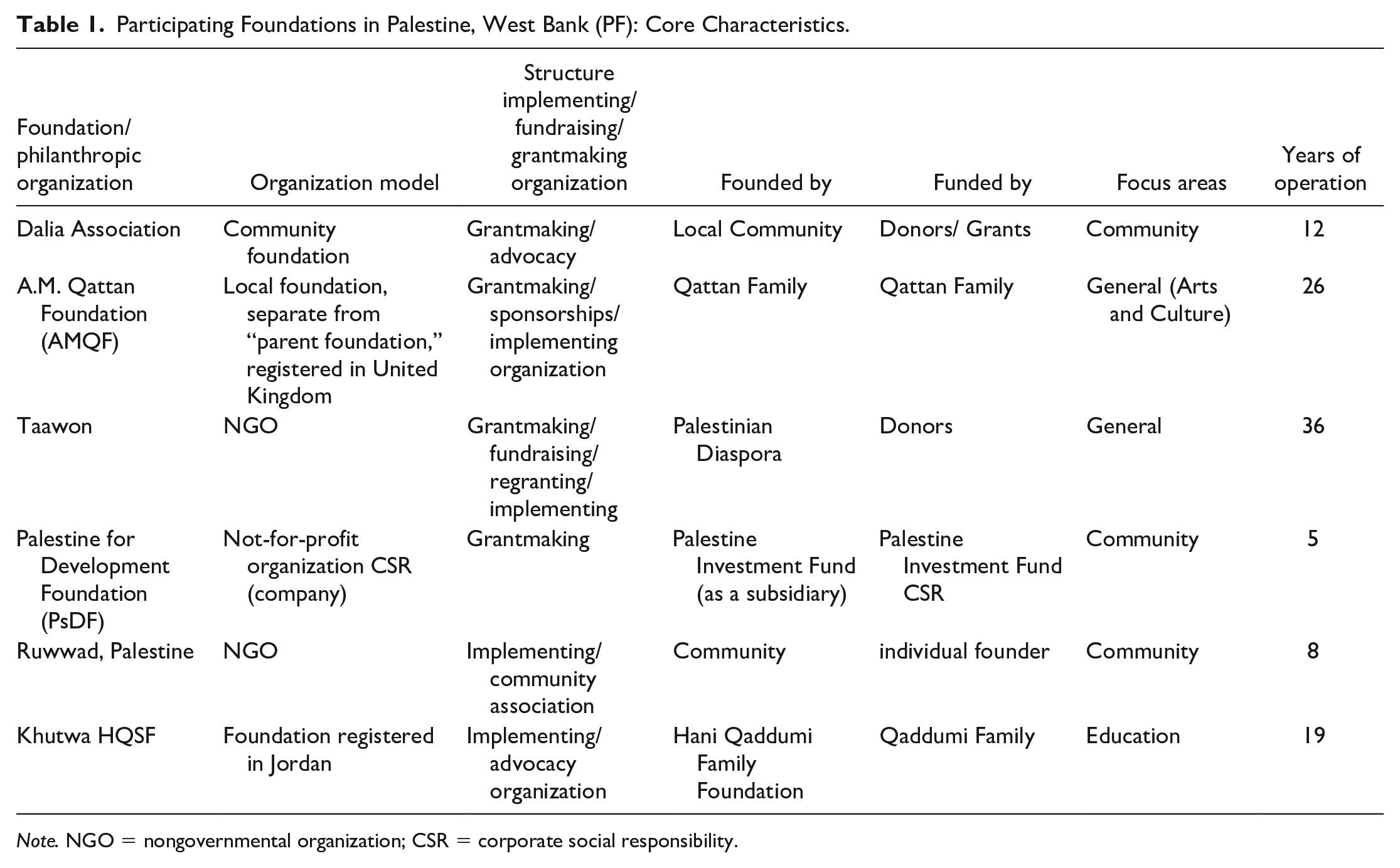
Note. NGO = nongovernmental organization; CSR = corporate social responsibility.
Participating Foundations in Jordan (JF): Core Characteristics.
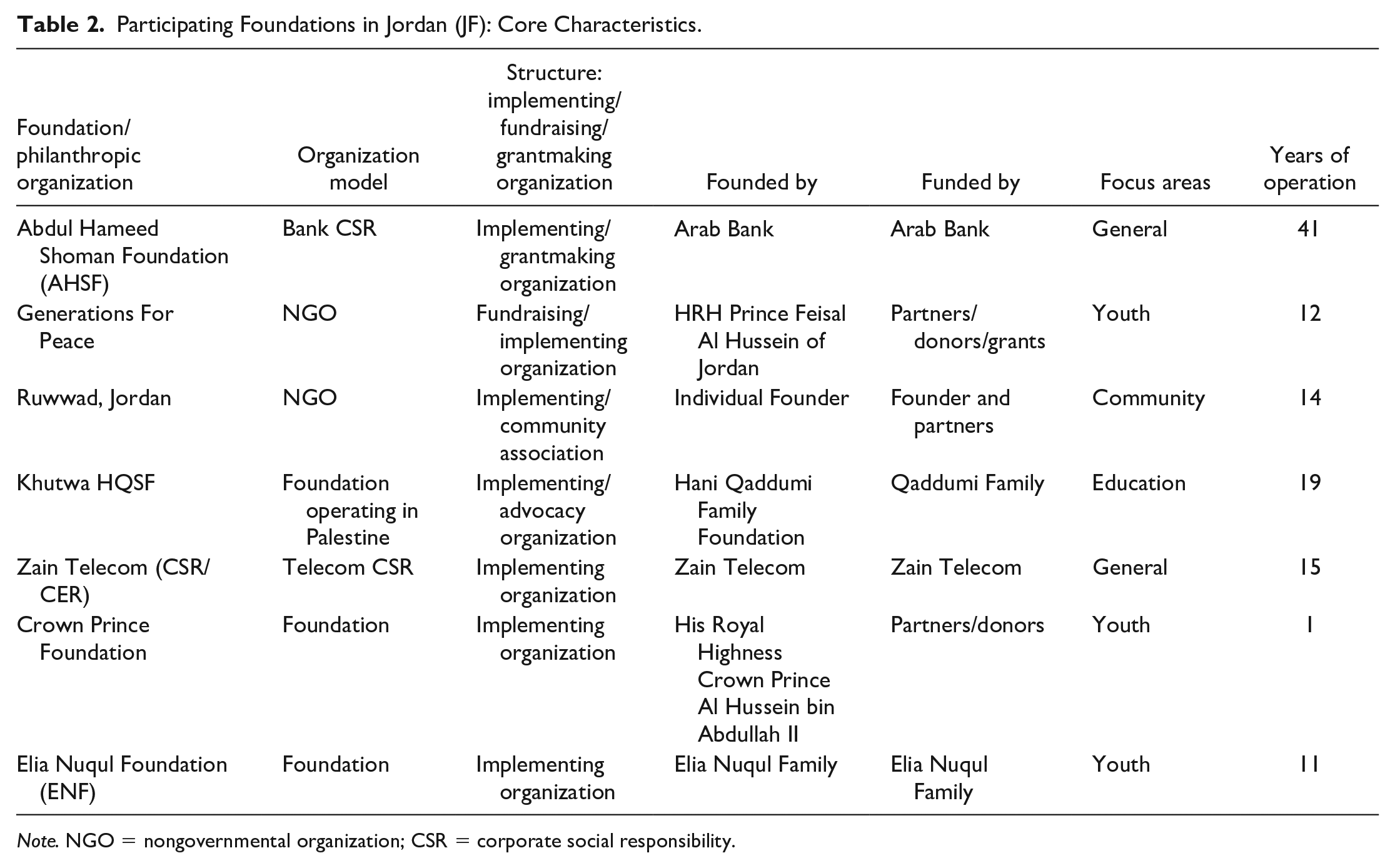
Note. NGO = nongovernmental organization; CSR = corporate social responsibility.
In the light of perspectives on anonymizing data “as a balancing act” and for “the need for a contextually-contingent approach to anonymising data” (Saunders et al., 2015, pp. 617, 618), we obtained participating foundations’ agreement, to their identification by organization name, for case study purposes, while not naming or otherwise identifying responding individuals. Phase-1 interviews were conducted with senior managers in Jordan and Palestine/West Bank, during March/April 2019, 10 face-to-face and two via Skype. The interview schedule explored foundations’ experiences of rising expectations for youth development; approaches to sustaining their purposes, capacity for, extent of, and directions of knowledge gathering and sharing across their work; and perspectives on the means for knowledge sharing on youth development philanthropy. Case study content was shared with participants for verification and feedback.
Content analysis of case study data, to make “valid inferences from texts to the contexts of their use,” Krippendorff (2004, p. 18) identified foundations’ reported forms of knowledge-sharing practices. Using content analysis in its manifest form (describing what was reported about the appearance of specific phenomena), we used Powell’s (2006) five channels for KS practice in ID organizations to group together practices, working separately, then jointly agreeing the nature of content deduced.
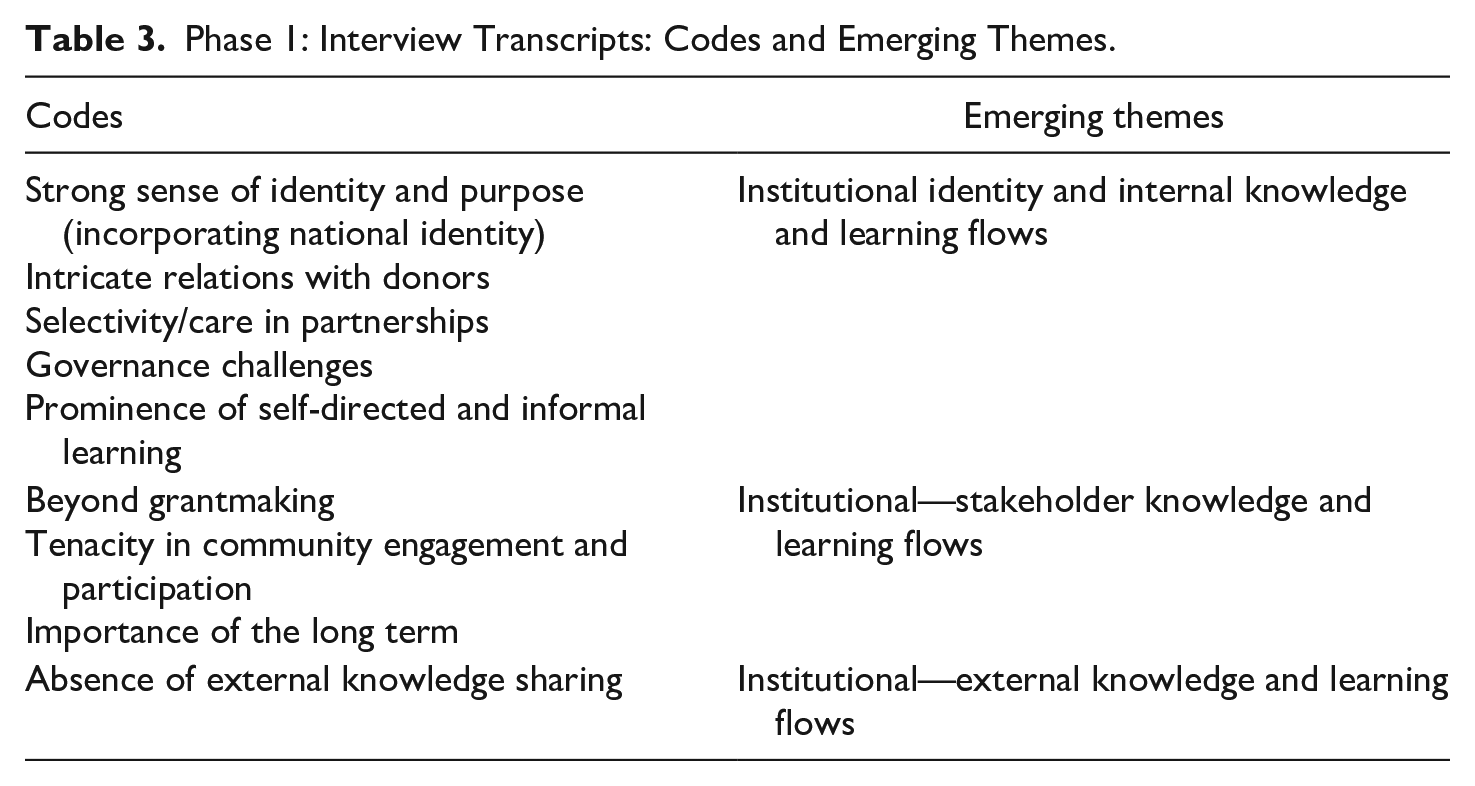
Interview transcripts were subjected to thematic analysis, “a method for systematically identifying, organising and offering insights into patterns of meaning (themes) across a date set, identifying what is common to way a topic is talked about and written about and of making sense of those commonalities” (Braun & Clarke, 2012, p. 57). We followed Braun and Clarke’s (2012, pp. 60–68) phases of analysis, beginning with data familiarization; reading and re-reading transcripts; developing initial codes (identifying interesting features of the data and bringing together data relevant to each code); searching for themes (collating the codes into possible themes and bringing together all the data relevant to each theme proposed), reviewing the themes (whether these told something useful about the data set and the research question and were coherent); and naming the themes, as the basis for reporting research findings. We sought themes emerging “from the informants’ stories (which) are pieced together to form a comprehensive picture of their collective experience” (Aronson, 1995, p. 3). Nine codes grouped into three overarching themes were identified, shown in Table 3.
Phase 1: Interview Transcripts: Codes and Emerging Themes.
Phase-2 field visits for March 2020, for participants’ feedback, incorporating round-table conference events and international foundation invitees, were prevented by a deteriorating political situation and the Pandemic’s onset. Instead, Skype interviews with four participating foundation CEOs took place, confined to exploring responses to the phase-1 findings and foundations’ current and future KS needs. Given these small numbers, a descriptive summary of interviews was made, without formal thematic analysis.
Research Findings
This section presents first findings in Figure 1 on the range of and relative emphasis on knowledge-sharing channels and activities taking place in participating foundations; framed by Powell’s five KS sources.
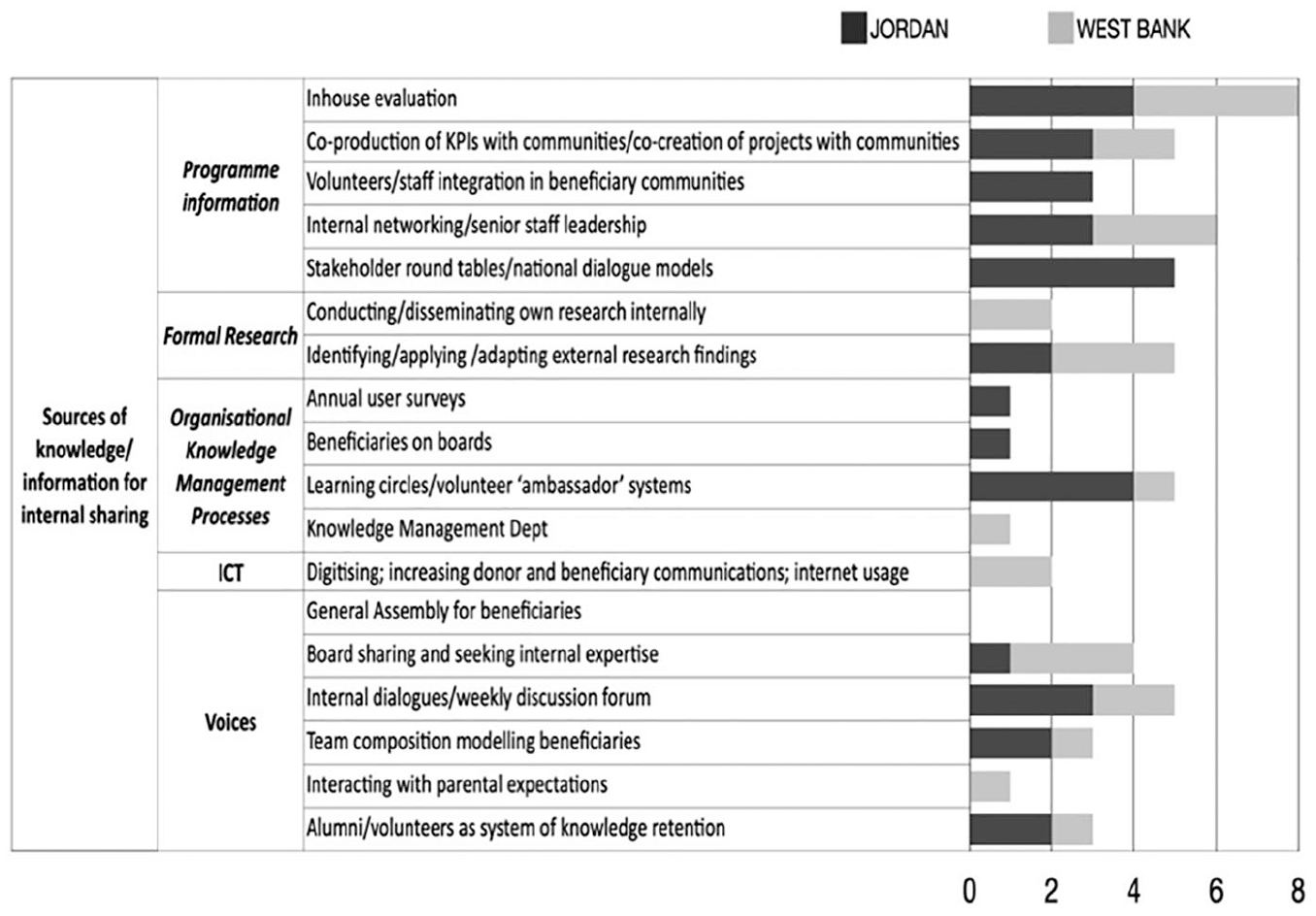
Powell’s (2006) categorization of knowledge-sharing sources and focus in international development organizations, applied to intraorganization knowledge sharing in Jordanian and Palestinian (West Bank) foundations.
The most prominent category reported, in-house evaluation, chimed closely with this activity’s prominence in western-led KS advocacy literature. However, contrasts with that literature occurred in emphasis on incorporating (strengthening) beneficiary involvement, including citing project co-creation. Case commentaries provided varying evidence of the effects of internal KS; from program cessation “(we found) no lasting impact.” After a million was given year after year, we had to change. We had fallen into the same trap as the foreign NGOs to “sometimes pausing and taking reflection”; (including an entire year’s program pause for staff training). Preprogram sharing with stakeholders and beneficiaries sought to gather communities’ own key performance indicators (KPIs), rather than impose pre-set KPI regimes. However, the means of knowledge sharing was sketched out only broadly, albeit indicating close proximity in social relations, through close community integration and informal networking among staff and volunteers.
Seeking out external research knowledge sources and subsequent internal sharing and adapting, was favored, in bold ways: We looked around and finally decided that Finland would be the place for our learning. We went to Finland “Some weight was placed on internal learning circles”: originally a by-product of a community activity, now found throughout (our) work, from youth participants to the admin team
so that KS was continual rather than structured events. Nevertheless only one foundation in Palestine, reported a “knowledge management department,” aiming to “explore, test and challenge ideas and proposals, share and brainstorm with the board, staff, other experts, and guide decisions and implementation”: There was a similarly low emphasis on digital development for KS. For Powell (2006, p. 530), “voices” as a KS channel may be used to explore a wider range of issues than other channels, “including local power relations.” Case studies content offered multiple examples, stressing youth-directed programs as helping ensure “knowledge retention,” organizing weekly forums for services users of specialized programs (such as library services) and having internal resultant learning on tap. The latter drew strongly from physical closeness: “we wake up every day in our communities. The issues we are going to address are for our families, our country.” This was a closeness also placing significant, ever-present uncertainties on foundations: “dialogue and outreach creates heavy pressures—we have no idea what (communities) will come up with.” Others expressed their disappointment that KS remained confined internally, doing and learning so much, yet not being asked about that learning.
Second, the three emerging themes from interview transcripts (Table 3) are presented, foundation sources being shown by initials. In the “Institutional Identity and internal knowledge and learning flows’ theme,” foundation identity linked to nation-building and sustaining programs: “this is about us, our countries, our neighbors” (PF). Youth development gave these foundations activist personas, from gap filling (“there was no post office; we created one,” JF) and landmark projects (major library provision) to continuous embedded programs (higher education scholarships, linked to community volunteering). Work was prioritized over publicity (“we do not create press releases,” PF). Foundations’ confidence in their own learning appeared essential, if perhaps somewhat embattled “at the end of the day we have to create our own method” (JF), while program design learning guided by beneficiaries was deemed “on that level, very strong” (JF). Alongside wariness of external project “cutting and pasting,” in favour of “going out, seeing and touching” (JF). KS internally made clear acknowledgment that “we have tried and failed at many things” (JF).
Internal KS linked clearly to foundations’ long-term perspectives: “After all the years of investment, only now I am seeing a difference. [Philanthropy] is not just about measuring impact for beneficiaries. We are learning and they are learning” (PF). While foundations’ densely woven beneficiary communities’ relations contrasted favorably with international foundations’ practices (requiring local intermediaries), close KS communications between foundations and young people created “learning burdens,” pressurizing resources as new problems were articulated: “we cannot say no to youth” (JF). Foundations nevertheless stressed due diligence among potential donors, refusing those “crossing red lines on religion or politics” (PF) and identifying as exceptionally important foundations’ equitable treatment of and sensitivity toward all faiths as part of both countries’ national heritage.
In the “Institutional Stakeholder knowledge and learning flows” theme, beneficiaries were seen as stakeholders, movement to direct program operation being based on internal learning where grantmaking only produced minimal change. Yet, challenges for foundations attaining youth empowerment goals in estranged or declining communities, when top–down interventions seemed required first, were apparent (for example, the foundation opining that “giving food parcels is not the best philanthropy, we do give but we also do not feel it is right,” JF). Effort was needed too in staying on when communities became exhausted, not energized; for one foundation, an inevitable price of youth development engagement.
“Institutional—Stakeholder knowledge and learning flows,” recording external KS’ absence among responding foundations, was sufficiently striking to be a stand-alone code and theme. Even where externally based foundations joined foundations’ projects, donors were reportedly not talking to each other. Responding foundations’ external knowledge flows were minimal, comprising one-way exchanges with government ministries and very limited contacts with other foundations, whether within or beyond their respective countries. Despite responding when (rarely) asked “know-how” questions (such as “how to run a foundation,” from Sudan), respondents emphasized that foundations lacked invitations to share their knowledge externally. Explanations were matter-of-fact and straightforward: “we do not share our learning in a formal way, because no one (outside) asks” (JF). One blunt, rhetorically expressed perspective was that international foundations were inevitably dismissive of KS value with the “nationals”: “Why I do not share my learning? Nobody asks me. People [international foundations] look at us as part of the problem. They are implementing in South America and then try and implement here” (PF).
Although ideas for external sharing had appeared (such as learning circles), they had not been acted upon, with interorganization trust issues prominent. For some respondents, it risked the stagnation of practices: “We are not working together as we should. We have a conspiracy theory mentality which makes it harder to share knowledge” (JF). The majority nevertheless declared their general openness to sharing, noting the need for “larger networks to share ideas and to learn from. But many are expensive to join” (PF); also wariness of one-way KS conferences because “conferences die slowly.”
Third, in the truncated and remotely managed substitute second phase of the research, responses were more circumspect regarding the findings of minimal external KS: interorganizational power issues were explicit, “The internationals have respect for organizations on the ground, . . . But this (external KS absence) is an inevitable result of the unavoidable power dynamic set up by their existence,” as well as the “constellation” of organizations, each with “different strategies, missions and interfaces,” and hence “pretty weak connections for KS” (JF). It came as “no surprise at all, we are born here” (PF). Interorganizational power issues were explicit. The fact that this exclusion propelled responding foundations inwardly to their own KS was again emphasized: “the international foundations don’t share (with us) as well as not inviting us to share with them (so)we have to be self-learners” (PF). One CEO respondent asked rhetorically “is gender underpinning the whole ‘no invitation’ question?” (PF) but took her question no further. However, KS’s imperfections were recognized. One respondent worried that in moving externally, “KS and learning might show impact as a pretty slow affair” (PF). Again, “. . . returns (from investing in KS) are not occurring fast enough and anyway are not certain” (JF), alongside the risk that “if we pay attention to (KS), our real work will wither” (PF).
Discussion of the Findings
Our findings of foundations’ KS development challenged Kuttab and Johnson’s (2015) characterization that foundations in this region did not see the importance of improving their knowledge base, albeit internally confined. Nor were expectations that different foundation types (Jung et al., 2018) might offer different KS approaches upheld. Yet, findings did not dispel Farouky’s (2016) charge of “weakness” in knowledge sharing in Arab philanthropy (assuming the applicability of that categorization) but reinforced it when external KS’s lack appeared, with learning from internal KS remaining hidden. Although embedded with beneficiaries as this was, uncertainties remained concerning KS’s internal value when occurring over time in relative organizational isolation.
The lack of external visibility and sharing of internal KS surprised us but not our respondents. Their welcome (“you are the first people to ask us these (KS) questions”) may have had deeper meaning beyond pleasantries to visiting researchers. It suggested acceptance of confining KS to internal improvement and change because of the complex “constellation of organizations” within which these foundations operated. The importance of KS’ relational nature (Hartley & Benington, 2006) was confirmed indirectly as well as directly, for example, where KS among beneficiaries created further foundation “burdens,” by opening them up to further support needs. Being thus “unable to refuse youth” in these contexts might signal organizational weakness, or at least, easily diverted programs. We saw it, rather, as the lived experiences of pressures produced by efforts to fill those unmet needs, amplified by beneficiary-directed KS, among articulate young people.
The links made by our respondents between internal KS national identity, and nation-building suggested alignment with Zakariás and Feischmidt’s (2019) work on nationally based philanthropy as “an important site for nation building,” with philanthropic institutions “doing the nation.” These nation-building links also cast KS as an activity for the very long term. This is a view somewhat at odds with KS practice advocacy, suggestive of speedy impactful change for KS inquirers. The endorsement of “all faiths” identities by the foundations as central to their working, notwithstanding their Muslim-majority country locations, appeared to illustrate possible developing understandings of Muslim philanthropy, through its multiple community (including national community) interactions (see for example, El Taraboulsi, 2015 and her notions of development in Muslim philanthropy through its encounters across cultures, geographies, and physical spaces). In broad terms, these findings suggest that multiple faith perspectives operating within majority-faith backgrounds of foundations could be incorporated usefully in future ID-based KS studies.
Foundations’ responses concerning the absence of invitations to share their knowledge reflected varying degrees of realism, humility, and pride. Yet why these foundations were waiting to be asked, not placing their learning in the public domain, is also raised. We initially heard hesitancy arising from belief that international foundations would find local foundations’ extensive informal learning and KS, derived from long-term engagement with beneficiaries, especially challenging; with knowledge-sharing beneficiaries not the internationals’ preferred experts (as seen by Nolan et al., 2019, and Coffman and Beer, 2016). Phase-2 findings suggested however more prosaic, less hurtful but equally worrying barriers to interfoundation KS in Jordan and Palestine. The first was the inevitable if frustrating consequence of fragmented philanthropic institution operations in these contexts. The second was an underlying limitation in the studied foundations’ commitment to KS and learning, beyond their own organizational boundaries; lest it diminish their front-line youth priority work. This was occurring even though these foundations were in Coffman and Beer’s (2016, p. 40) terms, recognizing learning as “real work.” Hence, at best, “waiting to be invited” to share knowledge externally could be a means of conserving foundations’ energy for their often overwhelming tasks. This is an interpretation supported by Gururajan and Fink’s (2010) recognition that KS activities and motivations may be overtaken by heavy organizational workloads.
Nevertheless, questions also remain as to why incoming international donor institutions and/or international NGOs as well as donor governments working or seeking to work in these countries do not make those invitations. Oelberger et al’s (2020) identification of the “liability of foreignness” experienced by local NGOs seeking funding from international (United States) foundations, raises a further possibility. This is that for international foundations working in Jordan and Palestine, nationally based foundations’ KS content and direction might also represent a “liability of foreignness.” (Paradoxically, this ‘liability’ could also be inferred by the national foundations of their international counterparts.) For one CEO however, there was more intractable factor at work that international institutions’ “loss of hope in the region” (not only its philanthropic institutions) was synonymous with “local foundations” not being invited to share their knowledge. Although the concept of the “local” was itself vague, it was suggestive of “the locals” unstructured, often informal, working. Hence, KS from these local sources might be dismissed, or ignored by international counterparts, especially through the lens of the latter’s professionalization. This led to major uncertainties about interorganizational KS’s feasibility and utility in these circumstances, where knowledge sharing as exchange was negligible, let alone supporting the creation of new knowledge together.
These findings concerning KS in demanding contexts demonstrate incompleteness and uncertainty in activities, operations, and choices. Together, they prompt our suggestion that these sources and directions of internal knowledge acquisition and sharing in national foundations appear as “buried treasure” for the complete spectrum of foundations working in Jordan and Palestine. Like all buried treasure, concealed or hiding in plain sight, once unearthed, tests would be needed on its authenticity, quality, ownership, portability, and its immediate and lasting value.
Limitations of the Study
The limitations of our study include its case study strategy, given that case study strengths (recounting lived experiences, studying the unusual or unexpected, conveying complexity) may also represent weaknesses. (For example, where complexity challenges simplification of findings and their relative importance, produces large amounts of data, needing to be used selectively, and raises issues of generalizability). Our choice of a number of foundations, over the single case, concentrated on breadth in favor of depth, as did purposive sampling, so the directions in which our findings lead are provisional. Purposive sampling introduced the possibility of selection bias; as did interviews conducted in English. Respondents drawn from senior foundation managers and in one case, a founder-donor, also raised issues of the implications of elite interviewing, notably in professional organization settings (Empson, 2018), though balanced by interviewees’ perceived closeness to their organizations. The varying extent of and nature of interviewer probing and the data as self-reported (filtered by respondent socio-cultural and educational lenses) provided further bias likelihoods. However, the purposive sampling choice was mitigated somewhat by the different types of philanthropic organizations studied, including conventional, endowed foundations, business-led foundations, and endowed and/or operating, and/or fund-seeking foundations with NGO status.
Expectations of supplementing interviews with organizations’ reports, websites, and other documentation were fulfilled only variably; data absences that may reflect local cultures of philanthropy, not proclaiming themselves as matters for public attention. Resources pressures on the fieldwork timetable, precluded research enhancement through observation, notably with beneficiaries; while prior international access restrictions prevented Gaza’s inclusion in the “Palestine” study.
Although our boundaries around the cases produced insights in a hitherto research gap, foundations’ case profiles were gathered in the field at set points in time and place (Spring 2019 and Spring 2020). The former was during a period of relative political instability for Palestine. In the latter period, the global pandemic’s onset prevented our research program’s full implementation, including an initial canvas of international foundations’ KS perspectives, while requiring scaling back of interviews, using remote, web-based contact. Finally, resources pressures precluded deepening exploration of further emerging issues. Three are especially important for future research. These are: gender questions in these KS contexts (the majority of foundations studied were being led by Jordanian and Palestinian women); the challenges of majority faiths’ and multiple faiths’ intersections with the nature of and levers for KS, noted in our findings section; and the extent to which and ways in which youth development philanthropy may provide particular perspectives on forging and sustaining KS practices and channels (both advantages and difficulties), at intrafoundation and interfoundation levels.
Conclusions
Miković et al. (2020, p. 550) identify the lack and mismanagement of knowledge resources as among “the biggest challenges of ID NGOs in reaching vulnerable beneficiary populations.” Our case research with 12 nationally based foundations in Jordan and Palestine (West Bank), engaged in youth development, reported a range of internal organizational practices to engage in and sustain internal knowledge sharing that incorporated beneficiary relations. Findings thus supported some of the optimism in KS literatures concerning ID. Yet studied foundations’ reported awareness of their relative KS isolation and lack of invitations to share internally gathered KS more widely across the foundation spectrum in these countries, feeding a need to “create their own methods,” tempered that optimism significantly. This suggests that responding to the research gap we proposed may do more than extend KS scholarship. Rather, it may prompt renewed reflection on KS aspirations and opportunities, risks as well as rewards, across the spectrum of philanthropic foundations’ practices and choices. The autonomy and discretion that are core features of foundations’ practice in this region as elsewhere, are evidently capable of opening up to but also gaining immunity from other organizations’ knowledge stores and sources.
Most immediately, a study exploring the KS perspectives of the relevant international foundations operating in Jordan and Palestine is suggested as part of a continuing research agenda for the region, in response to our initial findings. However, wider implications also arise for KS’ scholarship and advocacy in foundation practice. The challenges of evidencing KS’ effects in long and medium terms that worried our respondents are no less important in western as in non-western settings. They deserve attention over time, exploring differentiation in KS forms and sources that offer shorter or longer learning staying power, when utilizing as well as sharing knowledge becomes important to the study. (Here, discarding as well as retaining organizational knowledge may be hard for knowledge creating and sharing organizations, while itself an outcome of interorganization KS that also has learning value.).
Increasingly nuanced theoretical as well as practice understandings should also be looked for in contexts, as in this study, where philanthropic organizations operating in conflict or proto-conflict zones, may or may not limit or move away from KS, while working to sustain themselves, or simply survive. “Whether and/or when may lessening efforts for KS be justified in ID conflict zones?” is an uncomfortable but relevant question. It underpins consideration of the emerging notion of neglected and neglecting organizations in ID KS landscapes. It further directs attention to whether philanthropic organizational KS in conflict zones requires stand-alone theoretical and practice focus in its own right, just as undertaking research in such zones carries its own demands and duties of care (Mohmand et al., 2017).
Our findings to date suggest meanwhile that the local foundations we studied hold potentially valuable, testable but buried knowledge (“treasure”) concerning youth development philanthropy growth and change in their countries. While these foundations’ relative KS isolation may place limits on that treasure’s continuing value, at present, it remains lost to international foundations, also working in these same countries, in the same spheres of philanthropic action. If the broad KS pattern we found continues, knowledge and learning experiences in the national foundations will remain buried, while international philanthropic organizations operating or intending operations in the region, may remain unaware of, disregard or neglect the wealth of local knowledge and learning that national foundations hold. In this situation, the purposes, work, and achievements of the international foundations operating in Jordan and Palestine may be affected adversely. In turn, national and international foundation nonengagement may reinforce issues of lack of trust and lack of KS impact among philanthropic institutions. Such reinforcement would feed cycles of non-KS practice that, finally, will not support the beneficiaries that all foundations operating in Jordan and Palestine in youth development wish to serve.
Footnotes
Acknowledgements
The authors acknowledge with thanks the insights and support they have received from the Editor and from our anonymous reviewers.
Authors’ Notes
The authors express their deep gratitude to their respondents, in the pilot and in the foundations they studied in Jordan and Palestine (West Bank), for their willingness to participate and their commitment toward their research.
Declaration of Conflicting Interests
The author(s) declared no potential conflicts of interest with respect to the research, authorship, and/or publication of this article.
Funding
The author(s) disclosed receipt of the following financial support for the research, authorship, and/or publication of this article: This research was supported by Research England (Global Challenges Research Fund).
