




Abstract
Digital social ventures are initiatives that intend to transformatively engage social and environmental problems through the application of digital technology and are a new phenomenon found globally. While the broad influence and consequences of disruptive digital technology are increasingly taken for granted, very little research focuses on the deliberate use of digital technology for social purpose. This study is situated within three areas of literature: disruption caused by digital innovations, the use of digital technology by social purpose organizations, and social entrepreneurship. The process of digital social venture emergence and evolution shows how flashy-sounding technological solutions develop into more modest and incrementally useful tech-supported adjuncts. A preliminary framework for conceptualizing the nature and process of digital social ventures shows how a Schumpeterian approach to social entrepreneurship as disrupting equilibrium gives way to a Hayekian approach as drawing on local, embedded knowledge to achieve incremental change.
Keywords
Introduction
It is rare to experience a day without the claim of a new online platform “disrupting” and transforming existing economic and social practices. From Uber to Smart Cities, digital online structures are emerging which fundamentally challenge and transform traditional institutions in the commercial and public sectors. While the use of online technology is not new in social movements (Harlow, 2011; Wall, 2007) nor in nonprofits (Zorn et al., 2011), so far there has been almost no research considering the role(s) of digital disruption in social entrepreneurship (Desa & Kotha, 2006) or in civil society initiatives more broadly (Guo & Saxton, 2013). This is particularly concerning given the rapid increase in “the use of digital technologies to cocreate knowledge and solutions for a wide range of social needs” (Bria, 2015, p. 9). The global pandemic of COVID-19 made digital technology even more essential to our daily lives as remote learning, working, shopping, and services became the primary way to function during pandemic lockdowns. In this exploratory article, we focus on the growing phenomenon of digital social ventures (DSVs), which have received much media coverage (e.g., Rice-Oxley, 2018), but have been the subject of almost no academic research.
We analyze the process of DSV formation through qualitative analysis of eight cases focusing on early stages of their emergence and provenance. We begin with the following definition that builds on Martin and Osberg’s (2007) analysis of social ventures in their article defining social entrepreneurship: DSVs are initiatives that address social and environmental problems through the innovative application of digital technology with the intention to create positive societal transformation rather than incremental improvement. Note that Martin and Osberg (2007) deliberately create a broad frame of “social ventures” to describe organizations with a primary social purpose to avoid various definitional quagmires of “social enterprise” and “social innovation.” This research provides insight on the process and nature of DSV emergence, situating it within literature on digital disruption, social purpose organizations, and social entrepreneurship. We were motivated to study DSVs because of the disruption digital ventures are causing widely throughout our economic and social lives. For the purposes of this article, our research question is exploratory and basic: “What is the nature of DSVs and through what processes do they emerge?”
Literature Review
Our literature review motivates the study of DSVs through describing the effects of digital ventures outside of the social sector, extending it from existing research on the application of information and communication technology by social ventures, and contextualizing it through a discussion of social entrepreneurship. Literature related to this article on DSVs, therefore, includes the following three strands:
The perspectives of digital disruption and transformation;
Present research on the use of digital technology by social purpose organizations; and
Social entrepreneurship with a focus on commercial rather than digital as the engine of transformation.
Digital Disruption and Transformation
The dramatic reorganization of past predigital social practice into contemporary Internet-based forms is commonly called “disruption” (Kane, 2016). It is exemplified by the transformation brought to the taxi industry by Uber, to the hotel industry by AirBnB, or to retail merchandizing by Amazon. Consider the transformation of the global hotel, travel, and automobile rental industries by a digital disruptor such as Expedia, where historic roles for travel agents, or for marketing and booking roles for airlines and for car rental agencies become completely reorganized. Modern business analysts look to digital disruption (Skog et al., 2018) as a fundamental reorganizing process of entire industry groups.
This kind of disruption is considered to exemplify Schumpeterian “creative destruction” (Schumpeter, 1934) where entrepreneurial agents catalyze a new equilibrium in which the primary relationships and institutions of a sector are transformed. Disruption and transformation are consonant with a view of entrepreneurship where agentic change is not merely incremental but instead focuses on transformational opportunity discovery and exploitation (Shane & Venkataraman, 2000).
Many disruptions are enabled by the creation of a relatively new digital organizational structure, commonly called multisided platforms (MSP), which mediate and facilitate the transactions of two or more parties (Hagiu & Wright, 2015). Amazon is a typical example of an MSP given its role mediating between retail customers, suppliers, and other merchants. Digital MSPs transform multiple fundamental aspects of industries (Kane, 2016). The concept of digital platform has also made its way into the public sector as the backbone of collaborative governance with the aim of actively engaging stakeholders (Ansell & Gash, 2018). Regardless of the specific structure, digital transformation is reconfiguring a great deal of business and governmental function. What, though, is its role in social problem solving?
Digital Technology in Social purpose organizations
The concept of social purpose organization is an inclusive approach to organizations that prioritize a social mission, including nonprofits, civil society organizations, and social enterprises (e.g., Weerawardena et al., 2021). In the academic literature on social purpose organizations, digital technology has so far been presented in relatively minor roles. It is framed as mostly internal and tactical for nonprofit human service organizations focusing on the adoption of digital technology for managerial and administrative purposes (Ihm & Kim, 2021). Guo and Saxton (2013) and Thackeray and Hunter (2010) discuss the role of social media in developing and advancing advocacy roles in the nonprofit sector. There are wider but similarly noncentral discussions of the use of social media and other ad hoc digital technology initiatives in a number of civil society contexts. Case studies such as Harlow (2011) and Wall (2007) examine particular contexts of social media use in social movements, and in grassroots and professional organizations. They distinguish between roles for the kinds of flexible organization and information sharing required by grassroots organizations, and the kinds of collective identity formation widely understood and experienced in social media contexts (Wall, 2007). These studies found that this use of digital technology does not change which actors are involved, or the type of change they are working toward (Harlow, 2017), but does enable larger groups to communicate and organize more effectively (Castells, 2015), such as with crowdfunding (Alexiou et al., 2020).
Beyond social media, one can find numerous specific examples of digital technology use in civil society, such as digital applications for transferring money via mobile phone networks (e.g., Mbogo, 2010), and crowdsourcing information for political purpose and citizen safety (e.g., Zook et al., 2012). In conclusion, the literature has presented mostly supportive and tactical roles for digital technology by social purpose organizations in contrast to its disruption framing in wider social discourses.
Social Entrepreneurship
Our approach to social entrepreneurship begins with the common assertion of its relation to the broader “entrepreneurship” construct (e.g., Alvord et al., 2004; Dees, 2001; Dees & Anderson, 2006). Economic theories explaining entrepreneurship (Hayek, 1945; Kirzner, 1973; Schumpeter, 1934) have been applied to social entrepreneurship in the way that they relate to disruption and change, not just in economic systems, but in broader social systems (e.g., Shockley & Frank, 2011; Zahra et al., 2009). Extending Hayek’s theory of limited access to knowledge, Zahra et al. (2009) develop the concept of the social bricoleur, agents who have adequate access to local embedded social knowledge such that they are able to assemble useful interventions to address social issues operating at a local level. In the Kirznerian approach, the social entrepreneur is aware of imbalances in the system, such as knowledge asymmetries, and uses them to create new ideas and initiatives and seize new opportunities (Di Domenico et al., 2010). From a Schumpeterian perspective, the social entrepreneur is a disruptor of social systems through an opportunity identification and exploitation process intended to create significant (i.e., potentially frame breaking, industry transforming, and/or new equilibrium catalyzing) improvements in social and environmental problem solving and intervention (Martin & Osberg, 2007; Zahra et al., 2009).
Because the digital disruption literature and practice correspond with the Schumpeterian understanding of entrepreneurship as disrupting the existing equilibrium, in this article, we build from the broad framework of Martin and Osberg (2007; 2015) to differentiate social entrepreneurship (as an ideal type) from other forms of social engagement. They create a two-by-two matrix with axes of aspiration/outcomes and the nature of their action. This matrix distinguishes two broad types of social ventures—social service provision and social entrepreneurship—where the mode of action is direct, and social activism, where the mode of action is indirect (i.e., through influencing others). Social service provision is defined in terms of social maintenance, incremental improvement, and modest scope. In contrast to this, social entrepreneurship aspires to larger scale (i.e., new equilibrium) change, directly led by the venture itself. Consistent with other theories of social entrepreneurship that conceptualize it as causing systemic change (Shockley & Frank, 2011), Martin and Osberg distinguish social service provision from social entrepreneurship based on the intention of creating a new equilibrium (i.e., some level of larger change). The three ideal types enable comparison between different types of organizations: third sector organizations that deliver social services, civil society organizations that engage in activism, and entrepreneurial social ventures that attempt to create a new equilibrium in the context of a social mission. While these three types of organizations have their own separate literatures, a conceptual framework that compares them is particularly useful for exploring a new phenomenon in social-purpose organizing.
The centrality of commercial/business means and ends are a specific element of social entrepreneurship that are particularly germane to our examination of DSVs. Dees (2001) emphasized social entrepreneurship operating within markets even while defining it in ways that emphasize innovation, tenacity, and value creation, and not containing explicit mention of markets, business practices, or managerialism. Overall, within social entrepreneurship, there is a tension between a focus broadly on innovative ways to create social value and a narrower focus on business/market/commercial subsets of those innovations. In general, definitions tend toward the former, but illustrations and exemplars tend to be primarily the latter (Dacin et al., 2010; Weerawardena & Mort, 2006).
To develop the concept of DSVs in a manner that is consistent with discussions of entrepreneurial emergence and evolution, we follow the framework developed by Gartner (1985) to describe new venture creation including the four elements: individual, organization, process, and environment. These foci parallel related literature on social entrepreneurs (individuals), social ventures (organizations), and social entrepreneurship (process of value creation) (Hoogendoorn et al., 2010) and supports theory development of DSVs as a type of entrepreneurship.
Having reviewed three separate areas of literature, we conclude that research on social purpose organizations may be anomalous in its modest appreciation of the significance or potential significance of digital technology. Where it considers the social and entrepreneurial seriously, it typically frames it narrowly in commercial/business terms rather than including digital technology as a potentially distinct modality for the important and new. We now shift our focus to organizations we describe as DSVs whose means of social entrepreneurial intent is significantly digital and technological in nature.
Method
To study DSVs, we used a qualitative approach, which allows for exploration of novel phenomena, with the goal of theory generating, rather than theory testing (Silverman, 2011). We aimed to both uncover novel insights and suggest future research.
The research took place in two stages. First, we scanned the phenomenon internationally, and then, we employed a multiple-case study methodology (Yin, 2003) to explore some geographically local instances in more detail. In the first stage, we assembled a list from reading and online research of 64 potential DSVs. Our search criteria for these innovations included characteristics of social entrepreneurship (i.e., intention to create large-scale change, new equilibrium, and social problem solving) with a particular focus on digital technology-based modalities. We found scatterings of DSVs from around the world. In the second stage, we focused our empirical study on DSVs in Dublin, Ireland, partly based on the researchers’ access opportunities. Dublin has evolved since the 1990s as a leading digital technology center, first by attracting tech firms and then by developing its own indigenous internationally competitive digital ecosystem (Roper & Grimes, 2005), thus making it a place ripe for DSVs.
We chose DSVs that reflected a range of different content/issue areas: health, mental health, climate change, food waste, poverty, fundraising, and housing/homelessness. All of the case study sites were still very young; the oldest one was founded in 2012. Most were freestanding new ventures, though some eventually merged with larger and more established nonprofit entities. We chose eight of the most successful DSVs, ones that had won pitching contests, had received either donations or investment, or seemed poised to scale. We included DSVs using different types of digital technologies, primarily software (apps and online platforms), but also including hardware (devices, a robot, and wearables). We did not take into consideration organizational form or sector in choosing the cases, since most of them were only at the idea stage at the beginning of our study, with no indication or discussion of legal entity type.
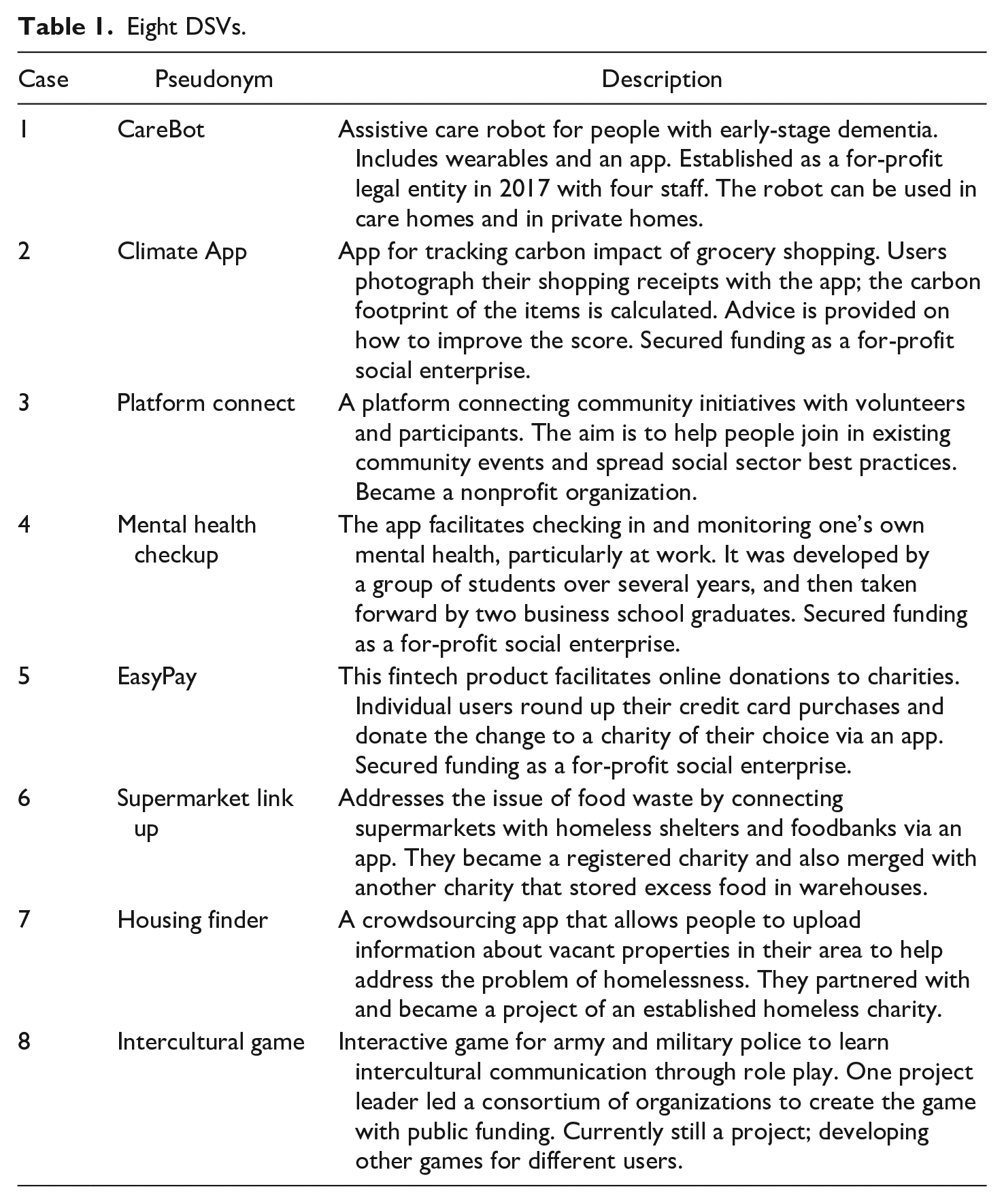
For the eight cases (described in Table 1), we gathered data online, conducted interviews, visited offices, and met with founders and other related actors where possible. The first author attended 22 events from 2018 to 2021 taking detailed notes. Events included launches, “pitching” sessions, award events, workshops, seminars, presentations, and networking opportunities. Data sources consisted of 18 interviews with key DSV participants, reviews of websites and social media, and meeting notes from office visits as well as the events. Written documents included four strategic marketing plans, three brochures, five business plans, and 21 different slide decks of pitches, strategic plans, and other presentations. Interviews included 10 DSV principals (founders, managers, directors) and eight key actors in the broader DSV ecosystem (organizers of pitching, incubators, and networking events, hotdesking office managers, and funders).
Eight DSVs.
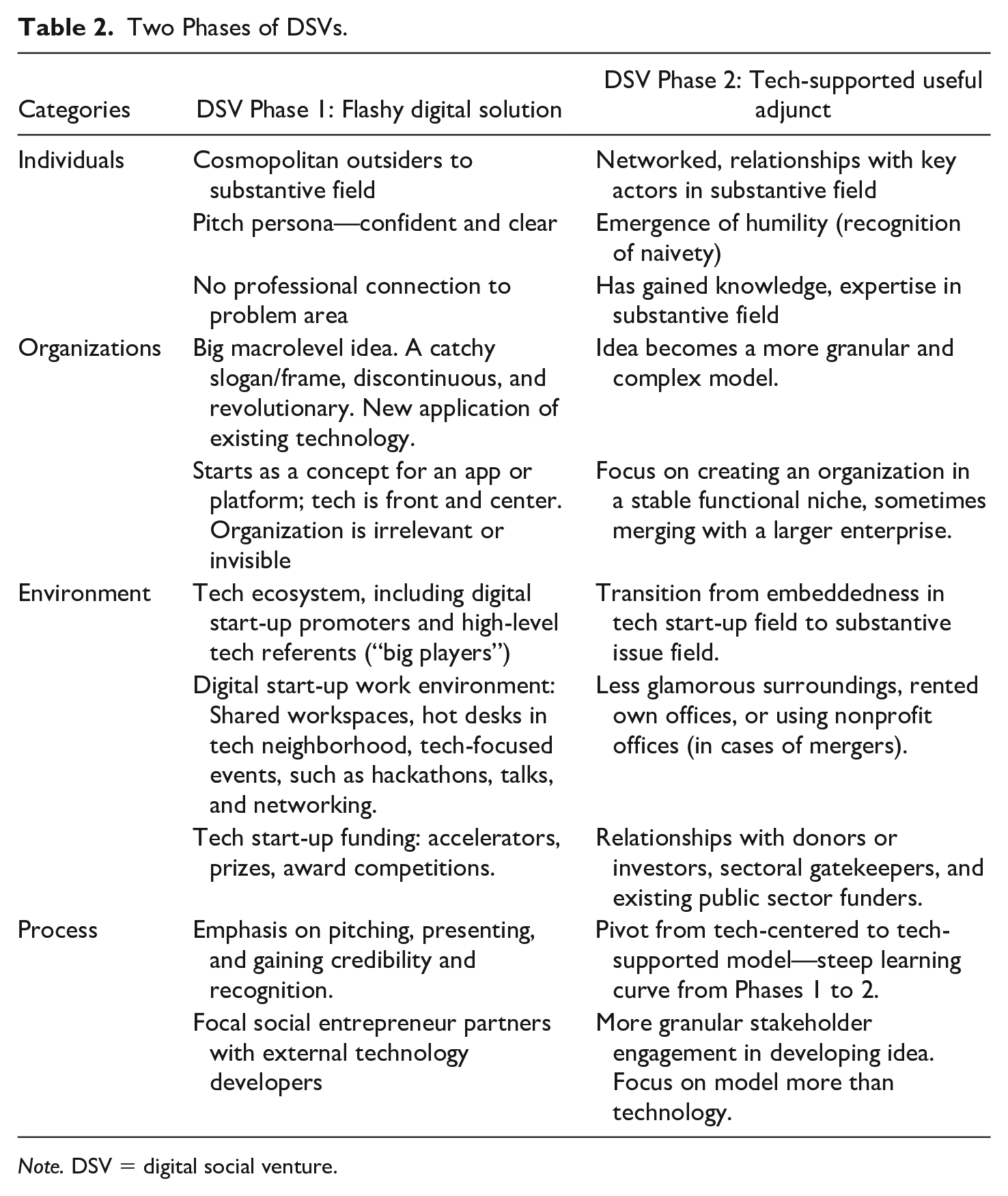
Interviews were transcribed and open coded (Williams & Moser, 2019). The authors coded transcripts separately and compared codes. The data were organized in two ways: first, using the four categories in Gartner’s (1985) framework: individual, organization, environment, and process, and, second according to two phases that emerged from the data (see Table 2). Through discussion, we agreed on key themes and concepts in the data. All organizations and individuals were anonymized using a key stored separately in a password-protected document. Interview participants are referred to in this article with the case pseudonym and a number; ecosystem actors are numbered. The research proposal was approved by a University Research Ethics Board, and consent forms were read and signed by all parties involved in the research.
Two Phases of DSVs.
Note. DSV = digital social venture.
Findings
We discovered two distinct phases among our case study examples, which are presented in Table 2 according to the four categories in Gartner’s framework: individuals, organizations, environment, and process. DSV Phase 1 was the initial technology-based concepts created by principals whose intention was to radically engage a social problem, but whose activities were mainly focused on pitching and presenting their ideas to technology funders and industry gatekeepers. Phase 1 was flashy sounding, and from outside the established field for which it was presented as not only a solution, but as a frame-breaking intervention. DSV Phase 2 was the subsequent evolution of these initial ventures as they integrated with the field in which they aimed to make an impact. These became organizationally formalized, but were less narrowly digital and discrete in focus, and more built upon relationships with established nonprofit players in their fields. We observed evolution from Phase 1 to 2 in all cases.
DSV Phase 1: Flashy Digital Solution
Most Phase 1 DSVs focused on the creation of apps, websites, or digital platforms as “solutions” for their target social/environmental problem. In five of the cases, the DSV was built around an app (Cases: Climate App, MHC, EasyPay, SLU, and Housing Finder). Three initiatives proposed software with the purpose of individual behavior change (Cases: Climate App, MHC, and IG). Three used MSP where various parties could communicate with each other with the DSV mediating (Cases: Platform Connect, EasyPay, and SLU). There was one each of the following: a new fintech service (EasyPay), crowdsourcing information (Housing Finder), an interactive computer game (IG), and a mobile care robot (CareBot). Phase 1 is narrated around four main themes.
Principals as Cosmopolitan Outsiders
The principals were consistently cosmopolitan outsiders to their substantive field who described “aha” moments of insight regarding possible innovative game-changing solutions to wicked social problems. They presented as tech-savvy and confident, and their presentations were well-polished. “I am self-taught in everything I do” (Platform Connect 1). They had experience in incubators and boot camps to learn presentation skills, such as voice coaching and “telling impactful stories” (Climate App 1), and they were not trained professionals in the domain that their DSV was proposed for. They were well-educated; in five of the cases, the founders have recently graduated from business schools. They were international coming from Ireland, Canada, Nigeria, France, and America. Most had lived in more than one country, and all had traveled or studied in more than one country. “I’m Canadian originally and when I was 20 years old . . . I moved to China and it was meant to be a year and I stayed for seven” (CareBot 1). “When I was eleven, I wanted to be an anthropologist and go to the North Pole . . . so I got out of Ireland as soon as I could even though I’ve ended up back here” (IG 1).
None had prior professional experience in their social issue. Two of the proponents had significant personal experience in the area that they now work in, which drew them to finding a digital solution (MHC and IG). “I had struggled with mental health issues myself” (MHC 2). They expressed dissatisfaction with the current system, and their digital solution was framed as an attempt to respond constructively and boldly to that dissatisfaction by changing the system.
The Immodest Vision
Phase 1 DSVs began as highly ambitious concepts or visions to radically engage a problem. For example, EasyPay intended to “revolutionize the way we fundraise in Ireland” (Easy Pay 1). In contrast to “shaking buckets” to raise cash and having donation boxes at the cashier in retail shops, EasyPay promised to provide a seamless digital app to round up purchases and send the funds to a charity of choice. Similarly transformative, the intention of Mental Health Checkup founders was to remove the stigma around mental health and normalize taking care of one’s mental health by regularly using this app. Mental Health Checkup “was not intended as just a pressure valve to help people, but to actually change the way we as a society talk about and treat mental health” (MHC 2). The etiology of this DSV was one of its founders walking through an airport and seeing satisfaction rating buttons for the airport experience and thinking, “why don’t we have something like this for mental health?” (MHC 1). It was a simple idea, transferred from the field of customer satisfaction to the field of mental health, and it was technology centered. “This is a game-changer for mental health” (MHC 1).
The initial ideas for other Phase 1 DSVs tend to this macro/global scale and flash insights, as big ideas that sound like well-crafted slogans or value propositions. Examples include “Reducing the carbon footprint of grocery shopping” (Climate App) and “Putting wellness in your pocket” (MHC). These slogans evoked a dramatic and disruptive digital solution.
The Tech Ecosystem
The environment and process of Phase 1 DSVs formed a tightly integrated cluster. The “ecosystem” (the term used by participants) centered on technology start-ups rather than on established issue-focused nonprofit/social enterprise communities. The language and referent organizations involved, such as mentors, advisors, and event/award sponsors, were those of digital technology start-ups. During data collection, there were several events for entrepreneurs, almost all with an explicit digital focus. Approximately half of the entrants had a social purpose. Advertized at these events were “accelerator programs,” “investors” in social innovation, “hotdesk” office spaces, consultants who support social enterprises, start-up mentors, a “Start-Up World Cup,” and entrepreneurship-focused business school partnerships. The ecosystem and tropes were those of entrepreneurial digital technology.
Emphasis on Pitching
Proponents of Phase 1 DSVs described numerous opportunities at “pitching contests,” “hackathons,” and digital innovator awards to promote their ideas. The awards and prizes were frequently described as “funding” and as “investments” in an organization, although the amounts were more often at the level of short-term employment grants used to support the proponents themselves. Interestingly, the emphasis of Phase 1 participation in the pitching events was on gaining publicity, credibility, and funding, rather than developing/improving the idea or the model of the DSV itself. The proponents themselves were aware of this.
We were in this sort of “agile development process” but . . . it was all a bit early if I reflect on it. We were put through this business accelerator but it was all about pitching so I learnt a lot about pitching, but it’s very hard to pitch for something when you aren’t totally sure what it is . . . we didn’t have a product as such . . . we were pitching before we developed the product. (Housing Finder 2)
Phase 1 was more about generating interest from the funding and digital technology gatekeeper communities than it was about developing the social problem-solving modality. A number of the proponents even expressed concern or surprise at the degree to which the hype exceeded the actuality of their own work. “It’s all ‘fur-coat and no knickers.’ Ya know, just a website with nothing behind it” (Ecosystem Actor 2).
DSV Phase 2: Tech-supported Useful Adjunct
If Phase 1 is characterized as tending toward a digital version of “fur-coat and no knickers” (i.e., glamorous but inwardly unsubstantial), DSV Phase 2 becomes significantly more recognizable to those in nonprofit and charity contexts. Similarly, while Phase 1 is first and foremost digital technology focused, Phase 2 involves a “pivot” that sees digital technology mostly relegated to a supporting role that is part of a much more modest, granular, complex, and articulated model of innovation, where specific organizational, collaborative, and operational funding issues come to the forefront. Whereas Phase 1 is a relatively homogeneous model, Phase 2 provides a plural and diverse set of organizations.
Some of the impetus for change to Phase 2 was due to difficulties in entering fields of activity. Relationships between DSV principals and the community of long-standing organizations and practitioners in the substantive fields (food waste, eldercare, charitable fundraising, etc.) began as awkward and frosty. DSV proponents described difficulty “breaking in” to issue-focused (rather than tech start-up focused) activity and funding streams. This was attributed to a variety of causes ranging from professional jealousy and organizational turf to the difficulty of traditional practitioners perceiving the “enormous potential” of a disruptive DSV. “The charities and researchers working in this area didn’t return her phone calls; they didn’t want to know about what she was doing. It took a lot of work and some lucky meetings to break into the existing sector” (CareBot 2).
Equally, endogenous realizations were important to the transition from Phase 1 to 2. Eventually, participants described their own realization that the Phase 1 model based on a discrete digital breakthrough solution was too simplistic to work usefully. The self-descriptor of “naïve” came up frequently. The transition from Phase 1 to 2 came from an understanding that important social change was much more complex than their flashy digital technology approach, and that their goals needed to be reframed modestly rather than disruptively. “We started with the hypothesis that all people needed was the information and that was enough. . . to assist in the change of behavior. . .That was really naïve in the beginning” (Climate App 2). A more detailed example of the endogenous learning process from Phase 1 to 2 is from EasyPay: Our initial idea was to provide a fabulous website that would be the platform for all of our partner charities who fundraise through our app, and it would be a whole new way to fundraise. But after meeting with them, we learned that none of them wanted to direct their donors away from their own websites that tell their own stories, and which they have invested so much time and effort in. So that was an important piece of learning that led to our pivot to create a plug-in on our partner-charities websites. (EasyPay 3)
As the principals moved away from pitching and towards actually operating their DSVs, they became much less focused on the digital solutions, and much more built upon relationships, and particularly relationships with those with the deeper institutional communities involved in the substantive issues. “In the beginning it was an on-line platform, but now it is really about much more than that. It is the relationships and the empowerment and meaningfulness of engaging with communities” (Platform Connect 2). Working in a more granular-specific manner in particular contexts with experienced players was described as central to Phase 2. “Anyway, so the collaboration, that’s kind of where the value is” (IG 1).
The theme of collaborations and relationships (and the shift away from the DSV being a major freestanding social game changer) led to DSVs both embedding themselves within larger traditional nonprofit organizations operating in their fields (Cases: SLU, Housing Finder, and IG) or at least working closely with them (Cases: CareBot, Climate App, Platform Connect, MHC, and EasyPay). One of them abandoned both their specific digital technology and their substantive field (Housing Finder) and began applying the more complex consultation and planning model developed in Phase 1 in multiple other substantive fields on a consulting/advising basis.
The need for funding and the desire to support longer-term activity meant that the DSVs moved from the tech start-up funding ecosystem toward either traditional nonprofit funding environments or commercial investors. Three of the cases sought nonprofit/charity status that is required to obtain grant funding from public or private sources in Ireland (Cases: Platform Connect, SLU, and Housing Finder). “We had to become a charity because there were grants available and that was the only way to keep doing what we wanted to do” (SLU 1). Four secured small investments and set up as a for-profit social enterprise (Cases: CareBot, Climate App, MHC, and EasyPay). Intercultural Game first obtained governmental funding, but the business model is in development to secure private investors. Thus, Phase 2 DSVs were not so unusual or distinct in the nonprofit/social enterprise space in Dublin after all, nor was the technology such a defining feature of the intervention.
Discussion
Analysis of the findings in light of the three areas of literature—digital disruption, digital technology in social purpose organizations, and social entrepreneurship—provides a conceptual context for developing theory on the two distinct phases of DSV emergence and evolution and the process from flashy digital solution to tech-supported useful adjunct.
Regarding “disruption,” in our case studies, we found disruptional intent and disruptional rhetoric/discourse, but the DSVs did not live up to their billing in terms of effect or impact. In Martin and Osberg (2007)’s conceptualization of social entrepreneurship, the two dimensions that define social-purpose interventions or initiatives are social-transformation versus service provision and direct versus indirect action. While the Dublin DSVs certainly aspired to be social-transformation direct-action initiatives, unanticipated difficulties led them to evolve away from their initial intent. They were then mostly enveloped within a civil society context that consisted of more incremental initiatives either within traditional third sector organizations or as small for-profit adjuncts to existing social services. All of our DSV case studies intended toward the Schumpeterian type of social entrepreneurship, but over time they relied on Hayekian social bricolage, drawing on embedded local knowledge of the social issue to see how they could add value (Di Domenico et al., 2010; Zahra et al., 2009), closer to Martin and Osberg’s (2007) social service providers. The glitzy and well-promoted Phase 1 DSVs advanced the belief that digital disruption is a modality to address social and environmental issues. The implication is that disruptors and social bricoleurs are not necessarily different types of social entrepreneurs, but in our study, they reflect different phases of evolution of social entrepreneurship. Others have suggested that social entrepreneurs may start out at bricoleurs and become disruptors (Martin & Osberg, 2007; Zahra et al., 2009); in our study, the DSV process ran in reverse, with agents starting out intending to be disruptors, and becoming more like social bricoleurs, or digital adjuncts of social service providers.
Only one DSV in our study seemed clearly poised for significant and extraregional growth (SLU) in a manner that could be considered social entrepreneurial. The others with more modest success and more specific and bounded utility became examples of the Martin and Osberg (2007) pure type of “social service provision,” incrementally improving existing organizational practice. SLU is likely significantly improving practice, by diverting food from landfill to charities, but they have not changed the system that leads to food waste.
Our study of Dublin DSVs also connects with discussions of digital technology in social purpose organizations. In contrast to documentation in past research (e.g., Ihm & Kim, 2021), our case studies at least attempted to apply digital technology ambitiously and strategically rather than internally and administratively (Hackler & Saxton, 2007). However, when their more strategic visions foundered, a number of our case study sites did eventually focus digital efforts on internal administrative and infrastructural activities (Platform Connect, EasyPay, and Housing Finder). Given the advanced digital technology community that is found in Dublin (Roper & Grimes, 2005), we were surprised to find no evidence that the application of digital technology to social issues had produced unqualified large-scale successes, apart from one, SLU, that was beginning to scale internationally. This study does not establish whether digital disruption is still to come in prosocial organizing or whether particular complexities in the nature of solving social/environmental problems mean that they are somehow less amenable to Uber-type disruptive digital solutions.
DSVs which sought to directly replace human service provision with digital substitutes (Phase 1 of CareBot, MHC, and EasyPay) presented as less immediately successful in our data than DSVs which either sought to complement or support human service provision (Phase 2 of CareBot, MHC, EasyPay, Housing Finder, and IG) or which approached the social problem context from a novel perspective (Climate App, EasyPay, and SLU). Again, the flashy digital solution gave way to the more modest tech adjunct.
Our data on the “cosmopolitan outsiders” of Dublin DSVs connect with but is different from the concept of social entrepreneurs as innovative individuals, or “changemakers” (Bornstein, 2005; Drayton, 2006; Zahra et al., 2009). The DSV principals, unlike many documented social entrepreneurs, did not come from deep backgrounds in the issues in which they were involved. In fact, most were newcomers. They did share the high levels of passion and drive that are typically attributed to social entrepreneurs (e.g., Dees, 2001). Whether the atypical features of DSV social entrepreneurs are idiosyncratic to the Dublin ecosystem requires further research. Our tentative hypothesis is that these characteristics are somehow important for legitimacy in the tech start-up ecosystem context.
When studying the differences and similarities between social and commercial entrepreneurs, many conclude that the process and resource needs are more similar than different (e.g., Meyskens et al., 2010). Our study shows the need to consider the complexity of social challenges, and the multiplicity of actors in any given field, who are not only competitors, as is often the case with commercial ventures, but key actors in addressing the social issue. For example, if an entrepreneur wants her app to deliver on changing behavior, she is not merely competing with other supports available to the “customer.” In a DSV, the app will also need to be accorded legitimacy within traditional and nontech members of funder, beneficiary, and peer communities.
Potentially more important to our understanding of DSV is the difficulty we experienced in our attempt to map the two phases of development on Gartner’s (1985) typology of new venture creation. Although this framework is extremely widely used (5284 citations, according to Google Scholar, June 8, 2022), it was a difficult hermeneutic on which to map our DSVs. This suggests specific aspects of the nature of a DSV are difficult to fit within both a social entrepreneurship framework, and also within the wider new venture creation field (Dacin et al., 2010). The challenge in our study concerned how to map DSVs in terms of the “organization” dimension of Gartner’s (1985) framework. The other dimensions (people, environment, process) were useful heuristics for our research. However, without exception during Phase 1, questions of formal organization were invisible and unimportant. Questions of formal organization (including structure and incorporation) only became important in Phase 2, and only if the DSV had significantly devolved in importance. For many of the DSVs, concerns of formal organization were connected with a pivot to become significantly more like relatively comprehensible nonprofit/social enterprise organizations.
To state this clearly, the focus of DSVs in our Dublin study was not the creation of organizations. Gartner’s (1985) framework presupposes that organizational creation is the goal of a new venture, and our study demonstrates a context in which this is not the case. These new ventures were, instead, focused on the creation of problem-solving digital communication and interaction structures rather than formal organizations. Initially, we wondered where this finding from our exploratory research might be highly significant in a third sector context, since it appeared to parallel shifts described elsewhere (Davis, 2016) away from formal organization as the focal “entity” and toward information and communication technology structures as the artifact or entity of concern. For Davis (2016), this shift to communications networks, supply chains, and pop-up enterprises suggests we may need to rethink that ontological centrality of organizations in a field like third sector studies. However, our findings showed clearly that the DSVs become more comprehensible organizational entities over time, two as nonprofits, two as departments or projects of existing third sector organizations, and four as for-profit social enterprises (see Table 1). In fact, the question of sector does not emerge as significant in theorizing about the emergence and phenomenon of DSVs.
Based on the findings of our study, DSVs are not a new type of social enterprise, so much as a novel point and process of entry into social enterprise and nonprofit domains. Certainly, in the initial phase, the focus and process of these ventures are distinct. The patterns of behavior and activity observed were unfamiliar to the experience of nonprofit and social enterprise start-ups. Whether we consider language (pivots, minimum viable products), institutions (accelerators, hackathons, pitching events, hot desks), and referents (google.org, angel investors) all were from the digital entrepreneurship domain, and this domain had little to no overlap with more familiar nonprofit and social enterprise contexts. This changed as the DSVs moved from Phases 1 to 2. Phase 2 DSVs were significantly more heterogeneous, and we were not able to characterize this phase as a single or specific type of actor based on our Dublin case studies. The heterogeneity of Phase 2 DSVs ranged from innovative charity sector initiatives that had a strong digital technology component, to individual practitioners with innovative community engagement process models without a major emphasis on technology. Certainly, the resources, scope, and legitimacy of the Dublin technology ecosystem were a fertile and novel ground for DSVs. Our study shows the need for a critical perspective on the potential and role of digital technology in social entrepreneurship and in social purpose organizations more broadly.
Conclusion
This research has shown how the language and performance of social entrepreneurship and digital disruption overlay seamlessly, both having the lofty intention of transformative change. Digital disruption relates to industries or markets, whereas for social entrepreneurship the change concerns a social issue. By using the language of digital disruption, the DSV proponents gain legitimacy and thus symbolic and material resources. Our exploratory research shows the limits of that formula when DSVs move from Phase 1 to Phase 2. The legitimacy gained from successful pitching of the idea did not translate directly to implementing the idea for transformative change. The direct-action aspect remains relevant, but the disruption of markets does not easily apply to social change. Instead, DSV Phase 2 shows how digital technology can be used as a new tool within social services.
Future research on Phase 1 DSVs could focus on the legitimizing techniques used by social entrepreneurs pitching digital solutions, investigating what works, and what type of initiatives win and lose pitching competitions. Future research on Phase 2 DSVs could usefully include the perspectives of existing third sector organizations and donors, exploring the value or weaknesses they see in DSVs. The technology artifact component of the DSV process of emergence and development could be further explored with future research on the ways in which value is created when digital technology is applied to social problems. Research on digital social innovation in Europe focuses on connecting people, applying existing technology in new ways, and accessing new resources (Bria, 2015). With the increasing attention on and resources for DSVs, future research also should critically examine the value added to social issues by digital technology interventions.
The reason that DSVs become social services may in part be due to the context in Ireland which has relatively large social welfare provisions delivered by an historically significant third sector (Donnelly-Cox et al., 2001; O’Shaughnessy, 2020). Future research could examine DSVs in other national contexts, particularly ones with privately funded or smaller third sectors. Furthermore, we used the language of DSVs fairly uncritically but encountered terminology from the technology sector used within the context of a social venture, including terms such as accelerator, pitching, running a beta, design sprints, fintech, and platform. Such a study could analyze the dramaturgy of pitching and the use of the technology and business discourses as a way of gaining legitimacy for an idea and gaining credibility as an individual (Kreutzer, 2022).
Our study queries an expansion in the area of digital entrepreneurship (Cavallo et al., 2019; Nambisan, 2017; Qureshi et al., 2021), to include DSVs. We have found that simply extending digital disruption to social-purpose initiatives will not capture the differences in context and nature of these different sectors and endeavors. Our research shows that DSVs co-evolved with their context to survive and become useful, while at the same time frequently becoming less entrepreneurial. The process of DSV creation illustrates how value is created through learning, relationships, and collaboration when implementing a digital innovation, but how this learning may also result in redefined and more modest goals. Qureshi et al. (2021) highlight the huge potential for information systems scholars to advance the understanding and application of digital social innovation by setting out a research framework including opportunity identification, scaling digital innovation, and achieving system change aligned with the Sustainable Development Goals. We propose that a multidisciplinary approach between scholars of information systems and of social entrepreneurship or third sector studies would bring necessary knowledge from both social and technological domains to the study of DSVs.
Gregory Dees stated in his seminal article on social entrepreneurship that “The time is certainly ripe for entrepreneurial approaches to social problems” (Dees, 2001, p. 1). Two decades later, it appears that this entrepreneurial approach may now have additional digital features.
Footnotes
Declaration of Conflicting Interests
The author(s) declared no potential conflicts of interest with respect to the research, authorship, and/or publication of this article.
Funding
The author(s) received no financial support for the research, authorship, and/or publication of this article.
