




Abstract
On June 24, 2022, the Supreme Court released its decision in Dobbs v. Jackson Women’s Health, which officially repealed Roe v. Wade and its subsequent rulings. Employing social network analysis and semantic analysis methods, the current project reviews the public reaction among Twitter users shared from the May 2 draft leak to the June 24 official repeal, using a series of Twitter hashtags related to Roe v. Wade. The project identified the main influencers within the network, namely, journalist/news organizations, Internet celebrities, activists/activist groups, professional/non-profit organizations, and politicians/political organizations through social network analysis. Through semantic analysis, the authors found prominent themes such as legal concerns, discourse on reproductive rights, distrusting of Supreme Court’s authority, and political nepotism. The results offer policy implications and communication message strategies to healthcare providers and policymakers. The authors believe that the polarizing nature of Roe v. Wade-related issues will be a crucial factor in shaping voters’ decisions during the upcoming 2024 presidential election.
Background
Roe v. Wade, a landmark case the Supreme Court decided in 1973, held that the Constitution of the United States protects the right to abortion (Roe v. Wade, 1973). On May 2, 2022, a leaked document containing a draft Supreme Court decision to repeal abortion law sparked concerns that the court might overturn Roe v. Wade and subsequent rulings of Planned Parenthood v. Casey in 1992 (Gerstein & Ward, 2022; Politico Staff, 2022). On June 24, the Supreme Court released its decision in Dobbs v. Jackson (2022), which officially repealed Roe v. Wade and its subsequent rulings. The court’s ruling asserts that the Roe and Casey rulings were oversteps by the federal government in its interpretation of the constitution and that those prior rulings “arrogated that authority” that ought to be regulated at the state level by elected officials (Dobbs v. Jackson Women’s Health, 2022, pp. 78–79). As a result, abortion is banned or has limited access in nearly half of the states previously upholding Roe v. Wade (U.S. Abortion Clinic Locator, n.d).
Following the overturn, the protests sparked by the entail draft leak continued with protests assembling outside the Supreme Court, as well as nationwide (McCleary & Yan, 2022). While many protested in person, online protests erupted across various social media sites. Since early May 2022, thousands of Twitter users have utilized #roevwade and #bansoffourbodies to engage in online discussion of the reversal of Roe v. Wade.
The study of social media and social networks helps researchers identify the reversal’s public discourse on certain topics (see Yum, 2020; Ahmed & Lugovic, 2019). Inspired by the previous studies, we used social network analysis and semantic analysis methods to explore the discourse among Twitter users surrounding #roevwade and #bansoffourbodies, to identify the top influencers and prevalent topics that emerged in the network of Roe v. Wade’s reversal. The analysis was carried by NodeXL Pro, an open source media analytic tool. Our analysis explored the influential actors, communication strategies, and public reactions to the repeal of Roe v. Wade on Twitter. We started to identify the role that Twitter played in shaping public discourse and participation on healthcare-related issues, and then we described the method of social network analysis and semantic analysis. Following it, we examined the top influencers and emerged topics in the networks. We further discussed the public reaction, policy implications, and communication message strategies regarding the reversal of Roe v. Wade.
Twitter, Social Network Analysis, and Public Discourse
A growing number of scholars are employing social network analysis research method to study the public discourse on Twitter. Twitter has often served as a channel for public participation, via tweeting/retweeting/commenting, where users express their responses to a variety of topics both individually and collectively (see Feng, 2016; Yum, 2020; Rim, Lee, & Yoo, 2020). Notably, Feng (2016) conducted a study on Starbucks’ #RaceTogether campaign on Twitter using social network analysis with the assistance of NodeXL Pro, and she identified the central users in the Twitter discussion network. Yum (2020) also utilized social network analysis to identify the roles that public figures played in the COVID-19 networks on Twitter. Similarly, Rim and colleagues (2020) used NodeXL to analyze news diffusion during news events, demonstrating the potentiality of NodeXL Pro to provide network insights and map news information diffusion.
Moreover, Twitter has provided a new dimension on studying public discourse responses to changes in reproductive rights and women’s healthcare policies (see Sharma et al., 2017; Hunt, 2022; Trzcińska, 2021). Sharma and colleagues investigated the ideological discourse surrounding the abortion debate on Twitter and found the discourse was influenced by hegemonic nature (2017). Hunt (2022) researched the involvement of social movement organizations in the abortion debates during the COVID-19 pandemic on Twitter, and found that both pro- and anti-abortion organization framed the global pandemic as both an “opportunity” and a “threat.” Trzcińska (2021) discussed the main themes emerging in the abortion discussion on Polish Twitter, highlighting the significance of Twitter as a unique discursive platform for public opinions on controversial topics.
There is an increasing interest in reproductive healthcare-related research, and there is a demand for the use of social network analysis methods in this area. While some projects have examined the topic of reproductive healthcare using content analysis or critical discourse analysis methods, few have applied social network and semantic analysis methods to explore the social and relational aspects of these controversial topics. Therefore, this highlights the need for further discussion into the potential insights that can be gained from employing social network and semantic analysis in the reversal Roe v. Wade discourse.
Twitter plays a significant role in disseminating information and shaping public discourse and beliefs on controversial topics. Therefore, it is pertinent to understand and study how Twitter users have constructed discourse on the overturn of Roe v. Wade. Inspired by previous studies (Yum, 2020; Glowacki et al., 2021; Shahin & Dai, 2019), the current project raised the following research questions:
What actions and/or actors constitute a response to the reversal of Roe v. Wade on Twitter?
What thoughts and perspectives were expressed on Twitter regarding the leak, overturn, and upholding time phases of Roe v. Wade?
Methods
Sample and Data Collection
Detailed Timeframe and Total Numbers of Tweets.
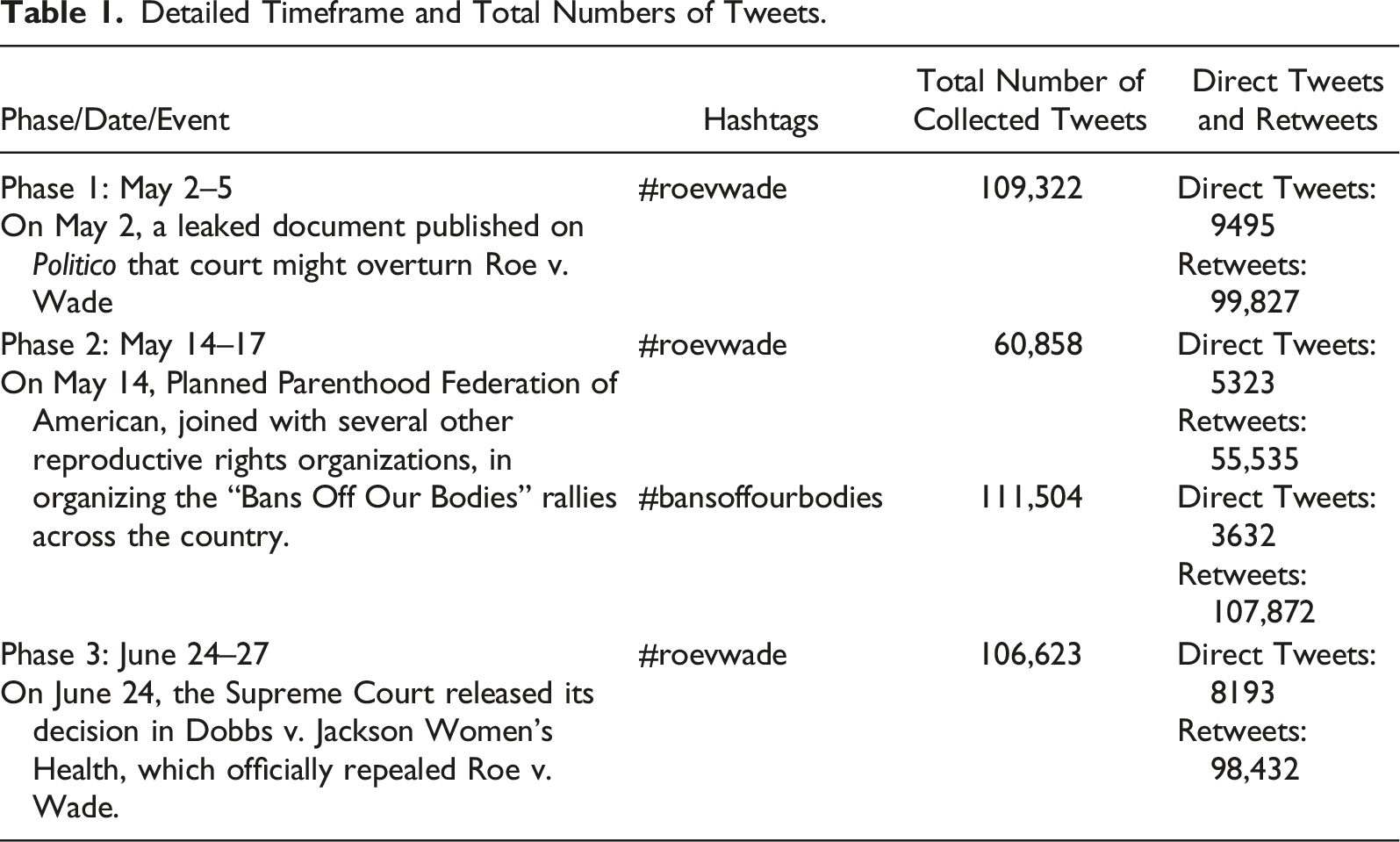
Social Network Analysis and Semantic Analysis of Tweets
A social network is “a set of nodes (actors or vertices) that are connected via some type of relations (ties or edges)” (Yang, Keller, & Zheng, 2017, p. 5). Social network analysis (SNA) reveals social structures and relations (ties) among social interactions (nodes) via the networks and graph theory (Otte & Rousseau, 2002; Yang et al., 2017). Employing SNA, the researchers can study the relationships within the actors (see Yum, 2020; Feng, 2016). Using SNA to answer the research questions, the current project studies the social networks of Twitter users who tweeted using the hashtags #roevwade and #bansoffourbodies. The SNA was performed within NodeXL Pro, as it can identify influential users and the content they share/create on Twitter (see Ahmed & Lugovic, 2019). To answer RQ1, we identified the top 10 influential Twitter users (from each time phase) using the above hashtags and their content within the social networks using NodeXL Pro.
Categories of Top 10 Influencers in the Network.
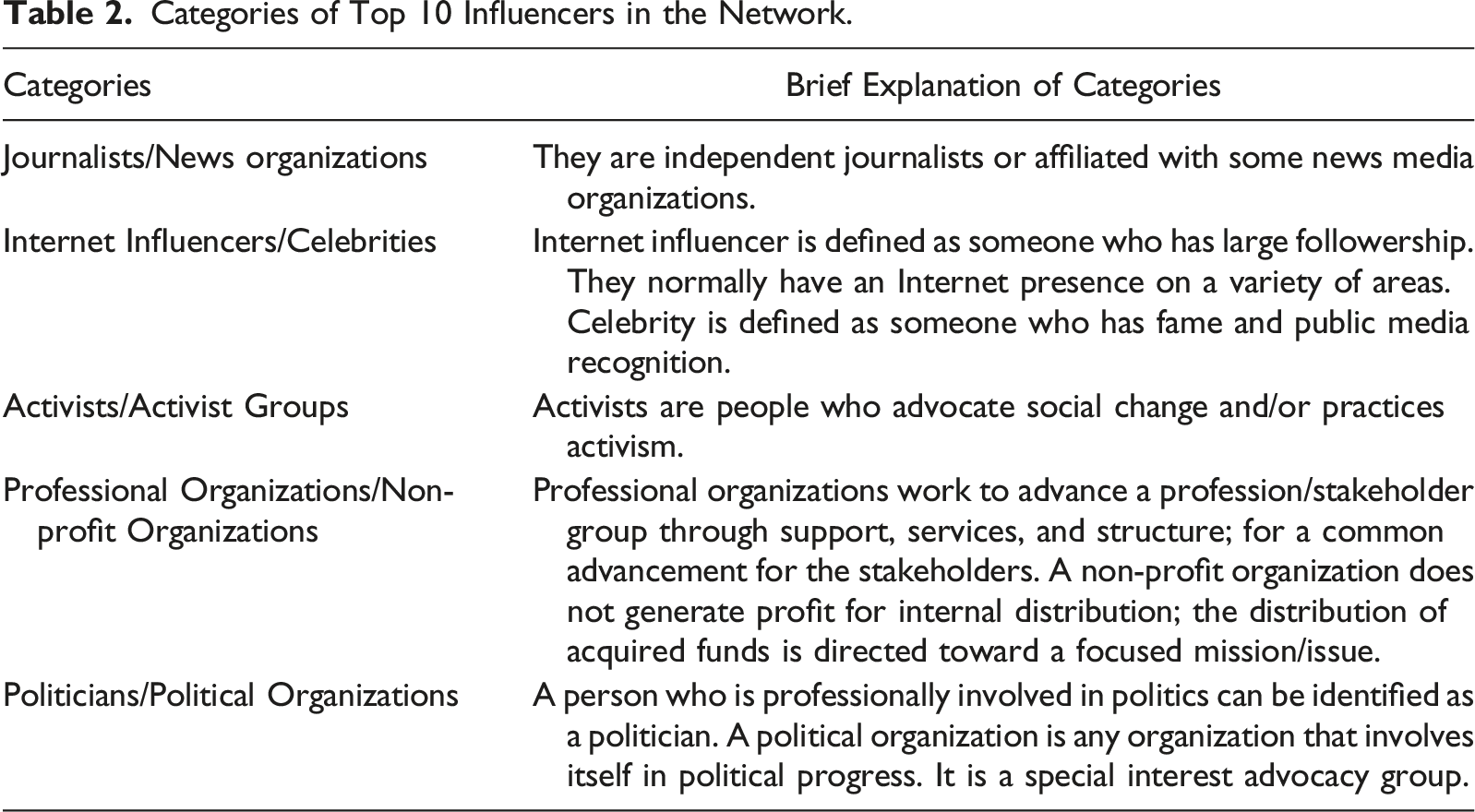
The semantic network analysis aimed to understand text-based information and structured relationships in a social network (Segev, 2022). To answer RQ2, we conducted a semantic network analysis with the help of NodeXL Pro to examine the most frequently occurring word pairs and content that emerged in the network. We mapped the semantic network that emerged around #roevwade and #bansoffourbodies in different time phases. After the calculation of word pairs, the data were grouped into clusters using the Clauset-Newman-Moore algorithm (2004). At this stage, the pairs of words were understood as vertices (number of users or things in the network) and edges (connections between users). To clarify the interpretations, we provided brief descriptions for each group.
Findings
Influencers
The discourse in phase 1 (May 2–5), using the #roevwade’s network, was led by Internet Influencers/Celebrities and Activist accounts. Notable influencers included a public educator and writer Sari Beth Rosenberg, and Grammy award-winning singer Grey DeLisle, followed by a group of activist influencers featured in the social network PageRank. The activists included: Freedom61 Susie—a Democrat living in Georgia; Joe Montfort—a political scientist from Texas; Bryan Dawson—an activist for freedom and democracy; and an activist group, Southern Sister Resister—the founders of #Fresh, also emerged among these top influencers.
Top 10 Network Influencers by PageRank.
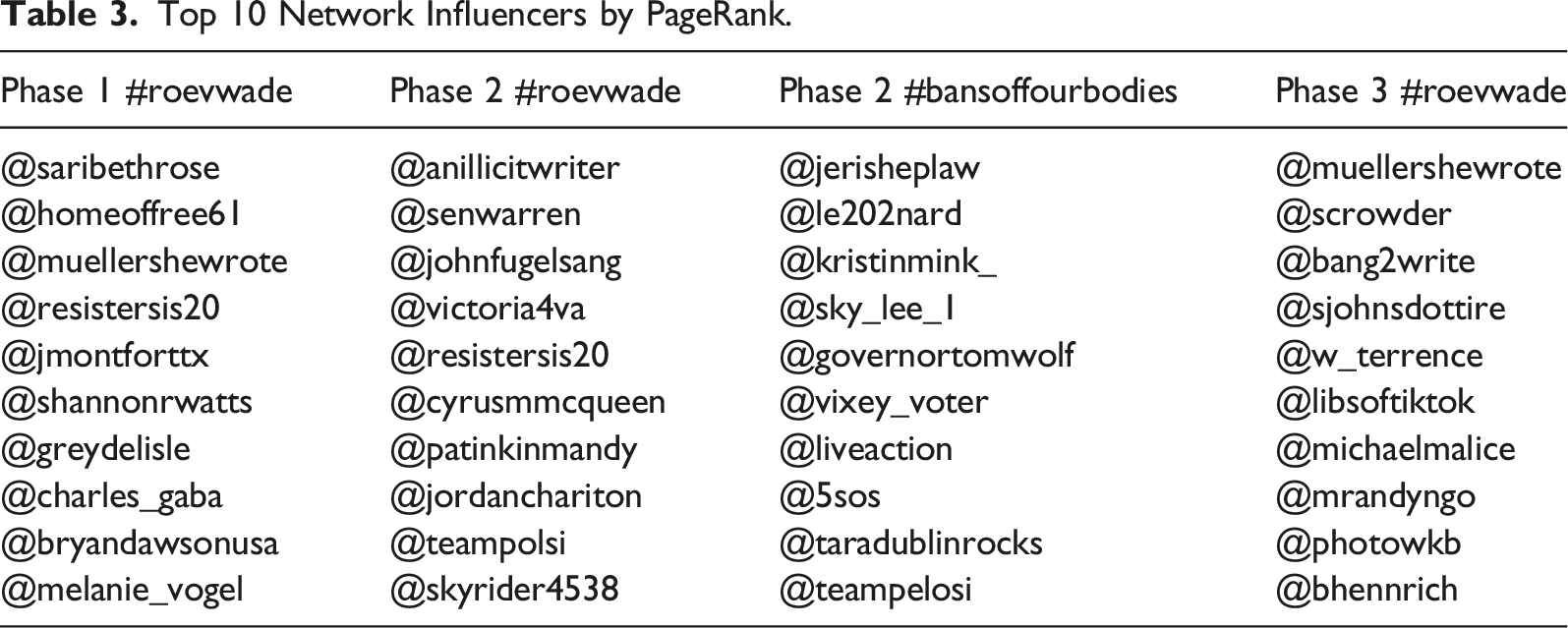
Phase 2 reviewed two hashtags and their respective networks. The discourse in the phase 2 (May 14–17), using #roevwade, was dominated by Internet Influencers/Celebrities and Politicians/Political Organizations’ accounts. An Internet Influencer Amber, self-described as “Wifey & Mom of 3, B.S. Social Psychology, and Graphic Artist,” had the highest PageRank score. Meanwhile, John Fugelsang, a comedian-actor-broadcaster; and Cyrus McQueen, a writer and comedian, ranked among the top influencers as well.
Within phase 2’s #roevwade political network, Senator Elizabeth Warren; House Speaker Nancy Pelosi; and Democrat Candidate for Congress in VA-08 district, Victoria Virasingh, were featured among the top influencers. Similar to phase 1, Southern Sister Resister - Wordsmith was again featured among the top 10 influencers. Additionally, independent journalist Jordan, an affiliate with Status Coup News, also emerged as an influencer in the network.
The discourse in the #bansoffourbodies network was predominantly Politicians and Political Groups. Jeri Shepherd had the highest PageRank score, who is an attorney and committee member for Democrat National Committee (DNC). Other politically involved actors, such as Pennsylvania Governor Tom Wolf, House Speaker Nancy Pelosi, and Democratic nominee for Montgomery County Council—District 5, Kristin Mink, were featured among the top influencers within this category.
Notable inclusions within the #bansoffourbodies network include activist Skyleigh Heinen and Internet influencer Leonard. The outlet, LiveAction, a non-profit pro-life organization, ranked as the 9th most popular influencer within the network of #bansoffourbodies. In the bio of LiveAction, they describe they are a “global human rights movement dedicated to ending abortion and building a culture of life.”
The discourse in phase 3 (June 24–27), using #roevwade’s network, was led by the News Organization Mueller, She Wrote, which ranked as the third influencer in the phase 1’s network. Meanwhile, journalists Andy Ngo and Photographer Keith Birmingham were also featured among this network’s top influencers. Steven Crowder and Michael Malice featured as the second and seventh influencers in the network, respectively. We identified them as Internet influencers since their influence can be found mostly on multiple digital platforms, including Instagram, YouTube, and/or Truth.
Topics
Word Pairs in Three Phases.
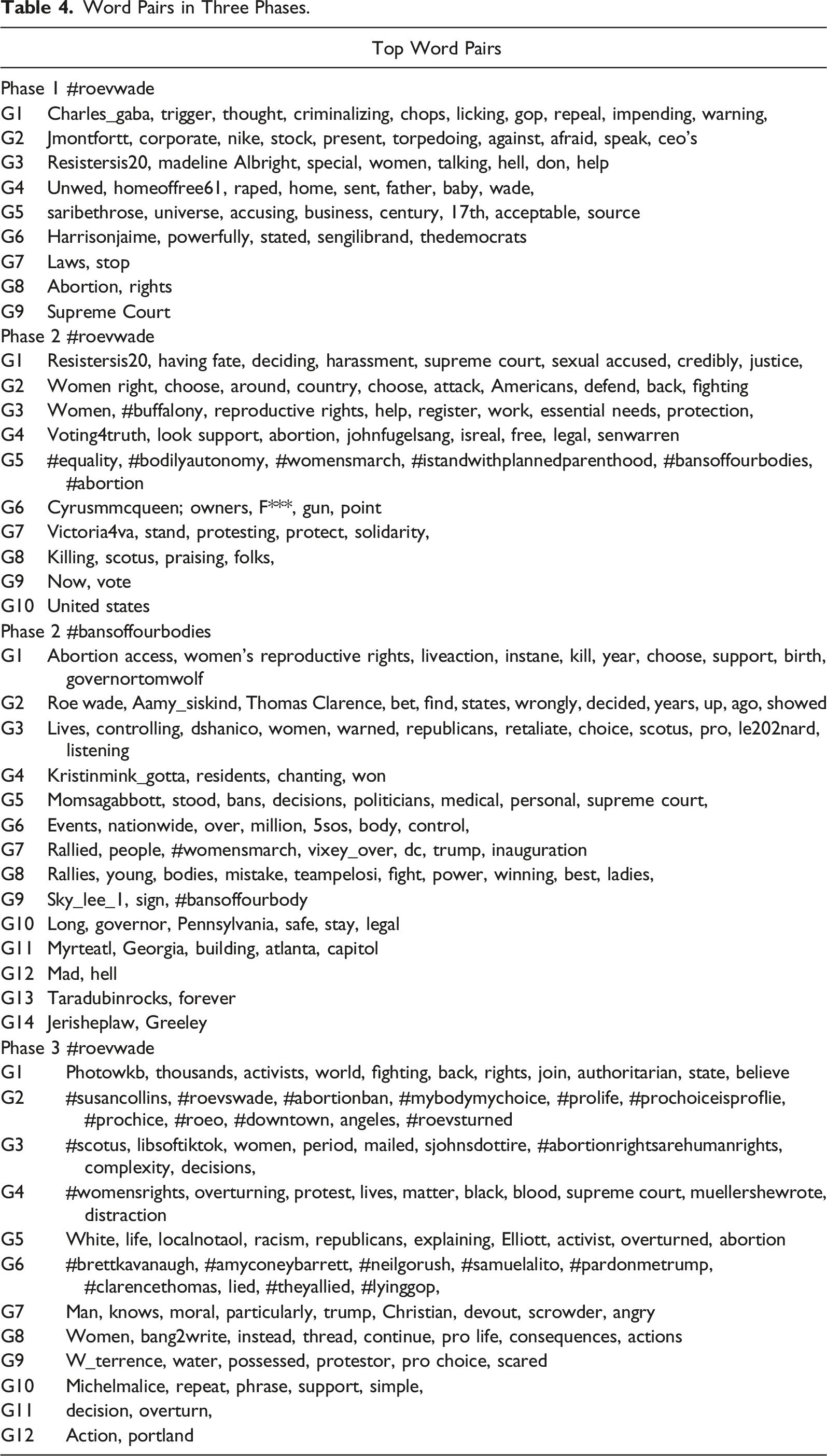
Regarding phase 1, after searching #roevwade and cleaning irrelevant terms (e.g., amp, rt, http), we included the word pairs that appeared more than 550 times in the analysis. From this analysis, nine sub-groups emerged in the semantic network. The first group, G1, and subsequent, G2, are the biggest clusters on the graph; both are independent of each other. Several words in G1 came from the tweets of Charles Ghoul-ba. Charles Ghoul-ba, a healthcare policy analytic company, was featured as one of the top influencers in phase 1, and attempted to give a warning to the public on the potential “impending repeal” of Roe v. Wade and the “GOP[’s]” intention of “criminalizing [criminalize]” abortion.
Words like “Nike,” “CEO,” “corporate,” and “stock” emerged in G2. This resonated with the statement from Nike after Politico published the leaked draft. Along with several cornerstone American businesses, Nike vowed to support their employees’ family planning journey, including contraception, abortion coverage, pregnancy health, and any family-building endeavors (Cain et al., 2022). After this statement, Nike’s stock rose 237%. Therefore, the reaction from corporate organizations was an important part of the discourse on Twitter in phase 1.
Groups G3 and G4 were linked by the term ”women,” related to Roe v. Wade’s decision about women’s rights and bodies. Similarly, words like “Madeleine Albright” (Former Secretary of State), “Jamie Harrison” (Democrat National Chair), “senbilibrand” (New York Senator Kirsten Gillibrand), and “homeoffree61” (abortion rights activist Freedom 61) also emerged in G3 through G6. This indicates that these women’s names are very frequently mentioned/retweeted in the discourse of multiple groups (Figure 1). Word pairs repeated more than 550 times in phase 1’s network.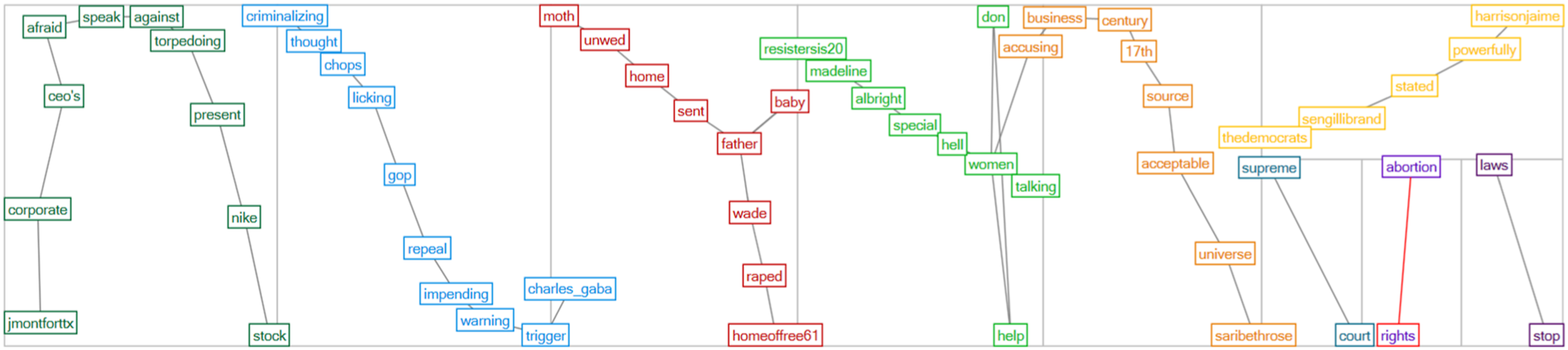
After searching #roevwade (phase 2) and cleaning irrelevant words (e.g., amp, s, things, f, de), the authors uncovered word pairs that appeared more than 240 times within phase 2’s #roevwade network analysis. Ten sub-groups emerged in the semantic network. G1 is the biggest cluster in the graph. The terms “women,” “reproductive,” “rights,” and “abortion” are the most relevant nodes in terms of sheer frequency; serving as the connecting hubs to G2, G4, G6, and G7 in the network.
A group of hashtags emerged in G5, including #womensmarch, #bodilyautonomy, #istandwithplannedparenthood, and #abortion. In fact, these hashtags were widely used by the protesters, from both pro-choice and pro-life supporters, to organize rallies in the phase 2 timeframe. Pro-choice camps used these hashtags to organize online campaigns to express their outrage over the potential repeal of Roe v. Wade, to send a resounding message of support for upholding abortion rights, and to demonstrate their support for Roe v. Wade to policymakers and the Supreme Court. Pro-choice supporters also attended the rallies organized by Planned Parenthood and several reproductive rights organizations on the weekend of May 14–15, corresponding with our time phases (Silverman et al., 2022). Although these hashtags had the attributes of the pro-choice camp, pro-life supporters still used them to celebrate a potential victory of their advocacy and intended to disseminate the opposition’s messages (Figure 2). Word pairs repeated more than 240 times in phase 2’s network #roevwade.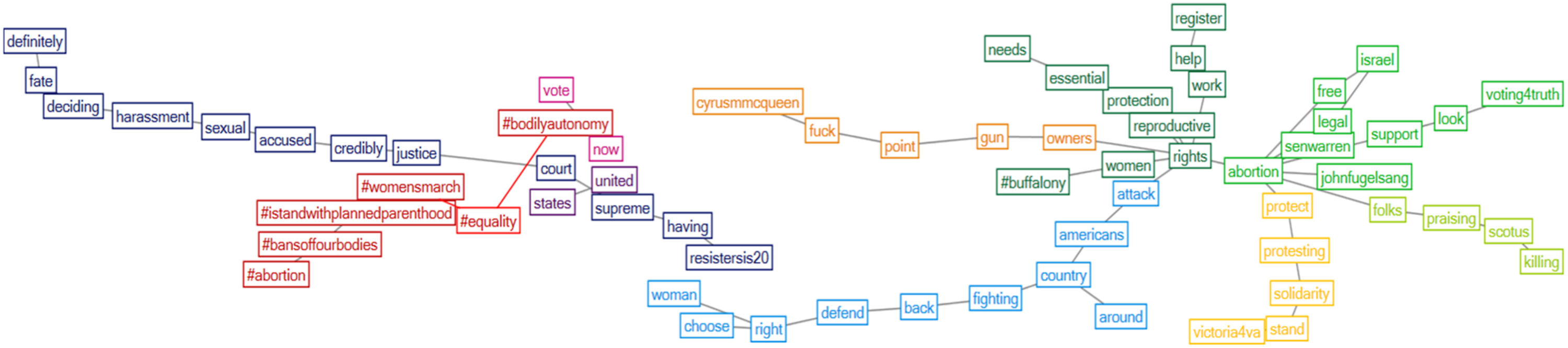
Regarding the #bansoffourbodies network (phase 2), after searching the hashtag and cleaning irrelevant words (e.g., again, en, ck, yeah), the authors found word pairs that appeared more than 495 times. Fourteen sub-groups emerged within the semantic network. G1 is the biggest cluster in the graph, with “Abortion access” and “women’s reproductive rights” being the most relevant nodes in terms of frequency. LiveAction and the terms “kill” and “birth” were other relevant and frequent terms in G1. Along with the terms “won” and “chanting” in G4, they represent the voice of pro-life supporters. In other words, within the #bansoffourbodies network, both pro-choice and pro-life engaged in the Twitter discourse.
The terms “Rallied,” “#womensmarch,” “rallies,” “nationwide,” and “events” were counted very frequently in G6 through G8. These terms appeared to have resonated with the public’s reaction to the leak, which sparked protests nationwide. Since Pennsylvania Governor Tom Wolf spoke out against the Supreme Court’s attempt to overturn Roe v. Wade, ensuring abortion would remain legal in Pennsylvania, “Pennsylvania,” “Governor,” “stay,” “legal,” and “governortomwolf” were prevalent throughout G1 and G10 (Figure 3). Word pairs repeated more than 495 times in phase 2’s network #bansoffourbodies.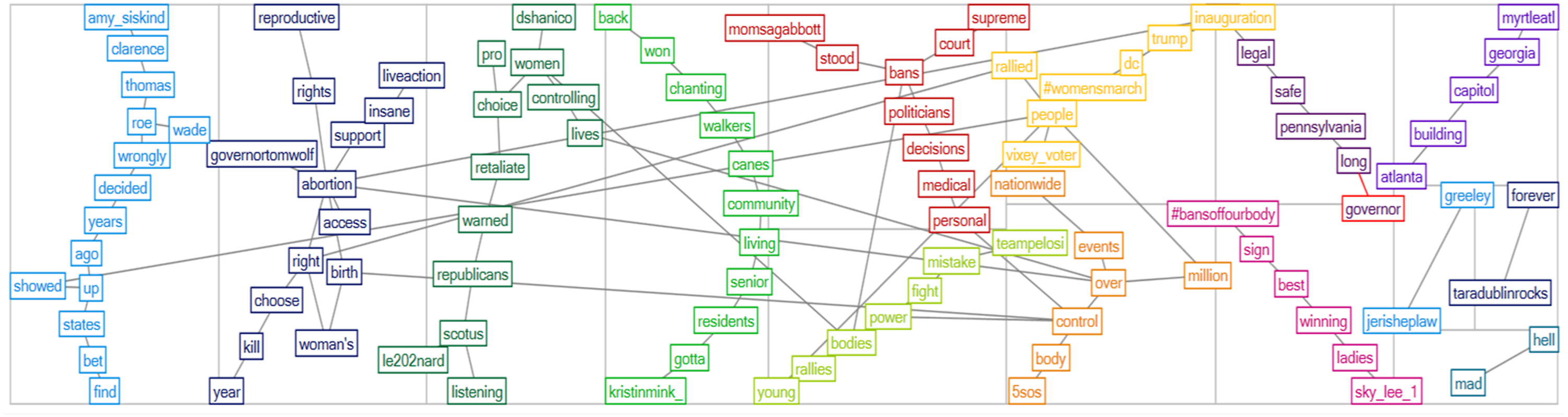
Phase 3 analysis began by searching #roevwade, cleaning irrelevant words (e.g., s. un, go, again), and uncovering word pairs appearing more than 420 times. Twelve sub-groups emerged within the semantic network. G3 is the biggest cluster on the graph and serves as a connecting hub to other clusters in the network. Prominent hashtags that emerged within G3 included #abortionrightsarehumanrights, #womensrights, and #scotus. “#scotus” (G3) has a linkage with “trump” (G6) as well as a linkage with “#amyconeybarrett” and “#brettkavanaug” (G9). These refer to the political events taking place during President Trump’s administration with the appointment of two conservative judges to the Supreme Court. Additionally, a group of hashtags appeared in G2 (e.g., #roevswade, #abortionban, #mybodymychoice, #prolife, #prochoiceisproflie, #prochice). These terms represent both pro-choice and pro-life reactions to the official reversal of Roe v. Wade (Figure 4). Word pairs repeated more than 420 times in phase 3’s network #roevwade.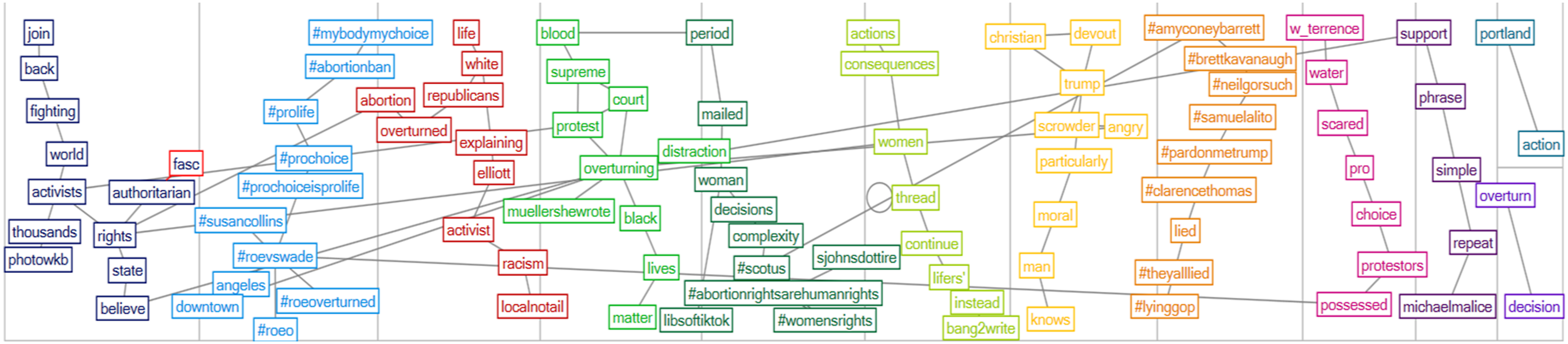
Discussion and Outlook
Influencers in the Social Network
The social network analysis around the reversal of Roe v. Wade has shown the top 40 influencers within the specified timeframes on Twitter. These influencers were the main actors, with a central position, wide reach, and large connections within the network. Regarding the categories the authors interpreted, the main actors (influencers) fall approximately into each category.
By analyzing 40 influencers’ profile information, the authors believe they all showcase a high interest in the discussion and knowledge discourse about Roe v. Wade and reproductive healthcare-related issues. There were three influencers featured twice in two phases, across the differentiated timeframes. Southern Sister Resister - Wordsmith #IAmTheStorm (featured in phases 1 and 2) was a founder’s account for an activist group, #Fresh. #Fresh is a group of activists’ writers aiming to defend democracy and liberal values (FreshVoicesRise, (n.d.)). Mueller, She Wrote (featured in phases 1 and 3) was an official account associated with news company MediasTouch, and it was “a binder full of women unraveling the mysteries of Mueller investigation.” Mueller, She Wrote also produced podcasts that feature women’s reproductive rights. House Speaker Nancy Pelosi was featured in both #roevwade and #bansoffourbodies in phase 2. These users showcase a discourse of feminine resistance to the reversal of Roe v. Wade.
Moreover, the authors did recognize the hashtags in the current project somehow fall into the pro-choice camp’s discourse, to some extent, by default. Interestingly, Internet influencers Steven Crowder and Michael Malice emerged as top influencers in the network, which brought the conservative voice into the discourse. LiveAction, a pro-life non-profit organization, was also featured among top influencers. In addition to engaging in the #roevwade and #bansoffourbodies, pro-life activists and groups have also used #prolife, #whyImarch, #marchforlife, and #heartbeatlaw in their discussion.
Interestingly, the authors found that while discourse emerged from both camps, including liberal (pro-choice) and conservative (pro-life) discourse, the top influencers in the category of Politicians/Political Groups was only from the liberal camp, as the liberal side contained not only influencers and activists, but politicians as well. Representing the liberal pro-choice camp, users such as Senator Elizabeth Warren, House Speaker Nancy Pelosi, Pennsylvania Governor Tom Wolf, and the DNC emerged within the network. However, no comparable actors emerged for the conservative pro-life camp within this network. Instead, the conservative side showcased only influencers and activists, no politicians were present. The authors suggest this is an indicative of the current highly polarized Republican/Conservative party and situation. Since Roe v. Wade had been an established constitutional law for 50 years, Republican/Conservative representatives potentially did not want to risk alienation or political loss during this turbulent time.
Repeal of Roe v. Wade
The semantic analysis has showcased the main thoughts and perspectives discussed on Twitter prior to, during, and after Roe v. Wade was overturned. The themes of legal concerns, flawed systems, loss of rights, distrusting the Court’s authority and ability, and political nepotism emerged within analysis. One of the primary concerns with the reversal of Roe v. Wade was that a constitutional right—the right to obtain an abortion was taken away from people. We noticed the terms “laws,” “lawsuits,” “SCOTUS,” “Supreme Court,” “Thomas Clarence,” and “justice” repeatedly emerged in the analysis. Some Twitter users believed the Supreme Court’s decision in Dobbs v. Jackson Women’s Health was due to the fact that the majority of the justices were conservative. There was also a call to reform the current Supreme Court, including limiting the time/tenure judges serving on the court and calling on President Biden to add seats to the court.
Moreover, “women,” “body,” “#bodilyatunomy,” “#womenatunomy,” “right,” “choice,” “pro-choice,” and “solidarity” frequently emerged in the word pair semantic analysis. This indicated additional concerns about the repeal of Roe v. Wade, where women have lost access to abortion care and autonomy of their own bodies. The theme of loss of autonomy and mobility emerges alongside the restriction and banning of abortion care in nearly half of the United States following the reversal. As a result, women seeking abortion care in these states have to travel exterior of their state and healthcare networks, where abortion care services remain legal. Although Nike, Amazon, and other American cornerstone corporations stated their companies would offer to fund for their employees seeking reproductive healthcare and abortion care, it proportionally disadvantaged low-income, underserved communities and many racial minorities of women across the nation (Suleymanova, 2022). As a tweet so clearly expresses, But for women of color, poor women, women who lack the resources to travel, who don’t have the time to take off work, who don’t have additional child care for their children, it’s going to be really grim.
Meanwhile, there was a perspective circulating suggesting women, especially pregnant women, should not travel to states where abortion is not legal anymore. The authors believed this expression suggested that the repeal of Roe v. Wade had implications beyond a single medical procedure—abortion care—that it had now affected a woman’s right to choose and have autonomy over her mobility.
Furthermore, the authors also noticed terms like “hell” and “f***” conveyed negative emotions that emerged in the discourse. These terms expressed outrage and strong demands for “helping.” On the other hand, words like “winning,” “wins,” “best,” and “chanting” conveyed positive emotions that also emerged in the network. In contrast to the anger and fears of pro-choice supporters, pro-life supporters viewed the overturning of Roe v. Wade as a victory by tweeting, “Life Wins!”
It is worth noting that terms associated with pro-life perspectives frequently emerged in the semantic analysis, including “#prolife,” “prolife,” “wins,” “killing,” and “chanting.” They advocated for the protection of preborn/unborn babies/material, and they believed pro-life and anti-abortion were about advocating for human rights. In their opinion, abortion is the “killing” of the unborn. Some Twitter users within this camp expressed their outrage at the expense that Nike and many companies would offer for their employees travel funding to have an abortion. Importantly, many pro-life supporters suggested the media coverage has not given their sides enough coverage and attention, and their voices have been marginalized. The authors believed their statements indicated the fundamental differences between pro-life and pro-choice: When does life begin? Is it a fetus or an unborn baby? What are human rights? Who has the right to make decisions about women's bodies?
Public Reaction to Reversal of Roe v. Wade
By analyzing both the type of actions Twitter constituted, and the thoughts expressed by Twitter users regarding Roe, the authors have to acknowledge that the repeal of Roe v. Wade is a failure for pro-choice supporters, but a victory for pro-life. In other words, pro-choice supporters are the affected population, and pro-life supporters are the beneficiaries in the current case. Moreover, the impact of overturning Roe v. Wade differs depending on individual beliefs about the relevant issues.
Since the release of the leaked documents in early May, pro-choice advocates and abortion rights supporters have expressed anger, frustration, despair, and negative emotions building to a crescendo when Supreme Court released Dobbe v. Jackson Women’s Health decision in late June. Their negative sentiments were expressed in street protests as well as online activism. Their resistance did not end in June; instead, the reversal of Roe v. Wade was a new beginning for them. At the public (institutional) level, pro-choice supporters advocate for a constitutional right to abortion care. At the individual (personal) level, pro-choice supporters advocate for individual access to safe and legal abortion care, especially for underrepresented and marginalized women.
As the beneficiaries, pro-life supporters celebrated their historic victory by addressing their campaign efforts over the 50 years since Roe v. Wade. They expressed positive sentiments, including satisfaction with achieving their goals and determination to continue the pro-life movements. In the street protests, they often used their own campaign slogans, such as ProLife, MarchforLife, and LetTheirHeartsBeat. When they engaged in online activism, they used pro-life hashtags alongside some that had pro-choice attributes, such as #Bansoffourbodies, #prochoice, and #IStandWithPlannedParentHood. The authors believe pro-life supporters used these hashtags to disseminate their messages to the other side (pro-choice), which also intentionally makes Twitter a political battleground.
Policy Implications and Message Strategies
Tuesday, August 2, 2022, marked Kansas’ primary midterm elections. Kansas was the first state to attempt to enact policy change following the Supreme Court’s decision to overturn the rulings of Roe v. Wade (Hanna & Stafford, 2022). As a result, voters in Kansas rejected an initiative phrased “Should the Kansas constitution be amended to remove protections of abortion rights?” (Smith, 2022). More than 900,000 people turned out in the Kansas primary, approximately half of Kansas’s total registered voters, and 59 percent of voters (543,855) voted No on the women’s abortion right issue proposed on the ballot. This victory for the pro-choice but failure for the pro-life triggered a political shockwave inside traditional conservative Kansas and beyond its borders. Meanwhile, the authors acknowledge each voter’s priorities are different and that the act of voting is a complex decision influenced by a variety of factors, including economic inflation, immigration issues, and more. As the 2024 presidential election approach, the authors believe the polarizing topic of abortion will be one of the most important deciding factors for voters: whether to fight to maintain access to abortion (with liberal ideas and representatives) or fight to remove protections of abortion rights (with conservative ideas and representatives).
Limitation and Future Studies
Employing the social network analysis approach, the authors examined the top influencers and the prevalent topics that emerged in the Roe v. Wade networks. Methodologically, the social network analysis helped us to maintain an objective position in the research. With a neutral position, it allowed the authors to cover both sides’ narratives and communication strategies in the discourse. The impacts of the Supreme Court’s decisions go beyond overturning an established constitutional law, and it will impact people in a variety of ways. In practice, the authors suggest that methods like social network and semantic analysis can help researchers and policymakers have a better understanding of this highly polarizing topic. The authors also believe it is important to understand the communication strategies in the current discourse, which not only utilized by pro-choice angle, but the pro-life position as well. This dual focus allows for a further dismantling of how the public perceives this healthcare crisis, the strategies used, and the sentiments expressed in building these realities.
The authors must also acknowledge that Twitter users’ population sampled may be skewed, toward younger, ergo more liberal audiences. Similarly, the hashtags reveal a bias toward more liberal attitudes by default of the discussed subject. Therefore, the future projects will include a study of #prolife and #heartbeatlaw to gain a more robust understanding of the discourse around the topic. Further, the time phases are built around a seemingly sudden emergence of Roe v. Wade conversations following the Politico leak; this excludes other conversations around the topic, such as the discussion around the Texas abortion ban in September 2021.
Exterior to the original research questions, the authors believe the findings of this project highlight the influence and power afforded to the use of computer-mediated technology such as social media like Twitter. Further, its vital role in creating and sustaining discourse is influential and has a powerful pull, potentially seen in the responses from the public and their movement to vote in the face of their outrage. The use and understanding of communication strategies and discourse on platforms like Twitter showcase a clear path that could swing polarized masses or further fragment them depending on their actors and who utilize this tool of influence.
Footnotes
Acknowledgement
We appreciated the comments and feedbacks from the editors and anonymous reviewers. We also appreciated the research funding support from College of Humanities and Behavioral Sciences at Radford University.
Author Contributions
All authors contributed to the project design and data analysis.
Conflict of Interest Disclosure
The authors declare that they have no known competing financial interests that could have appeared to influence the work reported in this manuscript.
Funding
This project received $505 research grants from College of Humanities and Behavioral Sciences at Radford University, Virginia in the 2022-23 academic year. The authors appreciated the generous support from our college and university.
Ethical Approval
The current project was performed with public Twitter data. This type of data is published for all users (audience), and it is not considered as “human subject research.” Additionally, IRB does not require research to submit protocol for this type of research.
Data availability Statement
The data that support the findings of this study are available from the corresponding author upon reasonable request.