



Abstract
In an increasingly digitized world, online information-seeking (OIS) behaviors have reflected people’s intentions and constituted a critical component in synthesizing public opinion. Climate change is among the gravest threats facing the world today, and previous studies have adopted OIS data to gauge public interest in climate change. However, such studies have ignored the psychological attributes of search keywords and the role of social identities in influencing OIS. This study explores whether search strategies align with the expected confirmation biases of regions with different partisan beliefs. We use spatial web search trends to show the significant differences in the search keywords adopted by the Democrat-majority (“climate change”) versus the Republican-majority (“global warming”) regions of the United States. Furthermore, using the region-level search and survey data (2008–2018), we demonstrate that the preferential use of search keywords can predict climate opinions. This study concludes by discussing the significant findings and the open questions for future work.
Introduction
Although scientists have warned that climate change is the gravest risk of the 21st century (Oreskes, 2004), climate change skepticism and denial remain high (Haltinner & Sarathchandra, 2018), which can obstruct the collective action in climate adaptation and mitigation (Smith & Mayer, 2018). Therefore, it is critical to trace the public opinion on climate change for conducting effective climate change communication. The existing literature primarily uses surveys to collect climate opinions (Brulle et al., 2012; Damsbo-Svendsen, 2021; Howe et al., 2015; Mildenberger et al., 2017). However, adopting survey-based methods might involve problems such as sampling, response accuracy, and social desirability biases (Morgan & Sonquist, 1963; Wright, 2005). On the other hand, the wide adoption of digital technologies can supplement the limited reliability of self-reported behavioral measures (Stier et al., 2019). Therefore, the present study triangulates survey-based data with digital traces by analyzing the pattern of search queries across social identities and its relationship with partisanship and climate opinions.
In an increasingly digitized information environment, consumers are given various venues to form and express their opinions (Riles et al., 2018; Webster & Ksiazek, 2012). The availability of rich digital trace data offers nuanced insights into public opinion, which gives birth to the paradigm of computational social science (CSS). Compared to the traditional survey method, the CSS approach can process large-scale data at a relatively low cost and analyze human behavior at a high-granularity level. Still, it may not always comprise users’ key attributes and outcome variables through these digital venues (Stier et al., 2019). Therefore, there emerges an integrated paradigm of combining survey data and digital trace data, through which researchers can remedy the deficiencies in each paradigm and comprehensively capture behavioral patterns (Dvir-Gvirsman et al., 2016; Eady et al., 2019; Guess et al., 2019; Haenschen, 2019; Shin, 2020).
However, despite the variety of digital traces, contemporary literature on this integrated paradigm primarily focuses on explicit actions performed on social media platforms (e.g., post, comment, like) and pays less attention to implicit traces on Web browsers (Guess, 2015; Wilkinson & Thelwall, 2011; Williams et al., 2015). With the coming of Web 2.0, the wide adoption of social media enables the passive consumption of information, and the recommendation algorithm cultivates the “news-find-me” perception rather than the other way around (Gil de Zúñiga et al., 2017). In contrast, online information-seeking (OIS) is dynamic behavior driven by complex informational needs that can reflect searchers’ opinions and identities (Mangono et al., 2021; Pawar et al., 2020). OIS is anticipated to offer a more authentic perspective on users’ needs and opinions since information seekers are free from the pressures of self-presentation and community interactions (Jaidka, Eichstaedt et al., 2021; Park & Jang, 2016). In addition, aggregate OIS data is available at the spatial level, while geographically tagged social media posts constitute a small, unrepresentative portion of the whole (Jaidka, Guntuku et al., 2021).
This study leverages the potential of OIS and fills several literature gaps in the realm of seeking climate information. Firstly, while previous studies have focused broadly on search trends or offered survey-based evidence regarding the differences in partisan perceptions of “climate change” and “global warming,” we propose to combine the two strands of work and explore whether such a psychological tendency would be manifested in OIS search strategies, such as the wording of search queries. Secondly, we adopt the integrated CSS paradigm to study climate change attitudes. While a recent study used self-reported survey data to explicate the confirmation bias in OIS about climate change (van Hoof et al., 2022), this is the first study that uses OIS data to corroborate such an argument. Thirdly, prior works on climate opinions treat OIS as anecdotal evidence of public interest (Lineman et al., 2015; Soutter & Mõttus, 2020), but we seek to use the presented confirmation bias (i.e., differences in search queries) to predict climate opinions in nationwide polling data.
In the following text, we review the theoretical backgrounds of OIS and motivate our interest in studying subjective norms in seeking climate information. Next, we examine partisan differences between Democrats and Republicans that pertain to the wording preferences in discussing climate change. Then, we question whether such partisan norms will converge with confirmation bias in influencing partisans’ searching behaviors. Moreover, guided by the integrated paradigm, we also intend to examine whether OIS data can be used to predict nationwide polling data. The results support the confirmation bias in partisan search behaviors and show that search queries are strongly associated with opinion polls.
By integrating OIS data with survey data, we show that search queries with similar semantic meanings can have distinctive psychological attributes which can be used to infer public opinion. Also, this study advances the integrated paradigm of survey and computational social science by highlighting the importance of wording. The wording preferences within a population can help predict public opinion and attitudes. Lastly, we capture the social dynamics beneath information-seeking behaviors and notice that confirmation bias in partisans’ search queries might further toxify the information environment. We illuminate the implications of OIS in climate change communication and research directions for future studies.
Literature Review
Locating Climate Search: Information Seeking and Processing in Risk Communication
OIS behaviors offer insights into users’ informational needs, including but not limited to their health needs (Ofran et al., 2012). Meanwhile, search queries can also reflect users’ attitudes toward various subjects, such as political candidates (Arendt & Fawzi, 2019). However, the distance between climate risks and personal interests may be subjective and contextual compared to health and politics. For instance, much literature on information-seeking treats climate change as an impersonal risk that threatens something other than the self (Ho et al., 2014; Kahlor et al., 2006; Rickard et al., 2014). Other studies have shown that extreme climate events can increase people’s likelihood of indulging in OIS on climate change (Moore & Obradovich, 2020; Zhang et al., 2019). In other words, the personal experience of climate disasters can reduce the psychological distance, shifting the public perception of climate change from an impersonal risk to an individual risk (McDonald et al., 2015; Wang, 2018). Considering the duality of climate risks (i.e., both personal and impersonal), we resort to the Risk Information Seeking and Processing (RISP) model (Griffin et al., 1999) to locate the social meaning of climate search.
Griffin et al. (1999) suggested that people’s information-seeking motivations are primarily driven by information insufficiency (a gap between information held and information needed) and subjective norms (perceived social pressure to perform specific behavior or not). While informational insufficiency is more relevant to personal risks, subjective norms are critical for processing impersonal risks (Kahlor et al., 2006; Rickard et al., 2014). Although this indicates two routes for interpreting climate search, empirical studies show that subjective norms can more strongly predict people’s climate search than informational insufficiency (Ho et al., 2014; Yang et al., 2013, 2014). Lang (2014) finds that weather fluctuations do not always lead people to search for climate information, while social attributes (e.g., education and political ideology) can significantly predict people’s seeking of climate information, suggesting a prominent role of subjective norms in influencing people’s climate perception. Recent evidence also corroborates that subjective norms influence people’s climate search and affect their attitudes toward climate change (Cialdini & Jacobson, 2021; Fielding & Louis, 2020), which can further heighten people’s motivations to search (Kahlor, 2010). This might indicate that climate change is an environmental risk with long-term implications and few imminent consequences for most individuals.
In RISP model, Griffin et al. (1999) also referred to the dual-process theory, which suggests that the human mind can apply two main kinds of reasoning processes. The first is intuitive and heuristic, and the second is deliberative and analytic (Evans, 1984; Wason & Evans, 1974). Heuristic processing requires less cognitive effort and resources, whereas systematic processing requires comprehensive judgment (Casnici et al., 2019; Chaiken, 1980). Scholarship has revealed that although systematic processing produces enduring attitudes and a better understanding of complicated problems, people often prefer heuristic processing and strategies to conserve cognitive effort unless motivated by powerless status or increased emotion (Ebenbach & Keltner, 1998). Therefore, heuristic processing is the most common way of information processing and usually accompanies routine information seeking, such as watching the evening newscast (Griffin et al., 1999). While this study is posited in the context of OIS, we seek to determine whether people might perform routine search queries in their climate searches. In addition, the existing literature on climate search behaviors primarily focuses on search intentions (whether people search or not) without examining the search queries (how people search) driven by social norms. Therefore, we seek to find out whether the subjective norms in search queries can reflect users’ social identities.
Confirmation Bias in Information Seeking Behaviors
Scholarship suggests that heuristic rather than systematic processing is associated with “cognitive misers” (Corcoran & Mussweiler, 2010; Tversky & Kahneman, 1974). Cognitive miserliness has been linked to flawed reasoning and behavioral processes; for instance, decision-makers may overemphasize their favored hypotheses (Klayman, 1995). In addition, such information processing styles can lead to individuals’ “confirmation bias” (Knobloch-Westerwick et al., 2020), which refers to the phenomenon of processing information consistent with one’s existing beliefs and discounting contradictory information (Nickerson, 1998). Confirmation bias has been linked to biased information-seeking (i.e., selective exposure and avoidance), interpretation, and memory recall (Hart et al., 2009; Vedejová & Čavojová, 2022). Such confirmatory information behaviors can reinforce individuals’ preexisting beliefs and isolate them from cross-cutting perspectives (Modgil et al., 2021).
In search behavior, contemporary scholarship has validated that the architectures of Web browsers (e.g., preference-consistent search query suggestions) can influence people’s OIS intentions, and users tend to select results confirming their previous beliefs and ignore competing possibilities (Lallement et al., 2020; Suzuki & Yamamoto, 2020). However, most of the existing literature on the confirmation bias in OIS focuses on health information (Keselman et al., 2008; Meppelink et al., 2019; Ofran et al., 2012; Schweiger et al., 2014), and limited studies have explored this phenomenon in the context of climate change communication. Although van Hoof et al. (2022) conducted a survey study in the Netherlands and reported that the search keywords varied across partisans, no study has adopted OIS data to validate this behavioral tendency in climate change search. Therefore, we aim to explore whether partisans in the US might use different search keywords concerning climate change.
Climate Search as a Proxy for Political Partisanship
In the United States, climate change is not only an environmental issue but also a sociopolitical issue that reflects partisan conflicts in value, culture, and ideology (Collomb, 2014; Hoffman, 2015). Driven by economic interests and partisan media, the climate opinion is partisanly divided (Dunlap & Jacques, 2013; Elsasser & Dunlap, 2013). Democrats tend to acknowledge climate change, while Republicans lean to negate its happening, downplay its consequences, and are less likely to develop an accurate understanding of climate knowledge (McCright & Dunlap, 2011). Previous experiment-based studies have spotted confirmation bias as an explanatory mechanism for understanding the partisan polarization in climate opinions (Druckman & McGrath, 2019; Zhou & Shen, 2021). With the polarization of climate news (Chinn et al., 2020), dissonant climate messages can dissolve partisans’ trust in scientific communities (Nisbet et al., 2015), and their perceived sufficiency in scientific knowledge may further drive them to search for information in alignment with their existing beliefs (Jang, 2014). Therefore, we attempt to examine whether confirmation bias might exist in the context of seeking climate information.
In the current politically divided environment, Schuldt et al. (2011) found a partisan-oriented “labeling effect.” Although the public often uses “global warming” and “climate change” interchangeably (Whitmarsh, 2009), partisans have different perceptions of these two terminologies. Compared to “climate change,” “global warming” is strongly related to heat-related cues (Schuldt & Roh, 2014b; Zaval et al., 2014), refers to more of a human-caused phenomenon than a natural process (Asplund, 2014), and has catastrophic connotations that can evoke affective imagery, such as melting icebergs (Schuldt & Roh, 2014a). Therefore, “global warming” can more significantly evoke partisan difference than “climate change,” and Republicans are less likely to admit the authenticity and urgency of this phenomenon when it is referred to as “global warming” instead of “climate change” (Schuldt et al., 2011, 2017).
The distinction between “climate change” and “global warming” can evolve into a partisan norm and influence people’s wording. Although the National Academies of Sciences notes that “climate change” is a more scientifically-accurate terminology, Republican media, and politicians prefer to use “global warming” in discussing climate issues (Samenow, 2018). As people tend to adopt the vocabulary of their social surroundings (Bourdieu, 1984/2010), this wording preference is especially prominent for the ones with strong partisan identities (Morin-Chassé & Lachapelle, 2020). Furthermore, Jang and Hart (2015) found that people in “blue states” (Democrat-majority states) are more likely to use “climate change” rather than “global warming” as compared to “red states” (Republican-majority states). Also, they found that “global warming” is mainly used to associate with hoax frames, meaning that people tend to use “global warming” when they try to support climate skepticism.
In addition, the media’s word choice on “climate change” or “global warming” (media frames) can influence audiences’ accessibility to these terminologies (audience frames) (Chong & Druckman, 2007a). Media frame (or “frame in communication”) highlights how a speaker relay information to an audience; audience frame (or “frame in thought”) focuses on the audience’s processing information and refers to how they understand a given situation (Chong & Druckman, 2007b). In comparison, audience frames are temporarily accessible schemata that capture the most prominent aspect of an issue for individuals (Entman, 1993). Through audience frames, people resort to their preconceived ideas in a quick and heuristic manner (Higgins et al., 1977). Although we cannot ascertain that partisans are fully aware of the difference between “global warming” and “climate change” when they make a word choice, the heuristic manner of wording can lend us confidence that people’s word choices can reflect the most accessible terminology in their information environment as well as the associated climate beliefs (Chong & Druckman, 2007a). Previous work has substantiated partisans’ adoption of this audience frame (“global warming” vs. “climate change”) in an interpersonal context (information-sharing), and we seek to examine whether such an audience frame can influence people’s information behaviors in a personal setting (information-seeking).
Directed by subjective norms, partisans might be exposed to an information environment that primarily uses either “global warming” or “climate change.” Also, “global warming” and “climate change” might be implanted into partisan cognitive schemata and influence their information-seeking behaviors. Therefore, we expect that partisans tend to perform confirmation bias in OIS and employ search queries aligned with their partisan identity. Specifically, we speculate that Republicans and Democrats use “global warming” and “climate change,” respectively, in seeking climate information. Given the role of cultural values in influencing language use, our study is based on the data from 2008 to 2018, when this partisan effect on wording preference remains strong in the United States (Schuldt et al., 2011, 2017). These arguments motivate our first hypothesis:
The relative search volume of “climate change” in Democrat-majority regions will be higher than in Republican-majority regions. Furthermore, if online information-seeking behavior is an accurate instrument of political partisanship, we can expect to see that the regional trends in search volume correspond with regional partisanship. Accordingly, we frame the following hypotheses:
The region-level relative search volume of “climate change” (RSV) is associated with region-level political partisanship.
Climate Search as a Proxy for Climate Opinions
According to attitude-behavior consistency theories, people’s attitudes can predict their behaviors (Zanna et al., 1981), and people’s behaviors (OIS) might also be a significant predictor of attitudes toward climate change. The theory of planned action (Ajzen, 1991) asserts that attitudes can strongly motivate one’s behaviors, especially when individual attitudes align with social norms. In the context of climate opinion, partisan climate attitudes align with partisan norms. As the attitude-behavior link is moderated by factors such as attitude strength and accessibility (Ajzen, 1991; Fazio, 1990), the strong partisan attitudes on climate change can further strengthen this link. In addition, both OIS and nationwide polling data examine the attitude-behavior link at a collective level. As OIS data aggregates each user’s search queries, nationwide polling data also presents public opinion as an aggregate of individual views, attitudes, and beliefs about a particular topic (Price, 1992). Regardless of the variances at the individual level, the convergence of individual behaviors and opinions drives the collective search outcomes and public opinion. Therefore, we postulate that confirmation bias in seeking climate information can reflect climate opinion.
While numerous studies on climate change communication use OIS data to infer public interests, we contribute to the existing literature by pointing out that search queries with similar semantic references might imply different attitudes. For example, although “coronavirus” and “china virus” both refer to the pandemic, the latter shows a much stronger xenophobic attitude from the information seeker (Zhang & Trifiro, 2022). Similarly, “global warming” and “climate change” might also imply different attitudes, but in a more concealed way. As Jang and Hart (2015) find that “global warming” is mainly associated with hoax frames, we assume that climate skeptics are more likely to use “global warming.” Therefore, the relative search volume (RSV) of “climate change” over “global warming” might indicate climate opinions. Because Republicans are more likely to negate global warming, the search query of “global warming” tends to associate with climate skepticism, incorrect climate knowledge, and fewer concerns. As previous studies use RSV models to predict COVID-19 symptoms (Husnayain et al., 2021; Mirza et al., 2021), we aim to build spatiotemporal RSV models of “climate change” over “global warming” to predict climate opinions in nationwide polling data.
The relative search volume (RSV) of “climate change” predicts survey-based beliefs about global warming.
Method
Data
Survey Data
The Yale Program on Climate Change Communication (YPCCC) and George Mason University Center for Climate Change Communication (Mason 4C) launched nationwide polling of climate opinions every half year to understand public climate change knowledge, attitudes, and behaviors (YPCCC & Mason 4C, 2020). The published dataset collected 19 waves of survey responses (N = 22,416) from 2008 to 2018, and all estimates were weighted to adjust for sample deviations from census benchmarks (Ballew et al., 2019). Notably, there was only one wave in 2008, while there were two waves from 2010 to 2018.
This study used a set of responses in the survey asking participants about their opinions on “global warming,” which might exacerbate climate opinions due to the labeling effect, as stated above. Specifically, we adopted four constructs in the survey: Do you believe global warming is happening? How do you recognize the cause of global warming, How do you recognize scientists’ consensus on global warming, and How much do you worry about global warming? These four questions are prominent in the surveys on climate opinion, which also capture partisan divisions on climate change (Schuldt & Roh, 2014b). In addition, since people may search for genuine climate concerns and climate skepticism (Jang & Hart, 2015), adding climate knowledge and climate worries to global warming beliefs can lend us confidence that search behavior can indicate genuine climate concerns. The survey also collected information about the regions where respondents reside, which was recoded and made available as a “region” nominal variable with nine possible values. Therefore, we used region-level partisanship information and yearly fixed effects as the dependent variables to model a relationship between regional climate opinions and regional search behavior.
OIS Data
Considering the broader user base of Google Search, the availability of the Google Trends API, and the opportunity to replicate prior approaches, we use Google instead of other search engines to operationalize this research question, as Google might more accurately present the collective information demand. We used the Google Trends API to collect the Digital Marketing Area (DMA)-level search volume for “global warming”: and “climate change” matched to the exact duration of the survey data collection (i.e., from January 1, 2008, to December 31, 2018). The data, constituting relative daily search volumes in each DMA, was first transformed into a yearly average. Next, following the approach and crosswalk file used in previous work (Jaidka, Eichstaedt et al., 2021) and using county- and state-level population weights, annual DMA-level search volumes were transformed into region-level search volumes to correspond to the nine regions reported in the Yale Climate Change survey. In cases where a DMA constituted areas from two states, for instance, following a county-level population-weighted approach ensured that both states were attributed with a corresponding proportion of the total search volume. Figure 1 shows how we matched the OIS data with survey data via spatiotemporal transformation. Spatiotemporal transformation of OIS data.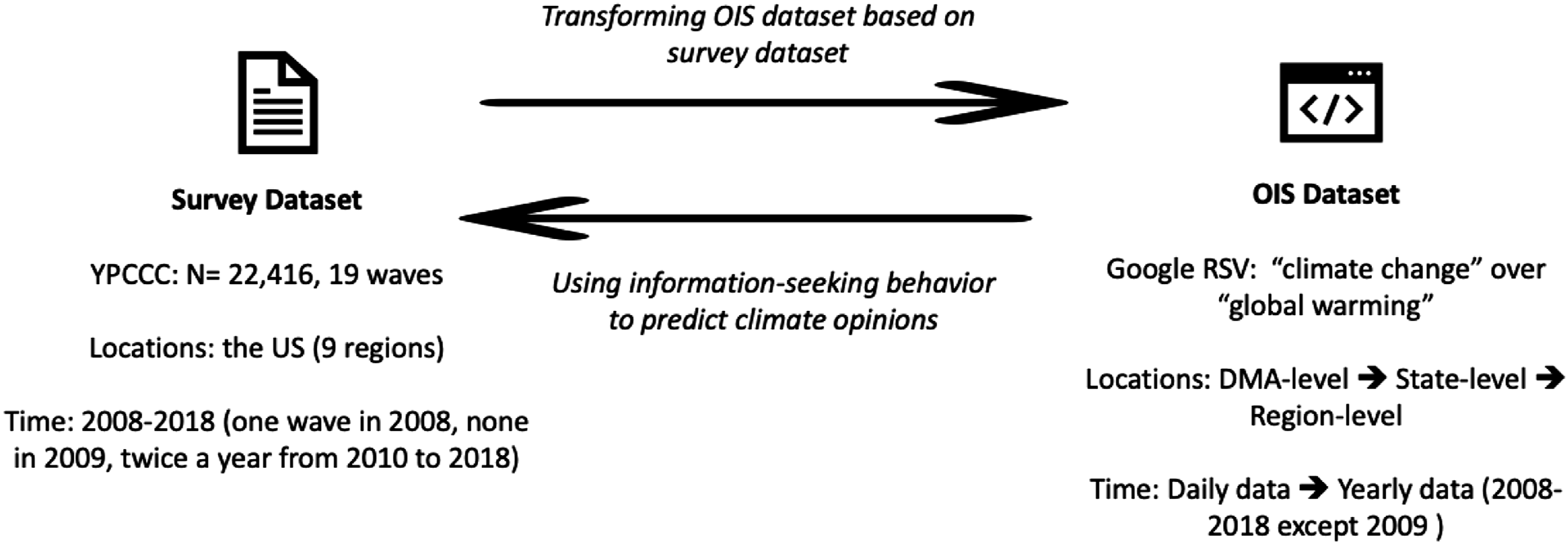
Measurement
Relative Search Volume
We measured the variation in people’s searching interests as the relative search volume (RSV) operationalized as the ratio of “climate change” over “global warming.” For example, if the total search volume of “global warming” is 1000 and the search volume of “climate change” is 500, then RSV will be 2. Notably, as we added search volumes from DMA into states into regions, the weighted averages of total search volumes might introduce decimals. For example, the total search volume for “global warming” in region 1 was 195,170.39 in 2008.
Climate Opinion
We adopted four constructs concerning climate opinion from the original survey dataset. 1 Global Warming Belief (GWB) was calculated yearly as the proportion of the respondents who believe “global warming is happening” at the regional level. Global warming cause (Cause) was calculated yearly as the proportion of the respondents who believe global warming is “caused mostly by human activities” at the regional level. Scientific consensus (SCI) was calculated yearly as the proportion of the respondents who believe “most scientists think global warming is happening” at the regional level. Finally, worry about global warming (Worry) was calculated yearly as the proportion of respondents who expressed “Very worried” and “Somewhat worried” at the regional level.
Region
Region refers to the areas recoded based on states of residence in the survey data, which includes New England (CT, MA, ME, NH, RI, VT), Mid-Atlantic (NJ, NY, PA), East-North Central (IL, IN, MI, OH, WI), West-North Central (IA, KS, MN, MO, ND, NE, SD), South Atlantic (DC, DE, FL, GA, MD, NC, SC, VA, WV), East-South Central (AL, KY, MS, TN), West-South Central (AR, LA, OK, TX), Mountain (AZ, CO, ID, MT, NM, NV, UT, WY), and Pacific (AK, CA, HI, OR, WA).
Partisanship at the Regional Level
To calculate the regional partisanship corresponding to the region-level survey data on climate opinions, we used information about the percentage voting margin in each state for each general election conducted between 2008 and 2018. These margins were population-weighted and averaged to obtain the average vote margin percent for each region for each year in which a general election was conducted. The partisanship for subsequent years was interpolated based on the voting margin numbers for the previous election. “Republican-majority” regions were operationalized as the regions where Republican votes are more than Democratic votes, and vice versa for Democrat-majority regions.
Following Jang and Hart’s work (2015), we then categorized partisanship at the regional level into swing, red, and blue regions. Swing regions comprise those where the vote margin between the two major-party candidates (the Democratic and the Republican nominees) was less than 10%. Red regions are the ones that the Republican candidate won with a vote margin greater than 10%, and vice versa for blue regions. As the vote margin is counted as Republican votes minus Democrat votes, we coded swing regions as 0, red regions as 1, and blue regions as −1. Notably, Republican-majority regions are not the same as “red regions” in our constructs. The former also includes a part of swing regions and vice versa for Democrat-majority regions.
The Vote Margin and Political Partisanship Across Nine Regions.
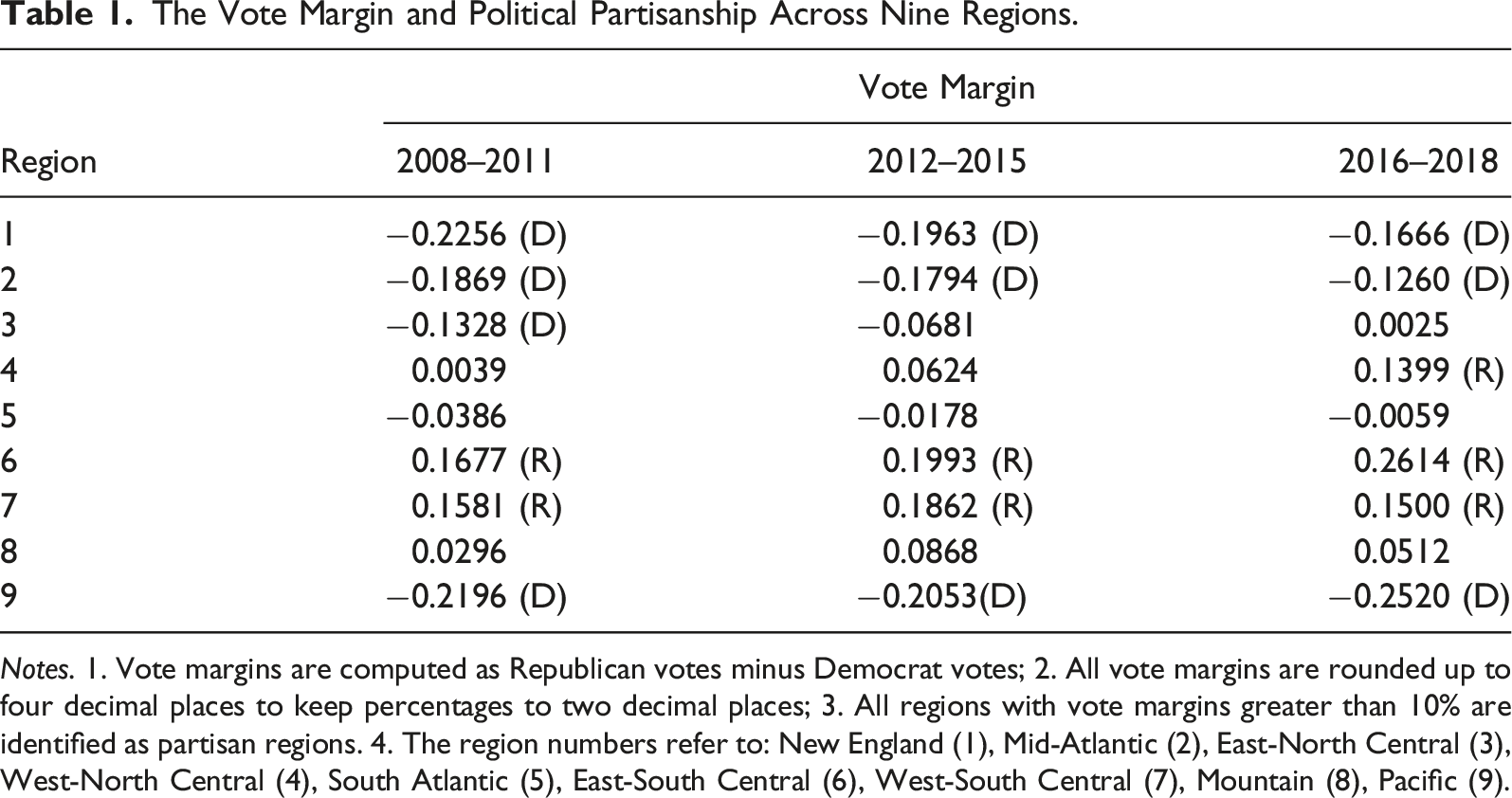
Notes. 1. Vote margins are computed as Republican votes minus Democrat votes; 2. All vote margins are rounded up to four decimal places to keep percentages to two decimal places; 3. All regions with vote margins greater than 10% are identified as partisan regions. 4. The region numbers refer to: New England (1), Mid-Atlantic (2), East-North Central (3), West-North Central (4), South Atlantic (5), East-South Central (6), West-South Central (7), Mountain (8), Pacific (9).
Results
We visualized the spatial distribution of the average relative search volumes of “climate change” and global warming beliefs at the DMA-level to explore the dataset. Figure 2 presents values by plotting on a map of the continental United States, using the choropleth package in Python on the DMA-level shape files provided by the US Census Bureau, Department of Commerce, 2014. In addition, we reported the descriptive statistics for the relative search volume and climate opinions across regions in the supplementary materials. Average region-level trends in (a) the relative search volume of “climate change” (2008–2018) and (b) beliefs in global warming (2008–2018) depicted with state-level boundaries.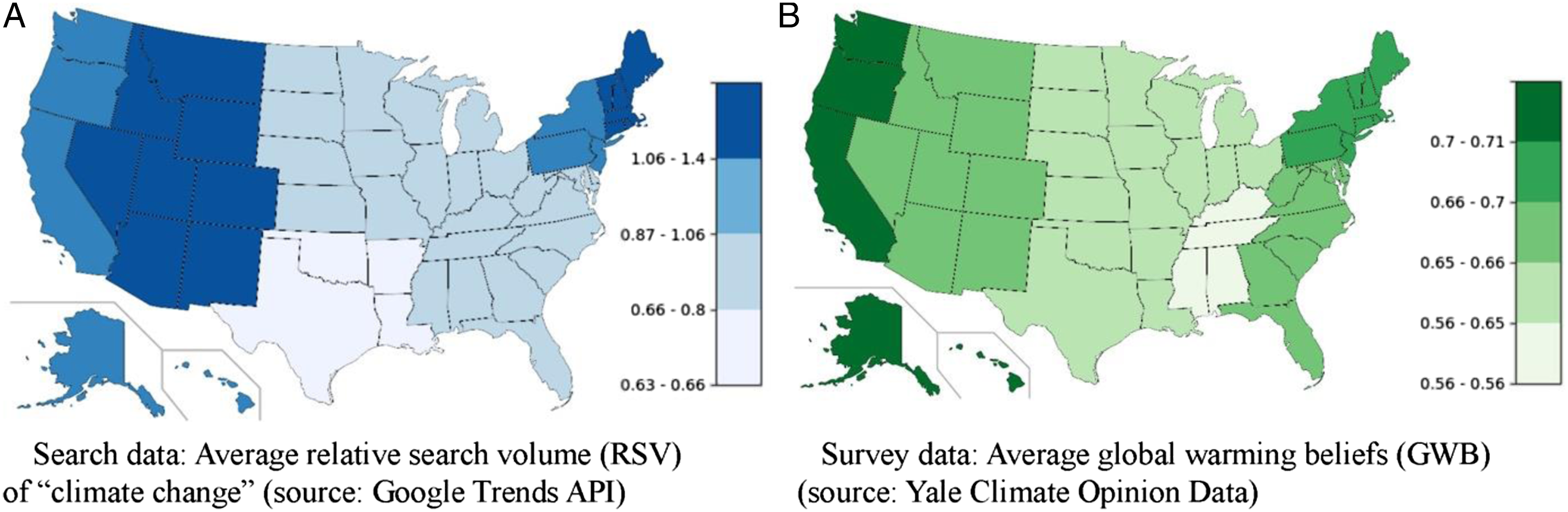
Figure 3 reports the yearly relative search volumes in Democrat-majority and Republican-majority regions. It shows that residents in Democrat-majority regions were more likely to search “climate change” than “global warming” than those in Republican-majority regions. Meanwhile, we observe a considerable shift in search behavior. The public gradually used “climate change” than “global warming” from 2008 to 2018. Average relative search volume across Democrat-majority and Republican-majority regions.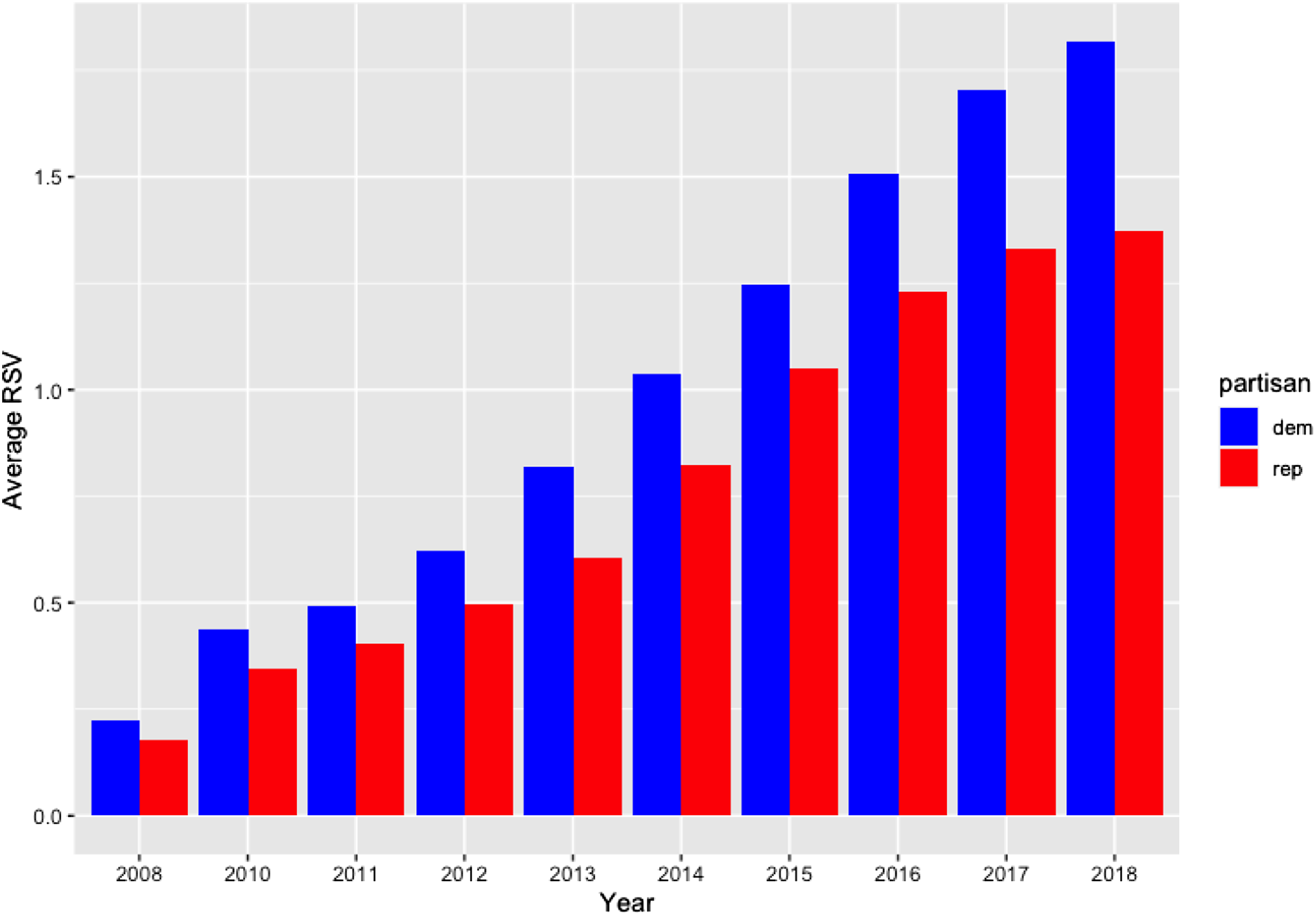
H1 explores whether residents in partisan regions are more likely to perform confirmatory search behavior. We operationalized this by comparing the relative search volumes between Democrat-majority and Republican-majority regions. Paired tests indicate a statistically significant difference between the yearly average relative search volume for “climate change” in Democrat-majority and Republican-majority regions (p = 0.02). We calculated the Cohen’s effect sizes between the yearly average values and found a large-sized effect of 1.13 standard deviations (d estimate = 1.13, 95% confidence interval = [0.12, 2.14]). The relative search volume of “climate change” in Democrat-majority regions is higher than in Republican-majority regions; thus, H1 is supported.
H2 examines the association of relative search volume with partisanship at the regional level. Figure 4 visualizes the distribution of the relative search volumes of “climate change” across partisan regions. Regions with the highest RSV are blue regions (i.e., New England, Mid-Atlantic, and Pacific). In contrast, regions with the lowest RSV are red regions (i.e., East-South Central and West-South Central). Meanwhile, regions with modest RSV tend to be swing regions (i.e., West-North Central, South Atlantic, East-South Central, and Mountain). In addition, although both red and blue states may have experienced an increasing search frequency of “climate change” during the presented periods, the gap in RSV between them appears to have risen. The range of RSV in 2008 was 0.25, whereas the RSV in 2018 was 1.31. Further, when we test the Pearson correlation between RSV and regional partisanship (i.e., red region:1; swing region:0; blue region: −1), the results show a strong negative correlation with r (88) = −0.21, p < .05. In alignment with our assumptions, the RSV of “climate change” is associated with blue regions. Therefore, H2 is supported. The association between region-level relative search volume of “climate change” (RSV) and region-level political partisanship.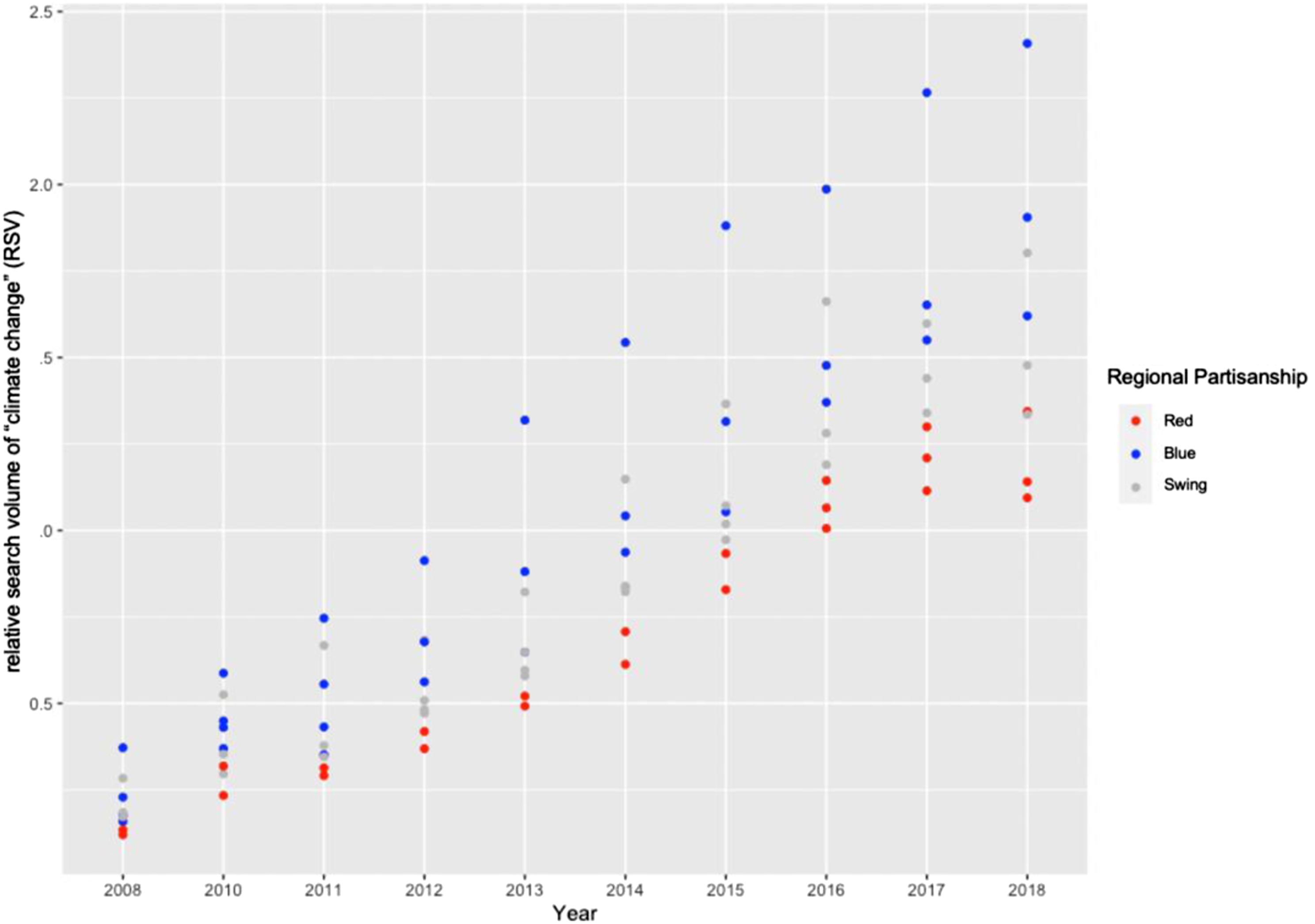
H3 examines the association of relative search volume with climate opinions at the regional level. We first tested the correlation between RSV and climate opinions to test the first-order relationship. We found that the relative search volume of “climate change” (RSV) is strongly positively correlated with global warming beliefs (GWB) (r = 0.54, p < .001), the accurate awareness of global warming causes (Cause) (r = 0.50, p < .001), the accurate awareness of scientific consensus (SCI) (r = 0.68, p < .001), as well as worry about global warming (Worry) (r = 0.52, p < .001). 2
We further adopted linear regression models to examine these relationships in partisan regions. First, simple regression models were calculated to predict GWB based on RSV in Democratic-majority regions (R2 = 0.34, F (1, 45) = 22.85, p < .001) and Republican-majority regions (R2 = 0.24, F (1, 41) = 12.96, p < .001). Simple regression models were calculated to predict Cause based on RSV in Democratic-majority regions (R2 = 0.35, F (1, 45) = 23.86, p < 0.001) and Republican-majority regions (R2 = 0.12, F (1, 41) = 5.68, p < .05), and to predict SCI based on RSV in Democratic-majority regions (R2 = 0.50, F (1, 45) = 44.86, p < .001) and Republican-majority regions (R2 = 0.45, F (1, 41) = 32.99, p < .001). We also used simple regression models to predict GWB based on RSV in Democratic-majority regions (R2 = 0.35, F (1, 45) = 24.02, p < .001) and Republican-majority regions (R2 = 0.16, F (1, 41) = 7.68, p < .01). The results suggest that RSV explains more variance in climate opinions in Democratic-majority regions than in Republican-majority regions. Therefore, the relationship between RSV and climate opinion is more prominent in Democrat-majority regions than Republican-majority regions.
Linear Mixed Effects Model of Relative Search Volume on Global Warming Beliefs.
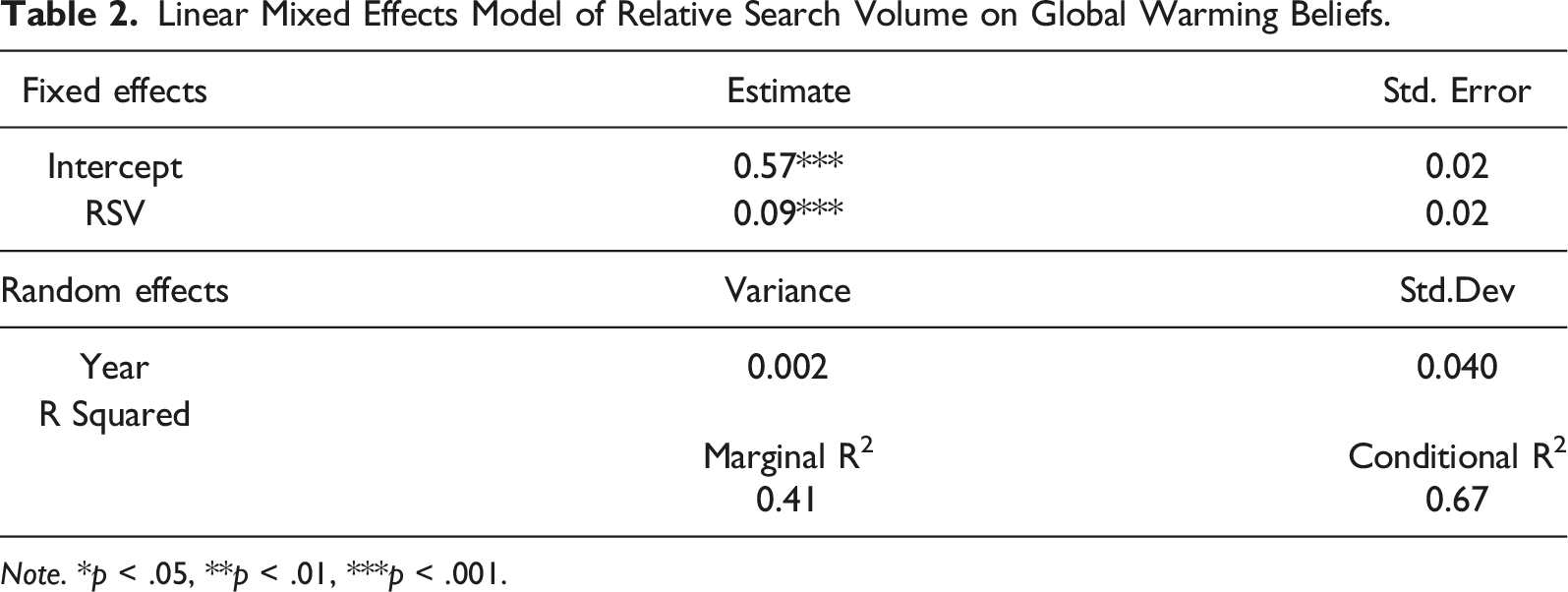
Note. *p < .05, **p < .01, ***p < .001.
Discussion
Firstly, we inquired into the relative search volume of “climate change” across regions. In alignment with the existing literature on the “labeling effect” (i.e., partisan-oriented wording preference), we found that residents in Democratic-majority regions are more likely to search “climate change” rather than “global warming,” as captured in the relative search volume. These findings validate confirmation bias in seeking climate information and imply a worrisome phenomenon that people’s confirmatory search behavior might limit Web search results and hinder people from receiving cross-cutting information (Schwind et al., 2012). Moreover, such preferences may strengthen people’s cognition of partisan-leaning information and consolidate the labeling mindset adopted from the media environment. With scholars worrying that partisan polarization infiltering into apolitical and personal areas (Iyengar et al., 2019), this study shows that partisans dwell in a divided information environment and perform divided information-seeking behaviors.
Secondly, we explored the relationship between the relative search volume of “climate change” and regional partisanship. We found that RSV is significantly associated with region-level political partisanship. Using the voting data from the US presidential elections, this finding highlights the politicization of climate change in the United States and the prominence of the climate agenda in constituting one’s partisan identity. It corroborates the confirmation bias across partisanship and underlines the importance of social norms in OIS. As OIS reflects collective information demand, the presented labels (i.e., “climate change” and “global warming”) are endowed with communal properties. “Climate change” becomes more widely circulated among Democratic communities, whereas “global warming” is more closely linked with Republican identities. This further substantiates the perspective of the “audience frame” that people tend to utilize temporarily accessible schemata and seek top-of-mind information. It also suggests that partisans might have internalized the wording tendency cued by their information environment.
Thirdly, our results suggest that RSV in OIS data predicts survey-reported climate opinion at the regional level. Regions inclined to use “climate change” in their search queries tend to align with Democrat-oriented climate opinions (i.e., believing the happening of global warming, anthropogenic cause, scientific consensus, and worry). In contrast, “global warming” in search queries tends to align with Republican-oriented climate opinions (i.e., not believing it is happening, wrong climate knowledge, and lower worry). While previous research used OIS as an indicator of public attention (Jungherr et al., 2017), this study captures the sociocultural environment underlying search behavior. Since people of different social identities may perceive the same sign differently (De Saussure, 1916), seemingly similar words can contain varying attitudes and opinions. Built on this, we suggest that search behaviors can inform researchers of regional trends in public opinion. As we have recognized that the political environment affects residents’ climate attitudes and information-seeking behaviors, this finding corroborates previous findings (Ballew et al., 2019). Furthermore, by illustrating attitude-behavior consistency, it informs on the relationship between political environment, climate attitudes, and information-seeking behavior.
We also found that the predictive power of RSV on climate opinions is more prominent in Democrat-majority regions, meaning that liberals’ search queries are more likely to reflect their climate opinions as measured in survey data. Although previous research found that Republicans have a stronger reaction to the wording difference than Democrats, their skeptical reactions may be rooted in political values other than climate change, including religion and economic policy (Collomb, 2014; Kilburn, 2014). In other words, compared to Republicans, Democrats’ climate opinions are more contingent on climate information and knowledge, which might account for the greater predictive power of RSV in Democrat-majority regions. In addition, it might suggest that climate change is a critical political agenda for Democrats, so their genuine interests are better measured through information-seeking behaviors than Republicans.
As an alternative to survey experiments that investigate wording preference from individual perspectives, we adopted OIS data to evaluate this phenomenon at a collective level. OIS data offers scalable, privacy-preserving alternatives to understand regional opinion in ways that can reflect unprompted real-life behavior and exemplify culture in action. When it comes to the computational social science (CSS) paradigm, researchers should consider the word meaning and the psychological reasons driving people’s word choices. Since the wording is particularly stressed in the survey method (Schuman & Presser, 1977), CSS scholars can draw insights from survey studies to understand different perspectives in the information environment.
Lastly, the results presented a shift in climate terminology that although the public becomes more likely to search “climate change,” this tendency is much more prominent in Democrat regions. Our results show an asymmetric adoption of “climate change” between partisan regions, which can indicate the dynamics of the information environment. Information-seeking behaviors usually reflect people’s information inputs, such as news media and social networks (Katz, 1957). In a sense, confirmation bias in information-seeking can be upstream that partisans circulate the terminologies in the information environment they are exposed to. We found that people absorbed this wording tendency in their active information-seeking behaviors, which might suggest a transformation from “media frame” to “audience frame.” As terminology adoption is related to social categorization and might indicate institutional changes (Boltanski, 1982/1987), future studies can further explore the push-pull mechanism and social psychological structures underlying such a transformation in climate terminology.
Conclusion
It is essential to acknowledge the limitations of this study before we conclude. Firstly, the survey data only provides respondents’ geographical information at the regional level, which hinders us from comparing search data and public opinion in more precise units (e.g., state and county). Future studies can further examine our results and test the predictive power of RSV models at a higher granularity level.
Next, our results speak to the correlation between variables but not causation. Although RSV models show rigid predictive powers and significant association with partisanship, factors such as the state’s location and natural disasters can influence search behavior and locale-specific model precision (Kaufmann et al., 2016). For example, people living near the coast perceive the more considerable danger of climate change in their community than those living inland (Kennedy, 2020), which might change people’s information-seeking behaviors.
Moreover, RSV models cannot ascertain to what degree searching can present their attitudes. Although we spot strong positive associations between RSV and a wide variety of climate opinion questions, such as climate concern (i.e., worry) and correct climate cognition (i.e., scientific consensus and anthropogenic cause), we cannot exclude the possibility of confounds. For instance, people may have been searching for climate hoaxes. As Jang and Hart (2015) found, “global warming” is more associated with “hoax frames” on Twitter as compared to “climate change.” Future studies may explore whether the fine-grained “hoax frames” exist in Web searches.
Notwithstanding these limitations, this study explores the confirmation bias underlying information-seeking behaviors and adopts the integrated survey and digital trace paradigm. Built on the survey-based literature, we first show that partisan-oriented wording preferences can be extended to digital traces and identify the confirmation bias in OIS. Such a tendency may hinder people from receiving cross-cutting information, strengthen partisan cognition, and consolidate wording preferences. As this study uses survey data to make assumptions about OIS data, future studies can explore whether the variances in search queries can be used to speculate the wording difference in survey data. Also, while we examine the confirmation bias in seeking climate information, subsequent research can further explore confirmatory search behaviors in other settings. Next, the aggregation of information seekers’ partisan identities endows the spatial dimension with social meaning. Finally, we used the spatiotemporal traits of OIS data and found that confirmatory search behaviors predict regional ideologies. This may also indicate the communal properties of search behaviors worth future explorations.
Furthermore, we explore the practical implication of confirmatory search behaviors and examine the predictive power of RSV models on climate opinions by fathoming the logic of confirmation bias: attitude-behavior consistency. Specifically, we explored the associations between confirmatory search behavior and climate attitudes. Aside from subjective motivations, the media environment may conform people to adopt social norms and facilitate the internalization of wording as audience frames. Our results corroborate the embedded attitudes in search queries and show confirmatory search behaviors can help predict public opinions. Notably, this study places information-seeking behaviors as a reflection of the entire media environment. Future studies can stress the agency of information-seeking behaviors in shaping public opinion and explore the interactions among confirmation bias, audience frames, information environment, and information-seeking behaviors.
Supplemental Material
Supplemental Material - Confirmation Bias in Seeking Climate Information: Partisan Searching Behaviors Correlate to Global Warming Beliefs
Supplementary Material for Confirmation Bias in Seeking Climate Information: Partisan Searching Behaviors Correlate to Global Warming Beliefs by Yifei Wang and Kokil Jaidka in Social Science Computer Review.
Footnotes
Acknowledgments
The authors are grateful to Dr Jonathon Schuldt for his valuable feedback and help in an early version of this work.
Declaration of Conflicting Interests
The author(s) declared no potential conflicts of interest with respect to the research, authorship, and/or publication of this article.
Funding
The author(s) received no financial support for the research, authorship, and/or publication of this article.

Supplemental Material
Supplemental material for this article is available online.
Notes
Author Biographies
References
Supplementary Material
Please find the following supplemental material available below.
For Open Access articles published under a Creative Commons License, all supplemental material carries the same license as the article it is associated with.
For non-Open Access articles published, all supplemental material carries a non-exclusive license, and permission requests for re-use of supplemental material or any part of supplemental material shall be sent directly to the copyright owner as specified in the copyright notice associated with the article.
