



Abstract
Short video-based social media platforms, such as TikTok, Instagram Reels, and YouTube Shorts, are changing the way individuals’ access and search for health information. This study analyzed the factors that influence the intention and behavior of users in searching for health information on short video platforms. A mixed-methods approach was used by distributing questionnaires to 566 respondents and interviewing 30 respondents. The questionnaire data were analyzed using partial least squares structural equation modeling, and the interview data were analyzed using content analysis. Visual appeal was found to impact the perceived usefulness and the perceived ease of use, while user interactivity only impacted the perceived ease of use. Health consciousness did not influence the intention to search for health information online. The intention to search for health information online was found to significantly influence the actual online health information-seeking behavior. These findings indicate that user intent affects the actual behavior of users in seeking health information. This study contributes to the theoretical understanding of the behavior of searching for health information online and offers insights for platform developers to improve the visual appeal, ease of use, and credibility of their platforms.
Introduction
Social media platforms are often used to obtain various kinds of information, including health-related information. 1 To this end, short videos, in particular, have become popular, their popularity tied to their ease of access, visual appeal, and much higher level of interactivity compared to long-term articles, thereby aligning with today's increasingly fast-paced and dynamic lifestyle. 2 These videos, typically 15 to 60 seconds long, are also popular because they can satisfy short attention spans and the need for instant information. 3 Lim et al. 4 found that YouTube, Instagram, and TikTok are the most common social media platforms used to source health information—they are easy to access, and they host videos that are visually appealing and that present information lucidly and concisely. These platforms also tend to have high engagement rates, better retention, and the potential to be shared more widely. 5
In the context of health information, social media can be used to disseminate health information to the public, either through direct uploads from health experts or collaborations with influencers. 2 Through collaborations between health workers and influencers, the credible information supplied by health workers can be made more interesting and accessible by influencers. 6 Moreover, more than 70% of healthcare professionals worldwide have used social media to communicate with patients, share medical information, and build their professional reputation. 7
In Indonesia, digital health literacy has been on the rise. 8 More Indonesians can now understand and use online health information effectively, and short video platforms, such as TikTok and Instagram, have become popular sources of health information, especially among the younger generation. To study these platforms, a different conceptual approach than text-based health information platforms, such as Google or Wikipedia, is needed. This is because of their unique characteristics: their compact visual formats and their consumption patterns, which are passive and not always based on intentional searches.4,5,9
Unlike conventional search engines, short video platforms offer a different experience because of their visual, interactive, and fast-paced nature, characteristics that can shape users’ perceptions of the benefits and ease of access to health information. The studies that focused on the factors that influence an individual's health information search on short video platforms remain quite limited. Gunasekara et al. 10 focused more on the psychological and technological factors that influence managerial employees’ online health information search. Ma et al. 11 also examined the individual and psychological factors and did not consider the impact of using video-based media as health information search channels. Most of the other studies focused on content analysis or the dissemination of health information on social media in general, such as Facebook, X, and YouTube, rather than on the factors that motivated individuals to seek information. For example, Basch et al. 12 examined TikTok's potential as a medium for delivering health information, but they did not explore why users search for health information on that platform. Moreover, as Suarez-Lledo and Alvarez-Galvez 13 revealed, the majority of research related to the spread of health information and misinformation on social media focused only on platforms such as Facebook and X.
In this study, we explored how psychological and technological factors affect the behavior of seeking health information on short video platforms. Our results can be used as a guide by short video platforms and health content creators, such as healthcare professionals and digital creators, to improve their presentation of health information. In this study, we used the technology acceptance model (TAM). In contexts such as mobile learning and e-grocery, TAM has demonstrated its flexibility in explaining the adoption of technology based on interaction and user experience.14,15 We also used the health belief model (HBM), which has been widely used to analyze the behavior of seeking health information online. 11 In the context of searching for health information, HBM is relevant, as it suggests that an individual's perception of a health risk, such as its perceived susceptibility and perceived severity, can influence their intention to seek health information online. 11 Moreover, to obtain a more complete picture of user motivation, we considered health awareness, a general psychological factor.
By integrating TAM and HBM, we built a comprehensive research model to examine the psychological and technological factors that motivate individuals to search for health information on short video platforms. From a technological perspective, we used the TAM to explain how visual appeal and user interactivity impact the perceptions of usefulness and ease of use. The two perceptions were analyzed for their impact on the intention to seek health information online, which, in turn, was further analyzed for its impact on actual behavior. From a psychological perspective, we used the HBM to explain how perceptions of health risks, such as perceived susceptibility and perceived severity, can encourage individuals to seek health information online, especially on short video platforms. We also considered health consciousness, the level of concern one has for their health in general: Those with high health awareness tend to be more motivated to proactively seek health information, including through new media such as short video platforms. This variable of health consciousness is, as proven in several previous studies, an important predictor of health information-seeking behavior. 11
Literature review
Online health information-seeking
Online health information-seeking (OHIS) refers to the search for health information on digital media networks. 16 This action is increasingly carried out in the digital era, in line with advancements in digital technology, the growing availability of online health information, and the increase in public literacy in using technology for their needs. OHIS is also conducted to understand health conditions, address health problems, and support health-related decision making. 16 Content delivery in the form of text, images, audio, and video through electronic platforms, such as the internet, has ushered in major changes in the way individuals’ access and share information. OHIS is influenced by various interrelated cognitive, social, and technological factors. One of the main factors is digital literacy, the ability of individuals to access, understand, and evaluate information using digital devices. 17 According to Ban et al., 17 digital competencies significantly contribute to digital health literacy, especially in the middle-aged population. Those with higher digital skills can navigate health information more effectively. Another factor that influences OHIS is digital health literacy, which helps understand the provided health information. Doctors with a high level of digital health literacy have a greater tendency to actively engage in OHIS. 18 Moreover, health workers who can evaluate the quality and accuracy of the information found online can make optimal use of information technology to access scientific journals, clinical practice guidelines, and digital-based health resources.
Health belief model
Researchers focused on information systems employ the HBM to conduct research on online health information searches and the communication of health problems. 19 Shang et al. 19 used perceived severity and perceived susceptibility to examine the factors that affect older adults’ intention to share health information on social media. To develop the HBM, Rosenstock 20 defined several aspects related to a person's behavior of taking preventive measures for a disease such as perceived susceptibility, perceived severity/perceived seriousness, perceived benefits, and perceived barriers. 20 Perceived susceptibility refers to the extent to which an individual believes they are vulnerable to a disease. 20 Perceived severity/seriousness refers to the extent to which they believe in the seriousness of the disease's impact on some aspect of their life. 20 Perceived benefits refer to the extent to which individuals believe that taking certain health measures will minimize their susceptibility to a disease or reduce its severity. 20 Perceived barriers refer to the extent to which one believes that taking certain health measures will produce negative consequences. 20 Over time, Rosenstock 20 added cues to action to measure the factors that motivate individuals to take health measures and to evaluate the extent to which they feel confident in their ability.
Technology acceptance model
The TAM explains how external factors affect internal beliefs, behaviors, and user intentions and facilitate computer technology adoption. 21 Davis et al. 21 proved that perceived usefulness and perceived ease of use are factors that determine users’ technology acceptance. An individual's use of computer technology can be predicted from the intention to use it. 21 The intention to use a technology is significantly influenced by its perceived usefulness. 21 In addition, the perceived ease of use directly and indirectly affects the intention to use. 21 Since the variable of attitude toward using a technology did not significantly affect behavioral intention when compared to perceived usefulness, it was not included in our study.
Conceptual model
Our proposed conceptual model, which integrated the HBM and the TAM, is based on Shang et al., 19 Zhao et al., 22 Barua and Barua, 23 Feng and Zhao, 24 Wei and Li, 14 Pagnanelli et al., 15 and Shamlou et al. 25 We integrated the HBM and TAM. Two variables from the HBM were adopted, perceived susceptibility and perceived severity, and they represent an individual's perception of the vulnerability and severity of the health risks they face, which influences their intention to seek health information online. Based on the TAM, we used two main constructs: perceived usefulness and perceived ease of use. Further, we added two external variables that reflect the visual and interactive aspects of short video platforms and can affect the perception of their usability and ease of use: visual appeal (VSA), adopted from Feng and Zhao, 24 and user interactivity (USI), adopted from Feng and Zhao 24 and Wei and Li. 14
Health consciousness (HCS), adopted from Barua and Barua, 23 represents an individual's concern of their health in general. HCS is considered to directly influence an individual's intention to seek health information online. Meanwhile, the OHIS variable, adapted from Shamlou et al. 25 and Shang et al., 19 describes an individual's intention to seek health information online. This intention is manifested in the form of real behavior, which is represented by the variable of actual online health information-seeking behavior (ISB), which was based on Shamlou et al. 25 Our proposed research model (Figure 1) has 10 hypotheses.

Proposed research model.
Visual appeal refers to the extent to which the visual appearance of a digital platform or system provides a pleasing and esthetic user experience.
24
It is informed by various elements—colors, layouts, icons, and animations—that influence user engagement and their perception of a digital platform.
24
A platform's visual appeal can affect its perceived usefulness—a visually appealing platform can make it easier for users to understand the platform's functions and thus improve the user experience.
24
Perceived attractiveness was also found to significantly affect perceived usefulness.
26
Similarly, Lazard et al.,
27
who focused on mobile health apps, found that attractive designs can drive adoption, as users would then feel that such apps are useful and enjoyable to use. In the context of this study, the visual appeal of short video platforms, such as TikTok, Instagram Reels, and YouTube Shorts, plays an important role in shaping users’ experience of searching for health information. Visually appealing videos—informed by factors such as good video quality, esthetic color use, clear information delivery, and supporting animations—can enhance users’ interest in a platform. When users feel comfortable and interested in the videos, they are more likely to consider the platform useful (perceived usefulness) in their search for health information. In addition, users’ attachment to the videos in short video platforms can trigger their desire to continue using such platforms to search for information. The following was thus hypothesized.
Visual appeal also influences the perceived ease of use. Attractive and esthetic interface designs, informed by the tasteful use of images, colors, fonts, and shapes, help produce a visually pleasing user experience.
24
Moreover, Feng and Zhao
24
found that visual appeal plays an important role in creating fun interactive experiences through gamification elements. When the visual information is well organized, users will find an app attractive as well as easier to use and more useful. Pagnanelli et al.
15
showed that, in the context of e-groceries, pleasant design aspects, represented by hedonic motivation, can make technology feel simple to use and thus increase the perceived ease of use. Denison-Day et al.
28
also emphasized the importance of simple designs in digital health interventions: A neat and uncomplicated visual layout was found to enhance the perceived ease of use. Esthetically pleasing interface designs, such as an orderly layout, matching colors, and supporting graphic elements, help users navigate and better understand the presented health content. The following was thus hypothesized.
User interactivity refers to the extent to which users can interact with an application or a digital platform to access the needed information,
14
both in the form of human interactions with computers and interactions with other users on digital platforms.
14
Feng and Zhao
24
examined how user interactivity in digital applications can affect perceived usefulness: a high level of interaction allows users to better understand the functions of an application and enhances user experience. Moreover, Xuan et al.
29
found that the quality of interactions in health videos significantly affects the perceived value, which has similarities to perceived usefulness, as both factors reflect the benefits users feel when using a platform. However, in the context of this study, user interactivity on short video platforms plays an important role in improving the user experience. The features such platforms offer, such as comments, likes, and interactions with other users, can make users feel more involved in their search for health information. When users feel that such platforms are interactive, they tend to be more involved in their search for health information. Interactions can increase their sense of engagement and connectedness with the information presented, encouraging them to perceive the platform as useful in meeting their health information needs. The following was thus hypothesized.
Interactivity, according to Wei and Li,
14
is the extent to which users interact with other users on a software application. Moreover, Wei and Li
14
defined interactivity in a more contextualized sense, focusing on user interactions with the platform used. They argued that the interactions that occur between learners can support their learning process and improve its effectiveness. In the context of mobile application use, Nandi et al.
30
found that interactive features that enable two-way communication and user control increase the perceived ease of use. When users can interact with a platform's content, explore its interactive features, and engage with their fellow users, it is likely to influence how they perceive the ease of using the platform. Moreover, if users often watch, search, comment on, and like health information videos, a platform's algorithms can automatically offer similar recommendations, reducing users’ efforts to search for relevant health information. These findings are in line with Wang et al.,
31
who found that user-perceived interactivity in mobile applications can improve the perception of value and user flow experience, which further impacts the intention to continue using an application. The following hypothesis was thus formulated.
Perceived usefulness refers to the extent to which individuals believe that using a particular information system will enhance their job performance.
14
Widiar et al.
32
found that perceived usefulness influences behavioral intention, and Jia et al.
16
found that the perception of the usefulness of health information found online can encourage further information-seeking behavior, as users feel supported in understanding their health conditions, making decisions, and even changing their health-related behaviors. If users perceive a short video platform as useful in searching for health information, they tend to continue using the platform for the same purpose. This is in line with previous findings that showed that the higher the perception of a system's usability, the greater the intention of users to adopt and use the system in the long term.13,18,29 The following was thus hypothesized.
Perceived ease of use is defined as the extent to which an individual feels that they can effortlessly use a platform.
21
In the context of mobile learning applications, according to Wei and Li,
14
perceived ease of use positively influences user intent behavior. The ease of using digital platforms—which involves the ease of navigation, interaction, and access to information—is an important factor that drives users’ intention to search for health information online.
16
In this study, perceived ease of use was tested for its effect on the intention of use. If users feel that they can obtain relevant health information using a short video platform that can be operated and navigated easily, it is likely to affect their decision to continue using the platform to search for health information. The following was thus hypothesized.
Perceived susceptibility refers to the extent to which individuals feel vulnerable to a particular disease or health condition.
19
Shamlou et al.
25
found that perceived susceptibility is a key factor in motivating OHIS behavior—those who feel more vulnerable are more active in accessing health information to reduce uncertainty and improve their understanding of health conditions. Moreover, Shang et al.
19
found that perceived susceptibility positively influences the intention to share health information on social media—the more susceptible an individual feels to a disease, the more likely they are to seek and share relevant health information. Malik et al.
33
also found that perceived susceptibility to certain health conditions can improve the behavior of seeking and sharing health information on social media. In addition, Mou et al.
34
found that perceived susceptibility positively influences individuals’ intention to search for popular health information online, suggesting that perceived susceptibility can encourage active health information-seeking behavior. In this study, perceived susceptibility was examined in the context of using short video platforms as a medium for health information-seeking. With increasing public awareness of health risks, especially after the COVID-19 pandemic, those who feel more susceptible to diseases tend to be more active in seeking health information on short video platforms such as TikTok and Instagram Reels. The following was thus hypothesized.
Perceived severity refers to the extent to which individuals believe that a disease or health condition can seriously impact their life.
19
It has a positive relationship with health information-seeking behavior.
19
In Zhao et al.,
22
those who consider a disease a serious threat was more likely to take proactive actions, such as seeking relevant information and adopting preventive measures. Similarly, in Shang et al.,
19
being aware of the dangers posed by a disease encouraged individuals to actively seek and share health information using social media. In our study, perceived severity was associated with the intention to search for health information on short video platforms. When someone believes that a disease or a health condition can seriously impact their life, they are more motivated to seek additional information to better understand the risks they could face and the steps that can be taken. According to Shamlou et al.,
25
those with a high perception of health threats are more likely to use digital media to find health information. The following hypothesis was thus formulated.
Health consciousness refers to an individual's level of awareness of their health as well as their tendency to seek information and take actions to maintain or improve it.
23
Those with high levels of health consciousness tend to pay more attention to health-related information and actively seek it out to make more informed health-related decisions. Barua and Barua
23
found that health consciousness positively influences the acceptance and use of digital health technologies, suggesting that health-conscious individuals are more likely to use technology as a source of health information than others. Furthermore, according to Mustafa et al.,
35
health consciousness is an important factor in the digital health technology adoption process. Shamlou et al.
25
found that those with a high level of health consciousness are more likely to seek health information online to improve their understanding of relevant health issues. The following hypothesis was thus formulated.
Online health information-seeking intention refers to an individual's intention to seek health information online before actually performing the actual online health information-seeking behavior. Shamlou et al.
25
found that this intention plays a key role in the actual behavior of seeking health information. Shang et al.
19
supported this finding, demonstrating that individuals’ intention to share health information on social media often correlates with their actual behavior of both seeking and disseminating health information online—in other words, if someone is strongly motivated to seek health information online, they are more likely to translate that intention into real behavior. Furthermore, Bonny-Noach et al.
36
found that positive attitudes and perceived behavioral control significantly affect an individual's intentions in the context of online health. Perceived behavioral control, such as the perception of ease or difficulty in accessing information, also plays an important role in ensuring that intentions can be realized into real actions. The relationship between intentions and actual behavior is thus not purely linear—instead, it is influenced by several mediating factors that bridge the two processes.
36
In the context of this study, the relationship between online health information-seeking intention and the actual behavior is growing relevant with the increasing use of short video platforms as sources of health information. When individuals have a strong intention to seek health information, they are more likely to actively search for, watch, and interact with content about health information on these platforms. The following hypothesis was thus formulated.
Methodology
Research design
We used a mixed-methods approach in this study, combining quantitative and qualitative data to obtain a more comprehensive understanding of the data analysis results. We tested the relationship between the variables or hypotheses in the research model using questionnaire instruments. To enrich the understanding of the analyzed quantitative findings (hypothesis testing), we conducted in-depth interviews. We focused on three short video platforms—TikTok, Instagram Reels, and YouTube Shorts—and our respondents were users from different backgrounds over the age of 18 who used these platforms to search for and access health information in Indonesia (purposive sampling). From 8 to 21February 2025, we tested the readability of our questionnaire on nine respondents and received inputs and suggestions concerning clarity, diction, and syntax. To further test the feasibility of the questionnaire, a pilot study was conducted from 26 February 2025 to 5 March 2025. Link to the online questionnaire was given to 30 respondents.
We used the snowball sampling technique, which is considered effective for identifying and contacting respondents who are difficult to access directly and for allowing the accumulation of relevant respondents through referrals from previous respondents. 37 The initial respondents who met our inclusion criteria—individuals who are 18 years old or above and who have used short video platforms such as TikTok, YouTube Shorts, or Instagram Reels to search for health information—were asked to recommend or distribute the questionnaire to others in their social networks who also met the inclusion criteria.
The questionnaire was distributed through various social media, such as Line, WhatsApp, Instagram, X, and Telegram, between 18 March and 20 April 2025. Before completing the questionnaire, the respondents were asked to agree to an informed consent statement and confirm their participation in the study. Only those who agreed were allowed to proceed with the questionnaire. This study was approved by the authors’ university (reference number S-25 /UN2.F11.D1.5/PPM.00.00/2025). In total, 566 responses were obtained. Table 1 presents the demographic data of the respondents.
Respondents’ demographics.

The quantitative data were analyzed using partial least squares structural equation modeling (PLS-SEM). PLS-SEM involves several important stages that must be completed to produce a valid and reliable model: (1) model specification, (2) measurement model assessment (outer model), and (3) structural model assessment (inner model). 38 The quantitative analysis revealed that eight hypotheses were accepted and one rejected. For qualitative data collection, 30 respondents were interviewed: 27 were aged between 18 and 27 years (90%), 2 were aged >47 years (6.7%), and 1 was aged between 28 and 37 years (3.3%). Moreover, 24 were female (80%) and 6 were male (20%).
The interview preparation stage included compiling a list of questions, selecting respondents according to the inclusion criteria, and implementing online and offline interviews. The interviews were conducted between 15 May and 22 May 2025, and content analysis was performed on the collected data. The data were collected until data saturation—when no new themes, codes, or information from additional interviews were found, and when the answers began to consistently produce repeated insights—was reached. In other words, data collection was stopped after the last interview no longer yielded new insights relevant to the research question.
Research instruments
The questionnaire was divided into three parts: demographic questions, additional questions related to the use of short video platforms and health information searches, and measurement items. The demographic questions and additional questions followed the multiple-choice and checkbox answer formats. The answer format for the measurement items statement used a five-point Likert scale to represent the respondents’ level of agreement (1 = “strongly disagree,” 2 = “disagree,” 3 = “neutral,” 4 = “agree,” and 5 = “strongly agree”). The measurement items were modified from previous studies and contextualized for this study. Appendix A shows the measurement items and their citations used in the questionnaire, Appendix B lists the interview questions, and Appendix C presents the good reporting of a mixed-methods study (GRAMMS) checklist according to O’Cathain et al. 39
Results
Measurement and structural model testing
According to Hair et al., 38 after checking the value of the outer loadings above 0.7, the average variance extracted (AVE) and composite reliability (CR) calculations can be made. The discriminant validity test is a stage to evaluate the extent to which a model's constructs have clear differences and do not intersect conceptually. 38 We conducted discriminant validity testing using three main approaches: cross loadings analysis, the Fornell–Larcker criterion, and the heterotrait-monotrait ratio (HTMT). Appendix D presents the results of the cross-loading test for each indicator with other related constructs. The internal consistency reliability test was conducted using the CR value. 38 Compared to CA, CR is more reflective of real conditions in the PLS-SEM model, as it considers the weight of individual contribution indicators. 38 Table 2 shows the AVE and CR values for each variable used in Figure 1.
AVE and CR values.
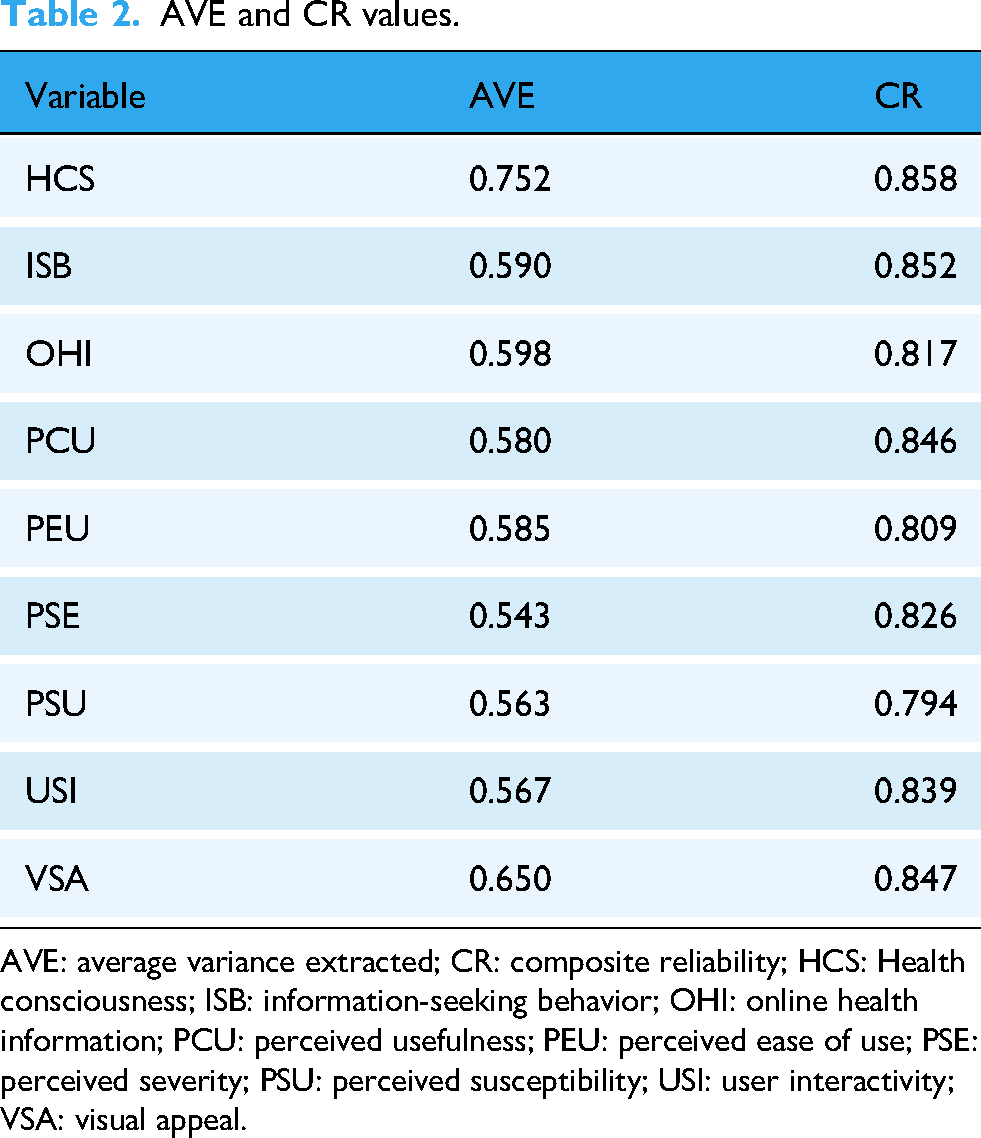
AVE: average variance extracted; CR: composite reliability; HCS: Health consciousness; ISB: information-seeking behavior; OHI: online health information; PCU: perceived usefulness; PEU: perceived ease of use; PSE: perceived severity; PSU: perceived susceptibility; USI: user interactivity; VSA: visual appeal.
Hypothesis testing
After conducting the measurement model test and the structural model test (the latter conducted by bootstrapping, which produced p-value and t-statistics values from the interconstruct relationship), hypothesis testing, the final stage of quantitative data processing using the PLS-SEM method, was conducted to find out which hypotheses were accepted and rejected. This test uses a two-tailed method: A hypothesis is accepted if the p-value is < 0.05 and the t-statistics is > 1.96. 38 Table 3 summarizes the results of the hypothesis test.
Hypothesis test results.

HCS: Health consciousness; ISB: information-seeking behavior; OHI: online health information; PCU: perceived usefulness; PEU: perceived ease of use; PSE: perceived severity; PSU: perceived susceptibility; USI: user interactivity; VSA: visual appeal.
Discussions
Hypothesis one (H1), as visual appeal was found to influence perceived usefulness, was accepted. This is in line with Xuan et al., 29 who found that the quality of popular health science videos affects users’ perception of their value. Xuan et al. 29 assumed that health education videos can create a positive perception of the value of the information conveyed. This finding can be contextualized in this study, indicating that the visual appeal of short videos on health and short video platforms is an important factor that shapes their perceived usefulness. This finding is in line with Feng and Zhao, 24 who found that visual appeal significantly influences perceived usefulness. Similarly, Garcia II et al., 26 focusing on academic website portals, found a significant influence of perceived attractiveness on perceived usefulness: Users tend to browse a platform for long periods if they consider its design and layout interesting enough. Moreover, Jiang et al. 40 found that a website's esthetic aspect affects the usefulness perceived by its first-time users. Our findings is also in line with that of Lazard et al., 27 who found that attractive designs can increase the adoption of mobile health applications. Our qualitative analysis also supports these results, as we found that visual appeal improves perceived usefulness. Visualizations, such as animations and diagrams, help users understand complex health information—this was conveyed by 24 interviewees (80%). Interviewee 5 said, “For example, when it comes to explaining hormones or metabolic processes … When there are simple animations or motion pictures, I can imagine and finally understand.” Interviewee 10 stated, “Visually, information that was difficult at first becomes simpler and easier to follow, especially for me, who doesn’t really understand medical terms.” Moreover, 15 interviewees (50%) corroborated that videos with bright colors, less text, and a clean, clear, and simple appearance are more attractive: “Videos that look clean HD, have helpful texts, and colors are easy to see” (interviewee 4). Interviewee 6 also said thus: “Usually I like videos that look clean, not noisy, continue to use soft colors.” According to these findings, perceived usefulness emerges not only from the visual content of a video but also from the layout and visual design of an app.
Hypothesis 2 (H2) was accepted, as visual attraction was found to significantly influence the perceived ease of use felt by users of short video platforms in searching for health information, both in terms of content and platform. According to Denison-Day et al., 28 simple designs affect users’ perception of convenience, and Jiang et al. 40 found that users’ first esthetic impression of a website affects the level of convenience they feel when they use it. In addition, Tarchi et al. 41 found that presenting information using subtitled videos is the most effective way to enhance comprehension, as such videos combine visual aspects, audio, and text. These results are also supported by Pagnanelli et al., 15 who found that visually pleasing design elements can trigger hedonic motivation, which can enhance the perceived ease of use. Consequently, visual appeal is not only an esthetic factor—it also contributes by making a platform convenient to use. A platform's layout, colors, icons and design and the presentation of information in short videos affect the ease of users in searching for and understanding the information presented in short video content. According to 25 interviewees (83.33%), anatomical illustrations, animations, simple graphics, and captions helped them understand complex medical terms: “For example, when there is a medical term that is unfamiliar, then the video gives an illustration of anatomy or a simple graph, it immediately makes you understand” (interviewee 7). In line with this, interviewee 10 said the following: “Clear visuals, additional text in the video, simple graphics, and animations make it easy for me to understand the sometimes complicated material.” Moreover, according to 14 interviewees (46.67%), visual elements, such as subtitles or subtexts, are helpful, especially when they are unfamiliar with medical terms or videos in foreign languages: “I really like it when the video has text or subtitles that appear when the person is talking. Because sometimes there are medical/health languages that we are not familiar with” (interviewee 6). Interviewee 29 also stated the following: “It makes it easier and faster to understand the information conveyed in addition to the animation. It can also be if there is a subtext because sometimes the explanation is too fast.” In addition to the content of a video, the visual appeal of a platform also contributes to its ease of use. Elements such as search bars, suggested search, topic tags, and navigation icons can help users find information quickly and without undertaking complicated steps.
Hypothesis 3 (H3) was rejected, as we found no relationship between user interactivity and perceived usefulness. This is in line with Feng and Zhao 24 but not with Gu et al., 42 who focused on internet-based health services. In our study, interactivity was not found to provide considerably significant usefulness—users are more focused on how they can obtain informative and trustworthy content. This is supported by the interviews, with 20 interviewees (66.7%) not considering interactive features as the main aspect that makes a platform useful—the content itself was deemed more important: “The first thing I saw was the information discussed in the video. The interactive features were the second thing” (interviewee 20). Moreover, regarding the role of interactive features in making a platform useful, interviewee 5 said the following: “The role is not big for me. It's more of a compliment.” In addition, according to 13 interviewees (43.44%), the accuracy of the information conveyed on short video platforms is what users consider more than the usefulness of interactivity features as conveyed by the interviewee 11, “… the quality of the content itself due to its accuracy and how the doctor explains in easy-to-understand language…” Interviewee 13 stated thus: “… because the content of health information is the result of the experience of people or people who have found out, while if you make such comments, it can be more based on opinions.”
Hypothesis 4 (H4) was accepted, as we found that user interactivity influences the perceived ease of use. This is in line with Wei and Li, 14 who found that interactivity can improve the perception of ease of use in online learning applications. Moreover, according to Wei and Li, 14 the higher the level of interactivity, the greater the ease of use. Nandi et al. 30 found that interactive features that allow two-way communication and control from the user's side contribute to increasing the perceived ease of using mobile applications. These three findings corroborate that the interactivity of short video platforms plays an important role in making them easier for users to access and understand health information. The acceptance of H4 is also supported by our qualitative results, according to which other users’ comments were found to often help speed up the search process and clarify the information presented in the video. In total, 19 interviewees (63.3%) stated that the information they were looking for was easier to find in the comments than in the video itself: “Moreover, I searched for videos about certain health information several times, but I looked for answers in the comments, not in the videos” (interviewee 1). Further, interviewee 2 stated thus: “Comments and discussions help me validate the information. Sometimes the answer is clearer in the comments than in the video.” Both the interviewees revealed that the comment feature is not only used as a means of social interaction but also as a tool that facilitates the process of finding and understanding information. Other users’ comments often provide additional explanations that help simplify information that may not be fully understood from the content alone. “… it made it easier for me to find the information I was looking for, and from those comments I was exposed to more perspectives” (interviewee 27). The responses from the video creators or other users also make the process of searching for health information easier, faster, and more interactive. Technical interactivity, manifest in features such as the search bar, suggested comment (blue comment), hashtag, and suggested search, supports the ease of accessing information. User interactivity thus both socially and technically contributes significantly to improving efficiency, speeding up search, and facilitating the understanding of health information on short video platforms.
Perceived usefulness was found to be linked to online health information-seeking intention. Hypothesis 5 (H5) was thus accepted. This corroborates the findings of Wei and Li, 14 who found that usability perceptions play an important role in shaping digital system usage intentions, particularly in the context of mobile applications. Similarly, Widiar et al. 32 found that perceived usefulness significantly affects the behavioral intention to use digital-based systems. Jia et al. 16 added that the perceived usefulness of health information found online can encourage further information-seeking behavior, as users feel supported in their endeavor to understand health conditions, make decisions, and change their health behavior. These three findings corroborate the results of our study, according to which perceived usefulness plays an important role in shaping the intention to seek health information through short video platforms. The acceptance of H5 was also supported by the interviewees. In total, 27 interviewees (90%) felt compelled to explore other health topics after seeing content relevant to their personal conditions: “For example, when I watch a video about a skin disease that explains its causes and how to treat it, I get curious to see other videos related to it” (interviewee 15). This shows that the relevance of content to one's personal needs and conditions is a major factor that increases the perception of a platform's usability. When users feel that the content presented can satisfy their health information search needs, they become more motivated to continue their active search for health information. According to 24 interviewees (80%), the information they obtained was not only useful but also strengthened their intention to continue using short video platforms for seeking health information: “As long as the content is relevant to the cave's health complaints. I will definitely save it and share it with my closest friends” (interviewee 8), and “Usually I save if the content is related to long-term health that I may need in the future” (interviewee 17). Fast and engaging content delivery is also considered effective in meeting users’ health information needs efficiently and pleasantly, thus increasing their motivation to continue using the platform to search for more information.
We found that the perceived ease of use impacts online health information-seeking intention. Hypothesis 6 (H6) was thus accepted. Jia et al. 16 underlined the importance of ease of navigation and access to information on digital platforms as drivers of the intention to search for health information online. In the context of this study, we indicate that if users feel that short video platforms are easy to access and use, they are more likely to be encouraged to continue using them to seek health information. The acceptance of H6 was also supported by the interviews. As many as 27 interviewees (90%) stated that quick and easy navigation and access to health information can increase their motivation to continue seeking health information: “Because it's so easy to find relevant videos, I’m looking for health info on TikTok more and more” (interviewee 6). A total of 18 interviewees (60%) felt that a platform's convenience was strengthened by features such as search bar, suggested comment (blue comments), hashtags, and suggested search (which can automatically expand searches to new health information topics): “Because on TikTok you just have to search, and there are many relevant videos, I became more interested in finding out more about health” (interviewee 9). Moreover, 28 interviewees stated that it is easy to evaluate the credibility of content through visual and social indicators, such as creator profiles, other users’ comments, or the number of interactions (likes, shares, and so on), making users feel more confident in looking for information. Twelve interviewees stated that the simplicity of the short and easy-to-understand video format strengthens their intention to seek advanced health information.
Hypothesis 7 (H7) was accepted, as perceived susceptibility was found to affect the online health information-seeking intention. This finding is consistent with that of Shang et al., 19 who found that those who feel vulnerable to a health condition have a greater tendency to seek relevant information. Shamlou et al. 25 emphasized that perceived susceptibility is the main factor that motivates the behavior of seeking online health information. Malik et al. 33 added that perceived susceptibility can increase the frequency of an individual's searching for health information and sharing it on social media. In this study's finding, short video platforms are becoming a relevant medium, as they offer quick, easy-to-understand, and easily accessible information. Moreover, the interviews revealed that the feeling of having risks or symptoms similar to the topic covered in a video can prompt them to find out more information immediately to take preventive or vigilant measures (28 interviewees): “For example, if I feel that my waist is relapsing, I want to find the cause, how to treat it. I look for several sources on TikTok because the treatment may vary” (interviewee 22). If one feels that the content of a video is related to their personal or family experiences, the content becomes more interesting and encourages a deeper exploration of the presented health information. According to 28 interviewees, feeling such an emotional connection with a video increases their sense of urgency to understand and explore the possible risks that can occur to themselves and those closest to them. According to 12 interviewees, fear or worry about the possibility of developing a certain disease, either to themselves or to those close to them, is the main motivation to find out further health information: “I used to feel worried when I found a video that discussed a disease whose symptoms were similar to the ones I experienced. Because I was also far from home. I couldn’t immediately check or ask my parents, so I immediately looked for information on TikTok. I want to know sooner, so I can take action on my own first” (interviewee 4).
As perceived severity was found to affect the online health information-seeking intention, hypothesis 8 (H8) was accepted. This is in line with Shang et al., 19 according to whom individuals will be more aware of their health and more motivated to actively seek information on social media when they feel that their health is threatened. This finding is also supported by Zhao et al., 24 who found that the perceived risk and severity of a disease motivates the intention to seek health information online, especially in the context of short video platforms such as TikTok. In addition, Shamlou et al. 25 found that perceived severity is one of the main drivers of the intention to search for health information online. In this study, perceived severity was found to encourage individuals to search for health information online: “If there is a lot of news about a new disease, or suddenly someone close to me is sick, it makes me faster to find information about the disease” (interviewee 6).
Hypothesis 9 (H9) was rejected, which is not in line with Jayanti and Burns, 43 who stated that individuals with high health awareness exhibit more preventive behaviors, including seeking health information. Barua and Barua 23 also found that health consciousness made an important contribution to the decision to adopt mobile-based health technology during the pandemic, especially in developing countries. This is also reinforced by Shamlou et al. 25 and Mustafa et al., 35 emphasizing that individuals with a high level of health awareness are more likely to adopt digital health services and seek health information online. According to the interviews, not everyone with high levels of health consciousness was encouraged to seek health information. As many as 30% of the interviewees said that they only seek health information when they feel sick, when certain symptoms appear, or when those closest to them have health problems: “… if you are experiencing an illness or have a friend who is sick, I will find out more to understand better” (interviewee 9). In addition, 17 interviewees stated that they did not chiefly use short videos for making health-related decisions, treating them only as an initial trigger or a source of inspiration to seek more comprehensive information: “Usually TikTok videos only make me curious. so I look for complete information on Google or watch longer YouTube videos” (interviewee 3). Despite one's level of health consciousness, the intention to seek further information is thus more directed to sources that are considered more credible or complete: “I go to Google or Halodoc more often because it is used and seems more trustworthy” (interviewee 4). The low influence of health consciousness on the intention to search for health information online can be explained by two main factors. First, being aware of the importance of health is not completely preventive but more reactive to the health conditions experienced. Second, the characteristics of the media used—in this case, short video platforms—were not considered credible or deep enough by most users with high health awareness, so they were not the main channel for seeking more information.
Hypothesis 10 (H10) was accepted, as we found that online health information-seeking intention has a significant effect on the actual online health information-seeking behavior. This finding is in line with Shamlou et al., 25 who found that the intention to seek health information online has a significant impact on the actual behavior. This finding is also reinforced by Shang et al., 19 who found that online health information-seeking intentions significantly affect the frequency and intensity of health information-seeking behavior, especially when individuals are strongly motivated to engage in this behavior and possess a clear perception of its potential benefits. Furthermore, Bonny-Noach et al. 36 found that intention is the main predictor of actual behavior, including in the context of searching for health services or information online. All these findings confirm that the higher a person's intention to search for health information online, the more likely they are to actually do so, whether using search engines, health applications, or social media. More than 50% of the interviewees were encouraged to search for more information through the same platform or other sources after seeing a short video they found interesting and deemed as credible: “If the video is interesting and looks right, then I continue to search on Google or watch YouTube to find out more” (interviewee 3). This suggests that the initial intent arising from exposure to health videos triggers broader information exploration behaviors, thus clearly reflecting the transition from intention to real action and behavior. Furthermore, the intention to seek health information can also be seen in the action of saving or sharing health content that is considered relevant and useful.
Implications
The unique findings that led to the rejection of H9, concerning the influence of health consciousness on online health information-seeking intention, raise important theoretical implications. We found that user satisfaction did not necessarily strengthen perceived usefulness, especially when information was presented without much depth or incompletely in short videos. Similarly, the level of health consciousness was not found to be strong enough to drive search intent when users doubted the credibility of a platform or a source of information. These findings are in line with Shamlou et al., 25 who found that internal motivations, such as HCS, must be supported by external perceptions, such as trust in information sources.
This study also emphasizes the important role of information-seeking behavior as a mediating variable between users’ initial perceptions of content and their intention to seek further information outside a platform. When users are interested in the topics presented in short videos, they are more likely to continue their search on other platforms, such as search engines or online health journals, that they consider more credible and complete. Short video platforms can thus serve as triggers for broader searches for health information.
Overall, this study proves that the integration of TAM and HBM remains a valid and effective method to explain the behavior of searching for health information on short video platforms. These findings strengthen the flexibility of the TAM and HBM in adapting to technological developments and new media characteristics. By incorporating the risk factors and perceptions of technological utility, this combined model can capture the complexity of user motivation in highly visual, fast, and informal contexts, such as TikTok, YouTube Shorts, or Instagram Reels. This study thus provides factual evidence that classical models remain relevant to today's digital media if they are contextualized using appropriate approaches.
Since the interviewees were encouraged to seek further information from a short video if they found it visually appealing and easy to understand, health workers and health content creators can pay more attention to the visual aspects of their content to ensure what they want to convey is visually appealing and capable of increasing their viewers’ intention to search for advanced information. Moreover, since the intention to search for health information online was found to be influenced by the ease and effectiveness of understanding the content and its perceived usefulness, health workers and health institutions must collaborate with influencers or health content creators who can present health information in simple and relevant language to a wide audience. Although short video content can trigger the intention to seek further health information, the interviewees still sought validation from sources they considered more credible on other platforms—the intention to seek information can thus become real actions. In light of this, short video platforms can add features such as a “Learn More” button or links to trusted sources to help users search for more credible and targeted information. Further, the rejection of H9 shows that even if individuals are aware of the importance of health, it does not necessarily encourage their intention to seek health information online. Some interviewees sought health information only when they felt sick or vulnerable to a disease. To ensure that users are motivated to proactively access health information, short video platforms can consider adding custom features or channels containing curated and verified health content.
Conclusion
Visual appeal was found to affect the two main constructs of the TAM: perceived usefulness and perceived ease of use. Visually appealing short video platforms can drive the perception that they are useful as well as easy to use for health information-seeking. User interactivity was found to affect the perceived ease of use, but it did not significantly affect perceived usefulness. Moreover, although a platform's interactive features can make it easier to use, they were not found to necessarily increase the perception of the platform's usability in the context of searching for health information. These findings were supported by our qualitative analysis, according to which users place more emphasis on the accuracy, relevance, and informational value of videos compared to a platform's interactive features—interactivity was considered a complementary rather than a primary factor in assessing a platform's usability. In fact, according to some respondents, the comment section often features irrelevant information, hoaxes, or unimportant debates that interfere with understanding the video's content.
The TAM constructs were also found to significantly affect the intention to search for health information online. This finding emphasizes that the perceived ease and the perceived usefulness of a platform are the main drivers that shape user intent. On the other hand, the two HBM constructs, perceived susceptibility and perceived severity, were also found to impact intention—the perceived susceptibility to a disease and its perceived severity can motivate individuals to become more active in seeking health information online. However, the construct of health consciousness was not found to significantly affect intention, indicating that one's awareness of their health did not necessarily correlate with the desire to seek information through short video platforms.
Most of our respondents reported that they prefer to use search engines, telemedicine platforms, or scientific journals as sources of information instead of short videos, as they are considered more credible and using them has become habitual. Trusting the content featured on short video platforms is highly dependent on the creator's credibility. If the content creators are considered competent and trustworthy, users are more likely to continue their search on the platform. However, in general, short videos are often interpreted as an initial trigger or as an initial source of inspiration for further information exploration and not as a primary source for health-related decision-making. In addition, health information is often sought only after certain symptoms are experienced and not before. This behavior is also not dictated by high health awareness or concern.
Finally, the qualitative analysis revealed that the intention to seek health information online has a significant effect on the actual behavior of seeking health information, thereby strengthening the emphasis that users’ intention to seek information using digital platforms can translate to real actions. Overall, this study contributes to the literature by developing a behavioral model that examined the intention to search for health information online. Moreover, our findings have practical implications for the developers of short video platforms, recommending that they pay attention to their platforms’ visual aspects and ease of use and the psychological factors related to health perception to encourage positive behaviors in society.
This study has several limitations. The majority of the respondents were female (71.9%) and aged between 18 and 27 years (61.3%). Their uneven distribution can affect the generalization of our results. In addition, most of the respondents belong to a higher education background, especially at the bachelor's level or equivalent, which can make our results biased toward individuals with high levels of digital literacy and who are capable of effectively accessing and assessing health information. The majority of respondents also reside in Greater Jakarta (60.6%), which can cause a geographical bias, especially considering the differences in social conditions and digital access in various regions of Indonesia. In light of these limitations, to obtain results that are more representative of the population of short video platform users in Indonesia, future research could involve respondents with a more equitable distribution in terms of gender, age, education, and domicile. Moreover, we examined only the variables of visual appeal and user interactivity, so their nature remains still broad and general. Constructs for these two variables must be developed in future research, as doing so will help us learn more about the visual aspects or features of a platform. We also did not include credibility variables, which the interviewees stated as one of the important factors in seeking health information. Future research should thus explore the influence of credibility on the intention and behavior of seeking health information online, particularly in the context of short video platforms.
Footnotes
Acknowledgements
We would like to thank to all respondents involved in this study for their time and valuable contributions.

Ethical approval
This study was approved by the authors’ university (reference number S-25/UN2.F11.D1.5/PPM.00.00/2025).
Contributorship
AZP, NAZ, RS, PWH, HF substantially contributed to the conception and design, analysis, and interpretation of the study. AZP, NAZ, and RS were involved in the data collecting and analysis. PWH participated in the writeup of the article. All authors approved the manuscript for publication.
Funding
The authors disclosed receipt of the following financial support for the research, authorship, and/or publication of this article: We want to convey our gratitude to the University of Indonesia for PUTI Q1 grant number PKS-86/UN2.RST/HKP.05.00/2025.
Declaration of conflicting interests
The authors declared no potential conflicts of interest with respect to the research, authorship, and/or publication of this article.
Guarantor
Not Available.
Informed Consent
All respondents agreed to participate in this study.
Peer Review
Dr. Joseph Owusu-Marfo, University for Development Studies reviewed this manuscript.
Appendies
References
Supplementary Material
Please find the following supplemental material available below.
For Open Access articles published under a Creative Commons License, all supplemental material carries the same license as the article it is associated with.
For non-Open Access articles published, all supplemental material carries a non-exclusive license, and permission requests for re-use of supplemental material or any part of supplemental material shall be sent directly to the copyright owner as specified in the copyright notice associated with the article.
