




Abstract
Silica-based shear thickening fluid (STF) reinforced with hexagonal boron nitride (h-BN) nanoparticles was synthesized and systematically investigated over a wide range of temperatures, applied stresses, and shear rates. Experimental results revealed a pronounced, stress-dependent, nonlinear shear-thickening response with an optimal h-BN concentration range. The synergistic interaction between SiO2 and h-BN nanoparticles promoted the formation of mechanically robust hydrocluster networks, thereby intensifying the resistance to flow under increasing shear conditions. To accurately capture and predict this complex rheological behavior, advanced machine learning (ML) models, namely Random Forest (RF) and CatBoost, were developed and further optimized using Particle Swarm Optimization (PSO). Among the developed models, the optimized CatBoost algorithm demonstrated superior predictive accuracy and generalization. Moreover, Shapley additive explanation (SHAP) analysis was employed to improve model interpretability, identifying applied stress as the most dominant parameter governing the shear-thickening response, followed by strong interactive contributions from temperature and shear rate. The h-BN concentration was found to positively contribute within an optimal range, supporting microstructural reinforcement. The proposed ML-based framework provides a reliable, generalizable approach to predicting STF rheology, offering valuable insights for the intelligent design and optimization of high-performance STFs for advanced impact protection and vibration control applications across diverse environmental conditions.
Keywords
Introduction
Shear-thickening fluids (STFs) are a class of non-Newtonian materials distinguished by their unique rheological behaviour, in which viscosity increases sharply under high shear stress or sudden impact. These systems are typically composed of dispersed solid particles suspended in a liquid medium, forming a nanocomposite structure. Under normal conditions, STFs exhibit relatively low viscosity; however, when subjected to elevated external forces or high shear rates, particle interactions lead to the formation of hydro-clusters. This results in a marked increase in viscosity, modulus, and other rheological parameters, effectively transforming the STF into a solid-like state.1,2 A key feature of STFs is their reversibility, as they readily return to their original liquid state once the applied stress is removed.3–5 This liquid-solid transition is further explained by additional mechanisms, such as Hoffman’s order-disorder transition (ODT) theory. 6 According to this model, STFs maintain an ordered, layered arrangement of particles at low shear rates. At higher shear rates, however, this lamellar structure collapses into a disordered configuration, leading to an abrupt viscosity increase; a hallmark of shear-thickening (ST) behavior. The jamming theory 7 further explains dilatant shear thickening (DST) in suspensions, where dispersed particles aggregate to form temporary clusters or obstructions that hinder flow. This phenomenon leads to a substantial increase in shear stress and apparent viscosity. Together with other mechanisms, these processes provide a comprehensive understanding of shear-thickening behavior in suspensions. Owing to these unique properties, STFs have been adapted for a wide range of engineering applications, including aerospace, 8 sports equipment,9,10 surgical and medical device,11,12 vibrations isolation,13–16 low-velocity impact protection,17–19 industrial polishing,20,21 high-velocity impacts resistance,22,23 and structural vibration damping.24–27 Among these, the most prominent research focus has been on soft body armor for high-velocity impact protection.28–30 Incorporating STFs into armor fabrics significantly enhances energy absorption and impact resistance.31,32 Consequently, STFs have been widely explored as base materials in diverse industrial applications, including smart fabrics, fibre-reinforced composites, vibration control systems, and ceramic polymers.
The rheological behavior of STFs is governed by various factors, including the shape, size, and distribution of dispersed particles6,7,33 the composition of the suspending medium,8,9 ambient temperature,10–12,34 and the mass fraction of dispersed particles.13–15,35,36 Egres et al. 37 investigated the influence of particle morphology on shear-thickening behavior and found that rod-shaped particles exhibited the strongest shear-thickening response, followed by plate-like particles, while spherical particles showed the weakest effect. In addition, irregularly shaped particles, such as calcium carbonate, have been reported to significantly enhance shear-thickening performance due to their structural interactions within the suspension. Similarly, Marazano et al. 38 demonstrated that increasing the mass fraction of dispersed particles raises the initial viscosity of the suspension while lowering the critical shear rate required to induce shear-thickening behavior.
The performance of STFs is also strongly influenced by temperature sensitivity. Wagner et al. 39 Conducted a detailed experimental study and reported that higher temperatures led to a reduction in the initial, minimum, and peak viscosities of the suspensions. Increasing the nanoparticle mass fraction in STF systems can further enhance performance, but this often poses challenges due to particle aggregation, which negatively impacts shear-thickening behavior. 40 To overcome these limitations, researchers have explored various approaches, including surface functionalization and chemical or physical modifications, to improve the dispersion stability and optimize rheological properties.17–22
Recent progress in STF research has emphasized incorporating advanced fillers to enhance performance. For example, Yang et al. 41 demonstrated that introducing particles of different sizes into TiO2-based suspensions improved viscosity and yield stress, underscoring the significance of particle size distribution. The impact of TiO2 nanoparticles on the rheological behaviour of silica-based STF has been systematically reported in recent studies.42,43 Similarly, Tan et al. 44 found that the addition of graphene to SiO2-based STFs considerably increased viscosity and flow stress at high strain rates, attributed to enhanced hydrodynamic lubrication forces between nanoparticles. Hwang et al. 45 also reported that incorporating multi-walled carbon nanotubes (MWCNTs) into SiO2/PEG suspensions significantly enhanced the shear-thickening response by improving both the dispersibility of silica particles and the mechanical properties of MWCNTs. In another study, Gurgen et al. 46 examined the rheological properties of STFs containing ceramic fillers such as boron carbide, aluminium oxide, and silicon carbide across different temperatures. Their results showed systematic variations in suspension properties depending on both type and concentration of ceramic particles.
Functionalized STFs have been developed to meet specific application requirements. For example, Wang et al. 47 incorporated TW-ZnO/SiO2 whiskers into STF systems to improve the sound insulation properties of STF-impregnated fabrics, achieving superior performance compared to conventional SiO2-based STFs. Shah et al. 40 reported that graphene nanostructures (GNs) reduced STF viscosity, whereas carbon nanotubes (CNTs) enhanced the shear-thickening performance. Similarly, Chen et al. 48 showed that the addition of CNTs not only improved the ST effect but also increased the electrical conductivity of SiO2-based suspensions. Qin et al. 49 investigated suspensions of hydrophilic silica in ionic liquids, demonstrating that the rheological and viscoelastic properties were strongly influenced by the ionic liquid configuration.
Hexagonal boron nitride (h-BN), a two-dimensional layered nanomaterial with a graphene-like hexagonal lattice, has recently attracted attention as a potential STF additive. Its unique combination of high thermal conductivity, electrical insulation, chemical stability, low density, and excellent mechanical strength makes it a promising candidate for enhancing shear-thickening behavior and thermal stability by modulating interparticle interactions and microstructural evolution under shear. 50 Despite these advantages, the application of h-BN in STF systems remains relatively unexplored and represents an important direction for future research.51–55 As compared to conventional oxide nanoparticles, hexagonal boron nitride gives a unique combination of high thermal conductivity, two-dimensional morphology, chemical inertness, and effective stress transmission at ultra-low loadings, making it particularly suitable for thermally stable STF systems.
A rheometer can be used to test the viscosity of nanofluids and STFs experimentally, but this process is time-consuming, costly, and requires a great deal of laborious and repeated work to determine the viscosity of a nanofluid over a range of values of different parameters. 56 Furthermore, the empirical models used to forecast viscosity are based on the observation that standard models can only describe a continuous viscosity path in response to shear rate; in contrast, STFs exhibit complex characteristics, including discontinuous shear thickening. Unluckily, there aren’t many efforts to develop analytical or computational models that can predict the full viscosity curve of STFs, including the shear-thinning areas preceding and after the discontinuous shear thickening zone. An apparent viscosity relation that effectively conformed to several experimental datasets was presented by Galindo-Rosales et al.. 57 Furthermore, a different study built on the work of Galindo-Rosales and colleagues by revealing a thorough viscosity function that could predict STF viscosity at a range of temperatures and concentrations. Similarly, Shende et al. 58 create an empirical equation based on free volume theory that establishes the STF threshold parameters and uses measurable parameters to characterize the rheological properties of STFs. Instead of requiring further rheological experiments, these phenomenological models may provide a useful way to generalize experimental insights. However, not all of the factors that influence a nanofluid’s viscosity value are taken into account by the phenomenological viscosity models, which are predicated on specific assumptions. Consequently, these models have limited applicability. Furthermore, phenomenological models cannot clearly explain the underlying physical mechanisms driving this relationship and involve a large number of non-process parameters and intricate repetitive computations. To date, limited studies have explored predictive or hybrid approaches that combine experimental rheology with data-driven modeling to capture the nonlinear and discontinuous behavior of STFs. Moreover, the specific influence of functional nanoparticles such as h-BN on the rheological and thermal response of SiO2-based STFs remains insufficiently understood, despite their potential to enhance shear-thickening intensity and stability. Consequently, machine learning (ML) approaches appear to have a great deal of promise to increase prediction accuracy in comparison to the empirical models put forth in literature in order to overcome the limitations, complex behavior, and restricted generality of phenomenological models.59–61 To accurately predict the yields of pyro-products in the microwave-assisted co-pyrolysis of biomass and polymers, for example, Potnuri et al. used the SVR model. They highlighted the effects of input parameters like catalyst type, pyrolytic conditions (rate, pyrolysis temperature, pyrolysis time, and microwave power), and feedstock characteristics (elemental and proximate analyses) on oil, char, and gas yields, which provided crucial insights for optimization strategies in the co-pyrolysis process. 62 Similarly, Sun et al. employed SVR as an optimizer for the first time to forecast crude oil viscosity versus a number of input criteria, such as the composition and physicochemical characteristics of the oil. Since computational methods can be combined with experimental methods to save measurement time and effort, the creation of predictive models that estimate reservoir fluid characteristics as a function of temperature, composition, and pressure is essential for oil reservoir modeling. 63 Recent studies have explored multi-phase shear thickening fluid through phenomenological modelling, intelligent data-driven prediction, and mathematical optimization. For example, 64 improved constitutive modelling for multi-phase STFs, 65 applied intelligent modelling to predict nonlinear rheological behaviour, and 66 utilized regression-based mathematical optimizations of existing formulations. The present study advances the field by integrating nano-scale h-BN modification with temperature-dependent rheological validation and optimized ensemble learning within a unified experimental-computational framework.
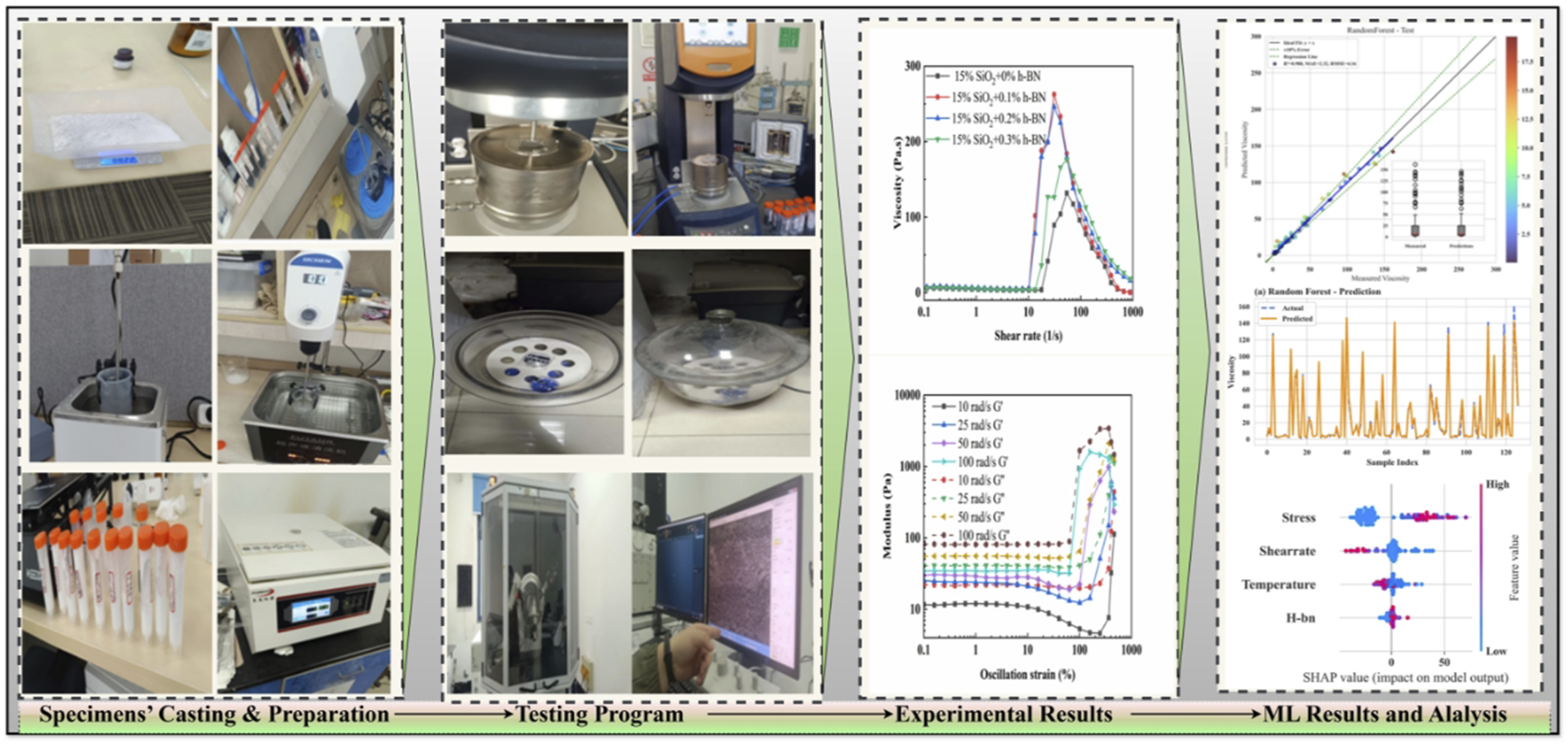
This research aims to examine the role of h-BN nanoparticles in improving the shear-thickening properties of silica-based STFs. The h-BN/SiO2 suspensions were prepared through mechanical stirring and ultrasonication, followed by detailed structural and rheological characterization. To assess how the h-BN mass ratio and surrounding temperature affect STF performance, steady-shear and oscillatory-shear tests were performed. Alongside the experimental investigation, machine learning models, including Random Forest (RF) and CatBoost, optimized with Particle Swarm Optimization (PSO), were developed to predict and generalize the rheological response of the suspensions. The data were divided into training, testing, and validation splits, and Shapley Additive explanations (SHAP) analysis was conducted to interpret the contribution of input features to model predictions. By integrating experimental evaluation with machine learning, this work seeks to provide insights into the development of high-performance shear-thickening fluids with enhanced rheological behavior and multifunctional capabilities.
Experimental procedure
Materials
The nano-silica (SiO2) particles used in this study were procured from Aladdin Biochemical Technology Corporation Limited, Shanghai, China. The SiO2 particles had an average diameter of 15 nm, a pH range of 3.88–4.77, and a relative density of 2.339–2.665. Polyethylene glycol (PEG200) was obtained from Usolf Chemical Technology Cooperation Limited, Shandong Province, China. At room temperature, PEG200 appeared as a stable, transparent liquid with a hydroxyl value of 510–623 mg KOH/g h-BN with an average particle size of 100 nm was supplied by Zhen Weld New Materials, Suzhou Co., Ltd, China. Some materials specifications and procurement details follow the procedure reported in our previous work. 67
STFs Preparation
The preparation of the STFs involved several steps to ensure uniform dispersion and optimal rheological performance. Before experimentation, the dispersed-phase particles (nano-SiO2 and h-BN) were dried in an automated oven at 80°C for 12 hours to remove any residual moisture.
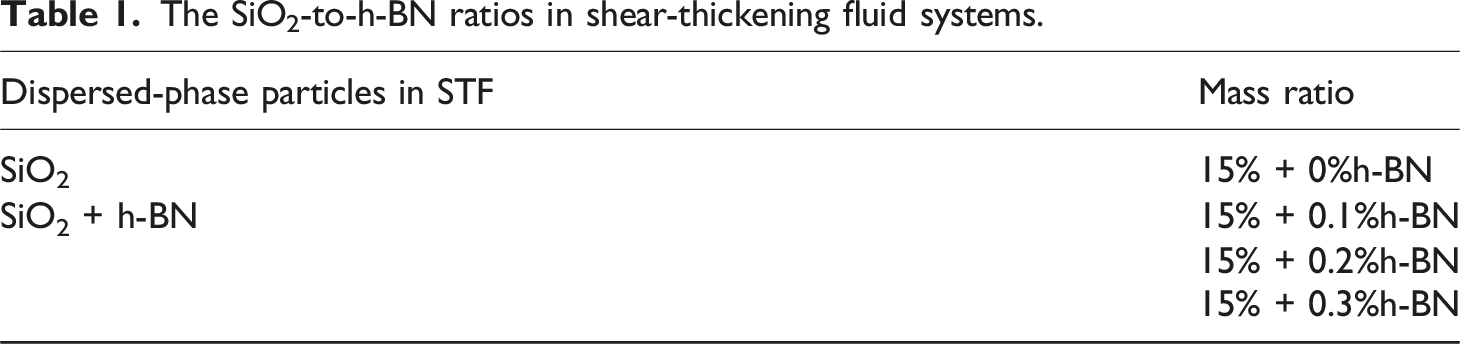
To prepare the STF, a measured quantity of polyethylene glycol (PEG200) and (h-BN) nanoparticles, at concentrations ranging from 0.1% to 0.3% by mass ratio, was put into a beaker and agitated with a mechanical device. Subsequently, SiO2 particles were gradually introduced into the carrier fluid to achieve the desired SiO2-to-h-BN ratios for each sample. After each incremental addition of SiO2, the mixture was mechanically stirred for 25 minutes, with the final stage requiring an extended stirring duration of 90 minutes.
Following the initial mixing, the required quantity of h-BN was added to the beaker, and the mixture was agitated mechanically until uniform blending was achieved. The beaker containing the mixture was placed in a water bath maintained at a constant temperature to ensure consistent agitation. Once all the dispersed-phase powders had been introduced, the mixture was subjected to ultrasonic oscillation (at a frequency of 40 kHz and a power output of 120 W) for 30 minutes to further disperse the particles evenly throughout the PEG200 medium.
The SiO2-to-h-BN ratios in shear-thickening fluid systems.
Rheological testing
The rheological properties of the prepared h-BN/SiO2-STFs with varying SiO2-to-h-BN ratios were evaluated under both steady-state and dynamic conditions using a rheometer (TA Instruments AR2000, United States). The tests were conducted at a laboratory ambient temperature of 18°C. A cone-plate geometry with a 25 mm diameter and a 2° cone angle was used for all measurements, and the cone-plate gap was maintained at 52 μm throughout the experiments.
To prepare for testing, STF samples were uniformly distributed around the rheometer’s bottom plate. After that, the top cone plate was lowered until the desired 52 μm gap was reached. Temperature control during the experiments was ensured using a temperature regulation device integrated with the rheometer, which was used to precisely regulate the sample temperature. The rheological behaviour of the STF samples was analysed at various temperatures, specifically 15°C, 20°C, 30°C, 40°C, and 50°C, to assess the impact of temperature on their performance. At each temperature, the sample was allowed to equilibrate for approximately 5–10 minutes before measurement to ensure uniform thermal distribution throughout the suspension.
The steady-shear rheological tests were conducted by changing the shear rate between 0.1 s−1 to 1000 s−1. This allowed for the evaluation of shear-thickening behaviour, including the critical shear rate and viscosity changes under varying stress conditions. For dynamic rheological testing, the STF samples were subjected to oscillatory shear stress within the range of 0.1 to 1000 Pa. These tests provided insights into the viscoelastic properties of the STFs, including energy storage and dissipation characteristics, under both low- and high-stress conditions. The combination of steady-state and dynamic rheological analyses ensured a comprehensive understanding of the shear-thickening behaviour, viscoelasticity, and temperature sensitivity of the h-BN/SiO2-STFs. These findings are critical for optimizing STF formulations for advanced applications.
Machine learning methodology
Methods
Random forest
The RF algorithm is a robust ensemble learning method based on Classification and Regression Trees (CART), formally introduced by Leo Breiman in 2001. 68 RF has since been widely applied in both classification and regression problems due to its strong generalization capability. As a statistical learning technique, RF employs bootstrap resampling to generate multiple training subsets from the original dataset, 69 each of which is used to construct an individual decision tree.
In addition to bootstrap sampling, RF incorporates random feature selection at each split: a subset of predictors is randomly selected, and the optimal split is determined only within this subset. This mechanism reduces inter-tree correlation and enhances model robustness. The predictions of all trees are then aggregated to produce the final output: averaging is used for regression, while majority voting is applied for classification, as illustrated in Figure 1(a). Further methodological details can be found in 70. Schematic diagrams of (a) RF, (b) CatBoost, and (c) PSO.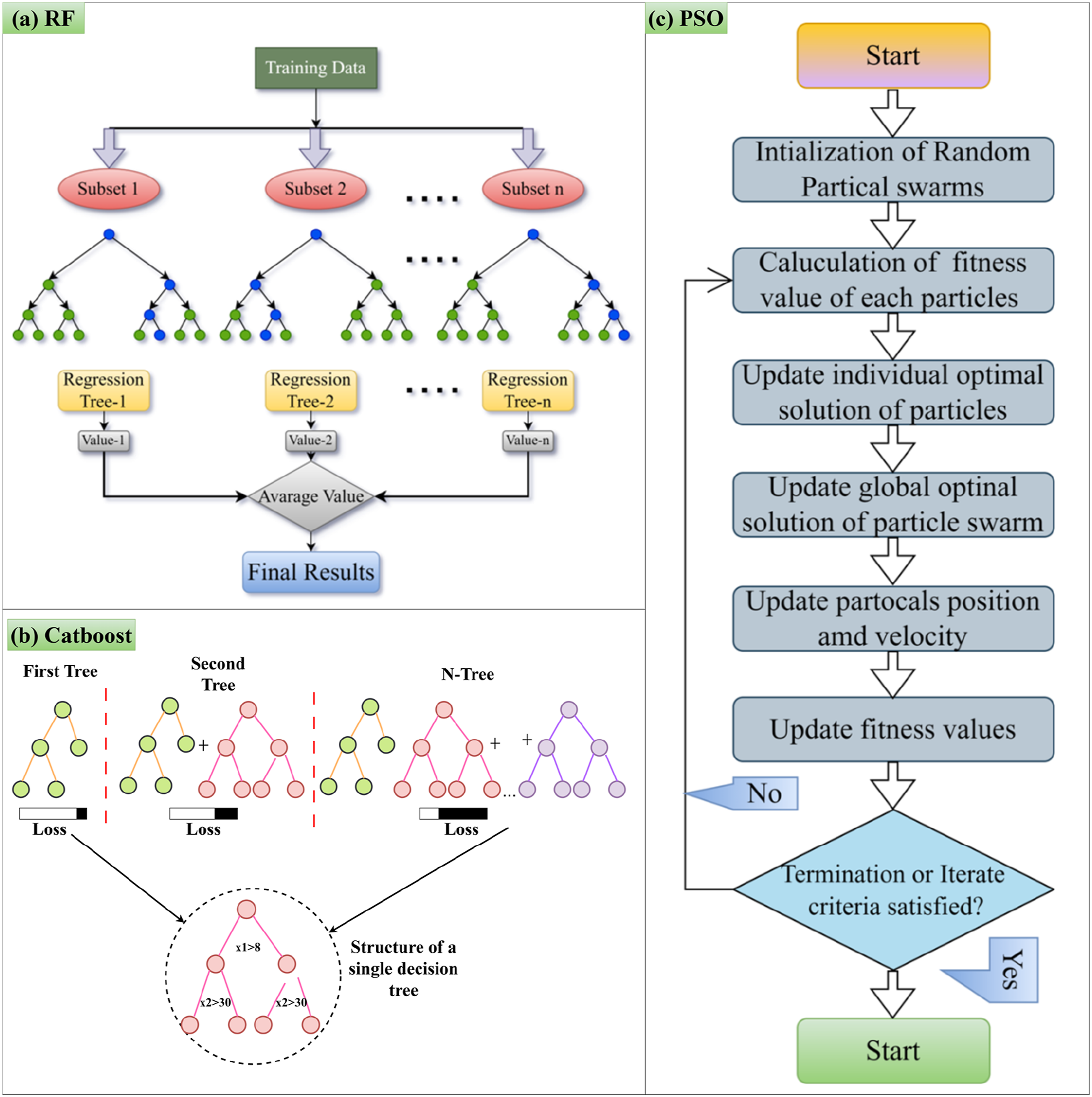
CatBoost
In 2017, Yandex introduced CatBoost, an ML algorithm based on Gradient Boosting Decision Trees (GBDT). 71 CatBoost constructs an ensemble of decision trees sequentially, where each new tree is fitted to the negative gradient of the loss function with respect to the current model prediction. Through this iterative procedure, the model progressively minimizes the specified loss function. An overfitting detector is incorporated to control model complexity and prevent performance degradation on validation data. 72 The schematic representation is shown in Figure 1(b).
The model update at iteration 
The weak learner 
Tree construction in CatBoost involves split selection, leaf value estimation, and efficient handling of categorical features. Unlike conventional GBDT implementations, CatBoost employs ordered boosting and permutation-driven target statistics to reduce prediction shift and overfitting. Trees are typically grown using greedy splitting strategies under predefined structural constraints such as depth and regularization parameters. During successive iterations, the model evaluates performance using a specified optimization metric to ensure consistent improvement of the objective function. 70
Particle swarm optimization
PSO developed by James Kennedy and Russell Eberhart,73,74 is a population-based stochastic optimization algorithm inspired by collective social behavior. In PSO, each particle represents a candidate solution within an
PSO begins with a randomly initialized population of particles. Each particle adjusts its trajectory based on its personal best position (pbest) and the global best position (gbest) discovered by the swarm.77,78 The iterative process continues until a termination criterion is satisfied. Figure 1(c) illustrates the schematic flow of the algorithm.
The velocity and position of the 

To balance exploration and exploitation, the inertia weight 
Shapley additive explanations
Tree-based ensemble learning methods, such as RF and CatBoost, inherently provide measures of feature relevance, commonly based on impurity reduction or split frequency during tree construction. 79 Although these importance measures offer useful insights, they do not fully characterize the marginal contribution of features nor capture complex interactions between predictors and the response variable.
To address these limitations, SHAP proposed by Lundberg and Lee, 80 provides a unified framework grounded in cooperative game theory. In SHAP, features are treated as players in a coalition game, and their contributions to the model output are quantified using Shapley values. These values represent the average marginal contribution of a feature across all possible feature subsets. Global feature importance is typically obtained by averaging the absolute Shapley values over all samples. SHAP summary plots display these values in descending order, with the x-axis representing Shapley values, the y-axis listing features ranked by importance, and color gradients indicating feature magnitude. Dependence plots further illustrate interaction effects between features, providing detailed local interpretability beyond traditional partial dependence methods. 81
Lundberg and Lee developed various SHAP analysis versions, such as DeepSHAP, LinearSHAP, Kernel SHAP, and TreeSHAP.
82
This study employs TreeSHAP, an efficient algorithm specifically designed for tree-based models.
83
The explanation model for the initial prediction is formulated as presented in equation (6):
Here, 

Results and discussion
Steady-shear rheological analysis of STFs
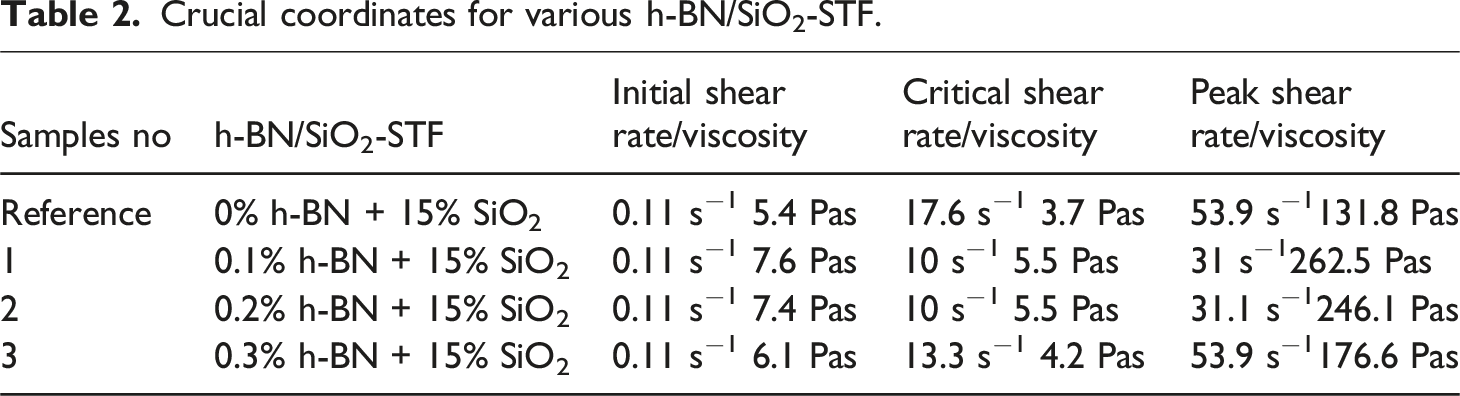
Figure 2 represents the viscosity curves of h-BN/SiO2-STFs under steady-state shear tests (0.1–1000 s−1) for four distinct mass mixing ratios. All samples used PEG200 as the dispersive medium, with h-BN mass fractions of 0%, 0.1%, 0.2%, and 0.3%, and a fixed 15% SiO2 content. Each curve exhibits regions of rapid viscosity reduction, shear thickening, and shear thinning. Notably, the h-BN/SiO2-STF system exhibited a higher apparent viscosity and a pronounced effect of shear-thickening in contrast to the SiO2-only STF. For the h-BN-SiO2/STF system with different h-BN to SiO2 ratios, the viscosity against shear rate. (a) Logarithmic coordinate. (b) Semi-Logarithmic coordinate.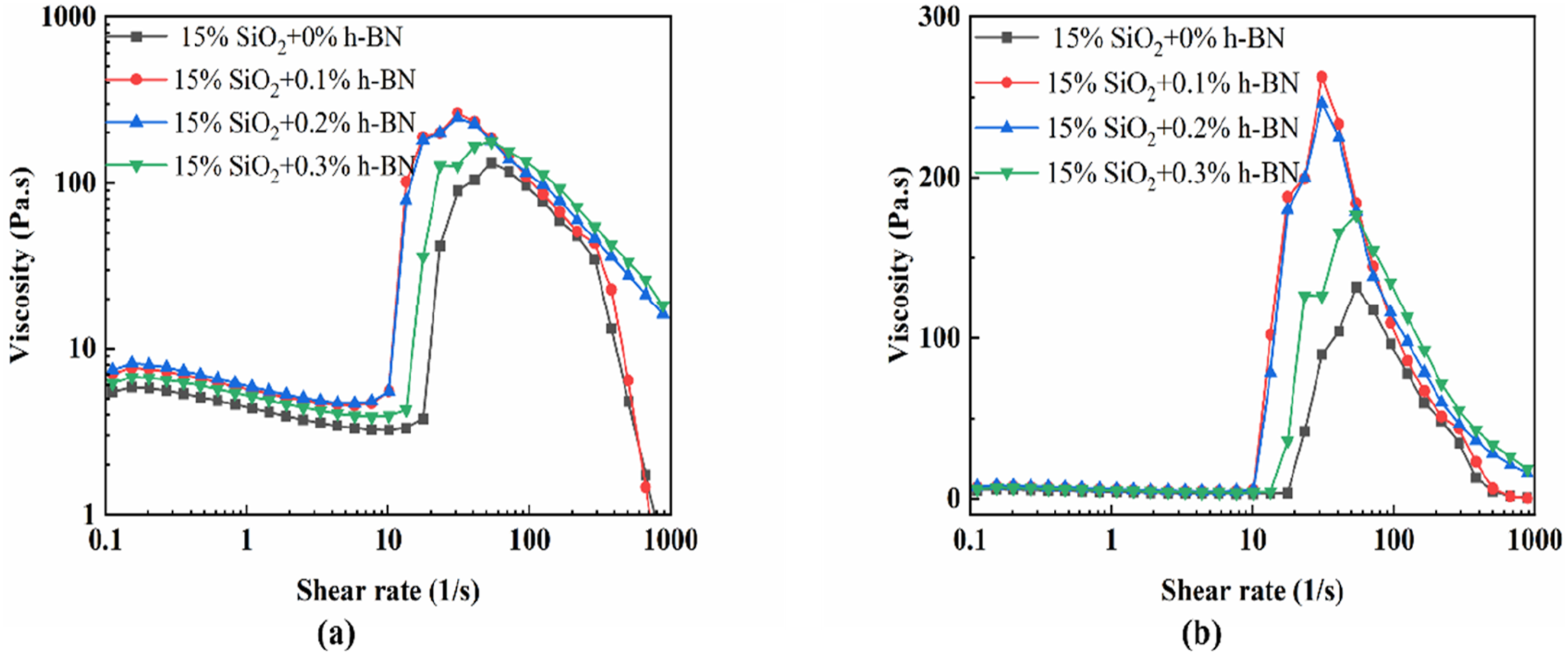
Crucial coordinates for various h-BN/SiO2-STF.
To demonstrate the enhancement in the STF’s viscosity, we set the ratio as:
Percentage Increase = The improved viscosity ratio of various STFs in comparison to the Reference STF.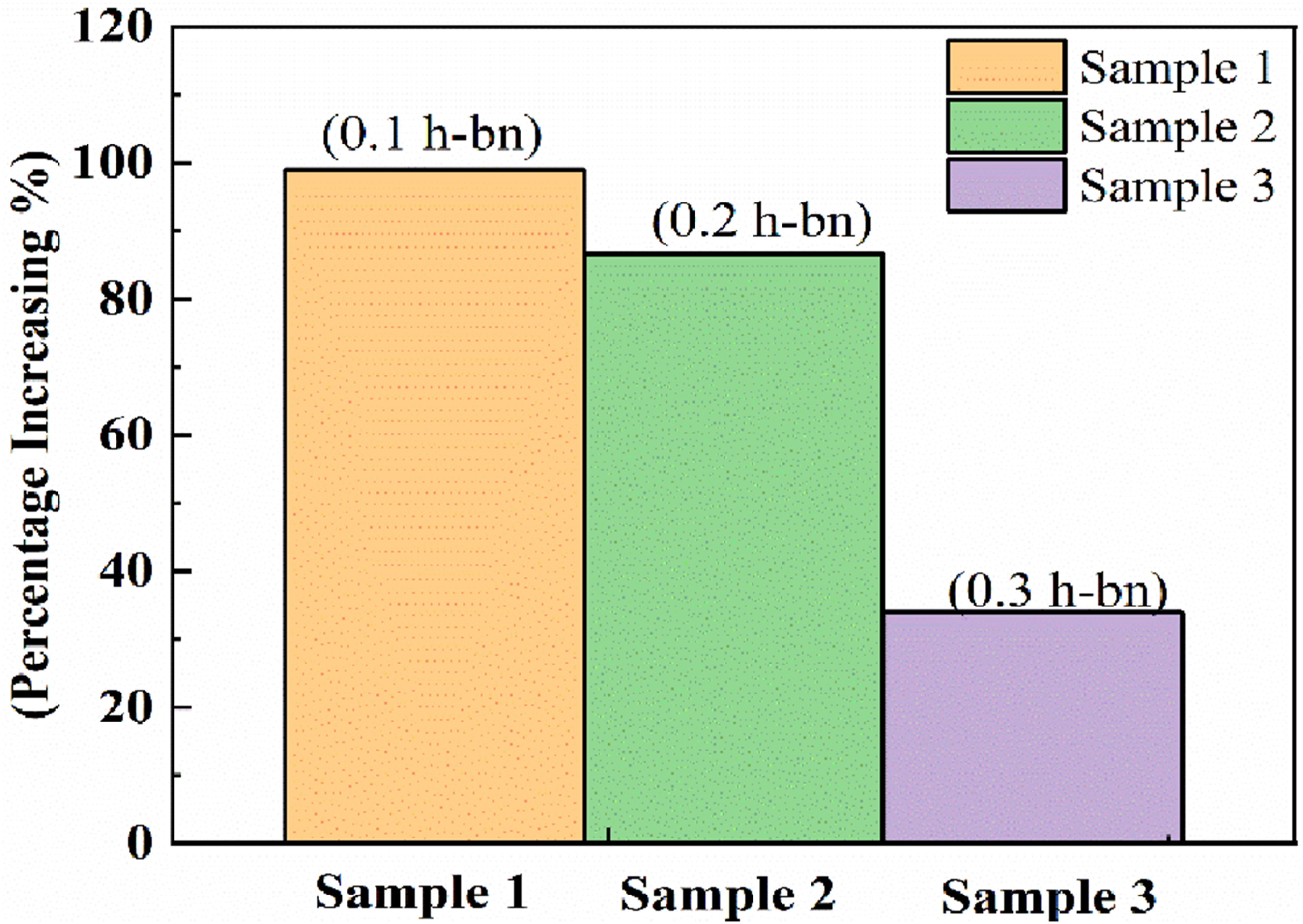
Increasing the h-BN concentration beyond 0.1% resulted in a decrease in peak viscosity and an increase in critical shear rates, attributed to excessive particle dispersion and lubrication effects. For instance, at 0.3% h-BN, the critical shear rate rose to 13.3 s−1, and the peak viscosity dropped to 176.6 Pas. These results underscore the importance of optimizing h-BN concentration to balance shear thickening and flowability, with 0.1% h-BN identified as the optimal composition.
Figure 4 shows that the reversibility and stability of the STF were also evaluated. Figure 4(a) shows the reversible nature of the STFs, with minimal hysteresis between viscosity curves during cyclic shear tests. This reversibility is attributed to the transient nature of particle clustering under varying shear forces. Stability tests in Figure 4(b) demonstrated that viscosity remained largely constant under steady shear conditions, highlighting the STF’s reliability for extended use. Rheological characteristics of the 0.1%h-BN/SiO2-STF shear thickening fluid sample (a) Reversibility. (b) Stability.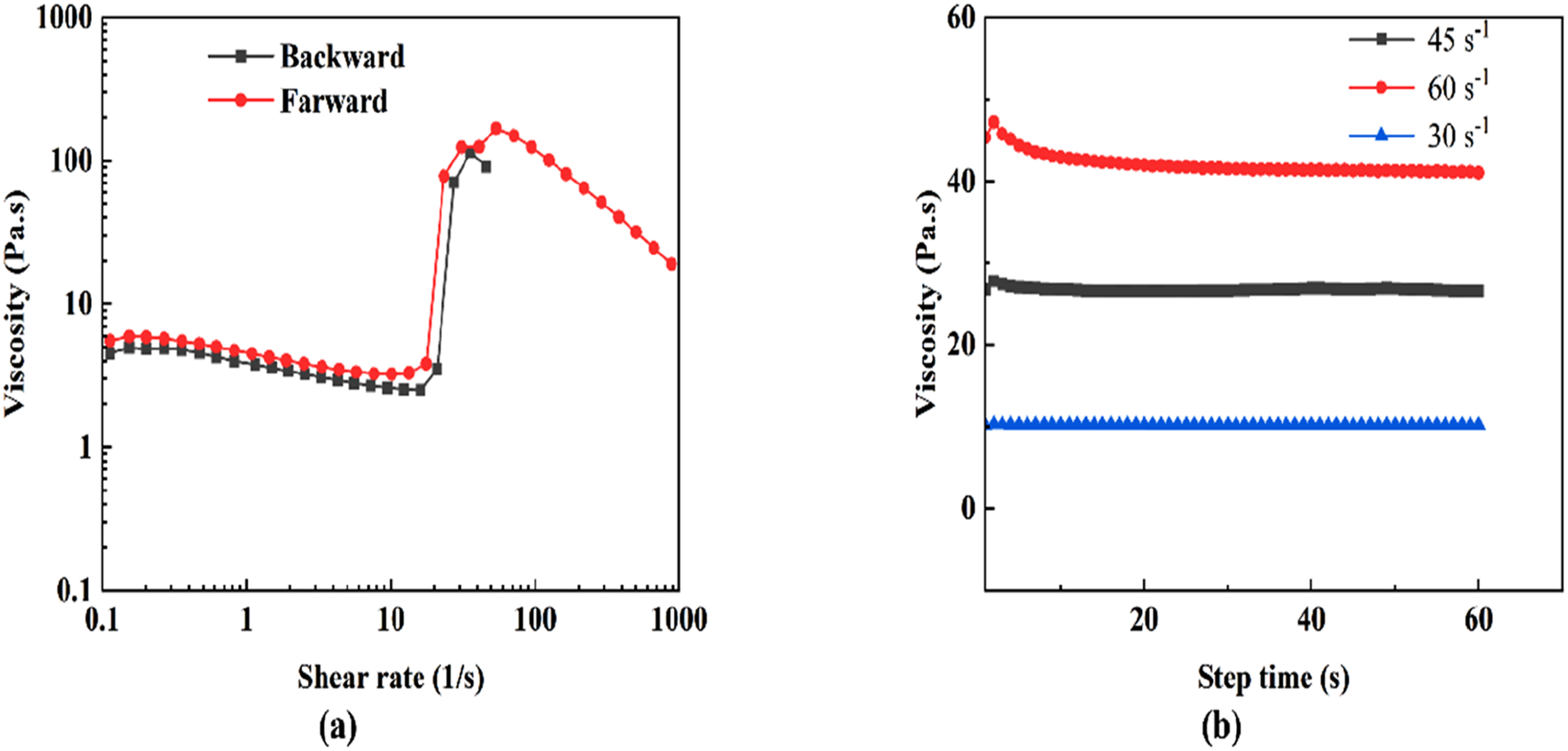
Dynamic rheological analysis of STF
The dynamic rheological properties of the 0.1% h-BN/SiO2-STF system were examined. Figure 5 shows how the storage modulus (G′) and loss modulus (G″) vary with strain at angular frequencies of 10, 25, 50, and 100 rad/s. The system underwent four stages: elastic behavior, slight thinning, complete thickening, and eventual thinning. As the strain increased, both moduli exhibited a general upward trend, influenced by the uniform particle distribution and clustering within the system. Strain versus storage and loss modulus for 0.1%h-BN/SiO2-STF. (a) Coordinate logarithm. (b) Semi-Coordinate Logarithm.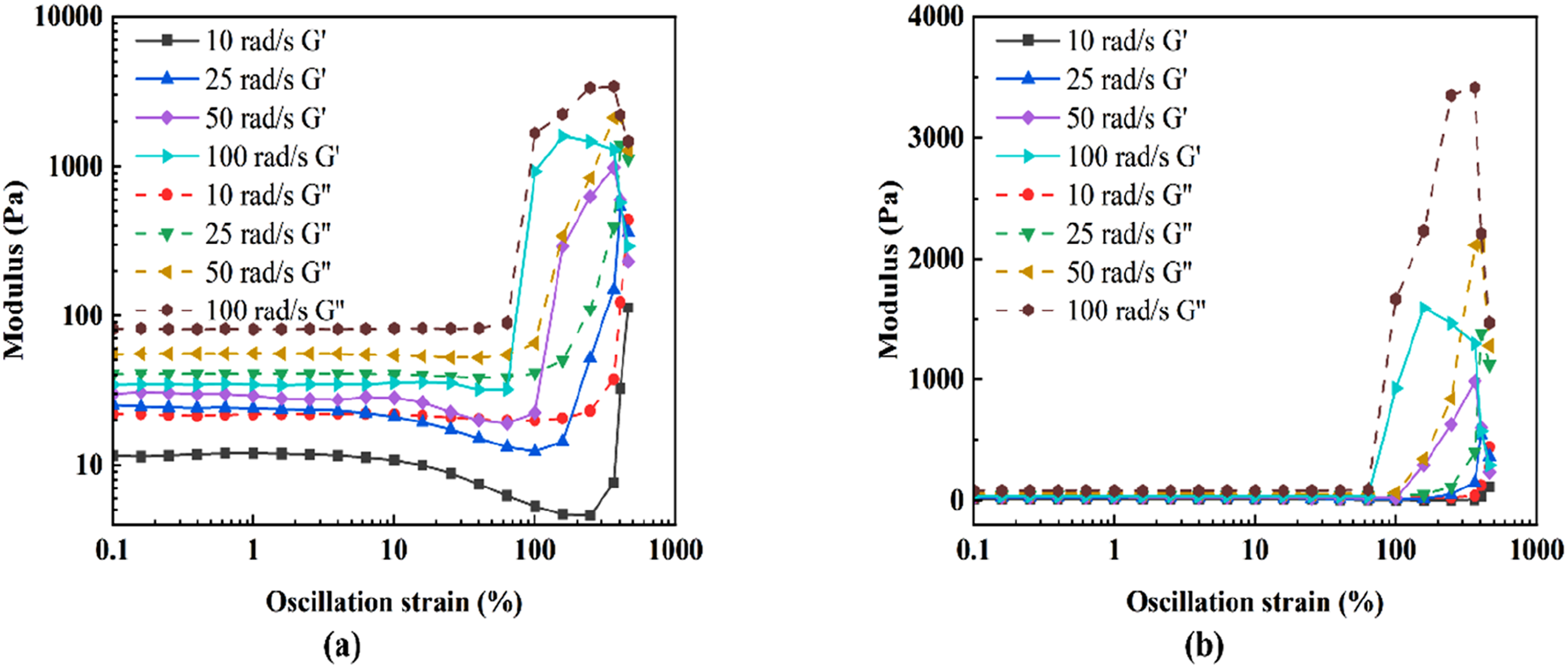
Frequency-dependent behaviour of G′ and G″ is shown in Figure 6. At low angular frequencies, the intermolecular and Brownian forces maintained the structure, resulting in gradual increases in moduli. At higher frequencies, hydro-lubrication promoted particle clustering, resulting in nonlinear modulus growth. These trends indicate the STF’s capacity for energy dissipation under dynamic conditions, making it suitable for vibration control applications. Storage and loss modulus for 0.1%h-BN/SiO2-STF as a function of frequency. (a) Logarithmic coordinate. (b) Semi-logarithmic coordinate.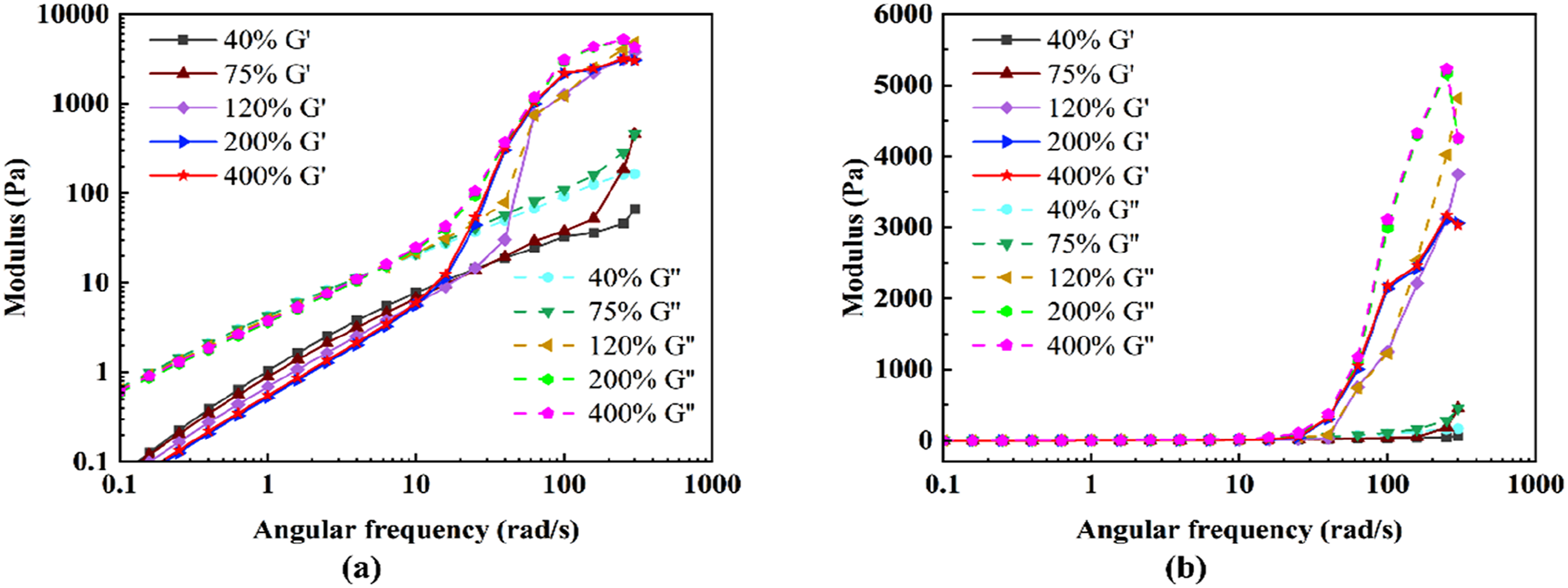
The performance of the 0.1% h-BN/SiO2-based STF under oscillatory loading conditions was assessed by analysing its dynamic rheological characteristics. The evolution of G′ and G″ at different angular frequencies (10, 25, 50, and 100 rad/s) with increasing strain amplitude is shown in Figure 6. Four distinct rheological stages are shown by the system: (i) an initial elastic behaviour at low strains; (ii) a weak shear-thinning response; (iii) a strong shear-thickening transition marked by a notable increase in both G′ and G″; and (iv) the final stage that involves secondary shear-thinning or structural disintegration. These findings are in good agreement with the behaviour of CeO2/SiO2-STFs reported by Wei et al.
85
who noted comparable rheological transitions as strain magnitude increased. Higher energy dissipation and better modulus responsiveness during the thickening phase are caused by the uniform network development and increased particle dispersion in both systems. The h-BN-based STF’s improved capacity to store and release mechanical energy, a crucial parameter for vibration dampening and protective applications, is indicated by the increasing trend in G′ and G″ with increasing angular frequency. Further analysis of the moduli’s frequency dependency at fixed strain amplitudes is shown in Figure 6 and 7. Because of the dominance of Brownian motion and weak intermolecular interactions at low angular frequencies, the STF structure can reorganize effectively. Particle clustering is encouraged by the hydro-lubrication forces created by high-frequency oscillation, which raises internal resistance and causes nonlinear increases in both moduli as frequency rises. CeO2/SiO2-STFs have also been found to exhibit this hydro-lubrication-induced clustering, demonstrating its versatility in nanoparticle-reinforced STF systems. Interestingly, G″ consistently outperforms G′ at all frequencies, particularly at high ones, highlighting the fluid’s better viscous dissipation tendency. The substantial energy absorption capabilities suggested by this dynamic loss modulus dominance validate the potential of h-BN/SiO2-STFs for usage in impact mitigation and damping systems. Crucially, the addition of h-BN seems to alter the system’s clustering and internal friction properties. The 0.1% h-BN loading in our STF produces a similar rheological increase at a far lower concentration than CeO2/SiO2 systems, which exhibit peak dissipation around 12% ceria loading. The high aspect ratio and smooth surface of h-BN, which aid in both lubrication and structure development, are responsible for this efficiency. Higher concentrations of h-BN, however, were found to impair performance because of possible particle agglomeration and over-lubrication. These effects are in line with earlier findings in systems modified by zirconia,
84
where excessive additive loading disrupted network formation and reduced the efficiency of shear thickening. These results highlight the h-BN-reinforced STFs’ dynamic adaptability and adjustable rheological response, bolstering their potential as cutting-edge materials for structural damping, vibration control, and protective gear applications. Distribution of the input features and the range of the target variable.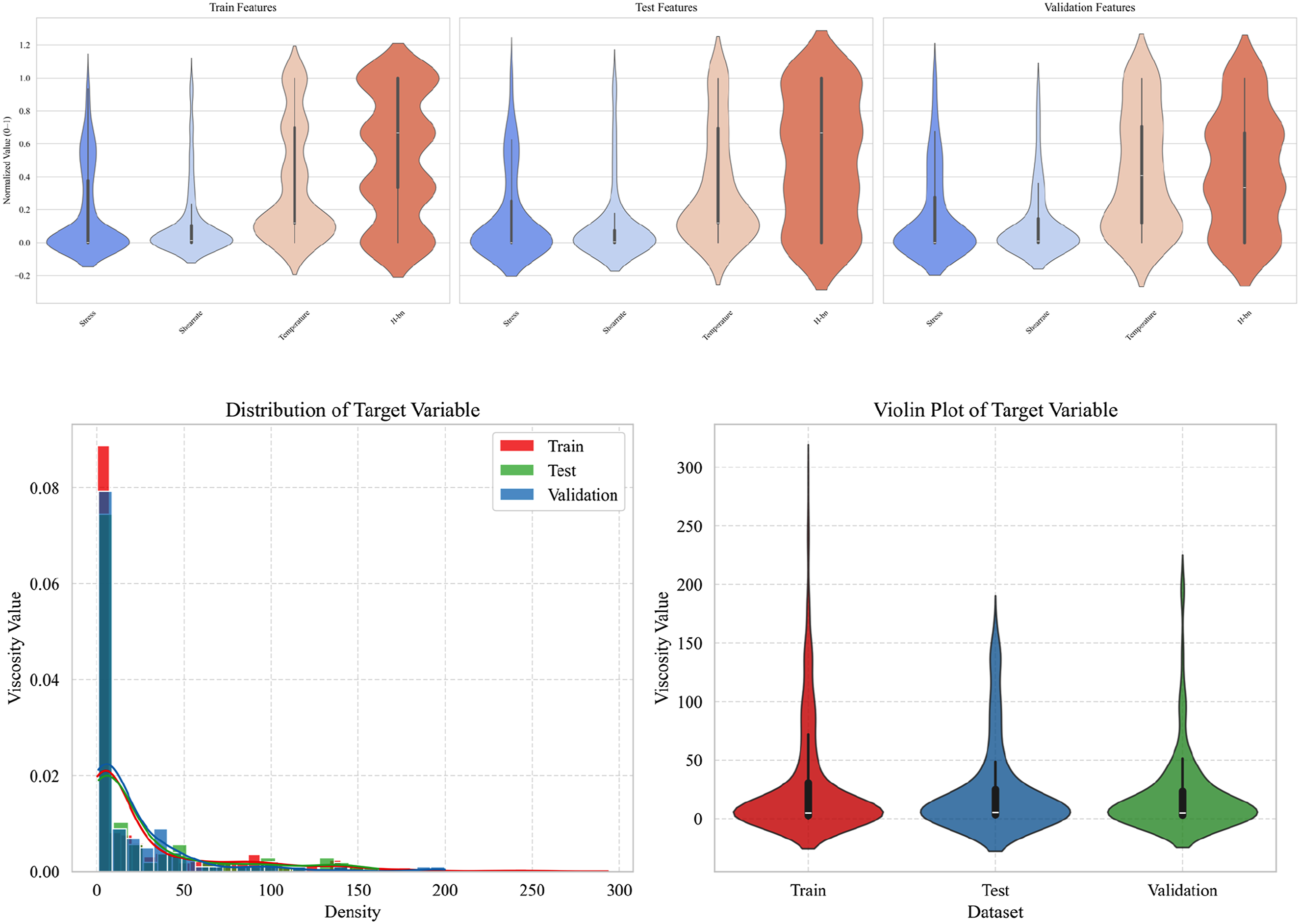
Temperature Sensitivity of STF
Figure 8 illustrates the connection between shear rate and viscosity at different temperatures for 0.1%h-BN/15%SiO2-STF. The systems exhibited decreasing initial and peak viscosities with increasing temperatures, accompanied by higher critical shear rates. Shear rate against viscosity for 0.1%h-BN/SiO2-STF. at different temperatures. (a) Coordinate Logarithm. (b) Semi-coordinate logarithm.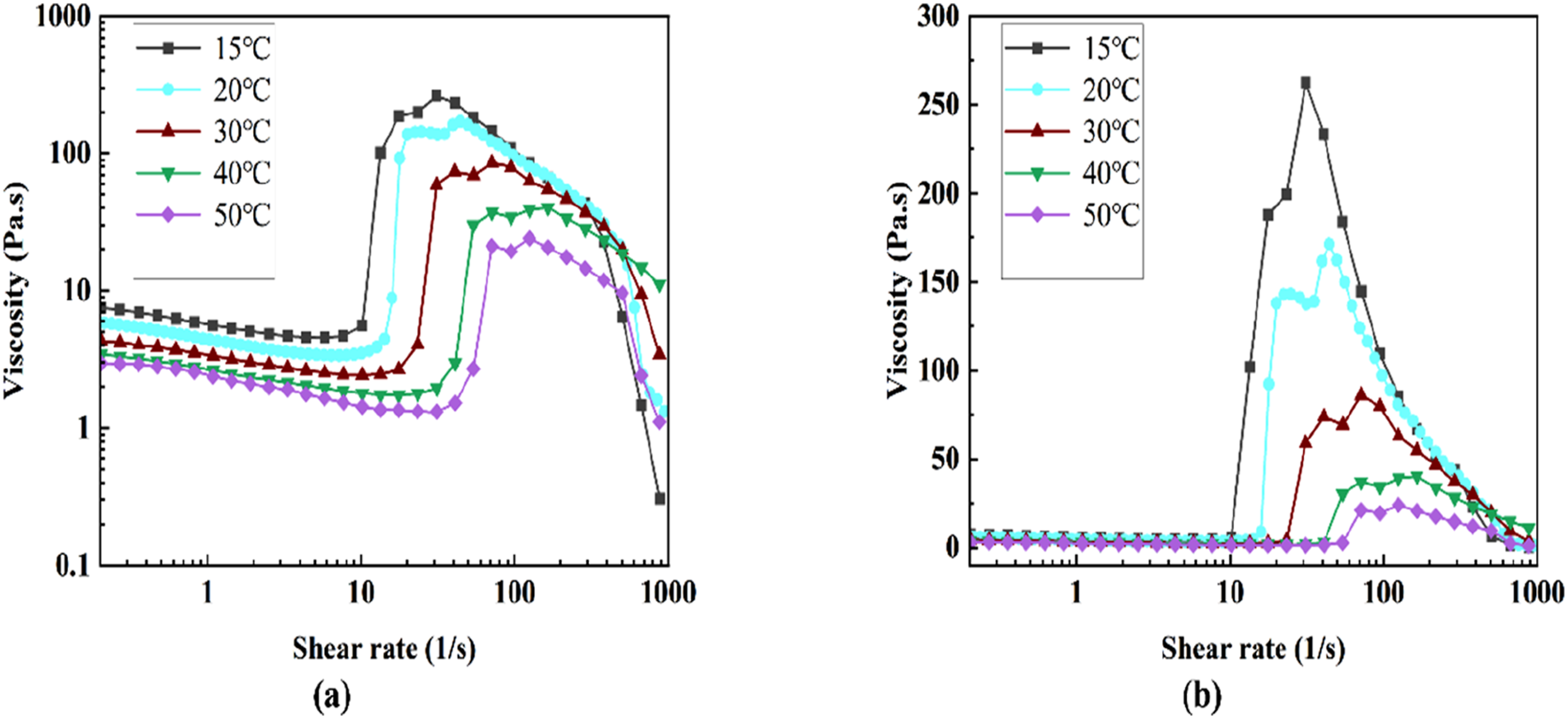
At 15°C, the 0.1% h-BN system demonstrated a peak viscosity of 263 Pas and a critical shear rate of 10s−1, representing a 99.05% improvement in viscosity and a 42.49% reduction in critical shear rate compared to the 0% h-BN system. Even at 50°C, the 0.1% h-BN system retained superior performance, with a 43.32% viscosity improvement and a 42.24% reduction in critical shear rate. These results highlight the enhanced thermal stability and shear-thickening behavior of h-BN-enhanced STFs, making them promising candidates for high-temperature applications requiring reliable performance. 50 The PEG-h-BN matrix’s capacity to sustain particle–polymer interactions over the measured temperature range (15–50°C) is thought to be the cause of the observed stability in viscosity with temperature. By decreasing molecular mobility in the matrix, h-BN may serve as a thermal stabilizer, maintaining STF behavior. These results are supported by the previous literature.84,85
ML model development and assessment
Data splitting
The h-BN/SiO2 STF dataset comprises 844 experimental observations collected over a temperature range of 15°C to 50°C. To develop reliable machine learning models and ensure robust generalization assessment, a three-way data partitioning strategy was adopted. Initially, 85% of the dataset (717 samples) was allocated for model development, while the remaining 15% (127 samples) was reserved as an independent validation set to evaluate final model performance on unseen data. The development subset was further divided into 70% training data (590 samples) and 15% internal testing data (127 samples). This partitioning yields a consistent distribution of 70% training, 15% testing, and 15% validation samples, ensuring reproducibility and unbiased performance evaluation.
In accordance with prior research 10 which predicted STF viscosity as a function of temperature and shear rate, the present work expands the input feature space to better capture the underlying rheological complexity. The selected input variables for both the RF and CatBoost model development were applied stress, shear rate, temperature, and h-BN concentration, while STF viscosity was used as the target variable. The input variables were maintained in their original measured scales throughout model development. RF and CatBoost are tree-based ensemble methods that perform recursive partitioning using threshold-based splits, making their learning processes invariant to monotonic rescaling and independent of feature-magnitude standardization. Stress and shear rate were used in their experimentally measured forms, preserving the intrinsic physical relationships within the rheological data and enabling the models to capture nonlinear dependencies directly from the raw measurements. Outlier observations were retained to reflect realistic experimental variability and extreme rheological responses. Due to the inherent robustness of tree-based ensemble methods and the use of mean absolute error (MAE) as the optimization metric, the influence of extreme values on model training and evaluation was effectively mitigated without the need for explicit data filtering. Figure 8 illustrates the normalized distributions of the input features and the range of the target variable (viscosity) across the training, testing, and validation subsets, primarily to demonstrate that each subset spans the full experimental range of the dataset.
RF and CatBoost models’ parameters optimization
Hyperparameters obtained during PSO optimization for RF and CatBoost.
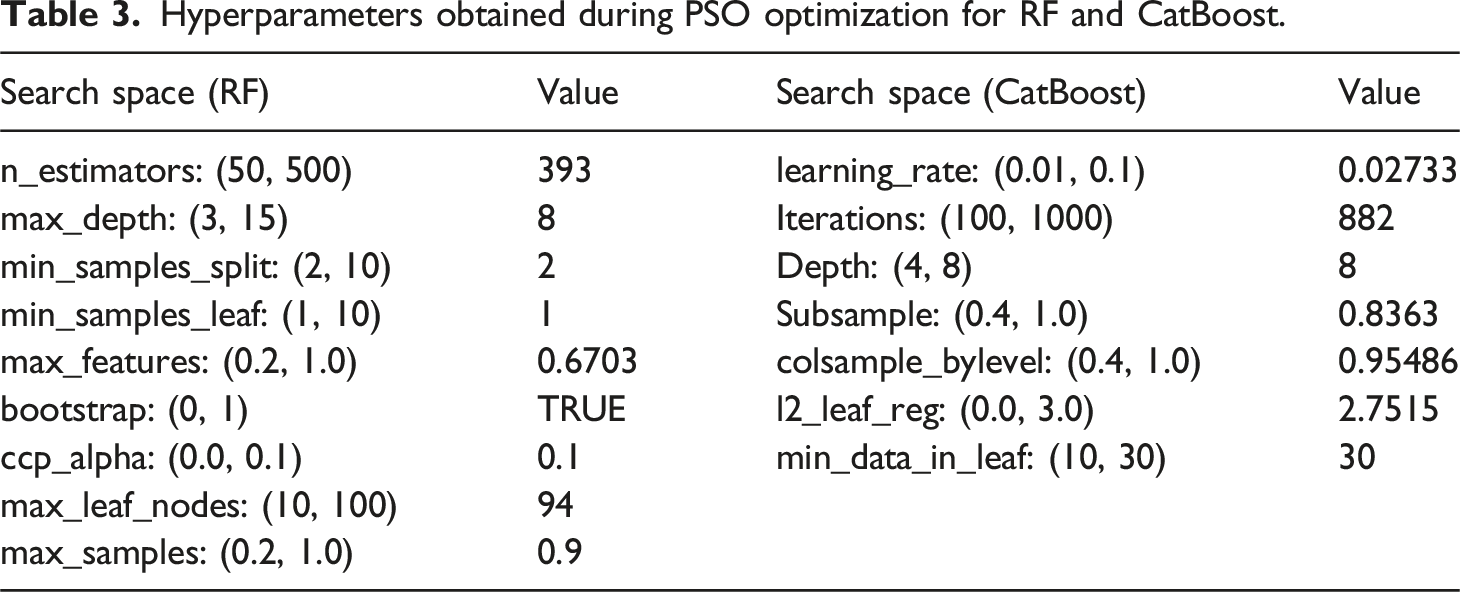
The PSO algorithm was implemented with a particle population of 20. The inertia weight was fixed at 0.5 to balance exploration and exploitation within the hyperparameter search space, while the cognitive and social acceleration coefficients were both set to 1.5 to guide particles toward their individual and global best solutions. The convergence behavior of the optimization process for both models is illustrated in Figure 9. A monotonic reduction in MAE was observed as the number of iterations increased, indicating stable convergence. The RF model reached convergence after approximately 10 iterations, whereas the CatBoost model required 38 iterations, reflecting the higher complexity of its parameter space. PSO convergence plot of RF and CatBoost.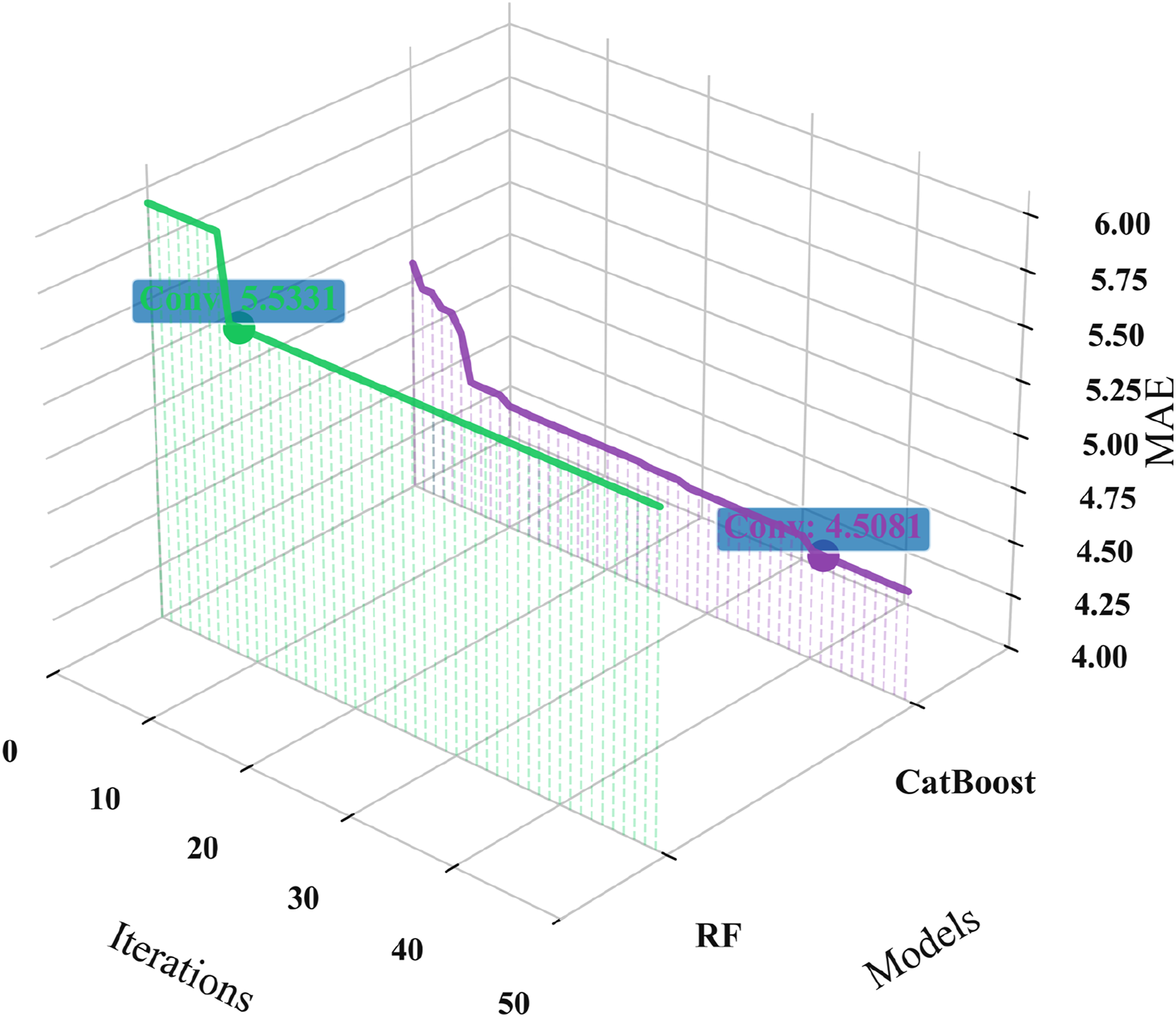
Model performance assessment
To quantitatively evaluate the predictive performance of the PSO-optimized RF and CatBoost models on the training, testing, and validation datasets, the following statistical indicators were employed: coefficient of determination 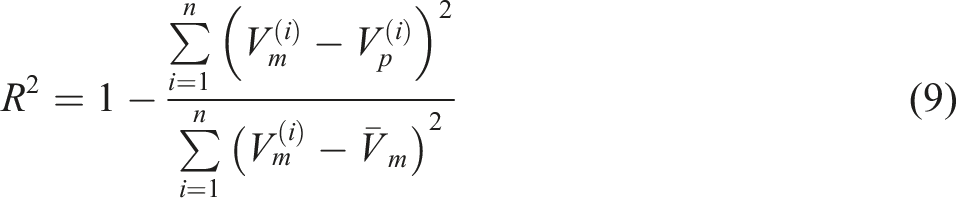


Prediction results
Figure 10 presents scatter plots comparing measured and predicted viscosity values, with dashed lines indicating 10% error bands and accompanying residual distributions: panels (a) and (b) correspond to the RF model for training/testing and validation, respectively; panels (c) and (d) show the corresponding results for CatBoost. Actual and predicted viscosity of STFs for (a, b) Random Forest and (c, d) CatBoost models across training, testing, and validation datasets.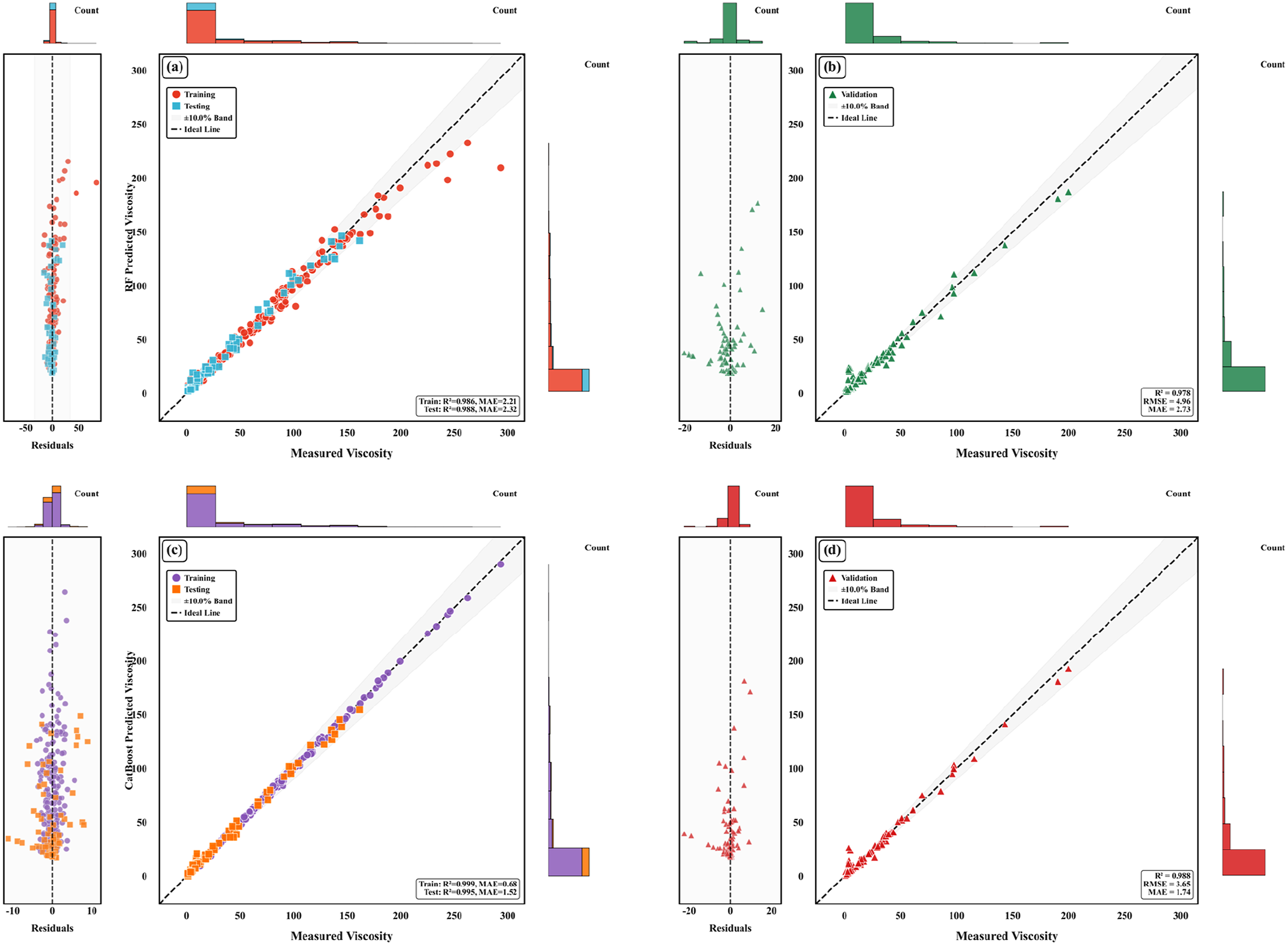
The RF model exhibits a good fit across all datasets, with R2 values of 0.9862, 0.9879, and 0.9781 for the training, testing, and validation sets, respectively. The error metrics remain moderate: the training set yields an MAE of 2.21 and an RMSE of 5.47; the test set shows an MAE of 2.32 and an RMSE of 4.16; and the validation set achieves an MAE of 2.73 and an RMSE of 4.96. The residual distributions in panels (a) and (b) indicate that most predictions fall within the 10% error bands, though occasional outliers suggest the model can produce larger errors in specific instances, particularly during validation.
The CatBoost model achieves higher training accuracy, with an R2 of 0.99, an MAE of 0.68, and an RMSE of 1.0542. Its performance on unseen data remains robust, with test and validation R2 values of 0.9948 and 0.9881, respectively. The error metrics are consistently lower than those of the RF model: the test set yields an MAE of 1.5152 and RMSE of 2.73, while the validation set shows an MAE of 1.7367 and RMSE of 3.65. As shown in panels (c) and (d), the predictions generally align well within the 10% error bands, though the residual plots reveal somewhat greater dispersion in the testing and validation phases compared to training. Both architectures generalize effectively to unseen data, though the residual patterns suggest opportunities for further refinement to address occasional prediction discrepancies, particularly in the validation set.
Figure 11 presents a comparative uncertainty analysis of the RF and CatBoost models for viscosity prediction, displaying predicted values against sample indices with 95% prediction intervals. Panels (a) and (b) correspond to the RF model for testing and validation, respectively, while panels (c) and (d) show the corresponding results for CatBoost. The accompanying uncertainty metrics quantify model reliability and prediction precision. (a, b) Random Forest and (c, d) CatBoost: comparison of predicted versus observed values on the validation and testing sets, including 95% prediction intervals.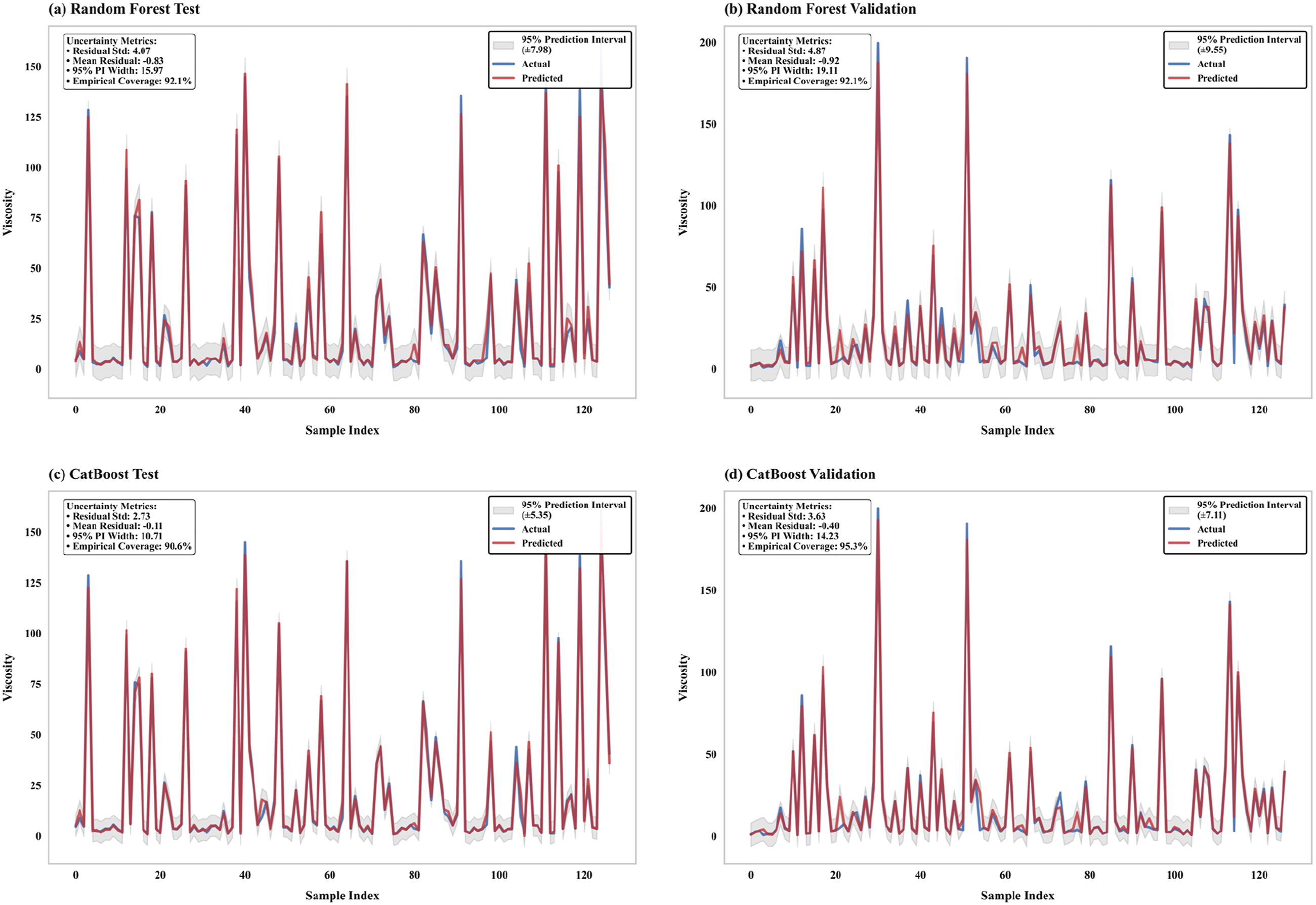
The line plots in Figure 11(a) and 11(c) track predicted viscosities against measured values across the test set sample indices. Both models fit the experimental data reasonably well, though deviations become more pronounced at higher viscosities, indicating reduced predictive accuracy in these regions. The uncertainty metrics quantify this behavior: the CatBoost model demonstrates superior precision with a residual standard deviation of 2.73 on the test set, compared to 4.07 for RF. This translates to narrower 95% prediction intervals for CatBoost (width of 10.71) than for RF (width of 15.97), representing approximately a 33% tighter uncertainty bound. The mean residual values reveal systematic bias patterns. CatBoost exhibits near-zero mean residuals on both test (−0.11) and validation (−0.40) sets, indicating minimal systematic error. In contrast, RF shows a tendency to underestimation, with mean residuals of −0.83 on the test set and −0.92 on the validation set.
The validation results highlight important generalization characteristics. RF maintains consistent empirical coverage (92.1% on both test and validation) but shows increased uncertainty on the validation data, with the residual standard deviation rising from 4.07 to 4.87 and the prediction interval width expanding from 15.97 to 19.11. CatBoost exhibits a different pattern: while residual standard deviation increases modestly from 2.73 to 3.63 on validation, its empirical coverage improves to 95.3%, indicating well-calibrated uncertainty estimates that appropriately capture the true variability in unseen data. This suggests that CatBoost’s prediction intervals provide more reliable indicators of actual prediction uncertainty. This superior performance of CatBoost can be attributed to its gradient boosting framework, which effectively models complex feature interactions and incorporates regularization mechanisms to control model complexity. This results in reduced overfitting and more stable predictions, as evidenced by the narrower prediction intervals and lower residual variability across both test and validation datasets.
Prediction model interpretation
The SHAP analysis provides detailed insights into the influence of individual features on viscosity predictions. As shown in Figure 12, Stress exhibits the highest mean absolute SHAP value (26.80), establishing it as the most influential predictor. Shear rate follows with a value of 9.10, whereas Temperature (5.71) and h-BN concentration (2.40) contribute comparatively less. The summary plot indicates that higher Stress values are consistently associated with positive SHAP values, reflecting an increase in predicted viscosity. In contrast, Shear rate demonstrates a non-linear, bidirectional influence: lower values generally decrease predicted viscosity, while moderate levels can increase it, depending on interactions with other variables. Overall, Stress dominates the predictive structure, with Shear rate exerting a secondary but non-negligible influence. Mean SHAP value plot and scatter beeswarm plot.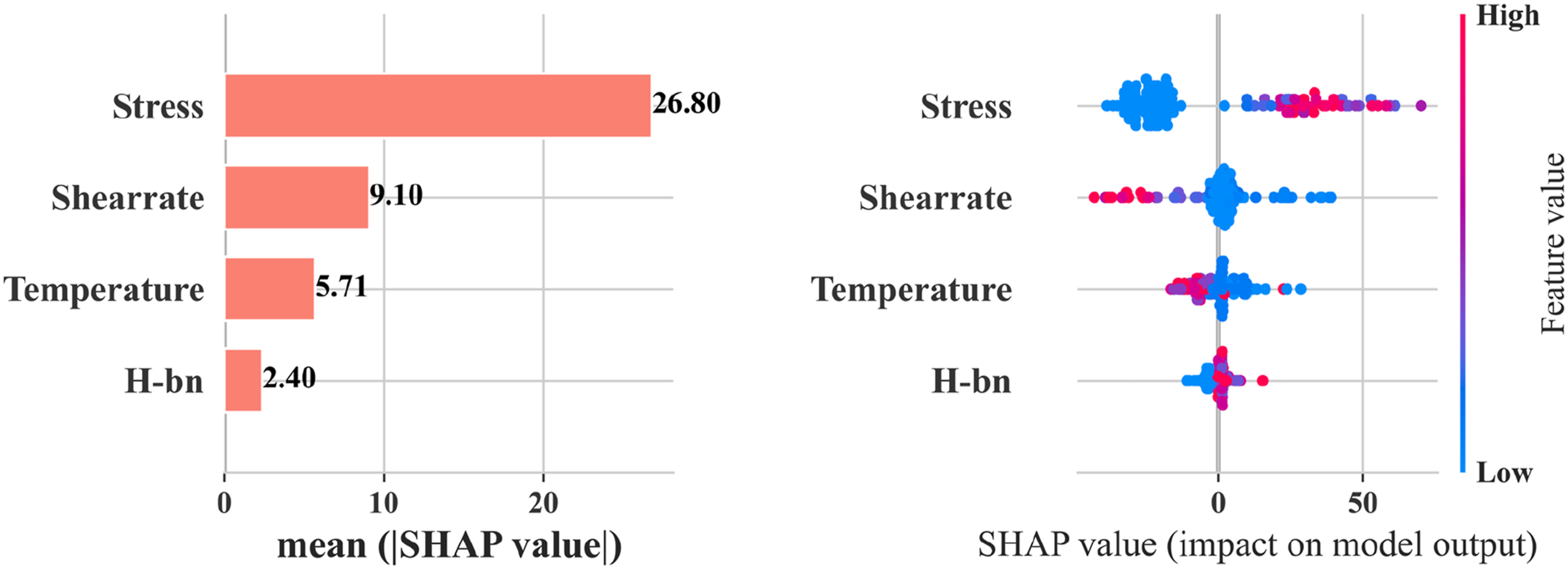
The predominance of Stress over Shear rate can be justified from both rheological and modeling perspectives. Rheologically, Stress represents the mechanical force required to overcome interparticle interactions and internal structural resistance in complex suspensions. In non-Newtonian systems, similar shear-rate values may arise under distinct internal structural states, whereas Stress directly reflects the material’s resistance to deformation, making it a more representative descriptor of viscosity variation.
The SHAP dependence plots in Figure 13 further clarify feature interactions. Figure 13(a) shows that increasing Stress generally elevates predicted viscosity. The color gradient reveals interaction with Temperature: at lower Temperature, Stress has a pronounced positive effect, whereas this influence weakens at higher Temperature. Figure 13(b) demonstrates the non-linear role of Shear rate. At low levels, it reduces predicted viscosity; at moderate levels, combined with favorable Stress conditions, it produces the strongest positive contribution. However, simultaneous high Stress and high Shear rate lead to diminished or negative effects, indicating an interaction-driven trade-off. Figure 13(c) reinforces the moderating role of Temperature, showing that rising Temperature attenuates the positive impact of Stress. Figure 13(d) indicates that h-BN concentration exerts a modest but generally positive influence, particularly under thermally favorable conditions. SHAP feature dependency plot of the CatBoost model.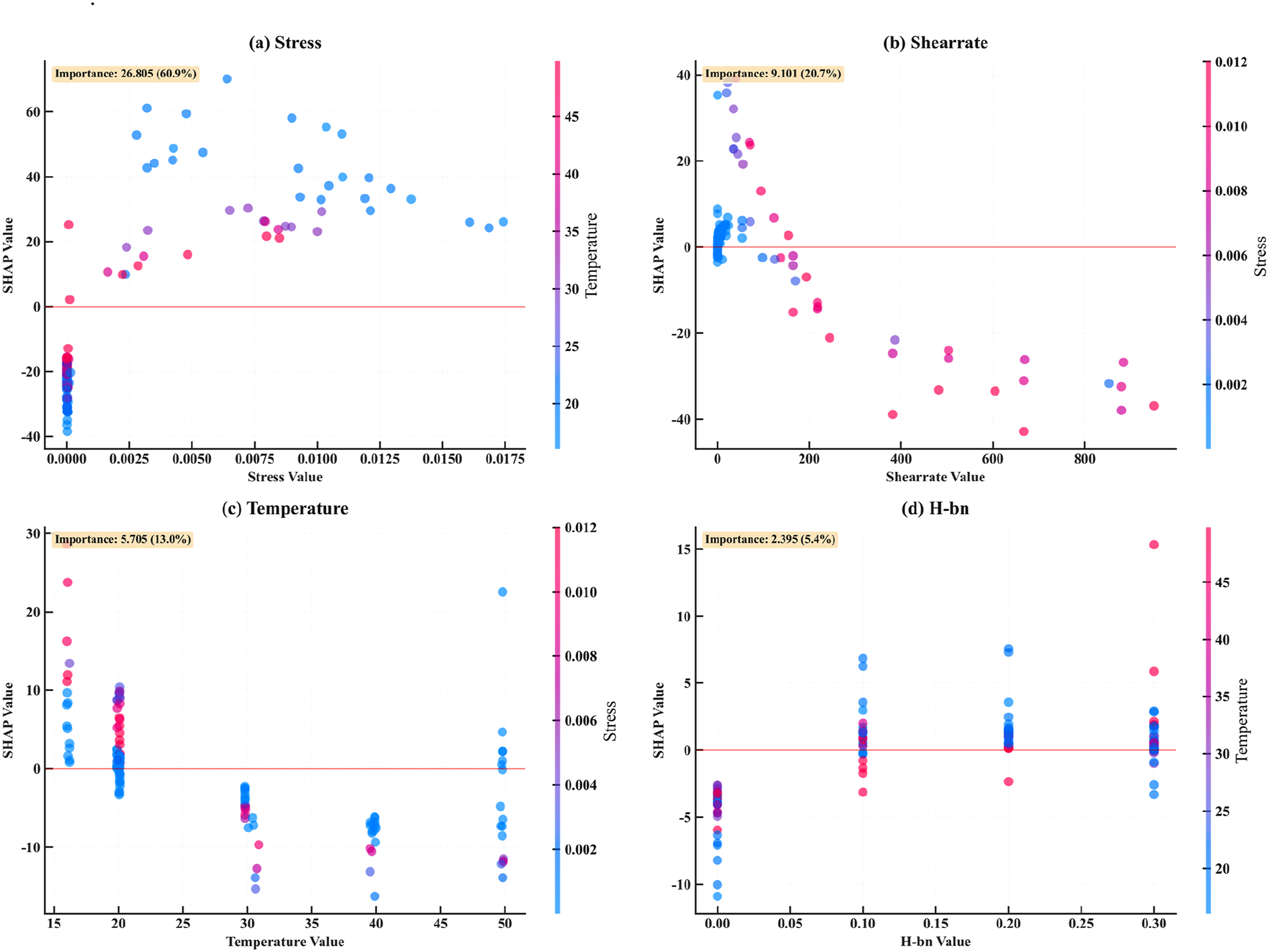
From a modeling standpoint, SHAP values reflect the consistency and magnitude of a feature’s marginal contribution across the dataset. Stress displays a relatively monotonic relationship with viscosity and strong, stable interactions with Temperature, resulting in a higher average SHAP value. By contrast, the influence of Shear rate is highly non-linear and directionally variable, which reduces its overall mean contribution despite its localized impact.
Conclusions
This study investigated suspensions with varying h-BN/SiO2-STF mass ratios, focusing on their dynamic rheological responses, steady-state properties, temperature sensitivity, reversibility, and stability. Suspensions with different h-BN/SiO2 mass ratios exhibited excellent ST behavior, particularly at shear rates below the critical threshold. The addition of h-BN nanoparticles considerably enhanced the material’s apparent viscosity of the SiO2-STF solution, demonstrating the efficacy of these nanoparticles in enhancing rheological properties. However, the influence of h-BN on ST performance was non-monotonic. Among the tested formulations, the 0.1%h-BN/SiO2-STF exhibited the most favourable ST characteristics, achieving a high peak apparent viscosity and a relatively low critical shear rate. This optimal composition ensures a superior balance of viscosity and shear-thickening behavior, making it a promising candidate for practical applications.
The 0.1%h-BN/SiO2-STF demonstrated significant sensitivity to temperature variations. Elevated temperatures affected the critical shear rate, peak viscosity, and shear thickening effect. However, in the absence of the ST phenomenon, the viscosity remained nearly constant, indicating that the 0.1% h-BN/SiO2-STF effectively mitigates the temperature-induced impacts on performance. The STF exhibited excellent reversibility in cyclic shear tests and maintained a consistent viscosity under steady-state conditions, confirming its reliability for extended use. These results emphasize the importance of optimizing h-BN concentration to achieve enhanced rheological performance and improved thermal stability. The 0.1% h-BN/SiO2-STF formulation, therefore, presents strong potential for applications that demand reliable shear-thickening functionality across varying thermal environments.
ML analysis demonstrates that viscosity predictions for silica-based STFs can be accurately captured using RF and CatBoost models, with CatBoost exhibiting superior stability, narrower residual distributions, and a prediction confidence exceeding 95%. SHAP analysis identifies Stress as the most influential factor, whose effect is strongly modulated by Temperature and Shear rate, while h-BN concentration contributes positively to viscosity predictions under optimal thermal conditions. These results emphasize the critical role of both individual features and their interactions in governing STF rheological behavior and highlight the value of integrating data-driven modeling with experimental insights to optimize STF formulation and performance.
Limitations and future work
Despite h-BN’s stabilizing role, long-term sedimentation of silica particles remains an issue under static conditions. Current rheological models fail to fully capture the complex interplay among nanoparticles, nanosheets, and carrier fluids during shear thickening. The temperature sensitivity of PEG limits the operational range of the STF.
Despite the strong predictive performance of both RF and CatBoost models, several limitations are evident. Both models exhibit occasional large residuals, particularly in the validation dataset, indicating that extreme combinations of shear rate, temperature, or h-BN concentration may not be accurately captured. The finite size and scope of the experimental dataset also constrain model generalization, limiting predictive reliability beyond the parameter ranges included in training. Moreover, while SHAP analysis provides insight into feature importance, these models remain primarily data-driven and do not explicitly incorporate the physical mechanisms governing shear-thickening behavior. This limits interpretability under untested or extreme conditions.
Functionalizing h-BN nanosheets could improve compatibility with PEG/SiO2 matrices and reduce agglomeration, ensuring long-term suspension stability. H-BN-based STFs should be evaluated in practical vibration-control devices, such as adaptive dampers and protective systems, to assess their performance in real-world applications. Extended cyclic and environmental aging studies are recommended to evaluate performance stability over time.
For ML applications, expanding the experimental dataset to include a broader range of shear rates, temperatures, and h-BN loadings would improve model generalization and reduce residual errors, particularly in regions of the parameter space that are currently underrepresented. Incorporating hybrid or physics-informed ML approaches could further enhance predictive accuracy while providing mechanistic interpretability, bridging the gap between data-driven predictions and rheological theory. Finally, validating the models in practical applications, such as adaptive dampers or protective systems, would ensure that predictions remain reliable under real-world operating conditions and facilitate the design of high-performance, thermally robust STFs.
Footnotes
Author contributions
Declaration of conflicting interests
The authors declared no potential conflicts of interest with respect to the research, authorship, and/or publication of this article.
Funding
The authors received no financial support for the research, authorship, and/or publication of this article.
