



Abstract
To analyze the effect of nano-solid particles on the mechanical properties of shear thickening fluid (STF) and its Kevlar composite fabric. In this study, nano-silica and polyethylene glycol (PEG 200) were used as dispersed and continuous phases. Nano-graphite and nano-diamond particles were used as additives to prepare STF and Kevlar composite fabric. Study the friction characteristics and rheological characteristics of STF at different temperatures. Explore the STF’s mechanical response under transient high-speed impact conditions through the split Hopkinson pressure bar experiment. The mechanical properties of STF-Kevlar fabric are studied through yarn pull-out test and burst experiments. The experimental results show that the intermolecular repulsive force of STF is enhanced under a high-temperature environment, and shear thickening effect is reduced. Nano-diamond particles strengthen the contact coupling force and contact probability between the particle clusters, so that the maximum viscosity of the system reaches 1679 Pa s, the thickening ratio reaches 318 times, and the rheological properties of the shear thickening fluid are improved. The results of the SHPB experiment show that the STF can complete a dynamic response within a 50–75 µs time range, and the maximum stress can reach 78 MPa. The bullet’s incident kinetic energy is not only transformed into thermal energy and phase change energy of solid-liquid conversion, but also into frictional energy between particles. The mechanical experiments of STF-Kevlar composite fabrics show that the tensile force value of STF5-Kevlar is the largest (10.3 N/13.5 N), and the tensile force of neat Kevlar was the smallest (4.3 N/4.9 N). The maximum bearing capacity (0.3 kN) and absorption energy (51.8 J) of Neat Kevlar are less than those of STF1-Kevlar (3.2 kN, 116.7 J) and STF3-Kevlar (1.9 kN, 88.2 J), and STF5-Kevlar (4.7 kN, 143.3 J). Fabric’s failure mode is converted from partial yarn extraction to overall deformation and rupture of the fabric. Therefore, by changing the solid additives’ parameters, the STF and the composite fabric’s mechanical properties can be effectively controlled, which provides a reference for preparing the STF and fabric composite materials.
Keywords
Presently, there are two common types of shear stiffening intelligent materials, shear thickening fluid (STF) systems and shear stiffening gel (SSG) systems. Shear stiffening gel is a kind of boron-siloxane polymer silicone rubber with a low crosslinking degree, which is often synthesized using polysiloxane dimethyl silicone oil or hydroxy silicone oil, boric acid, and benzoyl peroxide (BPO) at high temperature. 1 The STFs are non-Newtonian fluids which are also termed as dilatant fluid and identified by significant increase in apparent viscosity under the condition of applying shear stress or high shear rate. As the most traditional shear stiffening material, the shear thickening fluid has the characteristics of simple preparation, fast response speed, and reversible reversibility. 2 Freundlich and Röder 3 first discovered the phenomenon of shear thickening in the spherical dispersed phase in 1938. Early related research was mainly to improve the negative impact of shear thickening in industrial production. For example, shear thickening fluid causes pipeline blockage, turbine blade damage, and uneven surface coating. 4 With the continuous deepening of research, people realized that the phenomenon of shear thickening could also positively affect the industrial field. Not only has it gradually solved the various problems caused by the spectacle of shear thickening, but based on its characteristics, it has found that the shear thickening fluid has good application prospects in damping, vibration reduction, and personal protection.5–8 And in the microscopic mechanism of shear thickening,9–11 mechanical properties and influencing factors,12–15 STF-based development and application,16,17 and other research fields have achieved fruitful results.
At present, shear thickening fluids have been used in commercial products. However, some problems still need further research in the development of STFs-related materials. There is still room for improvement in the mechanical properties of shear thickening fluids. The mechanical properties of the STF system are mainly affected by dispersed phase, continuous phase, additives, and external environment. The choice of disperse phase and continuous phase is relatively fixed, and there are many related studies. However, the research on the effect of additives on the mechanical properties of the STF system is still in the early stage. Gürgen
15
and others used SiC,
As the most widely used shear thickening fluid fabric composite material, the specific mechanism of its impact resistance is still controversial. It is mainly divided into two viewpoints: shear thickening effect and friction enhancement between yarns. Researchers such as Majumdar31,32 believe that the failure mode of STF fabric composites is directly related to the friction between the fabric yarns. The fiber’s toughness is crucial for the penetration of the fabric. Srivastava 33 and others believe that the energy absorption capacity of fabric materials after STF soaking treatment is increased due to the following three reasons: energy dissipation caused by shear thickening behavior; increased friction between yarns (yarn extraction energy); The coupling and load transfer between fiber and fiber and between yarn and yarn is more robust. Kordani et al. 34 believed that the friction in the shear thickening fluid was the main reason for enhancing fabric performance and proposed a velocity-dependent finite element friction model to verify the effect of the shear thickening fluid. Gürgen et al. 35 found in the study of multiphase shear thickening composite fabrics that the increase in friction between yarns is the primary mechanism for increasing energy absorption of STF composite fabrics. The performance of the multiphase material is a crucial factor in the stab resistance of the STF composite fabric system. Hasanzadeh et al.36–38 summarized that there are many factors affecting the performance of STF/fabric composites. Both the numerical and experimental investigations on the impact resistance of neat and STF-treated HMPP fabric confirmed the contribution of frictional properties induced by STF impregnation in restriction of the yarns within the fabric. However, compared with STF-treated fabrics, the fabric impregnated with the suspension containing carbon nanotubes (CNTs) showed lower enhancement. Majumdar et al. 8 used monodisperse phase silica and double-dispersed phase silica, respectively, for comparative experiments. Experiments show that the monodisperse STF exhibits discontinuous shear thickening and exhibits a higher peak viscosity. At the same time, the two materials exhibit similar mechanical properties in the yarn pull-out test. However, the single-dispersed STF composite fabric can absorb stronger impact energy than the double-dispersed STF composite fabric, so the shear thickening phenomenon plays a dominant role in the energy absorption field of the composite fabric.
The above researches have made great progress for both shear thickening fluid and shear thickening fluid composite fabric materials field. However, the influence of nanoparticles with different friction characteristics on the contact network of shear thickening fluids is still unclear, and the effect on the contact force between particles in the dispersed phase still need further studied. At the same time, the current STF mechanical characterization research mainly focuses on the rheological properties of STF at low and medium speeds. In practical protection applications, STF is often subject to transient high-intensity shocks. Therefore, the mechanical properties, energy absorption, and time response of STF under high-speed dynamic impact are in urgent need of research. On the other hand, the effect on the energy absorption and mechanical properties of STF composite fabrics needs further analysis.
In response to the above problems, this paper uses nano-silica and polyethylene glycol as the dispersed and continuous phases, uses nano-graphite and nano-diamond particles with different hardness, morphology, and friction characteristics as additives to prepare a shear thickening fluid. Kevlar fabric is used as a fabric carrier to prepare STF-Kevlar composite fabric material. Explore the impact of nano-solid particles in the process of shearing thickening and their role in low-to-medium-speed steady-state shearing and high-speed dynamic impact environments. Analyze the effects of nano-solid particles on the mechanical properties of STF-Kevlar fabric. Compared with previous studies, this paper innovatively improved the Split Hopkinson pressure bar (SHPB) equipment to achieve dynamic impact testing of shear thickening fluids. Derived based on current theory, analyzed the influence of particle volume fraction and structural dimension. Starting from the critical condition of shear thickening behavior in suspension, the formula of critical shear rate is deduced, and the influence of volume fraction on the formation of friction contact network is analyzed. Further comprehensively discuss the mechanism of impact resistance of shear thickening fluid composite fabric to provide a reference for the preparation of shear thickening fluid and the development of fabric composite materials.
Experiment preparation
Material preparation
Preparation of raw materials
The materials used to prepare STF include fumed nano-silica particles (30 nm, 99.5%, Aladdin Biochemical Technology Company), polyethylene glycol (200 g/mol, Aladdin Biochemical Technology Company). The solid additives include nano-graphite (120 nm, 99.9%, Aladdin Biochemical Technology Company), nano-diamond (80 nm, 99.9%, Aladdin Biochemical Technology Company), and the morphology and size distribution are shown in Figure 1. The properties of the aramid fabric prepared from the STF-Kevlar composite are shown in Table 1.
Aramid fabric performance.

Shear thickening fluid preparation.

Morphology and size distribution of solid additive: (a) Nano graphite morphology, (b) Nano diamond morphology, (c) Nano graphite particle size distribution, and (d) Nano diamond particle size distribution.
The nano-silica particles were dispersed in the PEG 200 medium using a magnetic stirrer and stirred at a speed of 500 r/min for 1 h. The particles are easy to agglomerate due to the tiny particles of fumed silica and high surface hydroxyl value. When the solid content exceeds 30%, the system’s viscosity at room temperature is extremely high, which is not suitable for further study. Therefore, this study set the silica content at 30%. According to the sample design Table 2, put in the solid additives quantitatively, continue to stir for 2 h, then put the sample in a vacuum drying oven for 24 h to remove the air bubbles, and finally obtain a stable dispersion system.
Sample design of STF system.

Preparation of STF-Kevlar.
First, cut the Kevlar fabric into fiber pieces with a size of 150 mm × 150 mm, and then remove the warp yarns on both sides of the fiber and the upper weft yarn to make the effective weaving area 100 mm × 100 mm. Then it is soaked in absolute ethanol and ultrasonically cleaned by an ultrasonic cleaner. After washing, put the fabric into a drying box for drying treatment. The prepared shear thickening solution and absolute ethanol are diluted according to the mass ratio of 1:1, and the uniform distribution of the solution is ensured by the method of ultrasonic dispersion. Put the dried fabric piece by piece into the diluted shear thickening fluid and soak for 30 min. After taking it out, remove the excess liquid on the fabric’s surface with a ram, and then place it in a 70°C blast drying oven dry for 2 h to remove excess absolute ethanol on the material to obtain Kevlar fabric impregnated with shear thickening solution. In this paper, pure Kevlar fabrics were prepared by the above methods, and composite fabrics impregnated with three shear thickening fluids of STF-1, STF-3, and STF-5. The specific components are shown in Table 3, and the fabric micro-topography is demonstrated in Figure 2.
Sample design of STF-Kevlar design.


Microscopic morphology of composite fabric: (a) STF1-Kevlar, (b) STF3-Kevlar, (c) STF5-Kevlar, and (d) Neat Kevlar.
Testing and characterization
Steady state shear rheological performance test
Anton-Paar MCR301 advanced rotating rheometer was used for steady-state rheological performance test. Cone rotor model CP25-2, cone plate diameter 25 mm. Cone-plate rotor’s bottom in the rheometer is fixed, and the angle between the cone and the plate is 2°. Five kinds of shear thickening fluids are measured at a shear rate of 0–1000
Friction performance test
Using high-frequency friction and wear tester (SRV) at room temperature, under the conditions of a load of 300 N, a frequency of 50 Hz, and a friction stroke of 1 mm, a friction test of 5 kinds of shear thickening fluid samples was carried out for 10 min. The friction signal analysis system (FSA) is equipped to establish the corresponding relationship between friction force, stroke and sliding speed. The friction coefficient curve changes under specific experimental conditions are collected.
Split Hopkinson pressure bar (SHPB) experiment
Since the mechanical response of an object under impact is often significantly different from that under static load, in practical protection applications, shear thickened fluid composites are often subject to transient high-strength impacts. Therefore, understanding the dynamic mechanical response of STF will help the engineering application and design of such materials. As far as the current experimental conditions are concerned, SHPB is still the best testing method that can be used to obtain the stress, strain relationship, and energy absorption of the material at different times.
The traditional SHPB equipment consists of a bullet, an incident rod, and a transmission rod, and the test piece is placed between the incident rod and the transmission rod. The basic principle of the experiment is based on the one-dimensional assumption (also called plane assumption) and the assumption of uniform stress. Considering that the physical state of the shear thickening fluid is liquid, this experiment uses an aluminum perforated sleeve with the same diameter as the equipment rod as the liquid container. After ensuring the tightness of the device, the mechanical properties of the STF were tested on the improved SHPB equipment. The experimental apparatus is shown in Figure 3. Since the tested STF is a soft material, to obtain a better wave impedance matching degree in the test, the entire system of this experiment uses an aluminum rod with a minor wave impedance to test. The specific equipment parameters are shown in Table 4.
Parameters of SHPB equipment.


Split Hopkinson pressure bar (SHPB) equipment system.
When the bullet hits one side of the incident rod, an incident wave (elastic wave) is generated and propagated in the incident rod. When the incident wave propagates to the interface between the sample and the rod, because the wave impedance between the rod and the sample does not match, the incident wave is partially reflected to form a reflected wave back to the incident rod, while the rest of the wave passes through the sample to create a transmitted wave in the transmission. A strain gauge collects the strain


In the formula, C0、 A、 E、 A0、 L are the wave velocity, cross-sectional area, elastic modulus, cross-sectional area of the test piece, and original length of the rod, respectively. From this, the trend of strain, stress, and strain rate over time is obtained. Because the dynamic experiment is more complicated, there are many uncertain factors. To ensure the reliability of the experimental data, this experiment under the same loading conditions (room temperature 20°C ± 0.5°C, bullet speed 10 m/s), STF-1, STF-3, STF-5, and polyethylene glycol solvent (PEG 200). Four samples were tested twice, and the average of the measured experimental data was taken as the result.
Yarn pull-out experiment
To study the influence of nano-solid particles on the STF-Kevlar yarns, in this study, we used a universal testing machine (Instron Microtester 5848) to conduct a Yarn drawing test on fabric samples at a drawing rate of 50 and 200 mm/min. The testing machine clamps the single yarn in the middle of the fabric sample, U-shaped plates fix the two sides of the fabric, and there is a gap between the bottom of the fabric and the clamp. During the test, the fixture holding the fabric remains stationary, and the upper chuck moves upward at a specified rate until the entire yarn is pulled out. In order to ensure the validity of the experimental data, the test ends when the fabric pull-out displacement reaches 80 mm. The yarn pull-out force and loading displacement are collected and recorded by a computer. The schematic diagram of the fabric yarn pulling device is shown in Figure 4.

Fabric yarn pull-out device system.
Bursting experiment
In order to study the fabric strength and impact resistance of STF-Kevlar, this experiment uses a bursting test machine model WDW-100D for experiments. The composite fabric material was fixed with a circular clamp with a radius of 50 mm, and a punch with a diameter of 25 mm was used to carry out a burst experiment at a punch speed of 100 mm/min. The sensor measures the relationship between the force and deformation of the fabric and records the failure load and energy absorption of the STF-Kevlar fabric. The bursting device system is shown in Figure 5.

The bursting device system.
Experimental results
Rheological properties results
Figure 6. shows the apparent viscosity-shear rate curve of five STF samples under different temperature environments. As the shear rate increases from 0 to 1000

Viscosity of nano-silica/polyethylene glycol shear thickening fluid at different temperatures: (a) STF-1, (b) STF-2, (c) STF-3; (d) STF-4, (e) STF-5, and (f) comparison of five samples at 20°C.
The addition of nano-diamond and nano-graphite significantly increased the shear thickening fluid’s initial viscosity and maximum viscosity. Compared with nano-graphite, nano-diamond has a more noticeable effect on viscosity. This is because the density of nano-diamond is much higher than that of nano-graphite, and the solid particles in the suspension have stronger internal particle adhesion. From the data, it can be found that the maximum viscosity of STF-5 with 3% nano-diamond at 20°C reaches 1679 Pa s, and the maximum viscosity of STF-3 with 3% nano-graphite reaches 801 Pa s at 20°C. It is much higher than the STF-1 viscosity without adding nanoparticles at 20°C. Also, the addition of nano-solid particles delayed the appearance of shear thickening, and the degree of delay increased with the increase of the additive mass fraction.
Friction characteristic results
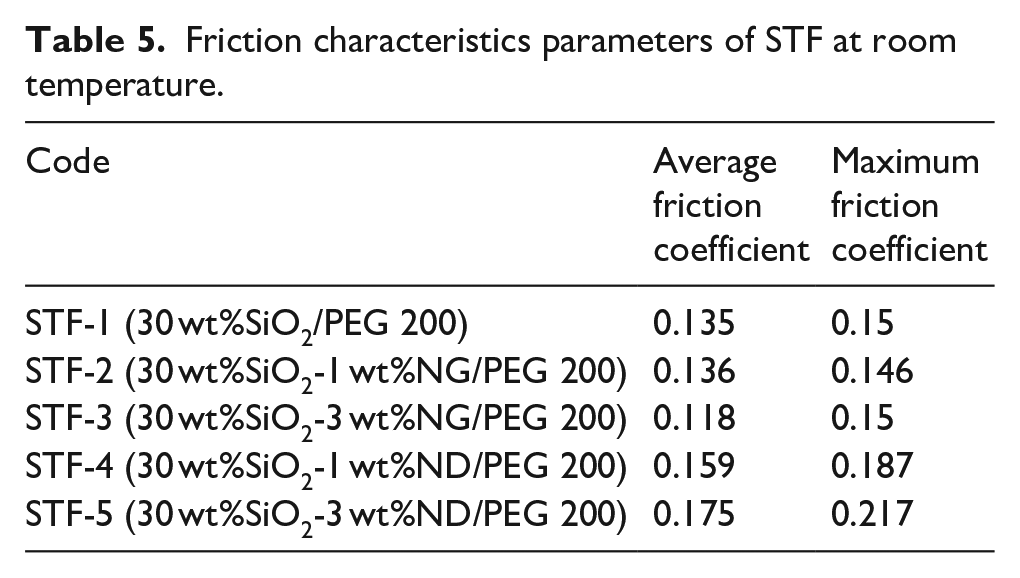
Figure 7 and Table 5 shows the friction characteristics of five samples at room temperature. It can be found that the friction curves of STF-4 and STF-5 with nano-diamond added have large fluctuations, and the average friction coefficient is greater than that of pure STF-1. As the content of the nano-diamond increases, the friction coefficient of the STF becomes larger, and the average friction coefficient of STF-5 reaches 0.175. During the test, the curves of STF-4 and STF-5 showed abrupt changes. This is due to the sharp shape and high hardness of nano-diamond particles. When they move under load pressure, they have a sizeable obstructive force against the plate, which results in abrupt changes. The average friction coefficient and maximum friction of STF-2 with 1% nano-graphite added and pure STF-1 are similar, but the friction curve of the former is smoother; that is, the friction coefficient remains basically unchanged during the entire movement stroke, and the particles have better lubrication. The friction curve of STF-3 with 3% nano-graphite is lower than the other four samples. The average friction coefficient is only 0.118.
Friction characteristics parameters of STF at room temperature.

Friction characteristics curve of nano-silica/polyethylene glycol STF at room temperature.
In summary, nano-solid additives have a significant effect on the friction characteristics of STFs. Nano-diamond particles can significantly enhance the friction characteristics of the suspension fluid, while the nano-graphite particles can enhance the lubrication characteristics of the suspension fluid, and their effects are more significant as the content of solid additives increases.
Split Hopkinson pressure bar (SHPB) test results
Figure 8 shows the dynamic mechanical response results of STF-1, STF-3, STF-5, and PEG-200 at a bullet impact velocity of 10 m/s. Figure 8(a) shows the stress-time curves of the four samples. It can be found that the four samples all show a trend of increasing first and then decreasing. The stress curve of STF-5 with a 3% nano-diamond is significantly larger than the other three samples, and the maximum stress is 78 MPa at 457 μs. STF-1 was achieving the maximum stress of 73 MPa at 453 μs. The stress curve of STF-3 with 3% nano-graphite was significantly lower than that of STF-5 and STF-1 in the early stage and finally reached the maximum stress of 68 MPa at 464 μs. As the dispersed phase of STF, PEG-200 also shows a trend of stress increase under the impact, but the stress value is much smaller than the other three STFs. Compared with PEG-200 as the dispersed phase, the thickening behavior of STF can provide tremendous stress to the system. The time corresponding to the peak stress represents the time for the system to complete the thickening response. The first to complete the thickening response is STF-1, followed by STF-5, and finally STF-3. This shows that nano-diamond and nano-graphite interfere with the formation of the contact network, especially the latter’s influence is more prominent. According to the stress-time curve, it can be observed that the thickening response time of the STF system is about 50–75 μs.

SHPB test results of four STFs at 10 m/s impact velocity: (a) stress-time curve, (b) stress-strain curve at the same time, and (c) energy absorption-time curve.
Figure 8(b) shows the stress-strain curves of the four samples, and the three STFs are all convex shapes. Point A represents the yield limit point of the material, and point C represents the strength limit point of the material. Between A and C is the hardening stage of the material. STF-5 has more significant shear stress under the same strain conditions, followed by STF-1, and STF-3 is the smallest. At an impact velocity of 10 m/s, nano-diamond can increase the strength of the STF without reducing the toughness of the material. The addition of nano-graphite minimizes the strength of the STF system. Figure 8(c) shows the energy absorption of the four STFs. It can be found that the energy absorption capacity of PEG-200 is the weakest, only one-third of the energy absorption value of STF. STF-5 has the most robust energy absorption capacity, reaching 22.2 J; STF-3 has the lowest energy absorption capacity, only 15.7 J.
STF-Kevlar yarn pull-out test results
The load-displacement curve and the maximum pull-out force results of Kevlar and STF-Kevlar composite fabrics at the yarn pull-out rate of 50 and 200 mm/min are shown in Figure 9. In the process of yarn pulling, the tensioned yarn slips and rubs in the fabric. As the drawn length increases, the remaining wave number in the stretched fabric decreases, and the load continues to decrease. Whenever the pull-out distance reaches the intersection of two warp and weft threads, the yarn completes a “slide in-slide out” process, at which time the tension value fluctuates. Therefore, the load-displacement curves of the four fabrics at the two drawing rates all show an oscillating downward trend. From Figure 9, it can be found that the tensile force value of STF5-Kevlar is the largest (10.3 N/13.5 N) at the two drawing rates, followed by the tensile force value of STF1-Kevlar (8.3 N/12.9 N), and the tensile force value of Neat Kevlar was the smallest (4.3 N/4.9 N). Simultaneously, the tensile value of the composite fabric soaked in STF increased significantly with the increase of the drawing rate, while the load of Neat Kevlar changed little. This shows that STF substantially increases the friction between the yarns, resulting in a substantial increase in the ultimate load. Simultaneously, the addition of nano-diamond also significantly improves the static and dynamic friction between the yarns. However, the pull response of pure Kevlar fabric has little correlation with the pull-out rate.

Test curve of yarn pull-out at different speeds: (a) 50 mm/min and (b) 200 mm/min.
STF-Kevlar burst test results
In order to study the mechanical response and energy absorption characteristics of STF-Kevlar fabric under the low-velocity impact, four Kevlar materials were subjected to bursting experiments at an impact velocity of 100 mm/min. The experimental results are shown in Figure 10. By comparing the force and energy absorption characteristics of the four fabric materials, it can be found that the maximum bearing capacity (0.3 kN) and absorption energy (51.8 J) of Neat Kevlar are less than those of STF1-Kevlar (3.2 kN, 116.7 J) and STF3-Kevlar (1.9 kN, 88.2 J) and STF5-Kevlar (4.7 kN, 143.3 J). Except for the strain-load curve of Neat Kevlar, which contains two peaks, the other three types of STF-Kevlar composite fabrics all have only one peak. By observing the morphology of the fabric after impact, it can be found that the four materials are entirely penetrated, the yarn at the impact point of Neat Kevlar fiber is drawn out, and the morphology of the surrounding yarn is relatively complete. The STF-Kevlar fabric has fewer fibers at the impact point, and the materials show tensile fracture and fibrillation. This indicates that the addition of STF improves the impact resistance and energy absorption properties of the fabric and changes the failure mode of the fabric under impact. At the same time, nano-solid particles also significantly impact the impact resistance and energy absorption characteristics of the material by changing the friction between the yarns.

Burst test results of four materials: (a) STF1-Kevlar, (b) STF3-Kevlar, (c) STF5-Kevlar, and (d) neat Kevlar.
Discussion
STF rheological characteristics analysis
In order to analyze the effect of nano-solid additives more intuitively on the rheological properties of shear thickening fluids at different temperatures, this paper selects several vital parameters in the rheological curve: the critical shear rate



Schematic diagram of rheological curve parameters.
In order to deeply analyze the influence of nanoparticles on the rheological properties of STFs at different temperatures, this paper is based on the rheological curve data extracted in Table 6. Plot the critical shear rate
Rheological curve parameters of nano-silica/polyethylene glycol shear thickening fluid.


Rheological curve parameters of shear thickening fluid at different temperatures: (a) critical shear rate, (b) thickening interval, and (c) thickening ratio.
Figure 12(a) shows the change of the critical shear rate of five STFs at different temperatures. It can be found that the critical shear rate of the five samples all increases with the increase of temperature. Simultaneously, the addition of nano-graphite and nano-diamond both increases the critical shear rate, and its effect becomes more obvious as the mass fraction of solid particles increases. The critical shear thickening rate of STF-1 without additives at 20°C is 7.4
Figure 12(b) shows the comparison of the STF thickening period at different temperatures. The difference between the thickening period and the critical shear rate is that the latter represents that the STF has begun to form a frictional contact network, while the thickening period represents the stage from the beginning of the contact network to the STF creating a firm frictional contact network. It can be found that the shear thickening period has the same changing law as the critical shear rate: it increases with the increase of temperature and increases with the addition of nanoparticles. The thickening period of STF-1 without additives at 20°C is 7.4
Figure 12(c) shows the thickening ratio of five STFs at different temperatures. Compared with pure STF, the use of nano-solid additives increases the thickening ratio of the system. Among them, STF-4 has the highest thickening ratio, reaching 318 at 20°C. In the medium and low-temperature environments of 20°C and 40°C, the thickening ratios of STF-2, STF-3, and STF-5 are similar. At 60°C, the thickening ratio of STF-4 and STF-5 containing nano-diamond is higher than that of the other three samples. And different from the critical shear rate
Analysis of the STF thickening mechanism
Through the above experimental results, it can be found that temperature has a significant effect on the rheological properties of the STF. It is mainly reflected in three aspects: the increase of the critical shear rate, the growth of the thickening period, and the decrease of the thickening ratio. On the one hand, the temperature rise will cause the viscosity of the continuous phase to be significantly reduced. On the other hand, it will make the Brownian motion of the nano-dispersed phase particles and the water solvent molecules more violent, enhancing the repulsive force between the molecules. In order to form particle clusters, the system will require stronger molecular dynamic contact to resist the repulsive force brought by temperature. Therefore, the start time of thickening is delayed, and the thickening effect is affected.
The influence mechanism of nano-solid additives and temperature is different. The influence of nano-solid particles on shear thickening mechanism is mainly divided into the following two points: the influence on the volume fraction of dispersed phase and the influence on the dimension of the particle structure. Simultaneously, these two influencing factors act on different stages of shear thickening. According to the order-disorder theory (ODT) and the particle cluster theory (Hydro-cluster), the particles are affected by electrostatic repulsion and Brownian motion at low shear rates, and the dispersed particles in the STF system are far away from each other. The particles remain in a relatively stable structure, and system viscosity is low. As the shear rate increases, the molecular dynamics between particles increase. When the molecular power between particles is higher than the repulsive force, the dispersed phase particles aggregate and form particle clusters, and the apparent viscosity of STF system increased. According to the previous researches, 4 the repulsive force and lubricating force between particles in the suspension are as follows:


Among them:

From layering mode of the particles in the suspension system and the distance between the particles, the particle volume fraction

Substituting formula (9) into (10) can obtain the critical shear rate of the system:

The addition of nano-solid particles reduced the volume fraction
On the other hand, the structural dimensions of the additive particles also affect the shear thickening mechanism. According to the contact rheological model, the blockage formed by particle clusters only works at low and medium shear rates, and mainly affects the occurrence time of critical shear state. At high shear rates, the frictional contact network formed by particle clusters dominates. The dispersed phase used in this study is fumed silica, and its surface is uneven. Therefore, the morphology and friction characteristics of the nano-solid particles will affect the maximum apparent viscosity and thickening ratio of the system. In the previous experiments, it can be found that under the same mass fraction, the addition of nano-diamond particles can significantly increase the maximum apparent viscosity and thickening ratio of the system. This is because the high hardness and sharp morphology of nano-diamond particles increase the probability of frictional contact between particles, strengthen the contact coupling force between particle clusters, and thus increase the thickening ratio of the system. Compared with nano-diamond particles, nano-graphite has a lubricating effect between particle clusters, and even forms a coating layer on the surface, further reducing the contact and friction between particle clusters. Therefore, the effect of the system with the larger friction coefficient additive is more apparent, and the nano-diamond particles effectively improve the frictional contact between the dispersed phase particles and significantly increase the thickening ratio of the system. The influence mechanism of nano-solid particles is shown in Figure 13.

The influence mechanism of nano-solid additives on the STF thickening process.
STF dynamic shock response analysis
At present, the discussion on the mechanical characterization of STF in the existing research mainly focuses on the rheological properties of STF at medium and low speeds. Most of them pay attention to the change of STF apparent viscosity or shear stress with the increase of shear rate in the rheometer. In practical protection applications, STF and its composite materials are usually subject to transient impact, so the dynamic response characteristics of STFs are essential. According to the mechanism of shear thickening, the necessary condition for forming a contact network and beginning to thicken is that the sample must reach the critical shear rate. According to the experimental results of the rheological properties of this article, it can be found that the critical shear rate of the five samples is between 10 and 100
By analyzing the SHPB mechanical results of the four samples at an impact velocity of 10 m/s, it is found that the use of nano-solid particles will significantly affect the stress of the STF at the same time and change the overall strength and toughness of the system. Simultaneously, the length of the response time observed in the stress-time curve is consistent with the conclusion in analyzing the thickening mechanism. The lubricating effect of nano-graphite reduces the contact and friction between the dispersed phase particles, which delays the thickening response time. However, nano-diamonds with more robust friction characteristics have a slight delay in the critical shear thickening rate.
Nano-solid particles can affect the thickening response time and maximum stress of the system and significantly affect the energy absorption characteristics of the material. For PEG-200, the kinetic energy of the bullet is converted into heat energy only through viscous dissipation. For STF, the bullet kinetic energy can be converted into the heat energy of the sample and the phase change energy of the solid-liquid conversion. This is the reason why the energy absorption characteristics of the three STF samples are significantly better than that of PEG-200. In addition to the phase change energy, the factors affecting the energy absorption characteristics of STF-1, STF-3, and STF-5 are the frictional energy generated by the solid additive particles themselves. In the process of bullet impact, friction occurs between dispersed phase particles and solid additive particles. Nano-diamonds with high friction coefficients dissipate a lot of energy during this contact process, so the energy absorption characteristics are more significant. The nano-graphite weakens this effect, so the energy absorption characteristics are weak. The schematic diagram of the influence of nanoparticles on energy absorption when the STF is impacted is shown in Figure 14.
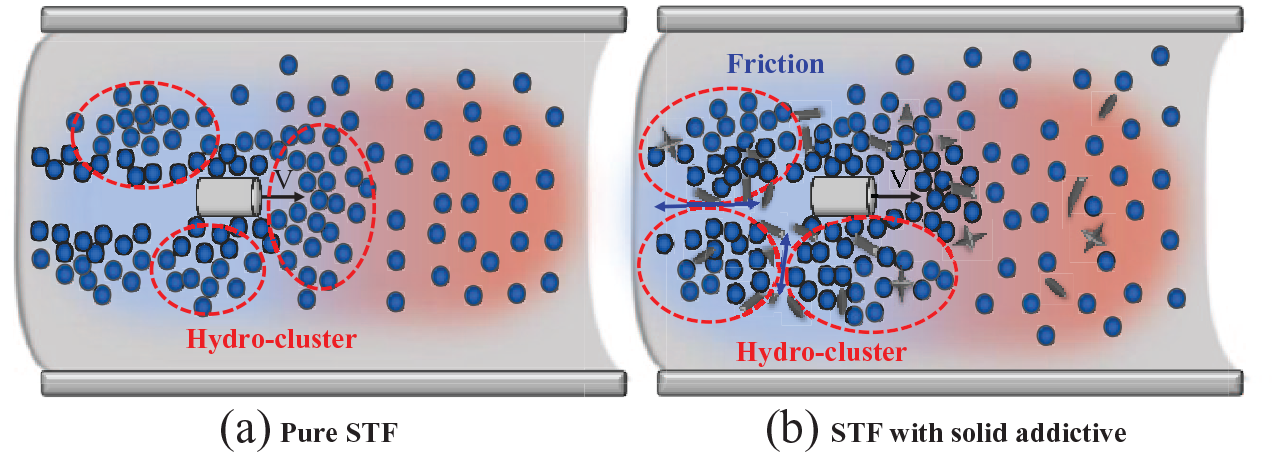
Influence of nanoparticles on energy absorption when nano-silica/polyethylene glycol STF is impacted.
STF-Kevlar mechanical performance analysis
Through the yarn pull-out experiment and burst experiment of the composite fabric, it can be found that the addition of STF increases the friction between the yarns and changes the failure mode of the fabric when subjected to impact. Dividing the deformation-load curve of Neat Kevlar in Figure 10(d) into four parts, the material from the initial impact to the deformation failure can be divided into the following stages: (a) the elastic deformation stage. When the punch is in contact with the fabric, the load increases linearly, the yarn is stretched, and the load reaches its maximum value as the deformation increases. (b) Fiber separation stage. With the continuous impact of the punch, the load on the fabric continues to increase, and the yarn around the impact point separates, showing a tendency to break windows. The number of yarns that hinder the punch is reduced, and the load is significantly reduced. (c) The secondary drawing stage of the yarn. With the continuous action of the punch, few yarns continue to elongate and deform and reach the peak again. (d) Yarn withdrawal stage. When the load of the punch is greater than the force between the yarns, the yarn is drawn out and slipped, the punch completely breaks through the fabric, and then the impact force drops rapidly. The deformation-load curve of STF-Kevlar fiber is divided into two parts, and its failure mode is divided into two stages in total: (a) the elastic deformation stage. In the initial phase of impact, the load of the fabric by the punch increases, the impact point of the yarn and the surrounding fabric are recessed and deformed, and the yarn undergoes elastic deformation. (b) Fiber fracture stage. When the punch further exerts pressure, the fiber force continues to increase to a peak value. When the force is greater than the fabric bearing capacity, the yarn deforms and breaks. Then the punch penetrates the fabric, and the pressure on the fabric drops to zero. Under a specific shear rate, the STF shear thickens, strengthening the coupling between the yarns, and the dispersed phase particles of the STF fill the gaps between the yarns. The combination of STF converts the failure mode of the fabric from partial yarn extraction to overall deformation and rupture of the material.
In the fabric impact test, the punch’s kinetic energy is mainly converted into the energy consumption between the yarns, the phase change energy of the STF, the strain energy, and the heat energy of the yarn. The main effect of solid particles on the mechanical properties of STF-Kevlar is that it changes the surface roughness of the yarn. Among them, nano-diamond significantly increases the frictional energy between the yarns and enhances the coupling force between the yarns. Therefore, compared to STF-Kevlar without additives, STF-Kevlar with strong frictional solid particles positively affects the impact and stab resistance of the fabric.
Conclusion
In this study, nano-silica and polyethylene glycol (PEG 200) were used as the dispersed and continuous phases, nano-graphite and nano-diamond particles were used as additives to prepare STF and Kevlar composite fabrics. Study the friction coefficient curve of the STF and the steady-state shear rheological characteristics at different temperatures, and explore the mechanical response of the STF under transient high-speed impact conditions through the split Hopkinson pressure bar (SHPB) experiment. The mechanical properties of STF-Kevlar single yarns under different pull-out rates are analyzed. The impact resistance and energy absorption properties of the composite fabric are studied through burst experiments. The following conclusions are obtained through experiments:
(1) The repulsive force between molecules increases under high-temperature conditions. The Brownian motion between the nano-dispersed phase particles and the continuous phase molecules becomes more intense, enhancing the repulsive force between molecules. In order to form particle clusters, the system will require stronger molecular dynamic contact to resist the repulsive force brought by temperature. Therefore, the increase in temperature will increase the critical shear rate of the STF, increase the thickening period, reduce the thickening ratio, and reduce the thickening effect.
(2) The solid additive particles prolong the thickening period by blocking the contact of the STF dispersed phase particles. The lubricity of nano-graphite reduces the contact friction between particles, resulting in more obvious thickening interference. However, nano-diamond has a small effect on the critical shear thickening rate and can improve the rheological stability of the STF at different temperatures. Simultaneously, the additive particles increase the particle concentration in the system and strengthen the contact coupling force and contact probability between the particle clusters. Among them, the greater the friction coefficient, the more obvious the effect of the particles. Therefore, the addition of nano-diamond particles significantly increases the thickening ratio of the system and improves the rheological properties of the STF.
(3) When subjected to dynamic impact, the STF can complete the thickening response within 50–75 µs. The bullet’s incident kinetic energy will convert into heat energy and phase change energy of solid-liquid conversion and friction energy between particles. Therefore, the shear thickening fluid with superior thickening characteristics and high friction coefficient between particles has good energy absorption characteristics. The use of solid additive particles will effectively control the rheological properties of the shear thickening fluid and the mechanical properties after impact. By adjusting the type, size, shape, and content of solid additives, various parameters of STF can be effectively modified, thereby preparing shear thickening fluids suitable for applications in different fields.
(4) The dispersed phase particles in the STF fill the gaps between the yarns, and shear thickening occurs at a certain shear rate, the coupling between the yarns is strengthened. The fabric’s failure mode converted from partial yarn extraction to the overall deformation and rupture of the material. The main effect of solid particles on the mechanical properties of STF-Kevlar is that it changes the surface roughness of the yarn. Particles with a high friction coefficient significantly increase the frictional energy consumption between the yarns and enhance the coupling force between the yarns. Therefore, controlling the solid additive particles can positively impact the impact resistance and stab resistance of STF-Kevlar fabrics.
Footnotes
Declaration of conflicting interests
The author(s) declared no potential conflicts of interest with respect to the research, authorship, and/or publication of this article.
Funding
The author(s) disclosed receipt of the following financial support for the research, authorship, and/or publication of this article: This work was funded by the National Natural Science Foundation of China [No. 51605490].
