




Abstract
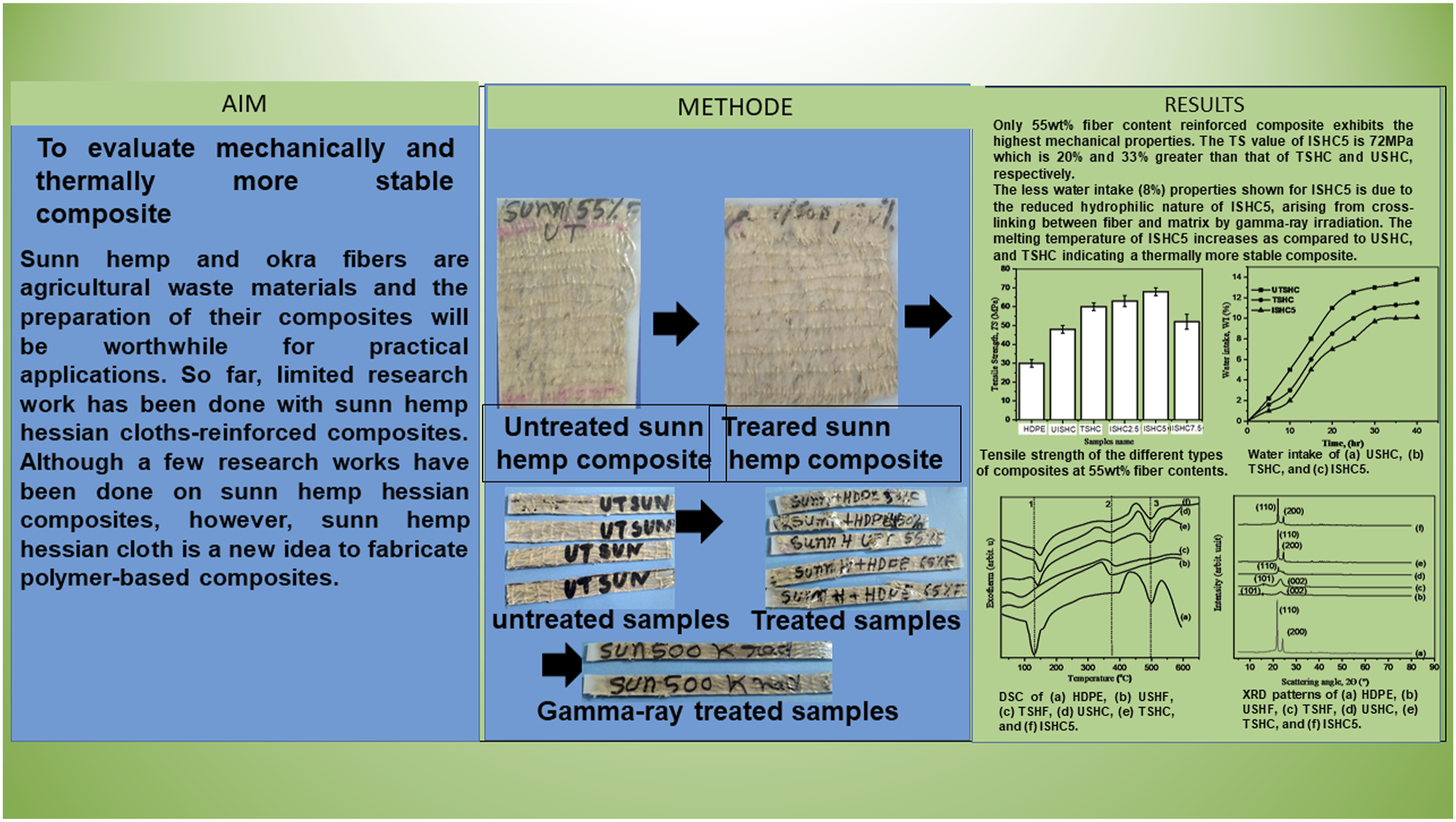
Untreated and alkali-treated Sunn hemp hessian cloth-reinforced high-density polyethylene (HDPE) composites were prepared by the compression molding method. The fabricated composites contained 40, 45, 50, 55, 60, and 65wt% fiber contents and were optimized. 55wt% fiber contents reinforced composites showed better mechanical properties. This composite was alkali treated and irradiated under gamma-ray at doses 2.5‒7.5 kGy at the rate of 6 kGy/h. The X-ray diffraction (XRD) result indicates that the crystallinity of the alkali-treated Sunn hemp-reinforced HDPE composites shows a higher value than those of untreated and irradiated composites. Better adhesion between fiber and matrix was observed from surface micrographs. Fourier-transform infrared (FTIR) spectroscopy reveals cross-linking between fiber and matrix. The water intake properties of irradiated composite show more hydrophobic nature than that of untreated and alkali-treated composites. The tensile strength of the gamma-ray irradiated composites are 20% and 33% greater than that of untreated and alkali-treated composites. Similar results are found for Young’s modulus. At a certain dose of 5 kGy, the irradiated composites show improved thermal, mechanical, and structural properties than untreated and alkali-treated composites.
Introduction
In the fast-developing world, more construction materials are needed as the population grows. Construction materials are widely used in building construction, vehicle body, furniture, seat panels etc. Though the rate of population growth is increasing, the growth rate of wealth is not at the same pace. So people have to find suitable alternatives to meet this shortage of resources. Our modern technologies demand not only energy, but also high-performance, specific service materials. To fulfill these requirements, a lot of important research works have already been done by scientists in the field of composite fabrication.1–3 Particularly, the research has been performed in natural fiber-reinforced HDPE composites.2–5 Basically, these types of composites have been manifested as suitable alternatives to conventional structural materials due to their high mechanical strength, high impact resistance, highly flexible design, high degree of dimensional stability, and low cost.6–9
High-density polyethylene (HDPE) may be the first option of thermoplastics for researchers in preparing composite materials for several important and useful properties such as transparency, dimensional stability, high mechanical strength, flame resistance, and when heated up it becomes pliable and develops hard after cool. Moreover, HDPE is an available and a low cost material for fabrication of composites. In practice, synthetic fibers, such as glass fiber, carbon, aramid, ceramic, etc., are used as reinforcement in composites due to their high mechanical and thermal properties. But synthetic fiber-reinforced composites are not biodegradable at all, and they cause severe environmental pollution. So, we have to be careful in using them in our modern technologies.3–6 For this reason, researchers have recently paid more attention in preparing composites by alternative reinforcement with natural fibers for their low cost and low density, biodegradability, and recyclability. As a result, natural fiber-reinforced polymer composites with natural fibers (jute fiber, coir fiber, kenaf fiber, banana fiber, etc.) have been developed and tested as potential candidates. 8 Bangladesh is an agricultural country. That is why agriculture is the mainstay of this country's economy. Although thousands of tons of various agricultural wastes are generated, including wheat or paddy chaff and straw, okra husks, coconut husks, and husks of various dry fruits, most of it is used as cooking grates. It rots and becomes wasted, which is of no use. Among these agricultural wastes, Crotalaria juncea, commonly known as Sunn hemp, has been used to prepare fiber-reinforced polymer composites for commercial use. Sunn hemp is mainly a cellulose-based natural fiber, which is grown primarily in India, Bangladesh, Pakistan, Russia, Korea, China and Romania. Sunn hemp is the finest natural fiber than sisal, jute, coir, and mesta. Its mechanical strength is higher than jute and mesta. 9 Therefore, Sunn hemp is not only used as a cooking material, but its fiber will play an important role in generating sufficient mechanical strength if we use it to make natural fiber-reinforced polymer composites. Sunn hemp fiber contains 66.31% cellulose, 18.60% hemicellulose, 14.90% lignin, 4.75% pectin, 4.16% ash, and 0.93% wax. 10 It also contains fats and waxes, inorganic substances, and pigments, such as β–carotene and xanthophyll. The inconsistency of the mechanical and physical properties of Sunn hemp natural fibers is dependent not only on the geographic origin and climate change; but also its growth conditions. Otherwise, due to the presence of hydroxyl groups in their structure, poor wettability, and low moisture resistance make them tenacious for fiber-matrix adhesion and proper reinforcement. 11 So, for better fiber-matrix adhesion we have to improve the surface structure and surface energy of the fibers by physical and chemical treatments, such as alkali treatment which will improve the fiber-matrix adhesion and enhance the physical, and mechanical properties of Sunn hemp-based composites. After surface treatment with alkali, ionizing radiation such as gamma-ray obtain from a Co-60 source, can introduce better surface cross-linking between natural fiber and matrix, by forming free radicals and reducing the hydrophilicity of the Sunn hemp fiber.12,13
The goal of this research work is to study the mechanical, thermal, and structural properties of sun hemp hessian cloth-reinforced HDPE composites and to observe the effect of gamma-ray irradiation on the performance of the composites. It is expected that the physical, mechanical, and thermal behavior and degradation properties of Sunn hemp hessian cloth-reinforced HDPE bio-composite will show a new avenue of fabricating thermoplastic composites.14,15
In this present research, we considered all the issues and prepared untreated, alkali-treated, and gamma-ray irradiated composites to compare the effect of alkali treatment and gamma-ray irradiation on the structures and properties of the resulting composites.
Experimental details
Materials
High-density polyethylene
High-density polyethylene used in this study was a product of Guangzhou Zhongshan Trading Co., Ltd. China. Densities of HDPE is from 0.940 to 0.965 g/cm3 and melting point 130°C.
Sunn hemp hessian cloth
Sunn hemp fibers (SHF) were waste materials obtained from Gopalpur, Tangail, Bangladesh. After keeping the sun hemp plant under water for 15 days, its fibers and stalks are separated. Then, Sunn hemp fibers were washed again and again by running with water to remove foreign impurities such as mud and sand. The washed Sunn hemp fibers were dried under sunlight for 3 days in long strands. These fibers were then converted into yearn. Figure 1 shows how hessian cloths were prepared from sunn hemp fiber. After making the yarn from the fiber, the yarns are drawn tightly in a row parallel to each other at equal distances on a bamboo frame. Then, other yarns are drawn perpendicularly and tightly with the parallel yarns to make hessian cloth. Sunn hemp hessian cloth-making process.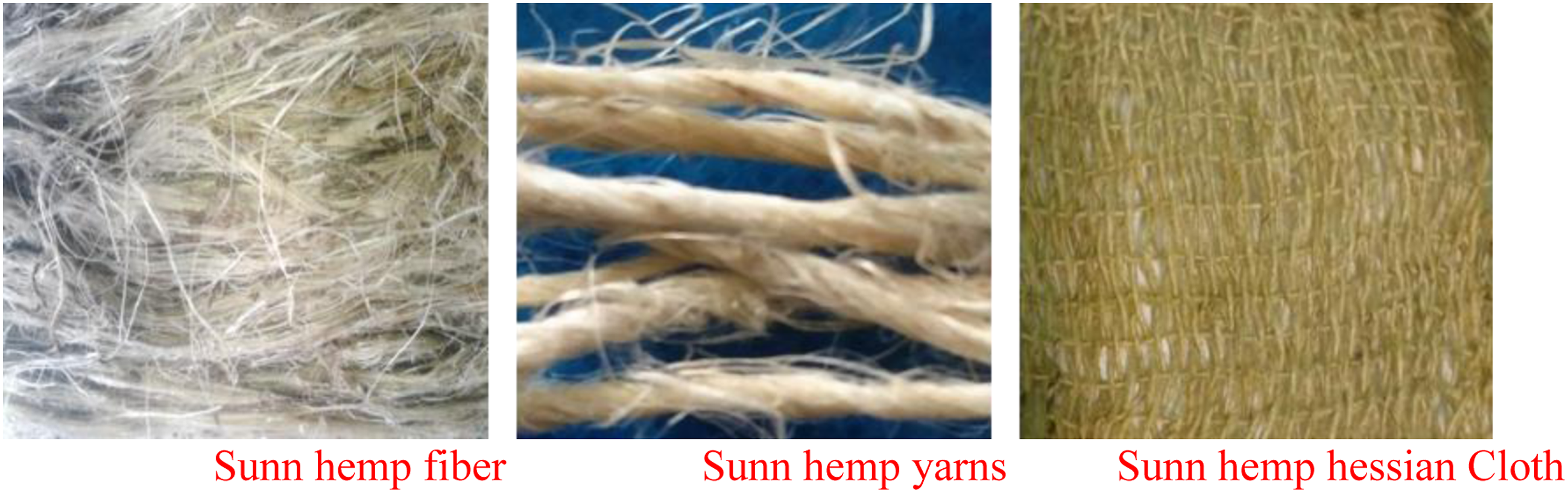
Sodium hydroxide
Important chemicals used in this work were Sodium hydroxide (NaOH) (Merck, Germany), which was collected from the local market of Bangladesh.
Methods
Sunn hemp hessian cloth modification
Untreated Sunn hemp hessian cloth was abbreviated as USHF. The USHFs were treated with 5, 10, and 15 wt% alkali solution for 1 h and washed with water at 60°C to remove impurities. 16 Then, they were dried in sunlight to remove moisture for 2 days. These treated Sunn hemp hessian cloths are named as TSHF, and just before the preparation of the composite, they are also dried in an oven at about 70°C for 1.5 h to remove moisture from the fiber.
Composites fabrication and optimization of fibers content
Mass of hessian cloth with respect to HDPE.
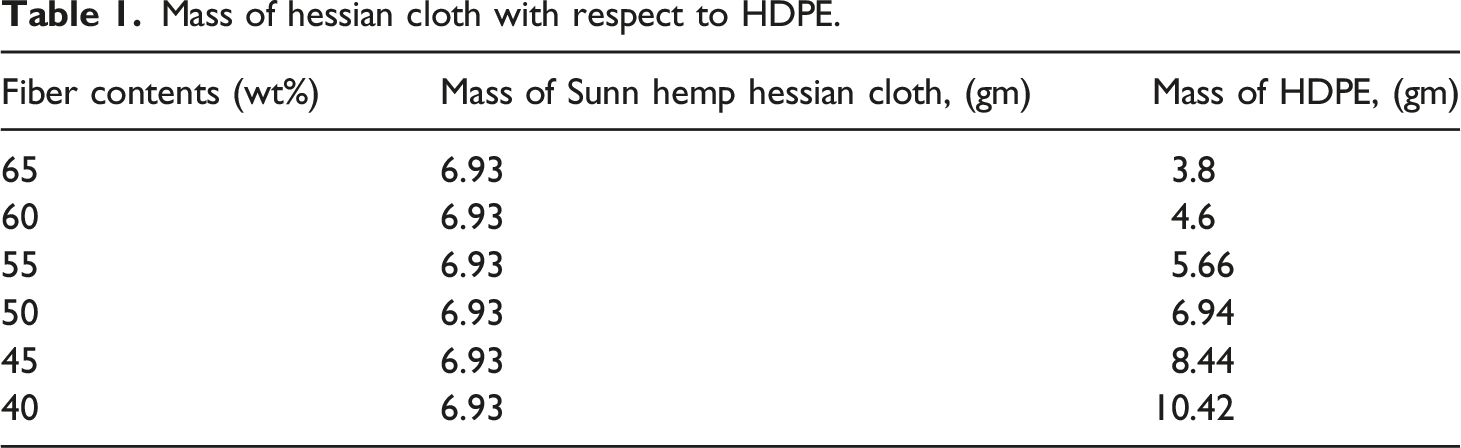
After that, the composite sample containing two steel plates was cooled with the cold press machine through the same process as discussed earlier. Then, the hessian cloth contents were optimized by measuring the mechanical properties of the composites. The samples fabricated for subsequent characterization are untreated Sunn hemp hessian cloth-reinforced HDPE composite (USHC).
For alkali treatments, 5, 10 and 15 wt% of alkali solutions with de-ionized water were prepared. USHFs were immersed in 5, 10 and 15 wt% of alkali solutions separately. To optimize the concentration of alkali, treated Sunn hemp hessian cloth-reinforced HDPE composites with fixed fiber content (55 wt%) were prepared by the same process described earlier. From 5, 10, and 15 wt% alkali treatment, only 10 wt% alkali treated composite shows improved mechanical strength. Therefore, the optimum concentration of alkali is 10 wt%. Then, 10 wt% alkali treated and 40, 45, 50, 55, 60, and 65 wt% Sunn hemp hessian cloth reinforced HDPE composites were prepared again, named as treated Sunn hemp composites (TSHC). Due to high mechanical strength, only 10% alkali treated and 55wt% hessian cloth contents composites were irradiated by gamma radiation of doses 2.5, 5, and 7.5 kGy. The irradiated samples of doses 2.5, 5, and 7.5 kGy are named as ISHC2.5, ISHC5, and ISHC7.5 respectively.
Characterization
X-ray diffraction
X-ray diffraction (XRD) patterns of HDPE, USHF, TSHF, USHC, TSHC, and ISHC5 were examined by an X-ray diffractometer. This diffractometer produces monochromatic CuKα radiation whose wavelength is λ = 1.5418Å and the generator functions at a current of 40 mA and voltage of 40 kV. The crystallinity of HDPE, USHF, TSHF, USHC, TSHC, and ISHC5 was evaluated by the following formula.
17

The crystallite size of HDPE, USHF, TSHF, USHC, TSHC, and ISHC5 was estimated by Scherrer’s formula.
16

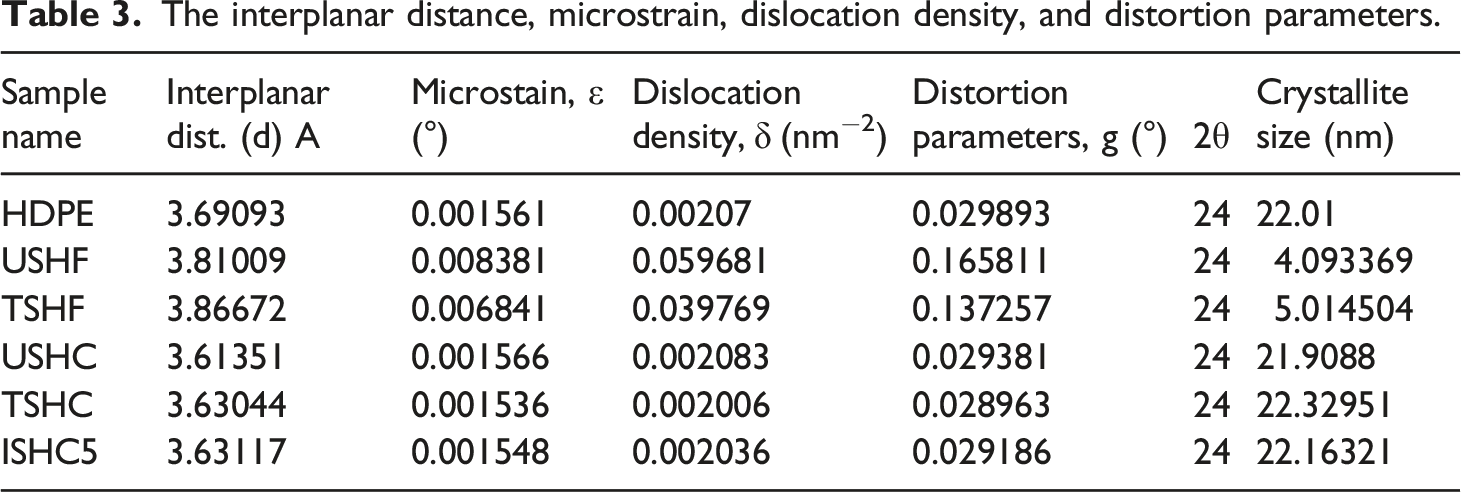
The microstrain, distortion parameters, dislocation density, and interplanar spacing of HDPE, USHF, TSHF, USHC, TSHC, and ISHC5 were estimated by the following relations:
Microstrain,
Distortion parameters,
Dislocation density,
Interplanar spacing,
Field emission scanning electron microscopy
The fractured surface morphologies of USHC, TSHC, and ISHC5 were analyzed using a field emission scanning electron microscope (ZEISS, EVO50, Germany). Samples were mounted on aluminum stubs with carbon tape and then sputter-coated with platinum to make them conductive prior to field emission scanning electron microscopy (FESEM) observation.
Fourier-transformation infrared spectroscopy
The functionality of HDPE, USHF, TSHF and the interaction of fiber-matrix in the USHC, TSHC, and ISHC5 were studied by an FTIR spectrometer (Nicolet 6700 MAGNa-IR, Thermo Scientific, Germany) using the standard ATR in the wave number range 650 cm−1 to 4000 cm−1.
Water intake
Water intake values of USHC, TSHC, and ISHC5 samples were calculated by placing the samples underwater in a bath at 30°C. The samples were taken out of the water after a constant time interval, wiped, and weighed. The water intake values of the samples were calculated by the following formula.10,11
Here, W i = initial weight, W f = Final weight of the specimen at time t.
Mechanical testing of composites
Mechanical testing of the composites was conducted according to ASTM 638 (Model: AG-1) for the Tensile test. A Universal tensile testing machine was fitted with a load of 5 kN. The gauge length was 30 mm and the cross-head speed was 10 mm/min. Three samples of each series were tested for tensile strength (TS), and Young’s modulus (Y) measurements.
Differential scanning calorimetry
Differential scanning calorimetry (DSC) was performed under a nitrogen atmosphere to determine and evaluate the thermal transition of the samples, the glass transition temperature (Tg), melting temperature (Tm), and crystallization temperature (Tc), using a TA/Q1000 apparatus. Prior to the measurements, all the test samples were dried at 90°C for 7 h. For monitoring DSC, the samples were initially heated at 27°C–600°C with a heating rate of 20°C min−1 to monitor calorimetric properties in the nitrogen atmosphere.
Thermogravimetric analysis
Thermogravimetric measurements were performed by a TGA Q500 V6.4, Germany, under a nitrogen atmosphere and in a platinum crucible (flow rate 60 mL/min) with a heating rate of 20°C/min to determine the weight loss of the samples at different temperatures. The range of the temperature was taken from 25 to 600°C.
Results and discussion
XRD analysis
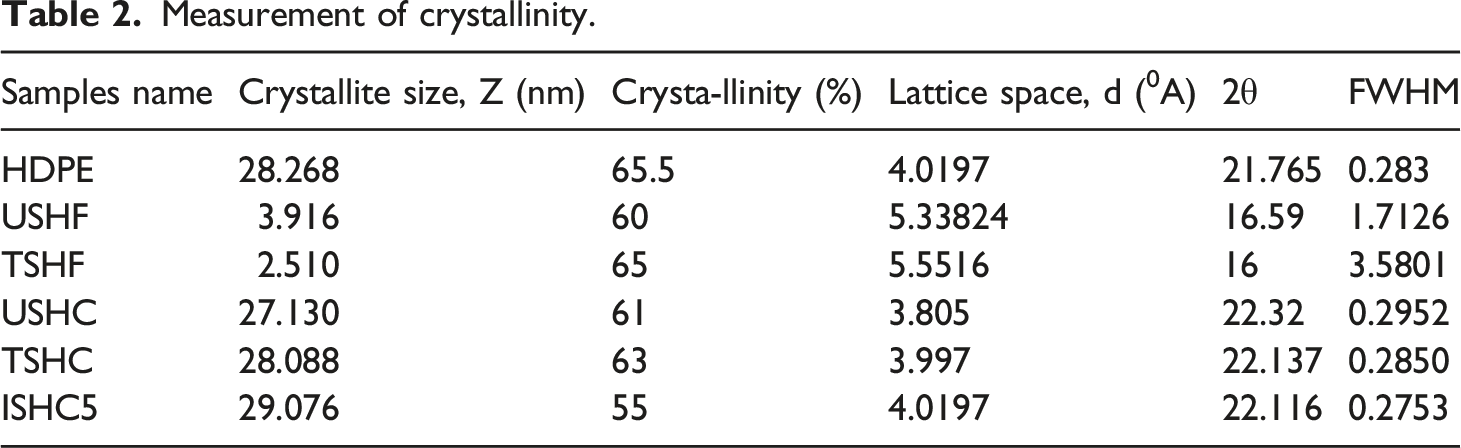
X-ray diffraction patterns of HDPE, USHF, TSHF, USHC, TSHC, and ISHC5 are shown in Figure 2. The X-ray pattern of HDPE shows two strong (110) and (200) reflection peaks, appearing at 21.8° and 24.16°, which correspond to lattice spacing of 4.0197 and 3.68804Å, respectively. Analysis of the result indicates that the neat HDPE exhibits an orthorhombic structure with 65% crystallinity.
18
The XRD patterns of both USHF and TSHF have two prominent intensity peaks at the Bragg’s angle of 23.2° and 16.6°, showing two main reflection peaks at (002) and (101), respectively, which are assigned to the presence of pure cellulose embedded with some small percentage of non-cellulosic amorphous components, i.e. lignin, hemicellulose, pectin, etc.
19
XRD analysis of HDPE, (b) USHF, (c) TSHF, (d) USHC, (e) TSHC, and (f) ISHC5.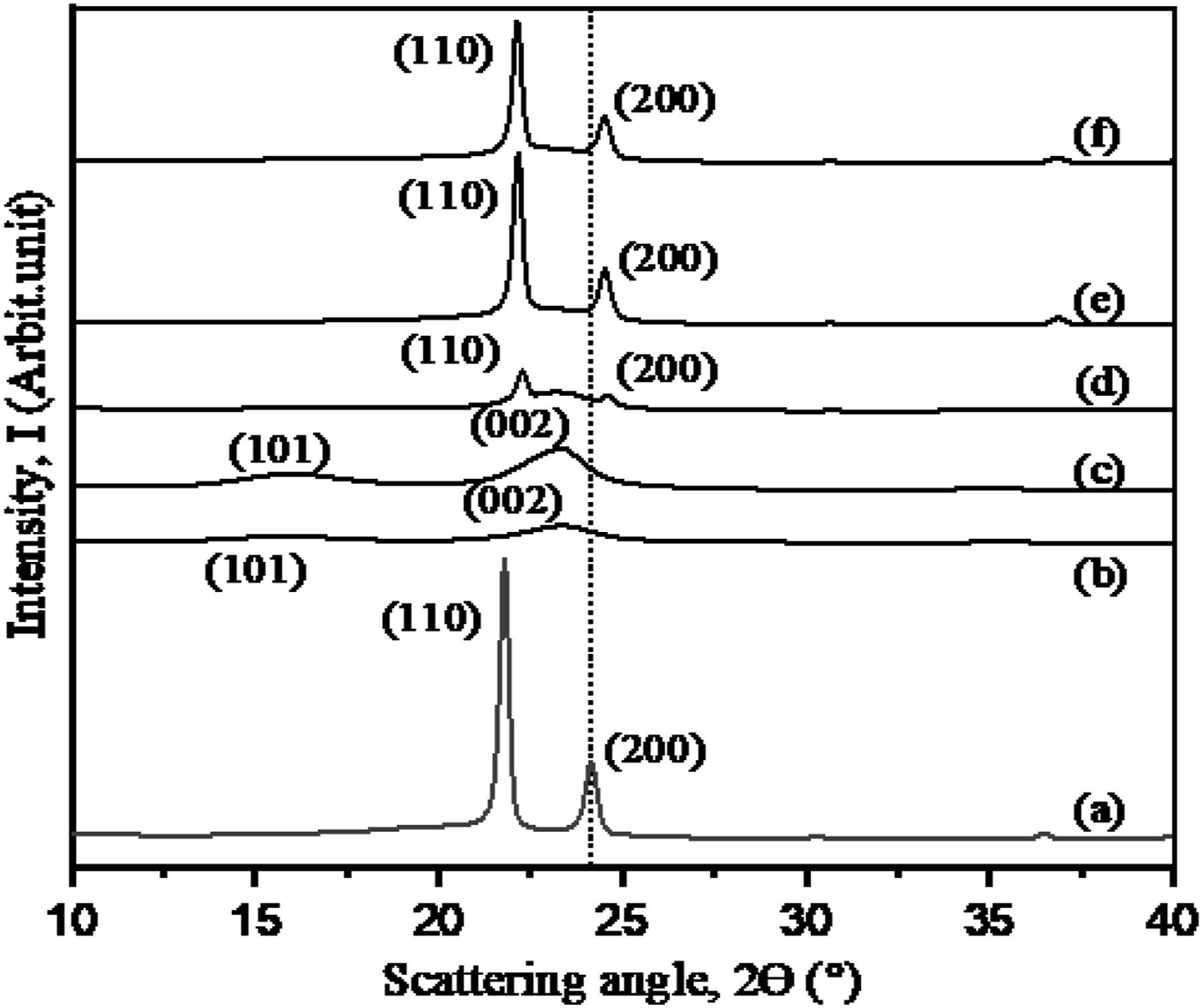
Measurement of crystallinity.
The interplanar distance, microstrain, dislocation density, and distortion parameters.
Surface morphology
Figure 3(a)–(d) shows the FESEM micrographs of single TSHF and USHC, TSHC, and ISHC5, taken from their fractured surfaces after tensile tests. The micrograph of the alkali treatment of a single TSHF is shown in Figure 3(a). FESEM micrographs of the fractured surface of (a) single 10% TSHF, (b) USHC, (c) TSHC, and (d) ISHC5.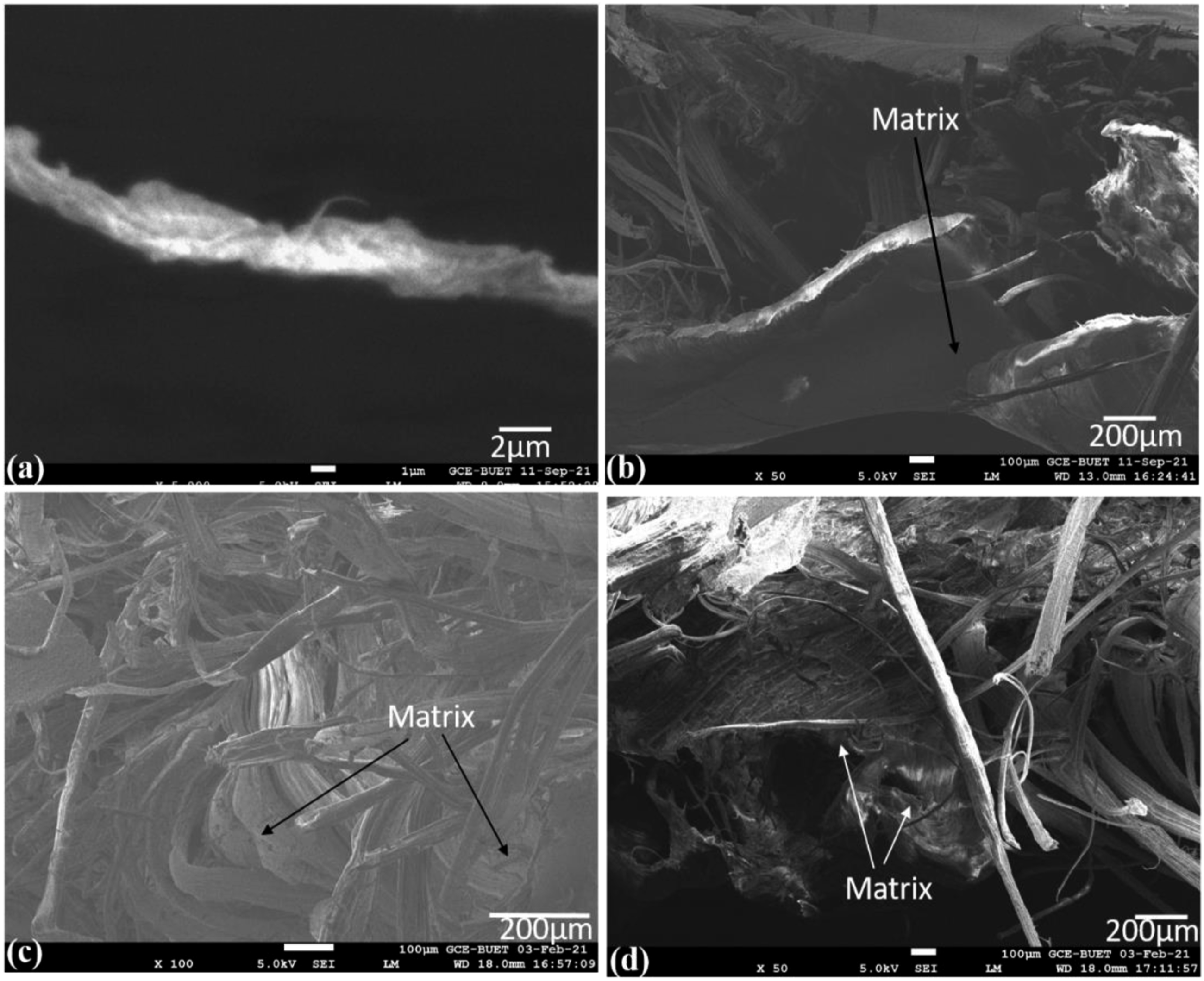
The surface of a single TSHF becomes rough due to alkali treatment. In the case of USHC Figure 3(b), it is noticeable that a large number of fibers are randomly pulled out from the HDPE matrix in the composites, while fiber break is observed and a less amount of fibers is detached from the matrix in the case of TSHC and ISHC5. In Figure 3(c) and (d), the matrix seems to stick to the fibers even after their detachment. This indicates a better adhesion between SHF and HDPE by alkali and gamma-ray treatments. 22 However, the micrograph of the gamma-ray irradiated sample indicates comparatively smoother surfaces than those of others, and few fibers are dragged out from the HDPE matrix. The observed surface morphology of the samples suggests that the interaction between Sunn hemp fiber and HDPE has been increased by both alkali and gamma-ray treatments. 20
FTIR analysis
Figure 4(a) in the range of wave number 600–200 cm−1 and Figure 4(b) in the range of wave number 2000–4000 cm−1 illustrate the FTIR spectra for (a) HDPE, (b) USHF, (c) TSHF, (d) USHC, (e) TSHC, and (f) ISHC5. FTIR spectrum of HDPE shows a band at 719‒730 cm−1 is attributed to a rocking deformation and 1472 cm−1, which is assigned to ‒CH2 as a bending deformation. A peak in the region of 2900 cm−1 is observed for HDPE which is due to the ‒CH2 as an asymmetric stretching. In the region, 1462 cm−1, methyl asymmetric deformation vibration is observed for HDPE. Another peak is observed in the region of 1575 cm−1, which indicates the presence of ‒CH3, ‒CH, and ‒CH2 groups. At the wavenumber 2342 cm−1, strong O=C=O stretching is also found. In the region of 2855 cm−1 and 2930 cm−1, two narrow peaks are for the presence of the ‒CH group, for asymmetric stretching, and for symmetric stretching, respectively.
23
(a). FTIR analysis of (a) HDPE, (b) USHF, (c) TSHF, (d) USHC, (e) TSHC, and (f) ISHC5, (b). FTIR analysis of (a) HDPE, (b) USHF, (c) TSHF, (d) USHC, (e) TSHC, and (f) ISHC5.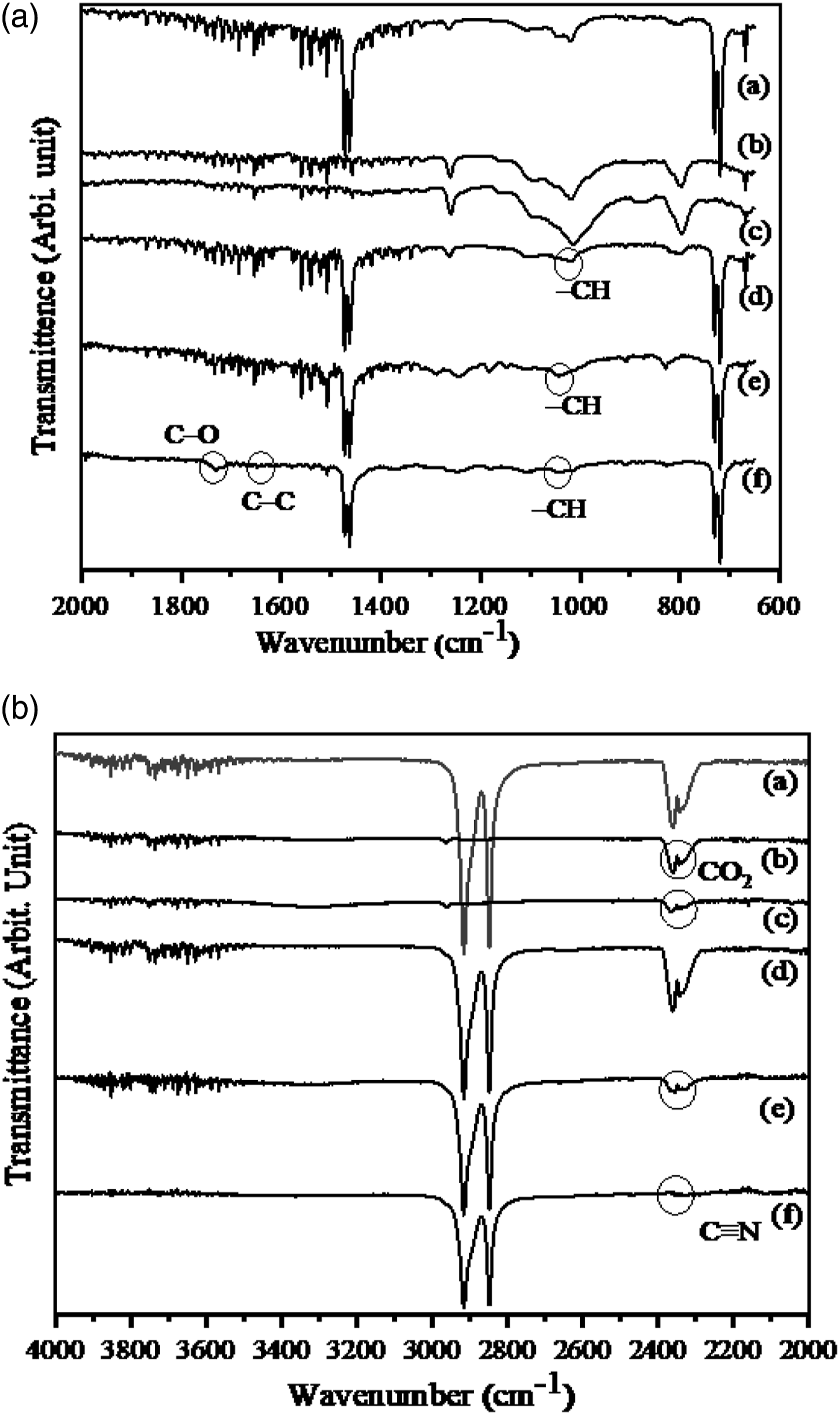
A broad hydroxyl group peak appears in the wave number of 3335 cm−1 for untreated Sunn hemp and 3315 cm−1 for treated Sunn hemp fiber attributed to ‒OH stretching and H bonded, but due to alkali treatment a reduced absorption band is observed at 3315 cm−1 which indicates the decrease of the functional group ‒OH stretching. 23 A band at 2905 cm−1 shows a small absorption peak which is ascribed ‒OH stretching and contains the functional group of carboxylic acid and alkanes. Though the spectra of TSHF and USHF are almost the same but some important variation is seen for intensity and shape changes of the absorption band of TSHF appearing at 906 cm−1. It indicates C‒H bond for a functional group of aromatic compound. Band at 1021 cm−1 is for C‒O stretching due to alcohol. Bands at 1262, 1435, 1510, and 1693 cm−1 are ‒CH bending for alkenes and 2358 cm−1 is assigned to C≡C stretching for alkynes. The band at 2894 cm−1 is ‒CH stretching, and peak at 3320 cm−1 indicates ‒OH stretching for alkanes group assigned to the removal of water and gummy components. The band of TSHF at 1021 cm−1 is shifted to the right side which is assigned to C‒O‒C stretching, C‒O stretching vibration of cellulose, and C‒H bending. The band at 1257 cm−1 is assigned to C–O–C stretching vibration of ester groups in hemicellulose is assigned to ‒CH bending, ‒CH2 twisting, and ‒CH3 rocking. Also, the band of USHF at 2360 cm−1 can be attributed antisymmetric stretching mode of ‒CO2, which is reduced due to alkali treatment. The fingerprint region 3284 cm−1 indicates the O‒H stretching vibration modes from alcohols and phenols which are mostly broad and very strong.
At the 720 cm−1 band, rocking deformation takes place for the methylene group which is due to the crystallinity of HDPE. But for both TSHC and ISHC5, this band is shifted to the right side at 725 cm−1 indicating better cross-linking. 24 FTIR spectra for ISHC5 are mostly different from USHC and TSHC. The broad absorption peak at 3284 cm−1 is absent in ISHC5, which indicates that the irradiation of gamma-ray disappears the hydroxyl groups (‒OH) and favors the formation of crosslinking between Sunn hemp fiber and HDPE matrix through C‒O and C‒C, ‒CH bonds that appear at the bond 1737 cm−1 and 1650 cm−1, 1025 cm−1 respectively. Absorption peaks for neat HDPE, USHC, and TSHC at 2365 cm−1, 2365 cm−1, and 2354 cm−1 respectively, which are attributed to the nitrile (C≡N) group. For the ISHC5 sample at 2360 cm−1 for group C≡N, the intensity of the peak is mostly reduced due to the gamma-ray irradiation. 25
These results exhibit that the inclusion of Sunn hemp fibers affects not only the vibrational or rotational motion of molecules but also plays a role in the formation of new crosslinking bonds between the HDPE molecule and Sunn hemp fiber. The chemical reaction between USHF and alkali partially removes lignin and hemicellulose from the fiber. Therefore, the adhesion and crosslinking between TSHF and HDPE molecules in the TSHC and ISHC5 due to gamma-ray irradiation, are confirmed from the FTIR spectra.
Bonding mechanism
The possible chemical reaction of Sunn hemp fiber with alkali (10%NaOH) is sketched in Figure 5. NaOH reacts with the cellulose of Sunn hemp fiber and Na atom replaces the hydrogen atom with –OH group.12,24 The possible chemical reaction of SHF with alkali (10%NaOH).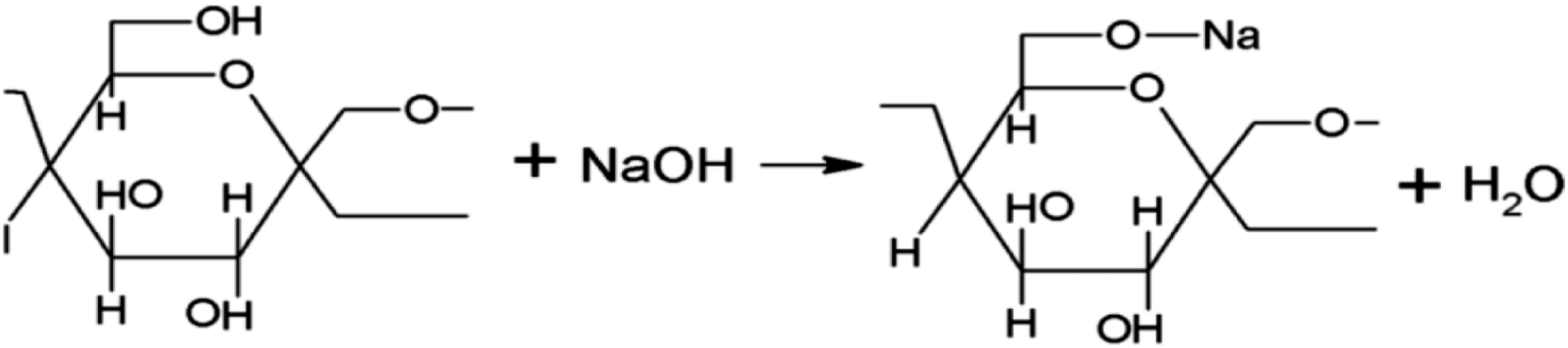
Figure 6 illustrates the possible reaction mechanism of cellulose due to gamma-ray irradiation. When sunn hemp fibers in the composites are irradiated by gamma rays, free radicals are formed by hydrogen (‒H) and hydroxyl (‒OH) abstraction on the cellulose unit. These free radicals are responsible for combining with other cellulose units by a covalent bond. Cross-linking among fibers increases due to gamma-ray irradiation.
23
Hydrogen or hydroxyl abstraction from cellulose.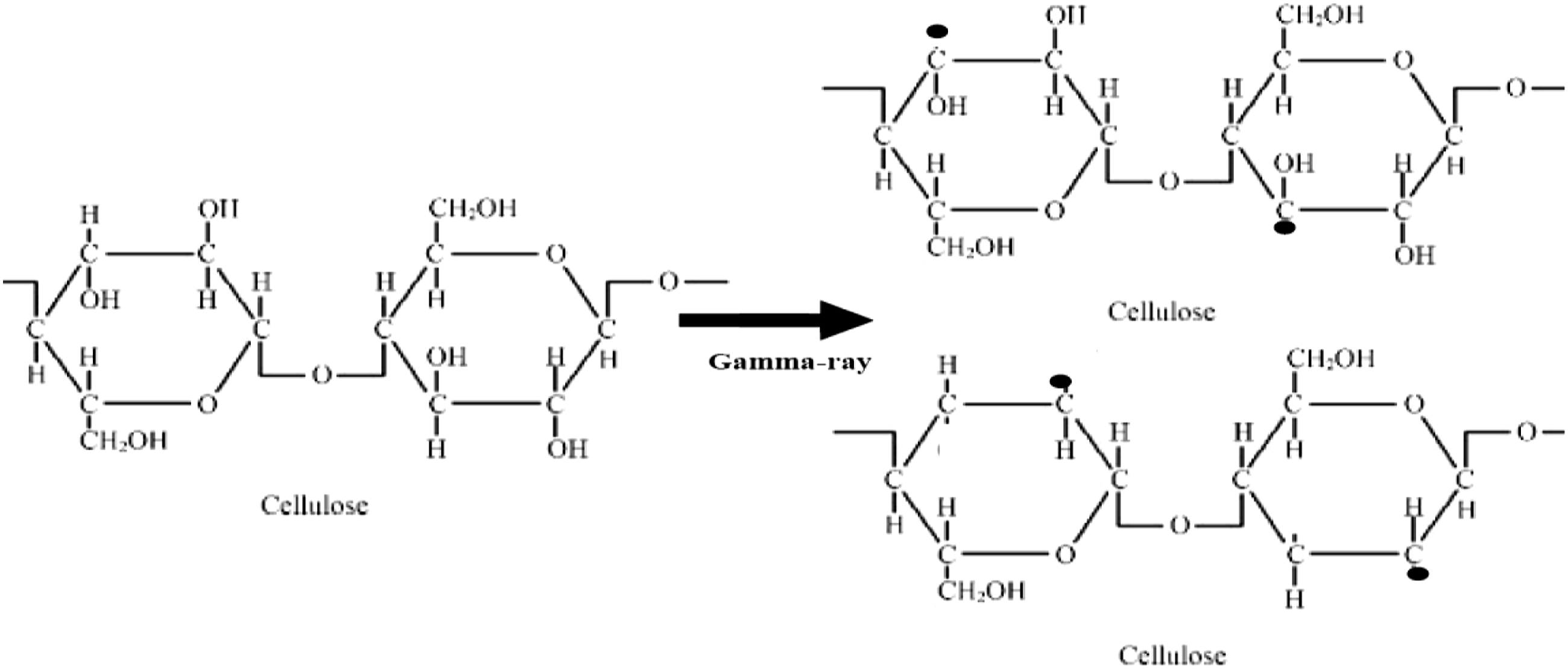
Figure 7 shows that due to gamma-ray irradiation C‒C and C‒O bonds of the ring break up. When Sunn hemp fibers are irradiated with gamma-ray, free radicals are also formed after breaking these bonds. Figure 8 shows that a chain scission may occur and the rings are separated due to gamma-ray irradiation. As a result, free radicals are created in every unit of cellulose. Figure 9 shows free radical formation in HDPE molecules of the TSHC due to the effect of gamma-ray irradiation. When gamma-rays is irradiated on the composites, free radicals are created from the matrix molecule due to the abstraction of the H molecule. These free radicals are the main cause of the formation of new bonding between molecules of the matrix.
24
A possible reaction mechanism among molecules of cellulose and neat HDPE due to gamma radiation in the TSHC is depicted in Figures 10 and 11. Due to the irradiation of gamma-ray, free radicals are formed by the cleavage of both molecules. After that, these two molecules combine with each other and is created a covalent bond between them. As a result, the irradiated composites become more stable than unirradiated ones.
24
Free radical generation by cycle opening of C‒C and C‒O bond due to gamma-ray irradiation on cellulose. Free radical generation by chain scission due to gamma-ray irradiation on cellulose. Formation of free radicals in HDPE molecules. Formation of C‒C bonds due to gamma-ray Irradiation. Formation of C‒O bonds due to gamma-ray Irradiation.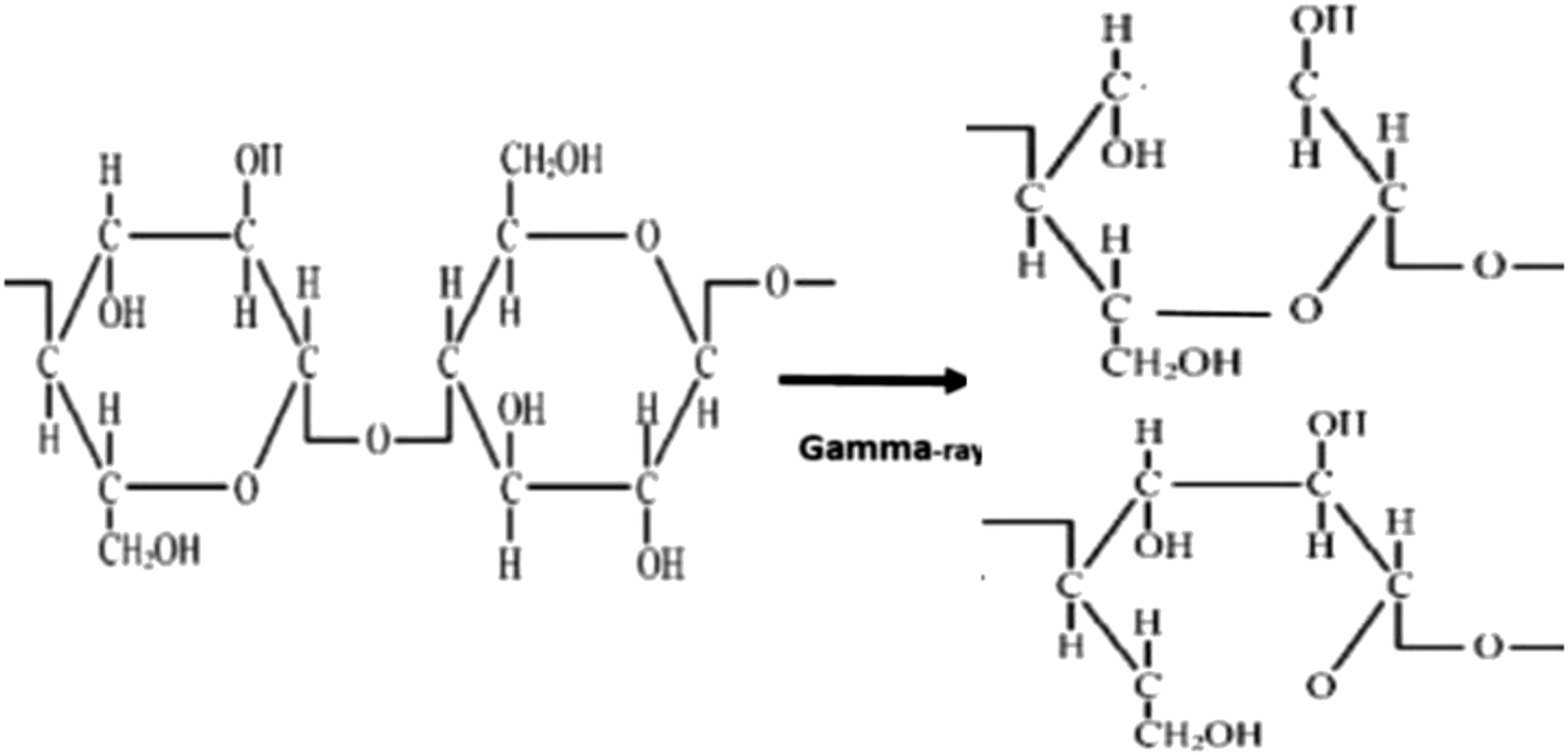
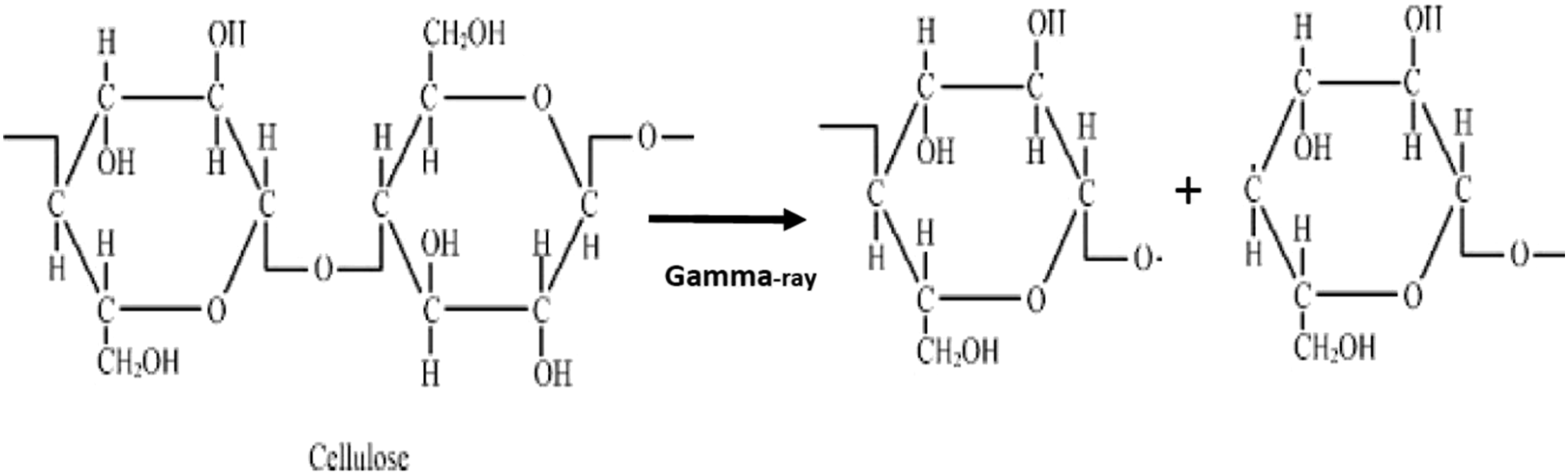
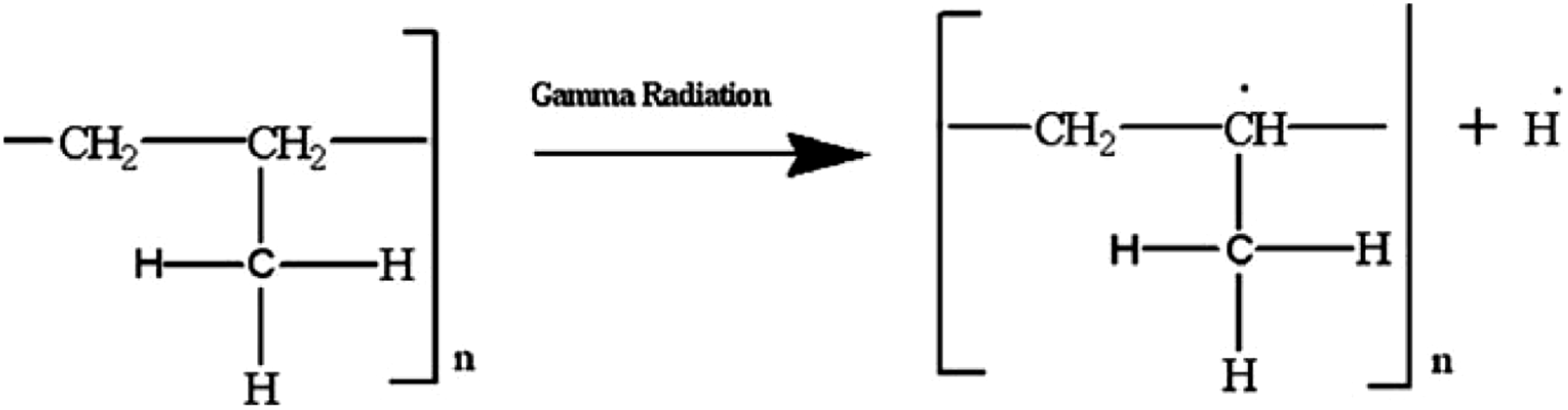
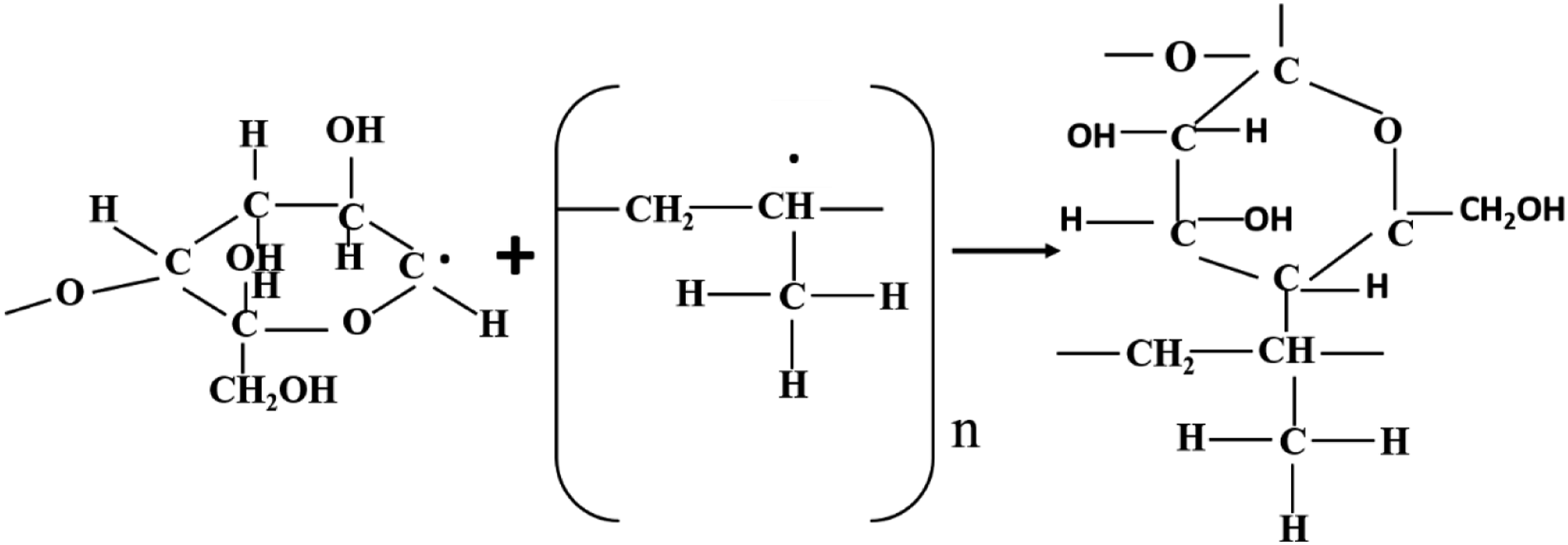
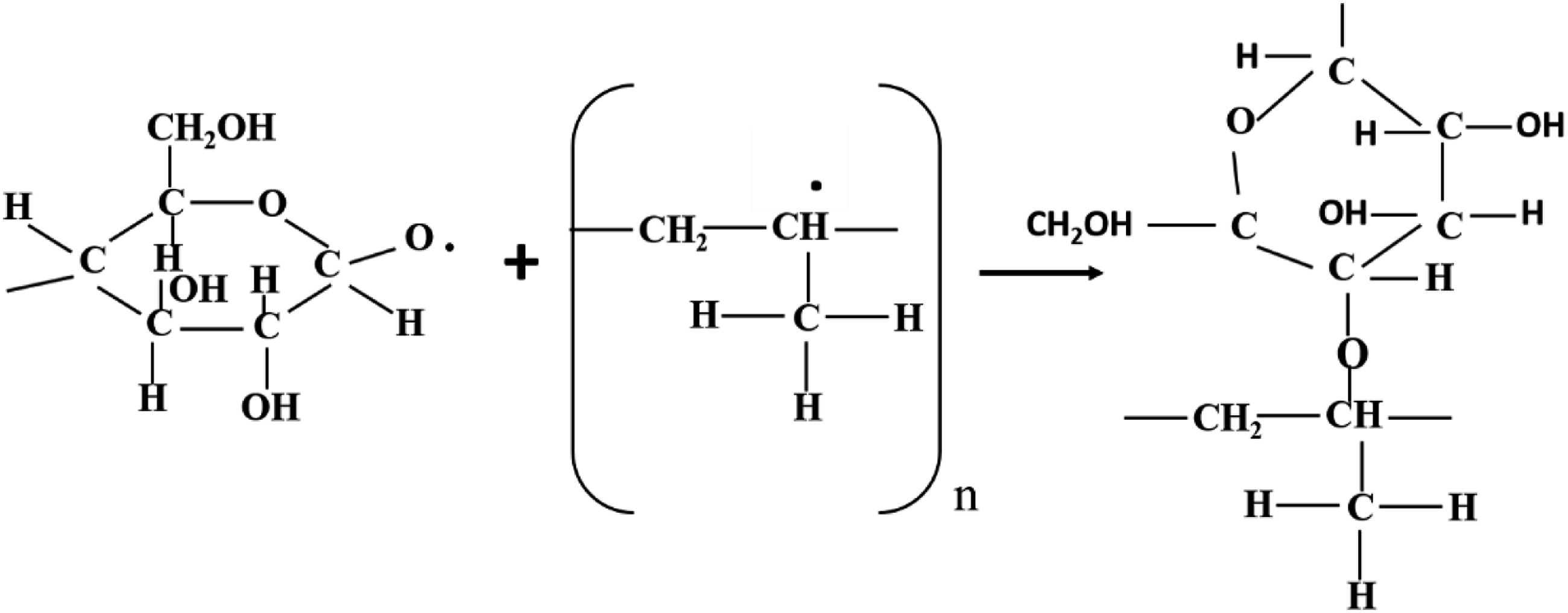
On the basis of the above mechanism, free radicals are created after C‒O, C‒C, and C‒H bonds cleavages of the monomeric units of SHF cellulose through hydrogen and hydroxyl abstraction, shown in Figures 7–10 by gamma radiation. Thereafter, Sunn hemp fiber and HDPE molecules join together through the C‒H, C‒C, C‒O, and C‒O‒C bonds (Figure 11). Thus, the observed results of the proposed bonding mechanism between the cellulose and HDPE is agreed with the finding of the FTIR spectrum analysis.
Water intake
The water intake (WI) properties of USHC, TSHC, and ISHC5 samples were calculated using equation (7) and shown in Figure 12. The WI of USHC increases rapidly up to 25 h, from which it increases slowly. Similar trend of WI is found for TSHC and ISHC5. The WI of the latter two samples at a particular time is lower than that of USHC. The WI for all samples nearly levels off at 35 h The WI of USHC shows 52.94% higher than that of ISHC5 and 16% higher than that of TSHC at 40 h. Water intake of composites as a function of time.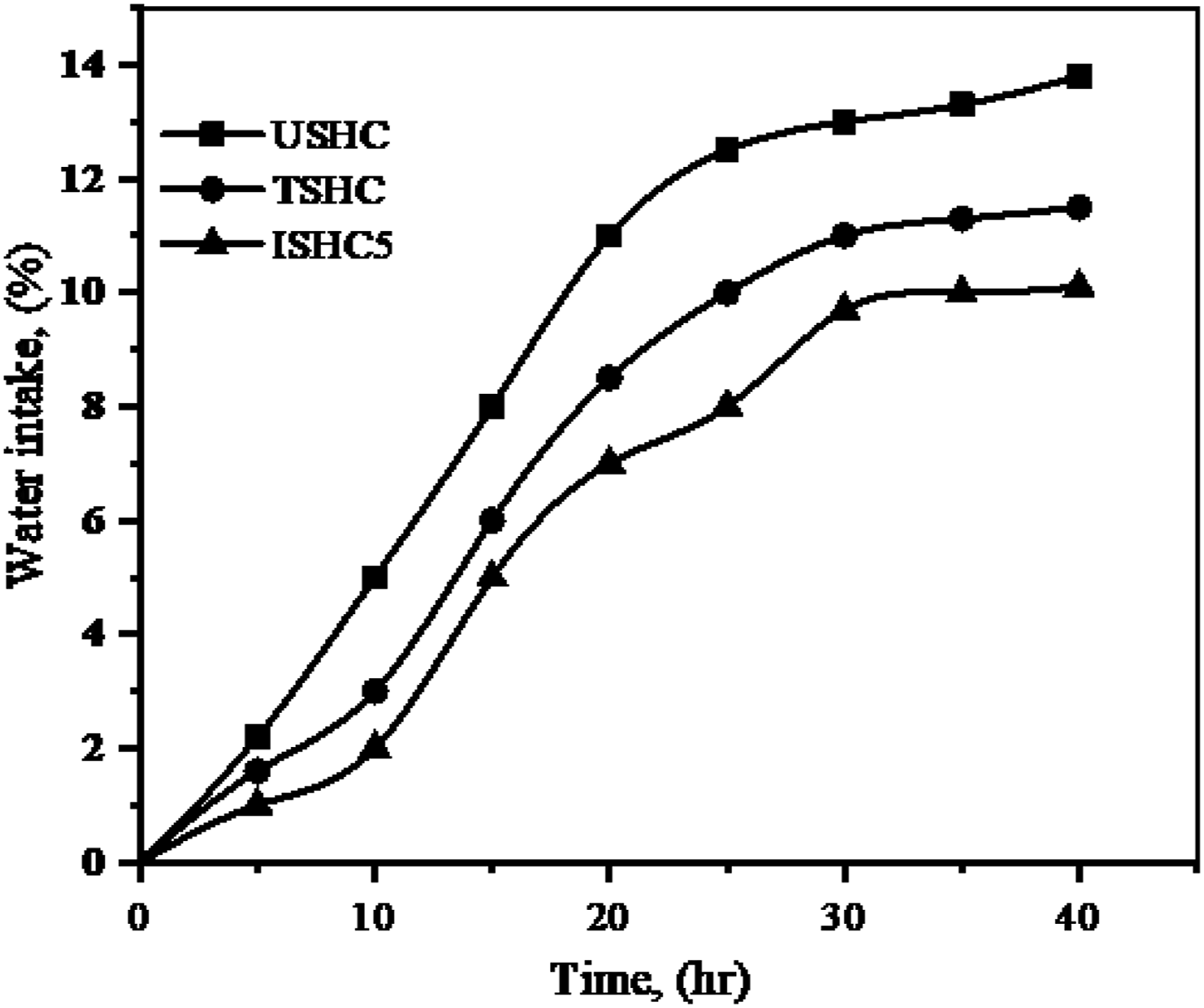
The differences in WI behavior of USHC, TSHC and ISHC5 are possibly due to the following reasons: (i) because of the incompatibility between Sunn hemp hessian cloth and HDPE, more microvoids may be developed at the polymer–fabric or the fiber–fiber interfaces wherein water can be trapped and can result in high WI in USHC, (ii) alkali treatment may eliminate impurities from fiber, resulting in improved fiber-matrix adhesion, which may reduce water intake in TSHC, and (iii) the hydrophilic moiety of fabrics is reduced by gamma-ray irradiation due to the crosslinking between fiber and HDPE molecules.10,11,25
Mechanical properties
Figure 13 shows the variation of TS with respect to the wt% of fiber contents. The TS values of USHC and TSHC increase with fiber contents up to 55wt% and then decreases. The maximum TS at 55wt% fiber contents may be due to the increased fiber contents in the composites in which homogeneous distribution of fibers may occur. Due to this reason a balanced wettability of the fibers with the matrix takes place. The TS value of TSHC is 60 MPa and USHC is 44 MPa, indicating an increase of TS of about 30% after the addition of 55wt% fiber contents. This increase in TS is due to the alkali treatment of fiber, because waxy and gummy components of Sunn hemp fibers are eliminated after treatment. The fiber surface becomes rough after alkali treatment and Van der Waals’s interaction between Sunn hemp fibers molecules and HDPE molecules increase.
26
Variation of TS as a function of fiber contents.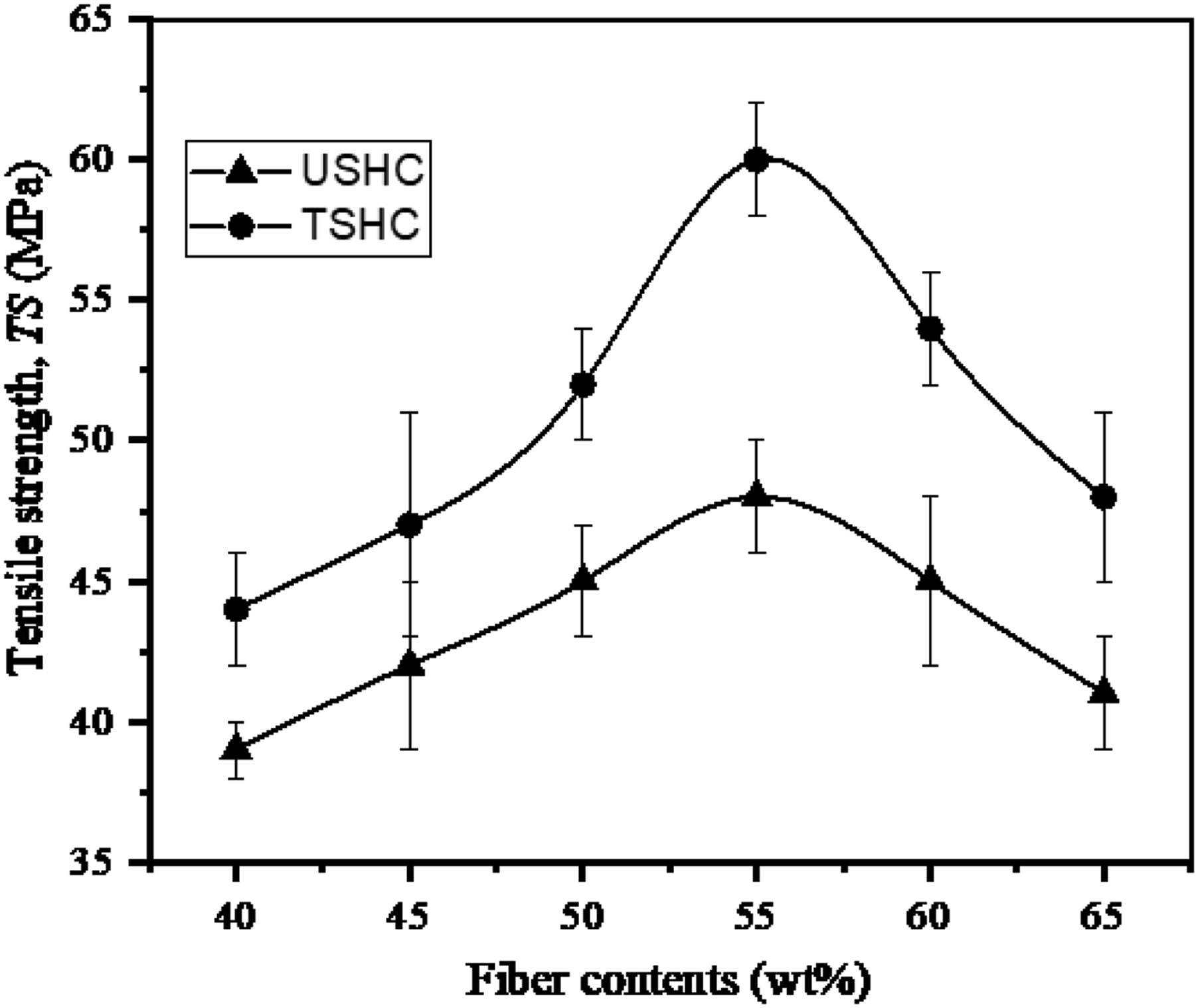
Figure 14 demonstrates the TS of HDPE, USHC, TSHC, ISHC2.5, ISHC5, and ISHC7.5. The TS value increases up to 5 kGy and after that, it decreases with increasing radiation dose. The maximum TS value of ISHC5 at 5 kGy dose is 72 MPa which is 20% and 33% greater than that of TSHC and USHC, respectively. The increase in TS value may be attributed to the improvement of cross-linking between fiber-matrix molecules.
26
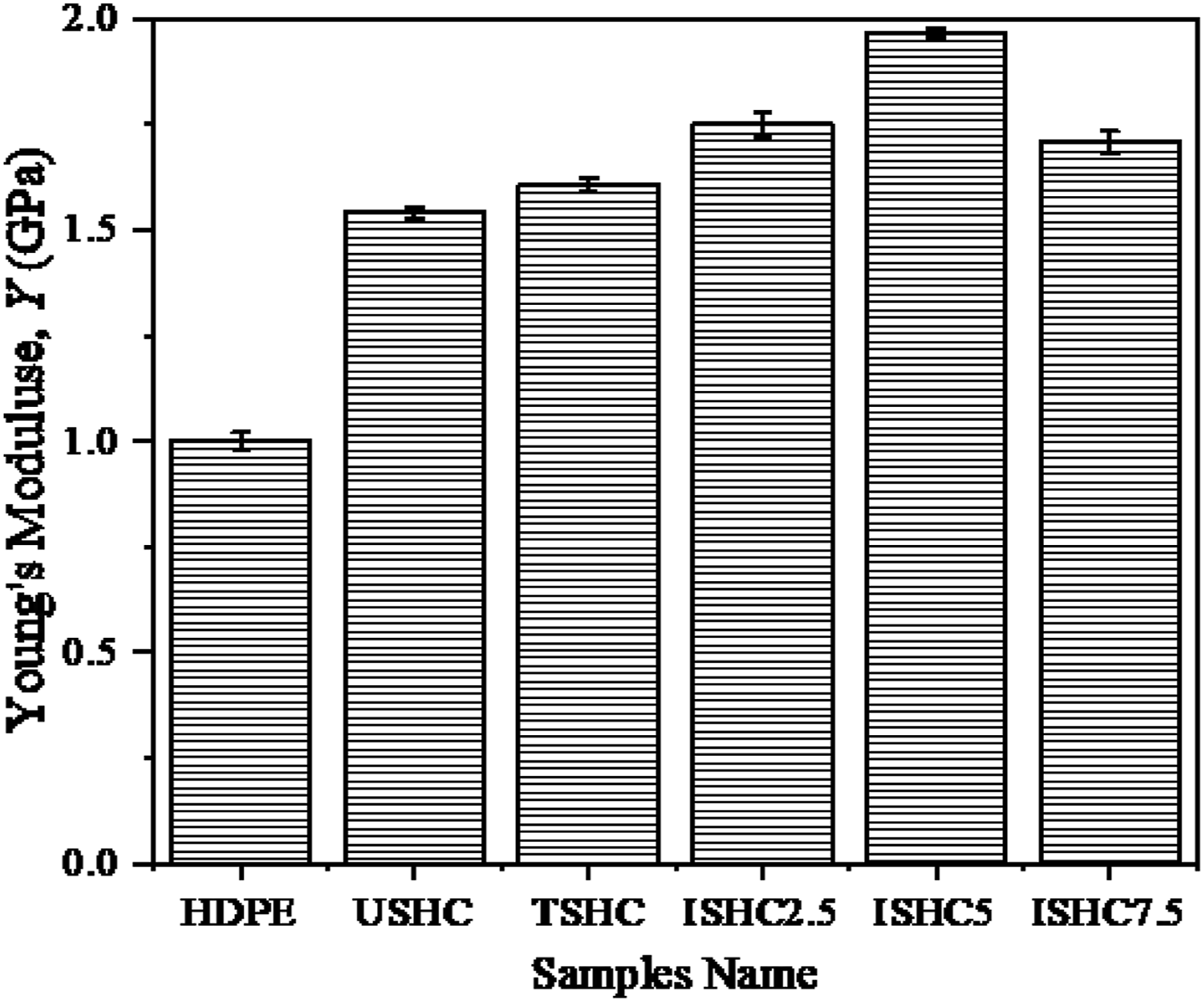
Figure 15 shows the change of Y for HDPE, USHC, TSHC, ISHC2.5, ISHC5, and ISHC7.5 at 55wt% Sunn hemp fibers contents. The maximum Y value obtained for the ISHC5 sample is 1966 MPa which is 96.6%, 28% and 22% greater than that of HDPE, USHC and TSHC, respectively. The increase in Y value with radiation dose up to 5 kGy may be due to the cross-linking between the molecules of fiber and matrix. At higher doses after 5kGy, the Y value is found to decrease, which may be for the degradation of fiber and polymer molecules by high energy gamma radiation.27–29 Tensile strength of the different types of composites at 55wt% fiber contents. Young modulus of HDPE, USHC, TSHC, ISHC2.5, ISHC5, and ISHC7.5.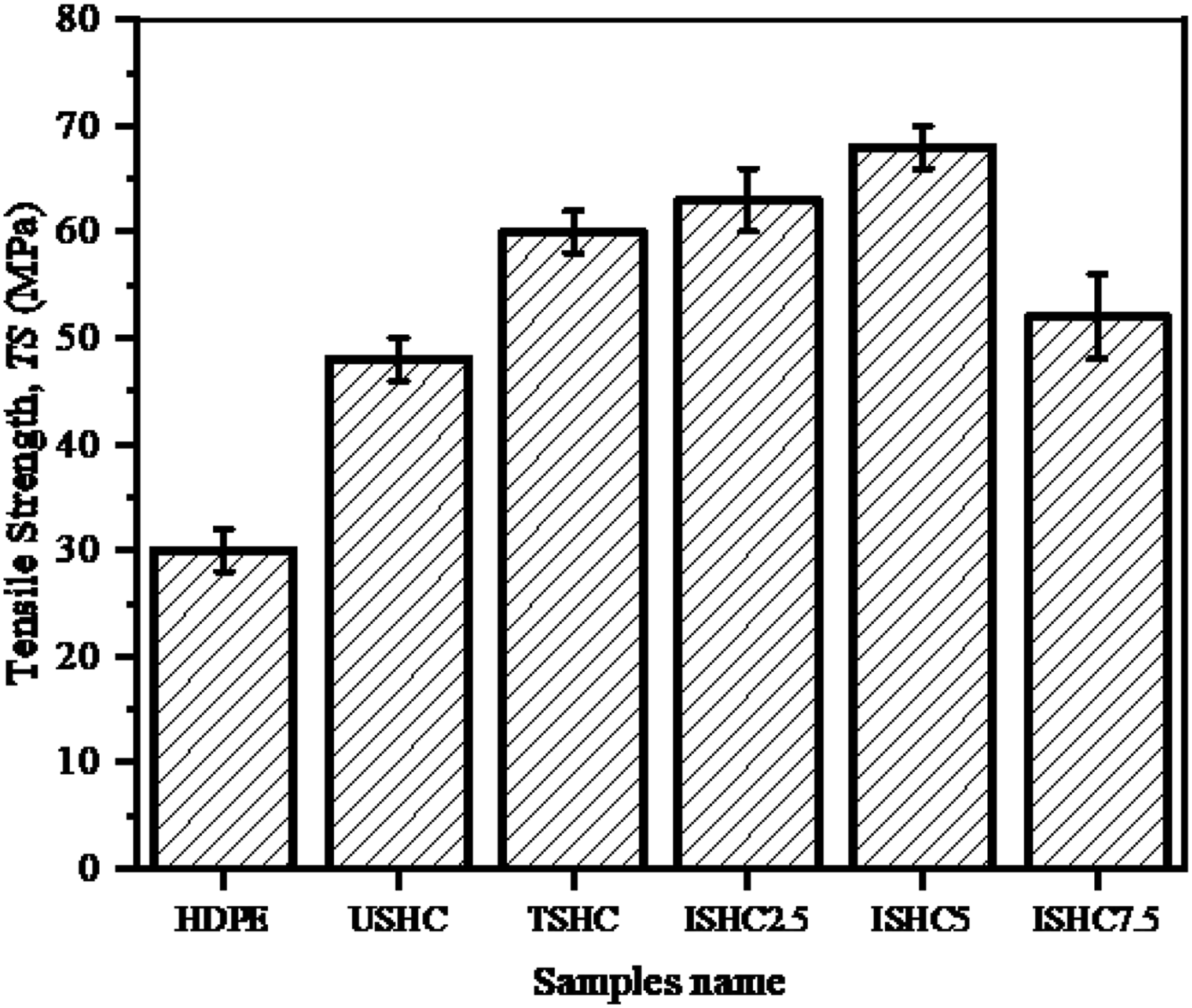
Due to the gamma-ray irradiation in the composites, polar groups of C=O and C–O are created and the compatibility between the Sunn hemp fiber and matrix can be improved. Thus the mechanical properties of the ISHC5 is increased.
Thermal analysis
The DSC thermograms of HDPE, USHF, TSHF, USHC, TSHC, and ISHC5 are shown in Figure 16. The DSC of HDPE contains two important peaks of which one is the melting temperature at 130°C and the other is the decomposition temperature at 505°C. The USHF shows a diffuse peak at 78°C, which appears because the absorbed water starts to emit from the fabric, as reported by other researchers.
30
The decomposition temperature of USHF is 375°C. A small downward fall of nearly at 285°C may be due to the decomposition of hemicellulose from USHF.
30
Moreover, all treated and untreated fiber-reinforced composites reveal four decomposition peaks at different temperatures (Table 4). The peaks at 450°C may correspond to the crystallization temperature of the fiber. The melting temperatures of HDPE, USHC, TSHC, and ISHC5 are shown in Table 4. In Figure 16, dotted vertical line one is drawn to show the melting temperature of USHC, TSHC, and ISHC5. The melting temperatures of USHC, TSHC, and ISHC5 are shifted right side than that of HDPE. TSHC and ISHC5 show higher melting temperatures than that of untreated ones Table 5. This result may be due to the breaking of crystalline structures in TSHC and ISHC5 which developed by crosslinking between the HDPE and the Sunn hemp fiber.
31
DSC thermograms for (a) HDPE, (b) USHF, (c) TSHF, (d) USHC, (e) TSHC, and (f) ISHC5. TGA of HDPE, USHF, TSHF, USHC, TSHC, and ISHC5. Thermal decomposition temperature of HDPE, USHF, TSHF, USHC, TSHC, and ISHC5.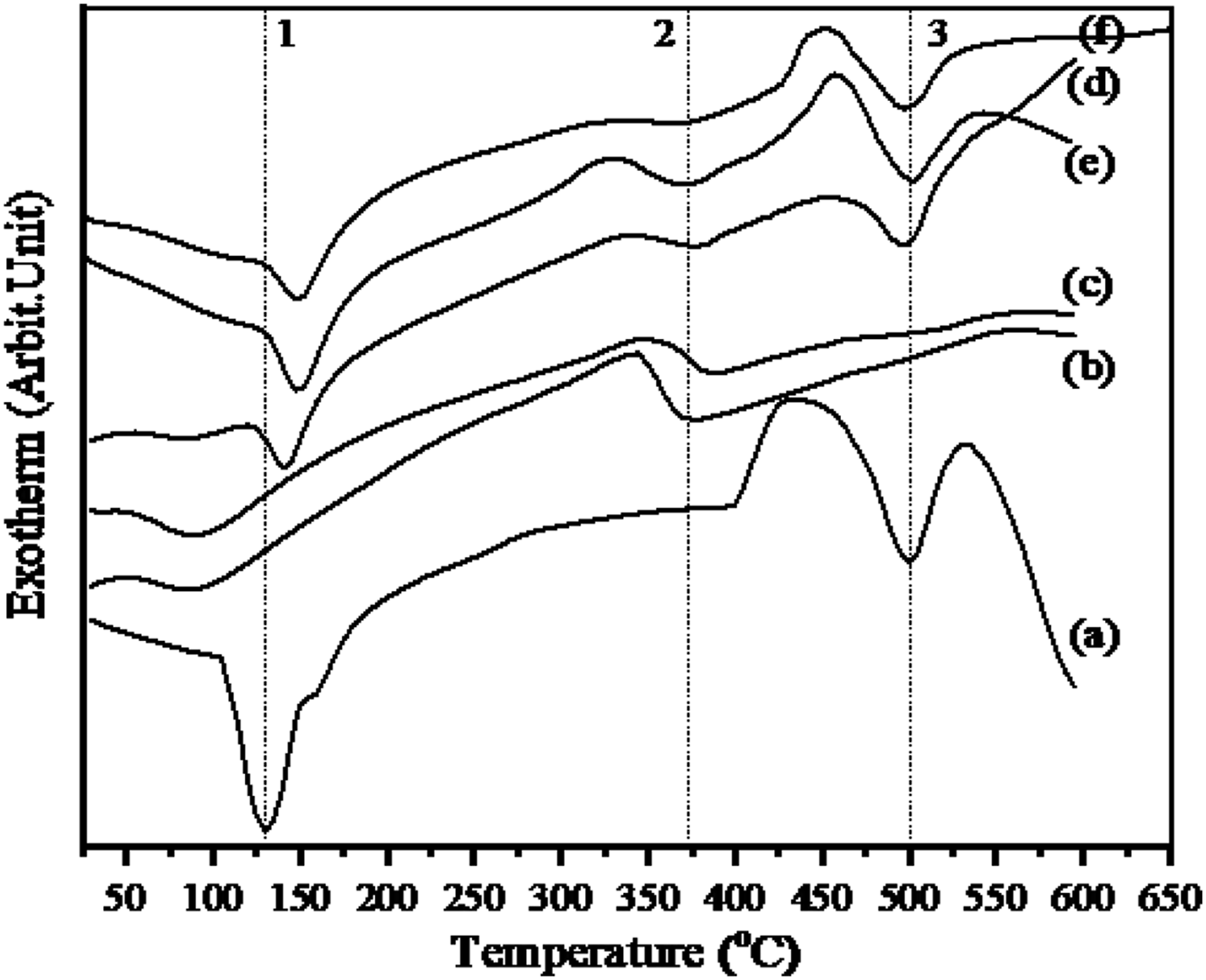
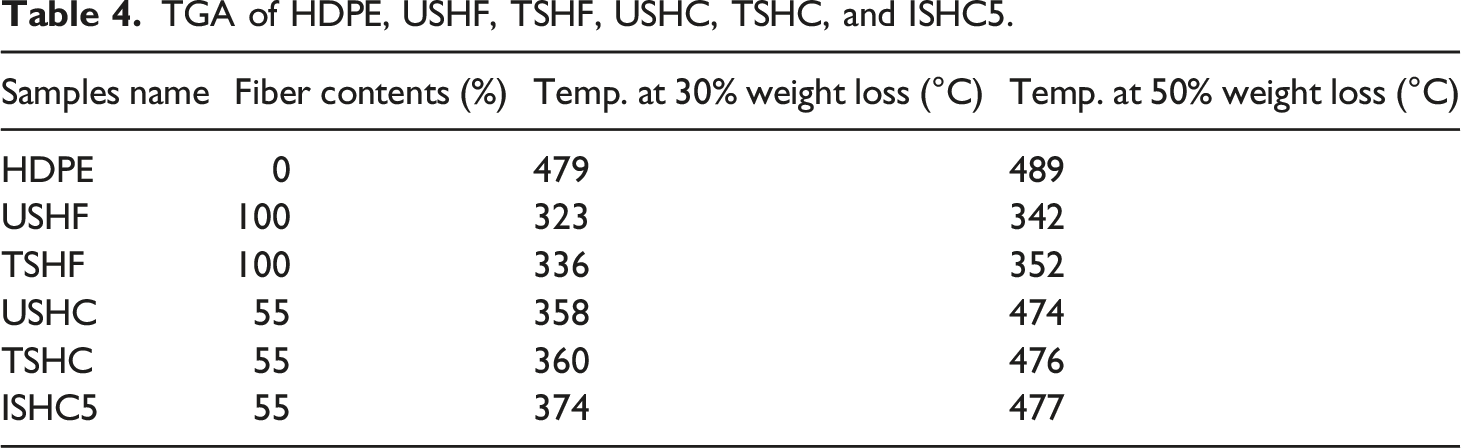
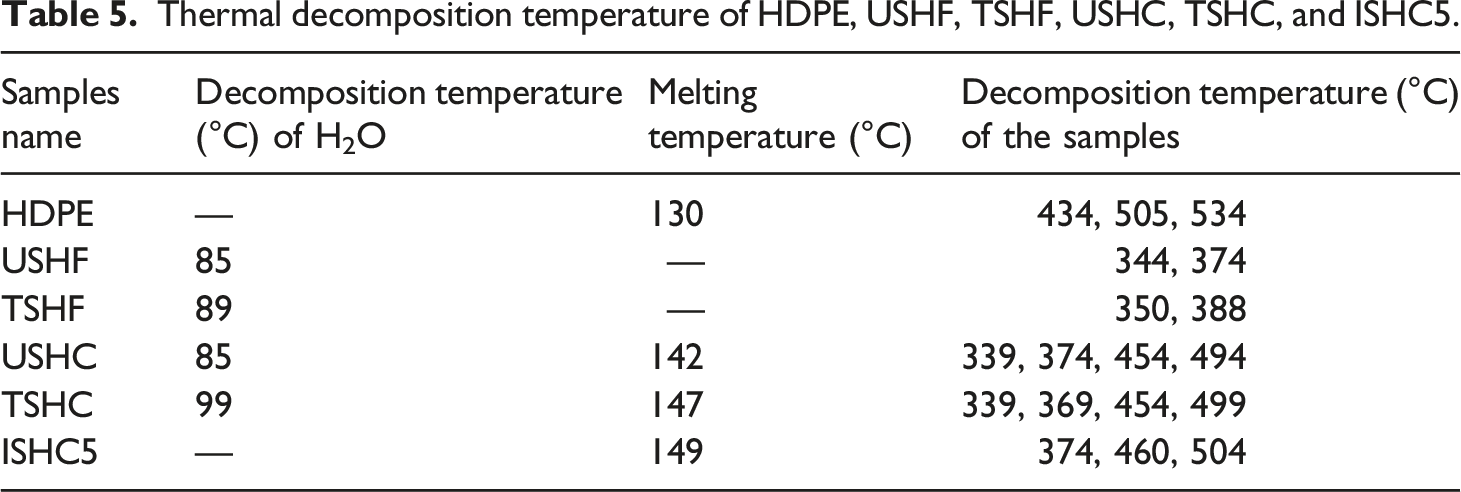
Figure 17 shows the percentages of weight losses with respect to the temperature for HDPE, USHF, TSHF, USHC, TSHC, and ISHC5, respectively. The 30 and 50% weight losses that occur at different temperatures are shown in Table 4. USHC, TSHC, and ISHC5 exhibit the degradation process in which the characteristic of the structural degradation or destabilization is at 50% weight loss of a sample.
32
The increasing value of degradation temperature from USHC to TSHC and ISHC5 indicates better adhesion between matrices and the formation of new chemical bonds among Sunn hemp and HDPE molecules by surface treatment with alkali and also gamma-ray irradiation, respectively.
33
TGA thermograms of (a) HDPE (b) USHF, (c) TSHF (d) USHC (e) TSHC, and (f) ISHC5.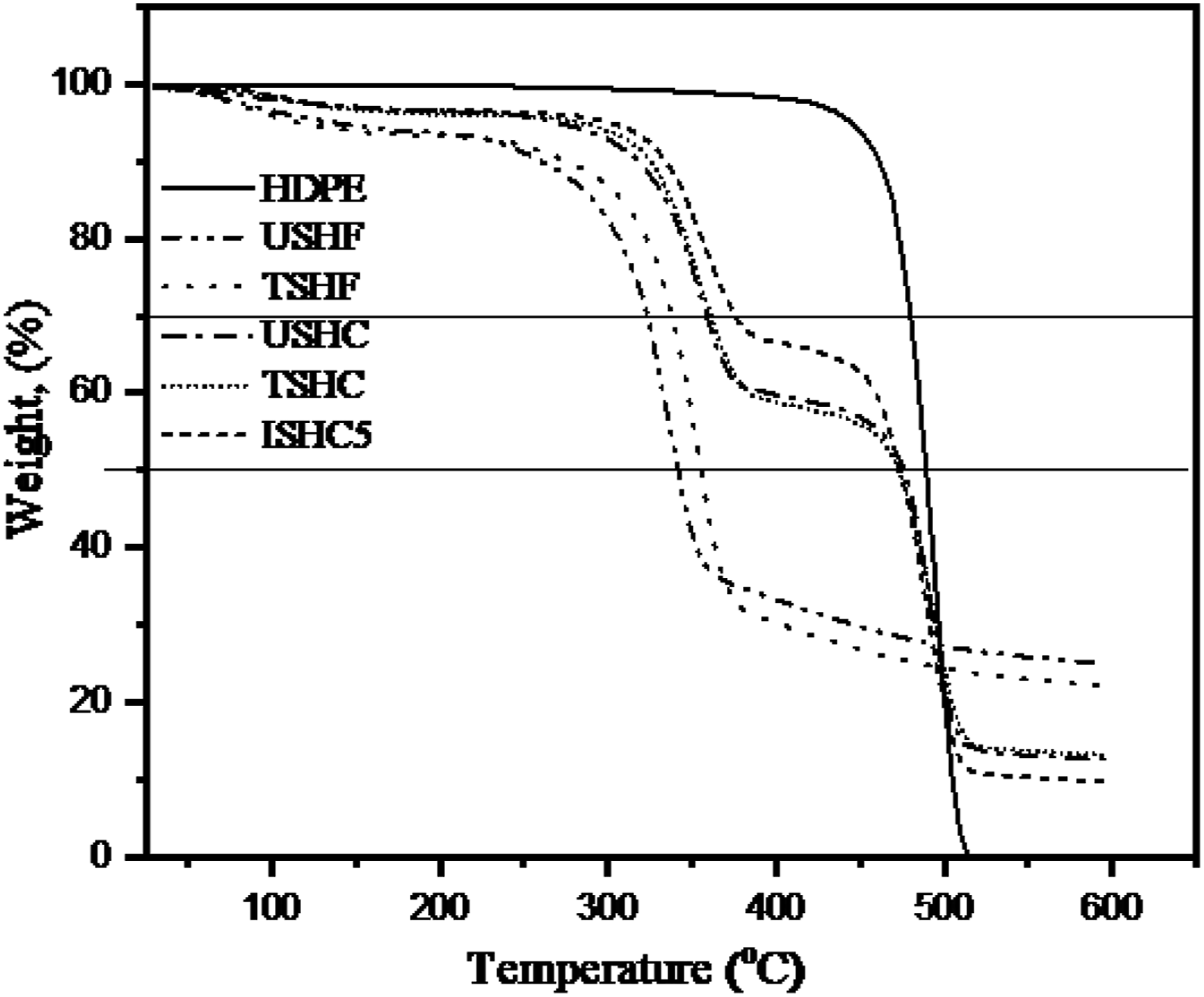
It may be attributed to the decomposition of α-cellulose and lignin at the middle stage of TGA. 31 It is more interesting that the weight loss pattern for the gamma-ray treated composites is unlike that of other composites. 30% weight loss observed for the sample ISHC5 is at temperature 374°C which is higher than those of USHC and TSHC but 50% weight loss observed for ISHC5 is at 477°C, which is slightly higher than those of USHC and TSHC. Above 477°C, the weight loss is approximately the same for all composites. For the USHF the observed residue is more than that of TSHF because of impurities contents in the USHF. On the other hand, for USHC and TSHC, the observed residues are more than that of ISHC5 because of fewer impurities in the latter sample. This high decomposition temperature indicates the formation of a new bond between fibers and matrix in the composites prepared by gamma-ray irradiation. The degradation of hemicellulose occurs at the temperature of 300°C and the degradation of lignin occurs at high temperatures of 330°C corresponding to the fission of C‒O and C‒C bonds, as declared elsewhere.32,34
Figure 18. shows the derivative of TGA for all samples investigated. The degradation of HDPE starts at 377°C and finishes at about 500°C, with only a peak in the first-derivative curve with a maximum peak at 488°C. This degradation may occur through the separation of C–C chain bonds along with H-abstraction.32,34,35 The thermal degradation for both USHF and TSHF is observed in the temperature range of 200°C–400°C. The USHF and TSHF shows only one degradation peak in the temperature range 200°C–400°C. The USHF and TSHF shows a weight loss rate peak at about 328°C and 347°C, respectively. Lignin decomposes in a large temperature range of about 200°C–600°C, whereas the hemicellulose and cellulose degrades in the range of 225°C–325°C and 300°C–400°C respectively. These results agree with the findings of others.
31
The thermal degradation of USHC, TSHC, and ISHC5 is followed by the presence of two peaks. Initial weight loss at 350°C of the composite samples may have corresponded to the burning of the lignin, hemicellulose, and cellulose. The final weight loss of the composites was observed at the temperature range of 400°C–520°C by a breakdown of the HDPE.
35
First-derivative analysis of the thermal breakdown of HDPE, USHF, TSHF, USHC, TSHC, and ISHC5.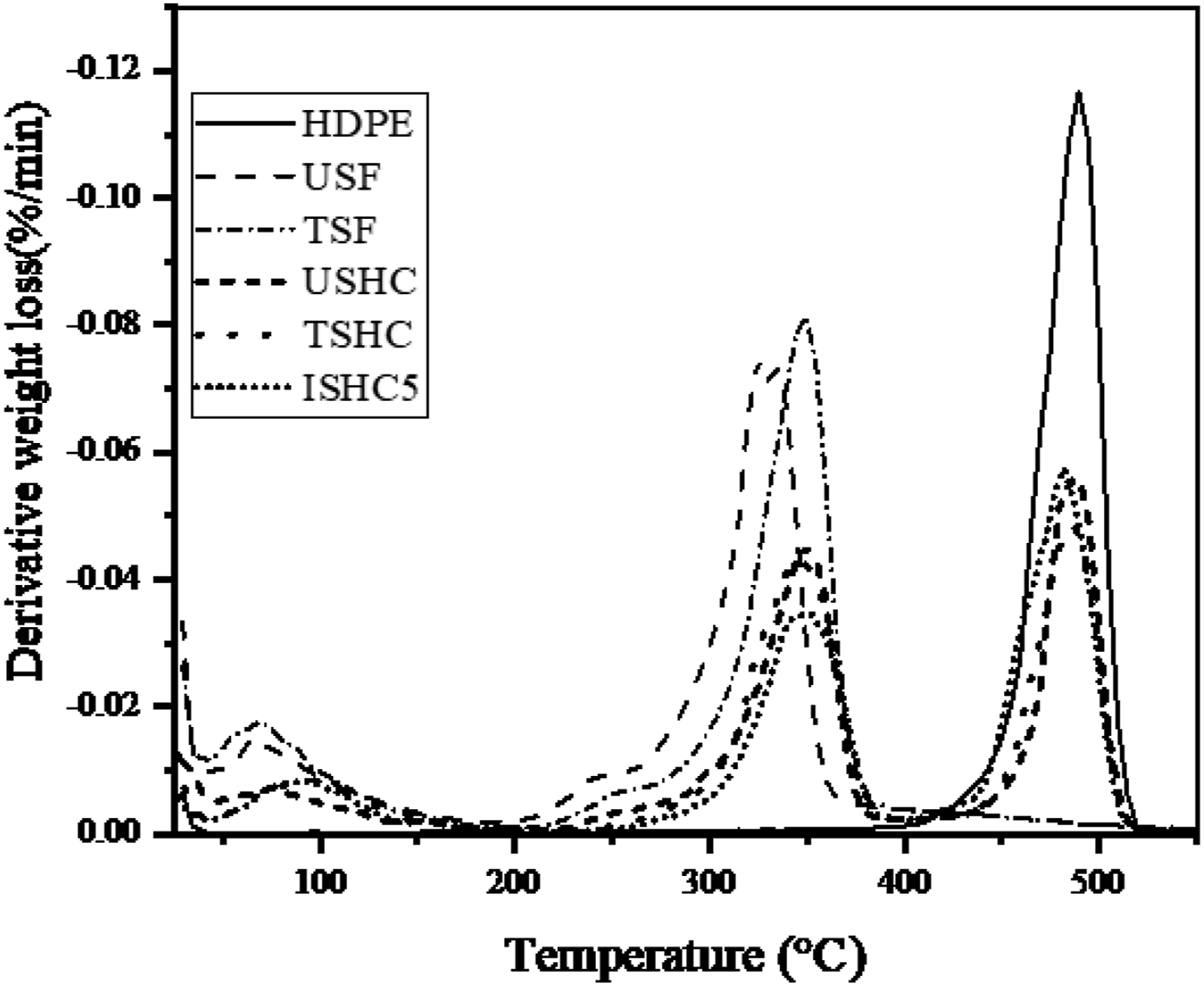
Conclusions
Sunn hemp hessian cloths were treated with 5, 10, and 15 wt% alkalies, and the optimum concentration of alkali, which shows better properties, is found to be 10 wt%. Then, treated and untreated Sunn hemp hessian cloth reinforced-HDPE composites were prepared and irradiated by gamma rays. Different measurements like; XRD, FESEM, FTIR spectroscopy, water intake test, mechanical test, and thermal tests of HDPE, USHF, TSHF, USHC, TSHC, and ISHC5 were performed. XRD shows that the crystallinity of TSHF has a larger value than USHF. On the other hand, the crystallinity of TSHC is greater than that of USHC and ISHC5. FESEM reveals that, ISHC5 shows better adhesion between fiber and matrix than USHC and TSHC. From the FTIR analysis, the composite samples confirm the new formation of ‒CH, ‒C‒O‒C‒, and ‒C‒C‒ bonds which indicate that the ISHC5 shows cross-linking between fiber and matrix. The less water intake (8%) properties shown for ISHC5 is due to the reduced hydrophilic nature of ISHC5, arising from cross-linking between fiber and matrix by gamma-ray irradiation. In the case of all USHFs and TSHFs with fiber contents 40–65 wt%, only 55wt% fiber contents reinforced composite exhibits the highest mechanical properties. In the case of all TSHCs and ISHCs, the TS value of ISHC5 is 72 MPa which is 20% and 33% greater than that of TSHC and USHC, respectively. The melting temperature of ISHC5 increases as compared to USHC, and TSHC indicating a thermally more stable composite.
Future scope
Scientists will expect better and more suitable outcomes if they stay on their study by using different kinds of fiber sizes and different orientations. The composite may be also fabricated by using different kinds of thermoset polymer instead of thermoplastic. These materials are lighter than the material used by automobile manufacturers that can be used as usual and also for household applications.
Footnotes
Acknowledgements
The authors greatly acknowledge the Bangladesh University of Engineering and Technology (BUET) to provide financial support for this research work. They are grateful to the Institute of Radiation and Polymer Technology (IRPT), Atomic Energy Research Establishment (AERE) Savar, Dhaka, Bangladesh, to allow facilities for this research.
Declaration of conflicting interests
The author(s) declared no potential conflicts of interest with respect to the research, authorship, and/or publication of this article.
Funding
The author(s) disclosed receipt of the following financial support for the research, authorship, and/or publication of this article: This work was supported by the Only sample test funding by the Bangladesh University of Engineering and Technology.
