




Abstract
Carbon nanotube (CNT) was employed as a reinforcing material to prepare polyoxymethylene (POM)-based composite film through a simple melting extrusion. An effective approach was developed to clean and modify the surface of as-received CNT with nitric acid and then with a silane coupling agent. The mechanical evaluation demonstrated that a significant reinforcement was achieved for POM/CNT composites due to the improved interfacial adhesion between CNT and the matrix. The thermal stabilities of the composites were also improved in the presence of CNT. The studies on crystallization behaviors showed that CNT acted as a nucleation agent for the crystallization of POM domain in composites, and therefore, the crystallization rate and nucleation density increased remarkably due to the heterogeneous nucleating effect of CNT.
Introduction
The nanostructured materials have gained great prominence in the scientific community due to their inclusion in various scientific and technological fields, such as catalysis, biological sensors, optoelectronic materials, and polymeric composites. Nowadays, the search demands to find methods of preparation, characterization, and manipulation of nanostructures for a specific use, as in the case of nanotechnology related to composite materials. Recently, one of the most used materials, in combination with polymeric matrices, is carbon nanotubes (CNTs), forming the nanostructured composites. 1
The extremely large surface area and high aspect ratio make it possible for the property improvements resulting from the formation of a nanocomposite. The most promising application of CNTs)is to make polymer/CNT nanocomposites with excellent reinforcing properties and high electrical conductivity, coming from their very regular molecular structure. 2,3
Polyoxymethylenes (POMs) have been proved as efficient catalysts in many areas because of their unique advantages: firstly, they have various designable structures, which make them suitable building blocks for a variety of new compounds and secondly, they are perfect electron transferors due to the ability of undergoing fast reversible multi-electron processes without decomposition. 4
POM resin is a kind of widely used engineering thermoplastic material, which exhibits good fatigue resistance, creep resistance, and high impact strength. It has low friction coefficient due to the flexibility of linear molecular chains. It has good wear-resistant properties because of its high crystallinity and high bond energy, so when sliding against stainless steel it is difficult to transfer to the metal counter-surface or form wear debris in the contact area. 5,6 POM can replace not only nonferrous metals, for example, copper, zinc, and chromium, but also iron castings, steel castings, stainless steel, and so on. POM and its composites have been widely used as self-lubricating materials in many fields such as automobile, electronic appliance, and engineering. 7 –10
In the present work, we reported a study on mechanical enhancement and morphologies of POM/CNT composites, and the effect of CNT on crystallization behaviors of POM was also described in light of nonisothermal and isothermal process. Considering the high cost of both raw carbon fiber and engineering thermoplastic POM, it is prospective that the recovery and reuse of CNT toward the POM reinforcement can offer sound economic benefits. This work aims to develop an application of CNT in reinforced POM composites via a simple melt compounding method using a twin-screw extruder.
Experimental
Materials
The POM resin used in this work is purchased from Asahi Kasei Chemicals Co. (Tokyo, Japan). It is a polyacetal copolymer (commercial grade: Tenac-C 4520) with a number-average molecular weight of 25,000 g mol−1, melt flow index of 9 g/10 min, and specific gravity of 1.41. CNT was kindly supplied by Weiyuan Chemical Fiber Co. Ltd (China).
Preparation of composites
The CNTs were first immersed in a concentrated solution of nitric acid for 2 h to clean and activate the fiber surfaces. After washed to neutrality with deionized water, the activated CNT was further surface treated with a solution of γ-glycidoxypropyltrimethoxysilane in acetone at a concentration of 5 wt% for 4 h. Then, the CNT with the saturated absorption of coupling agent was baked under vacuum at 90°C for 2 h.
POM with modified CNT (various contents to POM) respectively in SHJ-30 twin-screw extruder were blended. The temperature of screw was controlled between 160°C and 170°C, and the screw rotating speed was 25 r min−1. The temperature of barrel tested was 180°C. The melting extrudate was cooled in a water bath and subsequently pelletized. The resultant pellets were dried under vacuum at 80°C overnight and then were stored in the sealed aluminum foil bags.
Measurement of mechanical properties
All of the pelletized samples were dried at 80°C in a vacuum oven for 8 h prior to injection molding and then were injection molded into the test bars with the different shapes required for mechanical and heat-resistant measurements. The tensile and flexible properties were measured with a SANS CMT4104 universal testing instrument (MTS system, Shenzhen, China) using a 10,000 N load transducer according to ISO 527 and ISO 178 standards, respectively.
Notched Izod impact strength was measured with a SANS ZBC1400A impact tester according to ISO 180 standard. The impact test bars were notched with a depth of 2 ± 0.2 mm, and impact energy was set to 2.75 J. All the measurements were performed at a constant temperature of 23°C, and the reported values reflected an average from five tests.
Differential scanning calorimetry
The crystallization kinetics of POM/CNT composites was studied in terms of both nonisothermal and isothermal crystallization behaviors using a TA Instruments Q20 differential scanning calorimeter (New Castle, Delaware, USA), equipped with a Universal Analysis 2000 data station, which has a temperature precision of ±0.1°C and a heat flow precision of ±0.01 mW. All operations were performed under a nitrogen flow of 50 mL min−1.
Polarized optical microscopy
Dynamic mechanical analysis
The dynamic mechanical behaviors of POM and its composites were measured on a TA Q800 dynamic mechanical analyzer under a dual cantilever mode. The test was run during the temperature range from –80°C to 60°C at a heating rate of 5°C min−1 and a strain amplitude of 10 μm at a frequency of 1 Hz. The samples were cut in strips of about 2–3 mm width, their thickness and width measured with calipers, and then mounted on a submersion clamp.
Thermogravimetric analysis
Thermogravimetric analysis (TGA) was performed under nitrogen atmosphere using a TA Instruments Q50 thermal gravimetric analyzer. Samples were placed in a platinum crucible and ramped from room temperature to 750°C at a heating rate of 10°C min−1, while a flow of nitrogen was maintained at 50 mL min−1.
Results and discussion
Mechanical properties
The enhancement effect of CNT on POM was evaluated by tensile and flexural experiments, and the obtained results are presented in Figures 1 and 2. The relationship between the tensile strength and the CNT content of the POM composites is plotted in Figure 1. A phenomenon can be observed, which is that the tensile strength and Young’s modulus of the two groups of composites increase with the increasing of CNT content. The trend keeps well until the CNT content rises to 40 wt%. Then, the tensile strength decreases with the increasing CNT content. From the experiment on the tensile properties, it can be concluded that the optimum CNT content was at 40 wt% for POM composites. Moreover, the modified CNT would have better dispersion in matrix. Accordingly, it is expected that the less agglomeration CNT should play an important role in increasing the Young’s modulus and tensile strength. The flexural strength of the composites increases with the increase of CNT content in the POM composite. The addition of CNT can cause an obvious improvement of flexural strength compared with the POM, and an enhancement of strength occurred for the hybrid composites in comparison with POM.
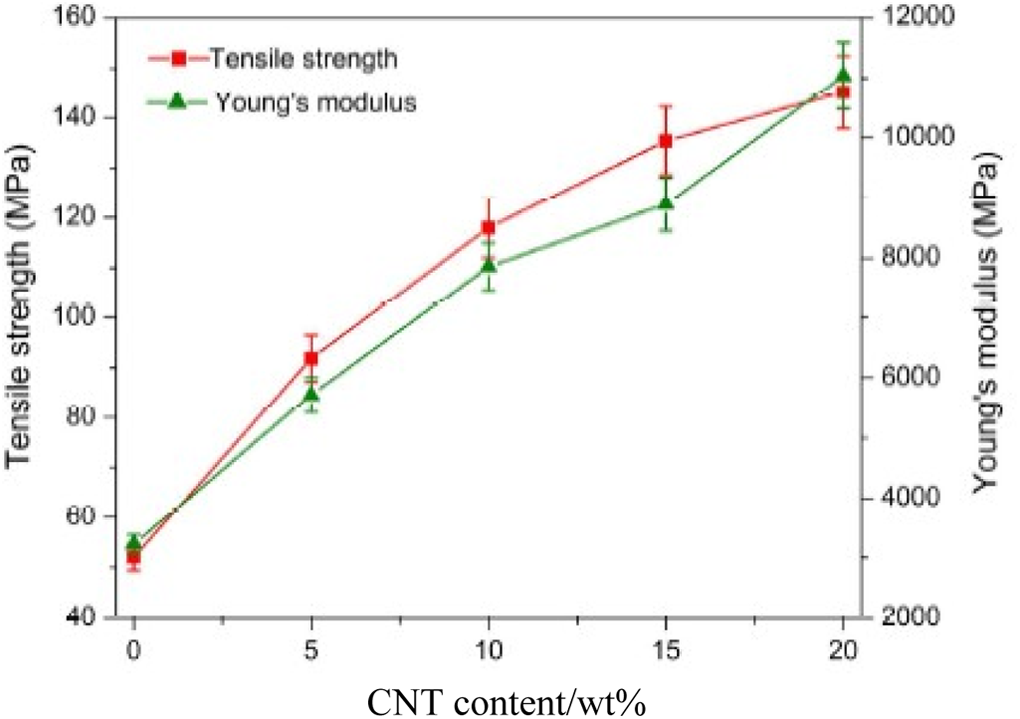
Tensile strength and modulus of POM/CNT composites as a function of CNT content. POM: polyoxymethylene; CNT: carbon nanotube.
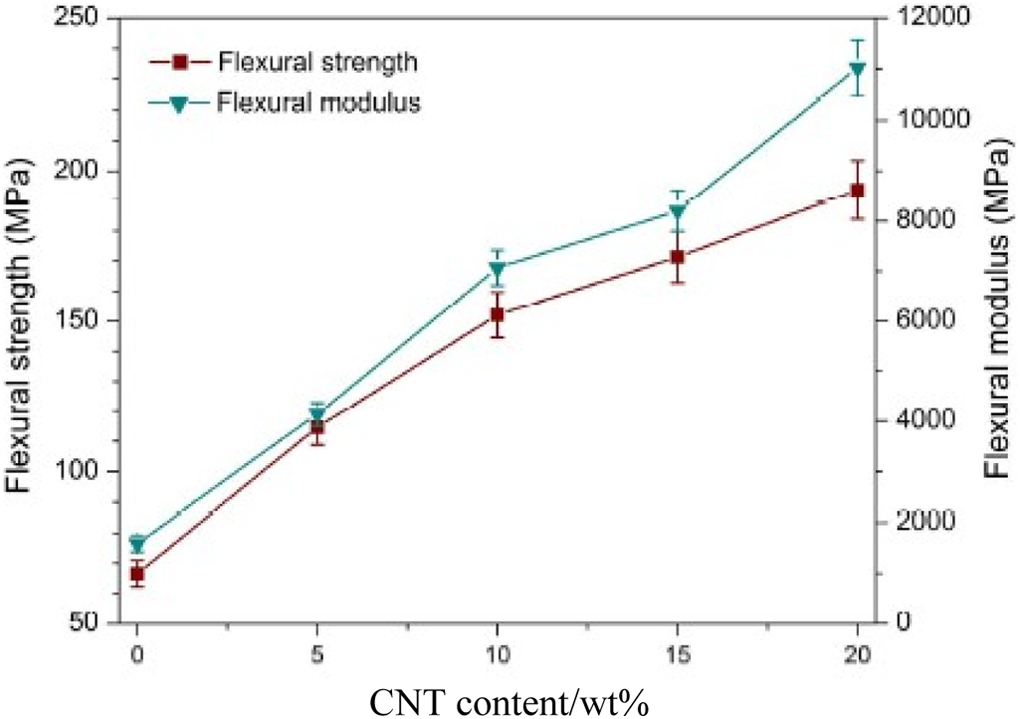
Flexible strength and modulus of POM/CNT composites as a function of CNT content. POM: polyoxymethylene; CNT: carbon nanotube.
Dynamic mechanical property
Dynamic mechanical analysis was performed to evaluate the dynamic mechanical properties of POM and its composites with CNT, and the temperature dependences of storage modulus and loss factor (tan δ) for these specimens are illustrated in Figure 3. It is clearly seen in Figure 3(a) that the dynamic storage moduli of POM composites in the whole range of test temperature were remarkably improved with the addition of CNT. On heating, the curves show insignificant variation up to denaturation, a decrease is observed that progressively shifts to lower temperatures following aging. The tan δ decrease is again similar for all samples from a series. On the other hand, as shown in Figure 3(b), the temperature dependence of tan δ is found to present a maximum when POM and its composites were heated through the glass transition region.
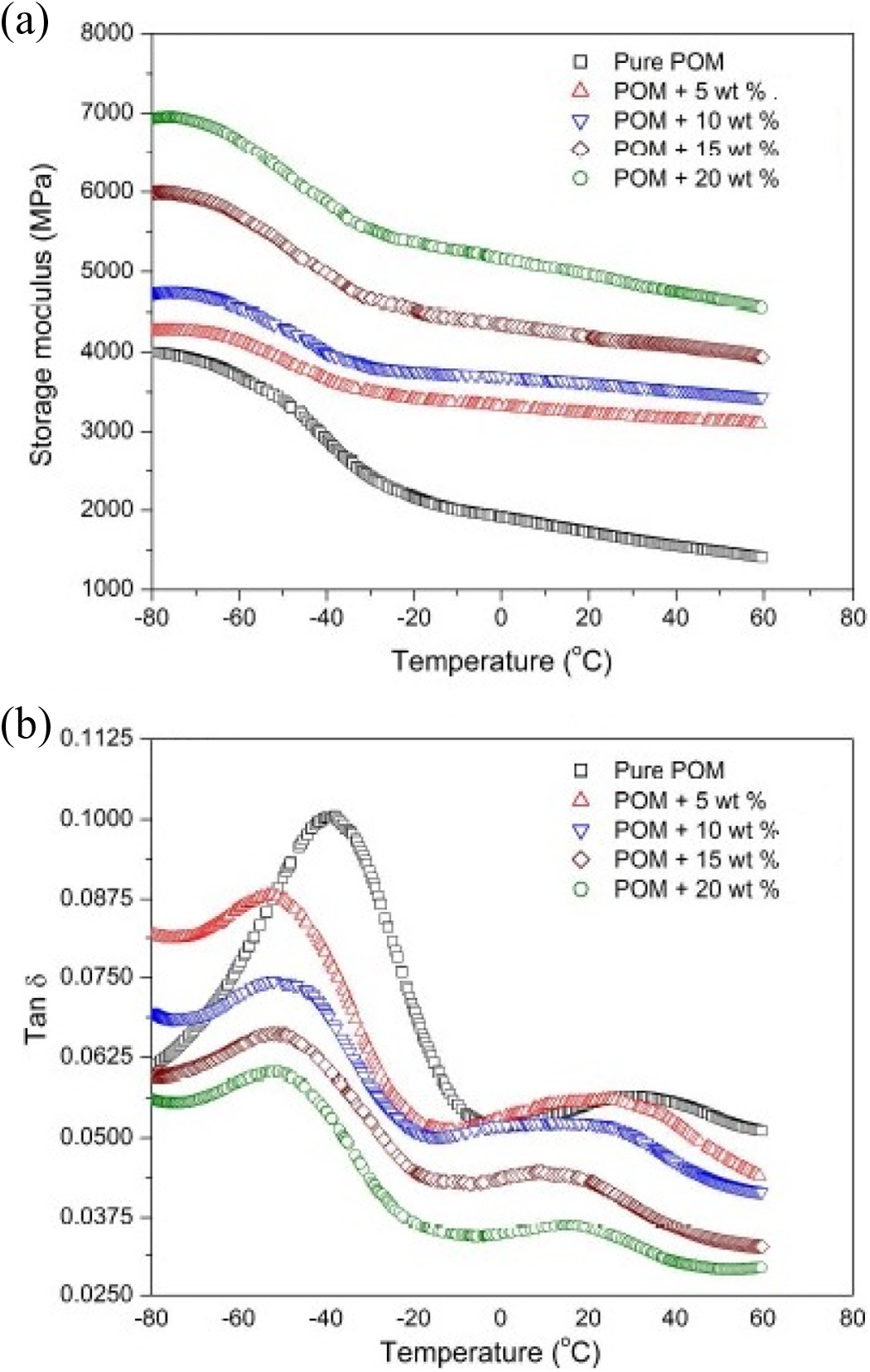
Temperature dependence of (a) storage modulus and (b) loss factor obtained from DMA measurements for pure POM and its composites with CNT. POM: polyoxymethylene; CNT: carbon nanotube; DMA: dynamic mechanical analysis.
Thermogravimetric analysis
TGA was performed to investigate the thermal stabilities of POM and its composites with CNT. Figure 4 demonstrates the obtained TGA thermograms, which reflect the thermal degradation behaviors of POM/CNT composites under nitrogen atmosphere. TG profile has a gradual and slight weight increase before 271°C and then a great weight loss till the burnout of the coal; correspondingly, TGA curve presents a tiny mass gain peak centering at 226°C and a big weight loss peak at 461°C. The weight gain at the low temperatures is mainly attributed to oxygen chemisorptions accompanied with the formation of surface oxygen-containing complexes, while the weight loss at the high temperatures is obviously due to intensive coal combustion. It was reported that the incorporation of carbon materials in polymeric matrix could reduce the heat release rate, which plays a key role in retarding the decomposition temperature. 11
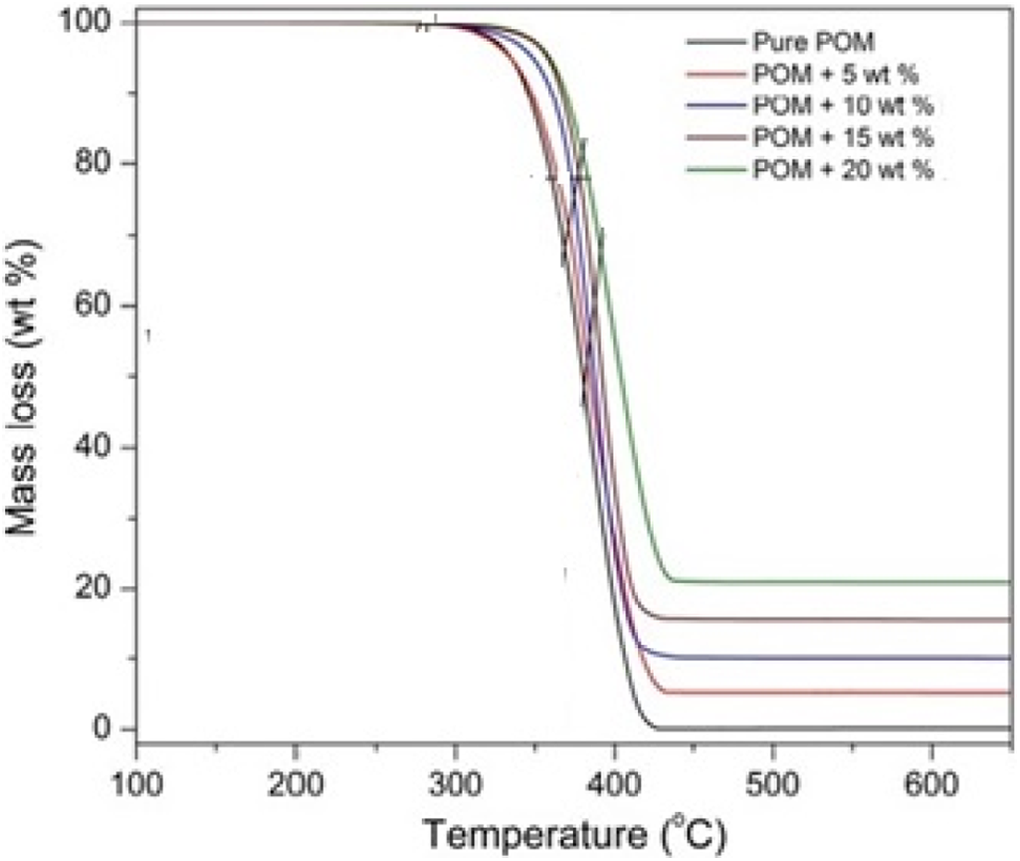
TGA thermograms of pure POM and its composites with CNT. TGA: thermogravimetric analysis; POM: polyoxymethylene; CNT: carbon nanotube.
Crystallization behaviors
Figure 5 shows the crystallization thermograms of POM and the cross-sectional composite containing 20 wt% CNT. It is clearly observed that both pure POM and its composites containing 20 wt% CNT exhibit a single exothermic peak corresponding to the nonisothermal crystallization of POM at the given cooling rates. It is no doubt that POM has the fastest crystallization rate at the crystallization peak temperature (Tp). Furthermore, the Tps of both pure POM and its composites are observed to shift toward lower temperatures when the cooling rate increased. This phenomenon is ascribed to the fact that the timescale which allows the polymer to crystallize becomes lower with increasing the cooling rate. In this case, the macromolecular segments do not have enough time to finish an orderly arrangement at a high cooling rate, and thus, the polymer requires a higher undercooling to initiate crystallization. DSC thermograph obtained showed that the heat absorption started at 18.7°C with a peak at 24°C and completed at 31.4°C. The melting point that is found to be 22°C with a latent heat of fusion of 139 kJ kg−1 is in good agreement with the corresponding manufacturer data of melting point of 21°C and heat of fusion of 134 kJ kg−1. The curve shows a larger gradient from 40°C to 21°C, which points to the sensible cooling while at 21°C, the slope of the graphs decreases sharply, which shows the start of melting, and keeps decreasing till 8°C, after which the slope starts increasing pointing out to sensible heat release in the solid POM below 8°C, showing the end of solidification.
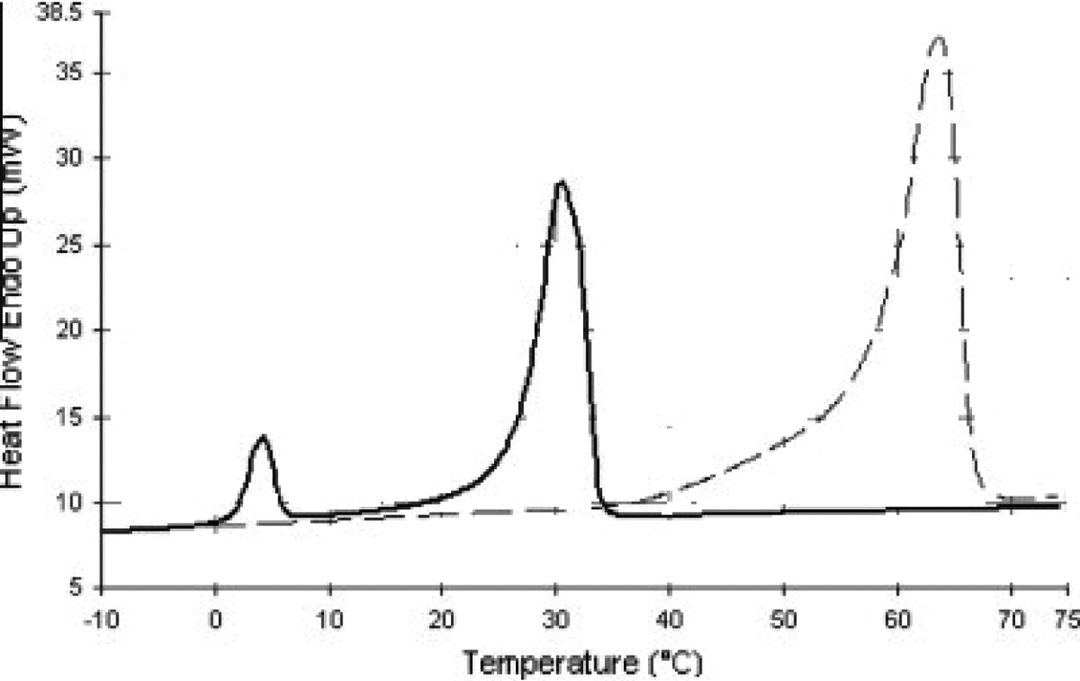
DSC cooling thermograms of POM and its composite containing 20 wt% of CNT. DSC: differential scanning calorimetry; POM: polyoxymethylene; CNT: carbon nanotube
A fast scanning rate of 5°C min−1 was also used to detect pre-transition for these samples, but pre-transition still cannot be detected. That is to say, they do not undergo pre-transition any longer during heating. When the concentration of CNT reaches 5 mol%, these liposomes will exist as rippled gel phase at room temperature (25°C), thus they do not undergo pre-transition any longer during heating.
The DSC measurements of parchments under nitrogen flow have shown two main endothermic processes, as observed previously. The first DSC peak, which is the largest and has a minimum below 100°C, is assigned to moisture release from materials. No clear correlation of the position and enthalpy of this peak with aging time was found. The second process at above 200°C originates from the collagen denaturation. Interestingly, this DSC peak occurs roughly at the same temperature (approximately 230°C) for both unaged and aged parchments and the corresponding enthalpies are comparable.
Conclusion
CNT was used to prepare the POM-based composites through a simple melting extrusion. A significant reinforcement effect was achieved due to the enhancement of interfacial adhesion between fillers and POM matrix as a result of the CNT content, thus leading to a remarkable improvement in mechanical properties and thermal stability. The incorporation of CNT into POM also caused an increase in storage moduli but a decrease in loss factors. The crystallization behaviors and kinetics of POM/CNT composites were intensively studied. On the basis of the results derived from the crystallization kinetic investigation, it was deduced that the CNT acted as a nucleation agent for the crystallization of POM domain. The crystallization rate and the nucleation density of POM domain in composites were improved remarkably as a result of the heterogeneous nucleation effect of CNT. The presence of CNT enhanced the nucleation capability and crystallinity of POM domain. These crystallization features may be advantageous for the enhancement of the mechanical properties and heat resistance of POM-based composites.
Footnotes
Declaration of Conflicting Interests
The author(s) declared no potential conflicts of interest with respect to the research, authorship, and/or publication of this article.
Funding
The author(s) disclosed receipt of the following financial support for the research, authorship, and/or publication of this article: National Natural Science Funds for Youth of China (grant no.s 51305251 and 51405824).