



Abstract
The development of natural fiber-reinforced polymer composites is becoming prominent in numerous engineering applications over the synthetic fiber-reinforced composites mainly because of their environment-friendly characteristics. This article deals with comparative study on selection of optimal stacking sequence (jute/rubber/jute (JRJ), jute/rubber/rubber/jute, and jute/rubber/jute/rubber/jute) of the jute/natural rubber-based completely biodegradable flexible composite using multi-attribute decision making (MADM) approaches namely hybrid entropy-VIse Kriterijumska Optimizacija kompromisno Resenja (VIKOR) and preference selection index (PSI) methods. Tensile strength, tear strength, specific impact strength, and specific wear rate are used as attributes for MADM methods. The results show good agreement between hybrid entropy-VIKOR and PSI methods used for stacking sequence selection. Scanning electron microscope analysis is carried out to study the failure mechanisms of the proposed flexible composite. The findings of the present study led to the choice of JRJ as the preferred stacking sequence among all the three stacking sequences considered as it exhibited the best overall properties compared to other two configurations of the flexible composite.
Introduction
Composites are finding a prominent place in almost all fields of engineering over the last few decades mainly due to their remarkable properties over the conventional metals and alloys. To minimize the weight of the components, in almost all fields of engineering, synthetic fibers are dominantly being used as reinforcements in composites. 1,2 Engineers and researchers are losing interest in the synthetic fibers over the past few decades owing to environment and energy issues 3,4 and they are looking into natural fibers as the potential substitutes for synthetic fibers as they provide various advantages over synthetic fibers 5 –8 like low cost, ease of availability, less weight, resistance to corrosion, improved thermal properties, stiffness, sp. strength, toughness in acceptable range, and so on. 9 Natural fibers are popularly used nowadays in manufacturing the interiors of automobiles. 10,11
Based on the type of application where the composites are proposed to be used, the different properties of the composites can be tailored according to the requirement by trying different combination and proportions of reinforcement and matrix. 12 Flexible composites are another class of composites where stiffness in neglected and fibers and matrix which is flexible in nature combine together to provide properties which are entirely new and at the same time, the individual properties of the constituents are retained. The comparison of flexible composites with stiff composites reveals the difference in mechanical behavior among these composites. Mainly, it is the stiffness of these flexible composites which makes them stand apart from the stiff composites. It is possible to achieve a wide range of stiffness in flexible composites and due to this, the flexible composites exhibit a different mechanical behavior compared to stiff composites. 13 The sacrificial structures intended to absorb impact energies are one of such applications where these flexible composites find their place. However, selecting appropriate volume fractions of the constituents of the composite, stacking sequence of the composite is a challenging task. 14 Hybrid polymer matrix composites (PMCs) making use of glass and Kevlar fibers along with micro rubber and nanosilica with varied weight percentages are studied by Gokuldass and Ramesh. 15 Similarly, PMCs made of Indian ramie fiber with varied weight percentage were mechanically characterized by Kumar and Anand. 16 Material selection is an important and critical activity of the designers and material engineers that affects the performance of the end product. 17 –19 It is worth noting that there do not exist single perfect criteria to select the materials. It depends on the requirement and various other factors. Hence, it becomes the responsibility of designers and engineers to consider various material selection criteria.
Multiple criteria decision making (MCDM) where the decision making is carried out considering numerous conflicting criteria 20 can be further divided into two categories namely multiple attribute decision making (MADM) approaches and multiple objective decision making. 17 When there are two or more alternative materials for a particular application, selecting the optimal material out of the available ones considering multiple attributes is an approach of MADM methods. 21 Many literatures are available related to material selection based on classical MADM approaches such as Elimination Et Choix Traduisant la REalite meaning elimination and choice expressing reality, 20 technique for order preference by similarity to ideal solution (TOPSIS), 22 weighted product method, 22 simple additive weight method, 23 preference selection index (PSI) method, 24 analytic hierarchy process, 17 graph theory and matrix representation approach, 23 VIse Kriterijumska Optimizacija Kompromisno Resenja (VIKOR) method 17 , TOPSIS-PSI approach, 25 combined DEMATEL-VIKOR, 26 and so on.
MCDM tools are widely used in many areas such as marketing, supply chain, power plant, and so on since it provides realistic results. MADM method namely “TOPSIS” is found useful in selecting the best material among the alternatives available. TOPSIS is based on selecting a preferred alternative that is nearer to a positive ideal solution and away from the negative ideal solution. In the field of polymer composites, to rank the composites based on various properties of the composite, TOPSIS method is extensively used. 7,27 –29 However, the concept of adopting the VIKOR method to select the best possible stacking sequence in the composite remains untouched.
VIKOR strategy is utilized for improvement of intricate systems taking into consideration numerous criteria. The solution which is agreed upon is obtained using this method after getting to know the probable weights of each criterion. When there is a conflict in the criteria, this method selects the best among the conflicting criteria and ranks them. VIKOR ranking taking into consideration numerous criteria is provided to the alternatives based on how close they are to the ideal solution. 30
PSI is another approach developed by Maniya and Bhatt 24 which aids in solving the MADM issues in a more effective manner and also with minimal effort. An added advantage of PSI method is that, there is no necessity of weight to be assigned to the criteria as opposed to other MADM methods like TOPSIS and VIKOR. This method becomes quite handy when there exists a conflict in deciding the relative importance among the attributes.
The present study is aimed at determining the best stacking sequence for the jute/rubber-based flexible composite with tensile strength, tear strength, specific impact strength, and specific wear rate which are determined experimentally as the attributes and making use MADM approaches namely hybrid entropy-VIKOR and PSI methods.
Experiment
Material
To prepare the proposed flexible composite, naturally available jute fiber in the form of plain woven fabric with a density of 1450 kg m−3 and 350 GSM procured from local market of Haryana, India is used as the reinforcement. Natural rubber and natural rubber-based bonding gum supplied by Manjunath rubbers, Baikampady, Mangaluru, India are used as the matrix. Natural rubber is basically obtained from the sap of the latex tree. It is an elastic hydrocarbon polymer. Natural rubber sheets used in the present study are nonvulcanized and are obtained after coagulation of the sap obtained from the latex tree. After coagulation, the rubber is rolled into sheets and is dried in sun. The rubber being elastic is best suited as a matrix for a flexible composite where stiffness is neglected.
Composite preparation and characterization
The proposed flexible composite is prepared by compression molding method by applying heat and pressure. The stacking sequences for the present experimental study are selected based on the preliminary study carried out by our previous work Mahesh et al. 31 for low velocity impact applications using finite element approach to minimize the effort, resources, and time in selecting appropriate material for the intended application. The stacking sequence considered in the present study along with the fiber weight percentage is given in Table 1. The jute and rubber sheets are arranged in the required stacking sequence (according to jute/rubber/jute (JRJ), jute/rubber/rubber/jute (JRRJ), and jute/rubber/jute/rubber/jute (JRJRJ)) and rubber bonding gum is placed in between each layer. The entire arrangement is kept in between two aluminum plates smeared with silicone high vacuum releasing agent and placed in a compression molding machine. Laminates are obtained after applying heat (138°C) and pressure (25 kg cm−2). The steps involved in the preparation of laminates are shown in Figure 1 and their cross-sectional view is shown in Figure 2(a) to (c) along with their schematic representation in Figure 2(d).
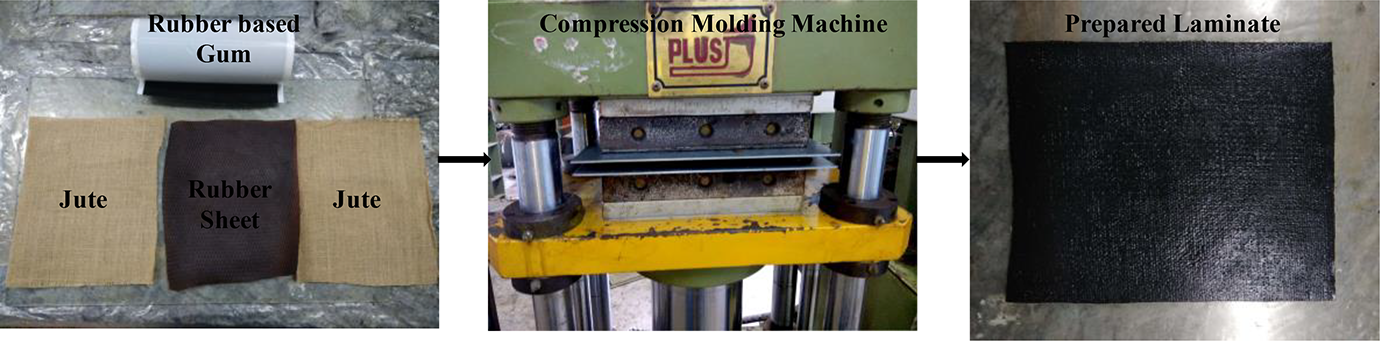
Preparation of jute/rubber-based flexible composite.
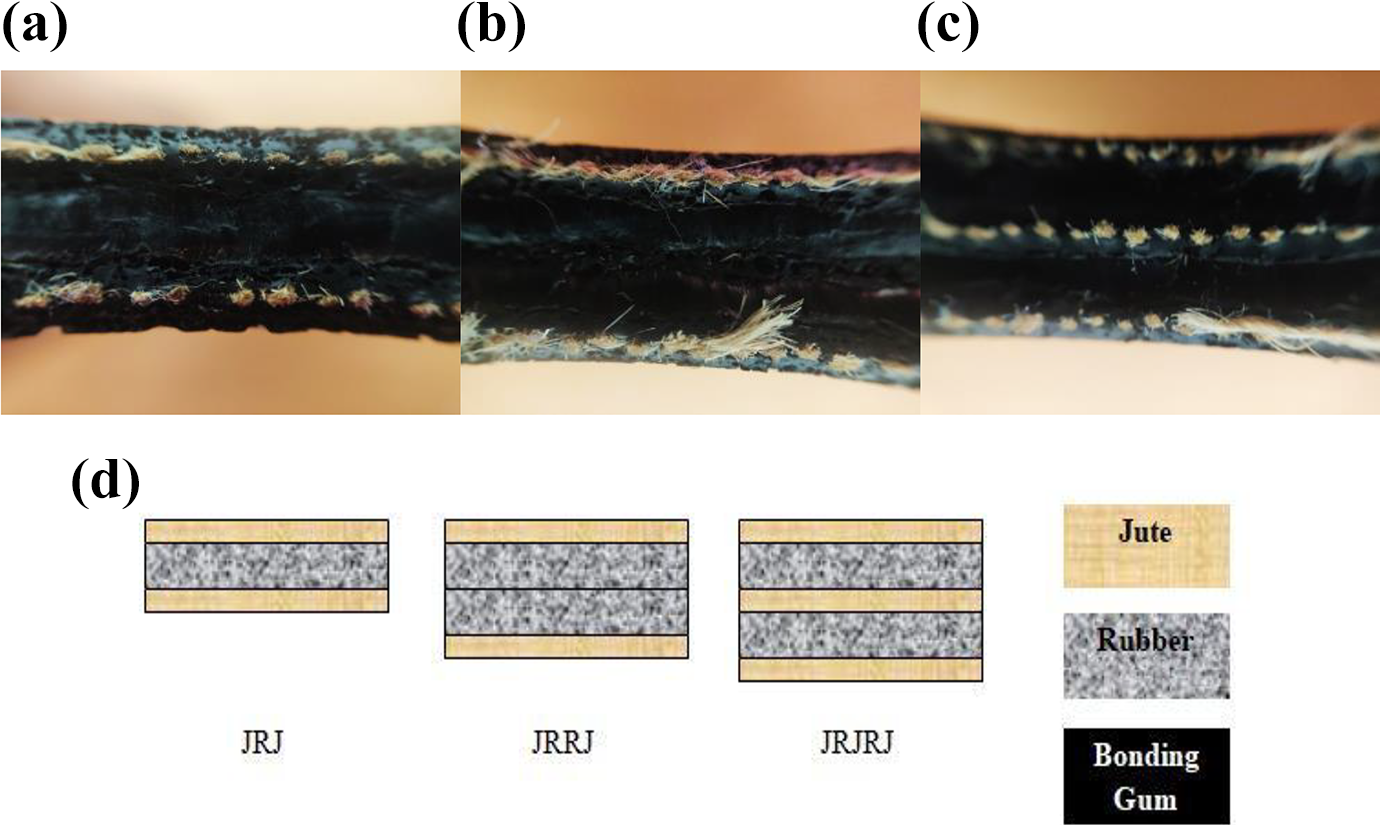
Cross-sectional view of flexible composites: (a) JRJ, (b) JRRJ, (c) JRJRJ, and (d) their schematic representation. JRJ: jute/rubber/jute; JRRJ: jute/rubber/rubber/jute; JRJRJ: jute/rubber/jute/rubber/jute.
Various stacking sequences and fiber weight percentage considered in the present study.
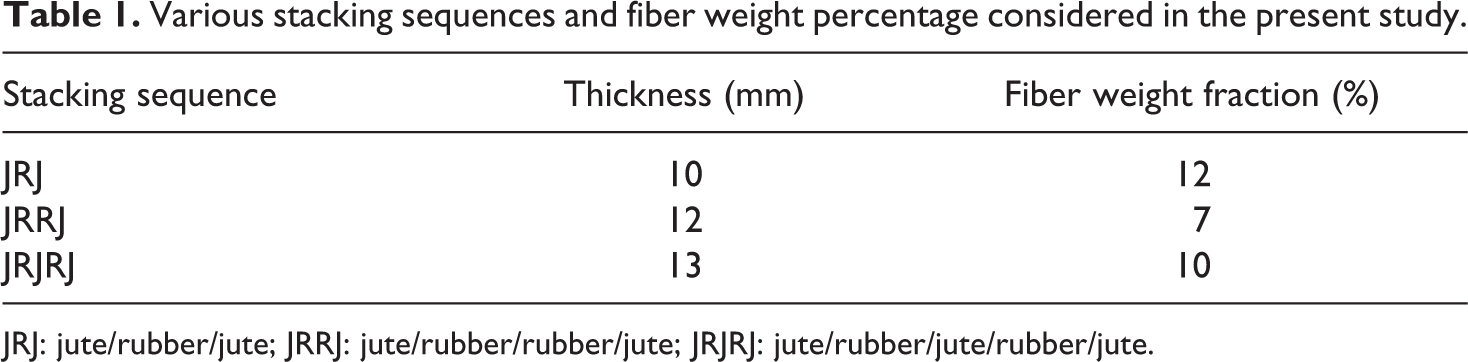
JRJ: jute/rubber/jute; JRRJ: jute/rubber/rubber/jute; JRJRJ: jute/rubber/jute/rubber/jute.
The physical, mechanical, and wear characterization of the proposed flexible composites are performed according to the respective standards. Prior to performing various tests, specimens are cut from the laminate. Tensile, tear, and Charpy impact tests were performed according to ASTM D 412, ASTM D 624, and ASTM D 6110, respectively. Wear, hardness, and water absorption tests were carried according to ASTM D5963/ISO4649, ASTM D2240, ASTM D 570-98, respectively. Void content is determined by finding out the theoretical and experimental densities of the composite. Theoretical density is found by using the rule of mixture and experimental density by using standard water displacement method.
Theoretical principle and model building
The flow chart of the proposed VIKOR and PSI methods used to select the optimal stacking sequence in the present study is shown in Figure 3.
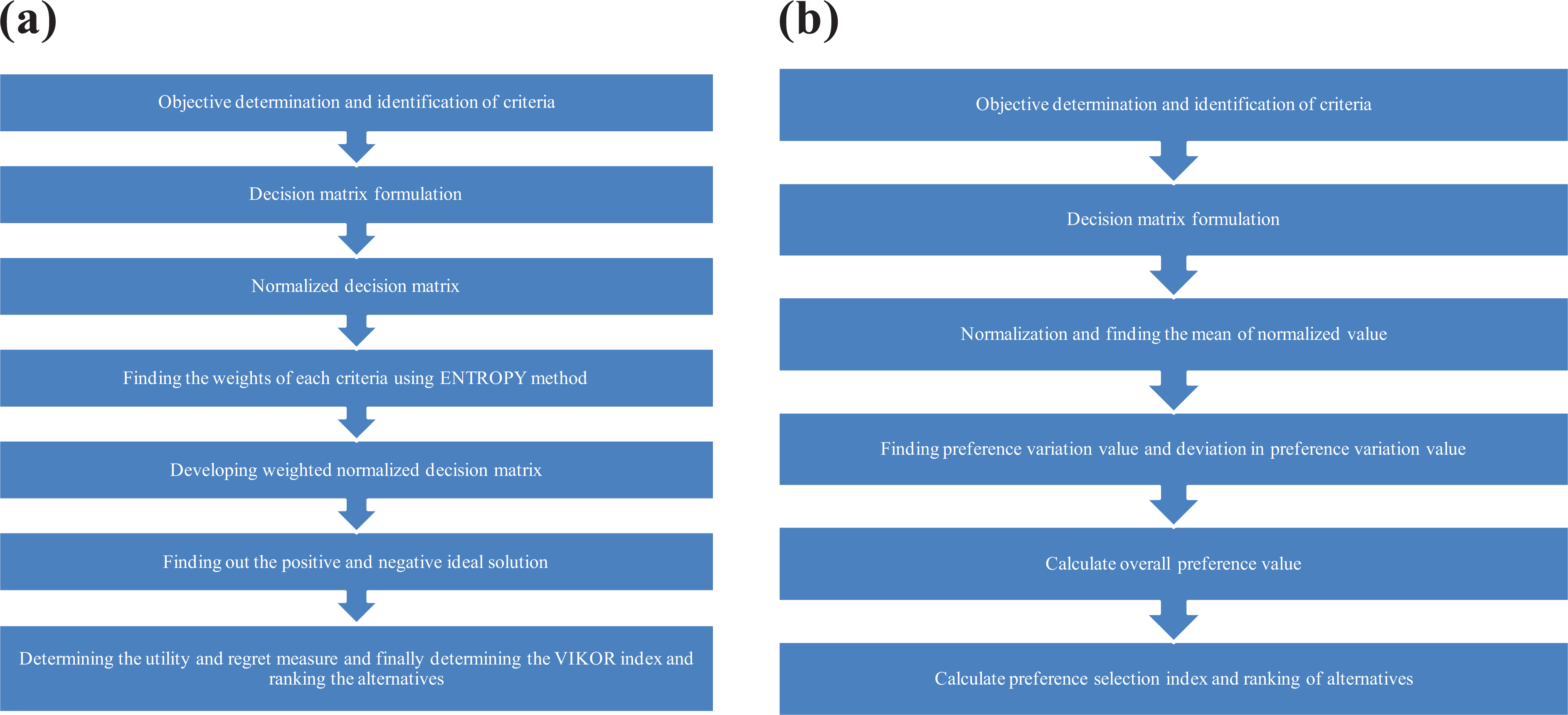
Flow chart of the proposed (a) VIKOR method and (b) PSI method. VIKOR: VIse Kriterijumska Optimizacija kompromisno Resenja; PSI: preference selection index.
VIKOR method
The VIKOR method is used for the purpose of optimization of complex problems with multiple criteria and has been proposed by many researchers to solve MADM problems with contradicting criteria and the criteria which are not measurable by the same standard. This method aims at obtaining a compromise solution for a problem having contradicting criteria by comparing the measure of closeness to the ideal alternative and thus ranking the alternatives. The weights initially assigned to each criterion. To calculate the weights of the different criteria for using in the VIKOR method, the entropy method is used

Equation (1) shows decision matrix “D” of the present multi-criteria problem with three alternatives (JRJ, JRRJ, and JRJRJ) and four criteria (tensile strength, tear strength, specific impact strength, and specific wear rate). The decision matrix is normalized by initially finding the normalized vector “rij” using Equation (2) and then building a normalized matrix using the normalized vector. Normalization is carried out to obtain dimensionless values of different criteria for the purpose of comparing them

where i = 1,2,….,m and j = 1,2,….,n.
The weights used for developing the weighted normalized matrix is found using “entropy method.” The proportion “Pij” of the index is calculated using equation (3) and entropy Ej of index j is calculated using equation (4)


where k is calculated using equation (5)

where m is the number of alternatives (m = 3 in the present study).
The entropy weight “wj” of index “j” is calculated using equation (6)

The standardized value of weight “vij” is calculated using equation (7) and the standardized weighted normalized matrix is built

where i = 1,2,….,m and j = 1,2,….,n.
The positive and negative ideal solution is determined using equations (8) and (9), respectively


The utility and regret measures for each nondominated solution are calculated according to equations (10) and (11), respectively


where

where α is a weighing factor ranging from 0 to 1. Usually, α is selected to be 0.5.
PSI method
PSI method is an approach to solve MADM problems that were developed by Maniya and Bhatt. 24 This is a simple approach to select the best alternative as there is no necessity to assign relative importance between the attributes and also there is no need to find and assign the weights for the attributes. The steps involved in PSI method are as follows:
Step 1. Problem definition: In this step, the objectives are determined; attributes and alternatives involved in decision making are identified.
Step 2. Decision matrix formulation: The decision matrix is formulated based on the attributes and alternatives. Each row of the decision matrix represents the attributes of each alternative and each column is dedicated to one attribute. Hence, in an element xij of the decision matrix represents x value of jth attribute in real values which in nonnormalized for ith alternative. Hence, if there are m alternatives with n attributes for decision making, the matrix will be of the order m × n and represented as in equation (13)

Step 3. Normalization: It is essential to make the values of the attributes dimensionless in MADM approaches. This is carried out by converting the attribute values to a value between 0 and 1. For the beneficial kind of attributes, the larger values are desired. Hence, normalization is carried out using equation (14) and for nonbeneficial kind of attributes, smaller values are desired and thus normalization is carried out using equation (15)


where
Step 4. Finding the mean of normalized value: for every attribute, the mean value of the normalized data is calculated using equation (16)

Step 5. Finding preference variation value: for every attribute, the preference variation value is calculated using equation (17)

Step 6. Finding the deviation in preference value: here, for each of the attribute, the deviation in the preference value is calculated using equation (18)

Step 7. Calculate overall preference value: for each of the attribute, the overall preference value is calculated using equation (19). The total value of

Step 8. Calculate PSI: for each of the alternative, PSI is calculated using equation (20)

Step 9. Ranking and selection of suitable alternative: the alternative with the highest PSI will be ranked 1 and so on.
Results and discussions
The tensile and tear specimens before and after test are shown in Figures 4 and 5, respectively. Similarly, the specimens used for carrying out Charpy impact test is shown in Figure 6. The specimen needed for two body abrasion is obtained from the hollow drill and is shown in Figure 7.
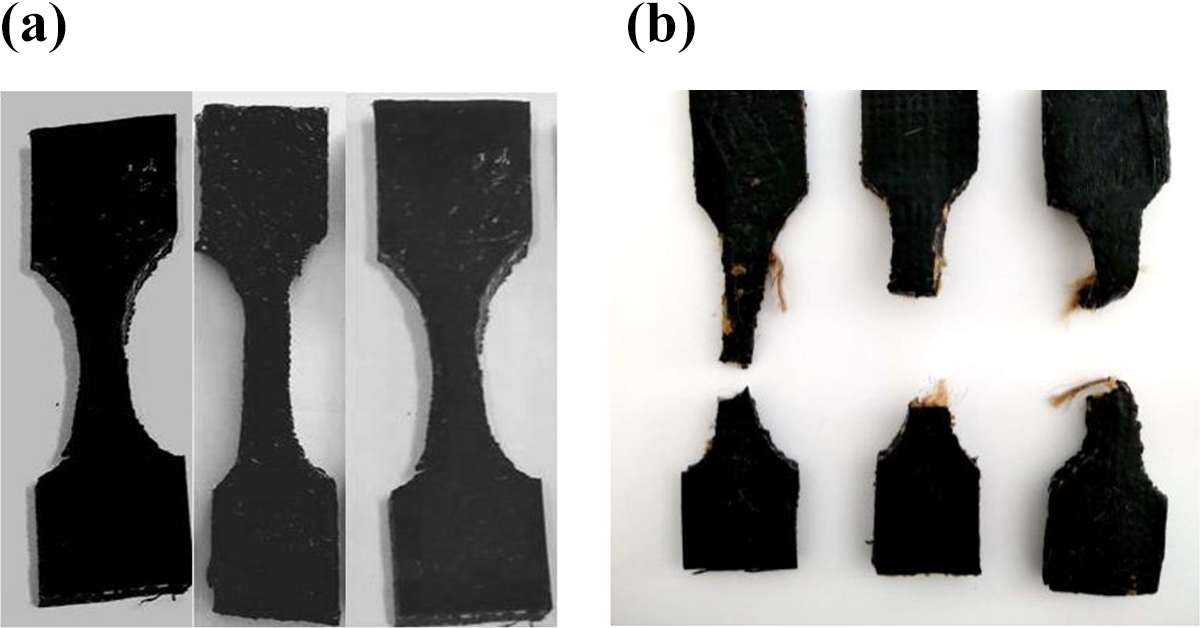
Tensile specimen (a) before and (b) after the test.
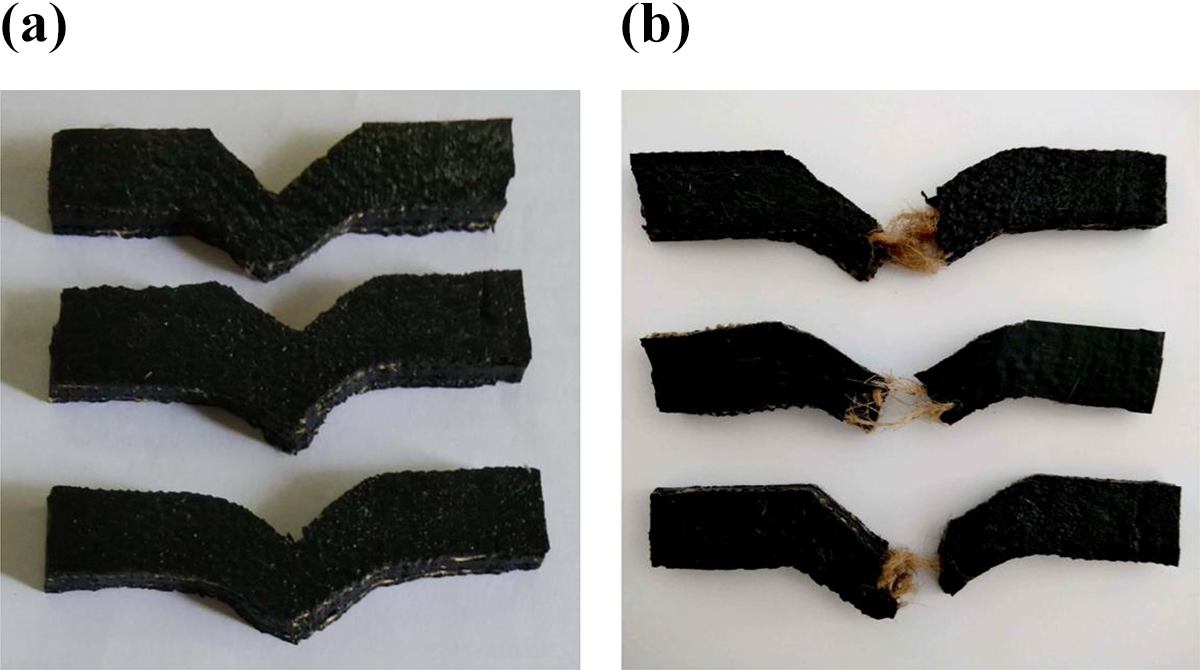
Tear specimen (a) before and (b) after the test.
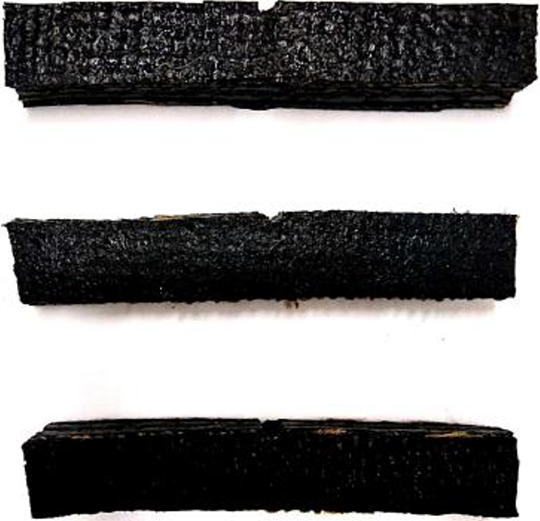
Charpy impact testing specimens.
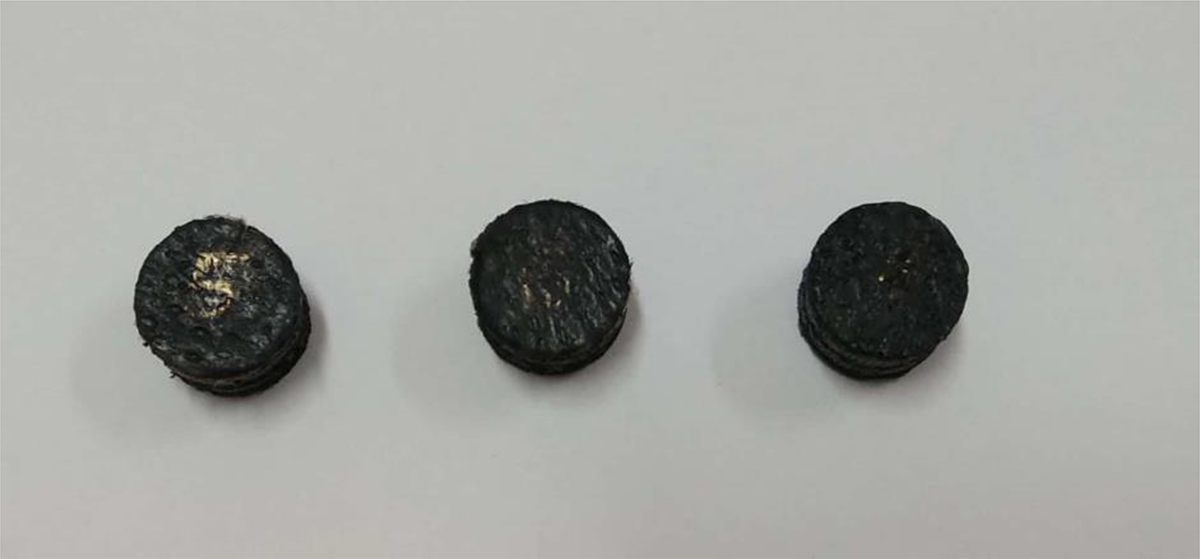
Circular specimen for two body abrasion test obtained from hollow drill.
The results obtained from the physio-mechanical and wear tests on the proposed stacking sequences of the composite are presented in Table 4. Though it looks like there is no much variation in the properties of the three different stacking sequences considered in the present study, statistically analyzing them with inclusion of standard deviation and analyzing for p values obtained for each case shows that the results are statistically different and are suitable for the purpose of comparison in case of flexible composites which are prone to variation in their properties. The variation of mechanical properties are presented in Figures 8 and 9. Similarly, physical and wear properties of the flexible composites obtained through their respective characterization are presented comparatively in Figures 10 and 11, respectively.
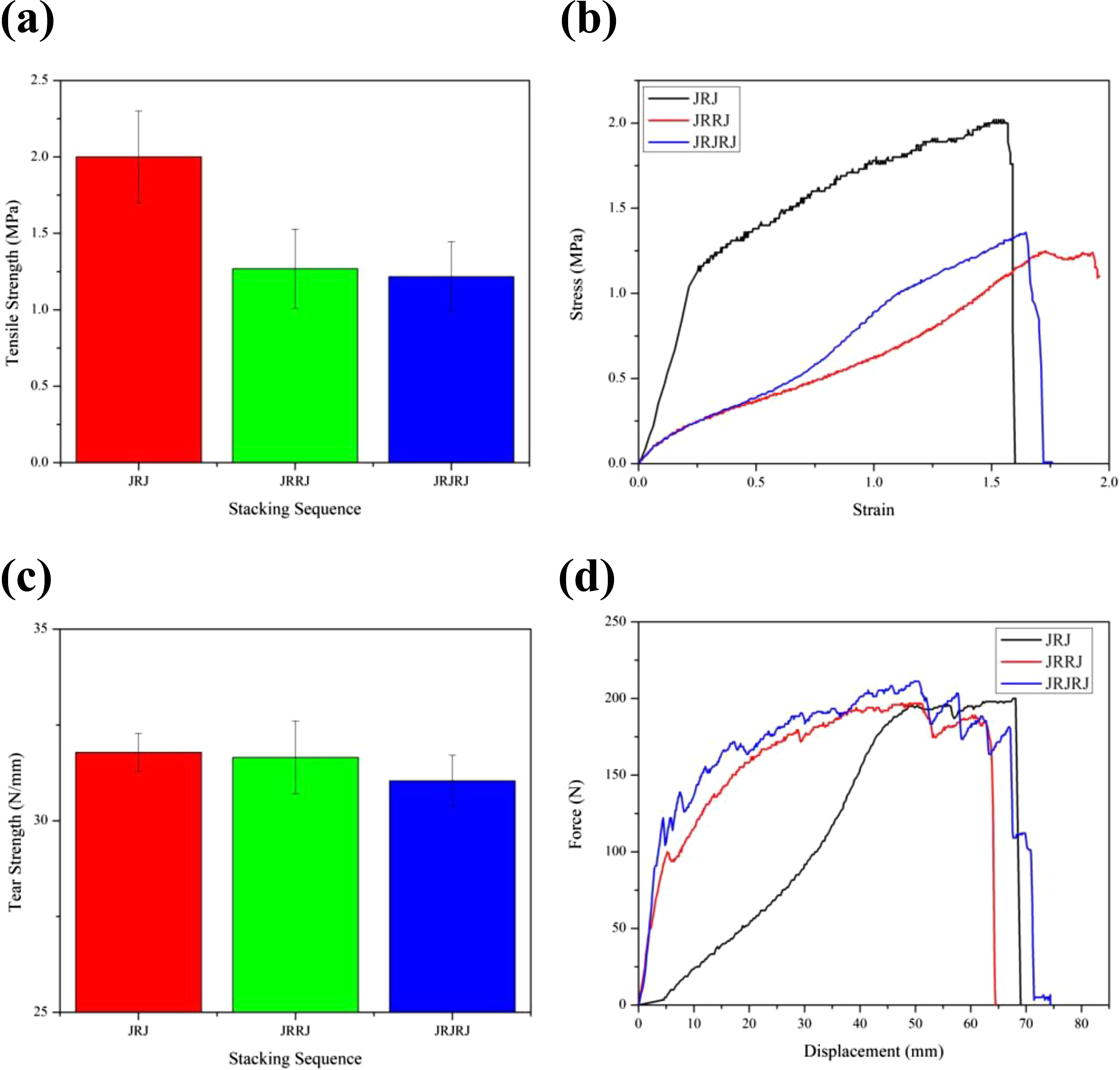
Mechanical characterization of (a) tensile test, (b) stress–strain behavior under tensile load, (c) tear test, and (d) force–displacement behavior under tear load.
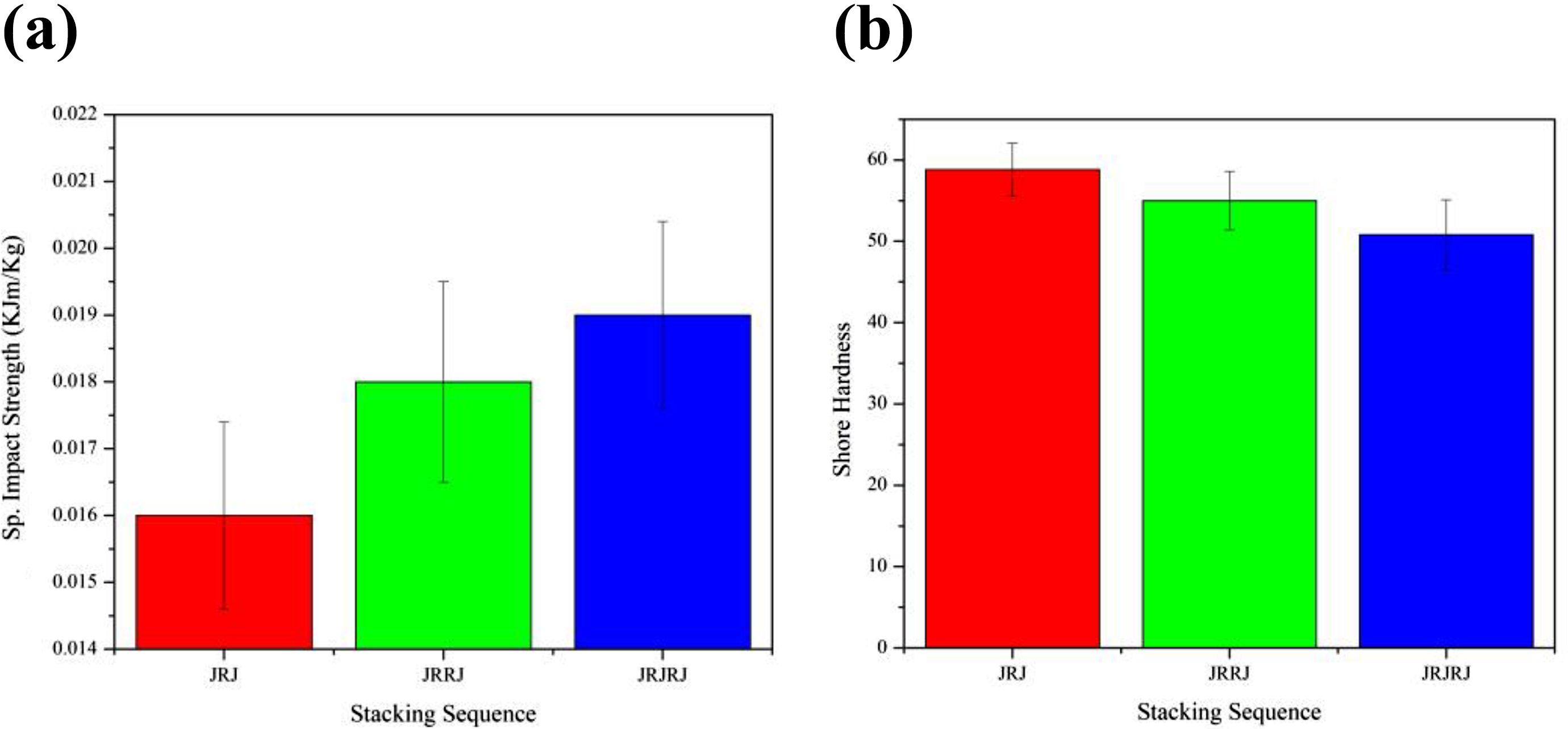
Mechanical characterization of flexible composites for (a) specific impact strength and (b) shore hardness.
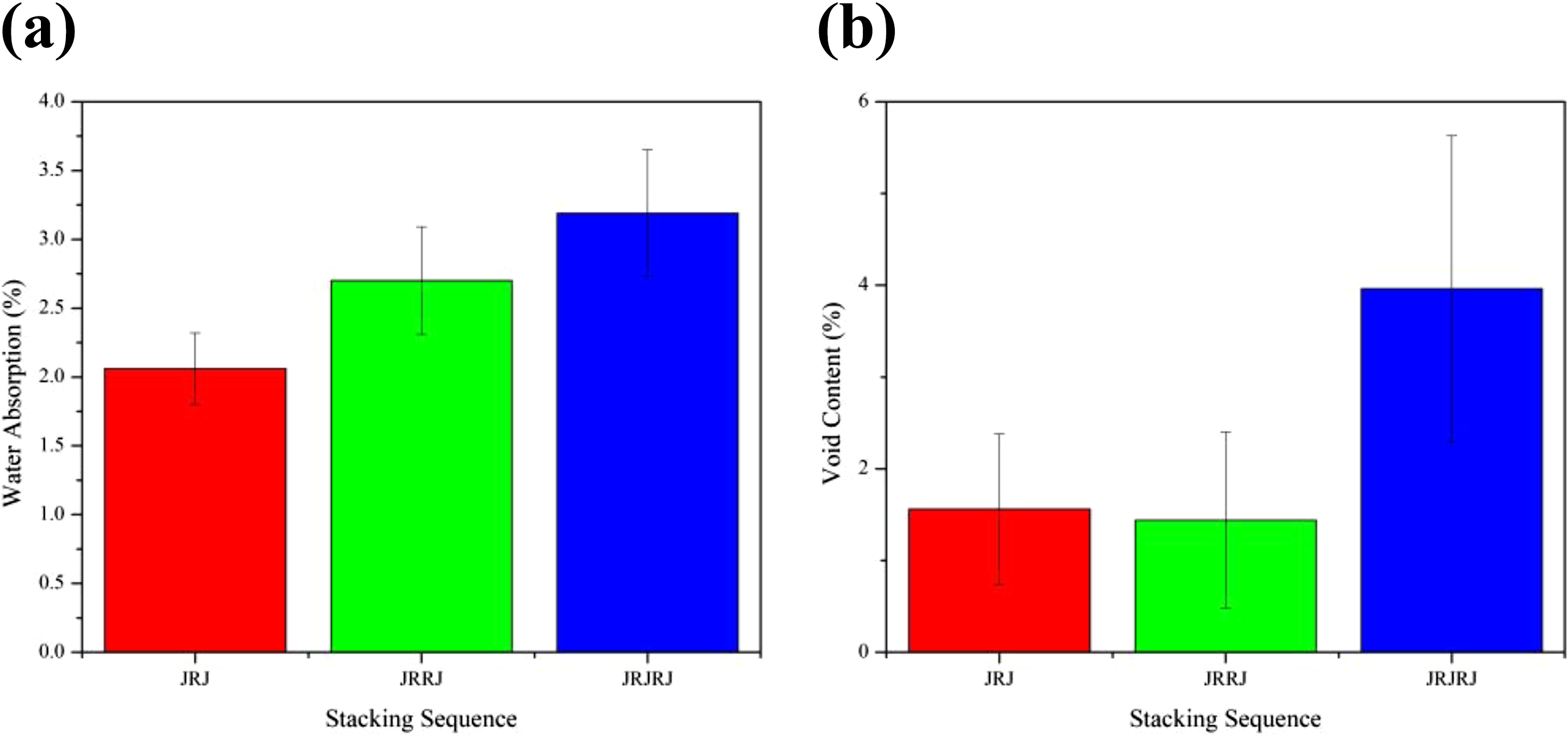
Physical characterization of flexible composites: (a) water absorption and (b) void content.
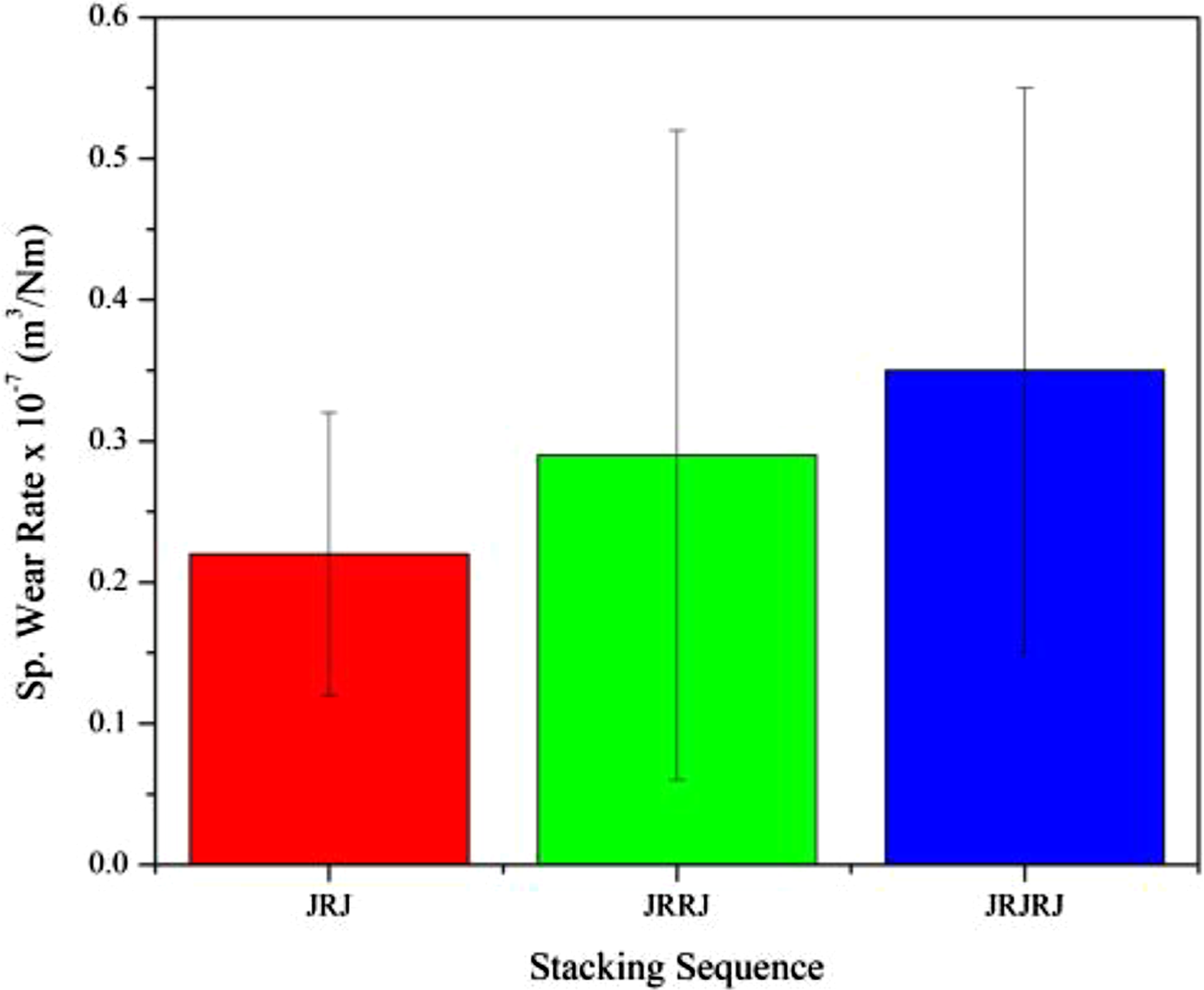
Wear characterization of flexible composite.
It can be seen from Figure 8(a) that as the tensile strength for stacking sequence JRJ is highest compared to its counterparts JRRJ and JRJRJ. The stress strain behavior of the proposed flexible composites are presented in Figure 8(b). It is also observed that with the addition of one rubber (to JRRJ compared to JRJ), the drop in tensile strength is more compared to the addition of jute (to JRJRJ compared to JRRJ). This could be due to the reason that rubber being an elastic and compliant material does not add to the strength of the composite considerably compared to jute. The tensile strength of JRJ is 1.57 and 1.64 times more than JRRJ and JRJRJ, respectively. In contrast to the above argument, the addition of rubber (to JRRJ compared to JRJ) the reduction in tear strength in minimal compared to addition on jute (to JRJRJ compared to JRRJ). The variation of tear strength of flexible composites is shown in Figure 8(c) along with the force–displacement behavior in Figure 8(d).
Though, it can be seen from Figure 9(a) that the specific impact strength of JRJRJ is more compared to JRRJ and JRJ, the variation is negligible and the specific wear rate of JRJ is minimal compared to JRRJ and JRJRJ. This is due to the fact that, with the addition of each layer of either jute or rubber, the thickness of the composite increases and with an increase in thickness, the contact area of the composite with the abrasive medium is more resulting in enhanced wear rate. The hardness of JRJ is more followed by JRRJ and JRJRJ as shown in Figure 9(b). This is also reflected in the indentation depth of the flexible composites calculated using equation (21) 32 and presented in Figure 12. The indentation depth indicates that JRJRJ is softer compared to JRRJ and JRJ.
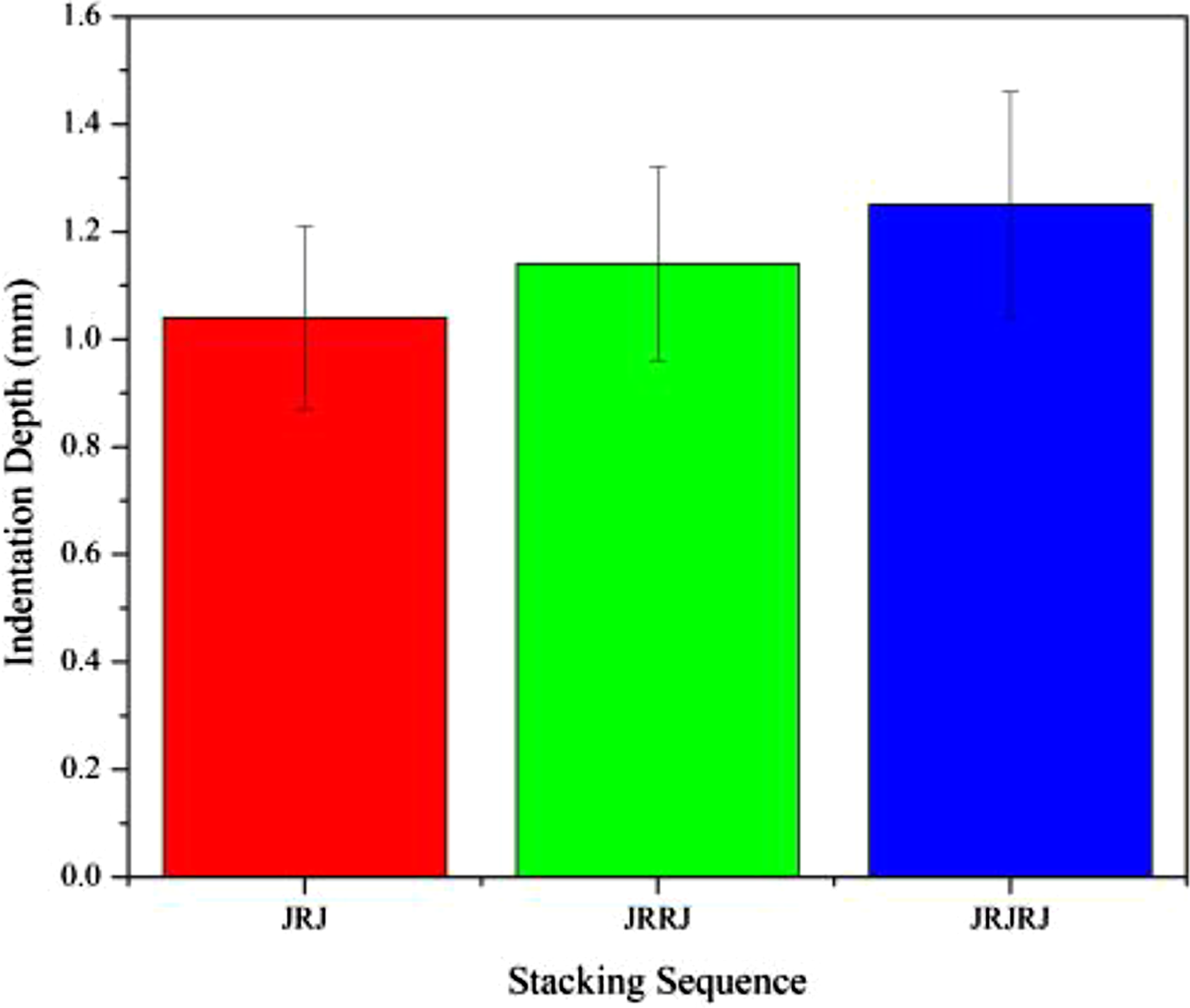
Indentation depth of proposed flexible composites.
The physical characterization of the flexible composites is presented in Figure 10. In the proposed flexible composites, both jute and rubber contribute toward water absorption with JRJRJ stacking sequence absorbing more water followed by JRRJ and JRJ as shown in Figure 10(a). This is due to the fact that JRJRJ has more number of plies compared to other two stacking sequences. Figure 10(b) shows the void content in each stacking sequence with JRJRJ absorbing more water followed by JRJ and JRRJ. This is due to the fact that when rubber and jute fabric are side by side voids are created compared to two rubber sheets being placed side by side. Thus, the void content is reduced in JRRJ compared to JRJ and is increased in JRJRJ

The results pertaining to wear characterization of the proposed flexible composites are presented in Figure 11, which shows that specific wear rate of JRJ is minimum indicating that this particular stacking sequence provides better resistance to wear compared to other two stacking sequences. This is due to the fact that the stacking sequence JRJ being harder compared to JRRJ and JRJRJ provides much better resistance to wear compared to JRRJ and JRJRJ.
Prior to applying the MADM method to select the optimal stacking sequence, it is essential to establish that the results are statistically different. Table 2 shows the statistical results obtained through ANOVA for different criteria for the different stacking sequences at a confidence level of 95% (α = 0.05) along with their standard deviation. It can be seen that the p value is less than 0.05 in all the cases. This concludes that the range of data/results obtained in each tests are significantly different.
Statistical results.
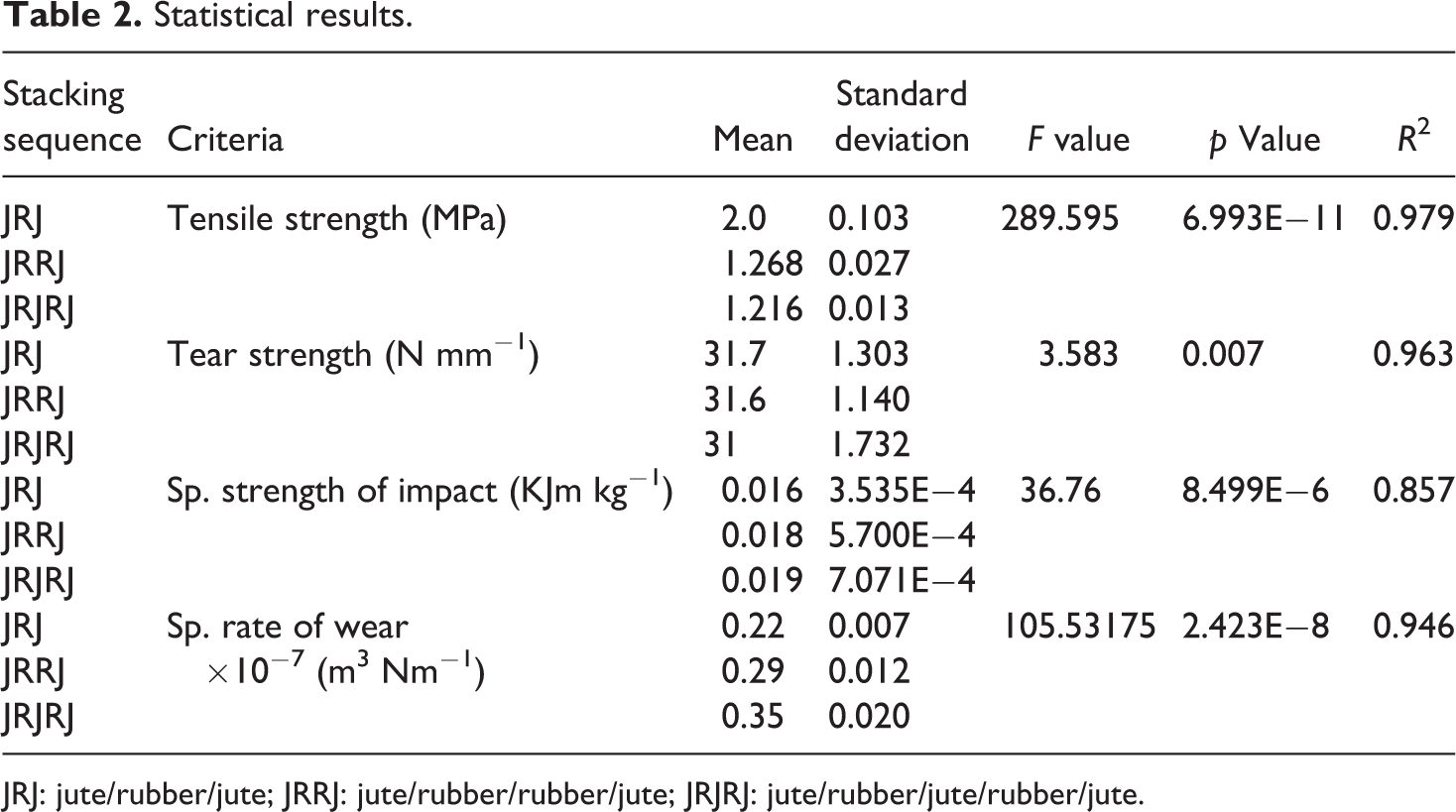
JRJ: jute/rubber/jute; JRRJ: jute/rubber/rubber/jute; JRJRJ: jute/rubber/jute/rubber/jute.
VIKOR method
The three composite configurations JRJ, JRRJ, and JRJRJ are compared using the VIKOR method and ranking has been done accordingly. The performance defining attributes description is provided in Table 3. The decision matrix is developed based on the experimental results obtained and is presented in Table 4.
Performance defining attributes description.
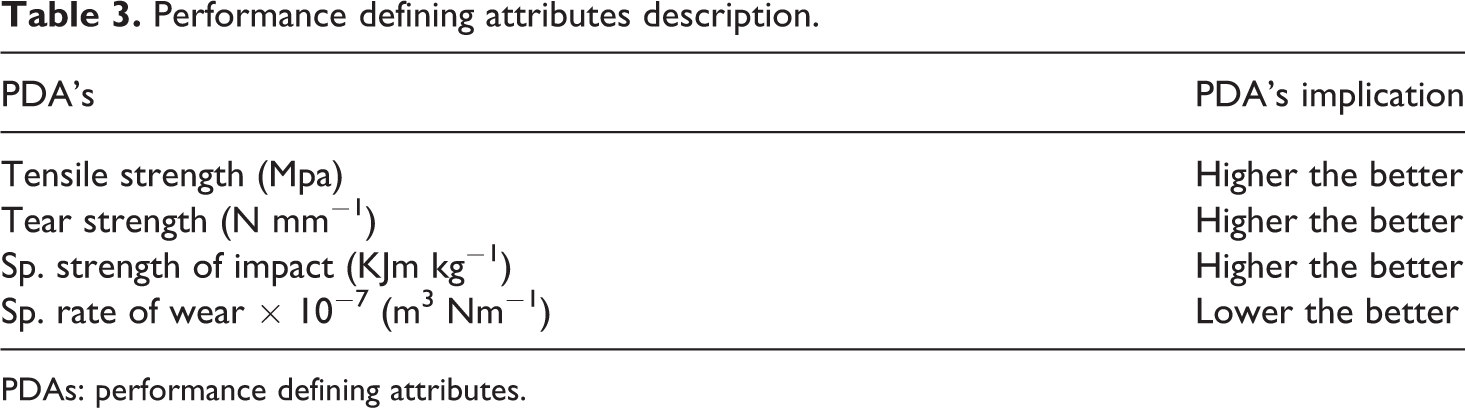
PDAs: performance defining attributes.
Decision matrix.
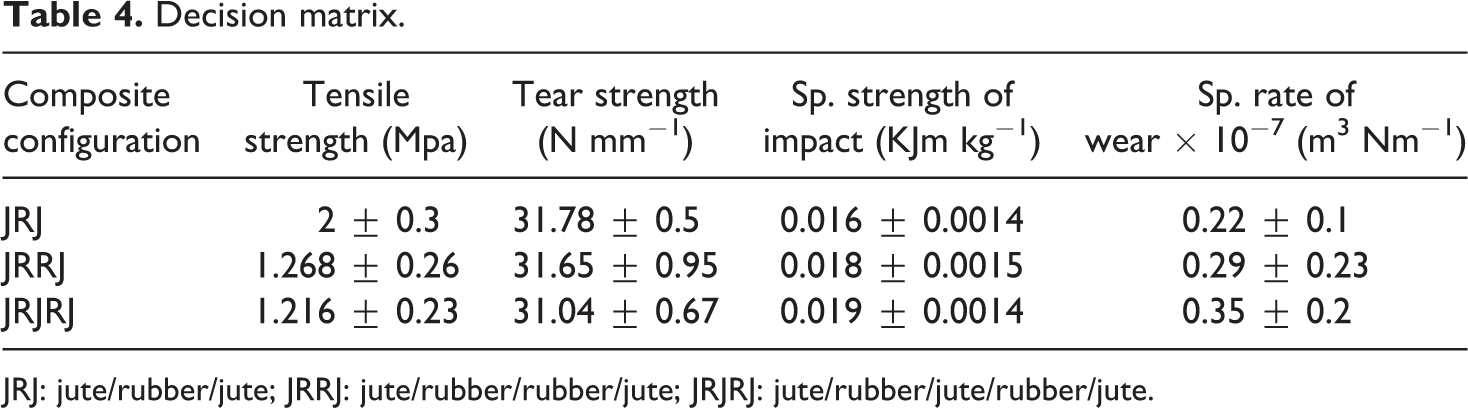
JRJ: jute/rubber/jute; JRRJ: jute/rubber/rubber/jute; JRJRJ: jute/rubber/jute/rubber/jute.
Normalization is carried out to facilitate the comparison of the various different values of the properties obtained experimentally and thus standard deviation is not considered for normalized matrix which is presented in Table 5. This is in accordance with the approach followed by Chauhan et al. 33
Normalized matrix.
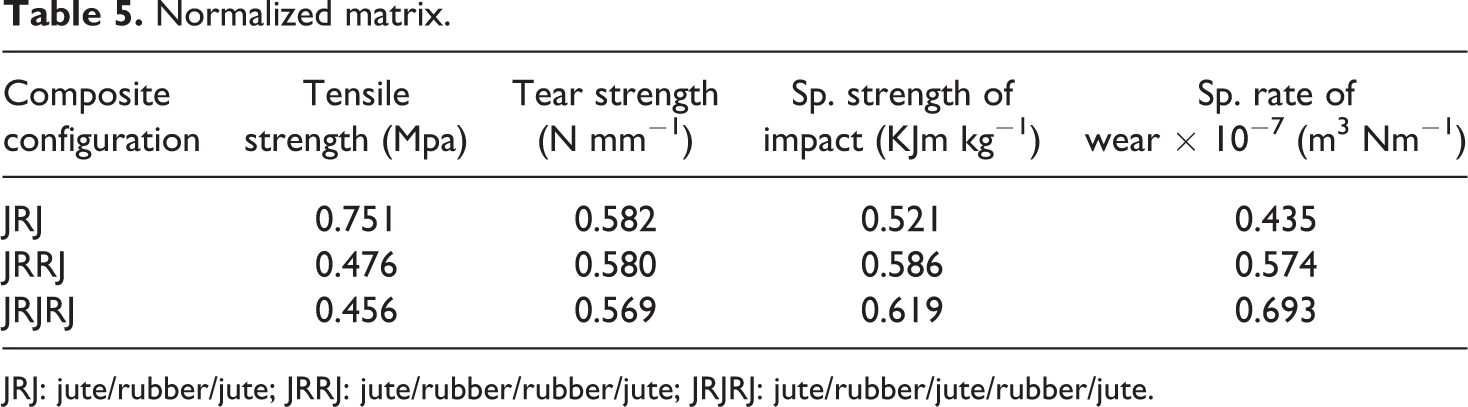
JRJ: jute/rubber/jute; JRRJ: jute/rubber/rubber/jute; JRJRJ: jute/rubber/jute/rubber/jute.
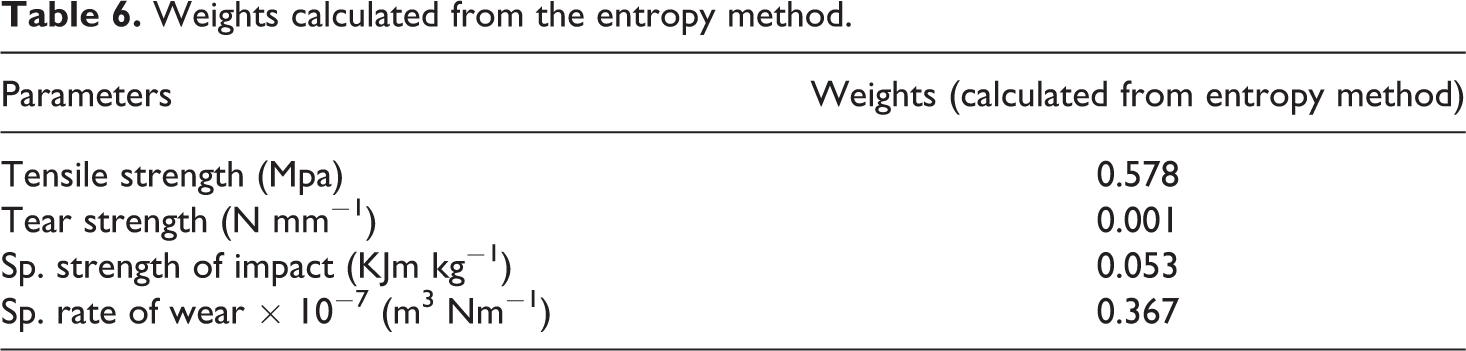
The weights are calculated using the entropy method using equations (3) to (6). The weights found are given in Table 6.
Weights calculated from the entropy method.
The weighted normalized matrix is provided in Table 7.
Weighted normalized matrix.
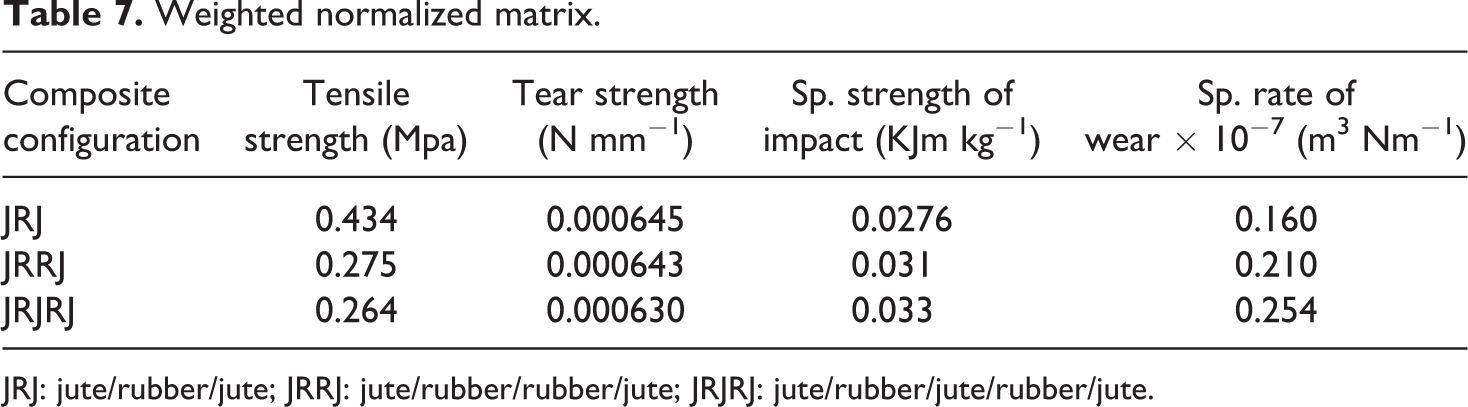
JRJ: jute/rubber/jute; JRRJ: jute/rubber/rubber/jute; JRJRJ: jute/rubber/jute/rubber/jute.
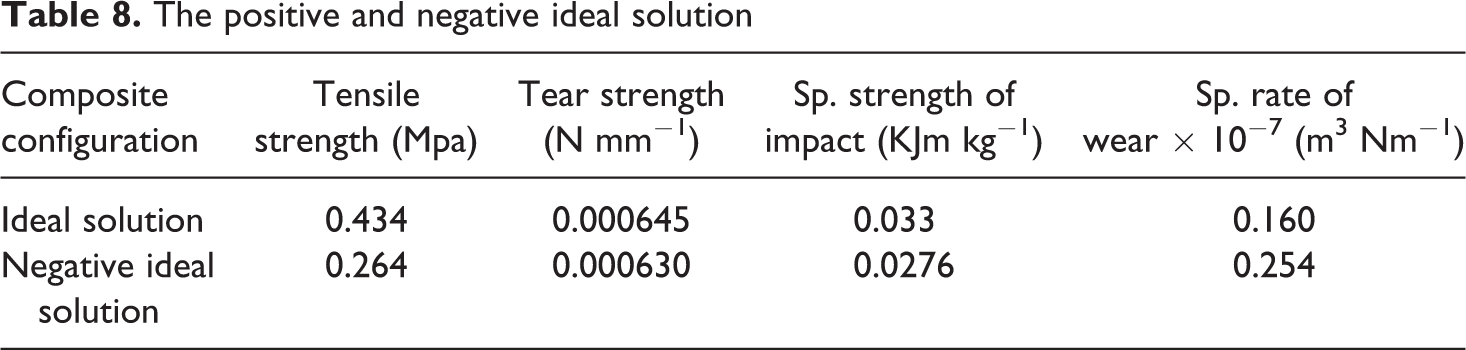
The positive and negative ideal solution is determined according to equations (8) and (9), respectively, and tabulated in Table 8.
The positive and negative ideal solution
Si and Ri values are found out using equations (10) and (11), respectively, and are reported in Table 9. Equation (12) is used to find the VIKOR index as a last step to rank the alternatives. Table 10 provides the VIKOR index and ranking provided to each of the alternative. The alternative having lowest VIKOR index is assigned with rank 1 and so on.
Utility and regret measures.
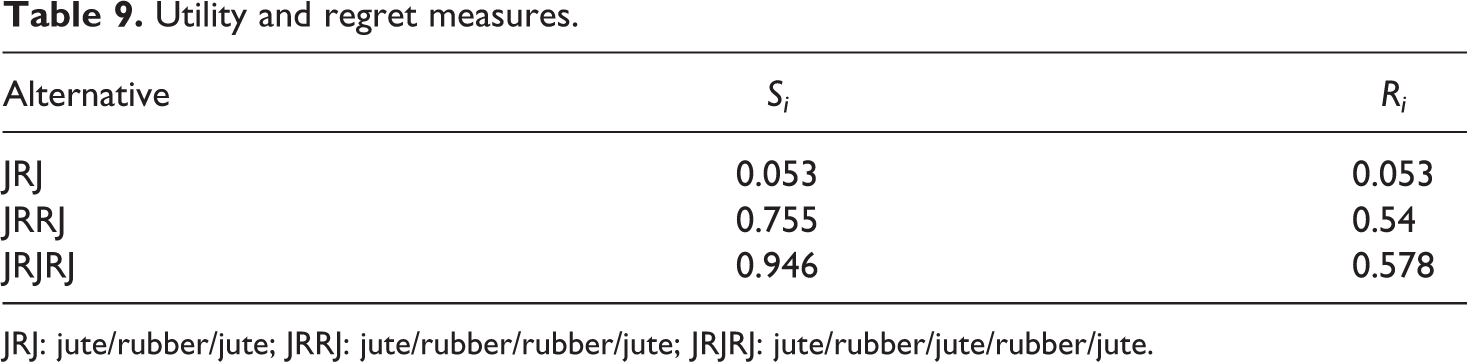
JRJ: jute/rubber/jute; JRRJ: jute/rubber/rubber/jute; JRJRJ: jute/rubber/jute/rubber/jute.
VIKOR index for α = 0.5.
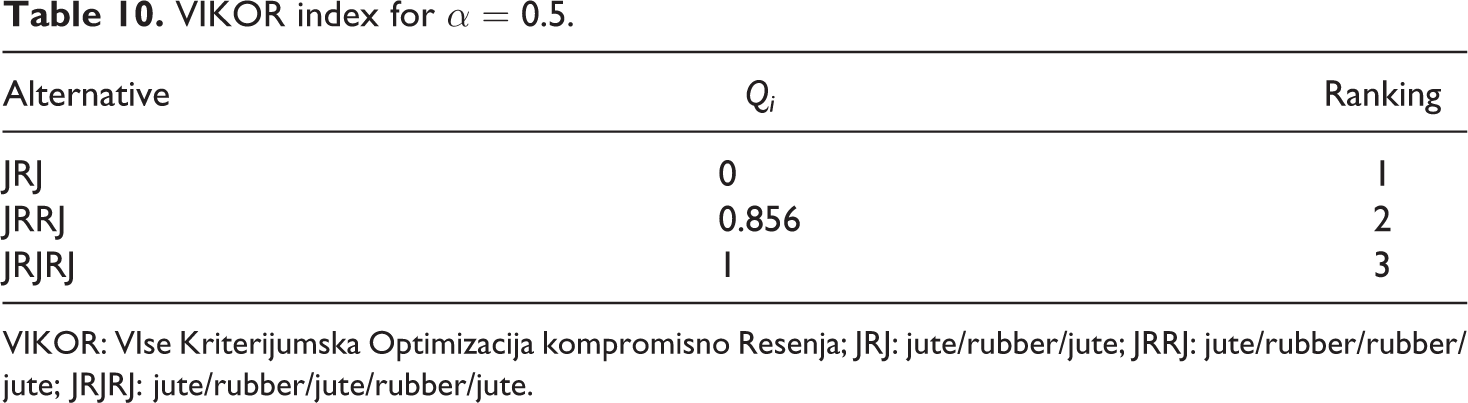
VIKOR: VIse Kriterijumska Optimizacija kompromisno Resenja; JRJ: jute/rubber/jute; JRRJ: jute/rubber/rubber/jute; JRJRJ: jute/rubber/jute/rubber/jute.
The results indicate that JRJ has the lowest VIKOR index compared to JRRJ and JRJRJ. Thus, JRJ emerges as the optimal stacking sequence for the criteria considered in the present study based on the VIKOR method.
PSI method
The decision matrix for the current problem is represented as in Table 4. This decision matrix is normalized using equations (14) and (15). The mean value of normalized data is calculated according to equation (16) and are represented in Table 11.
Normalized matrix and mean values of normalized data for PSI.
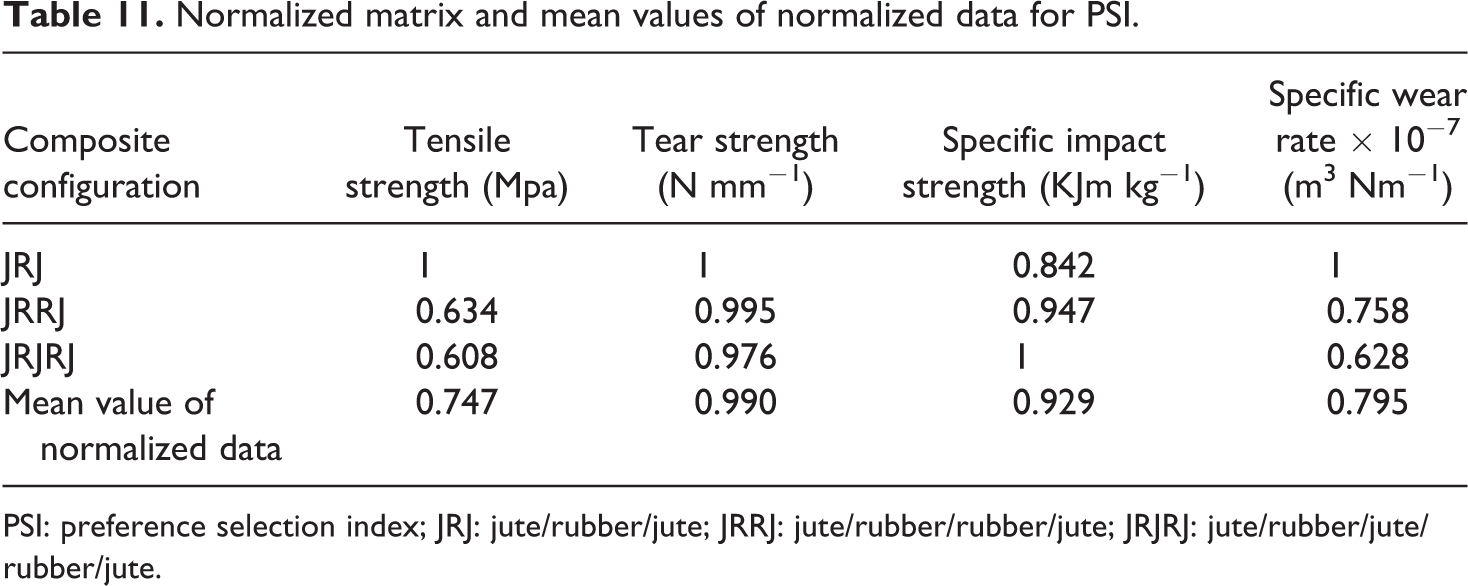
PSI: preference selection index; JRJ: jute/rubber/jute; JRRJ: jute/rubber/rubber/jute; JRJRJ: jute/rubber/jute/rubber/jute.
The preference variation value, deviation in preference value, and overall preference value calculated using equations (17) to (19), respectively, are tabulated in Table 12.
Preference variation value, deviation in preference value, and overall preference value.
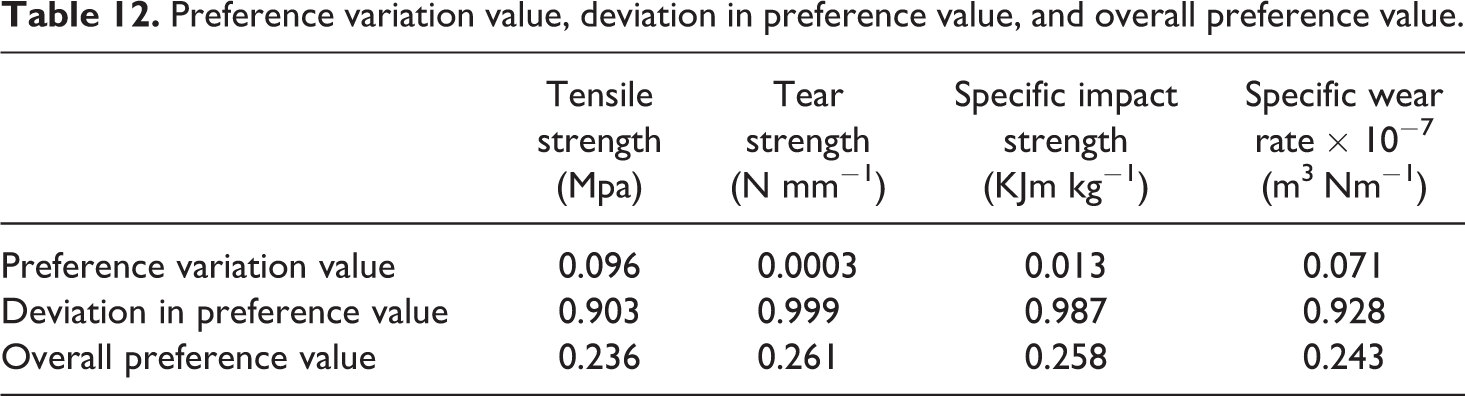
The PSI values for each of the alternative is calculated using equation (20) and ranking based on PSI values are provided with the alternative having the highest PSI with rank 1 and so on. The same are tabulated in Table 13.
PSI values and ranking of alternatives.
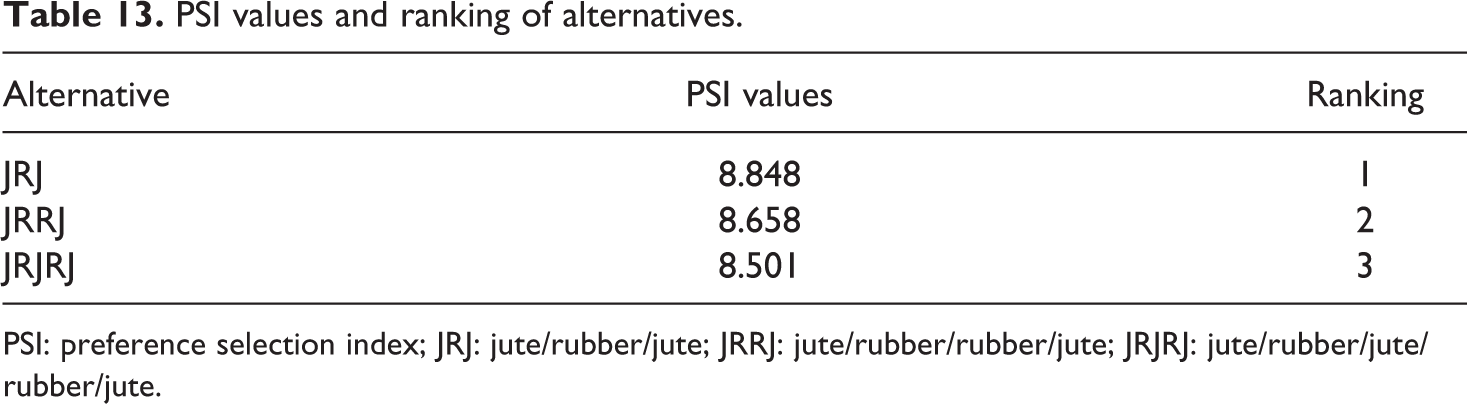
PSI: preference selection index; JRJ: jute/rubber/jute; JRRJ: jute/rubber/rubber/jute; JRJRJ: jute/rubber/jute/rubber/jute.
The results obtained through the VIKOR and PSI methods used in the present study are provided in Table 14. In the case of VIKOR method, the ranking is provided based on the ascending order of VIKOR index (JRJ = 0 < JRRJ = 0.856 < JRJRJ = 1). Aggregate functions, in case of the VIKOR method, are always nearer to ideal values. For example, in the case of the VIKOR method, JRJ is assigned with rank 1 and it has an aggregate function of 1 (1-0). This is equal to the ideal value of 1. In the case of the PSI method, the ranking is provided based on higher PSI values (JRJ = 8.848 > JRRJ = 8.658 > JRJRJ = 8.501). It can be seen that the order of ranking in both the MADM methods remains the same and thus can be said that JRJ stacking sequence is preferred over JRRJ and JRJRJ.
Results of VIKOR and PSI methods.
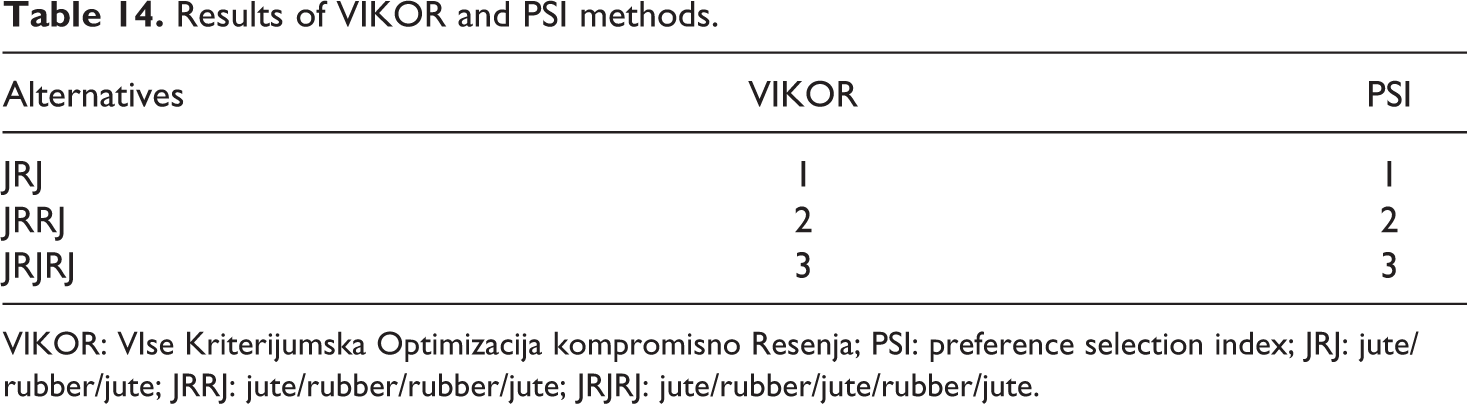
VIKOR: VIse Kriterijumska Optimizacija kompromisno Resenja; PSI: preference selection index; JRJ: jute/rubber/jute; JRRJ: jute/rubber/rubber/jute; JRJRJ: jute/rubber/jute/rubber/jute.
SEM analysis
SEM analysis was carried out to study the different failure mechanism involved in the proposed flexible composites during different tests. Figure 13 shows the failure mechanisms involved in the proposed flexible composite during tensile and tear tests. It can be seen clearly that the proposed flexible composite fail mainly due to matrix tearing and fiber breakage. The failure behavior of proposed flexible composites is different from the conventional PMCs in the terms that the matrix in the flexible composite does not undergo cracking as it is found in conventional PMCs. This is mainly due to the flexible nature of the matrix. Due to the tearing of the matrix (rubber), the fiber (jute) which is attached to it gets pulled out from the matrix and finally breaks.
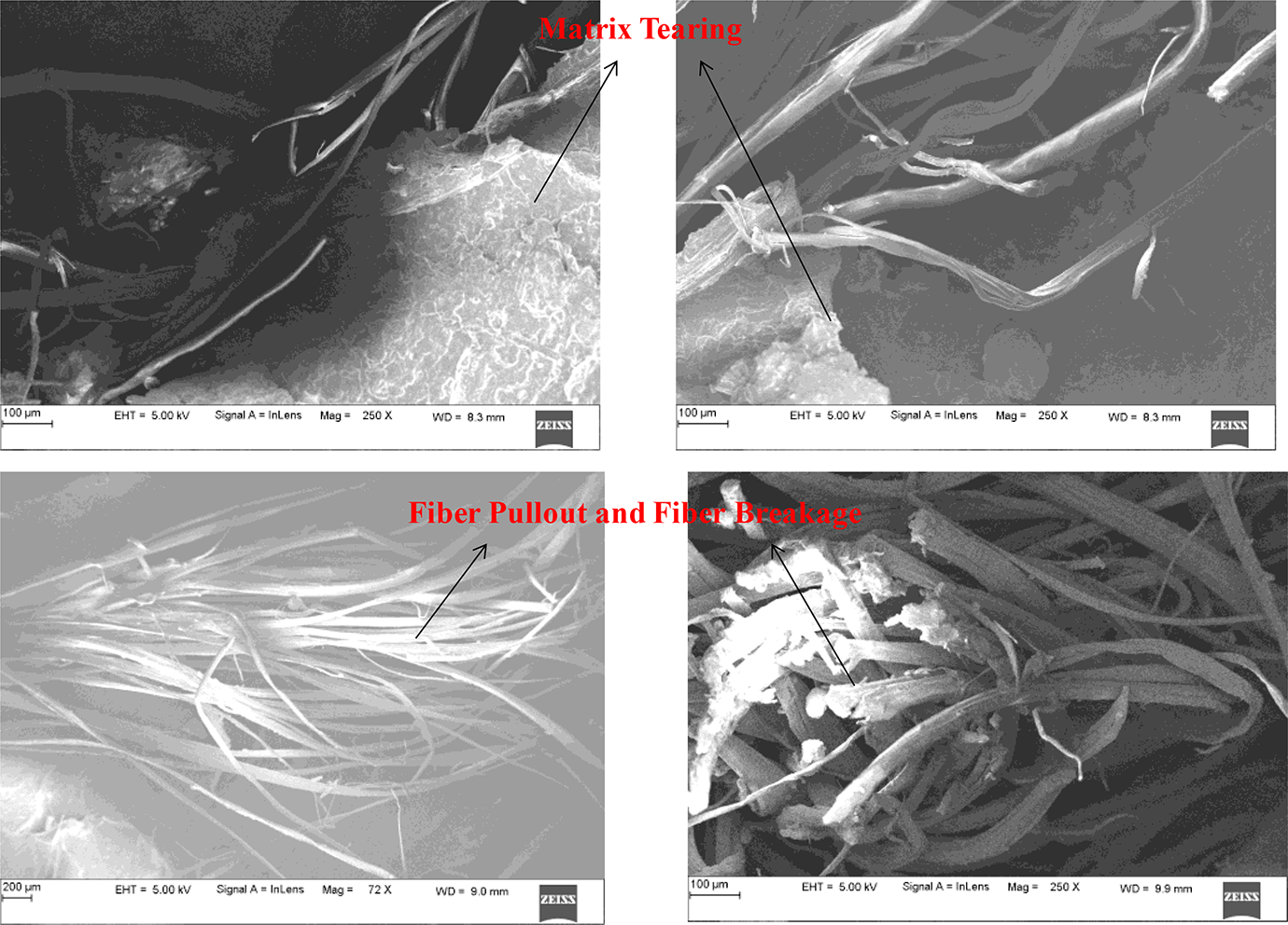
Failure mechanism in the flexible composite during tensile and tear test.
The wear mechanism of the constituents used in the composite varies from one another. To study the wear mechanism of the matrix and fiber, SEM analysis of the worn out composite at different stages of wear is studied. The wear mechanism of the composite is dominated by stretching of asperities when rubber is exposed to the abrasive medium resulting in the formation of wave-like pattern as shown in Figure 14(a). At this stage, more time is required for the tearing and complete separation of the rubber from the composite. This is due to the flexible nature of the rubber. Jute is another constituent of the flexible composite when exposed to abrasive medium results in breakage of the fiber as shown in Figure 14(b) and (c) due to abrasion and being powdered. The residuals after the abrasion test are the jute and rubber powders in the order of few micrometers and are shown in Figure 14(d).
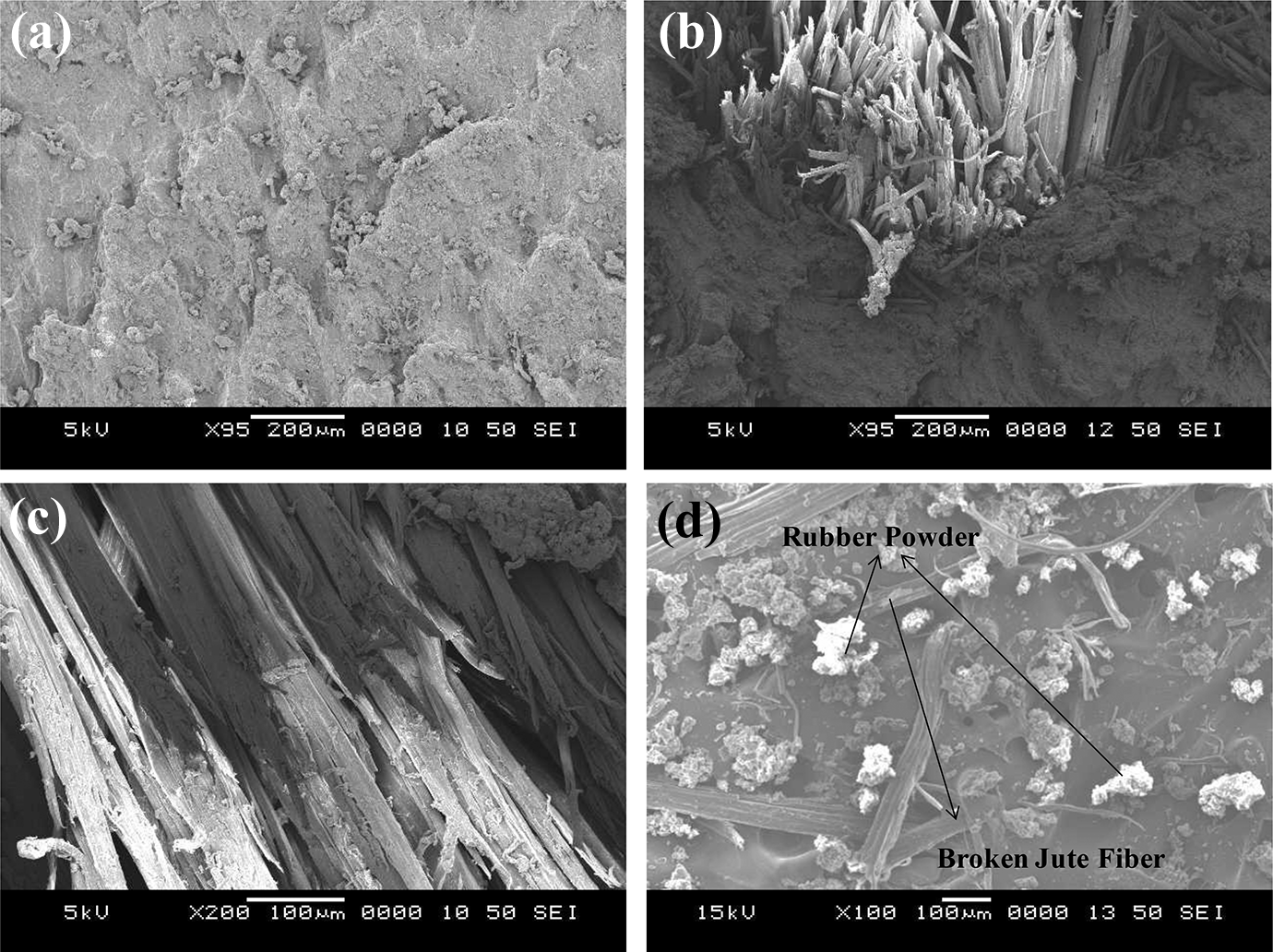
Wear mechanism of constituents of flexible composite: (a) rubber, (b) jute, and (c) residuals of wear.
Conclusions
The present study effectively and systematically makes use of the MADM approaches (hybrid entropy-VIKOR and PSI) for choosing an appropriate stacking sequence for the novel jute/rubber-based flexible composite with the help of various attributes obtained through mechanical and wear characterization of proposed composites. Based on the present study, following conclusions are drawn: The comparative result of hybrid entropy-VIKOR and PSI proved to be a competent technique for selecting an optimal stacking sequence for the proposed flexible composite. In this research work, the optimum stacking sequence was evaluated with consideration of various conflicting nature of the criteria using the MADM techniques. The results obtained indicate JRJ as the best suitable stacking sequence. The SEM analysis identifies the failure and wear mechanisms of the constituents of the proposed flexible composite, indicating that the failure of the matrix in the proposed composite is due to matrix tearing as opposed to matrix cracking, which is commonly found in conventional PMCs. Fiber breakage remains the reason for failure of fibers. It was found that, rubber being an elastic material, stretches more leading to formation of wave like pattern when subjected to wear and thus provides better wear resistance. JRJ provides better tensile strength, tear strength, hardness, water absorption, and specific wear rate compared to JRRJ and JRJRJ. The flexible composite JRJ being harder compared to JRRJ and JRJRJ provides better wear resistance and lower indentation depth. It is statistically proved that the results obtained for each stacking sequence are different from each other and thus it suitable to apply MADM approach to select the best stacking sequence. It is clearly seen that the hybrid entropy-VIKOR and PSI models significantly support the selection of optimum stacking sequence and can be extended to the selection of suitable compositions for the composite for any intended engineering application. Also, these models are easily understood, marked by exactness and very efficient tools which can be conveniently used to aid the engineers and designers in selecting appropriate material among the alternatives available. The approach used in the present study can be handy in the future for researchers, engineers, and designers working on material selection issues for engineering applications.
