




Abstract
Silaned nano-silicon dioxide (SiO2) was used to improve the adhesion properties of carbon fiber/polyoxymethylene (CF/POM) composites. The CF and nano-SiO2 were treated and the changes on the surface properties of the treated and untreated composites were studied by impact, three-point bending tests, and scanning electron microscopic analysis. The measurement showed that the fracture toughness increases with the increase of CF content, while very high content of CF did not further cause the increase of the toughness of CF/POM composite. The impact strength of treated specimens is still higher than those of the untreated ones. The modified composite with the good matrix/fiber adhesion possessed 20% higher interlaminar shear strengths compared to the composite having weak interface.
Introduction
During the last decade, considerable attention was paid to inorganic–organic hybrid materials because their solid-state properties could be tailored in relation to the nature and relative content of their constitutive components. Low-volume additions (1–5 wt%) of highly anisotropic nanoparticles, such as layered silicates, provide property enhancement with respect to the neat polymer that are comparable with those achieved by conventional loadings (15–40 wt%) of traditional fillers. Besides, unique value-added properties not normally possible with traditional fillers are also observed, such as enhanced strength, electrical conductivity, electrostatic discharge, remote-actuated shape recovery, and ablation resistance. 1 –3
Carbon fiber (CF) has been widely employed as the reinforcing material in the advanced composite materials that have been applied in a variety of areas such as the aerospace industry, automobile applications, and sporting goods, 4,5 so it is significant to develop the composite reinforced by CF with high-performance mechanical properties. Polyoxymethylene (POM) resin is a kind of widely used engineering thermoplastic material, which exhibits good fatigue resistance, creep resistance, and high impact strength. 6,7 It has good wear-resistant properties because of its high crystallinity and high bond energy, so when sliding against stainless steel it is difficult to transfer to the metal counter-surface or form wear debris in the contact area. 8 –10 Due to the weak interfacial adhesion of untreated CF-reinforced composites, many researchers have developed a series of surface treatment methods for CFs to control and modify the interfacial performance of the composites. POM can replace not only nonferrous metals, for example, copper, zinc, and chromium, but also iron castings, steel castings, and stainless steel and so on. POM and its composites have been widely used as self-lubricating materials in many fields such as automobile, electronic appliance, and engineering. 11 –14
In this work, silicon dioxide (SiO2) is treated by silane in order to improve the surface properties of CF. The purpose of this work is to study the impact properties of the POM composites filled with surface-modified CF. Some insights into the impact fracture mechanisms of the POM composite are also given.
Experimental
Materials
High-density polyethylene (HDPOM; glass transition temperature (Tg): 85°C, melting point (Tm): 130°C, p: 0.95 g cm−3, and molecular weight (Mw): 125,000 g mol−1) was obtained from Merck Chemicals (Germany) and used as purchased.
For the present investigation, the reinforcement materials were continuous polyacrylonitrile-based CFs manufactured by Shanghai Sxcarbon Technology Co. Ltd (China).
A 3:1 (v/v) mixture of concentrated sulfuric acid/nitric acid was prepared with sonication at 60°C. In a typical reaction, several small pieces of CF paper were added to 60 mL of this mixture in a reaction flask. (The acid mixture is highly corrosive. Extreme care should therefore be exercised during handling.) The flask was placed in an ultrasonic water bath (Cole–Parmer Instrument Company, Vernon Hills, Illinois, USA), operating at 152 W and 47 kHz and maintained at 60°C. The treatment was carried out at various precisely controlled times between 10 s and 240 min. The treated substrate was then placed in a beaker and washed twice in deionized (DI) water. If the pH of the wash water was not 7, it was again washed for 2 min, with sonication; this was repeated, without sonication, until the pH reaches 7. Washing removes all water-soluble nitrogen oxides and sulfur oxides, that is, those oxygen-bonded to the fiber, replacing them with hydroxyl groups through ion exchange.
The silane (KH550) was dissolved in ethanol before use. The particles of nano-SiO2 were dispersed in ethanol and subjected to ultrasonic agitation for 15 min, the silane solution was then introduced and the ultrasonic treatment continued for 1 h.
Composite preparation
POM samples were first dissolved in 40 mL of xylene in a three-necked flask. Required amount of CF was added into the above solution. Indole was also dissolved in 10 mL of xylene and added into the same flask. The reaction mixture was washed with distilled hot water several times and dried in a vacuum oven at 70°C for 24 h.
Impact and TPB tests
A Charpy unnotched impact strength test was carried out on a pendulum impact tester (model PH 125, Amsler & Co., Schaffhouse, Switzerland) with a capacity of 0.98 J. The test span was 20 mm, measured between the two specimen supports.
The specimens were impacted on the narrow 1 mm surface, with the line of impact midway between the supports, and the direction of blow normal to the plane of reinforcement.
An Instron 4206 electromechanical machine (Norwood, Massachusetts, USA) was used to implement the three-point bending (TPB) test.
Transmission electron microscopy (TEM) experiment was carried out using a Hitachi H-600 microscope (Chiyoda, Tokyo, Japan) to study the dispersibility of nanoparticles in POM. The sample used for the TEM experiment was 60 nm in thickness. Nanoparticles have a strong tendency to agglomerate due to their high surface activity, so they should be dispersed effectively to prevent from agglomerating.
Results and discussion
Impact strength
The results of fracture toughness measurements are shown in Figure 1. As seen in this figure, CF increases fracture toughness with the increase of CF content. Very high content of CF did not further cause the increase of the toughness of CF/POM composite. Based on the results shown in Figure 1, it can be expected that composites made using CF show improved interlaminar fracture toughness.
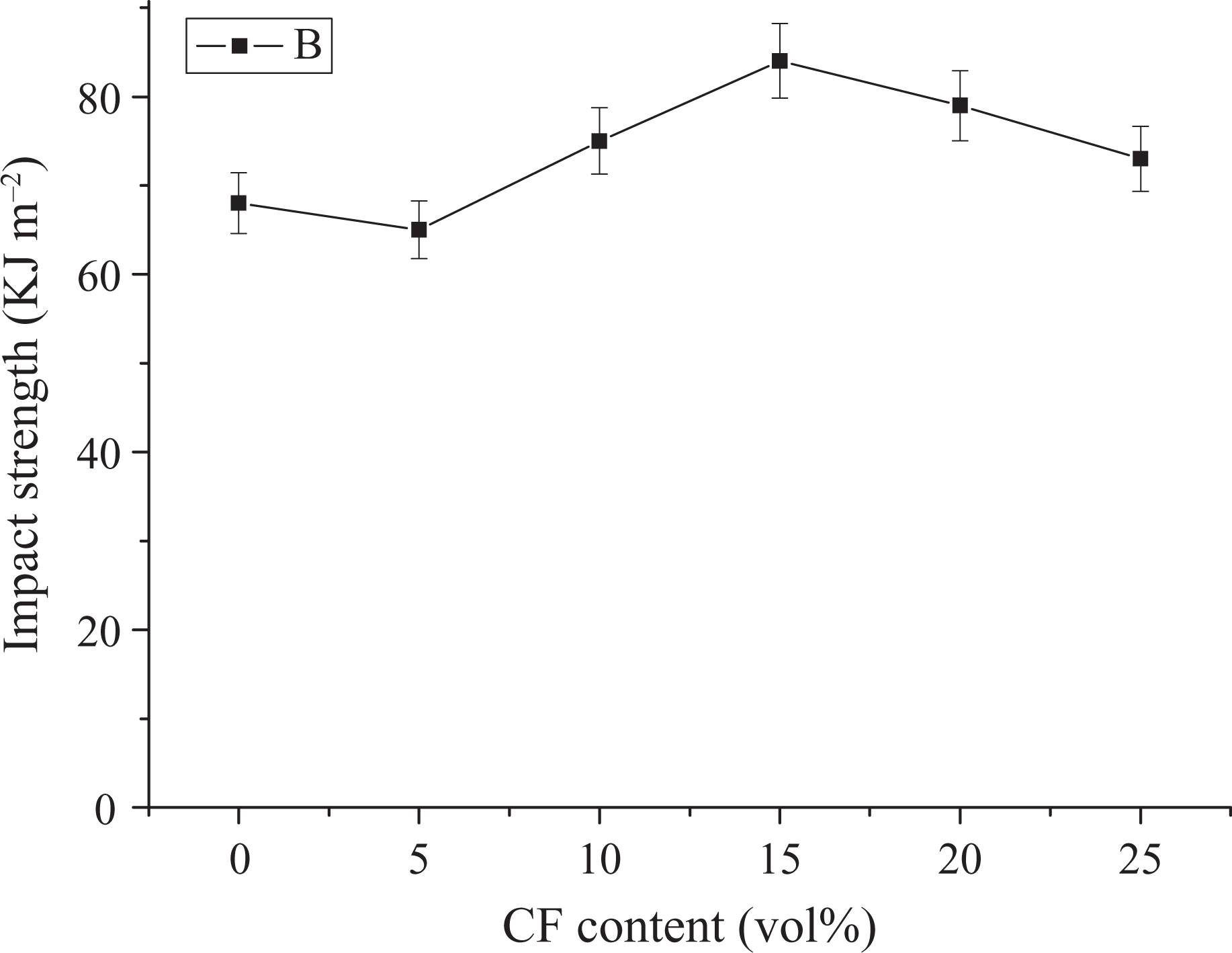
The impact strength of CF/POM composite with CF content. CF: carbon fiber; POM: polyoxymethylene.
To study the effect of silaned nano-SiO2 modification on toughness improvement of final composite against through thickness cracks, the results of impact strength versus SiO2 content for notched test specimens are reported in Figure 2. It is interesting that all samples fractured through thickness and increase in modifier content led to increased impact strength. While similar type of impact test was used to evaluate impact strength of CF-modified POM composites, no significant improvement in the impact strength of the composite (Figure 1) was revealed. This can be attributed to the fact that the POM used in that particular investigation was not ductile enough to be toughened by CF modification. This is why no obvious improvement in impact strength of the composite was observed. The contribution of fibers in absorbing the impact energy is not influenced effectively by CF modification. In addition, Figure 2 shows that the impact strength of silaned specimens is still higher than that of the unsilaned ones. The modified composite with the good matrix/fiber adhesion possessed 20% higher interlaminar shear strengths (ILSSs) compared with the composite having weak interface. Therefore, one may conclude that silaned SiO2 modification improves crack initiation energy of the composites.
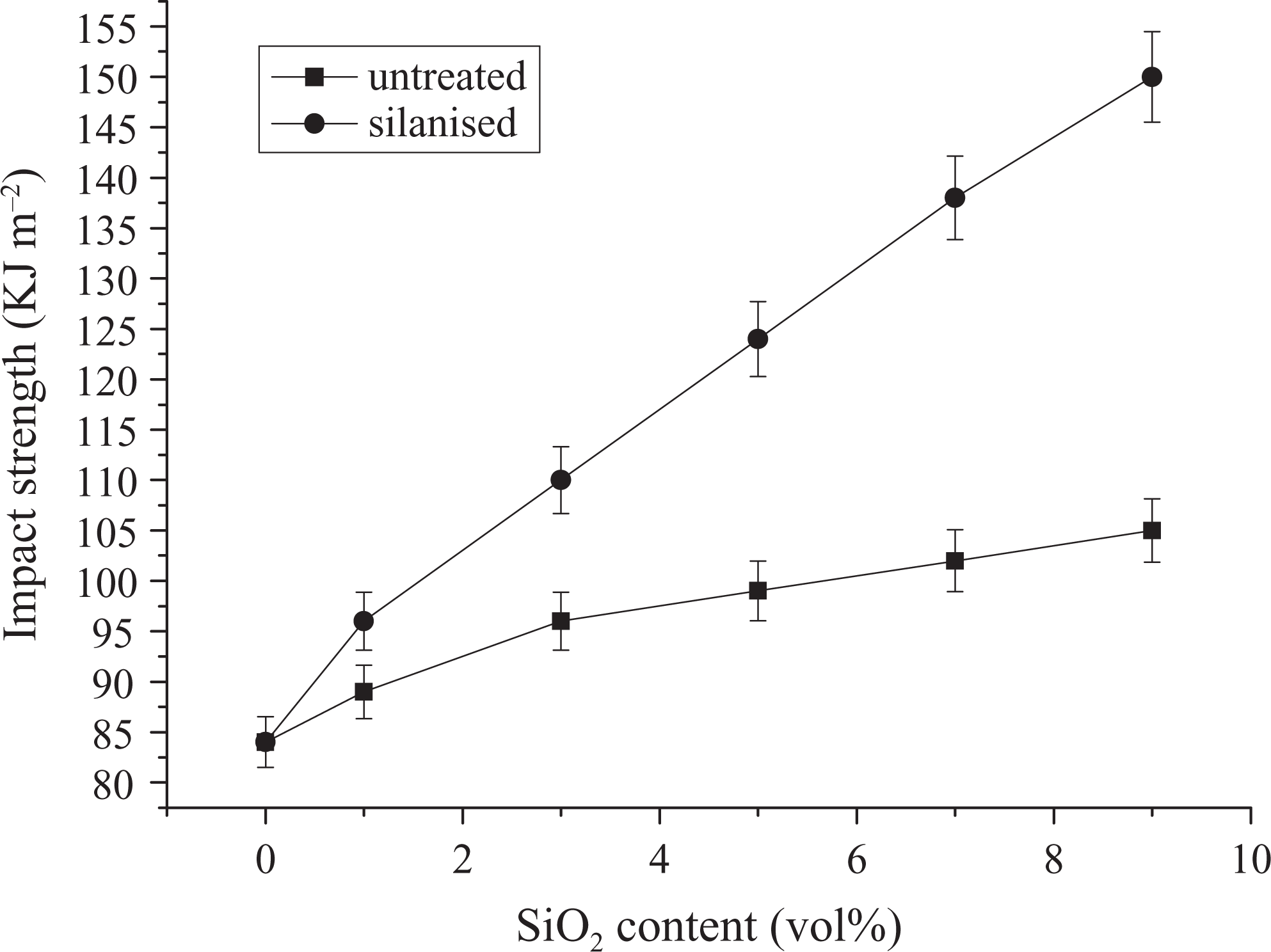
The impact strength of CF/POM composite filled with SiO2 with and without treatment (15 vol% CF). CF: carbon fiber; POM: polyoxymethylene; SiO2: silicon dioxide.
The mechanical benefit of these nanoscale materials appears to increase as stress intensity decreases. They are not capable of hindering crack propagation (fracture toughness) once a crack begins to advance, but their nanoscale dimensions enable them to better interact with the matrix before a critical crack is initiated. In addition, SiO2 maintains their high aspect ratio post-processing.
This allows for a delay in craze formation and coalescence prior to crack initiation. CFs do not present an aspect ratio that favors a strong interaction with the matrix, reducing creep improvement. On the other hand, the larger size of the CFs allows them to slow the growth of the crack by deflection, pullout, and crack-bridging mechanisms. When an advancing crack is presented with a CF, it is deflected following the CF/matrix interface, eventually leading to the pullout of the filament. The surface modification was said to help in exfoliating agglomerations and strengthening SiO2–matrix interactions.
The effect of SiO2 addition on the failure behavior of CF/POM is illustrated by the scanning electron microscopic (SEM) micrograph shown in Figure 3. Fiber pullout is still evident on the fracture plane and no POM matrix appears to adhere to the fiber surface. The ductile failure of the POM matrix changes to a brittle one that is associated with some limited crazing. The craze remnants on the fracture surface are clearly visible. Thus, it can be expected that, during the fracture process, the resistance to crack propagation will be reduced markedly and the samples fail in a more brittle manner.
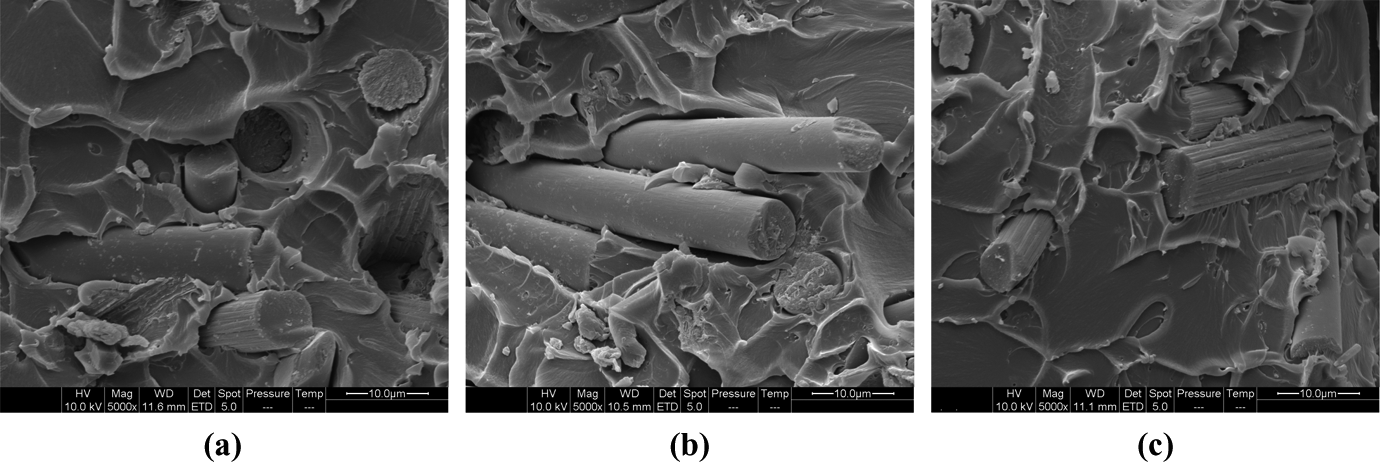
The impact fracture morphology of CF/SiO2/POM composite. CF: carbon fiber; POM: polyoxymethylene; SiO2: silicon dioxide.
As seen, plastic deformations at the plastic zone of modified resins are accompanied by stress whitening. The size of stress whitening increases with increasing the SiO2 content, such that in 5 vol% specimen it expands to the whole surface in front of the crack tip (Figure 3(a)). The difference in the damage zone sizes seen in Figure 3 is in agreement with the fracture toughness data reported in Figure 2.
The flat and almost featureless image seen in Figure 3(a) indicates the typical brittle fracture of neat POM. On the other hand, the rough fracture surface of 3 vol% specimen seen in Figure 3(b) shows the significant amount of plastic deformation that occurred in this material prior to fracture. It is found that cavitation is a prerequisite for massive shear deformation of the matrix. The latter is known as the main source of energy absorption in fracture of rubber-toughened POM. However, comparison of Figure 3(b) with Figure 3(c) reveals less cavitation and void grows on the damaged surface of the impact test specimen. Decrease in cavitation and void growth corresponds to decrease in plastic deformation and energy absorption. These regions are vulnerable to stress due to stress concentration and consequent poor strength compared with the regions with no porosity.
Hackling-type morphology is observed for unmodified matrix remaining between the fibers (Figure 3(a)), and in the case of modified resin (Figure 3(b)), treated SiO2 particles are observed between fibers with no hackling in the resin surface (Figure 3(c)). Figure 3 shows some typical fibers on the fracture surface of composite samples. This figure illustrates that the fiber in unmodified specimen (Figure 3(a)) contains less remaining resin on its surface in comparison with treated SiO2 samples (Figure 3(b)).
It is interesting to note that the surface of the fibers in CF/POM composite (Figure 3(a) and (b)) is partially covered with a sheath of POM matrix. The presence of SiO2 seems to contribute to the interfacial bonding between CF and POM matrix. The effectiveness of SiO2 particles in improving the toughness of thermoplastic matrices is strongly controlled by their ability to act as stress-concentrating sites to induce multiple crazing and shear yielding, thereby forming a large damage zone.
Therefore, it confirms that treated SiO2 has more adhesion to fiber surface than unmodified one. The surface appearance of CF shown by the SEM micrograph in Figure 3 provides a good indication that matrix deformation still persists.
A great improvement in the mechanical properties of the CF/SiO2/POM system can be explained by the microstructure, that is, by developing a void around the particle. When an exerted stress is applied to the matrix, the stress runs along the rubber chain, which appears as elliptical with the longest axis along the traction one. The stress concentration would lie in the two poles of the ellipse. If the interphase interaction between the polymer matrix and carbon filler is too weak, decohesion will happen at the two poles and, subsequently, the sample would submit to destruction under bending. However, when a strong cohesion exists between the polymer matrix and particles, like the CF/SiO2/POM system, the stress will pass to the filler effectively through chemical bonds without decohesion.
TPB properties
Figure 4 shows the TPB value obtained from the tests of CF/POM and CF/SiO2/POM composites; it can be seen that all TPB values of CF/SiO2/POM composites are significantly higher than those of CF/POM composite, the former is 1.2–1.4 times the latter; in addition, the composite made up of treated SiO2 shows a higher value of ILSS. These phenomena can be attributed to the change of interfacial adhesion induced by the variety of the treatment of SiO2 in the composite interface.
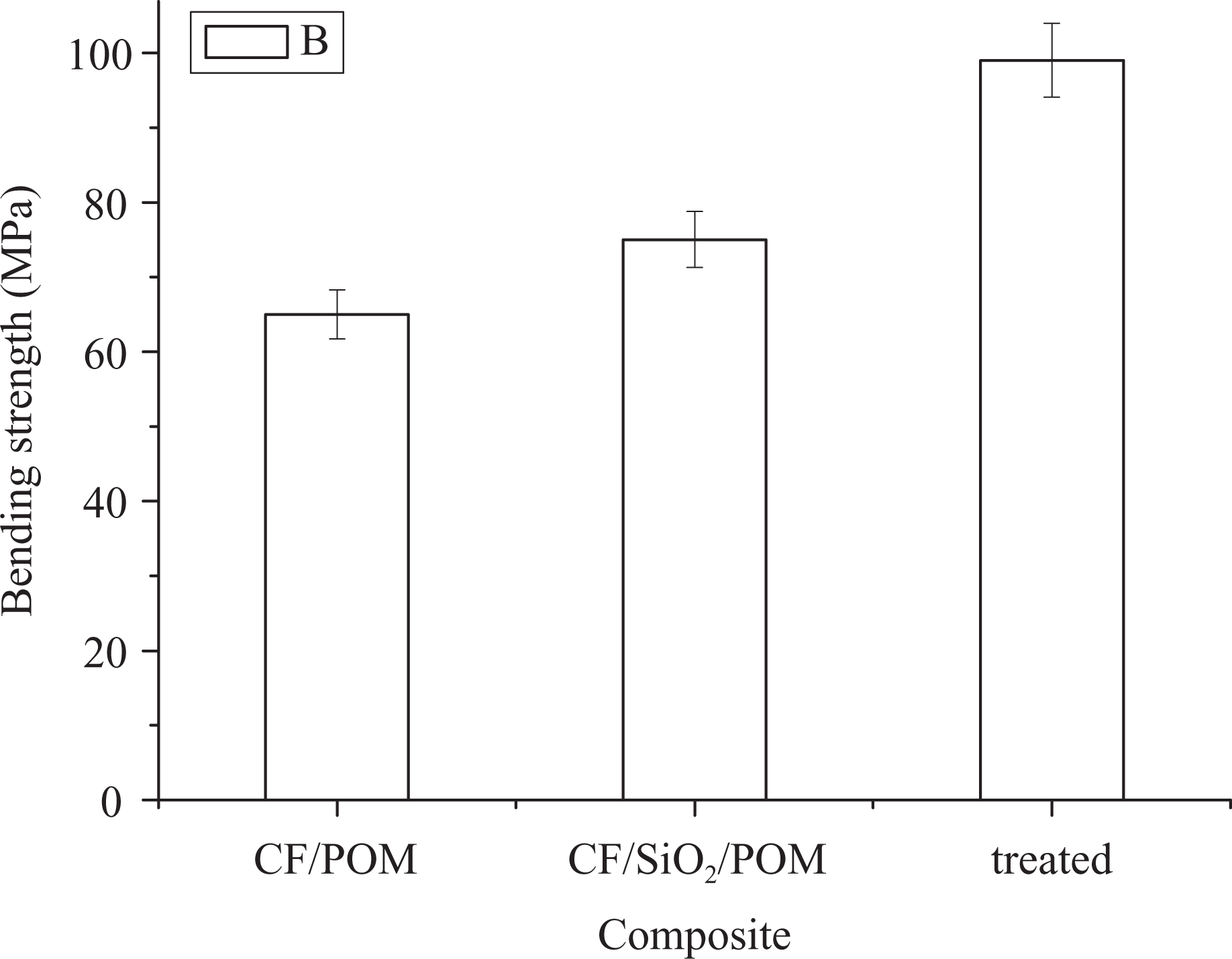
The TPB of CF/SiO2/POM composites. TPB: three-point melting; CF: carbon fiber; POM: polyoxymethylene; SiO2: silicon dioxide.
Figure 5 shows the TEM of CF/SiO2/POM composites. In these micrographs, the bright phase is the matrix and dark phase is the nanolayers of SiO2. Only the SiO2 rich zones were captured in TEM pictures to study the nanocomposite structure and morphology. In Figure 5(a) and (b), the nanolayers of SiO2 platelet are dispersed randomly in the matrix and the structure is an exfoliated nanocomposite structure.
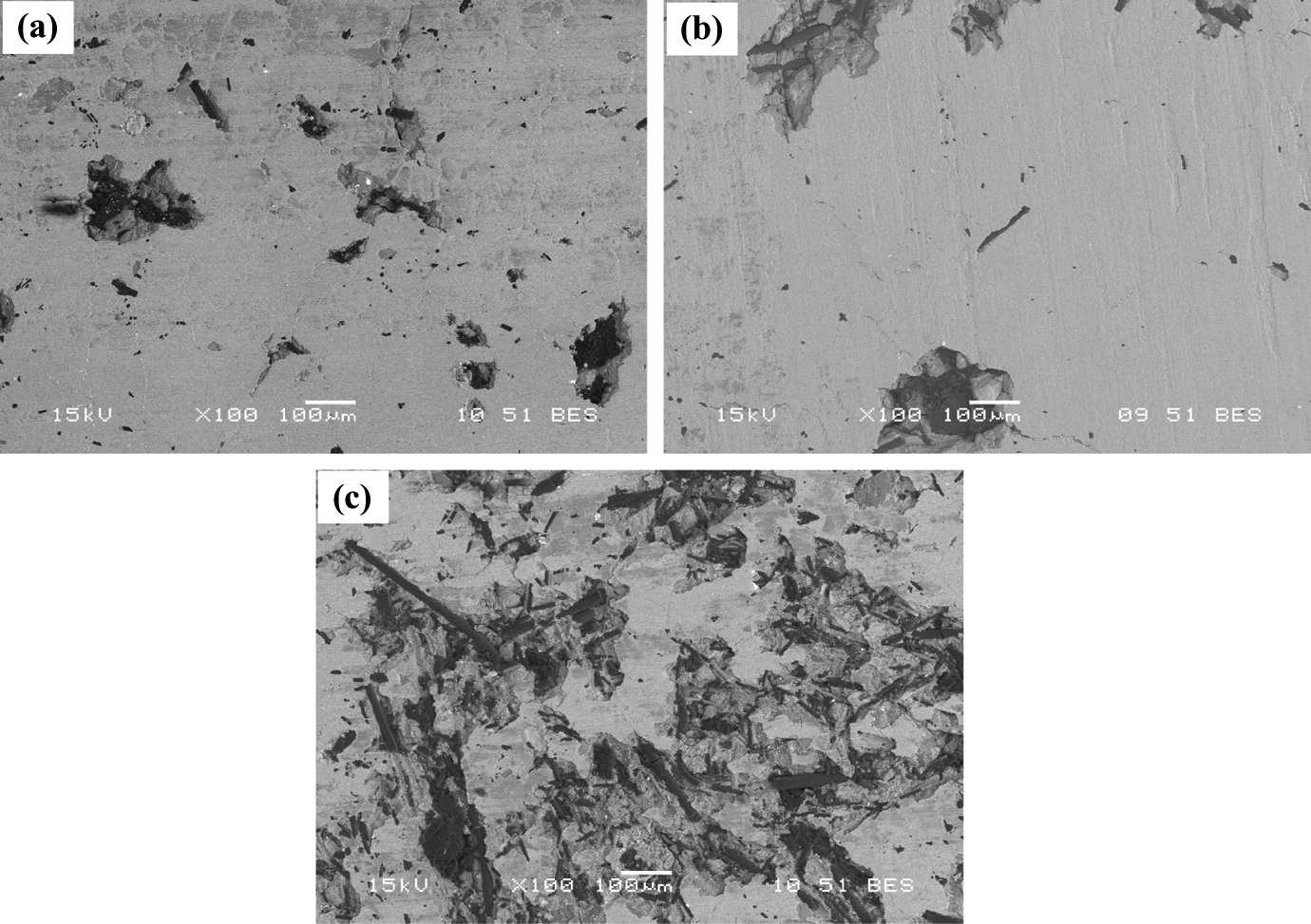
The bending fracture morphology of CF/SiO2/POM composite. CF: carbon fiber; POM: polyoxymethylene; SiO2: silicon dioxide.
(XPS) analysis
After extensive scanning by X-ray photoelectron spectroscopy (XPS), it was found that carbon (C) and oxygen (O) were the major elements on the surface of CFs. The data in Table 1 for the effect on the content of CFs elements after treatment showed that the value of O/C increased. There were only three kinds of functional groups on the untreated CF surface, namely C–C, C–OH, and C–O–C. After treatment, some new functional groups such as –C=O groups emerged.
The effect on the content of CF elements after treatment.
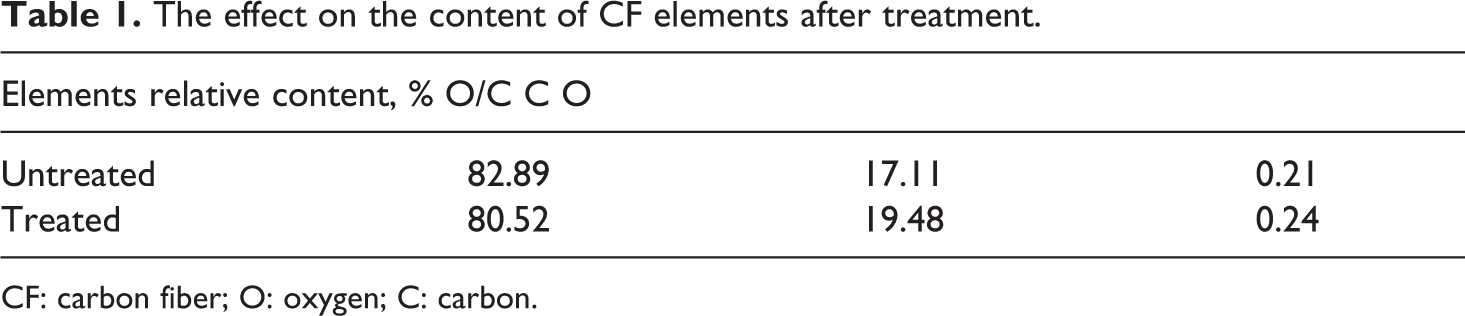
CF: carbon fiber; O: oxygen; C: carbon.
Table 1 also indicates that the relative content of the C–C group decreased after treatment. The relative content of C–C group on the untreated CF surface decreased from 69.60% to 49.86%. The new –C=O functional group appeared and the relative content was 8.18% in the treatment condition. The C–O–C group greatly increased and the COO group was found to have a relative content of 4.94%. The relative content of –C–OH also declined from 23.35% to 21.02%.
Theoretically, the treatment could induce free radicals in all kinds of organic radiation systems by breaking their bonds. As in the present research, organic groups would graft on CF surface by free radical bonding.
The hydroxyl group is an important component because silane SiO2 forms a strong chemical bond with the hydroxyl group. The hydroxyl group was detected from the treated CF surface. The hydroxyl group is primarily formed on the CF surface during treatment, but the portion of hydroxyl group on the CF surfaces decreases as the portion of carboxyl group increases.
Conclusions
When the SiO2 volume fraction increased in the CF/POM matrix from 1 vol% to 5 vol%, the impact improved. Silaned SiO2 modification improves crack initiation energy of the composites. Acid treatment efficiently improves the interfacial adhesion of the clay-filled composites.
Treatment with silaned SiO2 would increase the interlaminar shear bonding strength of CF/POM composites, thus the TPB of CF/SiO2/POM composite increased significantly.
Footnotes
Declaration of Conflicting Interests
The author(s) declared no potential conflicts of interest with respect to the research, authorship, and/or publication of this article.
Funding
The author(s) disclosed receipt of the following financial support for the research, authorship, and/or publication of this article: This work was sponsored by the National Natural Science Foundation of China (No. 31300783, No. 51202144, No. 71201099), Doctoral Fund of the Ministry of Education Jointly Funded Project (No. 20123121120004), the Shanghai Top Academic Discipline Project-Management Science & Engineering, the Natural Science Foundation of Shanghai (No. 08XD1401900, No. 13ZR1419200), NSFTJ (No. 11JCZDJC16900), 973 Program (No. 2011CB711000), the Shanghai Municipal Education Commission Project (No. 13YZ080), the Ministry of Transport Research Projects (No. 2012-329-810-180), the Shanghai Maritime University Research Project (No. 20130474), and the High-tech Research and Development Program of China (No. 2013A2041106).