




Abstract
A series of the thermal conductive polyamide 66 (PA66) composites were prepared by two methods, including extrusion method (EM) and solution method (SM). The thermal conductivity, mechanical properties, thermal stability, and electric property of PA66 composites were investigated. The results showed that the maximum value of thermal conductivity of carbon fiber/PA66 composites containing 40 wt% carbon fiber prepared by SM achieves 2.537 W/m·K, which was superior to that of carbon fiber/PA66 composites prepared by EM at the same carbon fiber content. Moreover, its value was eight times more than that of pure PA66. The orientation of carbon fiber in process of injection had an influence on thermal conductivity of carbon fiber/PA66 composites, and the perpendicular distribution of carbon fibers helped in improving the thermal conductivity of composites. The carbon fiber/PA66 composites had good heat conducting performance but also had good material properties and electrical properties.
Introduction
With the development of technology of electronic packaging, humans further hope to diminish the volume of the electronic components and circuit and improve the working frequency of these. However, the micromation of electronic devices generates heat that accumulates in a fast manner and declines the stability of the system. Based on the light-weight electronic equipments, heat dissipation plays a role in micromation of electronic devices. In recent years, the polymer composite materials with high thermal conductivity have been one of the most promising candidates because of its valuable properties in mechanical, electronic, thermal conductive, and its processability, which have attracted more and more attentions. 1 –7
It is well known that the typical thermal conductivity values in W/m·K are 0.2 to 0.3 for polymers. 7 By adding thermal conductive fillers to polymers, the thermal behavior of polymers can be improved drastically. Varying kinds of thermal conductive fillers, such as metal, metal oxide, carbon black, graphite, carbon fiber, and so on, has been applied to preparing the thermal conductive polymer composites with a component of 20–70 vol% filler. The thermal conductivity of these composites ranges from 1 W/m·K to 28 W/m·K. 8 –14 For example, Heiser and King prepared the carbon fillers/polyamide 66 (PA66) composites with thermal conductivity of 1.97 W/m·K, which contained three different fillers (5 wt% carbon black, 30 wt% synthetic graphite, and 20 wt% carbon fiber). 8 By investigating the insulating thermal conductive boron nitride (BN)/high-density polyethylene (HDPE) composites, Zhou et al. found that it is easier for the smaller BN particles to form conductive chains than the larger one and that the thermal conductivity of BN/HDPE composite was 1.20 W/m·K with the 30 vol% BN particles that have 0.5 µm size. 9 Tu and Ye prepared the thermal conductive polystyrene (PS)/multiwalled carbon nanotube (MWNTs) composites, and the thermal conductivity was 0.89 W/m·K for the composite with 33.3 vol% carbon nanotube–grafted copolymer of styrene and maleic anhydride (MWNTs-g-SMA). 10 King et al obtained an in-plane thermal conductivity of 28.0 W/m·K with the 80 wt% synthetic graphite. 11
In this work, a series of thermal conductive PA66 composites were prepared. We investigated the effect of the variety of thermal conductive fillers on the thermal conductivity and mechanical properties. The carbon fiber was selected as thermal conductive filler in this article because carbon fiber/PA66 composites own the best thermal conductive property among these PA66 composites with 30 wt% filler. Meanwhile, the effect of content of carbon fiber on the thermal conductive property, thermal stability, mechanical properties, electric properties and morphology of thermal conductive carbon/PA66 composites were systematically studied.
Experimental
Materials and preparation
PA66 resin (Zytel 101F) was supplied by DuPont Company (USA). High thermal conductive carbon fiber (Q-ML200C.600) and Graphite fiber (Q-GMA99MF-150) were supplied by Shanghai Qijie Carbon Material Co., Ltd (China). Boron nitride (JYHB01) was supplied by Shanghai Bestry Performance Materials Co., Ltd (China). Aluminum nitride (ST-N-001-1) and silicon carbide (ST-C-001-1) were supplied by Shanghai ST-NANA Science & Technology Co., Ltd (China). Silane resin acceptor (KH550) was a commercial product of Nanjing Yudeheng Fine Chemical Co., Ltd (China).
PA66 resin was dried at 80°C for 6 h to remove residual moisture, and thermal conductive PA66 composites were prepared by the following two methods: Extrusion method (EM): The PA66 resin, silane resin acceptor, and thermal conductive fillers were proportionally mixed in a high-speed blender for 1 min and were then processed in a TE35 twin-screw extruder (KEYA, China) to give samples. The rotational speed of the extruder was 90 rpm, and the temperatures of its five sections, from the charging hole to the ram head, were 265, 265, 270, 270, and 275°C. The samples were dried at 80°C for 8 h to remove moisture. Solution method (SM): PA66 completely was solved in 80 wt% formic acid (HCOOH) water solution. Then, the thermal conductive fillers were added to the PA66 solution and stirred for 3min. The samples were then dried at 80°C for 24 h to remove formic acid and were fractured by pulverator. The residual formic acid was cleaned by ethanol and the samples were dried at 80°C for constant weight.
According to the test standards, all of samples of measurements were injected to standard testing samples with a Minijet 2 microscale injection molding machine (Thermofisher, Waltham city, Massachusetts state, USA). The injection barrel temperature profile was set at 280°C, and the mold temperature was kept at 150°C.
Mechanical properties
The tensile and flexural properties of the samples were carried out with a CMT710 universal testing machine (SUNS, Shenzhen city, Guangdong province, China), according to GB/T 1040-1992 and GB/T 9341-2000. The crosshead speed for tensile measurement was 5 mm/min, and for flexural measurement was 2 mm/min. The testing of unnotched charpy impact of the samples was carried out with ZBC 1251-B impact testing machine (MTS, Shenzhen city, Guangdong province, China) according to GB/T 1043.1-2008. All tests were carried out in an air-conditioned room (25°C).
Thermal properties
The thermal conductivity of samples was carried out with an LFA447 laser thermal analyzer (Netzsch, Selb city, Bavarian state, Germany) in an air-conditioned room (25°C). The size of samples was Φ12.7 × 2 mm.
The heat deformation temperature (HDT) of samples was determined with XWK-300 thermal deformation vicart test (Xinke, Changchun city, Jilin province, China) according to the standard GB/T1634.2-2004. The test samples were loaded on three points, bending flatwise. A load of 0.45 MPa was placed on each sample and the samples were heated at a rate of 2°C/min.
Electric properties
Surface resistivity and volume resistivity were performed on PC68 megger (INESA, China) according to the standard GB/T 1410-2006 and GB/T 15662-1995, respectively. Dielectrical constant was performed on 4294A precision impedance analyzers (Agilent, Palo Alto city, California state, USA), equipped with 16451B dielectric test fixture. Electrode B was used for the contacting electrode method. The size of samples was Φ80 × 2 mm.
Scanning electron microscope
Samples were cryogenically fractured in liquid nitrogen and observed with an Apollo 300 (Camscan, England) scanning electron microscope (SEM).
Results and discussion
Thermal properties
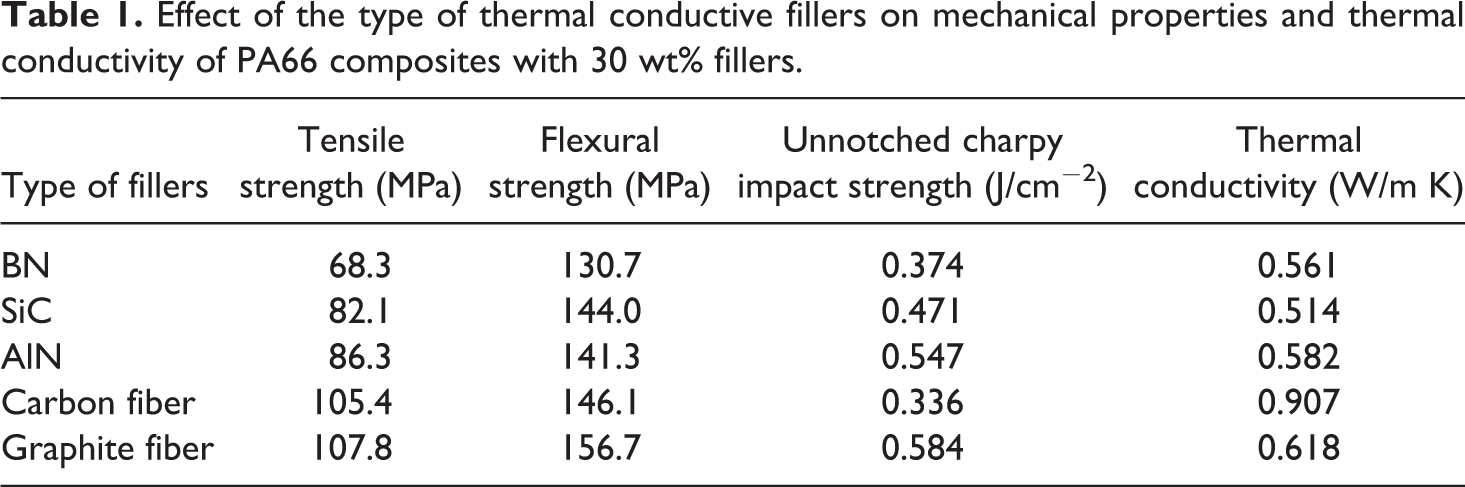
It is well known that the type of thermal conductive fillers has obvious impact on thermal conductive property of PA66 composites. The type of the thermal conductive fillers used in this study is listed in Table 1, in which the carbon fiber/PA66 composite has the best thermal conductive property among these PA66 composites with 30 wt% filler. Moreover, carbon fiber/PA66 composite has excellent mechanical properties. Therefore, the carbon fiber was selected as thermal conductive filler in this article.
Effect of the type of thermal conductive fillers on mechanical properties and thermal conductivity of PA66 composites with 30 wt% fillers.
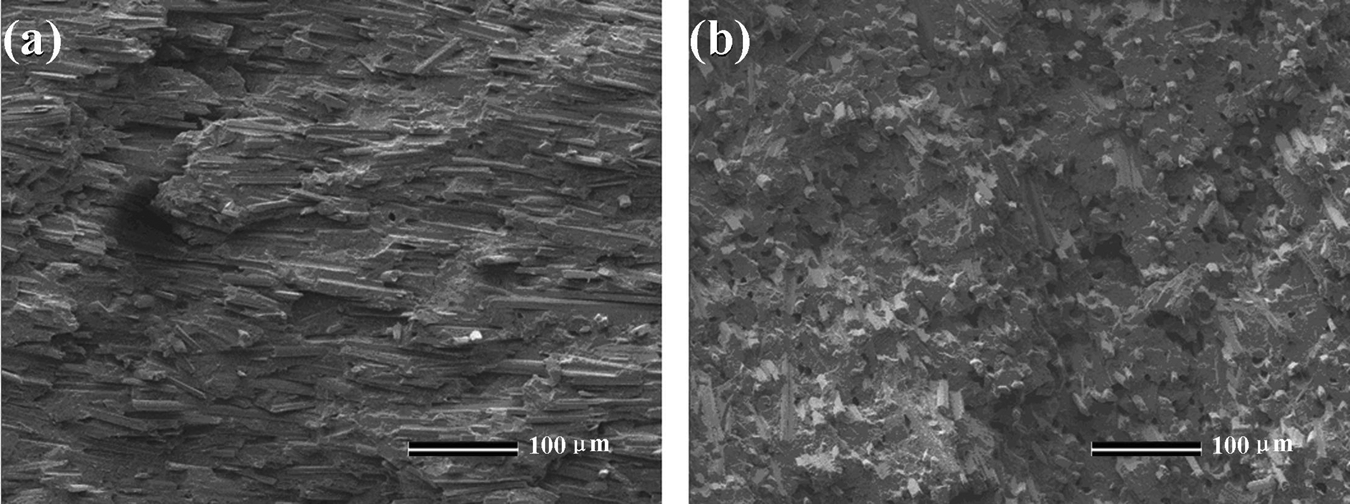
The effect of carbon fiber content and preparation method on thermal conductivity of carbon fiber/PA66 composites are shown in Figure 1. However, carbon fiber/PA66 composites are manufactured by means of EM or SM, and a nonlinear increase in the thermal conductivity of carbon fiber/PA66 composites is observed with the increase in the carbon fiber content. The thermal conductivity of carbon fiber/PA66 composites prepared by EM increases from the value of 0.33 W/m·K for neat PA66 to a value of 1.307 W/m·K with 27% of carbon fiber by volume. Meanwhile, the thermal conductivity of carbon fiber/PA66 composites prepared by SM is higher than that of carbon fiber/PA66 composites prepared by EM for varying carbon fiber content. The thermal conductivity of carbon fiber/PA66 composites prepared by SM achieves the maximum value of 2.537 W/m·K at the same content of carbon fiber, which is eight times more than that of pure PA66. This is because the different preparation method may form different dispersing states of carbon fibers in the PA66 matrix and change the compatibility between carbon fibers and PA66 matrix. As seen in Figure 2(a), the carbon fiber surface is relatively smooth, and there are some traces in the matrix for as much as the carbon fibers are removed in the process of brittle failure. This indicates that the carbon fibers are weakly bonded to the PA66 matrix in the composites prepared by EM. However, the weak bonding can produce gaps between carbon fibers and PA66 matrix, which goes against forming the conductive chains in composites. There are few traces in the matrix shown in Figure 2(b), which implies the carbon fibers are strongly bonded to the PA66 matrix in the composites prepared by SM. From Figure 3, a very thin polymer film remains on the fiber surface, which further proves the SM can improve the compatibility between carbon fibers and PA66 matrix and become propitious to form the conductive chains.
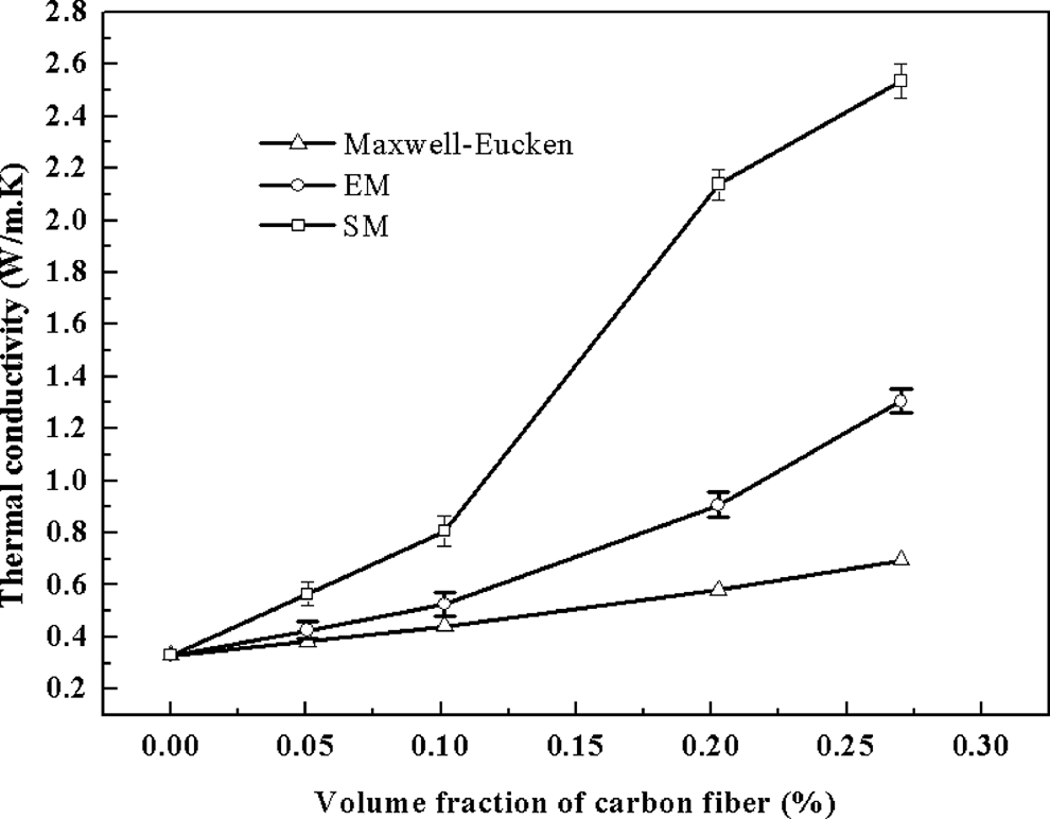
Comparison of experimental and predicted thermal conductivity of carbon fiber/PA66 composites. PA66: polyamide 66.
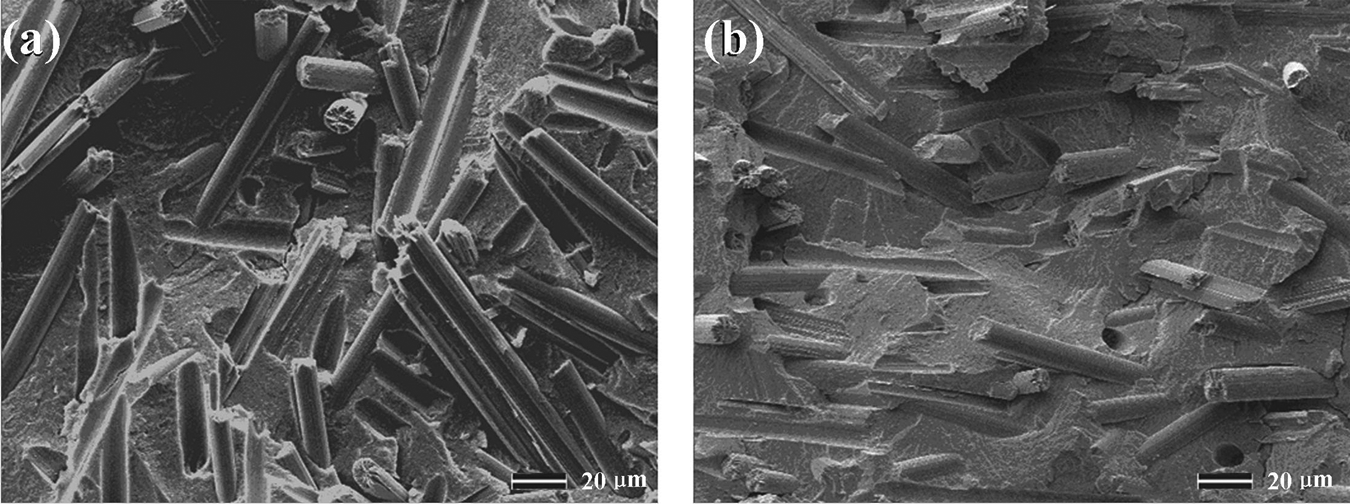
SEM micrographs of carbon fiber/PA66 composites prepared by different method. (a) EM and (b) SM. PA66: polyamide 66; SEM: scanning electron microscope; EM: extrusion method; SM: solution method.
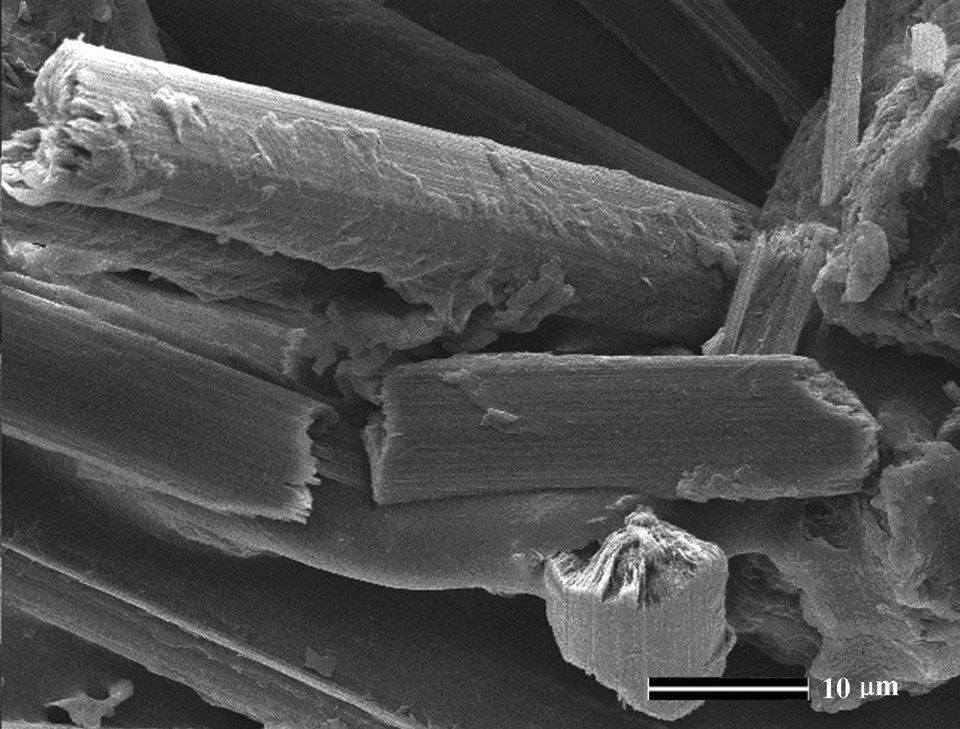
SEM micrographs of carbon fiber/PA66 powders prepared by SM. PA66: polyamide 66; SEM: scanning electron microscope; SM: solution method.
At the same time, Maxwell-Eucken model
15
is used to evaluate the thermal conductivity of the carbon/PA66 composites.
where λ, λp , and λf are the thermal conductivity of composites, polymer, and filler, respectively. Vf is the volume fraction of filler. From the Figure 1, it is shown that the experimental data do not agree with the Maxwell-Eucken model well, and the experimental data were always higher than those predicted. It is probably that the model assumes that the shape of filler is sphere and confined to common dispersion state in the polymer matrix. However, the carbon fiber has cylindrical structure and the special dispersion state of filler formed here obviously exceeds the presuming limits of the model, which lead to improving the thermal conductivity of carbon fiber/PA66 composites.
The model of Agari
15,16
is applied to investigating the effect of dispersion state by introducing two factors C
1 and C
2:
where λ, λp , and λf are the thermal conductivity of composites, polymer, and filler, respectively. Vf is the volume fraction of filler. C 1 is a factor relating to the structure of polymer, such as crystallinity of matrix, and C 2 is a factor relating to the measure of ease for the formation of conductive chains of filler. According to Agari model, the values of C 1 and C 2 should be between 0 and 1; the closer the C 2 values are to 1, the more easily conductive chains are formed in composites. So, if the dispersion state of filler is different, the thermal conductivity of composites may be different even if the composites are the same. 9 By fitting the experimental data of the thermal conductivity of the carbon fiber/PA66 composites system into the model, C 1 and C 2 for the above two systems, a possible explanation of the dispersion state of filler in composites could be obtained as listed in Table 2.
C 1 and C 2 of Agari model for carbon fiber/PA66 composites prepared by different method.
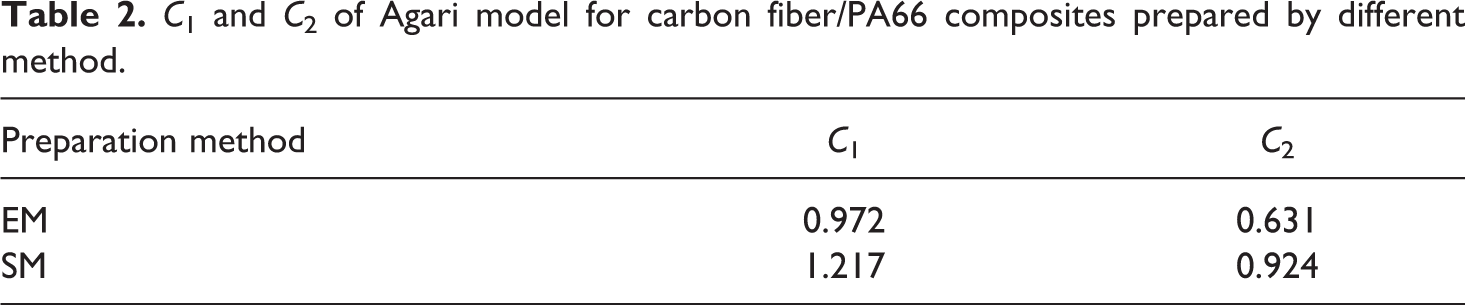
From Table 2, it is observed that the different preparation method can affect the values of C 1 and C 2. The value of C 2 in carbon/PA66 composites prepared by SM is very close to 1, which indicates that it is more easily forms the conductive chains in composites than the composites prepared by EM. Meanwhile, the different preparation method could have influence on the structure of the composites, which impacts the values of C 2.
In process of injection, the orientation of carbon fibers exists in the different injection direction as shown in Figure 4, which plays an important role in the thermal conductivity of carbon/PA66 composites. In this study, parallel and perpendicularity orientations of carbon fibers are obtained by different injection mold. Figure 5 shows the carbon fiber distribution in the sample using thermal conductive measurement. The effect of orientation of carbon fibers on thermal conductivity of composites is listed in Table 3. The thermal conductivity of carbon fibers’ perpendicularity improved by 29.3% compared with that of parallel carbon fibers. It is probably that carbon fibers plumbing circle panel of samples more easily form the conductive chains than the carbon fibers paralleling circle panel of samples Moreover, the number of carbon fibers that are composed of the conductive chains is at least when carbon fibers plumbed circle panel of samples, which decreases the probability that the heat is transmitted by surface contact of carbon fibers. So the way that carbon fibers plumb circle panel of samples can effectively improve the thermal conductivity of composites.
SEM micrographs of the orientation of carbon fibers in carbon fiber/PA66 composites. (a) The orientation of carbon fibers parallels injection direction. (b) The orientation of carbon fibers plumbs injection direction. PA66: polyamide 66; SEM: scanning electron microscope.
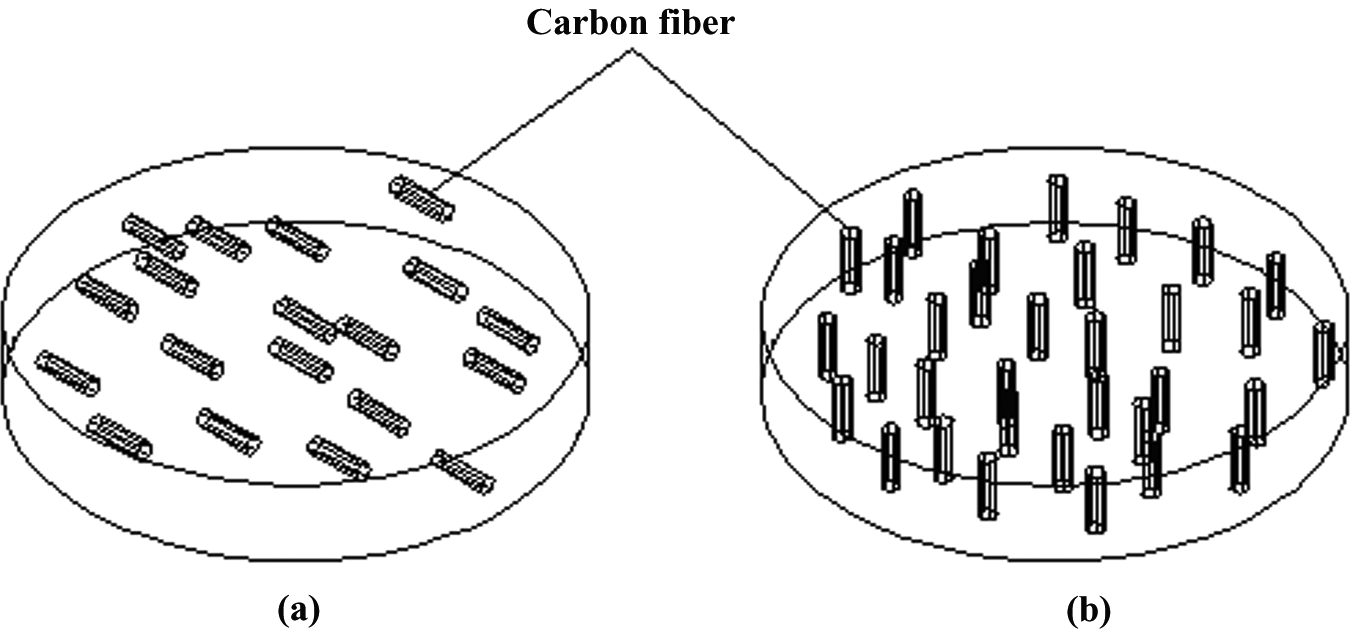
Distribution of carbon fibers in sample using thermal conductive measurement. (a) Carbon fibers’ parallel circle panel (//). (b) Carbon fibers’ plumb circle panel (⊥).
The effect of carbon fibers’ orientation on thermal conductivity of carbon fiber/PA66 composites with 40 wt% carbon fiber.

The thermal resistance of the composites is a major requirement for electronics products. Figure 6 shows that the effect of content of carbon fiber on thermal resistance of fiber/PA66 composites. With the content of carbon fibers increasing, the thermal resistance of fiber/PA66 composites declines. Moreover, the thermal resistance of fiber/PA66 composites with 27 vol% carbon fiber prepared by SM reaches the minimum value of 0.39 m2 K/W, proving that the composites have excellent radiation.
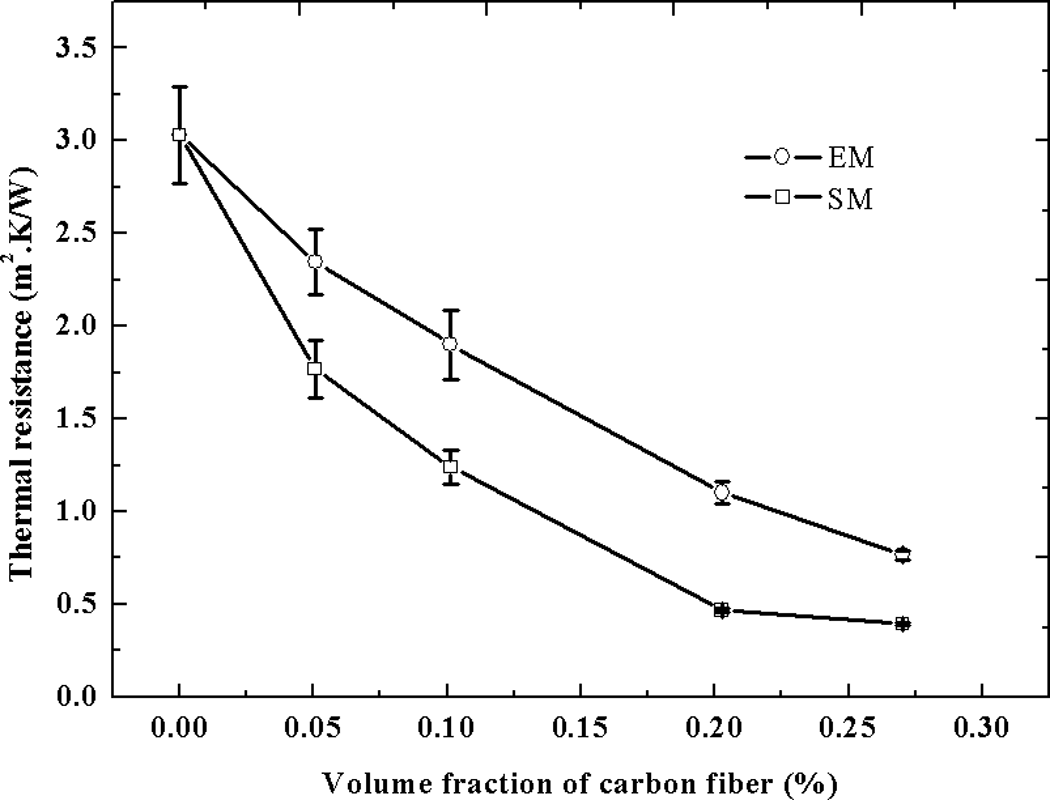
Curves of the thermal resistance versus the content of carbon fibers for carbon fiber/PA66 composites. PA66: polyamide 66.
HDT is another important thermal property from the view of practical application. Therefore, the HDT of pure PA 66 and carbon fiber/PA66 composites was examined. As seen in Figure 7, carbon fiber has obvious effect on the HDT of carbon fiber/PA66 composites. The HDT of composites increases with the increase in the carbon fiber content. The HDT of carbon fiber/PA66 composite is beyond 250°C as the carbon fiber content reaches 40 wt%. Moreover, there are almost no changes in HDT of composites prepared by EM or SM. It is probably that the addition of carbon fiber can improve the crystallinity of PA66, which results in the enhancement of HDT. Thus, the carbon fiber/PA66 composites are suitable to use in the thermal conductive field at high-temperature condition.
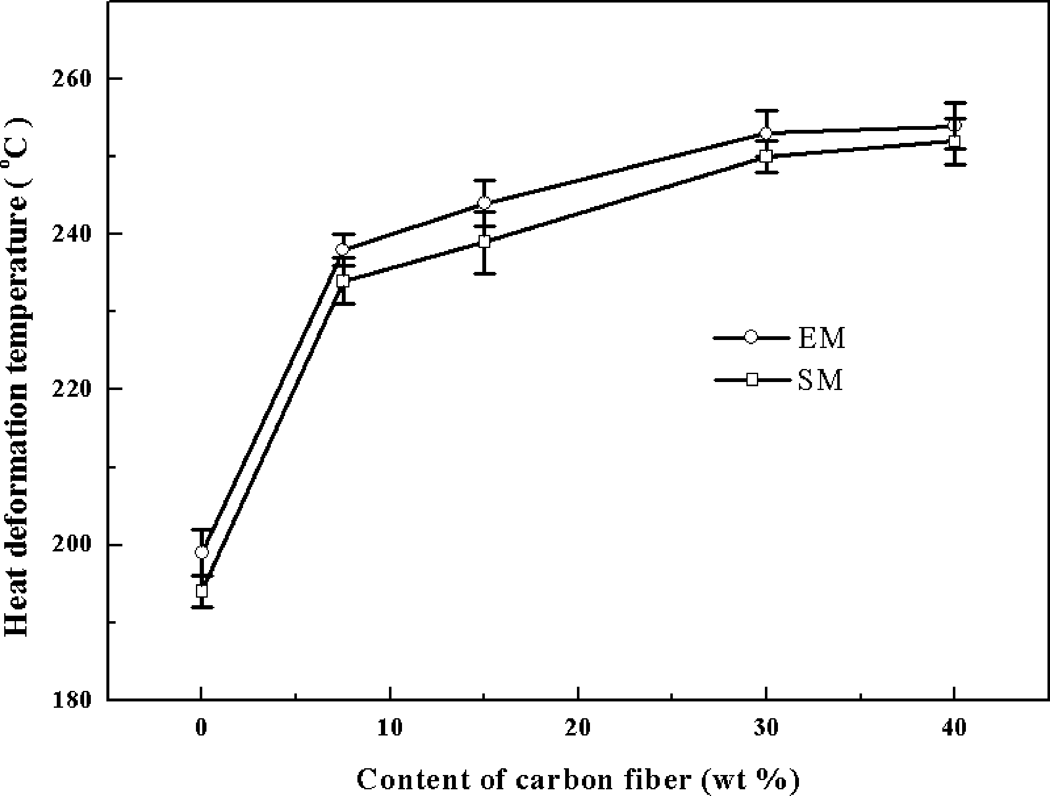
Curves of the HDT versus the content of carbon fibers for carbon fiber/PA66 composites. PA66: polyamide 66; HDT: heat deformation temperature.
Mechanical properties
The curves of mechanical properties versus the content of carbon fibers for carbon fiber/PA66 composites prepared by different method are shown in Figure 8. The tensile strength and flexural strength of carbon fiber/PA66 composites manufactured by EM increases from 67.9 MPa to 116.9 MPa, and from 90.5 MPa to 156.7 MPa as the content of carbon fiber increases from 0 to 40 wt%, respectively. However, the impact strength of composites decreases with the growth of carbon fiber. This implies that carbon fibers have a better reinforcing effect. The mechanical properties of carbon fiber/PA66 composites manufactured by SM have the same trend. In the SM, the dissolvent can affect the mechanical properties of PA66 matrix, which causes the decline in mechanical properties of carbon fiber/PA66 composites prepared by SM. However, the tensile strength and flexural strength of carbon fiber/PA66 composites with 40 wt% carbon fiber content prepared by SM can achieve 73.1 MPa and 93.1 MPa, respectively. Thus, carbon fiber/PA66 composites prepared by SM are still suitable to use in widespread applications.
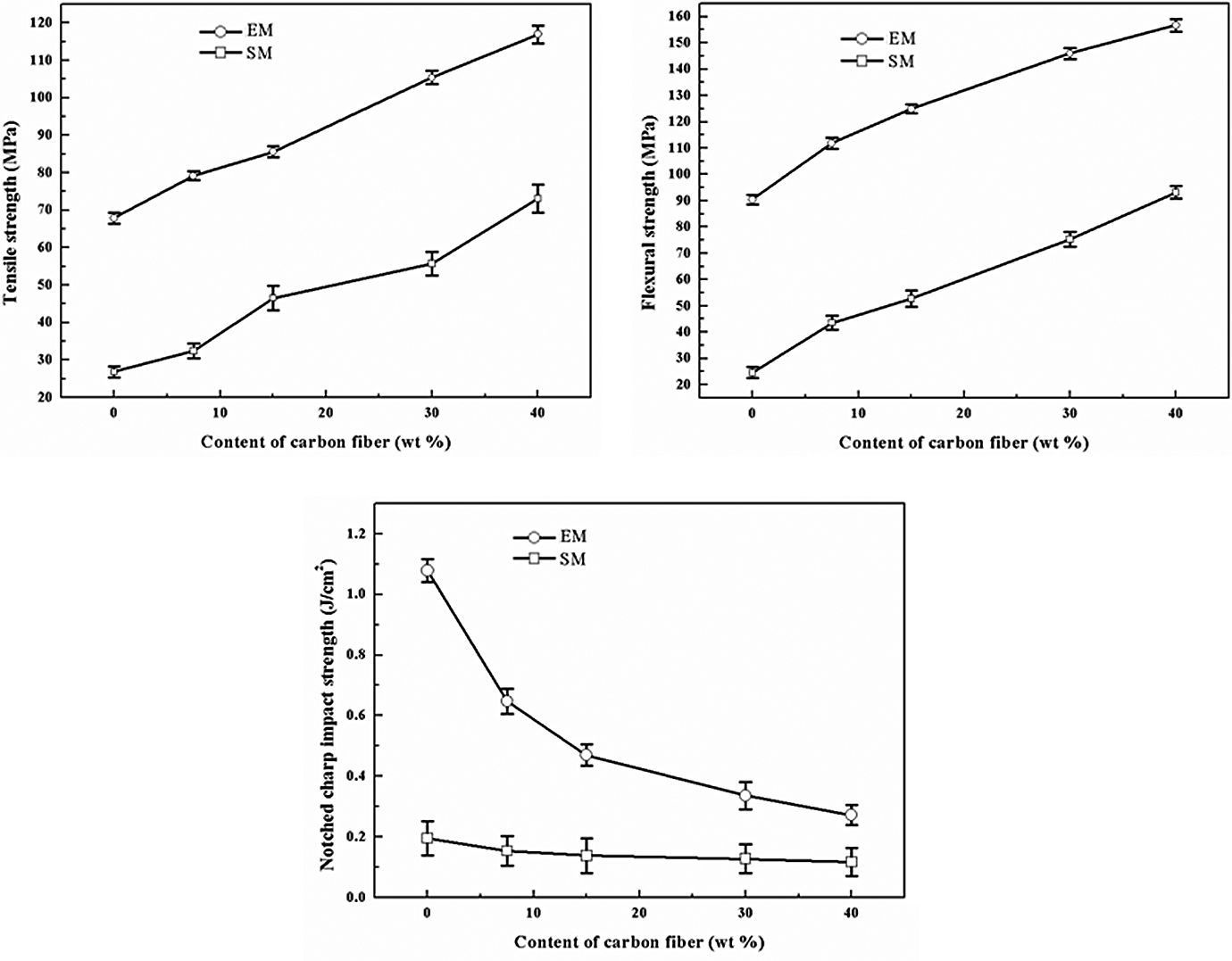
Curves of the mechanical properties versus the content of carbon fibers for carbon fiber/PA66 composites prepared by different method. PA66: polyamide 66.
Electric properties
Figure 9 shows that curve of the surface and volume resistivity versus the content of carbon fibers for carbon fiber/PA66 composites prepared by EM. It is well known that carbon fiber is a material of electric conduction, so the addition of carbon fiber should have an influence on electric properties of carbon fiber/PA66 composites. As a matter of fact, it is found that with the content of carbon fiber increasing, the surface resistivity and volume resistivity of carbon fiber/PA66 composites decrease (Figure 9). The surface resistivity and volume resistivity of carbon fiber/PA66 composites with 40 wt% carbon fiber reach 104 and 105, respectively, both diminish about 10 order of magnitude compared to the pure PA66 matrix. Moreover, Figure 10 shows that curves of the electrical conductivity versus the content of carbon fibers for carbon fiber/PA66 composites. The electrical conductivity of carbon fiber/PA66 composites increases from the value of 5.71 × 10⁻¹⁷ S/cm for neat PA66 to value of 3.88 × 10⁻⁶ S/cm with 27 vol%. This is because the electric conduction of carbon fiber is the best compared to that of PA66, and according to the rules of mixture, the electric conduction of composites is to be exhibited between the filler and the polymer matrix. Meanwhile, conduction in polymers with dispersed conductive particles is a matter of percolation and the formation of a conductive network of particles. With the growth of the content of carbon fiber, the conductive network density of composites increased. So this directly proves that the carbon fiber/PA66 composites not only possess high thermal conductive property but also have good electric conduction.
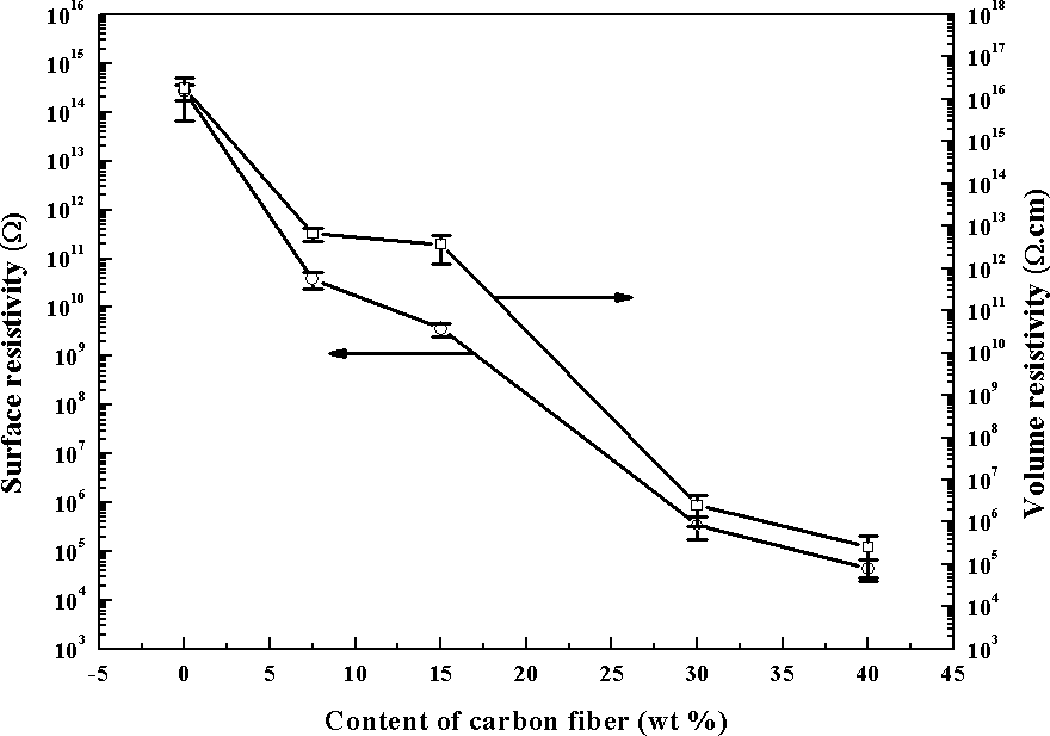
Curves of the surface and volume resistivity versus the content of carbon fibers for carbon fiber/PA66 composites prepared by EM. PA66: polyamide 66; EM: extrusion method.
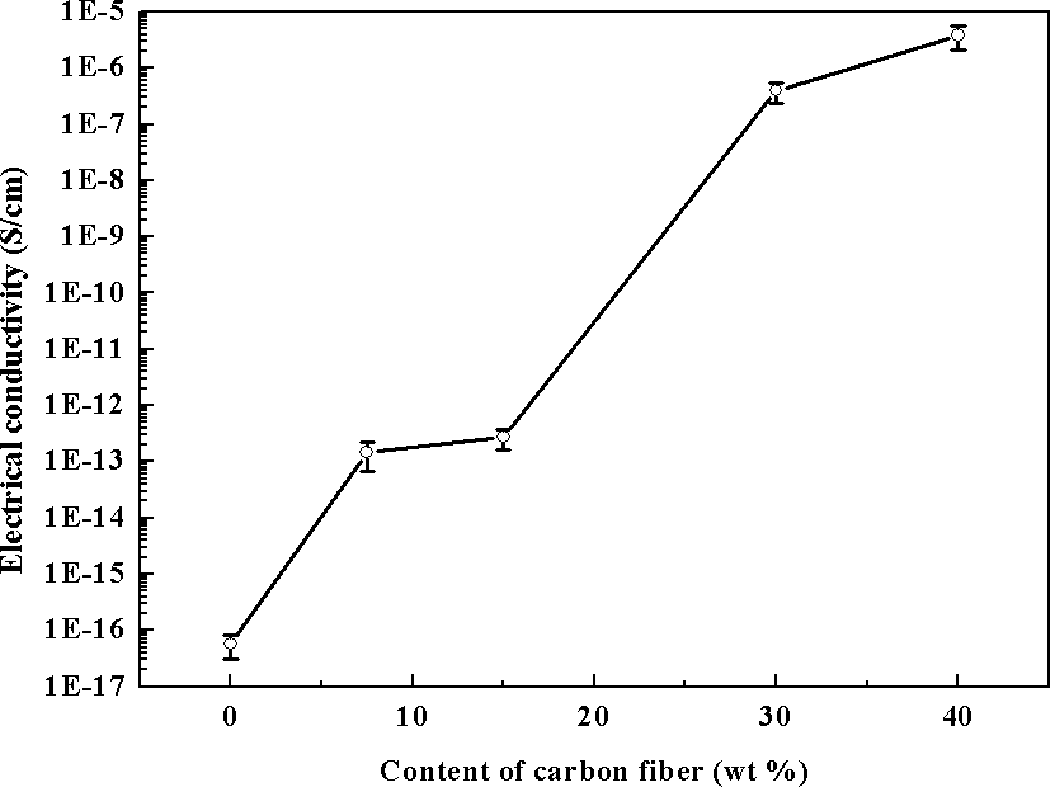
Curves of the electrical conductivity versus the content of carbon fibers for carbon fiber/PA66 composites. PA66: polyamide 66.
Dielectric constant is an important electric index of materials. Figure 11 shows curve of the dielectric constant versus the content of carbon fibers for carbon fiber/PA66 composites prepared by EM. As shown in Figure 11, the dielectric constant of carbon fiber/PA66 composites does not change compared with pure PA66, when the carbon fiber content is below 7.5 wt%; but the dielectric constant of composites increases with the growth of content of carbon fiber as the carbon fiber is above 7.5 wt%. The dielectric constant of composite with 40 wt% carbon fiber reaches 5.05 at a frequency of 107 Hz, which improved by 66.1% compared with pure PA66. This further proves that carbon fiber/PA66 composites have good electric conduction.
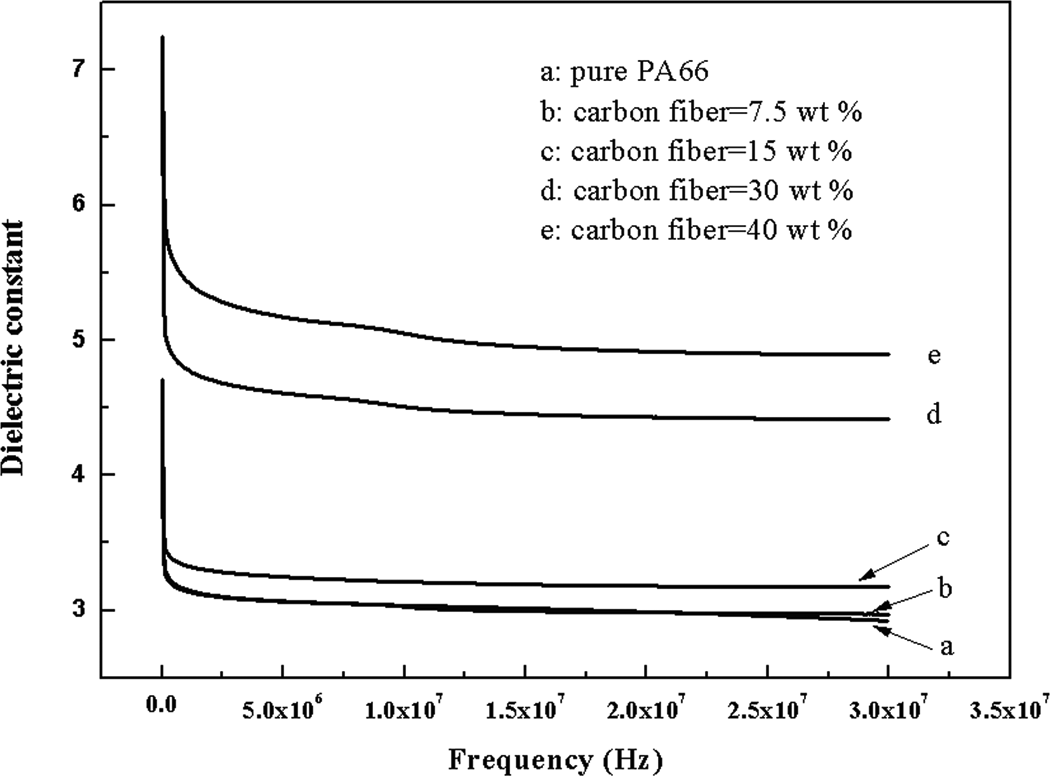
Curves of the dielectric constant versus the content of carbon fibers for carbon fiber/PA66 composites prepared by EM. PA66: polyamide 66; EM: extrusion method.
Conclusion
A series of the thermal conductive nylon 66 (PA66) composites were prepared by two methods, including EM and SM. The thermal conductivity, mechanical properties, thermal stability, and electric property of PA66 composites were investigated. The carbon fiber/PA66 composites possess excellent thermal and electric conductive properties as well as good mechanical properties. The maximum value of thermal conductivity of carbon fiber/PA66 composites prepared by SM achieves 2.537 W/m·K, which is superior to that of carbon fiber/PA66 composites prepared by EM at the same carbon fiber content. Examining the parameters of the Agari model indicates that carbon fiber/PA66 composites prepared by SM can more easily form the conductive chains. The orientation of carbon fiber in the process of injection has an influence on thermal conductivity of carbon fiber/PA66 composites, and the perpendicular distribution of carbon fibers improves the thermal conductivity of composites. The carbon fiber–reinforced PA66 composites have excellent heat durability. Despite the fact that the mechanical properties of carbon fiber/PA66 composites prepared by SM are lower than those of carbon fiber/PA66 composites prepared by EM, the mechanical properties of carbon fiber/PA66 composite with 40 wt% carbon fiber prepared by SM still maintain good practicality. With the exception of the thermal conductivity, the carbon fiber/PA66 composites have excellent electric properties. With the addition of carbon fiber, the surface and volume resistivity of composites rapidly decline but the dielectric constant of composites increases.
Footnotes
Funding
We acknowledge financial supports from Director Foundation of Institute of Chemical Materials (Grant number: 626010940), National Natural Science Foundation of China (Grant number: 51073143) and Science and Technology Development Foundation of China Academy of Engineering Physics (Grant number: 2010B0302037).