




Abstract
The effects of polytetrafluoroethylene (PTFE) on the tensile and tribological properties of carbon fiber–reinforced poly(methyl methacrylate) (PMMA) composites were studied. Tribological tests were conducted on an Amsler friction and wear tester using a block-on-ring arrangement. It was observed that the PTFE played a main role in the tensile-resistant and wear-resistant properties of the PMMA composites. The tensile properties were ruled by the fiber–matrix adhesion. And the excellent tribological performance of the PTFE fillers improved the tribological properties of PMMA composites.
Introduction
The development of many fields of technology is conditioned by the acquisition of materials, which fulfill different demands. Therefore, a great interest in new composite materials has been observed for a number of years. One of the composite application areas is elements of machines, which are working in tribological connection conditions. 1 –3
The excellent friction and wear properties of fabric composites have drawn more and more attentions these years. It was reported that inorganic fabrics (such as glass fabric and carbon fabric) could enhance the wear resistance of various matrices significantly. The reinforcing mechanism of polymeric fabrics is different from that of inorganic fabrics, since inorganic fabrics are liable to brittle fracture, while polymeric fabrics show ductile characteristic during the sliding process. However, the investigations on friction and wear properties of polymeric fabric-reinforced composites mainly focused on two-phase fabrics, 4 –6 and three-phase fabrics have not been well studied.
Transfer film is very important to some polymer component, especially those designed to be used under dry friction condition. Generally, transfer film formed during the friction process could effectively improve tribological condition of polymer, which means lower friction coefficient and remarkably reduced wear of material. For example, as a kind of very important tribological material, application of polytetrafluoroethylene (PTFE)-based composite is just as this situation. 7,8
Poly(methyl methacrylate) (PMMA) is one of the most commonly used thermoplastic polymers. PMMA has several desirable properties, including exceptional optical clarity, biocompatibility, good weatherability, high strength, and excellent dimensional stability. It can also be processed at the micro- and nanoscale by lithography (deep UV and electron beam) and replication technologies (injection molding and hot embossing) and has applications in microoptical and microfluidic devices. 9 –11
In this study, carbon fiber (CF) and PTFE were adopted to modify PMMA, and an extensive investigation of the effect of PTFE on friction and wear performance of CF/PMMA composite was carried out.
Experimental
Materials and the preparation process
Poly(methyl methacrylate) (MW: 996,000, Aldrich, St Louis, Missouri, USA) was chosen as the matrix material. The composite based on PMMA powders with 5% volume fraction of PTFE and 20 vol% CF were investigated.
PMMA and PTFE were dried at 80°C prior to blending for 5 h to remove all the moisture. PMMA, CF, and PTFE were blended in a Haake twin-screw (TWIN SCREW, Taiwan) extruder at a screw speed of 60 r/min and a temperature profile ranging from 160°C near the hopper to 200°C at the die exit. The extrudate was then continuously cooled in a water bath and then pelletized.
Tensile tests
Tensile properties were measured on an Instron-1195 universal materials test machine equipped with a 10-kN load cell at a constant speed of 5 mm/min according to GB/T 1447. The specimen had a width of 10 mm and a thickness of 3 mm. The distance between the grips was fixed at 25 mm. Tensile strength and modulus were obtained. All tensile tests were performed at room temperature on at least five specimens, and the average values were reported.
Friction and wear test
The friction and wear tests were conducted on an Amsler friction and wear tester using a block-on-ring arrangement. The dimension of the block specimens was 30 mm × 7 mm × 6 mm and the working face was 30 mm × 7 mm. A plain carbon steel ring (HRC50) with a dimension of R40 mm × r16 mm × 10 mm was used as the counterpart, the surface roughness of which was Ra = 0.8 μm, which was determined by a surface roughness tester.
Results and discussions
Tensile properties
Table 1 shows the effect of PTFE on the tensile properties of CF/PMMA/PTFE composites. It can be seen that the incorporation of PTFE into CF/PMMA composite significantly increased its tensile modulus. The improvement in stiffness may be caused by the reinforcement effect of the rigid inorganic CF and the constraining effect of PTFE layers on molecular motion of polymer molecular chains. The higher tensile strength of CF/PMMA composite may be due to the good dispersion of PTFE in the CF/PMMA composite. The better exfoliated structure in the CF/PMMA composite is believed to be responsible for the higher tensile strength.
The tensile properties of the CF-reinforced PMMA composites.
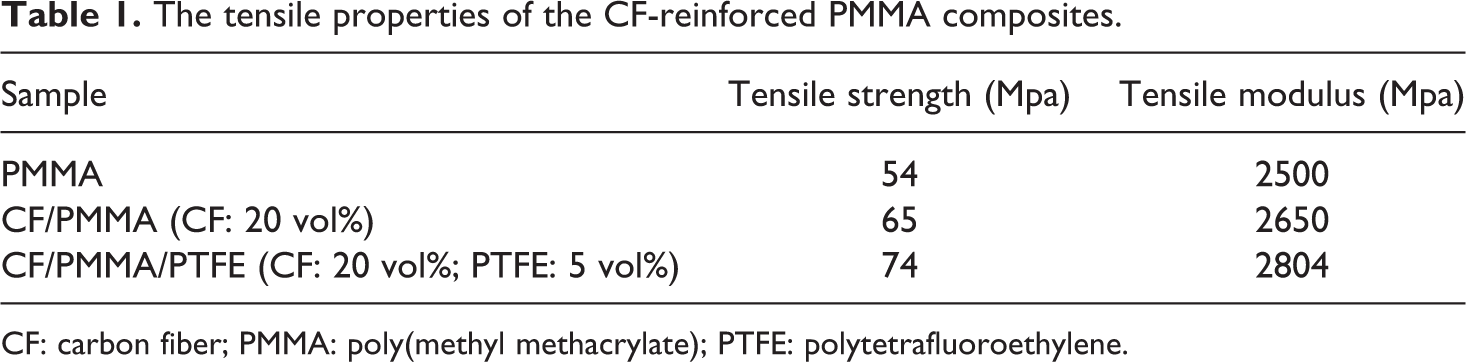
CF: carbon fiber; PMMA: poly(methyl methacrylate); PTFE: polytetrafluoroethylene.
Tribological behavior of PMMA composites
Figures 1 and 2 show the data of coefficient of friction and wear of the composites with the change in loads. In the process of friction test, the matrix in the composites was dragged out by the metal block. The CF in the composites appeared gradually and shared partial pressure, and the actual area of contact decreased. So, the coefficient of friction of the composite was reduced with the addition of CF. It will be explained further in analysis of worn mechanism of the composite according to scanning electron microscope (SEM) photos.
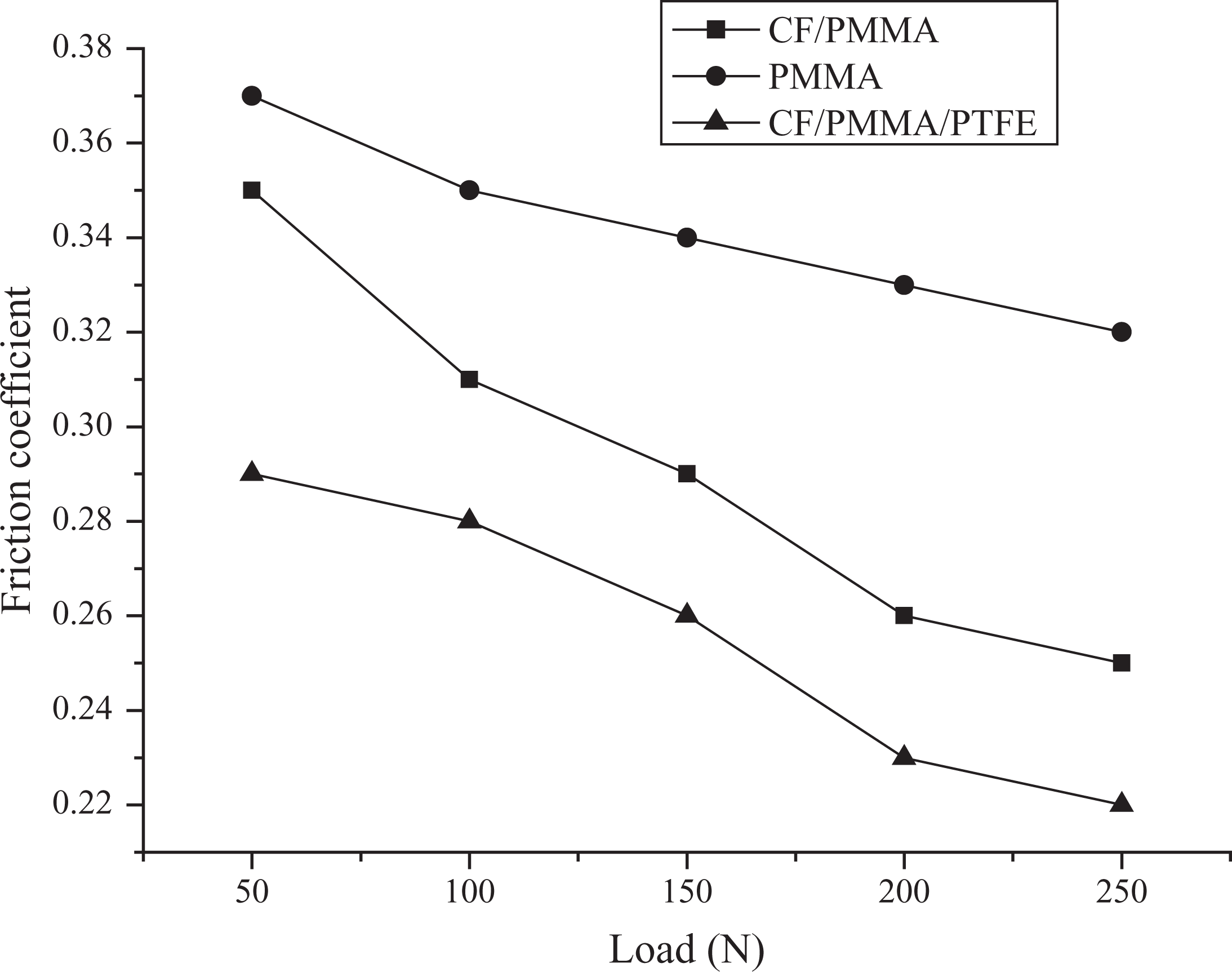
The friction coefficient of the CF/PMMA/PTFE composites. CF: carbon fiber; PMMA: poly(methyl methacrylate); PTFE: polytetrafluoroethylene.
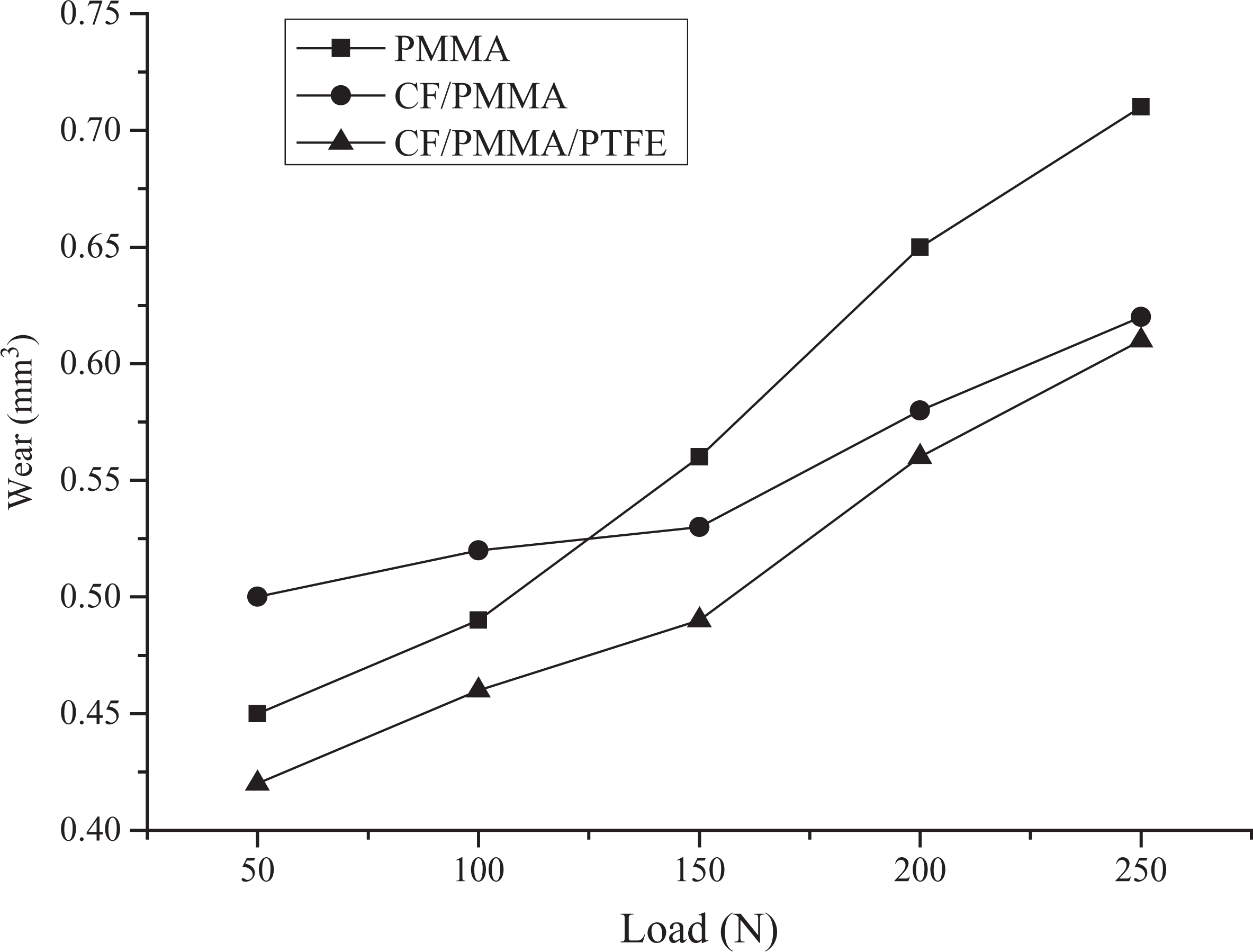
The wear of the CF/PMMA/PTFE composites. CF: carbon fiber; PMMA: poly(methyl methacrylate); PTFE: polytetrafluoroethylene.
The analysis of the achieved results showed that the addition of PTFE had an advantageous influence on friction and wear properties. The friction coefficient values for composites with PTFE were lower than that without. The composite with PTFE filler proved the highest compactibility.
It is now fully recognized that tribological behavior of polymer sliding against metal is strongly influenced by its transfer film–forming ability on the counterface. Therefore, the transfer film is a very important researching point of polymeric tribological material. Much attention has been paid to the mechanism, interior structure, and stability of the transfer film. The presence of PTFE in the composite matrix highly influences the third body morphology and generates adhesive friction, and friction coefficient and wear decrease spontaneously.
So, friction composites made of CFs and PTFE have the advantage to present lower friction coefficient than CF/PMMA composite. Moreover, PTFE decreases the transition temperature. This could be improved by increasing PTFE dispersion in the matrix.
With the increasing load, the coefficient of friction and wear rate of the composites increased. It can be illustrated by the increasing area of contact between the metal counterpart and the composites that induced higher flash temperature, heat generation, and the viscous–elastic property in the response to material stress, adhesion and transferring behaviors were influenced. Hence, the coefficient of friction and wear rate increased with the increased applied load.
As the load increased, the CF on surface of the composite was crushed easily under the higher load, and stripped gradually. The wear increased dramatically. While for the CF/PMMA composite filled with PTFE, the CF in the composites revealed earlier in the friction process, and it was not pulled out easily due to the excellent interfacial properties.
Figure 3 shows the SEM of the worn surfaces of PMMA composites. The worn surface of PMMA is rough (Figure 3(a)). The worn surface of the CF/PMMA composites is characterized by some furrows (Figure 3(b)). While the worn surfaces of the composites filled with PTFE are quite smooth, the PMMA matrix combines with the CF well, as shown in Figure 3(c). This reveals that the interfacial adhesion between CF and PMMA matrix is good. As a result, the friction coefficient and the wear of the composites are relatively low. PTFE improved the interfacial adhesion between CF and PMMA matrix. The worn surface does not show plastic deformation and adherence. While the worn surface of the counterpart varies greatly due to the incorporation of PTFE. As shown in Figure 4(b), the surface in contact with CF/PMMA/PTFE is a layer of thin film and the surface in contact with CF/PMMA is easy to be peeled off (Figure 4(a)).
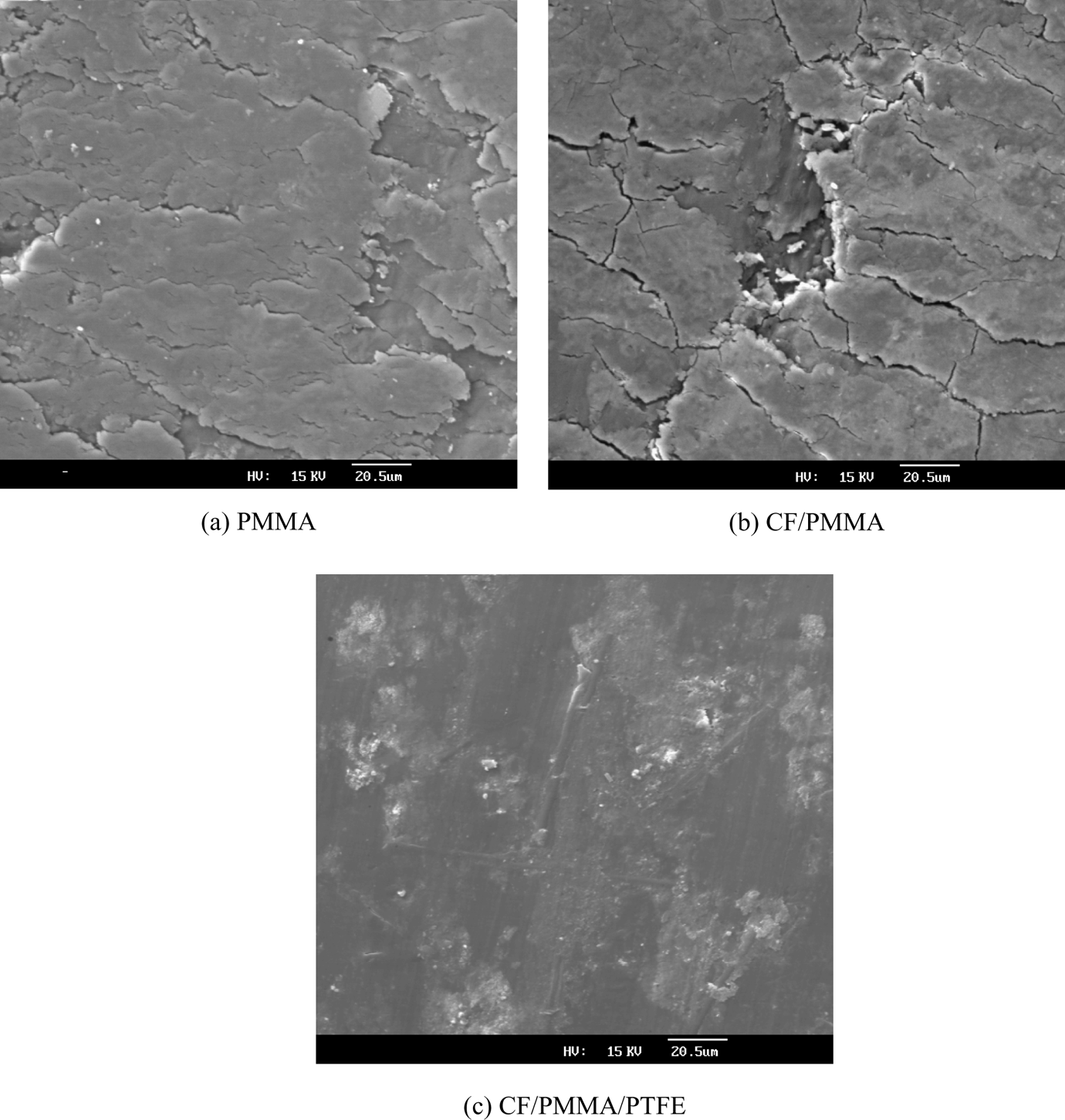
Scanning electron microscopy photographs of worn surfaces of PMMA composites. PMMA: poly(methyl methacrylate).
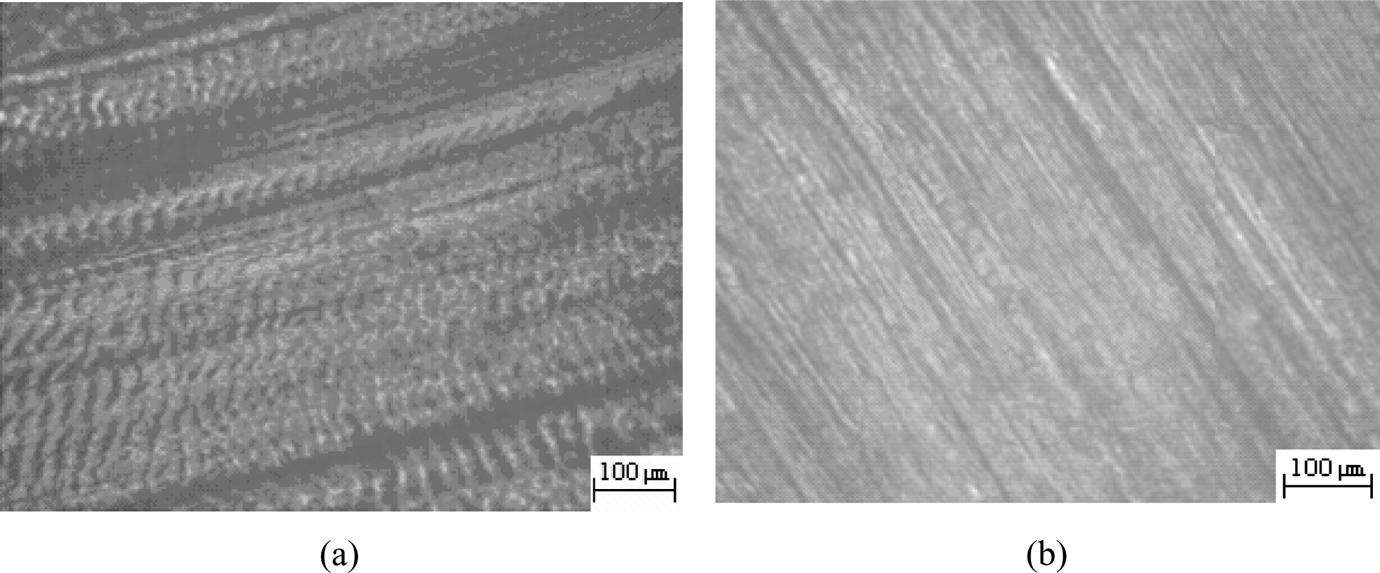
Scanning electron microscopy photographs of the counterpart.
Conclusions
The tensile properties of PMMA composite increased with the addition of CF. The addition of PTFE further improves the tensile properties of CF/PMMA composite.
The coefficients of friction of PMMA and its composites decrease with increasing load. The coefficient of friction of CF/PMMA composite is slightly less than that of PMMA. When PTFE was added to CF/PMMA composite, the coefficient of friction was lowered further. And the wear of CF/PMMA is more than that of CF/PMMA/PTFE. The transfer film is a very important researching point of polymeric tribological material.
Footnotes
Funding
This work was financially supported by the Education Department Foundation of Yunnan Province (2012Y541), and Analysis and Test Foundation of Kunming University of Science & Technology (20130575), and the National Natural Science Foundation (51165013).