



Abstract
The interlaminar shear strength (ILSS) of polytetrafluoroethylene (PTFE) fiber-reinforced polymethyl methacrylate (PMMA) composites enhanced by filled silicon dioxide (SiO2) is studied. The PMMA blends were prepared by combining the techniques of high-speed mechanical stirring. Experimental results showed that ILSS and impact properties of PMMA composites were improved. The largest improvement in ILSS and impact strength were obtained with 7 vol % loading of SiO2. ILSS and impact strength were improved by 15 and 50%, respectively, compared with the composite without SiO2. The fracture and surface morphologies of the composite specimens were characterized using scanning electron microscopy. This PTFE fiber-reinforced composite can be applied to bioengineering and fabrics.
Introduction
In recent years, the use of polymeric composites is becoming more and more important and their products have been reported in applications such as aerospace, medical implant materials, bioengineering, and so on, where traditional fluid lubrication cannot be used. 1 –3 Fiber-reinforced polymers (FRPs) are an area that has been the subject of much academic research and commercial development for many decades, and they have shown improved mechanical properties as well as excellent structural properties. 4,5 The traditional design approach has been to use fibers for strengthening and filler particles for lubrication. There has been some study on carbon nanotubes, carbon fibers, glass fibers, and natural fibers to try and have both strengthening and lubrication from the same fibers. 6 –8
Polytetrafluoroethylene (PTFE) is extensively used in high-performance mechanical seals due to its low friction, low outgassing, high temperature capability, and high chemical inertness, which make it an ideal filler material for a wide variety of applications. 9 Interestingly, PTFE fiber is a fibrillated form of PTFE that has a porous network of PTFE fibrils connected to dense nodes of PTFE. PTFE fiber films can have a variety of densities and shapes, with porosities ranging from 5 to 90%. PTFE fiber provides increased strength to weight ratio and creep resistance compared with fully dense PTFE. Moreover, PTFE fiber also exhibits greater chemical and steam resistance than PTFE films. Although PTFE fiber has many advantageous properties, previous work with PTFE fiber has been limited to coating and woven applications. 10 –12 In this study, PTFE fibers were subjected to silicon dioxide (SiO2) chemical treatment in an attempt to produce high strength and stiff PMMA composites.
Polymethyl methacrylate (PMMA) is one of the most commonly used thermoplastic polymers. PMMA has several desirable properties, including exceptional optical clarity, good weatherability, high strength, biocompatibility, and excellent dimensional stability. 12,13 It can also be processed at the micro- and nanoscale by lithography and replication technologies. Its unique properties, like good mechanical strength, excellent optical transparency, and its ability to get molded in any form, have led to enormous possibilities. 14 In order to enhance the physical and mechanical properties of PMMA, numerical studies on the improvement methods have been extensively carried out in the past three decades. 15 –17
Polymer-based nanocomposites are presently seen as one of the most promising materials in the field of future engineering applications. Some studies have shown that fully and uniformly dispersing nanoparticles in the polymer matrix can markedly improve the properties of materials, such as enhanced mechanical and thermal properties, and improved barrier performance and flame retardancy. 18
In this study, the primary objective was to investigate the effect of adding SiO2 on the mechanical properties of PTFE fiber/PMMA composites. The mechanical properties were studied by means of both ILSS and impact testing. The fracture of the composites was characterized using scanning electron microscopy (SEM).
Experimental
Materials and composite preparation
PTFE fibers were supplied by Fluoron Chemicals Co. Ltd (Shanghai, China) in this work. Unfilled PTFE fibers were prepared through a preloading process followed by sintering. The JF-4TM molding powder was firstly molded at 40 MPa for 15 min with several pressure relaxations (4 s each time). Then, the preloading block was sintered with a temperature control procedure. The details of the PTFE fiber materials are shown in Table 1.
Properties of the PTFE materials.

PTFE: polytetrafluoroethylene.
The PMMA matrix was developed on thermal initiation using a minimal initiator amount, 0.025 g of dibenzoyl peroxide, for 10 g of monomer methyl methacrylate.
The SiO2 with an average of 1 μm was commercially obtained.
Preparation of PMMA composites
PTFE fiber, SiO2, and PMMA powder were weighted in proportions as needed and were mixed completely in a high-speed blender. The mixture was molded into a sample by compression molding under 70 MPa for 6 min. Then, the PMMA composite sample was sintered to 150–200°C and cooled to the room temperature step by step. Finally, the sintered sample was shaped as required.
SBS and impact test
The short beam shear (SBS) test is designed to generate interlaminar shear indirectly through bending and is the most popular method to characterize the apparent interlaminar shear strength (ILSS) of unidirectional, fiber-reinforced composites (ASTM D 2344). The specimen (6.0 × 0.5 × 0.5 cm3) is placed on two cylindrical supports, and the cylindrical head is moved down to apply a force at the center and generate an increasing transverse load until the first failure is recorded. The load at failure is then used to determine the apparent ILSS of the composite.
The impact strength of unnotched specimens (5.0 × 0.6 × 0.4 cm3) was studied on a Charpy tester (Shenzhen Kaliqiang Testing Instruments Co. Ltd, China) according to GB/T1043-93(ISO179). In the tensile and impact tests, five specimens were tested for each sample composition. The results are statistically significant.
Results and discussion
Regarding hybridization, an increase in ILSS was observed for higher hemp fiber fraction. This increase is due to the decrease in strain with increasing PTFE fiber content. These results could be explained by the ineffectiveness of the coupling agent to form ester with PTFE fibers. The variation observed in the properties of PTFE fiber/PMMA composites may therefore be attributed to the behavior of the filler and its compatibility with the plastic material.
The ILSS depends primarily on the matrix properties and the fiber–matrix interfacial strength rather than the fiber properties. Nevertheless, the PTFE fiber composites exhibited improved ILSS, but the difference is small at low PTFE fiber fraction (15:85). Maximum ILSS occurred for the composite at 20 vol%. Thus, for 20% PTFE fiber incorporation, the reinforcement is still effective in enhancing the fiber/matrix stress transfer. The ILSS of the PTFE fiber/PTFE composites is shown in Figure 1. With higher fiber content, an increase in fiber–fiber contact could decrease the interaction between the fiber and matrix. At higher PTFE fiber fraction, agglomeration occurs, thereby decreasing the effective stress transfer between the PTFE fibers and the matrix.
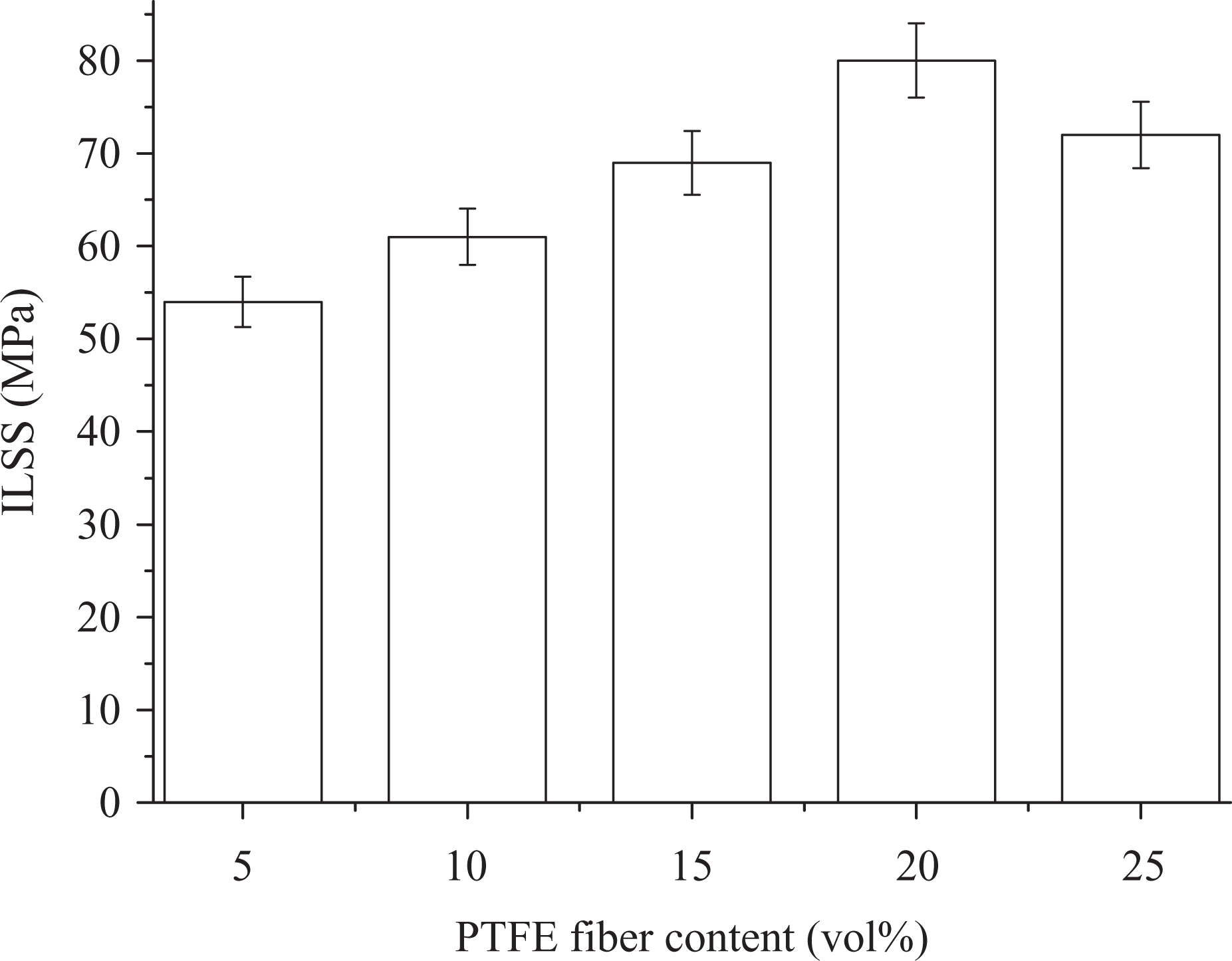
The ILSS of the PTFE fiber/PMMA composites. ILSS: interlaminar shear strength; PTFE: polytetrafluoroethylene; PMMA: polymethyl methacrylate.
To determine the effectiveness of adding SiO2 for enhancing ILSS of hybrid PMMA composites, the overall average for the ILSS of 1–9 vol% SiO2-loaded composites was compared. From the data, it could be found that the ILSS of the composites had a relation with the SiO2 content. The ILSS of the PTFE fiber/PMMA composites with different amounts of SiO2 is illustrated in Figure 2. An increase in the SiO2 concentration increased the ILSS of the hybrid composites. The fracture toughness of the composites increases as the SiO2 content increases from 1 to 7 vol%. The toughening mechanisms operating in the composites are pullout of the fibers and debonding of the matrix and fibers. As a result, both the above two toughening mechanisms were observed in the composites. When the SiO2 content increased, the composites became more densified and the ILSS increased.
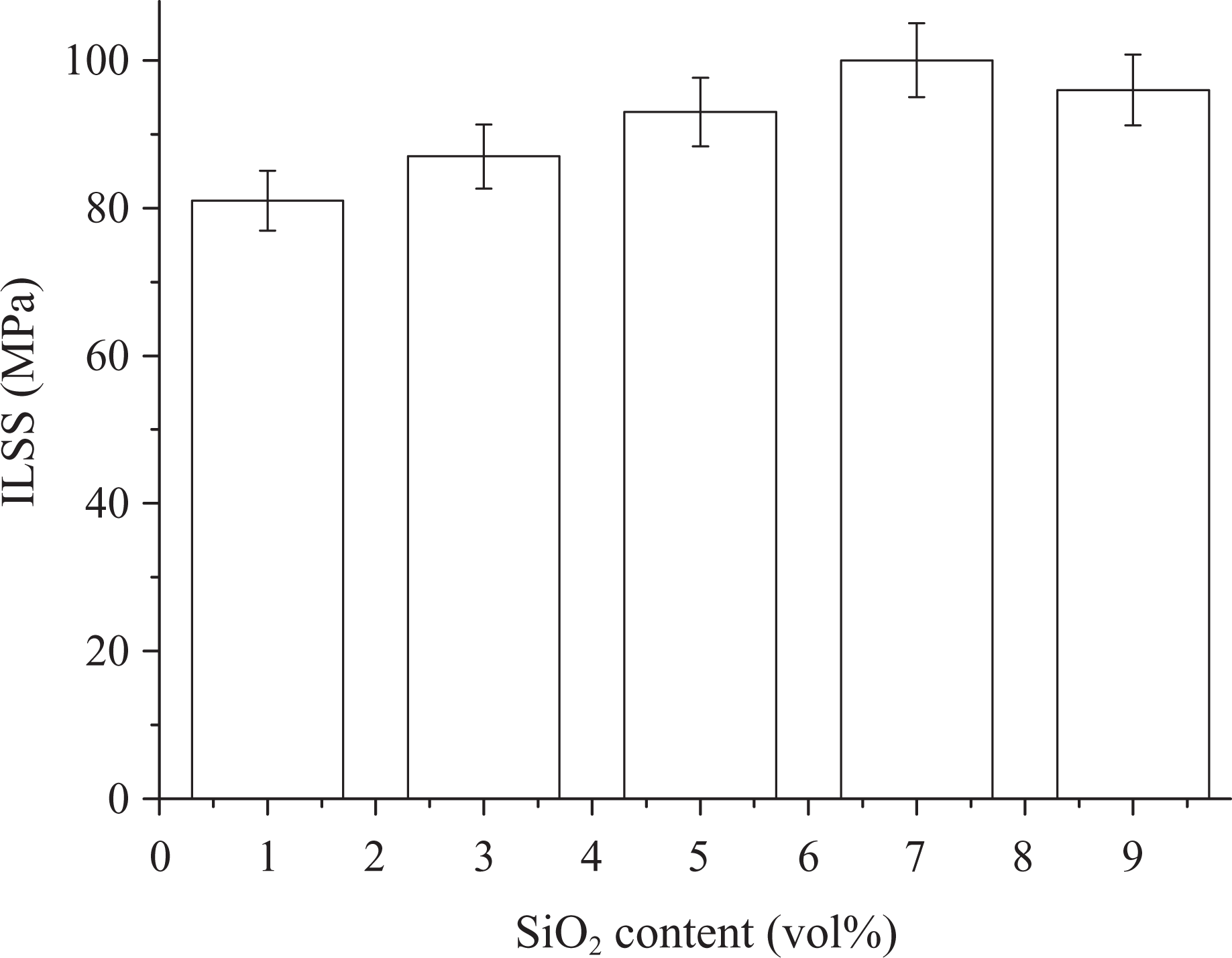
The ILSS of the PTFE fiber/PMMA/SiO2 composites. ILSS: interlaminar shear strength; PTFE: polytetrafluoroethylene; PMMA: polymethyl methacrylate; SiO2: silicon dioxide.
The ILSS of PTFE fiber/PMMA/SiO2 composite became higher when more amount of SiO2 was added, and it showed the maximum at 7 vol% SiO2 loading reached 98 MPa. The addition of nanosized fillers to PTFE matrix caused higher thermal residual stresses on the surface of the fibers, which increased the fiber–matrix interfacial bonding, leading to the improved ILSS. The enhancement of bending strength may result from the good dispersion of SiO2 particles in PMMA matrix and the interfacial adhesion between SiO2 and PMMA; meanwhile, the uniformly dispersed SiO2 particles also promoted the crystallization of PMMA. However, it would lead to a drastic reduction in the blending strength when further increasing the SiO2 content up to 7 vol%. The main reason may also be ascribed to the SiO2 particles agglomeration of high content, which resulted in early failure at the interface and thus deteriorated the mechanical properties, although it could promote the crystallization better than the lower content. Based on the above analysis, it can be concluded that the mechanical properties of PTFE fiber/PMMA/SiO2 composites not only depend on the promotion crystallization behavior of SiO2 acting as nucleate but also have a more close relation with the dispersion of SiO2 in PMMA blends.
Figure 3 shows the impact strength results of the PTFE fiber/PMMA/SiO2 composites. The composites showed higher impact strength than the pure resin, and when PTFE fiber was added to the composite, impact strength significantly increased for all PTFE fractions. Additionally, impact strength increases with increasing overall fiber content except for the pure PMMA composite, possibly due to poor overall quality of the composite and to large fiber-to-fiber contact in which case matrix breakage becomes the predominant failure mechanism.
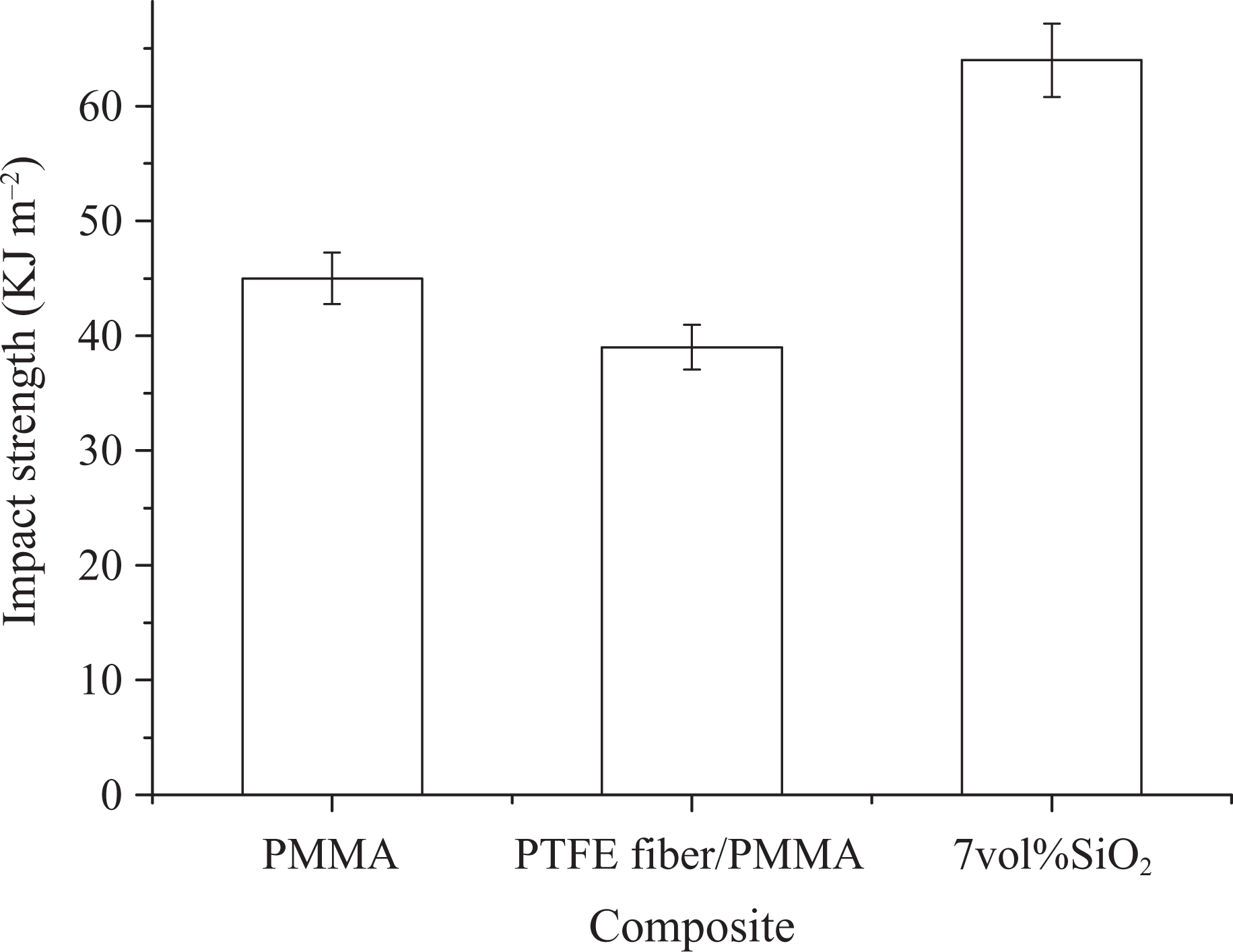
The impact strength of the PTFE fiber/PMMA/SiO2 composites. ILSS: interlaminar shear strength; PTFE: polytetrafluoroethylene; PMMA: polymethyl methacrylate; SiO2: silicon dioxide.
It is known that the dispersion of SiO2 particles in PMMA matrix is essential to determine the mechanical properties, and it is closely related with the addition content, although SiO2 can promote crystallization by acting as an effective heterogeneous nucleating agent, which may also be one of the important factors to improve the mechanical properties of PTFE fiber/PMMA/SiO2 composites. Therefore, the fractured surfaces of the PTFE fiber/PMMA/SiO2 composites with different SiO2 contents had been observed by SEM as shown in Figure 4. It shows the fracture surfaces of the PTFE fiber/PMMA composites with and without SiO2 after the SBS tests. The composite made from the PTFE fiber/PMMA (Figure 4(a)) showed sheared hackle markings in the matrix, which is characteristic of brittle fracture for the PMMA composites.
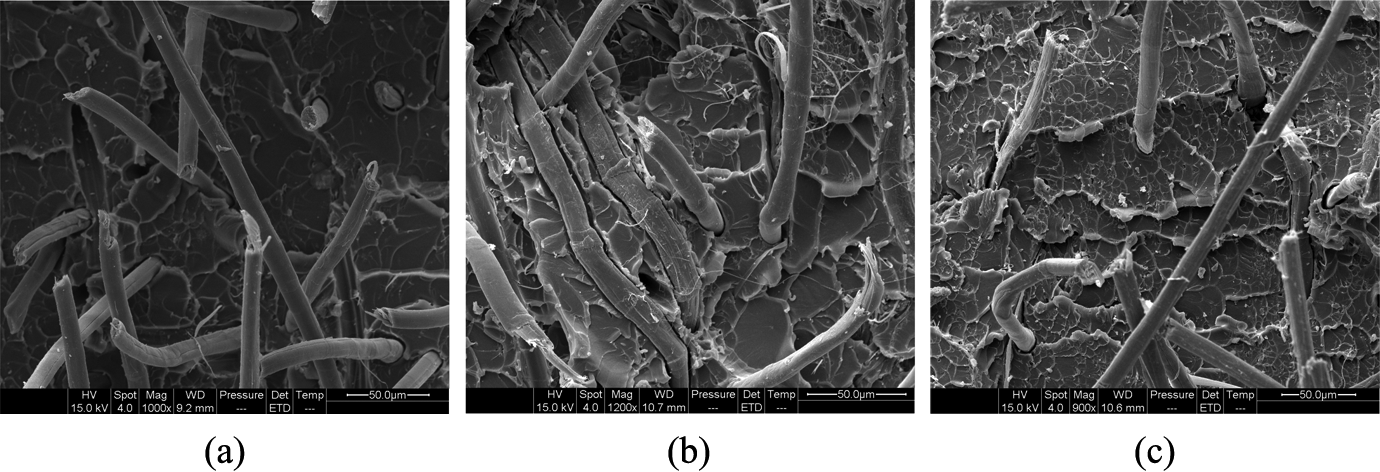
The fracture surfaces of the PTFE fiber/PMMA/SiO2 composites. ILSS: interlaminar shear strength; PTFE: polytetrafluoroethylene; PMMA: polymethyl methacrylate; SiO2: silicon dioxide.
As shown in Figure 4(a), cracks were found propagating along the fiber–matrix interface, representing a typical interlaminar shear failure. The holes were the result of the pull out of the fiber bundles caused by grinding and ultrasonication during the sample preparation process. Figure 4(b) shows a trans-ply crack passing through a SiO2-rich particle. During the trans-laminar crack propagation process, the cracks extended by breaking the SiO2-rich particles. A detailed investigation of the damaged SiO2-rich regions revealed that microcracks that were generated in the SiO2-rich regions were stabilized by SiO2 bridging (Figure 4(c)). The formation and stabilization of microcracks turned the SiO2-rich particles into damaged zones, which can absorb a substantial amount of energy and stop or slow down the crack propagation, making the system tougher and stronger. Numerous microcracks were created in the PMMA matrix as illustrated in Figure 4(b), but the growth of the microcracks was arrested by SiO2 bridging. Each of the above mechanisms contributed to the enhancement of ILSS.
Remarkable differences between both materials can be observed. While in the PTFE fiber/PMMA composite an easy debonding between matrix and fiber occurs (Figure 4(a)), this debonding is not observed in the PTFE fiber/PMMA/SiO2 composite as a result of the stronger bonding between fiber and matrix (Figure 4(b)). The PTFE fiber/PMMA composite showed a strong pull out on the fracture surface (Figure 4(a)), indicating a weak bonding between the fiber and matrix. Figure 4(a) shows a detail of the holes formed by matrix due to the pull out of fibers. Meanwhile, the fracture surface showed a joint failure of the fiber and matrix, demonstrating the strong bonding between them.
Moreover, the cracks propagated along the fiber–matrix interface, reflecting weak fiber–matrix interfacial adhesion. For the hybrid composite samples containing SiO2, the cracks propagated through the breaking of the fibers but not along the fiber–matrix interface, suggesting strong adhesion between the fibers and the matrix. Figure 4(c) also shows that the SiO2-rich particles at the locations near the carbon fibers were damaged by SiO2 pull out and the formation of microcracks. Because the SiO2-rich particles were tough and strong, they worked like microfillers in the fracture process. According to the crack bowing theory, higher toughness is achieved because the advancing crack is pinned by the particles, causing the crack front to bow out between particles, resulting in longer crack lengths. Clearly, there are two main factors contributing to the ILSS enhancement. The increased toughness of the PMMA matrix due to the incorporation of SiO2 is the most important factor. Stronger interfacial adhesion between the PTFE fibers and PMMA matrix due to an unclear mechanism brought about by the SiO2 is another contributing factor to the higher values of ILSS.
Conclusions
The ILSS and mechanical properties of PTFE fiber-reinforced PMMA composites enhanced by filled SiO2 are studied. This PTFE fiber-reinforced composite can be applied to bioengineering and fabrics.
A study of ILSS and impact properties of the SiO2-filled PTFE fiber/PMMA composites in relationship to fiber loading was conducted.
A strong correlation of mechanical strength increase with the increase of fiber loading has been observed. For PTFE fiber/PMMA composites, maximum ILSS occurred for the composite at 20 vol% PTFE filled. The ILSS of PTFE fiber/PMMA/SiO2 composite became higher when more amount of SiO2 was added, and it showed that the ILSS reached the maximum at 7 vol% SiO2 loading.
Footnotes
Declaration of Conflicting Interests
The author(s) declared no potential conflicts of interest with respect to the research, authorship, and/or publication of this article.
Funding
The author(s) received no financial support for the research, authorship, and/or publication of this article.