




Abstract
The surface treatment of carbon fibers (CFs) was carried out using a self-synthesized sizing agent. The effects of sizing agent on the surface of CFs and the interface properties of CF/polymethyl methacrylate (PMMA) composites were mainly studied. Scanning electron microscopy, Fourier transform infrared spectroscopy, X-ray photoelectron spectroscopy, and static contact angle were used to compare and study the CFs before and after the surface treatment, including surface morphology, surface chemical element composition, and wettability of the surface. The influence of sizing agent on the mechanical properties of CF/PMMA resin composite interface was investigated. The results show that after sizing treatment, the CF surface O/C value increased by 35.1% and the contact angles of CF and resin decreased by 16.2%. The interfacial shear strength and interlayer shear strength increased by 12.6%.
Introduction
Carbon fiber-reinforced resin-based composite materials (CFRP) have been widely used in aerospace, marine, transportation, sporting goods, and medical equipment because of their excellent properties such as high specific modulus, high specific strength, heat resistance, and corrosion resistance. 1 The performance of CFRP is not only determined by the carbon fiber (CF) and resin matrix but also by the interface between the two phases. The substrate and the reinforcement are combined through the interface, and at the same time, the interface transmits the stress of the substrate to the reinforcement. Studies have shown that the original CF has few surface active functional groups, low surface activity, and poor adhesion to the matrix, making it difficult to fully exert the excellent properties of the CF itself. In order to improve the performance of composite materials, the surface of CFs must be treated. CF surface treatment methods include coating method, oxidation method, and high-energy radiation treatment method. 2 The optimal design of the interface of carbon nanomaterials grafted on the surface of CF has been a research hot spot in recent years. Therefore, this article will review and analyze the current research status of carbon nanotubes and graphene oxide-grafted CFs, interface synergistic design, and interface enhancement mechanisms.
CFRP have become the important materials for aerospace and other applications due to their unique advantages such as high specific strength, high specific modulus, and strong designability. 1 –3 However, the surface of CF is inert due to fewer active groups, and it is not easy to combine with the resin matrix, which results in a decline in interface performance. In practice, the compatibility of CF and resin matrix can be improved by CF surface modification methods. There are liquid phase oxidation method, 4 anodization method, 5 electropolymer coating, 6 sizing method, 7 plasma modification, 8 gas phase oxidation method, 9 and so on. Among them, the sizing method has attracted widespread attention from scholars in various countries for its advantages such as simple process operation and easy control of processing conditions. Zhou et al. 10 considered that the surface energy and surface functional groups of fibers are important factors affecting the fiber/resin interface performance.
Li et al. 11 studied the effects of sizing agents of different molecular weights on the properties of CF composites. The results showed that sizing agents of moderate molecular weight can effectively improve the interlaminar shear properties of CF composites. Mohammed et al. 12 found that nano-silica modified emulsion type sizing agents can significantly increase the active functional groups on the surface of CFs, and increase the interlaminar shear strength of CF composites by 14%. This shows that sizing modification can achieve the effect of enhancing the interface performance between the fiber and the resin matrix. 13,14 Wu et al. 15,16 developed new method to graft renewable cardanol onto the CF surfaces to strengthen the fiber–matrix interface.
PMMA has the best transparency and weather resistance characteristics. The penetration of white light is as high as 92%. PMMA plastic parts have very low birefringence, especially suitable for making video discs. PMMA has higher mechanical strength, creep resistance, and better impact resistance at room temperature. PMMA has good heat resistance, heat distortion temperature of 98°C, low surface hardness, easy to be scratched and leave marks, so the packaging requirements are very high. The biggest disadvantage of PMMA is brittle.
Due to short development time, technical confidentiality, and so on, there is still a lack of clear understanding of the technical requirements for CFs/PMMA composites. The influence of sizing agent on the interfacial strength of PMMA composites was studied.
Experiment
Materials
CF (6K), density 1.91 g/cm3, linear density 218 tex (Toray Group, Japan); polyester polyol (adipic acid-1,4 butanediol PE-2708, M = 3000; Huafeng Group); 2,2-dimethylolpropionic acid, triethylamine, diethylenetriamine, dibutyltin dilaurate (DBTDL), and stannous octoate (T9) (Shanghai Aladdin Biochemical Technology Co., Ltd); sodium hydride (Dongguan Shuwan Chemical Co., Ltd, Shanghai Pudong district); dimethylformamide (Shanghai Reagent No. 1 Factory, Shanghai Pudong district); and acetone (Tianjin Fengchuan Chemical Reagent Technology Co., Ltd, Shanghai Pudong district).
Synthesis of sizing agent
Absolute ethanol (CH3CH2OH): analytical grade, produced by Shouguang Fine Chemical Co., Ltd, Shandong Weifang; acetone (CH3COCH3; Shouguang Chemical Reagent Technology Co., Ltd, Shandong Weifang); deionized water: lab made; anhydrous ethanol (CH3CH2OH): analytical grade (Shouguang Chemical Reagent Technology Co., Ltd); PMMA (Shouguang Fine Chemical Co., Ltd); and curing agent: tetrahydrophthalic anhydride (Wenzhou Qingming Chemical Co., Ltd). Add a certain amount of PE-2708 polyester polyol to a four-necked flask equipped with a reflux condenser, add the catalysts DBTDL, T9, and raise the temperature to 85°C under nitrogen protection for 2 h and then cool. The temperature was increased to 55°C and reacted for 1 h. The reaction was kept for about 5 h, reducing the prepolymer to 30°C, reduce the viscosity with acetone, add sodium hydroxide solution to neutralize for 0.5 h, and add distilled water to disperse. After forming a uniform and stable emulsion, add aqueous solution dropwise and extend the chain for about 20 min. Acetone was distilled off under reduced pressure and filtered to obtain sizing agent.
CF treatment
Take about 50 g of CF and dry it in an oven at 70°C for 2 h. The dryer was equilibrated for 2 h, weighed, placed in a Soxhlet extractor, Shanghai Unical Company, and an appropriate amount of acetone was added as an extract, heated and controlled to reflux for about 30 min, and extracted for 24 h. After the extraction is completed, the CF is taken out, dried in an oven at 110°C for 2 h, and then placed in a desiccator to cool for 2 h to room temperature, the mass is weighed, and the mass fraction of the extracted phase is calculated. Test three times and take the average.
The field emission scanning electron microscope was used to observe the surface morphology of the CF. The samples were gold-sprayed before the test. The acceleration voltage was 10 kV and the resolution of the electron microscope was 2.0 nm.
The Nicolet iS50 infrared tester (Thermo Fisher Scientific, XPSpeak41, Massachusetts) was used to perform infrared spectrum analysis on the extracted sizing agent. The scanning range of the test was 4000–400 cm−1.
CF-reinforced PMMA interface shear strength test
Use a fine needle to pick up a small amount of PMMA prepreg and place it on the CF. On the monofilament, the microspheres were controlled to be between 120 µm and 150 µm and cured in an oven at 80°C for 3 h. The length of the contact surface of the PMMA microspheres with the fibers and the diameter of the CF monofilaments where the microspheres were located were measured with an optical microscope.
As shown in Figure 1, one end of the CF adhered to the PMMA microsphere is downward, the PMMA microsphere is under the cutter, and the other end is clamped on the fixture of the micro debonding instrument, and the upper end of the CF is fixed, and the spacing of the lower cutter is slightly larger than The diameter of the CF is smaller than the diameter of the PMMA microspheres. The test was performed until the microspheres were pulled off and the microsphere debonding force was recorded. The interfacial shear strength (IFSS) of the CF and PMMA composite was calculated.
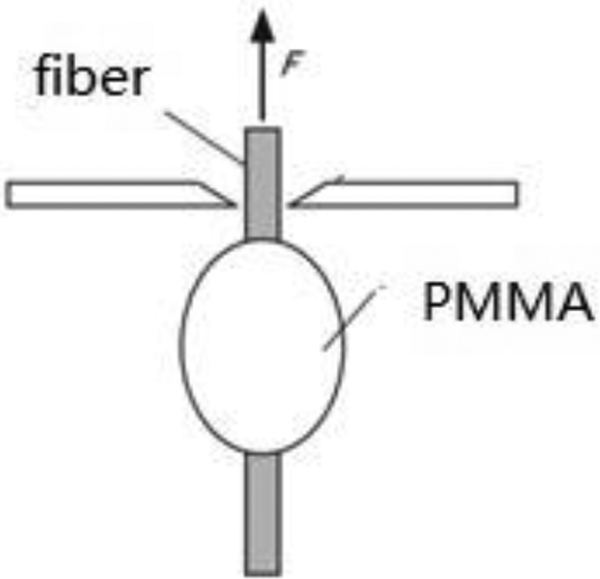
Schematic diagram of micro-droplet test.
X-ray photoelectron spectroscopy (XPS) test
The K-Alpha XPS (Thermo Fisher Company, Massachusetts, USA) was used to perform a full scan and C1s scan on the surface of CF with C1s (binding energy = 285.0 eV) as the standard, and the chemical element composition on the surface of the CF was tested, and the XPS-peak software was used. The types and relative contents of each functional group on the surface of the CF were obtained by the treatment.
Results and discussions
Analysis of the infrared spectrum of CF surface
Figure 2 shows the Fourier transform infrared (FTIR) images of the CF surface before and after modification. It can be seen from Figure 2 that the FTIR curve of CF shows a stretching vibration peak of –OH at 3470 cm−1, and –CH3 at 2971 cm−1, 2921 cm−1, and 2857 cm−1. The stretching vibration absorption peaks of –CH2 and –CH and the stretching vibration peaks of –CH (O) CH– appeared at 916 cm−1 and 833 cm−1. Compared with CF, the stretching vibration peak of –OH disappeared at 3470 cm−1 in MCF, and there was no stretching vibration peak of –NCO–, but –NH appeared at 3300 cm−1 and 1730 cm−1, respectively. The stretching vibration peak of –C and the stretching vibration peak of –C=O in the urethane indicate that the hydroxyl groups in the system react to form a urethane bond. In addition, the characteristic peaks of the quaternary carbon atoms in the PMMA resin and the vibration peaks of the benzene ring skeleton in the bisphenol structure appear at 1230 cm−1 and 1510 cm−1, respectively.
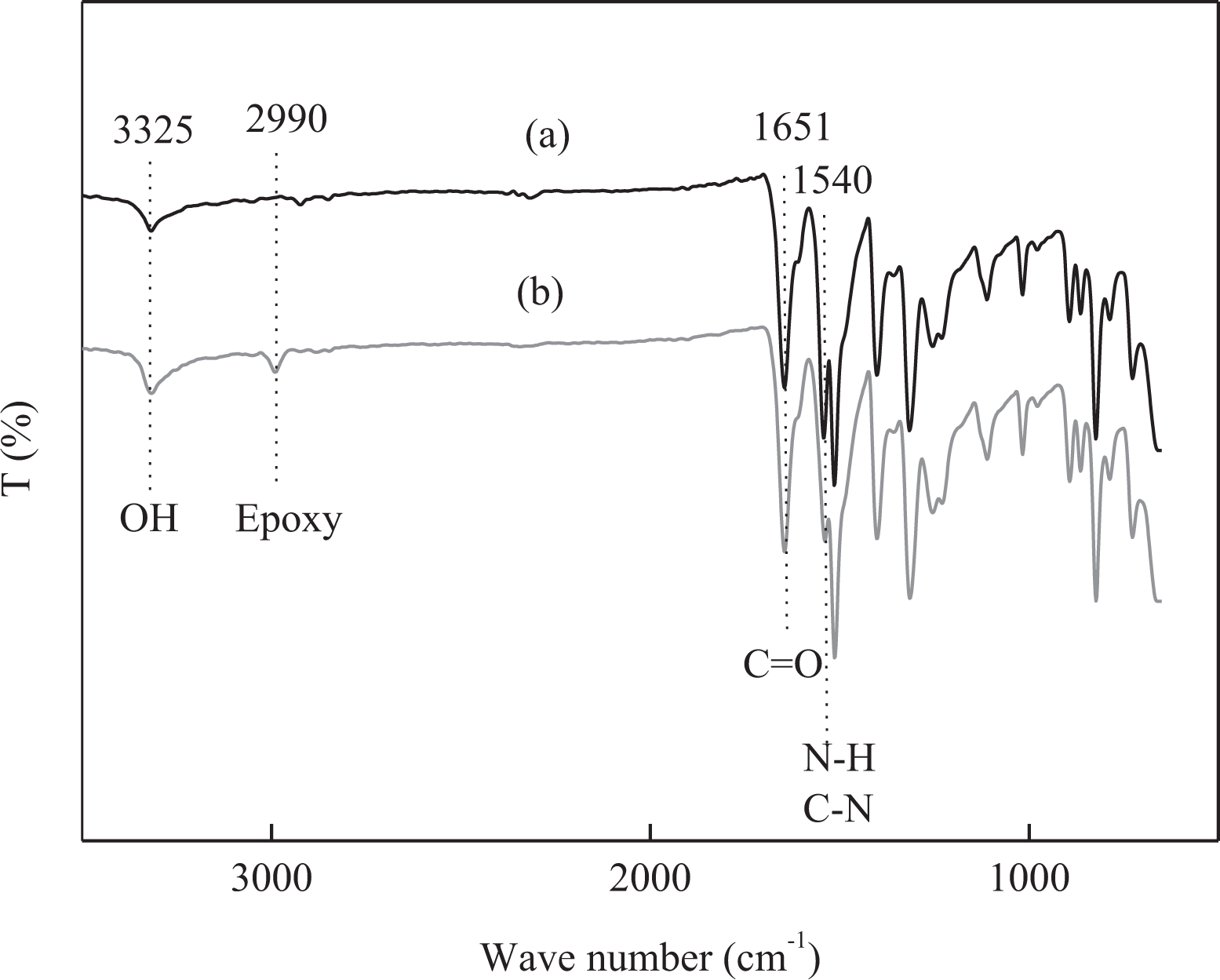
FTIR transmittance spectra of (a) untreated and (b) treated CF. FTIR: Fourier transform infrared spectroscopy; CF: carbon fiber.
XPS analysis of CF surface
Table 1 shows the chemical elements and their contents on the surface of the CF before and after modification. It can be known from Table 1 that the surface of the CF mainly contains two elements of C and O. After the sizing treatment, the C content is reduced, and the O content is increased. The surface activity of CF can be expressed by the O/C ratio. It is generally believed that the surface activity of CF is better when O1s/C1s on the surface of CF is higher than 0.14. After the sizing, the O/C ratio of the CF surface increased by 35.1%, which indicates that the second sizing is beneficial to improve the surface activity of the CF.
Surface chemical elements and contents of CFs.

CF: carbon fiber.
In order to further analyze the composition of CF surface active functional groups, the XPS-peak software was used to fit the C1s peaks. Figure 3 shows the C1s spectra of the CF surface before and after modification. And relative peak areas are shown in Table 2. As can be seen from Figure 4 and Table 2, MCF contains –C–OR, –C=O, and –COOR active carbon atoms, as well as NC=O, and the content of CF surface active functional groups increased. Reactive functional groups can not only enhance the surface energy of CFs but also chemically react with the resin. The increase of its content is conducive to enhance the interface bonding between CFs and resin.

The C1s spectra of the carbon fiber surface before and after modification ((a) untreated and (b) treated).
C1s peak analysis (%) of treated and untreated carbon fiber surfaces.


The cross-sectional morphology of the carbon fiber after three point bending ((a) untreated and (b) treated).
The influence of sizing on the surface wetting performance of CFs
The wettability of fibers and resins can be measured by the size of the contact angle. The larger the contact angle, the worse the droplet’s stretchability on the fiber surface. Table 3 shows the change in the contact angle of the PMMA resin before and after modification on the CF surface. As can be seen from Table 3, the contact angle decreases with time, and the contact angle on the CF surface after the second sizing decreases at the same time compared with that before the sizing. The contact angles between CF and treated CF and the resin were 53° and 43.5°, respectively. Compared with CF, the initial contact angle of treated CF with the resin decreased 16.21%, which indicates that the sizing agent effectively enhanced the wetting ability of the CF surface. As can be seen from Table 3, the IFSS of the CF/PMMA composite increased 12.6% after the sizing treatment, which indicated that the sizing agent increased the interfacial bonding strength between the CF and the resin. The TPB of the CF/PMMA composite increased 21.4% after the sizing treatment. The fiber surface functional groups influence the wettability and improves surface roughness for mechanical interlocking, fiber surface energy, and chemical bonding. 15,16
Contact angles, ILSS, and TPB of CF/PMMA composite.
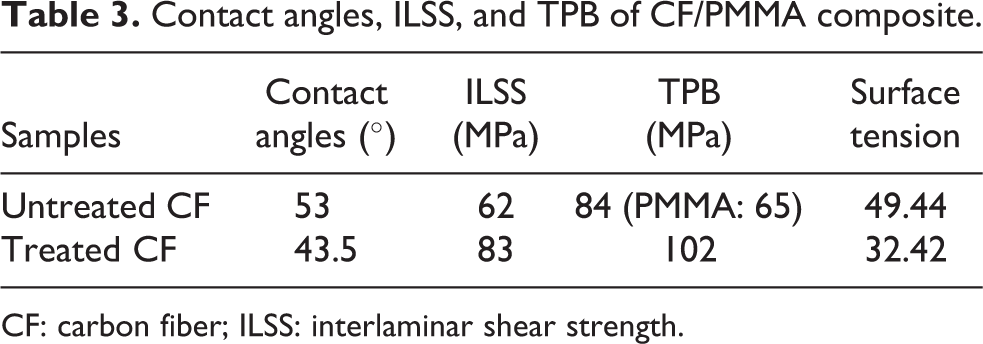
CF: carbon fiber; ILSS: interlaminar shear strength.
Figure 4 shows the cross-sectional morphology of the CF after TPB before and after modification. It can be seen from Figure 4 that CF is extracted from the resin matrix, indicating that the binding force between CF and the resin matrix is weak; and treated CF is broken at the cross section, and the fiber is broken, indicating that the sizing agent is between the CF and the resin matrix. An effective interfacial transition layer was formed, which improved the efficiency of stress transmission and caused the CFs to crack when the CF monofilament composite failed. In the cross section of the composite without CF surface modification (Figure 4(a)), there are a lot of gaps between CF and PMMA, and the surface of CF is not covered with PMMA resin, indicating that during the fracture of the composite, CF is peeled from PMMA and the interface strength is relatively low and weak. In the cross section of the surface-modified composite material (Figure 4(b)), the CF did not peel from the PMMA matrix to create gaps at the interface. The CF surface was covered with a large amount of PMMA and the adjacent CFs are still integrated by the PMMA matrix after the composite material is fractured. These phenomena indicate that the interface peeling phenomenon during fracture, the wettability of the CF, and the CF-PMMA interface are improved.
The chemical bonds established increase the CF-PMMA interface strength and increase the composite interlaminar shear strength (ILSS). However, when the concentration is too large, the CF surface coating becomes thicker, and the presence of a part of an excess of unreacted surface modifier instead introduces a weak small molecule interface layer, causing the ILSS to begin to decrease. Due to the larger specific surface area, stronger mechanical bonds can be formed at the interface. It takes more energy to remove it from the resin matrix, which improves the IFSS and the overall properties of the composite material. A large number of functional groups such as carboxyl and hydroxyl groups can be connected to the surface of CFs through amide bonds, dendrimers, and so on as a “bridge” structure.
Conclusion
Through FTIR analysis, it was found that the stretching vibration peak of –OH on the surface of treated CF disappeared. At the same time, the stretching vibration peak of –C=O in urethane, the stretching vibration peak of –NH–, and the quaternary carbon atom appeared.
The XPS analysis of CF showed that the O/C ratio of the CF surface after the sizing increased by 35.1%, the content of surface active functional groups also increased.
The experimental analysis of the contact angle found that the contact angle on the treated CF surface was reduced by 16.2%, which indicates that the sizing agent effectively enhances the wetting ability of PMMA resin on the surface of CF.
Through the analysis of single fiber breaking test, it was found that the sizing agent formed an effective stress transfer interface layer between the CF and the resin matrix, and the monofilament interface shear of the CF/PMMA composite increased by 12.6%.
Footnotes
Declaration of conflicting interests
The author(s) declared no potential conflicts of interest with respect to the research, authorship, and/or publication of this article.
Funding
The author(s) disclosed receipt of the following financial support for the research, authorship, and/or publication of this article: Materials Science and Engineering Discipline of Shanghai Polytechnic University (XXKZD1601).