




Abstract
The objective of this work is to improve the interlaminar shear strength and tribological properties of the high-density polyethylene (HDPE) composites by oxidation treatment method of carbon fiber (CF) and ultraviolet irradiation of HDPE. The morphologies of untreated and treated CFs were characterized by x-ray photoelectron spectroscopy. Surface analysis showed that after treatment, the surface of CFs chemisorbed oxygen-containing groups, active carbon atom, the surface roughness, and wetting ability were increased. The results show that the treated CF composites can possess excellent interfacial properties and tribological properties accordingly after treatment.
Introduction
Because of the characteristic of extremely high strength and modulus, good stiffness, creep resistance, and so on, carbon fiber (CF) has been widely employed as the reinforcing material in the advanced composites materials that have been applied in a variety of areas such as the aerospace industry, automobile applications, and sporting goods; 1 so it is significant to develop the composite reinforced by CF with high performance mechanical properties. The full potential of carbon fibers-reinforced polymer matrix composite has not yet been realized primarily due to fiber/matrix adhesion. 2 The characteristics of interface between fiber reinforcement and matrix have a strong influence on the properties of a composite material. 3,4 Modification of the fiber/matrix interface is therefore expected to change the properties of composites. 5,6 Consequently, a variety of methods of oxidation, plasma, radiation, as well as grafting 7 –9 were used to enhance the properties of carbon fibers and ensure adequate adhesion between the fibers and the matrix.
In the recent years, the development of new materials for biomedical application has been the result of the interaction of different multidisciplinary research groups. Particularly, many materials have been essayed where the polymers are considered one of the best choices due to good compatibility, functionality, and low cost. In previous works with high-density polyethylene (HDPE) as biomaterial, it was proved the low toxicity of this material by degradation in low-molecular-weight fragments, even reporting monomers. 10 –13 Furthermore, thermoplastic polymers are being reinforced with inorganic fillers in order to improve mechanical and thermal properties without impacting the lowering cost production.
To gain low cost and simplify manufacturing process, the effect of CF surface oxidation treatment was studied systematically. In addition, oxidation treatment of PAN-based CFs on the friction and wear properties of HDPE composite is given by reciprocating sliding wear.
Experimental
Materials and specimens
HDPE (DGDA1158 powder) was manufactured by Qilu Petrochemical (China) and has a melt index of 0.13 g/10 min (measured at 190°C and 5000g) and a density of 0.945 g/cm3.
The ultraviolet irradiation of HDPE was made in air at a temperature of 70°C by an ultraviolet lamp with light intensity of 78 W/m2, and was manufactured by Chengdu Lamp Factory.
For acid modification of the CFs, 3.0 g of carbon nanotubes (CNTs) were dispersed in 300 mL of concentrated H2SO4: HNO3 (3:2 v/v ratio) solution at 50°C and stirred for 20 h. The solution was filtered and washed with distilled water. The resulting oxidized CFs were then dried in a vacuum at 80°C for 12 h. Then the oxidized CFs were dispersed in a 2% 3-aminopropyltriethoxysilane solution (Aldrich, USA), which was then added to 300 mL of an ethanol:water (95:5 v/v) solution. The mixture was stirred at 70°C for 4 h. The CFs were separated by filtration using distilled water and were dried at 80°C for 12 h.
Preparation process
The HDPE and CF were blended with a twin screw extruder. The blending temperature was 190°C, and the screw rotation rate was 60 r/min. The blends were then melted and pressed at 190 °C and 15 MPa for 10 min in a hot hydraulic press, then cooled sample in another hydraulic press under about 10 MPa pressure for 15 min to room temperature to get CF/HDPE plates. These plates were then cut into the required specimens according to the test standards.
XPS analysis
X-Ray photoelectron spectroscopy (XPS) analysis of the CF surface was carried out with a SCIENTA SES-200 X-ray photoelectron spectrometer equipped with a conventional hemispherical analyzer. The latter was operated in the fixed transmission mode at constant pass energy of 100 eV.
Tensile and wear tests
The tensile strength of the CF composites was determined using a DY35 universal materials test machine at a constant speed of 50 mm/min. The dimensions of the tensile sample were 100 mm in length, 10 mm in width, and 0.2 mm in thickness.
An M-2000 friction and wear tester (Xuanhua Tester Factory, China) was used to examine the friction and wear behavior of the CF/HDPE composites sliding against SAE52100 steel in a block-on-ring configuration. The friction and wear tests were performed at a normal load of 50–250 N, sliding velocities of 0.84 m/s, and ambient temperature of about 25°C.
Results and discussion
X-Ray photoelectron spectroscopy
The surface elemental compositions of the samples are determined by XPS. Figure 1 shows the surface functional groups of untreated and treated CFs. A distinct change in functional groups on CFs surface after the surface treatment can be seen. The graphitic carbon and carbonyl groups decrease, whereas alcoholic hydroxyl/ether groups and carboxyl/ester groups produce 34% and 132% increase after the oxidation. The amount of oxygen-containing functional groups in the state of carboxyl/ester groups is increased, which enhance molecular polar and surface energy of CFs. In addition, ratio of activated to inactivated carbon atom of untreated CFs is 0.26, and treated CFs is 0.37 obtained from the calculation of Figure 1. It is deduced that interfacial adhesion between fiber and matrix could be improved when CFs is modified with oxidation treatment, which results in the promotion of interfacial properties. After surface treatment, some oxygen-containing groups are introduced onto the fiber surface, which can be stated that the oxidation of the fiber surface is the most decisive contribution to improve the bond property between the fiber and adhesive.
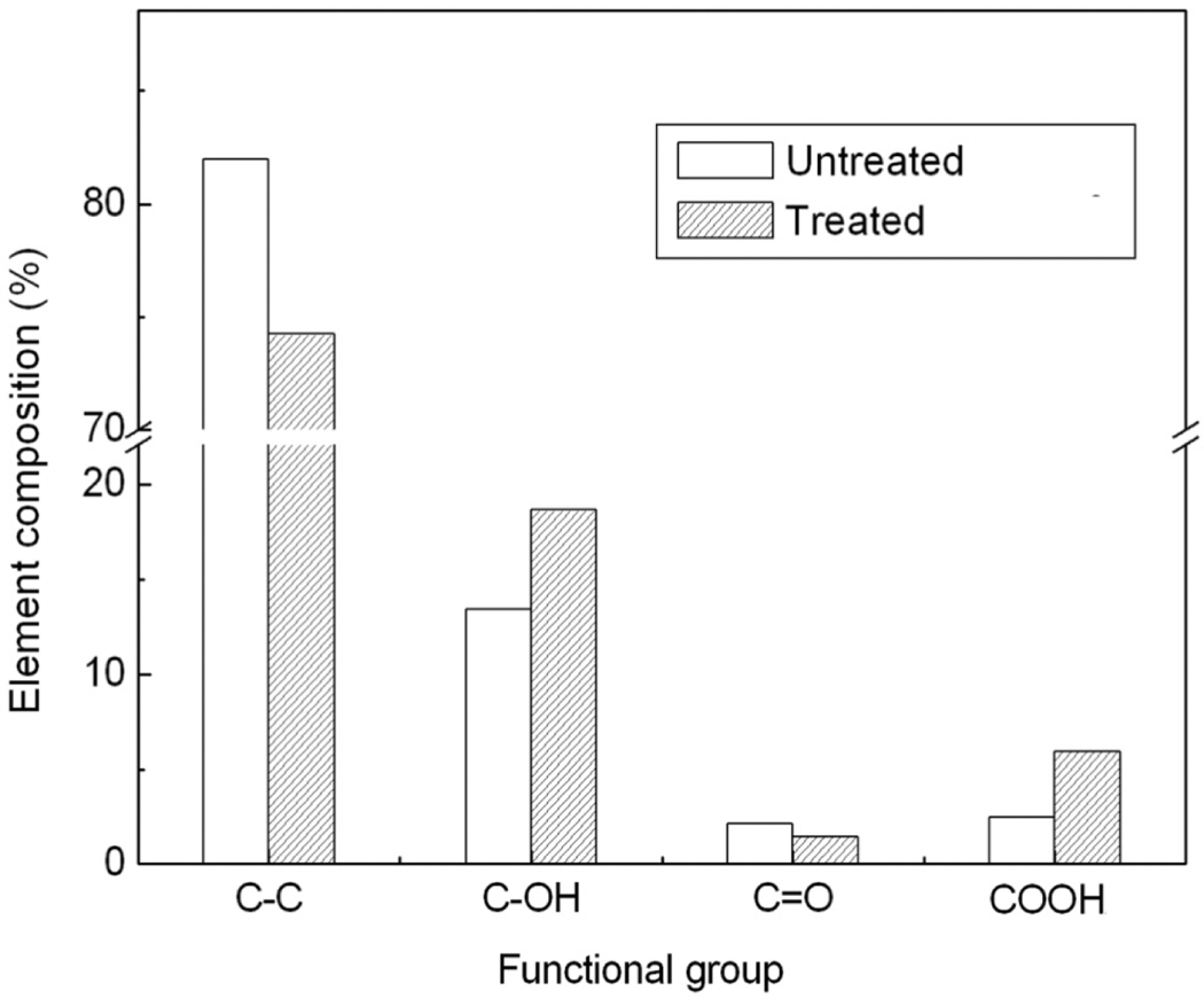
The content of containing-oxygen functional groups on the carbon fiber surface.
Interfacial properties of CF/HDPE composites
Interlaminar shear strength (ILSS) of CF/HDPE composites with different CF was showed in Table 1. The oxidation treatment can increase the oxygen-containing functional groups of CFs surface according to the above analysis. The surface-treated CFs with the current concentration treatment was used as reinforcement materials. ILSS of treated CF composites is obviously higher than that of untreated CF composites. This is attributed to the increase in surface functional groups that in turn improved the adhesion between fiber and matrix. Also it is found that ILSS can reach to 106 MPa under the condition of equal mass ratio mixed resin and a moderate current concentration treatment on fibers, which can meet the demand of engineering materials.
ILSS of CF/HDPE composites.
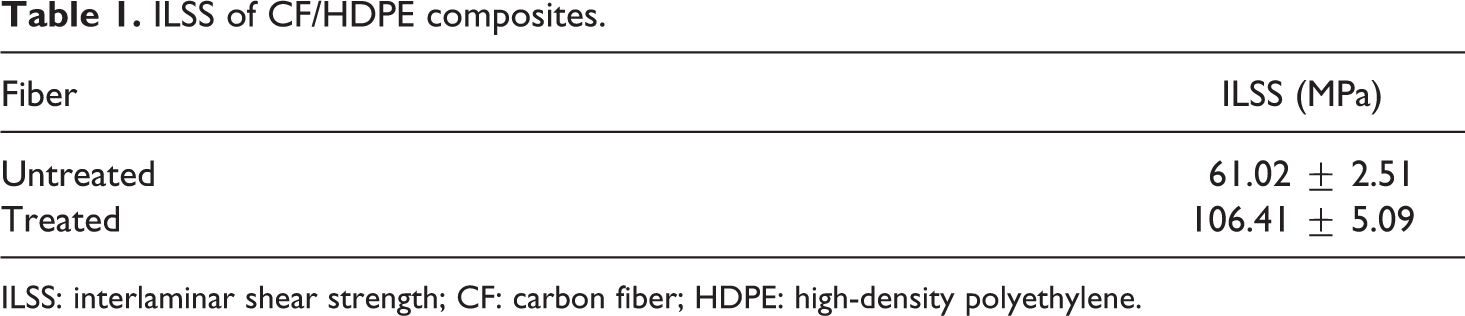
ILSS: interlaminar shear strength; CF: carbon fiber; HDPE: high-density polyethylene.
Friction and wear properties
Figure 2 shows the variation of coefficient of friction with sliding time at a normal load of 100 N and sliding speed of 0.84 m/s for CF/HDPE composite. The treated CF/HDPE composite exhibited a lower coefficient of friction compared with untreated one with the increasing sliding time. At preliminary stage of friction, coefficient of friction of the composites increased a little. The reason for this phenomenon was that the surface of metal ball was not very smooth and the ploughed function on friction test caused by the bulge on surface of the ball was large. At the beginning, the transfer film was not formed between the metal counterpart and the composites.
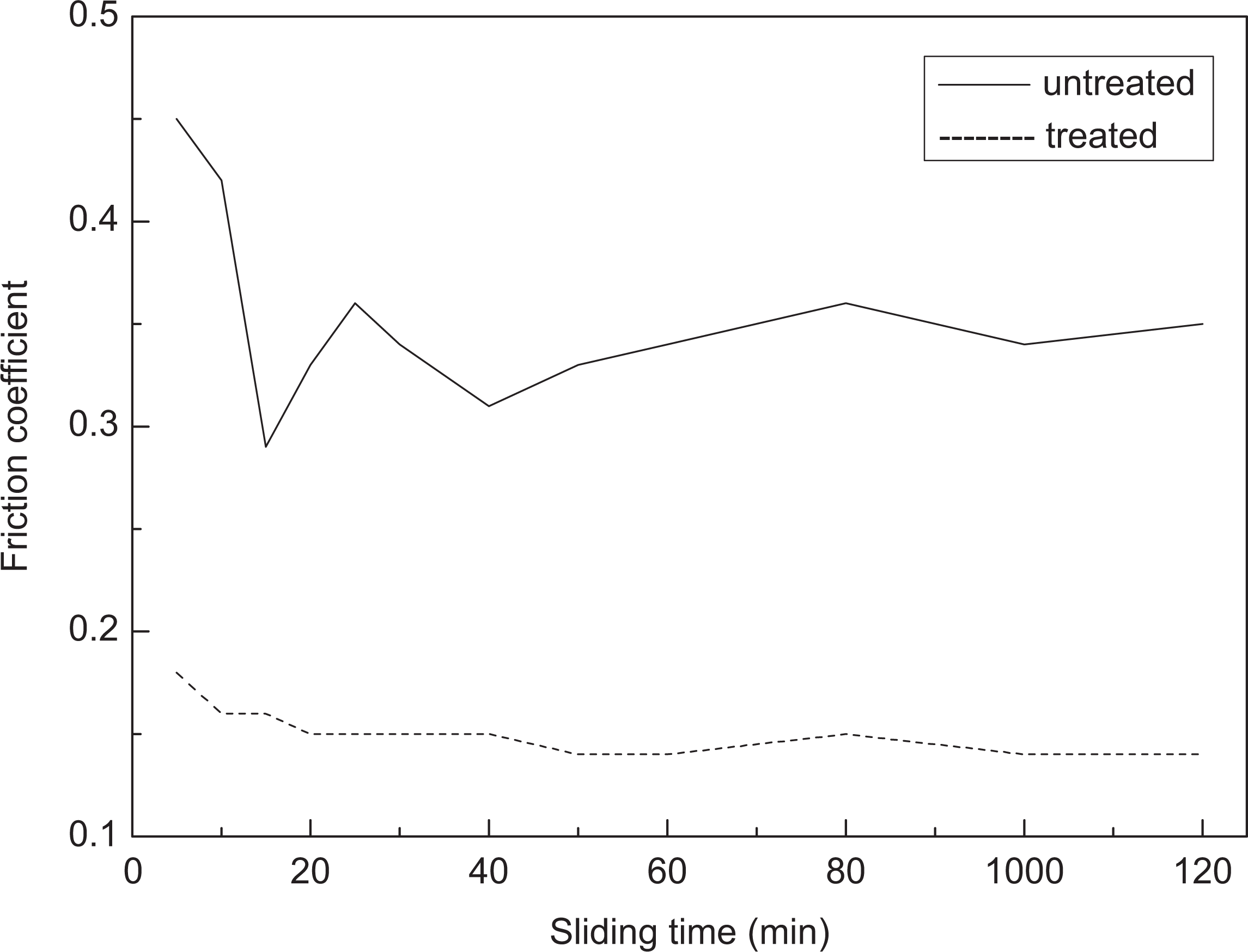
Evolutions of friction coefficients of CF/HDPE composite as a function of sliding time. CF: carbon fiber; HDPE: high-density polyethylene.
Figure 3 shows that the wear of all CF/HDPE composites, both with pretreated CF and untreated CF, increased with increasing sliding load. Figure 3 shows that the wear of the CF/HDPE composite can be significantly reduced by CF surface treatment. This improvement in the wear resistance correlates with an increase in the composite interface. This finding is in accordance with the higher creep resistance of composites with CF after treatment.
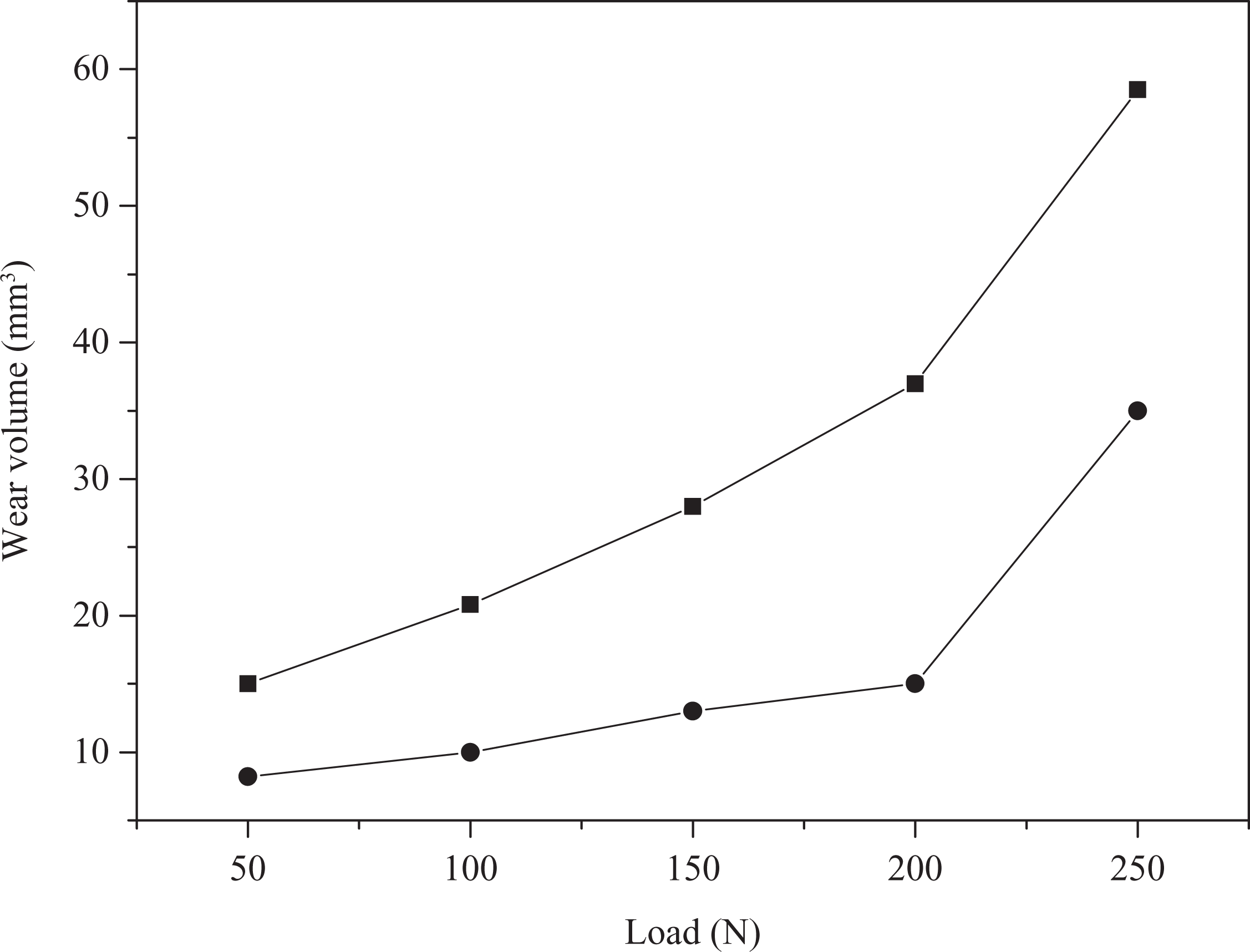
The variation in wear with sliding load.
Under dry sliding condition, when the applied load is small, the stress in contact region between the sample and the steel wheel is small, the friction heat is less, and the surface of the steel wheel is smooth, that is, the transfer film is not easy to form. With the increase in the applied load, the friction heat increases, and a part of wear debris adheres on the steel wheel and forms a transfer film, but this initial transfer film is noncontinuous and increases the friction coefficient. When the applied load increases further, the friction heat is much more and more wear debris adheres on the steel wheel and a complete transfer film is quickly formed. The contact between the sample and the steel wheel turns into the contact between polymer and polymer.
Figure 4 shows SEM micrographs of CFs with and without oxidation treatment ((a) untreated; (b) treated with current concentration). An SEM micrograph of the untreated fiber was presented in Figure 4(a). Only extrusion marks running parallel to fiber axis and particles from fiber manufacturing process could be seen in the image. The surface of untreated fiber seems to be relatively smooth. However, oxidation treatment produced etching lines along fiber axis direction and increased the number of particles on treated CFs surface, as shown in Figure 4(b). This high roughness can increase reactivity between CFs and matrix.
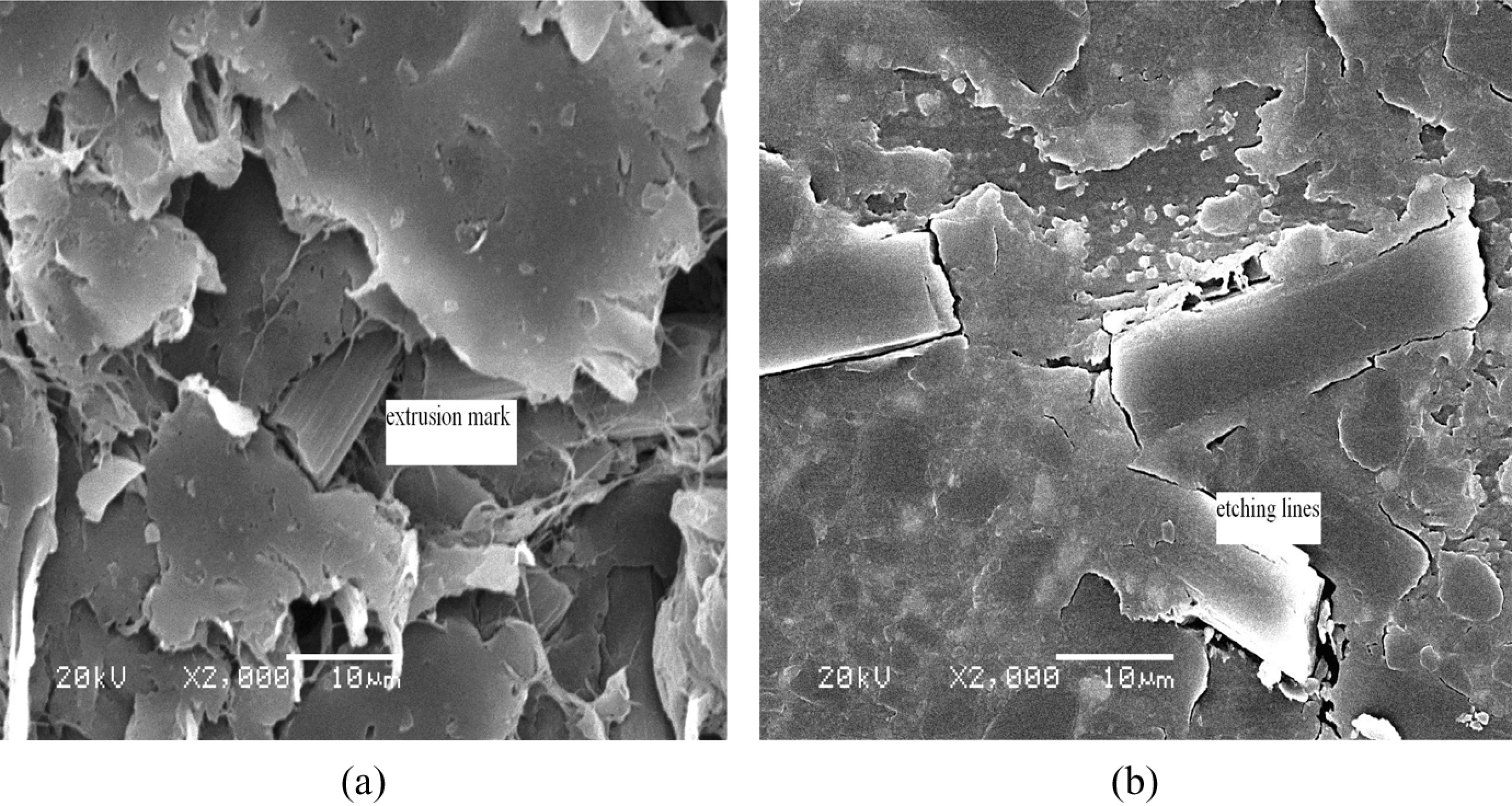
SEM micrographs of surface of carbon fibers: (a) untreated (b) treated.
Conclusions
To make the surface of inert CF active and enhance the interfacial property between CFs and HDPE matrix, CF modified by oxidation treatment and the ultraviolet irradiation of HDPE matrix from the standpoints of economy were investigated. The study has demonstrated the modified CF is crucial for the improvement of interfacial bonding between CF and HDPE matrix. The wear resistance of the CF/HDPE composite can be significantly improved by fiber surface treatment. Oxidation treatment is to be considered promising methods for the preparation of high-performance composites.
Footnotes
Funding
This work was supported by 973 Program (2011CB711000), NSFTJ (11JCZDJC16900), Shanghai College Young Teacher Training Program (shhs008), 973 Program (2010CB734103), The National Natural Science Foundation of China (71101090), Shanghai Education Committee Projects (J50604), Shanghai Education Committee Projects (12ZZ148), and Ministry of Communications Research Project (2009-329-810-020).