




Abstract
The surface functionalization of titanium dioxide (TiO2) was used to modify the surface of carbon fiber (CF). The objective of this study is to improve the interlaminar shear strength and impact properties of the composites by mixing high-density polyethylene (HDPE) resin and modifying CFs. The Izod impact strength of the CF/HDPE composites increases with increasing CF content because of the high impact strength of the CF, whereas incorporation of the TiO2 increased the impact strength of the CF/HDPE composites, which may be attributed to the reinforcing effect of the TiO2 particles. Especially the surface treatment of TiO2 increases the interfacial adhesion and the thermal stability of the CF/TiO2/HDPE composite.
Keywords
Introduction
New carbon fiber (CF) materials have been widely investigated for possible applications, because it was thought they had high potential abilities for innovation of industry. These materials also have the potential for mechanical use. 1 CFs combine exceptional mechanical properties and low weight, making them ideal reinforcements for polymer matrix composite materials. 1 –3 The performance of these composites depends largely on the quality of the matrix–reinforcement interface, which determines the way loads can be transferred from the polymer to the fiber. 2
Therefore, numerous amount of scientific work has been developed over the years to modify the fiber surface and thus enhance the ability to establish strong interaction between the fiber and matrix. 4 However, CFs are chemically inert in nature and hence have poor wettability and adsorption with most of the matrices. This needs to be addressed carefully. There have been several efforts with various treatment methods to fibers practiced either in combination or in isolation such as to graft reactive functional groups on the fiber surface which would lead to chemical bonds between the resin and fiber or to roughen the fiber surface to enhance mechanical keying between resin and fiber or by attacking the fiber with oxidizing agents leading to etching and finally more interaction between the fiber and the matrix. 5
Polymers that are often reported to form a transfer layer are polytetrafluoroethylene, low-density polyethylene, high-density polyethylene (HDPE), ultrahigh–molecular-weight polyethylene (UHMWPE), and sometimes polyoxymethylene (also known as polyacetal). 6 –11 Compressive strength and strain to failure, impact properties, damage initiation threshold, fracture toughness, and fatigue life are particularly sensitive to the strength of the fiber–matrix interface. A fundamental understanding and quantitative characterization of the properties of the fiber–matrix interface can help design fiber-reinforced materials with improvement of the above properties. 12,13
In this study, in order to improve the interfacial strength of CF-filled HDPE composite, titanium dioxide (TiO2) was added. The purpose of this work is to study the interfacial shear strength (IFSS) and impact properties of the CF/HDPE/TiO2 composites. Some insights into the fracture mechanisms of the ternary composite are also given.
Experimental
Materials
HDPE (Aldrich, Shanghai, China), nanosized TiO2 fillers were used as received without further purification. Degree of polymerization and saponification of HDPE were 1700 and 98–99%, respectively. HDPE was supplied from Shanghai Changjiang Co. Ltd (China), which was ultrasound dispersed for 1 h, and then treated with 2 M hydrochloric acid with continuous stirring at 80°C for 2 h. TiO2 was obtained from Tianjing Hongxing Co. Ltd (China), which was further fine grinded with a ball mill. All other reagents used were of analytical reagent grade. After water solvent evaporation, the container with the composite solid polymer membrane was weighed again. The composition of the CF/HDPE/TiO2 composite polymer membrane was determined from the mass balance. The thickness of the composite polymer membrane was controlled between 0.10 mm and 0.30 mm.
Surface treatment of CF
The TiO2 particles used in this investigation were provided by Nanostructured and Amorphous Materials with 10 nm diameters. The functionalization procedure was carried out as follows: in a typical experiment, a mixture with 10.0 g TiO2 and 13.6 g toluene diisocyanate (TDI) dispersed in 100 ml dried toluene was placed in an ultrasonic bath for 10 min, then the mixture was added with CF, and then degassed by three freeze-pump-thaw cycles under the atmosphere of nitrogen. The reaction mixture was magnetically stirred at 95°C maintained by a thermostat for 6 h. The product was separated by centrifugation and then carefully washed with dry toluene to remove the unreacted and physically absorbed TDI. The TDI-functionalized TiO2 (TiO2-NCO), which was dried in vacuum at 80°C for 24 h and was characterized by Fourier transform infrared (FTIR) spectroscopy (potassium bromide film) performing on Spectrum One B (Perkin Elmer, Waltham, Massachusetts, USA).
The preparation of composite
The CF and HDPE were mixed and milled under room temperature with different CF contents. The mixture was sealed in a stainless steel vial containing five balls with a diameter of 30 mm. Four vials are mounted on a planar disk. With the rotation of disk, the vials move in circular and opposite direction compared to the disk rotation. The rotation speed of vials was 200 r min−1. A total milling time of 5 h was selected.
The as-milled composite was used directly for following compression molding without further melt mixing. Then, they were compression molded at 400°C under 12 MPa and finally cooled to room temperature with a speed of 20°C min−1. The composite specimens were prepared by hot molding press technique. The molding press temperature is kept at 340°C for 2 hr.
Mechanical test
The tensile test was carried out on a universal testing machine (CMT5254 Shenzhensans Testing Machine Co. Ltd, China) at the constant temperature (20°C) and the extension rate was set as 5 mm min−1. Charpy impact tests were conducted on notched composite specimens according to ASTM D 6110-97 standard using a universal impact testing machine. The dimension of the specimen was 79 × 10 × 4.1 mm3.
Results and discussions
Impact strength
Figure 1 shows the impact strength behavior of both treated and untreated CF/HDPE composites as a function of filler content. It is evident from Figure 1 that up to 10% filler content the impact strength shows a linear increase and then shows a plateau with a little increase in the values up to 20% filler content. This phenomenon attributed to weak interfacial bonding between the filler and the matrix. In this study, we have shown that the impact strength values show a sharp increase up to 15% filler content and then show a steady behavior upon further increases in filler loading. The impact strength of composites is governed mainly by two factors. First, the capability of the filler to absorb energy to stop crack propagation; second, poor interfacial bonding that induces microspaces between the filler and the matrix, resulting in easy crack propagation. Probably these two factors offset each other when the filler content exceeds 15%, showing a steady behavior in the impact strengths of the composites. Slightly higher values of impact strength for treated CF/HDPE composites could be due to more favorable interaction between the TiO2-deposited CF filler and the matrix.
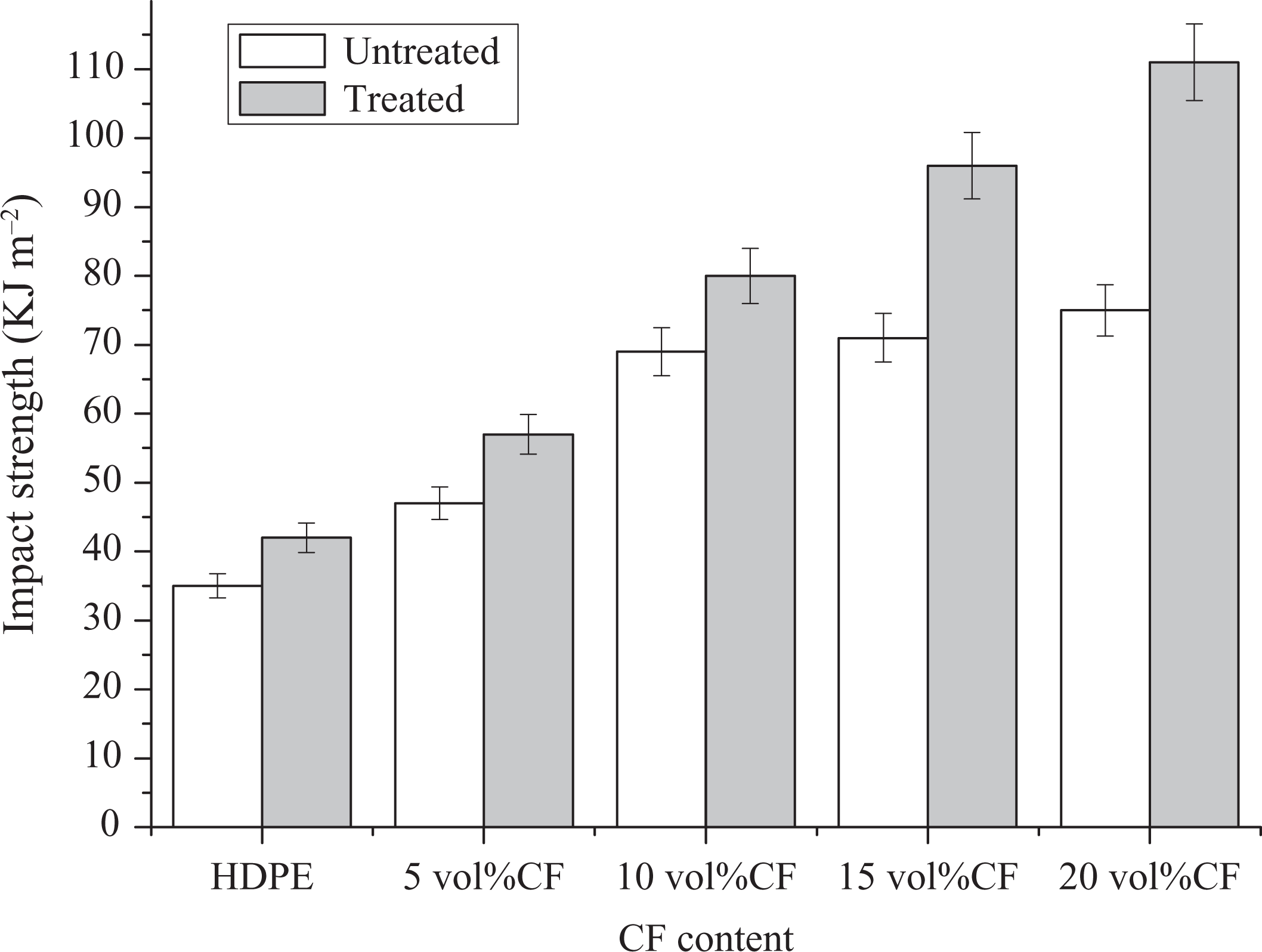
The impact strength of CF/HDPE composite filled with and without TiO2. CF: carbon fiber; HDPE: high-density polyethylene; TiO2: titanium dioxide.
The Izod impact strength of the CF/HDPE composites increases with increasing CF content because of the high impact strength of the CF, whereas incorporation of the TiO2 increased the impact strength of the CF/HDPE composites, which may be attributed to the reinforcing effect of the TiO2 particles.
Interfacial properties of CF/HDPE composites
Interlaminar shear strength (ILSS) of these two kinds of HDPE reinforced by CF is shown in Table 1. It was seen that treated CF composite shows the highest ILSS in the two kinds of HDPE matrix, which is over 100 MPa. The result can be explained in light of the inherent properties of coupling agents with reactive HDPE groups per molecule. The composites have high stiffness owing to the high cross-link density of coupling agents. Although high viscosity of coupling agents can hinder resin impregnation into the fibers, large amount of HDPE groups can increase the cross-link density of the composite, which results in better mechanical performance than that of HDPE composites.
ILSS of CF/HDPE composites.
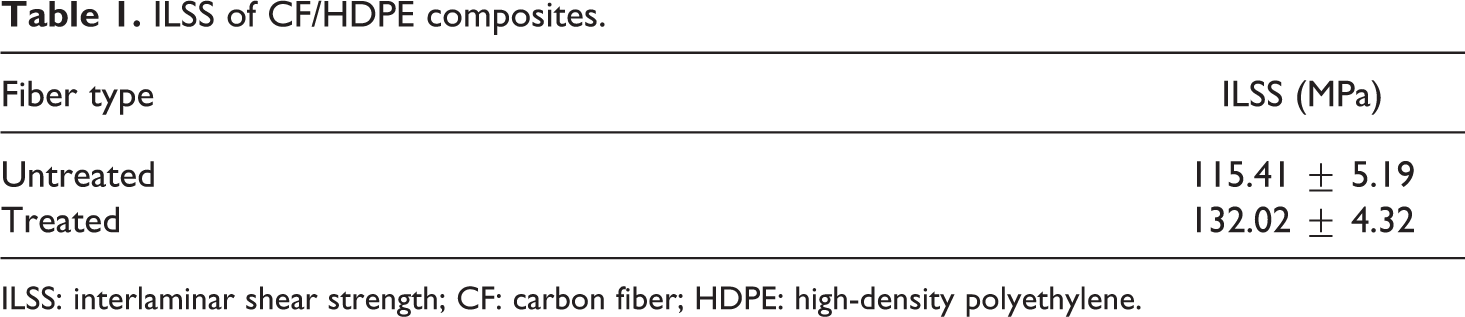
ILSS: interlaminar shear strength; CF: carbon fiber; HDPE: high-density polyethylene.
Table 1 shows that the ILSS values of the composites with coupling agent-treated CF are increased by 12% compared to that without treatment. It is proved that better interfacial adhesion can be obtained through surface modification. Therefore, the ILSS of the composite reinforced by coupling agent-treated CFs are improved.
Figure 2 shows scanning electron microscopic (SEM) micrographs of CF with and without treatment ((a) untreated and (b) treated with coupling agent). A SEM micrograph of the untreated fiber is presented in Figure 2(a). Only extrusion marks running parallel to fiber axis and particles from fiber manufacturing process could be seen in the image. The surface of untreated fiber seems to be relatively smooth. However, coupling agent treatment produced etching effect and increased the number of particles on treated CF surface, as shown in Figure 2(b). This high roughness can increase reactivity between CF and matrix. From Figure 2(a), it can be seen that the wet out of untreated fibers is poor, and the micrographs show some of CFs are pulled out from the matrix. The delamination of untreated CF composites occurred at the interface between the fiber and matrix, which indicate that the interfacial bonding is poor and the interface structure could not transfer stress effectively. As seen in Figure 2(b), strong interlocking of fiber/matrix could be observed. In Figure 2(b), it can be seen that large quantity of resin matrix is covered on fiber surface, which indicates strong interfacial adhesion between the fiber and matrix. The fracture model was changed from pure fibers broken to the combination failures of fibers broken, interface broken and delamination.
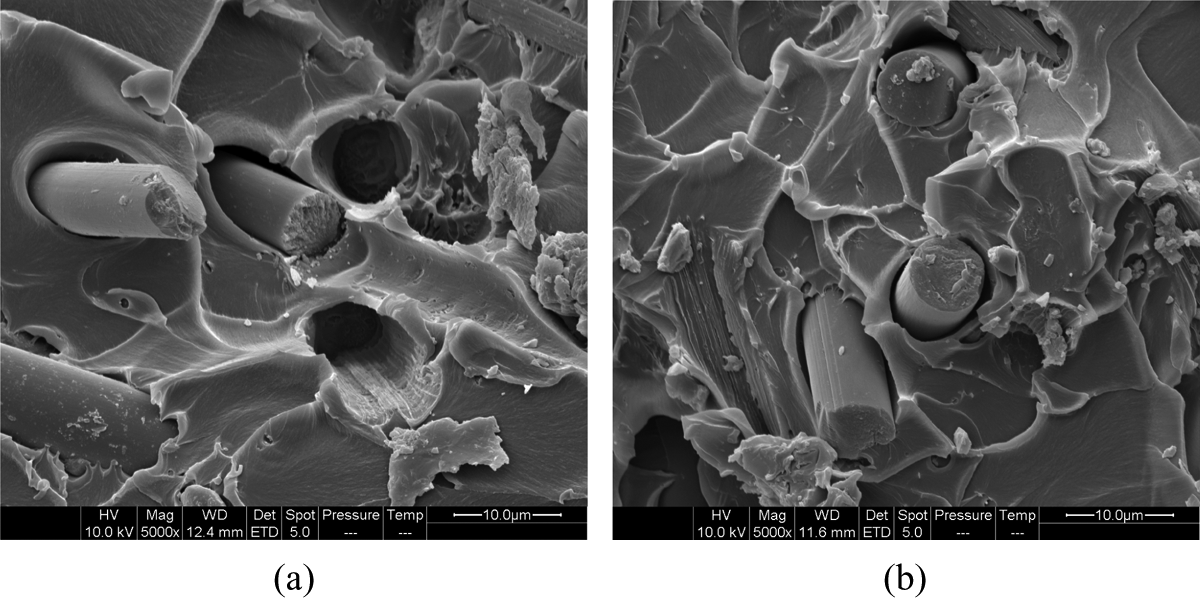
SEM micrographs of fracture surface (a) untreated (b) treated. SEM: scanning electron microscopic.
FTIR analysis
TiO2 surface was treated with excessive TDI; in the presence of excessive TDI in the reaction system, accessible surface hydroxyl preferentially reacted with a para-isocyanate group and left an ortho-isocyanate group unreacted owing to the different reactivity of the two isocyanate groups together with steric hindrance in TDI molecule. Therefore, a hydroxyl group at the TiO2 surface reacts with a TDI molecule and leaves an unreacted isocyanate group for further reaction, which provides a mean for covalent attachment of other molecule or polymer.
Figure 3 shows the FTIR spectra of CF/TiO2/HDPE composite with and without treatment. The FTIR spectrum of the untreated CF/TiO2/HDPE composite (curve a) is relatively simple. The strong absorbance at 663 cm−1 is reasonably attributed to the Ti–O–Ti stretch of TiO2, the absorbance at 1384, 1634, and 3418 cm−1 are assigned to the surface hydroxyl groups of TiO2. Curve b shows the FTIR spectrum of treated CF/TiO2/HDPE composite, compared with the spectrum of the pristine untreated one, the treated one exhibited peaks at 2273, 1642, 1600, and 1550 cm−1 in addition to the peaks of pristine TiO2. The peak at 2273 cm−1 can be attributed to the ortho-isocyanate groups of TDI attached to the TiO2 surface, while the bands at 1600 and 1642 cm−1 can be reasonably assigned to the group of –OCONH– formed in the reaction, the peaks at 1550 cm−1 are reasonably attributed to the phenyl ring of TDI. These results clearly confirmed that the TDI molecule was covalently linked to TiO2, suggesting successful functionalization of the TiO2 with TDI.
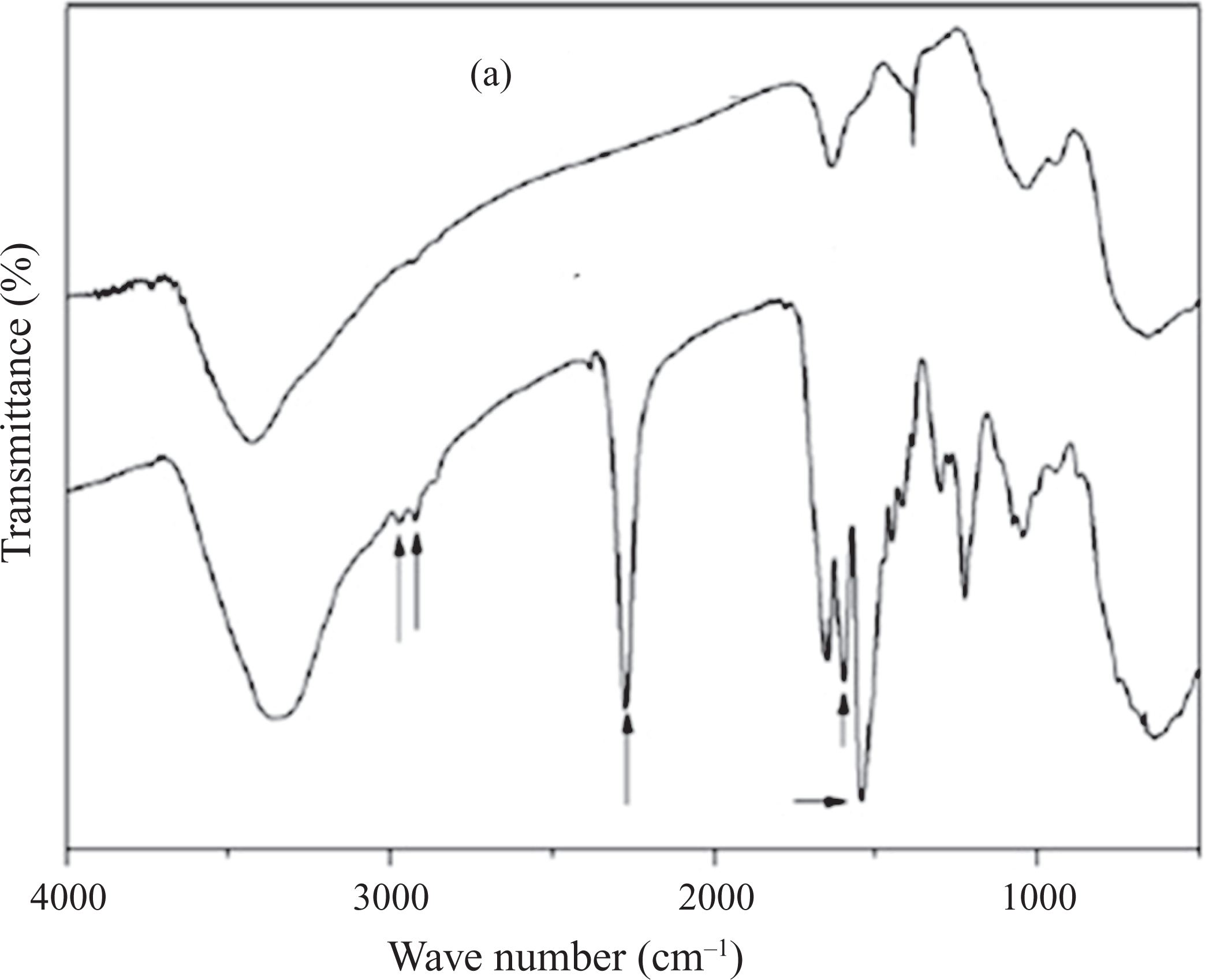
FTIR spectra of CF/TiO2/HDPE composite. FTIR: Fourier transform infrared; CF: carbon fiber; HDPE: high-density polyethylene; TiO2: titanium dioxide.
The thermal properties of CF/TiO2/HDPE composite
The thermal stability of CF/TiO2/HDPE composite with and without treatment at different heating rates is investigated by thermogravimetric analysis, with their patterns shown in Figure 4, where (a) and (b) represent the thermal degradation curves for untreated and treated samples, respectively. It is seen that with the increase in heating rate, the values of Tonset, Td, and Tend for both samples increase. At the same heating rate, however, Tonset, Td, and Tend of treated CF/TiO2/HDPE are all higher than those of untreated, showing that the thermal stability of treated CF/TiO2/HDPE is superior to that of untreated. The surface treatment of TiO2 can prevent HDPE from degradation by creating many polarized fibers, which enhances the stability of TiO2/HDPE.
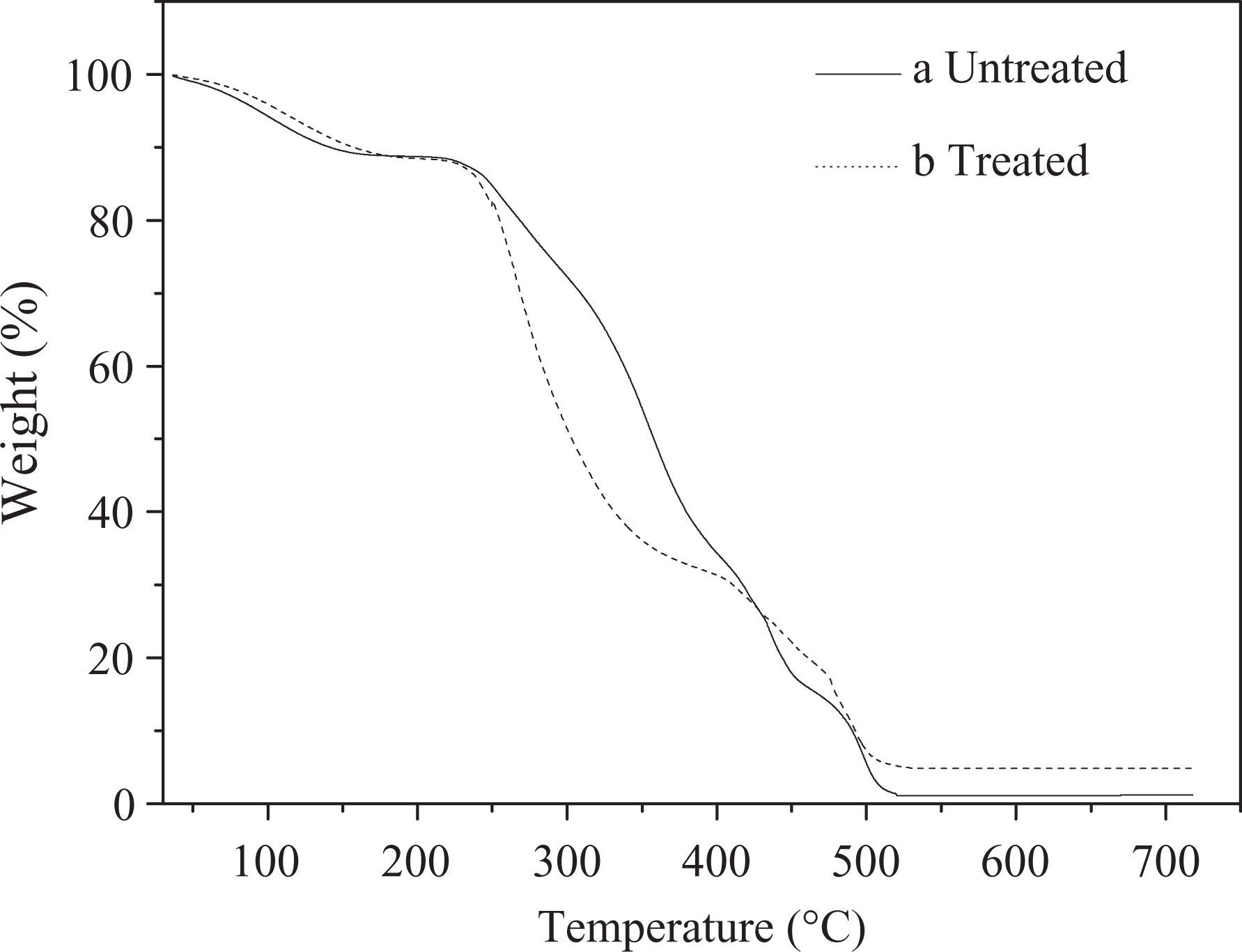
The thermal stability of CF/TiO2/HDPE composite. CF: carbon fiber; HDPE: high-density polyethylene; TiO2: titanium dioxide.
The comparative observation of the three-dimensional atomic force microscopic (AFM) images (Figure 5) for original and treated fibers also confirms the above statement. The change in the surface roughness of each sample based on AFM results reveals that the treatment remarkably increases the surface roughness of CF. Note that the increased surface roughness of treated CF is attractive for reinforcing polymers because the rougher surfaces bring stronger mechanical anchoring between the fibers and the matrix and thus lead to improved composites properties. Similar results showed that the improved mechanical properties resulted from controlled fiber surface chemistry and nanoscale topological features within the fiber–matrix interphase. 14,15
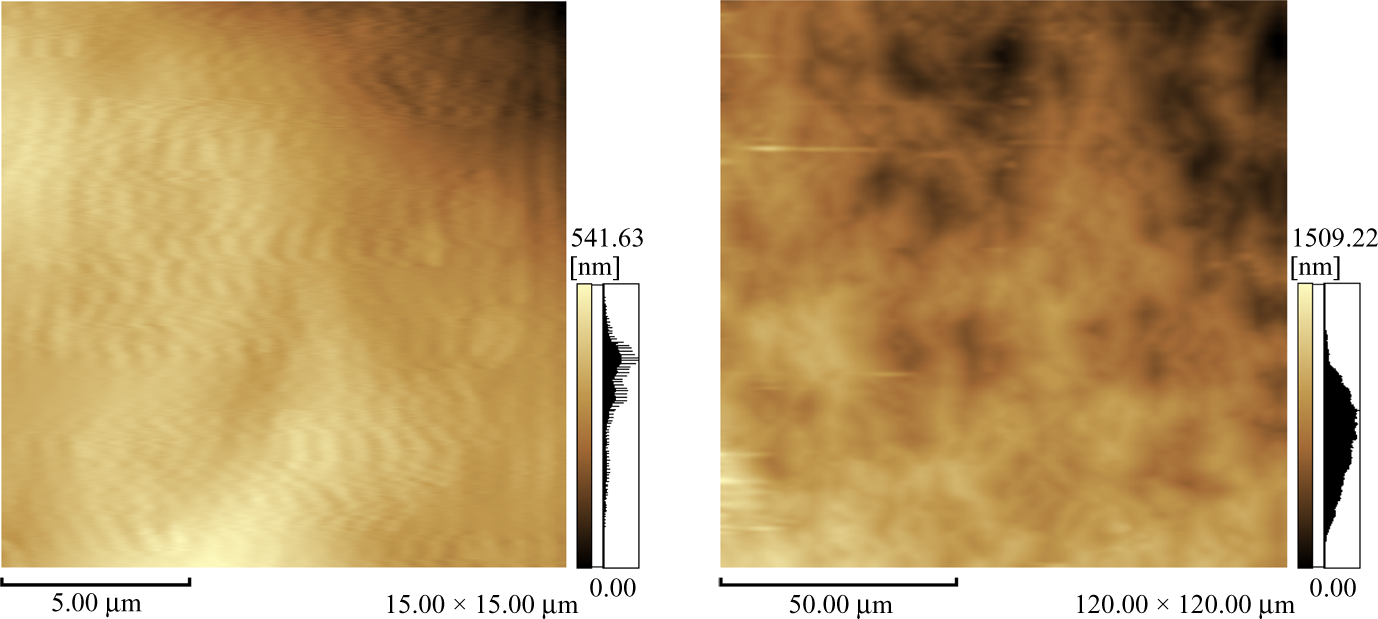
AFM images of CF. AFM: atomic force microscopic; CF: carbon fiber.
Conclusions
The IFSS and impact properties of TiO2-deposited CF/HDPE composites are better than the untreated ones. The improvement of the ILSS may be attributed to the modification of CF by surface-treated TiO2 that improves effectively the load transfer between the CF and HDPE matrix since introduction of TiO2 can form nano bridging between the fibers and the matrix. Effective interfacial adhesion leads to the improvement of the impact properties of the TiO2-deposited CF/HDPE composites.
Footnotes
Declaration of Conflicting Interests
The author(s) declared no potential conflicts of interest with respect to the research, authorship, and/or publication of this article.
Funding
The author(s) received no financial support for the research, authorship, and/or publication of this article.