




Abstract
Socio-legal ethnographies have focused largely on the dramaturgical themes present in the competing performances seen in adversarial trials. Drawing on ethnographic observations of British homicide investigations, we illuminate the hidden “backstage” space of prosecution barristers’ case conferences. Using Goffman’s dramaturgical framework, we analyze the interactions, deliberations, and negotiations that are enacted between barristers, homicide detectives, forensic scientists, and other specialists. To our knowledge, the work that happens in these conferences has never been documented. Our findings reveal how prosecution narratives evolve and are tested behind the scenes before being performed in court. We pay particular attention to the role of anticipatory work in guiding how criminal justice actors choreograph the prosecution case. The findings add to our understanding of narrative case building and elaborate Goffman’s dramaturgical framework. We discuss the implications of our findings for due process.
Introduction
Ethnographic research is “grounded in a commitment to the first-hand experience and exploration of a particular social or cultural setting on the basis of (though not exclusively by) participant observation” (Atkinson et al. 2001, 4). Although observation and participation are core features of the ethnographic approach, in many cases ethnographers use a variety of research methods including interviews, conversations, the analysis of documents, and observations. Observations are particularly important because they provide researchers with unrivaled access to events as they unfold and to people as they co-create these events (Brookman and Jones, forthcoming). Socio-legal scholars have found that observations are especially well-suited to the open courtroom, where the public gallery affords researchers an “observation-friendly” position from which to view the whole performance (Scheffer 2010, xxiv). However, focusing attention on the courtroom limits our understanding of the work that criminal justice actors do since much of what happens has already been rehearsed and decided in “backstage negotiations” (Paik and Harris 2015, 289).
Based on data drawn from a four-year ethnographic study of the role of forensic science in British homicide investigations, this paper explores the rarely seen backstage interactions, deliberations, and negotiations that take place in prosecution barristers’ case conferences. 1 These preparations are particularly important to observe within an adversarial legal process where it is not the “truth” that is contested at trial, but rather the veracity, plausibility, and persuasiveness of the competing narratives of prosecution and defense (Jasanoff 1998, 731; Sanders 1987, 230). During both the pre-trial and trial phases of adversarial justice systems, a “game culture” dominates where actors are “driven by the goal of ‘winning’ against one’s own adversary in court” (Julian, Howes and White 2022, 94). Constructing a compelling narrative becomes paramount within this backstage work.
Prosecution case conferences provide one of the few occasions where actors from within and outside policing come together. They may involve the barrister and/or junior counsel, the Crown Prosecution Service (CPS) lawyer and/or their junior, the senior investigating officer (SIO 2 ) and/or their deputy, the officer in the case (a detective), forensic scientists, and other specialists employed by the police such as intelligence analysts, CCTV officers, exhibits officers and disclosure officers. During these meetings, actors discuss the progression of the case for trial. A range of matters are considered, such as disclosure or the results of any forensic examinations. Conferences also present an opportunity to discuss and select which witnesses will testify in court and to speak with expert witnesses (whose specialist knowledge permits them to give opinion evidence in court) to clarify or assess the reliability of the evidence they can give. These meetings are especially pertinent within homicide investigation which, compared to some other crime types, are resource rich, involving a range of actors with different knowledge, experience, and cultural background (Brookman et al., 2020). Since no comprehensive records of these kinds of meetings are kept, 3 observations grant researchers the only means of obtaining detailed insights from these important meetings.
We draw on Goffman’s (1959) concept of the “backstage” to unravel the work that happens in barristers’ case conferences in preparation for the homicide trial. We also use Goffman’s (1959) dramaturgical framework to analyze the social interactions that unfold in these spaces and how they shape the future prosecution narrative heard in court. To our knowledge, these interactions and preparations have never been documented. In the sections that follow, we briefly describe some of the ethnographic studies that have examined frontstage dynamics and practices visible in the courtroom before discussing studies that have focused on the pre-trial stage. Next, we describe Goffman’s dramaturgical framework and consider relevant studies that have applied his framework. We then move on to describe our methodology and data, before presenting our findings and discussing their implications.
Ethnography and The Legal System
Several ethnographic studies of the courtroom have been undertaken. They document, for example, the role of storytelling in criminal trials (Bennett and Feldman 2014) and the importance of the plausibility of the narrative (Rock 1993). Others have used observations through which to explore the experiences of those giving evidence in court, for example, lay witnesses (Fielding 2013), or to examine court practices, such as how digital communications evidence is used (Daly 2021). By contrast, others have focused on legal decision-making in magistrates’ courts (Conley and O’Barr 1988) and juvenile drug courts (Paik 2010). While these studies have provided a detailed understanding of the interactions among various actors within the courtroom, they have tended to overlook what happens during the backstage.
Some ethnographic studies have considered the role of specific actors in the backstage, such as barristers’ clerks (Flood 1981) or criminal defense lawyers (Travers 1997). Others have considered how cases are prepared for trial. For example, Scheffer (2010) observed (defense) case-making in England. Van Oorschot (2014) traced how case files were prepared for court hearings by clerks and judges in a Dutch criminal court. Kruse’s (2016) study of the Swedish criminal justice system revealed how prosecutors weave together different kinds of evidence to tell a persuasive story for the court. Also in Sweden, Wettergren and Bergman Blix (2016) observed how, when preparing cases for court, prosecutors imagined how professionals and lay people would interpret and react to the evidence given. In America, Offit (2021) drew on her participatory research in Attorney’s offices to demonstrate how prosecutors collaboratively assembled and revised their opening and closing statements for trial.
These studies illustrate how court narratives are constructed prior to trial. Our previous analysis, based on homicide cases, also reveals how stories are told and re-told by a variety of police, scientific, and prosecution actors during the pre-trial phase, as they are shaped into one coherent and compelling narrative that can withstand scrutiny during a future adversarial trial (Brookman et al., 2022). However, our understanding of how backstage interactions within barristers’ case conferences help shape the prosecution narrative remains limited. In the next section, we consider how Goffman’s (1959) dramaturgical framework provides a useful tool for interpreting the social interactions that unfold in the criminal justice backstage.
Theoretical Framework
In The Presentation of Self in Everyday Life, Goffman (1959) developed his theory of impression management and considered some of the techniques that people use during their social interactions to control the impression that others receive of the situation and/or of themselves. Goffman used the analogy of the theater to describe face-to-face interaction and introduced various dramaturgical themes. Drawing on examples from anthropological fieldwork, Goffman demonstrated how individuals manage impressions through the performances that they give. Notably, he discussed front region performances (109–10), where individuals perform or act out a role to others, and back region or backstage areas (114–5), where they prepare for their performance and step out of character. Here, access is restricted, performers can relax, conduct and language are more informal, and opportunities are taken to run through the performance out of sight of the audience. Consequently, backstage activities are critical in shaping activities in the frontstage. Goffman also recognized how performances may be given by one or more performers and introduced the concept of “performance team” to refer to any group of people who collaboratively stage a single routine (85).
Lewin and Reeves (2011, 1596) note that Goffman’s theory has been drawn on widely by scholars exploring “performances” within the healthcare setting. For example, Sinclair (1997) conducted an ethnographic study of a London medical school, expanding Goffman’s distinction of front and backstage to include both “official” and “unofficial” regions. Lewin and Reeves (2011) subsequently divided frontstage and backstage performances into “planned” and “ad hoc” to explain the interprofessional performances they observed in a large teaching hospital in England. Similar studies have been undertaken in hospices in America (see Cain 2012; Wittenberg-Lyles et al. 2009).
Turning to the criminal justice setting, various scholars have drawn on Goffman’s dramaturgical framework. To illustrate, Manning (1977) conducted extensive fieldwork in London and the United States, observing and interviewing police officers. He used the dramaturgical metaphor to analyze the actions used by police to manage their appearance of social control. More recently, O’Neill (2017) conducted an observational study of neighborhood policing teams (comprising police constables and police community support officers) in England, exploring the ways that different performance teams worked together. During their evaluation of three restorative justice schemes in England and Wales, Dignan et al. (2007) analyzed mediation sessions involving victims, offenders, facilitators, and supporters. They highlighted how restorative justice encounters are “staged” (24) and how various elements affect these encounters, such as selecting a venue and appointing the cast (e.g., deciding who to invite and what role they will perform).
Finally, and more closely aligned to our own research, a few studies have utilized Goffman’s framework within courtroom analyses. Focusing on problem-solving courts in America, Portillo et al. (2013) explored how roles and leadership shifted between the front and backstage. Their findings revealed that judges took a presiding role in the courtroom, while probation officers took the lead backstage, often cueing what judges said in the frontstage about court participants. Based on observations of courtrooms in Sweden, Flower (2018a) revealed some of the impression management strategies used by defense teams to “save face,” while Rose, Diamond, and Baker (2010) drew on Goffman’s concept of “performance teams” to explore how jurors in American civil trials attended to the offstage behavior of defendants and witnesses. Lastly, drawing on dramaturgy more broadly, Carlen’s (1976) ethnographic study of Metropolitan Magistrates’ Courts in England discussed the staging of magistrates’ justice, illuminating the importance of, for example, timing, spacing, and placing.
In summary, Goffman’s dramaturgical framework provides “a useful analytical tool for describing and conceptualising face-to-face interactions” (O’Neill 2017, 23). We are not aware of any prior research utilizing Goffman’s framework to help interpret the interactions and preparations that take place in barristers’ case conferences. Moreover, we are unaware of any (ethnographic) study that has detailed the work that happens in these spaces. Consequently, little is known about how the prosecution narrative is shaped by actors in these backstage areas, in readiness for the “theater of the courtroom” (Levenson 2008).
Methods
The data that we draw upon in this paper were gathered during a four-year ethnographic study of the use of forensic sciences and technologies (FSTs) in British homicide investigations. 4 The study examined forty-four homicide investigations undertaken across four police services. All offenses, except for two, took place between 2011 and 2017. Thirty-three investigations were completed at the time of data gathering (i.e., a guilty verdict of murder or manslaughter was reached in court or agreed upon through pleas). In addition, we observed eleven live investigations as they unfolded, including two where the victims unexpectedly survived their injuries. The forty-four cases studied include a range of modus-operandi, victim–offender relationships, motive, circumstance, and forensic contributions. They also include cases where suspects were identified very quickly through complex, protracted investigations.
The research comprised three main methods: document analysis, interviews, and observations. To elaborate, for all cases studied, we analyzed case papers, such as SIO policy files and forensic scientists’ statements. We also conducted in-depth semi-structured interviews with 134 criminal justice practitioners—118 of whom were involved directly in the cases studied. Participants were recruited to reflect a range of roles and experiences, and included, for example, thirty-nine SIOs or deputy SIOs and thirty-eight forensic scientists. The average length of interviews was eighty-three minutes during which we gathered participants’ views, perceptions, and reflections on organizational processes as well as details of individuals’ work on particular homicide investigations. Where possible, our observations informed our interviews.
The most immersive research phase involved ethnographic observations, during which we spent 700 hours observing different moments of eleven live homicide investigations, from the initial scene attendance through to trials at court. Although not part of our proposed methodology, during our observations of the re-investigation of a cold case, we became aware of the importance of barristers’ case conferences and asked the SIO if it would be possible to attend. The SIO approached the barrister, who gave her approval. We found the whole encounter fascinating, and it led us to pursue other opportunities to observe case conferences. In total, we observed eleven case conferences across five of the live investigations, covering all four police forces (see Table 1). Where possible, we examined prosecution documents (e.g., barristers’ opening statements) and interviewed forensic scientists, SIOs, detectives, and intelligence analysts (barristers were not part of our initial study or sample), gaining further insight into the backstage discussions that we observed and participants’ interpretations of these encounters. The data presented here include extracts from our fieldnotes (written during our observations and later typed up), which we supplement, where relevant, with extracts from interviews with SIOs and forensic scientists.
Summary of Observed Barristers’ Case Conferences.
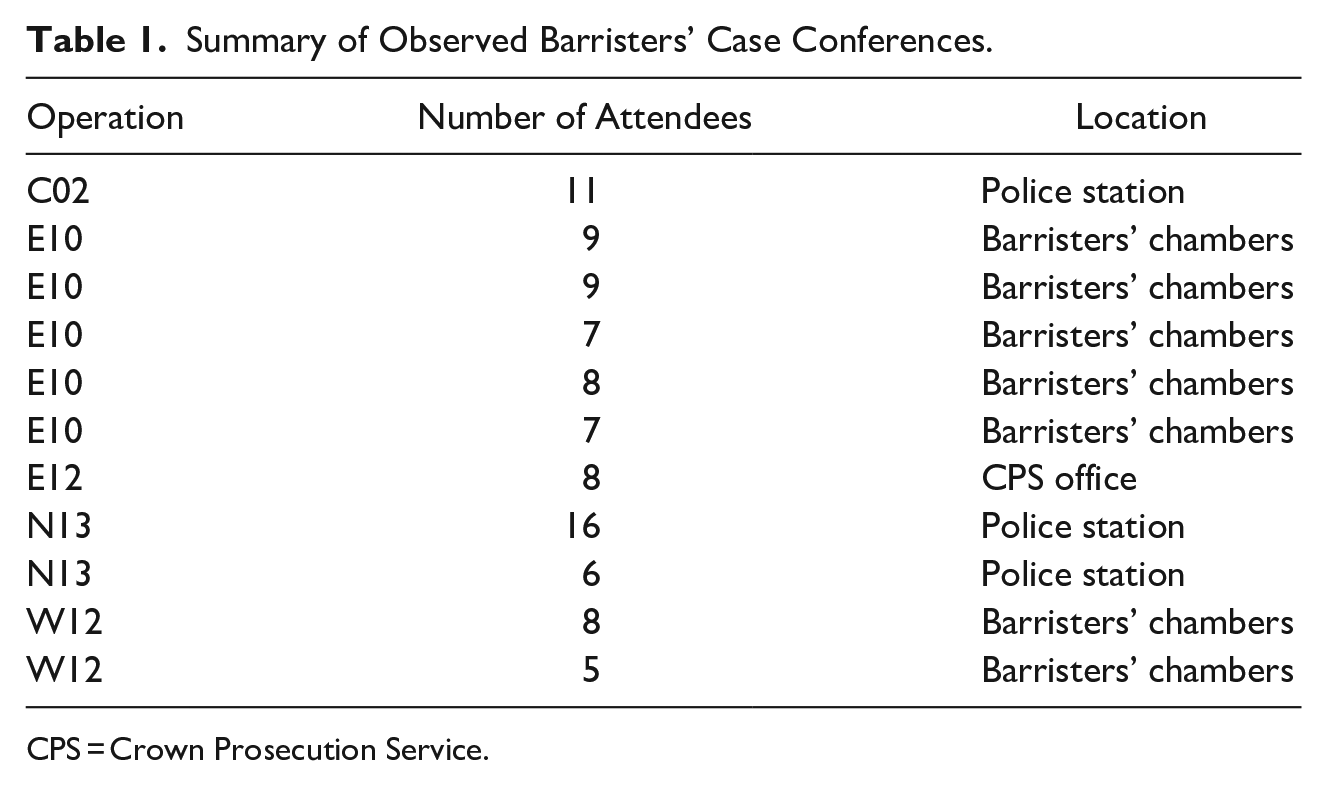
CPS = Crown Prosecution Service.
Interview transcripts, field notes, case papers, and notes made from these were all uploaded into QSR NVivo 12 and analyzed thematically (Braun and Clark 2006). This involved engaging regularly with the data and ultimately creating memos containing reflections and nodes of conceptual categories in accordance with grounded theory (Corbin and Strauss 2008). Nodes were created to capture the different kinds of work that happens in case conferences, for example, decisions around disclosure and the interpretation of results from forensic examinations. We also captured some of the challenges of collaborative working, such as sharing CCTV footage. Several nodes related to the preparation of the courtroom performance, for example, “setting,” “props,” and “allocating parts.” These nodes form the focus of this paper, which we interpret using a dramaturgical framework.
In terms of positionality, the authors, who collected all the data, are both white, British females and, at the time of data collection and analysis, were in their early and late forties. We had substantial experience in homicide investigation and the environment of major crime investigation. The lead author was a former review officer 5 and had specialist knowledge of systems and processes, and shared occupational knowledge that was of practical benefit but also allowed her to engage in conversations about “the job” and investigative work. The second author had engaged previously in ethnographic research of police homicide units in Britain and the United States and had the benefit of prior exposure to detectives from different backgrounds and homicide units, and other criminal justice actors. While homicide investigation is still predominantly a male-dominated environment, our positionality meant that we were quickly accepted by a broad range of detectives, SIOs, and police investigators as well as barristers and forensic scientists (many of whom were females and of similar age and ethnicity).
Gaining access to the closed world of homicide investigation can be difficult given the sensitive nature of the work of homicide detectives and although we had formal research agreements with each police force, access was multi-layered (Brookman 2015, 243). In the first instance, the experience and credibility of the research team, plus established relationships with key stakeholders, were central to negotiating access to research sites. Subsequently, the relationships that we developed with gatekeepers (e.g., SIOs) and with those actors being observed were pivotal to our ongoing efforts to access people, places, and events. Notably, introductions from SIOs helped us to broach access to barristers, who invited us to submit a project overview, whereupon access was approved in all instances. From informal conversations with those who granted us access to an interview or observe them, it appeared that they agreed because they viewed the research as valuable and were interested in the findings.
During our observations, our previous experience of homicide investigation enabled us to quickly establish rapport and trust with a range of actors. While professional experience was beneficial it was also, on occasion, a “liability.” For example, we were sometimes asked for our opinions or recommendations. While we generally managed these situations by declining to comment, there were occasions when we acquiesced, as we detail later (see also Brookman and Jones, forthcoming). There were times when our different experiences and practitioner/research backgrounds likely impacted how we received some of the information, stories, and worldviews of actors. To account for this, on some occasions, we jointly observed investigations and carefully compared fieldnotes (Brookman and Jones, forthcoming). In this way, we came to understand some of the different ways that we interpreted and recorded our observations.
The research was conducted in accordance with the British Society of Criminology Code of Ethics (2015) with particular attention to the issues of informed consent, anonymity, confidentiality, and stringent data management protocols. To preserve anonymity and confidentiality, all reported data relating to research participants, cases, people, and places have been disguised using pseudonyms or removing identifiable information.
Findings
In this section, we present extracts from our observational field notes to explore in detail the backstage interactions that take place in barristers’ case conferences and how these shape the prosecution performance. 6 We use a dramaturgical framework, drawing on Goffman (1959) and others, to help interpret our findings, and consider how Goffman’s dramaturgical framework might be elaborated. We begin by briefly describing the prosecution’s backstage setting and actors.
The Backstage Setting and the Performance Team
The settings in which we observed case conferences were diverse and included barristers’ chambers, police stations, and a CPS office. We observed barristers attending carefully to aspects such as clothing and posture, as well as the setting of chambers (e.g., furniture and décor), which may all be used to manage frontstage performances (Goffman 1959, 32–4). However, we also observed attendees sharing jokes, which contrasted with expectations of courtroom behavior. Similarly, Flower (2018b, 192) found that while defense lawyers’ offices may be considered frontstage—a place to meet with clients—the strict rules that govern courtroom behavior are relaxed during any lawyer–client meetings, and these spaces are consequently viewed as backstage. As such, we categorize barristers’ case conferences as being held in the planned backstage, that is, they are structured meetings held away from the ultimate intended court audience but in a setting of formality that sets them apart from more informal conversations found in the ad hoc backstage, such as in private offices or corridors (Lewin and Reeves 2011).
Led by barristers, membership in case conferences is not fixed and will change depending on the progress of the case and the needs of the barrister. As a performance team (Goffman 1959), members discuss, shape, and ultimately control the narrative heard at trial. In addition, the team carefully manages the impression that is formed of both the performers and their performance (see Flower 2018a). The work that goes on in these settings continually references, and is mindful of, the looming courtroom arena. This brief insight into the prosecution backstage area serves as a backdrop to contextualize the social interactions that we observed. We turn now to a detailed consideration of this interactional work.
Allocating Parts
Within a performance team, “someone is given the right to direct and control the progress of the dramatic action” (Goffman 1959, 101). The barrister assumes the role of director for the prosecution, taking a lead role in the court performance and chairing case conferences. According to Goffman (1959, 103), one of the special functions given to directors involves allocating parts in the performance (see also Dignan et al. 2007, 8). While Goffman (1959) did not elaborate on how such decisions are made, our observations help to illustrate how barristers, as directors, allocate parts, for example, whether they decide to call a witness to give evidence in court.
Five of the case conferences that we attended related to the re-investigation of a cold case involving a young female who was sexually assaulted and fatally stabbed. Over the decades, there have been several reviews and media appeals. The suspect, Harry, was eventually identified through familial DNA. The team had to decide which of the witnesses who had provided evidence either during the original or subsequent investigations to call to testify in court.
Following one appeal, Thomas contacted the police reporting that on the night of the murder he had seen a male following, and arguing with, a female, near to where the victim’s body was discovered. Although Thomas said he reported this at the time of the murder, a statement was never taken by police. During the re-investigation, an identification procedure took place using an image of the suspect from the time of the murder, but Thomas failed to make a positive identification. At a case conference, five months into the re-investigation, the team discussed whether to call Thomas as a witness and whether his account enhanced the prosecution narrative:
. . . I don’t mind the fact he didn’t pick Harry out 31 years later, it concerns me that he didn’t come forward until 2010. . .
My thought is that he thought he’d already told the police. There’s no record of [scene] cordons, no record of officers or who approached the cordon. . .
I think this is too dangerous, it doesn’t add anything
I wouldn’t agree he doesn’t add anything – he saw the offender running away, there’s no reason to run if it was consensual sex. . . There are positives to using him
. . . There are things that can undermine the case. We want to achieve a conviction for murder. We have great evidence. If [their] view is they are apparently nervous, don’t do it. . .
I’d say he’s not deliberately lying, he’s difficult to keep in focus due to having autism. . .
. . . I’m unhappy about whether the evidence is reliable and will make the final decision later
(Fieldnote, Operation E10, 16th December).
The disagreements or power struggles evident in this extract are not unusual in case conferences and are reflective of the different epistemic cultures of barristers and investigators (Kruse 2016, 62). Specifically, the barrister’s decision not to call Thomas as a witness was guided by her “legal assessment” of the evidence (Kruse 2016, 62), that is, that Thomas (and therefore his evidence) was unreliable. By contrast, the review officer adopted a more “people-centred perspective” (Kruse 2016, 59), arguing that any unreliability could be accounted for (e.g., because Thomas was neurodivergent). To resolve this struggle, the SIO (as director of the investigation) mediated between the review officer and the barrister, but ultimately conceded to the barrister, as director of the performance.
At the next case conference, the barrister decided that she would not ask Thomas to testify because of concerns that he was unreliable and Thomas’ account was omitted from the prosecution narrative. By “dropping” (Goffman 1959, 115), this “problematic” witness from the court performance, the barrister sought to minimize opportunities for doubt about the veracity of the case that she imagined might arise among members of the jury. This strategy also prevented the defense from attacking the witness’s performance. Thus, barristers allocate parts based on assessments of how credible a witness appears and how their testimony will likely be received by the jury.
We were also privy to discussions about whether to allocate parts to expert witnesses. On one occasion, the barrister queried whether to call a forensic scientist to present DNA evidence. The SIO asserted “we don’t want her.” Both the deputy SIO and CPS lawyer explained that they were concerned that the forensic scientist might undermine their case because of her non-committal findings. Guided by these concerns, the barrister agreed that she would not call this forensic scientist to present evidence. Moreover, there were other forensic scientists who appeared better placed to give evidence (fieldnote, Operation E10, 16th December). At the same conference, the barrister decided that the “new” pathologist would testify because of her concerns that the jury would not interpret correctly the evidence provided by the original pathologist:
His report is terrible—there are passages that could be taken in two or three ways by the jury, not clear. Best to call the new pathologist (fieldnote, Operation E10, 16th December).
The barrister had no knowledge of how well the original pathologist would perform in court, and her decision appears to have been influenced by the style of his report and concerns that the jury might become confused by the evidence. Given that one of the central tenets of compelling narration or storytelling is coherence (Brookman et al., 2022), ambiguity is generally avoided in the stories presented by barristers. In short, predictions about how expert witnesses are likely to perform in court, in particular, how clearly or with what levels of certainty, determine whether they are called to give evidence.
We also observed barristers rehearsing how expert witnesses would respond to anticipated defense narratives and how they would answer potential lines of questioning in court. This work helped to inform their decisions about which parts to allocate expert witnesses. In the following example, the barrister wanted to unpack what the forensic scientist might say, if asked by the defense, about the chronology of the sexual assault and the stabbing, given that semen from the suspect was found on both the oral and vaginal swabs from the victim:
What would you say about the sequence of events?
What do I think? He’s stabbed her, they’ve had oral intercourse—we can’t place a time on it, she was fully clothed when stabbed, she’s been undressed, there’s been other sexual activity most likely vaginal, she’s redressed but not her knickers which were deposited away from her body
Weird isn’t it about her knickers?
Yes. . .
I’d like to agree with you how you’re going to answer. This is to go in the conference notes to the defense, so they know it’s been discussed further. Can you make it more explicit, the sexual activity after she was undressed?
Some form of sexual activity involving ejaculation
(Fieldnote, Operation E10, 14th April).
Goffman (1959, 129) alerted us to performance teams engaging in “dress rehearsals” in the backstage. However, it was unexpected to find such rehearsals taking place with expert witnesses. Moreover, our observations reveal how backstage work can help to fix a script for the court. As part of this scripting, Saks (1990, 303) recognized that barristers test what experts are willing to say at trial and negotiate with them—our observations provide a rare insight into how these negotiations are enacted, and the extent to which barristers engage in persuasion. In the following example, the barrister wished to demonstrate to the jury that the statistical evaluation of a DNA result was stronger than that reported in the scientist’s statement and tried to sway the scientist to present their findings differently:
Regarding your “one in a billion” result, I need to work out how to explain this to a jury. I realise that professionally you can’t give the real computer number. I’m aware of professional limitations imposed on scientists. Are you content to explain that there is a ceiling imposed in this country and that the real figure is in excess of this?
Yes
And what about unique occurrence ratio?
That’s not done here. We haven’t got a single source profile and so I can only give a match probability. These other terms are confusing and it is not the recommended way to report these kinds of results. . .
Is it possible to re-jig the likelihood ratio so it sounds like a match probability?
No. The maths behind it doesn’t support that and this is an agreed and recommended way of expressing this result.
(Fieldnote, Operation E10, 14th April)
Frustrated by the reporting limits placed on forensic scientists, the barrister wanted the scientist to report a “bigger,” more impactful result. After the case conference, the deputy SIO confided in us that he thought the barrister was “desperate to ramp up the uniqueness” of the DNA result and that he was uncomfortable with how she was pressuring the scientists to push their scientific interpretation. Despite having a very good understanding of forensic science, the deputy SIO did not challenge the barrister, revealing the power imbalance within the performance team. By contrast, the forensic scientist defended his position during the conference and, in a subsequent interview, explained that he refused to be swayed by the barrister because of the risk that his evidence could be refuted by the defense in court.
The examples presented here reveal how the performance team engages in rehearsals ahead of the trial. These rehearsals arise in response to anticipated weaknesses in the evidence, such as lack of clarity or robustness, and are enacted to manage these risks at the performance stage. The rehearsals that we observed involved the barrister preparing expert witnesses for their appearance in court and considering potential questions or challenges from the defense. In addition, and expanding Goffman’s work, we also observed what we term “auditions.” Distinct from rehearsals, auditions provide an opportunity for the barrister and wider team to test the witness’s knowledge, suitability (e.g., how personable they appear), and skills to (later) perform in court. Based on these auditions, the barrister decides whose performance will enhance the prosecution narrative and be permitted to perform on the front stage. To guide their decisions, the team often shares their impressions of potential witnesses (see Wittenberg-Lyles et al. 2009, who detail similar backstage discussions about patients in hospice team meetings).
In one particularly enlightening moment, after three forensic scientists had been “auditioned,” the barrister turned to all of those present at the conference (ourselves included) and asked, “who do we ask to present the DNA evidence?” We were each invited to comment in turn on the persuasiveness of the three scientists we had observed and how well we thought each had presented. 7 The barrister also shared her views. She explained that while she “liked” one of the forensic scientists, she found “a nervousness about him.” She also recalled that she and the SIO had seen this scientist “crumple” in a previous court case (fieldnote, Operation E10, 14th April). Goffman (1959, 173) described such discussions as “staging talk” when, away from the audience, the performance team discusses potential staging problems. As Goffman (1959, 174) puts it, “the reception given one’s last performance is mulled over in what are sometimes called ‘post mortems.’” In the discussion that we observed, the barrister and SIO noted the forensic scientist’s earlier performance as a potential disruption to the prosecution’s performance in court. Interestingly, despite her reservations, the barrister decided to call this forensic scientist to present some of the DNA evidence. She chose another scientist to report and explain the statistical analysis of the DNA results on the grounds that he had specialist expertise to present statistical evidence and, as the barrister put it, “that is a crucial bit.” The third scientist, she dropped altogether.
Stage Props
Goffman (1959, 32) remarked that performers use props as part of their frontstage performances. However, although he briefly considered their role in impression management (217–8), he did not elaborate on this. Recently, Flower (2018a, 230) added to Goffman’s (1972) concept of “little dramatic productions” with “little dramatic reductions,” illuminating how defense lawyers overcommunicate certain facts and under-communicate others using props and emotional displays. For example, Flower observed defense lawyers polishing their glasses to detract from and trivialize the impact of potentially damaging information that was being presented by the prosecution. Our observations reveal the kinds of “stage props” that are used in homicide trials to support the presentation of evidence and how they are decided upon within case conferences. These might include murder weapons, exhibits relating to the victim or defendant (e.g., clothing) or photographs of crime scenes or injuries.
Sometimes, stage props are used to provide impact to the prosecution narrative, that is, to make the story more powerful. Since jurors in the UK are prohibited from discussing any aspect of jury deliberations either during or after the trial, barristers infer which props jurors will find impactive. For example, during our observations of a case conference regarding a fatal shooting on a travelers’ site, the team discussed taking the jury to visit the site:
Everyone agrees that it is important for the jury to be taken to the site. . . The barrister says to focus on the address where the murder weapon was found, where the witnesses were standing and the blood on the ground from the incident (fieldnote, Operation E12, 9th September).
In a subsequent interview, the SIO explained that the decision to take the jury (as well as the judge, counsel, and defendants) to the scene was partly undertaken for effect but also to convey to the jury the height of a grass bank and fences (near to where the shooting took place) and the close proximity of the various caravans. Photographs were deemed inadequate to capture the scale and detail of the scene.
During another case, we observed discussions between the barrister, deputy SIO, and forensic scientist about how best to present and explain the DNA evidence in court, given the evolution of DNA profiling methods. The barrister was keen to combine DNA results from the case with a generic handout produced by the forensic science provider that explained DNA, to help the jury understand the processes involved and, importantly, the significance of the DNA results (fieldnote, Operation E10, 6th April). At a subsequent case conference, a similar discussion with another forensic scientist ensued, including whether to have the DNA profile represented as a picture or numerically. The barrister stated “I’d prefer it visually, makes more of an impact. A picture paints a thousand words” (fieldnote, Operation E10, 14th April).
In a different case, the fatal stabbing of a young male, we observed discussions of how best to present CCTV footage and phone data related to the two suspects who traveled to and from the scene of the murder on bicycles:
We have now met with [our technical unit] and they can enhance the colours on images and insert rings or arrows where appropriate on the [CCTV] package to highlight particular people, etc. . .
What I envisage doing. . . is including an arrow to suspect one, for example, a red arrow. . . or a circle. Then it’s always a red arrow or circle throughout for him. . . So, just for presentation, we will go with a colour coded system, it’s not rocket science!. . .
I have already used colour coding on all of my phone work charts to depict and separate out key players
I will try to use the same colours
(Fieldnote, Operation C02, 18th October).
The barrister directed how the evidence should be packaged and presented to the jury in a way that simplified the presentation of large amounts of (sometimes) complex data (for a similar account, see Wettergren and Bergman Blix 2016). These extracts of backstage discussions illustrate the importance assigned to clarity in the presentation of evidence at trial and align with Offit’s (2021) findings that prosecutors presumed that jurors who were confused by evidence or who misunderstood it might perceive defects in the case.
Lastly, we observed backstage actors anticipating how jurors might react to certain props. In the example below, the barrister imagined how jurors might respond when viewing photographs of the victim’s injuries:
We have amended the photo albums; they’ve been produced without close-ups. One wound can’t be seen though. There’s an arrow to it but you can’t see it as it’s on the victim’s side
That’s fine. We need to be cautious. We don’t know who we’re going to have on the jury and how freaked out they’re going to be. We want to reduce horror levels as much as we can
(Fieldnote, Operation E10, 14th April).
We also witnessed a contrasting sentiment. During one case conference, the barrister, CPS lawyer, and SIO discussed what imagery to show at trial and all agreed that the X-rays of injuries to the victim (who had been shot at close range) were very impactive and should be used at trial (fieldnote, Operation E12, 9th September). Other researchers have also observed occasions when prosecutors aim to shock members of the jury. During Offit’s (2021, 482) observations (in Sweden), one prosecutor commented that photographs of physical injuries “should have a ‘blockbuster’ effect that would bowl the jury over or not be used at all.” In the following section, we explore in more detail how the team manages the impression that the jury receives of their performance.
Impression Management
The examples that we have drawn upon so far reveal how a series of actors constantly anticipate what impression the jury will form of the performers and their performances, and undertake work to manage these impressions (Goffman 1959), by negotiating which actors should be allocated parts, deciding upon scripts, and carefully choreographing stage props. In the following sections, we illuminate some further strategies adopted in barristers’ case conferences to manage the eventual impressions that the jury receive. As will become apparent, this collaborative backstage work is intended to arrive at a prosecution narrative that is more credible and plausible than that delivered by the defense (Jasanoff 1998).
The Character of the Characters
Drawing upon his study of homicide investigations, Innes (2003, 167) suggests that detectives produce moral identities for victims and suspects, such as the “undeserving” victim and the “malevolent” suspect. Our previous analysis also reveals how, within the pre-trial phase, narratives are assembled that pit the “good” victim against the “bad” suspect, and, importantly, that these typifications extend to other characters, including witnesses (Brookman et al., 2022). Here we will discuss examples of backstage work that help to shape the “character of the characters” in readiness for the adversarial trial. In essence, this work involves “highlighting the good witnesses on one’s own side and protecting the poor witnesses, while at the same time attacking the weaker witnesses on the other side and limiting the damage of their stronger ones” (Morison and Leith 1992, 142).
Previously, we illustrated how “problematic” witnesses are dropped from the performance if it is judged that the (imagined) audience might consider them unreliable or dishonest. However, this unsurprising strategy is not always possible. There are occasions when problematic witnesses cannot be dispensed with because their testimony is critical to the prosecution narrative. The following extract is taken from a case conference concerning the fatal stabbing of Keith, witnessed by his friend, Findley, who subsequently named the two offenders. Both Keith and Findley were known by police to be drug dealers and the barrister and detectives were concerned that Findley had not been truthful about why he and the victim encountered the offenders:
Clearly Keith and Findley are involved in drugs too
We’ve got to focus on what our case is. What do we say? If we rely upon what Findley our key witness says, it’s all over nothing. So we have to be a bit cute about how we play this. Given that this case depends almost entirely upon a witness but he is not telling the truth entirely I’m nervous about doing anything to undermine his credibility. So the issue of drug dealing has to come from the defence at the moment, tactically. The defence say that the victim was there for a drugs deal. Findley says it’s all over nothing and there is no mention of drugs
(Fieldnote, Operation C02, 18th October).
Confronted with evidence that impacted negatively on the character of both the victim and the key prosecution witness, the prosecution decided not to present motive as part of their narrative, reasoning that it would alert the jury to the damaging fact that both were involved in drug dealing. Backstage work also includes managing how the jury will perceive the defendant. This may include discrediting the defendant’s character (as a kind of witness), which, in turn, discredits their testimony, leading the judge and jury to question the veracity of the defense case (McBarnet 1980, 172). In the example below, Brian was suspected of fatally stabbing his partner, Wendy. Evidence suggested that Brian had attacked Wendy because he thought that she had passed to him a sexually transmitted disease (this was proven not to be the case) and, in the meeting, the barrister sought opportunities to “blacken his sexual character and not hers” through medical records. As part of this work, the barrister saw an opportunity to acquire further damning evidence of bad character from mobile phone data:
We have Brian’s phone and Wendy’s two phones. . .
We need to paint as dirtier a picture as possible to the jury. . . I suggest you look for any spyware on Wendy’s phone. . .
There were 40 text messages the day before the murder between Brian and Wendy plus a picture message. . .
It would be nice to see if there are any threats
(Fieldnote, Operation N13, 8th June).
Anticipating the forthcoming trial, this backstage work serves to undermine the credibility of the defendant while enhancing or protecting the credibility of prosecution witnesses. Work is also undertaken backstage to manage how jurors might digest the narrative that is presented by the prosecution.
The (Emerging) Plot
Criminal justice actors undertake work in the backstage to fix upon the narrative that is eventually presented in court. Although we focus here on the plot, other key components of the prosecution narrative include character (discussed above), motive and intent (Brookman et al., 2022). The plot is used by barristers to tie together witnesses’ “stories and bits of stories,” giving them structure (Rock 1993, 75). Throughout this work, prosecution actors consider hypothetical jurors’ potential interpretations of the narrative (Offit 2021). Here we explore how plots are prepared backstage and how “troublesome knowledge” (Nic Daiéd 2007) that threatens to undermine the emerging plot is managed.
During barristers’ case conferences, actors deliberate over plotlines, ever mindful of how the ultimate story will be received by the jury and, in some instances, the judge. In the following example, the prosecution team was troubled by the lack of forensic evidence linking the defendant to the fatal stabbing of a female, although there was evidence of a sexual assault. The barrister and detectives imagined that the defense could argue that the defendant happened upon the victim’s dead body and engaged in necrophilia. To refute this notion, the barrister hoped to demonstrate to the jury that the victim was alive during the sexual assault, having scratched the defendant during a struggle:
Can you help me with the nail clippings. . . Does it add anything?
No
I wondered if it helped show she’d try to defend herself – cellular material?
That was our aim, but they were heavily blood stained. It doesn’t indicate she scratched him
(Fieldnote, Operation E10, 14th April).
Since the forensic scientist could not say that the defendant’s DNA, found on the victim’s fingernails, had come from the skin (cellular material), the barrister determined that this plotline be dropped from the narrative and that she would not draw upon this evidence at court. Toward the end of the case conference, we observed a discussion between the barrister and the deputy SIO about how best to set out the sequence of events regarding the sexual assault and murder of the victim. The discussion focused on damage to, and positioning of, the victim’s clothing, and blood distribution, and whether these helped to establish the ordering of events. Once again, forensic evidence was not helpful—it did not support a clear sequence of events. The barrister declared, “I’m going to try to not present a clear chronology—I’ll be the mistress of understatement” (fieldnote, Operation E10, 14th April).
Thus far, we have focused on how prosecution actors working backstage anticipate how the jury will digest the plot. However, the team is also cognizant of, and sensitive to, how the judge will evaluate their evidence. They are acutely aware of the judge’s fundamental role in the trial and their power to determine whether the jury hears certain evidence or not or to halt a trial. During one case conference, we observed a discussion between the barrister and detectives about whether to divulge how guns were acquired and brought onto the travelers’ site where the murder occurred:
We will not be able to go into this. The fact that they [guns] are all over the place and that there is a history of firing them is what we’ll deal with—not whether they were acquired illegally. . . So, no to following the trail of the weapons. The judge would not let us, and it doesn’t bear upon the issues of the case. . . (fieldnote, Operation E12, 9th September).
Barristers are knowledgeable about what points of evidence might be vulnerable to challenge by the defense and upheld by the judge. In this instance, while detectives were keen to explain how the murder weapon (and other guns found on the site) had been stolen two years’ previously, the barrister thought that they would be reprimanded by the judge if they included this history. Knowing that the guns were acquired illegally was irrelevant to proving (or disproving) the facts at issue.
Discussion
This paper unravels the interactions, deliberations, and negotiations that are enacted backstage in prosecution barristers’ case conferences. Drawing on Goffman’s (1959) dramaturgical framework, we elucidate how the performance team, including police, scientific and prosecution actors, prepare homicide cases for the adversarial trial. We explore and conceptualize the social interactions that unfold in these spaces, shifting attention away from frontstage dynamics and practices visible in the courtroom. To our knowledge, no other researchers have examined prosecution barristers’ case conferences in this way. Here we discuss our findings and their significance.
Our findings reveal how prosecution actors undertake a series of backstage activities designed to manage the impression that the jury (and judge) will form of their case. This includes negotiating which actors should be allocated parts, assessing how they will perform, settling upon scripts, and choreographing stage props.
Within the performance team, the barrister assumes the role of director for the prosecution, taking a lead role in the ultimate court performance but also presiding over backstage case conferences. A fundamental function of the director is to allocate parts in the performance. While Goffman (1959) recognized both this role and function, he did not elaborate on how such decisions were made. Advancing Goffman’s work, this paper demonstrates that within homicide cases, decisions are guided primarily by predictions of how well actors (witnesses) will perform and how their performance will likely be received by the audience (primarily the jury). These decisions are informed through collaborative exchanges that take place backstage, as the barrister clarifies accounts and explores responses to anticipated defense narratives or potential lines of questioning at court. Potential disruptions to the prosecution performance (i.e., staging problems) are also discussed within the team. Consequently, in some instances, problematic actors are dropped from the future court performance. As part of this work and in preparation for the frontstage, scripts are fixed, and rehearsals are held. Expanding upon Goffman’s framework, our observations reveal a further dramaturgical device—auditions—which allow barristers to test the knowledge, suitability, and skill of potential actors. Rather than a mere run-through, auditions enable barristers to assess the credibility and coherence of actors and their performance and are used to guide their decisions about whom to allocate parts.
While props are a feature of Goffman’s dramaturgical framework, he did not consider their function in any detail. Our observations reveal how and why certain props are chosen to be used in homicide trials and the backstage deliberations that inform these decisions. Of note, we find that preference is given to visual representations of evidence, especially those that simplify complex data or information. While others before us (e.g., Wettergren and Bergman Blix 2016) have explored how prosecutors anticipate the actions and reactions of professionals and laypeople when preparing for trial, they have not reflected on how these deliberations influence the selection of evidence for presentation at court. Our research highlights occasions when barristers selected props because they anticipated that jurors would find them impactful. On other occasions, by contrast, props (e.g., photographs of the victim’s injuries) were altered to minimize the distress that might be caused to jury members. Throughout these backstage interactions and negotiations, the performance team carefully choreographed their future court performance, planning which stage props to use and shaping how they should be presented.
Advancing Goffman’s work on impression management, our findings highlight backstage activities that help to shape the character of the characters in readiness for the court performance. For the prosecution team, this involves giving center stage to their most credible witnesses and/or undermining defense witnesses. Our observations revealed occasions where the performance team dropped weaker prosecution witnesses from the performance, while in other instances, problematic essential witnesses were retained, but the team engaged in a process of damage limitation. On some occasions, plotlines were altered to manage the impressions that the jury might form of key prosecution witnesses (and victims), on others, work was undertaken to discredit the character or credibility of the defendant.
Our findings reveal how backstage work enables prosecution actors to fix upon the narrative that is eventually presented in court and how this work is achieved. Importantly, our fieldnotes illuminate how, for example, when presented with troublesome knowledge (Nic Daiéd 2007) that threatens to contradict the emerging narrative, barristers may drop or reframe plotlines. The aim, in all this backstage work, is to settle upon the most robust prosecution narrative and to deliver a compelling and credible prosecution performance at trial.
Our observations indicate that anticipatory work is crucial in guiding the evolution of the prosecution case and emerging narrative. Innes (2003) briefly discussed how anticipatory work guides the police in constructing their cases. Our observations reveal the nature and extent of anticipatory work in the context of barristers’ case conferences, that is, how the performance team constantly predicts jurors’ interpretations of both prosecution performers and their performance (and, in some instances, extends these considerations to judges). Several implications emerge from our findings.
Fielding (2013, 303) asserts that “Adversarial justice is, ultimately, a contest over who is allowed to tell the story.” Equally, we suggest, it is about how that story is told and who might be believed. Our findings document some of the power struggles inherent within prosecution backstage spaces, given the different epistemic cultures of prosecutors and investigators (Kruse 2016). Through the processes of auditions and rehearsals, barristers decide whom to include and exclude from the storytelling drama that unfolds at trial—settling upon those they think are most convincing, robust, and coherent. On some occasions, information or prior knowledge of past performances is drawn upon to choose the “best” actors.
Given the focus on performance, it follows that barristers may be excluding witnesses who have important and relevant stories to tell, but whose performance credentials are seemingly troubling or less than optimal. For example, individuals who struggle to provide the clearest or most comprehensible account, such as witnesses who are neurodivergent or those perhaps for whom English is not their first language. It is possible that this might impact unfairly on particular social groups or homicide cases.
Even when a witness is allowed to tell their story, their account may be curated. We found instances of barristers scripting expert witnesses’ accounts and attempting to reposition scientists’ findings. While we may expect defendants to be coached by their solicitors (Carlen 1976, 66), it is surprising to observe expert witnesses’ testimony and performance being negotiated in such ways; after all, as forensic scientists reminded us, their duty is to the court and not the prosecution. Not all witnesses called by the prosecution may have been “coached” in this way or to such an extent. For instance, we did not observe lay witnesses attending barristers’ case conferences nor were all expert or police witnesses asked to attend. Instead, prosecution barristers appeared to focus their attention on witnesses whose evidence was central to the narrative and whose evidence might ultimately be refuted by the defense.
As part of this curation, barristers may drop or reframe plotlines that threaten to undermine the narrative. While barristers are prevented, in the UK, from knowing how the jury interprets the evidence heard, there appears to be a shared understanding among prosecuting actors that certain elements help to enhance plotlines, making them more convincing than others. For example, plotlines that include character, motive, and intent (Brookman et al., 2022, 360). Our previous analysis (Brookman et al., 2022, 362) also suggests that evidence from forensic science and digital technologies are increasingly crucial to credible homicide narratives. Our current findings illuminate how and why barristers sometimes drop or reframe plotlines that are not supported by forensic science. It is not clear whether this shift in emphasis of what “counts” as robust evidence is being influenced by, or is being filtered through to, jurors who now come to expect cases to be supported by forensic science or digital evidence and perceive deficits in a case when such evidence is not available.
Another important implication of our findings relates to an imbalance in backstage preparatory work between prosecution and defense teams. To elaborate, the use of backstage auditions for the selection of the “best” expert witnesses seems to be a luxury only afforded to the prosecution. Defense teams, rather than having their “pick” of experts, appear to be restricted to the cheapest, as approved by the legal aid agency (Bellamy 2021, 138).
Relatedly, the use of rehearsals during barristers’ case conferences enables the prosecution team to delve into scientific evidence, test it, and explore how best to present it. By contrast, a recent study of criminal defense lawyers and their use of digital evidence suggests that defense counsel have limited opportunities to meet with experts and discuss findings (Wilson-Kovacs et al. 2023). The implication of this imbalance in the opportunity to explore and curate evidence is self-evident—it may provide the prosecution with an unfair advantage over the defense and undermine due process.
In conclusion, ethnographic research of the kind discussed in this paper affords us a rare and fascinating glimpse into the mindset and working practices of prosecution actors. Most notably, perhaps, the extent to which they engage in anticipatory work—imagining what their adversaries might make of their frontstage performance and how it might be countered—to “win.” These imaginings, some of which seem to border on the absurd (e.g., anticipating that the defense might propose that the defendant was not guilty of murder, rather of the sexual assault of a corpse that he happened across), help to explain the lengthy and detailed evolution of prosecution narratives behind the scenes before their final elocution in the courtroom.
McBarnet (1980, 126, emphasis in original) reminds us that “What is seen in court is molded by all sorts of unseen factors and what is not put on public display is exactly
Footnotes
Acknowledgements
We would like to thank the anonymous reviewers for their insightful and helpful comments. The authors wish to thank the Trust for the opportunity to undertake this research. The authors extend their gratitude to all of the detectives; police staff; forensic scientists; crime scene managers and coordinators; forensic accounts, submissions, and budget managers; prosecutors; judges; and other specialists within and beyond the criminal justice system who kindly gave up their time to take part in the research.
Declaration of Conflicting Interests
The author(s) declared no potential conflicts of interest with respect to the research, authorship, and/or publication of this article.
Funding
The author(s) disclosed receipt of the following financial support for the research, authorship, and/or publication of this article: This work was supported by the Leverhulme Trust [grant number RPG-2014-143]. The paper is based upon research that was funded by a Leverhulme Trust Grant and which involved Professor Robin Williams (Faculty of Health and Life Sciences, Northumbria University and School of Applied Social Sciences, Durham University) and Professor Jim Fraser (Centre for Forensic Science, University of Strathclyde).
