




Abstract
In total, 139 Texas special education due process hearings that occurred between 2011 and 2015 were examined. Cases were coded with regard to the student’s special education disability category; the number of hearings in which a specific party prevailed; the primary, secondary, and/or tertiary issues of the case; the number of issues in these hearings held for the student/family, the district, and issues held in part for the student/family and in part for the district. Overall, the primary student eligibilities involved in these cases were autism, emotional disturbance, and other health impairment. In addition, the most common issues involved in the dispute included the Individualized Education Program (IEP), evaluation, and placement. Districts prevailed in approximately 72% of cases. Findings are compared with previous data, and implications are discussed.
The Individuals With Disabilities Education Improvement Act (IDEIA; 2004) requires school districts to identify students with disabilities and provide identified students with a free appropriate public education (FAPE) in the least restrictive environment (LRE). This process is quite involved, and actually begins prior to a referral for special education assessment, in that resources and interventions delivered in general education are attempted and documented regarding student progress. Once a student is suspected of having a disability, that student is referred and the process begins with a Full Individual Evaluation (FIE). If a student is eligible, the process culminates in the development of an Individualized Education Program (IEP). The IEP team, composed of a variety of school personnel and the student’s parents, makes decisions regarding eligibility (e.g., Does the student qualify for special education? Specifically, does he or she meet the criteria for a disability condition, and by reason thereof, does he or she need specialized instruction?), educational programming (e.g., What are the student’s needs regarding accommodations and modifications, including modified standards with specific goals and objectives for various courses, assistive technology, various related services such as counseling, speech/occupational/physical therapy?), and placement (e.g., In what type of program or class will the student be educated, and how many minutes will be spent in such classes, including access to general education?). Numerous other issues are addressed, and many decisions are made in the IEP meeting; the ultimate outcome is the student’s total educational program.
Given the complexity of this process and the many issues that arise, it is safe to say that there can be conflict and differing opinions. As Zirkel and Gischlar (2008) pointed out, in some cases the school district and parents disagree with the decisions of the IEP team which may include eligibility conclusions or proposed services recommended by the team. When such disagreements occur, various forms of dispute resolution are used to try and resolve the conflict. Blackwell and Blackwell (2015) explained that “there are three formal procedures for resolving special education disputes: mediation, resolution meetings, and due process hearings” (p. 1). Due process is a procedural safeguard under Individuals With Disabilities Education Act (IDEA; 2004), and Code of Federal Regulations (CFR) §300.507 of the IDEA specifically addresses this right: “a parent or a public agency may file a due process complaint on . . . the identification, evaluation or educational placement of a child with a disability, or the provision of FAPE to the child.”
Blackwell and Blackwell (2015) noted that due process hearings are more costly, not only in monetary terms but also in the amount of time spent and in the impact on relationships. In 2013, the American Association of School Administrators (AASA; Pudelski, 2013) issued a report based on the results of a survey of 200 school superintendents. They identified cost and emotional burden as major factors in deciding whether to move forward to a hearing. Regarding cost, the AASA report noted that “school districts across the United States spend over 90 million per year in conflict resolution” (Pudelski, 2013, p. 23). Almost all superintendents (95%) indicated that due process hearings resulted in high levels of stress. About one fourth of the superintendents (24%) also indicated that teachers who have been involved in some form of litigation (a due process hearing or similar proceeding) either leave the district or request transfers out of special education 10% to 25% of the time.
There have been numerous studies on various aspects of due process hearings (e.g., cost, perceptions by different education groups and parents, number of issues and outcomes regarding the party who prevailed in the hearing, legal representation for parents, disability category), and most relevant to this investigation are the aspects of disability category, issues, and outcomes.
Regarding disability category, Yocom (2010) found that the autism disability category was overrepresented in due process hearings in Texas. Mueller and Carranza (2011) found the most frequent disability categories to be learning disability, autism, and health impairments. Shuran and Roblyer (2012) noted autism, low-incidence disabilities, multiple disabilities, and learning disability to be the most common disabilities in hearings. Blackwell and Blackwell (2015) found the most common disability categories to be multiple disabilities, learning disabilities, autism, and emotional/behavioral impairment. These authors note that when one disability category was not clear as the primary category, they coded the case as multiple disabilities; thus, multiple disabilities had the highest percentage.
Regarding issues, there are usually multiple issues in a specific case, making the percentages noted by various researchers not equal to 100. In general, the major categories of issues are relatively consistent across hearings. Mueller and Carranza (2011) found that the most common issues were placement (25%) and IEP and program appropriateness (24%). Shuran and Roblyer (2012) found that FAPE was the most frequent issue (78.6%), and 50% of hearings had multiple issues. Cope-Kasten (2013) found that the most frequent issues in hearings were IEP (47%), service provision (42%), evaluation (38%), and placement (35%). Blackwell and Blackwell (2015) found the most common issues to be IEP (34.3%), placement (30.4%), procedural safeguards (10.3%), and evaluation (8.5%).
Regarding outcomes, Newcomer and Zirkel (1999) examined a random sample of 200 published court cases from January 1975 to March 1995 in which the decisions of the due process hearings were appealed to either a federal or state court (the population of hearings from which this sample was derived was 414). According to the authors, districts won in 60% of the cases, but on appeal, “the margin of district victories was narrowed (49% for districts to 41% for parents)” (Newcomer & Zirkel, 1999, p. 479). In a study by Archer (2002), 343 hearings in Illinois were reviewed from the time period of July 1997 through June 2002. The district prevailed in 69.5% of the hearings. Rickey (2003) examined 50 hearing decisions in Iowa between 1989 and 2001, and districts prevailed in 63% of the hearings.
More recent studies are consistent with the trend of districts prevailing in the majority of hearings. Mueller and Carranza (2011) conducted a descriptive analysis of 575 hearings that occurred in 41 states in 2005 to 2006. Parents initiated 85% of hearings, and districts prevailed in 59% of the hearings. Cope-Kasten (2013) reviewed 210 hearings in Wisconsin and Minnesota that occurred between 2000 and 2011, and found that districts prevailed in 90% of the hearings. Yocom (2010) examined 122 hearings in Texas from 2006 to 2008 that included 480 separate issues or disputes. Of these 480 issues, 82% (393) were ruled in favor of the school district. Blackwell and Blackwell (2015) examined 258 hearings over an 8-year period in Massachusetts from 2005 to 2013, and “districts prevailed in 55% of hearings and received a mixed decision in an additional 24.4%” (p. 8). There were 496 issues in these hearings, and “districts prevailed on 62.5% of all issues and received a mixed decision in an additional 10.3%” (Blackwell & Blackwell, 2015, p. 8).
The issue of legal representation for parents is important to note. In the Blackwell and Blackwell (2015) study, parents with attorneys prevailed in 30.8% of hearings, but this number declined to 20.5% when representing themselves with advocate support and 10.7% when representing themselves without any support. In the Cope-Kasten (2013) investigation, 0% of parents prevailed if unrepresented by an attorney. In a review of hearings from January 1, 1978, to December 31, 2012, Zirkel (2015) noted that parents won 58% of cases in which they had legal representation versus 14% of cases when they were not represented. It is clear from these investigations that parents fare much better if represented by an attorney.
Zirkel and Gischlar (2008) documented the number of adjudicated hearings in the 50 states from 1991 to 2005. They noted that hearings increased between 1991 and 1997, and plateaued at a relatively high level from 1997 to 2005. Texas ranked eighth in total number of hearings, but 28th based on per capita rate (adjusted totals in relation to the annual special education enrollments). In the table presented on page 31 of the Zirkel and Gischlar article, Texas had 902 hearings during the 15-year period reviewed. That is approximately 60 hearings per year. Since 2005, the number of hearings has been greatly reduced. It should be noted that the IDEA was substantially amended in 1997 and 2004 which may be factors in the plateau and subsequent decline of due process hearings. In Yocom’s (2010) dissertation, which examined hearing decisions in Texas from 2006 to 2008, there were 122 cases (approximately 40 hearings per year). Zirkel (2014) updated the longitudinal analysis of the frequency of hearings by examining the number of filings and adjudications for the time period 2006-2011. Texas was ranked eighth in total adjudications (average 27) and ninth in filings (total 318). Although Texas has reduced the number of hearings, Texas remains within the top 10 for both number of adjudications and number of filings.
The purpose of the present investigation was to review due process hearings in Texas over a 5-year period from 2011 through 2015. Of particular interest were the disability categories of students, the number and types of issues in the hearings, and the outcomes. Regarding outcomes, there is an important concept to consider which involves the type of due process system used in the state. In states with a two-tier system, the hearing officer decision, if appealed, is reviewed at the state level prior to entering the court system. Texas is a one-tier state, which means that the decisions of the hearing officer, if appealed, go directly to the court system. In this study, the authors examined the actual due process hearing decision and did not examine whether any of these hearings were appealed. The following research questions were addressed:
Method
Data Source
The data set for the current study included 140 special education due process hearings issued by the Texas Education Agency (TEA) between January 1, 2011, and December 31, 2015. All hearings were available from the TEA’s website (http://tea.texas.gov). All due process hearing decisions were downloaded and reviewed. A database was created to assist with coding, data entry, and data analysis. One due process hearing was excluded from the analysis as the case was related to a previously filed hearing.
Coding and Analysis
Upon reviewing each case, trained raters logged each case in the database. Coding procedures were similar to those outlined by Blackwell and Blackwell (2015). Initial codes were identified and refined during the establishment of interrater reliability training. Trained graduate students assisted with reviewing the cases and coding. The final coding scheme was determined by the two principal investigators as noted below:
Attorney representation of student/family: The representation of the student/family by an identified attorney during the due process hearing. Within this category, some families also had parent advocates during the case; however, those students/families represented solely by advocates were not included in this category.
Issues held for school: The number of issues held for the school district by the hearing officer.
Issues held for student/family: The number of issues held for the student/family by the hearing officer.
Issues held in part for district and in part for student/family: The number of issues where a split occurred, indicating that a portion of the issue was held for the district and a portion of the issue was held for the student/family.
Prevailing party: The party (either student/family or district) with the majority or substantial number of issues that prevailed in the case based on the hearing officer’s decision.
Primary special education eligibility: The primary disability of the student as noted in the hearing decision. These disability categories are based on the special education regulations of Texas. For those students without an identified special education eligibility, the student was coded as “not eligible.” Some students had protections afforded under Section 504.
Issues: Up to three (primary, secondary, and tertiary) issues were identified for each case. The categories for issues were coded based on criteria adapted from Blackwell and Blackwell (2015) and were as follows:
Evaluation: Evaluation process and procedures for determining areas of need and potential services, including independent education evaluations and the selection/qualifications of evaluators.
Extended School Year Services (ESYS): Special education and related services provided to eligible students beyond the typical academic calendar.
Identification: Eligibility determination for special education services.
IEP: Components and development of the IEP, commonly examined to determine the extent to which the IEP was calculated to provide a FAPE in the LRE. Predominantly, this category addressed the goals, objectives, accommodations, and modifications made to a student’s program of services.
Placement: Location of special education services for a student, including services provided in general education settings and specialized settings that will provide the student access to the general education environment to the appropriate extent; included unilateral placement by parent.
Procedural safeguards: Procedural protections afforded to students, parents, and schools through federal and state special education laws and regulations; included timelines, parental consent, and written notices.
Related services: Developmental, rehabilitative, corrective, and supportive services that are necessary to assist a student in accessing and benefiting from special and general education services; included specialized transportation, occupational therapy, physical therapy, and orientation and mobility services.
Discipline: Removal of a student from the agreed-upon placement due to disciplinary actions; included both in-school and out-of-school suspensions. Also included manifestation determination review (MDR) disputes involving disciplinary actions or issues related to restraint/seclusion.
Transition: Practices and procedures related to transition planning for secondary students to assist in developing the knowledge, skills, and strategies for accessing and benefiting from postsecondary opportunities such as college, employment, independent living, and community participation.
A total of 46 cases (~33% of due process hearings) were randomly chosen and coded by another rater to determine interrater reliability. Interrater reliability was calculated using the following formula: Reliability = (number of agreements) / (total number of agreements plus disagreements). Agreement for most fields involved matching frequency counts (e.g., number of issues held for a party). For the issues category, agreement was counted when any category among the primary, secondary, and tertiary subcategories matched. This was based on the difficulty in deciding at times what may be considered primary, secondary, or tertiary, but desiring to identify the most pressing issues involved in each hearing. The interrater reliability calculation was 92.49% for the total coding of data. Additional interrater reliability percentages are as follows: (a) attorney representation of student/family = 97.83%, (b) issues held for school = 86.96%, (c) issues held for student/family = 93.48%, (d) issues held in part for district and in part for student/family = 95.65%, (e) prevailing party = 93.48%, (f) primary special education eligibility = 91.30%, and (g) issues = 93.20%. All data were analyzed using descriptive statistics, as the purpose was to describe the cases.
Results
Attorney Representation of Student/Family
In the cases coded for this investigation, approximately 71% of students and families were represented by an attorney (99 of 139). It should be noted that at times families employed the use of advocates in addition to attorneys and sometimes solely advocates. This investigation did not code parents’ use of only advocates during the due process hearing.
Primary Special Education Eligibility of Students Involved in Due Process Hearings
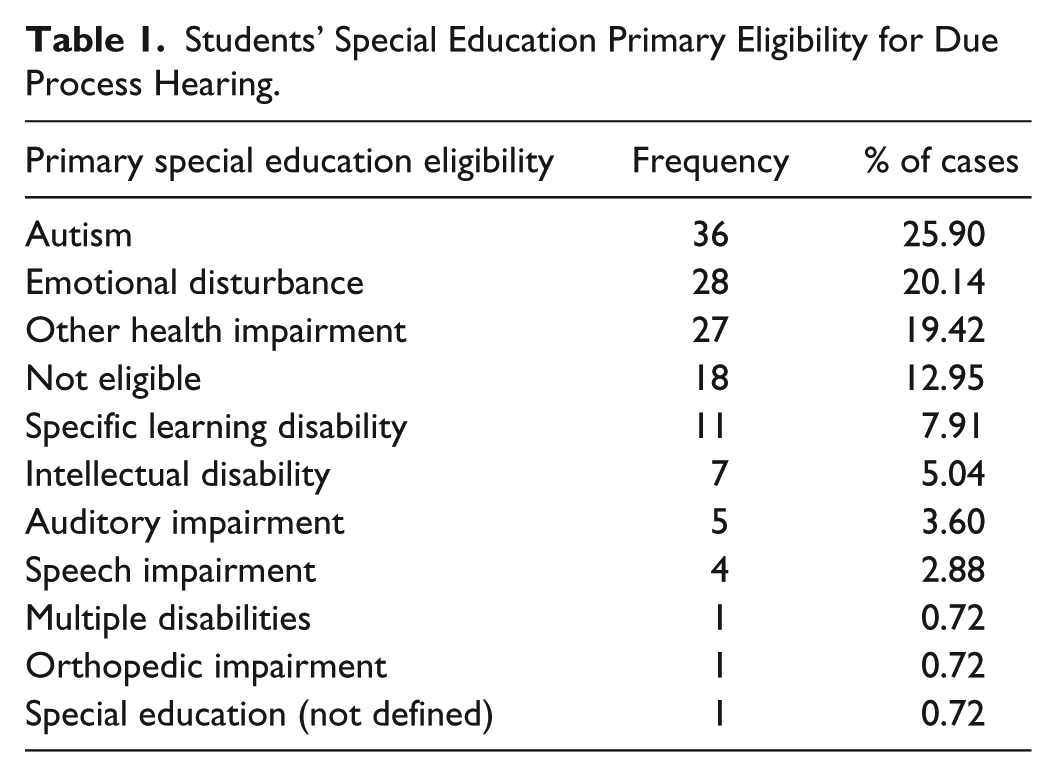
As stated previously, each special education due process hearing was coded to analyze the student’s primary special education eligibility category. Within the time period reviewed, approximately two thirds of all cases involved students with a primary eligibility of autism (25.90%), emotional disturbance (20.14%), or other health impairment (19.42%). While not all cases specified the student’s eligibility for other health impairment, many times attention-deficit/hyperactivity disorder was identified in the hearing and recorded anecdotally in the database. These data are presented in Table 1.
Students’ Special Education Primary Eligibility for Due Process Hearing.
Predominant Issues Involved in Due Process Hearings
In examining the predominant issues involved in the due process hearings, hearings were coded with regard to the top three (primary, secondary, and tertiary) issues involving the case as coded by the raters. Overall, the majority of issues within the due process hearings involved disputes regarding the IEP (62.86%), evaluation (40%), placement (37.86%), and identification (32.14%) (see Table 2).
Issues Identified Within the Special Education Due Process Hearings.

Note. IEP = Individualized Education Program.
Prevailing Parties for Issues and Due Process Hearings
Within the cases, the various issues were outlined by the hearing officer. Of the 139 cases reviewed, a total of 610 issues were decided. Overall, the various school districts prevailed on 479 issues (78.52%), students/families prevailed on 111 issues (18.2%), and 20 issues were split (3.28%). In considering the overall case for which party won on the majority or substantial issues, districts prevailed in 100 cases (71.94%) and students/families prevailed in 39 cases (28.06%). When considering the factor of attorney representation of the student/family during the hearing, families that were represented by an attorney prevailed 34% of the time (34 of 99 cases). Families that were not represented by an attorney prevailed in only 12.5% of hearings (five of 40 cases).
Discussion
Based on the data reviewed, students with the primary disability conditions of autism, emotional disturbance, and other health impairment account for the majority of due process hearings. This is somewhat consistent with data from other studies identifying these disability categories (Blackwell & Blackwell, 2015; Shuran & Roblyer, 2012; Yocom, 2010); however, other investigations also have learning disability as a prominent condition. Blackwell and Blackwell found the top two eligibility categories represented in due process hearings were multiple disabilities (29.1%) and specific learning disabilities (23.6%); however, it should be noted that multiple disabilities encompassed students presenting with more than one disability code. The primary category of learning disability only accounted for approximately 8% of the hearings in this review. It is important to note that in Texas, autism, emotional disturbance, and other health impairment eligibilities make up approximately 29% of the special education population (Texas Education Agency PEIMS Standard Reports Overview, 2016); however, they account for approximately 65% of all hearings. Students with these conditions often have both learning and behavioral challenges which can lead to more complex and contentious IEP meetings. Behavior is a major theme across the hearings.
As noted by Yocom (2010) and further supported in this investigation, autism is overrepresented in hearings in the state of Texas. Across the 5-year period of review, the mean percentage of special education students identified with autism is 9%; however, approximately 26% of due process cases involved a primary eligibility of autism. This is due to both identification and programming issues. Several hearings involved differentiation between autism and other conditions, with parents potentially seeking the autism label. Texas has an autism supplement (Texas Education Agency Commissioner Rules, §89.1055, 2016) which lists 11 strategies/services that must be considered in educational programming for this group. This supplement is not used with other disability categories and creates issues such as student–teacher ratio, methods for instruction, and related services.
The results of the present investigation are consistent with other investigations indicating that school districts prevail in the majority of hearings. In this investigation, school districts prevailed in 71.94 % of the hearings. Many believe that this is due to the resources that districts have (e.g., monetary, attorneys; Blackwell & Blackwell, 2015). However, given the negative impact of hearings (e.g., costs, relationships), districts may choose to settle those cases that are less likely to be won and go to hearings on those cases where they anticipate a favorable outcome. In the current data, the majority of parents (~71%) elected to employ attorneys during the due process hearing—a higher percentage than that reported by Blackwell and Blackwell. While more parents in Texas opted to hire an attorney for these cases, parents prevailed in a majority of issues for only 34% of those cases—highly similar to the percentage of parents prevailing in cases reported by Blackwell and Blackwell (~30%) but lower than the 58% reported by Zirkel (2015).
Consistent with other investigations (Blackwell & Blackwell, 2015; Cope-Kasten, 2013; Mueller & Carranza, 2011; Shuran & Roblyer, 2012), most hearings have multiple issues. The two major categories of issues in these hearings include programming (IEP and placement) and eligibility (evaluation and identification). This suggests that the disability classification and identification as a student in need of special education services are often in dispute. In the hearings reviewed, there were many Child Find issues—issues where a student was found not eligible for services—and issues involving the actual diagnostic label. Regarding placement and programming, many disputes involved the LRE issue and related services. The issue of procedural safeguards was also common. These issues usually involved parents indicating that they had not been given the opportunity for meaningful participation in the IEP process.
Under this set of hearings, school districts were required to provide “appropriate” education, not ideal education. This issue of the level of educational benefit was recently decided by the Supreme Court of the United States in Endrew F. v. Douglas County School District RE-1 (2017), with parents advocating for a higher standard of “meaningful educational benefit” rather than “some educational benefit.” The Supreme Court decided on March 22, 2017, that districts must give students the opportunity to make meaningful “appropriately ambitious” progress in light of the students’ circumstances. The impact of this decision is unknown at present but has the potential to lead to more disputes over private versus public placement, the need for related services, special education versus general education settings, and the goals, objectives, and measurable progress of students receiving special education services.
It is important to consider the potential limitations of the current study. First, only cases from Texas were utilized, so results may not generalize to other states. In addition, there were 21 various hearing officers writing the final hearing decisions. Officers did not follow a set format for outlining information such as the issues and findings. Given these constraints, the data are likely to still be useful for comparison and discussion of due process hearings around the country to further consider the various issues in dispute and the associated outcomes.
Addressing the special education service needs of youth with disabilities requires a collaborative school–family approach that carefully considers the opinions of both parties and ultimately acts in the best interest of the student with regard to eligibility and programming recommendations. Due process hearings provide an important avenue for families and schools to remedy disagreements in educational planning. Future studies may wish to examine the more substantial issues and decisions affecting families and schools, such as reimbursement for private placement, in-home services, and private remediation of academic skills. Further investigations may also wish to more closely examine the specific types of cases in which families or districts prevail and the relief provided. In addition, future studies may wish to examine differences in prevailing rates of families based on eligibility categories.
Footnotes
Declaration of Conflicting Interests
The author(s) declared no potential conflicts of interest with respect to the research, authorship, and/or publication of this article.
Funding
The author(s) received no financial support for the research, authorship, and/or publication of this article.