




Abstract
Sociological research has demonstrated a keen interest in authenticity by different audiences in a wide variety of social domains. The current study joins recent efforts by both sociologists and pornography scholars to empirically investigate the meaning and importance of authenticity for pornography viewers. It relies on in-depth interviews with 302 regular pornography viewers from a wide range of countries, cultural backgrounds, ethnicities and sexual identities. Findings show that most viewers ascribe significant importance to watching sexual acts that they perceive as authentic, although a significant minority does not find authenticity to be very important. I discuss the implications of these findings to sociological theory and research in fields such as the sociology of culture, the sociology of emotions and the sociology of consumption, reflecting on the challenges that demands for authenticity in pornography pose to feminist ethics.
Introduction
While discussions of authenticity are centuries old, modern understandings of the term can be traced back to the early 20th century (Weigert, 1988). Sociological interest in authenticity has grown substantially since the 1950s, especially in the subfields of organizational sociology, economic sociology (particularly the sociology of consumption), the sociology of culture and the sociology of emotions. This interest has been driven by the realization that individuals in advanced consumer economies show a strong appetite for products perceived as authentic (Erickson, 1995). Sociological research has demonstrated this keen interest in authenticity in a wide variety of social domains, including politics (Hahl et al., 2018; Rosenblum et al., 2020), tourism (MacCannell, 1973; Wang, 1999), sports (Hahl, 2016), music (Grazian, 2003; Lena, 2013; Peterson, 1997), literature (Miller, 2006), the performing arts (Reilly, 2018), the fine arts (Hahl et al., 2017; Newman and Bloom, 2014) and the dining and alcohol industries (DeSoucey and Demetry, 2016; Negro et al., 2011). According to Potter (2010: i), this cultural thirst for the ‘real’ and ‘genuine’ in products and services, as well as the desire to determine the ‘true’ essence of both others and self, has been ‘one of the most powerful movements in contemporary life’.
Calls for more authentic representations have also been one of the most highly debated issues in the study of pornography. As Macleod (2021) notes, views on the concept of ‘realness’ in pornography and the ‘need’ for more authentic representations diverge significantly. These views range from those who believe pornography is too authentic (MacKinnon, 1993), to those who criticize it for depictions seen as inauthentic (Gordon and Kraus, 2010), to those who would like to see more ‘genuine’ representations of sexual pleasure, body types, sexual identities and sexual practices (Eaton, 2017; Young, 2014). Furthermore, the very concept of authenticity in pornography remains unclear and poorly understood (Maina, 2014). Is ‘real’ pornography, as Levin-Russo (2007) argued, pornography that repudiates scripts, formulas and staging in favor of lower but more naturalistic production values? Can it be equated with maximum visibility and more detailed investigations of performers’ bodies, as suggested by Williams (1989)? Or is it the case, as Moorman (2007) argues, that the issue with porn’s authenticity is not so much in what it shows, but rather in what it does not show, including the portrayal of ‘genuine’ female pleasure, non-heteronormative practices, explicit consent and common safer sex practices?
Only recently have scholars of pornography begun to investigate these questions by speaking to pornography viewers and asking them about the meaning of authenticity and the role it plays in their pornography viewing preferences and choices (e.g. Chadwick et al., 2018; Daskalopoulou and Zanette, 2020; Macleod, 2021; Shor, 2022; Tillman and Wells, 2023). The current study joins these efforts relying on interviews with more than 300 men and women who regularly watch pornography, representing a wide range of countries, cultural backgrounds, ethnicities and sexual identities. Building on previous sociological research on authenticity, it seeks to understand how pornography viewers define authenticity, how they think about it and what criteria they use to judge whether pornographic performances are authentic. In contrast to most existing research on authenticity in pornography, it also compares the views of women and men, seeking to understand potential gender differences and similarities in preferences and perceptions of authenticity.
The Sociological Study of Authenticity
Sociological writing on authenticity has been largely influenced by the seminal dramaturgical analysis of Goffman (1959) and his distinction between sincere and cynical role playing. According to Goffman (1959: 10), a sincere performer is ‘fully taken in by his own act; and he can be sincerely convinced that the impression of reality which he stages is the real reality’. Conversely, cynical actors are not as invested in their roles and their acting is often merely a means to another end, such as self-interest or private gain. Goffman further recognized that sincere and cynical performances are two extremes at the end of a continuum and individuals often travel between these poles. For example, they might start their performance cynically and unwillingly but then get captivated by the role and gradually forget that it is an act. This ‘cycle of disbelief-to-belief’ (1959: 12) may of course also be followed in the opposite direction.
Hochschild’s (1979, 1983) research on emotion work provides a complementary prism to Goffman’s ideas, expanding them into the sociology of work and the sociology of emotions. Similar to Goffman, when Hochschild described the labor that service workers engage in to manage both their own emotions and those of others, she distinguished between ‘surface acting’ and ‘deep acting’. In the former, individuals work to disguise and hide authentic feelings such as boredom or annoyance or alternatively to simulate or feign feelings of enjoyment or desire in order to induce appropriate emotions in others. In the latter, individuals work to actually feel differently while performing the service act.
More recently, cultural, economic and organizational sociologists have increasingly been paying attention to the demands that various actors act authentically, as well as to the ways in which these actors respond to such demands (Carroll and Wheaton, 2009; Grazian, 2003; Reilly, 2018). The work of Hahl (Hahl, 2016; Hahl and Zuckerman, 2014; Hahl et al., 2017, 2018) has examined the relevance of Goffman’s concepts of ‘frontstage’ and ‘backstage’ to the efforts of actors in various social domains and to the ways in which audiences respond to these efforts. According to Hahl and Zuckerman (2014), the fact that the backstage is often hidden and the potential for inconsistencies between front and backstage, lead audiences to two general authenticity concerns. First, the performance itself could be faked due to hidden backstage manipulations (e.g. doping in sports or faking data in science). Second, the actor may be performing in pursuit of implicit extrinsic rewards that follow audience appreciation rather than seeking intrinsic motivations or working to uphold the values and standards that audiences might expect to be guiding the act.
Both of these concerns are clearly relevant to viewer evaluations of authenticity in pornographic performances. First, pornographic performers are known to often employ backstage procedures, such as using performance enhancing medications or undergoing cosmetic body modifications (Glass, 2021). Second, performers may be motivated primarily by extrinsic rewards (primarily monetary rewards) rather than by seeking sexual pleasure and engaging in authentic sexual interactions. As Reilly (2018) notes, such deviations from a claimed identity or an authentic performance significantly degrade the perceived value of individuals or consumer goods, as they entail an impression of deception or fraud.
Organizational sociologists and scholars of consumption have further suggested that despite the clear importance of authenticity to consumers, the mere definition of authenticity remains disputed. As a socially constructed concept, authenticity may mean different things to different people and cannot be determined by any set of objective facts (Peterson, 2005; Potter, 2010). Nunes et al. (2021), for example, suggested that authenticity involves six different components. These include accuracy (transparency is self-presentation), connectivity (feelings of engagement and familiarity with the actor or product), integrity (perceiving the actor as intrinsically motivated, rather than being motivated by financial interests), legitimacy (adherence to shared norms, standards and rules), originality (standing out from other mainstream offerings without unnecessary embellishments) and proficiency (perceiving the actor as properly skilled and exhibiting expertise). The importance of each of these components may vary according to both the social domain and the conceptualizations of consumer audiences (Grazian, 2003). One may therefore wonder how pornography viewers conceptualize authenticity, which components they value more and how they assess the presence of these components in videos.
Previous Research on Pornography Viewers and Authenticity
Most of the initial research on pornography has focused on the more negative aspects of the industry (Daskalopoulou and Zanette, 2020), with an emphasis on sexual aggression (for recent examples, see Seida and Shor, 2021; Shor, 2019; Shor and Golriz, 2019; Shor and Seida, 2018). Newer approaches, however, often examine pornography as a potential source of pleasure, empowerment, education and self-discovery (Attwood et al., 2018; McCormack and Wignall, 2017; Shor and Seida, 2021, 2022). Accordingly, several recent studies have begun exploring viewers’ preferences and perceptions of pornographic videos, focusing mostly on female viewers and utilizing primarily focus groups and in-depth interviews with a select group of respondents (typically fewer than 30) in a single locale (Ashton et al., 2019; Chadwick et al., 2018; Chowkhani, 2016; Daskalopoulou and Zanette, 2020; Macleod, 2021; Parvez, 2006; Tillman and Wells, 2023).
Many of these recent studies emphasize the importance of authenticity and realism for viewers of pornographic videos. For example, Ashton et al. (2019), who interviewed 27 Australian women, found that many of these women believed that mainstream pornography misrepresented female pleasure and that videos often lacked authenticity. Similarly, Macleod (2021), who interviewed 18 feminist women in London, found that interviewees showed a clear preference for both performers and acts that looked more genuine (e.g. more realistic body types and less makeup). Non-genuine pleasure displays were often seen as ‘deal breakers’ and the perception of authenticity was associated with good quality pornography. Tillman and Wells (2023), who interviewed 24 women from the United States, also found perceptions of authenticity to be highly important. Performers who looked closer to ‘real people’ (i.e. ones who the interviewees were likely to encounter in their everyday lives) were perceived as more authentic. Viewers also wanted to see genuine performances with appropriate levels of sexual expression and engagement and without clear exaggeration and performativity, judging such pornography as more ethical.
These recent studies highlight the importance of authenticity in viewing experiences. However, as Frith (2015: 390) notes, ‘although a concern with the real is often assumed to motivate consumers, the interpretative work of consuming pornography is severely under-researched’. Indeed, there is still much to uncover regarding how viewers, both men and women, think about authenticity, what it means to them, what clues they use to detect it and why authenticity is important to some viewers while others may not view it as crucial. These questions are the focus of the current study.
Methods
Sampling Strategy and Recruitment
The research team posted recruitment ads inviting participants over the age of 18 who have watched pornographic videos online at least once per month over the previous year to share their experiences and preferences. We posted these ads to Craigslist, Kijiji and to several Facebook groups, primarily those of current and former students in several North American universities. We consequently applied a theoretically driven purposive sampling strategy, designed to increase variability in theoretically important factors, primarily gender, age, ethnicity, sexual orientation and geographical residency.
Most notably, most previous studies on the perceptions and preferences of pornography viewers have focused on women (e.g. Ashton et al., 2019; Attwood et al., 2021; Chadwick et al., 2018; Chowkhani, 2016; Daskalopoulou and Zanette, 2020; Macleod, 2021; Tillman and Wells, 2023). In contrast, we sought to reach a roughly balanced number of men and women. Comparing the preferences and views of women and men regarding authenticity in pornography is particularly important given common claims suggesting that these preferences vary significantly and drive the tendency of mainstream pornography to focus on men’s desires while ignoring women’s authentic pleasure. Therefore, toward the end of the recruitment process, when we realized that the sample included more women than men, we gave preference to the recruitment of men. Similarly, we gave preference in the later stages of the recruitment process to older individuals (over the age of 25), seeking to increase the representation of this population.
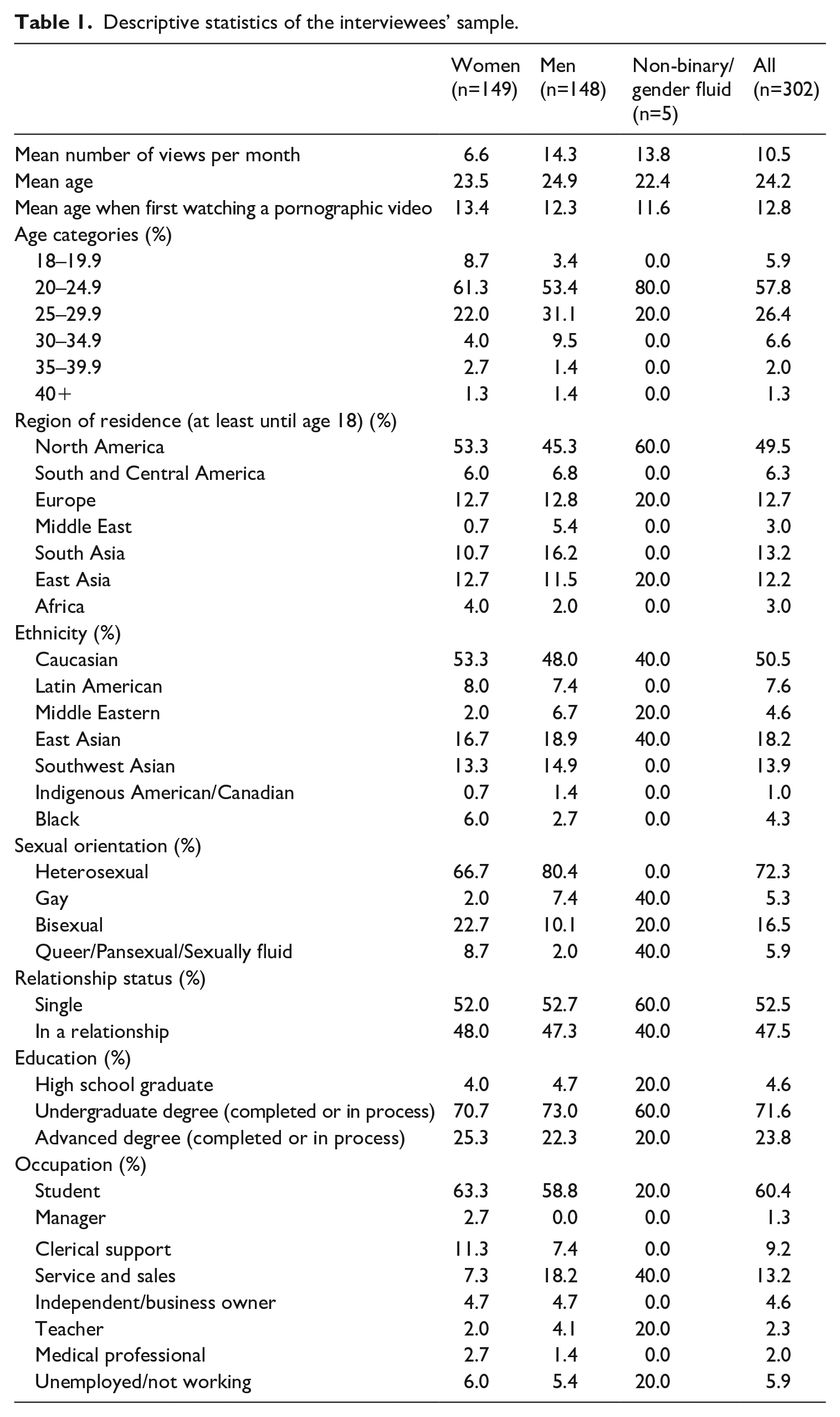
The final sample includes 302 interviewees. Of those, 149 identified as women (two of them transgender), 148 identified as men (one of them transgender) and five identified as non-binary or gender fluid. Table 1 presents some of the key descriptive statistics of the sample of interviewees. We spoke with interviewees coming from 55 different countries, including substantial representation for interviewees from Europe, South Asia, East Asia and Latin America. This cultural diversity is in line with recent calls for studies that provide a better understanding of how individuals from different cultural backgrounds engage with pornography (Daskalopoulou and Zanette, 2020). Indeed, with the exception of Chowkhani (2016), who interviewed six Indian women, no previous research efforts have been able to capture pornography consumers’ views in the developing world. The interviewee list includes a relatively high share of younger people and students. Nevertheless, we were able to reach considerable variability in features and characteristics that could influence viewers’ preferences, including gender, ethnicity, sexual orientation and relationship status.
Descriptive statistics of the interviewees’ sample.
Procedure, Coding and Analysis
Following approval from a university research ethics board, all interviews were conducted in either French or English by two highly skilled and well-trained research assistants. These two languages are spoken by nearly one-quarter of the world’s population and are official languages in nearly half of the world’s nations. Both interviewers were graduate students (a man and a woman) in their 20s, helping them to establish rapport with the interviewees, who were also mostly in their 20. There were no noticeable differences between interviews conducted by the two interviewers, suggesting that their gender did not significantly affect interviewees’ responses. Both research assistants met with the project leader multiple times before beginning and while conducting the interviews, undergoing careful training and discussing and resolving various issues that came up during interviews.
To reduce social desirability bias, both interviewers and interviewees were encouraged to avoid revealing their real names or any specific identifying details. Accordingly, all interviewee names appearing in this article are pseudonyms. All interviews were conducted via Skype audio (without video), to increase interviewees’ sense of confidentiality and encourage them to speak candidly about their preferences, experiences and views (while also facilitating geographical diversity). Indeed, most of the interviewees appeared to be open about their preferences and views, even when these did not seem to conform with social conventions. Interviews lasted between 30 and 120 minutes. Interviewees were presented with specific questions about authenticity, such as: ‘Is it important whether pleasure seems genuine or not?’; ‘How can you tell if performers are truly enjoying themselves?’; and ‘Does it matter to you if performers are really enjoying or if they are just acting? Why?’ They were also encouraged to speak more broadly about other experiences with sexuality and their views and preferences regarding pornography.
The interviews were recorded (with the consent of the interviewees) and subsequently transcribed, coded and analyzed using an open coding strategy, which is useful in gaining a rich understanding of under-researched phenomena (Hsieh and Shannon, 2005). More specifically, we used an Excel spreadsheet to code binary variables for yes/no questions, while also noting common themes for questions that required more detail (e.g. regarding indicators for pleasure). The project leader then went over all quantitative coding to verify its validity. For questions with a clear answer, inter-coder agreement between the research assistants’ coding and that of the project leader was very high (over 97% for each of the variables), with Kappa statistic scores higher than 0.84, indicating excellent agreement. We resolved the few remaining disagreements by discussing them among the research team until consensus was reached.
Results
The findings show no noticeable differences between male and female interviewees, with 71.6% of all interviewees noting that genuine pleasure was something they sought and enjoyed. While non-heterosexual respondents were slightly more likely to consider authenticity important (74.5%) than heterosexual respondents (67.8%), this difference was not statistically significant (Χ2 = .7499, p = .387). There was some regional variability in how important genuine pleasure was considered by respondents, as interviewees residing in East Asia were least likely to consider it important (64.0%), while interviewees residing in Africa were most likely to view authenticity as important (83.3%). Again, though, these differences were not statistically significant (Χ2 = 1.5398, p = .957).
The Importance of Authenticity
Daisy, 22, a student from China, expressed a very common sentiment about authenticity: ‘If it’s all an act, then what’s the point?’ Many other interviewees agreed, saying that ‘genuine pleasure [is] arousing’ (Selena, 23, an educational assistant from Canada), and that whenever pleasure displays did not seem genuine, they would move on to another video. Leila, 26, a student from Syria, told us that ‘genuine is the most important thing; it’s what I look for’. Dylan, 21, a Canadian student, told us: I need to know at the end of [the] day that the woman wants it and isn’t being forced. She needs to enjoy and ask for it. I need them to enjoy it for me to [enjoy it too]. Sometimes it’s in between fake and real; like, it’s a mix. Those videos aren’t as exciting to me. I’ll walk away from them.
Many interviewees cited the desire to see genuine pleasure as the reason they preferred to watch videos tagged as ‘amateur’ instead of professionally produced ones. Emmett, 19, a student from the United States, said that the search for genuine pleasure is ‘why I look for amateur porn. I like authenticity. I want to see it. Otherwise, it connotes that it’s just a job and it’s a little rapey in my head.’ Mohamed, 25, a student from Pakistan, also preferred amateur videos because of their presumed authenticity: ‘It’s a main reason I stopped watching porn a lot. When they show pleasure it’s always so unreal.’ Similarly, Selena, 23, an educational assistant from Canada, said: ‘It’s why I prefer amateur; it’s more people being into it. It just feels more real.’ Alvaro, 27, an unemployed man from Ecuador, appeared quite sober about the pornography industry: ‘Genuine is very important. [But] I know you can’t be genuine if you have sex six times a day. . . Sometimes I watch porn with pro actors, and when they fake, I switch to amateur.’
Much like Alvaro, many of the interviewees were reflective about the pornography industry and viewed it critically, oftentimes the result of reading about it or watching documentaries uncovering the behind-the-scenes of the industry. They were therefore interested in pornography performers’ explicit reporting about their experiences and searched for external validation that pleasure displays were at least partly genuine. Paul, 24, an army officer from the United States, reflected on this issue when talking about the importance of genuine performances: One of my favorite categories of porn is behind-the-scenes stuff, where they interview the actress or actor in conjunction with the video and talk about what they want to do. When they get so turned on that they want to keep having sex [beyond what the script dictates], that’s cool.
It is thus clear that most viewers clearly desire genuine sexuality and wish to see more of it in videos. However, they also often find many of the videos they watch to be lacking in authenticity and are thus engaged in a constant pursuit of ‘real’ representations of pleasure. This pursuit is often reflected in the search for genres that they perceive as more authentic, such as ‘amateur’ pornography or ‘behind-the-scenes documentary footage’.
A Job Like Any Other
While most interviewees found authenticity to be important, a significant minority (nearly 30% of the interviewees) did not feel this way. For many of them, authenticity was not a necessity because it was very hard to ascertain. Among the interviewees who felt that genuine pleasure was less important in pornography, the most common sentiment was that this was merely a work of fiction or a job to perform. These interviewees were mostly content knowing that performers consented to participate in the video and that they were not suffering while doing so. For example, Laura, 23, a student from Canada, said: ‘If I can actively tell they aren’t enjoying it, I won’t enjoy it. But to me, porn isn’t to see real enjoyment. I’m there because I’m horny and want to get off.’
Another common theme among interviewees who did not find authenticity to be important was treating participants in pornographic videos as sex workers and equating their work to employment in other professions. Indeed, multiple interviewees equated working in pornography to their own uninspiring jobs, suggesting that this is the unavoidable nature of a capitalist job market. For example, Jeanne, 23, a student from Canada, emphasized that as long as she was assured consent was given, she was okay with performers not enjoying: ‘Sometimes you don’t like your job. You still do it.’ Similarly, Suleiman, 20, a student from Pakistan, told us: ‘It’s their job. I work and I hate it, but I always smile. As long as it’s consensual, I don’t care.’ Victoria, 36, a student from Germany, also felt that ‘any job has parts you hate about it. . . It goes both ways, for men too. It’s a job.’ Finally, Beatrice, 26, a marketer from Canada, thought that performers ‘don’t need to be loving it as long as they chose to be there. Just like a real job.’
Of note, even this line of reasoning does not necessarily reflect a complete lack of care about authenticity and performers’ genuine pleasure. More likely, viewers are trying to settle the cognitive dissonance emerging from watching pornography while not being able to suspend their disbelief and fully ‘buy into’ the often exaggerated and dubious displays of pleasure by performers. Reassuring oneself that ‘at least they are not suffering’ or that ‘every job has some unpleasant features’ may thus help viewers manage the dissonance between the idea that genuine pleasure is important and the reality of watching videos where such authentic pleasure appears to be absent. Some viewers have consequently adjusted their expectations and views, allowing them to continue enjoying pornography even while recognizing that much of it lacks authenticity. The medium of pornography may thus require authenticity in ways that are different from other acted media, due to the desire to place oneself in the fantasy while ameliorating the moral incongruence arising from viewing pornography.
Detecting Genuine Pleasure
As noted above, most of the interviewees who claimed to not care about the authenticity of pleasure displays attributed this indifference to their inability to detect genuine pleasure. This suggests that at least some of them in fact did care but remained incredulous. For example, Daisy, 22, a student from China, said that ‘genuine [pleasure] is hard to tell. Every actress plays it up.’ It is therefore not surprising that many of the interviewees were preoccupied with trying to assess whether pleasure displays were real or just simulated.
Most viewers were annoyed and deterred by exaggerated acting, which they believed clearly suggested faking. Charles, 24, a student from the United States said: ‘Some people are so over the top, it’s ridiculous and obvious.’ Ellen, 24, a lesbian biotech worker from South Korea, disliked exaggerated acting and predetermined sexual scripts: ‘I don’t like it when they yell and when they say “I like it”. It sounds fake.’ Megan, 20, a student from Canada, was also turned off by overacting: ‘When an actress is squirting and yelling for two minutes, that doesn’t seem realistic. I’m not turned on by it.’
When asked how they recognized inauthentic performances, many interviewees mentioned drawing on their own sexual experience when judging the degree of authenticity in videos. For example, Leyla, 23, a bisexual student from Turkey told us: ‘I never find myself shouting when I have an orgasm. So, when I see someone shouting too loud, it’s suspicious.’ Like Leyla, Doruk, 23, a heterosexual student, also from Turkey, drew on his personal sexual life: ‘If they’re talking too much or being too verbal, it seems fake and a turnoff. If you’re truly enjoying yourself, you shouldn’t be able to talk that clearly. . . You would moan a lot; one word at a time.’ Charles, 24, a student from the United States, similarly said that ‘if it matches what you’ve seen in your life, it’s a cue’.
Others, particularly male viewers, searched for cues that the connection between the two sexual partners was genuine and mutual. For them, taking initiative and being clearly engaged in the sexual act, especially by female performers, was often viewed as a sign that the act was more genuine. Emmett, 19, a student from the United States, disliked passivity from both partners: ‘If someone is laying there and the other person is really into it, I don’t like it.’ Adonis, 22, a Greek student, agreed: ‘If the woman is having a good time, she opens herself to the partner more, takes initiative, leads him.’ Jasper, 22, a student from Iran, reflected about the importance of chemistry and affection in his favorite videos: You can tell when two people have chemistry. Like, in an Abella Danger’s video, she does a scene with someone. I remember because there was a lot of eye-to-eye contact, close kissing, a lot of exploring body, [and] movement from both parties. She wasn’t just there. She was taking control too; she played with herself.
Many of the interviewees admitted that it was hard for them to recognize whether or not pleasure displays were authentic. Consequently, most viewers became adept at seeking and detecting verbal and non-verbal cues for authentic pleasure. The former, as demonstrated by Doruk, included moaning that appeared genuine and dialogue that felt unscripted. The latter included facial expressions, such as eye rolling and the face becoming flushed, as well as various seemingly involuntary bodily expressions, such as hand gestures (‘grabbing sheets or pillow’), becoming sweaty, the male performer appearing to be struggling to last, the female performer’s body or legs trembling during orgasm and displays of sensitivity after climaxing.
Viewers also enjoyed scenes where it appeared that participants ‘forgot themselves in the moment’ and stopped acting. Stephanie, 19, a student from the United States, told us: ‘I think it’s appealing when the woman doesn’t care what she looks like during the scene.’ Similarly, Francesca, 20, a bisexual student from Mexico, enjoyed scenes in which ‘they don’t care about the [camera] angle; a queef can happen’. Daisy, 22, a student from China, summarized this preference: If it’s all an act, then what’s the point? I think one cue [that the pleasure is genuine] is when they don’t care about making faces and looking pretty. That’s a good indicator. I just like it when people don’t care how good they sound or look.
Other non-verbal cues were detected through following the interaction between the sexual partners. These included substantial eye contact, visible care for the partner’s comfort and pleasure, and expressions of affection. Jada, 23, a student from the Democratic Republic of Congo said: ‘Occasionally, I’ll look for kissing or cuddling. It’s quarantine; sometimes you want a hug.’ Female viewers, especially European ones, also often saw scenes where men paid attention to women’s clitoris as more authentic. Kathleen, 23, a radio station employee from the Czech Republic, commented that ‘when the clitoris is included, it’s more genuine’. Ida, 19, a student from Denmark, agreed: ‘If I see that the guy is not touching the clit, I assume he has no idea.’
In sum, most interviewees considered perceived authenticity to be very important and searched for various cues in the videos trying to ascertain that performers were not merely faking pleasure. Yet, most of them also recognized that authenticity remained elusive and hard to ascertain, sometimes resulting in confusion and uncertainty or in interviewees playing down the importance of genuine pleasure.
Discussion and Conclusion
Relying on a sample of more than 300 regular viewers of pornography from a wide range of countries and cultural backgrounds, I explored men’s and women’s views on authenticity. Similar to other recent studies (e.g. Ashton et al., 2019; Chadwick et al., 2018; Macleod, 2021; Tillman and Wells, 2023), I found that most viewers ascribed great importance to watching pleasure displays that they perceived as authentic. I found no gender differences in these preferences, echoing the findings of McCormack and Wignall (2017) about the importance of authenticity for men who watch pornography. The findings also challenge traditional notions of ‘the negative effects paradigm’ (McCormack and Wignall, 2017), which suggests that viewers simply watch pornographic sexual scripts and then act them out. Instead, many of the interviewees described challenging the authenticity of pornographic sexual interactions by comparing them with their real-life sexual activities and finding them lacking. For many viewers, the pornographic fantasy must include realistic aspects to be meaningful.
Since authenticity was very important to most viewers, they were also invested in monitoring and detecting it. Most were highly aware of the difficulty for performers (particularly female performers) to experience genuine pleasure in the pornography industry, leading them to develop consumer cynicism (Nunes et al., 2021). Consequently, they actively searched for involuntary and non-verbal cues of pleasure and authenticity and interactions that appeared less scripted and harder to fake.
One of the main questions explored in this study was how viewers perceive authenticity and define it, given suggestions by previous sociological work that perceptions of authenticity are subjective and socially constructed, and that it often means different things to different audiences and individuals (Peterson, 2005; Potter, 2010). Nunes et al.’s (2021) typology of the components of authenticity is useful here. The findings show that the components of connectivity (personal engagement with performers), integrity (perceiving performers as intrinsically motivated) and originality (standing out from the mainstream without unnecessary embellishments) were particularly important for viewers in judging pornographic performances as authentic. Conversely, accuracy (transparency in self-presentation), legitimacy (adherence to shared norms, standards and rules) and proficiency (perceiving the performer as properly skilled and exhibiting expertise) were not always appreciated or pursued, as these could interfere with the fantasy or be interpreted as evidence for performances that were too rehearsed and lacked a degree of spontaneity and true exploration.
Goffman’s (1959) dramaturgical framework is also useful in making sense of the study’s findings. Goffman noted that audiences long to be convinced that performances are sincere. Indeed, interviewees in the current study clearly preferred pornographic videos in which they were able to interpret the acts they watched as sincere; videos in which performers appeared to be immersed in the act and genuinely enjoying it. When such interpretive work could be achieved, the performance was no longer perceived as paid work, but rather as (at least partly) voluntary leisure, and therefore as intrinsically motivated. Reaching this conclusion enabled viewers to better identify with the performers, facilitating the suspension of disbelief and consumer cynicism, which was necessary for viewers to become more fully engrossed in the fantasy.
Building on Goffman’s insights, more recent research in organizational and cultural sociology is also useful in contextualizing the findings of this study. I found support for Hahl et al.’s (2017) proposition that the search for authenticity is often motivated by an effort to enhance one’s own sense of authenticity and morality ‘by association’. Many of the interviewees judged those videos and performances to which they could personally relate (e.g. ones in which female performers were more active) as more authentic, regardless of whether or not this was factually true (Grayson and Martinec, 2004; Rose and Wood, 2005). Similar to the tourists studied by MacCannell (1973), who tried to enter back regions of the places they visited because they associated them with intimacy of relations and authenticity of experiences, the interviewees in the current study often sought ‘amateur’ videos and ‘behind-the-scenes’ footage in an attempt to reach greater authenticity. In doing this, they were often oblivious to the fact that, much like tourist attractions, these videos and footage are often ‘arranged to produce the impression that a back region has been entered even when this is not the case’ (MacCannell, 1973: 589).
Furthermore, in line with Hahl and Zuckerman’s (2014) suggestion that potential inconsistencies between front and backstage lead audiences to authenticity concerns, I found that some of the interviewees were concerned about hidden backstage manipulations (primarily body modifications that led to inauthentic physical appearances). However, viewers’ main concern was that performers’ pursuit of extrinsic rewards (primarily monetary) rather than intrinsic ones (sexual pleasure and fulfilment) detracted from the authenticity of the sexual interactions and, consequently, from the value of the video as a consumer good, as it entailed an impression of deception or fraud (Reilly, 2018).
Authenticity, the Sociology of Emotions and Feminist Ethics
This study’s findings are also relevant to research on the sociology of emotions. Both Goffman (1959) and Hochschild (1979, 1983) reflected on the labor that service workers engage in to manage their own emotions and those of others. In Goffman’s (1959: 11) terms, we can conceive of pornographic performers as ‘practitioners of service occupations’, who are often ‘forced to delude their customers [viewers] because their customers show such a heartfelt demand for it’. Hochschild’s concept of ‘surface acting’ similarly describes how individuals work to disguise and hide authentic feelings such as boredom or annoyance, or alternatively to simulate or feign feelings of enjoyment or desire, attempting to induce appropriate emotions in others. The findings of the current study suggest that most interviewees indeed demand the appearance of authenticity even when it is not actually felt by performers. Viewers respond negatively both to performers who do not seem to make enough efforts to feel or convey pleasure and to those who go ‘over the top’, simulating pleasure in ways that appear inauthentic.
Scholars have suggested that this repudiation of exaggerated acting is related to female viewers’ aversion toward emotional labor. According to Fahs and Swank (2016), the perception of pornography performers, particularly women, as doing emotional labor creates a sense of repulsion and resentment among female viewers. Similarly, Tillman and Wells (2023) argued that female viewers are particularly motivated to believe that pornography performers are not performing emotional work, as this allows them to envision themselves in the scenes. Interpreting performances as emotional work reminds female viewers of their own emotional and caretaking work and highlights that the performers are in fact engaged in commercial sex work, which in turn reduces sexual arousal and satisfaction.
The findings of the current study show that such visceral responses are not unique to female viewers. Male interviewees had a similar reaction to performances that appeared to involve substantial faking and emotional labor. Male viewers also reported that they found it hard to connect with videos and insert themselves into the fantasy when these videos appeared to involve a high degree of inauthentic emotional labor. They often found such videos pointless or even annoying. Indeed, performances that appear inauthentic and involve a great degree of emotional labor may appear to simulate too closely the purchasing of sex work in the form of prostitution, which many men find morally objectionable and/or sexually unappealing.
Viewed in this way, demands for authenticity and ‘real pleasure’ in pornography may seem merited – perhaps even benevolent – from a moral standpoint, considering the educational message that such scenes convey to viewers and the welfare of the performers themselves. Accordingly, some feminist scholars and activists (e.g. Drabek, 2016; Eaton, 2017; Taormino et al., 2013; Young, 2014) have been advocating for the production of feminist or ‘female-friendly’ pornography. Proponents of this approach suggest that in such feminist pornography male performers should be measured by their ability to enjoy giving women genuine sexual pleasure. According to Eaton (2007), such feminist pornography would thus represent authentic pleasure for everyone involved.
However, I argue that the repercussions of such demands for pornography performers and for public perceptions may be more complex and should be carefully scrutinized. The observations by cultural sociologists about authenticity as a social construction that cannot be determined by any set of objective facts (Grazian, 2003; Peterson, 2005; Potter, 2010) seem particularly relevant in the field of pornography. First, one might wonder whether pornography that strives to invariably show ‘real pleasure’ (for either female or male performers) is in fact authentic or even realistic. Macleod (2021), for example, questioned what makes some pornographic representations more real or authentic than others. Other scholars have suggested that ‘feminist pornography’ may in fact be less authentic if one believes that ‘real’ means the rejection of the artificial or the unapologetic celebration of the crude and the defiance of standard bourgeois conceptions (Attwood, 2012; Levin-Russo, 2007). In this view, pornography that aspires to represent what ‘should be’ rather than ‘what is’, is in itself inauthentic. Berg (2017) further argues that the very debate around authenticity in porn presumes that there is authentic sexuality that exists out there in the world, a notion challenged by both the pornography industry and the private lives of its consumers.
As various scholars have noted, performers and their sexual encounters on-screen are not less real in mainstream pornography than in any alternative genre (Maina, 2014; Paasonen, 2011). Macleod (2021) adds that the desire by feminist viewers for more ‘authentic’ sexual representations and acts in pornography might collide with other feminist values, such as the demand to give explicit consent. Berg (2015) further suggests that some performers may in fact wish to reserve their more authentic displays of sexuality for their private lives and prefer to adhere to scripted sexual scenarios in their work. Indeed, insisting on more ‘authentic’ sexual performances risks increasing industry exploitation if performers feel compelled to share parts of their sexuality that they might otherwise wish to keep private, taking on unpaid duties that should be reserved for directors and scriptwriters. Simulating, rather than actually experiencing pleasure or desire might thus create an illusion of authenticity while allowing pornography performers to shield themselves from the emotional labor and psychological demands that ‘deep acting’ (Hochschild, 1983) would require of them. Recent research on pornography has indeed documented that on-screen practices that consumers interpret as authentic are often disconnected from the off-camera authentic pleasure of the performers (Lebedíková, 2022).
Finally, the preoccupation of viewers and feminist thinkers with authentic representations also carries potential repercussions for the very legitimacy of sex workers and their ability to claim sex work as a valid profession. According to Berg (2017), porn’s discourse of authenticity is a legacy of the feminist sex wars, which shaped women’s discomfort with commercial sex work and positioned authenticity as central to feminist sexual ideals. As Scott (2016) notes, the idea that authentic sex or pleasure necessarily mean better ethics perpetuates a belief that sex work is only acceptable when it does not actually feel like work. This idea, in turn, undermines and stigmatizes those who claim it as labor.
Footnotes
Funding
The author received no financial support for the research, authorship and/or publication of this article.
Ethics Statement
All interviewees for this study gave their informed consent for (confidential) inclusion before they participated in the study. The study was conducted in accordance with the Declaration of Helsinki, and the entire research protocol was approved by an academic Research Ethics Board.
