




Abstract
While much has been written to guide early career researchers (ECRs) and those charged with socializing them into academic ontologies, much less is known about ECRs’ own experiences of becoming academic. This article presents a narrative, new-materialist account—drawing on Facebook updates and personal diaries—of one ECR’s experience. Interdisciplinary theorizing is proposed, using work-types and zones-of-development models. Individualism is problematized within three contexts: autoethnography as method, the materiality of affect within ECR assemblages, and the limited capacity of any individual ECR to effect systemic change. As ECRs are driven to produce ever more, and thus to “succeed,” they are their own nexus of accountability, making overwork and burnout endemic. So, although ECRs may progress from adaptive to technical work and from proximal to actual zones of development, their workload has no ceiling. Issues of “balance” are therefore retheorized within the assemblage, with extant models critiqued as problematically dependent on neoliberal framings of individual responsibility.
A few years ago, I wrote an autoethnographic paper about my experiences of doing a PhD (Stanley 2015). Published in the Journal of Contemporary Ethnography, that piece became—as of June 2022—the journal’s most cited article of 2015. In it, I wrote:
[T]here is [a] well-established genre within travel, beyond the guidebook: travelogues, first-person narratives, travelers’ tales. While such texts proliferate around physical journeys, there is much less “travel writing” about the PhD “journey” . . . Experienced supervisors will know that PhD candidates often travel with the angst that they are muddling through, not doing it “right.” I want to show that this state of suspended messiness is normal, that getting lost along the way does not mean never reaching a destination, and that the destination itself may well be different from that which was imagined . . . I hope to create a text from which I, myself, would have benefited during my candidature: while I was lost, I would love to have known that getting lost is part of finding the way (145).
As I wrote those words, I was a recent PhD graduate, trying to make sense of identity and other issues. In writing, I hoped that others might come to understand their own, lived PhD experiences as I was doing, by unpacking the process: uncertainties, anxieties, and the grind, but also the moments of enlightenment and even joy. And, over the years since, PhD students have approached me—at conferences, on emails, and even once on a train(!)—to say it spoke to them. It helped.
However, even as I was writing about my PhD journey, I was already in a different career stage, as an Early Career Researcher (ECR). While a continuation of “becoming researcher,” the ECR years are a distinct phenomenon from doctoral study. And if I had thought—by finishing my PhD and embarking on an academic career—that the struggle was over, I was wrong. In this paper, then, I offer insight into one ECR “journey” and a theorization of why “making it” in the academy can be so tough. But there is a route through; it can be done. Further, it is possible, although not easy, to hold onto a sense of oneself while doing so.
This is a layered, iterative account. Autoethnographic sections—all called “be(com)ing academic” 1 —evoke early career experiences. Then, interleaved, are discussions of the issues this paper raises: methodological issues of autoethnography, an account of the data sources on which the paper is based, and theorization as to why the early career academic experience is difficult and how it might be otherwise First, however, it is necessary to situate the study, and I begin with a brief discussion of what is known about ECR experiences.
On “the” ECR Experience
There exists a busy academic literature on “the” (seemingly singular) ECR experience(s), within which discussion has recently focused on ECRs’ publishing trajectories (Habibie and Burgess 2021), funding success (Yousoubova and McAlpine 2022), career pro-/re-activity (Forbrig and Kuper 2021), support types and amounts (McAlpine, Pyhältö, and Castelló 2018), child-having (Hughes 2021), and agency (McAlpine and Amundsen 2018). There is also a lively genre of advice blogs, such as the US-based The Professor Is In (2022) and Get a Life, PhD (2022), and the Australia-based The Research Whisperer (2022). Similarly, Colón Semenza and Sullivan (2015) advise on “how to build a life in the humanities.”
As with the PhD, however, much of the ECR literature is written by those charged with supporting, mentoring, training, socializing, and disciplining new researchers into be(com)ing “good,” productive, neoliberal, academic citizens. The five gerunds in the preceding sentence can be placed along a continuum of the same process, whereby ECRs are initiated into academic ways. This is one of two issues in this space: the tendency of ECR discussions to be “about us (but) without us,” to paraphrase from Yarbrough’s (2020) work on the symbolic violence and harms perpetrated by putative experts who presume to speak about and for marginalized groups.
There are exceptions. For instance, Thwaites and Pressland’s (2017) anthology brings together 19 ECR women, and Weatherall and Ahuja (2021) draw on their own first-year ECR experiences to propose a queering of ECR time. This speaks to Tuinamuana and Yoo’s (2021) invocation of Pasifika framings of—and resultant call for decolonizing—time, socially constructed in the Centre-West academy as necessarily rational, linear, and ordered. Weatherall and Ahuja (2021) similarly resist linearity, through a lens of queer theory, critiquing socially constructed notions of re/productive time that permeate norms of what ECRs “should” need and want. This includes expectations that ECRs will have ambitious publishing plans, and that they—especially those who are mothers—will balance work and family life. Heteronormativity, they note, pervades. But ECRs are diverse, and Weatherall and Ahuja cite ECR “Heather,” who hopes “to write about beautiful, radiant things. . . [and] share these things with others” (412) and for whom parenting does not feature in a life “made up of less definable moving parts: mental illness; familial and non-familial platonic relationships; activism; academia; music; dance; domestic labor; care work; reading fiction; writing fiction” (417). These insights pluralize and complexify ECR experiences.
Such work is quite rare, though (Hoskins, Moreau, and McHugh 2022); this is the second issue. Whereas normativity proliferates in “guidebook”-style writing—telling ECRs how they “should” do things—there is a dearth of “travel writing” in which ECRs reflect on journeys taken. Two recent publications (Klevan and Grant 2022; Nititham 2022) buck this trend, offering insights into new-academic precarity and marginalization. But, as with PhD writing, there remains a “travelogue” gap. My purpose, then, is to evoke resonance and to theorize with reference to an interdisciplinary literature. My hope is that ECRs may find succor in, first, knowing they are not alone and, second, new insights about what is happening to them and why.
Be(com)ing Academic: The “Bullshit Air of Martyrdom”
April 30, 2014. Personal journal entry. [The speaker on the “academic leadership” course, a professor] says she put herself last, sleeping 4 hours a night. “Gandhi slept 2; Mandela slept 2,” [she says]. I’m thinking this is going to be a piece about prioritising yourself, finding balance, but it isn’t. “Full is relative,” she says, “One can always take on more. . . . She goes on say that she took maternity leave but put her newborn into childcare so she could finish her book. This is not what I aspire to, on any level. . . . I feel horrified. September 15, 2014. Journal. [Three colleagues] are workaholics. . . . I’m not myself with any of them. I fear them. I get anxious around them. I’m so afraid of them accusing me of not caring “enough”. . . . There’s so much talk of them working literally all the time—they brag about it with this put-upon, bullshit air of martyrdom—and unless I do it too, I feel I’m not (doing) enough. [One] said she flew to [from Australia, to her hometown in Europe], sat with her mum and dad on the sofa, they watched TV and she managed to finish a paper. WTAF? . . .I feel like a charlatan because I say “no” to some stuff. . . . But I’m afraid to say, “I’m not happy” [about academic workload] because whenever people quit, the talk is always, “Ah, she just wasn’t up to it; she couldn’t hack it.” That’s NOT me, but. . .surrounded by all this, it’s easy to lose perspective. March 11, 2015. Journal. [A colleague] told me a joke about academia and how wonderfully flexible our jobs are. The punchline was, “Yeah, we can work whichever 80 hours of the week we choose.” We both laughed, but like, yeah, where’s the joke?
These journal entries serve as a vignette to characterize the nature of early career academic work as I experienced it. The key ideas are as follows: anxiety, workaholism, feeling like a charlatan, bragging, neglecting loved ones, putting oneself last, trying to find balance, trying to say no, conditional flexibility, quitting, colleagues’ judgment, and the loss of perspective. Distilled into such a list, these ideas do not serve to recommend academia as a career. But there is no shortage of willing new PhD graduates, who greatly outnumber academic jobs (e.g., Guerin 2020). As a result, academic work is a buyers’ market and competition is fierce. Some people burn out. Others survive. Certainly, plenty of colleagues came and went: some to other jobs, others exiting academia altogether. To some extent, then, my story is atypical in that I made it: I succeeded in building an academic career. The Royal Society (2010, 14) puts the odds of UK science PhD graduates ending up in permanent academic jobs—akin to tenure in the US system—at 3.5%, calculating that fewer than half of one percent of PhDs will eventually become full professors. While things may be slightly easier in the social sciences, I am aware of just how unlikely my pathway has been: 2022 is my seventeenth year of university teaching and my eleventh year in ongoing, teaching-and-research “bundled” academic work. This is a story of survival, then.
Always More than One
Atypicality does not trouble autoethnography, as the point is to capture not the general but the specific: my aim is to give an account that shines with verisimilitude, allowing for insight and resonance (Stanley 2019; 2020). However, “auto”-ethnographic writing on one’s “own” experience does problematize the individuated self. Here I draw on Erin Manning (2013, 17):
Identity is less a form than the pinnacle of a relational field tuning to a certain constellation. . . . The point is not that there is no form-taking, no identity. The point is that all form-takings are complexes of a process ecological in nature. A body is the how of its emergence, not the what of its form. The issue is one of engendering: how does this singular taking-form happen given the complex collusions of speeds and slownesses, of organic and inorganic tendings, of activities and movements, that resolve into this or that body-event?
This is to say that ECRs’ development as/into (particular types of) academics is localized, contingent, and dependent. This perspective draws upon new materialist thinking, within which social problematics are “conceptualized in terms of processual, contingent, and volatile enactments of relationality among a heterogeneity of animate and inanimate elements” (Khan 2022, 7). The notion of assemblage “focus[es] on relations of exteriority where component parts cannot be reduced to their function within the whole and can simultaneously be part of multiplicities” (Burrai, Mostafanezhad and Hannam 2017, 6). So, although ECR socialization might be imagined as a guided tour—“Base yourself at a research-intensive university and visit all the main sights: join committees, connect with savvy mentors, and access all the training on offer. Carry with you some published journal articles and a good dose of self-confidence. Otherwise, travel ultra-light, bringing few external commitments. . .”—becoming academic is necessarily ever-emerging, and thus irreducible to any such instructions.
However, such an assemblage perspective makes for tension in the writing of the “I” that is central to autoethnography (e.g., Adams, Jones, and Ellis 2022). For this reason, Palmgren (2021, 114) describes the carrying-between and resultant social markedness that necessarily remains on entry into any “new” period in life, and Gale and Wyatt ditch the “auto” label altogether, proposing Assemblage/Ethnography (2013). Such contestations of the “I” suggest important imbrications between the “auto” and the “ethno,” which Murray playfully highlights in her reversal of elements, coining “ethno-autography” (2022, 493). Thus, my “auto” ethnography consciously walks with the contextual and the co-textual: the “was-me” (before-ECR), the “not-me” (my friends; my nonacademic contexts), and also the more obvious “being-ECR-me.”
As I have written elsewhere (Stanley 2022), my “self” is one characterized by effects borne of “trying to fit in” and shame at “not quite fitting in.” Elspeth Probyn (1996, 40) writes: “[T]he processes of belonging are always tainted by deep insecurities about the possibility of truly fitting in, of even getting in.” This was me. My belonging within academia was so longed for, was borne in part of the ruinous sting of amateurism with which I and others associated my previous career: English Language Teaching. I had s/tumbled into language school work in my early twenties (Stanley 2014; 2017) and, by my mid-thirties, perceived myself thoroughly stuck (Stanley 2016; 2022). For so-called “native” teachers, like me, this is an “industry that expects docile and inexperienced bodies, and a. . .market where nativeness enables quick access to jobs, but only to unskilled and temporary ones” (Codó 2018, 448). 2 Academia presented a route out of this rut. Additionally, I brought with me the attributed-and/or-appropriated identities of backpacker and solo hiker/camper, identities into which, later, I would retreat, much as I had into a backpacker-tourist identity when things got tough during my PhD.
Erin Manning (2013, 26) explains the power of such affective factors to permeate assemblages:
Take the example of a snake in the context of a phobia. Wandering through the desert, everything is felt as the force of snakeness. There is no rustling that does not elicit fear. But this is fear even before it can be defined. It is in the edginess of pace, the tenseness of posture. It alters how each step is taken. Every quick movement —lizard, wind, fly—activates a certain bodying that attends, intensively, to an environment in the making. . .. Since bodying cannot be thought without milieu, it is not simply the body tha t is tense but the field of the event itself which is poised. An emergent ecology is forming—one of jitteriness, hyperattention, sensory acuity. . . . [E]cology is marked by a. . .field of affect.
If “snake phobia” is replaced with “shame” and “academia” stands in for “desert,” this excerpt describes how marked my ECR years were by the underlying shame that I brought to them. In centering this materiality of affect, I reflect on Talbot’s (2020) work, which demonstrates the sheer complexity of how affect, learning, work, co(n)-text, and lived experience come together.
Be(com)ing Academic: On the Outside, Looking in
August 19, 2010. Journal. [My manager] said, “If you want to do research, just do it. Treat your weekends as your research days.” Really? . . . . The university sends us on work–life balance workshops, but the only way to be an academic is to write all weekend? June 31, 2011. Journal. [My manager] invited all of us [Academic Developers] to yet another meeting [on ePortfolios, lecture clickers, etc; educational technology], four hours long, and my heart just sank. . . . I can’t be bothered with it at all. As with so much else we [Academic Developers] do, it is entirely ignored in the uni more widely anyway. . . . What is the point of us? We’re wasting our own time and everyone else’s. October 27, 2011, Facebook. 10 pm in the office. Two papers submitted this week. Very tired but very smug.
There I was, working at an actual university —in Adelaide, Australia— with the actual title of Doctor beside my name on a plastic plate on my actual office door, onto which I stuck some colorful postcards, because that is what actual academics do (Ruth 2015). I had actually made it as an academic.
Except, of course, I had not. Not really. While my title and accoutrements felt academic, I quickly realized that the Academic Developer role I had landed was no such thing. At best, I was still a teacher-educator (which is what I had latterly been in English language teaching), and my sense of nonprogress was palpable. At worst, I was still disposably interchangeable: a tick in a box next to the university’s lofty statements about student experience and teaching quality: an irritant to be ignored while harried academics got on with their jobs. So, even as I mimicked an academic identity, my becoming academic felt so elusive, still:
October 10, 2011. Journal. [A colleague, a Senior Lecturer] constantly refers to his academic status. . . . He does this sneer—lips pulled back and air breathed in through his teeth— to indicate disapproval but also when he’s making a point more generally. . . . I said I was a bit upset because I hadn’t even got an interview for the Melbourne[-based, Lecturer] job [that I’d told him about having applied for], and he starts talking about the various academic jobs he’s been offered but has turned down. I said, kind of laughing, “That doesn’t help.” He just sucked in his breath at me. He has no social skills, no sense of humor, just this need, constantly, to establish his own status. . . . Why do I talk to him? Wanting to integrate academically? A vague feeling that he might be useful?
How do you operate when you badly want entry to a world that will not let you in? You pretend. And then: you rail against that world. That was me. Academia had rejected me, so I rejected it:
March 15, 2011. Facebook. I met an “academic” today who told me he had stayed in a hotel room that had had a bat in it, and wondered if it had laid eggs in the room. Bat eggs. This is proof that you don’t have to be smart to be an academic.
I needed to prove to myself that I was just as “smart” as the “proper” academics that I met—even the teeth-sucker and Dr Bat Eggs—because if I knew that I was “smart” then the problem was not me. The problem was academia. On some level, I believed this. (And I still do. Academic work is no guarantee of social skills or general knowledge.) But if it were true—and that I was smart enough—then why, why, why, WHY could I not get what I saw as a “proper” (i.e., research-teaching-service, bundled) academic job?
August 11, 2011. Journal. Very important conversation today with [a non-academic friend]. I say: I’m in a rut; academic jobs are so hard to get; I apply all the time and don’t even get shortlisted; the [Academic Developer] role is awful, it’s not really academic, etc. I tell her I want community, like-minded people; I want to be around excitement and ideas. . . . “Woah, woah, woah,” she says, and starts suggesting things: start a business; get some consulting work. She says, “You need to change your paradigm: everything is negative; you shoot down every idea I suggest.” I know she’s right, but the thing is I don’t want to be a freelance consultant or to run a business; I want an academic job. “This is the most negative I’ve ever seen you,” she says. She’s right. I know she is. . . . I just feel so stuck.
Cautiously, Then: An Autoethnography
Having worried at the “auto” in “autoethnography,” it is with some trepidation that I offer written-in-the-moment sources as autoethnographic data in this paper. These are, first, the 551 Facebook status updates that I posted over five ECR years (May 2010–2015); the printed record runs to 216 pages. Second, there are eight handwritten journals that I kept through the same five years, totaling 818 pages. These texts provide otherwise hard-to-obtain insights, echoing approaches described by Atay (2020) and Coleman (2022), who used social media including Facebook in autoethnography, and Neal (2020) and Winkler (2018)—among many others—who used personal diaries in autoethnography. I approach my source texts ethnographically, attending to discourse, content, and absences of content, and the recurrence and development of themes.
While the Facebook posts are more obviously performative—an enactment, in the moment, of the identity I wanted to claim for myself—the journal entries, too, are necessarily products of the assemblages of which I was part. But the sources differ in important ways. For instance, the mentions of academic-work increased over time in the journals while staying fairly constant on Facebook. In year one, 23 of my 131 Facebook posts mention academic work, (i.e., 18%); in year two 25 of 120 (21%); in year three 36 of 109 (33%); in year four 25 of 104 (23%); and in year five 19 of 87 (22%). In contrast, in my journals, I increasingly obsessed about academic work. In year one, 98 of 182 journal pages mention academic work, (i.e., 53%); in year two 84 of 140 (60%); in year three 100 of 147 (68%); in year four 125 of 172 (73%); and in year five 143 of 177 (81%). How might this be explained? Clearly, I became more and more work-focused. But on Facebook, I reined in the shop talk. This is not to say that I was not thinking about work. Rather, I was aware that most of my Facebook friends were not academics, so I performed a “normal,” nonworkaholic identity. I knew that academia seemed esoteric and weird from the outside, and this made me uneasy. I knew also that becoming academic seemed necessarily to be about becoming workaholic, and this, too, felt wrong. So, I feigned normalcy, playing up the everyday aspects of life in my Facebook posts. This is one way in which juxtaposing public and private writing lends verisimilitude, telling a story—tellingly—about what could be said, and where, and to whom, and how—and what could not easily be said at all.
Six of the journals were plain, A5-sized notebooks while two were “gratitude journals”: diaries for writing “three things that I am grateful for today,” with space for notes underneath; I wrote these entries for no better reason than writing about gratitude made me happy. Examples of each journal entry type appear (redacted, to anonymize others) in Figures 1 and 2. The writing was sporadic: sometimes daily, more often every few days, and sometimes nothing for weeks. I wrote about day-to-day occurrences and my feelings about them but also about longer-term priorities, worries, and frustrations. I never wrote about quitting academia or about my reasons for wanting an academic career; these seemed self-evident. So, rather than the “what,” I wrote the “how”: how to be an academic; how to manage uncertainty; and how to find balance, not least as a single woman, living alone and childfree (see Grass and Rivero 2015, for some challenges therein).
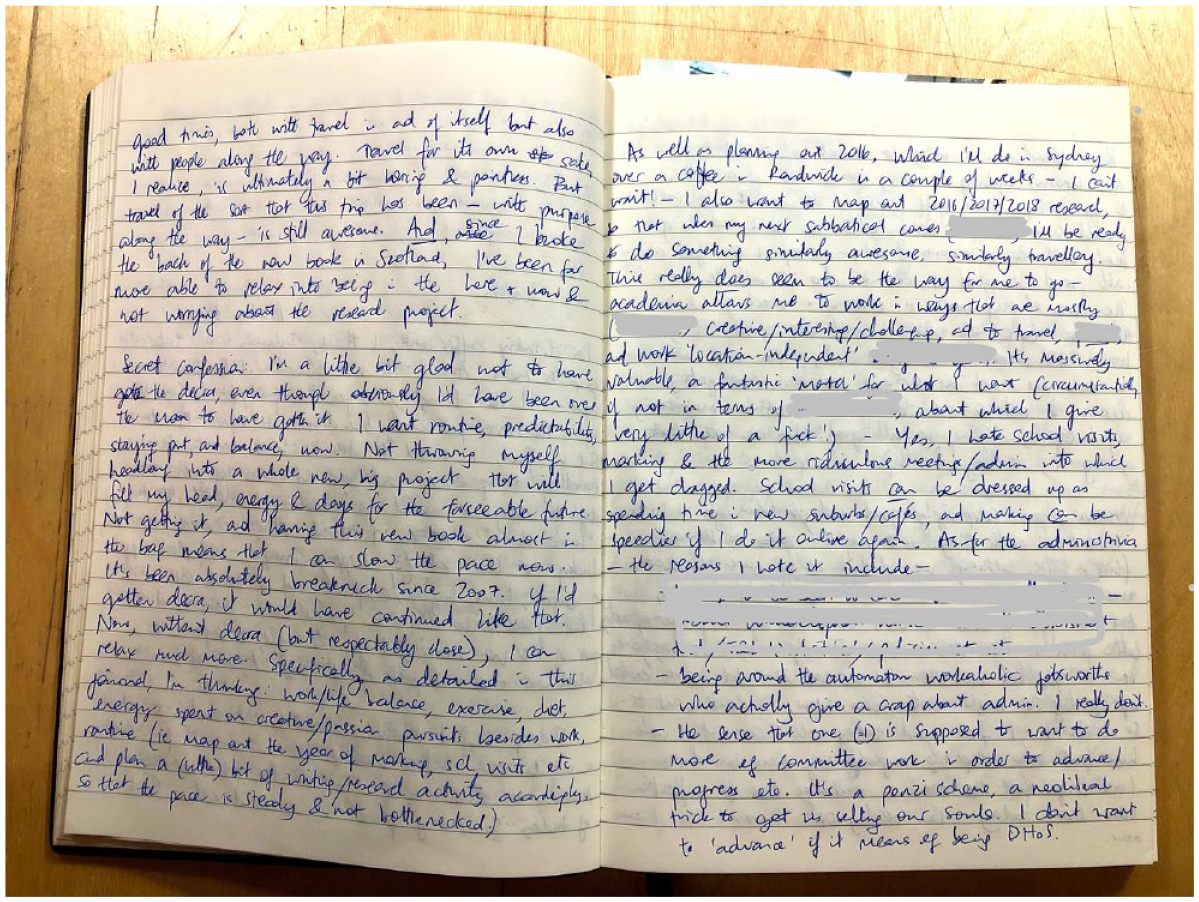
Example of a Journal Entry, October 20, 2015.
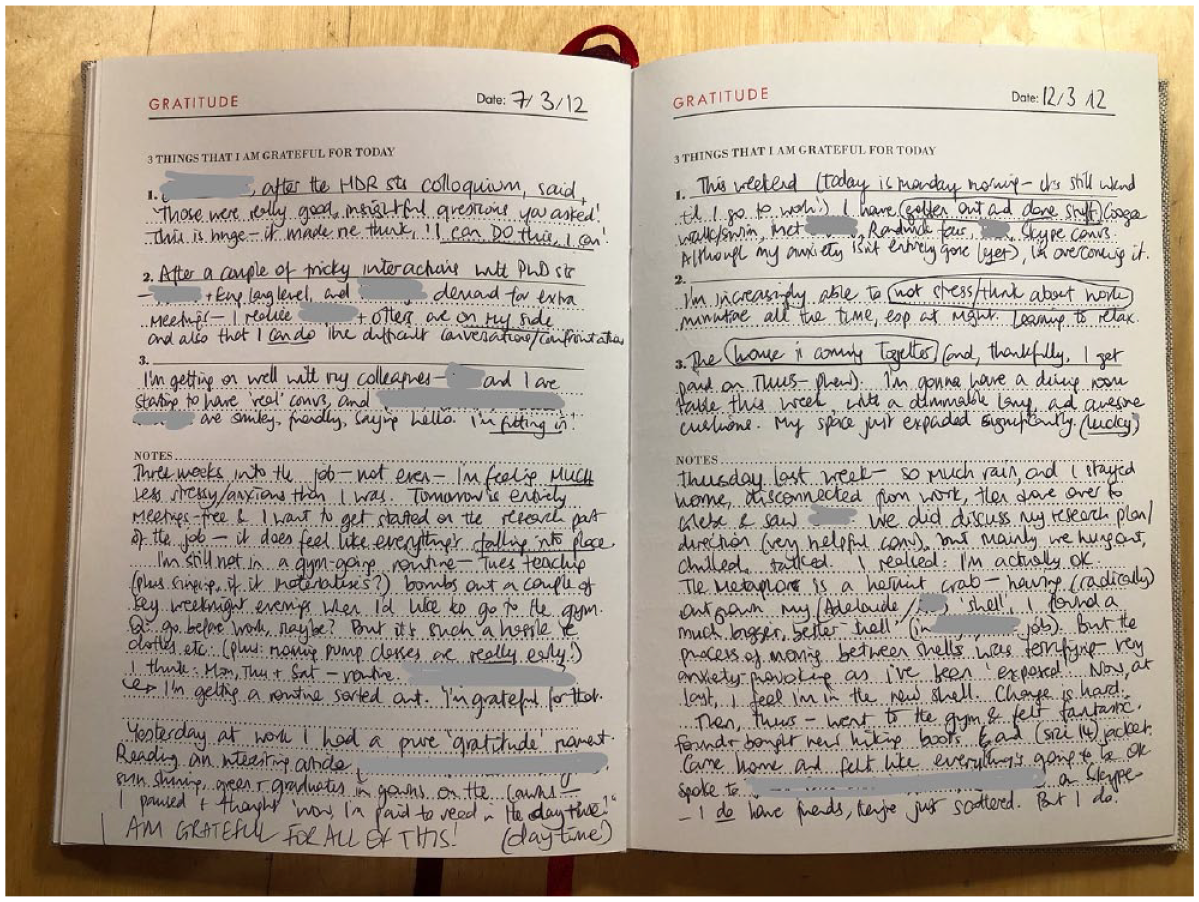
Gratitude Journal Entries, March 7 and 12, 2012.
Be(com)ing Academic: Misdirected Energy
August 15, 2010. Journal. Talking to [a senior professor] at the drinks [at a conference], and I say how disheartened I feel when I get rejections from [academic] journals. (I don’t say that I get rejection after rejection and it is KILLING ME.) I say I just don’t get it. I got a “good” PhD (he knew [from the Melbourne grapevine] that I won the university medal; that’s why he came over after I presented, to say hello) . . . . But I can’t get stuff published, and it makes me feel like I know nothing at all. He laughs and says that when HE gets stuff rejected from journals, it makes him think that THEY know nothing at all. We both laugh. . . . Later, I think: Huh. There’s the difference: he’s the son and grandson of professors. . . . Is it about connections? Is it mindset? WHAT? September 26, 2011 [Sunday]. Journal. Yesterday I wrote most of [a job application] and today I’ve been trying to finish it, but I’m procrastinating. Is this because I’m scared of not getting it right and not getting the job, again? I think so. Everything is riding on this [i.e., getting an academic job]. Today, I’ve done laundry, put weedkiller on the weeds and pulled lots up, and I have to go to the supermarket. I was thinking of a big, beach walk (it’s 24 degrees, blue sky, sunny). But I feel paralyzed by the guilt of not writing. I could walk, come back, and write all evening/night; pick up supermarket stuff on the way. But I don’t think I can justify a walk. I need to get this job.
A “good,” neoliberal, self-regulating (almost-)academic citizen, I had taken my boss’s advice and, writing mostly in my own time, I was by now churning out publications. I self-funded myself to conferences, where I networked. However, most of what I published was book chapters (e.g. Stanley 2011), because I still knew no one who could usefully read my drafts, and the journal reviewers were savage. In contrast, when people at conferences saw me present and asked me to contribute to their edited book projects, their feedback was gentler. My doctoral supervisor had also given me some terrible advice: “Publish, just publish anywhere” (In fairness, perhaps she meant, “to begin with,” but I followed this advice for years). No one told me otherwise, and I did not know to ask.
Why this rush and the push toward profligacy? Having studied celebrity academics’ résumés/CVs online, my understanding was that long lists of frenetic activity were the currency, and I emulated them, or tried to. But my habitus was not guild-route academic, strategic, and wise. I was a first-in-family pracademic: clueless and unguided. My colleagues were not academics, either. So, I did what I thought was right: I wrote chapters that were slow to appear, unsearchable online, and thus largely uncitable. My work came to the attention of almost no one for a long, long time, and my H index is still lower than it “should” be. But I stepped through what I thought were the motions of being academic, trying to reverse-engineer the “secrets” of success.
I was also applying for the wrong jobs: lectureships only tenuously connected to my area, in which I would have little hope of contributing to the hiring departments. But the universities’ glossy materials all mentioned interdisciplinarity, so I tried a scattergun approach. I got nowhere:
November 14, 2011. Journal. I’m stressing out about the [Sydney] interview, thinking of what I said (and how it could have been better) and what I didn’t say (but should have). The mistakes I made: trying to bond with the panel rather than trying to impress by matching myself to the criteria; assuming they had read my application; vagueness about my future research direction (because it all depends on whether I get this job!) And, by mistake, I highlighted a negative (lack of journal articles). Shit. I should have had a coherent five-year plan. I’m thinking about how [an experienced academic that I had recently met] would have performed. He’d have been one expert visiting others, not being intimidated by the situation. . . . I think I came over as just a lowly little teacher who happened to have done a PhD. November 16, 2011. Facebook. I got the job in Sydney and I start in Feb. I’m OVER THE MOON!!!
And so, I made it! Lecturer! Me! I unstuck my door postcards from the Adelaide office and threw them out, buying myself nice, new things—including new postcards—to celebrate the fact of my big, new job. I packed up my house and moved myself, my things, and my cat to Sydney. Journey complete. Was it not? Of course not. This was just the beginning. For one thing, the job came with a three-year probation period, during which I would have to prove myself.
On Academic Work
What is an academic? And, nested, what is an ECR? When I worked as an Academic Developer, what was “it” that I sought in a “proper” academic job, as I saw it? Is academic-ness a job title (as I imagined it) or a behavior (as my boss had alluded to, suggesting that I spend my weekends writing, if that was what I so badly wanted to do)? Is it about trajectory? Is it a point? A process?
Consider one chronology. I started my PhD 3 at a research-intensive university in Melbourne in February 2007, finishing in December 2009 and submitting the thesis in February 2010 (I had three years’ worth of scholarship money, so I waited to submit). My examiners reports came back in May 2010 and—as Australia does not use the viva voce system and no revisions were needed—I immediately received confirmation of completion, before graduating in October 2010. Throughout and prior to my PhD, from July 2006 to May 2010, I taught undergraduate and masters courses as an hourly contracted Associate Lecturer and Tutor at three Australian universities. Immediately after finishing my PhD, from May 2010 to December 2011, I held a still temporary, but longer, 20-month contract as an Academic Developer at a teaching-focused university. Notionally academic, this role was located outside any school or faculty in a “service-provision” team of disability advisors, student counselors, and careers advisors; it entailed providing staff support in teaching and curriculum planning. This role finished in December 2011, and in February 2012, I started as a Lecturer at a research-intensive university in Sydney. My work was now “bundled” (Macfarlane 2011), comprising 40% research, 40% teaching, and 20% service. I spent seven years in that department, being promoted to Senior Lecturer in June 2014. Then, in early 2019, I moved both jobs and countries, taking up an Associate Professor (akin to Reader) role in the UK.
Within this trajectory, at what point did I become an academic? When was I ECR? Definitions vary. 4 My interpretation is based on the Australian Research Council (2015) definition: the ECR clock starts at PhD “completion” and runs for five years, minus any periods of nonacademic work. And, while only notionally academic, my Academic Developer role still “counted,” giving me a clean five ECR years from May 2010 to May 2015.
But at what stage did I “become” an academic? It was gradual: the ECR period is one of transition and becoming. Indeed, the existence of ECR as a label speaks to the understanding that newly-trained researchers are different in important ways from established academics. Also agreed upon is that an ECR designation allows institutions and funders to provide career-stage-specific support. This might include mentoring, dedicated revenue streams, or workload allowances to free up time for training and research. The goal is that ECRs should have space and support to establish academic careers; to become academics.
Definitional fuzziness is further complexified by those, like me, who come to academia after another career. Thus, while I was a beginning researcher, I found teaching easy: I had been planning lessons and managing classrooms for years, after all. Similarly, although university administration was new, I had long held office jobs in which I developed generic skills. However, there was a great deal that did not transfer. As a first-in-family academic, I lacked the connections, processual understandings, and the resultant confidence that others unthinkingly enjoyed. Macfarlane and Jefferson (2022) offer a Bourdieusian analysis of this phenomenon, distinguishing between guild-route and non-guild-route academics, the latter of whom may enter academia later, from industry. They write that “guild-route” academics enjoy academic social and cultural capital (i.e., networks and know-how) and the “right” habitus for academia. “Guild-route” scholars simply slot in more easily.
This speaks to the sheer complexity of academic work. Traditionally, academics engage in research, and teaching, and service, and it is rare to be good at all three. Further, Laudel and Gläser (2008) note that academics develop three careers simultaneously: cognitive (i.e., research trajectory and iterative knowledge development), community (i.e., development of networks and contributions to the discipline), and organizational (i.e., attending to the needs of the “employing” organization, conceptualized as a “host” from which a researcher “rents” status and income). This is to say that academic work is organized differently from other jobs, being conceptualizable as autonomous subjects remaining primarily their own nexus of accountability. Universities then hire academics to research and teach in their name. In reality—and especially in semi-academic roles and in more teaching-oriented institutions—this model feels archaic, not least as much academic work is disaggregating. Teaching-focused roles are common now, and some new academics undertake many years’ worth of precarious grant-funded, research-only postdoctoral appointments with no suggestion of ongoing work. Some vestiges of the journeyman academic remain though, not least in the expectation that researchers will bring with them—including to job interviews—a trajectory for their own research development and suggestions of how they might fit in and what they might usefully teach within the “host” department.
Be(com)ing Academic: Directed Energy
March 7, 2012, Gratitude journal. [A senior colleague in my department in Sydney], after the student colloquium, said, “Those were really good, insightful questions you asked.” This is huge—it made me think: I can DO this, I can. . . . Yesterday at work I had a pure gratitude moment. Reading an interesting article for [a postgraduate course I’m writing], sun shining, green [grass] + graduates in gowns on the lawns. I paused and thought, “Wow, I’m paid to read in the daytime.” I AM GRATEFUL FOR ALL OF THIS. May 29, 2013, Gratitude journal. Yesterday I went to [a café] and finished [an article] that I had lots of fun writing. . . . It was SO lovely to get to sit and work/write in the world for a living. . . . I’m really glad of the flexibility that I’m now learning how to handle. I’m learning to take [a colleague’s] advice: BE AN ACADEMIC. Prioritise the stuff that matters. Focus on output, not input. Make the flexibility work for you. Yes!
In some ways, I was be(com)ing academic. But while I feigned guild-route-style practices—as my own nexus of responsibility, I integrated academic reading and writing into days of cafes and sunshine—I still fed from the table crumbs of my senior colleague’s approval. This is to say: as I went through the motions of be(com)ing academic, I still thought of myself as an employee that works for an employer, who has the power to bestow or withhold praise. I was in an academic role and I was feigning being academic, but I was not there yet. Not really.
Certainly, though, I worked like an academic. I read Roberts’s (2003, 146–47) novel Shantaram, annotating this passage and noting in the margin: “academia as crowded lifeboat”:
She would’ve done anything for him. Some people are like that. Some loves jobs are like that. . . . Your heart head/life starts to feel like an overcrowded lifeboat. You throw your pride out to keep it afloat, and your self-respect and your independence. After a while you start throwing people out: your friends, everyone you used to know. And it’s still not enough. The lifeboat is still sinking, and you know it’s going to take you down with it.
I was willing to sink along with the lifeboat if there was even the possibility of staying afloat. I knew how hard it had been to get this job and how much I wanted to make it in academia. I could not go back to language schools, with their low entry bar, low pay, and low horizons. Not now. I had to make this academic thing work:
September 19, 2012. Journal. I’ve been living so chaotically: too much work. Nothing else in my life. I don’t have down time. . . . I want to be able to come home and say, “job’s done,” and forget about work. Focus on something else. But I cannot seem to do that. . . . I’m SO FREAKIN’ TIRED. I had a meltdown last week. Too much marking. . .just generally falling apart. . . . [My manager] was great. Reminded me that within a few weeks, I’ll be done with teaching until February, and then I’ll be re-teaching my courses from this year. . . . [We talked about how] the first year is so tough: you’re developing your courses as you go along and you don’t have any sense of when the busy or calm points in the year are, so you stay “on” all the time. May 16, 2014. Journal. I have a good, solid publications pipeline now and a permanent job [which had been confirmed early, after two years’ probation]. A promotion application that should get up [it did; I became a Senior Lecturer in July 2014]. Eight months of sabbatical next year. . . . So why is work–life balance still such a struggle? Why this relentless hamster wheel? If I write nothing more this year, that would be OK. (I will, but there’s no real pressure, I mean.) If I teach the way I always teach, with the materials I’ve already written, I’ll still get great feedback [I did] . . . . Having worked so hard. . .it’s now time to cruise a little [I didn’t], before I burn out [I did].
In my Sydney-based role, there was ample support from senior colleagues. One professor obtained workload allowance specifically so that he could give extensive feedback on ECRs’ grant applications; his advice was invaluable. Others provided in-the-moment advice about how university processes worked. This ranged from the hyper-practical (e.g., “Promotions committees like to know you have published a lot, so print it all out and put it in a box. Print it one-sided, so the box feels heavier”) to the cunningly strategic (e.g., “It does not hurt to leave an easy-fix ‘lightening conductor’ in a good paper so that reviewers feel they have something to say”).
At an institutional level, too, there were support initiatives. ECRs were encouraged to apply for—and most got—annual research funding as well as conference funding. There was also training, such as “managing workload” workshops, where one could learn to prioritize tasks by placing them into the four quadrants of an Eisenhower matrix (e.g., Bast 2016, 72). On the X-axis, tasks are accorded high to low urgency, and, on the Y-axis, tasks are of high to low importance. Thus, the four quadrants are DO (urgent and important, such as responding to key, time-sensitive emails), DIARISE (important but not urgent, such as research-related writing), DELEGATE (urgent but not important, such as passing a journal review on to a PhD student), or DELETE (neither important nor urgent; much of the work of my Academic Developer role was given as examples in this section; no wonder we had been thoroughly ignored by the academics).
While such tips were helpful, the overarching message of these workshops was that our balance issues were our own. This served to obfuscate the core problem, which was that the expectations placed upon ECRs—what could be achieved within working hours at our stage of development—were far too high. Mickey (2019) describes a “women’s empowerment” conference, which comparably “represents a neoliberal, entrepreneurial intervention contributing to the (re)production of a self-regulating, feminist subject” (103). ECR training was similar. Although the problems were systemic, the solutions were individual.
Further, the pressure to apply for ECR-dedicated funding—while enviable—also meant having to find the time to undertake the tasks that were funded. As ECRs, we were constantly submitting ethics-committee approvals, always proposing and starting new projects, and so very often traveling to conferences. On top of writing courses, teaching, marking, supervising PhD students, handling all manner of “service”-related administration and meetings, publishing from our existing projects, and learning how to do each and every one of these processes, the work engendered by these “support” mechanisms perversely only added to the pressure and the workload.
But what choice did we have? We were choosing beggars, all too aware of our luck while others lingered in precarious contracts, semi-academic roles, and teaching-focused universities. These were the academic Hunger Games, a zero-sum war in which the failure of some allowed for the success of others. Collegiality suffered collateral damage:
April 8, 2013. Journal. I’m conscious of the narrative in my head as I listen [to fellow researchers introducing themselves at an event]. [One] has a bunch of research grants [and I think] “Oh, I don’t have those.” The internalised, constant surveillance and the constant measuring of how we stack up against each other creates a distorted reality [in which we’re] not sure who we are anymore versus who we’re being. Who is the “me” of performance reviews and promotion applications? Is there still a “me” underneath?
It is important to note that I was not rejecting an academic identity as such. Entirely swallowed by the paradigm of doing more and better, at this stage I questioned only how I might improve within the confines of what “mattered”: the publications, the keynote invites, the funding bids. Indeed, throughout this time, I was performing an emerging-academic identity on Facebook:
April 12, 2012. Facebook. A crazy thing just happened. I’m at work (6 pm, not too bad), reading a paper. And—here’s the crazy thing—I found a reference to. . .one of my own papers. Quite by chance, there I was, being cited in the work of an American graduate student that I don’t know and have no connection with at all. The world is small indeed. Does this count as having “made it” as an academic, I wonder? I like to think so.
Throughout this time, I was only peripherally aware that overload was structural. For this reason, I beat myself up, working ever later and striving to catch up on the un-catch-up-able.
Two Models of Overload
Two conceptual models serve to problematize the nature of ECR overwhelm. The first is Heifetz, Grashow, and Linsky’s (2009) Productive Zone of Disequilibrium (PZD), which comes from business management. The PZD model distinguishes between technical problems and adaptive challenges. Technical problems have knowable parameters and extant “fixes.” Adaptive challenges, in contrast, are those in which solutions do not come ready-made but are solved only through new learning and innovation, involving deeper ontological, epistemological, and even axiological change. But the adaptive-versus-technical delineation is relative, what may be a technical fix for an experienced researcher may pose an adaptive challenge for an ECR. And while this binary is a simplification—technical- and adaptive-type problems tend to be combined—it serves as a heuristic with which to conceptualize ECR overwhelm.
At issue is the proportion of ECR work that comprises technical-type problems—doable at the stage ECRs are at—versus the proportion that represents adaptive-type challenges. Of course, as ECRs develop, some previously adaptive challenges will become technical problems. Figure 3, therefore, includes both lines and zones, showing the PZD—in gray—but also the ways in which the perception of tasks shifts over time, as expertise develops. If the work is too easy, work slips below the grey zone, becoming routine. But too much challenge pushes at the top of the PZD, at the limit of tolerance. If the work expected of ECRs is too much and/or too complex, attrition occurs.
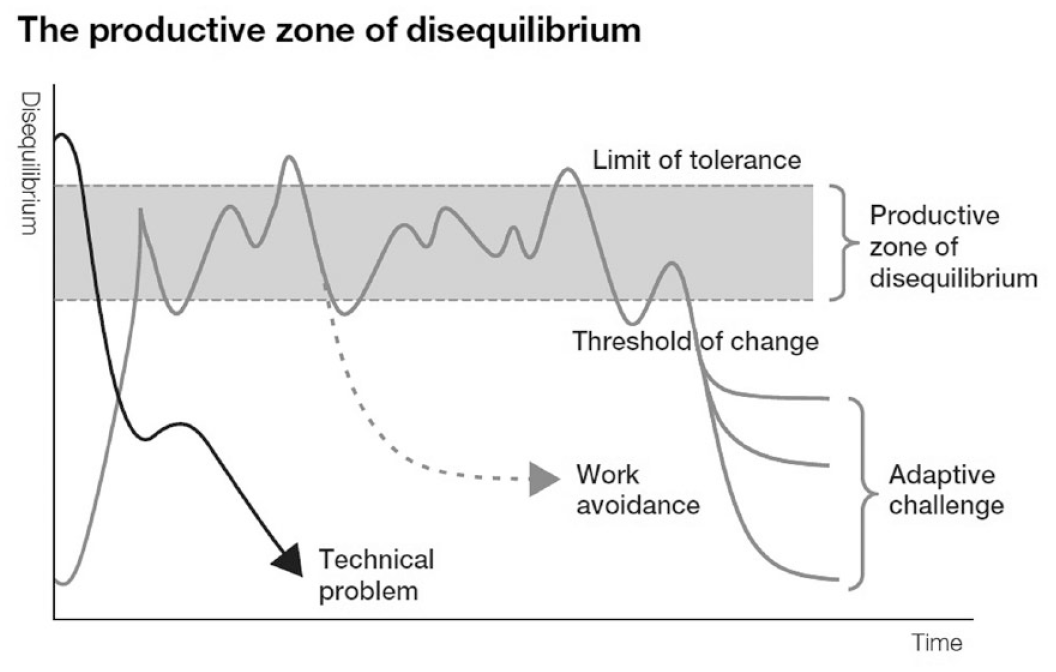
Heifetz and Laurie’s (1998) PDZ model, on which Heifetz et al’s (2009) work is based.
A second model that helps theorize ECR experience is Vygotsky’s (1935) Zone of Proximal Development (ZPD). Canonical in education and psychology, this model posits a zone in which learning occurs. As for how this happens: the ZPD is associated (or erroneously conflated; Smagorinsky 2018) with assisted development or “scaffolding,” in which experts guide learners to accomplish tasks they could not do alone. Vygotsky’s model is generally illustrated as three concentric circles: the inner circle represents the “Zone of Actual Development” (i.e., what one can currently do), the second circle is the ZPD (i.e., where one can operate with support), and the outer circle is the “Zone of Insurmountable Difficulty” (i.e., work that is beyond us).
How, then, might we put these models to work to theorize the ECR experiences above? As an Academic Developer, I had applied technical fixes to knowable problems (Figure 3), operating well below the zone of challenge and interest, instead reinscribing what I had long done as a teacher educator. Further, I operated within Vygotsky’s Zone of Actual Development, learning some procedural skills for working within university environments but rarely challenged or supported toward paradigm change. Thus unchallenged, I had plenty of bandwidth for producing book chapters on the weekends.
Then everything changed. As a Lecturer, many more tasks were new to me; I had a few extant fixes to apply. The complexity of academic work and my newness to it meant that I was operating mostly in the ZPD, guided by those around me. In addition, I was fully engaged within the PZD, although often reaching the upper limit of what I could manage at my current developmental stage and learning everything anew all the time. It was exhausting. (How DO you push back gently when colleagues try to inveigle you into toxic office politics?) It was high stakes. (How DO you support a terribly weak PhD student that you should never have accepted, but you did not have the experience to see the issues?) And it was hugely stressful. (How DO you do all this while still on probation, with what felt like no room for getting things wrong?) Perilously close to the limits of what was possible (for me, then) and all too often beyond it, I strayed into the Zone of Insurmountable Difficulty, where I sometimes faltered. And in this state, how does one find the headspace to write academic papers? I don’t know. Somehow, though, I did. But this suspended state of distress could not last.
Be(com)ing Academic: The Outdoors and/as “Balance”
Gradually, I began pushing back against the singular, rigid academic identity—of workaholism and “put-upon, bullshit. . .martyrdom”—instead trying to craft a version of myself-as-academic. The academic identity as my colleagues performed it—of striving, always, to do more, be more, be better, and to brag about it—felt like so much chasing of a moving target. And all I could see in that was more of the s(h)ame. Where was “enoughness”?
May 18, 2013. Facebook. Like a naive fool, I just hit “print” on a [colleague’s] academic CV [résumé]. Then I realised it was 38 pages long. Jeez. • [a nonacademic friend replies] Not good for the paper but must bring a little smile to the face that it now goes on for so long! • [me] Ha! Not MY CV. God no. Mine is four pages of nice, neat brevity. This was a high falutin’ academic type who, honestly, needs to get out more. • [nonacademic friend 2] WTF. • [nonacademic friend 3, who works in HR] expecting people to spend three hours reading your CV speaks of massive personal insecurity and a lack of understanding of people.
These replies felt comforting as voices from the “real world,” reaching me through the fog of academic performativity in which a 38-page résumé appears to be reasonable (which it is not).
It is important to note that my resistance to academic identity was not about earnings. Often, at conferences, I hear(d) academics complaining about money. But this was not my issue:
June 14, 2011, Facebook. Newly debt free (mortgage aside) for the first time since 1990. I just paid of my 1990–1994 UK student loans, after never earning enough even to hit the [repayment] threshold [throughout my] years [of] working in English language teaching. This feels VERY sweet! October 24, 2011. Gratitude journal. [I’m grateful for. . .] Earning good money. [A friend from Melbourne] was arriving at 6.30 pm [yesterday, a Sunday] and I was meeting [another friend] for a hike at 10 am. Adelaide, being. . . . Adelaide, nothing is open before or after these times, and there’s no food in the house. But, instead of cancelling walking for the sake of going to [the supermarket], I called [restaurant], booked a table, took [my friend] out to dinner, and made an evening of it. . . . Throw some money at the problem.
These extracts speak to feelings of conflict. During (and since) my time as an ECR, I (have) felt enormous gratitude to academia, in which I earn(ed) more, in more secure employment, than I ever did as an English teacher. I was (and am still) also grateful to academia for the status it gave me and I performed my relief against the foil of my previous, subaltern role. Like Manning’s desert-walk in the context of a snake phobia, my journey from language teaching to academic work was imbued with the shame I felt previously, when I saw myself through the eyes of an industry that positioned me as a disposable and interchangeable “native speaker,” and little else. For this reason, even long after securing an academic job, I performed this distancing:
August 8, 2014, Facebook. Having been a scruffy backpacker teacher for the majority of my adult life, I now earn something akin to “proper” money. What this means is the following: tonight, after a looong work week, I went out with [two friends] and we drank beer. . . . But I have an early flight booked tomorrow to Brisbane for a conference, a disgruntled kitty to deliver to the cattery before then. . .and I’m yet to pack. . . . So, I came home and jumped on the Qantas website. . .and changed my flight to early evening, even though it cost me a hundred bucks to do so. And you know what? I’m very glad to fall asleep tonight without setting the alarm. Right there, that time is worth a hundred bucks in my exhausted, no-longer-on-the-absolute-bones-of-my-arse life. I’m feeling relieved.
My strong sense of needing an academic job was therefore about both security and identity. No wonder I struggled when academia’s intensity started to consume me: I could not walk away. But nor could I keep walking into the fire.
So, for me, the only way out was through. In order to pare back the overwork, first I had to prove to myself that I could “make it.” By the time I came to find resistance, my PhD research had won prizes and been published as a monograph, I had published and conference-presented extensively, and my research was being sought by industry. I had also won a teaching award, nailed a promotion, graduated a handful of PhD students, published a second monograph, and had my job confirmed (akin to tenure). Tuinamuana and Yoo (2021, 56) critique this as academics’ “endless procurement of badges,” but I needed such badges before I could feel safe enough to stake a nonnormative identity claim. This way, “doing less” was not about failing to do more. No. This was about choosing less while still distancing myself from what had gone before:
October 27, 2014. Facebook. At Six Foot Track [in the Blue Mountains] . . .I’m gonna do a solo hike, a big one. Three nights camping, four days hiking, one historical trail. The forecast is 11°C to 30°C (nights, days) and sunny. No one to hear me whine about the uphills but Mother Nature herself. Feelings include: feisty, brave, scared, last-lingering-effects-of-dengue-eeek [I got dengue fever during fieldwork in Nicaragua in June 2014], empowered, overdue, meditative, strong, fat, capable, incapable, daring, cannot, can, and YES! I. . .love that I live in this place and time and that such things are possible. I wish I was more svelte/fit/entitled to be out there, but I’m not letting anything stop me—the trail and I are simply meant to be. I have camping gear, a fabulous sense of the possible, increasing body confidence, and the bloody mindedness required to make this happen. February 28, 2015 (a Saturday). Facebook. At McIvers Ladies Pool [a rockpool at Coogee Beach, twenty minutes’ walk from my Sydney flat]. I have literally spent all day, from 6 am until now (6 pm), revising my bloody [grant] application, the same one I spent all of last week on, and many months before that. . .. Now, I’m going swimming. I am too hot and too OVER IT to write another word. Tomorrow is a day of REST, hurrah!
I was still working long hours. Knocking off at 6 pm on a Saturday felt rebellious enough for me to justify it, and taking four days off was a big event. Indeed, calculating my ECR workload brings me to an eye-watering figure of around 160% (or: just over one-and-a-half people’s worth of already-too-much overwork). My workload-on-paper, in contrast, was 100% (i.e., fulltime). Through this assemblage strolled a jumble of the nonhuman: I spent such long hours in the office that I got a second cat as a playmate for the first. Anxiety medication was prescribed and it helped, although it also numbed me. And the materiality of affect—shame—was still pervasive, meaning that I kept up a performance of coping, smiling through the exhaustion.
But I was starting to find balance, which did not look like the quadrants or color-coded diarizing that the university workshops had suggested. Instead, I started taking email-disconnected solo camping trips, which were meditative and not in any way performative: there was no one there to impress or feel ashamed by. And gradually—in green, wilderness places—I started to uncurl, a plant watered just in time. I spliced these trips together with periods of binge-writing, including writing about hiking itself (e.g., Stanley 2018; 2022). I also made more efficient the other parts of my job; I was still available for students and colleagues, but I was careful to be available for myself, too. Getting ill also helped, as absurd as that statement seems:
August 10, 2014. Journal. Since getting dengue [fever], and having to pare back my commitments a bit, I’m getting better at saying “no”. . . . Or yes: yes to down time, resting, time out, and time for me.
I liked my academic job then, and I still like it now. As I progressed through the ECR years, the newness of adaptive challenges lessened and thus the complexity—all that bumping around at the top of the PZD—calmed down. Much of what I do now is technical. My learning has moved from Zone of Insurmountable Difficulty (too often) and Proximal Development (sometimes) to the Zone of Actual Development. That is, while I still learn things—especially from students and through writing—I can now do academia without thinking too much about the process.
However, I still feel that most academic jobs are sliced too thickly. For this reason, seven years after finishing my PhD, I wrote the following:
June 15, 2017. Facebook. For the past 5.5 **YEARS** . . .I have been/become a workaholic. Partly this is my own stupid, perfectionist desire to be an academic superstar: to write and publish prolifically (and to write beautifully), to be the best damn teacher I can be, and a million other things. . . . All of this has been killing me. I can see its effects on my skin, my waistline, my distractedness, and my sleep (from which I awaken thinking of work). . . . The upshot is: I’ve been crying a lot. . . . [T]he answer is to rein in the amount of time AND HEADSPACE I’m willing to commit to academia. . . . So. This week I’ve negotiated going part time ([80%, in effect cutting in half my workload]). This means having every Friday off (HALLELUJAH!) and a proportionate downgrading of my expected academic output. . . . Of course, this means taking a salary cut. I get that. I’ll figure it out. . . . I won’t be eligible for promotion. . .but I’m OK with that, too. I do think universities use promotions as the carrot to get academics to do tons of extra work, and I don’t want to play that game anymore. . . . It is making me sick (in both senses of the term). I also refuse to play the “I’m a martyr” game of bragging about how much unpaid overtime I’m doing. Life is short. I care about work, but not that much. As for what I’ll do with my Fridays: swim. Walk. Do the crossword in the newspaper in a cafe. Play with the cats. Lie in a hammock and read a novel. . . . Get fit again. Sew. Cook. Paint. Go camping. . . . Anything. The main thing is to feel good again.
I loved my free Fridays, but I did not stay part-time for long: eighteen months was enough for me to learn to more carefully guard my time. This meant that when I came back to a full-time role, in early 2019, I was better able to keep my work at 100% and not let it slide upwards again.
Conclusion
Academics are accountable to themselves as well as their universities, and the internal as well as external pressure that this creates—to do more, to do better—is relentless. However, as ECRs progress, there does seem to be movement from adaptive-challenge to technical work-types and a shift toward the Zone of Actual Development. This means that as becoming academics transition toward being-academics, the work becomes more routine and the learning curve flattens out. But the potential for overwork does not end, and universities seem to take advantage of academics’ drive to succeed, demanding ever more in an absurdist Olympics-of-Suffering.
Why does anyone play along? While affective factors will be specific to each person and assemblage, shame and identity have served as examples in this paper. Wherever identities are performed and negotiated against a normative “put-upon, bullshit air of martyrdom,” academics will continue to collect status badges with which to prove themselves to each other. Overwork and burnout are thus baked into the system. Unless and until individuals draw lines around what they are willing to tolerate, they may find themselves—as one colleague did—ignoring their parents on a visit home in order to sit behind a laptop and finish a paper. While this may appeal to some, it is not necessary. We can resist. We must.
However, such “fixes” are individual rather than systemic. While this paper has discussed one ECR survival strategy—paring back to 80% (on paper) in order to pull back from 160% (in reality)— this does not address the underlying problem. The first contribution of this paper, then, has been to ask iteratively: at a level above “how to survive,” what knowledge types and which knowledge producers is academia missing out on because of its insistence on this maniacal way of sorting the “quitters” from those who “can hack it”? What talent is being squandered where it resides in ECR-assemblages that do not burn quite so brightly with the toxic affect of shame? That I survived does not mean that the system is not broken. It just means that I survived.
I hope ECR readers will find a way of doing so, too, and this is the second contribution. While the bigger project is to effect systemic change—requiring a paradigm shift well beyond individual ECRs or those mentoring them—this text has shown that while a suspended state of ever-becoming is normal for ECRs, it does get easier, better, although there may be a need to push back. Resistance is fertile, after all. And so is spending time in nature, which is the part of the assemblage that I credit with making it all come together for me.
Footnotes
Declaration of Conflicting Interests
The author declared no potential conflicts of interest with respect to the research, authorship, and/or publication of this article.
Funding
The author received no financial support for the research, authorship, and/or publication of this article.
