



Abstract
Over the past year, COVID-19 and the restrictions imposed in its wake have meant that a range of research methodologies involving social contact could no longer be pursued. Whilst this time has been challenging, this article aims to showcase how it nonetheless presents opportunities for methodological innovation that can be carried forward into the future. Drawing upon an autoethnographic dissertation that sought to conceptualize the researcher’s lived experience in Scotland’s lockdown as an assemblage that was situated within, and intersected with, the wider “lockdown cultural assemblage,” it proceeds chronologically from how the research began to inductively drawn findings on shifts to lived experience produced by the lockdown across five interrelated dimensions to lived experience: embodiment, spatiality, temporality, a changing vocabulary of sociality, and narratological environment and broader context. In recounting this journey, it demonstrates how assemblage theory can both benefit from, as well as transform, autoethnography as its primary methodological strategy.
On the evening of March 23, 2020, UK Prime Minister Boris Johnson announced the imposition of a countrywide lockdown to stem the rampant spread of COVID-19. Among those closely watching his address was myself, a Pakistani postgraduate student living in Edinburgh, Scotland at the time. While I was worried about the embodied threat posed by a novel, highly transmissible disease, and that distressing scenes similar to those from Italy may now be approaching the UK, it was also clear to me that a lockdown going into force had just dissolved any possibility of conducting fieldwork on my then planned dissertation research topic. Thinking up a new project was the only way forward.
About two weeks later, I was deliberating on how to design a project that can interrogate the ongoing process through which my daily life, along with that of millions in the UK, had been quickly disrupted. This disruption was necessarily having an ongoing impact on the cultural knowledges and practices that guide the rhythms of our everyday life. The import of these has been theorized by an array of concepts in cultural sociology, including but not limited to: norms, values, codes, tool-kits, habits, discourses, cognitive frames, and tacit knowledge (Alexander and Smith 1993; Bellah et al. 1988; Bourdieu 1984; Swidler 2013). However, interested as I was in the movement or the process of how the articulation of meanings, materials and practices tied to everyday life was dramatically shifting, I approached the matter from the perspective of “cultural assemblage,” engaging with programmatic ideas on cultural sociology put forth by Inglis, Blaikie, and Wagner-Pacifici (2007), Bennett (2007, 2013), and Stanley, Salter, and Dampier (2013).
Moving further, I came to believe that studying the lockdown itself, by conceptualizing it as an “assemblage” (Buchanan 2021; DeLanda 2006; Deleuze and Guattari 1988) that was taking form, would perhaps result in a valuable contribution to understanding the present moment. From my standpoint as a postgraduate sociology student, there were two principal questions to be pursued, and they were closely interlinked. First, how can the coronavirus lockdown be conceptualized as a cultural assemblage that is organized through an interplay between a set of heterogeneous, human and non-human elements? And how does this assemblage—after it has been brought together—act upon the lived experiences of social actors situated within it? For me, the starting point for answering these questions manifested itself in space; the lockdown had given the city this strange, vacant persona that I found intriguing from a sociological standpoint. Albeit I knew that space would be an essential facet within the lockdown cultural assemblage, this led me to draw on a supplemental framework that specifically focuses on it—that of “non-place” (Augé 1995).
Theoretical considerations aside, the key question then was: what methodological approach could be feasible for such an inquiry, considering that restrictions on social contact ruled out any fieldwork involving other social actors living in lockdown? It was at this point that I started considering, and was later to decide upon, autoethnography as my primary methodological strategy, finding it as a way of doing research that would allow me to base my dissertation on a reflexive engagement with my own experience and perception of living in lockdown. Reviewing prior work on autoethnography made me recognize my positionality as an “insider” in the “field” of the lockdown who can attain “verisimilitude” in a dissertation that was “written-in-the-moment” (Ellis, Adams, and Bochner 2011; Grant 2010; Stanley 2015). And thus, I entered the field of Edinburgh in lockdown for a period of over three months, culminating in my dissertation.
Drawing upon this dissertation, this article chronologically takes the reader on a journey through the stages in which I operationalized autoethnography, in order to first map out my own lived experience as assemblage, and thereafter probe into the intersections between this assemblage and the wider lockdown cultural assemblage it was situated in. By recounting this journey, I have a twofold aim. First, by discussing an autoethnography focusing upon what will in all likelihood be remembered as a generational event, that is, the onset of COVID-19 and the ensuing lockdown, I intend to illustrate how thinking with assemblages opens interesting apertures to how this period of accelerated sociocultural change positioned me as an international student: my body, experiences, and spaces. In doing so, the objective is not only to connect “my self and others’ selves in tangible and meaningful ways” (Adams, Jones, and Ellis 2015, 77), but also to invite further research that can help “pluralize the experience” (Stanley 2015, 163) of living under COVID-19 restrictions.
Secondly, while this research is the result of circumstantial constraints and the unconventional routes they compelled me to explore, this article aims to establish the resonance between assemblage theory and autoethnography. It does this by presenting a case that explores the possibilities of what is to be gained by bringing them together, by doing assemblage theory autoethnographically. Ideas originating from Deleuze and Guattari (1984, 1988) that comprise a part of assemblage theory, in particular their emphases upon affect, embodiment and flux, have been variously invoked in framing the theoretical orientation that underpins autoethnography. Scholars have stressed upon the primacy of relating affectively with research participants (Ellingson 1998; Ellis 1999) and readers (Ellis et al. 2011; Gannon 2013); underlined the relational constitution of subjectivity (Harris and Jones 2021; Richardson 1992; Wyatt and Gale 2013); as well as advocated for autoethnographic texts to produce “deterritorializing” flows—through both form and content—that challenge and venture beyond deeply ingrained dichotomous thinking in social science research (Ellingson and Ellis 2008; Richardson 1993; Turner et al. 2018).
However, as transformative as these efforts have been, there has not been an attempt at tapping into assemblage theory—in any of its diverse iterations—as a toolkit for social inquiry. Thus, at present, the praxes of assemblage theory and autoethnography remain far apart. And this is where my intervention lies; my autoethnography aims to demonstrate that bringing a holistic engagement with assemblage theory firmly within the autoethnographic milieu is indeed a valuable and rewarding endeavor that should not be put off any longer. In my research, assemblage theory and autoethnography were not just conceptual-methodological components operating in tandem, but also became co-constitutive of each other. But my work only scratches the surface, which is why the audience I am targeting here in particular is those scholars and graduate students who share an interest in either assemblage theory or autoethnography, so they are invited to consider an innovative, and also engaging, approach to their research. This way, we can work towards ensuring that the synergy between these two traditions does not remain untapped in the future.
In this article, I begin with an overview of autoethnography as method, in which I invoke Anderson’s emphasis on “analytic autoethnography” (2006) before setting out the requirements for data collection and analysis that were posed by my application of assemblage theory and, as its subcomponent, non-place. In the next section, I proceed to how these requirements were weaved into the manner in which I designed my autoethnography, spanning across my approach towards field notes, the inclusion of photographs, and the forms of autoethnographic representation that were chosen for writing my seven-day narrative account. Using a range of extracts from my narrative account, the fourth section reviews the findings of my investigation in terms of five “loci of shifts” to lived experience produced by the lockdown cultural assemblage, originally drawn inductively from my analysis of the narrative account: embodiment, spatiality, temporality, a changing vocabulary of sociality, and narratological environment and broader context.
Autoethnography, Analytic Autoethnography, and The Lockdown as Cultural Assemblage
Arising from a “crisis of representation” relating to how prior claims about society had been advanced as scientific knowledge (Denzin and Lincoln 1998; Ellis et al. 2011), autoethnography has come to establish a considerable interdisciplinary following in recent years. The firmly qualitative method is the aggregate of three components—“the self (auto), culture (ethno), and writing (graphy)” (Adams et al. 2015, 54). Owing to its origins and the direction of its development, it has been associated with the turn towards poststructuralism and postmodernism; however, certain scholars have attempted to reconceive it as a method in realist ethnography rooted in symbolic interactionism (Anderson 2006). What is commonly held still is that autoethnography sees the self as a valid gateway to the social world, asserting that “we are always in culture and culture is always in us” (Adams et al. 2015, 77; Rambo et al. 2019). In accordance with this epistemic frame, it seeks to enact an inside-out movement (Hamdan 2012) that leads from an individual researcher to society and vice versa.
Assuming such an insider–outsider, participant–observer status necessitates that autoethnographers actively maintain reflexivity by not only acceding to, but making visible, the social positionalities, motivations, and formative assumptions that shape their research. Indeed, “all ethnography” is “self-ethnography” (Goldschmidt 1977, 294) that comes with “personal investments, interpretations, and analyses” (Adams et al. 2015, 26). Accordingly, it is an appropriate moment to note that the autoethnography I present in this article was inevitably shaped by positionalities such as being an able-bodied young male, a person living alone, a Pakistani, and a sociology postgraduate student interpreting his surroundings in terms of the assemblage and non-place frameworks. To make my presence as a live participant–observer in the ethnographic field of the lockdown visible, I wrote in first-person narrative voice, making clear that I myself “form part of the representational processes” (Atkinson, Coffey, and Delamont 2003, 62) that my research brings to light.
Taking aim at scholars who have come to be known as pioneers of autoethnography, Anderson (2006, 373) coined the term “analytic autoethnography” to denote autoethnography that is explicitly aimed at “developing theoretical understandings of broader social phenomena.” He argued that authors such as Ellis and Bochner, in defining autoethnography as a firmly “evocative” method with a rich variety of formats like memoirs, poems, and plays (Ellis 2009; Faulkner 2018; Manning and Adams 2015; Richardson 1992), had shunned principles of social inquiry when they declared that it “refuses to abstract and explain” (Ellis and Bochner 2000, 744). A discussion on the evocative versus analytic debate 1 lies outside the scope of this article. But it is important to establish at this point that within this spectrum, my autoethnography leans more towards the analytic categorization whilst also incorporating aspects of the evocative one.
Designed in line with Anderson’s intervention, it is analytic as it is firmly rooted in the tenets of assemblage theory, and it fulfils the set of criteria put forth by him to qualify as such (2006, 378), except that an attention to social actors beyond the self was curtailed by the lockdown I found myself in. I take seriously his contention that social scientists undertaking autoethnography must actively avoid digressing into self-absorption in their narratives; instead, “self-consciously” analytic introspection should be “directed towards theoretical development, refinement, and extension” (2006, 387). At the same time, however, I agree with Adams et al. (2015, 36–8) when they say that autoethnography can be emotive and simultaneously derive theoretical understandings from personal narratives by revealing “sense-making loops” and “meaning-making processes” constitutive of cultural phenomena. In this manner, I follow Phiona Stanley in charting a hybrid version that can yield both theoretical understandings as well as an immersive, eclectic and “verisimilitude-seeking” (Ellis et al. 2011, 282–83; Stanley 2015, 149) account of lived experience.
In charting such a version, I do not seek to distance myself from the merits of analytic autoethnography, or indeed the range of work in the evocative form which has established autoethnography as a legitimate mode of research for social scientists like me. Rather, what I am proposing by bridging these two forms is to further the space for dialogue between them. One way to do so is to counter the issue of a fixation on “emotional resonance” at the cost of social inquiry, which forms the basis of Anderson’s critique (2006, 377), in a different way. My stance is that it is certainly possible for an autoethnographer to incorporate, or indeed prioritize, the role of emotions in sociological research without them violating an “analytic” posture. As will become clear, this stems from my application of assemblage theory, a conceptual approach that puts the Spinozist notion of “affect” at the center of social inquiry (Deleuze 1988, 101; Fox 2015, 306). Emotion, desire, and feelings are not shunned but rather foregrounded in the analysis of my life in lockdown, with a particular focus on where they lead me in terms of decoding relations among a myriad of actors implicated in the “bringing-into-being” (Inglis et al. 2007, 16) of cultural change tied to the lockdown. In following this emphasis on affect, I relate it to the terms of “evocative” autoethnography; it is by following and reflexively engaging with my “sense-making loops” and “meaning-making processes” (Adams et al. 2015) that I gain insight into my relational placement in the lockdown as cultural assemblage. I now proceed to discussing this conceptualization of the COVID-19 lockdown, and how it oriented my autoethnographic data collection and analysis, in more detail.
As a framework that does not distinguish between being a conceptual approach and a practical methodological strategy towards investigating social issues, assemblage theory is particularly suited to advancing the autoethnographic enterprise. By seeing the lockdown as cultural assemblage, the ontological positioning I assume broadly draws upon new materialist social inquiry, which Fox and Alldred (2015, 399) describe as being “transversal to a range of social theory dualisms such as structure/agency, reason/emotion, human/non-human, animate/inanimate and inside/outside.” Instead, social problematics are conceptualized in terms of processual, contingent, and volatile enactments of relationality among a heterogeneity of animate and inanimate elements. The notion of assemblage seeks out the logic of how a given web of relationships comes alive; as Buchanan aptly writes, it is the ordering or “yoke” that fastens them together, a “virtual entity with actual effects” (2015, 384, 2017, 473). Multiscalar at its core, assemblage analysis does away with the divide between micro, meso, and macro levels of social inquiry (Taylor and Ivinson 2013), thus making it compatible with autoethnography as its methodology.
When it comes to abstract entities like culture, scholars in this tradition have underscored an analytical distinction between the cultural and the social as distinct “historical rather than anthropological realities,” whereby production of the former—as assemblage—“works” to sustain, or reform, understandings that underpin the latter (Bennett 2007, 32–3). Culture, or for that matter society, is to be seen not as something existent but rather as something continually “produced” (Stanley et al. 2013, 299), holding no ontological status outside of contingent relationships that are constitutive of its existence yet continuously in flux (Deleuze and Guattari 1988, 261). This conceptualization of culture means that the foremost aim of my autoethnography was to capture the symbiosis between the “work of making” culture, namely the ideas and material practices implicated in producing the lockdown as lived experience involving a range of human and non-human entities, and the “work it does” on the social (Bennett 2007, 2013; Stanley et al. 2013) by disassembling and reassembling prior understandings as they pertain to, for instance, how we socialize with friends and family. Alternatively speaking, the central task was to identify the “working surfaces” (Bennett 2007, 39) through which assembled lockdown-related cultural knowledges and practices intersected with and acted upon the social plane to bring about larger shifts in behavior. What is of essence, and influenced the format of my field notes, is the need for my study to be spatiotemporally specific, identifying “specific articulations among a myriad of heterogenous elements” (Pedersen, Tutenges, and Sandberg 2017, 161) or “constellations” (Deleuze and Guattari 1988, 464–65) that produce particular cultural manifestations largely unprecedented prior to the coronavirus. A helpful heuristic for working towards this has been laid out by Liz Stanley, who has emphasized upon the “analysis of time, place, persons and—importantly—the practices or work involved in making the cultural in this time, this place, involving those persons and circumstances” (Stanley et al. 2013, 299).
While mapping out the lockdown cultural assemblage in these terms, I take note of assemblage theory’s foregrounding of “affect” over agency, denoting autonomous mobilizations of and by desire that give rise to the relational capacities brought to bear by a particular assemblage (Deleuze and Guattari 1988, 303–4; Fox 2015, 306; Massumi 1995, 105). Deciphering an assemblage therefore entails tracing “affective flows” (Fox 2015; Fox and Alldred 2015) passing between its constituent elements, which can either be “aggregative”—capable of enacting broad cultural and subsequent social change such as compliance with the 2 m social distancing rule—or “singular,” in which case they do not have such an effect. This dichotomy of affective flows is reflective of social production being nonlinear or “rhizomatic” (Deleuze and Guattari 1988, 7), characterized by opposing tendencies or “rupturing” flows (Fox and Alldred 2015). The rhizomatic nature of affective flows means that at any given time, there are affective flows stabilizing relational capacities that cement or “territorialize” the lockdown as an emergent sociocultural formation, as well as those which simultaneously and conversely “deterritorialize” the assemblage (Buchanan 2021, 88–9; DeLanda 2006, 19; Deleuze and Guattari 1988, 387–89); however the chaos of the latter tends to be resisted by immediate “reterritorialization” (Buchanan 2017, 463), whereby stabilizing capacities are preserved in a new form. My autoethnography was thus geared towards deciphering how the imposition of lockdown permeated in the form of affective flows into individual, subjective lived experiences to then shape a broader environment, or in Deleuze and Guattari’s terms, how the lockdown assemblage territorialized itself beyond original constellations.
As for the points of origin of these affective flows, I deploy Actor-Network Theory’s notion of “actant,” denoting anything “that acts or to which activity is granted by others” (Inglis and Thorpe 2019; Latour 1996, 375, 2005, 71–2), to capture the heterogeneity of human and non-human actors through which the bouncing of affective flows tied to my lockdown lived experience ensues. Alongside friends and strangers I came into contact with, my autoethnography records a range of non-human actants in the assemblage I attempt to chart, which has me at its center: travels and changes in the path of the coronavirus, 2 my dissertation itself, coronavirus dashboards published on government websites, posters and screens alerting pedestrians to newly-instituted rules, online news articles, social media, my flat, among others. Tracing affective flows between actants and not merely actants themselves in effect prioritizes the expressive attributes of the assemblage—“desires, feelings and meanings” (Fox and Alldred 2015, 399)—over the material ones, and this is consistent with Deleuze and Guattari’s original formulation of the concept (Deleuze 1988, 127; Deleuze and Guattari 1988, 66; Guattari 1995, 120). In the case of the UK’s lockdown, such attributes include the ideas (mediated by state institutions like SAGE, the mass media, “technical” actants like Twitter, among others) of caring for vulnerable groups, of civic responsibility, of positive sentiment for the NHS, and so forth, that were causative of the emergent semiotic-material arrangements (Buchanan 2021, 103–4) tied to the lockdown cultural assemblage and its subsequent variations. Pursuant to this, I pay special attention in my autoethnography to the “narrative environment and repertoire” which can “shape and motivate experiences” (Pedersen et al. 2017, 166) of human actants embedded within the assemblage.
In sum, and for analytical-terminological consistency, this article will have the lockdown cultural assemblage as the focal point of consideration, made up of heterogeneous actants whose interactions generate affective flows in spatiotemporally specific constellations. After identifying these elements, I trace aggregative affective flows or working surfaces on the social in my lived experience that signify the territorialization of the lockdown (Bennett 2007, 2013; Buchanan 2021; Deleuze and Guattari 1988; Fox and Alldred 2015; Latour 2005). Before progressing to how my autoethnographic inquiry was turned towards dissecting these attributes as they pertain to the lockdown, I briefly address how Augé’s concept of “non-place” (1995) co-constitutes my employment of assemblage theory.
As noted earlier, an assemblage relates material attributes with expressive ones (Buchanan 2021, 32–5). The former can be thought to comprise of relational affective flows passing between “things,” “bodies,” and “environments” (Middleton 2010, 587). Space, beyond the conventional Euclidean understanding, is an important dimension continually constituted in a “play” that draws in and extends all three of these (Thrift 2007), and thus serves as a major anchor in my analysis. Tapping into Augé’s (1995, 93) thesis on “non-places” 3 —fast-proliferating spaces that are marked by a suspension of identity, history, and relations, resulting in a “very particular and modern form of solitude”—is meant to serve as a supplemental analytic tool focusing entirely on this spatial dimension. His framework complements my study of the lockdown as cultural assemblage in several ways: its focus on the spatial production of meaning, laid out primarily in affective terms; its ideas on the role of non-places in times of accelerated sociocultural change, such as the lockdown; and its emphasis on semiology. What allows me to incorporate it in my conceptual–methodological lens is his brief suggestion that place and non-place are relational, and may blend into each other, opening up the possibility that certain spaces in Edinburgh may “reconstitute themselves” (Augé 1995, 78) in a partial manner during lockdown, such that they start to emulate certain features of non-places.
There are two such features that I draw upon in interpreting the role of spaces in producing the lockdown cultural assemblage. The first is the aforementioned idea that the proliferation of non-places in space, which Augé considers a persistent tendency of present-day “supermodernity” (1995, 109), comes with a unique solitary detachment from inert realities of “anthropological place” (1995, 93, 1998, 105)—the type of space contrasted with “non-place” as “familiar, localized, historic, organic and meaningful to its occupants” (Merriman 2009, 16). I put this to the test in the context of the lockdown as a novel socio-spatial terrain, to see whether this reconfiguration of social relations produces certain variations of solitude that are contingent upon it, and if so, whether they resemble the positive feelings of dissociation Augé speaks of. The second feature, carrying greater significance, is what he calls “the invasion of space by text” (Augé 1995, 99) in non-places. He underscores that non-places are “defined partly by words and texts they offer us”—“prescriptive,” “prohibitive,” or “informative,” and that image-evoking “supports” like signboards and screens play an integral role in managing “traffic conditions” in these spaces (Augé 1995, 96–9). Observing a number of new lockdown-related texts, I incorporate them in the assemblage I devise based on my lived experience, and I draw on his work to interpret what effects they may be having in linking space to affect and meaning, as well as their role in how the overall assemblage orchestrates itself.
Designing the Autoethnography: Field Notes, Visual Sociology, and Forms of Autoethnographic Representation
I now turn to how the aforementioned requirements for data collection and analysis were intertwined with the manner in which I designed my autoethnography of the lockdown as cultural assemblage. To work towards my analytic-evocative hybrid autoethnography, I utilized certain techniques outlined by Adams et al. (2015, 96–7), foremost among which is “the intervention of theory in writing itself,” or “citationality.” The primary step taken to this end was to give my field notes an “internal through-line/logic” (Adams et al. 2015, 79). For me, this logic was assemblage theory; I chose to record and organize observational data in a manner that would aid the mapping of the assemblage in focus. Combining an attention to aspects of assemblages as discussed in the previous section with a consideration of what had repeatedly stood out in my personal experience of lockdown, such as the strangeness of an altered, quietened spatial terrain, I devised a template that compartmentalized each entry of my field notes under the following headings: Short details on activities carried out, Spatiotemporal details, Narratological environment, Broader context, Affective aspects, and Photographs.
For four weeks between May and June 2020, I filled out each section daily to the extent that I believed all pertinent information had been logged, which took on average one and a half hour. While there is overlap, all six sections helped record a variety of facets to the cultural assemblage. By supplementing entries in my field notes with photographs taken via my mobile phone camera, I heed the call from Harper (2012) to incorporate visual sociology into ethnographic research design, thereby recognizing the salient role of the visual in meaning-making processes for social actors with sense of sight (Cipriani and Del Re 2012). As selective representations, capsules of times and spaces related to incidents in my narrative, these photographs invite my readers to take a vicarious journey of their own, and help elicit relatable capsules of times and spaces from their own lives. In this manner, they play the role of converting specific visual representations into certain general experiential features that convey similar affective flows.
As for my seven-day narrative account, which is based upon field notes taken from June 3 to June 9, 2020, I wrote it such that it constitutes a sum of “layered accounts” (Adams et al. 2015; Ellis et al. 2011; Rambo et al. 2019) wherein fragments of experiential narratives are juxtaposed with theoretical interpretation. Drawing upon Phiona Stanley’s (2015) analytic-evocative autoethnography on her journey as a PhD student, Run’s (2012) autoethnography of exile and refuge, as well as studies in the assemblage tradition (Middleton 2010; Pedersen et al. 2017), it is “intertextual” in format, whereby I concurrently draw upon quotations from field notes, personal narrative, and photographs for interpretive analysis. In each of its seven layered accounts, I blend two forms of autoethnographic representation—“impressionism” and “conceptualism” (Adams et al. 2015, 91–4). Impressionism, as a form of representation grounded in experience-specificity, seeks to reveal the self by immersing readers in my sensory modalities during the lockdown, taking them to the sights and places where I was situated at the time a particular constellation may have transpired. Effective “impressionist tales” 4 (Van Maanen 1988), by way of temporal, affective, and sensory accounts, are able to elicit in readers an image of impressions felt and narrated by the author, making the read a “vivid, visceral” (Stanley 2015, 148) journey for them. Moreover, they incorporate narratives of space and place, demonstrating “how spaces and places infuse, inform, and shape our identities and experiences” (Adams et al. 2015, 92).
Conversely, conceptualism is intricately tied to enacting citationality and having a “through-line/logic” to the narrative. Though my story is an impressionist one, the concurrent use of conceptualist representation means that “showing and interpreting are tightly coupled” (Adams et al. 2015, 94). In this respect, my narrative plays the role of a “textual account” (Latour 2005, 128) that is geared towards tracing affective flows generated by intersections among a myriad of actants. Accordingly, each daily account identifies and draws attention towards actants, affective flows, constellations, and other conceptual attributes encountered along the way, as a means of incrementally working towards charting my lived experience seen as assemblage. Albeit assemblage theory advocates for methodological experimentation, the idea of using an account to investigate a particular assemblage very much underpins assemblage research (Feely 2020; Fox and Alldred 2015). This is because an account orientated to this end embodies the task of “reassembling” the contingent assembly (Latour 2005, 126–29) of which the participant–observer is part; it is a depiction of how an actant is embedded within that assembly. Alternatively speaking, an account is an assemblage, which in this article is synonymous to the assemblage of my lived experience. And this is in line with the primary objective of interpreting the intersections between this lived experience as assemblage and the wider lockdown cultural assemblage in which it was situated.
Finally, it necessarily follows from the above that my daily accounts clearly entail a high degree of selectivity in which my selections in amount were inevitably affected by the assemblage character of the project I am presenting here. Cumulatively they try to capture a range of events that constituted my day, while at the same time engaging lines of interpretation with respect to the assemblage and non-place frameworks that were much in my mind as I carried out the narrated activities. Any quotations within the forthcoming extracts are as recorded in my field notes, which on a daily basis I locked under a number of headings that appear at the bottom of each quotation. These are equivalent to sections of my field notes as discussed above and acted as a way of thematically engaging with the material I collected, thereafter feeding into the final, inductive themes being used in the upcoming section. Alongside this selectivity in data collection and analysis, it is equally necessary to establish that the events narrated below were themselves shaped by time-bound as well as place-oriented restrictions. The lived experience I recorded and conceptualized as an assemblage, in order to access the lockdown cultural assemblage, was contingent upon rules in place during “Phase 1” of Scotland’s route map out of lockdown (The Scottish Government 2020), at which point I began to be allowed to meet one other household outdoors. Focusing on field notes from this period enabled me to incorporate these social interactions, occurring for the first time since 23 March, and at the same time portray a lived experience which partly resembled the preceding “Lockdown” stage. As Scotland moved beyond “Phase 1,” the assemblage inevitably evolved as well. For example, I was able to meet friends indoors in July, even though many remained hesitant to do so due to aspects of the assemblage that persisted, such as continued pervasive news coverage of the pandemic’s fallout and dangers. I return to discussing this processual character of the assemblage in the temporality subsection below. Without further ado, I now continue to the findings.
The Lockdown Lived Experience as Assemblage
This section lays out the findings of my autoethnography in conjunction with extracts from all seven days of my narrative account. I organize my discussion around five analytic themes, which were drawn inductively from the narrative account after it had been written. These themes signify five loci of shifts in “sense-making loops” and “meaning-making processes” (Adams et al. 2015) that were effectuated by the lockdown cultural assemblage: embodiment, spatiality, temporality, a changing vocabulary of sociality, and narratological environment and broader context. As will be evident shortly, each of these loci was observed to be thoroughly impacted by, and thus dependent on, the other loci of shifts; a disjuncture in one could not be explained without looking at the ways it was in negotiation with the others.
Embodiment
The first key theme drawn from my seven-day narrative account was that sensory and embodied movements, for instance regularly going on a wee wander round the city in lockdown, had an impact on affective flows. They were intrinsically related to the spatial landscape of the lockdown, which by restricting prior movements—such as going to the pub to physically meet others—and engendering new ones—such as putting on a mask, washing your hands immediately upon returning home, and walking or biking for the sake of it, without having a destination—co-produced the lockdown lived experience. The latter were accompanied by a novel affective hinterland produced by, and contingent to, the lockdown cultural assemblage, rearticulating emotions ranging from fear (of the virus, or passing it on and potentially killing someone, or a loved one contracting it), to sadness (for those dying by the day), to wanderlust (for hills, meadows and shores that promised some semblance of escape from our predicament). By following the actor (Latour 2005, 12) of myself in lockdown, I was able to connect these shifts in embodiment—and the affective hinterland wherein they arose—to both the broader context ushered in by news coverage of the pandemic, whose steady consumption determined active awareness of the embodied threat posed by the virus, as well as spatial texts dispersed across indoor and outdoor spaces that acted to reform particular embodied routines or “arts of doing” (de Certeau 1984). One example of such a routine is shopping in supermarkets: Donning a mask, I then enter the local Sainsbury’s. I briefly interact with an attendant to inquire about where I might find sugar, which I usually never buy but I now need it to go with tea. The attendant too wore a mask, but him not social distancing when guiding me made me wonder how different navigating the lockdown, in terms of risk assessment, must have been for him as a “key worker.” Further inside the store, I come across an array of signboards in the form of posters, floor markings, etc. Knowing that enclosed spaces are prone to infection, signboards like these always make me pause and be conscious of my personal space. (Narrative account, June 7, 2020)
While this interaction with the attendant, as recalled above, reminded me of my positionality, this was only because a basic sense of security—tied to us wearing masks—remained in place. This was not always the case, however, as I’d also unexpectedly encountered unmasked shoppers on several occasions. Each time that happened, a potent awareness of the virus surfaced and made itself felt on my body, signaling it—with considerable distress—to set in motion a reflex (stepping away from the unmasked person’s body) that would calm it down. In this manner, an embodiment of in/security vis-à-vis the invisible threat posed by the virus was keenly and viscerally felt, so much so that I gradually learned to preemptively evade unmasked people in indoor spaces. Such a view towards others—in plain terms seeing them as vectors of disease—is both corporeally and affectively extremely unpleasant; yet the continued presence of the virus has meant that it has proven rather hard to entirely relinquish.
As I moved further inside the local Sainsbury’s, semiology became of essence. Not only did it act on embodied movements in enclosed spaces like supermarkets, but it also encouraged adoption of new cultural practices—comprising the lockdown assemblage—in other spaces where signs may not be present, for instance on sidewalks where I now had to pause to give way to others: [While out on a walk] there were two instances where me and someone I encountered on the sidewalk had trouble social distancing due to lack of space. On both occasions, the other person and I were mindful and paused for one another. These new-found social cues, of giving strangers adequate distance, resemble de Certeau’s “tricks in the art of doing” (1984), which Augé (1995) says are employed by social actors in non-places. Just like there is social etiquette for enclosed non-places like airports, there is social etiquette for the city in lockdown. In both cases, I observe the etiquette subconsciously, without active awareness on my part of the sense-making loops it entails. (Narrative account, June 6, 2020)
The next subsection explores this further, in relation to spatiality.
Spatiality
At 4:30 The aforementioned experiential attributes are striking because Calton Hill houses several historical “monuments,” key markers of an anthropological place (Augé 1995, 60). Lately, however, its character had shifted towards mimicking a non-place that, for me, produced a novel form of solitude born of the wider social landscape—a landscape acted upon by the lockdown cultural assemblage. The onset of this affective state at the hilltop approximates what Augé described as “the end of a movement that empties the landscape, and the gaze of which it is the object, of all content and all meaning, precisely because the gaze dissolves into the landscape and becomes the object of a secondary, unattributable gaze—the same one, or another” (1995, 93). (Narrative account, June 9, 2020) Close to 12:15
We looked into what is usually a bustling center of student activity and (in terms of “place”) houses central monuments/landmarks, i.e., Teviot House, Library Bar and McEwan Hall. It was always full of people, but not anymore, and Marie remarked that it had “lost its character.”
—logged under the headings:
Short details on activities carried out, Spatiotemporal details
(Narrative account, June 3, 2020)
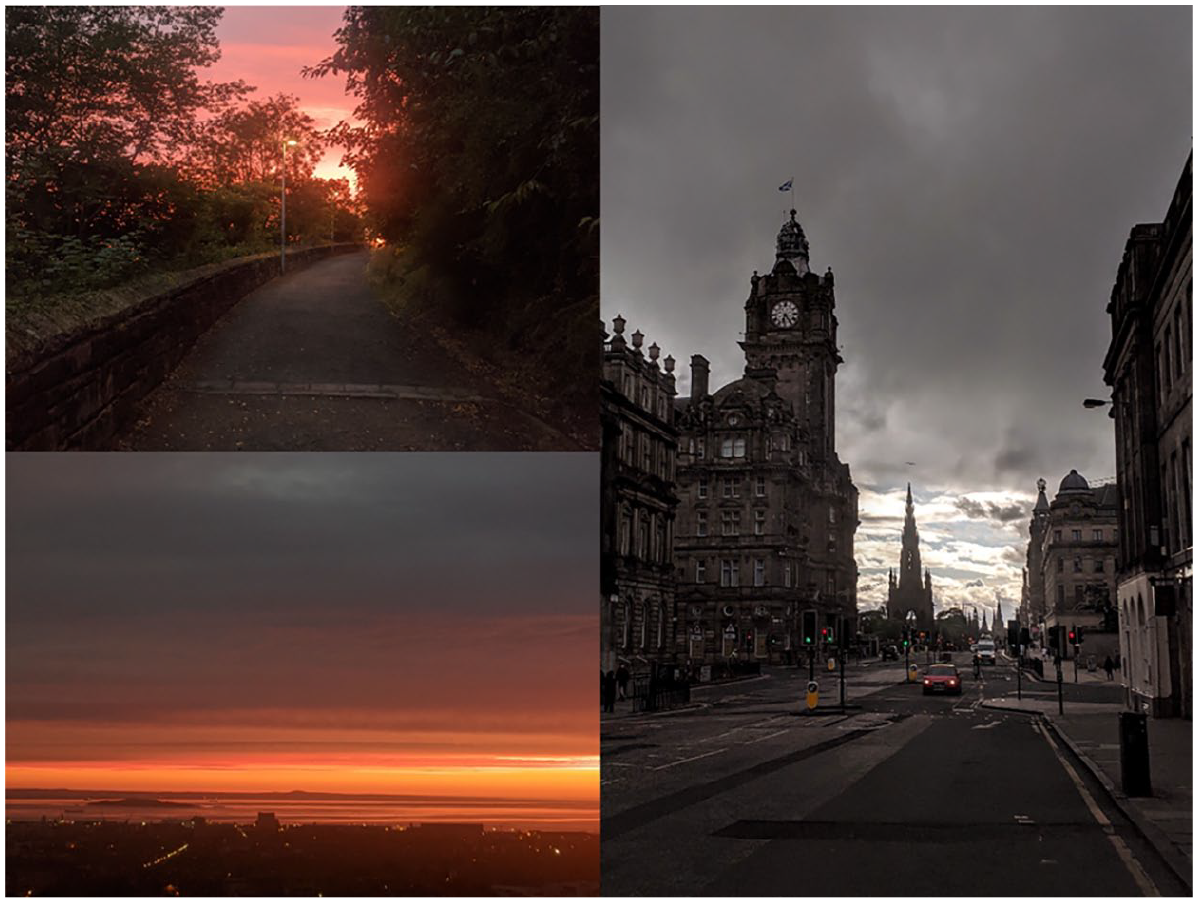
Going to (left) and returning from (right) Calton Hill, photographed between April and June 2020.
My narrative affirmed that affective flows in certain constellations were tied to spaces in Edinburgh, some among them “anthropological places,” like Bristo Square, and some archetypal non-places, 6 being reconstituted into new variations of non-place—marked by the erasure of prior enactments of identity, history, and relations (Augé 1995, 77–78). Set in motion by the lockdown cultural assemblage, this reconstitution is in line with Augé’s (1995, 78) indication that non-place “never exists in a pure form; places reconstitute themselves in it; relations are restored in it.” This blurring of boundaries explains why Calton Hill, a site of landmarks, was able to refigure itself as the non-place where I was able to pinpoint a solitary “reversal of the gaze” (Augé 1995, 86), as well as how a new, text-aided etiquette of shopping was able to take hold in supermarkets.
Another pertinent spatial shift that surfaced as part of the lockdown cultural assemblage was an element of dislocation, or being affected by multiple spaces at once, that was an actant upon me as an international student: I briefly spoke to my host mother today via Facebook. Nine years ago, I went on a year-long high school exchange program to Perry, Michigan, where I lived with an American host family. I have stayed in touch with my host mom ever since. An excerpt recalling thoughts after the conversation is given as follows:
Two months ago, when the virus was raging across the US, I’d be checking in with her much more regularly than I do now. It was as if I had one leg here in Edinburgh, and one in Perry thousands of miles away. The latter has lately been replaced with Lahore, my hometown in Pakistan, and a sense of being divided across space persists.
—logged under the heading: Affective aspects (Narrative account, June 9, 2020)
As the above extract shows, this dislocation manifested in the form of concern for myself in the UK, my family in Pakistan, and my host family in the US. Throughout the narrative, this global-local interplay of affective flows was reliant on communication mediated by non-human/technical actants, such as Facebook. A striking juxtaposition however was that this dislocation went side by side with the spatiotemporal inertia, state of suspension, and restricted mobility that was inscribed in one’s immediate surroundings, such as being within a certain spatial perimeter for long periods of time to comply with the lockdown: Winding up my field notes for the week, I note that “seeing the calendar turn” so quickly is making me a bit nervous. As a postgraduate student who has lived through the lockdown, I’ve found time to be fleeting, yet there is a certain inertia tied to a state of suspension that has been inscribed in space. I see this as a fracture, where on one end my sense of temporality with respect to the future—inseparable from how I traversed space everyday—has been suspended, and on the other end I notice that, looking back, time has indeed passed away quickly within this state of suspension. (Narrative account, June 9, 2020)
For me, this perimeter primarily took the form of my flat, which I consider an important actant implicated in producing the dislocation element—staying home meant more engagement with the world accessed via non-human/technical actants. I describe this inertia or suspension as “spatiotemporal,” not just spatial, as it affected how temporality was experienced with respect to my progression as a graduate student; the passage of time was deemed to be “fleeting,” akin to a perennial stasis from March up to the first relaxation of measures, as space was not being traversed as much as, and in the manner that, it used to. While this state of suspension was inherently tied to being in lockdown, my temporally-bounded social positionality as a graduate student worked to amplify it; that I was approaching the end of my studies in the midst of the COVID-19 crisis, and foreseeing uncertainty of what lies beyond, structured my lived experience. As a decline in infections led to a phased “unlocking” of the lockdown, producing a newer variation of the cultural assemblage with an uptick in embodied movement, the spatiotemporal inertia too changed form to become less overbearing.
Finally, there is the role played by spatial texts in public spaces, who were actants in their own right: After a couple hours of reading, I decide to take advantage of a rare sunny day and go for a short walk. I take a new route outside Old Town, walking downhill on Leith Street to the roundabout and back up. While returning, I notice that an advertisement screen has been repurposed for coronavirus messaging, though I also catch an ad for broadband. The messages shown in Figure 2 qualify as what Augé calls “texts” that define enclosed non-places (1995), in this case applied to the city. After the lockdown, a number of them occupied spaces across Edinburgh; not only do they restate its presence via directives on behavior and tributes to “key workers” shown, but they also generate affective flows in actants that pass them by and thus encourage compliance to social distancing. The notion of “key workers,” who kept services deemed “essential” running when everything else was shut down, is solidified through the same affective flows emanating from people walking by and glancing at spatial markers constitutive of the lockdown cultural assemblage. These affective flows, as they are reiterated, “territorialize” the assemblage (Deleuze and Guattari 1988). (Narrative account, June 6, 2020)
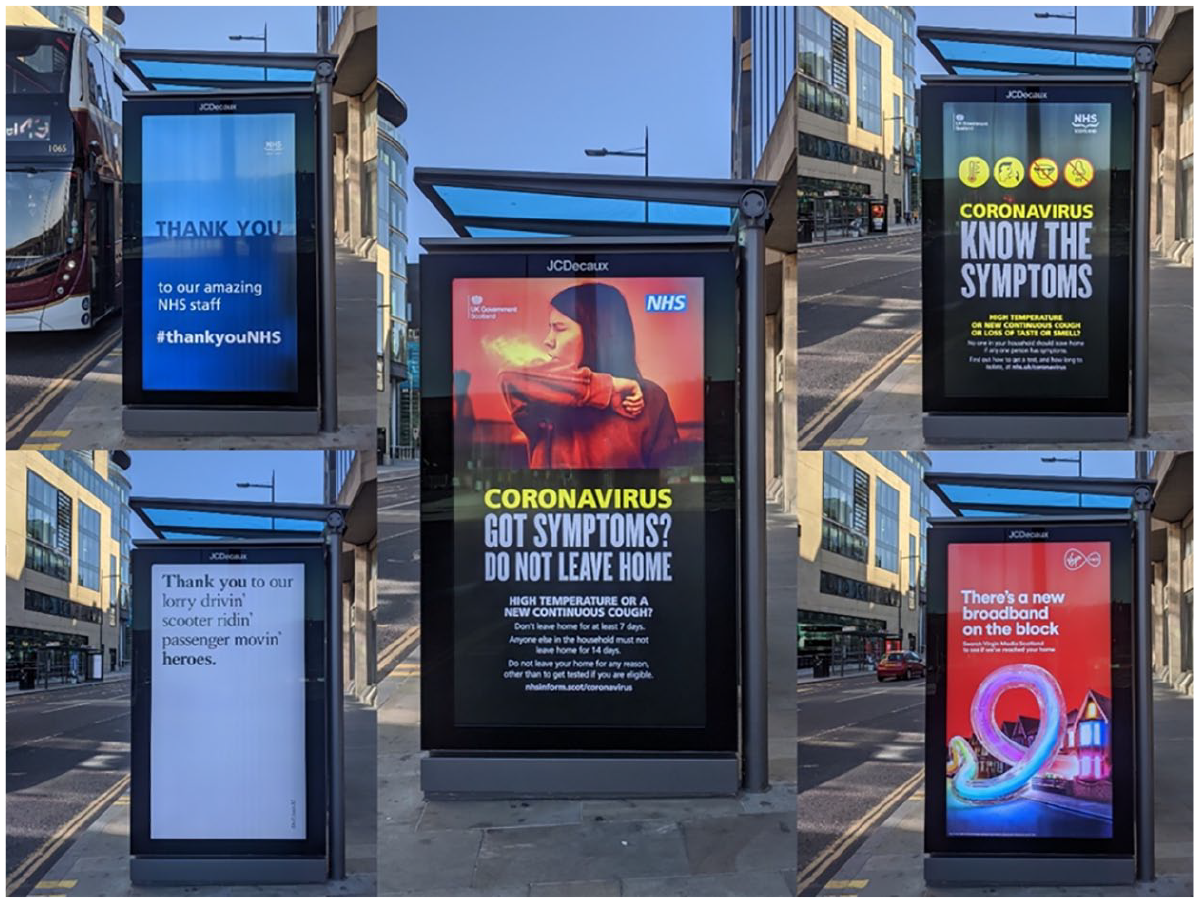
Lockdown texts on Leith St, June 6, 2020.
Placement of these texts across the city, people reading off them, and people following their directives, together organized “interfaces through which culture is able to connect with and act on the social” (Bennett 2007, 32). These interventions on the social, synonymously territorializing (Deleuze and Guattari 1988) of the lockdown cultural assemblage were also undertaken in a similar manner by accumulation of constellations tied to mobile texts; ambulances and police vehicles became mediums for semiotic reinforcement of acceptable behaviors—like keeping a 2 m distance: In the short walk from the Just Eat [bike hire] booth to my building, I saw an ambulance racing to the hospital. I can’t exactly gauge if I’ve seen more ambulances lately than before the lockdown, but I’m sure that I never noticed the loud siren the way I do now, which involves an influx of affective flows that can be tied to, among other things, pictures of hospitals on the news. The sight and sound of an ambulance passing by has been a common incidence over the past few weeks, to the extent that I consider ambulances to be moving “actants” part of the lockdown cultural assemblage (Latour 2005). They make me think of whether a coronavirus patient is being transported, and whether I am doing enough to fulfil my civic responsibility towards at-risk groups and frontline health workers. Other moving actants that reinforce the lockdown are police officers as well as police vehicles on patrol, which through their functions of surveillance and enforcement work on a different level than ambulances; before the lockdown, I had never witnessed a police presence in Edinburgh as visible as it has become now. Ambulances and police vehicles also qualify, in spatial terms, as mobile “texts” (Augé 1995) symbolic of an otherwise immobile social landscape generated by the lockdown. (Narrative account, June 8, 2020)
Temporality
While I have previously pointed to time and space being inseparable in a state of spatiotemporal inertia, there is another important observation to be noted about how temporality assumes a new modality as a result of the work done by the lockdown cultural assemblage. This relates to the processual nature of the assemblage, which evolved, and continues to evolve, with the trajectory of the disease and related guidance from state institutions. One such institution is SAGE, with its expertise on epidemiology. The role of these institutions in dissemination of information has been paramount, with briefings sharing guidelines and projections of the disease’s path that consequently affect people’s expectations and behavior. Given asymptomatic transmission, this behavior is again linked to the disease’s trajectory. This asymmetrical entanglement between the constant actant of travels and changes in the path of the coronavirus and the state’s adaptive responses to it has come to define, in a sense, the way we perceive and experience time. The ongoing negotiation it entails resonates with Bennett’s (2007, 34) assertion that “the making of culture” is “above all else, the work of institutions” that is undertaken by way of “institutionally produced zones of cultural action.” While the eventual form of the assemblage that is brought together and its actions upon the social are not linear, the reassembly begins with and is dependent upon state institutions.
Along with spatiality, then, temporality forms an integral actant (Bender 2010, 310) in the fluid “becoming” (Deleuze and Guattari 1988, 358) of the lockdown as cultural assemblage. A useful way of conceptualizing how this assemblage differed, for instance, between Phase 1 of Scotland’s route-map in which I wrote my narrative and another subsequent phase, is to treat each formation as a contingent “gelling” of relationships (Sheller 2004; Tironi 2010, 47–9; White 1992)—between social actors enacting different variations of social distancing, non-human actants like masks, travels and changes in the path of the coronavirus, government projections and guidelines, the discourse they generate, spatial actants as reviewed above—that produces unique and time-bound shifts in lived experience. It thereby follows that my autoethnographic interrogation of the Phase 1 assemblage, like any assemblage analysis, essentially seeks to account for the intricacies of “society and culture in movement from a recent past toward a near future (the temporal span of emergence)” (Marcus and Saka 2006, 102; emphasis added). While certain relationships among actants may carry across into the next temporal phase, for example, mask-wearing and social distancing being reinforced over time, the affective intensities they embody will change, as these are determined by the entire ensemble of expressive-material relationships tied to that phase. The clearest illustration of this perhaps is the entry of vaccines as an actant within this ensemble, which has significantly altered the landscape of affective flows and associated capacities with respect to containing COVID-19. Although in the present assemblage of containment measures the vaccines are material actants, it is their expressive dimension—their potential to save lives, expedite a return to “normal” life, prevent the collapse of health infrastructures, and salvage the economy—that lies behind both their development in record time, as well as the emphasis placed by governments on their uptake once their distribution had begun. The latter has meant that affective flows previously territorializing restrictions as necessary are now reterritorializing as those which present the vaccines as an antidote to not just the virus, but also the collateral damage of the restrictions themselves.
A Changing Vocabulary of Sociality
Operating in tandem with the other shifts, especially embodiment and spatiality, a crucial shift brought about by the lockdown assemblage was the disruption of prior understandings of what it means to experience or partake in sociality, and the gradual, ongoing assembly of newer understandings that arose to supplant them. Shortly after the pandemic’s onset, “social distancing” emerged as a form of social etiquette that, although not completely, displaced earlier forms of embodied sociality—such as shaking hands and hugging—with new ones—such as sitting at a distance when meeting friends at the park. Where earlier forms did occur, they came with newfound meaning, as was the case when I and Marie hugged on June 3; precisely because it was the “wrong” course of action, it oddly became a deeper mode of affection.
In all its manifestations, social distancing during Phase 1 inherently signified processes of deterritorialization and reterritorialization set in motion by the lockdown cultural assemblage (Deleuze and Guattari 1988). As a developing etiquette, it was reinforced by spatial markers or texts tied to the assemblage, including mobile ones. Through the agglomeration of constellations wherein such reinforcement takes place, the cultural assemblage was able to produce, and thereafter cement, newer forms of sociality on the social plane. Here it is useful to recall DeLanda’s (2006, 42) suggestion that “the main territorializing process providing the [personal-scale] assemblage with a stable identity is habitual repetition,” to which I will add that this repetition may be material, such as pausing for strangers on sidewalks to give way, or expressive, such as a friend asking you to socially distance. It must be noted however that as the timeline of lockdown measures progressed based on travels and changes in the path of the coronavirus, social distancing as an etiquette changed form and character as well. Despite being dynamic, newer forms of sociality engendered by the lockdown were an eminent part of both “the work of making it” as cultural assemblage, as well as “the work it does” on society after it has been contingently assembled (Stanley et al. 2013).
On the latter aspect, my narrative observed that one consequence of these new forms of sociality was that affective flows tied to previously mundane interactions, such as exchanging a smile with a dog walker or saying thank you to a Deliveroo rider, attained new meaning and significance: After around three hours [spent writing my literature review], I ordered Thai food via Deliveroo. The rider, Sarah, did not immediately leave after placing the order at my door but rather stood at a distance. This gave me the opportunity to say “thank you!,” to which she replied “enjoy!” Such previously mundane interactions have now become laden with meaning. Apart from hearing the predictable “enjoy!” from Deliveroo riders, another form of interaction I experienced in a perhaps a more meaningful manner was exchanging smiles with dog walkers at the Meadows [a central park in Edinburgh] and other spaces. Happening at a distance, lasting for a few seconds, and devoid of any words, receiving such a smile and reciprocating it reverberated a new-found comfort, a feeling of “we’re in this together.” Alternatively, this comfort characterises “affective flows” (Fox 2015; Fox and Alldred 2015) emanating from the contingent transfiguration of society post COVID-19. (Narrative account, June 4, 2020)
I found the experience of deriving meaning from interactions like the ones recalled above to be inadvertent, becoming more familiar as it was reiterated over time. Since they effectively stabilized my sense of being situated within Edinburgh in lockdown, I consider these interactions, qualifying as constellations as they were invested with meaning, to be “working surfaces” through which territorialization of affective flows tied to the lockdown cultural assemblage took place (Bennett 2007, 2013; Deleuze and Guattari 1988).
One final and eminent aspect of how the vocabulary of sociality has shifted pertains to an increased reliance on mediated, mobile-inflected, online communication. Digital connectivity, operating via “socio-technical” assemblages 7 (Middleton 2010) comprising non-human, technical actants such as Facebook, has been instrumental in helping people in lockdown maintain contact with friends and family. Though social media’s role as a mediator of sociality precedes the pandemic, it can be argued that as embodied sociality became constricted, this role considerably expanded in parallel. On the other hand, as mentioned earlier, it also contributes to a sense of dislocation at a time when the space in one’s vicinity has taken up a state of inertia.
Narratological Environment and Broader Context
Around 7 (Narrative account, June 9, 2020)
In a “network society” ushered in by “the information age” (Castells 1996), the pandemic was followed by accelerated flows of information relating to a multitude of places. These informational flows generated, and thereafter acted upon, affective flows within the lockdown cultural assemblage. Away from the frontlines, COVID dashboards of Scotland and Pakistan, as well as COVID-focused news articles, were non-human/technical actants that became portals through which travels and changes in the path of the coronavirus became a constant actant upon me. Another portal through which I intersected with this actant was social media discourse. Together, they comprise the broader context, which evolved by the day in terms of its effects on the narratological environment me, my friends, and my family inhabited. One manifestation of this evolution during the period in focus was when news coverage and social media discourse, making up the broader context, were marked by rupture between coronavirus and BLM. BLM protests pierced through already-charged news cycles, ending a protracted period during which I had routinely consumed live reporting of the coronavirus crisis. Shortly afterwards, a protest was also held in Edinburgh: I cycled to St Margaret’s Loch in Holyrood Park and back from there. Half-way into the park, I noticed several BLM posters placed next to each other, forming a sort of collage (Figure 3). It was a moving sight, prompting me to stop the bike and snap a picture. Just 10 feet or so away, a pedestrian too was taking a photo of these posters. I presumed that the posters were left behind by protesters who had convened for a BLM march yesterday. Seeing them made me think that the BLM movement has effectively driven a wedge into discourse previously overshadowed by the coronavirus—a wedge now visible in space. In terms of my lockdown lived experience, this wedge signified a counter current—one that was colliding with those affective flows that had previously been territorializing the lockdown cultural assemblage. While I was mindful that the protest may drive up coronavirus transmission, I found myself touched by the participants’ resolve to make their voices heard. After all, I know full well that the perennial injustices being protested against, inextricably tied to the legacy of colonialism, have left their traces on my own life as a person of Pakistani descent and will inevitably continue to do so. This holds true in many ways, but what I was particularly reminded of in this instance was the ambivalent mix of determination and doubt that has come with making my way in the predominantly Euro-American, White space of the Academy. Why is it this way, and could it have been otherwise? Can it be otherwise? In a way, those protestors had made my voice heard, too. (Narrative account, June 8, 2020)
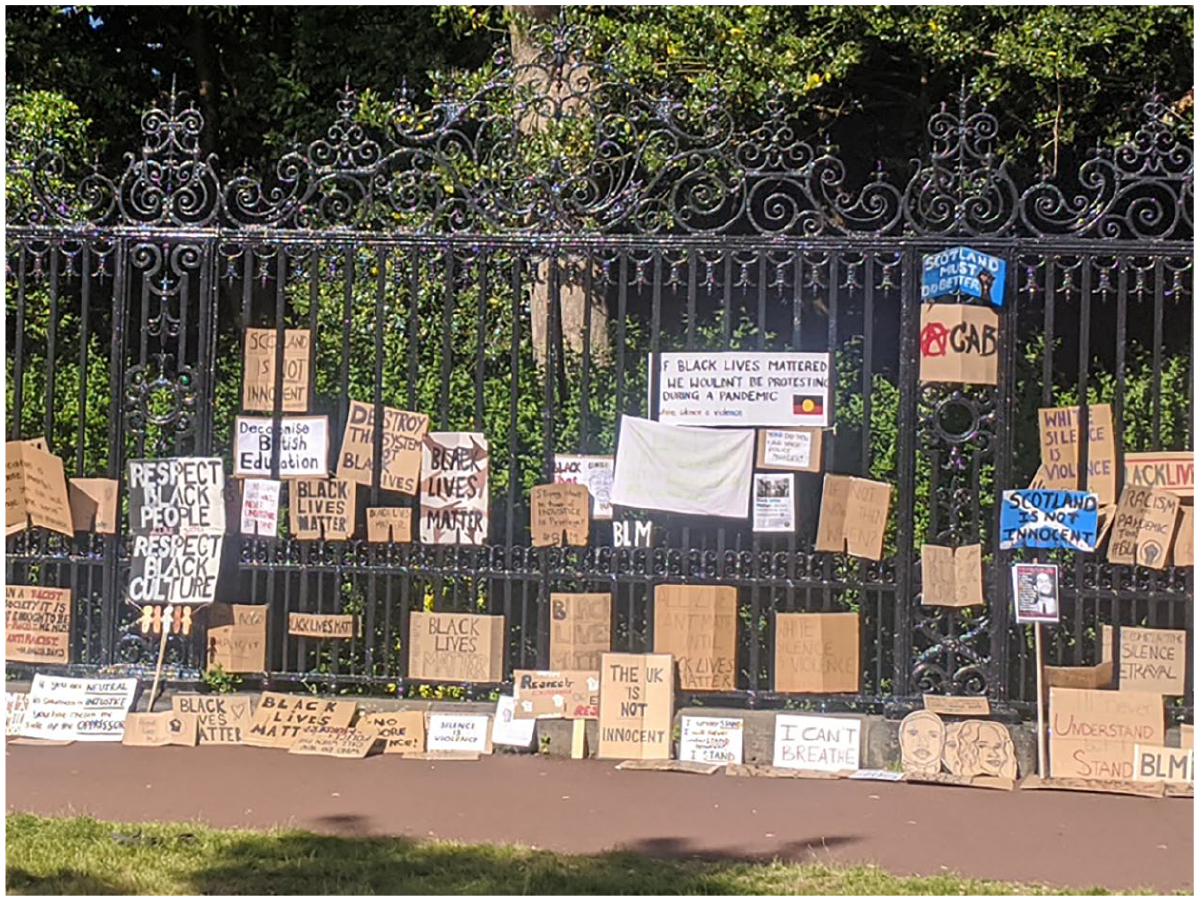
BLM texts in Holyrood Park, June 8, 2020.
Given my application of Augé’s ideas on non-place (1995), the “wedge” I talk about above was particularly surprising as it signified an expressive and then material reappearance of identity, history and relations in a spatial landscape that had been reconstituting itself to erase their prior enactments. The gathering of protesters against systemic racism in Edinburgh, the posters left behind, statues coming into the spotlight as well as my own emotional reaction exemplified this reappearance. Not only is this illustrative of place and non-place always being relational, but also the inherent volatility of the lockdown cultural assemblage ever since it first came into being in March 2020. I construe this volatility in terms of how the broader context was a determinant of the incidence of my intersections with the constant actant of travels and changes in the path of the coronavirus. By late July, live coverage of the pandemic—entailing a steady stream of numbers of infections and deaths from around the world, along with pictures of patients, ICU wards, and exhausted health workers—was largely back to its prior levels, upholding my awareness of this actant along with affective flows tied to it in view of concern for myself, my friends, and my family. The (reported) state of the pandemic also acted on the conversations making up my narratological environment, such as those with my father, which generated affective flows of their own. At a time when physical interactions have declined and activity has picked up in socio-technical assemblages (Middleton 2010), this interplay between broader context, narratological environments, and affective flows constituent of the lockdown cultural assemblage becomes even more of essence. The symbiosis between “the work of making” a pattern of news coverage and resultant social media discourse, and “the work it does” (Stanley et al. 2013) on this social media discourse, narratological environments, as well as a changing vocabulary of (embodied and online) sociality, could be observed in my narrative.
This symbiosis is testament to two fundamental qualities of the lockdown cultural assemblage and its subsequent variations. First, that all loci of shifts produced by the assemblage, as discussed in this section, are in several ways relational to one another. And second, that the assemblage is always in motion, never coming to a standstill. It thereby follows that even today, sense-making loops and meaning-making processes with respect to these five loci continue to be in negotiation with each other, and continue to evolve.
Conclusion
By writing this article, I hope to have made a modest contribution towards qualitatively researching a generational public health crisis which, among various detriments, has decimated lives, overturned the norms of everyday life, and jolted the global economy. Like all my readers, my life has been deeply impacted by COVID-19. When I went to Edinburgh for graduate school in August 2019, I never expected that over half my time there would be spent living under some form of containment measures. In the midst of these circumstances, interrogating my lockdown lived experience as an assemblage that stemmed from, and was thereafter shaped by, the lockdown cultural assemblage, proved to be a valuable undertaking. The insights I have put forth necessarily come from a positioned version of events, which is why my autoethnography cannot, and does not, claim to be a comprehensive representation, or template, of what lived experience of the lockdown can entail. Rather, it has been geared towards unpacking an array of shifts occurring in relation to one person from one category of lived experience—international postgraduate students—as a means of gaining insight into the “programmatic” (Stanley et al. 2013) reconfiguration of culture and society that produces those shifts.
In essence, this article demonstrates how the assembly of the lockdown, or any variation of COVID-19 restrictions, is an eventful, cumulative process; it is only through the reiteration of new cultural manifestations across “constellations” that it is able to produce “working surfaces” that allow it to “territorialize” society (Bennett 2007, 2013; Deleuze and Guattari 1988). Two examples of this from the narrative include meaningful interactions I had with dog walkers, and an altered cognitive-sensory awareness of the sound of an ambulance, both of which became familiar over time. It can be said that the “work of making” culture and the “work it does” on the social thereafter were, across both their expressive and material dimensions, inextricably interlinked (Stanley et al. 2013). When one contemplates change in these terms, it becomes possible to think of the spread of the virus and the subsequent adoption of new lockdown-related cultural practices, such as social distancing, from a similar viewpoint. As Latour aptly notes in a recent interview, “COVID has given us a model of contamination. It has shown how quickly something can become global just by going from one mouth to another”; a key lesson from this, he says, is that “we must not think of the personal and the collective as two distinct levels” (Watts 2020). My research validates this standpoint; although the changes in cultural practices are not as contagious as the virus itself, their evolution cannot be grasped except in terms of relationality.
It is this very relationality that I tapped into as the basis for doing an autoethnography that can transcend beyond my individual circumstance. My self and the cultural assemblage of Edinburgh in lockdown intersect; this unbolts a window to it. By writing an autoethnographic “textual account” that brings forth “the recorded movement of a thing. . .what moves and how that movement is recorded” (Latour 1996, 378, 2005, 128), I am able to advance arguments about how the processual assembly of Edinburgh’s lockdown—more precisely its Phase 1 mutation—acted upon lived experiences of the social actors situated within it. As a methodology that is first and foremost experiential, autoethnography helped me in accessing the intricacies of, and giving “verisimilitude” to (Ellis et al. 2011, 282–83; Grant 2010, 573), the labyrinth that is lived experience. By moving from self to culture and back again, it enabled me to translate shifts to my own “sense-making loops” and “meaning-making processes” (Adams et al. 2015) into implications for those inhabiting the same cultural assemblage, all the while maintaining reflexivity by engaging with my positionalities as well as the impact of my dissertation as itself an actant throughout my narrative. The shifts identified in this manner, traced across five co-dependent dimensions that I believe adequately represent my lockdown lived experience, again point to the contingent relationality of affective flows that produces them; this holds true whether the change in question pertains to a fluctuating awareness—mediated by socio-technical assemblages (Middleton 2010)—of a threat to embodied life, or how we try to carve a new sociality whilst negotiating that awareness. In critically engaging with the dialectic of how these shifts were constitutive of, and at the same time contingently upheld by, the situatedness of my lived experience in Edinburgh’s lockdown as cultural assemblage, the objective has been to provide an account comprehensive enough to elicit in my readers a consideration of how the lockdown, and on a more abstract level the presence of the coronavirus itself, may have materialized in their own lives. Mine is a particular experience, but one that connects to the generality of what has been a shared affective environment.
A relational ontology, together with the inside-out movement it makes possible, is precisely where the synergy between assemblage theory and autoethnography lies, and I hope this article will invite further scholarly engagement that can advance this new and promising direction for autoethnography. I also hope that this article will be followed by further research on present-day cultural production, autoethnographic and otherwise, and which can help “pluralize the experience” (Stanley 2015, 163) of everyday life during COVID-19. While much interesting work is already emerging (Burton 2021; de Klerk 2020; Erni and Striphas 2021; Harris and Jones 2021; Kawalec 2020; Prior 2020; Stanley 2020), it is pertinent that the dialogue I am contributing towards here encompasses within it successive temporal stages, more actants (especially vaccines, but also variants of the virus), occupying different social positionalities, in cultures across the world. Given that this pandemic is bearing on lived experience for billions across the globe, especially now in the Global South, COVID-19 restrictions as a cultural and social phenomenon—in all their heterogeneity—merit scholarly understanding.
Footnotes
Declaration of Conflicting Interests
The author declared no potential conflicts of interest with respect to the research, authorship, and/or publication of this article.
Funding
The author received no financial support for the research, authorship, and/or publication of this article.
