




Abstract
Australian universities are faced with the imminent retirement of a large proportion of their researchers. One way to avoid a decrement in research performance is to consider greater support for early career researchers (ECRs). To investigate how another university system that is ranked high in research performance supports its ECRs several universities in the Netherlands were visited. Seventeen senior academic staff in these universities were interviewed to examine their perceptions of the support that is provided for the development of ECRs, and the nature of the research environment in which they are employed. Interviews were recorded, transcribed, and coded using a thematic analysis procedure that was guided by the IPA framework to identify common themes amongst the views of the interviewees. Several features of the Dutch university system were identified as different to the Australian system and which the interviewees suggested were responsible for the high level research performance exhibited by their universities. These include the organization of universities by chair groups that are responsible for both research and teaching in a subject area, tenure track systems, and generous financial and material support for developmental activities. On the basis of these findings, I recommend Australian universities consider revising the support they provide to ECRs to be more aligned with what is provided in the Dutch system.
Introduction
After the major investment in growth in universities that occurred in Australia during the early 1970s (Hugo, 2005), these same universities are now faced with the loss of the “baby boomer” academics hired during that period due to retirement (Hugo, 2005; Loomes & McCarthy, 2011). In order to ensure that research activity in universities is maintained during this replacement of staff, new academics should be given the opportunity to develop as productive researchers. In the past, I would not have been confident that universities were up to the task of managing this transition well. Certainly, in my experience, having worked in four Australian universities, it seems that early career researchers (ECRs) are usually welcomed into their new departments, and encouraged to undertake whatever research they would like, but they are left to discover for themselves how best to achieve this. This impression is supported by the results of a study reported by Debowski (2006) which indicate that research active staff in Australian universities are often “left to learn on the job” (p. 84). It should come as no surprise then that many early career researchers fail to flourish under such conditions, and that many become disenchanted with an academic career (Åkerlind, 2005; Crome et al., 2019; Laudel & Gläser, 2008; Petersen, 2011).
Recently, attention has been devoted around the world to how best to support new academics during the phase of their careers when their research programs are nascent, and they may also be teaching new units and learning how to function as an academic. Boulton (2010) reports that “career support is often considered an optional “add-on” (p. 14) in European universities, but is explicitly encouraged by a Concordat between research institutions in the UK (Åkerlind, 2005; Vitae, 2016). Taylor (2006) described a case study of six research intensive universities from around the world, and reported that “all had well established programmes of staff development linked to research, including guidance in the preparation of research proposals, project management, postgraduate supervision and writing papers for publication. Most of the universities also used mentoring schemes, linking younger staff with experienced researchers” (p. 21).
In Australia, recent attention to ECR support appears to have been mostly in the relevant higher education literature (Debowski, 2004, 2006, 2007, 2011; Laudel & Gläser, 2008; Petersen, 2011) rather than in university action, although efforts by some universities are significant (e.g., Thompson et al., 2017). For example, Debowski (2004) has discussed several capabilities that researchers must develop throughout their career to ensure satisfactory performance, which inevitably determines their survival as academic researchers. Debowski concluded that in general the Australian university system was failing to provide adequate support for the development of these capabilities, and that this would lead to poor performance in research rating exercises, such as the Research Quality Framework (RQF) and Excellence in Research Australia (ERA). As suggested above though, if universities in Australia are to cope with the imminent loss of a large proportion of their research active staff, then greater efforts should be directed at ensuring recent academic hires are given the best opportunities for developing active research careers.
The current project was prompted by this concern, and so the first research question to be addressed was “What can be done to provide greater support for the development of the research careers of ECRs?” In particular, I was curious as to what was being done to address this issue in countries that exhibited better research performance than Australia. One such country is the Netherlands. This country has a smaller population than Australia and also has fewer universities, but it regularly has more universities listed in The Times Higher Education Supplement (HES) top 100 world university ranking than Australia (see https://www.timeshighereducation.com/world-university-rankings). I wondered if universities in the Netherlands were doing something different to Australian universities with respect to the way research is structured, and/or how ECRs are supported, and if so, were there some lessons that could be learnt from the Netherlands that would be helpful in supporting ECRs in Australian universities. Thus, the second research question addressed by this project was “What can Australian universities learn from universities in the Netherlands with respect to support for ECRs?”
The specific aim of the research was not merely to uncover the academic structure in Dutch universities, as this could be achieved easily by accessing websites of these universities. Rather the aim was to investigate the features of the Dutch system that senior academics believed were providing the most effective support for ECRs. Thus it was their lived experience of the system, and their perceptions of the way the system affected the career development of younger researchers that I wanted to examine. Although much has been published regarding the perceptions of ECRs with respect to the support they are provided (e.g., Åkerlind, 2005; Crome et al., 2019; Laudel & Gläser, 2008; Petersen, 2011), no research has been reported regarding the perception of senior researchers on this matter.
With the assistance of an Endeavour Executive Fellowship, I visited the Netherlands and conducted interviews with senior academic staff in seven universities that, at the time, were ranked in The Times HES top 100 universities in the world. I asked each academic a series of questions that were motivated in part to address some of the problems that have been identified recently in the way that Australian universities support the development of researchers. For example, Debowski (2011) noted that survival in an academic career is associated with performance expectations regarding funding and publication that may not be clear to the researchers (Questions 2 & 6), and that new academics are encouraged to forge their own identities rather than collaborate with others (Question 4). The questions were also motivated by desirable qualities of research environments espoused by Debowski (2011), Boulton (2010), and the Concordat for supporting career development of researchers, an agreement between the funders and employers of researchers in the UK (Vitae, 2016). For instance, Debowski proposed that research enterprises have a clear strategy about the research process, and that this should be articulated to all researchers in the enterprise (Question 3), which is complimented by a mentoring strategy (Question 11), a networking strategy (Question 12), and a strategy for facilitating external collaborations (Question 13). The Concordat recommends recognizing all researchers as playing a part in an institution’s research strategy (Question 1). Questions 5, 7, 8, and 10 all reflected the role of an institution, and function it could play, in the development of an ECR’s research career, something recommended by Debowski (2011), Boulton (2010), and the Concordat. Questions 14 and 15 were designed to provide the interviewees with further opportunities to reflect on what had or had not worked in their institutions with respect to providing support for ECRs.
Method
Design
In this project I was interested in how individuals (in this case, senior academic staff from universities in the Netherlands) make sense of their experiences. For this reason, I went directly to the source (the senior academic staff) and asked them about their experiences of the support provided to ECRs in their institutions, and their perceptions of the value of this support. The data were analyzed using Thematic Analysis (Braun & Clarke, 2006), guided by principles of Interpretative Phenomenological Analysis (IPA) (Pietkiewicz & Smith, 2014; Shaw et al., 2014). An assumption of IPA is that people attempt to make sense of their experiences, and so IPA researchers investigate this sense and how it is made by trying to decode people’s perceptions about their experiences (Pietkiewicz & Smith, 2014). Interview data is commonly collected in IPA because it provides a rich and detailed account of people’s experiences (Pietkiewicz & Smith, 2014).
Participants
This study was approved by the Edith Cowan University Human Research Ethics Committee. Eight universities in the Netherlands were selected for study in this project on the basis that they all appeared in the Top 100 world rankings published by The Times HES. Thirty-seven academics in the universities were selected from the web pages of the universities on the basis that their listed position suggested that they held a senior academic position responsible for the management of research in an academic unit (e.g., research center, department, school, faculty, or university). Emails were sent to the university email addresses of these people. These emails described the aims and the nature of the study, and included a request to meet with me later in the year to answer some questions about how their academic unit supported ECRs. A second email was sent to people who did not respond within 2 weeks of the first email being sent. Overall, no response was received from 14 people, 6 people responded that they did not wish to take part in the study or were unable to, and 17 people agreed to take part (see Table 1). The positions of those who were interviewed in the study are listed in Table 2. Interviewees were promised their responses would be confidential, so the discipline areas of the interviewees have not been listed in Table 2 with their positions, but these included European and Economic Law, Sociology, Governance and Global Affairs, Humanities, Ancient Philosophy and Science, Electrical Engineering, Mathematics and Computer Science, Electrical Sustainable Energy, Applied Sciences, Environmental Sciences, Science, Behavioural and Social Sciences, Arts and Social Sciences, History, Psychology, and Neuroscience.
Participant and University Details.
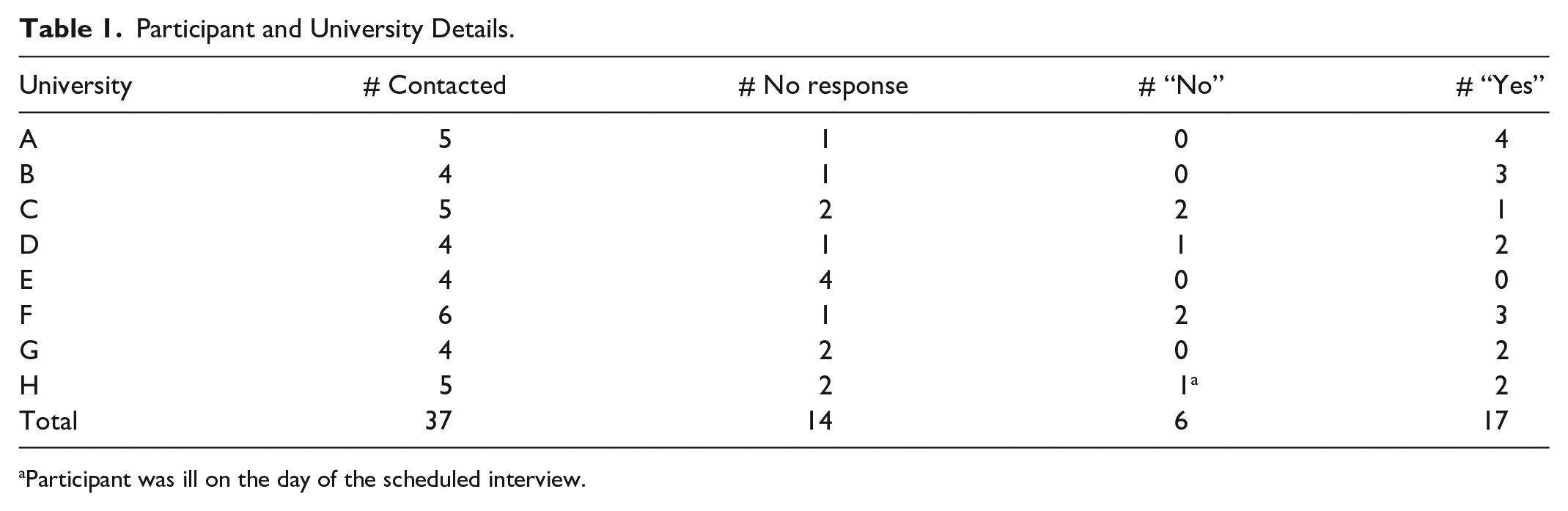
Participant was ill on the day of the scheduled interview.
Positions Held by Interviewees.

Data Collection
Questions asked during each interview are in Appendix 1. These questions functioned as stimuli for a conversation about how each interviewee’s academic unit supported their ECRs and the perceptions of the participants regarding what aspects of this support were or were not effective in terms of facilitating the research development of ECRs. Later questions could be skipped or altered depending on the answers provided to earlier questions. Furthermore, other questions were sometimes added to follow up interesting responses. All interviews were recorded on a hand-held dictaphone and a mobile telephone to ensure at least one useful recording of each interview was obtained.
Each interview was conducted in the university office of the interviewee, or a university meeting room organized by the interviewee. Each interviewee was asked to read an information sheet about the study that had previously been sent in the recruitment emails. They were then asked to sign a consent form on an electronic tablet. The aims of the study were stated for the interviewee, and the definition of an Early Career Researcher was provided. This involved explaining that an ECR in Australia can have a formal definition (e.g., government research granting bodies such as the Australian Research Council define an ECR as someone who is within 5 years of obtaining their PhD), however, for the sake of this study, that definition could be stretched to include people who are late-stage PhD and those who are up to 10 years after obtaining their PhD but may have had significant career interruptions. The important element was that an ECR was someone who would be considered to be in the early stages of becoming an independent researcher. The questions in Appendix 1 were then read out to the interviewee, in a semi-structured manner, to enable a free-flowing conversation. Interviews lasted from 25 to 75 minutes depending on the length of an interviewee’s responses.
Data Analysis
I was interested in finding out about the nature of research support in each interviewee’s academic unit, and whether there were different ways of providing this support that could be adopted in Australian universities. Importantly, I was also interested in the experiences of the academics in relation to this support, and their perceptions of what did and did not help ECRs in developing their research careers. To this end, I performed a thematic analysis procedure (Braun & Clarke, 2006) that was guided by the IPA framework (Pietkiewicz & Smith, 2014; Shaw et al., 2014). Through immersion in the participants’ data the themes were identified inductively (Braun & Clarke, 2006). I listened to all of the interview recordings, taking notes of possible future themes. Each recording was then transcribed. All transcriptions were read multiple times, and codes were developed to summarize sections of the data and to represent points of connection between the responses of the interviewees. These codes enabled me to notice patterns, contradictions and important ideas across transcriptions, which were utilized to extract general themes that were observed in the responses.
This stage involved making connections between the codes and themes, and sorting them into potential themes and subthemes. This process was facilitated by the development of thematic maps, like mind maps (Braun & Clarke, 2013). A recursive process of revisiting earlier transcripts as new themes were identified from data strengthened the credibility and confirmability of the interpretations (Braun & Clarke, 2013). Finally, the rigor of the process was strengthened by adopting several strategies. (1) Braun and Clarke’s (2006) 15-point checklist of criteria for good thematic analysis was employed to check for scientific rigor. This checklist covers transcription, coding and analysis, recursive reviewing of the transcripts, field notes and journal reflections (Liamputtong, 2009). (2) A transparent audit trail was used throughout the data collection and analysis process to enhance the dependability of the findings (de Witt & Ploeg, 2006). (3) Member checking through presenting the final themes to one of the interviewees increased the credibility of the findings (Creswell & Miller, 2000).
Findings
Below I present each of the identified themes with some illustrative quotes from the interviewees, and comment on how each theme is connected to previous research, or contrasts with ECR support in Australian universities. Although the interviewees covered a broad range of issues in their responses, I have limited the presentation here to six broad themes, some of which have sub-themes. Other common perceptions were expressed by participants, but these were not relevant to the research questions and so are not detailed here.
Theme 1: Chair Groups
Almost unanimously, interviewees described the basic unit within universities in the Netherlands as the chair group, which was also referred to as a research line, a program team, and a research program or group. Each chair group is headed by a chair holder, typically a professor.
Chair groups are managed by chair holders. Every chair group consists of a number of personal professors, some associate professors, some assistant professors, support personnel (secretaries and technicians), postdocs and PhDs.
–Interviewee 10
The members of these groups work on the same research theme, but there are a number of projects within the theme undertaken by sub-groups of members, or individual researchers. Researchers in a group meet regularly for research seminars, they present their research to each other, they read each others’ papers and research proposals, and provide feedback on these. ECRs are appointed to these groups and so are immediately integrated into a support structure.
That program is basically a sort of coaching context for their research.
–Interviewee 2
The section leader is responsible for yearly reviews of the ECRs and for ensuring they get proper coaching.
–Interviewee 5
Such groups certainly exist in Australian universities, but the structure of Australian universities is not made up exclusively of such groups as is the case in the Netherlands. Furthermore, in the Dutch universities, these same chair groups are also responsible for the teaching program related to the group’s research area. Although it may be the case in Australia that researchers might deliver lectures and co-ordinate teaching units in their areas of expertise within a degree course, in the Netherlands, the chair group is essentially a department, and the group is responsible for all aspects of the teaching in that area. So, for instance, one university may have a Department of Social Psychology, which delivers an undergraduate teaching program and undertakes research in Social Psychology.
Sub-theme 1A: Induction Processes
A common feature of Australian universities is a Research Office, which organizes induction training that provides ECRs with information about meta-research processes, such as grant application, project management, and ethics. In contrast, very few interviewees indicated that such a system exists in the Netherlands. Instead, most learning about the meta-research processes occurs within chair groups.
There is no centrally organised research induction process. The ECRs all start as part of a chair group so there are always older scientists who will help the younger ones to grow into their career.
–Interviewee 10
ECRs learn by becoming part of the culture of their research group. Their first project proposal we write together.
–Interviewee 6
Some chair group leaders arrange for their ECRs to take courses in project management, project leadership, and grant writing if they need more instruction than is available within their group.
What is more likely to be organized centrally are funding officers, who develop a close working relationship with each ECR to monitor their progress, ensure they are aware of and apply for relevant grants or prizes, link them with previous winners or successful applications, and arrange mock interviews if their grant applications reach the interview stage. Many interviewees commented that these funding officers were an invaluable support in securing research funding.
Sub-theme 1B: Mentoring
Only two interviewees stated that there was some form of formal mentoring process in place for ECRs at their universities. The rest could not really see the need for such a scheme as mentoring was an inherent part of the chair groups.
There is no formal mentoring system, but it’s the duty or privilege of all senior members of staff to coach and to mentor juniors. It’s also in the interests of their own research group that the real talents stay.
–Interviewee 1
This usually happens within the chair group. There is a lot of feedback and discussion within the chair group.
–Interviewee 15
It’s not formalised. It’s not an obligation. For me it is part of the culture that is normal if you start here.
–Interviewee 9
Sub-theme 1C: PhD-ECR Relationship
Interviewees expressed many different responses when asked about the relationship between preparation of PhD students and support for ECRs (i.e., are they two ends of the one continuum, or are they distinct entities?). However, several interviewees responded in the same way, and reinforced the important role of the chair group.
I think it is a continuum. We embed our PhDs and ECRs in research groups to show them the ropes.
–Interviewee 14
It is really a continuum. If you are doing a PhD you are already embedded in a chair group.
–Interviewee 9
Theme 2: Tenure Track System
Although two people claimed a tenure track system was not a feature of Dutch universities, the remainder stated that it was operating in the Netherlands, a claim supported by Boulton (2010). Several interviewees were keen to point out that the system was not the same as the one common in the USA in that it was not as cut-throat in terms of securing tenure. These people also seemed positive about how the system had led to improvements in research productivity, although some did point out this came at a cost (see also Sub-theme 2G and Theme 6).
Sub-theme 2A: Performance Appraisal
The tenure track systems described in the universities I visited feature annual appraisal of research performance against targets that are set at the beginning of the contract. These targets concern the number or amount of research outputs, grant money, PhDs and postdocs the ECRs should achieve in a particular period. The appraisal is performed by the tenure tracker’s supervisor, which is usually the head of their research group. Meeting the performance targets consistently usually means confirmation of tenure after 5 years. Failure to meet targets can spark a number of outcomes, including: more teaching at the expense of research time, training in research relevant skills, contract cancelation, or movement into another position (e.g., teaching focused, administrative).
We have here a system in which we have, every two years, a performance review. In the year where there is no review, there is a progress discussion. In the performance review, the staff member defines their performance goals for the next 1–2 years. The tenure-trackers report to a section leader, mostly a full professor, who will try to ensure that the goals are met.
–Interviewee 5
Managers assess performance goals with tenure trackers on a yearly basis. Yearly appraisals look at the recent past, and also future perspectives, and the tenure trackers, in addition to an assessment, and an appraisal, they also receive a mark “on track” or “not on track”.
–Interviewee 7
Sub-theme 2B: Performance Goals
There was no consensus about how strict the performance targets are for securing tenure. Some interviewees stated that performance goals were “explicit,” “transparent,” and “strict.” Others suggested there were more shades of gray.
The criteria for achieving tenure are not strict and consider discipline norms. The dialogue between the ECR and their manager provides context.
–Interviewee 7
Sometimes it is not always about quantitative targets. Sometimes it is more about the soft skills – does somebody fit within a research group? Do they have the necessary social skills to perform in the wider organisation? The pressure to meet targets does not suit everyone equally. Some would like to have a more gentle approach. I think we are still to find a good balance.
–Interviewee 1
Sub-theme 2C: Accelerated Progress
The majority of interviewees indicated that exceeding performance goals, or achieving something that was top class (e.g., a publication in Nature or Science, winning a Vici grant) could result in accelerated progress through the tenure-track system, a bonus, increased salary, or a permanent position. Some interviewees explained that this was necessary because there was increased competition for research talent amongst universities, and such excellent performance meant the ECR could be easily poached by another university. Therefore, an ECR performing at an excellent level may need to be offered something additional to convince them to stay.
With that comes the chance of promotion and increases in salary, or a bonus, so there are some carrots. There is a yearly round where your performance in the year is evaluated and your head of department can put you forward for a bonus or an increase in salary.
–Interviewee 3
There is strong competition. Someone could say, well if you don’t give me tenure then I will go to another university. . .So, if there is a really good person, then we can certainly shorten the probation period.
–Interviewee 5
Sub-theme 2D: Career Advice
Most interviewees indicated that ECRs obtained career advice, and guidance about the next stages in their career, from the head of their chair group during their yearly appraisal meeting. Some were confident that the chair received training in this aspect of their role and so could provide good advice. Others felt the advice was variable in quality because not all chairs utilized the training available.
It is the role of the chair group professor. They help with the HR component of developing their staff. There is training, and awareness programs, change programs etc. that all chair holders are supposed to take and be aware of their role.
–Interviewee 9
Sub-theme 2E: Importance of Teaching
The majority of interviewees commented on the importance of teaching quality in assessing ECRs for tenure. Indeed, many suggested that research performance was only one of several components of tenure trackers’ performance that were assessed in tenure decision. Teaching allocations for ECRs varied between 40% and 60% of overall workload.
Teaching is important in securing later permanent employment.
–Interviewee 8
The evaluation is based on research, education, citizenship, organisation and leadership.
–Interviewee 6
Sub-theme 2F: Costs and Benefits of the Tenure Track
Some people felt that the tenure track system had great advantages, such as ultimately better research performance and the possibility of avoiding being stuck long-term with non-performers.
One advantage of the tenure track system is we can see if someone is good before they are made permanent.
–Interviewee 4
Others, however, felt that there were downsides too, such as long periods of uncertainty.
The probation period is too long and uncertain.
–Interviewee 5
Another commented that the tenure track system fostered perverse cultural expectations.
. . .the culture associated with the tenure track system: it is expected that all will be promoted up the ranks, and so there is something wrong with a 60 year old assistant professor.
–Interviewee 2
Theme 3: Support Provided to ECRs; Financial and Other
When asked what type of support is provided to ECRs to help them undertake research and develop as researchers, many interviewees focused on financial and/or material support, such as:
Money for a postdoctoral fellow or PhD student to supervise;
Money for specialist equipment;
Money for international conference travel.
Some interviewees also noted other forms of support, such as:
Relief from teaching to increase time for research;
Funding officers, who provide individualized support for ECRs to become successful in grant applications (e.g., they provide advice in CV writing, and arrange mock interviews if grant applications reach the interview stage);
Coaching and professional development;
Research group members assist ECRs in writing grant proposals and papers, and provide feedback prior to submission
There was a view consistently expressed by the interviewees that support for ECRs had a time limit. Some suggested this period ended around the time that they were assessed for tenure. Others indicated support ended when the ECRs ceased asking for it, or they won their first large external research grant, both of which indicate they probably no longer require the support.
Theme 4: ECR Networks
When interviewees were asked “Is there an ECR network that is made known to new ECRs?” some stated that there were no such networks that they were aware of. The remainder indicated that their academic unit facilitated initial meetings between new tenure trackers, but then most organized their own activities after the initial meeting.
The faculty organises meetings for tenure trackers, who come together and exchange experiences. Different departments do it differently.
–Interviewee 6
I know that the assistant professors from all of the departments – around 20 or so – they meet and discuss things. They find it useful.
–Interviewee 17
Yes, they do self-organise. It’s not something that we facilitate, but you see that all kinds of networks of younger scholars emerge naturally.
–Interviewee 14
One person suggested that ECRs within chair groups would offer each other support.
The research groups take on this role.
–Interviewee 11
Theme 5: Support to Establish Collaboration Networks
When interviewees were asked “What support is there for ECRs to establish external collaborations,” everyone agreed that establishing such networks was important and encouraged within their academic units. Some people interpreted the question to refer to financial support for developing such networks.
. . .funding for collaboration, and offices that facilitate external contacts.
–Interviewee 2
Yes, we still have ample money to tailor-make arrangements for funding for conferences and trips abroad if you want to collaborate with others.
–Interviewee 1
There are uni-wide schemes where people can apply for funding to bring a group of scholars here to hold a conference/workshop. There is money, not just for ECRs, that will help them increase their visibility, their networking, by organising or contributing to workshops, special issues.
–Interviewee 16
The majority, though, saw this question as referring to the social facilitation of establishing such networks that can come from senior researchers introducing more junior researchers to their own networks. These interviewees saw this as an important and fundamental role of the professors in assisting ECRs with their career development.
ECRs are connected to existing networks of companies we are working with or have agreements with.
–Interviewee 5
. . .considerable support to establish external networks. They are crucial for submitting grant proposals. So the first 1–2 grant proposals submitted by ECRs, we write with them, and introduce them to our external colleagues.
–Interviewee 6
This is through the supervisor. The expectation is that they will introduce their junior colleagues to their own research networks, and that they will make use of these in order to further their own links, which are important for developing their careers.
–Interviewee 12
The culture within our university is to work with other organisations. If you don’t have a network, you cannot grow in the tenure track. In the chair groups, there are supporters for arranging your own network.
–Interviewee 10
Theme 6: Work Pressure
Although there was universal agreement that the initiation of a tenure track system had been effective in increasing the research productivity of the interviewees’ academic units, there also were frequent comments that this improved productivity had come at a cost. In particular, many interviewees indicated that the tenure track systems put a lot of pressure on ECRs, and many did not cope well with the pressure.
One of the challenges is keeping the work-life balance. It’s the work pressure and the high demands of tenure track. You feel the work pressure, and we have growing student numbers. You have to be excellent everywhere in the domain, so the work pressure is pretty high.
–Interviewee 9
ECRs are overall under a lot of pressure, to get funding when success rates are very low, and from quite high teaching loads. Many leave after a few years because it’s too tough.
–Interviewee 14
I would argue that the work requirements are still very high, but people know that, and we see that in work surveys. Sometimes they struggle with this.
–Interviewee 16
Discussion
The main aim of this study was to discover ways to support early career researchers (ECRs) utilized in universities in the Netherlands (Research Question 2) that could be adopted by Australian universities (Research Question 1). Several features of the way that ECRs are supported in the Netherlands were identified as common to many of the universities visited. The most important feature according to the interviewees was the academic structure to which they were appointed. The chair group delineated the research and teaching topics the ECR works on, and provides them with leadership, career development advice, skills training, peer support, and connections with external networks. These groups are clearly hierarchical in nature, mirroring the staffing structure within most Australian academic departments, but the main difference in the Dutch groups is that ECRs enter at the bottom and are actively assisted upwards through the structure by the other members of the group. The interviewees were unanimous that this feature of universities in the Netherlands was responsible to a large degree for their successful research performance. This feature also provides all aspects of the research and career support considered desirable by Debowski (2011), Boulton (2010) and the Concordat (Vitae, 2016). On this basis there could be a case for adopting a system such as this in Australian universities. Certainly ECRs in Australian universities have expressed a desire for the types of support mentioned here (Åkerlind, 2005; Crome et al., 2019; Tynan & Garbett, 2007). Similar calls have been made in UK and Swiss universities (Evans, 2014; Schulz, 2013; Skakni et al., 2019). Some Australian universities have started exploring theme-based research groupings (e.g., Edith Cowan University, 2021; Murdoch University, 2018; University of Sydney – Powell, 2019). However, to fully adopt the Dutch system would require wholesale re-organization of both the research and teaching structures of Australian universities. This would be an expensive exercise, and is likely to require many years for the change to bear fruit. Afterall, the Dutch system has been in place for at least the last century.
Another important feature of the support provided to ECRs in the Dutch universities is the career structure provided by the tenure track system. New staff are provided with clear performance criteria to achieve to be granted tenure and promotion, as recommended by Debowski (2011). Some interviewees indicated achieving these criteria was typically tough for ECRs. These sentiments mirror complaints that have been reported recently at the University of Canberra, which has one of the few tenure track systems operating in an Australian university (Matchett, 2019; Rowbotham, 2019). Although these complaints have prompted a review of the University of Canberra system, no such move appears likely in universities in the Netherlands, where, according to the people I interviewed, the positive results appear to outweigh the costs. The chair group structure provided considerable support to ECRs as they developed their research careers, with many senior members of these groups seeing it as their role to facilitate the upwards trajectory of the more junior staff. It is safe to say that this supportive role of senior staff is not a universal feature of the Australian university system. Although there will be some research groups that provide such support with respect to the research endeavor, it is unlikely that this also extends to learning how to juggle research activities with teaching duties, and yet this is where ECRs require significant assistance in developing their academic careers.
Another feature of the universities in the Netherlands identified by the interviewees that assists the career development of ECRs was ample resources for their professional development (e.g., courses, finance officers) and research-related expenses such as conference travel and equipment, again something recommended by Debowski (2011), Boulton (2010) and the Concordat (Vitae, 2016). Although some universities in Australia are sufficiently well-funded to provide significant financial support for ECRs, this is by no means universal. In the Netherlands, however, all of the interviewees made it clear that because of their very successful teaching programs, and grant success, there was plenty of money available to support ECRs in the ways just described. For many Australian universities, providing such support for ECRs is a struggle, particularly since the COVID pandemic.
Limitations
Although this study identified some features of universities in the Netherlands that the interviewees believed contribute to the successful research performance of those universities, the information collected in this study was mostly observations provided by academic members of those universities. In that sense, I make no claim that adopting these features would necessarily lead to research performance similar to that exhibited by these universities. Nonetheless, in trying to understand why a country that is smaller than Australia, and has fewer universities, can have universities that are ranked higher than most Australian universities, consideration of some of the structural differences between the two university systems has provided some useful clues, and useful lessons for Australian universities to consider in supporting their early career researchers.
Conclusions
I recommend that Australian universities that wish to provide more effective support for the career development of their ECRs should consider three features that academics from universities in the Netherlands consider instrumental in the research success of those universities. These are: (1) arranging academic departments as chair groups, with all of the structures and functions of the Dutch groups; (2) adopting a tenure track system whereby ECRs are provided with clear initial performance expectations that are re-visited on a yearly basis with the chair of the research group, where there are clear consequences for meeting or not meeting these expectations, and support is provided from within the research group for meeting the expectations; (3) institutional provision of ample resources for the professional development of ECRs.
Footnotes
Appendix 1
Questions used in interviews
Declaration of Conflicting Interests
The author declared no potential conflicts of interest with respect to the research, authorship, and/or publication of this article.
Funding
The author disclosed receipt of the following financial support for the research, authorship, and/or publication of this article: This study was undertaken with the support of an Endeavour Executive Fellowship awarded to the author by the Australian Government.
Ethics Statement
Approval for this project was provided by the Edith Cowan University Human Research Ethics Committee (19950 SPEELMAN).
