




Abstract
What characterizes individuals who stand up and take action against violations of fundamental moral principles, even in the face of personal risk and adversity? Due to methodological and ethical challenges, we are limited in our understanding of personality dispositions that predict who acts morally courageously in situations of severe wrongdoings and considerable risk. In Germany and Austria, we recruited recipients of public awards for outstanding moral courage (n = 54) and individuals who nominated themselves to have acted morally courageously (n = 48). We contrasted these morally courageous individuals with a demographically matched reference group of people who reported not to have acted morally courageously before (n = 323), and with normative samples of the German population. Results showed three key patterns: First, among the HEXACO personality factors, heightened extraversion consistently distinguished the morally courageous groups from the reference group. Second, membership in the morally courageous groups was predicted by heightened moral attentiveness and anger proneness, and lowered endorsement of loyalty and authority, indicating exceptional moral functioning of the morally courageous. Third, the morally courageous were characterized by diminished risk avoidance and social anxiety, suggesting that they encounter a lower psychological barrier posed by fear of negative social evaluation.
Plain Language Summary
When they witness serious wrongdoings, some people speak up and take action, even when it is risky for them, while others remain silent. What are personality characteristics that make morally courageous individuals different? We studied people in Germany and Austria who had shown moral courage in difficult situations. Some had received public awards for their actions, while others had nominated themselves as having acted morally courageously. We compared them to people who said they had never acted this way before. We found that people who had acted with moral courage tended to be more extraverted, pay closer attention to moral issues in everyday life, get angry easily, care less about loyalty to groups or following authority when these conflict with moral values, and be less afraid of social rejection. These results suggest that there are personality characteristics that make it easier for individuals to speak up against wrongdoings that they observe. People who show moral courage seem to be especially alert to moral problems and less held back by fear or social pressure.
Strikingly, some people take considerable personal risks in order to stand up and intervene against others’ wrongdoings. Real-life examples, such as those spotlighted by public awards for outstanding moral courage in Germany and Austria (in German Zivilcourage awards) can be awe-inspiring: Witnessing a group of men beating an individual on the ground, a woman rushes toward them, screaming at the top of her lungs; overhearing on the train how someone openly denies the Holocaust, a passenger confronts them, while everyone else turns away; when witnessing fraudulent behavior of a colleague, an employee blows the whistle, despite that colleague’s close relation with their superiors. These individuals have overcome threats to their own physical, social, or financial well-being to stop, prevent, or redress what they consider violations of fundamental moral principles. Such acts of moral courage by initially uninvolved witnesses are key for maintaining societal norms (Fehr & Fischbacher, 2004; Yamagishi, 1986), and consequently the well-functioning of democratic societies (Meyer, 2009). Yet, such acts are rather rare (Baumert et al., 2013; Kawakami et al., 2009; Sasse et al., 2022). Who are those exceptional individuals who are ready to stand up and intervene in situations of severe wrongdoings and considerable risk?
In the present research, we comprehensively address the personality characteristics underlying moral courage, defined as taking action in defense of one’s moral principles (Li et al., 2025; Skitka, 2012). For this aim, we investigated the broad personality factors that should become relevant due to the affordances of situations requiring moral courage. Moreover, we scrutinized whether morally courageous individuals are characterized by exceptional moral functioning, by addressing a theoretically derived set of moral dispositions. Finally, we explored whether overcoming risks and adversity is facilitated for morally courageous individuals due to potentially lowered dispositional risk avoidance and anxiety and heightened self-efficacy.
Previous research has provided us with the first insights into some of the personality characteristics that predispose or hinder an individual to intervene against others’ wrongdoings (e.g., Baumert et al., 2024; Moisuc et al., 2018; Mowle, 2019; Tedone & Bruk-Lee, 2021). However, due to methodological and ethical restrictions, these insights are limited to mundane or hypothetical situations. On the one hand, observation of relevant behavior in the lab or field is restricted to minor wrongdoings and low levels of risk (e.g., reactions to littering, Balafoutas & Nikiforakis, 2012; Brauer & Chekroun, 2005). On the other hand, so-called vignettes can serve to explore more extreme situations, yet self-reported reactions to hypothetical situations first and foremost shed light on folk conceptions about moral courage and pertinent implicit personality theories (Greitemeyer et al., 2006). To overcome these restrictions, and provide a comprehensive understanding of the personality makeup of morally courageous individuals, we compared individuals who had demonstrated moral courage (among them recipients of public awards for outstanding moral courage, and the examples described above) with a reference group of individuals who had not acted morally courageously in the past.
What Is Moral Courage?
Moral courage (also termed civil courage, Zivilcourage or courage civique, Schalk et al., 2024) has been defined as speaking up or taking action in defense of one’s moral principles (Li et al., 2025; Skitka, 2012). Accordingly, moral courage manifests when people witness others violating moral principles or important societal norms and take action to prevent, stop or redress these violations despite risking negative consequences for themselves. To illustrate, situations that afford moral courage are the unfair treatment of individuals, racism, sexual harassment, bullying, dishonesty, or corruption (Dungan et al., 2019; Fischer et al., 2006; Goodwin et al., 2020; Kemper et al., 2022; Pouwels et al., 2019). Morally courageous acts in such situations can consist in a direct intervention, including verbal or physical confrontation or sanctioning of the perpetrator, as well as indirect intervention or victim support, such as calling on other bystanders or authorities or moving a victim to a safe space (Wee et al., 2016). Intervening in such ways can bear considerable personal costs, such as physical harm, social isolation, or financial loss (Miller, 2005).
As a defining element, moral courage is concerned with defending moral principles (Li et al., 2025; Skitka, 2012). Thereby, moral courage is distinct from helping, caring or other ways of adhering to moral principles (e.g., donating or volunteering; Greitemeyer et al., 2006). Accordingly, personality characteristics that predispose individuals to act morally courageously could be distinct from those predisposing other moral behaviors, and need to be addressed for a comprehensive psychological understanding of morality.
What Personality Characteristics Underlie Moral Courage?
To identify candidate personality dispositions that might characterize morally courageous individuals, we took a three-fold theoretical approach. First, we addressed broad personality factors as described in hierarchical personality models, specifically the HEXACO factors (Ashton & Lee, 2007). Second, based on theoretical models of moral action (Bebeau et al., 1999; Blasi, 1983; Jennings et al., 2015), we addressed specific moral dispositions that capture individual differences in moral reasoning, moral attention, moral emotion, and moral identity. Third, since overcoming risks, adversity, and fear is an important process for morally courageous behavior, we scrutinized dispositional differences in risk avoidance, anxiety and self-efficacy.
Broad Personality Factors
The HEXACO personality model allows the parsimonious description of interindividual differences along six broad dimensions (i.e., Honesty/humility, Emotionality, eXtraversion, Agreeableness, Conscientiousness, Openness). From a situational affordances perspective on personality, these dimensions should become relevant for shaping experience and behavior in situations with certain characteristics (Columbus et al., 2019; de Vries et al., 2016; Tett & Burnett, 2003). De Vries and colleagues mapped the HEXACO dimensions onto a taxonomy of situational characteristics (Rauthmann et al., 2014) and posited that honesty/humility should become relevant specifically in situations involving potential exploitation or cooperation, emotionality should be relevant for handling situational insecurity and threat, extraversion should be relevant for engagement in social activities, agreeableness should shape behavior in conflictual situations, conscientiousness should be relevant for task engagement, and openness should be relevant in situations allowing exploration (de Vries et al., 2016).
Considering typical characteristics of situations affording moral courage, such situations involve (potential) conflict, uncertainty, and threat, and are inherently social situations. Accordingly, emotionality can be expected to hinder, and extraversion to facilitate morally courageous behavior. Notably, situational affordances inform counteracting roles for both honesty/humility and agreeableness. On the one hand, situations affording moral courage lack self-oriented incentives for intervening and defending moral principles requires a prosocial and cooperative orientation, as captured in both honesty/humility and agreeableness. On the other hand, intervening implies being uncooperative with a perpetrator. Therefore, the adversity of the situation, specifically the confrontative nature of intervening, could turn honesty/humility and agreeableness into hindering factors (Fischer et al., 2024). The typical characteristics of situations affording moral courage do not inform a general role for conscientiousness or openness, albeit these personality dimensions could become relevant in certain contexts. For example, openness could facilitate intervention when it requires exploring unconventional or creative ways of reacting to a situation.
Previous empirical research has addressed the role of the broad personality factors for bystander intervention in a variety of different contexts (e.g., school bullying, racism, sexual harassment, transgressions at the workplace, theft). Extraversion, but not emotionality (or neuroticism in the Big 5 framework), emerged as a relevant predictor of intervention (Bjørkelo et al., 2010; Moisuc et al., 2018; Mowle, 2019; Tedone & Bruk-Lee, 2021). A few studies also yielded openness as a relevant predictor, mostly for intervention intentions in hypothetical scenarios (Baumert et al., 2013; Moisuc et al., 2018; Mowle, 2019; Pronk et al., 2021; Redmond et al., 2014). In an experience sampling study of norm violations encountered in everyday life (Baumert et al., 2024), extraversion was the only uniquely relevant HEXACO factor to predict who tended to intervene. Moreover, extraversion also predicted who reported to have encountered norm violations in everyday life (see also Bjørkelo et al., 2010). These findings suggest a two-fold role of extraversion, first as a “gate-keeper” that determines whether situations affording moral courage are encountered and recognized as such, and second to facilitate intervention in a relevant situation. Extending and complementing the previous research, we tested whether the HEXACO factors would distinguish between individuals who had and those who had not demonstrated moral courage.
Moral Functioning
In order to bridge the gap between moral reasoning and moral action, scholars have emphasized a comprehensive perspective on the moral self (Blasi, 1983). According to this perspective, key facets of moral functioning are moral judgment, moral attentiveness, moral emotion, and moral identity (Bebeau et al., 1999; Jennings et al., 2015). In addition to judging what is morally right or wrong, an individual has to be attentive to and reflect on the moral implications of their action (Reynolds & Miller, 2015), they have to be emotionally responsive to moral implications (Tangney et al., 2007), and acting in morally right ways needs to be a central and consistent part of how they define themselves (Aquino & Reed, 2002; Hertz & Krettenauer, 2016). Interindividual differences in these facets of moral functioning have been linked to prosocial behavior and adherence to moral principles. These facets might also be relevant for taking action to defend moral principles, yet we lack comprehensive empirical evidence.
Dispositions of Moral Judgment
Historically, moral judgment has been a main focus in moral psychology, but purely cognitive factors of moral reasoning were not sufficient to explain moral action (Haidt, 2001). Nevertheless, being able to consistently apply abstract moral principles in one’s moral reasoning (i.e., moral reasoning competence, Lind, 2008) could potentially help to judge an incident as a moral violation that requires taking action. Furthermore, individuals can come to different moral judgments about an incident and their behavioral alternatives because they endorse different principles (Graham et al., 2011). Prior evidence in the organizational context demonstrated that endorsing fairness and care as moral principles was a positive predictor of whistleblowing when encountering unethical practices, whereas endorsing loyalty and authority principles was a negative predictor (Dungan et al., 2019; Waytz et al., 2013).
Dispositional Moral Attentiveness
Even before evaluating an incident as a moral violation that requires intervention, the situation needs to be recognized as morally relevant (Reynolds & Miller, 2015). Accordingly, dispositional moral attentiveness which captures the chronic inclination to consider the moral relevance of one’s experiences and actions (Reynolds, 2008) could be crucial. Based on experience sampling data, moral attentiveness was found to predict who perceived others’ norm violations in everyday life, and thus, by implication, had opportunities to exhibit moral courage (Baumert et al., 2024).
Dispositional Moral Emotions
As moral emotions, we investigated dispositional empathic concern and proneness to anger. Some scholars have conceptualized moral courage as prosocial behavior (Staub, 2015), and hypothesized that, similar to helping, empathy should be an important factor (Osswald et al., 2010a). Indeed, exceptionally courageous acts of helping during the Holocaust have been empirically linked to empathic concern (Fagin-Jones & Midlarsky, 2007). However, evidence regarding a potential role of dispositional empathy for intervention against others’ norm violations is mixed, depending on the context and involvement of a direct victim (e.g., Baumert et al., 2013; Moisuc et al., 2018; Nickerson et al., 2015; Osswald et al., 2010b). Notably, across contexts, defending moral principles implies to act against a perpetrator, even if a direct victim is not present or identifiable. Acknowledging this confrontational nature of morally courageous acts shifts the focus to anger, as a negative other-directed moral emotion (Haidt, 2003; Tangney et al., 2007). Correlational and experimental evidence showed that feeling angry can increase costly sanctioning of others who behaved unfairly (Chaurand & Brauer, 2008; Fehr & Gächter, 2002; Gummerum et al., 2016; Lotz et al., 2011; Rodrigues et al., 2020). Thus, a dispositional inclination to feel angry should facilitate overcoming personal risks when defending moral principles (Niesta Kayser et al., 2010).
Dispositional Moral Identity
As a fourth key facet of moral functioning, moral identity is seen as crucial for moral action (Blasi, 1980, 1983). If morality is central to the self-concept of an individual, they should be more strongly motivated to act in consistent ways with their moral principles (Aquino & Reed, 2002). In a meta-analysis, moral identity was an important predictor of prosocial and ethical behavior (Hertz & Krettenauer, 2016). Also, there is preliminary evidence for moral identity as a predictor of moral courage as positive associations were found with (self-, peer- and teacher-rated) tendencies of adolescents to stand up against others in defense of their beliefs (Sonnentag & Barnett, 2016).
In sum, we comprehensively tested whether morally courageous individuals are distinct in their moral functioning from individuals who had not acted morally courageously, by examining differences in moral reasoning competency, endorsement of moral principles, moral attentiveness, dispositional empathic concern, and anger proneness as well as the self-centrality of moral identity.
Dispositional Risk Avoidance, Anxiety, and Self-Efficacy
In addition to exceptional moral functioning, morally courageous individuals should be characterized by exceptional courage. Conceptually, this could have two alternative implications for the personality makeup of moral courage (Miller, 2000). On the one hand, courage has been defined as “ability to confront fear” (Bauhn, 2007) and is taken as predisposition to act for good reasons despite feelings of anxiety over perceived risks and adversities. This account suggests that morally courageous individuals might prefer to avoid risks and be inclined to feel anxious as much as others, but overcome these inclinations for moral concerns. On the other hand, a courageous individual might have “practiced” and habituated emotions in such a way as to allow consistent moral behavior (Jiang, 2000). In other words, courageous individuals might experience less fear when faced with others’ moral violations and feel efficacious to overcome adversity. Hence, we asked whether morally courageous individuals are dispositionally less risk avoidant, less prone to anxiety, and tend to have a higher sense of self-efficacy, making it easier for them to defend their moral principles than it is for the average person. Besides such general risk avoidance, anxiety proneness, and self-efficacy, we also investigated dispositional social anxiety, reflecting how much an individual is afraid of negative social evaluations. This specific disposition might be uniquely relevant for moral courage, since social repercussions through perpetrators or other bystanders constitute significant risks, typically faced when intervening against others’ wrongdoings (McGovern, 1976).
The Present Research
With the present study, we aimed to comprehensively understand the personality characteristics underlying moral courage, by addressing broad HEXACO personality factors, dispositions of moral functioning, and dispositional risk avoidance, self-efficacy, general and social anxiety. Methodologically, we built on research on exceptional caring and adherence to moral principles (Amormino et al., 2022; Damon & Colby, 2015; Walker & Frimer, 2007), and opted for group comparisons for the study of moral courage. In a nut-shell, we compared personality characteristics of individuals who had demonstrated moral courage with other individuals.
To recruit morally courageous individuals, we capitalized on the fact that in German-speaking countries, a range of public institutions present awards for outstanding moral courage on a regular basis. Such awards have the purpose of fostering moral courage in the population by highlighting exemplary cases. Through these institutions, we invited all award recipients as well as the award nominees from the five previous years (i.e., 2013–2018) to participate in our study. Henceforth, we refer to this group of participants as “awardees.”
Complementing this first recruitment strategy, we recruited a second group of morally courageous individuals through a mixed strategy relying on individuals to self-nominate as having acted morally courageously in the past. Henceforth, we refer to participants who responded to this call as “self-nominees.” For awardees and self-nominees, we ensured that they had demonstrated moral courage, by obtaining detailed open-ended descriptions of their acts and the situation they had encountered and coding them according to pre-defined criteria of moral courage.
While we saw the group of awardees as focal, we recruited the group of self-nominees to reach as many morally courageous individuals as possible, and to balance the selectivity that is necessarily tied to each recruitment strategy. For example, the award giving institutions might have certain preferences and select award winners accordingly, such as preferring courageous interventions against unambiguously illegal behaviors over interventions against immoral behavior that is not illegal. By contrast, self-nominating to participate in our study might require certain personality characteristics. By concentrating on consistent differences between both morally courageous groups and the comparison samples, these group-specific selection effects can be balanced out and the robustness of results can be scrutinized.
For group comparisons, we recruited a reference group of individuals who had not acted morally courageously in the past, matched in demographic characteristics to the two morally courageous groups (awardees and self-nominees). We can therefore explore the personality characteristics that distinguish between individuals who had demonstrated moral courage and a matched reference group of individuals who had not displayed such behavior by self-report.
In order to determine whether group differences emerge because of an exceptional dispositional makeup of the morally courageous, or rather because of characteristics specific to people who have not acted morally courageous in the past, we further compared the morally courageous groups with normative samples of the German population, which were not selected according to moral courage criteria. By means of these double comparisons, we aimed to identify those personality characteristics that might be decisive for taking action in defense of moral principles in a broad range of contexts, involving severe moral violations and substantial personal risks.
Methods
Transparency Statement
We report how we determined our sample size and all data exclusions. The study did not involve any manipulations. In the manuscript, we report the measures of interest for the present research questions, but the full material is provided online. Complete material, including invitation letters, analyzed data and scripts can be found here https://osf.io/daqx5. For privacy concerns, we only publish aggregated data on situation descriptions. This study’s hypotheses and analyses were not preregistered.
Samples and Design
Demographic Information, Separately for Each Group
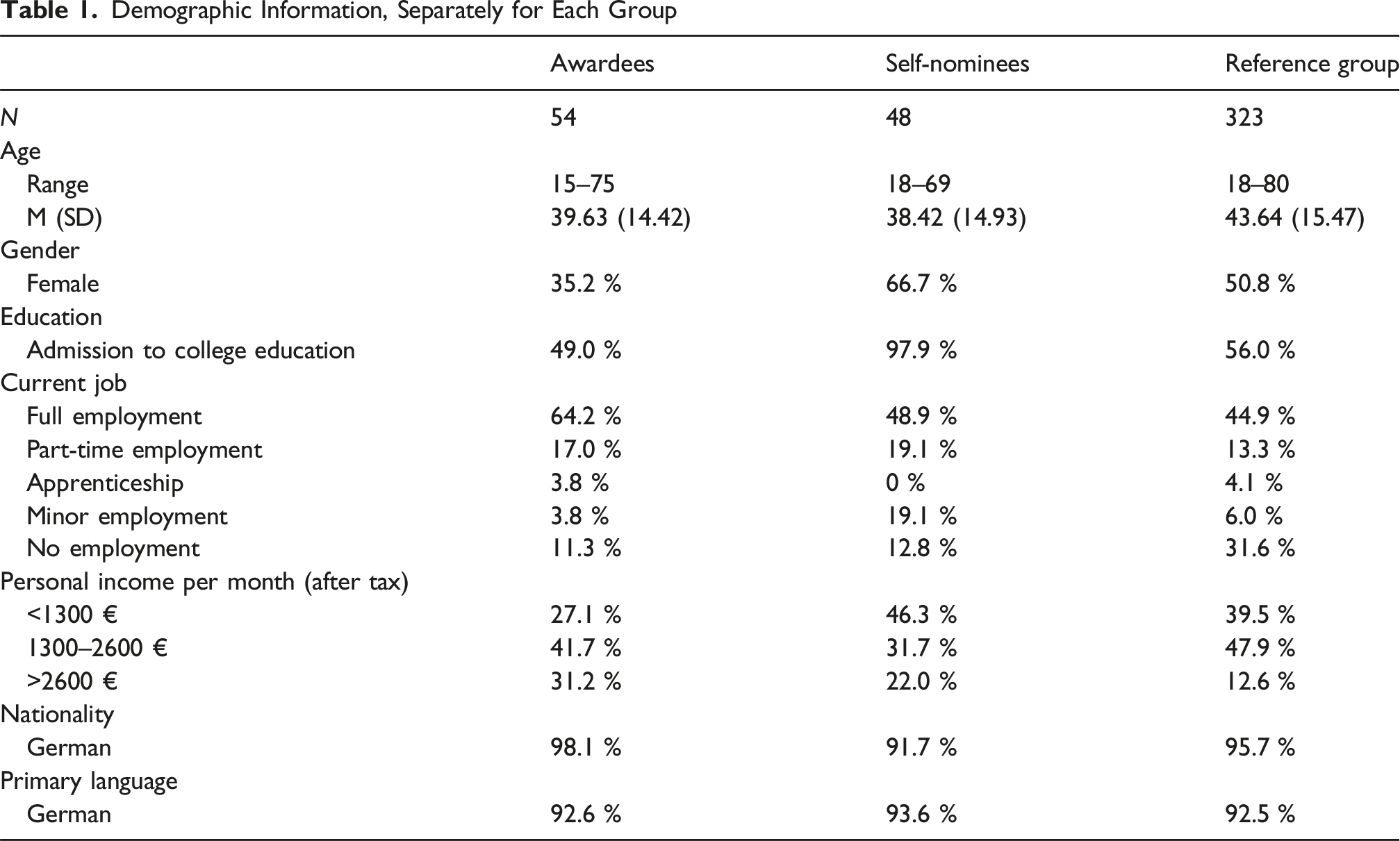
We did not conduct a priori power analysis, but to estimate a lower boundary for achieved test power, we conducted a sensitivity analysis with G*Power (Faul et al., 2007) in which we took our smallest group size (n = 48) to represent the cell sizes in a one-way ANOVA with three levels of a between-subject factor. This analysis indicated that we achieved sufficient power (>.80) for detecting a medium-sized effect of f = .26.
Recruitment of Awardees
Via internet search, we identified institutions in Germany and Austria that had issued Zivilcourage awards in the recent past. In 2017/18, 31 institutions were contacted by postal mail and telephone, informed about the background of our study, and asked to forward our study invitation to all award winners and nominees of the past 5 years. Twenty-two institutions agreed. In total, we sent 738 postpaid envelopes with invitation letters to these institutions to be forwarded via postal mail. In addition, some institutions contacted award winners and nominees via email. In the invitations, the study was advertised as a study on personality. Recruited through these channels, 101 individuals participated in part one of our study and provided descriptions of their experiences which were coded according to the moral courage criteria (see below). We invited 85 individuals who fulfilled the criteria for part two of the study. N = 56 complete data sets resulted, from which two had to be excluded based on exclusion criteria (see below).
Recruitment of Self-Nominees
We recruited the group of “self-nominees” through a combination of channels. Via social media, print media, and radio, the study was advertised to the general German-speaking public. Self-nominations were invited of individuals who, in the past 5 years, had (a) witnessed somebody else acting immorally, committing injustice, or violating fundamental human principles, (b) were not primary victims, but observers in that situation, and (c) intervened with the goal of stopping or preventing the act. In part one, 59 self-nominees participated and provided descriptions of their experiences. Out of 50 individuals whose descriptions fulfilled the criteria and who were invited for part two, 38 completed the study.
In order to reach a group size comparable to that of the awardees, we decided for an additional recruitment: During recruitment for the reference group (see next paragraph), a number of participants indicated to have intervened against a violation of moral principles they had observed. During the time of data collection, our resources were limited and did not allow coding all of these open responses. Therefore, we only coded a random subset of the open-ended descriptions according to our moral courage criteria, and invited participants whose descriptions fulfilled the criteria to part two of the study. We proceeded this way until we had 10 complete data sets which we added to the group of self-nominees, resulting in the final sample of n = 48. Importantly, we did not conduct any analyses of the data on personality variables before data assessment was complete.
Recruitment of Reference Group
A sampling agency (respondi) invited a demographically heterogeneous group of individuals for participation in a study on personality. Crossed-quota regarding gender, age, and educational attainment were set based on the demographic information of the combined groups of awardees and self-nominees. As a screening question, participants were asked whether, in the past, they had witnessed the violation of moral principles from the perspective of an observer and had intervened against it. Among 1389 individuals who answered this question, 836 (60.19 %) responded NO to this screening question. They were directly forwarded to part two of the study, and N = 326 complete data sets were obtained for the reference group, from which data of three participants were excluded based on exclusion criteria (see below).
Individuals who responded YES to the screening question did not proceed to part two of the study, but received follow-up questions on the situation they had encountered and their behavior in that situation. From 326 participants, sensible open-ended descriptions of the situation were obtained and they indicated that they had intervened. (After completion of our study, we later coded all open answers and found that 259 descriptions fulfilled our moral courage criteria, suggesting that 18.65% of the participants had acted morally courageously in the past.)
Normative Samples
For all focal personality scales in the present study, we aimed to obtain data from samples of the German population which were not selected according to moral courage criteria. For this purpose, we sought data from the original validation studies of the German measurement instruments. For HEXACO (N = 2032, Moshagen et al., 2018, Study 3), empathic concern (N = 2255, Schmal et al., 1996), risk avoidance and social desirability (N = 1134, Kovaleva et al., 2012), the authors of the German instruments were able to share data of random samples of the German population. For anger proneness and social anxiety, we drew relevant statistical parameters from the original publications (anger proneness: N = 990, random sample, Schwenkmezger et al., 1992; social anxiety: N = 2603, ad-hoc sample, Kemper et al., 2012). For moral reasoning competence, Pohling (2018) shared data of an ad-hoc student sample (N = 290). In addition, several measures were included in one of our own data sets with a quota-based sample of the German population (N = 1200, Baumert et al., 2024). The normative samples are described in detail in the supplement.
Procedure
For each participant, the study consisted of two parts (part one: screening, part two: personality assessment), both completed online. In part one, demographic information was obtained. Then, participants were asked whether in the past they had observed another person violating their moral principles and had intervened against the violation. If they stated yes, they were asked about the situation, the persons involved, and their own behavior in that situation, by means of open- and closed-ended questions. For awardees and self-nominees, the open situation descriptions were coded by teams of two independent, trained coders. In the few cases with disagreement between the coders, a third coder decided. If the moral courage criteria (see below) were fulfilled, participants were invited to part two, with an approximate time lag of 3 weeks. For the reference group, there was a two-step screen-out: first, based on crossed demographic quota and second, if they indicated to have acted morally courageously in the past. Participants who remained in the study were immediately forwarded to part two. In part two, all participants completed the identical personality assessment which took approximately 2 hours.
Materials
Assessment of Moral Courage Situation
All participants received an introductory text explaining the kind of situation we were interested in: “We are interested in situations within the past five years, in which you (a) witnessed a norm violation as an observer, and (b) actively intervened, to prevent, stop, or redress the norm violation, (c) despite the fact that this was or could have been unpleasant, tiring, time-consuming or dangerous for you.” It was further specified that “With ‘norm violation,’ we refer to situations in which someone breaks rules, behaves immorally, or violates imperatives of interpersonal conduct.” Then, participants were asked to indicate “Yes” or “No” whether they could report a situation that matched this description. If they responded “Yes,” they were asked for a detailed description of the situation in an open-ended format.
Coding of Moral Courage Criteria
Two independent, trained raters coded the open descriptions according to the following items: (1) Was there a norm violated? (Yes/No/Unclear); (2) Was (at least) one perpetrator present? (Yes/No/Unclear); (3) Was the participant him- or herself primarily an observer of the norm violation? (Something else/Only victim/Victim and observer/Only observer); and (4) Did the participant actively intervene against the violation? (Yes/No/Unclear). Moral courage criteria were taken as fulfilled if questions (1), (2) and (4) were coded with “Yes,” and question (3) was coded with “Only observer.” We assessed interrater agreement by means of percent agreement because variability in codings was low. Percent agreement was above 91% for criteria (1) and (2), and above 81% for criteria (3) and (4).
Coding of the Type of Violation
Two different independent, trained raters coded the types of violations described, according to five predetermined categories (i.e., physical violence; psychological/social threat; material/financial damage; other criminal act; other norm violation). For each category, they indicated whether the type of violation was mentioned or not. Multiple categorizations were possible. Interrater agreement as assessed by Cohen’s Kappa was high for physical violence (.84) and material/financial damage (.94) and low for other criminal act (.26) and other norm violation (.42). See Supplement Table S1 for the coding scheme and detailed results.
Assessment of Intervention Behavior
Participants were asked whether they had intervened (Yes/No). If the response was Yes, participants next described their behavior in an open-ended format.
Coding of Type of Intervention
Two trained raters, who were different from the ones coding the moral courage criteria, independently coded the type of intervention reported. Based on Wee et al. (2016), we distinguished direct confrontation (facing the perpetrator physically or verbally; Cohen’s Kappa .77), indirect intervention (calling police, authority, or other bystanders; tracking the perpetrator; testifying; Cohen’s Kappa .86), and victim support (Cohen’s Kappa .56). Multiple categorizations were possible. The coding scheme is provided in the supplement (Table S2).
Further Description of Situation and Intervention
Subsequent to the open description of the situation, participants in the moral courage groups were asked further questions about the situation, the persons involved, and their behavior. These questions and results are provided in the supplement (Table S3).
Personality Assessment
Except for the items assessing moral reasoning competence, all items were answered on 6-point rating scales from 0 (totally disagree) to 5 (totally agree).
HEXACO Personality Factors
We employed a German version of the HEXACO-60 (Moshagen et al., 2014), which included 10 items for each of the six personality factors, honesty-humility (e.g., “I wouldn’t use flattery to get a raise or promotion at work, even if I thought it would succeed,” α = .76), emotionality (e.g., “I would feel afraid if I had to travel in bad weather conditions,” α = .75), extraversion (e.g., “I prefer jobs that involve active social interaction to those that involve working alone,” α = .80), agreeableness (e.g., “I rarely hold a grudge, even against people who have badly wronged me,” α = .69), conscientiousness (e.g., “I plan ahead and organize things, to avoid scrambling at the last minute,” α = .75), and openness (e.g., “I would be quite bored by a visit to an art gallery” recoded, α = .76).
Dispositions of Moral Functioning
Moral reasoning competence. Moral reasoning competence
was assessed with the Moral Competence Test (Lind et al., 1985), with higher scores reflecting a pattern of judgments based on moral principles rather than opinions. This experimental questionnaire comprises two dilemma scenarios in which participants had to indicate whether they approved or disapproved of a protagonist’s behavior. For each scenario, they were presented with six arguments in favor and six arguments against the protagonist’s behavior and asked to which degree they found each argument acceptable (from −4/not acceptable to +4/very much acceptable). A score of moral reasoning competence was calculated based on variance partitioning (Lind et al., 1985), such that scores could vary between 0 (low moral reasoning competence) and 100 (high moral reasoning competence).
Endorsement of Harm/Care and Loyalty/Authority as Moral Principles
The moral foundations questionnaire (Graham et al., 2011; Jöckel et al., 2012) assesses the endorsement of different principles as basis for moral judgments. Sets of four items pertain to fairness, care, authority, and ingroup loyalty, respectively (example item from fairness subscale: “When you decide whether something is right or wrong, to what extent are the following considerations relevant to your thinking? Whether or not someone was denied his or her rights”). As they were highly correlated, endorsement of fairness and care (r = .63) were combined into one score, representing so-called individualizing foundations (α = .80); and endorsement of authority and loyalty (r = .61) into another score, representing so-called binding foundations (α = .75; Graham et al., 2011).
Moral Attentiveness
Four items (Pohling et al., 2016) were adapted to assess the readiness to perceive moral issues in everyday life (e.g., “I regularly face decisions that have significant ethical implications,” α = .90).
Empathic Concern
We measured dispositional empathic concern with nine items from the interpersonal reactivity index (Davis, 1983; Maes et al., 1995; e.g., “I can easily empathize with other people’s feelings,” α = .89).
Anger Proneness
We administered the state-trait anger expression inventory (Schwenkmezger et al., 1992) in its trait version which contains a subscale for dispositional inclination to feel angry (10 items, e.g., “I get angry quickly,” α = .89).
Self-Importance of Moral Identity
In a German translation of the assessment instrument developed by Aquino and Reed (2002; Rothmund & Gollwitzer, unpublished), participants were asked to envision a person characterized by moral traits (e.g., caring, fair, generous, honest, kind). By means of 5 items, they were then asked to indicate how important it is for them to be like such a person (e.g., “Being someone who has these characteristics is an important part of who I am,” α = .79).
Dispositional Risk Avoidance, Anxiety, and Self-Efficacy
Risk Avoidance
We combined three items measuring risk taking (Beierlein et al., 2015; Kovaleva et al., 2012; e.g., “How willing are you to take risks in general?”) and recoded them to represent risk avoidance (α = .90).
General Anxiety Proneness
Five items served to measure the individual probability of experiencing anxiety when confronted with a stressful situation (Rudaizky et al., 2012; e.g., “When exposed to a moderately stressful situation, I feel nervous.” α = .91).
Social Anxiety
A German short-form of the fear of negative evaluation scale (Kemper et al., 2012) was administered (5 items, e.g., “I worry about the impression others will have of me.” α = .92).
Self-Efficacy
We employed the German Generalized Self-Efficacy Scale (Schwarzer & Jerusalem, 1999), consisting of 10 items (e.g., “I can always manage to solve difficult problems if I try hard enough,” α = .91).
Control Variable
Social Desirable Responding
Based on Paulhus and Reid’s concept of impression management (Paulhus & Reid, 1991), a German short scale (Kemper et al., 2012) served to assess socially desirable response tendencies (6 items, e.g., “In conflict situations, I always remain calm and objective,” α = .65).
Data Exclusion
We employed two criteria to ensure high data quality. First, self-reported data quality in part two was assessed with two items (“To be honest, how seriously did you respond to the questions?” “To be honest, should we use your responses for our research?” Response options 1/Not at all to 5/Entirely). Data of participants who responded 1 or 2 on both items were excluded from analyses (n = 3 in reference group, n = 2 in award winner group). Second, we inspected the completion time for part two (considering completion times of less than 45 minutes problematic, based on test trials), combined with results of two attention check items (e.g., “If you are reading this attentively, chose 4 as response”). No data had to be excluded based on this exclusion criterion.
Statistical Analyses
We examined personality differences between the groups of morally courageous individuals on the one hand (i.e., awardees and self-nominees) and the reference group of individuals who had indicated to not have acted morally courageously in the past, on the other hand. As a first analysis step, we conducted ANOVAs and post-hoc t-tests of mean level differences in each personality variable, separately.
As a second analysis step, we scrutinized the robustness and uniqueness of each personality variable for determining membership in one of the morally courageous groups versus the reference group. For this purpose, we used a multinomial logistic regression framework and predicted nominally-scaled group membership (0/reference group, 1/awardees, 2/self-nominees). In this framework, we tested the robustness of effects by controlling for demographic variables and socially desirable responding as covariates. This way, we could account for any demographic differences between the groups after matching the reference group in age, gender, and education to the combined morally courageous groups. In the supplement, we also report the results of analyses without the covariates (Tables S4, S6–S8).
Moreover, we aimed to test the uniqueness of effects in the context of the other personality variables, thus ruling out redundancies between the personality variables in predicting group membership. For that purpose, we report results of two separate models, one model including all HEXACO factors as simultaneous predictors, and a second model including all variables of moral functioning and risk avoidance, anxiety, and self-efficacy.
A model including HEXACO factors and all facet-level variables of moral functioning, risk avoidance, anxiety and self-efficacy as simultaneous predictors gave rise to substantial multicollinearity issues, mainly resulting from including anger proneness and agreeableness simultaneously. So instead, we followed the statistical approach by Stewart et al. (2022) and residualized all facet-level variables of moral functioning, risk avoidance, anxiety and self-efficacy by regressing them on the HEXACO factors, and then tested the residuals as predictors of group membership.
All continuous predictors (except age) were z-standardized. This comes with the advantage that odds ratios are easily interpretable: When there is an increase of 1 SD in the predictor, the odds of belonging to the respective morally courageous group instead of the reference group change by the factor of the odds ratio.
Last, we employed comparisons with the normative samples to scrutinize whether group differences occurred because of exceptional personality characteristics among the morally courageous groups, or rather because of the reference group consisting of individuals who had reported to never have engaged in a morally courageous action (or both). For this purpose, we calculated effect sizes (Cohen’s d) for the differences between each group and the normative comparison sample.
In all analyses, we accounted for multiple testing by adjusting the critical alpha level to .01.
Results
Descriptive Statistics and Bivariate Correlations for Personality Variables and Demographics
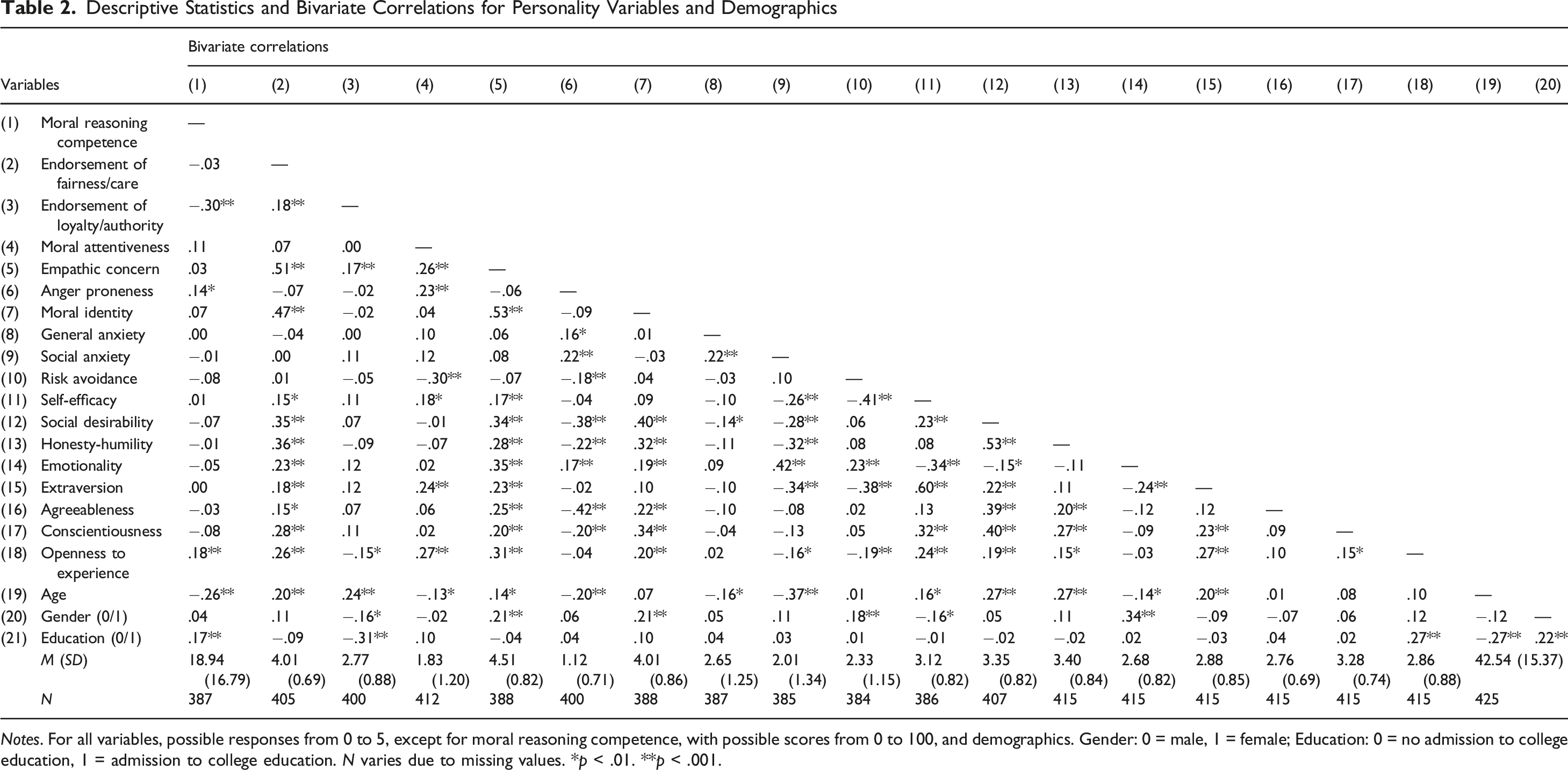
Notes. For all variables, possible responses from 0 to 5, except for moral reasoning competence, with possible scores from 0 to 100, and demographics. Gender: 0 = male, 1 = female; Education: 0 = no admission to college education, 1 = admission to college education. N varies due to missing values. *p < .01. **p < .001.
Relative Frequencies of Types of Violations (Upper Part) and Types of Interventions (Lower Part) as Coded From Open-Ended Descriptions Provided by Participants, Separately for Morally Courageous Groups
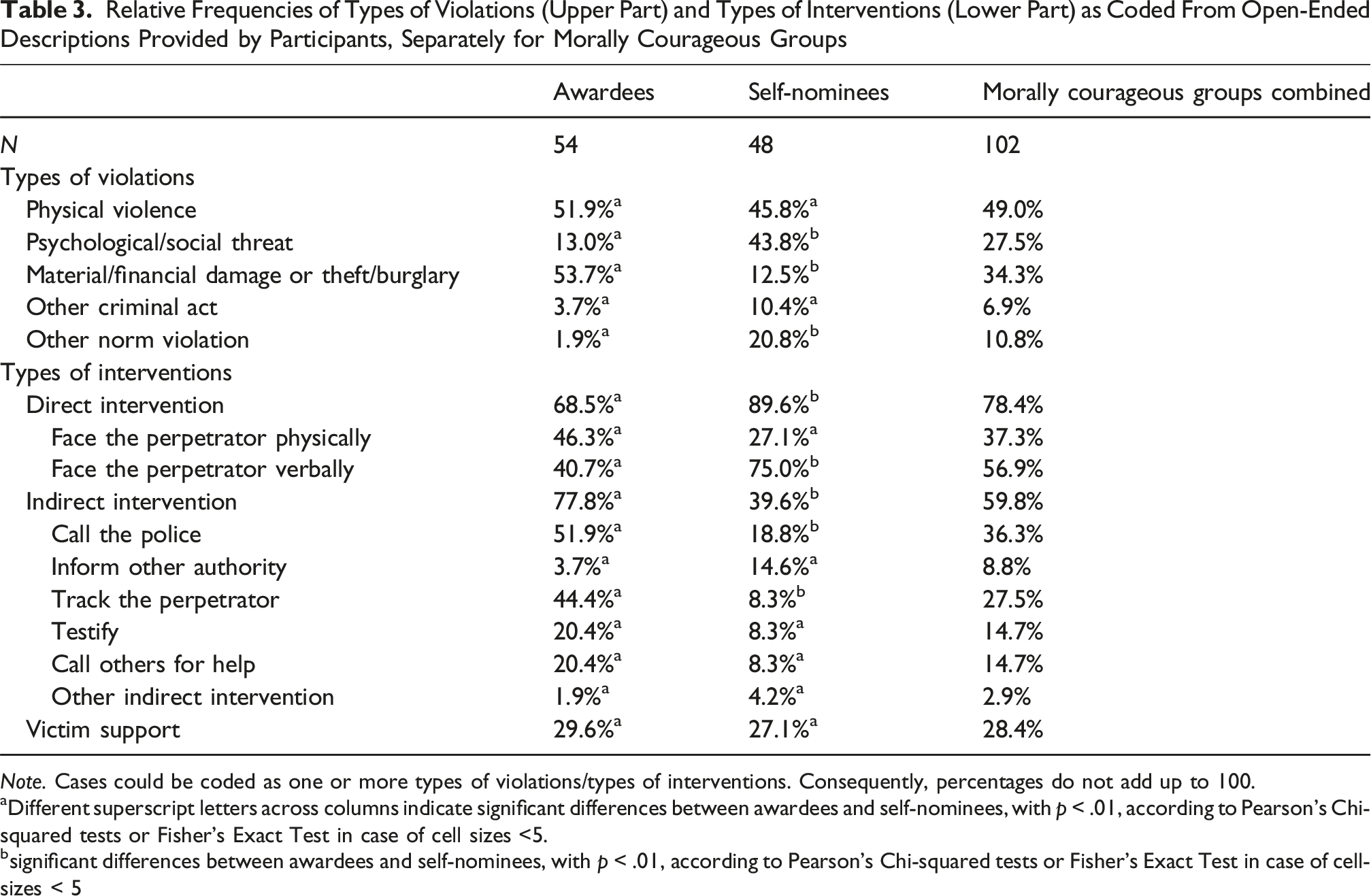
Note. Cases could be coded as one or more types of violations/types of interventions. Consequently, percentages do not add up to 100.
aDifferent superscript letters across columns indicate significant differences between awardees and self-nominees, with p < .01, according to Pearson’s Chi-squared tests or Fisher’s Exact Test in case of cell sizes <5.
bsignificant differences between awardees and self-nominees, with p < .01, according to Pearson’s Chi-squared tests or Fisher’s Exact Test in case of cell-sizes < 5
Group Differences in Personality Characteristics Between the Morally Courageous Groups and the Reference Group
Turning to our main analyses, Figure 1 displays mean differences between awardees, self-nominees and the reference group. Here, scale scores were z-standardized before group means were calculated. Table 4 displays group means in raw scale scores and results of one-factorial ANOVAs with the between-subject factor groups (awardees/self-nominees/reference group) and post-hoc t-tests. Group means and standard errors in personality factors, variables of moral functioning and risk avoidance, anxiety, and self-efficacy. All variables were z-standardized, so that zero represents the grand mean across the three groups in each variable, and units are standard deviations. Confidence bars represent standard errors. Results of Group Comparisons for Each Personality Variable, Separately, With One-Factorial ANOVAs and t-tests Contrasting Awardees, Self-Nominees, and the Reference Group Note. Endorse fairness/care = endorsement of fairness and care as moral principles. Endorse loyalty/authority = endorsement of loyalty and authority as moral principles. For all variables, possible responses from 0/totally disagree to 5/totally agree, except for moral reasoning competence, with possible scores from 0 to 100. df: nominator df vary due to missing values and Welch-correction in cases of heterogeneous variances; denominator df were always 2. est. ω2: As estimate of effect size, we report omega squared (Albers & Lakens, 2017). aDifferent superscript letters across columns indicate significant post-hoc differences in means between groups, p < .01. bDifferent superscript letters across columns indicate significant post-hoc differences in means between groups, p < .01.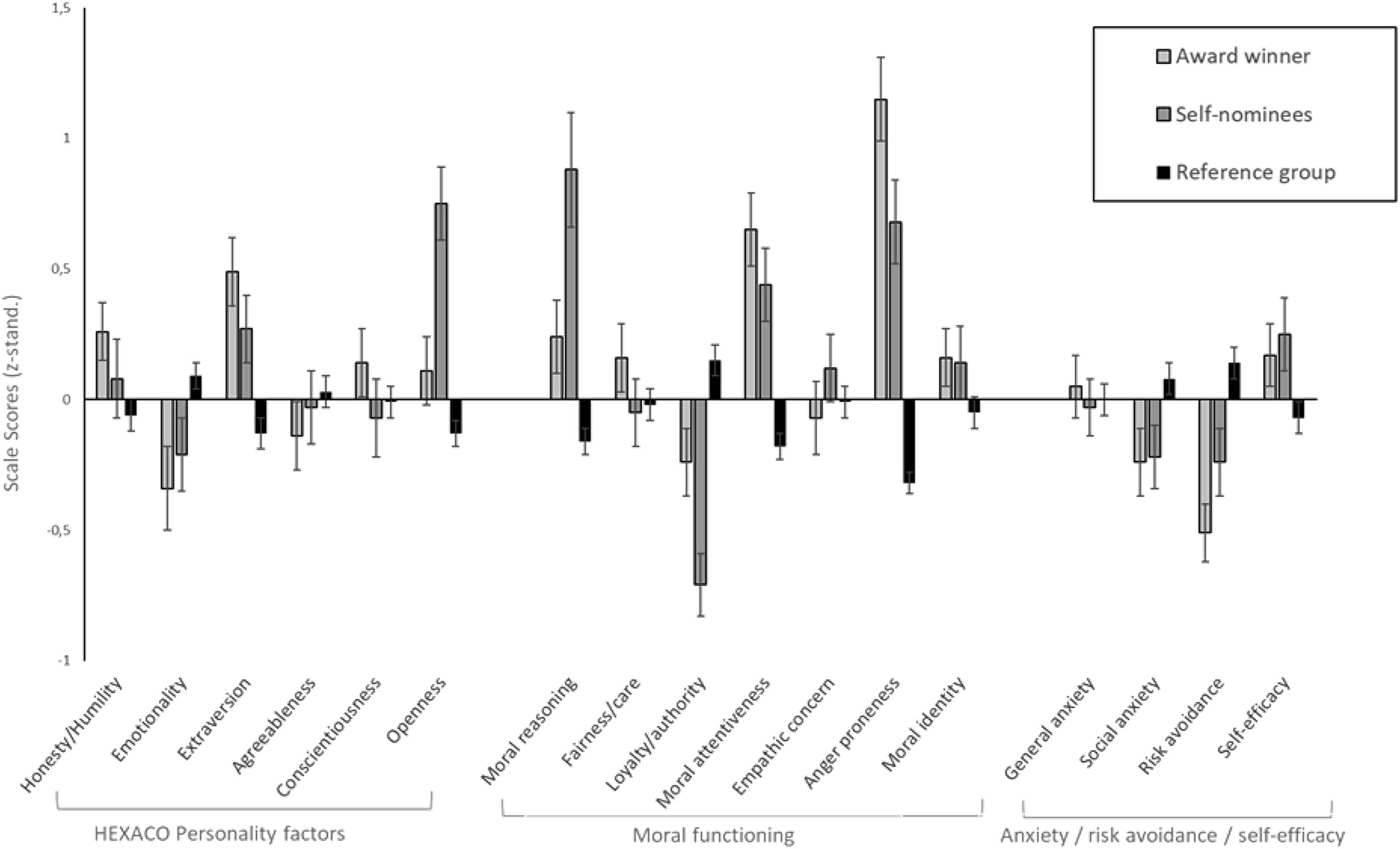
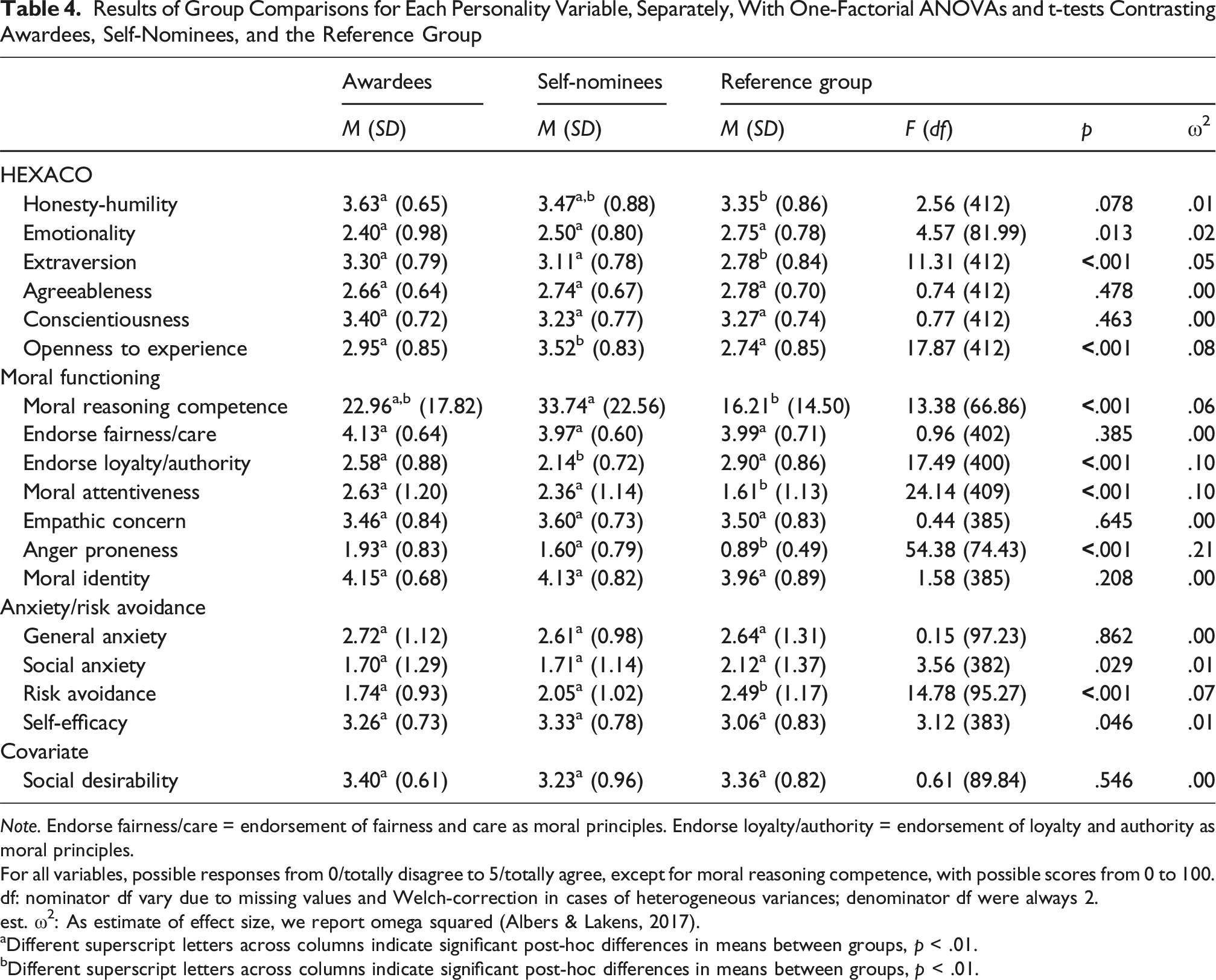
Looking at the HEXACO personality factors, the two morally courageous groups consistently scored higher in extraversion compared to the reference group. Distinguishing between the morally courageous groups, only the awardees but not the self-nominees, scored significantly higher on honesty/humility. Vice versa, only the group of self-nominees, but not the awardees scored higher than the reference group on openness to experience. For the other HEXACO factors, no significant group differences (p < .01) were found.
Regarding moral functioning, both morally courageous groups consistently scored higher than the reference group in moral attentiveness and anger proneness. While the overall ANOVA was significant for endorsement of loyalty and authority as moral principles and for moral reasoning, the t-tests yielded significant differences only for the self-nominees (but not for the awardees): The group of self-nominees, but not the awardees scored lower than the reference group on endorsement of loyalty and authority as moral principles, and higher than the reference group on moral reasoning competence.
Last, we found significant group differences for risk avoidance, with both morally courageous groups consistently scoring lower than the reference group. No significant group differences were found for general anxiety, social anxiety, or self-efficacy.
Testing the Robustness and Uniqueness of Effects
HEXACO Personality Factors and Covariates Tested as Simultaneous Predictors of the Probability of Belonging to One of the Morally Courageous Groups (Awardees/Self-Nominees) Versus Reference Group in a Multinomial Logistic Regression Analysis
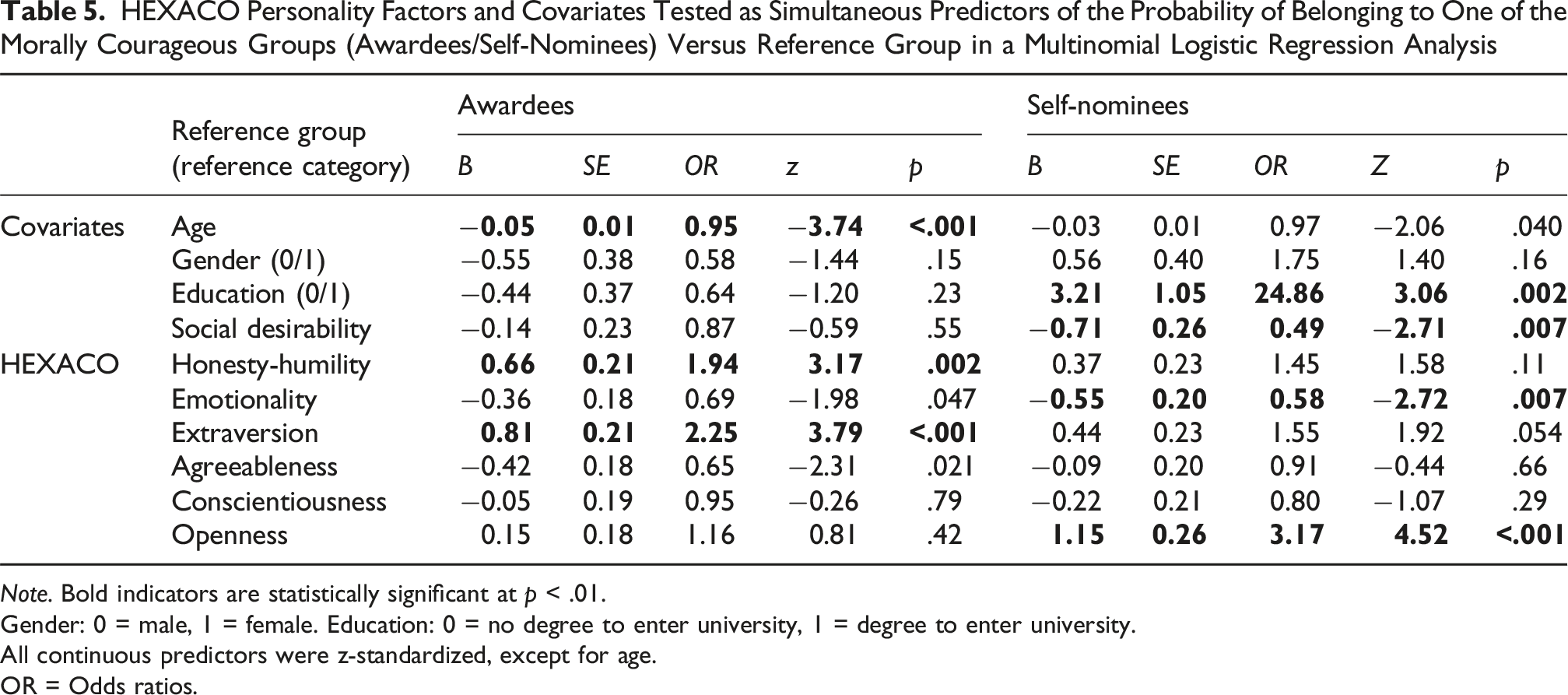
Note. Bold indicators are statistically significant at p < .01.
Gender: 0 = male, 1 = female. Education: 0 = no degree to enter university, 1 = degree to enter university.
All continuous predictors were z-standardized, except for age.
OR = Odds ratios.
Personality Variables of Moral Functioning, Anxiety, Risk Avoidance, and Self-Efficacy and Covariates Tested as Simultaneous Predictors of the Probability of Belonging to One of the Morally Courageous Groups (Awardees/Self-Nominees) Versus Reference Group in a Multinomial Logistic Regression Analysis
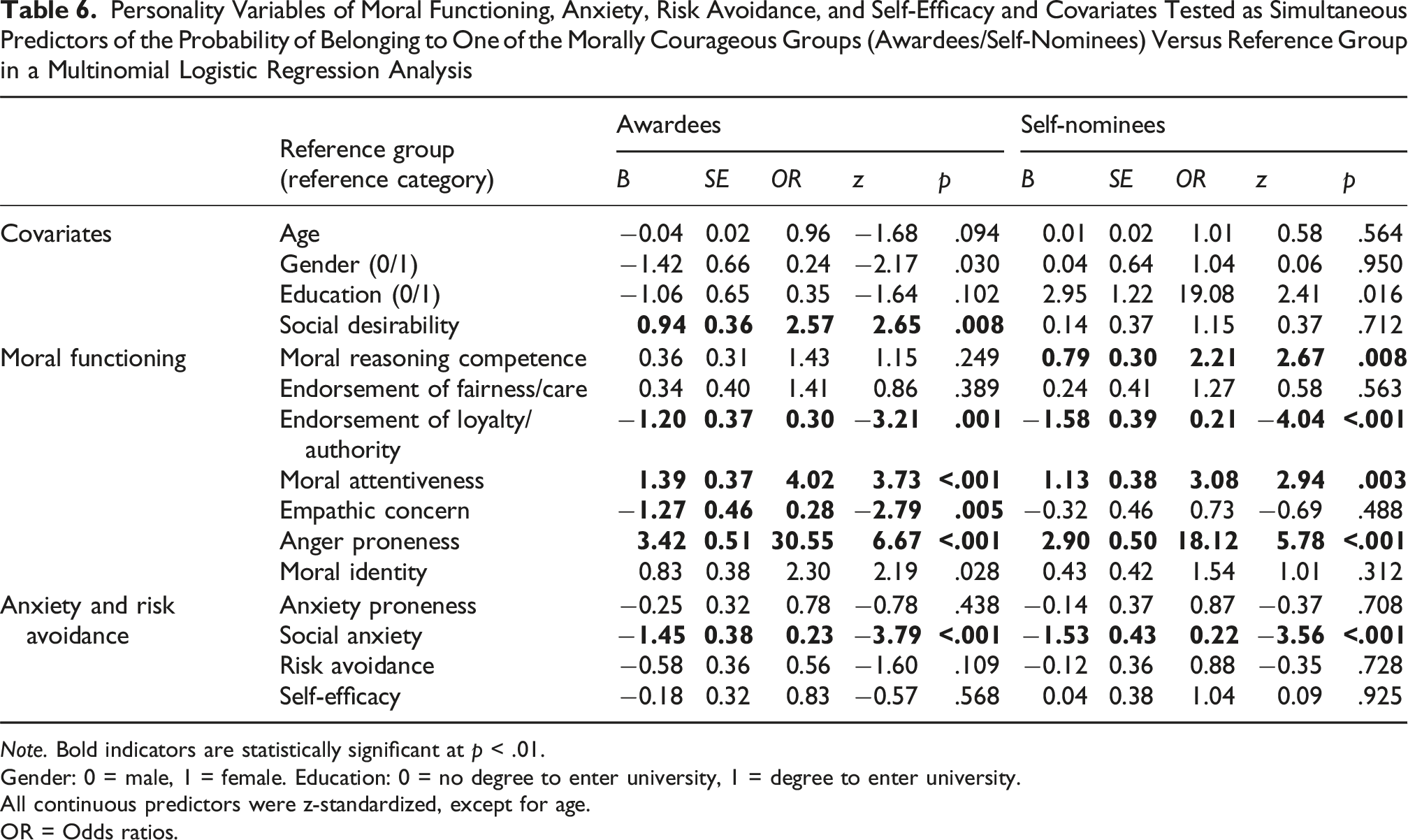
Note. Bold indicators are statistically significant at p < .01.
Gender: 0 = male, 1 = female. Education: 0 = no degree to enter university, 1 = degree to enter university.
All continuous predictors were z-standardized, except for age.
OR = Odds ratios.
Distinguishing between the morally courageous groups, heightened moral reasoning competence predicted membership in the group of self-nominees (but not awardees) versus the reference group. Surprisingly, in the context of the other predictors, lowered empathy emerged as a predictor of membership in the group of awardees (but not self-nominees) versus the reference group.
In order to test the unique predictive value of the facet-level variables of moral functioning and risk avoidance, anxiety, and self-efficacy beyond the HEXACO factors, we residualized the facet-level variables by regressing them on the HEXACO factors, and then tested the residuals as predictors of group membership (see Stewart et al., 2022). Detailed results of this analysis are displayed in the supplement (Table S8). Even when the variance shared with the HEXACO factors was extracted, endorsement of loyalty and authority as moral principles and anger proneness remained consistent predictors of membership in either morally courageous group (vs. the reference group). Moral attentiveness remained a significant predictor of membership in the group of awardees (but not self-nominees) versus the reference group. Also, self-efficacy emerged as significant predictor of membership in the group of awardees (but not self-nominees) versus the reference group.
Comparison to Normative Samples of the German Population
For each personality variable, we compared the group means of awardees, self-nominees, and the reference group to the means of a normative sample which was not selected according to moral courage criteria (and therefore arguably included individuals who had or had not displayed moral courage in the past). Effect sizes (Cohen’s d) for the differences between each group and the normative comparison sample are provided in the supplement (Table S9). Here, for conciseness, we inspect the results for those personality variables for which there were significant differences between the morally courageous groups and the reference group (see Table 4).
Regarding the HEXACO factor honesty/humility, the scores of all groups were higher than the normative sample (reference group: d = 0.26, p < .001; awardees: d = 0.31, p < .001; self-nominees: d = 0.41, p = .01). For extraversion, the reference group scored slightly lower than the normative sample (d = −0.11, p = .08), and the two morally courageous groups scored higher than the normative sample (awardees: d = 0.53, p < .001; self-nominees: d = 0.30, p = .04). For openness, the scores for the reference group were similar (d = 0.02, p = .77) and for awardees and self-nominees higher than the normative sample (awardees: d = 0.23, p = .12; self-nominees: d = 0.92, p < .001).
Regarding moral functioning, for the endorsement of loyalty and authority as moral principles, the scores of the reference group were similar to the normative sample (d = −0.04, p = .56), and awardees and self-nominees scored lower than the normative sample (awardees: d = −0.41, p = .006; self-nominees: d = −1.02, p < .001). For moral attentiveness and anger proneness, the scores of the normative samples fell right in between the morally courageous groups, on the one hand, and the reference group on the other hand. The reference group scored lower than the normative samples (moral attentiveness: d = −0.77, p < .001; anger proneness: d = −0.63, p < .001), and awardees and self-nominees scored higher than the normative samples (moral attentiveness: d = 0.50, p < .001 for awardees and d = 0.28, p = .06 for self-nominees; anger proneness: d = 0.66, p < .001 for awardees and d = 0.28, p = .04 for self-nominees).
Regarding risk avoidance, all groups scored lower than the normative sample, the reference group with d = −0.18 (p = .005), and the awardees and self-nominees with d = −0.89 and −0.58 (both p < .001), respectively. Since social anxiety emerged as consistent and unique predictor of group membership, it is worth also inspecting comparisons with the normative sample for this variable. Again, scores of the normative sample fell right between reference group (d = 0.17, p = .01) and awardees (d = −0.17, p = .26) and self-nominees (d = −0.16, p = .26).
Discussion
In the present study, we aimed to elucidate the personality characteristics underlying moral courage. We argued that standing up to defend one’s moral principles might involve unique dispositions which need to be considered for a full understanding of morality. To overcome theoretical and methodological restrictions of previous research, we addressed a comprehensive set of theoretically derived personality dispositions, and tested, in group comparisons, whether they characterize individuals who had demonstrated moral courage. We recruited individuals who had received or had been nominated to receive a public Zivilcourage award (for our group of “awardees”), and we complemented this group by inviting individuals who indicated to have acted in morally courageous ways (our group of “self-nominees”). By coding our participants’ open-ended descriptions, we could ensure that the morally courageous individuals had intervened against cases of severe moral violations (most often against physical violence), in many cases by directly confronting the perpetrator, verbally or physically, thus likely facing substantial personal risks.
In a nut-shell, our analyses revealed three key characteristic patterns: First, among the broad personality factors captured in the HEXACO model, heightened extraversion distinguished the morally courageous groups from the reference group and normative sample. Second, indicating exceptional moral functioning of the morally courageous, membership in the morally courageous groups was predicted by heightened moral attentiveness and anger proneness, and lowered endorsement of loyalty and authority as moral principles. Third, the morally courageous were characterized by diminished risk avoidance and social anxiety, suggesting that they encounter a lower psychological barrier posed by fear of negative social evaluation.
Extraversion Is a Relevant Personality Factor for Moral Courage
Considering that situations affording moral courage are inherently social and involve potential conflict and uncertain outcomes, the broad personality factors extraversion and emotionality were key candidates to facilitate or hinder moral courage, respectively.
Partially in line with expectations, we found that heightened extraversion characterized the morally courageous awardees when compared to the reference group of individuals who had indicated to not have acted morally courageously in the past. This result was robust across types of analyses, and comparisons with a normative sample of the German population further showed that, indeed, the awardees scored substantially higher on extraversion than people not selected according to moral courage criteria. Notably, ANOVA and t-tests also showed higher extraversion in the group of self-nominees compared to the reference group, so that heightened extraversion seemed to consistently characterize the morally courageous, but the results for self-nominees were less robust across analyses.
Since extraversion shapes how individuals engage in social activities (de Vries et al., 2016), a two-fold role seems plausible with regards to moral courage. First, individuals high in extraversion seek out rather than avoid social interactions (Breil et al., 2019; Sun et al., 2020), which in turn might predispose them to encounter situations involving others’ moral violations. In other words, extraverted individuals might tend to encounter more frequent opportunities to act morally courageously. Second, since extraversion entails self-confidence, assertiveness, and activation (Ashton & Lee, 2009), highly extraverted individuals may find it easier to overcome the psychological barriers to intervene against severe wrongdoings notwithstanding the involved risks. Results from an experience sampling study (Baumert et al., 2024) supported this two-fold role for mundane situations in everyday life. Specifically, extraversion predicted on the one hand who reported witnessed norm violations in their everyday life, and on the other hand who tended to intervene when having encountered such a situation. Our present findings suggest that extraversion contributes in this two-fold role to moral courage in situations involving severe wrongdoings and considerable risk. For future research, it seems promising to further disentangle the various processes through which personality contributes to exceptional moral courage, such as selecting into social contexts, being attentive to and recognizing critical situations, seeking further information to disambiguate situations, and taking action when having recognized a situation as affording moral courage.
Notably, no other broad personality factor, besides extraversion, consistently and robustly differentiated between the morally courageous individuals and the reference group and normative sample. Lowered emotionality emerged as predictor of belonging to the morally courageous groups in univariate analyses, but when considering all HEXACO factors as simultaneous predictors, emotionality did not uniquely distinguish the awardees from the reference group.
One might be surprised to see no consistent role of the “prosocial” personality factors honesty/humility and agreeableness, since standing up to defend moral principles should require a prosocial and cooperative orientation (Staub, 2015). Some analyses indicated that heightened honesty/humility might characterize the awardees, specifically, but this pattern was not robust against including or excluding covariates. Importantly, the confrontative implications of intervening against a perpetrator could counteract specific prosocial inclinations involved in honesty/humility and agreeableness (see, for example, the facet “forgiveness,” meaning absence of anger). Since the broad personality factors combine potentially counteracting personality processes, it seems advisable to address the facet level of personality models to obtain a more fine-grained understanding of the unique nuances of personality that contribute to moral courage. Located at the facet level of personality, next, we discuss our results regarding the specific dispositions of moral functioning as detailed in models of the moral self (Bebeau et al., 1999; Blasi, 1983; Jennings et al., 2015).
The Morally Courageous Stand Out in Their Dispositional Moral Functioning
Our results highlight the exceptional moral functioning of morally courageous individuals. Both groups of morally courageous individuals differed from the reference group in their dispositional moral attentiveness, anger proneness, and endorsement of loyalty and authority as moral principles. This pattern was robust across types of analyses, including or excluding covariates, and consistent for both groups of morally courageous individuals, with two exceptions: When the variance overlapping with the HEXACO factors was removed (Stewart et al., 2022), heightened moral attentiveness only predicted membership in the group of awardees (but not self-nominees) contrasted with the reference group. And for endorsement of loyalty and authority, results were slightly different between univariate and multivariate analyses: Only in the context of all other personality variables, lower endorsement of loyalty and authority emerged as a consistent predictor of membership in either group of morally courageous individuals. For anger proneness, results were fully robust across analyses and consistent across groups, also after removing variance overlapping with HEXACO factors. Heightened moral attentiveness, heightened anger proneness, and lowered endorsement of loyalty and authority were also consistently observed when comparing the awardees to the normative samples which were not selected according to moral courage criteria. Thus, we can draw three conclusions regarding dispositional moral functioning of the morally courageous.
First, our results suggest that the inclination to recognize moral relevance in one’s experiences (Reynolds, 2008) facilitates taking action in defense of one’s moral principles. In a previous experience sampling study, similar to extraversion, moral attentiveness predicted who reported having encountered other people’s norm violations in everyday life (Baumert et al., 2024). Accordingly, moral attentiveness appears to determine who recognizes opportunities affording moral courage. When passersby become witness to others’ wrongdoings, these situations unfold dynamically and tend to remain ambiguous. In this light, it seems plausible that individuals with heightened dispositional moral attentiveness stand out by approaching such situations and actively inquiring about their moral implications. Our present finding suggests that, potentially through these processes, moral attentiveness is relevant, not only in mundane situations in everyday life, but also regarding situations involving severe wrongdoings and considerable risk.
Second, heightened anger proneness characterized the morally courageous individuals. In line with the conceptualization of anger as a moral emotion (Haidt, 2003; Tangney et al., 2007), our results highlight its functional role in “fueling” moral courage. Anger typically involves appraisals that standards are violated (Frijda, 1987; Ortony et al., 2022) and fosters the motivation to rectify such violations (Fischer & Roseman, 2007), even if the violation affects others and not oneself (Hechler & Kessler, 2018). As such, anger has been shown to drive third-party punishment (Gummerum et al., 2016; Rodrigues et al., 2020) and other forms of bystander interventions against norm violations (Niesta Kayser et al., 2010; Sasse et al., 2022). Our finding complements the existing evidence, by highlighting that the proneness to react with strong anger could be a key personality disposition contributing to moral courage.
Third, moral courage seems to be facilitated when individuals do not endorse loyalty and authority as fundamental moral principles. This finding resonates with results obtained for whistleblowing in organizations. In that context, it was proposed that experiencing normative conflict between taking action against witnessed wrongdoings but thereby disobeying and being disloyal toward superiors or the organization hinders whistleblowing (Dungan et al., 2015, 2019; Near & Miceli, 1985). Our finding extends those findings and suggests that similar conflict could be a barrier to moral courage outside of the organizational context. Notably, it has been emphasized that defending moral principles could entail the violation of social norms (Brandstätter & Jonas, 2012), such as by breaching conventions of privacy and non-intervention (“mind your own business”), but also by disrupting conventional scripts. Presumably, people who do not endorse loyalty and authority as moral principles are shielded against experiencing conflict in situations when intervening to protect moral principles of care or fairness might imply acting against certain social norms.
In sum, we found that specific personality dispositions regarding moral attentiveness, moral judgment, and moral emotion characterize the moral functioning of the morally courageous. We did not find consistent evidence that dispositional empathic concern or the self-relevance of moral identity played a particular role in the personality makeup of the morally courageous. On the one hand, seeing no significant group differences in the self-descriptions for these concepts shows that the morally courageous did not present themselves as generally more likable or moral. In the same vein, we also did not find group differences in socially desirable responding. On the other hand, empathy and moral identity have been emphasized as crucial for (even exceptional) prosocial behavior, helping, and adherence to moral principles (e.g., Staub, 2015). If they do not contribute to defending of moral principles, as suggested by the absence of group differences in our study, this implies important psychological differences between these domains of moral action. Finding anger proneness, instead of empathic concern as an outstanding characteristic of morally courageous individuals underscores the psychological confrontational nature. Notably, in many cases of moral courage reported in our study, victims were supported (see Table 3). But even for victim support, it is possible that the main drivers of the behavior lay in the motivation to rectify the wrongdoing, rather than “only” to help a person in need.
Regarding moral identity, it could be possible that individuals assign differential self-importance to adherence and defending of moral principles. As conceptualized at present, moral identity is about the self-importance of being a caring, friendly, and honest person (Aquino & Reed, 2002). This might be related, yet still distinct from the self-importance of being principled, upright, and incorruptible (Sonnentag et al., 2018). As such, our findings highlight a potential avenue for future research to extend the conceptualization and measurement of moral identity when linking it to moral courage.
The Role of Lowered Risk Avoidance and Social Anxiety for Moral Courage
Besides moral functioning, we explored whether morally courageous individuals have lowered dispositional risk avoidance and anxiety, and heightened self-efficacy. We obtained somewhat mixed results regarding this question. In our ANOVAs and t-tests, we did not see differences in general anxiety or self-efficacy between our morally courageous groups and the reference group of individuals who had indicated to not have acted morally courageously in the past. By contrast, in these analyses the morally courageous scored lower on risk avoidance. Finally, social anxiety emerged as predictor of who belonged to the two morally courageous groups only under specific conditions: its effects emerged when controlling for demographic variables and in the context of all personality predictors, but they were not robust to removing variance overlapping with HEXACO factors. Given the social nature of situations affording moral courage, moral courage can be facilitated specifically when individuals are less afraid of negative social evaluations (McGovern, 1976). In other words, the personality makeup of morally courageous individuals might lower the psychological barrier for confronting a perpetrator by shielding against experiences of social anxiety, but more research seems necessary to draw firm conclusions.
Surprisingly, when comparing to the normative sample, we found that the morally courageous groups, but also the reference group scored lower in risk avoidance. This result is puzzling, and it could point to the possibility of selectivity regarding specific dispositions in the composition of our reference group: For instance, individuals with lower risk avoidance might select into the online panel from which our reference group was recruited (see limitation section for a thorough discussion of the implications of such effects). But we can also speculate that lowered risk avoidance might not linearly contribute to moral courage along the spectrum from mundane everyday situations to more extreme situations, as investigated in the present research. Since the normative sample was unselected regarding moral courage criteria, it likely included individuals who had acted against others’ wrongdoings in mundane ways in their everyday life. Regarding risk avoidance, these individuals might not fall between people who demonstrate moral courage in situations with severe wrongdoings and risks and people who never acted morally courageously before. Resonating with this speculation, lowered risk avoidance was not found as a predictor of bystander intervention in everyday life (Baumert et al., 2024). Speculating about such discontinuities between the dispositions that foster or hinder mundane acts of bystander intervention and those involved in acts of moral courage against severe wrongdoings despite considerable risks further highlights the importance of investigating cases of moral courage as we did in the present research (Lawn et al., 2022).
Limitations and Future Directions
The present study provides important insights into personality characteristics of morally courageous individuals. Our group comparisons complement in important ways those previous studies with hypothetical scenarios or minor transgressions staged in the lab or field. We were able to study moral courage across a broad range of real-life contexts, involving severe wrongdoings and interventions implying considerable personal risks for the morally courageous individuals. Nevertheless, naturally, several limitations have to be taken into account.
First, we have to carefully consider the comparability of our groups. Selectivity involved in the composition of our groups could limit the validity of the comparisons as to revealing personality characteristics of morally courageous individuals. As morally courageous, we recruited individuals who had received or been nominated for Zivilcourage awards presented by public institutions. This criterion, together with the coding of their open-ended descriptions, helped to ensure that these individuals had indeed intervened to stop, prevent, or redress severe wrongdoings despite considerable personal risk. Since the population of awardees is small, and public institutions might tend to attract or select nominations of certain types (e.g., intervention against clearly illegal behaviors), we complemented this group with a second group of morally courageous individuals. Arguably, the mixed recruitment strategy for this second group can be seen as less optimal. Awardees and self-nominees differed demographically (see Table 1) as well as with regard to the types of norm violations and intervention strategies that they reported (see Table 3). These differences preclude any direct comparisons of personality characteristics between the morally courageous groups. However, we argue that taking this two-fold recruitment approach and concentrating on consistent differences between both morally courageous groups and the comparison samples, serves to balance out potential group-specific selection effects and thereby enhance the robustness of our results.
Regarding the comparison samples, we also combined two approaches, comparing to the reference group as well as to normative samples which were unselected regarding moral courage criteria. The reference group was matched in demographic characteristics to the morally courageous groups and allowed the comparison with people who had not acted morally courageously in the recent past. Yet, this sample was an ad-hoc sample recruited through an online panel provider, potentially involving specific selection effects. Comparisons with the normative samples of the German population aimed to control for such effects and to further scrutinize whether group differences might be driven by the reference group rather than the morally courageous groups. It has to be noted that, between the personality measures, the normative samples were recruited in different ways and at different times, affecting how representative they can be considered (with recruitment varying from random route sampling, e.g., for anger proneness, to ad-hoc sampling among students, e.g., for social anxiety; and year of recruitment varying from 1990 for anger proneness to 2021, e.g., for moral attentiveness). In sum, we took measures to reduce, balance and control selectivity effects, but this potential threat to the validity of our comparisons needs to be taken into account.
Second, given the small sample size of our morally courageous groups, point estimates of group differences need to be interpreted with caution since confidence intervals were large. While our sensitivity analysis indicated that we had sufficient power to detect medium-sized effects in the ANOVAs, parameter estimates in the binomial logistic regression analyses should be treated with caution, particularly in the models with several simultaneous predictors (Hosmer et al., 2013). Regarding the effect of anger proneness, specifically, the estimated odds ratio varied across the different regression models, and was very high in the model including covariates and all other facet-level personality variables (OR = 30.55). Given that, first, group differences for anger proneness were large also in the ANOVA, and, second, we observed significant group differences in this variable across all our analyses with the critical alpha error level set to .01, we conclude that heightened anger proneness robustly characterized the morally courageous individuals in our study. However, we emphasize that to reliably estimate true effect sizes, future research might aim to achieve larger sample sizes by recruiting from the limited population of nominees and recipients of moral courage awards across extended time periods.
Third, our analyses cannot ascertain that those personality characteristics that distinguish between the morally courageous and the reference group actually causally contributed to the morally courageous acts. For instance, instead of personality predisposing individuals to act morally courageously, one might contend that the experience of having intervened (and subsequent consequences) could themselves trigger personality change (Bleidorn et al., 2018; Wrzus & Roberts, 2017). Since we concentrated on consistent predictors of belonging to the group of awardees or self-nominees, only experiences shared between these groups (but not social consequences related to winning a moral courage award, for instance) could explain the revealed personality differences. Future research could focus on the transactions between acting morally courageously and short- and longer-term personality change.
Last, our study was conducted in Germany and Austria. We capitalized on the fact that in German-speaking countries, a number of public institutions regularly present Zivilcourage awards. Such awards highlight that, within these societies, it is highly valued that citizens stand up for moral principles, democratic values and human rights. This could plausibly represent a societal boundary condition for our findings. We do not know whether the same personality dispositions that we found to characterize morally courageous individuals in Germany and Austria would also play a critical role in settings where moral courage is devalued or actively repressed. Previous research revealed that the content of moral norms (Buchtel et al., 2015; Graham et al., 2016) as well as what is deemed an appropriate response to another person’s norm violation (Eriksson et al., 2017, 2021; Henrich et al., 2006) are culturally dependent. Thus, cross-national comparative approaches to exceptional moral courage seem highly relevant.
Relatedly, we note that the translation of Zivilcourage in German to moral courage in English comes with some fuzziness (Schalk et al., 2024). The German term Zivilcourage has historical roots in the resistance against the Nazi regime and support of Jews and other persecuted communities (Fagin-Jones & Midlarsky, 2007), although uses of the term date further back (von Keudell, 1901). Defending liberal democratic values and protecting human rights is seen at the core of the term Zivilcourage (Meyer, 2014). Schalk and colleagues (2024) argued that the English term moral courage has been defined more broadly as standing up for personal principles. Systematic bibliographic analyses (Schalk et al., 2023, 2024) revealed that research under the label of moral courage has spanned various domains and uses of the term, including nurses’ coping with moral distress (Numminen et al., 2017) and ethical leadership in organizations (Hannah et al., 2011). Per implication, our present findings might be limited to the aspect of moral courage that overlaps with the German term Zivilcourage: Our results reveal personality dispositions that characterize individuals who took action against others’ violations of moral principles despite facing risks to themselves.
Conclusions
Our study provided important insight into the personality characteristics of individuals who, in cases of severe wrongdoings and significant risks, demonstrated moral courage. Our unique theoretical and empirical approach complements and extends the existing scientific knowledge on moral courage in substantial ways. Our results indicate that a specific personality makeup, involving heightened extraversion, exceptional moral functioning, and lowered social anxiety, might predispose individuals to act morally courageously when confronted with others’ wrongdoings. By revealing substantial differences in personality characteristics between the morally courageous groups and a demographically matched reference group, our study points toward individual differences in judgmental, emotional, and motivational processes that might be key for morally courageous behavior, independent of immediate contextual specifics. In this vein, our findings are of theoretical, but also of practical value because they suggest that fostering moral attentiveness and endorsing anger as functional for intervention against others’ wrongdoings might enhance moral courage in the population.
Supplemental Material
Supplemental Material - Personality Characteristics of Morally Courageous Individuals: Evidence From Group Comparisons
Supplemental Material for Personality Characteristics of Morally Courageous Individuals: Evidence From Group Comparisons by Anna Baumert, Anna Sckopke, Gabriela Küchler, Julia Sasse, Jenny Wagner in European Journal of Personality
Footnotes
Acknowledgments
We thank Fiona tho Pesch, Jürgen Baumert, and Brian Cooper for valuable feedback, David Izydorczyk and Marie Horak for their support in collecting the data; and Rebecca Rodrigues for support in preparing the tables.
Ethical Considerations
Ethics approval was obtained by the Institutional Review Board of the University of Koblenz-Landau, Germany (approval number 2017/80b).
Consent to Participate
All participants provided informed consent in an online format.
Author Contributions
Baumert and Sckopke developed the study concept and methodology, acquired funding, and administered the project. Küchler curated the data, developed coding schemes, and organized the coding procedure, under the supervision of Baumert. Baumert and Küchler analyzed the data, with support of Wagner. Küchler and Baumert prepared tables and figures, with input from Sasse. Baumert drafted the manuscript, and all authors provided critical revisions. All authors approved the final version of the manuscript for submission.
Funding
The authors disclosed receipt of the following financial support for the research, authorship, and/or publication of this article: This research was funded in part by the “Beacon Project” ( ) at Wake Forest University (through a grant from the Templeton Religion Trust) awarded to first and second author, and by a grant by the Max Planck Society awarded to the first author.
Declaration of Conflicting Interests
The authors declared no potential conflicts of interest with respect to the research, authorship, and/or publication of this article.
Open Science Statement
This study’s hypotheses and analyses were not preregistered. We report how we determined our sample size and all data exclusions. The study did not involve any manipulations. In the manuscript, we report the measures of interest for the present research questions, but the full material is provided online. Complete material, including invitation letters, analyzed data and scripts can be found here . For privacy concerns, we only publish aggregated data on situation descriptions.
Supplemental Material
Supplemental material for this article is available online.
References
Supplementary Material
Please find the following supplemental material available below.
For Open Access articles published under a Creative Commons License, all supplemental material carries the same license as the article it is associated with.
For non-Open Access articles published, all supplemental material carries a non-exclusive license, and permission requests for re-use of supplemental material or any part of supplemental material shall be sent directly to the copyright owner as specified in the copyright notice associated with the article.
