



Abstract
We experimentally investigated psychological responses of bystanders to violations of moral codes to find out why divinity violations may be more effective for gaining victimhood status than autonomy violations in real-world intergroup conflicts. In particular, we considered how anger versus disgust responses are differentially invoked by violations of autonomy versus divinity ethics. Two experiments compared autonomy versus divinity violations in interaction with two other parameters known to produce different effects: level of harm (Experiment 1) and differential intergroup power (Experiment 2). Overall, we found support for the proposed dissociation in anger versus disgust responses to autonomy versus divinity violations in a way that the anger responses to autonomy violations were amplified but disgust responses to divinity violations were not affected when the moral violation was more harmful and the perpetrator was more powerful than the victim. We discuss the implications of the cognitive processes involved in considering autonomy versus divinity violations, and the functionality for parties to intergroup conflict of accusing the opponent of divinity violations.
Keywords
A false conspiracy theory spread on social media shortly before the 2016 United States presidential election, claiming that leaked emails from one of the candidates, Hillary Clinton, revealed her involvement in a secret brothel located in the basement of a Washington pizzeria where children were allegedly being abused in satanic and cannibalistic rituals. Despite the absurdity of the claim, it prompted a man to fire shots with a rifle at the pizzeria “to rescue the hostage children.” Even after the conspiracy theory was discredited and debunked, a survey conducted 9 months later found that 46% of Trump voters and 17% of Clinton voters believed that Clinton’s emails contained references to pedophilia and human trafficking (Frankovic, 2016). It continued to spread to millions of social media users, considered by researchers as a robust and sustainable conspiracy theory (Avramov et al., 2020); and it is claimed to have been used by an online alt-right conspiracy collective as one of the motivational tools to band pro-Trump protestors together in the January 6 United States Capitol attack (Bleakley, 2023).
Turkish Prime Minister, then President, Recep Tayyip Erdogan claimed in a speech that a hijab-wearing woman was dragged on the ground by protestors during 2013 Istanbul Gezi Park protests. Two days later, the alleged victim stated in an interview that she found herself surrounded by 70 to 100 male protestors who were stripped to the waist and wearing leather gloves and strange headbands. She claimed these men attacked and urinated on her while swearing at her, her hijab, and Erdogan. Following this interview, progovernment media started a vilification campaign against the protestors. Although eventually the police reports and video records proved that this event never happened, and it came out that the interview was fabricated by a partisan journalist, by that time, the campaign had succeeded in legitimizing the brutal violence committed by the police against peaceful Gezi protestors, 8,000 of whom were seriously wounded and several were killed (Amnesty International, 2013; “Polisin Kabataş Raporu [Kabataş Report of the Police],” 2015).
The sympathies of group members and outside groups can be strategically important for groups in conflict (Bilewicz & Vollhart, 2013; Klandermans, 1997; Noor et al., 2012; Opotow, 1990; Staub, 1999). An efficient way to recruit the “hearts and minds” of bystanders is to shape their perceptions and feelings about the immoral actions of the opponent (Belavadi & Hogg, 2018; Sullivan et al., 2012). Throughout history, powerful groups have used this strategy by stereotyping, dehumanizing, and accusing less powerful groups of immoral actions to legitimize and sustain their powerful status in relation to them (Fiske, 1993; Jost & Banaji, 1994; Lammers & Stapel, 2011; Pratto, 1999). Parties in conflict, therefore, have choices about what kind of accusations to make or whether to support existing accusations in order to portray themselves as victims of an enemy who is outside the scope of moral concern.
One means of doing so is to accuse victims of moral violations, for their emotional impact on the public. Often, such strategic accusations and/or rumors suggest that the oppressed group engages in shockingly immoral and profane actions (e.g., witchcraft, having sex with animals or children, worshiping false gods, disrespect to dead bodies, cannibalism, or incest). The theories of moral content, such as social domain theory (Turiel, 1983), the “big three” of morality (Shweder et al., 1997), and moral foundations theory (Graham et al., 2009), have classified such actions as divinity violations, which involve perceived disruptions to the sacred/natural order, purity, or sanctity. A significant number of studies indicate that divinity violations evoke different emotional responses than violations defined in another moral domain, such as autonomy violations, which involve concerns about harm, care, individual and group rights, and justice. 1 The key finding in the literature on emotional responses to autonomy and divinity violations is that while autonomy violations tend to elicit anger as the primary emotion, divinity violations are more likely to evoke disgust (Gutierrez & Giner-Sorolla, 2007; Horberg et al., 2009; Moll et al., 2005; Rozin et al., 1999).
Considering its emotional impact on the public, those seeking to place opponents outside the scope of morality concern may try to figure out which type of moral violation to use when accusing their opponents. For example, regarding our opening case, why did actors associated with the American alt-right and the Republican Party spread accusations of cannibalistic rituals and child abuse to discredit the presidential candidate of the Democratic Party (Bleakley, 2023; Leal, 2020)? Why is it that the initial campaigns that portrayed protestors as vandals engaging in violent acts such as throwing stones at people and burning public vehicles (i.e., autonomy violation) were not as persuasive to Turkish people as the fake incident involving disrespect towards a hijab-wearing woman (i.e., divinity violation) was? On the whole, why might a divinity violation committed by a member of a group be more effective in inciting others to demonize that group than a violation of autonomy? This question is of practical significance because real-world intergroup conflicts and instances of repression from at least the Romans to the present have included numerous kinds of divinity violations, such as defiling the corpses of enemies one has killed by urinating on them, leaving them unburied, and collecting their body parts (e.g., Schogol, 2017; H. Young, 2005). Further, we continue to see accusations of divinity violations used to justify alleged victims’ subsequent violent attacks (e.g., the Charlie Hebdo attack in France). Although lower power groups have engaged in divinity violations, we should be mindful that falsely accusing a lower power group of divinity violations in order to justify past or future violence against them (Bar-Tal, 1990) is a tactic used by colonizers (e.g., Castañeda, 1993) and enslavers (e.g., Giddings, 1984), and that is being used by both governments and vigilantes in higher status groups to harm people in lower status groups in numerous countries today (e.g., Barstow & Raj, 2015; Human Rights Watch, 2009; Messer, 2021; Pasha-Robinson, 2017).
Given the significance of divinity violations in intergroup conflicts and the differing emotional reactions to them compared to violations of autonomy, we draw on a range of research to hypothesize which kinds of moral violations accusations will be most provocative for parties seeking to hold other groups outside the scope of morality. Specifically, we postulate that divinity violations may be more effective than autonomy violations for oppressors’ purposes because emotional responses to divinity violations are less likely to be affected by two key predictors of bystander reactions in intergroup conflicts: (a) harmfulness of the situation and (b) relative power of the accusing party. Firstly, we note that accusing of divinity violations makes the violator/victim group appear less harmful than an autonomy violator/victim group, which will prevent the accuser from being seen as very weak while still being able to claim the perceived benefits of being the victim. This because being seen as receiving excessive harm is undesirable by oppressor groups because it may distort group members’ perceived power (McGraw, 2003), may damage their self-esteem (Crocker et al., 1994), and may even threaten the group’s integrity (Pratto & Glasford, 2008). Secondly, we claim that accusing of divinity violations, compared to accusing of autonomy violations, is more likely to prevent the violator/victim group to be perceived as the underdog. Oppressor groups would not want accused violator/victim groups to be perceived as the underdog because that would gain them support from third parties (e.g., Vandello et al., 2007). We now detail the research and theories on which we based this reasoning.
The Harmfulness of the Moral Violation
To be able to infer that autonomy and divinity violations invoke different emotional responses, we designed experiments to manipulate features of the violations that should especially influence one but not the other.
The first we consider is the level of harm to other people produced by the moral violation. Some theorists argue that a divinity violation has no direct consequences (no harm) for people other than the actors directly involved in the conflict (e.g., Haidt, 2001). However, in real-life situations, a divinity violation usually produces psychological and physical harm, especially in intergroup conflicts (e.g., Kitts, 2018). Nevertheless, the level of harmfulness seems to be ineffective on some emotional responses to divinity violations. That is, disgust evoked by divinity violations is less likely to be modified by rational appraisals such as harm or intent (Gutierrez & Giner-Sorolla, 2007; L. Young & Saxe, 2011) than anger evoked by autonomy violations would be. Following this reasoning, in violations said to be committed within intergroup conflicts, we expected that more harm to the victims by a group’s autonomy violation would evoke more anger, whereas increasing harm to a group’s divinity violations would not increase disgust.
The Relative Power of the Perpetrator
The second important aspect of moral violations that, we predict, will differentially influence responses to autonomy and divinity violations concerns the relative power of the perpetrator group. We make a similar prediction of a smaller effect of a moral violator’s relative power in the case of divinity violations (vs. autonomy violations) as we did regarding the degree of harm caused by the violation. We explain the reasons in what follows.
When they have no previous affiliation with either party in a conflict, people tend to favor the less powerful group (i.e., underdog effect; Vandello et al., 2007). Third parties are therefore more likely to perceive violent actions by underdogs as more moral and justifiable than powerful groups’ violence (Glasford & Pratto, 2014; Vandello et al., 2011). Vandello et al. (2007) suggested that the basic motivation underlying underdog support is the sense of unfairness and injustice that is evoked by inequality between powerful and less powerful groups (Lerner, 2003). The fact that people’s support for underdogs decreases as their autonomy violations become more harmful (i.e., increasing the actions’ threat to justice and fairness) supports this claim (Glasford & Pratto, 2014; Orazani & Leidner, 2018; Vandello et al., 2011). It seems that when harmfulness of the underdogs’ actions has so much impact that makes it hard to justify those actions, people can associate them with morally bad character (Giner-Sorolla & Chapman, 2017) and find no legitimate reason to defend them. Likewise, it is hard to find reasonable, justice-based explanations for divinity violations (Haidt, 2001). Moreover, disgust evoked by divinity violations is less likely to be modified by rational appraisals such as harm or intent than anger evoked by autonomy violations would be (Gutierrez & Giner-Sorolla, 2007; L. Young & Saxe, 2011). Without engaging in moral reasoning, we postulate, people will not take into account the relatively lower power of a group perpetrating a divinity violation. Therefore, we predict that the underdog effect will be evident in anger responses to autonomy violations, but not in disgust responses to divinity violations.
In sum, we predict stronger effects of level of harm and level of power of the violator (compared to the victim) for autonomy violations.
Experiment 1: Level of Harm by Type of Moral Violation
Experiment 1 tested the differential emotional responses to autonomy and divinity violations by members of a group (i.e., perpetrators) against members of another group (i.e., victims) when the level of harm was experimentally manipulated. We tested the hypotheses that more harm to the victims would evoke more anger in response to autonomy violations (H1), but that more harm would not increase the level of disgust evoked in response to divinity violations (H2). Throughout the experiments, we expected that the primary emotional response to an autonomy violation would be anger, whereas it would be disgust to a divinity violation.
Descriptions of the violations concerned fictitious groups, but the method of presentation and the actual facts of the violations were based on recent real-world events. We engaged members of the public in a cultural context where both autonomy and divinity moral violations are known to be evocative (Rozin et al., 1999). All measures, manipulations, and exclusions in the study are reported in what follows.
Method
Participants
We recruited 220 U.S. residents on Amazon’s Mechanical Turk in exchange for a compensation of $0.50 (the average time for study completion was 3.36 minutes, SD = 2.06). We screened for incomplete answers and incorrect attention checks, yielding a final sample of 172 participants (females = 74, males = 98; Mage = 37 years, SD = 10.35). Our attention checks—with questions that cannot be answered correctly without reading the scenarios—to filter out inattentive participants yielded a high number of missing cases relative to similar studies. A one-way ANOVA revealed no significant differences in missing data across conditions, F(3, 216) = 1.20, p = .310, ηp2 = .02.
Design, materials, and procedure
After completing standard consent procedures, each participant read one of four scenarios (presented as newspaper articles published a few months earlier) that described a moral violation by a group of soldiers from a named but fictitious nation against another nation’s soldiers. 2 The 2 (violation type: autonomy vs. divinity) x 2 (level of harmfulness of immoral action: low vs. high) factorial design had four between-subjects conditions.
The high-harmfulness autonomy (n = 35) scenario stated that a group of soldiers tied up another group of soldiers and left them outdoors without food and water for 4 days before killing them; in the low-harmfulness autonomy (n = 45) scenario, the exposure was for 2 days and no killing was included. As expected, a pilot study (n = 61) showed that participants perceived the high-harmfulness autonomy scenario (M = 6.56, SD = 1.39) as more harmful than the low-harmfulness autonomy scenario (M = 5.28, SD = 1.41), t(59) = −3.58, p < .001, d = 0.91.
The high-harmfulness divinity scenario (n = 48) included a group of soldiers showing disrespect for the corpses of soldiers they had killed (kicking their remains like a soccer ball after killing them). The low-harmfulness divinity (n = 44) scenario included a different disrespectful behavior to soldiers’ dead bodies (cannibalism of their remains); however, we lowered the level harm by changing three features. First, the perpetrators found the other soldiers already dead (no harm to living people); second, they were not described as engaging in any explicit harmful behavior such as kicking the bodies (no explicit aggressive act); and third, they put the rest of the bodies in a mass grave and no one ever found out what happened (relatively less harm to the victims’ loved ones). As stated before, divinity violations often involve defilement of bodies, but it is difficult to manipulate the alleged harm done to corpses, as opposed to harm to living witnesses who care about the dead. In fact, pilot testing showed we were unable to produce lower harm versions of kicking a corpse’s head. For this reason, the behaviors in the two divinity violation conditions were not the same. In the pilot study (n = 89), we manipulated the level of harm (high harm: killing and not burying the remains vs. low harm: finding dead soldiers and burying the bodies in a grave) in the kicking and cannibalism scenarios. Results showed that the main effect of level of harm was not significant, F(1, 85) = 1.25, p = .267, ηp2 = .01. However, we found a main effect of scenario type such that participants reported more harm for the high-harm kicking (M = 5.92, SE = 0.32) than for the high-harm cannibalism (M = 4.96, SE = 0.33) and low-harm cannibalism scenarios (M = 4.64, SE = 0.33), F(1, 85) = 7.64, p = .007, ηp2 = .082. The low-harm kicking scenario (M = 5.5, SE = 0.35) was not significantly different from the other three scenarios. Since these results indicate that kicking influences the perceived harmfulness as an explicit aggressive act, we decided to use the high-harm kicking and low-harm cannibalism scenarios in the main study. After reading the newspaper article, all participants indicated their emotions.
A separate study confirmed that autonomy violations were perceived in the autonomy domain, and divinity violations were perceived in the divinity domain (n = 62). In this study, after giving receiving brief descriptions of divinity (e.g., concerns about sacred/natural order and sanctity) and autonomy domains (e.g., concerns about causing pain to another and justice), participants were asked to indicate how well the violation in the vignette fit the autonomy and divinity descriptions. As expected, participants perceived the high-harmfulness autonomy scenario as fitting more the autonomy domain (M = 5.61, SE = 0.17) than the divinity domain (M = 4.69, SE = 0.18), t(61) = 5.75, p < .001, d = 0.73. They also perceived the low-harmfulness autonomy scenario as fitting more the autonomy domain (M = 5.48, SE = 0.17) than the divinity domain (M = 4.56, SE = 0.19), t(61) = 5.24, p < .001, d = 0.66. Participants’ ratings of matching the scenarios with the autonomy domain did not significantly differ between the high-harmfulness autonomy condition and the low-harmfulness autonomy condition, t(61) = 1.59, p = .117, d = 0.20. Similarly, participants rated the high-harmfulness divinity scenario as fitting more the divinity domain (M = 5.66, SE = 0.17) than the autonomy domain (M = 4.85, SE = 0.19), t(61) = 4.26, p < .001, d = 0.54. They also rated the low-harmfulness divinity scenario as fitting more the divinity domain (M = 5.74, SE = 0.19) than the autonomy domain (M = 4.68, SE = 0.18), t(61) = 5.75, p < .001, d = 0.73. As expected, participants’ ratings of matching the scenarios with the divinity domain did not significantly differ between the high-harmfulness divinity condition and the low-harmfulness divinity condition, t(61) = 1.04, p = .301, d = 0.13.
Measures
Emotions
We asked participants to indicate the strength of the emotions they experienced when reading about the behavior of the perpetrators by checking the number that best described the intensity of their emotional response. They rated emotion items in random order for all conditions (1 = not at all, 8 = very strong). Although our critical dependent measures were level of anger and level of disgust given that these emotions are specifically evoked by autonomy and divinity violations, respectively (Rozin et al., 1999), in line with previous emotion measurements (Cottrell & Neuberg, 2005), we included filler emotions to provide a broader emotional judgment context and reduce demand. Following Gutierrez and Giner-Sorolla (2007), participants rated several anger and disgust items along with filler emotion words (i.e., guilt, shame, pride, compassion, gratitude, and contempt) to increase the measurement reliability of our critical dependent variables. The index of anger items (anger, outrage, infuriation) had a Cronbach’s alpha of .95, and the index of disgust items (disgusted, sickened, repulsed, grossed-out) had a Cronbach’s alpha of .87, comparable to Gutierrez and Giner-Sorolla’s (2007) findings.
Sensitivity analysis
Sensitivity power analyses assuming N = 172, 80% power, and an alpha of .05 indicated detectable effect sizes of ηp2 = .05 (between factors), ηp2 = .01 (within factors), and ηp2 = .01 (within–between interaction) in a repeated measures ANOVA (G*Power 3.1.9.2; Faul et al., 2007).
Results
We conducted a repeated measures ANOVA on the anger index and the disgust index with a 2 (violation type: autonomy vs. divinity) x 2 (harmfulness: low vs. high) multifactorial design using the average nontarget emotions as a covariate to test the predicted effects of moral violation type and harmfulness of the violation on emotional responses (H1 and H2).
Exploratory analyses revealed that the anger and disgust indexes were moderately correlated, r(170) = .59, p < .001. The covariate was significant, indicating individual differences in emotion ratings across emotions, F(1, 167) = 20.00, p < .001, ηp2 = .11. Ratings were higher for the disgust index (M = 5.39, SE = 0.13) than for the anger index (M = 5.21, SE = 0.14); emotion rated F(1, 167) = 5.68, p = .018, ηp2 = .03. The main effect of violation type was not significant, F(1, 167) = 0.23, p = .632, ηp2 = .00, but we found a main effect for harm level such that the average index was higher in the high-harm condition (M = 5.83) than in the low-harm condition (M = 4.77, SEs = 0.17), F(1, 167) = 19.42, p < .001, ηp2 = .10. The two-way interaction between violation type and harm level was not significant, F(1, 167) = 0.02, p = .880, ηp2 = .00.
There was a two-way interaction between emotion rated and violation type, F(1, 167) = 49.10, p < .001, ηp2 = .23, indicating the expected emotional reaction differences according to violation type. Participants were angrier about the autonomy violation (M = 5.55, SE = 0.20) than about the divinity violation (M = 4.88, SE = 0.19), whereas they were more disgusted at the divinity violation (M = 5.84, SE = 0.17) than at the autonomy violation (M = 4.94, SE = 0.19). There was also a two-way interaction between emotion index and harm level, F(1, 167) = 8.86, p = .003, ηp2 = .05, such that the disgust index was higher (M = 5.03, SE = 0.18) than the anger index (M = 4.51, SE = 0.19) in the low-harm condition, but both emotions were higher and equivalent in the high-harm conditions (disgust index: M = 5.75, SE = 0.19; anger index: M = 5.91, SE = 0.20).
Finally, as implied by H1 and H2, there was a three-way interaction among emotion rated, level of harm, and type of moral violation, F(1, 167) = 20.10, p < .001, ηp2 = .11. Simple effects tests showed that participants were angrier when there was more harm (M = 5.98, SE = 0.30), in comparison to less harm (M = 5.12, SE = 0.27), in the autonomy violation condition, F(1, 167) = 4.51, p = .035, ηp2 = .03 (see top of Figure 1). They were also angrier when there was more harm (M = 5.84, SE = 0.26), in comparison to less harm (M = 3.91, SE = 0.27), in the divinity violation condition, F(1, 167) = 27.06, p < .001, ηp2 = .14. The bottom panel of Figure 1 shows that more disgust was elicited by the high-harm (M = 5.54, SE = 0.28) than by the low-harm (M = 4.34, SE = 0.25) autonomy violation condition, F(1, 167) = 10.04, p = .002, ηp2 = .06; but harm level did not influence the amount of disgust shown at the divinity violation, F(1, 167) = 0.543, p = .462, ηp2 = .00, which produced more disgust than the autonomy violation.
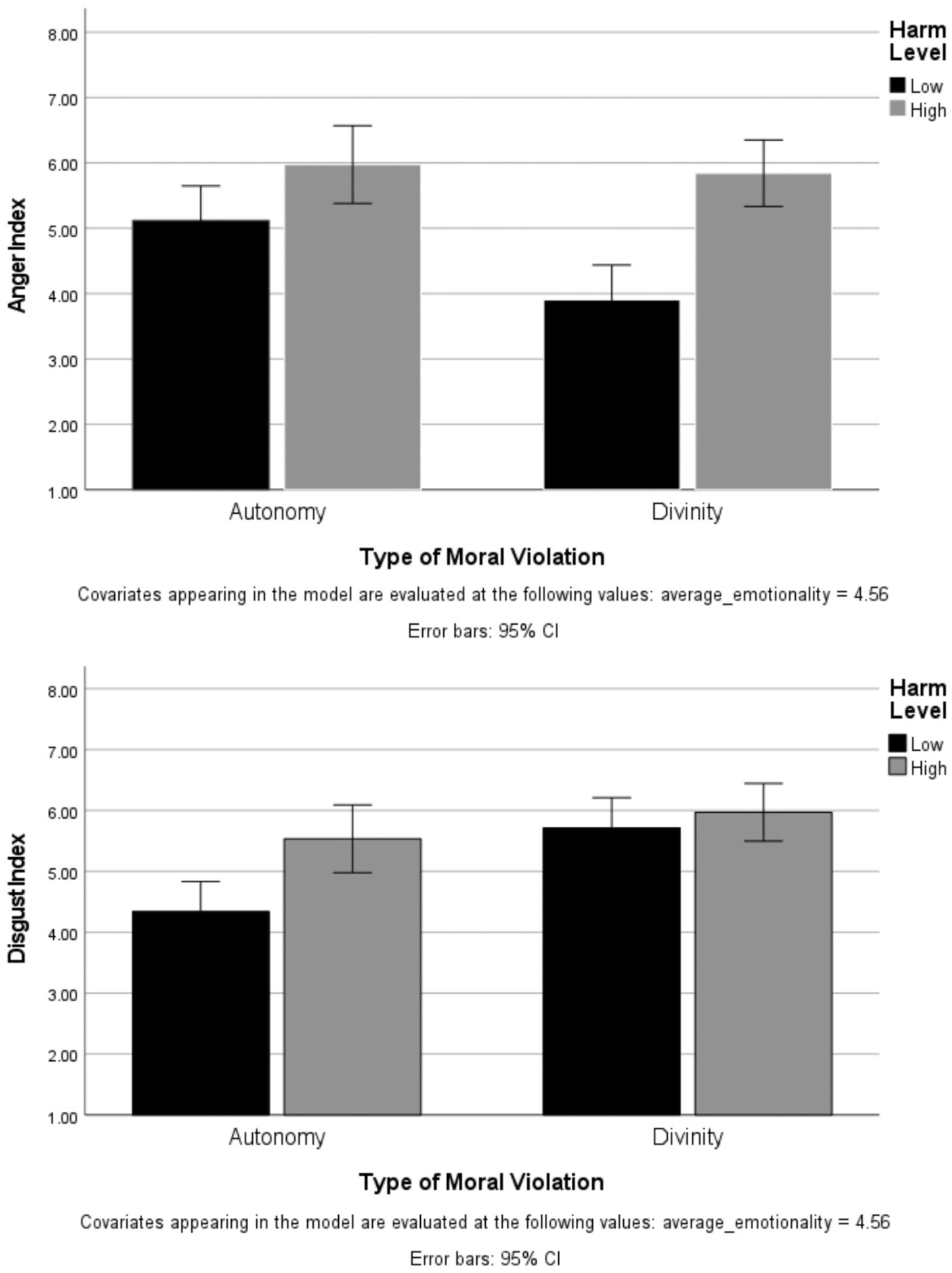
Means for the anger and disgust indexes by type of moral violation and level of harm: Experiment 1.
Discussion
Results supported our first and second hypotheses in that we found that more (vs. less) harm to the victims evoked more anger in the autonomy violation conditions, whereas level of harm to the victims did not affect the level of disgust in response to a divinity violation. This finding is consistent with previous studies showing that level of harm to others is a better predictor of anger than of disgust (e.g., Gutierrez & Giner-Sorolla, 2007), and that manipulations of divinity violations predicted disgust better than anger (e.g., Moll et al., 2005; Rozin et al., 1999). The present experiment is useful because it demonstrated both these effects in an intergroup conflict situation.
Unexpectedly, greater harm also increased anger in the divinity violation condition, and did so more strongly than in the autonomy violation condition. However, anger was not greater than disgust when divinity violation was more harmful; and also as expected, increasing harmfulness level had no effect on disgust feelings in response to a divinity violation. This finding is in line with the view that disgust-backed judgments are less likely to be modified by reasoning and circumstances compared to anger-based ones (Giner-Sorolla et al., 2018; Russell & Giner-Sorolla, 2013).
Apparently, a situational appraisal (perceiving more harm in a moral violation) may evoke more anger in autonomy violations, but it has no effect on disgust in divinity violations. This confirms our reasoning that accusing opponents of divinity violations is more effective than accusing them of autonomy violations. By accusing the opponent of divinity violations, such as those involving morally profane activities, the accuser group benefits from provoking feelings of disgust towards their opponent without experiencing negative consequences themselves such as damaging their perceived power (McGraw, 2003).
Experiment 2: Relative Group Power by Type of Moral Violation
In Experiment 1, we found that level of harm moderates the association of autonomy violations with greater anger than disgust reactions and the association of divinity violations with greater disgust than anger reactions. Experiment 2 examines the effect of moral violation type and the relative power of the groups in conflict on anger and disgust. In this study, we also included moral disengagement responses to moral violations, in an attempt to further understand why divinity violations are preferable for accuser groups.
Bandura (1991, 1999) suggested eight psychosocial maneuvers through which people selectively disengage from concerns about inhumane conducts (e.g., moral justification: giving a respectful position to destructive behavior by cognitively reconstituting it as serving a bigger social or moral purpose/value, thus evading moral responsibility). The anger/disgust dissociation for autonomy versus divinity violations has implications for the psychological strategies or maneuvers bystanders may employ in response to moral violations in intergroup conflict. As broadly shown in previous studies (e.g., Bastian et al., 2013), feeling angry and disgusted makes moral disengagement mechanisms hard to use in moral violations. However, these studies did not consider the distinct roles of anger and disgust in moral disengagement. As established by Russell and Giner-Sorolla (2013), disgust is less flexible and less likely to be justified with external reasons than anger when the ethic of divinity is violated, but changes in the level of anger based on deontological rules and considering the consequences are more likely than changes in the level of disgust. Based on this reasoning, we expected that, compared to cases of experienced anger, people would tend to morally disengage less when felt disgusted in response to a moral violation.
Importantly, Bandura (1991, 1999) assumes moral violations to occur in the form of autonomy violations and did not consider the possible differential effects of divinity violations. Yet, generating reasonable explanations and justifications for divinity violations is harder than for autonomy violations (e.g., Horberg et al., 2009). Because Bandura’s moral disengagement strategies seem to rely on reasoning to justify moral violations, 3 which is uncommon in response to divinity violations (Haidt, 2001), we also expected lower use of moral disengagement strategies in response to divinity violations than to autonomy violations. As a matter of fact, a previous unpublished study (Yalçın, 2014) showed that people tend to use moral disengagement strategies less in response to divinity violations than they do in response to autonomy violations. Likewise, we predict that the underdog effect of morally excusing a lower power moral violator will arise in moral disengagement responses to autonomy violations, but not in response to divinity violations.
Accordingly, Experiment 2 tested our hypotheses regarding the differential effect of relative intergroup power with respect to autonomy or divinity violations. Specifically, we hypothesized that while autonomy violations would reveal an underdog effect (that is, less anger and disgust towards, and more moral disengagement for, the weaker party; H3), this effect will not characterize responses to divinity violations (H4). Considering the autonomy–divinity distinction, the underdog effect regarding emotions and moral disengagement, and the emotions–moral disengagement association together, we also tested exploratory path models positing that the relative power of the perpetrator and the moral violation type affect anger and disgust, which in turn affect moral disengagement. All measures, manipulations, and exclusions in the study are reported in what follows.
Method
Participants
Initially, 510 U.S. MTurk workers participated in the study in exchange for $0.50; they spent 6.62 minutes on average (SD = 4.03) providing their answers. We removed 91 participants who responded incorrectly to the attention checks, and another five because they did not fully complete the study. A one-way ANOVA revealed no significant differences in missing data across conditions, F(3, 506) = 1.29, p = .278, ηp2 = .008. The final sample consisted of 414 participants: 180 women, 234 men, five provided another gender; Mage = 39 years, SD = 11.29. The sample was 85% White/Caucasian, 8.5% Black/African American, 1.3% American Indian or Alaska Native, 2.6% Latinx, 5.4% Asian American.
Design, materials, and procedure
The factorial design manipulated power differences between the moral violator’s nation and the victim’s nation (low vs. high), and type of moral violation (autonomy vs. divinity). To manipulate power, we followed the procedure used in previous studies (Glasford & Pratto, 2014; Vandello et al., 2011). Accordingly, participants first read about a conflict between a powerful country (Vyzkistan) that had controlled a less powerful country (Bakar) for many years, even though people from the less powerful country had always considered themselves to be a distinct cultural group. Power differences between the two countries were described in terms of population, support from powerful nations, and military budget. A manipulation check confirmed that all participants whose data were used remembered that Vyzkistan was the larger country.
Participants then read the same ostensible news article describing moral violations used in Experiment 1. The descriptions were similar to those in Experiment 1 at the lower level of harm (autonomy: tying up and exposing victims for 2 days; divinity: cannibalism of remains found). The second factor manipulated whether the moral violation was perpetrated by Vyzkistan soldiers (the more powerful nation) or by Bakar soldiers (the less powerful nation). Thus, the 2 (violation type: autonomy vs. divinity) x 2 (perpetrator’s power: low vs. high) factorial design had four conditions: high-power autonomy (N = 106); low-power autonomy (N = 92); high-power divinity (N = 107); and low-power divinity (N = 109). After reading the article, participants completed dependent measures in the following order.
Measures
Emotions
The same instructions and rating scale used in Experiment 1 were used to measure anger and disgust responses. Again, participants rated several anger and disgust items along with filler emotion words (i.e., compassion, sympathy, contempt) to increase the measurement reliability of our critical dependent variables. The index of anger items (anger, outrage, infuriation) had a Cronbach’s alpha of .96, and the index of disgust items (disgusted, sickened, repulsed, and grossed-out) had a Cronbach’s alpha of .93.
Moral disengagement
We used four measurements derived from the social cognitive theory of morality (Bandura, 1991, 1999) to assess participants’ moral disengagement strategies (see Appendix). These were conduct-focused moral disengagement (consisting of a moral justification, an advantageous comparison, and a euphemistic language item), perpetrator-focused moral disengagement (consisting of an emotional justification item), victim-focused moral disengagement (consisting of a dehumanization item and a victim-blaming item), and redirecting responsibility for harm (consisting of a diffusion of responsibility item and a displacement of responsibility item). Participants rated the statements on a scale from 1 (strongly disagree) to 7 (strongly agree). Nearly all moral disengagement strategies we included were based on Bandura’s (1999) original classification (i.e., reprehensible conduct, victim, distorting the agentive relationship between actions and the effects they cause, and minimizing the consequences of detrimental behavior). We further added perpetrator-focused moral disengagement to examine how participants trivialize the action based on the perpetrator’s features (the emotional state of the perpetrator, in this case). Consistent with Bandura’s classification, in a previous study (a qualitative and a quantitative study; Yalçın, 2014), the moral disengagement items loaded successfully into categories of conduct-focused (moral justification, advantageous comparison, and euphemistic labelling), victim-focused (dehumanization, blaming the victim), and redirecting responsibility (diffusion of responsibility and displacement of responsibility) factors. However, while minimizing the consequences of detrimental behavior was not separated as a single factor in those studies, a different moral disengagement mechanism that is not included in Bandura’s classification was revealed, namely, emotional justification. By using this mechanism, bystanders can obscure or twist the association between conduct and its consequences by making attributions to the transgressors’ mood. Emotional justification is about the perpetrator of the moral violation, thus akin to diffusion of responsibility and displacement of responsibility. The following are some examples of emotional justifications as responses to several moral violations from the qualitative study mentioned before: “They don’t have reasonable grounds [to do what they did] but soldiers were desensitized,” “It is a joy [to retaliate] for a soldier whose friend was killed in front of him. Psychological conditions of soldiers. . .,” “One has to live that moment. Dealing with so many people is not easy,” “It is a predicament for the actor. He can feel psychologically bad.” In line with that previous work, we used a four-factor version of moral disengagement (i.e., conduct-focused, perpetrator-focused, and victim-focused moral disengagement, and redirecting responsibility) in the current study. To examine whether moral disengagement measurements significantly differ from each other, we conducted a varimax rotated principal components factor analysis for all the moral disengagement items (see Appendix). The expected items of the four measurements loaded mainly on four different factors: conduct-focused moral disengagement (Cronbach’s alpha = .70), perpetrator-focused moral disengagement, victim-focused moral disengagement (Cronbach’s alpha = .69), and redirecting responsibility (Cronbach’s alpha = .52) when the model was constrained to produce four factors (variance explained = 73.49%). The correlations between moral disengagement measurements were moderate, varying from r(412) = .27, p < .001 to r(412) = .46, p < .001 across conditions.
Punishment
We provided a single question to participants asking them to rate how severely the perpetrators should be punished for their actions (0 = not at all, 7 = very).
Moral Sacredness Scale
We used the Purity Subscale of the Moral Sacredness Scale as a covariate to control for participants’ general tendency to sacralize values and objects (Graham & Haidt, 2011). Cronbach’s alpha coefficient for the subscale was .72 in the current sample. In line with Graham and Haidt, we also found that women (M = 6.93, SD = 1.18) are more likely than men (M = 6.24, SD = 1.40) to sacralize values, t(412) = 5.32, p < .001, d = 0.53.
Sensitivity analysis
For a repeated measures ANOVA, sensitivity power analysis assuming N = 414, 80% power, and an alpha of .05, indicated detectable effect sizes of ηp2 = .02 (between factors), ηp2 = .01 (within factors), and ηp2 = .01 (within–between interaction). For a multivariate analysis of variance (MANOVA), the same input parameters showed a detectable effect size of ƒ2 = .014 for global effects, and ƒ2 = .02 for special effects and interactions. Finally, for an ANOVA, a detectable effect size of ηp2 = .04 was calculated with the same parameters (G*Power 3.1.9.2; Faul et al., 2007).
Results
As expected, correlations between the sacredness scale and participants’ anger, r(214) = .25, p < .001, and disgust, r(214) = .31, p < .001, responses to the scenarios were statistically significant only for divinity violations. For autonomy violations, the correlations between the sacredness scale and anger, r(196) = .03, p = .658, and disgust responses, r(196) = .01, p = .841, were not statistically significant. Thus, we initially covaried the sacredness scores along with average emotionality (i.e., the aggregated mean of filler emotions: compassion, sympathy, and contempt) in the analyses. However, because results were substantively the same as when we did not control for sacredness, we present the results without this covariate. Intercorrelations for the whole sample are presented in Table 1.
Intercorrelations (Pearson r coefficients) in the whole sample: Experiment 2.
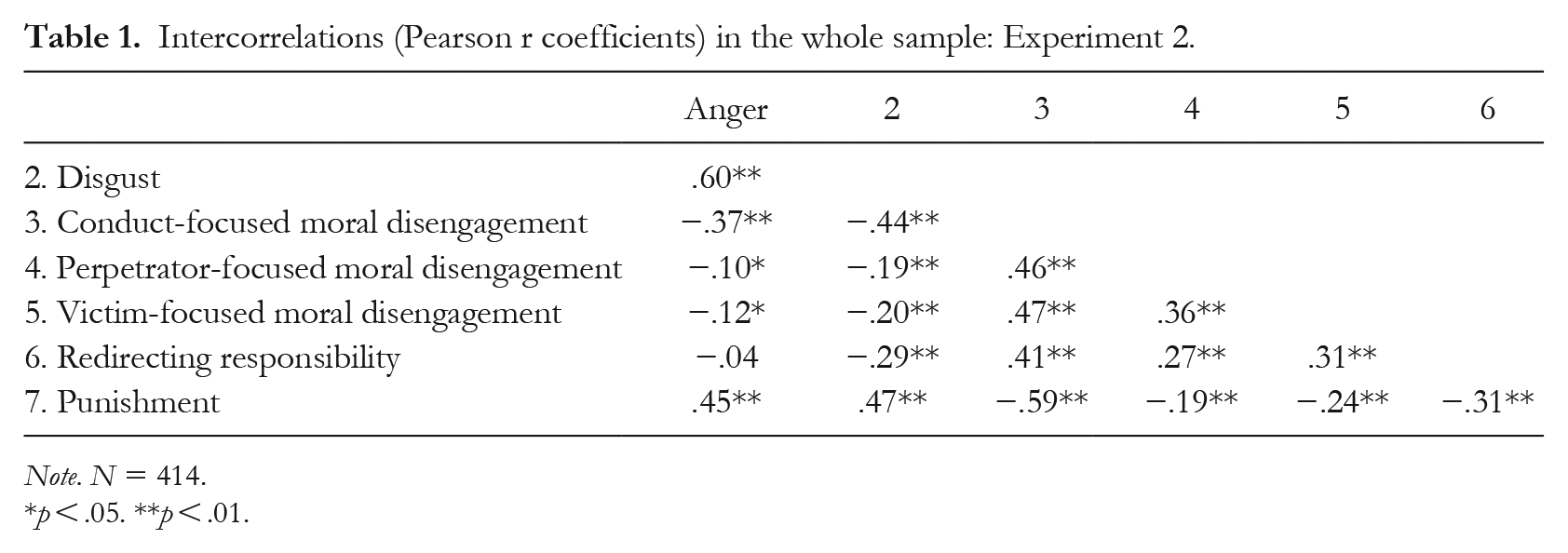
Note. N = 414.
p < .05. **p < .01.
Emotional reactions
To test whether participants’ anger and disgust were influenced by the perpetrator’s power and by moral violation type, we conducted a repeated measures ANOVA on anger and disgust indices with a 2 (violation type: autonomy vs. divinity) x 2 (perpetrator’s power: low vs. high) multifactorial design, using the mean nontarget emotions as a covariate (see Figure 2).
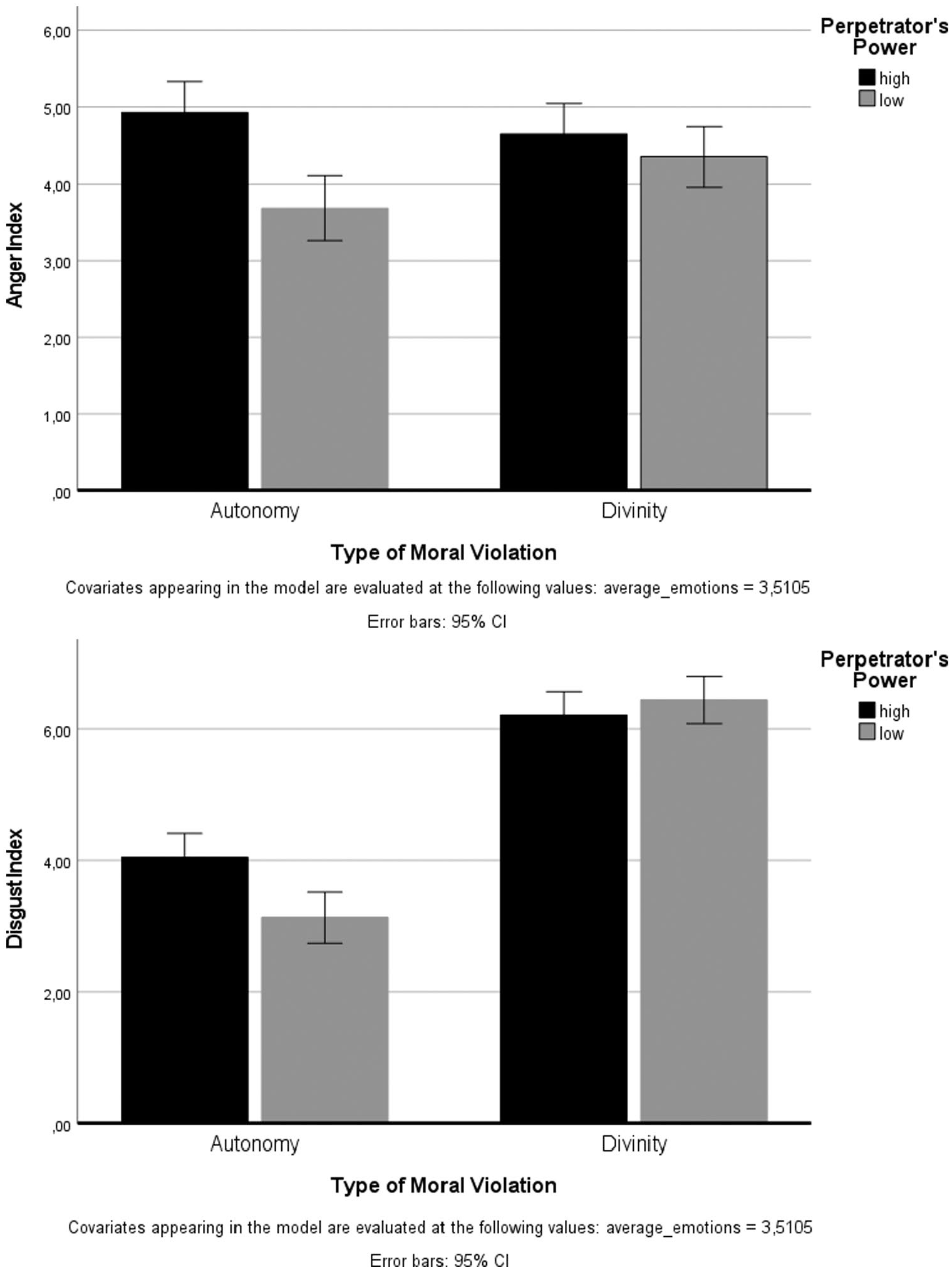
Anger index and disgust index as a function of ethical violation type (autonomy vs. divinity) and perpetrator’s power (powerful vs. less powerful): Experiment 2.
As in Experiment 1, the covariate was significant, indicating individual differences in emotion ratings across emotions, F(1, 409) = 67.05, p < .001, ηp2 = .14. Also as in Experiment 1, ratings were higher for the disgust index (M = 4.96, SE = 0.09) than for the anger index (M = 4.40, SE = 0.10); emotion rated, F(1, 409) = 53.41, p < .001, ηp2 = .12. We found a main effect for power level such that the average index was higher in the high-power condition (M = 4.96) than in the low-power condition (M = 4.40, SEs = 0.13), F(1, 409) = 9.42, p = .002, ηp2 = .02. As expected, there was a significant interaction between violation type and power, F(1, 409) = 8.54, p = .004, ηp2 = .02. Accordingly, a powerful perpetrator’s autonomy violation elicited more anger and disgust (M = 4.49, SE = 0.18) than a less powerful perpetrator’s autonomy violation (M = 3.41, SE = 0.19), showing an underdog effect, F(1, 409) = 17.22, p < .001, ηp2 = .04; whereas for the divinity condition, there were no differences in emotion rated based on perpetrator’s power (high power: M = 5.43, SE = 0.18; low power: M = 5.40, SE = 0.18), F(1, 409) = 0.02, p = .896, ηp2 = .00. This differential emotion result by violation type is consistent with H3 and H4.
There was a two-way interaction between emotion rated and violation type, F(1, 409) = 263.83, p < .001, ηp2 = .392, partly indicating the expected difference in emotional reaction by violation type. Participants were more disgusted about the divinity violation (M = 6.33, SE = 0.13) than about the autonomy violation (M = 3.59, SE = 0.14), F(1, 409) = 208.14, p < .001, ηp2 = .337, but the anger index was equivalent across violation types (autonomy violation: M = 4.31, SE = 0.15; divinity violation: M = 4.50, SE = 0.14), F(1, 409) = 0.90, p = .345, ηp2 = .00. There was also a two-way interaction between emotion index and power level, F(1, 409) = 7.79, p = .006, ηp2 = .02. Participants were angrier about the powerful perpetrator’s moral violation (M = 4.79, SE = 0.14) than about the less powerful perpetrator’s moral violation (M = 4.02, SE = 0.15), F(1, 409) = 14.14, p < .001, ηp2 = .03, but the disgust index was equivalent across power levels (high power: M = 5.13, SE = 0.15; low power: M = 4.79, SE = 0.14), F(1, 409) = 3.24, p = .073, ηp2 = .01. The three-way interaction between violation type, power, and emotion rated was not significant, F(1, 409) = 0.38, p = .535, ηp2 = .00.
Cognitive reactions
To investigate whether participants’ cognitive reactions were influenced by perpetrator’s power and by moral violation type, we conducted a 2 (violation type: autonomy vs. divinity) x 2 (perpetrator’s power: low vs. high) MANOVA on four different types of moral disengagement (i.e., conduct-focused, perpetrator-focused, victim-focused, and redirecting responsibility). Main effects of violation type and power were significant, F(4, 407) = 26.60, p < .001, Wilks’s Λ = .79, ηp2 = .21 and F(4, 407) = 20.03, p < .001, Wilks’s Λ = .84, ηp2 = .16, respectively. Most importantly, and as expected, a Violation Type x Power interaction effect was also significant, F(4, 407) = 3.68, p = .006, Wilks’s Λ = .96, ηp2 = .04. To examine the multivariate effects more carefully, results of the univariate analyses were examined for each moral disengagement strategy separately (see Figure 3).
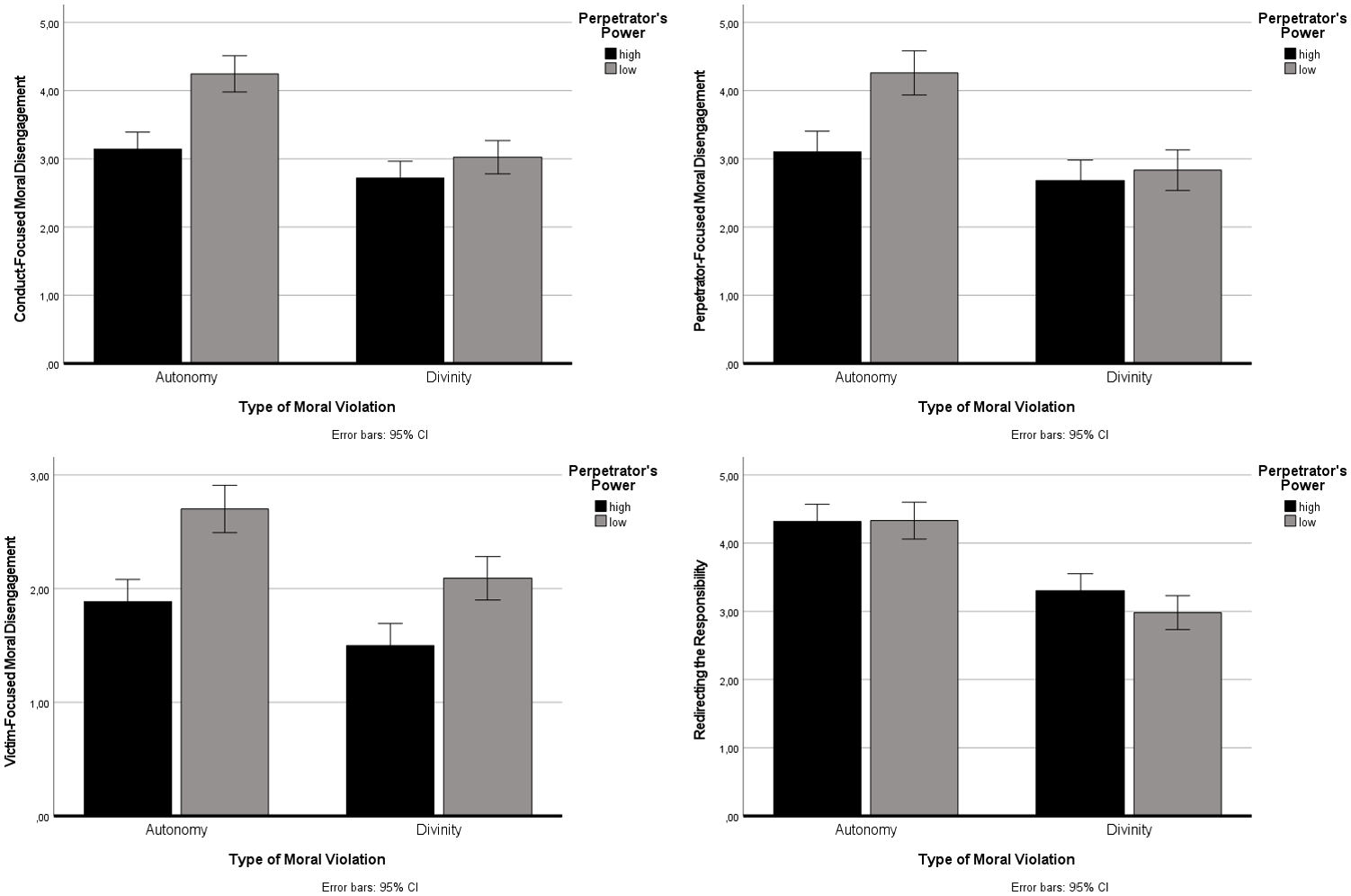
Moral disengagement mechanisms (conduct-focused, perpetrator-focused, victim-focused, and redirecting responsibility) as a function of ethical violation type (autonomy vs. divinity) and perpetrator’s power (powerful vs. less powerful): Experiment 2.
Conduct-focused moral disengagement
The main effect of violation type was significant, suggesting that participants used more conduct-focused moral disengagement strategies in the autonomy violation (M = 3.70, SE = 0.09) than in the divinity violation condition (M = 2.87, SE = 0.09), F(1, 410) = 41.69, p < .001, ηp2 = .09. The main effect of power was also significant, indicating that participants used more conduct-focused moral disengagement strategies when the perpetrator was less powerful (M = 3.64, SE = 0.09) than when the perpetrator was more powerful (M = 2.93, SD = 0.09), F(1, 410) = 30.41, p < .001, ηp2 = .07. The expected interaction between perpetrator’s power and violation type was significant, F(1, 410) = 9.76, p = .002, ηp2 = .02. Simple effects tests revealed that participants used greater conduct-focused moral disengagement when the autonomy violation was perpetrated by the less powerful (M = 4.25, SE = 0.14) than by the powerful group (M = 3.14, SE = 0.13), F(1, 410) = 35.68, p < .001, ηp2 = .08, showing an underdog effect, whereas there was no difference in conduct-focused moral disengagement between perpetrator’s power conditions when violation type was divinity, F(1, 410) = 2.99, p = .084, ηp2 = .01, showing no underdog effect.
Perpetrator-focused moral disengagement
Both the main effect of violation type (autonomy: M = 3.68, SE = 0.11; divinity: M = 2.76, SE = 0.11), F(1, 410) = 35.21, p < .001, ηp2 = .08, and of perpetrator’s power (high power: M = 2.89, SE = 0.11; low power: M = 3.55, SE = 0.11), F(1, 410) = 17.69, p < .001, ηp2 = .04, were significant. As expected, the interaction of power and violation type was also significant, F(1, 410) = 10.41, p = .001, ηp2 = .03. Simple effects analyses revealed that participants used greater perpetrator-focused moral disengagement when the autonomy violation was perpetrated by the less powerful nation (M = 4.26, SE = 0.16), compared to when the autonomy violation was perpetrated by the more powerful nation (M = 3.10, SE = 0.15), F(1, 410) = 26.41, p < .001, ηp2 = .06, indicating an underdog effect. In contrast, simple effects in the divinity condition showed no differences in perpetrator-focused moral disengagement based on perpetrator’s power (high power: M = 2.68, SE = 0.15; low power: M = 2.84, SE = 0.15), F(1, 410) = 0.50, p = .478, ηp2 = .00, showing no underdog effect.
Victim-focused moral disengagement
The main effect of violation type was significant, suggesting that participants used more victim-focused moral disengagement strategies in the autonomy violation (M = 2.29, SE = 0.07) than in the divinity violation condition (M = 1.80, SE = 0.07), F(1, 410) = 24.73, p < .001, ηp2 = .06. The main effect of power was also significant, indicating that participants used more victim-focused moral disengagement strategies when the perpetrator was less powerful (M = 2.40, SE = 0.07) than when the perpetrator was more powerful (M = 1.69, SE = 0.07), F(1, 410) = 49.27, p < .001, ηp2 = .11, another underdog effect. However, there was no significant effect of the two-way interaction between perpetrator’s power and violation type, F(1, 410) = 1.23, p = .267, ηp2 = .00.
Redirecting responsibility
The main effect of violation type was significant, F(1, 410) = 83.26, p < .001, ηp2 = .17, with participants engaging more in the redirecting responsibility strategy in the autonomy violation (M = 4.33, SE = 0.09) than in the divinity violation condition (M = 3.14, SE = 0.09). However, the main effect of perpetrator’s power was not significant, F(1, 410) = 1.44, p = .23, ηp2 = .00, nor was the interaction between perpetrator’s power and violation type, F(1, 410) = 1.65, p = .200, ηp2 = .00.
Punishment
To investigate whether participants’ punishment rates were influenced by perpetrator’s power and by moral violation type, we conducted a separate ANOVA. The main effects of violation type and power were significant, F(1, 410) = 18.57, p < .001, ηp2 = .04 and F(1, 410) = 20.03, p = .03, ηp2 = .012, respectively. As expected, a Violation Type x Power interaction effect was also significant, F(1, 410) = 17.21, p < .001, ηp2 = .04. Simple effects analyses revealed that participants reported more severe punishments when the autonomy violation was perpetrated by the powerful nation (M = 5.77, SE = 0.18), compared with when the autonomy violation was perpetrated by the less powerful nation (M = 4.59, SE = 0.20), F(1, 410) = 19.33, p < .001, ηp2 = .04, whereas for the divinity condition, there were no differences in punishment based on perpetrator’s power (high power: M = 5.80, SE = 0.18; low power: M = 6.16, SE = 0.18), F(1, 410) = 1.97, p = .162, ηp2 = .00. The only difference for any of the reported results when we covaried sacredness was that the main effect of power on punishment was not significant, F(1, 409) = 3.83, p = .051, ηp2 = .01.
Moral violation types, emotions, and moral disengagement
To investigate the mediating roles of anger and disgust in the relationships between our experimental manipulations and moral disengagement mechanisms, we also conducted mediation analyses using bootstrapping with 2,000 resamples in AMOS Version 26 (Arbuckle, 2019). While moral violation type (1 = autonomy, 2 = divinity) and perpetrator’s power (1 = high, 2 = low) were entered in the model as dummy-coded exogenous variables, and anger and disgust as mediators in all analyses, the different moral disengagement mechanisms were entered as outcome variables in separate analyses to estimate the specific indirect effects.
The path model examining the mediating role of emotions is illustrated in Figure 4. The paths from moral violation type to anger and punishment, and from perpetrator’s power to punishment were not significant; therefore, we removed them from the model. The model, χ2(4) = 5.46, p = .243, showed a very good fit, RMSEA = .03, SRMR = .02, TLI = 0.99, CFI = 1. The indirect effect of moral violation type on conduct-focused moral disengagement mediated by disgust was significant, β = −.11, p = .009, 95% CI [−0.58, −0.07]. Similarly, the indirect effects of perpetrator’s power on conduct-focused moral disengagement mediated by anger, β = .05, p = .001, 95% CI [0.06, 0.24], and disgust, β = .02, p = .009, 95% CI [0.02, 0.13], were also significant. In addition, the relationships between anger and punishment, β = .10, p = .001, 95% CI [0.04, 0.13], and between disgust and punishment, β = .09, p = .008, 95% CI [0.03, 0.13], were also mediated by conduct-focused moral disengagement. The path models conducted with other moral disengagement mechanisms showed no significant indirect effects of anger and disgust on the relationship between experimental manipulations and moral disengagement. Thus, Experiment 2 shows another kind of difference in emotional reactions by violation type; here, in relation to the type of moral disengagement, the type that focuses on the conduct of the perpetrator.
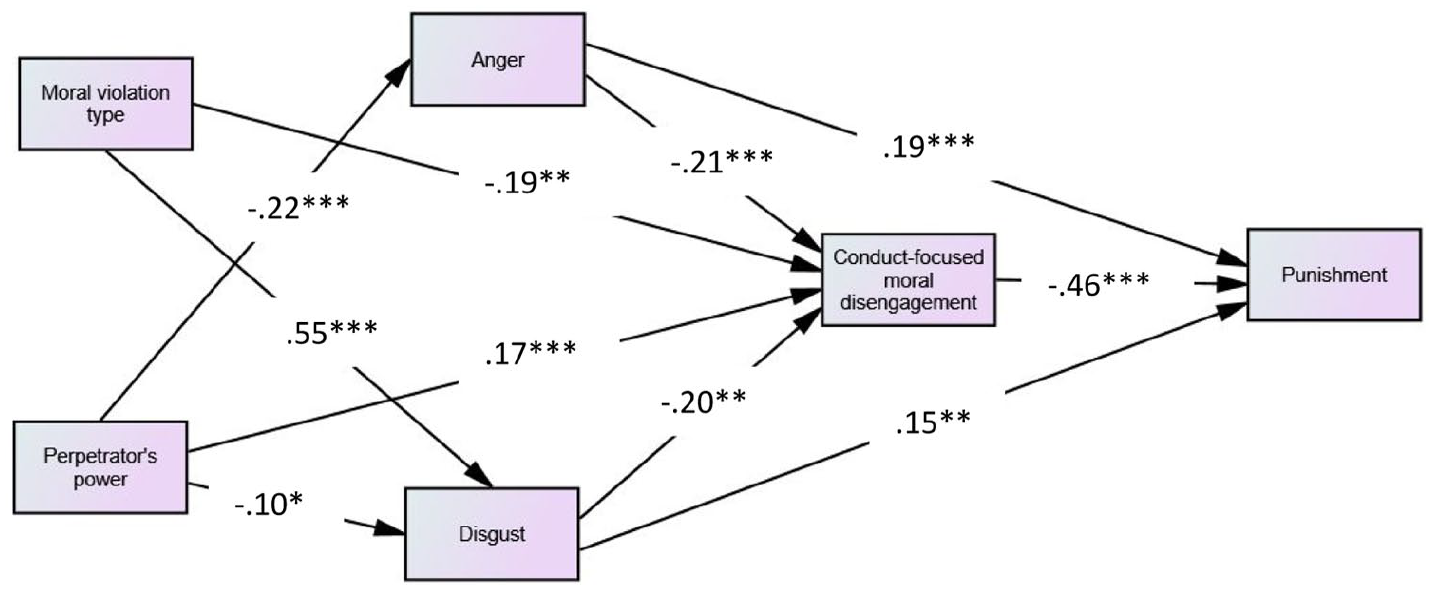
Path model of conduct-focused moral disengagement.
It should be noted that the path model presented here is compatible with only one of several models possible. The predictors of the model are experimental manipulations, but the model is not sufficient to argue a causal relationship without manipulating the mediators. Readers should keep in mind that the formation of the current model could be meaningful only by assuming a theoretical ordering of stimulus, emotion, reasoning, and behavioral intention.
Discussion
These results extend previous underdog effect studies (Glasford & Pratto, 2014; Vandello et al., 2011) by showing that an autonomy violation by a high-power group’s member (top dog) makes bystanders feel angrier and more disgusted than they would be in relation to a moral violation committed by a less powerful group’s member (underdog). Participants also tended to punish the autonomy violation of a top dog more, and tended to use moral disengagement mechanisms to a lower degree in order to cope with a moral violation by an underdog (except for redirecting responsibility). Note, though, that a divinity violation of a top dog did not make bystanders feel more disgusted than a divinity violation by an underdog. Likewise, the underdog effect was not revealed in punishment of a divinity violation and in conduct-focused and perpetrator-focused moral disengagement mechanisms for the divinity violation.
People tend to support underdogs because inequality between powerful and less powerful groups evokes a desire for fairness and justice (Vandello et al., 2007). However, consistent with moral dumbfounding studies (e.g., Haidt, 2001), where bystanders confront an underdog’s divinity violation, people tend to respond intuitively without reasoning (more likely, with a disgust response), and they are unable to explain the wrongness of the conduct in terms of justice (by lacking the information that can be used as a moral disengagement strategy); finding reasonable, legitimate, and justice-based explanations for divinity violations is highly challenging (e.g., Wright & Baril, 2011). In line with these studies, our results showed that considering justice-based explanations for autonomy violations seems relatively easier than for divinity violations. These results generally confirmed our hypotheses (H3 and H4) that the underdog effect is diminished in cases of divinity violations.
An alternative explanation for these findings may be possible within the framework of moral character (see Giner-Sorolla & Chapman, 2017). It is plausible that the anticipation of more impactful consequences arising from the actions of a powerful group may have elicited greater anger among third parties. However, the perceived moral character of the powerful group may not have been significantly affected by its perceived strength, thus potentially not leading to a change in third-party disgust.
Our findings also have theoretical implications for moral disengagement literature. Firstly, these results are consistent with the idea that Bandura’s methods of moral disengagement rely largely on thinking processes, and not (or not as much) on fundamental emotions. In our experiment, participants used more moral disengagement mechanisms for autonomy violations, which are likely to trigger rational processes in comparison to divinity violations, which are more likely to evoke associative processes (Garvey & Ford, 2014; Napier & Luguri, 2013; Pennycook et al., 2014). In a way, our results further confirmed this idea by showing anger as a stronger mediator in the relationship between perpetrators’ power differences and moral disengagement than it was for disgust, which is less likely to be modified by reasoning than anger (Giner-Sorolla et al., 2018). Secondly, the present results confirmed moral disengagement’s basic function of decreasing the probability of punishing the perpetrator of a violation (Bandura, 1999). Further, results showed moral disengagement as a mediator in the relationship between negative emotional responses to a moral violation and behavioral intention to punish the perpetrator. This implied that the lack of uncomfortable emotions usually caused by nonstandard behavior may increase the probability of using these mechanisms, thus preventing the perpetrator from being punished. And thirdly, our results revealed a distinction between different moral disengagement mechanisms. Conduct-focused moral disengagement was affected more than other mechanisms by the lack of anger and disgust emotions. This result is consistent with previous research (Yalçın, 2014). Although further research is required, the reason for this distinction may be explained, up to a point, by considering the following. Both anger and disgust are known to be associated with a sense of certainty, which provides an internal cue that one is already correct and accurate and can therefore rely on their judgment confidently, thus making further cognitive processing unnecessary (Tiedens & Linton, 2001). This suppressive effect of anger and disgust would affect different moral disengagement mechanisms distinctly because some of them (i.e., conduct-focused mechanisms: moral justification, advantageous comparison, and euphemistic labelling) are more complex and therefore may require more cognitive effort than others. As Bandura (2016, p. 48) states “[Conduct-focused mechanisms] take a lot of self-persuasive machination.”
We conjecture that the reason why perpetrator power did not affect the use of the redirecting responsibility strategy is a floor effect, possibly because the thought of a responsible powerful agent from whom perpetrators receive orders may have seemed to contradict perpetrators’ underdog status (where they would be less powerful). Overall, however, the results of the two experiments were consistent with what one would expect if autonomy and divinity moral violations result in divergent processing.
General Discussion
The current work examined bystanders’ anger and disgust responses to autonomy and divinity violations in intergroup conflict settings. Our results both replicate and extend previous findings concerning moral violations. Similar to results from previous studies (Gutierrez & Giner-Sorolla, 2007; Horberg et al., 2009; Moll et al., 2005; Rozin et al., 1999), our two experiments confirmed the assumption that the primary emotional response to a divinity violation is disgust. However, only Experiment 1 confirmed the assumption that the primary emotional response to an autonomy violation is anger. Both experiments provided support for the propositions that anger responses elicited by autonomy violations would be influenced by appraisals, and that disgust responses elicited by divinity violations would not be influenced by appraisals (Giner-Sorolla et al., 2018; Russell & Giner-Sorolla, 2013).
Further, our results extend previous studies by showing the divinity–autonomy differentiation in a new way. The results of Experiments 1 and 2 showed that emotional and cognitive responses to divinity violations, when compared with the same reactions to autonomy violations, are less likely to be influenced by harmfulness of actions and perpetrator power appraisals. Further, the current results extend prior competitive victimhood studies (Belavadi & Hogg, 2018; Noor et al., 2012) by suggesting three reasons why divinity violations may be more favorable for victimhood status than autonomy violations in the eyes of bystanders in real-world intergroup conflicts. These reasons are (a) being perceived as a victim in a relatively easy way, (b) not looking too weak because of the damage suffered, and (c) diminishing likely favorable effects of the perpetrator’s underdog status. Thus, the present findings improve our understanding of the function of accusing an opponent of immoral actions in intergroup conflicts.
Even if all sides behave unethically during conflict, the parties commonly exaggerate or fabricate immoral actions of their opponents to preserve their “superior” moral image, to gain victim status, and to establish the legitimacy of the harm they have inflicted or will inflict on their opponents (Bar-Tal, 2007; Wohl & Branscombe, 2008). At the same time, they need to be effective in retaining support from their ingroup members and in gaining support from third parties to the conflict. However, rational arguments and simple, objective facts could undermine the persuasiveness of the accusations (Chaiken, 1980; Wood et al., 1985); the current findings suggest that it is harder for people to modify their perceptions of divinity violations than of autonomy violations; thus, moral disengagement processes cannot help third parties to psychologically exonerate moral violators in divinity violations. That may be the reason why conflicting parties tend to highlight their opponents’ divinity violations. One could even claim that successful persuaders may be strategic in tailoring the kind of moral violation of which they accuse their opponents.
Accusing the opponent of divinity violations would have two beneficial functions for the accuser group in an intergroup conflict. Firstly, when one of the groups in a conflict situation accuses the other of committing a moral violation against them, the accuser group gains victimhood status, which increases the possibility of getting support from those not directly involved in the incident (Belavadi & Hogg, 2018; Noor et al., 2012; Simon & Klandermans, 2001). When accusing the opposing group of a divinity violation rather than of an autonomy violation, the accuser group may not need to present itself as excessively harmed to gain victimhood status because divinity violations, unlike autonomy violations, can grant them that status regardless of the physical damage suffered (Experiment 1). This factor would make accusations of divinity violations preferable to accuser groups because acknowledging having suffered excessive harm would affect their group’s perceived power (McGraw, 2003), would damage their group’s self-esteem (Crocker et al., 1994), would evoke collective guilt when their group has a role as both perpetrator and victim of its own harmful actions (Sullivan et al., 2013), and would lead group members to feel devalued, damaged, and subordinated, thus possibly threatening the group’s integrity (Pratto & Glasford, 2008). Hence, in an intergroup conflict, especially powerful parties will want to preserve their powerful image while claiming victimhood status at the same time. Our research shows this will be more effective when they accuse their opponent of divinity violations than of autonomy violations.
Secondly, if powerful groups construct their victim status in the context of divinity violations, they diminish the underdog effect (Experiment 2), thus preventing the underdog from benefitting from third-party support. Although previous studies showed that level of inflicted harm would impair the underdog effect (Glasford & Pratto, 2014; Vandello et al., 2011), the present experiments further reveal that divinity violations constitute another victimization frame.
Powerless groups who are in conflict with powerful ones often emphasize the power of their opponents, contributing to the underdog effect in the eyes of third parties. Powerful groups, on the other hand, cannot credibly deny their power, but they can try to prevent underdog sympathy towards their opponents by evoking distancing emotions through portraying the actions of the powerless party as violating divinity ethics, such as being against human nature and threats to purity. As shown in Experiment 2 and in prior studies (e.g., Haidt, 2001; Horberg et al., 2009), invoking divinity ethics rather than autonomy ethics prevents bystanders from explaining the low-power group’s actions as rational approaches to their situation, the kind of empathy known as perspective-taking. When a relatively low-power group is said to violate divinity ethics, their lower power fails to evoke a sense of injustice committed against them.
The limitations of the present research must be addressed. First, while we employed MTurk samples, which provide greater diversity compared to traditional social psychology samples (Paolacci & Chandler, 2014), they cannot be regarded as representative of the general population. Additionally, while our samples had ethnic diversity, the majority of participants were White and exclusively U.S. residents. Hence, all participants were profoundly influenced by Western culture. Including non-Western populations in future studies would be highly beneficial to evaluate the robustness of the present findings. Second, the scenarios we employed were limited in number, depicting only a few specific events; however, moral violations can manifest in numerous diverse ways, and unforeseen contextual factors within different scenarios have the potential to yield varying outcomes. Thus, the current results should be replicated using other depictions of moral violations. Second, we only used two appraisals (i.e., harmfulness of the acts and perpetrator’s power) to demonstrate the claim that responses to divinity violations are not affected by appraisals. Thus, future studies with different appraisals should be conducted to confirm this claim.
On the whole, the present research significantly expands the concept of moral disengagement as a frequent rational strategy that allows bystanders to minimize their own distress at learning how people have harmed other people (Bandura, 1999). Our results build on prior studies to show that accusing another group, especially a low-power one, of violating divinity ethics is enough to produce disgust and anger, and that these emotional reactions place the victims outside the scope of moral concern (Opotow, 1990). Given that all parties to violent conflict usually engage in, and can be accused of engaging in, violations of purportedly universal divinity ethics, each party’s claims of victimhood by an immoral opponent may contribute to the perpetuation of intergroup violence (Noor et al., 2012).
Our findings have broader theoretical and practical implications. Firstly, our second study may have broader implications for understanding third-party responses to intergroup discrimination. Accusing members of low status groups of divinity violations is common in the history of intergroup relations. Examples are cases in which women who do not conform to traditional roles, such as those not adopting reproductive roles (Kligman, 1995), those in homosexual relationships (Pasha-Robinson, 2017), and those who oppose racial discrimination (H. Young, 2005), have been accused of corrupting sacred rules. While religious norms—or their more secular version, the so-called “natural order”—construe the demands for intergroup equality as impurity, they may also rule out perceived injustice by third parties regarding disadvantaged groups via their underdog status. Our results emphasizing emotions may also open a discussion on the reduction of intergroup discrimination. When one group accuses another of a divinity violation, rational explanations, such as emphasizing that the accused group is in a relative disadvantageous position or highlighting the harm this group has suffered, may have a minor effect on the feelings and thoughts towards the accused person or group. For example, emphasizing that women have been historically oppressed or mentioning examples of physical abuse against them may not have a major impact on people that frame women’s actions within the moral domain of divinity violations. Instead, attempts to eliminate negative emotions, especially disgust, may contribute to reduce negative attitudes towards the actions of groups that have historically been accused of divinity violations. In this sense, our results suggest that pointing out the actions that would evoke disgust and finding ways to reduce this emotion would be a more efficient way to reduce discrimination than presenting rational explanations of why discrimination is wrong. Future studies in this area are needed to better understand this connection.
Secondly, the present results have implications for the investigation of competitive victimhood, a belief that a group of people holds of having suffered more than their opponents (Noor et al., 2008), which usually occurs as a fight over moral social identity between two opponents in intractable conflicts (Bar-Tal et al., 2009). Noor et al. (2012) define five dimensions of suffering that conflicting parties highlight to claim themselves as the “true” victim of the conflict. These are physical, material, cultural, and psychological damage, and legitimacy of their respective suffering. In their paper, they asked whether parties could strategically emphasize different dimensions of their victimhood, and postulated that more powerful groups may be more willing to highlight types of suffering that are more subjective in nature (such as injustice of the harm suffered) rather than objective ones (such as exact number of deaths caused by an outgroup attack), but the authors did not test this postulation and recommended its examination in future studies. We think our findings may provide an opening for this discussion as they showed that victimhood claims defined on the basis of two different types of ethics (divinity ethics, which is more subjective, and autonomy ethics, which is more objective) could affect third parties’ emotional and cognitive responses distinctly. Further, constructing their victimhood status on divinity ethics (vs. autonomy ethics) is strategically more beneficial for conflicting parties, especially for more powerful ones because being perceived as the victim of a divinity violation (vs. an autonomy violation) could be more persuasive, relatively easier, and could weaken the underdog effect, as demonstrated in the current study. Thus, the immorality evoked by an opponent that, for example, uses civilians as a shield, attacks holy places and things, and deceives children to become fighters, may be more effective for the accusing group in gaining the support of third parties. Further, this kind of divine victimhood (if we may call it such), which is based on cultural and religious suffering, would be a stable component of collective victimhood, one of the factors that feed the continuation of intractable conflicts (Bar-Tal et al., 2009). Future studies are needed to confirm these claims.
Parties could, to some extent, avoid such accusations and prevent divine victimhood from becoming a part of their opponents’ collective identity by showing respect to their opponents’ divine rules, rituals, and holy places. In some cases, however, it can be very difficult for a group to show the respect expected by an outgroup’s divine rules without sacrificing its own moral rules. Discussions around freedom of speech versus respect for religious beliefs could be considered as an example. The following interpretations of the current results may contribute to attempts to decrease the disruptive consequences of this dilemma. First, minimizing the disgust evoked by someone or by an action that is portrayed as divinely immoral may at least be helpful in reducing the intentions to punish the person or group in question or to take revenge for the divinity violation. Second, pointing out the intersections where autonomy-related concepts (such as freedom of thought and the right to life) show parallelism or are embedded in divinity-related concepts (such as spirituality that celebrates uniqueness and diversity) may also provide an escape from the destructive emotionalization of divinity violations. Third, cognitive restructuring of a divinity violation may weaken the disruptive consequences of the disgust feelings evoked by it. Our second study, which found that the relationship between disgust and punishment was mediated by conduct-focused moral disengagement, supports this argument when considered together with Bandura’s (2016) conceptualization of moral disengagement as involving the cognitive restructuring and bending of moral rules.
Although further research in this area is needed, the present study suggests that divinity violations may produce such affective, disgust-based responses that moral reasoning and justifications when evaluating perpetrators in intergroup conflict are hampered. By pointing out the necessity of reducing intergroup disgust’s role in escalating intergroup conflicts, the present study aims to promote mutual respect and constructive cognitive restructuring.
