




Abstract
Responses to norm violators are poorly understood. On one hand, norm violators are perceived as powerful, which may help them to get ahead. On the other hand, norm violators evoke moral outrage, which may frustrate their upward social mobility. We addressed this paradox by considering the role of culture. Collectivistic cultures value group harmony and tight cultures value social order. We therefore hypothesized that collectivism and tightness moderate reactions to norm violators. We presented 2,369 participants in 19 countries with a norm violation or a norm adherence scenario. In individualistic cultures, norm violators were considered more powerful than norm abiders and evoked less moral outrage, whereas in collectivistic cultures, norm violators were considered less powerful and evoked more moral outrage. Moreover, respondents in tighter cultures expressed a stronger preference for norm followers as leaders. Cultural values thus influence responses to norm violators, which may have downstream consequences for violators’ hierarchical positions.
Social norms—implicit or explicit rules that constrain behavior without the force of laws—are important guiding principles in organizations and societies at large (Cialdini & Trost, 1998; Van Kleef, Wanders, Stamkou, & Homan, 2015). Yet, even though following social norms is highly adaptive, norm violations are omnipresent. How do observers respond to norm violators? On one hand, norm violators appear powerful in the eyes of observers because of their expressed autonomy and free will (Van Kleef, Homan, Finkenauer, Gündemir, & Stamkou, 2011), which could have favorable downstream consequences for their power positions (Anderson & Kilduff, 2009). On the other hand, norm violations may evoke moral outrage in observers (Kam & Bond, 2009), which could have unfavorable downstream consequences for norm violators’ power positions (Ohbuchi et al., 2004). We addressed this paradox by considering the cultural context within which the norm violation occurs, focusing on the dimensions of individualism–collectivism and tightness–looseness. We develop hypotheses about the ways in which collectivism and tightness shape cognitive, affective, and behavioral responses to norm violators, which we tested in a large-scale cross-cultural study involving 19 countries from five continents.
Reactions to Norm Violations
Norm violations can bring about positive outcomes for the transgressor. According to evolutionary theorizing on costly signaling (Zahavi & Zahavi, 1997), behaviors that are potentially risky or costly signal an underlying quality. Norm violations signal that the actor experiences the leeway to act according to their own volition in spite of situational constraints and potential repercussions (Stamkou & Van Kleef, 2014). Indeed, as costly signals, norm violations fuel perceptions of power in observers. Studies conducted in the Netherlands showed that individuals who violated prevailing norms were perceived as more powerful than individuals who complied with the norms (Van Kleef et al., 2011). Studies conducted in Italy and the United States similarly showed that individuals who entered a boutique wearing gym clothes rather than appropriate attire or who attended a black tie event wearing a red tie were ascribed higher status (Bellezza, Gino, & Keinan, 2014). Moreover, research in marketing and psychology showed that norm violators whose behavior benefited others were more likely to be given a leadership role (Popa, Phillips, & Robertson, 2014; Van Kleef, Homan, Finkenauer, Blaker, & Heerdink, 2012).
However, psychological research has also found that norm violations evoke moral outrage, which is evident in feelings of anger and blame in observers (Helweg-Larsen & LoMonaco, 2008; Kam & Bond, 2009; Ohbuchi et al., 2004). Similarly, ethological research in nonhuman primates has demonstrated that animals punish conspecifics that violate established rules, for instance, through physical attacks and denial of access to important resources (Boyd & Richerson, 1992). Conversely, individuals who follow group norms are endorsed by the group because they are considered more committed to the group’s ideals (Anderson & Kilduff, 2009; Feldman, 1984). Furthermore, organizational field studies revealed that leaders whose behavior was inconsistent with espoused values were more likely to lose their status (Yukl, 2010).
How do these cognitive and affective processes translate into people’s behavioral tendencies to support a violator as leader? The two perspectives presented above inform inconsistent predictions regarding the relative potential of norm violators to be supported in leadership roles. The first perspective suggests that norm violators are more likely to be supported as leaders because they come across as powerful, whereas the second perspective suggests that norm violators are less likely to be supported as leaders because they elicit moral outrage. To address this puzzle, we investigated how culture moderates observers’ responses to norm violators in terms of power perceptions (cognitive response), moral outrage (affective response), and leader support (behavioral tendency).
The Cultural Context of Norm Violations
Norms do not exist in isolation from the social world—they are defined by, and embedded in, a social context that involves the shared expectations of others. Therefore, responses to norm violations may depend on a society’s perceived cultural norms, which influence how people are perceived to behave in a given context (Goode, 2002; Paluck & Shepherd, 2012). Research in pragmatics, for instance, has established that the evaluation of individuals who defy linguistic conventions (e.g., politeness principles) largely depends on the cultural context (Spencer-Oatey & Jiang, 2003). We propose that reactions to norm violations vary across cultures as a function of the importance that is attached to group obligations (i.e., cultural collectivism) and social order (i.e., cultural tightness). Importantly, we conceptualize these cultural dimensions as values and beliefs that are perceived to be widespread in one’s culture rather than as people’s personal values and beliefs (see Chiu, Gelfand, Yamagishi, Shteynberg, & Wan, 2010, and Zou et al., 2009, for a comprehensive account of intersubjective culture). Our conceptualization of culture reflects individuals’ understanding of behaviors that are typical of most members of the group, thereby capturing shared collective perceptions or descriptive norms of a given group (Shteynberg, Gelfand, & Kim, 2009).
A first cultural dimension that is relevant in relation to norm-violating behavior is individualism–collectivism. In collectivistic cultures, the cultural ideal is to meet the duties and obligations of one’s social role to maintain group harmony (Miller, Bersoff, & Harwood, 1990). In individualistic societies, on the contrary, the cultural ideal is to express one’s uniqueness and to be a free agent that acts according to one’s own volition (Kim & Markus, 1999; Markus & Kitayama, 1991). Accordingly, research showed that collectivist cultures value adherence to obligations, compromise, and maintenance of harmony, whereas individualistic cultures value self-actualization, privacy, and freedom (Triandis, McCusker, & Hui, 1990; Triandis, Bontempo, Villareal, Asai, & Lucca, 1988). Violating norms could jeopardize group harmony (Kiesler & Kiesler, 1970). Norm violators thus defy their duties and obligations as group members, and this may reduce their status in collectivistic societies. On the contrary, the freewheeling behavior of norm violators adheres to the individualistic cultural ideal of autonomy and as such may enhance their status in individualistic societies. Indeed, empirical evidence shows a broader range of acceptable social behavior and non-normative characteristics in individualistic than collectivistic cultural contexts (Kinias, Kim, Hafenbrack, & Lee, 2014). Similarly, normative beliefs were more important for people’s judgments and behavior in collectivistic than individualistic societies (Cialdini, Wosinska, Barrett, Butner, & Gornik-Durose, 1999; Enker, 1987; Suh, Diener, Oishi, & Triandis, 1998).
A second cultural dimension that is pertinent to norm violation is tightness–looseness. The defining characteristic of this dimension is the importance that is assigned to maintaining social order. Tightness is associated with lower tolerance of deviant behavior, which restricts the range of behavior that is deemed appropriate across situations. By contrast, looseness is associated with higher tolerance of deviant behavior, affording a wider range of permissible behavior across everyday situations (Pelto, 1968; Triandis, 1989). Compared with individuals in loose cultures, individuals in tight cultures have psychological qualities that promote social order, such as higher need for structure and self-monitoring ability (Gelfand et al., 2011). As norm violations break with a preexisting structure, norm violations may be considered a threat to the social order in tight cultures (Roos, Gelfand, Nau, Zuckerman, & Lun, 2015), which is particularly problematic given these contexts tend to have high ecological and human-made threats (Gelfand et al., 2011). Neuroscience data indeed show that people in tight cultures have stronger neurobiological reactions to norm violations than people in loose cultures (Mu, Kitayama, Han, & Gelfand, 2015). In a complementary vein, recent research showed that loose societies provide fertile ground for the emergence of leaders who challenge the status quo (Aktas, Gelfand, & Hanges, 2016; Mittal, 2015).
It is worth noting that collectivism and tightness are related but distinct constructs, both theoretically and empirically (Carpenter, 2000; Gelfand, Nishii, & Raver, 2006). Collectivism is concerned with the emphasis placed by societies on fulfilling duties and obligations to one’s group versus being independently oriented; it does not refer to the importance of social order, which is the core element of tightness. Furthermore, the two cultural syndromes have some unique precursors, such as common fate and need for mutual effort for collectivism, and high societal threat and isolation from external influences for tightness (Triandis, 1989). It is thus possible that a nation is collectivistic and loose or individualistic and tight, although collectivism and tightness covary moderately (Gelfand et al., 2011). Given the distinct profiles of collectivism and tightness, we treat them as theoretically independent cultural dimensions to illuminate their unique contributions in shaping responses to norm violations.
The Current Research: Model and Hypotheses
We investigated how the cultural dimensions of collectivism and tightness influence responses to norm violators. Based on the theorizing above, we propose a moderated dual-pathway model. Our model posits that, compared with norm-following behavior, norm-violating behavior may increase observers’ relative tendency to support violators as leaders by inspiring perceptions of power (positive pathway) and may decrease leader support tendencies by evoking moral outrage (negative pathway). The relative predictive strength of these paths depends on the country’s collectivism and tightness. We hypothesize that perceptions of power in response to norm violations are relatively less pronounced in more collectivistic and tighter countries, whereas negative reactions of moral outrage are relatively more pronounced in more collectivistic and tighter countries. In sum, we hypothesized that the strength of the association between norm violation and leader support via power perception or moral outrage depends on the level of collectivism or tightness in a given society (i.e., conditional indirect effect; see Figure 1). To get a full understanding of the conditional indirect effect, we also tested whether the effect of norm violation on leader support is moderated by collectivism and tightness (i.e., dashed arrows in Figure 1). In light of the distinct nature of collectivism and tightness, we also explored whether and how these two cultural values differ in shaping responses to norm violators.
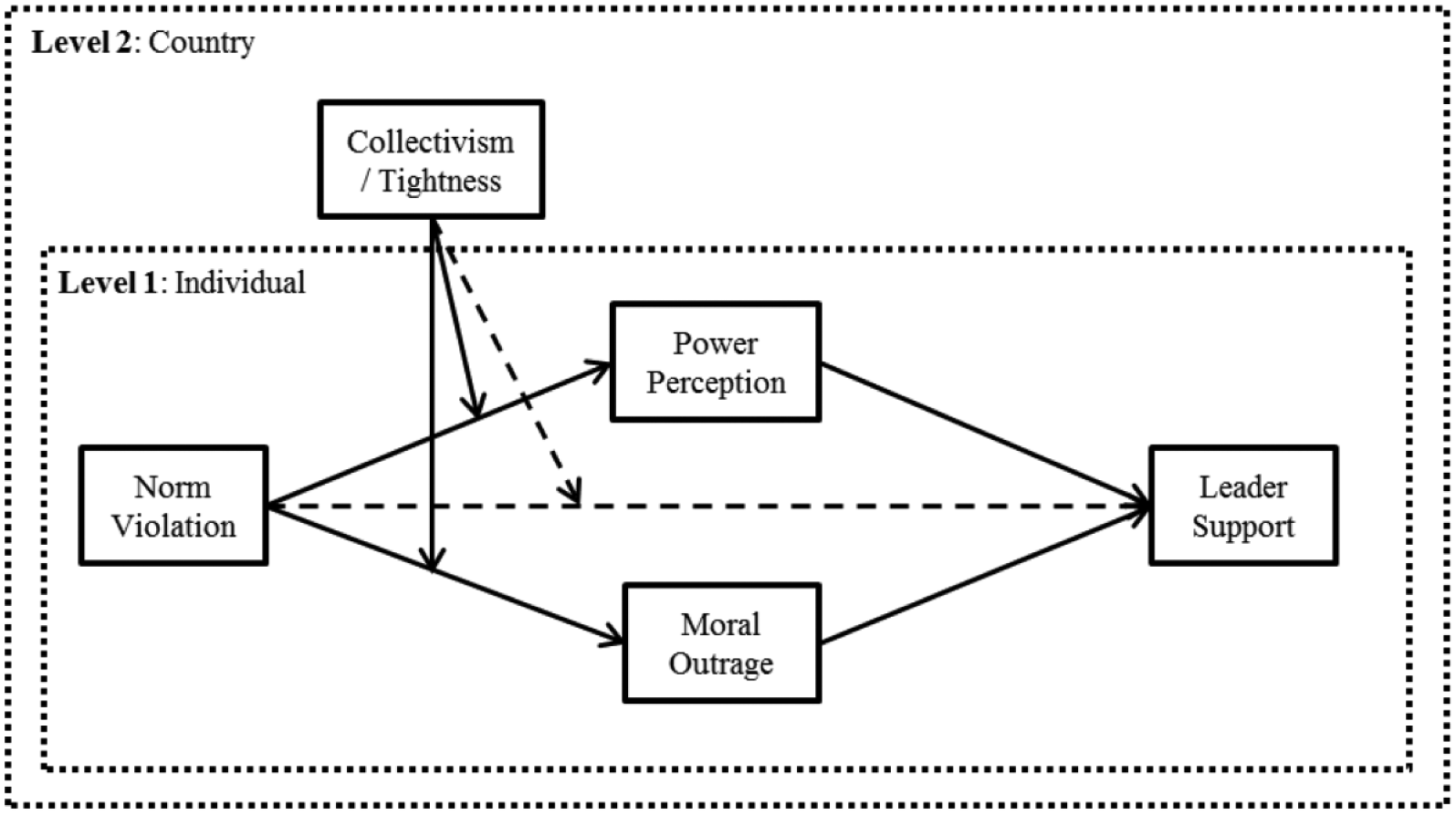
Multilevel theoretical model illustrating the hypotheses for the positive pathway from norm violation to leader support via power perception and the negative pathway from norm violation to leader support via moral outrage, as moderated by collectivism and/or tightness.
Method
Countries and Participants
Based on previous research (Gelfand et al., 2011; House, Hanges, Javidan, Dorfman, & Gupta, 2004), we selected 19 countries that span a broad range of collectivism and tightness. As expected, there was a positive correlation between collectivism and tightness, r(19) = .48, p = .040, but the systematic sampling of cultures enabled the inclusion of collectivistic countries that are loose and individualistic countries that are tight (see Figure 2).
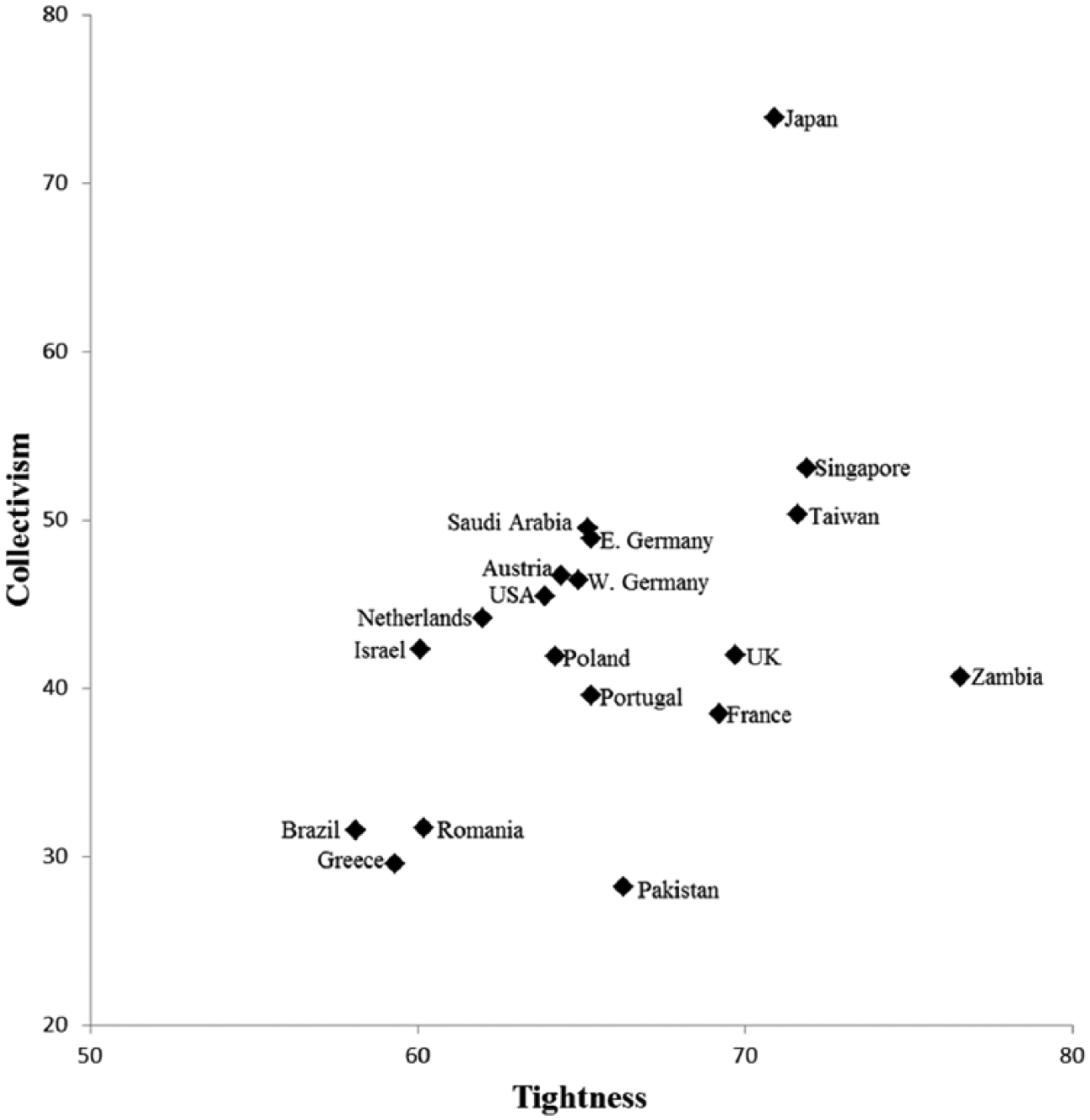
Variation of countries along the collectivism and tightness dimensions.
Given the current country sample (nj = 19) and the need to estimate conditional indirect effects with a multilevel structure, we aimed at an individual sample of approximately N = 100 per country to produce reliable estimates (see Bauer, Preacher, & Gil, 2006). Our final sample comprised 2,369 individuals, nested in 19 countries, who participated in the study in exchange for course credits or money. The proportion of missing values was 0.17% and we treated them as random. No participants were excluded from our sample.
Procedure and Design
The original questionnaire was translated into each country’s official language following the procedure outlined by Brislin (1986; see Supplemental Material; translations available upon request 1 ). The questionnaire was introduced as a survey on general thoughts, attitudes, and feelings. After replying to demographic questions, participants read a description of an organizational meeting in which the focal actor named K either violated or adhered to norms that are typical for organizational meetings, that is, the punctuality, discretion, and talk-in-turns norms (Allen, Lehmann-Willenbrock, & Rogelberg, 2015). Each of these violations has been examined separately in previous research and has been proven effective (Stamkou, Van Kleef, Homan, & Galinsky, 2016; Van Kleef et al., 2011; Van Kleef et al., 2012). Here, we combined these norm violations to strengthen our manipulation and to ensure that any effects would not be driven by one idiosyncratic type of norm violation (e.g., punctuality violation). This relates to the main goal of the current research, which was not to disentangle the effects of individual norm violations, but rather to examine the influence of cultural values on the effects of norm violations.
More specifically, in the norm violation vignette, K arrived late to the meeting, caused some commotion while getting a cup of coffee midway through the meeting, and interrupted his colleague to express his opinion regarding how the company should deal with a particular organizational issue. In the norm adherence vignette, K arrived well on time, waited until the end of the meeting to get his coffee since he considered it inappropriate to do so midway, and expressed his opinion regarding the policy the company should follow only after his colleague had rounded off. Importantly, the focal actor encapsulated his norm-violating or norm-adhering behavior at the end of the vignette by stating “. . . rules are there to be broken” or “. . . rules are there for a reason,” respectively. This explicit statement aimed at leaving no room for subjective interpretations of the actor’s behavior (see the Online Appendix for the full vignettes).
After reading one of the two vignettes, participants answered questions measuring their perception of K’s power, their feelings of moral outrage, their tendency to support K as leader, and their perception of K’s behavior as norm violating, which we included as manipulation check. After some filler questions, participants answered questions measuring cultural collectivism and tightness. At the end of the survey, we also measured power distance for exploratory purposes. (The psychometric qualities of this scale turned out to be poor, and it was therefore not analyzed. Further information about the power distance scale is reported in the Supplemental Material.)
The questionnaire was administered online in all countries with the exception of Japan, Pakistan, Saudi Arabia, and Taiwan, where we used a pen-and-paper version of the questionnaire, and Singapore and Zambia, where we used both administration modes. In the online studies, participants were recruited via the online system of each collaborator’s university (e.g., www.test.uva.nl in the Netherlands) or via Amazon’s Mechanical Turk (www.mturk.com) in the United States. In the pen-and-paper studies, participants were recruited at the university lecture halls.
Measures
Manipulation check
We measured norm violation perception by means of four items adapted from previous studies (Van Kleef et al., 2011). A sample item is, “I think that K behaves improperly.”
Power perception
We measured power perception with four items adapted from the Generalized Sense of Power Scale (Anderson, John, & Keltner, 2012). A sample item is, “I think K has a great deal of power.”
Moral outrage
Following previous research, moral outrage was measured by means of the moral emotions of contempt, anger, and disgust, using the items “K’s behavior makes me feel . . . contemptuous / angry / disgusted” (CAD triad; Rozin, Lowery, Imada, & Haidt, 1999).
Leader support
To measure leader support, we used a brief scenario followed by seven questions. The scenario described a leadership vacancy that K applied for. The questions were based on the Leader Support scale (Rast, Gaffney, Hogg, & Crisp, 2012), which includes items such as “I would vote for K.”
Cultural collectivism norms
We used the norms-versus-attitudes component from the individualism–collectivism as Descriptive Norms Scale (Fischer et al., 2009) to measure collectivism at the country level. This component consists of five bipolar items. An example item is, “Most people in my country . . . do what is enjoyable to them personally vs. carry out their group obligations.”
Cultural tightness
We used the six-item tightness–looseness scale (Gelfand et al., 2011) to measure tightness at the country level. An example item is, “In my country there are many social norms that people are supposed to follow.”
In keeping with the descriptive norm perspective on culture (Chiu et al., 2010), we conceptualized collectivism and tightness as collective constructs that reside at the culture level. We therefore measured them in line with a referent-shift consensus model (Chan, 1998; Glick, 1985), which requires individuals to evaluate a cultural characteristic at the desired culture level of analysis (i.e., “People in this culture do X in situation Y”) to indicate a crystallized collective-level construct (Fischer, 2009). Alternative scales that have been used in previous cross-cultural studies (e.g., Hofstede’s individualism, House et al.’s family collectivism, or Schwartz’s embeddedness scales) were deemed unsuitable for the current purposes because these scales measure personal preferences or attitudes pertaining to individuals’ own behavior (i.e., “I do X in situation Y”).
To examine the validity of the scales, we tested the correlation between the collectivism norms and tightness scores aggregated to the country level with country scores derived from previous studies that measured these cultural dimensions as culturally shared constructs, that is, from a descriptive norm perspective. Collectivism norm scores positively correlated with the GLOBE project’s (House et al., 2004) society-level institutional collectivism scores, r(16) = .70, p = .002 (scores were missing for Pakistan, Romania, and Saudi Arabia). 2 Tightness scores correlated with Gelfand et al.’s (2011) tightness scores, r(16) = .67, p = .004 (scores were missing for Romania, Saudi Arabia, and Zambia). These results attest to the convergent validity of the collectivism norms and tightness measures used in the current research.
Demographics
We assessed participants’ age, education level, religiosity, and socioeconomic status (SES). We also recorded the means by which the survey was administered and the type of compensation participants received for participating in the study. Finally, we measured the number of years participants lived in their country to estimate length of residence in proportion to participants’ age.
Key sample characteristics (i.e., sample size, demographics, collectivism, and tightness scores on 100-point scales) are displayed in Table 1. Additional information on the sample selection is provided in the Supplemental Material. Results are reported separately for East and West Germany to be consistent with previous cross-cultural studies (e.g., Gelfand et al., 2011; House et al., 2004).
Sample Characteristics per Country.
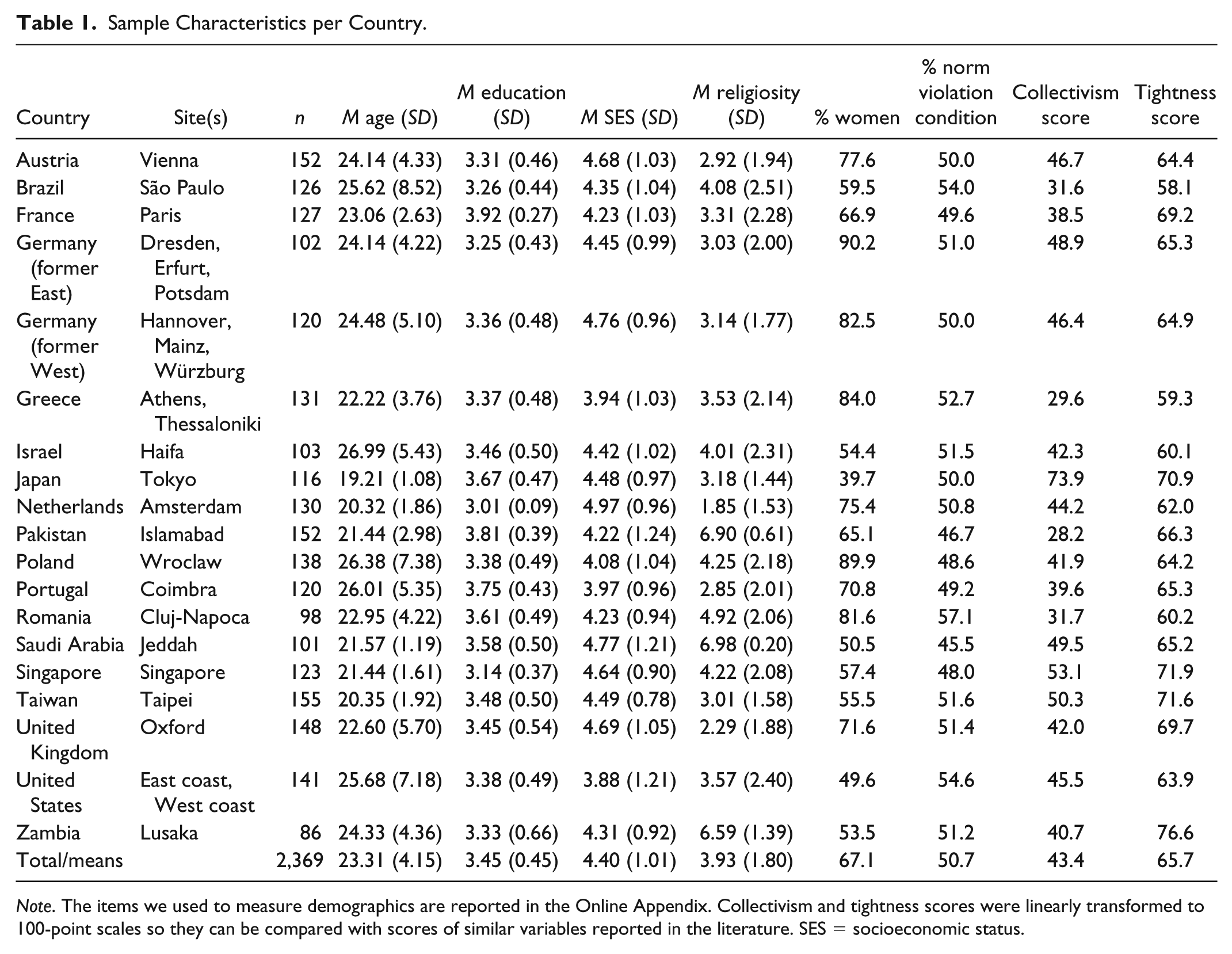
Note. The items we used to measure demographics are reported in the Online Appendix. Collectivism and tightness scores were linearly transformed to 100-point scales so they can be compared with scores of similar variables reported in the literature. SES = socioeconomic status.
Instructions, scale items, and response scales in which items were rated are reported in the Online Appendix.
Analytic Strategy
We used multilevel structural equation modeling (SEM) to assess the effects of actor’s behavior, collectivism, and tightness on individuals’ reactions toward the actor, after controlling for demographics. Multilevel analysis is indicated when dealing with nested designs and/or examining cross-level interactions between individual-level (i.e., actor’s behavior) and country-level (i.e., collectivism and tightness) predictors (Raudenbush & Bryk, 2002). SEM was appropriate because it allowed us to test all hypotheses in one model. Before carrying out multilevel SEM, we performed a number of preliminary analyses to check the feasibility of multilevel analytical techniques and we computed the intercorrelation of variables to check whether the mediating processes stipulated in our model are independent from each other.
Preliminary Analyses
The results of the preliminary analyses are displayed in Table 2. First, we assessed the internal consistency of each scale within each country by means of Cronbach’s alpha reliability analyses. All scales demonstrated acceptable to excellent reliability.
Scale Psychometric Qualities Across Countries.
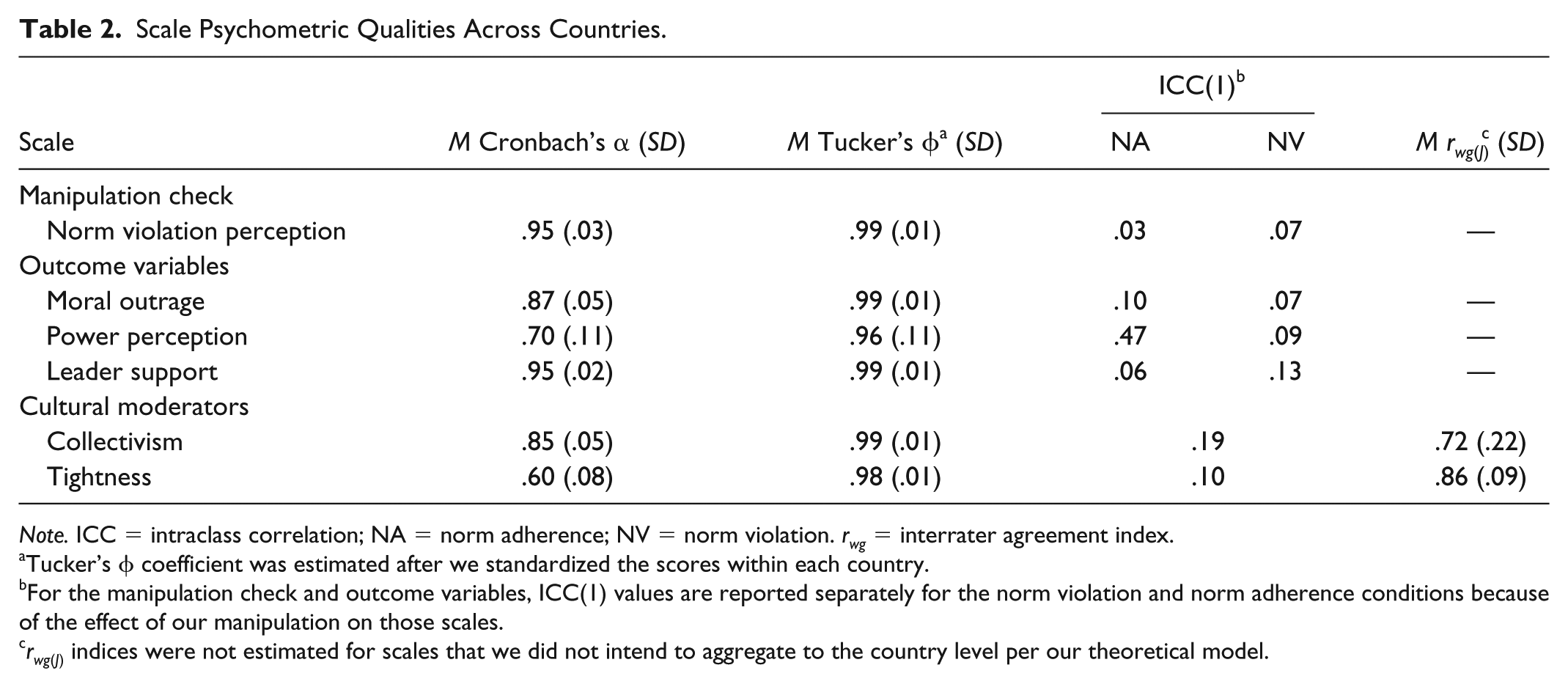
Note. ICC = intraclass correlation; NA = norm adherence; NV = norm violation. rwg = interrater agreement index.
Tucker’s ϕ coefficient was estimated after we standardized the scores within each country.
For the manipulation check and outcome variables, ICC(1) values are reported separately for the norm violation and norm adherence conditions because of the effect of our manipulation on those scales.
rwg(J) indices were not estimated for scales that we did not intend to aggregate to the country level per our theoretical model.
Second, we calculated Tucker’s phi congruence coefficient to examine the equivalence of factor structures across countries (van de Vijver & Leung, 1997). Before estimating the Tucker’s phi congruence coefficient, we standardized the scores within each country. Tucker’s phi compares two factor structures with each other. For each scale, we calculated the unidimensional factor structure for each country and compared it with the factor structure found across all participants. The mean Tucker’s phi far exceeded the recommended .90 cut-off point for all scales, which provided evidence for configural equivalence and supported the assumption that the psychological construct underlying each scale is the same across countries. 3
Third, we calculated the intraclass correlation coefficient ICC(1), which denotes the proportion of variance accounted for by country differences. All ICC(1) values were higher than .05 (apart from the manipulation check), which indicates that culture influenced individuals’ responses, warranting multilevel analysis (LeBreton & Senter, 2008).
Finally, we checked whether the within-country agreement was sufficiently high for the collectivism and tightness scales by estimating the rwg(J) index. The rwg(J) values exceeded the recommended .70 cut-off point, indicating high within-country agreement and justifying aggregation of individual scores to the country level (LeBreton & Senter, 2008).
Intercorrelation of Variables
We estimated the relationship among individuals’ cognitive (i.e., power perception), affective (i.e., moral outrage), and behavioral (i.e., leader support) responses to examine whether power perception and moral outrage independently relate to leader support tendencies. Table 3 shows that, in line with our theoretical model, power perception was positively correlated with leader support, whereas moral outrage was negatively correlated with leader support. Importantly, power perception and moral outrage were independent from each other, r(2,366) = .01, p > .250, which justified our decision to empirically treat them as separate mediating processes. We did, however, include their covariance in the model so we could control for any shared variance between them.
Intercorrelation Matrix.
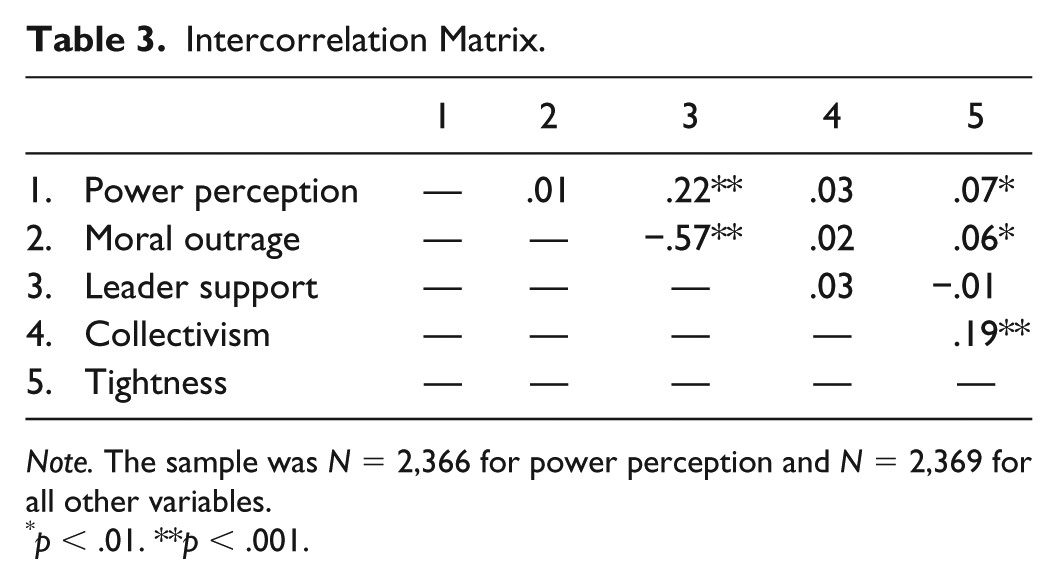
Note. The sample was N = 2,366 for power perception and N = 2,369 for all other variables.
p < .01. **p < .001.
To provide a more comprehensive view of the relations among variables, we also included the cultural variables in the intercorrelation matrix. The positive correlation between collectivism and tightness at the individual level, r(2,369) = .19, p < .001, is consistent with their positive correlation at the culture level reported above.
Multilevel SEM
Multilevel modeling accounts for nonindependent observations by estimating variance associated with country differences in average response (intercepts) and country differences in associations (slopes) between predictors and dependent variables (e.g., the relationship between an actor’s behavior and individuals’ reactions). This is accomplished by declaring intercepts and/or slopes that are expected to vary across countries to be random effects and those that are not expected to vary across countries to be fixed effects. Level 1 units in our analyses were the 2,369 participants, and Level 2 units were the 19 countries in which these participants resided.
Certain methodological decisions applied in testing the model. Actor’s behavior (Level 1 predictor) was coded as −1 for the norm adherence condition and 1 for the norm violation condition. Because we expected differences between countries in the associations between actor’s behavior and individuals’ reactions, the slopes associated with the effects of norm violation on the manipulation check, power perception, moral outrage, and leader support were declared to be random. Collectivism and tightness were used as covariates at Level 2 that predicted the random slopes at Level 1, which resulted in cross-level interaction effects between individual- and culture-level variables. Even though we had no hypotheses about the main effects of collectivism and tightness on individuals’ reactions, we included them as country-level effects so we could accurately probe and graph the cross-level interaction effects. This required that we declare a random intercept as well, because prediction of a random intercept by a Level 2 covariate results in a main effect. Because our main interest was in the cross-level interactions, we applied group-mean centering to our Level 1 predictors (actor’s behavior, power perception, moral outrage, and demographic variables) and grand-mean centering to our Level 2 predictors (collectivism and tightness). This way of centering allowed us to examine and interpret the effect of contextual variables (collectivism and tightness) on individuals’ responses (Enders & Tofighi, 2007; Raudenbush & Bryk, 2002). Multilevel SEM was implemented through MPlus®, Version 8 (Muthén & Muthén, 1998-2017) using a Bayesian estimation method with 10,000 iterations.
Bayesian estimation methods have recently been introduced in multilevel SEM and they have considerable advantages over classical methods (Asparouhov & Muthén, 2010). In contrast to the maximum likelihood method that relies on large-sample theory, Bayesian methods in multilevel SEM produce reliable parameter estimates and standard errors even when the country sample is relatively small, are appropriate when testing complex models that include multiple effects, and do not produce inadmissible parameter estimates such as negative variances (Hox, van de Schoot, & Matthijsse, 2012).
Considering the modest sample size at the country level and the fact that our model tested a large number of parameters due to the inclusion of both random and fixed effects, we used composite measures in the model, which means that item scores were averaged to form a scale measuring each construct (Marsh & Hau, 1999).
Results
Although the Bayesian approach is fundamentally different than classical statistics, results produced by the Bayesian estimation method can be interpreted in a similar way to results produced by the classical maximum likelihood estimation method (see Hamaker & Klugkist, 2011, for a comprehensive account). In Bayesian analysis, simulation techniques can be used to generate random draws from the so-called posterior distribution, which is the probability distribution of an unknown quantity (e.g., a parameter estimate) after taking into account the evidence obtained from the data. The posterior distribution is then used to compute a parameter estimate (b) with a standard deviation (SD), a p value, and a credibility interval (CI, the Bayesian counterpart of the maximum likelihood [ML] confidence interval). The parameter estimate represents the median of the posterior distribution and the SD represents its standard deviation. The p value represents the proportion of the posterior distribution that is below zero in case of a positive parameter estimate, and the proportion of the posterior distribution that is above zero in case of a negative estimate. The CI represents the 2.5 and 97.5 percentiles of the posterior distribution resulting in a 95% CI, which may not be symmetric because Bayesian analysis does not assume normal distribution of parameters.
Manipulation Check
We checked the manipulation by investigating whether actor’s behavior predicted norm violation perceptions as intended. We also explored whether actor’s behavior interacted with collectivism and/or tightness to predict norm violation perception. We thus regressed norm violation perception on actor’s behavior, collectivism, tightness, the interaction between actor’s behavior and collectivism, and the interaction between actor’s behavior and tightness. If the manipulation were successful, we should find a main effect of actor’s behavior on norm violation perceptions, and no main or interaction effects involving culture.
A main effect of actor’s behavior showed that individuals perceived the actor to be more norm violating in the norm violation condition than in the norm adherence condition, b = 2.00 (SD = 0.07), p < .001, 95% CI = [1.87, 2.13]. There was no main effect of collectivism on norm violation perception, b = 0.12 (SD = 0.10), p = .093, 95% CI = [−0.07, 0.31], and no main effect of tightness, b = −0.14 (SD = 0.24), p > .250, 95% CI = [−0.61, 0.36]. Most importantly, actor’s behavior did not interact with either collectivism, b = −0.02 (SD = 0.12), p > .250, 95% CI = [−0.25, 0.22], or tightness, b < 0.01 (SD = 0.31), p > .250, 95% CI = [−0.61, 0.62]. The variance explained in perceived norm violation was R2 = .80 (SD = 0.01), p < .001, 95% CI = [0.79, 0.81] at the individual level and R2 = .05 (SD = 0.06), p < .001, 95% CI = [<0.01, 0.24] at the country level. The variance explained by the random intercept was R2 = .11 (SD = 0.11), p < .001, 95% CI = [<0.01, 0.42]. These results indicate that the manipulation was equivalently successful across cultures.
Model Testing
Our theoretical model (see Figure 1) postulated conditional indirect effects involving collectivism norms and tightness as moderators of the effect of actor’s behavior on leader support via power perception (positive pathway) and moral outrage (negative pathway). The analyses were carried out in three steps. In the first step, we tested the entire model to see whether collectivism norms and tightness moderate the effects of actor’s behavior on individuals’ responses. We therefore regressed power perception, moral outrage, and leader support on actor’s behavior, collectivism norms, tightness, the interaction between actor’s behavior and collectivism norms, and the interaction between actor’s behavior and tightness, while controlling for the effects of demographic variables (age, gender, education, religiosity, SES, administration means, type of compensation, and length of residence) on the dependent variables. In this model, we also regressed power perception and moral outrage on leader support, so we could examine the conditional indirect effects in a next step of the analyses. Given that our theory predicted no interaction between collectivism norms and tightness, we tested the model by estimating the interactive effect between each cultural moderator and actor’s behavior on individuals’ reactions simultaneously. To check, however, whether results remain the same when we included the three-way interaction between collectivism norms, tightness, and actor’s behavior, we carried out exploratory analyses that we report in the Supplemental Material. 4 In the second step, we probed and plotted the significant interactions we observed in the previous step to examine the direction and magnitude of the interaction effects. In the third step, we tested the conditional indirect effects (Muller, Judd, & Yzerbyt, 2005). A conditional indirect effect occurs if the mediating process (power perception or moral outrage) that produces the treatment effect (actor’s behavior) on the outcome (leader support) depends on the value of a moderator variable (collectivism or tightness). Both interaction effects and conditional indirect effects were probed at ±1 SD and ±2 SDs about the mean of cultural variables to capture a wide range of cultural variation and to be consistent with the conventional procedure followed when probing these effects in multilevel modeling (Bauer et al., 2006). Parameter estimates of the analysis testing the entire model are summarized in Table 4 and parameter estimates of the analyses testing the conditional indirect effects are summarized in Table 5. Below, we report first the results that examined collectivism as a moderator of the positive and negative pathways and then the results that examined tightness, while noting that both sets of effects were estimated simultaneously.
Parameter Estimates for Multilevel Structural Equation Modeling Testing the Hypotheses That the Positive and Negative Pathways Are Moderated by Collectivism and Tightness After Controlling for Demographics.
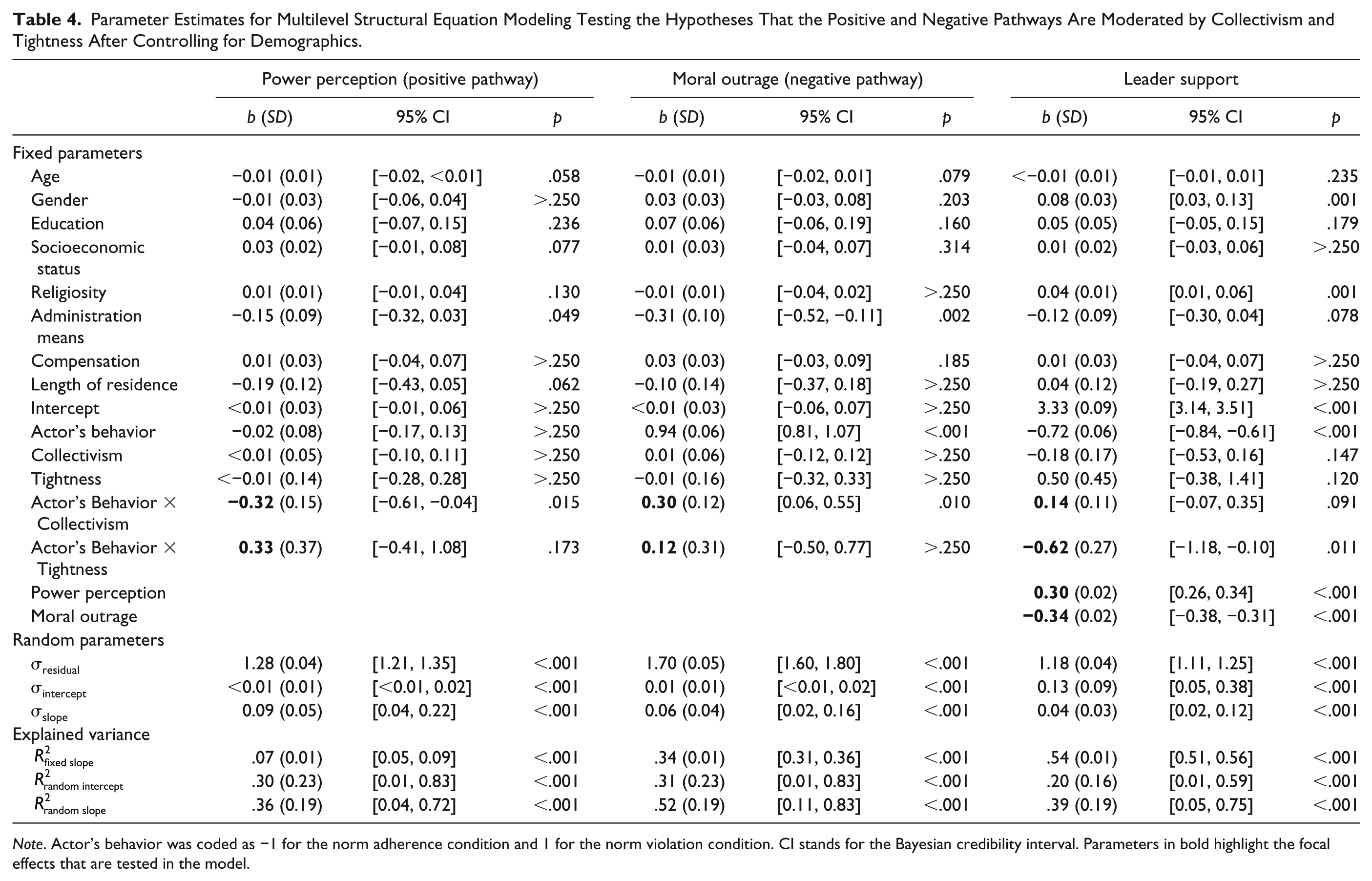
Note. Actor’s behavior was coded as −1 for the norm adherence condition and 1 for the norm violation condition. CI stands for the Bayesian credibility interval. Parameters in bold highlight the focal effects that are tested in the model.
Parameter Estimates of the Direct and Indirect Effect of Actor’s Behavior on Leader Support via Power Perception and Moral Outrage for Different Levels of Collectivism and Tightness.
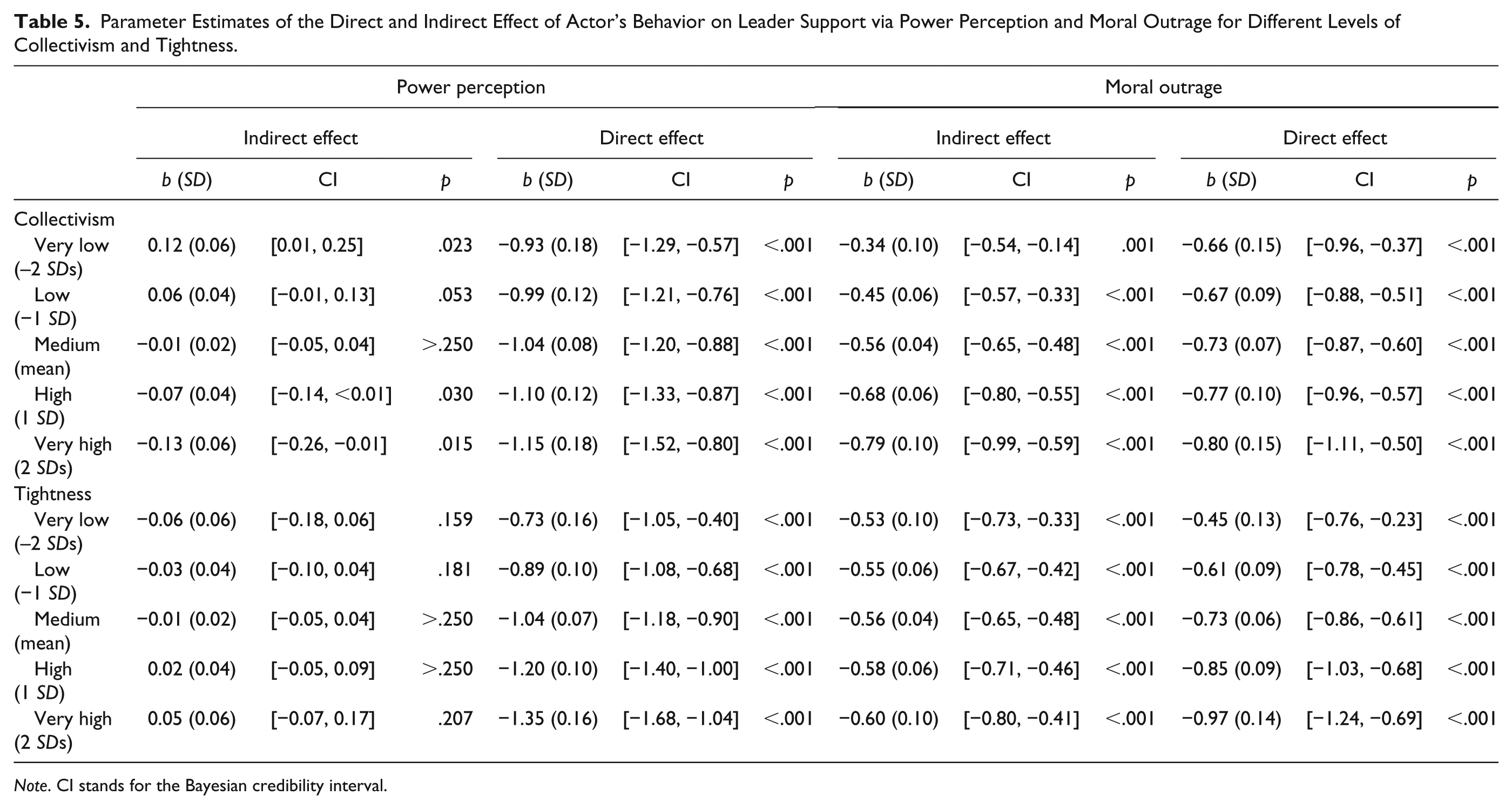
Note. CI stands for the Bayesian credibility interval.
Collectivism norms
The results showed no main effects of actor’s behavior and collectivism on power perception. As expected, there was an interaction effect between actor’s behavior and collectivism: In more collectivistic countries, individuals considered norm violators less powerful than norm abiders (1 SD: b = −0.22 [SD = 0.12], p = .033, 95% CI = [−0.45, 0.01]; 2 SDs: b = −0.42 [SD = 0.19], p = .017, 95% CI = [−0.80, −0.04]), whereas in less collectivistic countries, individuals tended to consider norm violators more powerful than norm abiders (−1 SD: b = 0.19 [SD = 0.12], p = .055, 95% CI = [−0.05, 0.42]; –2 SDs: b = 0.39 [SD = 0.19], p = .022, 95% CI = [0.01, 0.77]; see Figure 3, left panel).
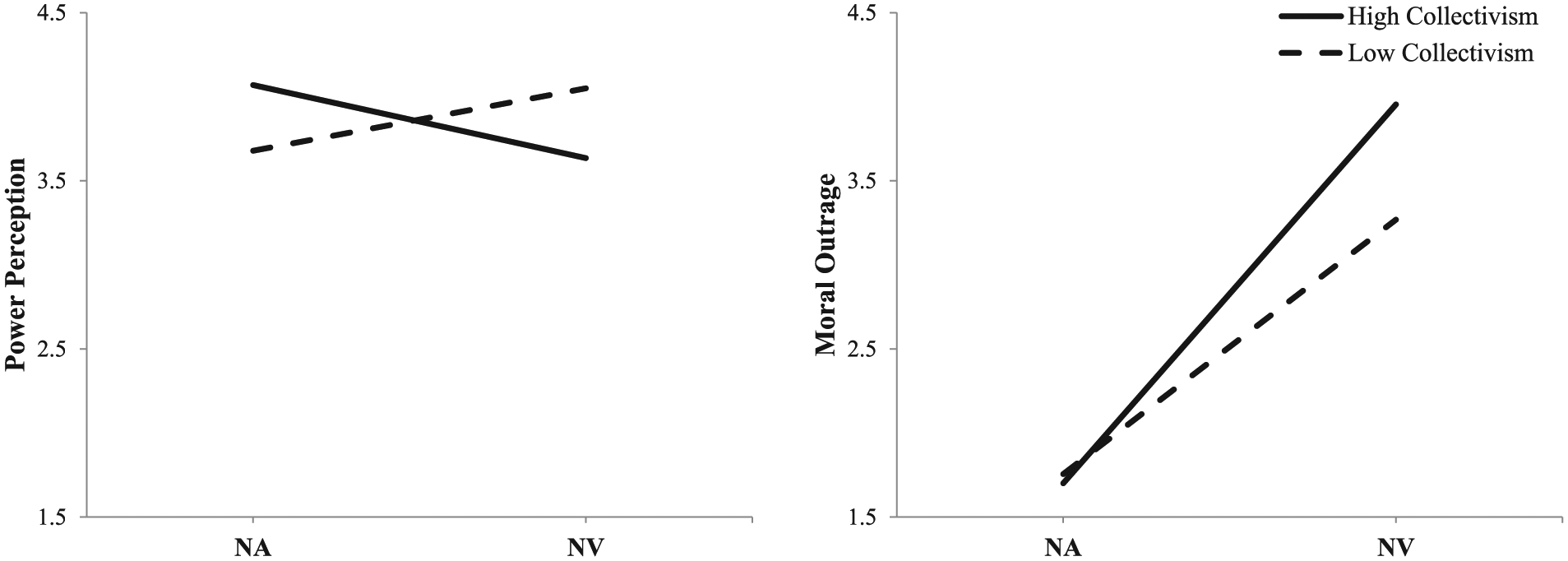
Power perception (left panel) and moral outrage (right panel) as a function of actor’s behavior and collectivism.
The results showed no main effect of collectivism on moral outrage. There was a main effect of actor’s behavior on moral outrage: Individuals experienced more moral outrage in the norm violation condition than in the norm adherence condition. More importantly, in line with our expectations, there was an interaction effect between actor’s behavior and collectivism: Moral outrage in reaction to norm violators was more intense in more collectivistic countries (1 SD: b = 1.13 [SD = 0.10], p < .001, 95% CI = [0.93, 1.32]; 2 SDs: b = 1.32 [SD = 0.16], p < .001, 95% CI = [1.00, 1.64]) than in less collectivistic countries (−1 SD: b = 0.76 [SD = 0.10], p < .001, 95% CI = [0.56, 0.96]; –2 SDs: b = 0.57 [SD = 0.16], p < .001, 95% CI = [0.24, 0.90]; see Figure 3, right panel).
In line with previous research (Stamkou et al., 2016), the results showed a main effect of actor’s behavior on leader support: Respondents indicated being less willing to support norm violators as leaders than norm abiders. There was no main effect of collectivism and no interaction effect between collectivism and actor’s behavior on leader support.
Finally, as predicted, power perception positively predicted leader support and moral outrage negatively predicted leader support: The more powerful individuals perceived the protagonist to be and the less moral outrage they experienced, the more they would support the person as leader. These two effects were independent from each other, as indicated by the covariance estimate, b < 0.01 (SD < 0.01), p = .473, 95% CI = [−0.01, 0.01].
Consistent with our conditional indirect effect hypothesis, these results indicate that the indirect effects of actor’s behavior on leader support via power perception and via moral outrage (i.e., the two mediation relationships) depend on collectivism (i.e., the moderator). To further probe the conditional indirect effects, we computed each mediation relationship at different levels of the moderator following the procedure recommended by Bauer and colleagues (2006). We first centered the moderator (i.e., collectivism) at five equidistant levels ranging from very low to very high: 2 SDs below the mean, 1 SD below the mean, the mean, 1 SD above the mean, and 2 SDs above the mean. We then estimated each mediation relationship at the various levels of the moderator and decomposed the total effect of actor’s behavior on leader support into an indirect and a direct effect. The indirect effect represents the variance in leader support explained by actor’s behavior through the mediator (e.g., power perception or moral outrage), whereas the direct effect represents the residual variance in leader support explained by actor’s behavior after partialing out the effect of the mediator. The total effect consequently represents the sum of the indirect and direct effects. A conditional indirect effect is indicated when the direction and/or magnitude of the indirect effect varies across levels of the moderator.
With regard to the positive pathway, the above analysis showed that the indirect effect of actor’s behavior on leader support through power perception was positive and significant for very low values of collectivism and it was negative and significant for high and very high values of collectivism (see upper left side of Table 5 and upper panel of Figure 4). That is, individuals in very individualistic countries perceived a norm violator as more powerful than a norm follower, which in turn reduced their tendency to reject violators as leaders. In rather collectivistic countries, on the contrary, individuals perceived a norm violator as less powerful, which in turn reinforced their tendency to reject norm violators as leaders. With regard to the negative pathway, the analysis revealed that the negative indirect effect of actor’s behavior on leader support via moral outrage became stronger with increased collectivism (see upper right side of Table 5 and lower panel of Figure 4). Specifically, the mediating role of individuals’ moral outrage on their tendency to reject norm violators as leaders was stronger in more collectivistic countries.
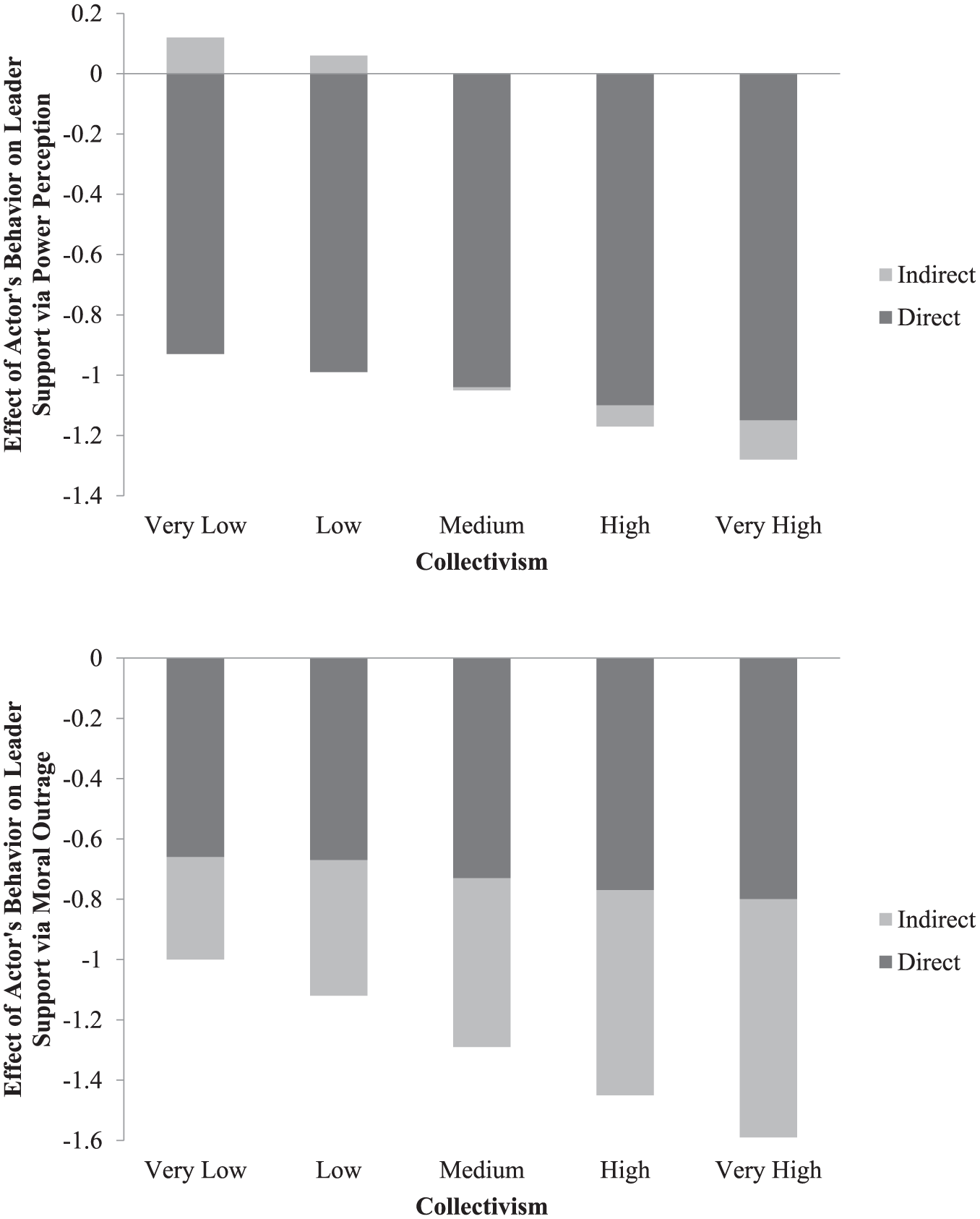
Bars indicate the decomposition of the average causal effect of actor’s behavior on leader support into a direct effect and an indirect effect through power perception (upper panel) and moral outrage (lower panel) for different levels of collectivism.
Tightness
The results showed no main or interaction effects of actor’s behavior and tightness on power perception. There was also no main effect of tightness and no interaction effect between tightness and actor’s behavior on moral outrage. However, the results showed a main effect of actor’s behavior on leader support, which was qualified by an interaction with tightness. Probing the interaction revealed that, even though individuals across countries indicated being more willing to support norm abiders as leaders than norm violators, this effect was stronger in tighter countries (1 SD: b = −1.19 [SD = 0.12], p < .001, 95% CI = [−1.42, −0.96]; 2 SDs: b = −1.33 [SD = 0.19], p < .001, 95% CI = [−1.72, −0.95]) than in less tight countries (−1 SD: b = −0.90 [SD = 0.12], p < .001, 95% CI = [−1.14, −0.67]; –2 SDs: b = −0.76 [SD = 0.19], p < .001, 95% CI = [−1.15, −0.38]; see Figure 5). Together, these results provide evidence for a simple moderation effect between tightness and norm violation on leader support, and no evidence for a conditional indirect effect involving either power perception or moral outrage as mediators.
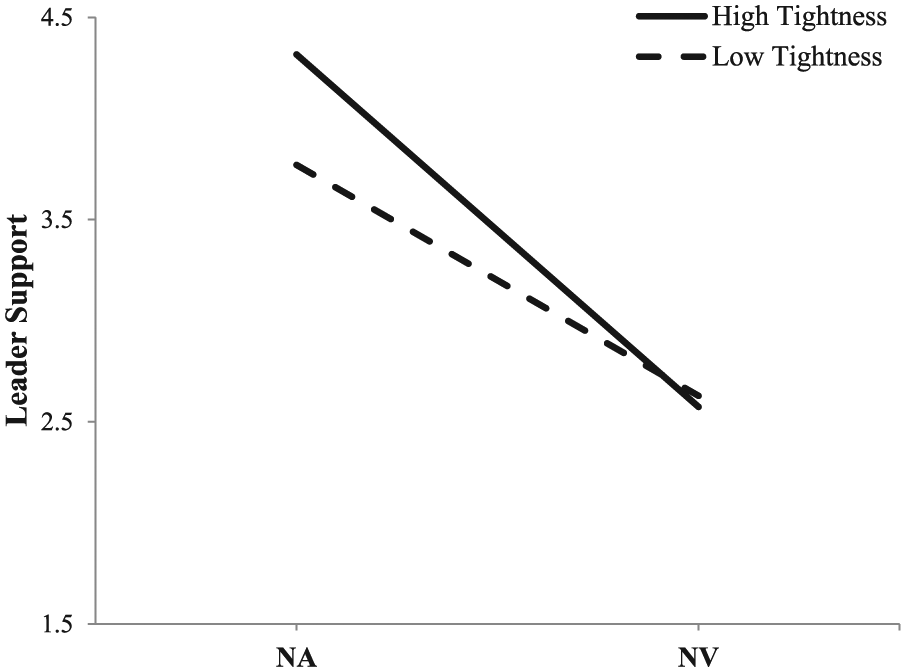
Leader support as a function of actor’s behavior and tightness.
Even though the conditional indirect effect hypotheses involving power perception and moral outrage were not supported, we still probed the effects to provide a complete picture of the findings. These analyses showed that, in line with the nonsignificant conditional indirect effects, even though the direct effect of actor’s behavior on leader support becomes more negative as tightness increases (i.e., moderation effect), the indirect effect via power perception remains nonsignificant (see bottom left side of Table 5) and the indirect effect via moral outrage remains significant but does not change substantially for different levels of tightness (see bottom right side of Table 5). In other words, the tighter a country is, the more individuals support norm followers as leaders over norm violators, but this interaction is not mediated by power perception or moral outrage.
Discussion
Norm violations are ubiquitous, but people’s reactions to them are complex and poorly understood. The current study aimed to explain variation in people’s reactions to norm violators by investigating the role of cultural values. We developed a theoretical model positing that norm violations induce both positive cognitive reactions (power perceptions) and negative affective reactions (moral outrage), which subsequently influence people’s behavioral tendencies to support the violator as a leader. We further proposed that these processes are modulated by culture, specifically by collectivism and tightness.
The results showed that norm violators provoke moral outrage in all cultures studied, but the extent to which individuals experience these negative moral emotions depends on their country’s culture: The more collectivistic the culture is, the more moral outrage individuals experience in reaction to norm violations. These feelings in turn relate to people’s reluctance to support violators as leaders. The reduced support for norm violators is stronger in more collectivistic countries where people consider norm violators less powerful than norm followers and, importantly, weaker in rather individualistic countries where people consider norm violators more powerful. Finally, the tendency to support norm followers as leaders is directly related to cultural tightness: The tighter the culture is, the more individuals would support norm followers as leaders.
Theoretical and Practical Implications
Our research offers a number of contributions to existing theory and research. First, the current findings help further our understanding of the social consequences of norm violations and extend previous research on the conditions that influence reactions to norm violations (Bowles & Gelfand, 2010; Stamkou et al., 2016). To date, empirical studies (which were conducted in Western cultures) had consistently shown that violating norms enhances the transgressor’s perceived power (Bellezza et al., 2014; Van Kleef et al., 2011). The current research indicates that the positive relationship between norm violation and power perception is not universal, as this relationship is reversed in collectivistic cultures. This novel finding may be explained by the different ways people conceptualize power and the different stereotypes people hold about the powerful across cultures. For instance, in countries where norm violators are seen as more powerful, people may think of power in terms of entitlement and may picture the powerful as assertive and unconstrained individuals. Conversely, in countries where norm followers are seen as more powerful, people may think of power in terms of responsibility and may portray the powerful as modest and restrained individuals (Torelli & Shavitt, 2010). These power concepts and power stereotypes may serve higher order goals related to the culture’s needs, which become manifest in divergent leadership preferences (Aktas, Gelfand, & Hanges, 2016). Restrained leaders are likely to show norm-abiding behavior, which would make them more effective in more collectivistic societies where respect for tradition, face saving, and modesty are valued. On the contrary, self-directed leaders may be more inclined to deviate from the norm, which could increase their effectiveness in more individualistic societies where innovation, uniqueness, and independence are praised (House et al., 2004).
Second, the differential effects of collectivism and tightness provide evidence that these are distinct cultural dimensions. Namely, for the interaction between norm violation and collectivism, both moral outrage and power perceptions proved to be explaining mechanisms for people’s rejection of norm violators, whereas the role of tightness could not be explained by either power perceptions or moral outrage. This implies that people’s behavior in tight cultures may be driven by other processes, such as perceived threat to social order, because the need for coordination in tight cultures renders people sensitive to behavior that challenges the status quo (Roos et al., 2015). Future studies need to examine the differential psychological mechanisms that distinguish between the effects of collectivism and tightness.
Besides these theoretical implications, our findings have practical implications for the rapidly growing field of intercultural competence. Intercultural competence refers to the challenge of understanding, adjusting, and excelling in modern multicultural societies (Deardorff, 2009). In this respect, one relevant conclusion that follows from the current research is that deviating from the norm may enhance one’s status in individualistic societies but may backfire in collectivistic societies. Another conclusion is that norm violators have a more challenging path to the top in tighter societies, where the only way up seems to be norm adherence. Given that culture is not only defined by country borders, this knowledge may also apply to meso-level communities (e.g., counties, organizations, professions) that differ in their group orientation or the strength of their norms (Harrington & Gelfand, 2014).
Furthermore, the present research has potential implications for managing cultural diversity at work, which is becoming important in the face of an increasingly culturally diverse workforce. Given that workplace diversity has the potential to enhance organizational effectiveness (Van Knippenberg, De Dreu, & Homan, 2004), our findings suggest that organizations may benefit from raising awareness of cultural differences in the ways power is construed, afforded, and challenged, for example, by designing culturally sensitive interventions.
Strengths, Limitations, and Future Directions
Our study offers numerous strengths given the challenges that come with carrying out cross-cultural research. First, our study included participants from 19 countries, some of which (e.g., Zambia) are not typically Western, Educated, Industrialized, Rich, and Democratic (WEIRD; Henrich, Heine, & Norenzayan, 2010). Second, using multiple measures, our findings illuminate a variety of responses to norm violations, while the systematic multilevel modeling of the data added valuable insights regarding both moderated and mediated effects (Leung & van de Vijver, 2008). Third, the experimental approach allowed us to draw causal inferences about the effects of norm violation on people’s reactions, which is notable because cross-cultural studies often rely on correlational designs (Heine, 2016). Furthermore, thanks to the random assignment of individuals to conditions, any response biases (e.g., extremity or acquiescence) at the country level should be equally distributed across conditions. Possible response biases are therefore unlikely to have affected our results, because the focus of our comparison was on the relative difference between the norm violation and norm adherence conditions rather than on absolute differences across countries (Heine, 2016). 5 Fourth, we heeded calls in the literature to pay careful attention to the equivalence of constructs (van de Vijver & Leung, 1997). Fifth, the measurement of cultural dimensions enabled us to “unpack” the observed cultural differences using up-to-date scores and the inclusion of tightness allowed us to move beyond the most commonplace mechanism investigated in cross-cultural studies (i.e., collectivism; Matsumoto & Yoo, 2006). In sum, we tried to overcome some of the most important limitations of cross-cultural research, which is often restricted by two-country comparisons, lack of experimental manipulation, absence of measures of underlying processes or contextual variables, and failure to conduct equivalence testing (Fischer & Poortinga, 2018).
However, our methodological approach of testing a conditional indirect effect model with a multilevel structure posed a high demand on the statistical power of our design. This likely explains why some of our effects only applied to the highest end of the cultural dimensions in our sample (e.g., –2 SDs in our collectivism scale). Although the 19 countries we included varied considerably in collectivism and tightness, they did not cover the entire spectrum of these cultural dimensions (see Gelfand et al., 2011; House et al., 2004, for examples of cultures with even higher collectivism and tightness scores). Nevertheless, the fact that the effects we observed were linear implies that, had we been able to cover the entire range of the cultural dimensions, we would have likely obtained stronger effects. In this respect, it is important to note that small effect sizes may still have major implications for theory and practice, especially when they pertain to widespread behaviors such as the ones studied here.
Furthermore, despite the broad geographic scope of our study, the majority of participants lived in industrialized societies, and all of them had a basic education level that allowed them to comprehend text and respond in writing. We therefore do not know whether our findings generalize to populations who reside in nonindustrialized societies or have not attained formal education. Investigating the current research model in nonindustrialized and/or preliterate societies would also require the use of different study material and procedures, such as the measurement of behavioral reactions to norm violations that occur in naturalistic settings. Although the current study employed only textual research material, previous studies that used behavioral manipulations of norm violation and assessed behavioral reactions to naturally occurring transgressions resulted in similar findings to studies that used textual material (Brauer & Chaurand, 2010; Van Kleef et al., 2012). Consequently, we do not expect such variations in materials and procedures to matter. Another consideration related to our study material stems from the fact that the norm violation manipulation involved a breach of multiple norms. Although the norm violations we used have been proven effective in previous research (Stamkou et al., 2016; Van Kleef et al., 2011; Van Kleef et al., 2012) and the manipulation check testified that the scenario was perceived similarly across countries, the compiled manipulations do not allow us to disentangle the relative strength of the various norm-violating behaviors in predicting cognitive, affective, and behavioral responses. Disentangling these different types of violations might be interesting for future research, as the relevance of particular norm violations may differ across cultures.
Future studies could also investigate whether the effect of norm violation on individuals’ reactions can be explained by a curvilinear relationship. It is conceivable that striking the right balance between norm adherence and norm violation brings about the best of both worlds (Harrington, Boski, & Gelfand, 2015; Stamkou, Van Kleef, & Homan, 2018). Furthermore, it would be interesting to investigate whether the effect of culture on individuals’ reactions to norm violators depends on the violator’s previous status. In high-power distance cultures, where powerful individuals are less likely to be confronted or reprimanded, high-status violators may be judged less negatively than low-status violators (Bowles & Gelfand, 2010).
Conclusion
The current research revealed that individuals’ perceptions, emotions, and behavioral tendencies toward norm violators are colored by prevailing cultural values. The increasingly globalized world necessitates a better understanding of how the global context of culturally diverse workforces and societies changes our theories and understanding about who is considered a suitable leader and how people’s affective and cognitive responses drive these processes across the world (Gelfand, Aycan, Erez, & Leung, 2017). Considering the role of culture helps to understand how norm violations shape social hierarchies.
Supplemental Material
Responses_to_NV_Across_Cultures_Supplement – Supplemental material for Cultural Collectivism and Tightness Moderate Responses to Norm Violators: Effects on Power Perception, Moral Emotions, and Leader Support
Supplemental material, Responses_to_NV_Across_Cultures_Supplement for Cultural Collectivism and Tightness Moderate Responses to Norm Violators: Effects on Power Perception, Moral Emotions, and Leader Support by Eftychia Stamkou, Gerben A. van Kleef, Astrid C. Homan, Michele J. Gelfand, Fons J. R. van de Vijver, Marieke C. van Egmond, Diana Boer, Natasha Phiri, Nailah Ayub, Zoe Kinias, Katarzyna Cantarero, Dorit Efrat Treister, Ana Figueiredo, Hirofumi Hashimoto, Eva B. Hofmann, Renata P. Lima and I-Ching Lee in Personality and Social Psychology Bulletin
Supplemental Material
Stamkou_OnlineAppendix – Supplemental material for Cultural Collectivism and Tightness Moderate Responses to Norm Violators: Effects on Power Perception, Moral Emotions, and Leader Support
Supplemental material, Stamkou_OnlineAppendix for Cultural Collectivism and Tightness Moderate Responses to Norm Violators: Effects on Power Perception, Moral Emotions, and Leader Support by Eftychia Stamkou, Gerben A. van Kleef, Astrid C. Homan, Michele J. Gelfand, Fons J. R. van de Vijver, Marieke C. van Egmond, Diana Boer, Natasha Phiri, Nailah Ayub, Zoe Kinias, Katarzyna Cantarero, Dorit Efrat Treister, Ana Figueiredo, Hirofumi Hashimoto, Eva B. Hofmann, Renata P. Lima and I-Ching Lee in Personality and Social Psychology Bulletin
Footnotes
Declaration of Conflicting Interests
The author(s) declared no potential conflicts of interest with respect to the research, authorship, and/or publication of this article.
Funding
The author(s) disclosed receipt of the following financial support for the research, authorship, and/or publication of this article: This research was supported by a research grant from the Public Welfare Foundation “Propondis” awarded to Eftychia Stamkou, a research grant from the Netherlands Organisation for Scientific Research (NWO, 406-11-024) awarded to Gerben A. van Kleef and Eftychia Stamkou, an INSEAD R&D budget granted to Zoe Kinias, a CONICYT grant from the Chilean Ministry of Education (CONICYT/FONDAP/15130009) on behalf of Ana Figueiredo, a grant by the Russian Academic Excellence Project “5-100” awarded to Fons J. R. van de Fijver within the framework of the Basic Research Program at the National Research University Higher School of Economics, and a grant by the National Science Council of Taiwan (NSC 10002-229-MY2) awarded to I-Ching Lee.
Notes

Supplemental Material
Supplementary material is available online with this article.
Authors’ Note
The study materials and translations are available on the Open Science Framework: osf.io/unj5d.
References
Supplementary Material
Please find the following supplemental material available below.
For Open Access articles published under a Creative Commons License, all supplemental material carries the same license as the article it is associated with.
For non-Open Access articles published, all supplemental material carries a non-exclusive license, and permission requests for re-use of supplemental material or any part of supplemental material shall be sent directly to the copyright owner as specified in the copyright notice associated with the article.
