




Abstract
Cynicism—the belief that humans are primarily driven by self-interest—leads people to assume that others will act dishonestly to achieve their goals. Yet, little is known about cynics’ own tendency to engage in dishonesty. The present research examined the relationship between cynicism and dishonesty and tested the relative strength of two underlying motives: the motivation to avoid exploitation and the motivation to exploit others. In Study 1, participants responded to hypothetical ethical dilemmas where they could lie to avoid being exploited or to exploit someone else. In Study 2, participants engaged in an incentivized behavioral task, where they could lie to protect their own endowment from another person, or to take away another person’s endowment. In both studies, participants completed a cynicism measure. Results showed that cynicism predicted dishonesty in both the hypothetical scenarios and the behavioral task. However, the effect of cynicism on dishonesty in the behavioral task was smaller and disappeared when controlling for additional personality traits (Honesty-Humility and the Dark Factor). Further, there were no consistent differences in the cynicism-dishonesty relationship between situations where lying served to avoid exploitation or to exploit others, indicating that both motives were relevant drivers of cynics’ dishonesty.
Plain language summary
A cynical person is someone who believes that humans are mainly motivated by self-interest. Cynics tend to expect other people to lie and cheat in order to reach their goals. But we know little about whether cynical people themselves lie more as a result of this. In this research, we investigated the relationship between being cynical and the tendency to lie. We also examined which situations motivated cynical people to lie more—situations in which they could take advantage of others, or situations in which they could avoid being taken advantage of. To do this, we conducted two studies, in which we first measured people’s cynicism using a questionnaire. In Study 1, we then placed people in one of two groups. In the first one, they read scenarios where they could lie to take advantage of someone else. In the second one, they read scenarios where they could lie to avoid being taken advantage of. We then asked them how likely they would be to lie in each scenario. In Study 2, people were placed in one of two groups and took part in a die-rolling game. In the first group, people were told they would be paired with another player and roll a die, which would determine how much money they could take from the other player. The higher the die roll, the more they could take, on average. In the second group, the die roll instead determined how much money people could protect from the other player. The higher the die roll, the more they could protect. Because people were allowed to roll the die in private, they could lie and report higher numbers. Our results showed that cynical people indeed lied more, both in the hypothetical scenarios, and in the die roll game. We also found that there was no difference in how much cynical people lied between the two groups. We concluded that when cynical people lie, they are motivated by both the desire to take advantage of others and the desire to avoid being taken advantage of.
Keywords
Cynicism is a worldview centered on the belief that self-interest is the primary motive for human behavior and that people will, inevitably, prioritize their own interests when making decisions, even at the expense of others (Stavrova & Ehlebracht, 2016). As a result, cynics 1 are more likely to expect other people to break ethical rules in order to benefit themselves (Pope et al., 1990). Given that beliefs about others’ unethical behavior often drive people’s own behavior (Keizer et al., 2008; Leib, 2023; O’Fallon & Butterfield, 2012), it stands to reason that cynical people would behave unethically themselves. Indeed, previous work has shown cynics to display questionable moral standards in hypothetical ethical dilemmas (Antes et al., 2007; Detert et al., 2008). Yet, the question of whether cynics are more likely to engage in unethical behavior—and what motives drive them to do so—has remained unexplored. Here, we examine the relationship between cynicism and unethical behavior (in the form of dishonesty), and importantly, investigate the relative strength of two key motivations for cynics’ dishonesty: the motivation to avoid being exploited versus the motivation to exploit others.
Understanding the association between cynicism and dishonesty, and the relative strength of the two motivations underlying it, is important for both theory and practice. From a theoretical standpoint, our findings inform the work on personality predictors of dishonesty (Heck et al., 2018; Hilbig, 2022; Jonason et al., 2014; Jones & Paulhus, 2017; Markowitz & Levine, 2021; Paul et al., 2022; Thielmann et al., 2023), and extend research on the interpersonal consequences of cynical worldviews (Choy et al., 2021; Kaplan et al., 2004; Stavrova et al., 2020), by examining how cynicism affects interdependent decision-making. This is particularly important, as cynicism has been described as an increasing trend in both the interpersonal (Twenge et al., 2014) and political domains (Miller, 2014), and is prone to creating vicious cycles, in which cynicism fuels negative interpersonal behaviors and interactions, which in turn make people more cynical (Stavrova et al., 2020).
Finally, from a practical standpoint, shedding light on the underlying motivations behind the cynicism-dishonesty link helps to inform when and how to implement interventions to curb dishonesty—a destructive behavior that can have major societal consequences (Gründler & Potrafke, 2019; Rustagi & Kroell, 2022).
Cynicism and dishonesty
The literature on cynicism is exceptionally broad and multidisciplinary. While different disciplines focus on different aspects of cynicism, 2 we adopt the most general, common, and recent definition: “individual differences in the belief that self-interest is the primary motive for human behavior” (Neumann & Zaki, 2023; Stavrova et al., 2020; Stavrova & Ehlebracht, 2016, 2019a). Cynicism is a relatively stable dimension of individual differences (Stavrova & Ehlebracht, 2016) and has been linked to negative life outcomes, such as poor physical and mental health (Stavrova & Ehlebracht, 2019a), and unsuccessful careers (Stavrova & Ehlebracht, 2016; Virtanen et al., 2005) and marriages (Baron et al., 2007; Renshaw et al., 2010).
In the interpersonal domain, cynics interpret the world through a lens of self-interest, believing that everyone is out to maximize their own gains, even at other people’s expense. As such, cynical individuals provide less social support to close others (Kaplan et al., 2004), they are bad organizational citizens (Andersson & Bateman, 1997), and are more likely to treat others disrespectfully (Stavrova et al., 2020). Moreover, they are more likely to endorse statements such as “I think most people would lie to get ahead” (Cook & Medley, 1954; Greenglass & Julkunen, 1989), indicating that they view dishonesty as quite common, and perhaps even normative.
Previous work revealed that cynics are more likely to make unethical decisions in hypothetical moral dilemmas (Detert et al., 2008), provide immoral advice in situations of academic misconduct (Antes et al., 2007), and endorse ambiguous, but potentially unethical business practices (Andersson & Bateman, 1997). Notably, these studies focus on the link between cynicism and unethicality in a broad sense and examine it using hypothetical scenarios. Given the importance of supplementing work on hypothetical scenarios with behavioral measures, especially in the context of unethical behavior (Batson et al., 1999; Monin & Merritt, 2012), here we aim to replicate the cynicism-dishonesty link in hypothetical scenarios (Study 1) and extend it to a behavioral, financially incentivized measure of dishonesty (Study 2). Based on the previously established link between cynicism and unethical behavior in various hypothetical scenarios (Andersson & Bateman, 1997; Antes et al., 2007; Detert et al., 2008), cynics’ belief that others tend to be dishonest (Cook & Medley, 1954; Greenglass & Julkunen, 1989; Stavrova & Ehlebracht, 2016), and the strong role of such beliefs in shaping people’s own dishonesty (Hilbig et al., 2022; Keizer et al., 2008; Leib, 2023; O’Fallon & Butterfield, 2012), our first prediction is:
The more cynical a person is, the more likely they will be to engage in dishonest behavior.
Testing two underlying motives: Avoiding exploitation versus exploiting others
We propose and test two key motivations that could drive cynics to behave dishonestly: The motivation to protect one’s own resources from being exploited by others and the motivation to gain more resources by exploiting others. Both motivations could drive cynics to be dishonest. Here, we consider three possibilities that capture the relative strengths of these motivations. First, we consider the possibility that cynical people are motivated primarily by the desire to avoid exploitation, rather than to exploit others, when engaging in dishonest behavior. This notion is consistent with previous research, which argues that cynicism arises from a desire to protect oneself from a hostile world, where people do not shy away from exploiting others as long as it serves their self-interest (Stavrova & Ehlebracht, 2016). Indeed, cynicism has been linked to a zero-sum worldview, in which other people’s gains are perceived as one’s own losses (Różycka-Tran et al., 2015). As such, cynics should be particularly sensitive to situations in which they could be taken advantage of, and ready to protect themselves (and their resources) at any cost. Research on cynicism in interpersonal relationships provides additional support for this idea, showing that cynics tend to respond with higher cardiovascular activity when engaging in self-disclosure (Christensen & Smith, 1993), an act that requires vulnerability and thus opens them up to potential harm from others. Finally, recent research in the context of power attainment showed that cynics’ desire for power is more strongly linked to their fear of being exploited than their willingness to exploit others (Stavrova et al., 2023). If cynics’ dishonesty is more strongly motivated by the desire to avoid being exploited than by the desire to exploit others, we would expect that:
Cynicism is a stronger predictor of dishonesty (= stronger β) in situations where one can lie to avoid exploitation (compared to when one can lie to exploit others).
Second, we consider the possibility that cynical people are primarily motivated by the desire to exploit others, rather than to avoid exploitation, when engaging in dishonesty. Supporting this idea, previous work highlighted cynics’ strong motivation to exploit others for their own self-interest. For instance, early theoretical work suggests that when cynics are placed in positions of power, they “have few compunctions about exploiting the vulnerabilities and preying upon the weaknesses of others” (Mirvis & Kanter, 1989, p. 381). Similarly, conceptual work suggests that cynical consumers are likely to exploit the market for profit (Odou & De Pechpeyrou, 2011). Finally, studies that have focused on self-reported unethical acts that exploit others for personal gain (i.e., benefitting from academic fraud, Antes et al., 2007; stealing from one’s organization, Detert et al., 2008) reported a consistently positive association between cynicism and such unethical behavior. If cynics’ dishonesty is more motivated by the desire to exploit others than the desire to avoid exploitation, we would expect that:
Cynicism is a stronger predictor of dishonesty (= stronger β) in situations where one can lie to exploit others (compared to when one can lie to avoid exploitation).
Finally, the third possibility we consider is that cynics’ dishonesty is equally driven by the motivation to exploit others and the motivation to avoid exploitation. That is, the two motivational forces might be equally strong. This might occur if cynics’ motivation to exploit others is inextricably tied with their motivation to avoid exploitation. Specifically, cynics might view exploiting others as a way to avoid being exploited themselves. For example, their zero-sum worldview (Różycka-Tran et al., 2015) might lead a cynical individual to assume that unless they exploit someone else for resources, they will be left behind with nothing, and thus vulnerable to exploitation. Thus, when a cynic acts dishonestly, this behavior might be a result of both the motivation to avoid being exploited and the motivation to exploit others, which occur simultaneously and are equally strong. Support for this idea comes from the theoretical framework of the Dark Factor of Personality (D; the tendency to maximize one’s own utility, even at the expense of others, Moshagen et al., 2018) which has been linked to both cynicism and dishonesty (Hilbig et al., 2022). The framework suggests that for people high in D, the very motivation to exploit others goes hand in hand with the justification that doing so is a way to avoid being exploited. If a similar justification exists among cynics, we should expect that cynics’ dishonesty is similarly motivated by both the desire to exploit others and the desire to avoid exploitation:
Cynicism is an equally strong predictor of dishonesty (= similar βs) in situations where one can be dishonest to exploit others and to avoid exploitation.
Cynicism, the Dark Factor, and Honesty-Humility
The focus of our investigation is on the association between cynicism and dishonesty, and the relative strength of the motivations underlying this association. However, when addressing the personality predictors of dishonesty, it is relevant to consider two additional personality dimensions: The Dark Factor of Personality (D) and Honesty-Humility. Below, we review the existing research on how these personality dimensions relate to dishonesty, and discuss both the overlap and the unique differences between these traits and cynicism.
D is conceptualized as a unifying factor that underlies all prominent “dark” personality traits and is defined as “the general tendency to maximize one’s individual utility – disregarding, accepting, or malevolently provoking disutility for others – accompanied by beliefs that serve as justifications” (Moshagen et al., 2018, p. 657). Recent research on D and cynicism has shown that the constructs are positively related, since individuals high in D use cynicism (along with other beliefs) to justify their unethical behavior (Hilbig et al., 2022). Despite the theoretical and empirical connection between D and cynicism, each construct has unique features.
Specifically, D captures people’s motivation to maximize their own gains (“utility”) at the expense of others (“disregarding, accepting, or provoking disutility for others”), along with various beliefs that justify this behavior. Cynicism, on the other hand, primarily captures beliefs about how others operate in the world. Namely, people high (vs. low) on cynicism consider self-interest as the primary driver of people’s behavior (Neumann & Zaki, 2023; Stavrova et al., 2020; Stavrova & Ehlebracht, 2016, 2019a). As such, individuals high in D may justify their own selfish behavior in various ways—some focused on the self (e.g., believing they are superior or more deserving than others), and some focused on others (e.g., believing others are untrustworthy or selfish). Conversely, cynicism is exclusively focused on beliefs about people’s self-interested motivations and behaviors. Hence, we expect that, above and beyond individual differences in D, cynicism will have a unique association with dishonesty, and that the cynicism-dishonesty link will be uniquely sensitive to settings that allow for the avoidance of exploitation versus the exploitation of others. In other words, we expect the main effect of cynicism (H1) and its interaction with the condition (H2) to hold when controlling for D. Nevertheless, given D’s predictive power and high relevance with regard to unethical behavior (Hilbig et al., 2022; Moshagen et al., 2018), we will include D as a control variable in our studies.
Honesty-Humility (H-H) is one of the six personality dimensions of the HEXACO personality model, and describes individual differences in the unwillingness to manipulate others for personal gain, break rules, and pursue wealth and status (Lee & Ashton, 2004). As such, individuals with higher Honesty-Humility scores are less likely to engage in unethical behaviors for the sake of personal gain, including dishonesty (Heck et al., 2018; Hilbig, 2022; Thielmann et al., 2023). In addition, recent research on assumed similarity has shown that people make assumptions about others’ Honesty-Humility based on their own levels of Honesty-Humility (Thielmann et al., 2020), implying that Honesty-Humility—similar to cynicism—affects people’s expectations about others’ (un)ethical behavior. Nevertheless, the two constructs are distinct from each other.
Specifically, Honesty-Humility is centered on individuals’ own behavioral preferences and tendencies, and we have no reason to expect that perceptions about others’ Honesty-Humility (due to assumed similarity) will vary across situations where people can be exploited or can exploit others. In contrast, cynicism primarily captures beliefs about others’ motives (as well as expected behavior), and, as outlined above, there are theoretical and empirical reasons to expect cynical individuals to be more sensitive to situations where they can be exploited or can exploit others. We therefore expect that, above and beyond individual differences in Honesty-Humility, cynicism will have a unique association with dishonesty, and the cynicism-dishonesty link will be uniquely sensitive to settings that allow for the avoidance of exploitation versus the exploitation of others. In other words, we expect the main effect of cynicism (H1) and its interaction with the condition (H2) to hold when controlling for Honesty-Humility. Nevertheless, we include Honesty-Humility in our studies due to its relevance to unethical behavior (Heck et al., 2018; Hilbig, 2022; Schild et al., 2020; Thielmann et al., 2020, 2023).
Overview of the studies
We conducted two studies, which tested the association between cynicism and dishonesty and the relative strength of the two underlying motives. Both studies recruited online samples using Prolific and measured participants’ cynicism using the Cynical Distrust Scale (Cook & Medley, 1954; Greenglass & Julkunen, 1989). Between participants, we manipulated the setting in which participants could engage in dishonesty. Namely, participants were either presented with a setting in which dishonesty allowed them to avoid being exploited by another person, or with a setting in which dishonesty allowed them to exploit another person. Lastly, in both studies we assessed the Dark Factor of Personality (D, Moshagen et al., 2018) and the Honesty-Humility dimension of the HEXACO (H-H, Lee & Ashton, 2004). All personality scales were presented in randomized order, and we also randomized whether they appeared before or after the dishonesty measures.
Study 1 focused on self-reported dishonesty in hypothetical scenarios, whereas Study 2 employed a financially incentivized, behavioral measure of dishonesty. Using these two different ways to measure dishonesty allowed us to balance each methodology’s strengths and weaknesses. While hypothetical scenarios carry the limitations of self-report measures, such as socially desirable responding (Van de Mortel, 2008) and a potential discrepancy between self-reports and actual behavior (Batson et al., 1999; Monin & Merritt, 2012), they have higher ecological validity. Conversely, while financially incentivized behavioral measures are constrained by the rather artificial setting, they have good internal validity (Roe & Just, 2009), capture behavior that correlates with dishonest actions in the field (Cohn & Maréchal, 2018; Dai et al., 2018; Potters & Stoop, 2016), and are commonly used in dishonesty research in general (see Abeler et al., 2019; Gerlach et al., 2019; Leib et al., 2021 for meta-analyses), and research linking personality to dishonest behavior in particular (e.g., Heck et al., 2018; Hilbig et al., 2022; Schild et al., 2020).
The stimulus materials, (power) analysis codes, and data for both studies are openly available and can be accessed at: https://osf.io/75shp/?view_only=5aed07c79e7c4a02b506df620f938077.
Study 1
Method
Procedure
In Study 1, participants were randomly assigned to one of two conditions and read hypothetical scenarios that placed them in an ethical dilemma. In the avoiding exploitation condition, participants were presented with three dilemmas in which they could be dishonest to avoid being exploited by another person. Conversely, in the exploiting others condition, they were presented with three dilemmas in which dishonesty could be used to exploit someone else. Each dilemma focused on dishonesty in a different context (scenario 1 was set in the work context and involved lying to a colleague; scenario 2 had an economic context and involved lying to an acquaintance; scenario 3 was set in a social context and involved lying to a friend). We conducted a pilot study (N = 216) to test the scenarios. The results revealed that the manipulation was successful across all three scenarios. Specifically, participants perceived lying in the “exploiting others” scenarios as allowing them to exploit others more than lying in the “avoiding exploitation” scenarios (ps < .05). Further, participants perceived lying in the “avoiding exploitation” scenarios as allowing them to avoid exploitation more than lying in the “exploiting others” scenarios (ps < .001). The full scenarios and results of the pilot can be found in Appendix A in the Supplemental Materials.
Dishonesty
After reading the scenarios, participants were asked to indicate how likely they would be to engage in the dishonest behavior in each scenario (1 = very unlikely; 7 = very likely).
Attention check
After reading the general instructions, and before reading the scenarios, participants responded to an attention check (“This is an attention check, please select ‘Somewhat disagree’”), to ensure they were paying sufficient attention to the study.
Personality measures
Cynicism
We assessed participants’ cynicism with the Cynical Distrust Scale (Cook & Medley, 1954; Greenglass & Julkunen, 1989). This scale is commonly used to measure cynicism (Choy et al., 2021; Kaplan et al., 2004; Stavrova et al., 2020), has a very good internal consistency (Cronbach’s α’s between .79 and .93), and good retest reliability (r = .80 for a 7-day time lag; Stavrova et al., 2020; Stavrova & Ehlebracht, 2016, 2018, 2019b). Further, it has good convergent validity, as it shows strong positive correlations with scales measuring related constructs, such as a lack of faith in people (r = .73, Stavrova et al., 2023). Finally, the scale predicts different everyday behaviors and life events, including health outcomes, career success, and experiences of disrespect (Barefoot et al., 1989; Stavrova & Ehlebracht, 2016, 2018; Stavrova et al., 2020). The scale consists of eight items, which participants evaluated on a 7-point Likert scale (1 = “strongly disagree” to 7 = “strongly agree.”). An example item is “I commonly wonder what hidden reasons another person may have for doing something nice to me” (for the full scale, see Appendix B in the Supplemental Materials). The scale had a good reliability in our sample (Cronbach’s α = 0.87).
Dark Factor of Personality (D)
We measured the Dark Factor using the D16, a short version of the D scale (Moshagen et al., 2020). This scale consists of 16 items, which participants evaluated on a 7-point Likert scale (1 = “strongly disagree” to 7 = “strongly agree.”). An example item is “I would be willing to take a punch if it meant that someone I did not like would receive two punches” (for the full scale, see Appendix B in the Supplemental Materials). The scale had a good reliability in our sample (Cronbach’s α = 0.89).
Honesty-Humility (H-H)
To assess Honesty-Humility, we administered the Honesty-Humility subscale of the HEXACO-60 (Ashton & Lee, 2009). This scale consists of 10 items, which participants evaluated on a 7-point Likert scale (1 = “strongly disagree” to 7 = “strongly agree.”). An example item is “Having a lot of money is not especially important to me” (for the full scale, see Appendix B in the Supplemental Materials). The scale had a good reliability in our sample (Cronbach’s α = 0.77).
Demographics
At the end of the survey, we asked participants to indicate their age and gender.
Sample size analysis
In order to calculate our desired sample size, we conducted simulation-based power analyses. For these analyses, we focused on the cynicism × condition interaction we predicted in H2, as testing this interaction effect was the main focus of our studies, as well as the most demanding effect in terms of power. Across the literature, the effect size for the relationship between cynicism and unethical behavior ranges from r ≈ .10 to .30 (see, e.g., Andersson & Bateman, 1997; Antes et al., 2007; Detert et al., 2008). Since, in two of the three H2 predictions (H2a and H2b), our expectation was to find a stronger cynicism-dishonesty link in one condition over the other, we assumed a correlation between cynicism and dishonesty of r = .10 in one condition, and r = .30 in the other. Further, we assumed the average level of dishonesty in the avoiding exploitation condition would be higher (M = 5) than the average level of dishonesty in the exploiting others condition (M = 4, see section “Planned Analyses” in Appendix D in the Supplemental Materials for more details). We further assumed a similar level of cynicism (M = 3.5) in both conditions (based on previous work, see, e.g., Stavrova et al., 2020), and SD = 1 for all variables. Running 1000 simulations of this data with 650 participants per condition (total N = 1300) indicated that we would have at least 95% power to detect a significant cynicism × condition interaction. To account for participant drop-outs, we planned to recruit a total of 1400 participants. Our planned sample size was thus about seven times the average sample size used in experimental cynicism research (Naverage ≈ 200, see, e.g., Choy et al., 2021; Stavrova et al., 2020; Stavrova & Ehlebracht, 2019b).
Sample
Participants were recruited on Prolific and paid £1.5 for their participation in our 10-minute study. Our initial sample consisted of N = 1,428 participants. Of those, two participants did not give informed consent and were not allowed to proceed with the study. Further, as per our Stage 1 exclusion criteria, we excluded 33 participants who failed the attention check, and 11 who did not respond to all three scenarios or complete all personality measures. 3 Thus, our final sample consisted of N = 1,382 participants (55.2% female, 44.1% male, 0.7% other responses: 8 non-binary, 1 bigender) with an average age of Mage = 41.01 (SDage = 13.80).
Results
Correlations
We first computed correlations between participants’ responses on the three dishonesty scenarios, the three personality measures, and demographics (age and gender). As per our Stage 1 pre-registration, because correlations between the dishonesty responses across the three scenarios were below r = .50, we report the results separately for each scenario. A full correlation table can be found in Appendix E in the Supplemental Materials.
Overall effects of condition and cynicism
To test the overall effect of condition, we ran a regression model predicting dishonesty from the condition (0 = exploiting others, 1 = avoiding exploitation). For the work context (scenario 1), dishonesty was higher in the avoiding exploitation (M = 2.88, SD = 1.51) than in the exploiting others condition (M = 2.23, SD = 1.42) (b = 0.66, β = 0.22, p < .001); t(1380) = −8.34, d = 0.45). This was also the case for the economic context (scenario 2) (Mavoiding exploitation = 5.20, SDavoiding exploitation = 1.83; Mexploiting others = 3.24, SDexploiting others = 1.83; b = 1.96, β = 0.47, p < .001; t(1380) = −19.91, d = 1.07), and social context (scenario 3) (Mavoiding exploitation = 3.39, SDavoiding exploitation = 1.86; Mexploiting others = 1.96, SDexploiting others = 1.31; b = 1.43, β = 0.41, p < .001; t(1244) = −16.54, d = 0.89). Thus, overall, participants reported higher tendencies to be dishonest when doing so allowed them to avoid being exploited than when it allowed them to exploit others.
Regression models testing the effect of cynicism on dishonesty across the three scenarios in Study 1.
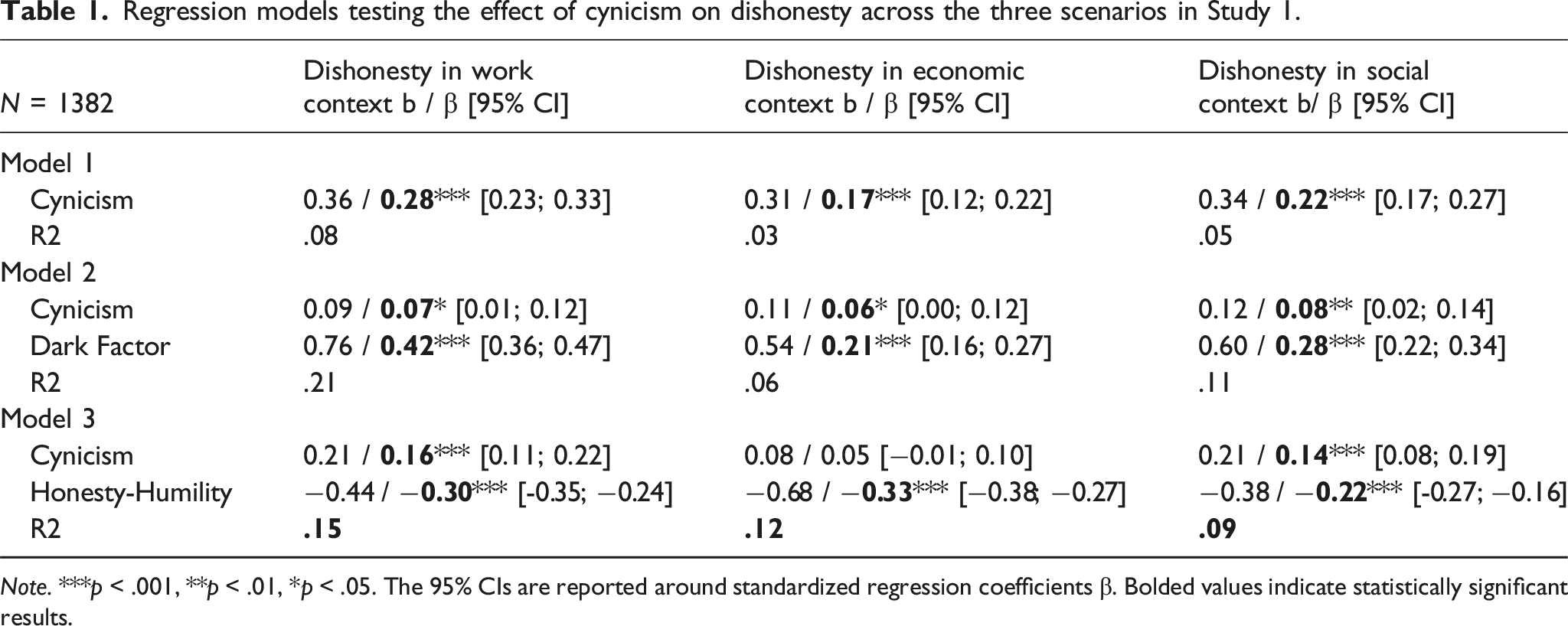
Note. ***p < .001, **p < .01, *p < .05. The 95% CIs are reported around standardized regression coefficients β. Bolded values indicate statistically significant results.
Cynicism-dishonesty relationship in the avoiding exploitation and exploiting others conditions
Regression models testing the interaction effect between condition and cynicism on dishonesty across the three scenarios in Study 1.
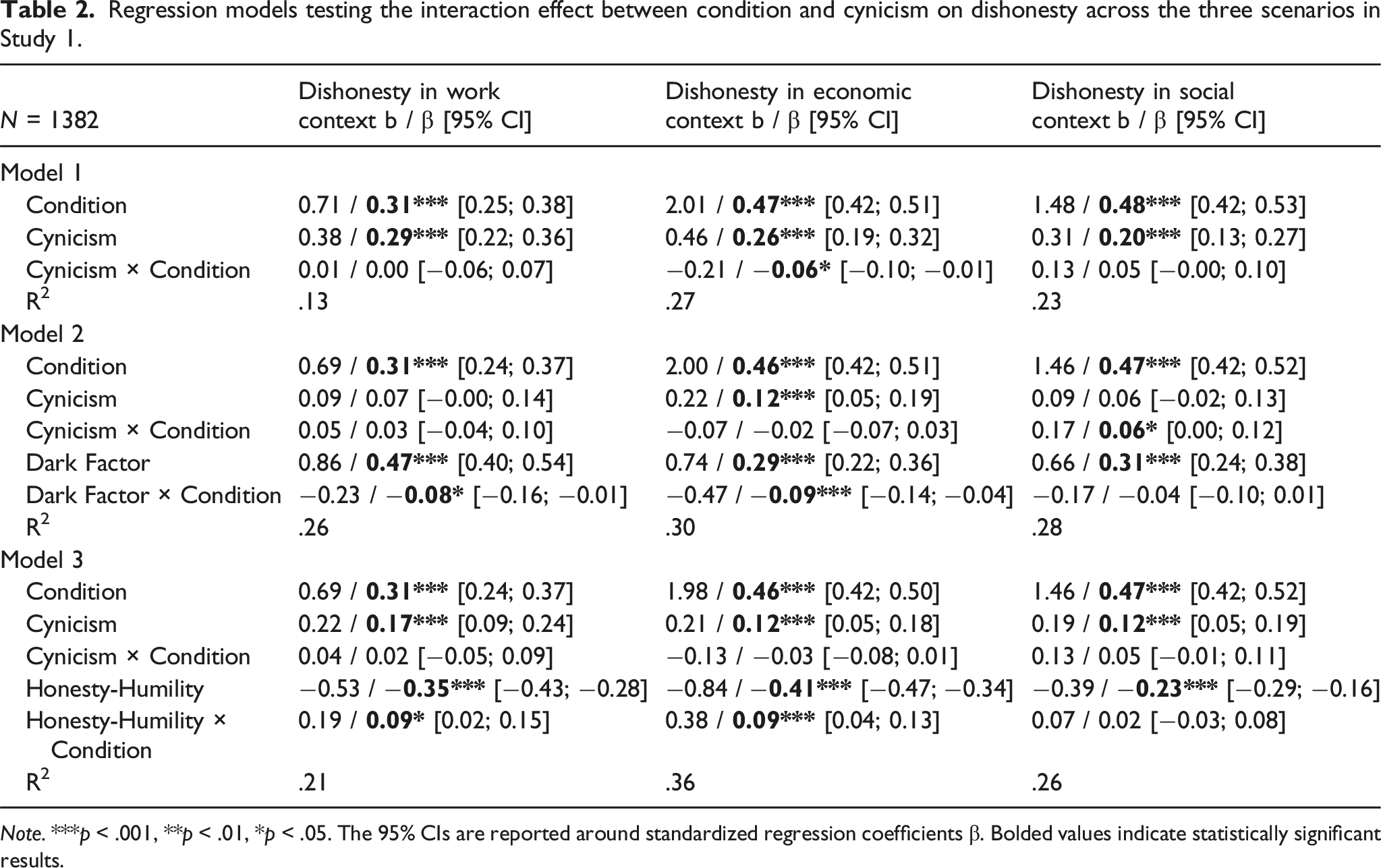
Note. ***p < .001, **p < .01, *p < .05. The 95% CIs are reported around standardized regression coefficients β. Bolded values indicate statistically significant results.
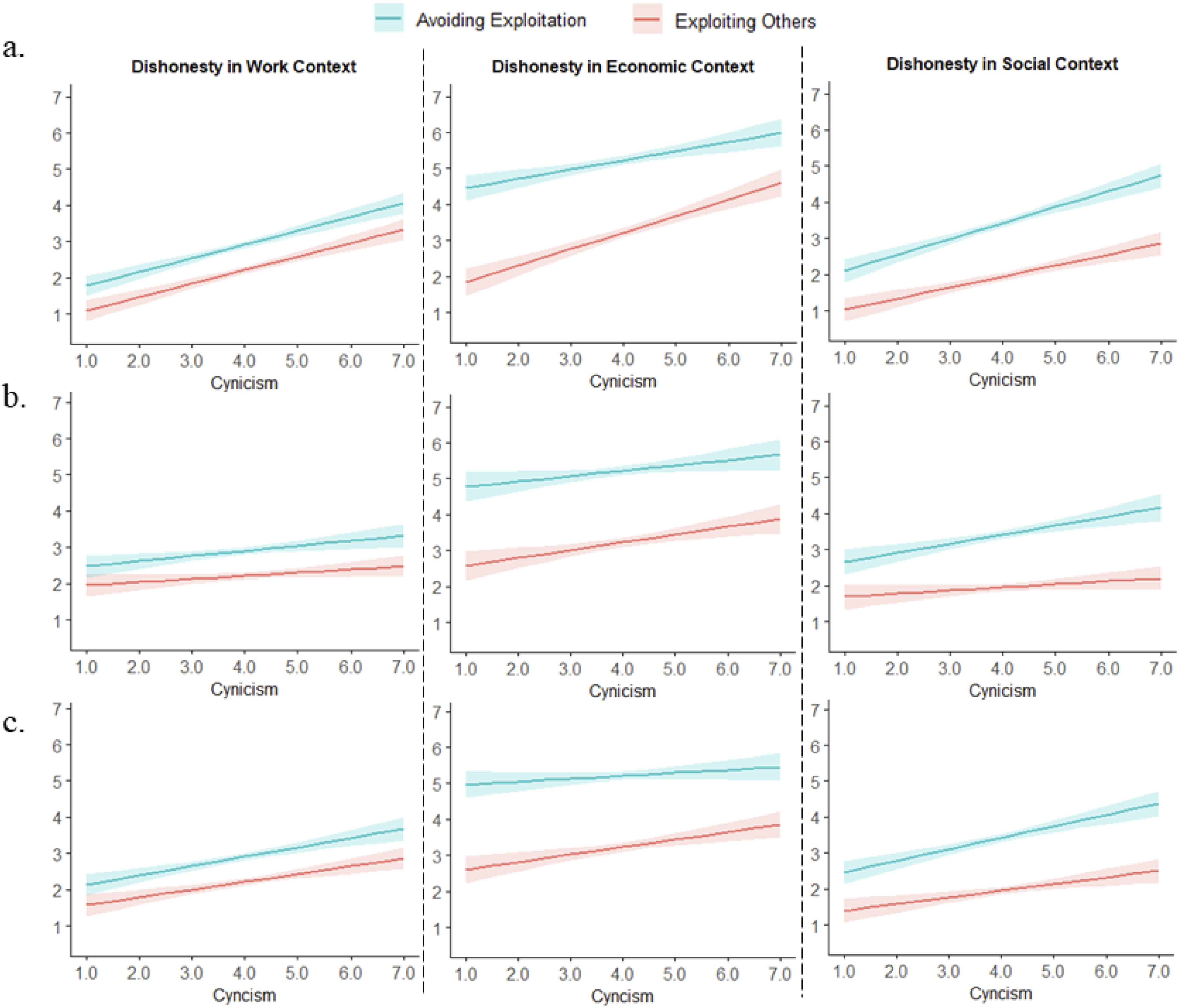
Interaction effect between cynicism and condition across the three scenarios in Study 1. Note. a = Model 1 (cynicism, condition, and cynicism × condition interaction), b = Model 2 (Model 1, including D and D × condition interaction), c = Model 3 (Model 1, including H-H and H-H × condition interaction).
For Model 2, we added D and its interaction with the condition to the previous model. Results revealed a significant interaction effect between cynicism and condition for the social context scenario (p = .042), but no cynicism × condition interactions for the work context (p = .468), nor the economic context scenario (p = .473). Probing the interaction for the social context scenario showed that the relationship between cynicism and dishonesty was only significant in the avoiding exploitation condition (b = 0.25, p < .001), but not in the exploiting others condition (b = 0.09, p = .12) (see Figure 1(b), social context). Lastly, for Model 3, we added H-H and its interaction with the condition to Model 1. Results revealed no significant cynicism × condition interaction for any of the scenarios (work context: p = .540; economic context: p = .136; social context: p = .082).
D-dishonesty and H-H-dishonesty relationship in the two conditions
Our analyses of Models 2 and 3 allowed us to further explore whether the link between dishonesty and other individual differences varies across contexts. Model 2 included the interaction between D and condition. Results of the model revealed a significant interaction effect for the work context (p = .018) and the economic context scenarios (p < .001) (see Table 2). Probing these interaction further, we found that, for the work context scenario, the relationship between D and dishonesty was stronger in the exploiting others condition (b = 0.86, p < .001) than the avoiding exploitation condition (b = 0.63, p < .001) (see Figure 2, work context). The same pattern emerged for the economic context scenario (b
exploiting others
= 0.74, p
exploiting ethers
< .001 vs. b
avoiding exploitation
= 0.27, p
avoiding exploitation
< .001) (see Figure 2, economic context). The interaction between D and condition was not significant in the social context scenario (p = .136). Interaction effect between Condition and Dark Factor (Model 2) across the three scenarios in Study 1.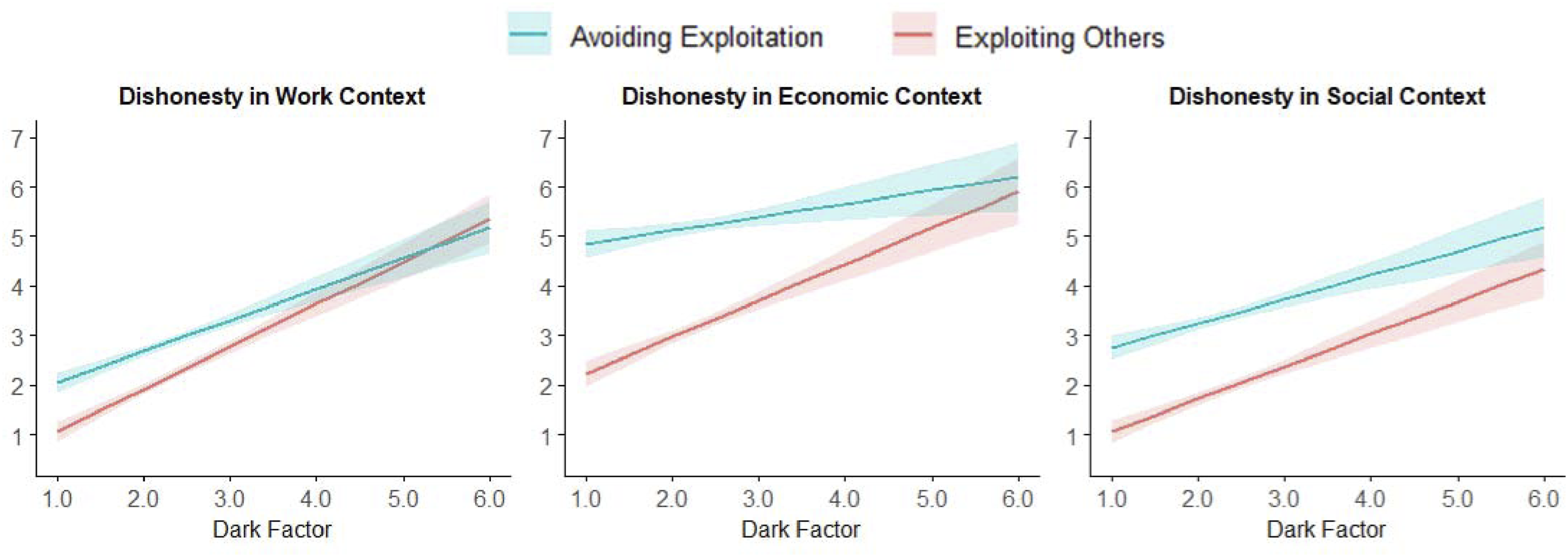
Model 3 included the interaction between H-H and condition. Results of the model showed a significant interaction effect in the work context (p = .014) and economic context scenarios (p < .001) (see Table 2). Probing these interactions further revealed that, for the work context scenario, the relationship between H-H and dishonesty was stronger in the exploiting others condition (b = −0.53, p < .001) than the avoiding exploitation condition (b = −0.34, p < .001) (see Figure 3, work context). The same pattern emerged for the economic context scenario (b
exploiting others
= −0.84, p
exploiting others
< .001 vs. b
avoiding exploitation
= −0.47, p
avoiding exploitation
< .001) (see Figure 3, economic context). As with D, the interaction between H-H and condition was not significant in the social context scenario (p = .419). Interaction effect between Condition and Honesty-Humility (Model 3) across the three scenarios in Study 1.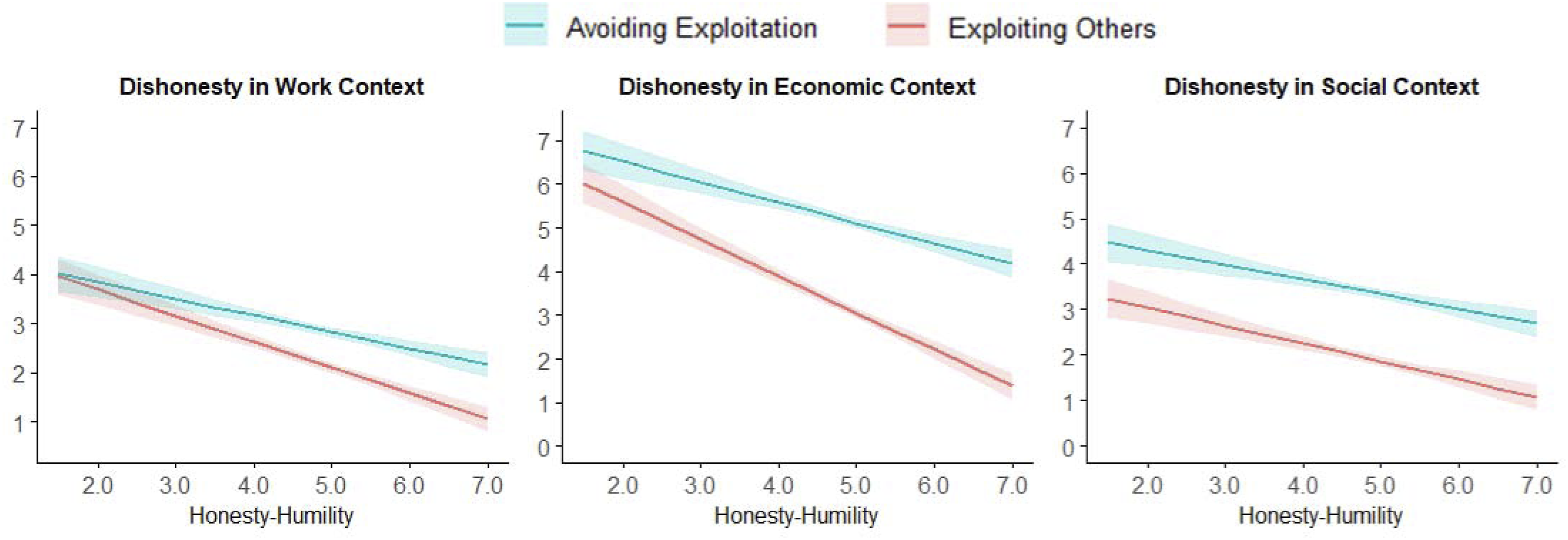
Additional robustness checks
Bayesian analyses
In addition to our main confirmatory analyses, we also tested H1 and H2 (across Models 1, 2, and 3) with Bayesian analyses, using the default priors in JASP (Heo et al., 2020). 5 This allowed us to test (1) how much more likely H1 is compared to H0 and (2) how much more likely H2c is compared to H2a and H2b.
First, focusing on H1 (cynicism-dishonesty link), we ran Bayesian regression analyses with only cynicism as a predictor of dishonesty, across the three scenarios (Model 1). For all three scenarios, consistent with the results of the NHST analysis, there was “extreme” 6 evidence in favor of H1 over H0 (work context scenario: BF10 = 3.23 × 10²²; economic context scenario: BF10 = 3.50 × 10⁷; social context scenario: BF10 = 3.78 × 10¹³). Furthermore, when controlling for D (Model 2) by including it in the null model, we found “weak” evidence for the alternative hypothesis (that cynicism predicted dishonesty beyond the effect of D) in the social context scenario (BF10 = 2.54). In contrast, we found “weak” evidence in favor of the null hypothesis in the economic context scenario (BF10 = 0.68). Additionally, for the work context scenario, we found no meaningful evidence for either the null or alternative hypothesis (BF10 = 1.03). Finally, when controlling for H-H (Model 3) by including it in the null model, we found “extreme” evidence for the alternative hypothesis (that cynicism predicted dishonesty beyond the effect of H-H) in the work context (BF10 = 4.30 × 10⁶) and social context scenarios (BF10 = 11,341.16), but “weak” evidence in favor of the null hypothesis in the economic context scenario (BF10 = 0.25).
To test the robustness of our findings regarding the cynicism × condition interaction (H2a, H2b, H2c), we also conducted Bayesian analyses comparing a model that did not include the cynicism × condition interaction (the null model) with a model that did include this interaction (the alternative model). For each analysis (across Models 1–3), the null model included all other relevant variables (i.e., Model 1: condition and cynicism; Model 2: condition, cynicism, D, and the D × condition interaction; Model 3: condition, cynicism, H-H, and the H-H × condition interaction). When testing Model 1, the results showed “strong” evidence in favor of the null model for the work context scenario (BF10 = 0.08), and “weak” evidence in favor of the null model for the social context scenario (BF10 = 0.36). We found “weak” evidence in favor of the alternative model for the economic scenario (BF10 = 1.36), mirroring the findings of our earlier (NHST) analyses.
Testing Model 2, we found “moderate” evidence in favor of the null model for the work context (BF10 = 0.11) and economic scenario scenarios (BF10 = 0.10), and “weak” evidence in favor of the null model for the social context scenario (BF10 = 0.62). Finally, when testing Model 3, the results indicated “moderate” evidence in favor of the null model for the work context scenario (BF10 = 0.11), “moderate” evidence in favor of the null model for the economic context scenario (BF10 = 0.21), and “weak” evidence in favor of the null model for the social context scenario (BF10 = 0.37).
Ordinal regressions
Overview of results for each hypothesis across all analyses in Study 1.
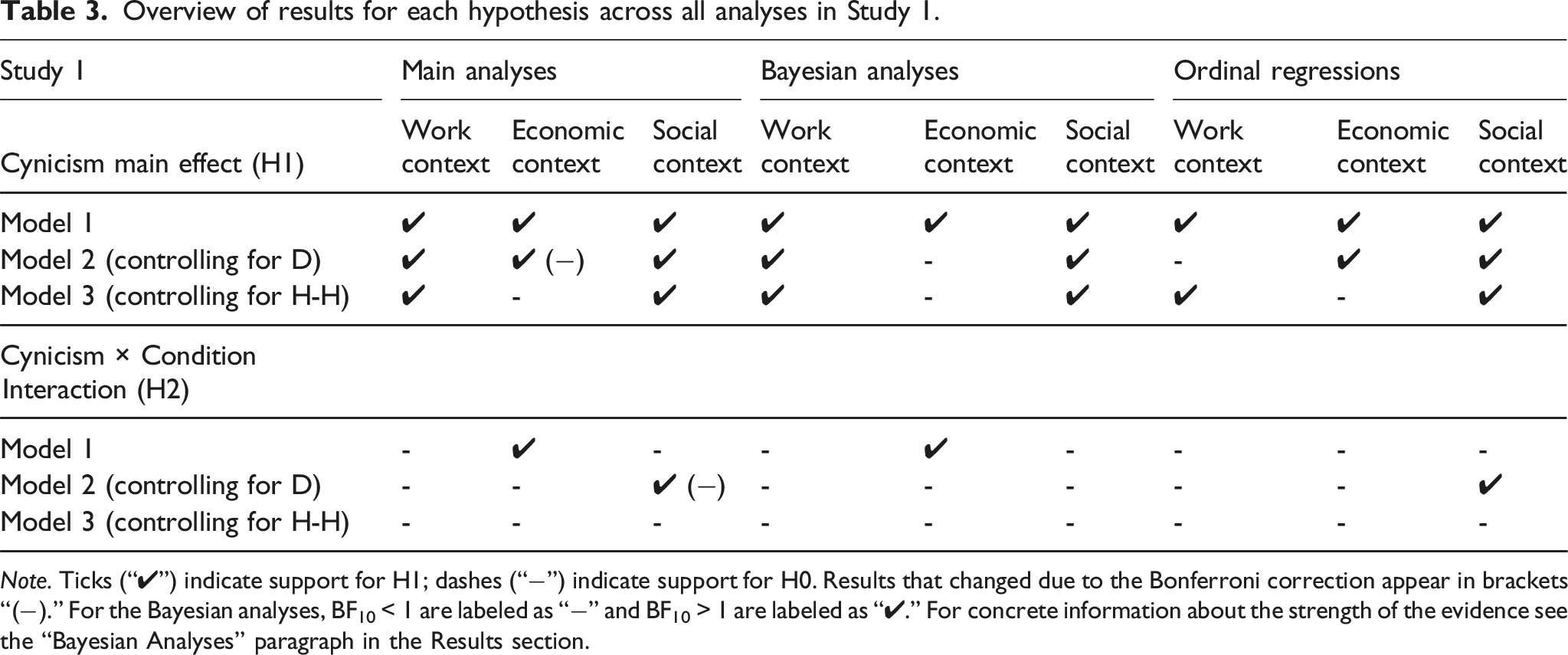
Note. Ticks (“✔”) indicate support for H1; dashes (“−”) indicate support for H0. Results that changed due to the Bonferroni correction appear in brackets “(−).” For the Bayesian analyses, BF10 < 1 are labeled as “−” and BF10 > 1 are labeled as “✔.” For concrete information about the strength of the evidence see the “Bayesian Analyses” paragraph in the Results section.
Bonferroni correction
Lastly, we employed a Bonferroni correction as an additional exploratory robustness check. Specifically, we corrected the alpha level for our analyses to .016 (dividing the original alpha (.05) by three, for each scenario/measure of dishonesty). When testing H1, the relationship between cynicism and dishonesty in the economic scenario was no longer significant in Model 2 (i.e., after controlling for D). All other results remained the same (see Table 3). When testing H2, the interaction effect between cynicism and condition in the social context scenario was no longer significant in Model 2 (i.e., after controlling for D). All other results remained the same (see Table 3).
Discussion
The results of Study 1 indicate that in hypothetical scenarios, cynicism is associated with dishonesty, supporting H1. This effect was present in 22 out of 27 analyses—including those in which we controlled for D and H-H—and occurred across all three contexts (i.e., lying to a colleague in a work context, an acquaintance in an economic context, and a friend in a social context). The evidence for H2 was less clear-cut: Cynicism interacted with the experimental condition (avoiding exploitation vs. exploiting others) in only two of the nine examined models (economic context scenario, Model 1; social context scenario, Model 2). Moreover, the results of the simple slopes pointed in different directions in each of the models (H2a vs. H2b). Given such inconsistencies and the fact that most of our analyses (23 out of 27, see Table 3) failed to provide support for the presence of a cynicism × condition interaction on dishonesty, we conclude that in hypothetical scenarios, cynics’ dishonesty is not driven by one motivation over the other. Instead, in line with most Bayesian results being in favor of the null hypothesis (H2c), it seems like cynics’ dishonesty is equally driven by both motivations—avoiding exploitation and exploiting others.
In addition to our main findings, we detected interactions between the condition and the Dark Factor (in two out of three models) and between the condition and Honesty-Humility (in two out of three models). Specifically, in both the work context and the economic context scenarios, the association between these traits and dishonesty was stronger in situations where one could lie to exploit others (rather than to avoid exploitation).
Study 2
Following up on Study 1, we conducted Study 2 to examine the relationship between cynicism and dishonesty—along with its underlying motives—using a financially incentivized, behavioral measure. Measuring dishonesty with a behavioral task allowed us to avoid some of the limitations of self-report measures (e.g., socially desirable responding, Van de Mortel, 2008) and test whether our findings replicate when dishonesty has financial consequences for participants.
Method
Procedure
Participants engaged in one of two variations of the die rolling task (Abeler et al., 2019). In this task, participants were asked to roll a six-sided playing die in private and report the outcome. The higher the outcome participants reported, the better their payoff. Thus, participants could either report honestly, or lie and report higher values to increase their pay. Participants were randomly assigned to one of two conditions. In each of the conditions, we adjusted the die rolling task such that it either captured the motivation to avoid being exploited, or the motivation to exploit others.
In the avoiding exploitation condition, participants started the task with an endowment of £7 and learned that they would be the potential “victim” in a take-some version of the dictator game. The “dictator” (another player) started the task with £0 and was able to decide how much of the participant’s endowment to take for themselves. Prior to this, participants could protect (some) of their endowment from being taken away by the dictator based on the die roll outcome they reported. The higher the die roll outcome participants reported, the higher the amount of their own endowment they could protect from the dictator (that is, the dictator was able to take away less of their endowment).
Specifically, if participants reported a 1, they could protect £1 of their endowment and the dictator would be able to take away any amount between £0 and £6 (=£7 minus £1); if they reported a 2, they would protect £2 from their endowment and the dictator could take any amount between £0 and £5 etc.; if they reported a 6, they would protect £6 from their endowment and the dictator could take any amount between £0 and £1 (see Appendix C in the Supplemental Materials for exact instructions). Participants were thus motivated to report high die roll outcomes to protect their endowment, and those with a stronger motivation to avoid being exploited would be especially motivated to (mis)report high die roll outcomes. Note that this variation of the task was designed specifically to capture variations in participants’ beliefs about how much the dictator would take away from them. Namely, we assumed that the more cynical individuals are, the more of their endowment they would expect the dictator to take, resulting in a perceived need to protect more of their original endowment by lying.
In the exploiting others condition, participants took the role of the “dictator” in a take-some version of the dictator game. They started the task with an endowment of £0 and learned that another player (the “victim”) started the task with £7. Participants then learned that they could take away a certain amount from the “victim’s” endowment, and that the exact amount would be determined by a lottery. Before the lottery, they could determine the range of amounts they could take away, based on the die roll outcome they reported. Here as well, the higher the die roll outcome participants reported, the higher the (minimum) amount they could take away.
Specifically, if participants reported a 1, they could take a minimum of £1, and the lottery would draw an amount between £1 and £7; if they reported a 2, they could take a minimum of £2, and the lottery would draw an amount between £2 and £7, etc.; if they reported a 6, they could take a minimum of £6, and the lottery would draw an amount between £6 and £7 (see Appendix C in the Supplemental Materials for exact instructions). Participants were thus motivated to report high die rolls (as this increased the minimum amount they could take), and those with a stronger motivation to exploit others would be especially motivated to (mis)report high die roll outcomes. Note that the exploiting others variation of the task does not trigger participants’ fear of being exploited by others, which is captured in the avoiding exploitation condition.
Importantly, our design ensured that the two conditions were comparable on two key dimensions. First, in both conditions, higher die roll reports increased participants’ possible payoff. More specifically, the same die roll report resulted in the same range of payoffs for the participant in both conditions (e.g., reporting a 1 resulted in a possible payoff between £1 and £7 in both the avoiding exploitation and exploiting others conditions; reporting a 6 resulted in a possible payoff between £6 and £7 in both the avoiding exploitation and exploiting others conditions). Second, in both conditions, participants faced uncertainty about their actual payoff. Such uncertainty was created by participants not knowing exactly what the “dictator” would choose in the avoiding exploitation condition. It was then mimicked by implementing a lottery in the exploiting others condition. Thus, in both conditions, participants could affect the range of possible payoffs by reporting a die roll outcome, but the actual payoff was uncertain.
After reading the instructions and before starting the task, participants learned that 10% of them would be assigned a partner and that their behavior in the task would have real financial consequences for them and their counterpart. This approach of incentivizing participants has proven successful in the past, yielding reliable, robust behavioral results (Leib et al., 2023). As such, our task contained no experimental deception and we made sure that participants were informed of that. Specifically, in the consent form participants were told “Importantly, note that all the information we provide you in the instructions is truthful. We hereby follow The American Psychological Association’s (APA) ethical principles and code of conduct, which state that deception in research should not be used, unless absolutely necessary (American Psychological Association, 2017). Since we do not consider it necessary in our study, all information presented to you is accurate” (see Appendix C in the Supplemental Materials). This addition was aimed at increasing participants’ trust in the instructions.
Lastly, to make sure participants engaged in the task without reputation concerns or fear of detection, they were asked to either find a playing die at home and roll it, or type in “roll a die” in Google and report the outcome they observed. This version of the die rolling task has been successfully used in online platforms and led to levels of dishonesty similar to those obtained in laboratory studies (e.g., Leib, 2023; Leib et al., 2023). The full instructions can be found in Appendix C in the Supplemental Materials.
Comprehension and attention checks
To ensure that participants understood the die rolling task, we asked them several comprehension questions (see Appendix C in the Supplemental Materials). Participants were given two attempts to answer these questions correctly. Additionally, we included an attention check (“This is an attention check, please select ‘Somewhat disagree’”) prior to the die rolling task.
Measures
Cynicism, the Dark Factor, Honesty-Humility, and demographics were measured the same way as in Study 1. All three personality measures had reliabilities similar to those observed in Study 1 (Cronbach’s αCynicism = 0.87; Cronbach’s αDark Factor = 0.88, Cronbach’s αHonesty-Humility = 0.77).
Exploitation expectation
Finally, we measured participants’ expectation of being exploited in the avoiding exploitation condition. Based on our prior theoretical reasoning, we expected that cynical individuals’ dishonesty in the avoiding exploitation condition would be driven by their expectations that the dictator would take as much of their endowment as possible. Therefore, at the end of the study, participants in the avoiding exploitation condition were asked to indicate how many pounds (between 0 and 6) they would expect the dictator to take away in the task. Specifically, the item read “Now that you have completed the task we would like to ask you about your general beliefs about Player B. Imagine you had no way of protecting your endowment, and that Player B could have taken away any amount between £0 and £6 from you. How much money do you think Player B would have taken?” Participants could choose between £0, £1, £2, £3, £4, £5, or £6.
Sample size analysis
We determined our sample size based on the same simulation-based power analysis we conducted in Study 1, as we did not have strong reasons to assume different sizes of either the cynicism-dishonesty link or the cynicism × condition interaction across the two studies. 7 We thus planned to recruit 1400 participants.
Sample
Participants were recruited on Prolific and paid £1.5 for participating in our 10-minute study. Those who had already participated in Study 1 could not take part in Study 2. We recruited an initial sample of N = 1,497. Of those participants, one did not give informed consent and was not allowed to proceed to the study, 44 did not continue past the informed consent, 8 did not complete the die rolling task, 5 did not complete all personality measures in full, 59 failed one of the comprehension checks, and 45 failed one of the attention checks. After excluding these participants, the final sample was N = 1,335 (55.4% female, 43.6% male, 0.7% other responses: 9 non-binary, 2 trans men, 1 trans woman, 1 did not specify), with an average age of Mage = 39.54 (SDage = 14.04).
Results
Dishonesty
First, we tested for the presence of dishonesty in the die rolling task. The average die roll report (M = 4.19, SD = 1.42) 8 was above the expected value in the case of honest reporting (EV = 3.5), and a one-sample t test showed that this difference was significant (t (1334) = 17.66, p < .001, d = 0.48). This indicates that at least some participants dishonestly reported higher die rolls. The exact distribution of die roll reports can be found in Appendix E in the Supplemental Materials. 9
Correlations
Correlations between dishonesty in the die roll task, the three personality measures, and demographics can be found in Appendix E in the Supplemental Materials. Notably, we found that participants’ expectations that Player B would take more of their endowment in the avoiding exploitation condition were positively correlated with their cynicism scores (r = .18, p < .001), as well as the extent to which they were dishonest in the die roll task (r = .09, p = .025).
Overall effects of condition and cynicism
As in Study 1, we ran a regression model predicting dishonesty (i.e., higher die roll reports) from the condition (0 = exploiting others, 1 = avoiding exploitation). Results revealed that participants were more dishonest in the avoiding exploitation condition (M = 4.29, SD = 1.40) than in the exploiting others condition (M = 4.09, SD = 1.45; b = 0.21, β = 0.07, p = .009; t (1333) = −2.63, p = .009, d = 0.14).
Regression models testing the effect of cynicism on dishonesty in Study 2.
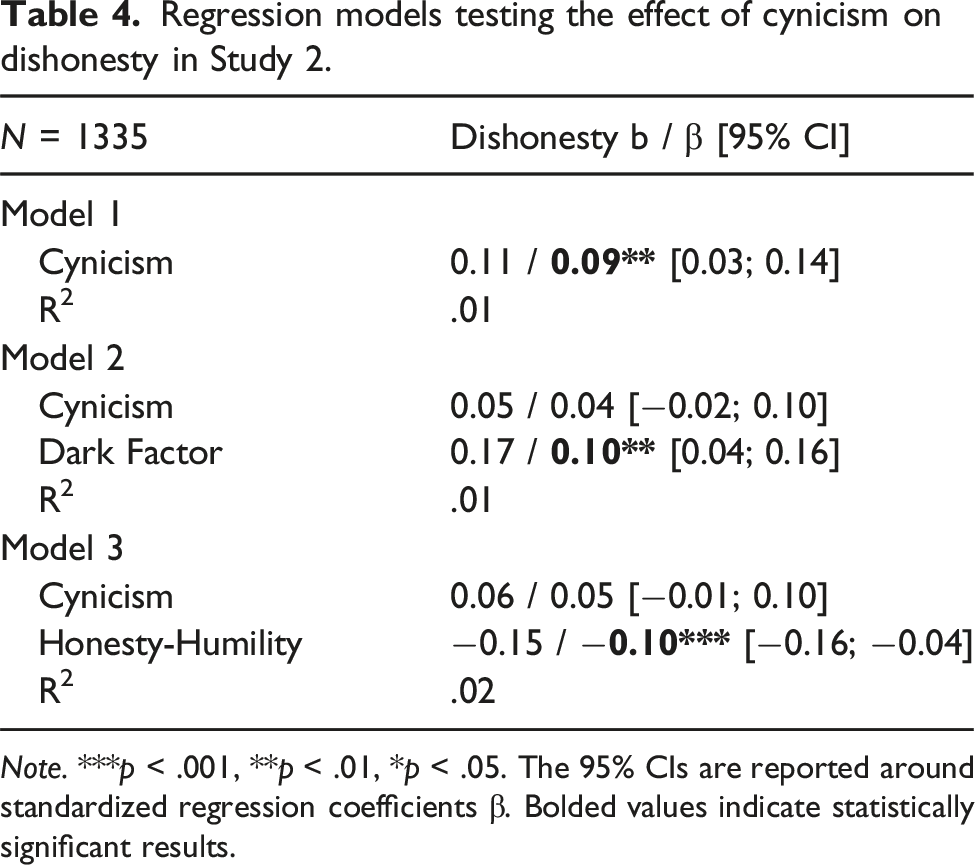
Note. ***p < .001, **p < .01, *p < .05. The 95% CIs are reported around standardized regression coefficients β. Bolded values indicate statistically significant results.
Cynicism-dishonesty relationship in the avoiding exploitation and exploiting others conditions
Regression models testing the interaction effect between condition and cynicism on dishonesty in Study 2.
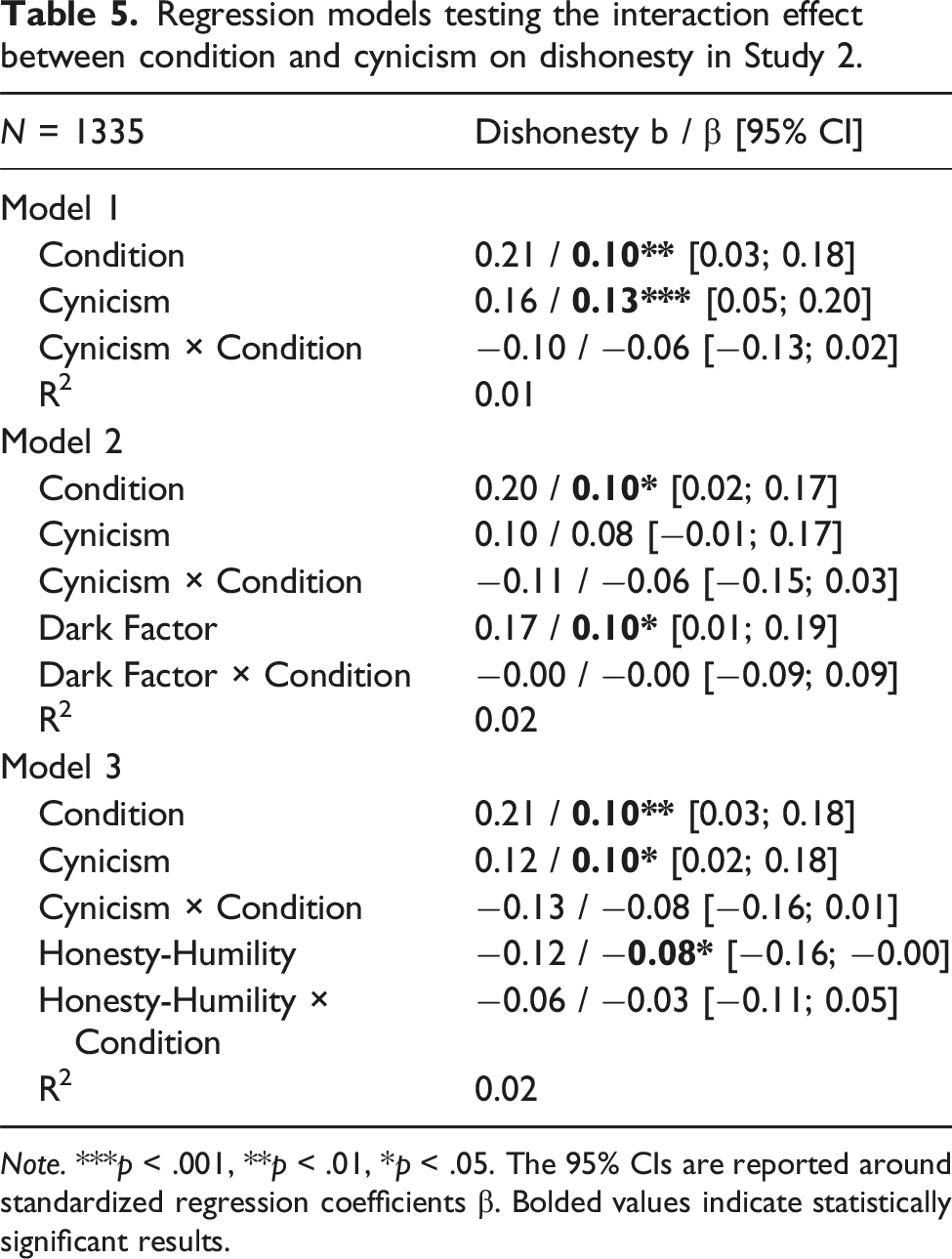
Note. ***p < .001, **p < .01, *p < .05. The 95% CIs are reported around standardized regression coefficients β. Bolded values indicate statistically significant results.
D-dishonesty and H-H-dishonesty relationship in the two conditions
Our analyses of Models 2 and 3 allowed us to further explore whether the link between the other individual differences (D and H-H) and dishonesty varies across contexts. Model 2 included the interaction between D and condition. Results of the model revealed no significant D × condition interaction (p = .981). Model 3 included the interaction between H-H and condition. As with the other personality traits, we found no significant H-H × condition in this model (p = .471).
Additional robustness checks
Bayesian analyses
As in Study 1, we supplemented our standard NHST approach with Bayesian analyses, testing (1) how much more likely H1 is compared to H0, and (2) how much more likely H2c is compared to H2a and H2b. First, examining H1 with Bayesian regression analyses, we found “moderate” evidence for the alternative hypothesis (i.e., that cynicism predicts dishonesty) over the null hypothesis in Model 1 (with only cynicism as a predictor of dishonesty), BF10 = 8.07—mirroring our previous findings using NHST. Next, we tested the robustness of our null findings for Models 2 and 3 by running Bayesian regressions that included D (Model 2) and H-H (Model 3) in the null model. We found “moderate” evidence in favor of the null hypothesis for both Model 2 (BF10 = 0.19) and Model 3 (BF10 = 0.32), indicating that cynicism did not predict dishonesty beyond the effect of D and H-H. Further, to test whether the evidence in all three models is indeed in favor of H2c, we also compared a model that did not include the cynicism × condition interaction (the null model) with a model that did include this interaction (the alternative model). For each analysis (across Models 1–3), the null model included all other relevant variables (i.e., condition, cynicism, D, H-H, and the interactions between condition and D and H-H). We found “weak” evidence in favor of the null model for Model 1 (BF10 = 0.37), Model 2 (BF10 = 0.38), and Model 3 (BF10 = 0.77).
Ordinal regressions
Overview of results for each hypothesis across all analyses in Study 2.
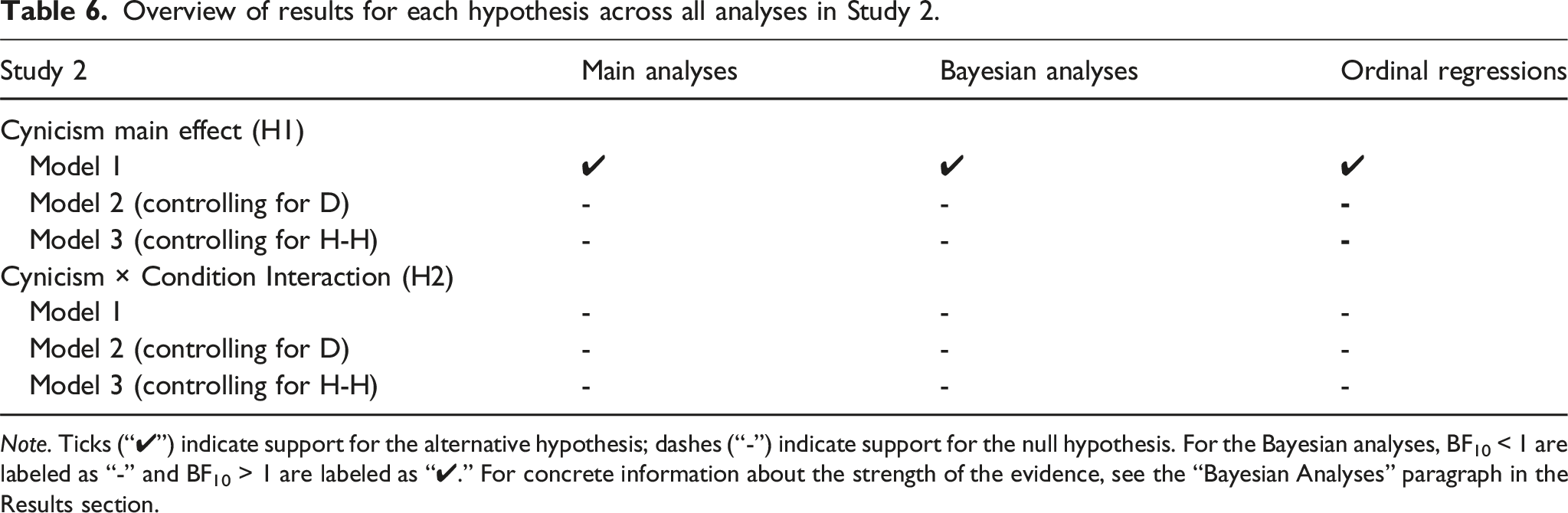
Note. Ticks (“✔”) indicate support for the alternative hypothesis; dashes (“-”) indicate support for the null hypothesis. For the Bayesian analyses, BF10 < 1 are labeled as “-” and BF10 > 1 are labeled as “✔.” For concrete information about the strength of the evidence, see the “Bayesian Analyses” paragraph in the Results section.
Discussion
Study 2 examined the relationship between cynicism and dishonesty in a financially incentivized, behavioral task. Regarding H1, the results demonstrated that cynicism is associated with dishonesty in the die rolling task, such that the more cynical individuals are, the higher die roll values they report. Notably, this effect was no longer significant when adding the Dark Factor or Honesty-Humility to the model, indicating that when it comes to a behavioral measure of dishonesty, cynicism does not explain additional variance above and beyond D and H-H. Further, in line with Study 1, when examining H2, we found no cynicism × condition interaction when examining dishonesty using a behavioral task. We thus conclude that the cynicism-dishonesty link, both in hypothetical scenarios and in an incentivized behavioral task, is not stronger in one setting (i.e., when people can lie to avoid being exploited by others) over another (i.e., when people can lie to exploit others). Instead, when the cynicism-dishonesty association exists, it seems to be equally driven by both motivations. Finally, in contrast to Study 1, we found no significant interaction between the condition and any of the additional personality traits we examined (D and H-H).
General discussion
Across two large-sample studies (total N = 2,717), we investigated the relationship between cynicism and dishonesty. We found that cynical individuals were more likely to lie in hypothetical ethical dilemmas (Study 1). Furthermore, extending this research into the behavioral realm, we found that cynics were also more likely to lie in a financially incentivized die roll task (Study 2)—although this association disappeared when controlling for the Dark Factor and Honesty-Humility. As such, our results conceptually replicate previous research and add to the literature examining the connection between cynicism and unethical behavior (Andersson & Bateman, 1997; Antes et al., 2007; Detert et al., 2008).
We further aimed to tap into the underlying mechanisms behind the cynicism-dishonesty relationship, by comparing this link in two settings—one in which dishonesty could be used to exploit others and one in which it could be used to avoid being exploited by others. A stronger cynicism-dishonesty link in one setting over the other would have indicated that the motivation captured in that setting is a stronger driver of cynics’ dishonesty. However, in both Study 1 and Study 2, our results revealed a non-significant interaction between cynicism and the setting participants were placed in. It thus appears that the strength of the cynicism-dishonesty relationship is similar in both settings, and that both avoiding exploitation and exploiting others are equally relevant motivations for cynics, when they engage in dishonesty. These results proved to be robust, as Bayesian analyses and ordinal regressions (largely) replicated this pattern as well.
In addition to testing the cynicism-dishonesty link in isolation, we further examined this link when controlling for two highly relevant personality traits: the Dark Factor of Personality (Hilbig et al., 2022; Moshagen et al., 2018) and Honesty-Humility (Heck et al., 2018; Hilbig, 2022; Thielmann et al., 2023). This allowed us to extend our investigation beyond its original scope and also report the associations between these additional personality traits and dishonesty. The results showed that D and H-H were consistent predictors of dishonesty across both studies (i.e., in eight out of eight models). This finding aligns with the literature on the Dark Factor and Honesty-Humility, which shows a robust association of these traits with dishonesty (e.g., Heck et al., 2018; Hilbig, 2022; Hilbig et al., 2022; Moshagen et al., 2018; Thielmann et al., 2023).
Furthermore, while we did not find a significant interaction between cynicism and condition across the two studies, results revealed significant interactions between D and condition and H-H and condition in Study 1 (in the work context and the economic context scenarios; i.e., in four out of six models). Specifically, individuals high in D and low in H-H were more likely to lie in situations that allowed them to exploit others (compared to situations that allowed them to avoid exploitation). Notably, however, these interactions were not present in Study 2.
There are several possible explanations for these between-study differences. First, on a theoretical level, it might be that individuals presented with hypothetical scenarios are not able to accurately estimate the extent to which they would engage in dishonest behavior “in real life.” Indeed, prior work has shown that self-reported (im)moral behavior in hypothetical scenarios does not always translate into actual behavior (Batson et al., 1999; Baumert et al., 2013; Monin & Merritt, 2012). This in turn could have reduced the associations between the personality traits and (behavioral) dishonesty.
Second, the larger effects in Study 1 versus Study 2 could be due to common method bias. In Study 1, we assessed both the personality traits and dishonesty using self-report measures. Conversely, in Study 2, dishonesty was measured using a behavioral, incentivized task. The common method in Study 1 could thus capture not only the true association between variables, but also participants’ response biases (e.g., their socially desirable response tendencies or their scale use preferences), which may have carried over from one measure to the next. As a result, the associations between the personality measures and self-reported dishonesty could have been inflated in Study 1. In line with the idea that self-report measures tend to correlate more strongly with each other than with behavioral measures, it is also possible that Study 2 had less power to detect small effects, relative to Study 1.
Notably, however, we collected larger samples than most previous cynicism research (Naverage ≈ 200, see e.g., Choy et al., 2021; Stavrova et al., 2020; Stavrova & Ehlebracht, 2019b; compared to N = 1,382 for Study 1 and N = 1,335 for Study 2) and our obtained effect sizes largely align with those found in previous literature. Specifically, the cynicism-dishonesty association in Study 1 was of similar size (r’s between .17 and .27) to effects found in previous research that used hypothetical ethical dilemmas (r’s between .10 and 30, see Andersson & Bateman, 1997; Antes et al., 2007; Detert et al., 2008). This was also the case for the association between cynicism and behavioral dishonesty in Study 2 (r = .09), whose effect size was similar to that of cynicism (as measured by participants’ estimates of the number of other people who would cheat) on cheating in a coin toss task (r = .11, see Hilbig et al., 2022).
Overall, our findings extend existing literature on the consequences of having a cynical worldview (Choy et al., 2021; Kaplan et al., 2004; Stavrova et al., 2020) and carry both theoretical and practical implications. The insight that cynics are equally motivated to lie to avoid exploitation and to exploit others has implications for how we view cynicism. For example, recent research has shown cynicism to be more strongly associated with the fear of being exploited than the willingness to exploit others (Stavrova et al., 2023). Our results, however, show that when it comes to dishonesty, cynics are not more motivated to lie by the desire to avoid exploitation. Instead, we find that, while their worldview is focused on other people’s (lack of) morality, cynics themselves are not only sensitive to falling victim to others, but also actively take the opportunity to exploit other people through dishonesty. These results support early theoretical accounts that describe cynics as opportunists who will use any power they have over others to gain an advantage for themselves (Mirvis & Kanter, 1989; Odou & De Pechpeyrou, 2011). In addition, they align with our reasoning that cynics’ motivation to exploit others could be directly tied to their motivation to avoid exploitation, for example, due to their zero-sum worldview (see Różycka-Tran et al., 2015).
From a practical perspective, our results demonstrate that in order to curb cynics’ dishonesty, interventions will have to account for both motivational pathways—the desire to avoid exploitation and the desire to exploit others. In an environment where cynicism is widespread, a combination of measures preventing people from exploiting others, and measures aimed at reducing the fear of being exploited, might be needed.
Limitations and future directions
For Study 1, we designed our scenarios such that one condition focused on the motivation to avoid being exploited, while the other focused on the motivation to exploit others. We further conducted a pilot study to make sure participants indeed perceived the two conditions as such (see Appendix A in the Supplemental Materials). At the same time, it might be that for some scenarios, the distinction between the two conditions was not strong enough, leading cynics to be equally dishonest across the two conditions. For example, the work context scenario in the exploiting others condition deals with (dishonestly) delegating more tasks to a colleague, and thus exploiting this colleague in order to do less overtime. However, delegating more tasks might have also been perceived as avoiding exploitation (e.g., by one’s boss), leading to a small difference between conditions. This is supported by the results of the pilot study, which show the smallest gap in perceptions between conditions in the work context scenario.
Similarly, in Study 2, the possibility of being exploited in the die roll task was manipulated by the setting, but not explicitly highlighted to participants in the instructions. Not highlighting participants’ vulnerability in the avoiding exploitation condition might have made participants focus on other, more general aspects of the task (such as maximizing profit) without considering their interaction partner in a substantial manner. As such, the fact that they could gain £6 by lying about rolling a 6 could have been interpreted as a way of exploiting the experimenter, rather than protecting oneself from the “dictator.” Future research could thus further emphasize the distinctions between the two settings, for example, by highlighting the fact that a counterpart can (and will) exploit the participant or fixing participants’ beliefs about the extent of exploitation (e.g., by informing them about the average amount their counterparts take in the task).
In Study 1, we captured self-reported dishonesty as it could plausibly occur in a variety of everyday situations: in a work, economic, and social context. While we deem these three contexts as sufficiently different from one another, they are by no means exhaustive. It might be that cynics tend to lie more to avoid exploitation than to exploit others (or vice versa) in a context that was not captured in the present study. For example, we did not include a scenario where one could lie to a very close other (e.g., one’s partner or family), or even to a supervisor or subordinate. Given that the largest cynicism-dishonesty association we found in Study 1 was in the work context, it is possible that cynics are particularly sensitive to such contexts. Indeed, prior work has speculated that cynics tend to exploit others when they are put in positions of power (see Mirvis & Kanter, 1989), and found that people generally dislike cynical leaders (Spiridonova et al., 2023). Thus, examining the cynicism-dishonesty link in contexts where participants are interacting with a subordinate instead of a peer might elicit different results.
Further, our behavioral measure could only capture one type of dishonest behavior: lying to avoid being financially exploited, or to exploit others for financial gain. This economic focus limits the conclusion we can draw about cynics’ dishonest behavior in general. The small effect of cynicism on dishonesty in the die roll task (r = .09) could be (partially) explained by this focus, such that financial dishonesty might not be the most common manifestation of cynics’ (behavioral) dishonesty. Supporting this notion, we also found the smallest correlation between cynicism and dishonesty in the economic context scenario (r = .17), which involved lying to an acquaintance about one’s financial situation. As such, we call on future research to investigate the relationship between cynicism and dishonest behavior in more naturalistic and ecologically valid settings (see e.g., Cohn et al., 2019).
Finally, future work could investigate whether there are additional motivations that drive cynics’ dishonesty, beyond the desire to avoid exploitation or to exploit others. While we derived these two motivational pathways from existing research and theory on cynicism, it might be that there are other, stronger motives, which we did not account for. For instance, it might be that cynics’ negative view of humanity leads them to engage in dishonesty purely out of spite, rather than for any instrumental reasons. Future research could examine this possibility, by measuring which (additional) motivations cynics are driven by in different situations, and which (positive and negative) emotions are evoked for them in such situations.
Conclusion
Cynicism is centered on the belief that other people will use unethical means—including dishonesty—to satisfy their self-interest. In this registered report, we demonstrate that cynics also engage in dishonesty themselves—though this effect is stronger and more robust in hypothetical scenarios than in incentivized behavioral tasks. We further find that the cynicism-dishonesty link is equally strong in situations where dishonesty helps individuals to avoid being exploited and situations where it helps them to exploit others. Thus, it seems that both motivations are relevant when cynics engage in dishonesty. As such, in order to curb cynics’ dishonesty, behavioral interventions should address both motivational pathways, for example, by designing environments that reduce the fear of exploitation, as well as the opportunity to exploit others using dishonest means.
Supplemental Material
Supplemental Material - Do cynics lie to avoid exploitation, to exploit others, or not at all? A registered report on the relationship between cynicism and dishonesty
Supplemental Material for Do cynics lie to avoid exploitation, to exploit others, or not at all? A registered report on the relationship between cynicism and dishonesty by Teodora Spiridonova, Margarita Leib, Ilja van Beest, and Olga Stavrova in European Journal of Personality
Footnotes
Declaration of conflicting interests
The author(s) declared no potential conflicts of interest with respect to the research, authorship, and/or publication of this article.
Funding
The author(s) received no financial support for the research, authorship, and/or publication of this article.
Open science statement

Supplemental Material
Supplemental material for this article is available online.
Notes
References
Supplementary Material
Please find the following supplemental material available below.
For Open Access articles published under a Creative Commons License, all supplemental material carries the same license as the article it is associated with.
For non-Open Access articles published, all supplemental material carries a non-exclusive license, and permission requests for re-use of supplemental material or any part of supplemental material shall be sent directly to the copyright owner as specified in the copyright notice associated with the article.
