



Abstract
Unethical acts are often witnessed by bystanders who may lie to cover up for the transgressor, thereby helping them avoid sanctions. Here, we investigate the dispositional basis of such unethical loyalty, including the psychological processes involved. Interestingly, as unethical loyalty helps the transgressor, it sets prosociality against honesty—two behaviors that are usually unified within the same traits, most prominently HEXACO Honesty-Humility. Prior research suggests that individuals high in Honesty-Humility may solve this conflict in favor of honesty, but evidence is scarce and inconclusive. We aimed at extending previous findings in a pre-registered study (N = 472) using a newly developed online version of an incentivized behavioral paradigm measuring unethical loyalty. As expected, Honesty-Humility showed a medium-sized negative relation with unethical loyalty, which was partly attributable to individual differences in perceiving unethical loyalty as (un)justifiable. Specifically, lower levels of Honesty-Humility were associated with perceiving unethical loyalty as justifiable particularly because it profits oneself, whereas considering unethical loyalty as profitable for the transgressor—and thus prosocial—was not significantly related to Honesty-Humility. This suggests that part of the predictive power of Honesty-Humility for unethical loyalty can be attributed to systematic differences in how individuals justify such unethical acts.
Plain language summary
Often, when someone is dishonest or does something wrong, others know about it. These others can then decide whether they want to expose the wrongdoer or cover up for them, even if covering up means that they have to lie themselves. We looked into why some people lie to cover up for wrongdoers, which is called being “unethically loyal.” Unethical loyalty has two important features: It requires being dishonest while at the same time helping another person (the wrongdoer). What is interesting is that these two features usually do not go together within the same people, that is, a person who is likely to lie does usually not help others, whereas those who are honest also tend to help. The tendency to be honest and helpful is described by the personality trait Honesty-Humility. Now, since being unethically loyal means to be dishonest and helpful, it is unclear who will engage in unethical loyalty and why so. Prior research suggests that people low in Honesty-Humility might be more likely to engage in unethical loyalty, but evidence is limited. Therefore, we studied unethical loyalty online with 472 participants. As expected, people with lower levels of Honesty-Humility were more likely to engage in unethical loyalty. This was partly because they considered unethical loyalty justifiable, especially because it benefits the unethically loyal person (they received money for it). In contrast, Honesty-Humility was unrelated to considering unethical loyalty justifiable because it helped the wrongdoer. We conclude that lower levels of Honesty-Humility go along with a greater tendency to cover up for wrongdoers because people low in Honesty-Humility can more easily justify such behavior by self-profit.
Introduction
Unethical behavior comes in many forms and flavors. Whereas one individual—the transgressor—usually initiates an unethical act, others may eventually enable a successful realization by actively covering up for the transgressor. Indeed, witnesses of unethical acts face the decision to either expose the transgressor or cover up for them. What renders such a decision difficult is that the latter often yields benefits which can be immaterial (e.g., maintaining a good relationship with the transgressor) or material in nature (e.g., in the form of a bribe). Consider, for example, a tax auditor who uncovers a company’s tax fraud and who is being bribed to sugarcoat their report and state that all taxes have been paid correctly. Such acts essentially describe an act of unethical loyalty, defined as “individuals’ willingness to lie to cover up others’ dishonesty” (Thielmann et al., 2021, p. 363). With the current work, we aim to expand the knowledge on unethical loyalty by specifically targeting corresponding individual differences and their underlying psychological processes.
Unethical loyalty is characterized by two seemingly conflicting features: dishonesty and prosociality. First, engaging in unethical loyalty means to lie to protect a transgressor, rendering it unethical in two ways, namely (i) by lying oneself and (ii) by supporting another’s unethical act. Second, unethical loyalty helps the transgressor to achieve their (unethical) goal and thereby protects them from sanctions. As such, the actor is loyal towards the transgressor (Waytz et al., 2013). In sum, unethical loyalty combines being unethical, that is, lying and supporting the realization of an unethical act, with what is commonly considered prosocial (Pfattheicher et al., 2022), that is, helping and loyalty.
Unethical loyalty’s dispositional basis
The case of unethical loyalty is particularly interesting when considered through the lens of (basic) personality traits. This is because dishonesty and prosociality are usually subsumed within the same traits, though in opposite directions. The basic trait showing most consistent negative relations with dishonest behavior (Heck et al., 2018; Hilbig, 2022) while at the same time showing most consistent positive relations with prosocial behavior (Thielmann et al., 2020; Zettler et al., 2020) is Honesty-Humility, which is defined as “the tendency to be fair and genuine in dealing with others” (Ashton & Lee, 2007, p. 156). By definition, the low pole of Honesty-Humility is described by characteristics such as insincerity, slyness, greediness, and pretentiousness, whereas the high pole is described by characteristics such as sincerity, loyalty, modesty, and fairness (Ashton & Lee, 2007). Thus, the question arises: What happens to the predictive power of Honesty-Humility (and related traits) if honest and prosocial behavior are at odds (Hilbig, 2022a; 2022b), as is the case for unethical loyalty?
To date, evidence on the relation between Honesty-Humility and behavior that combines dishonesty with prosociality—and vice versa—is inconclusive. Some studies suggest that individuals with higher levels on Honesty-Humility may indeed lie when it is prosocial, that is, when it benefits others (Levine & Lupoli, 2022). For example, when dishonesty could benefit a trustor after the trustor had placed their trust in the trustee, higher levels of Honesty-Humility among trustees were associated with greater dishonesty (Ścigała et al., 2020a). Similarly, Honesty-Humility was positively related to dishonesty when honesty could have hurt another individual emotionally (Paul et al., 2022); however, the corresponding effect was small and became negligible once individual differences in the remaining HEXACO dimensions were statistically accounted for. In contrast to these findings, other studies suggest that the usually observed negative link between Honesty-Humility and dishonesty remains even when lying is prosocial (Thielmann et al., 2024; Ścigała et al., 2019), although it may potentially be weaker than when dishonesty is purely selfish (Klein et al., 2017). Relatedly, there is evidence suggesting a negative link of Honesty-Humility to bribe-taking (Tanner et al., 2022; Vranka & Bahník, 2018), which is relevant for the dispositional basis of unethical loyalty because transgressors often incentivize unethical loyalty by offering a share of their payoff—a bribe—to witnesses. By implication, individuals high in Honesty-Humility should be less willing to accept such bribes.
More direct evidence regarding unethical loyalty and its link to Honesty-Humility comes from a previous lab-based study using an incentivized behavioral paradigm to measure unethical loyalty directly (Thielmann et al., 2021). This study reported a small-to-medium-sized negative relation between Honesty-Humility and unethical loyalty. However, the sample of this previous study measuring unethical loyalty was relatively small (n = 144 witnesses) and consisted of students only, with an average age of 23.4 years and low variance in age (i.e., SD = 4.6; age range = 18–50 years). As age correlates positively with both prosociality (Matsumoto et al., 2016) and honesty (Gerlach et al., 2019), and Honesty-Humility increases with age (Ashton & Lee, 2016), this particular characteristic of the sample may bias prevalence estimates of unethical loyalty and restrict the variance of Honesty-Humility in the sample. Moreover, the prevalence of unethical loyalty among those with high levels on Honesty-Humility was still substantial. Thus, replicating this finding in a larger and more diverse sample (in a new experimental setting) not only serves to validate previous results and test whether higher levels of Honesty-Humility are indeed associated with a tendency to prioritize honesty over prosociality when presented with the opportunity to lie to cover up someone else’s transgression (i.e., to engage less in unethical loyalty); it is also important to establish a foundation for investigating the processes underlying the relation between Honesty-Humility and unethical loyalty.
Justifying unethical loyalty
A crucial, yet unanswered question is why individuals low in Honesty-Humility engage in unethical loyalty—in other words, which cognitive and motivational processes are involved. Understanding these processes is important because it sheds light on how personality traits translate into specific behaviors in complex moral contexts. Indeed, understanding the processes at play when it comes to individual differences in behavior is a main priority in contemporary personality psychological research (Back & Vazire, 2015; Baumert et al., 2017; Mõttus et al., 2020).
Research suggests a primary role of justifications as a key process involved in the explanation of unethical behavior (e.g., Hilbig et al., 2022a; Leib & Shalvi, 2020). Justifications refer to “the process of providing reasons for questionable behaviors and making them appear less unethical” (Shalvi et al., 2015, p. 125). Having a viable justification for an unethical act may increase subjective justifiability and, thereby, increase the likelihood of corresponding behavior while allowing the actor to maintain a positive self-image. Note that justifications are to be distinguished from the subjective justifiability of an action. Justifications describe “subjective reasons why a particular behavior is justifiable in a given situation” (Hilbig et al., 2022a, p. 2734), for example, “everyone does it” (Hilbig et al., 2022a; Keizer et al., 2008). Justifiability (i.e., “it is ok to do it, too”), in turn, results from the use of justifications and refers to “the subjective extent to which the behavior is justifiable” (Hilbig et al., 2022a, p. 2734).
By implication, the fact that individuals systematically differ in their tendency to behave unethically (Zettler et al., 2020) suggests that they will also likely differ in the tendency to use corresponding justifications and to judge an action as justifiable. Supporting this reasoning, individuals with lower levels on Honesty-Humility have been found to generate more and better justifications for dishonesty (Ścigała et al., 2020b). Similarly, those with higher levels on the Dark Factor of Personality (Moshagen et al., 2018), which is strongly negatively linked to Honesty-Humility, hold various (e.g., cynical) justifying beliefs that account for aversive behavior through increasing its subjective justifiability (Hilbig et al., 2022a).
A common source of potential justifications are features of the situation (e.g., Bassarak et al., 2017; Pittarello et al., 2015). In the context of unethical loyalty, two such features related to the involved parties’ outcomes come to mind. First, unethical loyalty maximizes the self-interest of the unethically loyal person. Given that the initial transgressor will usually offer an incentive—a bribe—to make individuals cover up for them, unethical loyalty results in a benefit for the person covering up which, in turn, can be used as a justification (e.g., “I’d be stupid not to take the offer”). Second, unethical loyalty is prosocial to the extent that it benefits the transgressor by protecting them from sanctions. Thus, individuals may justify unethical loyalty by them wanting or even feeling obliged to help (e.g., “I ought to protect them”). These outcomes may be anticipated when a situation affords unethical loyalty and drive the corresponding perception of justifiability.
Based on the above reasoning and evidence, we aimed to investigate whether systematic differences in the perceived justifiability of unethical loyalty and corresponding justifications individuals draw on can account for the (to-be-replicated) link between Honesty-Humility and unethical loyalty. Based on the previous finding that Honesty-Humility is negatively related to unethical loyalty (Thielmann et al., 2021), we expected Honesty-Humility to also be negatively associated with the perceived justifiability of unethical loyalty. Moreover, individuals will likely systematically differ with regard to the specific justifications they use when engaging in unethical loyalty as a function of Honesty-Humility: Individuals high in Honesty-Humility may arguably be attracted by the fact that unethical loyalty is prosocial and, therefore, justify unethical loyalty because it has a positive impact on another person (i.e., the transgressor). Individuals low in Honesty-Humility should rather be attracted by the fact that unethical loyalty may profit themselves and thus justify unethical loyalty based on economic grounds.
The present investigation
Taken together, we aimed to extend prior findings with a larger and more diverse sample by investigating the role of justifications as a potential mechanism driving the link between Honesty-Humility and unethical loyalty. We derived and preregistered the following hypotheses: First, in line with prior evidence (Thielmann et al., 2021), we expected Honesty-Humility to be negatively related to behavioral unethical loyalty (H1). This replication of prior work serves as a foundation for exploring the nuanced mechanisms underlying unethical loyalty, particularly focusing on justifications as mediating factors. Second, we hypothesized that the negative relation between Honesty-Humility and unethical loyalty can be attributed to individual differences in perceiving unethical loyalty as justifiable. Specifically, the negative relation between Honesty-Humility and unethical loyalty should be mediated by the perceived justifiability of unethical loyalty (H2). By implication, this also suggests a positive relation between the perceived justifiability of unethical loyalty and engaging in unethical loyalty (H2a), and a negative relation between Honesty-Humility and the perceived justifiability of unethical loyalty (H2b). Third and finally, we expected that individuals will differ with regard to the specific justifications they use as a function of their Honesty-Humility level. In line with the above reasoning that those high in Honesty-Humility should tend to rely on prosocial justifications and those low in Honesty-Humility should tend to rely on self-serving justifications, we hypothesized Honesty-Humility to be negatively related to perceiving unethical loyalty justifiable because it serves one’s own self-interest (H3a), and positively related to perceiving unethical loyalty justifiable because it is prosocial (H3b). Note that whereas H1 addresses unethically loyal behavior, H3a and H3b explore the underlying justifications for this behavior. Individuals high in Honesty-Humility may still engage in unethical loyalty—albeit we expect they will do less so than individuals low in Honesty-Humility—if they find prosocial justifications compelling enough, despite generally considering unethical loyalty unacceptable. To test these hypotheses, we developed an online version of an existing behavioral paradigm to study unethical loyalty (Thielmann et al., 2021), the Unethical Loyalty Game-Online (ULG-O).
Method
All materials, data, analysis scripts, and supplementary analyses are available on the Open Science Framework (OSF; https://osf.io/9d8xz/). All procedures and materials used were pre-approved through an umbrella agreement by the local ethics board. There was no deception involved in the study. The study was preregistered (https://aspredicted.org/8wd6-dbpt.pdf).
Materials
The Unethical Loyalty Game-Online (ULG-O)
The Unethical Loyalty Game (ULG) was originally introduced by Thielmann et al. (2021), who devised and tested it in a laboratory setting. Here, we introduce a new, online version of the game—the Unethical Loyalty Game-Online (ULG-O). Figure 1 provides a graphical illustration of all possible courses and outcomes in the game. Graphical illustration of the Unethical Loyalty Game. Note. The courses and outcomes in the game are the same for the offline and online versions of the game.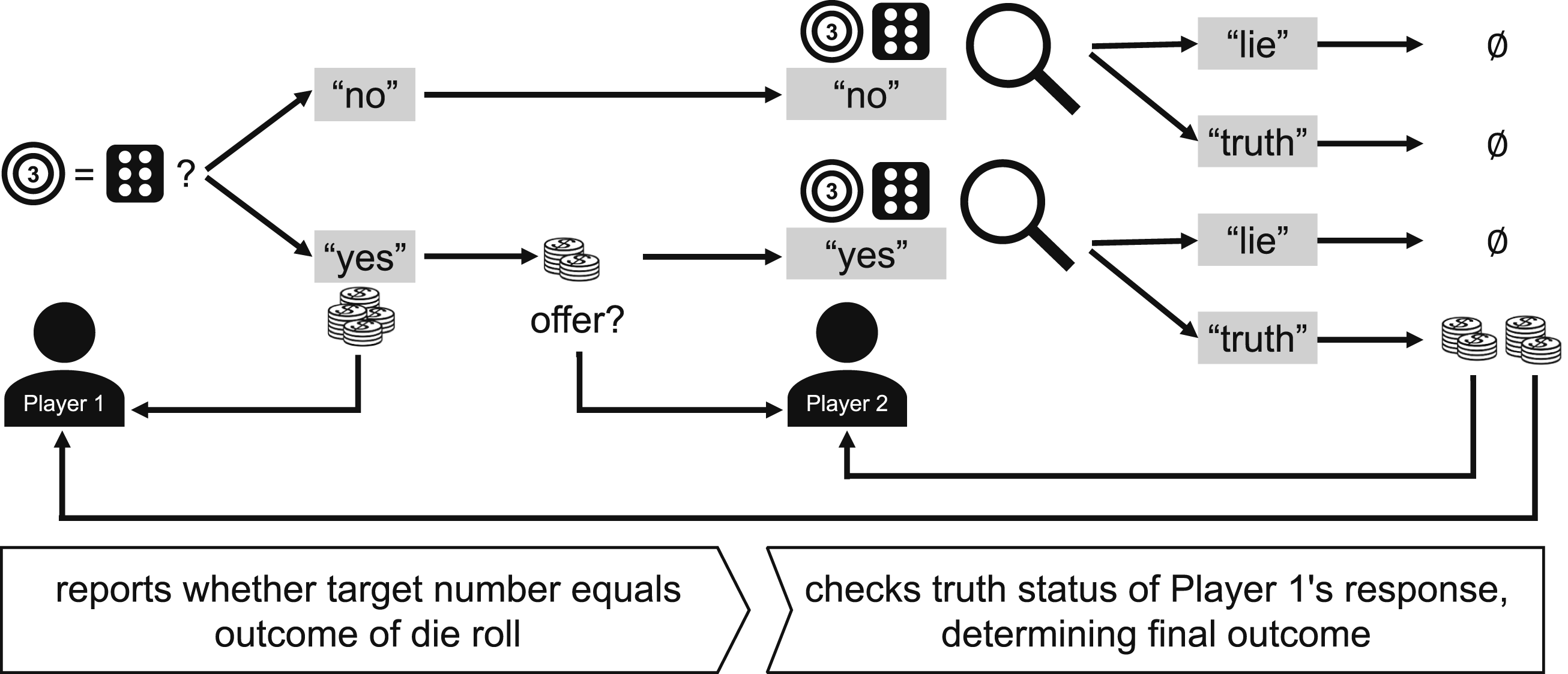
The game involves two roles, Player 1 (P1) and Player 2 (P2), who make their decisions sequentially. P1 first completes a classic cheating task, namely, a variant of the die-rolling paradigm (Fischbacher & Föllmi-Heusi, 2013; Hilbig & Hessler, 2013). Specifically, P1 receives a target number (integer between 1 and 6, randomly drawn), rolls a digital, six-sided die, and indicates whether the outcome of this die-roll matches the target number (“yes”) or not (“no”). If P1 responds “yes,” they receive a monetary payoff, otherwise nothing. Importantly, and in contrast to a classic die-rolling game, P1 knows that P2 will be asked to verify P1’s response. In case P1 responded “yes” and thus generated a payoff, P1 can offer any amount of their payoff to P2, who can keep the amount offered if they confirm the veracity of P1’s response. Thereby, P1 can encourage P2 to confirm the veracity of their response, even if it is factually a lie.
After P1 has made their decision and—in case of a “yes”-response—indicated how much of their payoff to offer to P2, P2 receives all relevant information to check the veracity of P1’s response. To this end, P2 is presented with P1’s target number, the outcome of the die roll, P1’s response (“yes” vs. “no”), the total payoff P1 received, and the amount of this payoff that P1 offered P2 for confirming their “yes”-response. P2 is then asked to indicate whether P1’s response was truthful (“yes”) or not (“no”). A “yes”-response by P2 in the face of a lie by P1 is the main behavior of interest here, that is, unethical loyalty. Importantly, the response by P2 determines whether both players receive any payoff. If P2 confirms the veracity of P1’s “yes”-response, P1 receives the payoff, minus what they offered to P2, and P2 receives the offer. If, however, P2 does not confirm (or if P1 responded “no” in the first place and thus there was nothing to verify for P2), neither of the players receives any payoff (see Figure 1).
To make the game feasible in an online setting, we implemented the following changes compared to the original, lab-based version. First, we recruited every P1 before recruiting any P2. This way, we could draw on the whole sample of P1 to randomly assign to P2. In the lab-based ULG, there were several laboratory sessions and the allocations of P1 to P2 were random only within these sessions. A key advantage of the sequential assessment of P1 and P2 in the online version is that it allows pre-selecting certain P1 to be assigned to P2. Thus, one can most efficiently study unethical loyalty by pre-selecting only dishonest P1, which are required to observe unethical loyalty (if P1 is honest, P2 has no possibility to be unethically loyal). Second, P1 rolled a digital die (instead of a die in a cup), which allowed us to save the outcome of the die roll as it occurred (which all players were aware of). In the lab-based ULG, the outcome of P1’s die roll (in the cup) was only checked and noted down by an independent experimenter after completion of the entire session.
Perceived justifiability and justifications
The measurement of perceived justifiability and justifications for unethical loyalty were based on prior research (Hilbig et al., 2022a). Specifically, we asked P2 whether or not they approved of the following question: “Do you find it justified and/or okay to respond ‘yes’ (and thereby indicate that Player 1’s response is factually correct) in the Dice Task even if Player 1’s target number and die roll do not match?” If a participant responded “yes,” we used one item each to further ask them about two potential reasons for this justifiability judgment, namely, because unethical loyalty (1) serves the actor’s own self-interest or (2) helps P1 and, therefore, can be considered prosocial. Participants indicated their agreement separately for each reason on a five-point Likert-scale ranging from 1 (strongly disagree) to 5 (strongly agree).
Personality
To measure basic personality traits, particularly Honesty-Humility, we used the 60-item version of the self-report HEXACO Personality Inventory-Revised (Lee & Ashton, 2004, 2006), the HEXACO-60 (Ashton & Lee, 2009). Participants were asked to indicate how much they agree or disagree with each statement using a five-point Likert-type scale ranging from 1 (strongly disagree) to 5 (strongly agree). An example item measuring Honesty-Humility reads “I wouldn’t use flattery to get a raise or promotion at work, even if I thought it would succeed.” Cronbach’s alpha of Honesty-Humility was acceptable (α = .74). For psychometric properties, descriptive statistics, and intercorrelations of the remaining dimensions, see Table S1 in the OSF Supplement (https://osf.io/9d8xz/).
Procedure
The study was run online via SoSci Survey (Leiner, 2022). Participants were recruited via Prolific (https://www.prolific.co/) in two waves. Specifically, we first collected P1’s data, inspected their responses, and only then recruited P2 and randomly assigned each of them to one (dishonest) P1. By default, participants could only take part in one of the two waves, meaning that P1 were excluded from signing up for the P2 survey. Due to the importance of understanding the instructions of the ULG-O, only participants fluent in English were invited using Prolific’s prescreening option.
Player 1
After providing informed consent, participants in the role of P1 received detailed instructions about the ULG-O, including information on the course of the game and their role. They were then asked to answer two comprehension checks to ensure that they understood the rules of the game. Only participants who answered these checks correctly (within three attempts) could continue the survey and participate. Next, the ULG-O followed. Participants were first asked to roll a digital die by pressing a button labeled “Roll the die,” which was followed by presenting them with the respective outcome (1, 2, 3, 4, 5, or 6). Participants were then asked to confirm that they memorized the outcome. On the subsequent screen, participants received their target number (an integer between 1 and 6, randomly drawn from a uniform distribution) and were asked to indicate whether they had rolled the target number in the previous die roll (“yes”) or not (“no”). If a participant answered “yes,” they received £5 and were then asked to indicate how much of this payoff, if anything, they wanted to offer to P2. Participants could choose any amount between £0 and £5 (in 50p increments). Finally, participants were thanked and debriefed.
As a compensation for participation, P1 received a base payment of £0.89 for the 7 min (SD = 2 min) survey. In addition, all P1 answering “yes” were eligible to potentially receive a bonus payment. That is, all honest P1 answering “yes” received £5 minus what they had offered to P2 (M = 3.41£, SD = 0.80£), whereas for all dishonest P1, the bonus payment ultimately depended on the assigned P2’s response (see below). The average bonus payment among all dishonest P1 was 1.12£ (SD = 1.45£). Dishonest P1 whose assigned P2 was unethically loyal received 2.94£ on average (SD = 0.53£).
Player 2
After reading a short introduction text and providing informed consent, participants completed the HEXACO-60 (Ashton & Lee, 2009). To ensure that participants completed the survey attentively, we embedded an instructed attention check (i.e., “To show that you are reading the statements attentively, please choose ‘disagree’.”) within the personality items. Following the HEXACO-60, participants received detailed instructions about the ULG-O, including information about their role, and had to answer the same comprehension questions as the P1. They were then presented with the die roll outcome of their randomly assigned (dishonest) P1 1 and asked to memorize it. P2 then also received information about P1’s target number, their response (which was always an illegitimate “yes”), and their offer to P2 for confirming their “yes”-response (i.e., the bribe). Next, P2 were asked to indicate whether P1’s response was truthful (“yes” vs. “no”) and whether they considered it justifiable to cover up a lie for P1 (“yes” vs. “no”). If P2 approved of this latter question, indicating that they considered unethical loyalty justifiable, they were asked about the two specific potential justifications that may underlie their justifiability judgment (i.e., self-interest and prosociality). Finally, participants received information about the background of the study.
P2 received a base payment of £1.75. All unethically loyal P2 received their payoff, irrespective of whether their response was relevant for the payoff of a P1 (M = 2.06£, SD = 0.53£). On average, participation took 15 minutes (SD = 6) for P2.
Participants
Power analysis
To ensure sufficient statistical power for all our hypothesis tests, we conducted a priori power analyses for all main hypotheses (see https://aspredicted.org/8wd6-dbpt.pdf) and used the largest resulting estimate as our target sample size. This was the case for Hypothesis 2, that is, the test of the mediation of Honesty-Humility on unethical loyalty through the perception of justifiability.
To determine the required sample size for this mediation, we used a Monte Carlo power analysis for indirect effects (10,000 replications; 20,000 Monte Carlo draws per replication; 95% CI) using the R shiny app Mc Power Med (Schoemann et al., 2017). We set alpha to a conventional level of .05 and aimed for 80% power. Assumptions for the required correlations and standard deviations (rHonesty-Humility/Justifiability = −.20, rJustifiability/Unethical Loyalty = .20, rHonesty-Humility/Unethical Loyalty = −.20, SDHonesty-Humility = 1.00, SDUnethical Loyalty = 0.03, SDJustifiability = 0.03) were based on prior research (Hilbig, 2022a, 2022b; Thielmann et al., 2021). This power analysis yielded a required sample size of n = 333 P2. We oversampled slightly to account for potential dropout due to predefined exclusion criteria, thus aiming for n = 350 P2.
In turn, we intended to assign the responses of one P1 to no more than four P2. Thus, we recruited n = 130 P1, assuming that the prevalence of dishonesty will be similar to previous estimates in the ULG (i.e., approx. 70%; Thielmann et al., 2021) which would result in approx. 90 dishonest P1 to be matched to the approx. 330 P2.
Sampling and participant characteristics
A total of 17 participants in the role of P1 failed the comprehension checks about the rules of the ULG-O and were thus preliminarily excluded from completing the survey. We filled their places with new participants to eventually obtain usable data from n = 130 P1, as preregistered. P1 were aged between 18 and 67 years (M = 27.7, SD = 9.8), 50.0% identified as female, 56.2% indicated to be students, and 54.6% reported to be employed. 2
Among the P2, 19 participants failed the comprehension checks about the ULG-O and were therefore preliminarily excluded from further participation. We filled their places with new participants to end up with the preregistered 350 P2 completing the survey. Of these, 8 participants had to be excluded from analyses because they failed the instructed attention check embedded in the HEXACO-60 (n = 5) and/or took less than 2 s on average per HEXACO-60 item (n = 5). We also preregistered to check for sufficient variation in item responses (i.e., SD ≥ 0.3); none of the participants had to be excluded based on this criterion. Thus, the final sample of P2 comprised N = 342. Around half of P2 identified as female (i.e., 50.6%), were students (i.e., 50.9%), and indicated to be in employment (i.e., 52.6%). P2 were aged between 19 and 72 years (M = 26.8, SD = 7.7), making our sample slightly older on average compared to the sample in Thielmann et al. (2021) and also covering a larger age range. Specifically, 66 participants in our sample reported to be older than 30 years, which is approx. 20% of the sample, compared to only 5% in the Thielmann et al. (2021) sample.
Results
Descriptive Statistics and Interrelations of all Focal Variables.
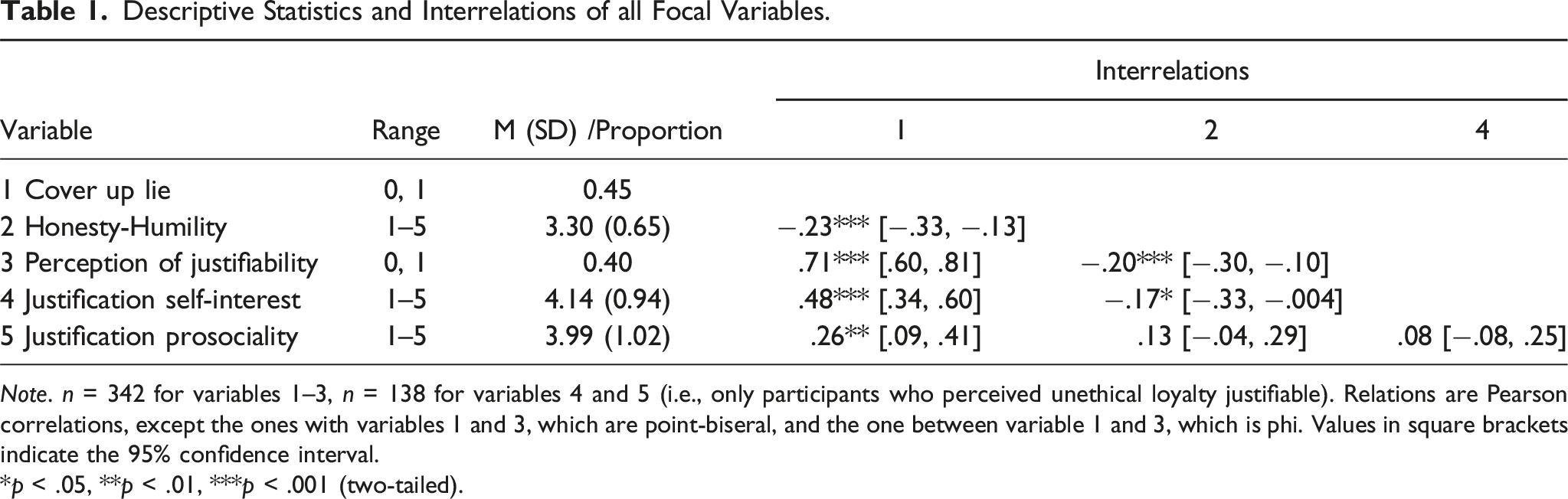
Note. n = 342 for variables 1–3, n = 138 for variables 4 and 5 (i.e., only participants who perceived unethical loyalty justifiable). Relations are Pearson correlations, except the ones with variables 1 and 3, which are point-biseral, and the one between variable 1 and 3, which is phi. Values in square brackets indicate the 95% confidence interval.
*p < .05, **p < .01, ***p < .001 (two-tailed).
As summarized in Table 1, 44.7% of P2 (n = 153) lied to cover up P1’s lie, meaning they were unethically loyal. As such, the prevalence of unethical loyalty was considerably lower than in the lab-based ULG in Thielmann et al. (2021; i.e., 85.8%; exact binomial test p < .001; Fisher’s exact test for count data, OR = 0.13, 95% CI [0.07, 0.24], p < .001), but nonetheless substantial. 4
To test Hypothesis 1 that unethical loyalty would increase with decreasing levels on Honesty-Humility, we used a logistic regression analysis predicting P2’s confirmation of P1’s illegitimate “yes”-response by Honesty-Humility (z-standardized). As expected, lower levels of Honesty-Humility were associated with a higher probability of unethical loyalty, yielding a medium-sized effect, OR = 0.61, 95% CI [0.48, 0.77], one-tailed p < .001. Importantly though, unethical loyalty was even somewhat prevalent among individuals scoring relatively high in Honesty-Humility (see Figure 2): Among the 10% of participants with the highest levels on Honesty-Humility in the sample, the prevalence of unethical loyalty was still 24.2%. The effect of Honesty-Humility was robust, OR = 0.62, 95% CI [0.49, 0.78], one-tailed p < .001, when additionally including the amount offered to P2, OR = 1.24, 95% CI [0.99, 1.55], one-tailed p = .033, and the interaction of the two variables, OR = 0.91, 95% CI [0.71, 1.16], two-tailed p = .433, as predictors of unethical loyalty. Lastly, the effect of Honesty-Humility remained robust, OR = 0.63, 95% CI [0.49, 0.82], one-tailed p < .001, once including all other HEXACO traits as predictors, none of which showed a significant relation to unethical loyalty (see additional analyses on the OSF for details). Predicted probability of Player 2 covering up Player 1’s lie as a function of Honesty-Humility (centered on the sample mean) in a logistic regression. Note. The shaded areas represent the 95% confidence interval.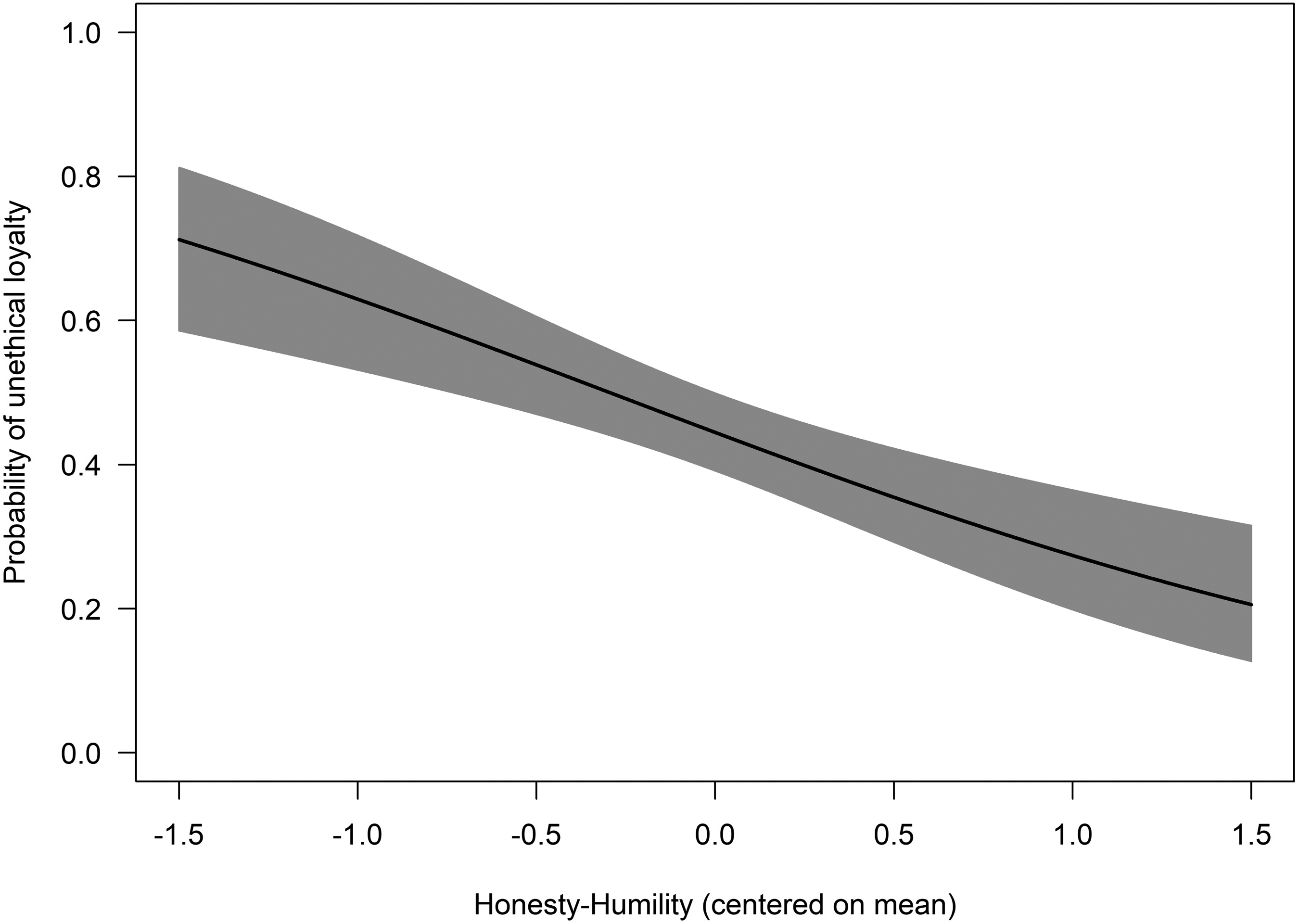
Hypothesis 2 postulated a negative relation between Honesty-Humility and perceiving unethical loyalty as justifiable, and a positive relation between perceived justifiability and unethically loyal behavior. Overall, 40.4% of P2 (n = 138) indicated that they perceived unethical loyalty as justifiable. More crucially, and in line with our hypothesis, perceiving unethical loyalty as justifiable had a small to moderate negative relation to Honesty-Humility (point-biseral r = −.20, 95% CI [−.30, −.10], p < .001) and a strong positive relation to unethical loyalty itself (φ = .71, 95% CI [.60, .81], p < .001). We further predicted that the negative relation between Honesty-Humility and unethical loyalty will be mediated by the perceived justifiability of unethical loyalty. To test this, we set up a single-mediator-model with z-standardized Honesty-Humility as the predictor, unethical loyalty as the outcome variable, and the justifiability judgment (“yes”/“no”) as the mediator. As hypothesized, the negative relation between Honesty-Humility and unethical loyalty was indeed mediated by the perceived justifiability of unethical loyalty (see Figure 3), ab = −0.07, Monte Carlo 95% CI [−0.11, −0.03], yielding a small mediation effect, Lachowicz’s υ = 0.02, 95% CI [0.01, 0.04] (Lachowicz et al., 2018). Beyond that, Honesty-Humility also had a direct effect on unethical loyalty (c’ = −0.05, 95% CI [−0.09, −0.01], p = .013). Path coefficients (direct effects), residual variances as well as indirect and total effect from mediation analysis. Note. Unstandardized values outside the parentheses, standardized values in parentheses. For path coefficients: *p < .05, ***p < .001. For indirect effect: * Monte Carlo 95% CI excludes zero.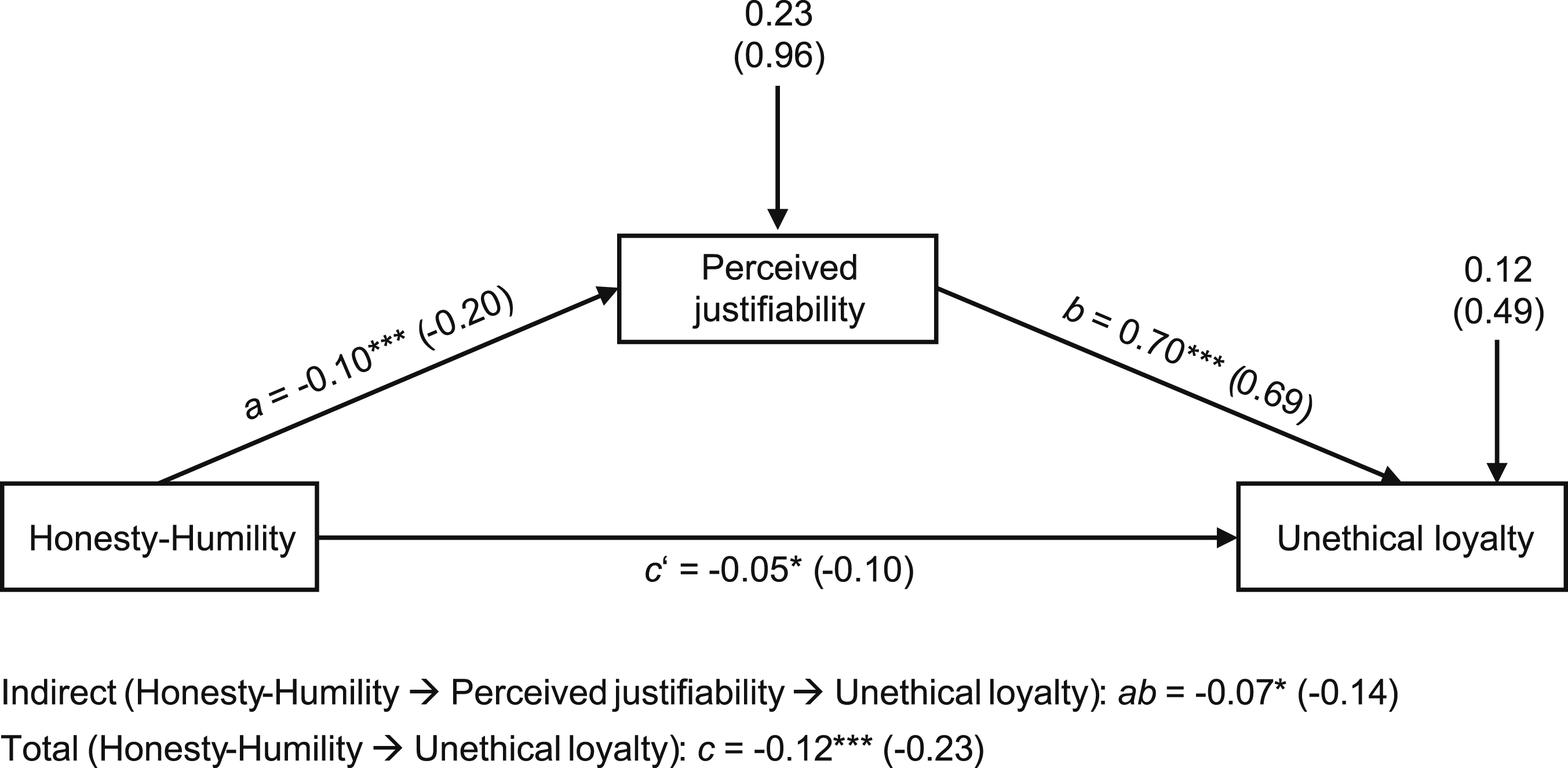
Finally, regarding the specific justifications used, participants who perceived unethical loyalty as justifiable indicated that both self-interest (M = 4.14, SD = 0.94; test against scale midpoint of 3: t(137) = 14.3, p < .001, d = 1.22, 95% CI [0.85, 1.58]) and prosociality (M = 3.99, SD = 1.02; test against scale midpoint of 3: t(137) = 11.4, p < .001, d = 0.97, 95% CI [0.62, 1.33]) contributed to their justifiability judgment. Interestingly, the two justifications were essentially uncorrelated (r = .08, 95% CI [−.08, .25], p = .323), but both showed a meaningful positive link to unethical loyalty (self-interest: point-biseral r = .48, 95% CI [.34, .60], p = < .001, prosociality: point-biseral r = .26, 95% CI [.09, .41], p = .002). In an exploratory additional analysis, both accounted for unique variance in unethical loyalty (self-interest: OR = 4.20, 95% CI [2.24, 9.50], p < .001; prosociality, OR = 2.84, 95% CI [1.42, 6.16], p = .005). According to Hypothesis 3, there should be a negative relation between Honesty-Humility and justifying unethical loyalty based on self-interest and a positive relation between Honesty-Humility and justifying unethical loyalty based on prosociality. In line with this prediction, Honesty-Humility was negatively related to perceiving unethical loyalty as justifiable because it serves one’s own self-interest (r = −.17, 95% CI [−.33, −.004], one-tailed p = .022). However, there was only a weak positive, non-significant relation between Honesty-Humility and perceiving unethical loyalty as justifiable based on it being prosocial (r = .13, 95% CI [−.04, .29], one-tailed p = .068). 5
Discussion
Some transgressors get away with their dishonesty because they have a partner in crime. That is, witnesses of unethical behavior may lie to cover up a certain transgression and thereby protect the transgressor from sanctions. Such acts of witnesses have been referred to as unethical loyalty. When it comes to the dispositional basis of unethical loyalty, little is known so far as there is only one, relatively small student-sample study (Thielmann et al., 2021) suggesting a link to HEXACO Honesty-Humility (Ashton & Lee, 2007). With the current investigation, we aimed to extend this knowledge. Besides replicating prior findings in a larger and more diverse sample, we investigated individual differences in perceived justifiability and specific justifications as a potential mechanism underlying the relation between Honesty-Humility and unethical loyalty. Methodologically, we further expanded the measurement of unethical loyalty to the online setting by devising and testing a new online version of an existing measure of unethical loyalty, the Unethical Loyalty Game-Online (ULG-O).
Unethical loyalty’s dispositional basis
Replicating previous findings (Thielmann et al., 2021) and supporting our first hypothesis, we found individual differences in unethical loyalty to be accounted for by HEXACO Honesty-Humility (Ashton & Lee, 2007). Specifically, the likelihood of engaging in unethical loyalty—that is, of lying to cover up another’s dishonesty—increased with decreasing levels on Honesty-Humility. This finding is also consistent with other evidence showing negative relations of Honesty-Humility to purely self-serving dishonesty (Heck et al., 2018), collaborative dishonesty (Ścigała et al., 2019), and corruption (Tanner et al., 2022). By implication, individuals high in Honesty-Humility seem to favor honesty over prosociality when the two are at odds as in the case of unethical loyalty—mirroring findings in the context of dishonesty that serves (needy) others (Thielmann et al., 2024). However, since unethical loyalty can, in principle, stem from selfishness or prosociality, one could also conclude that those high in Honesty-Humility prioritize honesty over increasing their personal benefit. This is indeed to be expected given the vast evidence that those high in Honesty-Humility typically do not seek personal gains (Heck et al., 2018; Thielmann et al., 2020). That said, the prevalence of unethical loyalty was clearly above zero even for individuals high in Honesty-Humility, showing that even among dispositionally honest individuals, there were still considerable interindividual differences in behavior.
Justifying unethical loyalty
As hypothesized, the relation between Honesty-Humility and unethical loyalty was mediated by individual differences in perceiving unethical loyalty as justifiable. However, this indirect effect was small—it only made up about half of the total effect of Honesty-Humility—meaning that Honesty-Humility accounted for unique variance in unethical loyalty beyond its effect through justifiability. This indicates that individual differences in justifiability are only part of what links Honesty-Humility to unethical loyalty. Future research is therefore needed to study additional paths through which Honesty-Humility may act out, and especially to explain the high prevalence of unethical loyalty even among individuals with high levels in Honesty-Humility, as noted before.
Of note, almost half of our participants perceived unethical loyalty as generally justifiable. Indeed, unethical loyalty seems to be more easily justifiable than self-serving dishonesty, which, according to a recent estimate, is only considered justifiable by around 15% of individuals (Hilbig et al., 2022a). This again shows that unethical loyalty is distinct from purely selfish lying, arguably because it is prosocial, which is also well in line with evidence showing that dishonesty is judged less unethical once it benefits other individuals in addition to oneself (Wiltermuth, 2011). Perceiving unethical loyalty as justifiable was, in turn, strongly related to engaging in unethical loyalty, arguably by reducing the threat to individuals’ moral self-image (Mazar et al., 2008; Shalvi et al., 2015). However, since we assessed the perceived justifiability only after participants had made a decision whether to engage in unethical loyalty or not and only used one single item to do so, our design may have artificially inflated said relation (Allen et al., 2022). Specifically, participants may have wanted to respond consistently with their behavior, possibly to achieve consistency for themselves (avoiding cognitive dissonance; Festinger & Carlsmith, 1959). Thus, it is also important to note that our study design does not allow drawing causal conclusions. Instead, the observed relations should be interpreted as indicative of potential pathways rather than as causal mechanisms. Future research may employ a manipulation-of-mediator design (Pirlott & MacKinnon, 2016) to overcome this limitation.
Moving on from a general perception of justifiability to the specific justifications that the outcomes of unethical loyalty provide—self-interest and prosociality—we found both justifications to be strongly approved by individuals who considered unethical loyalty justifiable. Interestingly, the two justifications were statistically independent, implying that people do not need to rely on multiple justifications to rationalize their behavior; a single justification seems to suffice. Moreover, this finding suggests that deriving a justifiability judgment is more nuanced than simply using every single justification available in a certain situation. Rather, individuals seem to differentiate between different justifications, pointing at individual differences in the use of justifications. Supporting this notion, individuals with higher levels on Honesty-Humility were less prone to use self-interest as a justification for unethical loyalty than individuals with lower levels on Honesty-Humility. This is well in line with the theoretical conceptualization of Honesty-Humility as individual differences in responses to opportunities for personal gain (Ashton & Lee, 2007) and evidence showing a consistent negative link between Honesty-Humility and self-serving dishonesty (Heck et al., 2018).
That said and unlike expected, we found no evidence that those high in Honesty-Humility, if perceiving unethical loyalty as justifiable, do so because unethical loyalty is prosocial. One may speculate that, unlike we had expected, those high in Honesty-Humility may not perceive unethical loyalty as prosocial, which is plausible given that the beneficiary is a transgressor. Alternatively, those low in Honesty-Humility may also make use of the prosociality aspect of unethical loyalty to increase its justifiability. Future research could further explore these dynamics by examining how the perception of the transgressor's character and the context of their actions influence justifications for unethical loyalty across different levels of Honesty-Humility. However, limiting the conclusiveness of this finding, the sample size available for this analysis fell below the required sample size as per our a priori power analysis. Moreover, since we assessed specific justifications only among those participants who had indicated that they found unethical loyalty generally justifiable—which was more likely among those low in Honesty-Humility—the variance in Honesty-Humility levels was restricted for these analyses (i.e., the Honesty-Humility level ranged between 1.4 and 5 among all participants, and only between 1.7 and 4.4 among participants who perceived unethical loyalty as justifiable), thus reducing the likelihood to detect a corresponding relation. All in all, this evidence calls for more research on the dispositional basis of motives for engaging in dishonest behavior (McArthur et al., 2022, 2024).
The assessment of unethical loyalty online
We devised and tested a new online version of the Unethical Loyalty Game (Thielmann et al., 2021) and thereby assessed unethical loyalty online for the first time. Almost every second participant behaved unethically loyal in our Unethical Loyalty Game-Online (ULG-O). This prevalence is high compared to other types of dishonesty, such as purely selfish dishonesty (i.e., 26.1% in Heck et al., 2018) or purely prosocial dishonesty (i.e., 15%–39% in Klein et al., 2017; Thielmann et al., 2024, respectively), which converges with evidence that dishonesty is particularly prevalent when it entails a benefit to both oneself and another person (Conrads et al., 2013; Wiltermuth, 2011), as is the case in collaborative cheating (Leib et al., 2021; Weisel & Shalvi, 2015). However, there was notably less unethical loyalty in the current study than in the lab study by Thielmann et al. (2021; i.e., 85.8%). To some extent, this may be due to the adaptations necessary in transferring the game from a lab-based to an online setting; however, it may also be due to different sample compositions and is actually well in line with the typical heterogeneity found across studies of (self-serving) dishonesty (Abeler et al., 2019; Gerlach et al., 2019). Beyond mere methodological differences, Thielmann et al. (2021) suggested that thrill of the game may have been one of the drivers of the large prevalence of dishonesty in their study. In the lab, participants know that their partner is among the other participants in the same session and that their responses will directly affect each other’s outcomes. In contrast, in the online implementation of the game, participants neither see any of the other participants, and therefore have even less (i.e., no) information who their partner in the game may be, nor do their responses have an immediate effect on someone else. Thus, there is likely no thrill involved in the ULG-O, meaning that dishonesty as P1 and unethical loyalty as P2 should be less prevalent. In general, reducing the effect of thrill of the game as a confounding variable is an advantage of the new ULG-O.
A particular practical advantage of the ULG-O compared to the original ULG is the assignment of P1 to P2. Due to the sequential data collection (i.e., first all P1, then all P2), it is possible to first inspect P1’s responses and then select only those P1 that one is interested in investigating the reactions to. Specifically, in order to assess unethical loyalty, P1 need to be dishonest in the first place. By specifically selecting only dishonest P1 to be assigned to P2, data can be assessed in a much more efficient and resource-friendly way because all P2 data can eventually be used (note that in Thielmann et al.’s 2021 study, the data of 12.5% P2 being assigned to an honest P1 could not be used for the analyses of unethical loyalty, and this proportion will naturally increase with a decreasing prevalence of dishonesty among P1). At the same time, it is not necessary to resort to deception (Hilbig et al., 2022b), and additional efficiency is even gained as a single P1 can be randomly assigned to multiple P2 (as done here). Finally, moving the assessment of unethical loyalty to the online setting allows to recruit larger and more diverse samples. In sum, our online behavioral measure of unethical loyalty provides multiple advantages for future research on a common instance of unethical behavior.
Future directions for research on unethical loyalty include investigating individuals’ motivations in the ULG-O further, for example, by adding comparison conditions that include no benefit for the unethically loyal individual, thereby rendering unethical loyalty purely prosocial, or different framings of incentives (e.g., benefits vs. punishment for both the partner and the unethically loyal individual). Moreover, future research should explore how the level of acquaintance between the transgressor and the unethically loyal individual influences behavior. Evidence on unethical pro-organizational behavior, a type of unethical behavior with consequences for known others, highlights that organizational identification and positive social exchange (Umphress & Bingham, 2011) and self-interest rather than prosociality (Steele et al., 2024) play significant roles in unethical pro-organizational behavior. Indeed, this latter finding in particular aligns well with our findings on the specific justifications for unethical loyalty.
Conclusion
In conclusion, our findings contribute to the understanding of the dispositional basis of unethical loyalty, including the mechanisms involved. We provide evidence that the predictive power of Honesty-Humility for unethical loyalty is replicable and can be partly attributed to systematic differences in how individuals justify their unethical acts. That said, despite the fact that, on average, individuals with higher levels on Honesty-Humility tended to favor honesty over prosociality, unethical loyalty was still prevalent among individuals high in Honesty-Humility. Future research is needed to fully understand how individuals solve the trade-off between honesty and prosociality depending on their personality. We envision our newly provided behavioral online paradigm to further facilitate investigation of who engages in unethical loyalty under which conditions, and thereby becomes a partner in crime.
Footnotes
Author note

Declaration of conflicting interests
The author(s) declared no potential conflicts of interest with respect to the research, authorship, and/or publication of this article.
Funding
The author(s) received no financial support for the research, authorship, and/or publication of this article.