



Abstract
Unethical behavior is often accompanied by others covering up a transgressor’s actions. We devised a novel behavioral paradigm, the Unethical Loyalty Game (ULG), to study individuals’ willingness to lie to cover up others’ dishonesty. Specifically, we examined (i) whether and to what extent individuals are willing to lie to cover up others’ unethical behavior, (ii) whether this unethical loyalty depends on the benefits (bribe) at stake, and (iii) whether trait Honesty–Humility accounts for interindividual variability in unethical loyalty. In a fully incentivized experiment (N = 288), we found a high prevalence of lying to cover up others’ unethical behavior, which increased with increasing bribes. In turn, unethical loyalty decreased with individuals’ Honesty–Humility levels. Overall, the findings show that most but not all individuals are corruptible to disguise others’ transgressions. Future research using the ULG can help to further illuminate (the determinants of) this prevalent type of unethical behavior.
Hardly a week goes by without the media reporting on another instance of fraud, corruption, or other types of unethical behavior committed by public individuals or organizations. Strikingly, such instances regularly involve individuals beyond those committing the initial unethical act, namely others who keep silent or lie to cover up the original transgression. For example, in 2018, the U.S. president’s lawyer admitted having lied to Congress to cover up the president’s questionable business dealings in Russia during the presidential campaign, which the president himself had previously denied. Despite the ubiquity and vital significance of such cover up behaviors, however, it is largely unknown what makes people lie to disguise others’ unethical acts. Here, we aim to tackle this issue of unethical loyalty.
Most prior research in the context of unethical behavior among dyads or groups has focused on corruption, that is, the act of abusing one’s power for private gains (e.g., Köbis et al., 2016; see also Abbink, 2006; Serra & Wantchekon, 2012, for overviews). For instance, research has shown that corruption increases when individuals interact repeatedly with the same partner (Abbink, 2004), that the route to corruption leads over a steep cliff rather than down a slippery slope (Köbis et al., 2017), and that descriptive norms affect corruption (Köbis et al., 2015). Moreover, studies have shown that individuals are willing to punish corrupt behavior (Cameron et al., 2009; Chaudhuri et al., 2016). However, no systematic research has yet investigated the role of individuals who allow the corruption to result in a beneficial outcome for the corrupt individual by covering up the initial transgression (but see Gino & Bazerman, 2009). Here, we focus on this issue, that is, individuals’ willingness to cover up another’s unethical behavior.
When lying to disguise another’s unethical behavior, both self-interest and prosociality are at odds with morality (e.g., Dungan et al., 2014; Waytz et al., 2013). First, lying in such situations is usually associated with some “benefit” provided by the original transgressor (e.g., a bribe). Second, one can protect the transgressor from being convicted. This latter prosociality (loyalty) aspect may render lying more easily justifiable (Shalvi et al., 2015) and, in turn, allow individuals to maintain their moral self-image even though they behave immorally (Mazar et al., 2008). Indeed, there is consistent evidence that individuals are more willing to lie when others profit from their dishonesty as well (e.g., Gino et al., 2013; Klein et al., 2017; Wiltermuth, 2011) or when they can collaborate, that is, jointly lie to maximize their mutual payoff (Weisel & Shalvi, 2015).
Here, we build on this prior research and extend it by specifically studying unethical loyalty, that is, individuals’ willingness to cover up others’ unethical acts. To this end, we devise a novel behavioral paradigm, the Unethical Loyalty Game (ULG), to answer the following research questions: (i) To what extent are individuals willing to lie to cover up another’s transgression? (ii) Does this unethical loyalty depend on the benefit (bribe) offered by transgressors—and are transgressors well calibrated in deciding how large a bribe they need to offer to corrupt others? (iii) Can personality account for individual differences in unethical loyalty? Concerning the latter question, prior research has identified the Honesty–Humility dimension from the HEXACO model of personality (Ashton & Lee, 2007; Ashton et al., 2014)—describing one’s dispositional tendency to be sincere, fair, nongreedy, and modest—as the most consistent basic trait predictor of dishonest behavior (Heck et al., 2018; Kleinlogel et al., 2018). Honesty–Humility has also been specifically (negatively) linked to collaborative lying (Ścigała et al., 2019). We therefore expected that Honesty–Humility will also negatively relate to unethical loyalty. Of note, it is yet an unresolved question whether Honesty–Humility will relate to dishonesty at all once lying is clearly prosocial—or whether it will essentially yield a zero relation—given that this trait dimension is also positively associated with prosocial behavior (see Thielmann et al., 2020; Zettler et al., in press, for recent meta-analyses; see also Zhao & Smillie, 2015).
Method
All materials as well as the data, analysis scripts, and supplementary analyses are available on the Open Science Framework (OSF; https://osf.io/e7x3h/). We confirm that we report all dependent variables and measures collected, any data exclusions, and all conditions/groups/predictors tested. There was no deception involved in the experiment.
Materials
ULG
The ULG allows for a behavioral assessment of unethical loyalty, that is, individuals’ willingness to lie to cover up another’s transgression, in this case, a profitable lie. The game is a two-player sequential game with asymmetric roles; Figure 1 provides a graphical illustration of the players’ strategies and corresponding payoffs. Player 1 (P1) first works on a variant of the die-rolling paradigm (Fischbacher & Föllmi-Heusi, 2013), in which one can lie to obtain a monetary gain. Specifically, P1 received a fair die in a cup and was asked to roll the die in private in the cup and to memorize the outcome while keeping it strictly confidential. The roll was preserved under the cup. Next, P1 received a “target number” (between 1 and 6, randomly drawn from a uniform distribution) and was asked to report whether she had obtained the target number (“yes”) or not (“no”) in the die roll. If P1 responded “yes,” she received a payoff between €10 and €15 (the exact payoff was randomly determined for each participant to allow for blinded payment; see below). Importantly, P1 knew that Player 2 (P2) was going to check the truth status of P1’s response and that P1 would only receive her payment if P2 confirms P1’s “yes”-response. In turn, every P1 who responded “yes” had the opportunity to offer any amount of her (potential) payoff to P2. Thereby, P1 illegitimately responding “yes” could bribe P2 so as to “encourage” unethical loyalty by P2.
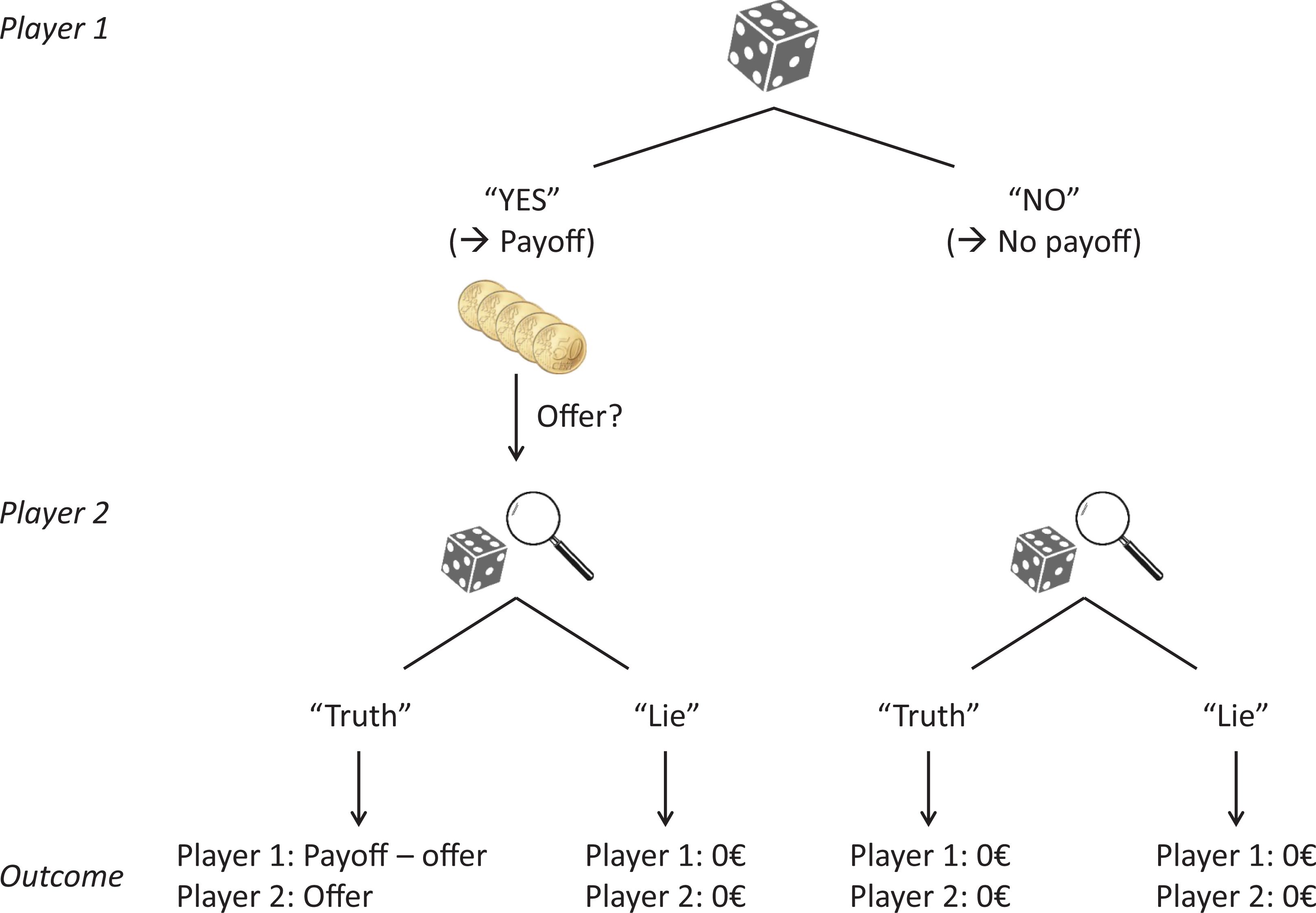
Graphical illustration of the Unethical Loyalty Game. The die roll of Player 1 remained completely confidential during the experimental session except to Player 2. The payoff for a “yes” response was randomly determined to range between €10 and €15.
Next, P2 was asked to privately check the truth status of P1’s response. Specifically, P2 was provided with P1’s cup under which the original die roll was preserved. Moreover, P2 was informed about the target number, the payoff associated with a “yes”-response, P1’s actual response, and the amount P1 had offered P2 (in case P1 had responded “yes”). P2 was then asked to indicate whether P1’s response was true or false, which led to the following potential outcomes (see Figure 1): If P1 had responded “yes” and P2 confirmed this response, both players received the corresponding payment, that is, P2 received P1’s offer and P1 received the total payoff minus what she offered to P2. In all other cases (i.e., if P1 had responded “no” in the first place or if P2 accused P1 of a lie), both players received nothing. Thus, only by (legitimately or illegitimately) confirming P1’s “yes”-response, P2 could ensure that P1 and herself (given that P1 had offered her something) would obtain a payment. Overall, the ULG is thus similar to the ultimatum game (Güth et al., 1982), with the critical difference that the amount to be shared by P1 can be generated by lying, and P2 has to decide whether to cover up that lie by accepting the offer.
Personality
To measure basic personality traits, particularly Honesty–Humility, we used the German (Moshagen et al., 2014) 60-item version of the HEXACO Personality Inventory–Revised (HEXACO-60; Ashton & Lee, 2009). Each of the six HEXACO dimensions (Honesty–Humility, Emotionality, Extraversion, Agreeableness, Conscientiousness, and Openness to Experience) is assessed with 10 items that are answered on a 5-point Likert-type scale ranging from 1 = strongly disagree to 5 = strongly agree. The inventory has been shown to provide a reliable and economic assessment of the HEXACO dimensions (Moshagen et al., 2019). In the current study, the Honesty–Humility dimension, which we focus on here, yielded satisfactory internal consistency of Cronbach’s α = .81 (for psychometric properties, descriptive statistics, and intercorrelations of the remaining dimensions, see Table S1 in the OSF Supplement).
Procedure
The study was conducted at two German universities, and it consisted of two parts: a web-based survey and a lab-based behavioral experiment. The web-based survey contained assessment of demographic variables and self-reported personality traits using the HEXACO-60. Specifically, at one of the universities, we recruited participants from a local participant pool who had completed such a survey (which also included other tasks following the HEXACO-60) when registering for the participant pool. At the other university, participants completed the online survey prior to being invited to the laboratory experiment.
The laboratory sessions comprised an even number of 6–16 participants to allow for unique assignment of participants to player roles and to ensure anonymity to participants. In case an odd number of participants showed up, the participant arriving last was dismissed with a €5 flat fee. Participants were welcomed in a waiting room and first asked to provide written informed consent. They were also asked to note down a pseudonymous code on a control slip which they should carry with them throughout the remainder of the experiment. This allowed matching of the data across parts of the experiment and anonymous payment. All participants then received a booklet containing instructions for the ULG in both roles. Instructions were framed neutrally (e.g., avoiding terms such as “bribe” or “covering up”) to counteract socially desirable responding. Moreover, we emphasized that (i) there would be no deception involved in the experiment, (ii) that the dice used in the game were all (thoroughly tested to be) truly “fair”, and (iii) that payment would be completely anonymous. Participants were not allowed to communicate throughout the entire session.
After all participants had read the instructions, two experimenters simulated (i.e., “acted out”) the game according to a standardized protocol. Next, to ensure that participants fully understood the rules of the game, they were asked to answer three comprehension questions. In case a participant provided an incorrect response, an experimenter explained the corresponding aspect of the game again thoroughly. Finally, participants were allowed to raise their hand in case they had any remaining questions about the game; an experimenter answered these questions bilaterally. Once all questions were resolved, participants were randomly assigned to their role (P1 or P2) in the game. Specifically, participants were asked to draw a card from a concealed deck containing either a “1” (for P1) or a “2” (for P2). This procedure ensured that it was fully transparent to participants that the assignment of participants to player roles was not predetermined by the experimenters.
Participants in the role of P1 were then asked to follow an experimenter to another room (the laboratory), while participants in the role of P2 stayed in the waiting room with another experimenter. This separation in different rooms ensured that participants had no knowledge about the other player they were matched with in the game. In the laboratory, all P1 were seated in separate cubicles in front of a computer; each computer was marked by a unique number. Once all participants were seated, they were asked one after the other to walk to a table in the room and roll their die. Specifically, the table contained as many cups (with lids) and dice as P1–P2 dyads in the session, and each cup was marked with the number of P1’s computer to ensure unique assignment of cups to participants and computers. P1 were instructed to roll the die once in the cup, to privately observe the outcome of the die and memorize it, to cover the cup with the lid, and to carefully put the cup back on the table without changing the outcome of the die in the cup. To ensure that participants followed this procedure, the table was located within sight of the experimenter, whereas it was impossible for the experimenter to observe the actual outcome of the die roll (to ensure anonymity). P1 then returned to their computer and indicated that they had rolled the die. Only then P1 received information about their target number and the payoff for reporting having rolled the target number. We informed P1 about the target number only after they had rolled the die to avoid that they had an incentive to change the outcome of the die in the cup. The payoff was randomly determined to range between €10 and €15. This was done so as to ensure that the payment a participant finally received provided no conclusive information about her role and/or response. P1 then indicated whether they had rolled the target number (“yes”) or not (“no”). If responding “yes,” P1 finally had the opportunity to offer any amount (including €0) of her payoff to P2. It was public knowledge that to accept this offer and receive the payoff, P2 had to confirm P1’s “yes”-response.
After P1 had finished their task, they were escorted back to the waiting room and all P2 were guided to the laboratory. P2 were randomly assigned to the cubicles and computers previously vacated by P1. They were asked one after the other to walk to the table with the cups in order to check the actual die outcome of their assigned P1. Specifically, P2 were instructed to simply lift the lid of the respective cup that was marked by the number of their computer while leaving the cup on the table (to ensure that the die remained unaltered) and to memorize the outcome of the die. After having returned to their computer, they were then presented with P1’s target number, the incentive associated with a “yes”-response, P1’s actual response, and—in case P1 had responded “yes”—the amount offered by P1 to P2 for confirming P1’s “yes”-response. P2 were then asked to indicate whether P1’s response was true or false. Note that P2 checked the truth status of P1’s response irrespective of whether P1 had responded “yes” or “no.” This ensured that the procedure was identical for all participants and that P1 had no reason to report “no” simply to prevent that their outcome would be checked. After P2 had completed the task, they were escorted back to the waiting room where all participants received written information about the background and aim of the experiment. An experimenter who was unaware of the assignment of participants to cubicles finally noted the factual outcomes of the dice in the cups. This, too, was common knowledge among participants.
At the end of each session, participants received their payment that was paid out by an experimenter who was blind to the participants’ roles and responses. Specifically, all participants (at both universities) received the amount they had earned in the ULG (between €0 and €15). Moreover, to ensure that all participants were compensated for their participation, at one of the universities, we adjusted the earnings of those participants who earned less than €4 in the game upwards to €4. At the other university, all participants received an additional flat fee of €4 and €1 for completion of the web-based personality questionnaire. Participants earned €10 on average in the experiment that took around 1 hr to complete.
Participants
To determine the required sample size, we conducted an a priori power analysis using G*Power (Faul et al., 2009). Specifically, we focused on the interaction between Honesty–Humility and the truth status of P1’s response in predicting the willingness of P2 to confirm P1’s “yes”-response—expecting that Honesty–Humility is only a negative predictor when P1 had lied—because this effect was the only one for which we had a clear and directed hypothesis (and for which an effect size could be reasonably estimated). Correspondingly, we aimed to detect a small to medium-sized effect (odds ratio [OR] = 0.50) in a logistic regression (expecting 70% illegitimate “yes”-responses; Thielmann & Hilbig, 2018) with high power of 1 − β = .90, a conventional (one-tailed) α = .05, and assuming other predictors (i.e., the main effects of Honesty–Humility and truth status) to account for 10% of the variance. This resulted in a required sample size of n = 108 participants in the role of P2 reacting to a “yes”-response by P1.
Corresponding to this sample size calculation and based on prior experiences that a large proportion of participants are willing to respond “yes” in cheating paradigms implementing a response control mechanism (Thielmann & Hilbig, 2018), we recruited n = 144 participants in each role, that is, N = 288 in total. All participants were students. Participants were almost equally distributed across the sexes (53.3% female), and they were aged 23.4 years on average (SD = 4.9). Of note, the sample size for analyses involving Honesty–Humility was slightly reduced, counting n = 141 (P1) and n = 140 (P2), because the responses of three participants to the HEXACO-60 indicated nonserious completion (taking < 2 s per item) and responses of four participants in the laboratory experiment could not be uniquely matched to their personality questionnaire.
Results
Table 1 summarizes the distribution of responses in the ULG. As is apparent, the vast majority of P1 (n = 126, 87.5%) responded “yes” in the die-rolling task, and most of these (n = 106, 84.1%) did so illegitimately. No one responded “no” to their disadvantage. Thus, there was clear evidence for dishonesty among P1. However, the absolute proportion of dishonest responses—which was highly skewed toward lying—should be interpreted with caution given that P1 can lie for different reasons in the ULG, including concern about P2’s welfare (because lying is the only way to also increase P2’s payoff) and the thrill of the game (see Thielmann & Hilbig, 2018, for similar reasoning). P1 responding “yes,” in turn, offered 40% of their payoff on average (SD = 11.7%) to P2. Notably, relative offers were considerably larger given an illegitimate “yes”-response (M = 42.7%, SD = 9.3%) as compared to a legitimate one (M = 27.9%, SD = 15.3%), t(124) = 5.78, p < .001, d = 1.41 (see also Figure S1 on the OSF, showing the distribution of relative offers as a function of truth status of P1’s response). Since issues of social welfare, inequality, and bargaining are completely comparable across both situations, this substantial difference can only be reasonably interpreted as reflecting bribing, suggesting that P1 indeed used offers as bribes to motivate P2’s unethical loyalty.
Correspondingly, the majority of P2 (n = 126, 87.5%) confirmed P1’s response, even though this typically implied covering up an obvious lie by lying oneself. That is, only 15 P2 accused P1 of an illegitimate “yes”-response (14.2%), whereas the vast majority of P2 (n = 91, 85.8%) were unethically loyal (see Table 1), despite the fact that P2 remained fully anonymous to P1. Thus, P1 had no opportunity to take revenge on a P2 who disconfirmed their response. More crucially still, the proportion of P2 confirming P1’s response was almost identical irrespective of whether P1 had originally lied or not (i.e., 85.8% vs. 86.8%). However, it must again be noted that relative offers by P1 were considerably larger when P1 had lied rather than truthfully responded “yes.” Overall, this implies that P1 were well calibrated in how much (more) they needed to offer (i.e., how large a bribe was necessary) to make P2 unethically loyal. The probability for unethical loyalty among P2, in turn, increased with increasing absolute offers, OR = 2.09, 95% CI [1.18, 3.98], p = .016, and relative offers by P1, OR = 1.78, 95% CI [1.05, 3.09], p = .034, as indicated by logistic regression analyses predicting P2’s confirmation of P1’s illegitimate “yes”-response by the (z-standardized) absolute or relative amount offered, respectively. Figure S2 in the OSF Supplement provides a graphical illustration of the influence of the relative amount offered by P1 on P2’s acceptance. By implication, P2 were not indiscriminately willing to lie to cover up a transgression, but they conditioned their unethical loyalty on the offer P1 made, that is, the bribe. This suggests that self-interest was a relevant motivation for unethical loyalty among P2.
Proportions of Responses in the Unethical Loyalty Game.
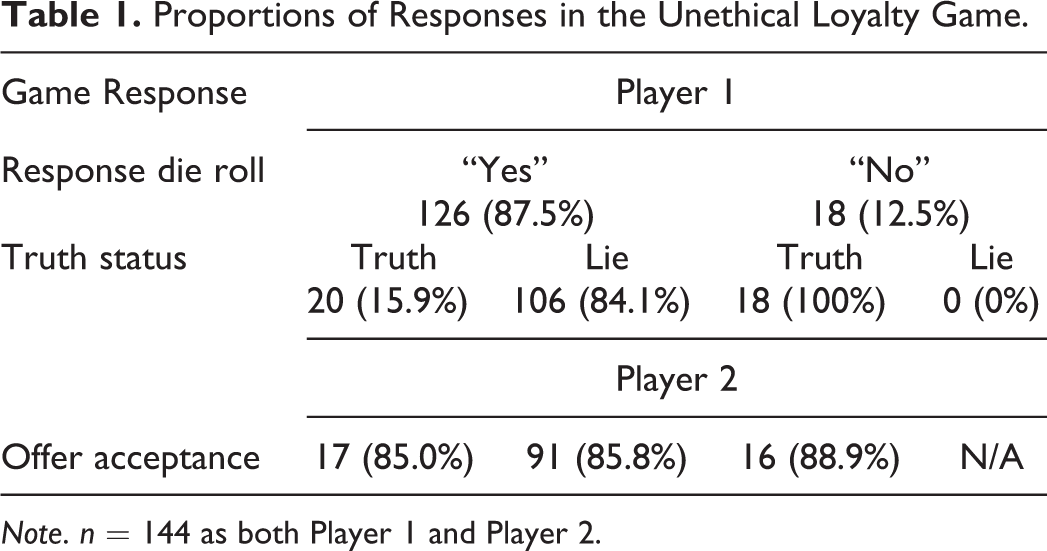
Note. n = 144 as both Player 1 and Player 2.
Finally, we investigated the relation between P2’s unethical loyalty and trait Honesty–Humility (z-standardized; for correlations of P2’s behavior with the remaining HEXACO dimensions as well as P1’s lying and bribing behavior, see Table S1 on the OSF). Overall, Honesty–Humility yielded a negative but nonsignificant effect on P2’s willingness to confirm P1’s response, OR = 0.65, 95% CI [0.37, 1.08], p = .110. Importantly, however, adding the truth status (0 = truth, 1 = lie; z-standardized) and its interaction with Honesty–Humility to the logistic regression model revealed a significant interaction between truth status and Honesty–Humility in line with expectations, OR = 0.65, 95% CI [0.39, 1.06], p = .040 (one-tailed). 1 That is, as depicted in Figure 2, Honesty–Humility only yielded a negative relation to confirming P1’s responses when this implied covering up a lie, OR = 0.48, 95% CI [0.23, 0.89], p = .015 (one-tailed), but it was unrelated to confirming an honest response, OR = 1.28, 95% CI [0.48, 3.27], p = .596. This demonstrates that individuals high in Honesty–Humility were less likely to lie to cover up P1’s unethical act, which suggests that these individuals consider the morality of their choice beyond its prosociality when both virtues are at odds. In fact, our data imply that whenever cooperation requires lying—and thus, whenever P1 did not get lucky in the first place and joint welfare (i.e., the sum of players’ payoffs) can only be maximized through P1’s dishonesty and P2’s unethical loyalty—it takes two individuals low in Honesty–Humility to pursue this goal. Specifically, the odds of maximizing joint welfare through mutual lying were considerably higher when two individuals low (i.e., ≤Mdn) in Honesty–Humility interacted with each other (88.2%) than in case of two individuals high (i.e., >Mdn) in Honesty–Humility (63.3%), OR = 4.10, 95% CI [1.02, 20.32], p = .037 (Fisher’s exact test). Nonetheless, although Honesty–Humility somewhat buffered against lying, the prevalence of unethical loyalty was remarkably high.
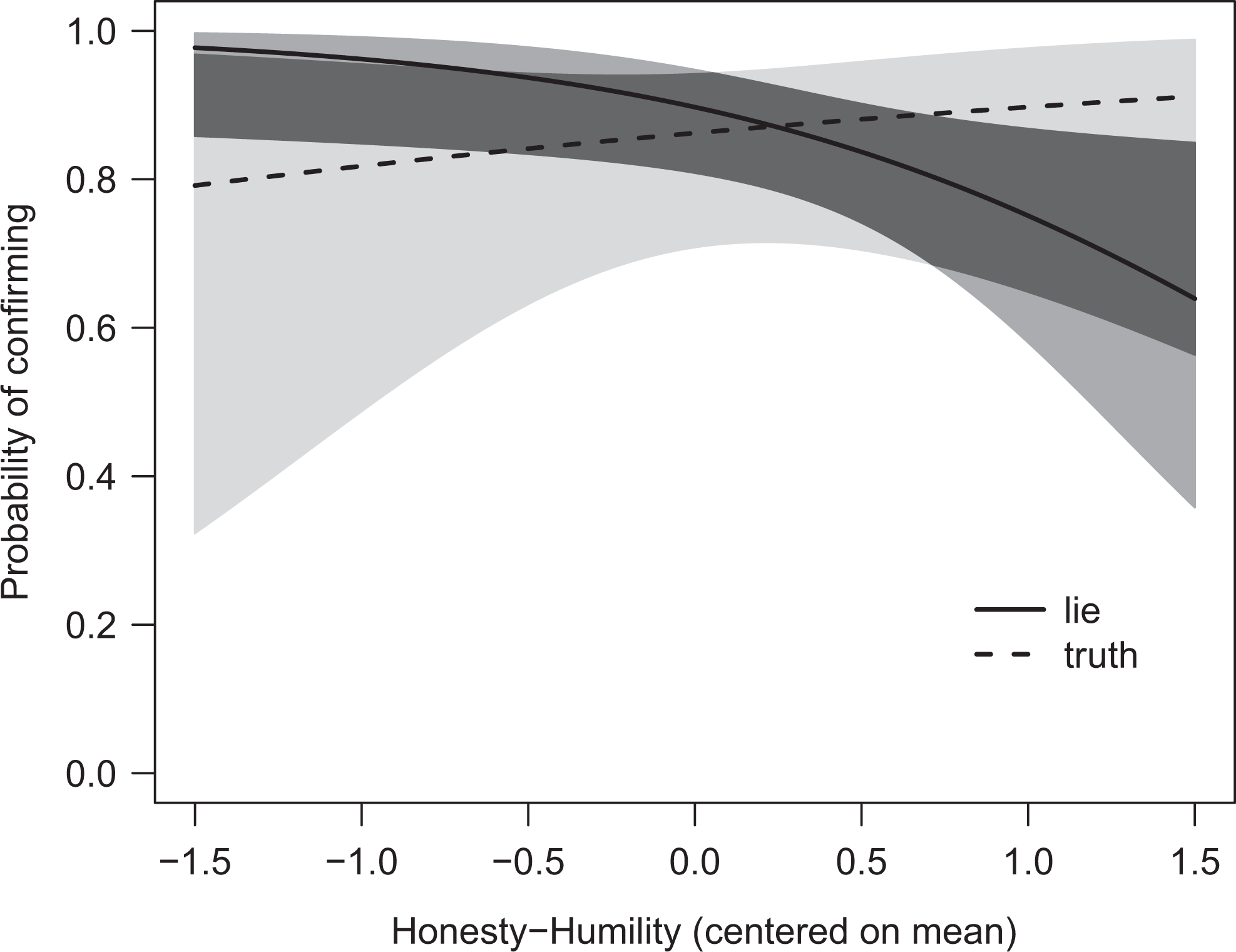
Predicted probability of Player 2 confirming Player 1’s response from a logistic regression on Honesty–Humility (centered on the sample mean) and the truth status of Player 1’s response (separate curves) in the Unethical Loyalty Game. Shaded areas represent 95% confidence intervals.
Discussion
Although previous research has thoroughly investigated the determinants of dishonest behavior in general (Abeler et al., 2019; Gerlach et al., 2019) and of corruption in particular (Abbink, 2006; Serra & Wantchekon, 2012), very little is known about individuals’ willingness to lie to cover up others’ transgressions (Gino & Bazerman, 2009). Using a novel behavioral paradigm, the ULG, we aimed to tackle this issue and to investigate whether and to what extent individuals engage in such unethical loyalty. Results showed that the prevalence of unethical loyalty is high: The majority of participants was willing to lie to cover up others’ transgressions. Moreover, our finding that unethical loyalty increased with increasing bribes offered suggests that individuals were indeed corruptible to some extent: They did not simply cover up a transgressor’s unethical act out of prosociality but (also) out of self-interest. Interestingly, this finding is at odds with extant evidence that the prevalence of dishonesty is, on average, unaffected by incentives at stake (Abeler et al., 2019; Hilbig & Thielmann, 2017), implying that lying to cover up others’ unethical behavior is potentially distinct from lying involving the self only. Transgressors, in turn, offered larger bribes than honest individuals, supporting their motivation to encourage the other to cover up their lie. In fact, bribes were sufficiently large so as to produce a stable level of confirmation by P2, irrespective of whether P1 had lied or not. By implication, transgressors were well calibrated toward the (average) price of unethical loyalty, or at least they were willing to pay a (sufficiently) higher price in order to reduce the risk of P2 not covering up their lie.
Importantly, however, not everyone is equally willing to lie to cover up others’ dishonesty. In line with prior research (Heck et al., 2018), we also found that individuals high in trait Honesty–Humility were particularly unlikely to do so. This was the case even though lying maximized the transgressor’s and joint welfare, which implies that individuals high in Honesty–Humility consider morality even when it conflicts with prosociality (loyalty). This is striking because Honesty–Humility also bears consistent positive relations with prosocial behavior (Thielmann et al., in press; Zhao & Smillie, 2015). As such, our data also confirm prior evidence in showing that dishonest individuals may profit from alliances with other dishonest individuals who will be willing to cover up their transgressions (Gross et al., 2018).
Limitations and Directions for Future Research
Although these findings enhance our understanding of unethical loyalty as a type of immoral behavior that specifically serves covering up others’ unethical actions, it should be acknowledged that we provide a single study with university students as participants only. Future research is thus needed to validate the (high) prevalence estimates of unethical loyalty provided here in other populations. In this regard, it should also be noted that players’ behavior cannot be exclusively interpreted in terms of (im)moral behavior in the current study. Specifically, P1 may not only lie (and bribe) out of self-interest but also out of a concern for P2’s (absolute or relative) welfare, which in fact corresponds to various related real-life settings. Future research is thus needed to more directly investigate individuals’ motivations in the ULG. Moreover, our findings are mostly correlational in nature given that we had no control condition. Future studies may thus compare our results with behavior in other conditions such as a benchmark treatment in which no second party is needed to confirm the lie (i.e., a simple lying task), a treatment in which bribing is not possible, a treatment in which the bribe is not determined by P1 but by the experimenter or a random device, respectively, or a treatment that does not entail lying (i.e., a simple ultimatum game). This will also help interpreting the high prevalence of lying among P1 in our study.
Another promising direction for future research is to investigate the effect of altered power relations between players. In the current (baseline) version of the ULG, individuals in the role of P2 have maximum power because they can (legitimately or illegitimately) accuse P1 of having lied, which ultimately determines both players’ outcomes. As a consequence, P2 can lie without fearing any sanctions, whereas P1 has to fear being sanctioned for both lying and for offering (too) little of the payoff to P2 even if the payoff was earned honestly. In many—if not most—real-life situations, however, unethical behavior is associated with a certain risk of getting caught and experiencing corresponding sanctions. Future applications of the ULG may thus additionally implement sanctions for P2 to study unethical loyalty when both players can get caught lying and power between players is, in turn, more balanced. Conversely, studies may also offer P2 a bonus for accurately accusing P1 of having lied, which should decrease unethical loyalty. In any case, adaptations of the ULG that change the incentives for lying and unethical loyalty, respectively, may ensure that the proportion of these behaviors is less skewed toward one behavioral strategy. Ultimately, such research can enhance our understanding of unethical loyalty and thereby also test the robustness of the (correlational) findings presented herein.
Conclusion
In conclusion, our findings contribute to understanding why and how unethical acts can remain undetected, namely through unethical loyalty which is indeed prevalent and influenced by basic dispositional tendencies. Future research may build on these findings to illuminate (additional) determinants and moderators of unethical loyalty. We are confident that the ULG presented herein provides a useful starting point for research along these lines.
Footnotes
Declaration of Conflicting Interests
The author(s) declared no potential conflicts of interest with respect to the research, authorship, and/or publication of this article.
Funding
The author(s) disclosed receipt of the following financial support for the research, authorship, and/or publication of this article: This work was supported by a grant to the third author from the German Research Foundation (HI 1600/1-2).

Supplemental Material
The supplemental material is available on the Open Science Framework (https://osf.io/e7x3h/).