




Abstract
This article aims to assess the Lithuanian population’s punitive attitudes towards juvenile delinquents, to discuss them from the perspective of authoritarianism and to connect them to Lithuania’s Communist past. This study was a cross-sectional population-based study, administered in 2021. Multistage stratified sampling techniques were used to create a representative sample of 1,508 Lithuanian residents aged eighteen years and older. A measurement of attitudes was created by the authors based on ideas about the tripartite attitude structure: measuring multiple attributes from the areas of affect (feelings towards juvenile offenders), cognition (explanations of the causes of juvenile offending), and action (measures for reduction of juvenile delinquency). The study revealed that almost half of Lithuanians hold punitive attitudes towards juvenile delinquents. These punitive attitudes correlate with negative feelings towards juvenile delinquents related to common stereotypes and inaccurate explanations of the causes of juvenile delinquency. Punitiveness was also connected with fears of “bad” Western influences, such as the perceived overvaluing of children’s rights and disapproval of violence against children and authoritarian parenting. The question “Is juvenile delinquency in Lithuania increasing because of the bad influence of the West?” divided the Lithuanian population into two almost equal groups: “Pro-Westerners” and “Anti-Westerners.” “Anti-Westerners” were more likely to hold authoritarian views, while “Anti-Western” attitudes were more prevalent among older, less-educated, and lower-income citizens.
Introduction
Public attitudes towards juvenile offenders are important to investigate because the public pressures professional systems to react and demand accountability for ineffective preventive measures, assigns blame for the “worsening” juvenile crime situation, criticizes the “lenient” juvenile justice system, and demands changes to the law. 1 Public attitudes affect juvenile justice policy decisions and influence the overall direction of penal policy. 2 People are more sensitive to crimes committed by children and young people than crimes committed by adults. Public sensitivity is particularly evident in high-profile cases highly publicized by the media. 3
This article uses data from a national survey of Lithuanians to assess public attitudes towards juvenile offenders in Lithuania. Given the country’s Communist past, we pay particular attention to punitive attitudes and their possible causes. Much research on public attitudes towards juvenile offenders are carried out in Western countries, for example, Moon et al., 4 Mears et al., 5 Piquero et al., 6 and Bolin et al. 7 in the United States; Haines and Case 8 in the United Kingdom; Ellis et al. 9 in Australia. Almost no research on public attitudes towards juvenile delinquency could be found from post-Communist societies, except for a few research papers in Romania. 10
Lithuania stands at the front line of the power struggle between East and West. Lithuanian society went through dramatic changes in the past thirty years as it transitioned from a planned economy to a free-market economy, from a one-party authoritarian regime to a democratic regime of multiple parties, and by leaving the Soviet Union and joining the European Union. These changes brought different outcomes for different groups. 11 Part of Lithuanian society longs for the good times associated with the Soviet past. 12 The hardships of transition and increased inequalities 13 might explain this longing. Still, perhaps it is also supported by the belief that the transformations resulted in the increase of many social problems, such as prostitution, homelessness, and juvenile offending. Perhaps Lithuanians have resisted reforms to the juvenile justice system because of ideas introduced by Western culture. This latter aspect of our research is new, and there is no research which looks at punitive attitudes towards juvenile offenders from this perspective.
People react sensitively to juvenile offences because offenders are children whose personalities are not yet formed and who must be educated and developed. 14 Fathers, mothers, grandfathers, grandmothers, aunts, and uncles, the subjects of this research, believe they are experts regarding children because they have children or were once children themselves. Because adults hold moral and legal responsibility for children, they have mixed feelings about children’s misbehaviour. Common feelings are anger about what a child has done, fear for the future, guilt that they might be responsible for the child’s actions, and helplessness that they cannot change the child’s behaviour. The reaction depends on how individuals and society feel about it, and how they deal with it. 15
Societal responses to juvenile offending are built along competing goals of the juvenile justice system: to punish or to rehabilitate. Most research on public attitudes attempts to determine whether the public supports rehabilitative or punitive measures for juvenile offenders. Several studies show public support for rehabilitative measures for juvenile offenders. For example, Moon et al. 16 found that the public’s belief in “saving the child” was firm and that U.S. citizens did not support an exclusively punitive response to juvenile offenders. Also, studies of Mears et al. 17 and Piquero et al. 18 in the United States and Ellis et al. 19 in Australia revealed a broad consensus in support of juvenile rehabilitation and optimistic views that juvenile offenders can be reformed.
The public is more likely to support harsher punishment for adolescent offenders if it views adolescents as more responsible for their actions, without considering other influences. Distrust of the judicial system, political prioritization of law and order, and anti-minority attitudes predict German citizens’ support for severe punishment as an effective crime reduction technique. 20 People’s attitudes about punishment also vary depending on the severity and the circumstances of the offence, together with the personal characteristics of juvenile offenders. For example, studies of Romanians found that public support for trying juveniles in adult courts varied significantly as a function of the offender’s age, criminal record, and offence. 21 Romanians considered that sentences handed down by the courts to juveniles were not harsh enough, but they changed their opinions when they were provided with more information or thought more closely about an issue with specific examples. 22 A study on the informed sense of justice in Scandinavian countries provided similar results. 23
Punitive attitudes are a complex phenomenon affected by various factors. There are various interpretative models of what makes people adhere to punitive justice. Several come from criminology: that people are concerned about becoming a victim of crime and they look to punishment to reduce future harm; that people are concerned about community breakdown and they support punishment to restore moral boundaries; 24 that the personal experience of being a victim or perpetrator affects punitive judgements. 25
The theory of the authoritarian personality is based on psychological theory and can be seen as the most robust theoretical perspective for understanding punitive attitudes. 26 Studies of authoritarianism started with the works of Fromm 27 and Adorno et al. 28 on the authoritarian personality. Their theoretical ideas were critiqued, developed, and tested by research in sociology and social psychology. The core of the theory is that people vary in the extent of their desire for conformity and authority in society and how strongly they look to institutions to punish transgressions that threaten collective security. Right-wing authoritarianism predicts the extent to which people support harsh punitive measures in general and specifically for juvenile offenders. 29
More focused measures identify two motivational and value-based social attitude dimensions: right-wing authoritarianism (RWA) and social dominance orientation (SDO). The first reflects a cultural pattern, termed threat-authoritarian, characterized by a socially normative view of the world as a dangerous and threatening place. The second, termed competitive-dominance, is characterized by a socially normative view of the world as inherently unequal and hierarchical with high levels of competitiveness for dominance and power. 30 Both attitudes reflect the authoritarian personality and are correlated with punishment attitudes but operate through different mechanisms and for different reasons. Persons with high RWA favour strict, harsh punishments to establish and maintain collective security through social order, stability, cohesion, consensus, and conformity. 31 Persons with high SDO favour strict, harsh punishments to establish and maintain power, dominance, and competitive advantages for themselves and their groups over others. Thus, authoritarianism has different roots, but research in political psychology has proved that it always predicts punitiveness. 32
Two lines of interpretation of the root origin of authoritarian attitudes compete in authoritarianism studies. One is that authoritarianism stems from socialization—that is, from the pattern of parenting and parent–child interactions in families 33 —and the other is that the causes of authoritarianism are found in the external situation, such as threats, dangers, insecurities, intergroup social conflicts, and other changes in society. The phenomenon of authoritarianism can be better understood by combining these two lines in a complementary way: not “socialization versus situation” but “socialization and situation.” 34 The latest theories in social psychology have focused on this interaction. Authoritarianism is found universally in different societies. 35 Nonetheless, research comparing East and West Germany shows that the post-Communist society tends to be more authoritarian than the one having longer liberal democratic traditions. 36
The guiding questions of the present research were as follows: (1) Which measures—punishing or supporting and educating—for juvenile offenders do Lithuanian residents support? (2) What feelings and explanations of the causes of juvenile offending predict a public preference for punitive justice? (3) How can explanations of the causes of juvenile offending be grouped? (4) How large is the group of Anti-Westerners? (5) How different are Pro-Westerners and Anti-Westerners in judgements on items from the Affect and Facts/Stereotypes scales?
Materials and Methods
Study Design and Procedure
This is a cross-sectional population-based study. Multistage stratified sampling techniques were used to create a representative sample. During the first stage, a stratified random sample of twenty-five municipalities out of sixty was selected. The sample was stratified by two areas, the district (ten districts) and the size of municipality’s population living in cities (three groups: more than 75 per cent, between 75 and 50 per cent, and less than 50 per cent of the population living in cities), to ensure sufficient recruitment in these areas. During the second stage, random route sampling was used in each selected municipality. Distribution in the sample according to the three municipal strata reflects the distribution (according to the three municipal strata) in the whole population. Registration office data (version dated 24 August 2020) were used as a base for the selection of households as primary points. A total of 511 households were selected using probability sampling (generated by simple random sampling). Rules of the route employed were up to five interviews from one primary point, one respondent from the same household, and the closest birthday inside the household. In total, 6,523 households were visited. The response rate was 23.1 per cent. It was computed using the following formula: completed surveys/(completed surveys + partial completes) + (refusals/terminations, non-contacts) + (unknown households + unknown others).
Data were collected between July and September 2021, using computer-assisted personal interviews (CAPI). The fieldwork was administered by a market research company, which followed the requirements of the European Society for Opinion and Marketing Research (ESOMAR) code of ethics. Interviewers were trained to provide respondents with information about the study and the investigators, data management, and protection. Subjects’ participation in the study was voluntary. They were informed that they could withdraw from the study at any time. The authors received anonymized data from the company, which were analysed only in summarized form with no identification of the respondents.
Participants
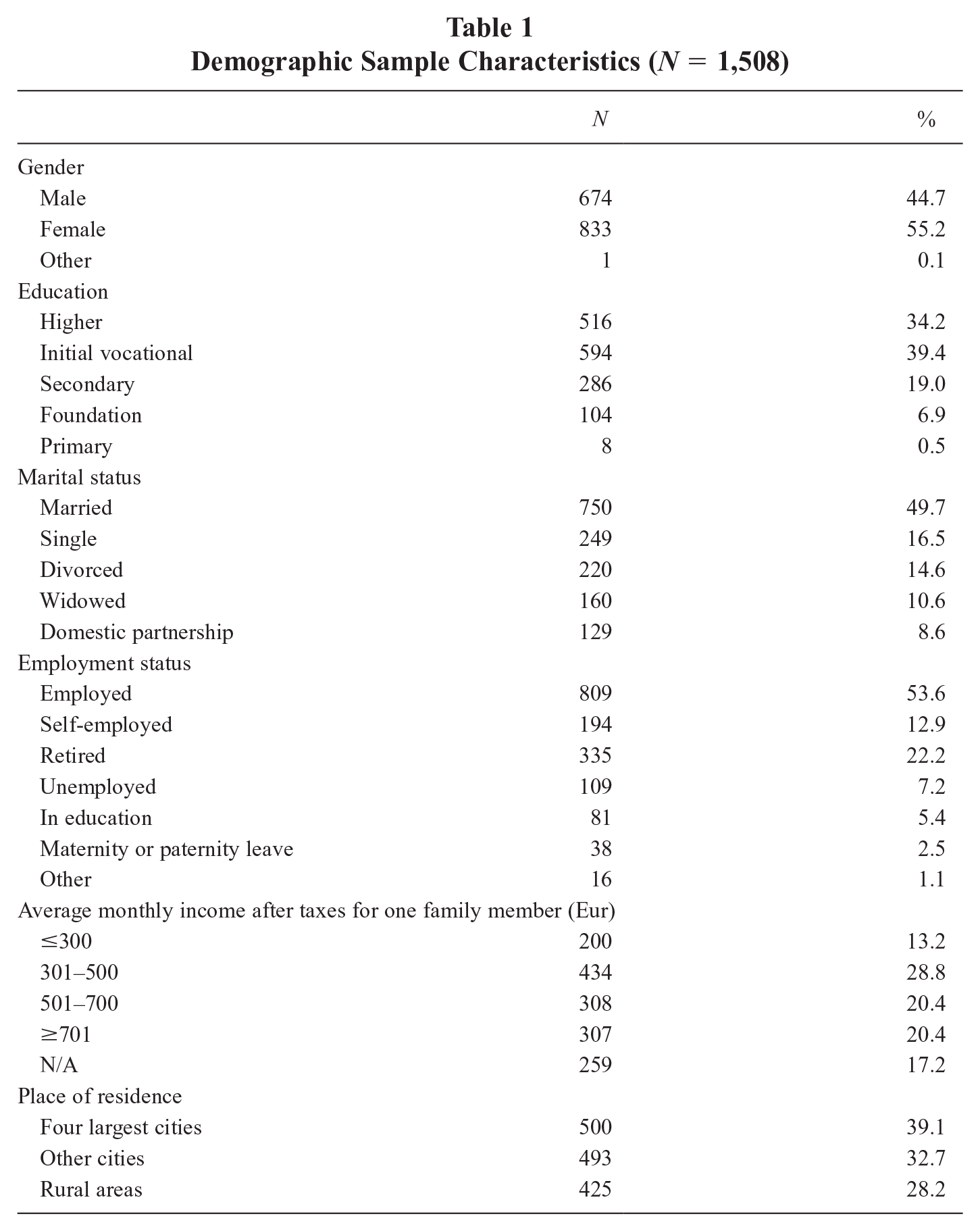
Lithuanian residents aged eighteen years and older participated in the survey. The sample size was 1,508 respondents. Demographic characteristics of the sample are presented in Table 1. A majority of the respondents had children (79.7 per cent) with almost a third (31.5 per cent) having children younger than eighteen.
Demographic Sample Characteristics (N = 1,508)
Measurements
A measurement of attitudes towards juvenile offenders was created by the authors based on the traditional social psychology idea about the tripartite attitude structure: affect (the positive and negative feelings that one holds towards an attitude object), cognition (beliefs that one has about the attitude object), and behaviour (overt actions and responses to the attitude object). Attitude is formed and manifested through the interaction of these elements. 37 The measurement strategy was built on measuring multiple attributes from the areas of affect, cognition, and action. The authors used meta-attitudinal measures, which involve reporting subjective evaluations about different attributes of the attitude or attitude object. Bassili 38 notes that meta-attitudinal measures are used in surveys which are concerned with the general tendencies of societal attitudes (moods) held by society at a given time and context.
Action was measured by six items that respondents believe could help reduce juvenile delinquency. Items of the Action scale were “Criminal liability should be applied to even younger minors than at present (applicable from fourteen)”; “Juveniles who violate the law and commit crimes should be punished similarly to adults”; “Parents should be allowed to use corporal punishment on their children”; “It is more important not to punish juveniles who violate the law and commit crimes but to educate them and help them”; “Parents of delinquent juveniles need help to bring them up”; and “Juveniles who commit violations of the law and crimes should be imprisoned only in exceptional and extreme cases.” The scale’s level of internal consistency, as determined by Cronbach’s alpha, is .611. The Action scale did not reach the recommended α level (.7). However, the correlations between the statements that made up the Action scale were strong enough, and the recommended α level may not have been achieved due to the small number of items that make it up. It was therefore decided to use the Action scale for further analysis.
Affect was measured by five items of negative feelings. 39 Items of the Affect scale were “I condemn juveniles who violate the law and commit crimes”; “I am annoyed by juveniles who violate the law and commit crimes”; “Juveniles who violate the law and commit crimes make me disgusted”; “Juveniles who violate the law and commit crimes frighten me”; and “Juveniles who commit violations of the law and crimes make me feel hopeless and helpless.” The scale’s level of internal consistency, as determined by Cronbach’s alpha, is .729.
Cognition was measured by six items. They included common misconceptions or incorrect explanations of why young people violate the law and commit crimes, contradicting the international standards of juvenile justice (United Nations and Council of Europe), and criminological theories and research. 40 The Cognition scale consisted of the following items: “Only juveniles who do not have will and a sense of responsibility commit crimes”; “Criminal behaviour is encoded in human nature, genes; if a person was born like that, he will not change”; “Bad parents have bad children: ‘the apple never falls far from the tree’”; “Juveniles are offending because it is now forbidden to punish children with corporal punishment; they are not afraid of anything”; “Juveniles live in abundance, committing crimes out of ignorance of what else to want”; “Juvenile delinquency is on the rise due to the bad influence of the West.” The scale’s level of internal consistency, as determined by Cronbach’s alpha, is .735.
Facts/Stereotypes was about juvenile delinquency. These items were based on current data on registered crime in Lithuania, “The number of crimes committed by juveniles in Lithuania is increasing every year”; “Younger and younger juveniles are committing crimes”; “Crimes committed by juveniles are becoming more severe and more violent,” and a stereotype common in society, “Minors have no duties, only rights.”
The respondents were provided with a Likert-type rating scale where 1 = “strongly disagree,” 2 = “somewhat disagree,” 3 = “somewhat agree,” 4 = “strongly agree,” 5 = “don’t know/can’t say” for all items.
Statistical Analysis
Data were analysed using the software package SPSS 26.0. It was used to calculate internal consistency reliability coefficients (Cronbach’s α), to run principal component analysis (PCA) and intergroup comparisons (Mann–Whitney U test), and to perform correlation (Pearson and Spearman) and linear regression analyses. The level of significance was set at p < .05.
Results
The first question assessed what actions towards juvenile offenders Lithuanian residents support. The majority of the sample supports helping and providing educational measures for juvenile offenders and their parents: 88.2 per cent somewhat and strongly agreed that it is more important not to punish juveniles who violate the law and commit crimes but to educate and help them; 88.2 per cent agreed that parents of offending juveniles need help to bring them up; 71.2 per cent felt that juvenile offenders should be imprisoned only in exceptional and extreme cases. Smaller parts of the sample support punitive measures: 41.3 per cent somewhat and strongly agreed that parents should be allowed to use corporal punishment on their children; 35.3 per cent agreed that criminal liability should be applied to even younger juveniles than at present; 32.0 per cent agreed that offending juveniles should be punished similarly to adults. Some of the respondents support both punishment and rehabilitation.
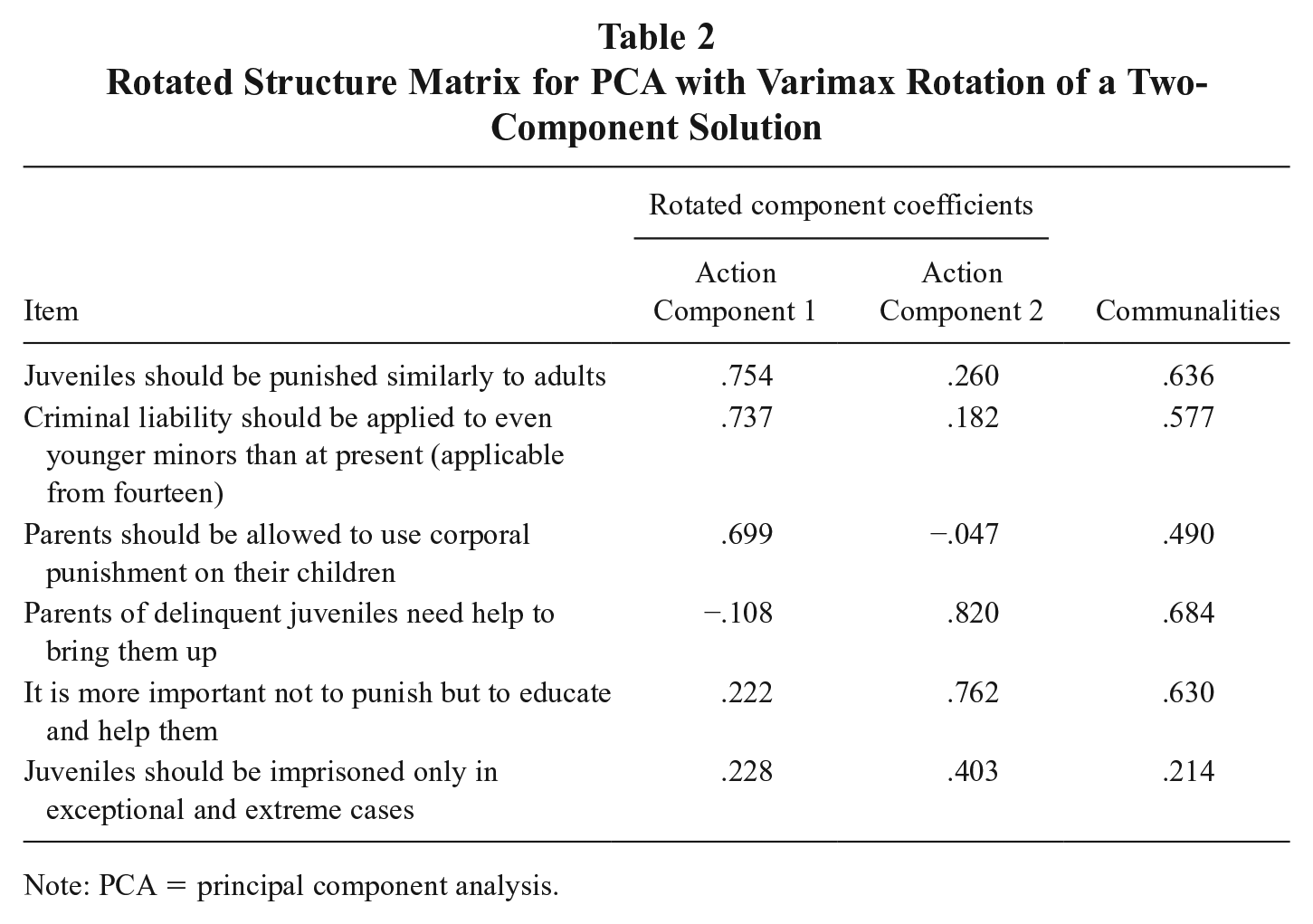
A PCA was conducted on the items of the Action scale. The suitability of PCA was assessed prior to analysis. Inspection of the correlation matrix showed that all variables had at least one correlation coefficient greater than .3. The overall Kaiser–Meyer–Olkin (KMO) measure was 0.66 with individual KMO measures all greater than 0.7, classified as “middling” to “meritorious” according to Kaiser. 41 Bartlett’s test of sphericity was statistically significant (p < .001), indicating that the data were likely factorizable. This analysis revealed two interpretable components that had eigenvalues greater than one and that explained 34.9 and 18.9 per cent of the total variance, respectively. Visual inspection of the scree plot indicated that two components should be retained. 42 In addition, a two-component solution met the interpretability criterion. As such, two components were retained. The two-component solution explained 53.8 per cent of the total variance. A varimax orthogonal rotation was performed to aid interpretability. The rotated solution exhibited “simple structure.” 43 As shown in Table 2, PCA grouped the Action scale items into two components: the first contained punishment-related items, with strong loadings on Action Component 1, and the second contained welfare-related items, with strong loadings on Action Component 2. Action Component 1 (punishment-related) had stronger loadings and explained more variation of the Action scale than Component 2.
Rotated Structure Matrix for PCA with Varimax Rotation of a Two-Component Solution
Note: PCA = principal component analysis.
The second question concerned what affects and explanations of the causes of juvenile offending predict public punitiveness. We sought to determine how respondents’ reported feelings (affect) and their support for explanations of the causes of juvenile offending may impact their support for societal measures for juvenile offenders. Linear regression was run to understand the influence of Affect and Cognition scales on the punitive Action Component 1. Affect scale accounted for 16.0 per cent of the variation in punitive Action Component 1 with adjusted R2 = 15.9 per cent, which is a medium size effect according to Cohen. 44 Affect scale statistically significantly predicted punitive Action Component 1, F(1, 960) = 182.21, p < .001. The Cognition scale accounted for 29.7 per cent of the variation in the punitive Action Component 1 with adjusted R2 = 29.6 per cent, which is a large size effect according to Cohen (2013). The Cognition scale statistically significantly predicted on the punitive Action Component 1, F(1, 846) = 356.82, p < .001. Thus, punitive reactions to juvenile offending can be partly explained by both negative feelings and incorrect explanations of the causes of juvenile offending, but the predictive effect of the latter is almost twice as strong. It means that the cognitive element has a stronger impact on the punitive Action Component 1 than the affect element of attitudes.
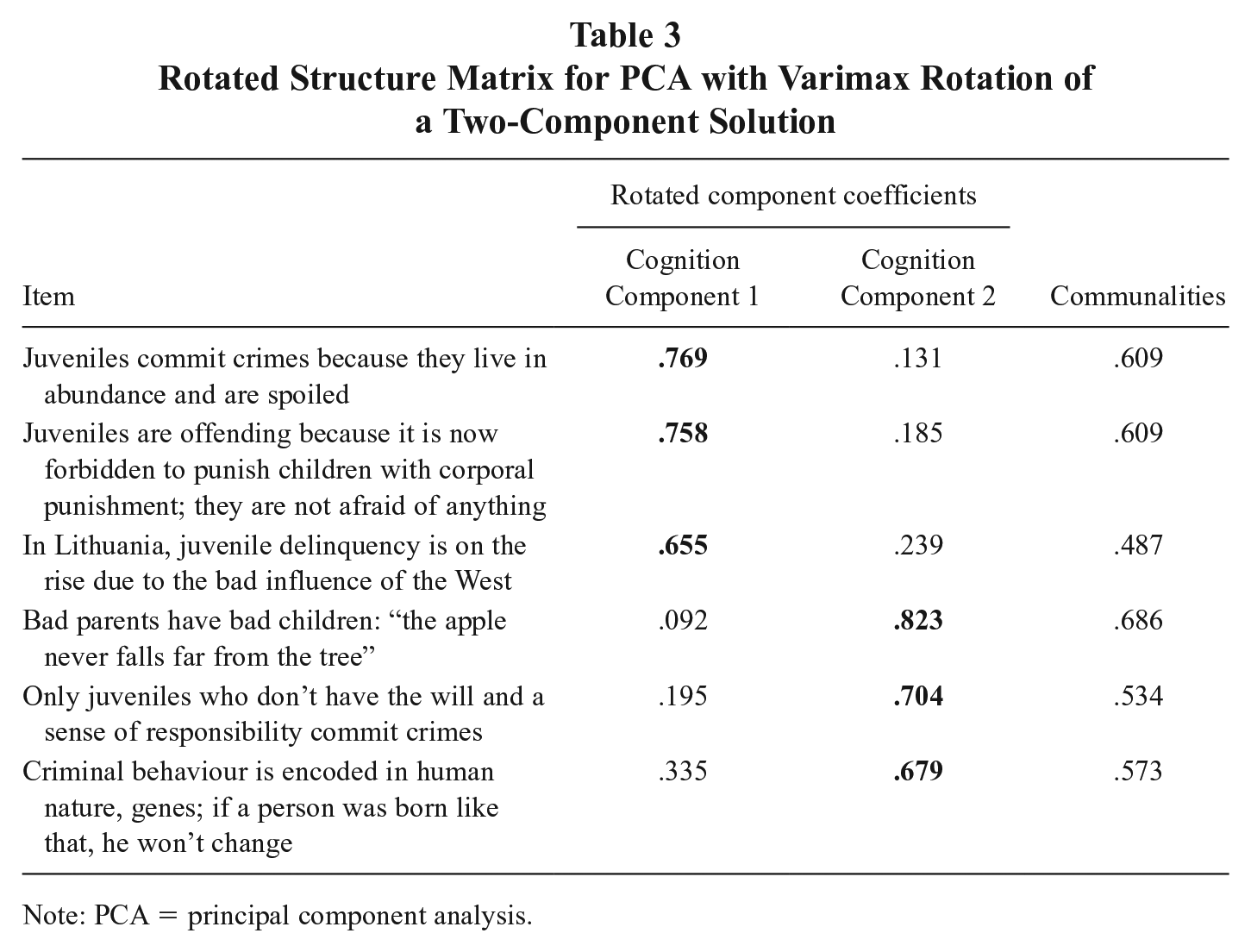
The third question was, how can explanations of the causes of juvenile offending be grouped? To determine which of the Cognition scale items could best explain the overall variation of the scale and to look for possible subscales, the PCA was conducted on the items of Cognition scale with forced two-factor extraction. The suitability of PCA was assessed prior to analysis. Inspection of the correlation matrix showed that all variables had at least one correlation coefficient greater than .3. The overall KMO measure was 0.80. Bartlett’s test of sphericity was statistically significant (p < .001), indicating that the data were likely factorizable. PCA revealed two components that had eigenvalues greater than or close to one and that explained 43.1 and 15.2 per cent of the total variance, respectively. Visual inspection of the scree plot indicated that two components should be retained. 45 In addition, a two-component solution met the interpretability criterion. The two-component solution explained 58.3 per cent of the total variance. A varimax orthogonal rotation was performed to aid interpretability. The rotated solution exhibited “simple structure.” 46 Component loadings and communalities of the rotated solution are presented in Table 3.
Rotated Structure Matrix for PCA with Varimax Rotation of a Two-Component Solution
Note: PCA = principal component analysis.
PCA divided the Cognition scale items into two components. The first set of items, comprising Component 1, emphasizes the contextual causes of delinquency: juveniles offend because they live in abundance and are spoiled, because it is forbidden to punish children with corporal punishment, and because of the bad influence of the West. The second set of items, comprising Component 2, is more related to individual characteristics and family environment: juveniles are offending because they do not have a sense of responsibility, because bad parents bring up bad children, and because criminal behaviour is encoded in human nature, in genes, where it cannot be changed. PCA showed that Component 1 (contextual causes) explains significantly more variation of Cognition 1 scale. Respondents’ ratings of contextual causes are the main determinants of their differences in the cognitive element of attitudes.
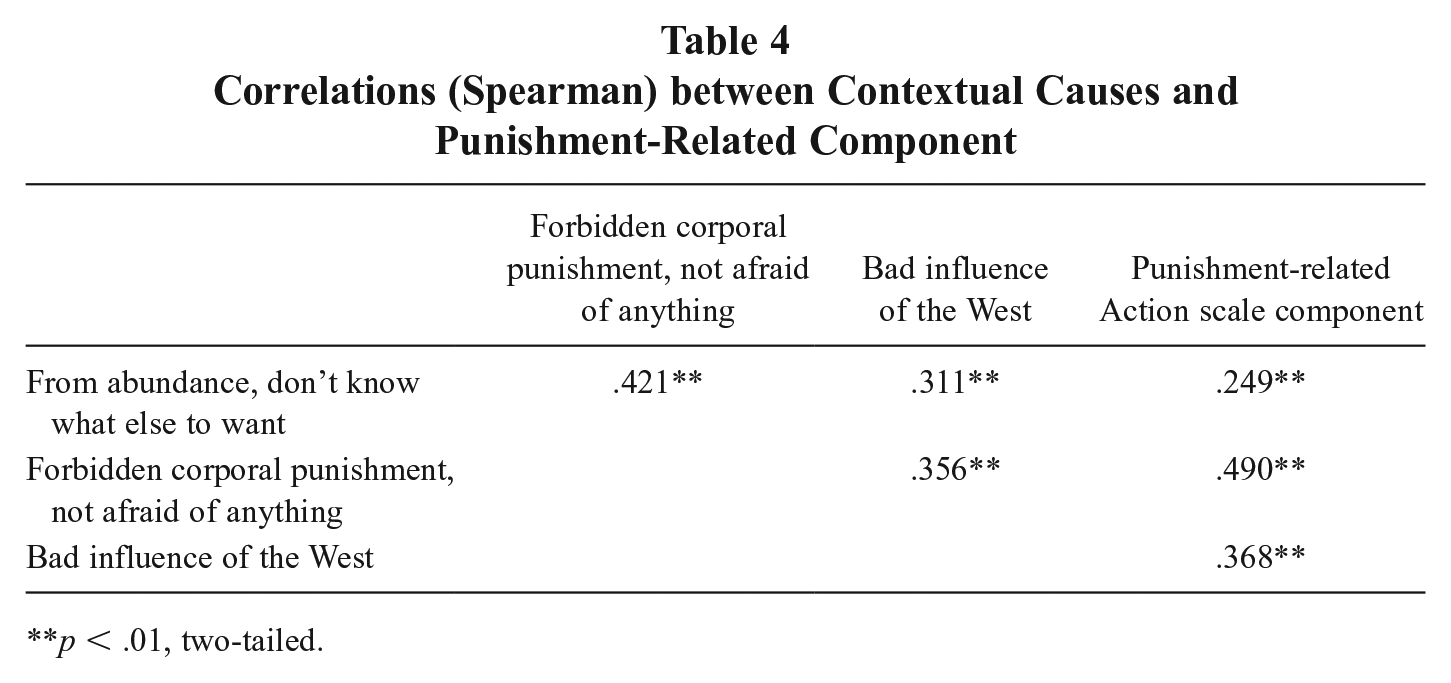
The largest proportion of respondents (46–64 per cent) tended to agree (somewhat and strongly agreed) with all three items of the subscale, which means that, based on previous analysis, these beliefs may best explain the measures (punishment or help) they choose when it comes to the action element of the attitudes. Ratings of these items positively correlate with the punishment-related Component 1 of the Action scale (Table 4): the more respondents agree that juveniles commit crimes because of too much wealth, because of the negative impact of the West, and because they are not afraid of anything since corporal punishment for children is banned, the more support for punitive measures they express.
Correlations (Spearman) between Contextual Causes and Punishment-Related Component
p < .01, two-tailed.
The fourth question is: How big is the group of Anti-Westerners? Research in Western countries demonstrates that RWA expects rule-abiding behaviours and supports punishment to control individual behaviour. 47 But the item concerning the influence of the West has very specific meanings in Lithuania and other post-Communist countries. Therefore, we decided to take a closer look at it in this article. The belief that juvenile delinquency in Lithuania is growing due to the evil influence of Western countries was supported by 45.8 per cent of the sample (55.8 per cent of those who rated this item).
The fifth question is: How different are judgements on items from the Affect and Facts/Stereotypes scales in groups of Pro-Westerners and Anti-Westerners? While the item itself does not disclose what that bad influence of the West is, it can be deduced from the ratings of other items. To this end, respondents of the study were divided into two groups: those who strongly or somewhat agreed with the item about the evil influence of the West were called “Anti-Westerners,” and those who strongly or somewhat disagreed were called “Pro-Westerners.” Furthermore, these groups were compared according to how they rated (tended to agree or disagree) the individual items on the Affect, Cognition, and Facts/Stereotypes scales. The Mann–Whitney U test was used to compare groups. Statistically significant differences are presented in Table 5.
Differences between Pro-Westerners and Anti-Westerners: Summary of Mann–Whitney U Tests
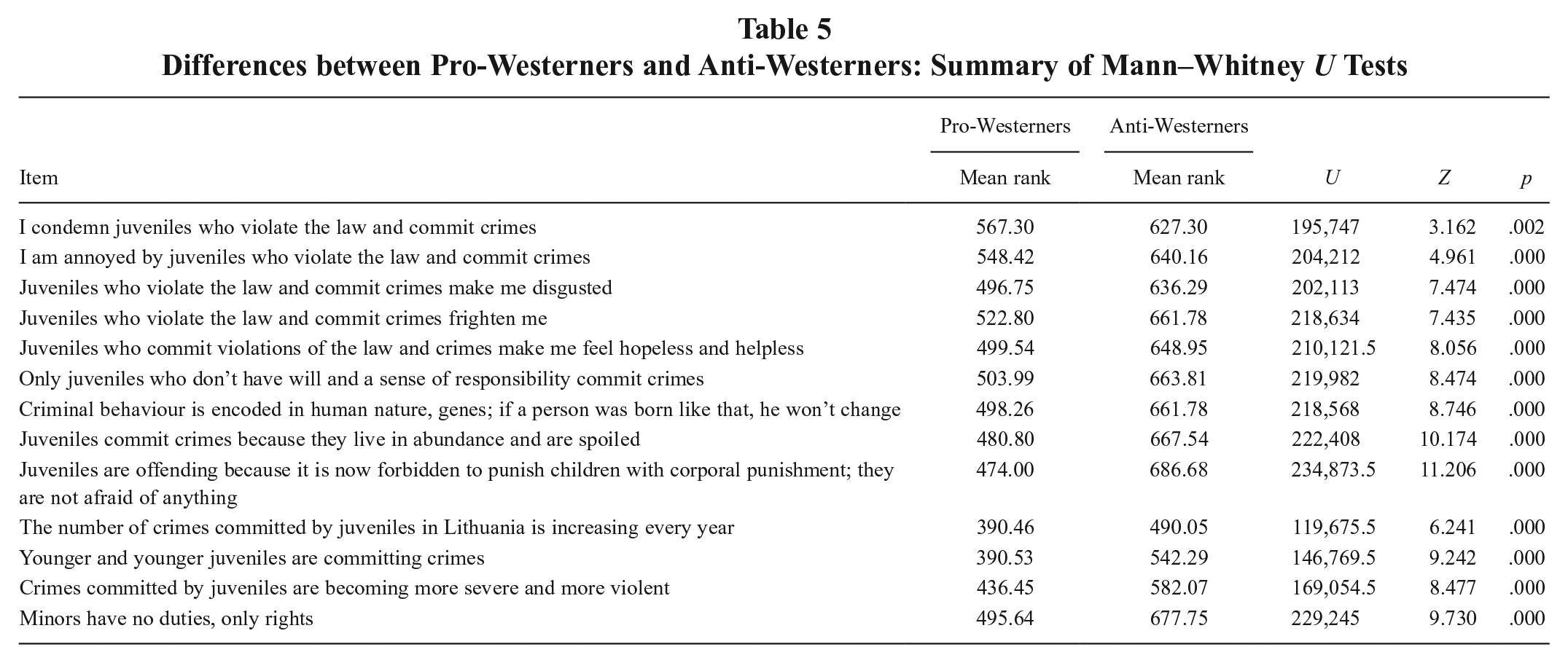
At the emotional level, “Anti-Westerners” stand out with a significantly higher prevalence of negative feelings towards offending juveniles. They are more likely to feel resentment, disgust, and fear and condemn offending youths. More often, they feel hopeless and helpless towards juvenile delinquency. “Anti-Westerners” are significantly more likely to agree that juveniles break the law because they have no will or responsibility; that criminal behaviour is innate, encoded in genes. Juveniles are saturated with abundance and do not know what more to want. And after all, young people are now not afraid of anything because corporal punishment for children is prohibited, and juveniles now have no more duties, only rights. Also, significantly more tend to believe that juvenile delinquency in Lithuania is on the rise, that increasingly younger minors are committing crimes, and that the crimes they commit are getting worse and more brutal.
The sociodemographic characteristics of the “Anti-Westerners” and “Pro-Westerners” groups were compared. These groups differ statistically significantly by age: the “Anti-Westerners” group consisted of older respondents (mean age = 51.5 years) than the “Pro-Westerners” group (mean age = 45.2 years). There is also a statistically significant difference between the groups in terms of income per family member: in the “Anti-Westerners” group (mean rank = 481.59), they were statistically significantly lower than in the “Pro-Westerners” group (mean rank = 564.96), Mann–Whitney U test = 110,533, z = −4.602, p = .000. The groups also differed statistically significantly according to the level of education; the education of “Anti-Westerners” (mean rank = 586.38) was lower than that of “Pro-Westerners” (mean rank = 659.10), Mann–Whitney U test = 166,204.5, z = −3.769, p = .000. Differences in gender and place of residence between groups were not statistically significant. Thus, “Anti-Western” attitudes tend to be supported by the older, less-educated, and lower-income citizens of Lithuania.
Discussion
A national study revealed that 32–41 per cent of Lithuanians tend to approve punitive measures for juvenile offenders. At the same time, only 7–22 per cent tend to disapprove of help and educational measures for juvenile offenders. Thus, support for punitive measures does not necessarily mean no support for welfare measures. These findings are similar to the results of other studies, which show that there is no strict dichotomy between punishment and rehabilitation. 48 The public believes that young people need to be punished, rehabilitated, and repent. Only through that combination can young persons be changed. 49
The study shows that the public approval of punitive justice can be partly explained by both negative feelings towards juvenile offenders (affect) and incorrect explanations of the causes of juvenile offending (cognition). The latter has a stronger predictive effect. The research of Baker et al. 50 indicated that the emotional dimension (fear) of crime salience reduced the likelihood of supporting rehabilitation and increased the likelihood of supporting youth punishment. The cognitive dimension of crime salience had no significant effect. In the latter respect, this study put more light on the cognitive dimension, as it used more and different items measuring cognition.
The cited causes for juvenile offending, as measured in the Cognition scale, fall into two categories: contextual conditions and individual characteristics. The first category explains more of the variation in the scale, specifically that youth have more possessions than they need, they follow bad examples from Western countries, and parents cannot manage children’s misbehaviour because they cannot use corporal punishment. The division of causes into contextual and individual in this study reminds us of the two sources of authoritarianism measured by RWA and SDO in the work by Duckitt. 51 The contextual causes might be attributed to the threats to social order, stability, and conformity. Study respondents believe that while young people should obey their parents who have authority over them, youth are no longer afraid of parents because they are spoiled and under the bad influence of the West. On the other hand, individual characteristics point to the personal responsibility of the offending youth, that is, that they are too weak and incapable of changing their attitudes and lifestyles. 52
The study revealed an unexpected correlation between punitive attitudes towards juvenile offending and fear of “bad” Western influences. Almost half of the sample supported the idea that juveniles offend due to the bad influences of the West, such as a perceived overvaluing of children’s rights and a disapproval of violence against children and authoritarian parenting. Anti-Westerners were more likely to hold authoritarian views. In the Anti-Westerners group, compared with the Pro-Westerners group, were older citizens and those with lower education and lower income.
Agreeing or disagreeing with Anti-Western statements likely reflects not just contradictory attitudes towards juvenile delinquency but instead a more profound split in society. The wider “bad influence of the West” for this group of people can specifically be related to children’s and human rights, which are fiercely defended in Western democracies. In 2001, the UN Committee on the Rights of the Child urgently recommended the Lithuanian state to adopt appropriate legislative measures to explicitly prohibit the use of any form of corporal punishment within the family. 53 Only after lengthy discussions and several attempts, the Parliament finally enacted a law prohibiting the corporal punishment of children in 2017. The results of the study show that a large part of Lithuanian society still does not support this legislation.
“Pro-Westerners” and “Anti-Westerners” also differ in factual knowledge and preconceptions. “Anti-Westerners” tend to believe that juvenile offending in Lithuania is on the rise with higher numbers, more serious crime, and at younger ages. Statistics on juvenile delinquency in Lithuania in recent years show the opposite trends. 54 The absolute and relative numbers of juveniles suspected or charged with criminal offences, including violent crimes, have gradually decreased since 2014 (Figure 1). Research in other countries proves that punitive public attitudes can be driven by a tendency for the public to overestimate the extent of youth crime, the number of young offenders, the proportion of all crimes committed by young people, and the severity of youth crime (especially violence). 55
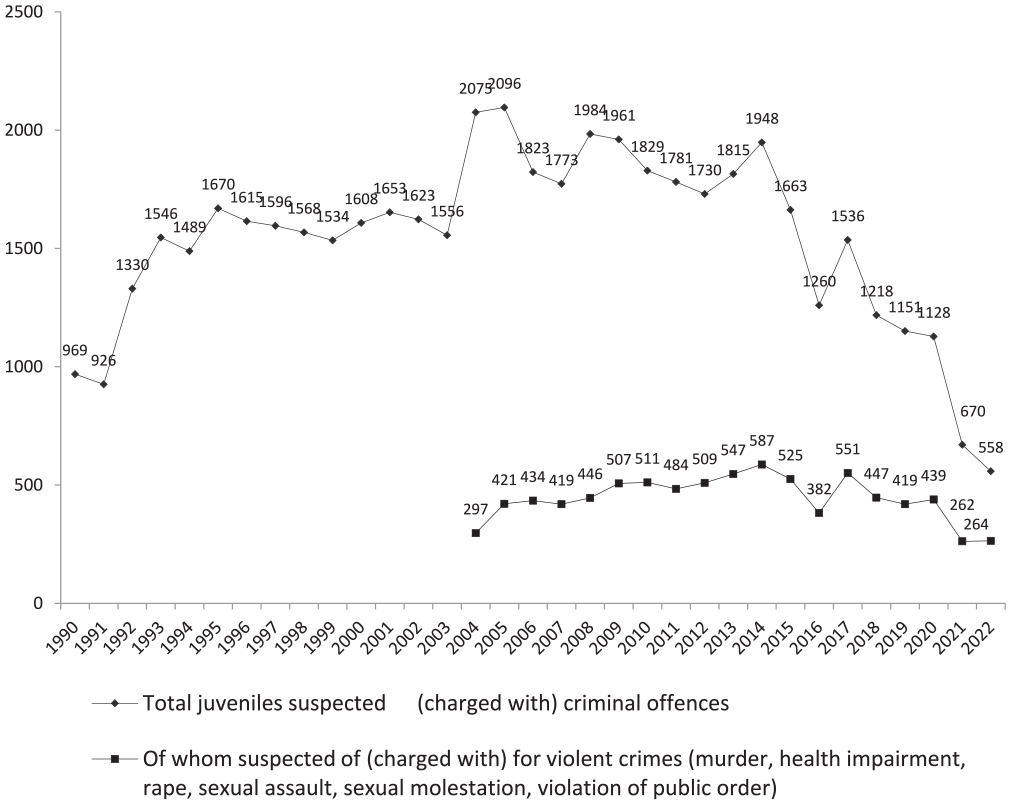
Juveniles (14–17 years) suspected of (charged with) criminal offences: Lithuania, 1990–2022 (persons per 100,000 of relevant population)
Looking at the results of the study, it is essential to discuss the reasons why about half of the Lithuanian population has not only punitive attitudes towards juvenile offenders but also an authoritarian, highly conservative approach to parenting in general. Moreover, they believe that the values of liberal democracy and the principles promoted in Western societies, such as the protection of children’s rights and the prohibition of corporal punishment, harm and are detrimental to the upbringing of children. This is somewhat puzzling, as the Lithuanian population has been one of the most enthusiastic supporters of the European Union for a number of years. 56 It could be assumed that they also support the values promoted by the European Union and do not oppose them.
One hypothesis for understanding the punitive and authoritarian attitudes of this relatively large group within Lithuanian society stems from socialization—the authoritarian tradition of parenting is still prevalent in Lithuanian culture as a legacy of the former totalitarian regime. It is most likely that a significant proportion of study participants have themselves experienced a pattern of authoritarian relationships with parents. They possibly adopted similar parenting practices themselves. Kemme et al. 57 showed that victims of parental violence during childhood and adolescence themselves are more punitive than non-victims. The idea that authoritarian parenting is common in Lithuania can be supported by the findings of Sebre et al. 58 that 42 per cent of the children in Lithuania reported experiencing parental emotional and/or physical abuse during the last year. The “Mare-Balticum-Youth-Survey” in 2002–2004 revealed that parental violence against children in the eastern Baltic region was much more common than in Finland and Sweden. 59
Comparative studies of East and West Germany show that the population of East Germany has a more pronounced authoritarian attitude than the population of West Germany, related to the experience of the Communist regime. 60 Studies of the consequences of the authoritarian regime and cultural trauma in Lithuania reveal that the violence perpetrated by state institutions and the persecution of citizens have disrupted the formation of their relationship with authority, both internal and external. 61 Due to these traumatic experiences, authority is perceived as punishing, controlling, and persecuting. In personal relations, it breeds domestic violence. In relations with the state, it breeds mistrust and resistance. These studies might explain why punitive attitudes are more common among the older Lithuanians who participated in our study.
The reasons for authoritarian and anti-Western attitudes in Lithuania may have roots in both the experience of Soviet totalitarianism and earlier historical factors. The long history of foreign occupation and cultural exchange has had a profound impact on its development and identity and has contributed to a sense of both admiration for and suspicion of the West. In addition, the division between the East and West of Europe, with the frontier more or less on the river Elbe, differentiated the development of the West and East of Europe in the time of great changes from the sixteenth century on, and has had a significant impact on the development of the two regions. Compared with Western Europe, which was more densely populated and had a more urban and industrialized economy, the Eastern European regions were more reliant on agriculture and had a more conservative lifestyle. 62 This can contribute to a sense of suspicion towards Western values and cultural norms, which may be seen as threatening to traditional ways of life. The totalitarian regime additionally froze social and cultural changes and blocked social influences from the West, probably even more in the inner circle of the Soviet Union (Lithuania) than in the outer circle of the Soviet bloc. Overall, a nuanced understanding of the region’s history, culture, and contemporary politics is necessary to fully understand the complex reasons behind contemporary attitudes.
A different interpretation of our findings can be made if the authoritarianism and authoritarian attitudes described here are viewed as deriving not from “socialization” but from the social “situation.” The authoritarian attitudes of the Lithuanian population may not be born of the society’s past but rather from the present experience of living in a liberal democracy. It would mean that the impetus for authoritarianism stems from an inability to deal with the freedom that is now available. This thought takes us back to the original ideas of Fromm’s “Escape from Freedom.” 63 Feelings of worry, anxiety, and insecurity are inherent in every modern society shaped by liberal democracy, which Beck 64 aptly calls a “risk society.” The disappointment with the transition from a planned to a market economy is based on the view that part of the society “won” and another part remained where it was. The part of the society that “lost” or feels like a loser therefore believes this freedom did not bring anything good. 65
The transformation from socialism to liberal democracy that has been going on in Lithuanian society for three decades has also specific winners and losers and specific preconditions for the polarization of values. Detailed research into the authoritarian attitudes of the Lithuanian population could confirm or reject these theoretical considerations. Further research could explain why a large part of the Lithuanian population sees “enemies of freedom” in the “bad West” and not in the increasingly authoritarian East, which would otherwise be expected considering the totalitarian past of this society. It would not be surprising if these large, socioeconomic anxieties manifest themselves particularly in attitudes and beliefs regarding juvenile offending.
Some limitations of the research are important to mention. The face-to-face survey has advantages in reducing the number of refusals to participate and the number of unanswered questions. It also has disadvantages, in that respondents are more likely to give a more socially acceptable answer than in the case of complete anonymity. 66 Thus, it is possible that the persons of our sample have even more punitive attitudes than they expressed during the survey. A study by Reuband 67 showed that the more anonymous the survey method, the more openly the subjects expressed their punitive attitudes and vice versa. Also, because we have access only to cross-sectional data, we do not postulate direct causal effects; the interpretation of the data is limited in drawing conclusions given the lack of longitudinal data. Finally, we did not look at how public punitive attitudes change depending on the severity of an offence. Haines, 68 Reuband, 69 and Kääriäinen 70 all argue that there is no generalized punitiveness: the more serious the crime, the greater the desire to punish.
Footnotes
Funding
This research was funded by the Research Council of Lithuania, grant number No. S-MIP-20-367
