



Abstract
In 2024, Prabowo won by the greatest margin in Indonesian presidential election history, garnering over 96 million votes. How did Prabowo win so decisively, despite his deep ties to the dark authoritarian past and allegations of human rights violations? Utilizing the original national survey data prior to the 2024 presidential election, the author finds that authoritarian beliefs and nostalgia for the authoritarian past do not explain support for Prabowo. Instead, authoritarian notions of democracy such as support for military governments and strongman leaders are highly linked to Prabowo support. Although supporting Prabowo does not necessarily indicate support for the return of authoritarianism, it does imply that many Indonesians may either be unconcerned or naïve about potential challenges to the current political system, or have a concept of democracy that aligns with the idea of a strong, powerful personalistic leadership that has been a central selling point of Prabowo's presidential candidacy.
Introduction
On 20 March 2024, the Indonesian Election Commission (KPU) officially announced Prabowo Subianto's landslide victory with 58.6 per cent of the votes over his two rivals, Anies Baswedan (24.9 per cent) and Ganjar Pranowo (16.5 per cent). Despite the accurate predictions of Prabowo's triumph by reputable pollsters in Indonesia, numerous observers and political analysts were perplexed by the fact that Prabowo, who has strong connections to the authoritarian Suharto era and is accused of numerous human rights violations from that time, managed to win the one-round election by a significant margin. How did Prabowo win so decisively, despite his deep ties to the dark authoritarian past and allegations of human rights violations?
Prabowo's landslide victory has raised questions about Indonesians' commitment to democracy. Notwithstanding problems such as underdevelopment, poverty, and military intrusion in politics, Indonesian democracy has persisted for years. In 2024, the majority of voters in Indonesia predominantly endorsed Prabowo, a candidate recognized for his anti-pluralistic position. In 2024, Prabowo presented a distinct persona compared to the campaigns of 2014 and 2019. In 2024, Prabowo not only ceased to employ the “classic authoritarian populist narrative” characteristic of prior elections, but he also succeeded in reshaping the formidable and menacing persona of the formerly notorious ex-military commander linked to human rights violations into a charming and appealing Gen Z figure.
However, doubts about Prabowo's authoritarian past continue to arise. Soon after being inaugurated as Indonesia's eighth president, Prabowo hosted a military-style retreat for all of his cabinet officials, who wore camouflage uniforms and camped in luxury tents at a military academy in Magelang, Central Java. Prabowo also proposed abolishing direct local elections and replacing them with an indirect election system in which province and municipal legislatures select local leaders, mirroring Indonesia's authoritarian past (Sood, 2024). Recently, Prabowo intends to establish 22 new Regional Military Commands and extend the military forces' duties in a variety of public areas, including overseeing much of his hallmark project to provide free school lunches. His allies in parliament are also working on legislation that would let Prabowo to appoint active military officers to key government positions (Reuters, 2025). It is apparent that Prabowo's adorable and cuddly grandfather image during the election campaigns concealed the strongmen-leader attitude he always has.
Democracy activists have therefore expressed concern that Prabowo's rise in 2024 could be interpreted as support for the resurgence of authoritarianism (BBC News Indonesia, 2024; Sood, 2024). Even though Indonesians still have strong support for democracy, popular preference for democracy is so far measured in abstract and generic terms. Scholars have repeatedly warned that such broad and simplistic classifications, such as democratic versus authoritarian, fail to capture people's complex and multifaceted attitudes toward democracy (Aspinall et al., 2019) and are insufficient to accurately capture authoritarian tendencies. The sentiment among activists and academia is that Prabowo's resurgence and ascension in Indonesian politics are partially due to the authoritarian tendencies of voters, which facilitate the emergence of strongman leaders (MacWilliams, 2016). If it is true that authoritarian voters behind Prabowo's landslide victory, then this goes against the generally held belief among academics that the Indonesian public plays the role of democratic bulwark against authoritarian initiatives put forward by illiberal politicians in Indonesia to hijack democracy in recent years (Mietzner, 2012).
Many studies have examined why people hold authoritarian values. Some scholars believe fear and threat drive authoritarianism (Feldman, 2003; Stenner, 2005). However, despite Prabowo's troubling electoral past, as evidenced by his frequent use of fear narratives about Chinese and religious minorities in 2014 and 2019, his rhetoric before the 2024 election was markedly different from previous campaigns. He no longer sold the narrative of fear as before; instead, he recast himself as a cute, cuddly – gemoy in Indonesian – grandpa (Muhtadi and Muslim, 2024). But for Hetherington and Weiler (2009), authoritarian voters do not have to be activated by messages of fear because they are always in a state of hypervigilance. They hold authoritarian attitudes even when there is no physical or normative threat.
Recent literature shows that Prabowo's overwhelming triumph can be attributed to two primary factors: President Joko Widodo's (Jokowi) significant level of public support and the backing of young voters (Kuipers et al., 2024; Muhtadi and Muslim, 2024). Nonetheless, the motivations of these satisfied Jokowi supporters and young voters for selecting Prabowo remain largely unexplored. Prabowo's past criticisms of the liberalism of the post-1998 system and his attempts at delegitimizing election losses in 2014 and 2019 gave rise to skepticism about whether he would be a sound custodian of the democratic system. Are authoritarian attitudes strongly related to support for Prabowo?
To answer this question, this article analyzes why many voters in 2024 were unperturbed by the illiberal dimensions of Prabowo's political history and personal style, whose major appeals were hyper-nationalism coupled with a strongman persona. Utilizing the original national survey data leading up to the 2024 presidential election, I test several explanations for Prabowo's support. The results are more nuanced than we might expect: Although supporting Prabowo does not necessarily indicate support for the return of authoritarianism, it does imply that many Indonesians may either be unconcerned or naïve about potential challenges to the current political system, or have a concept of democracy that aligns with the idea of a strong, powerful personalistic leadership that has been a central selling point of Prabowo's presidential candidacy.
Using a variety of linear and logistic regression models, I find that authoritarian beliefs and nostalgia for the authoritarian past do not explain support for Prabowo in 2024. Instead, authoritarian notions of democracy such as support for military governments and strongman leaders are highly linked to Prabowo support. These findings align with Webb's notion of Filipino democratic ambivalence (2017), wherein Indonesians exhibit an ambiguous interpretation of democracy – affirming its electoral and procedural dimensions while rejecting its liberal elements. However, unlike the situation in the Philippines, where there is a notable correlation between democratic ambivalence and a desire for the previous authoritarian regime, the Indonesian case demonstrates that democratic ambivalence in Indonesia is, in fact, a repudiation of the adverse elements of the past and a longing to move on from political trauma. Democratic ambivalence in Indonesia arises from the cognitive association between democracy and concepts such as public order or security, resulting in the glorification of populist, charismatic, and powerful leaders.
Theoretical Framework
This study examines the relationship between authoritarian attitudes and support for illiberal politicians such as Prabowo, drawing on three theoretical models from existing literature: Right-wing authoritarianism (RWA), authoritarian nostalgia, and authoritarian conceptions of democracy.
First, cross-nationally, scholars have found a relationship between RWA and voting for right-wing political parties and populist figures (Choma and Hanoch, 2016; Vidigal, 2022). The RWA theory was first developed by Altemeyer (1998) as a criticism of the shortcoming of the authoritarian personality theory pioneered by Adorno et al. (1950). Altemeyer detailed the RWA concept using three interrelated attitudinal clusters: authoritarian submission (uncritical subjection to authority), authoritarian aggression (feeling of aggression towards norm violators) and conventionalism (strict adherence to conventional norms and values). In other words, every individual must obey without reservation and respect authorities who are considered legitimate, obey social conventions, and support harsh punishments for violators of norms in society (Choma and Hanoch, 2016: 2).
Duckitt (2001) proposed a dual process model, identifying two primary factors that contribute to authoritarianism at the individual level: Personality traits associated with social conformity and a worldview that perceives the world as a dangerous place. Individuals with higher RWA have personality traits that tend to gravitate toward social order and conformity. They tend to have a negative view of outsiders because they are considered socially threatening and support policies that seek to maintain order and social control (Duckitt and Sibley, 2007). Authoritarian individuals, as described in the literature, are essentially portrayed as inflexible thinkers who perceive the intricacies of the world in simplistic, binary terms (Adorno et al., 1950). Obedience is a hallmark of authoritarians (MacWilliams, 2016). They are seeking order and adhere to authoritarian leaders. They exhibit aggressive behavior toward others, avoid diversity, and are adamant about adhering to their decision once they have identified their friends and enemies. Additionally, they are apprehensive about “the other.”
Apart from personality factors, the authoritarianism literature also notes the role of memory in explaining authoritarian political support (Belmonte and Rochlitzb, 2020). Many Asian countries are still grappling with a sense of nostalgia for authoritarianism, as citizens are often tempted to compare their lives under democratic regimes with previous growth-oriented authoritarian regimes or with the rich authoritarian neighboring countries of the present (Chang et al., 2007). Simultaneously, China's rise in economic and geopolitical stature in recent decades are a clear display of economic success and political stability under a non-democratic regime. Individuals with higher levels of nostalgia tend to look back through a lens that is biased towards the authoritarian period – remembering fondly or imagining, in the case of younger voter cohort born after the authoritarian rule, a higher level of political stability and security, dynamic economic growth, the widely recognized international reputation, and other positive attributes of Indonesia under non-democratic rule – and the longing to return to that system (Muhtadi, 2020).
Relatedly, existing research also finds a relationship between collective memory about past historical events. Maurice Halbwachs (1992) first introduced the term collective memory and rejected the popular theory which suggested that memory solely depends on individual factors. He is of the view that all memories are created in a collective context, so that how individuals remember the past depends on societal factors. Previous theory suggests that a given historical event is salient in a specific way; whether it is considered positive or negative depends on how a person interprets it (Dulay et al., 2022). However, there is little systematic empirical research about how individuals in a society assess these historical events. It is perplexing why Prabowo, who has a troubling and controversial past, was able to secure a landslide victory. Prabowo's relationship with the Suharto family runs deep and there is an alleged history of brutality and human rights violations (Pepinsky, 2024), including massacres in Papua and East Timor, the kidnapping of pro-democracy activists in 1997–1998, and the May 1998 riots that led to the death of about a thousand people and the rape of hundreds of Chinese women. Kuipers and his colleagues (2024) indicate that Prabowo's landslide victory is supported by the waning collective memories of his background.
The final theoretical framework that may explain support for Prabowo is authoritarian notions of democracy. Scholars have warned that how individuals interpret democracy will have an impact on different political behaviors and attitudes (Bengtsson and Christensen, 2016). Many people, especially in non-Western countries, exhibit inherently ambiguous notions of democracy, where democracy is interpreted simply as an electoral procedure but at the same time, they display support for authoritarian notions (Shin, 2015). Welzel and Kirsch (2018) define authoritarian conceptions of democracy as “obedience to the unchecked authority of electorally uncontested (or not seriously contested) rulers.” Kuipers et al. (2024) found that Prabowo's landslide victory that was supported by young people because their understanding of democracy underestimated the risks of supporting a strongman candidate. Even though the younger generation perceives democracy as a consensus, at the operational level they associate democracy with public order or security (Davis and Silver, 2004), willingness to accept military involvement in politics, and obedience to the government.
Empirical Backgorund
The 2024 presidential election represents Prabowo's third attempt after successive losses in 2014 and 2019. In the last two presidential elections, Prabowo employed ethnoreligious tactics that polarized the electorate, receiving backing from two Islamist organizations – Hizbut Tahrir Indonesia and Front Pembela Islam – which systematically leveraged religious issues to undermine Jokowi. In 2024, Prabowo did not employ such instrumentalization of ethnoreligious identity, as he has been joining the Jokowi administration as Minister of Defense since his defeat in 2019. Prabowo's campaign approach has always focused on gaining Jokowi's full support. This culminated in his choice to select Gibran Rakabuming Raka, Jokowi's eldest son, as his running mate to secure and solidify Jokowi's undivided support for his presidential bid via his son (Mietzner, 2024). This strategy has significant electoral upside because Jokowi's support rating remains high, hovering around 80 per cent during the election cycle.
Note that Gibran's age did not meet the minimum age requirements for presidential and vice-presidential candidates which have to be at least 40 years of age. However, the Constitutional Court decision which at that time was led by Jokowi's brother-in-law Anwar Usman allowed elected officials to be exempted from this age requirement, and Gibran, aged 37 then, became eligible to run because he was the elected mayor of Solo. Since Gibran was appointed as Prabowo's running mate in late October 2023, surveys have shown that Jokowi supporters have shifted its support dramatically to Prabowo. This circumstance unexpectedly left Ganjar Pranowo, who was formerly seen as Jokowi's successor, and PDI-P in a dilemma. They began accusing Jokowi for political treason, interfering in the electoral process, and undermining democratic and ethical values (Muhtadi and Muslim, 2024). However, their strategy was counterproductive. Ganjar's poll numbers began to plummet as voters witnessed a deepening schism between Jokowi and the PDI-P. They immediately began to follow Jokowi's political signal and support Prabowo, who had suddenly emerged as the lone contender pledging the continuation of Jokowi's programs.
The 2024 Presidential campaign narrative was overshadowed by the election referendum on Jokowi's popularity rating (Muhtadi and Muslim, 2024). The major campaign theme revolved around two messages: Continuity and change in Jokowi's plans. Along the way, voters became divided into two camps: Those who were content with Jokowi's reign and wanted to see his programs continue, represented by Ganjar and Prabowo, and those who were unsatisfied with Jokowi's rule, represented by Anies Baswedan. Indeed, expanding their electoral base was always a tough issue for the Anies camp, especially since 8 out of 10 people were satisfied with Jokowi's performance. When Ganjar left Jokowi Lane and adopted an oppositional stance, it was as if he left the “big pool” of voters who were pleased with Jokowi to join the “small pool.” Even the little pool had an owner, Anies. This explains why Ganjar's final election result was ranked at the bottom of the list.
Although Prabowo benefited from Jokowi's endorsement to achieve a decisive victory, he also possesses an old strong electoral base. In 2019, despite being ganged-up by Jokowi's massive coalition comprising the majority of parliamentary parties, oligarchs, mass media, and mass organizations, with limited resources Prabowo still managed to secure 44.5 per cent of the vote and led in 13 out of 34 provinces, including Aceh, West Sumatra, South Sumatra, West Java, Banten, South Sulawesi, and West Nusa Tenggara. Exit polls reveal that, while Prabowo has lost some of his support base, particularly in conservative Muslim groups, 60.7 per cent of his prior followers in 2019 still voted for him in 2024 (Indikator Politik, 2024: 74).
Another major factor contributing to Prabowo's landslide victory over his two opponents was his own successful electoral strategy of recasting his old strongman image in the previous two elections into a more friendly image of a “cuddly grandpa”; this attracted many Gen Z and millennial voters via social media platforms. The exit poll analysis clearly demonstrates that Prabowo has overwhelming support from young people, who account for more than half of the electorate. Despite a fairly comfortable victory with 58.6 per cent of electoral support in the final tally of the Presidential election, among Gen Z voters who were born after the Reformasi era, Prabowo's support is even greater at 71 per cent (Indikator Politik, 2024: 67), a highly important bloc of votes among all significant demographic groups.
Data and Methods
To test whether authoritarian attitudes are related to intentions to vote for Prabowo, I used an original face-to-face national survey conducted on 28 January to 7 February 2024, just before the 2024 presidential election with a total number of respondents of n = 7940. The paper-based survey interview Indonesian voters with representative sample base at the national level n = 3640. I also oversampled in 18 provinces. The total number of oversample respondents reached 4300. These respondents were selected with multistage random sampling, proportionally distributed over the 38 provinces throughout Indonesia. 1 The survey was implemented in collaboration with Indikator Politik, one of Indonesia's leading independent public opinion research institutes.
The main outcome of interest for this manuscript is the likelihood that a respondent intends to vote for Prabowo in 2024. However, as a comparison, I also asked whether they would vote for Anies and Ganjar. Respondents were asked to answer on a scale from 1 (definitely would not vote for them) to 10 (definitely would vote for them).
In this study, RWA was operationalized using an additive scale based on responses to a battery of five measures that make up RWA (Altemeyer, 1996) on a scale from 1 (strongly disagree) to 5 (strongly agree). These five items are
If we want to maintain public morals, we must harshly punish all groups that religious figures consider deviant and heretical; Indonesia needs stricter law enforcement, even though it might involve some human rights violation; We would face fewer problems if we treat all religious groups equally; Society overall would be better if there are certain groups at the top and other groups at the bottom; To get what we want, sometimes we have to use force on other groups.
A RWA index was created by averaging these items, with higher scores denoting greater endorsement of RWA.
To measure popular nostalgia about the past authoritarian regime, I used an index created from six questions (Muhtadi, 2020). These questions inquired whether respondents agree or disagree with the statements that compare the present democratic regime to the New Order:
Indonesia was more respected by other countries than it is today; Economic performance was better than it is today; The government was more effective than it is today; The economy was more just and equitable than it is today; In general, people were more prosperous than they are today; There was less corruption than there is today.
Each of these items is a five-point scale, with responses ranging through 1 (strongly disagree) to 5 (strongly agree). The score is derived from these six questions, with higher scores indicating a greater endorsement of authoritarian nostalgia.
To probe whether respondents are adopting authoritarian conceptions of democracy, the survey first asked for the level of agreement with the statement that “active soldiers should lead our government”. Second, I asked for the level of support for the statement that “we should abolish the parliament and the general election, and leave it to a strongman leader to make decisions.” Initially respondents were asked to respond on a four-point Likert-type scale, ranging from strongly agree to strongly disagree. For a better interpretation of the results, both are coded in reverse. I also made a five-point scale by inserting those who answered “do not know/no response” in the middle of the scale.
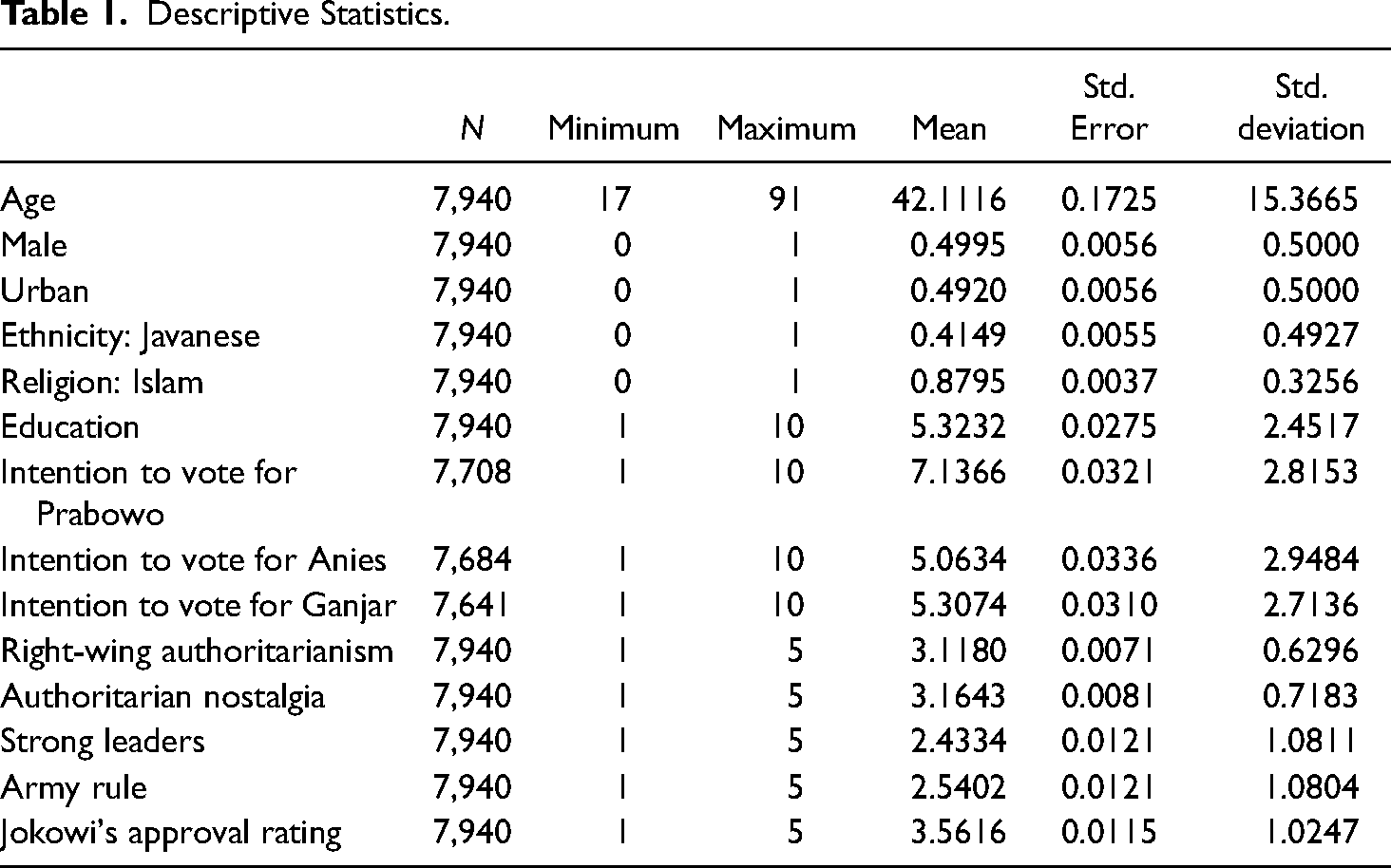
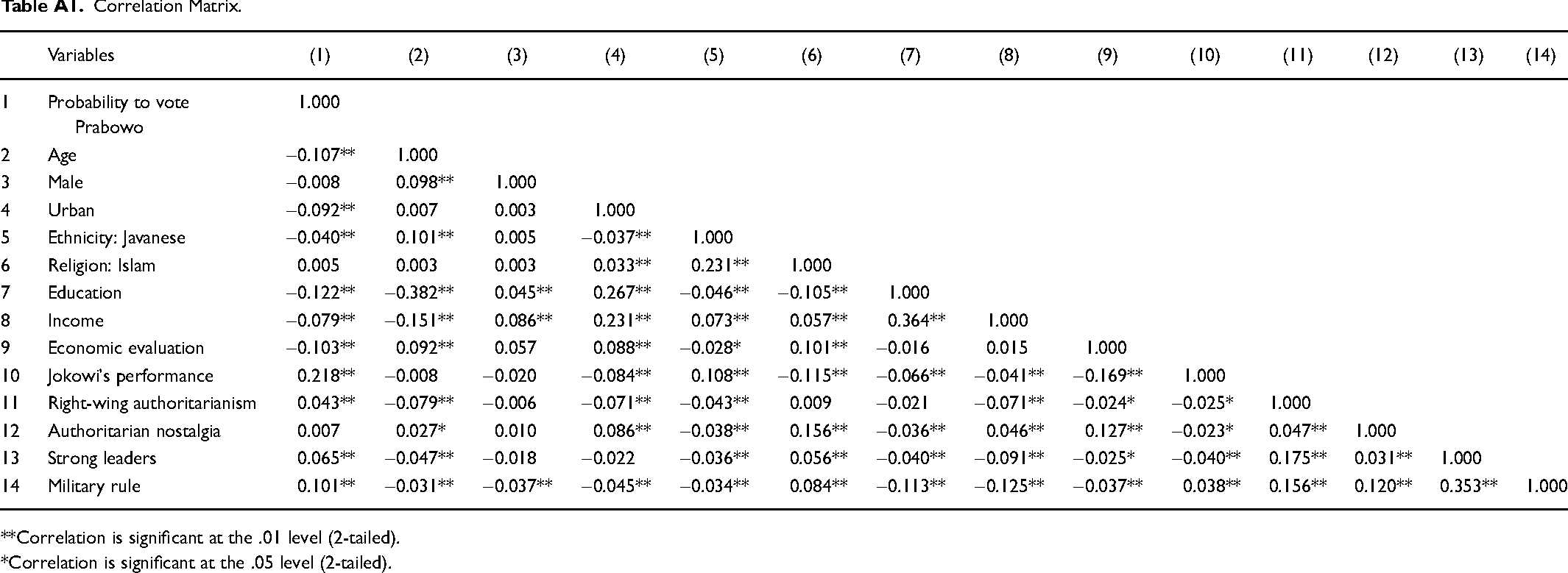
In the models, I also incorporate a series of sociodemographic variables that may be linked to political attitudes and behavior, namely age, gender, place of residence (rural versus urban), ethnicity (Javanese versus non-Javanese), religion (Islam versus non-Muslims), and education. 2 Given Jokowi's approval rating as president has been shown to be a strong predictor of support for Prabowo (Muhtadi and Muslim, 2024), I included this variable into the model as a control variable. The summary statistics for both dependent variable and covariates are listed in Table 1, and correlation matrix is included in the Appendix (Table A1).
Descriptive Statistics.
Drivers of Prabowo Support
In this section, I estimate a series of linear regression models to determine whether support for Prabowo is associated with the indexes of authoritarian attitudes, authoritarian nostalgia, and authoritarian conceptions of democracy. I evaluate the robustness of the findings in each model in relation to the inclusion or exclusion of the various covariates. I also report results from logistic regressions below, but I report the linear regression results as the main specification for two reasons. First, given that the linear and logistic regression analyses produce almost indistinguishable results, the difference in modeling choices is inconsequential. Second, compared to the logistic regression, the linear estimates are easier to interpret (Hellevik, 2007).
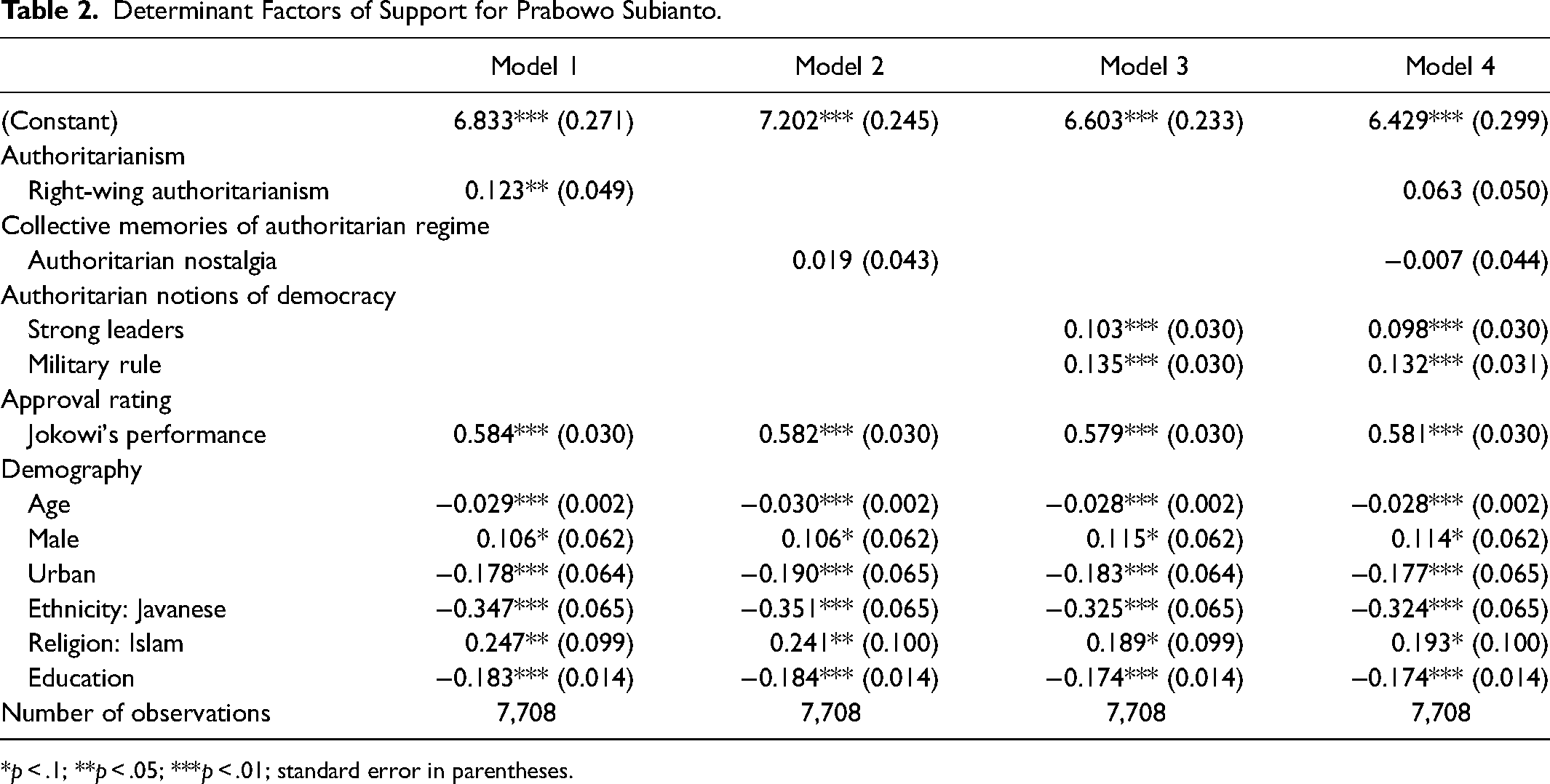
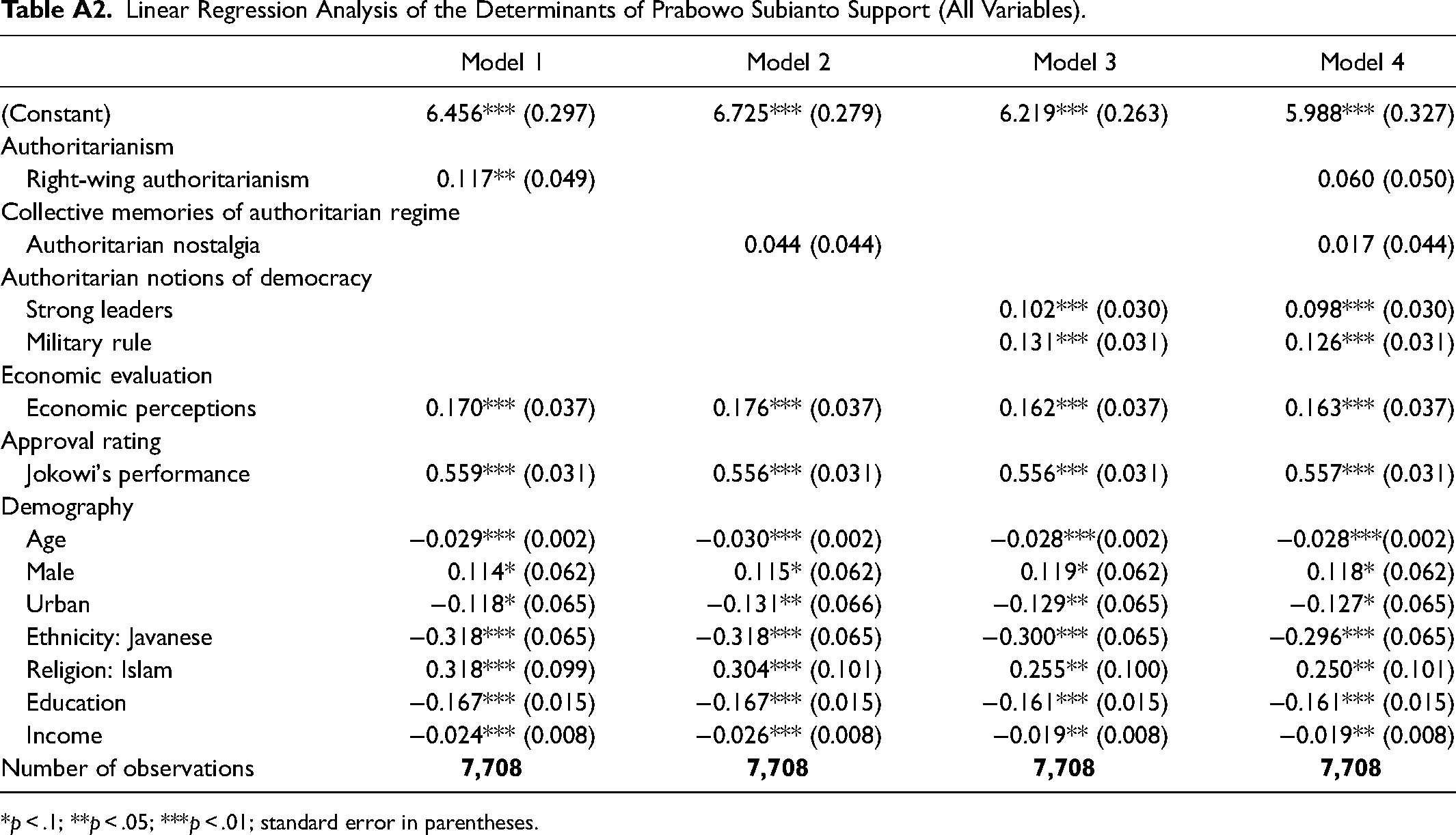
Table 2 presents the estimation of results derived from four distinct models. The first includes the index of RWA; the second the index of collective memories of authoritarian regime called authoritarian nostalgia; the third measures the authoritarian conceptions of democracy, which are characterized by agreement on strong leaders and active military officers; and the final model estimates coefficients for all the drivers of Prabowo support combined. The sociodemographic variables are included in each model. 3
Determinant Factors of Support for Prabowo Subianto.
*p < .1; **p < .05; ***p < .01; standard error in parentheses.
Table 2 demonstrates the authoritarian concept of democracy, which is assessed using two measures: support for strong leaders and the involvement of active military personnel. First, support for Prabowo is associated with willingness to tolerate strongman leadership. Second, there is also a positive and significant association between the endorsement of active military officers to govern and Prabowo support. These two variables are also significant in the comprehensive specification in Model 4. The pattern is clear: when support for authoritarian attitudes increases, so does support for Prabowo, and vice versa.
By contrast, the RWA index is not systematically and consistently associated with the desire to vote for Prabowo. In Model 1, which incorporates only demographic covariates and political attitude (specifically Jokowi's approval rating) as control variables, the authoritarianism measure is significant and positively correlated with support for Prabowo, indicating that individuals with higher authoritarian attitudes are more likely to intend to vote for Prabowo. Nonetheless, the predicted coefficient in Model 4, which incorporates all predictors, is considerably smaller in magnitude and lacks significance at traditional thresholds. The insignificance of RWA may stem from its impacts being mediated by authoritarian interpretations of democracy.
Similarly, popular nostalgia for the past authoritarian rule is not significantly associated with voting intentions for Prabowo. Even when examined without demographic factors and Jokowi's approval rating as covariates, the authoritarian nostalgia index is unrelated to support for Prabowo (Model 2). Based on this evidence, we can conclude that Prabowo supporters are no more likely to present strong authoritarian attitudes than those who intended to vote for Anies. In summary, they are distinctly embracing an authoritarian perspective, which includes the endorsement of both authoritarian leadership styles, such as strong leadership, which involves a leader who is willing to suspend parliament in order to achieve goals, and military government. Nevertheless, authoritarianism does not appear to be a distinctive characteristic of Prabowo supporters. Likewise, they do not demonstrate heightened levels of nostalgia for the authoritarian past.
The coefficient plot reported in Figure 1, based on Model 4 in Table 2, displays the substantial difference between the effect of authoritarian notions of democracy and that of RWA and feeling nostalgic toward authoritarianism. The plotted coefficients also show the estimated association between Prabowo support and the various demographic indicators as well as public approval for Jokowi included in the model. Age is highly associated with support for Prabowo, with a negative coefficient indicating that younger people are more likely to vote for him. This data is consistent with exit polls from previous elections, which showed Prabowo's support was strongest among youth. As previously stated, in the 2024 campaign, Prabowo attempted to rebrand himself as an adorable grandfather figure, which became known as the gemoy phenomenon, referring to an Indonesian word meaning ‘cute’ or ‘cuddly,’ and has proven effective in wooing young voters (Kuipers et al., 2024; Muhtadi and Muslim, 2024).
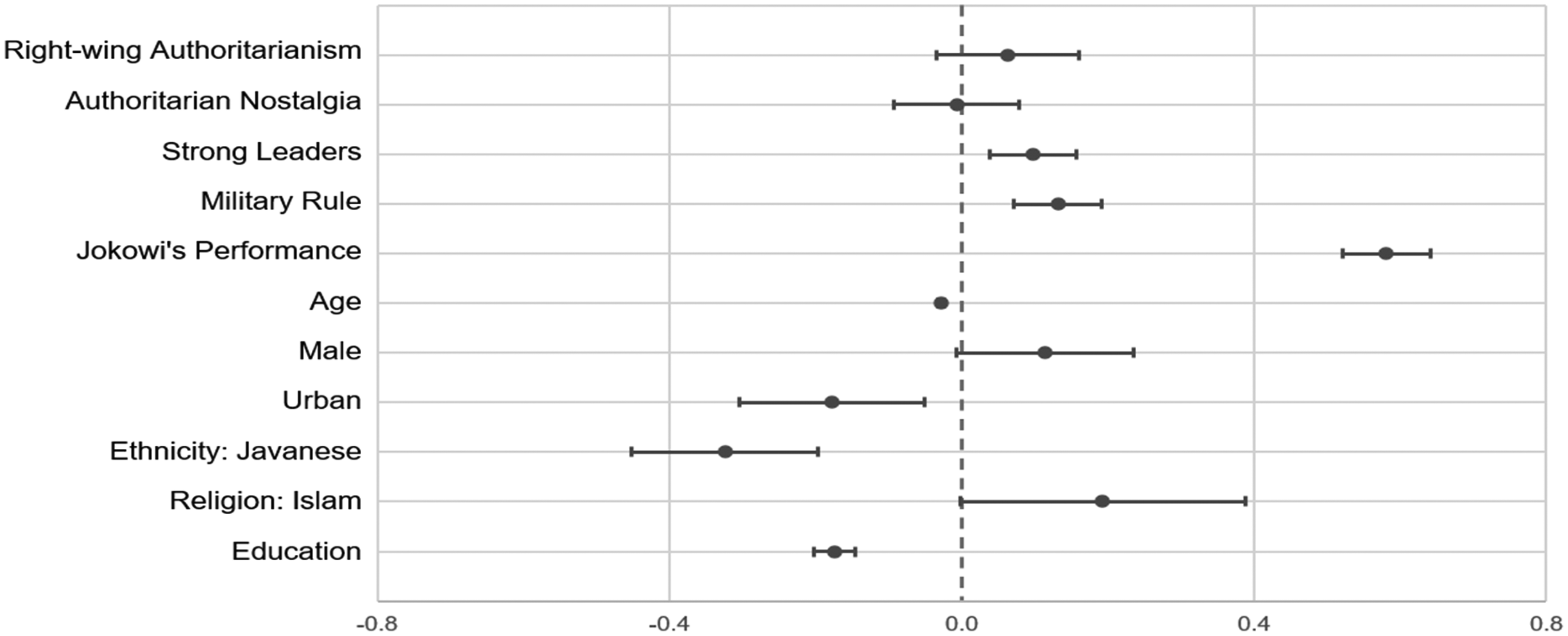
Coefficient Plot of Factors Associated with Prabowo Support.
As expected, education has a statistically significant relationship with the likelihood of voting for Prabowo. The Jokowi factor was at play here. Exit polls from previous elections reveal that people with higher education were more likely to support Prabowo, while lower middle-class voters, who make up the majority of Indonesian voters, preferred Jokowi (Indikator Politik, 2014: 22, 2019: 40). However, in 2024, after Gibran was officially appointed as Prabowo's running mate, and Jokowi had increasingly expressed open support for Prabowo, his electability had increased among the less educated. A trade-off was evident, as exit polls indicated that 37.6 per cent of Prabowo's 2019 electorate transitioned to Anies (Indikator Politik, 2024: 74), particularly among educated demographics. However, Prabowo received a far greater influx of support from Jokowi's voter base, particularly those with middle-to-lower education levels. Similarly, those residing in rural areas are more likely to vote for Prabowo in 2024. Previous elections show that traditional Prabowo voters in 2014 and 2019 predominantly resided in urban areas (Indikator Politik, 2014: 21, 2019: 43), but in 2024 he attracted new voters from rural regions due to massive support from Jokowi, who is extremely popular in rural areas.
Finally, the negative association between Javanese and Prabowo support indicates that he earned more support from ethnic groups other than Javanese than from Javanese, the largest ethnic group in Indonesia (almost 40 per cent of the entire population). Exit polls from 2014 and 2019 suggest that Prabowo has a relatively stronger appeal among non-Javanese ethnic groups, including Sundanese, Betawi, Minang, Malay, Madurese, and others (Indikator Politik, 2014: 26, 2019: 42). Meanwhile, Jokowi had an advantage in Javanese-majority districts (Shofia and Pepinsky, 2019). In 2024, despite Jokowi's backing for Prabowo in two critical Javanese-majority provinces, Central Java and East Java, his rival, former Central Java Governor Ganjar, still garnered significant support from Javanese voters.
In terms of other covariates, religion (Islam) is not correlated with support for Prabowo. This finding is unsurprising given that more non-Muslims have voted for Prabowo since he chose Gibran as his running mate. Jokowi is extremely popular among non-Muslims. Despite Prabowo's evident appeal among Muslim voters, the results of the 2014 and 2019 elections revealed that he performed poorly in non-Muslim bases such as North Sulawesi, Bali, Maluku, Papua, and North Sumatra. Jokowi's support garnered Prabowo the support of non-Muslims, resulting in a greater margin of victory than the national average (63 per cent among non-Muslims versus 58 per cent nationally), while preserving his appeal among Muslims.
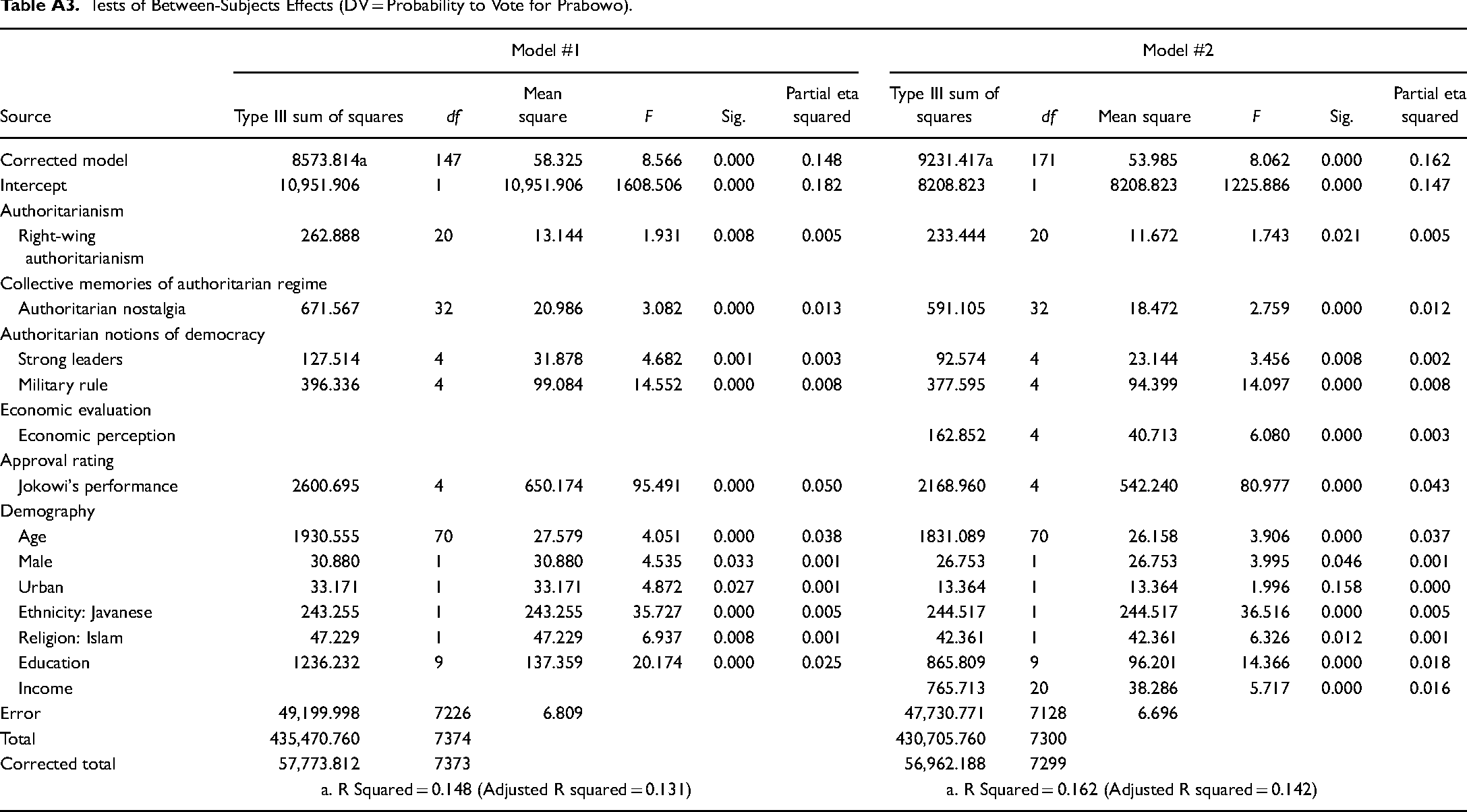
Table A3 of Appendix estimates each predictor's partial eta-square to quantify the effect of an independent variable on a dependent variable. In Table A3, I offer two models, the first of which excludes the variables of income and perception of the national economy, while the second include the whole variables. Both produce indistinguishable findings, with the Jokowi satisfaction displaying the largest eta-square score, which implies that it is the most important variable affecting Prabowo's support. The eta-square for age (young voters) are at the distant second place with large margin gap with eta-square for the Jokowi factor. This finding confirms the notion that Prabowo's landslide victory was primarily due to the satisfaction with Jokowi and support of youth voters.
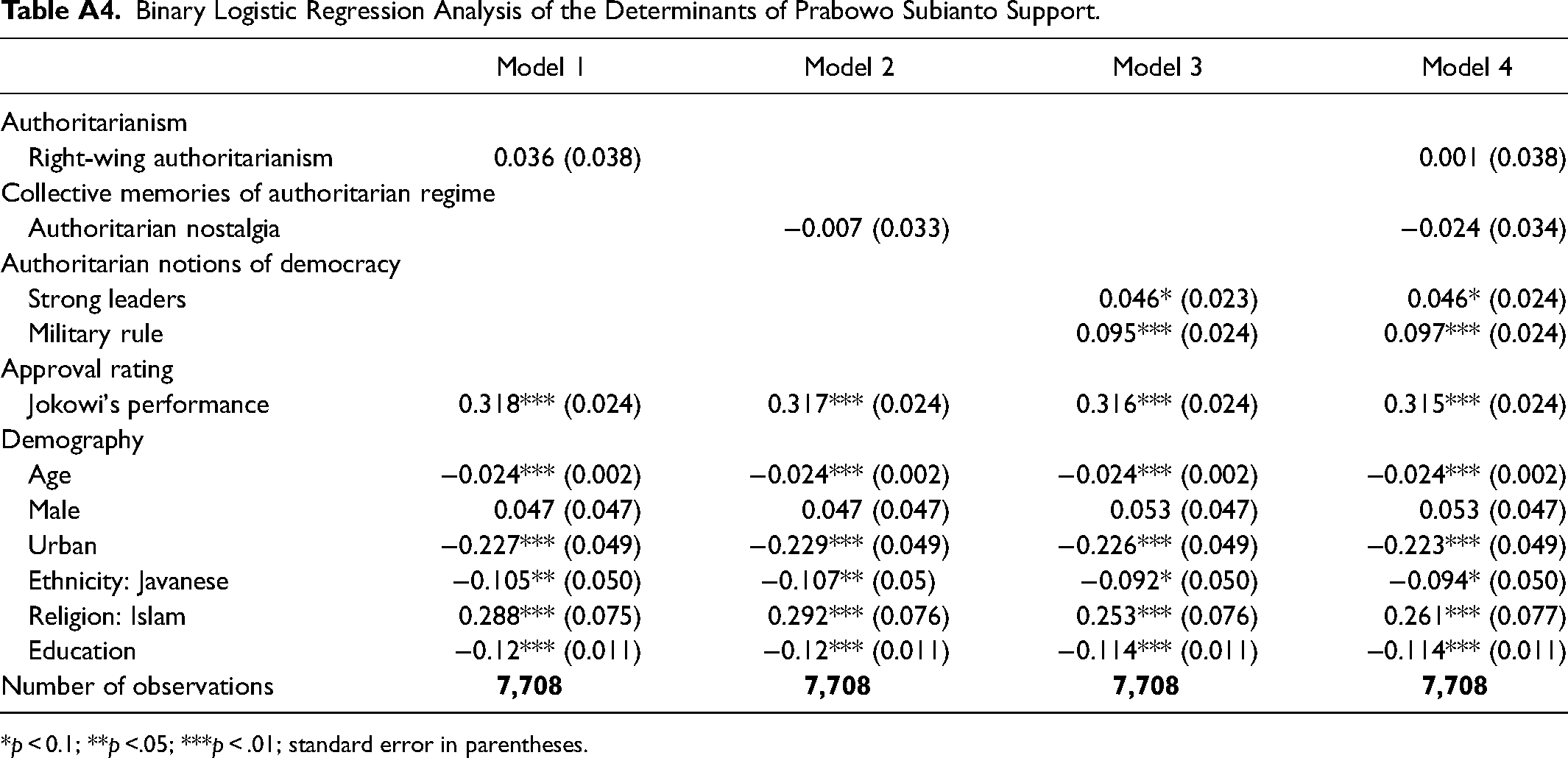
To probe the robustness of my findings, I conducted a binary logistic regression to relax the assumption of a linear relationship between the dependent and independent variables. In the logistic model, the dependent variable is a dichotomous measure that takes a value of 1 if the respondent intended to support Prabowo; 0 = otherwise. The results of both the logistic and linear models are relatively similar (Table A4 of Appendix), with the authoritarian attitudes variable such as military governments as well as Jokowi's performance and demographic variables such as age, rural, religion and education being significantly linked with Prabowo support. The estimate of the strongman measure is not statistically significant in the strictest sense, as its p-value slightly above 0.05, however remains significant at the 90 per cent confidence level.
Do Prabowo's Rivals Voters Exhibit Different Characteristics?
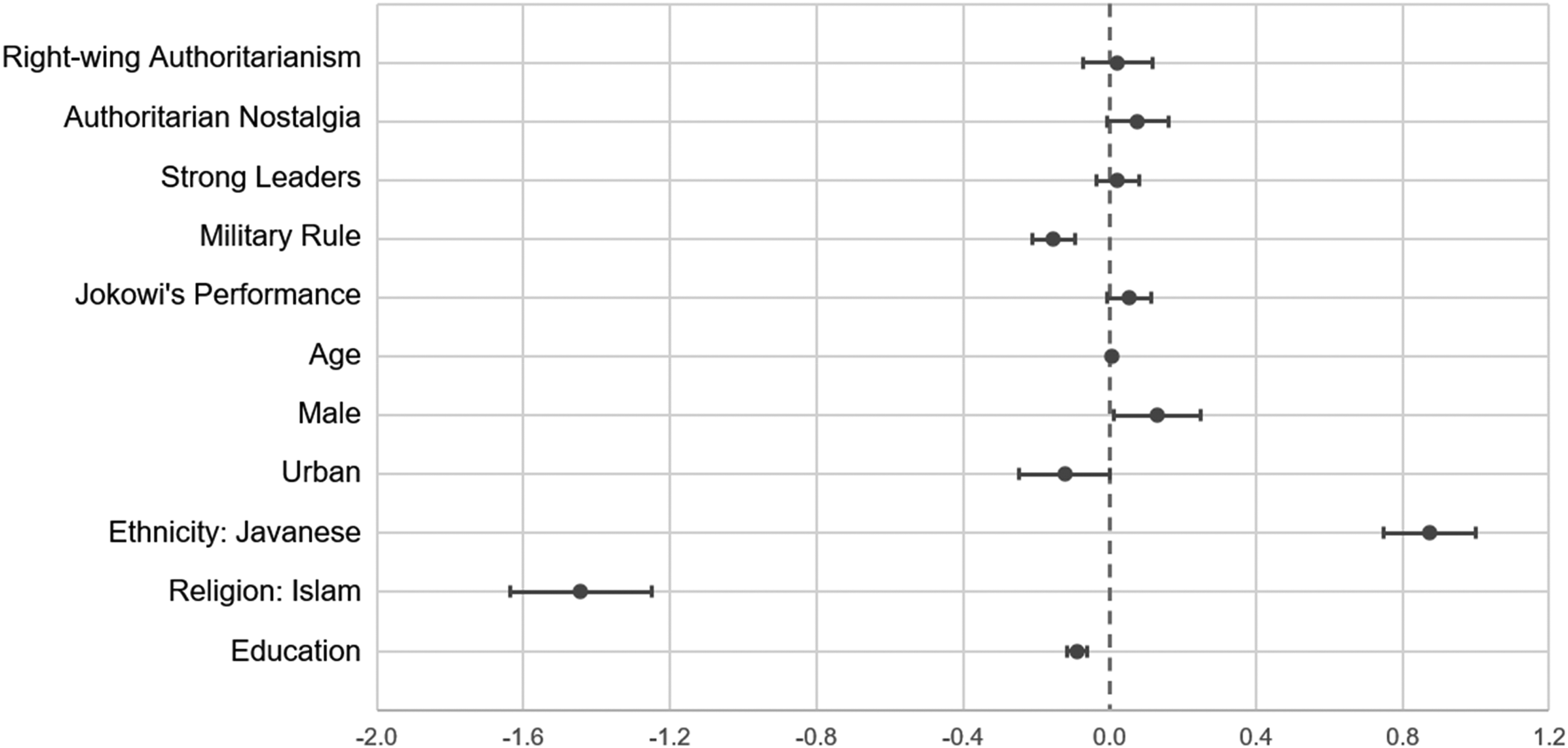
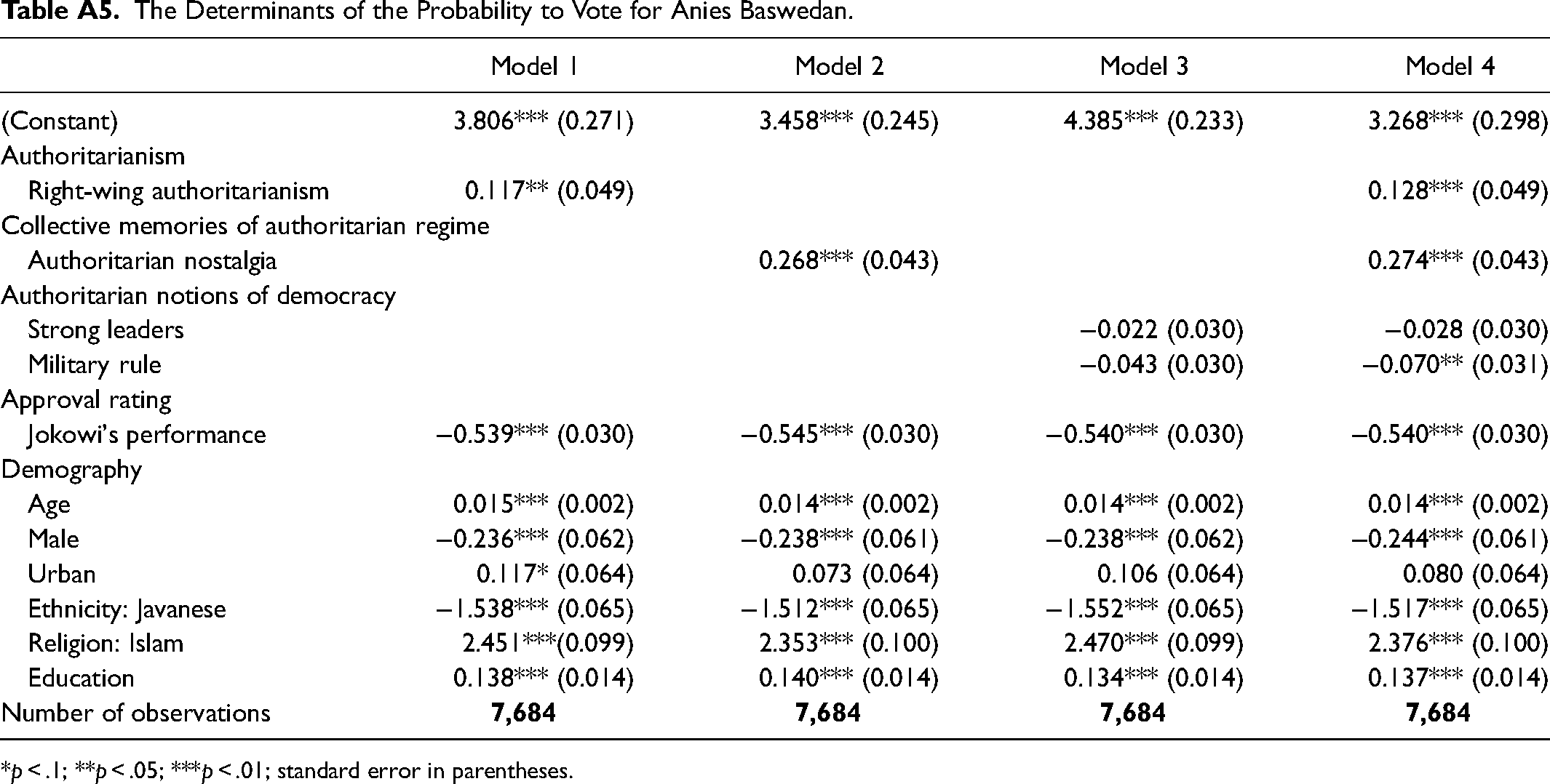
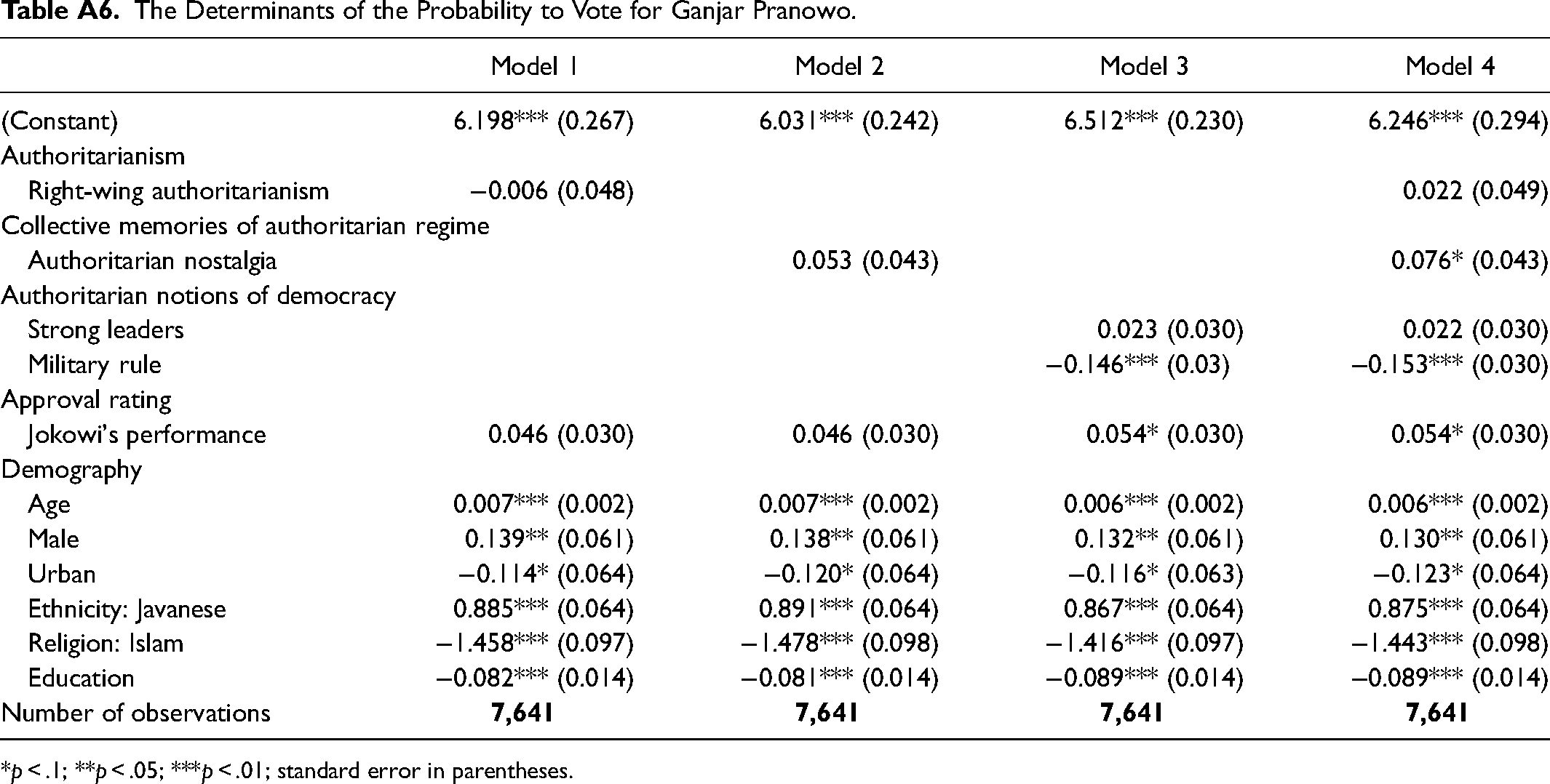
To get a more complete picture, I also conducted the similar regression analysis with similar covariates to test whether RWA, authoritarian nostalgia, and authoritarian conceptions of democracy predict voting intentions for Prabowo's rivals: Anies and Ganjar. As seen in Table A5 in Appendix, a series of linear regression models show that both Model 1, which incorporates only demographic covariates as well as Jokowi's approval rating as a control variable alongside the authoritarianism measure, and in Model 4, which incorporates all predictors, RWA is positively and significantly correlated with Anies support. Similarly, Anies' voters tend to express nostalgia for the authoritarian past (Models 2 and 4 of Table A5). 4 Jokowi's open support and endorsement for Prabowo in 2024, which prompted 37.6 per cent of Prabowo's 2019 voter base to switch their supports to Anies (Indikator Politik, 2024: 74), affected Islamist voters who typically hold authoritarian attitudes and are trapped in New Order nostalgia (Muhtadi and Halida, 2020). Furthermore, Anies, buoyed by his success in the 2017 Jakarta governor election, frequently repeated old narratives of pribumi (indigenous) economic grievance, implying that poor Muslim masses were dominated by a greedy, non-pribumi ethnic Chinese elite, in an appeal to conservative Muslims and religious identitarians. In contrast, regression analyses presented in Table A6 of Appendix indicate that there is no relationship between authoritarian attitudes and support for Ganjar. Similarly, there is no significant link between nostalgia for authoritarian regimes and support for Ganjar. 5
The divergence between Anies and Ganjar voters and Prabowo voters becomes more evident in the context of support for the two elements of authoritarian conceptions of democracy employed in this study: approval of strong leaders and military government. For the models predicting voting intentions for Anies (Table A5 of Appendix) and Ganjar (Table A6 of Appendix), while both Anies and Ganjar supporters have no predilection for strongman leadership, they strongly oppose military engagement in administration. Conversely, Prabowo supporters are relatively lack a penchant for an illiberal style of leadership.
Figure 2 shows that Prabowo voters display views and attitudes that could threaten democracy. The straight solid line represents predicted support for Prabowo, and that level of support increases along with support for military government. Meanwhile, the dash line shows the opposite findings, meaning that support among Ganjar voters is actually greater for the group that rejects active soldiers entering the government. Similarly, Anies voters align with Ganjar supporters who oppose military involvement in civilian government. The authoritarian inclinations of Prabowo voters are also abundantly clear in Figure 3: the more a respondent agrees with the presence of a strongman who can abolish parliament and elections, the more likely they are to support Prabowo.
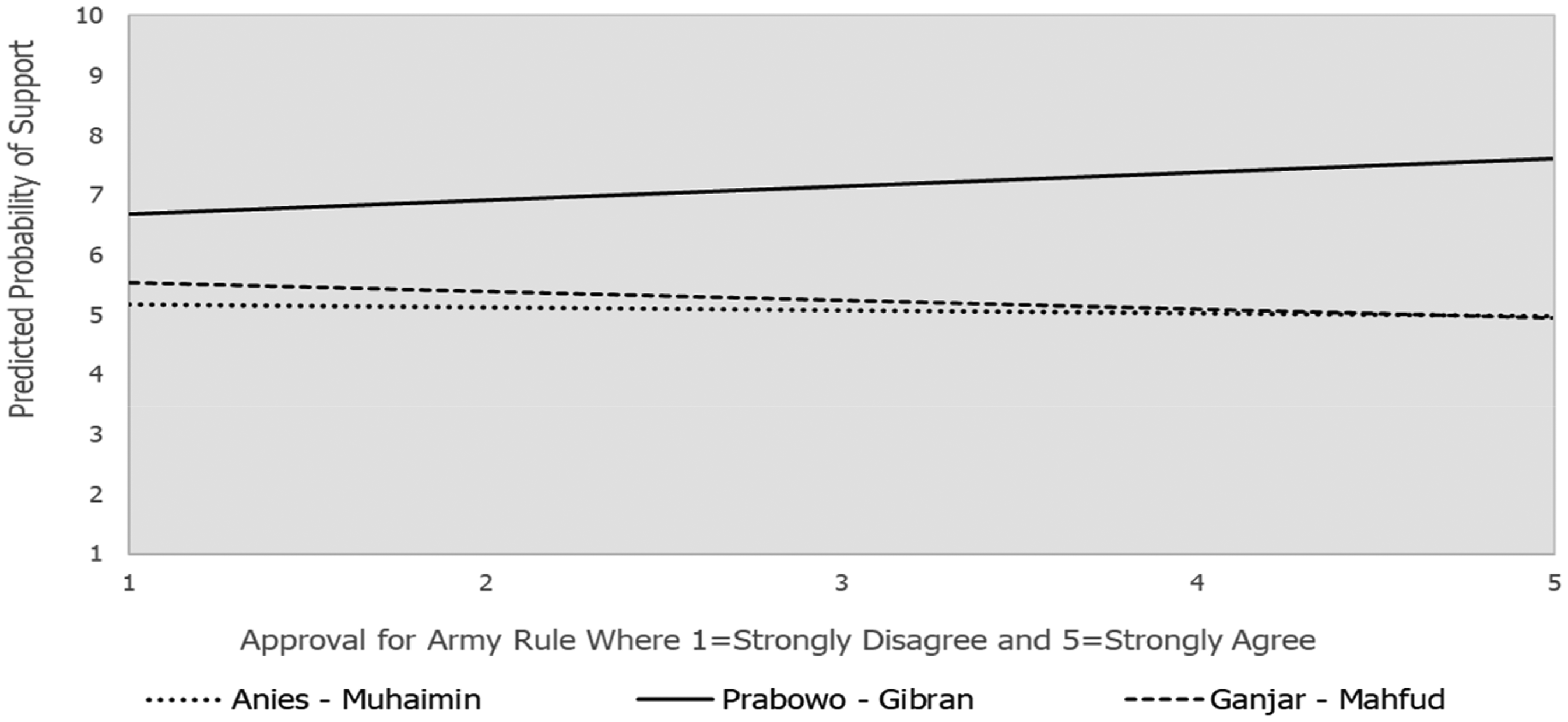
Support for Anies, Prabowo, and Ganjar by Support for Military Rule.
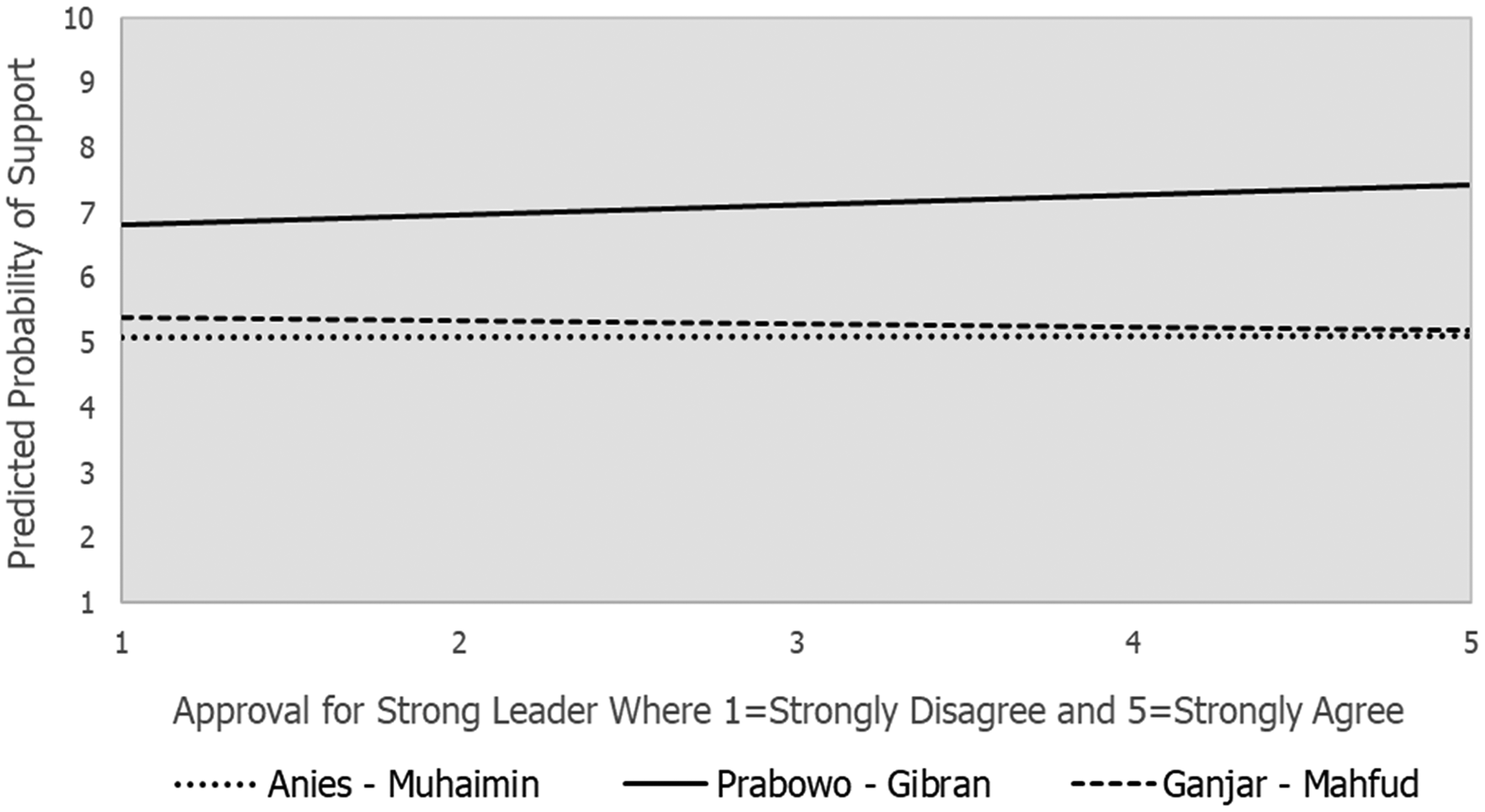
Support for Anies, Prabowo, and Ganjar by Support for Strongman.
However, while authoritarian notions of democracy contributed significantly to Prabowo's win, a closer examination reveals the ambiguity of Prabowo's supporters. Aside from the fact that this study found no significant association between authoritarian attitudes and Prabowo support, the six items that comprise the authoritarian nostalgia sentiment index did not significantly explain Prabowo support. Interestingly, it is Anies voters who shown a greater propensity for authoritarian tendencies in comparison to those supporting Prabowo and Ganjar. Also, Anies voters often lament the negative present era by longing for the positive past era (Table A5 of Appendix).
The absence of a correlation between the support for Prabowo and nostalgic sentiments towards the past authoritarian regime highlights the contrast with Bongbong Marcos in the 2022 Philippines election. The Marcos camp strategically revives “positive” collective memories of the past authoritarian era under Bongbong's father, Ferdinand Marcos, to persuade the Philippine population that it was better than the current regime. The strategic manipulation of political beliefs by the selective reinforcement of collective memories was carried out by the Marcos camp by building myths through effective social media campaigns by contrasting the “positive past” and the “negative present.” As a result, the former dictator, who suspended elections, destroyed the checks and balances mechanism, suppressed media freedom, violated human rights, and was involved in rampant corruption, was portrayed as more competent and successful. This contributed to Bongbong's landslide victory. Dulay et al. (2023) found that authoritarian propaganda among young people born post-Marcos explains the return of the Marcos family to the presidency. Bongbong's campaign basically bombarded social media platforms with flattering images of Ferdinand Marcos' era, portraying Martial Law as not only free of illiberal actions, but also as the “golden age” of Philippine history, particularly in terms of peace and prosperity.
In Indonesia, the mobilization of nostalgic sentiments about the authoritarian government of the past is also regularly propagated, especially by Golkar, the party that was once the political vehicle of Suharto's authoritarian regime. In 2024, several Golkar elites carried out a massive campaign of authoritarian mobilization, including spreading deepfakes on social media platforms, one of which depicted Suharto who had risen from his grave and made a speech about Indonesia's progress under his rule (Firdaus, 2024). Remarkably, even though Prabowo is a former son-in-law of Suharto who enjoyed many privileges in terms of military career, politics, and economic access, in the 2024 presidential election campaign he did not try to sell the past. Prabowo's campaign narrative also drew a line between Suharto by repeatedly assuring the public that he was a democratic figure who was willing to take the tough democratic road of building a political party from scratch, take part in elections even though he lost repeatedly, and did not seize coup opportunity in 1998 turbulent period right after the fall of Suharto's (Detikcom, 2023). His campaign narrative was “simply” positioning himself as Jokowi's successor at a time when eight out of ten voters approved of Jokowi and rebranding himself into a cute and cuddly Gen Z icon.
Conclusion
In 2024, Prabowo won by the greatest margin in Indonesian presidential election history (Santika, 2024), garnering over 96 million votes and convincingly defeating his two younger opponents, former Jakarta Governor Anies and former Central Java Governor Ganjar. How is it possible for a figure with such a history of violating human rights and who has been unsuccessful in elections on multiple occasions to suddenly be able to triumph over two formidable competitors by such a significant margin?
My results, from a well-powered survey conducted with a substantial sample size immediately prior to the 2024 presidential election, capture electoral preferences following extensive campaigning by the three candidate pairs, enabling us to obtain relatively stable voter choices. My findings indicate that Prabowo's supporters are distinguished by their inclination towards authoritarian concepts of democracy, including a preference for strongman leadership and military governance, setting them apart from the supporters of Prabowo's opponents.
The lack of statistical significance of authoritarian nostalgia, even when no other predictors are included in the model, suggests that voters do not necessarily want to return to a New Order-like regime. Voting for Prabowo is not the same as wishing the New Order would return. Rather, it is reasonable to think that voters regard Prabowo as a man of his own. Or, at the very least, they regard him as Jokowi's man, but definitely not a New Order's man. This finding challenges the conventional wisdom both among Indonesianists and comparative political scientists in general that links voting for a candidate associated with an authoritarian past to support for that past or a desire for its resurgence. Moreover, since support for Prabowo is closely associated with, if not predominantly influenced by, voters' positive perceptions of Jokowi, it is highly plausible that what voters desire is simply another Jokowi era.
The finding that Prabowo voters are clearly embracing an authoritarian perspective, which includes support for both authoritarian leadership styles, such as strongman leadership and military government, does not imply that Prabowo supporters reject democracy as the best form of government or that they have a stronger desire for the authoritarian past. Instead, they indicate the presence of conflicting attitudes towards democracy in Indonesia. Indonesian voters hold ambivalent views towards democracy, expressing both affirmation and negation simultaneously. While they claim to be democrats at a normative level, they readily support illiberal politicians such as Prabowo who have a history of disregarding democracy and human rights.
The results of my research align with Webb’s (2017) theory of Filipino democratic ambivalence, which demonstrates how Rodrigo Duterte was able to win the 2016 Philippines election despite implementing arbitrary rule and strongman tactics while displaying limited tolerance for opposing views. However, in contrast to the situation in the Philippines, where voters' uncertainty about democracy is strongly linked to a longing for a perceived stable authoritarian past under President Ferdinand Marcos, the Indonesian case presents a different trend: Ambivalence toward democracy in Indonesia is actually the result of a reluctance to feel nostalgia for the authoritarian past. Furthermore, this includes the phenomenon of suppressing memories of traumatic events that took place under authoritarian rule (Kuipers et al., 2024), while simultaneously envisioning a powerful leader who can ensure safety and minimize uncertainty. This clearly benefitted Prabowo, who has consistently promoted himself as a firm and strong leader in presenting public order and security.
Footnotes
Acknowledgements
The author thanks Meredith Weiss, Thomas Pepinsky, Jeremy Menchik, Andreas Ufen, Nathanael Gratias Sumaktoyo for their valuable feedback and comments, as well as the participants of Cornell University workshop on the State of Indonesian Democracy, Ithaca, 1-2 August 2024, where the first draft of this paper was presented.
Declaration of Conflicting Interests
The author declared no potential conflicts of interest with respect to the research, authorship, and/or publication of this article.
Ethical Approval
My survey was conducted in conjunction with Indikator Politik Indonesia. Indikator is part of the Indonesian Public Opinion Survey Association (PERSEPI). As a member, Indikator's survey implementation processes must adhere to the PERSEPI survey code of ethics. PERSEPI has an ethical board of campus academics in Indonesia to guarantee that the implementation process and survey technique for PERSEPI members are in conformity with academic norms and ethics.
Funding
The author received no financial support for the research, authorship, and/or publication of this article.

Notes
Author Biography
APPENDIX
Coefficient Plot of Factors Associated with Anies Baswedan Support. Coefficient Plot of Factors Associated With Ganjar Pranowo Support. Correlation Matrix. **Correlation is significant at the .01 level (2-tailed). *Correlation is significant at the .05 level (2-tailed). Linear Regression Analysis of the Determinants of Prabowo Subianto Support (All Variables). *p < .1; **p < .05; ***p < .01; standard error in parentheses. Tests of Between-Subjects Effects (DV = Probability to Vote for Prabowo). Binary Logistic Regression Analysis of the Determinants of Prabowo Subianto Support. *p < 0.1; **p <.05; ***p < .01; standard error in parentheses. The Determinants of the Probability to Vote for Anies Baswedan. *p < .1; **p < .05; ***p < .01; standard error in parentheses. The Determinants of the Probability to Vote for Ganjar Pranowo. *p < .1; **p < .05; ***p < .01; standard error in parentheses.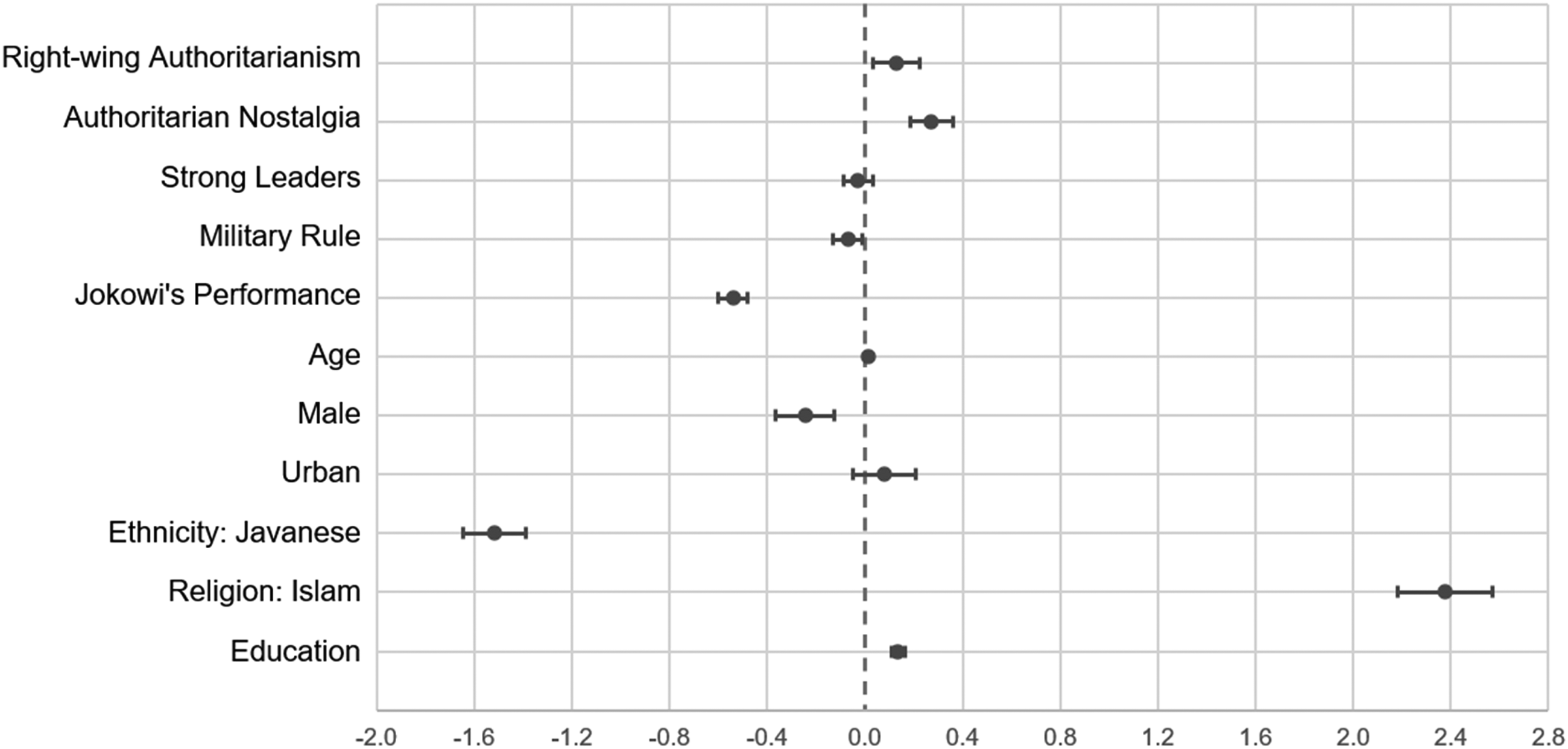
Variables
(1)
(2)
(3)
(4)
(5)
(6)
(7)
(8)
(9)
(10)
(11)
(12)
(13)
(14)
1
Probability to vote Prabowo
1.000
2
Age
−0.107**
1.000
3
Male
−0.008
0.098**
1.000
4
Urban
−0.092**
0.007
0.003
1.000
5
Ethnicity: Javanese
−0.040**
0.101**
0.005
−0.037**
1.000
6
Religion: Islam
0.005
0.003
0.003
0.033**
0.231**
1.000
7
Education
−0.122**
−0.382**
0.045**
0.267**
−0.046**
−0.105**
1.000
8
Income
−0.079**
−0.151**
0.086**
0.231**
0.073**
0.057**
0.364**
1.000
9
Economic evaluation
−0.103**
0.092**
0.057
0.088**
−0.028*
0.101**
−0.016
0.015
1.000
10
Jokowi's performance
0.218**
−0.008
−0.020
−0.084**
0.108**
−0.115**
−0.066**
−0.041**
−0.169**
1.000
11
Right-wing authoritarianism
0.043**
−0.079**
−0.006
−0.071**
−0.043**
0.009
−0.021
−0.071**
−0.024*
−0.025*
1.000
12
Authoritarian nostalgia
0.007
0.027*
0.010
0.086**
−0.038**
0.156**
−0.036**
0.046**
0.127**
−0.023*
0.047**
1.000
13
Strong leaders
0.065**
−0.047**
−0.018
−0.022
−0.036**
0.056**
−0.040**
−0.091**
−0.025*
−0.040**
0.175**
0.031**
1.000
14
Military rule
0.101**
−0.031**
−0.037**
−0.045**
−0.034**
0.084**
−0.113**
−0.125**
−0.037**
0.038**
0.156**
0.120**
0.353**
1.000
Model 1
Model 2
Model 3
Model 4
(Constant)
6.456*** (0.297)
6.725*** (0.279)
6.219*** (0.263)
5.988*** (0.327)
Authoritarianism
Right-wing authoritarianism
0.117** (0.049)
0.060 (0.050)
Collective memories of authoritarian regime
Authoritarian nostalgia
0.044 (0.044)
0.017 (0.044)
Authoritarian notions of democracy
Strong leaders
0.102*** (0.030)
0.098*** (0.030)
Military rule
0.131*** (0.031)
0.126*** (0.031)
Economic evaluation
Economic perceptions
0.170*** (0.037)
0.176*** (0.037)
0.162*** (0.037)
0.163*** (0.037)
Approval rating
Jokowi's performance
0.559*** (0.031)
0.556*** (0.031)
0.556*** (0.031)
0.557*** (0.031)
Demography
Age
−0.029*** (0.002)
−0.030*** (0.002)
−0.028***(0.002)
−0.028***(0.002)
Male
0.114* (0.062)
0.115* (0.062)
0.119* (0.062)
0.118* (0.062)
Urban
−0.118* (0.065)
−0.131** (0.066)
−0.129** (0.065)
−0.127* (0.065)
Ethnicity: Javanese
−0.318*** (0.065)
−0.318*** (0.065)
−0.300*** (0.065)
−0.296*** (0.065)
Religion: Islam
0.318*** (0.099)
0.304*** (0.101)
0.255** (0.100)
0.250** (0.101)
Education
−0.167*** (0.015)
−0.167*** (0.015)
−0.161*** (0.015)
−0.161*** (0.015)
Income
−0.024*** (0.008)
−0.026*** (0.008)
−0.019** (0.008)
−0.019** (0.008)
Number of observations
Source
Model #1
Model #2
Type III sum of squares
df
Mean
square
F
Sig.
Partial eta
squared
Type III sum of
squares
df
Mean square
F
Sig.
Partial eta
squared
Corrected model
8573.814a
147
58.325
8.566
0.000
0.148
9231.417a
171
53.985
8.062
0.000
0.162
Intercept
10,951.906
1
10,951.906
1608.506
0.000
0.182
8208.823
1
8208.823
1225.886
0.000
0.147
Authoritarianism
Right-wing authoritarianism
262.888
20
13.144
1.931
0.008
0.005
233.444
20
11.672
1.743
0.021
0.005
Collective memories of authoritarian regime
Authoritarian nostalgia
671.567
32
20.986
3.082
0.000
0.013
591.105
32
18.472
2.759
0.000
0.012
Authoritarian notions of democracy
Strong leaders
127.514
4
31.878
4.682
0.001
0.003
92.574
4
23.144
3.456
0.008
0.002
Military rule
396.336
4
99.084
14.552
0.000
0.008
377.595
4
94.399
14.097
0.000
0.008
Economic evaluation
Economic perception
162.852
4
40.713
6.080
0.000
0.003
Approval rating
Jokowi's performance
2600.695
4
650.174
95.491
0.000
0.050
2168.960
4
542.240
80.977
0.000
0.043
Demography
Age
1930.555
70
27.579
4.051
0.000
0.038
1831.089
70
26.158
3.906
0.000
0.037
Male
30.880
1
30.880
4.535
0.033
0.001
26.753
1
26.753
3.995
0.046
0.001
Urban
33.171
1
33.171
4.872
0.027
0.001
13.364
1
13.364
1.996
0.158
0.000
Ethnicity: Javanese
243.255
1
243.255
35.727
0.000
0.005
244.517
1
244.517
36.516
0.000
0.005
Religion: Islam
47.229
1
47.229
6.937
0.008
0.001
42.361
1
42.361
6.326
0.012
0.001
Education
1236.232
9
137.359
20.174
0.000
0.025
865.809
9
96.201
14.366
0.000
0.018
Income
765.713
20
38.286
5.717
0.000
0.016
Error
49,199.998
7226
6.809
47,730.771
7128
6.696
Total
435,470.760
7374
430,705.760
7300
Corrected total
57,773.812
7373
56,962.188
7299
a. R Squared = 0.148 (Adjusted R squared = 0.131)
a. R Squared = 0.162 (Adjusted R squared = 0.142)
Model 1
Model 2
Model 3
Model 4
Authoritarianism
Right-wing authoritarianism
0.036 (0.038)
0.001 (0.038)
Collective memories of authoritarian regime
Authoritarian nostalgia
−0.007 (0.033)
−0.024 (0.034)
Authoritarian notions of democracy
Strong leaders
0.046* (0.023)
0.046* (0.024)
Military rule
0.095*** (0.024)
0.097*** (0.024)
Approval rating
Jokowi's performance
0.318*** (0.024)
0.317*** (0.024)
0.316*** (0.024)
0.315*** (0.024)
Demography
Age
−0.024*** (0.002)
−0.024*** (0.002)
−0.024*** (0.002)
−0.024*** (0.002)
Male
0.047 (0.047)
0.047 (0.047)
0.053 (0.047)
0.053 (0.047)
Urban
−0.227*** (0.049)
−0.229*** (0.049)
−0.226*** (0.049)
−0.223*** (0.049)
Ethnicity: Javanese
−0.105** (0.050)
−0.107** (0.05)
−0.092* (0.050)
−0.094* (0.050)
Religion: Islam
0.288*** (0.075)
0.292*** (0.076)
0.253*** (0.076)
0.261*** (0.077)
Education
−0.12*** (0.011)
−0.12*** (0.011)
−0.114*** (0.011)
−0.114*** (0.011)
Number of observations
Model 1
Model 2
Model 3
Model 4
(Constant)
3.806*** (0.271)
3.458*** (0.245)
4.385*** (0.233)
3.268*** (0.298)
Authoritarianism
Right-wing authoritarianism
0.117** (0.049)
0.128*** (0.049)
Collective memories of authoritarian regime
Authoritarian nostalgia
0.268*** (0.043)
0.274*** (0.043)
Authoritarian notions of democracy
Strong leaders
−0.022 (0.030)
−0.028 (0.030)
Military rule
−0.043 (0.030)
−0.070** (0.031)
Approval rating
Jokowi's performance
−0.539*** (0.030)
−0.545*** (0.030)
−0.540*** (0.030)
−0.540*** (0.030)
Demography
Age
0.015*** (0.002)
0.014*** (0.002)
0.014*** (0.002)
0.014*** (0.002)
Male
−0.236*** (0.062)
−0.238*** (0.061)
−0.238*** (0.062)
−0.244*** (0.061)
Urban
0.117* (0.064)
0.073 (0.064)
0.106 (0.064)
0.080 (0.064)
Ethnicity: Javanese
−1.538*** (0.065)
−1.512*** (0.065)
−1.552*** (0.065)
−1.517*** (0.065)
Religion: Islam
2.451***(0.099)
2.353*** (0.100)
2.470*** (0.099)
2.376*** (0.100)
Education
0.138*** (0.014)
0.140*** (0.014)
0.134*** (0.014)
0.137*** (0.014)
Number of observations
Model 1
Model 2
Model 3
Model 4
(Constant)
6.198*** (0.267)
6.031*** (0.242)
6.512*** (0.230)
6.246*** (0.294)
Authoritarianism
Right-wing authoritarianism
−0.006 (0.048)
0.022 (0.049)
Collective memories of authoritarian regime
Authoritarian nostalgia
0.053 (0.043)
0.076* (0.043)
Authoritarian notions of democracy
Strong leaders
0.023 (0.030)
0.022 (0.030)
Military rule
−0.146*** (0.03)
−0.153*** (0.030)
Approval rating
Jokowi's performance
0.046 (0.030)
0.046 (0.030)
0.054* (0.030)
0.054* (0.030)
Demography
Age
0.007*** (0.002)
0.007*** (0.002)
0.006*** (0.002)
0.006*** (0.002)
Male
0.139** (0.061)
0.138** (0.061)
0.132** (0.061)
0.130** (0.061)
Urban
−0.114* (0.064)
−0.120* (0.064)
−0.116* (0.063)
−0.123* (0.064)
Ethnicity: Javanese
0.885*** (0.064)
0.891*** (0.064)
0.867*** (0.064)
0.875*** (0.064)
Religion: Islam
−1.458*** (0.097)
−1.478*** (0.098)
−1.416*** (0.097)
−1.443*** (0.098)
Education
−0.082*** (0.014)
−0.081*** (0.014)
−0.089*** (0.014)
−0.089*** (0.014)
Number of observations