




Abstract
How does privatization impact authoritarian governance on the frontline? This article examines the impact of outsourcing on the labour process involved in the operation of mayors’ hotlines. The mayor’s hotline system is a channel set up by Chinese municipal governments to address residents’ suggestions, appeals, inquiries, and complaints. While the expansion of mayors’ hotlines falls under the government in China, the operation of call centres has been outsourced to professional tele-corporations; thus, it is for-profit companies and their employees that represent the state in communications with the public. By examining both the practical and relational components of call operators’ labour process, this article looks at how an institution of responsive authoritarianism has been contracted out in China. It argues that the outsourcing creates a dual-pressure structure that shapes the frontline governance of this institution. The engagement of privatization in authoritarian domination leads to a conflict between market rationality and the inherited tradition of state intervention.
Keywords
How does the engagement of privatization impact authoritarian governance on the frontline? Since the 1970s, privatization has become a globally prevalent phenomenon not only in economic production but also in the affairs of politics. 1 Within this privatization trend, outsourcing public services to non-state sectors has become a commonly used tool for governments to reform their governance practice. In Western democracies, government outsourcing has extended to various fields, such as social welfare, public education, and even political campaigning. 2 In China, the government purchase of services has also become an important governance practice in the fields of education, health care, and social work. However, little systematic attention has been paid to how this shift has affected authoritarian responsiveness at the grassroots level.
This article examines the system of mayors’ hotlines, a government-responsive institution created by the Chinese state to channel citizens’ suggestions, appeals, and complaints. Citizens can call these hotlines to get access to their local governments. My research finds that a substantial portion of the operation of mayors’ hotlines in most Chinese cities is already contracted out to professional tele-corporations. In other words, it is for-profit companies and their employees, rather than local governments and officials, that represent the state in communication with the public. Drawing on ethnographic studies conducted in two mayor’s hotline call centres in China, I found that government outsourcing situates the operation of mayors’ hotlines under conflicting principles between a traditional form of state control and the profit logic of the market. On the one hand, to fulfil multiple tasks of authoritarian governance, call operators of mayors’ hotlines are not only required to resolve citizens’ general inquiries about public affairs, but also, more importantly, they are expected to collect public information, mitigate social conflicts, and maintain the state’s image through their communicative skills and emotional labour. Since the operation of mayors’ hotlines is contracted out to profit-driven tele-companies, cost control has become an increasingly influential force in shaping the daily routine and working conditions of call operators. Based on these findings, I argue that even though government outsourcing is usually considered a sign of democratization or at least a hindrance to the expansion of state power, this may not be the case with China’s mayors’ hotlines. With the help of private providers and under the name of social services, the tentacles of state control reach a wider range of the population. However, this does not mean the profit motive of the market is smoothly integrated into the control apparatus of the state. The outsourcing of mayors’ hotlines creates a dual-pressure structure under which frontline operators must handle pressures from both the state and the market.
My work contributes a sociological perspective to understand the impact of privatization on authoritarian political orders. By examining the labour process underpinning a formal institution of authoritarian domination, my article demonstrates that the frontline operation of authoritarian power is built on human labour and shaped by various social forces. Further, the article also bridges the literature on China’s neoliberal governance and the discussion on responsive authoritarianism through an empirical contribution which shows how the outsourcing of mayors’ hotlines remakes the market–state nexus in China and creates a new type of bureaucracy–capital tension. 3
Neoliberal governance: The privatization of government services in China
While privatization is broadly defined as ‘relying more on the private institutions of society and less on government to satisfy people’s needs’, 4 in Western democracies, it mainly refers to the neoliberal shift in domestic governance/government: outsourcing the production of a service to a private firm while retaining the responsibility for planning and financing the service. 5 Advocates believe outsourcing not only leads to a more cost-effective choice for governance but also protects freedom and autonomy by reducing government involvement. 6 In this sense, outsourcing is not only a pragmatic alternative for government, but it also contains reformative values that promote democratization.
Since the 1990s, influenced by the trend of neoliberal governance, lean government has also become an important principle defining state-driven political reform in China. 7 The central government claims that the goals of government outsourcing include the transformation of government functions, the reduction of service costs, and the improvement of service quality. 8 While outsourcing has accounted for a substantial portion of China’s delivery of public services, compared with Western democracies, state–market collaboration in authoritarian contexts is usually driven by different motivations and outsourcing practices and sometimes by different contents. 9 Although conventional wisdom highlights the democratization effect of outsourcing, there is a growing body of literature that shows the development of government contracting as a policy tool to help the party-state reinforce political legitimacy and maintain social stability. 10
One of the main differences between China and Western countries is the fact that the reform of government outsourcing is driven not by crisis and resource constraints but by growth and wealth. In many Western countries, budget shortfalls are major drivers of government outsourcing, but in China the party-state embraces outsourcing not only for enhancing economic efficiency but also to achieve political legitimacy and maintain governance stability. 11 Under this circumstance, as pointed out by Yijia Jing, when the party-state embraces the mode of outsourcing, deregulation and regulation are simultaneously promoted in the collaboration between state and non-state sectors. 12 On the one hand, the state promotes the retreat of government from overmuch economic and social functions to establish market dominance in resource allocation and social autonomy. On the other hand, the state also has regulation policies to guarantee that the engagement of non-state actors proceeds in a controllable manner.
Empirical studies provide extensive evidence showing how the state strategically balances the concerns of development and stability in its outsourcing practices. For example, by examining the contracting of migration education in China, Jessica Teets’s study shows that the introduction of private actors has allowed the local state to provide public goods and services to a population that is difficult to reach with the existing delivery models. 13 She further argues that outsourcing also ‘strengthens regulatory state restructuring by freeing up state resources for more supervisory activities, as well as still allowing significant government control and oversight over private production to guarantee stability’. 14 In terms of social work, although the party-state systematically contracts out social services to non-state sectors, evidence shows that third-sector organizations are not empowered by the state. Local governments maintain strong intervention through a top–down, authoritarian approach in government contracting. 15 For example, besides providing services to local residents, non-state organizations are often required to ‘monitor social order closely at the local level, reporting any special issues that may disrupt social order to the street-level government’. 16 All this analysis indicates that government outsourcing is embedded in China’s changing political, economic, and social circumstances. The party-state may not adhere fully to the principles and practices adopted from the West when contracting out social services. 17
Mayors’ hotlines: Outsourced responsive authoritarianism
Along with the neoliberal reform of administration and public service, in the past decades, another notable feature of China’s governance is that many participatory mechanisms were put in place across the country to channel citizens’ demands. Scholars developed the term ‘responsive authoritarianism’ to generalize the construction and expansion of citizen participation channels in contemporary China. This term, sometimes used interchangeably with ‘consultative authoritarianism’ and ‘deliberative authoritarianism’, refers to the governance practices that the party-state deliberately engineers as institutional channels to encourage citizen participation while simultaneously retaining the Chinese Communist Party’s (CCP) monopoly on political power. 18 Evidence shows that the Chinese state not only encourages citizen participation through traditional institutional channels such as the petition system but also actively and strategically manages citizens’ requests through newly developed tech-driven channels such as government online portals or new media platforms. 19
The mayor’s hotline system is one of the institutional channels developed by Chinese local governments to address citizens’ demands. By dialing the hotline number, citizens can directly contribute criticisms, opinions, and suggestions concerning government policies and actions to their local government. The first mayor’s hotline was set up in 1983 by Shenyang’s municipal government. The prevalence of home and mobile phones makes government hotlines a convenient channel of civic participation. Setting up a hotline therefore has become a popular way for government agencies to implement the mass line in party policy. In 1999, the central government issued a document stipulating ‘12345’ as the only contact number for government hotlines. In 2016, the state issued the ‘Specification for Government Hotline Service’ requiring government hotlines to be open 24 hours a day and requiring local governments to answer citizens’ calls within 15 seconds.
Mayors’ hotlines are similar to China’s petition system in which citizens are encouraged to visit a local petition office or write letters to express their concerns. However, the construction and expansion of mayors’ hotlines should be understood as a governance practice driven by the development of information technology. It is worth noting that the popularity of smartphones and the development of automatic call disputation systems are important technological innovations that empower the state to build a voice-based system of government responsiveness. Although scholars have provided insightful case studies on the motivations and preferences of authoritarian governments’ responsive practices, most of their research highlights the Internet as the main technological innovation in facilitating exchanges between government and society. 20 Mayors’ hotlines, especially compared with the mayors’ mailboxes, are rarely studied.
Another important but often neglected fact is that the mayor’s hotline is one of the earliest examples of a government applying outsourcing to deliver a public service. Before 2000, on most mayors’ hotlines, citizens’ calls were directly answered by civil servants. As the call volume rose dramatically, outsourcing became a pragmatic solution that would allow governments to handle the increasing labour cost and technological pressure. Currently, in almost all Chinese cities, the operation of government call centres is contracted out to professional tele-companies such as China Unicom and China Mobile; municipal governments only focus on supportive work such as promoting administrative coordination and offering government knowledge. This feature distinguishes mayors’ hotlines from other outsourced social services in the fields of health and education, where government agencies are still the main service providers and where private delivery mostly serves certain populations. 21 For citizens, those who answer their calls are no longer civil servants; they are telephone operators, employees of for-profit companies – who represent the party-state to address citizens’ complaints and requests.
It is in the outsourcing process of mayors’ hotlines that the two most important institutional effects of China’s governance reform converge: the party-state relies on government outsourcing to construct an institution of authoritarian responsiveness. Previous literature has pointed out that, compared with democratic counterparts, without elective accountability, institutions of government responsiveness usually operate as tools for authoritarian control: they operate as the institutional arrangements shaping citizen participation and help resolve social conflict, repress domestic dissent, collect public information, and maintain public trust. 22 This article aims to explore to what extent the outsourcing mode and engagement of third parties would impact the implementation of the mayor’s hotline system and the realization of its complex function.
Methods and data
Since the outsourcing of mayors’ hotlines is largely neglected in mainstream academic research, there is a risk of overlooking the fact that privatization has impacted the mayors’ hotlines by bringing new actors and social forces into the frontline operation of an institution of authoritarian responsiveness. To fix this problem, my article attempts to bridge gaps in the literature on responsive authoritarianism and the discussion of China’s neoliberal reform by displaying how outsourcing has impacted the delivery of the mayor’s hotline on the frontline. To do this, I combine the sociological theory of labour process 23 with a relational analysis of state power to analyse various forms of labour involved in the operation of mayors’ hotlines. 24 Josh Seim uses this perspective to analyse the frontline work of the ambulance system and shows how paramedicine is a neoliberal institution for governing urban suffering in the United States. 25 Seim elaborates that this method requires researchers to both analyse the practical dimension of governance (that is, how governance is conducted by executants of governance) and explore the relational components that shape the governance (that is, how the labour is structured by interacting institutions and downward pressures).
In this article, I expand the application of this theoretical perspective into the analysis of an outsourced institution of responsive authoritarianism: mayors’ hotlines. The operation of political power is embedded in a complex social context and shaped by various social forces. The analysis of authoritarian power should also build on a detailed examination of the practical and relational components of frontline work constituting authoritarian domination, regardless of whether the work is conducted in formal institutions or informal interactions.
Under this framework, I re-imagine the institution of the mayor’s hotline as a specific institution of responsive authoritarianism developed by the Chinese state to govern society. Given that the operation of the institution relies on call centres mediating the interactions between the state and citizens, the frontline work of call operators – a group of actors who represent the government to address citizens’ calls – constitutes the labour process underpinning the operation of this institution. In this way, my article describes the practical and relational components of call operators’ work and explains how they are shaped by privatization.
In the summer of 2015, with the help of a friend who had two years’ working experience as a call operator, I obtained access to the mayor’s hotline in DY, a medium-sized city in northern China. At that time, DY’s mayor’s hotline had 30 stations and around 40 employees. The hotline was established in 2009, though it did not complete the transition to privatization until 2014. My friend introduced me to the director of this centre and told him that I was a sociology doctoral student doing research on privatization and social governance. He quickly approved my fieldwork request because he was bothered by the disordered management caused by the reform at that time and expected that my research could help him address this problem. At this site, I conducted one month of exploratory fieldwork in 2015, followed by two months of participant observation in 2016.
To verify the representativeness of the operation of DY’s mayor’s hotline, I kept up my search for another field site so that I could observe another mayor’s hotline call centre with a well-organized outsourcing mode. In 2017, I got the chance to conduct two months of fieldwork with the mayor’s hotline of BP with the help of a friend working in the government of this city. BP is a city in northern China with a population of more than 21 million. At that time BP’s mayor’s hotline had 500 stations and around 700 employees to cope with an annual estimate of three million citizen calls. BP’s mayor’s hotline is often promoted nationally as a successful example of an outsourced government-hotline service.
In spite of the size difference, the two call centres share a similar organizational division. They are both made up of six sections: (1) a reception section (in charge of answering calls and transferring calls into work orders); (2) a dispatcher section (whose job is to dispatch work orders to corresponding government institutions); (3) a quality-inspection section (that makes spot checks on all the recordings and work orders to guarantee service quality); (4) a complaints section (that receives citizens’ complaints against call operators); (5) a training section (that is responsible for training new employees and delinquent operators); and (6) a review section (whose job is to check with citizens as to whether their complaints have been addressed). Currently, the call centres in both cities must address citizens’ online requests posted via official digital platforms such as Weibo, the Mayor’s Mailbox, and the People’s Message Board for Leaders. The processing procedure is similar to the procedure dealing with citizens’ telephone calls.
I conducted fieldwork on both sites in two stages. In the first stage, I spent one to four days in each section of the call centre to shadow its employees and gain knowledge on the labour division at the call centre. In the second stage, I turned my focus to the reception group, the core part of all government hotlines. Both call centres provided me with a special headset, which had a splitter that allowed me to link with the headphones used by a call operator. When I had to observe how call operators worked, I could sit beside them and use this device to listen to the conversation between the operators and callers. I used memos to record the conversations that interested me. In conjunction with the observations, I also conducted 64 formal interviews and dozens of informal interviews with employees working in different sections of two centres. My interviews lasted between 30 and 90 minutes and were usually arranged during interviewees’ break times. In these interviews, which were conducted in Mandarin at the call centre concerned, I asked interviewees questions about their roles in the call centre, their notable memories of dealing with challenging calls, and their view of the hotline system, citizens’ calls, and the outsourcing mode. I obtained oral consent from all interviewees, and I transcribed all interview recordings myself. 26 According to the confidentiality agreement with the call centres, I cannot use previous recordings or internal statistics in my publications, but I am allowed to use the model recordings selected by call centres for employee training. These recordings are used to teach employees about the difference between good service and bad service.
Governance labour in the mayor’s hotline system
In DY’s mayor’s hotline training tutorial, the mayor’s hotline system is explicitly defined as a main channel for local governments to hear social demands, supervise functional departments, protect public interest, and alleviate the cadre–mass conflicts. 27 In authoritarian regimes, institutions of government responsiveness are usually set up for multiple governance missions such as strengthening government legitimacy, gathering public information, and maintaining social order. As I will introduce in the following part, gathering information and maintaining social stability constitute important targets underlying the daily operation of the mayor’s hotline system.
Governance is not just an idea stated on policy documents; rather, it involves a practical process through which the world is changed by the work of frontline executants. 28 In the outsourcing mode, rather than officials it is the call operators that execute the state’s governance missions through their daily work. Considering that the party-state expects government hotlines to achieve the multiple purposes of social governance, I identify three – sometimes overlapping – practical components that underlie the governance labour of the mayor’s hotline system: information extraction, appeal guidance, and emotion channelling. 29
Information extraction
The first component of governance labour is information extraction. This refers to the process by which call operators obtain effective information from citizens’ narratives. When a citizen calls, the mayor’s hotline operators sort out the messy and emotional narratives and clarify the caller’s request. On both sites under study, call operators are authorized to directly answer simple requests (such as policy inquiries), but otherwise they dispatch the work orders to functional departments for future processing. Information extraction is a standardized procedure widely used in the call centre industry.
By relying on the communicative labour and analysis work of call operators, clients’ requests and feedback are channelled to the appropriate service provider. In the case of mayors’ hotlines, information extraction benefits social governance in two ways. First, citizens do not have to worry about which government department they should seek for help; the involvement of call operators helps citizens avoid having to directly face the complex bureaucracy, which also increases the efficiency of government service. Second, all the gathered information will be statistically analysed; the results will be presented to municipal governments in the form of periodic reports as important references for social governance.
A training staff member at BP’s mayor’s hotline told me that a competent call operator should have the capacity to accurately record a citizen’s request and transfer the request onto a worksheet. If a citizen’s request refers to a complex social problem involving different government agencies, call operators should sort out the citizen’s original (and sometimes incoherent) request and then figure out the right functional department to transfer this request to. Functional departments send back unclear worksheets which delay the process of addressing citizens’ requests. Therefore, the quality of a worksheet determines whether a request can be efficiently addressed, and both call centres in BP and DY resort to regular exams to assess this capacity of their employees.
In addition to the formal requirement on the accuracy of worksheet writing, call centres also have an informal understanding of information extraction. A senior call operator told me that she believed call operators should be politically sensitive: Fresh operators are usually weak on political sensitivity. Sometimes, the caller might be a journalist or a government leader. You must be more careful about who you talk with. The journalist may want your response to write a critical article. A government leader may directly report your inappropriate response to the supervisor of our office. When you take a call, you should be able to assess the person who is calling.
Appeal guidance
The second component is called ‘appeal guidance’. ‘Guidance’ is a popular and vague jargon used by frontline operators. It has different meanings in different contexts. For most operators, guidance generally means providing citizens with a possible solution. As clarified by an operator with 10 years of frontline experience at BP’s mayor’s hotline, guidance is a process of offering options: Citizens call us first, and we give them directions. Citizens do not know how to solve their problems. We guide them. If an operator knows how to provide guidance, citizens will follow his logic. An operator should not follow citizens’ logic. We give them some options and ask which one they want.
I remember there was a case about a property management company, . . . [which] provided poor service but still asked for a high management fee. Some tenants refused to pay the money; the company then cut off the power to that community. Residents called us to solve this problem. Actually, there was a legal loophole. Legally, the company had no authority to cut off the power. But if it did not do this, no tenant would pay the management fee [and there is no law to restrict tenant behaviour]. From our position, if too many tenants get involved in this problem, it would be a collective conflict [which would threaten social stability]. When those residents called us to ask what attitude the government had on this issue, we could not answer them directly. We could not tell callers the truth and let them blame the law. Even though some tenants asked our operators whether cutting off the power is illegal, we could not give them a direct answer. [In this situation], we needed to guide them slowly. [Rather than directly answering their query], I asked them: ‘Why do you refuse to pay the fee? Is it because the company provides poor service?’ If we are patient enough, the residents might follow our question and tell us how poor the service is. The residents complained that the company did not clear the trash can in time. We said: ‘OK, we will help you contact the company and urge it to clear the trash cans’. When the trash cans were cleared, the residents were satisfied and paid the fee.
In this case, guidance transferred the conflict between the residents and the property manager into a specific workable problem. It bypassed the weakness of the property management law. Although some solutions (such as a mass strike or class action) are also legal or even more effective for solving problems, call operators do not suggest that callers engage in such behaviour due to the potential threat to social stability.
Appeal guidance benefits social control not only by offering citizens easy solutions but, more importantly, it also prevents citizens from choosing any possible solutions that threaten social stability or question legal authority. According to my observation, most operators have had the experience of receiving threatening calls from petitioners or protestors. During threatening calls, citizens with unsolved problems usually claim that if the local government continues to delay their problems, they will engage in aggressive behaviour such as suicide or skip-level petitioning. Faced with this situation, providing proper guidance is a commonly used skill for operators. An operator at BP’s mayor’s hotline call centre told me: [Even though we know we cannot address their unsolved problems] we can never say: ‘Your problems have nothing to do with our hotline.’ We can never say: ‘The government will not solve your case.’ We have to find new connections [between their cases and current administrative policies]. We use these connections to help them find new solutions.
Emotion channelling
The third component is channelling citizens’ emotions. Research on a 911 hotline shows that call-taking is emotional labour because it involves addressing citizens’ anxiety, anger, and fear. 30 Similarly, mayors’ hotlines in China also require call operators to engage in emotional labour. The difference is that mayor’s hotline operators must handle highly emotional appeals from petitioners as well as from dissenters complaining about the government.
In BP’s training document, ‘regular client’ is a special term used by operators to refer to those petitioners/protesters who repeatedly call the mayor’s hotline for their unsolved appeals. Because those appeals usually remain unsolved for complex reasons, rather than keep helping the petitioners contact functional departments, call operators are required to pacify these petitioners through patient explanation and thought work. In both DY and BP, most interviewed operators typically described their experience of receiving petitioners’ emotional calls as follows: There are many emotional calls from general clients. They call us to relieve their emotions. They know their problem will not be solved. Many of them have already petitioned to the central government and their petition has been turned down by the central government. I doubt that they know how our hotline system works. They know that we have no authority to solve their problems. They still call us again and again . . . some directly curse us when the call is picked up. They call our hotline a hundred times a day just to curse us. No matter who picks up their call, there is only swearing [at the other end].
At BP’s mayor’s hotline, a special section named the ‘instability group’ has been established to address any potential risk against social stability. Any call with threatening content will be transferred to this group. Group members review the recordings to judge whether the reported risk is real. This step can be understood as the second round of information extraction. If the risk is verified, the instability group will immediately send the relevant information to both the police and different levels of government. At the same time, call operators must keep the threatening or emotional caller on the line to stabilize his/her emotions by using appeal guidance and pacification skills. Several times at both BP’s and DY’s mayors’ hotlines, I witnessed police officers visiting the call centre requesting the recordings. The recorded conversations, including the threatening content, could be used as evidence to detain those disgruntled petitioners or protestors. Previous literature has shown that online expression containing threatening content (such as threats of collective action or threats to report to upper levels of government) causes local governments to be more responsive. 32 Although my research has no direct proof that threatening calls will help citizens receive better response or that their complaints will be met with better and quicker service, at least it demonstrates that by setting up an official procedure to address citizens’ threatening calls, local governments devote more institutional resources to those calls that are perceived as threatening social stability. Moreover, compared with the mayor’s mailbox and other online channels, government responsiveness in relation to the mayor’s hotline system relies on the human labour of call operators and collaboration among different government agencies, a topic which has been rarely studied in previous literature.
Moreover, both mayor’s hotline call centres develop emergency-coping mechanisms to address potential instability factors. For example, in BP’s mayor’s hotline, there was one week when many citizens called in to complain that a bicycle-sharing company refused to return users’ deposit fund; some citizens threatened to occupy the company’s building if the government would not help. Considering that many citizens called in for the same problem, BP’s mayor’s hotline call centre labelled it as a recent hot issue and immediately reported it to the mayor’s office. Two days later, the office of BP’s mayor’s hotline required managers to select recorded examples of call operators successfully pacifying angry citizens and guiding them to follow the official procedure to report this company. The recordings were saved in a knowledge-based system, where call operators can access recent information and updates on policy and standard answers to common inquires. In this sense, the three components – information extraction, appeal guidance, and emotion channelling – constitute a coherent labour process to address potential instability.
Dual-pressure structure: The relational component of mayor’s hotline governance
The practical component of frontline governance cannot be understood without examining its relational components. Seim argues that governance labour is shaped not only by laterally interacting institutions but also by vertical pressure such as bureaucratic authority. 33 I summarize the relational components of the mayor’s hotline in Figure 1.
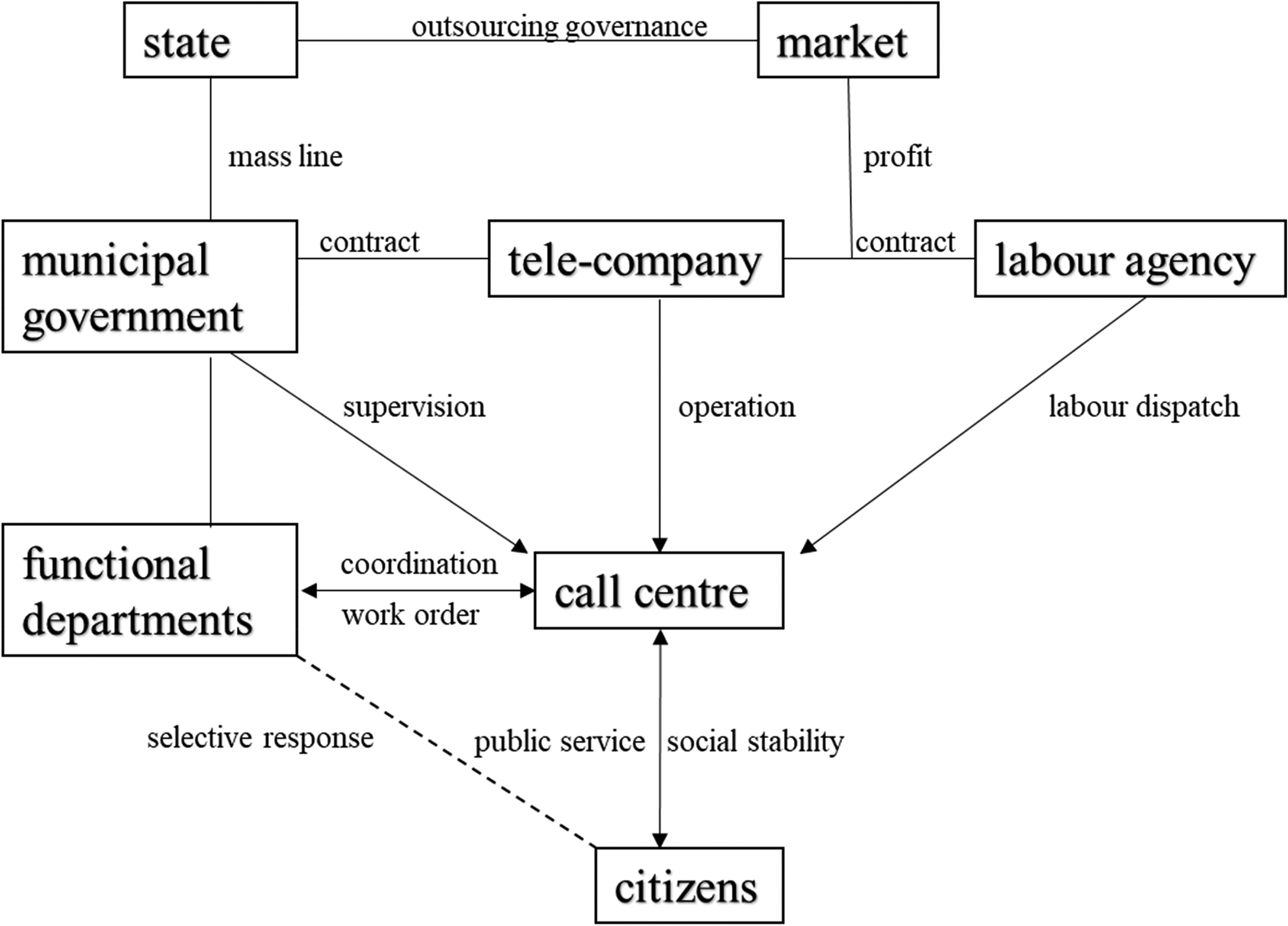
Governance labour in the mayor’s hotline system.
As Figure 1 shows, the operation of a call centre is not only influenced by the lateral interactions between call centres and other bureaus (such as functional departments and the police) but it is also shaped by the vertical forces coming from both the state and the market. Given that the lateral interactions in China’s constituency service are already addressed in previous literature, 34 in this part I will focus on the downward forces, especially those brought about by privatization.
Government impact
Vertically, the primary driving force shaping frontline call-taking comes from municipal governments because the mayor’s hotline system is aimed at facilitating direct consultation between citizens and officials while maintaining the CCP’s concentration of power. Although the operation of call centres is contracted out to for-profit companies, the government’s influence still penetrates the daily operation of call centres through different ways.
As shown in Figure 1, the most direct influence from the government is conducted through the contract negotiated with the service provider. In the contract, municipal governments state detailed requirements, such as service outcomes, key performance indicators (KPIs), dispatching procedures, training outlines, and evaluation modes. All the requirements are set around the targets of providing citizens with good service and helping local governments maintain social order. As one BP mayor’s hotline dispatcher explained: We are not allowed to delay requests. Within 24 hours, all requests must be dispatched. And for emergency requests about power cut-offs or environmental pollution, we have to dispatch them within two hours. If it is a threatening call, we must report it immediately.
Local governments also influence frontline operation through their physical presence. In DY, the mayor’s hotline call centre is located within the government building and the municipal government sends three officials to supervise its operation. In BP, although the call centre is located in a tele-company building, there are five offices in the same building designated to BP petition officials. Every day, at least three petition officials are sent to the call-centre hall, not only to provide policy explanations but also to conduct routine inspection. The presence of these officials shows that even though the operation is outsourced to for-profit companies, the government still exerts some control in the supervision of the interactions between call operators and citizens in mayors’ hotlines.
Market pressure
Financial pressure is one of the main factors driving local governments to outsource public services. As the popularity of mayors’ hotlines drives the demand for human labour and communication devices, local governments increasingly rely on market mechanisms to cover the increased costs. Although outsourced services in the West are expected to produce more profit opportunities for private providers, only state-owned tele-companies in China have at their disposal the technological capacity and political reliability to win bids. However, economic reform has also led to the establishment of state-owned companies with a strong profit pressure, such as China Unicom and China Mobile, and these companies lack the necessary budget to increase their staff size.
My fieldwork shows that tele-companies adopt a commonly used market strategy – labour dispatch – to solve this problem; they subcontract the provision of a labour force to private labour agencies rather than hiring staff themselves. As Figure 1 shows, the involvement of labour agencies leads to double outsourcing in mayors’ hotlines: when local governments contract the management of call centres and the training of operators to state-owned tele-companies, tele-companies rely on labour agencies to conduct employee recruitment and wage calculation.
Double outsourcing narrows the profit space of labour agencies. To guarantee a competitive bid price and to control costs, labour agencies choose to lower the basic wage of operators. The low-salary condition not only makes it difficult for labour agencies to recruit new employees, but it also results in a high turnover of current staff. The consequent labour shortage increases the workload of the remaining employees, which further decreases the attractiveness of working in call centres. In the current market environment, this vicious circle is difficult to break.
Frontline dilemmas
Privatization creates a dual-pressure structure that shapes the frontline labour in mayors’ hotlines. Although the state expects that the incorporation of market competition would increase the quality of public services, the requirements of social governance and the profit demand of market actors do not always coexist well. According to my observation, the government’s demand and market logic create at least three dilemmas on the frontline of mayors’ hotlines:
Dilemma 1
The first dilemma exists in the conflict between the vague scope of government service and the limited capacity of call operators. On the one hand, when the mayor’s hotline is propagandized as a channel that can solve people’s problems and resolve social conflicts, it actually leads to ambiguity in service specificity. On the other hand, although call operators are not empowered with any administrative resources to solve citizens’ problems, they are required to handle service requests that are irrelevant to government duties. As pointed out by a manager in BP’s mayor’s hotline: The upper-level government’s idea, maybe, makes us just like a grocery store. We deal with everything, but actually we can solve nothing. . . . We are not allowed to tell citizens: ‘We cannot accept your case.’ This is not just for family issues. It is forbidden to say ‘We can’t do it.’ Neither do they want us to say ‘What you need has nothing to do with this hotline.’ You have to pacify callers. Give them some suggestions and find out some connections. This is some sort of ‘good service’. It is like giving them a sense of being served.
Martin Dimitrov argues that maintaining high responsiveness to citizens’ appeals helps authoritarian regimes retain public trust. 35 Following the same logic, local governments also encourage mayor’s hotline operators to address every appeal from the public. As stated by a DY mayor’s hotline manager:
We have pressure. We know this hotline well. We worry that the government tells all the people that we can solve everything. This gives us so much pressure. If the government promotion builds this kind of image, we have to address every call. If we fail to do this, someone will complain, saying that ‘our government says that the hotline can solve any problem’ . . . There are a lot of issues with our service.
Although creating a hotline that does not refuse to handle any complaint helps the state promote its public image, it also raises citizens’ expectations; these expectations are then directly transferred onto the heavy workload of the frontline operators. An undeniable truth behind this dilemma is that the engagement of privatization here has not dismantled the strong tradition of state intervention, even though the Chinese state considers ‘shrinking government’ a major rationale for government outsourcing. In addition, one of the widely mentioned targets of mayors’ hotlines is to build a service-oriented government rather than a regulatory government. However, the construction of a service-oriented government is operationalized as building an omnipotent hotline through which local governments can both solve all citizens’ issues and control society at the same time. When citizens’ expectations towards an omnipotent state are reproduced, the control logic and intervention tradition of authoritarianism are perpetuated with the expansion of mayors’ hotlines.
Dilemma 2
The second dilemma is rooted in the trade-offs arising from two competing mandates: call-receiving quantity and service quality. In the call centre industry, the quantity and quality trade-off usually refers to the rival objectives of processing the maximum number of calls with the lowest staffing ratios while delivering a level of customer service that will not only retain the confidence of the public but also win it over. 36 However, when the call centre business is integrated as part of authoritarian governance, this conflict becomes more intense.
On the one hand, local governments set a series of KPIs to assess the operation of call centres. The primary KPI is the percentage of calls blocked, which refers to the percentage of inbound callers that receive the engaged tone when they call the hotline. In BP’s mayor’s hotline, the requirement on this indicator is no more than 3 per cent. To achieve this target, BP’s mayor’s hotline call centre has a big screen on its wall that displays the number of incoming calls waiting in a queue. Once the number increases, the directors stand up and walk around the centre, yelling ‘Pick up the phone’, to press the call operators to immediately turn to the next call.
On the other hand, good service takes time. Local governments set quantified KPIs such as satisfaction rates to estimate the service quality of call operators. Because mayors’ hotlines are expected to undertake multiple governance missions, such as channelling citizens’ emotions and resolving social conflict, call takers often spend a lot of time listening to and pacifying angry callers. However, because dissatisfied citizens make many complaint calls due to their disagreements with the government, these service-quality indicators lose their validity in the real field. Lacking an appropriate tool to estimate the service quality of call operators, mayor’s hotline managers have to use call-receiving quantity as the most critical performance index.
Dilemma 3
The last dilemma refers to the mismatch between the complex requirements of governance labour and the low salary conditions of frontline operators. Mayor’s hotline operators, compared with those working for call centres of other businesses, have to handle diverse cases and difficult clients; they are supposed to have abundant knowledge of local policies and administrative procedures as well as sufficient communicative skills to address citizens’ inquiries, appeals, complaints, and even threats. However, the call-centre industry also emphasizes the profit logic. Employers therefore usually increase profit opportunity by reducing salaries and increasing individual workloads. The most direct consequence of this conflict is that labour agencies find that in the current market it is extremely difficult to hire eligible employees. Rising service demand from the public leads to a workforce shortage in mayor’s hotline call centres, which increases the workload of the employed operators.
It is worth noting that this dilemma has also been observed in the outsourcing of social work. Based on an ethnography on social work practices in Shenzhen’s Foxconn, Mun Young Cho’s research shows that social workers also struggle with low earnings, delayed payment of wages, excessive demands from local governments, little recognition from the public, and uncertain career prospects. 37 The poor working conditions cause high dropout rates, which aligns with my observation of call-operator turnovers in the two mayor’s hotline call centres. To solve the workforce shortage problem, labour agencies build connections with non-local technical schools that send their students to call centres as cheap interns. In the past two years most new operators at BP’s mayor’s hotline have been recruited from this channel. These students, most of whom are around 20 years old, have neither the social experience nor the communicative skills to address experienced protestors or angry petitioners. To guarantee a supply of operators, tele-companies also shorten the training period from one month to one week; as a result, student interns are dispatched to the frontline before they acquire the necessary policy knowledge and communication skills. Not surprisingly, the service quality dramatically decreases. Even worse, most students, unsatisfied with the low salary and work intensity, refuse to renew their contracts with the labour agencies after their internship. Call centres then have to wait for a new batch of inexperienced students to fill the labour shortage.
Discussion and conclusion
By using the labour process theory to unpack the frontline operation of the mayor’s hotline system, this article finds that privatization is both restraining and enabling. By relying on for-profit tele-companies, the state provides citizens with a more accessible channel for civic participation. Meanwhile, the tentacles of state control, with the help of private providers and under the name of social service, are able to reach a wider range of the population. This research also finds that while privatization does not dismantle the strong tradition of state intervention, it does not mean that market forces are absorbed by the state. Under the current outsourcing mode, executants of the mayor’s hotline system are weighed down by the governance demand of local governments and the profit pressure of companies. This implies that the deep-seated contradiction between authoritarian control and market logic is forming a structural force that shapes the frontline governance of this regime.
My article contributes a sociological perspective for exploring frontline authoritarian governance. By incorporating a labour process analysis into the perspective of authoritarian governance, I provide a detailed examination of the practical and relational components of frontline work constituting authoritarian domination. As shown in my analysis of the mayor’s hotline system, privatization introduces various state–market conflicts that vertically shape the governance labour of an authoritarian institution. It demonstrates how institutionalized authoritarian control is embedded in the complex social context – exercised by both state and non-state actors – and shaped by struggles between state forces and market forces. This new perspective deepens our understanding of state–society relations in an authoritarian context.
To further understand the impact of outsourcing on the system of mayor’s hotline, this article also calls for a dialogue between research on authoritarian responsiveness and policy discussion on government outsourcing. Although mayors’ hotlines, compared with education, health, and social work, have not been systematically discussed in the government outsourcing literature, policy scholars already contribute inspiring insights that help us rethink the impact of outsourcing on responsive authoritarianism in contemporary China. In the discussion of China’s governance reform, the government’s purchase of social services is commonly considered a confirmation of state capacity and an instrument for social governance rather than passing on state responsibilities to civil society sectors with tight budgets. 38 This also aligns with my observation of mayors’ hotlines. The manager of DY’s mayor’s hotline told me that when his municipal government decided to develop its hotline, municipal leaders all agreed to construct it as a city brand that fits the party’s mass line. The hotline’s functions of collecting information, reinforcing government reputation, and resolving social conflict have been highlighted by government leadership since its very foundation. During the process of hotline construction, the municipal government actively advertised the hotline across DY. In this sense, local governments are not forced to develop an outsourced hotline to address tight-budget issues; instead, they embrace outsourcing as a policy tool to construct a new government-responsiveness channel to cover more of the population. This change shows that beyond deliberately selecting non-state service partners (such as NGOs) and requiring them to act as a state agent promoting social cohesion, 39 the state has already begun to actively use outsourcing in its institutional arrangements of authoritarian responsiveness.
In most cities, the claimed policy objective of the mayor’s hotline system is to better address citizens’ demands. However, while outsourcing is systematically applied in the mayor’s hotline system across the country, no innovative design has been implemented in the government procedure of dealing with citizens’ demands. Ann Schneider and Helen Ingram emphasize how the role of objectives, designs, and their linkages are highlighted in critical policy analysis. 40 Using this perspective to examine the outsourcing of mayors’ hotlines, we can find that good service, in the design of the current outsourcing model, is simply considered in terms of a high call-receiving quantity and call operators’ service attitude. The literature on responsive authoritarianism highlights a feedback mechanism in which highly responsive channels encourage citizen participation, which in turn provides more information to the state. 41 In my field sites, the problem-solving mechanism of the mayors’ hotlines operates in the same way as the traditional petition system. According to my observation, the effectiveness of mayors’ hotlines varies across different cities. After channelling citizens’ demands into the official channel, there is little or hardly any reformative arrangement to guarantee that citizens’ problems are quickly solved by government functional departments. Whether citizens’ demands can be properly addressed largely depends on the latitude of local authorities. 42 Frank Fischer argues that a good citizen-participation channel should create a space where citizens can meaningfully engage in shaping decisions together with state actors through durable forms of practices that advance more responsive governance. 43 Although the engagement of the private sector empowers citizens with more opportunities to contact their local governments, with the lack of relevant policy design to increase government accountability it is unclear to what extent this outsourced responsive channel will guarantee more deliberate participation.
Moreover, the literature on welfare service outsourcing inspires us to consider the policy design of the frontline dilemma faced by mayors’ hotlines. Scholars have noted that poor working conditions, manpower shortage, and high turnover rates have impeded the implementation of social-work contracting in many cities. 44 Wen argues that Chinese policymakers have underestimated the issue of manpower in the learning and designing stages of contracting out policy. 45 As the development of social work as a policy and as a profession is new in China, policymakers lack the in-house experience and knowledge needed to evaluate the effectiveness of outsourcing. Under this condition, many outsourcing policies are set and implemented without a rational analysis of service development or the demand and supply of manpower. 46 In my study, call operators also suffer similar working conditions and turnover problems. When local governments carry out the outsourcing policy of the mayor’s hotline system without sufficient in-house knowledge, they attempt to graft commercial customer service onto the delivery of authoritarian responsiveness. If Chinese local governments continue to require call operators to carry out the complex missions of responsive authoritarianism without improving their analytical and managerial capacity, the already mentioned bureaucracy–capital tension could worsen.
