




Abstract
On the crossroads between preserving a nationalist rhetoric and adding ways in which it can offer an alternative to mainstream politics, the Slovak Radical Right has transformed itself from having an unsteady presence in parliament over the last two decades to having two nationalist parties with a significant portion of seats. This article examines the radical right parties’ (RRPs’) gender rhetoric and parliamentary activity, and in comparison to other parties evaluates the substantive representation of women within these parties. The study covers the period from 2006 to 2016 and shows that while women are still significantly outnumbered in RRPs, they are more active on women’s issues than any of their counterparts. Moreover, their activity can be characterized as “positive representation,” as opposed to the usually assumed “negative representation” of women by RRPs.
A number of key parliamentary and presidential elections that took place in recent years around the world signify a common phenomenon: Populism, and especially radical right politics, is on the rise. Beginning with Brexit and the choice of a slim majority in Great Britain for the country’s exit from the European Union, through the election of Donald Trump as President of the United States, and culminating with the French election in which the radical right Front National was one of the two contenders for the presidential office, they all show that, albeit with various levels of success, extremist and nationalistic views are now not only part of the elite, but they also find strong resonance in voters’ support. This signifies that while a decade ago radical right politics was somewhat on the periphery, the study of these parties, their promises, voter base, and behaviour in power, if elected, has become central to the study of party politics. It has also become central to modern day politics. To borrow a phrase from Miller-Idriss’ new book, “the extreme [has] gone mainstream.” 1 The presence and success of these parties has shown that in addition to being on the rise and having a direct effect on politics is not something we still fear, but is the current political reality; they also have an indirect, yet substantial, effect on politics, since the increasing presence of radical right parties (RRPs) and parties’ supporters is changing the competitive space for political power. On the one hand, the existence of RRPs has helped newly formed political movements get to power by providing a clear target of other political forces to be against, such as the election of Emanuel Macron as the new French President. On the other, RRPs are also affecting the discourse of extant issues important for society, especially ones that are against their original ideological message, for example, gender and LGBTQ rights. As RRPs are becoming more mainstream, they also engage with more mainstream issues. 2 Their movement to issues of the “centre” and their increase around the world have decreased the stigma of participating in such movements and, in turn, attracted more women to join where they would have previously hesitated. 3 An important question here is how do women representatives of RRPs behave and what issues do they raise, while in parliament?
While not new, the questions of the descriptive and substantive representation of women, as well as the link between them, have become ever more important. Even if still observably outnumbered, the proportion of women in high-profile political jobs is increasing significantly. Studies on gender representation have shown that the number of women in politics is increasing across the board, 4 and that gender is also present in conservative claims. 5 At the same time, while equalizing the power between genders in politics is of central interest to scholars and practitioners supporting equality alike, the original idea of the critical mass, that more means more, has been refuted and replaced by a focus on quality rather than quantity. In this sense, what radical right women do once in parliament is a question of great interest on which, thus far, we have very little evidence. Furthermore, it is interesting to know what is the role of women parliamentarians from RRPs—is it the same as their male counterparts, or are they also marginalized within the party structures, as they often are in mainstream parties? Finally, do they speak on women’s issues, and if they do, is the discourse that they bring up in line with their party group ideology, that is, making vague claims on equality rights and twisting the gender discourse to support their anti-immigrant positions?
Despite the established body of research on gender politics, and the increasing amount of work on radical right politics, the link between gender and radical right populism has only recently attracted interest and we still do not have the answers to many questions. Scholars have studied the gender gap, 6 proposed explanations for the popularity of RRPs, 7 looked at the gender influences of integration and immigration policies in Italy and France, 8 and at the substantive representation of women within RRPs. 9 As a result of this scholarship, we are beginning to better understand the role of gender in radical right politics, yet we are still far from able to make general conclusions, without further evidence. In addition to the questions posed above, a big lacuna of knowledge exists between the East and the West. Most extant starting points in the literature studying the radical right stem from the Western experience where the main rhetoric is anti-Islam and anti-immigrant. In the East, given the smaller and only recent inflow of immigrants, the rhetoric of the RRPs is rather against the Roma, against the EU, and against “the other.” 10 Consequently, we can ask and examine to what extent this different analytical departure point affects our expectations and findings about the women in the radical right?
This article attempts to contribute to the debate on the role of gender in radical right politics and especially to start filling the gap in studying the substantive representation of women in these parties with a focus on Eastern Europe. In particular, it examines the composition of RRPs, and the extent to which RRP parliamentarians represent women’s issues. The article builds on the extant scholarship on descriptive and substantive representation of women, 11 within which the initial emphasis on the role of “the critical mass” has shifted to the argument that a link between more women and more representation of women cannot be assumed to be linear and straightforward. 12 The emphasis, rather, needs to be on critical actors. 13 Stemming from this debate, the current study asks “to what extent are women represented in the Slovak parliament” both descriptively, as well as substantively. The questions are answered with a focus on the radical right, which is of central interest here. The main point of interest, and the contribution that this article makes, is to test the propositions of Rashkova and Zankina on another case, in order to see whether the finding that Radical Right women are the most active MPs on women’s issues (which would run counter the intuition we have developed based on studies of West European democracies) stands. 14
While following Rashkova and Zankina’s methodological approach in examining this question across party families and across the gender divide, this article aims to serve as a check on their finding of women’s representation in RRPs in East European states. Evidence is drawn from Slovakia in the period from 2006 to the present. The current study confirms Rashkova and Zankina’s finding that although significantly outnumbered by male colleagues, women in RRPs are most active on women’s issues. In contrast to Rashkova and Zankina, however, this study finds that the representation of women’s issues is “positive,” or in favour of bettering women’s position overall, rather than the “negative” representation Rashkova and Zankina find in the case of Bulgaria. Additionally, the article shows that the fact that RRPs are mostly composed of men and discussions are dominated by issues unrelated to women is not a unique phenomenon for RRPs, but it reflects the situation in almost all Slovak political parties.
These findings have several important implications, and together they open an entirely new research agenda, which juxtaposes the developments towards achieving gender equality in developed and new democracies. First, the results complementing the study of Rashkova and Zankina allow us to be confident in the result that women in RRPs in East European states are quite active on women’s issues—a result that runs counter our general expectation of how MPs from these parties behave. Furthermore, we see that the role of women in RRPs in the East is not as uniform as it is claimed to be in the West. While in the West, radical right women are portrayed as just another member of the party machinery on the way to it achieving its goal, in the East, radical right women’s role can be seen as mixed and dependent on domestic constraints—in states where the minority against which RRPs mobilize is larger, the role of radical right women is closer to the party rhetoric even if masked to be for the protection of women. Thus, an important theoretical contribution to the gender and politics literature that stems from the current study is that the link between women’s substantive representation and party ideology is not straightforward and that there are other intervening factors, such as the size of the targeted minority group, which can influence women from ideologically similar political parties to behave differently in different contexts.
The article proceeds as follows. The next section discusses the theoretical framework of the current study. The third section presents parliamentary evidence for the period of 2006–2016, and discusses the data and method. The fourth section presents a brief history of the Slovak RRPs and analyses the empirical results. The fifth section concludes.
Theoretical Framework
This study builds on the previous literature on radical right politics and the role of gender in radical right populism. In particular, it looks at two specific expectations that we can draw from extant work. Unpacking the relationship of women to radical right politics as being composed of both descriptive and substantive representation, the article looks at the composition of parliament and how many female representatives there are in Slovak’s RRPs.
Originating in Mudde’s work, 15 the literature in gender politics and the radical right contains the notion that RRPs, characterized by nativism, authoritarianism, and populism, all manifesting themselves in issues related to immigration (at least in Western democracies), are men’s parties. The idea behind this notion is the assumption that it is men and not women who are more affected by issues such as immigration and who are more interested in nationalistic claims, as a result of which women make for a very small minority of RRPs’ political composition and constituency support-base. Further work on both radical right politics and its connection to gender equality has shown that while such a presumption may be valid to expect, the relationship is not so straightforward, and attitudes toward immigration are the same for male and female voters and are thus ill suited for explaining the gender gap that exists in the support that RRPs receive. 16 Furthermore, Spierings 17 notes that while many fewer women vote for RRPs, a considerable amount of RRPs’ support comes from women. On the other hand, Rashkova and Zankina 18 find that while Bulgaria’s RRPs have very few women on board, the gender inequality is not so striking, and by far not the highest, when presented in light of all political parties. These findings illustrate that current literature contains mixed findings regarding the composition of RRPs, and there is still evidence that fewer female than male voters and MPs represent the radical right. Furthermore, there is still quite little evidence on how gender and the radical right interplay in the new democracies of Eastern Europe. Given that gender representation is considerably lower in these countries than it is in the West 19 and based on the originally posed link between gender and radical right politics, this study expects that RRPs in Eastern Europe are primarily made up of male politicians (hypothesis 1); however this is not a stark difference with other parties (hypothesis 1a).
The second component of gender equality, which we are interested in, is who represents women and to what extent. What is at stake here is not how many female members of parliament or a political party there are but rather, do they represent women by being legislatively active on women’s issues or not? Following Celis and Rashkova and Zankina, 20 we conceive of substantive representation of women as the parliamentary activity on women’s issues. Women’s issues are conceived of as issues related to women’s structural social situation, from giving birth to child rearing, and women’s social perspective as marginalized, the need to overcome any sort of discrimination, and inequality related to women, children, and adolescents. The idea that the number of women represented in parties is not directly linked to the type of representation women receive has been discussed extensively in the literature and refuted. Neither can more women be taken to mean more women’s representation, nor can women’s representation be taken up only by women. It has been confirmed that the representation of women is not limited only to female politicians but that male MPs can also be active on what we call women’s issues, 21 while Rashkova and Zankina show that despite an expectation for low or lacking substantive representation of women in RRPs, the RRPs in Bulgaria offer a different story. 22 These parties have few women, but they have been shown to be most active on women’s issues in comparison to both female and male counterparts from their own, as well as from competing parties. Importantly, even in the lack of anti-immigrant rhetoric, the activity of Bulgaria’s RRP women tends to follow the party line of being against the Roma and other minorities, something that is reflected in their activity on policies of child rearing. This resonates with observations in the West, where the concepts of gender and women’s rights are twisted and used to further target specific ethnic groups and promote hatred and fear against them. What is particularly striking, however, is that Rashkova and Zankina show that this type of women’s representation, what they call negative representation, is the highest representation of women’s issues among all parties in the Bulgarian parliament. 23 The latter conflicts with the fact that women and women’s issues have been present in legislative discourses in Western societies for a number of decades, now. So, a budding question to answer is whether this is a trend in Eastern Europe and something that we can explain, or whether this is specifically related to the case of Bulgaria.
In light of the discussion above, if there is an East European trend to observe, which Rashkova and Zankina allude to, we should expect to see more representation on women’s issues in RRPs than in other political parties in other East European states as well. Further, in reflection of the fact that RRPs are gaining more and more popularity in recent elections and the claim that RRPs, especially those who have already been members of parliament, tend to be making a move toward the political centre, 24 it can be expected that RRPs will have increasing activity on issues related to women. Based on these logics, the second expectation of this study is that women in RRPs are more active on women’s issues than their counterparts from other political parties (hypothesis 2) and that their activity increases over time (hypothesis 2a). Even if traditionally “men’s parties,” in their attempt to compete better with mainstream political establishments, RRPs can be expected to make an attempt to increase the number of women on their squad (hypothesis 3).
Data and Method
To examine the hypothesized relationships between gender and RRPs, this article employs qualitative methods and studies the legislative activity of Slovak parliamentarians from 2006 to date. The main focus is on the two RRPs—Slovak National Party (SNS) and Kotleba’s People’s Party Our Slovakia (L’SNS). It is important to note that data are presented for all MPs across all the legislative represented political parties. The data were originally collected and it is the first systematic presentation on parliamentary activity and substantive representation of women in Slovakia, and only the second one for Eastern Europe (Rashkova and Zankina have studied women’s substantive representation in Bulgaria). As such, it is the first study to show the amount of activity of Slovak MPs, how much of this is related to women’s issues, and how they compare to each other. The choice of Slovakia as a case was twofold. First, it is one of the East European countries with the strongest parliamentary presence of RRPs, and, second, it is a country with a significant number of members from the Roma minority (which are targeted by RRP discourse, especially in terms of social provisions, not excluding maternity provisions).
The data were retrieved from the parliamentary website through a web-crawler, which extracted data on every MP’s legislative activity. Legislative activity is taken to mean all parliamentary activity (proposal of bills, questions raised, etc.) that a given MP has had in the legislature, which has been recorded on their personal page. The period for which data have been uploaded on individual MP’s profiles, and could thus be retrieved, begins with the 2006 parliament (the fourth after the split from the Czech Republic). As a result, the data presented here is from the current and the three preceding parliaments. To get the number of women per party for each parliament, all MPs’ dates of service were manually checked, to ensure that the proportion of women presented represents the initial gender balance at the start of each parliament. Following Rashkova and Zankina, 25 we choose to present the gender composition at the outset of each parliament because it is believed that the initial gender break-up most closely signifies a party’s stance of gender equality. Names of male and female MPs were then counted and checked via the pictures attached to each profile to ensure correct classification of name and gender correspondence.
All retrieved data come in the original language of the country—Slovak. Thus, a computerized translation was generated for all legislative activity in which each individual parliamentarian has been involved, and all of these have been manually processed, and activity related to women’s issues has been coded. Thus, for a given MP’s activity log, every activity was checked for the topic it covered. As elaborated in the previous section, the classification of a “women’s issue” was given to activities related to child bearing and child rearing, as well as to women’s socially deprived position in society and the related inequalities they may have had to face. For example, if a legislative activity referred to abortion or to child custody and the Family Act, it was coded and counted as activity on women’s issues. Similarly, the proposition of a draft law making education compulsory for a certain age group has been coded as legislative activity on women’s issues, because of its direct effect on child-rearing. If, however, the activity was not directly related to child-rearing, as for example a draft law on school buses, such a legislative activity was counted as part of the total number of activity a particular MP has had but not for her or his activity on women’s issues.
The article studies the representation of women in the Slovak RRPs for a number of reasons. First, Slovakia is the only country in Eastern Europe where the main RRP, the SNS, has consistently won seats in almost every parliamentary election since the transition to democracy. This offers a unique case of party continuity, while at the same time the party is of the specific family this study is concerned with. Second, as Kluknavska and Smolik point out, 26 there is a lack of academic research on the extreme right in Slovakia. Lastly, yet not of any less importance, the Slovak case was chosen also because of the uniqueness of its electoral system. Being the only single-district country in EE, and the second within the European Union (the other one being the Netherlands), this unique electoral setup provides specific competitive incentives for parties. For example, it can be expected that political parties in a single-district state will have a stronger incentive to stage women, since they do not have the pressure of, say, multi-member districts, where parties who have paid an electoral deposit will only get it back based on the amount of votes they receive. This latter setup ultimately produces an incentive for parties to place women at the end of the party list because of the perceived higher electability of known male candidates.
Empirical Analysis
The establishment of radical right politics in Eastern Europe follows a path affected to a large extent by communist and pre-communist historical legacies. 27 This sets it distinctly apart from the emergence of radical right populism in Western Europe, where issues of immigration and religious heterogeneity have been the driving forces for the development and the growing support for such parties. In addition to defending a nationalist ideal, the RRPs that were established from the beginning of the transition period also presented themselves as part of the non-communist camp of “alternative choice” for voters. Having established itself already in 1989 and having won enough electoral support to enter the first post-communist parliament, SNS certainly followed that path. SNS has been in every Slovak parliament except in two (2002 and 2012) and has consistently defended Slovak independence. The main issues on which the party campaigns are nationalism—primarily defending Slovakia’s interests in the face of the Hungarian minority 28 and the situation with the Roma minority, in addition to the defence and foreign policy related to internationalization of the Balkans and the unstable situation in the Ukraine. 29
Similar to a number of other opposition 30 parties in Eastern Europe, SNS has not been immune to internal party conflicts. A conflict between Ján Slota and Anna Belousovová (Malíková), who was chairing the party between 1999 and 2003, culminated in a party split prior to the 2002 election, which was the reason the party did not manage to enter parliament after these elections. The leaders of the two factions learned quickly from these results and the party united again for the 2006 election. Moreover, in addition to dealing with internal party conflict in a more mature manner, the party exhibited a changed rhetoric in the last two elections. The issue of Slovak–Hungarian relations, previously central to SNS, was significantly less visible in 2012, 31 and in 2016 the party focused on presenting itself through its “newly found moderation.” 32 This development is consistent with Erzeel and Rashkova’s thesis 33 that RRPs, especially those who have enjoyed being part of parliament and government on a number of occasions, will seek more moderate and centrally characterized political issues in the attempt to broaden their support base.
In addition to SNS, the 2016 parliament saw the entry of a new RRP—Kotleba People’s Party of Our Slovakia (L’SNS). Although the party’s origins can be traced back to the middle of the 2000s, the party ran for national office for the first time in 2010. It was not until the 2016 election, however, that the party secured enough votes to get in. 34 The main issues for Kotleba’s L’SNS were anti-Roma, immigration control, and Christian morality. The more radical and xenophobic program of L’SNS earned the party the votes of some nationally oriented voters. 35 Because of the party’s newness in parliament, we are yet to see if they manage to retain electoral support, and whether and to what extent L’SNS’s politicians may change or expand their electoral rhetoric.
The questions that this article sets out to answer—how does gender equality appear in these RRPs, both in terms of descriptive and substantive representation—connects well with the historical development of the parties. As outlined in the theoretical section, the relationship with gender and representation of women’s issues is very much related to the RRPs’ nationalistic culture and rhetoric. As a result, this article examines the extent to which women are part of RRPs’ members of parliament, are they active on women’s issues, and does the number of women and representation of women increase over time. From Table 1, which depicts the number and proportion of women in Slovak parliamentary parties from 2006 to date, we see that the RRPs in Slovakia do not have a lot of female MPs. The proportion of female MPs in SNS was 15, 11, and 20 percent in the 2006, 2010, and 2016 parliaments, respectively. Despite the fact that the SNS’s proportion of women MPs is close to the parliament’s average (except in 2010), in each of the legislatures that SNS has won seats, half or more than half of the legislative parties have a higher proportion of women MPs than the SNS. Based on this evidence, we cannot reject hypothesis 1 that RRPs are men’s parties, and, furthermore, the evidence points to the fact that this is indeed a difference with the majority of the other parties, which means that we can reject hypothesis 1a. Similarly, the L’SNS, which has only been a member of the current 2016 parliament, has a low proportion of women, namely, 14 percent of its total parliamentary representation. Only the leftist party Direction-Social Democracy (SMER) has a lower proportion of female MPs than L’SNS in the current parliament. Based on this, we can conclude that in terms of descriptive representation, Slovak RRPs are still indeed Männerparteien and that, overall, they have fewer women than the rest of the political parties
Women in Parliament, 2006–2016
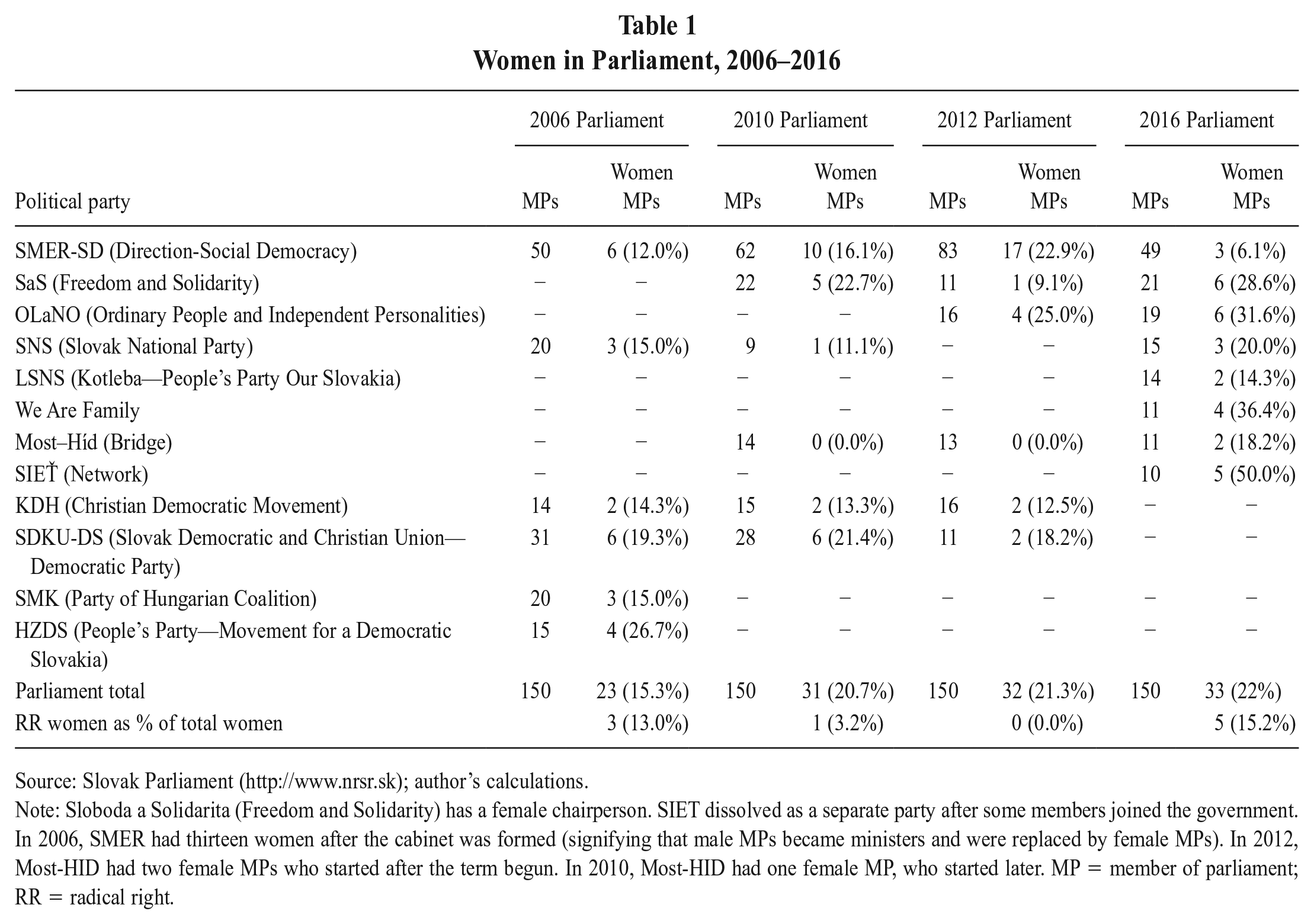
Source: Slovak Parliament (http://www.nrsr.sk); author’s calculations.
Note: Sloboda a Solidarita (Freedom and Solidarity) has a female chairperson. SIET dissolved as a separate party after some members joined the government. In 2006, SMER had thirteen women after the cabinet was formed (signifying that male MPs became ministers and were replaced by female MPs). In 2012, Most-HID had two female MPs who started after the term begun. In 2010, Most-HID had one female MP, who started later. MP = member of parliament; RR = radical right.
Considering the small number of female politicians within the parliamentary representation of Slovak’s RRPs, a more interesting question is what do these women do in parliament and what and whom do they represent. The theoretical section led to an expectation that women in RRPs are more active on women’s issues than their counterparts and that this activity increases over time. Turning to Tables 2 and 3 for evidence regarding the substantive representation of women, we observe the following: RRP women have a relatively low parliamentary activity rate. For all parliaments from 2006 until present, RRPs’ women have in total 32 legislative activities recorded in comparison to the 1,092 legislative activity instances of non-RR female MPs. This means that only 2.8 percent of the total legislative activity by female parliamentarians is done by women from RRPs. Interestingly, however, when we look at the frequency of legislative initiatives on women’s issues, as defined in the theoretical section, RR women are significantly more active. According to the data in Tables 2 and 3, RRP women have had 25 percent of the activity on women-related issues. At the same time, non-RR women’s activity on women’s issues is only 10.8 percent of activity focusing on women’s issues. While it is clear that these data attest more to the overall passivity of RRP women, it also suggests that we are unable to reject the hypothesis that RRP women are more active on women’s issues than their counterparts from other parties (hypothesis 2), but rather must confirm it. This follows from the fact that, in spite of the very low activity overall, a large proportion of it is devoted to women’s issues.
Slovak Radical Right Women—Parliamentary Activity
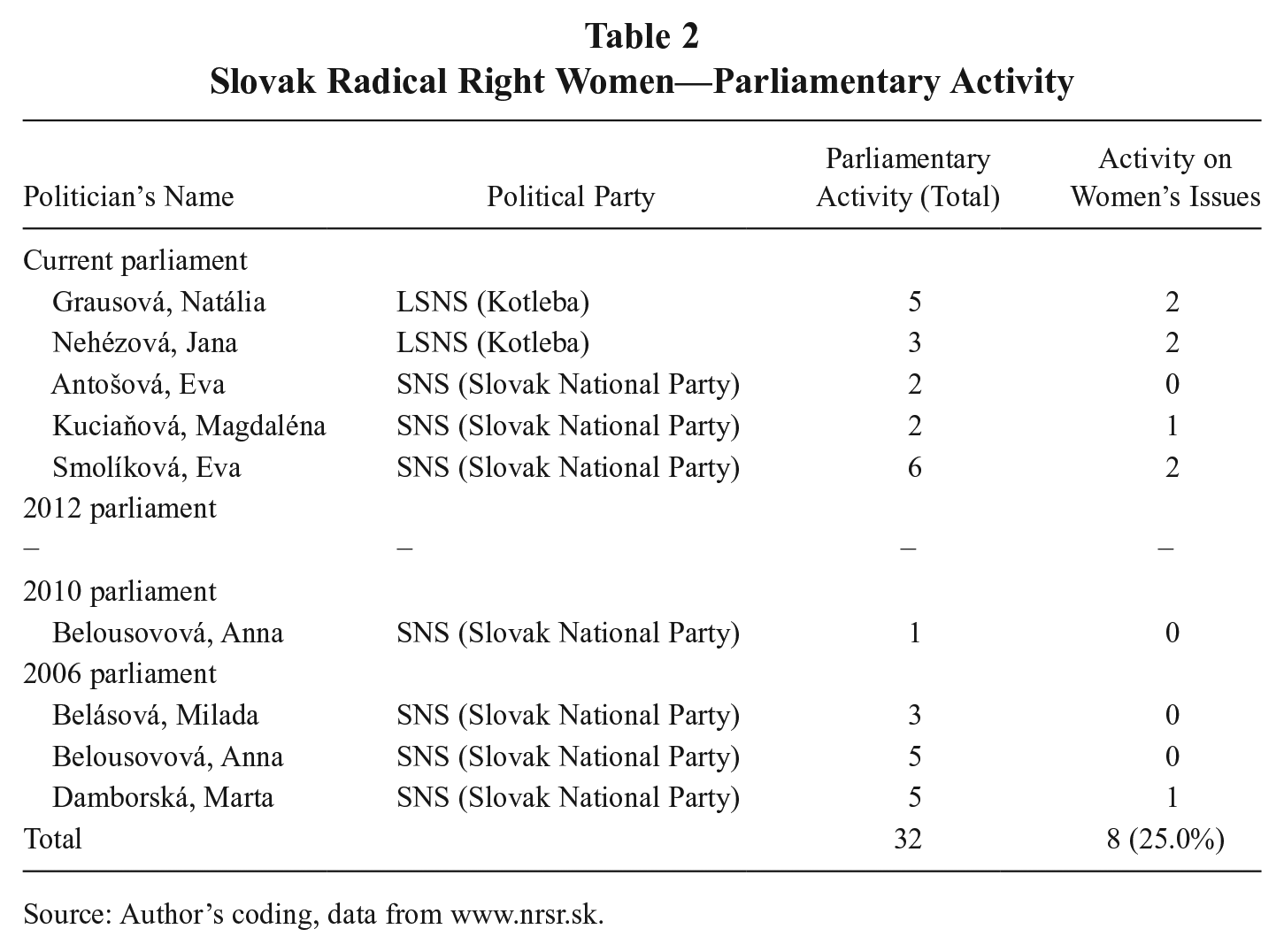
Source: Author’s coding, data from www.nrsr.sk.
Comparison of Slovak Women’s Parliamentary Activity
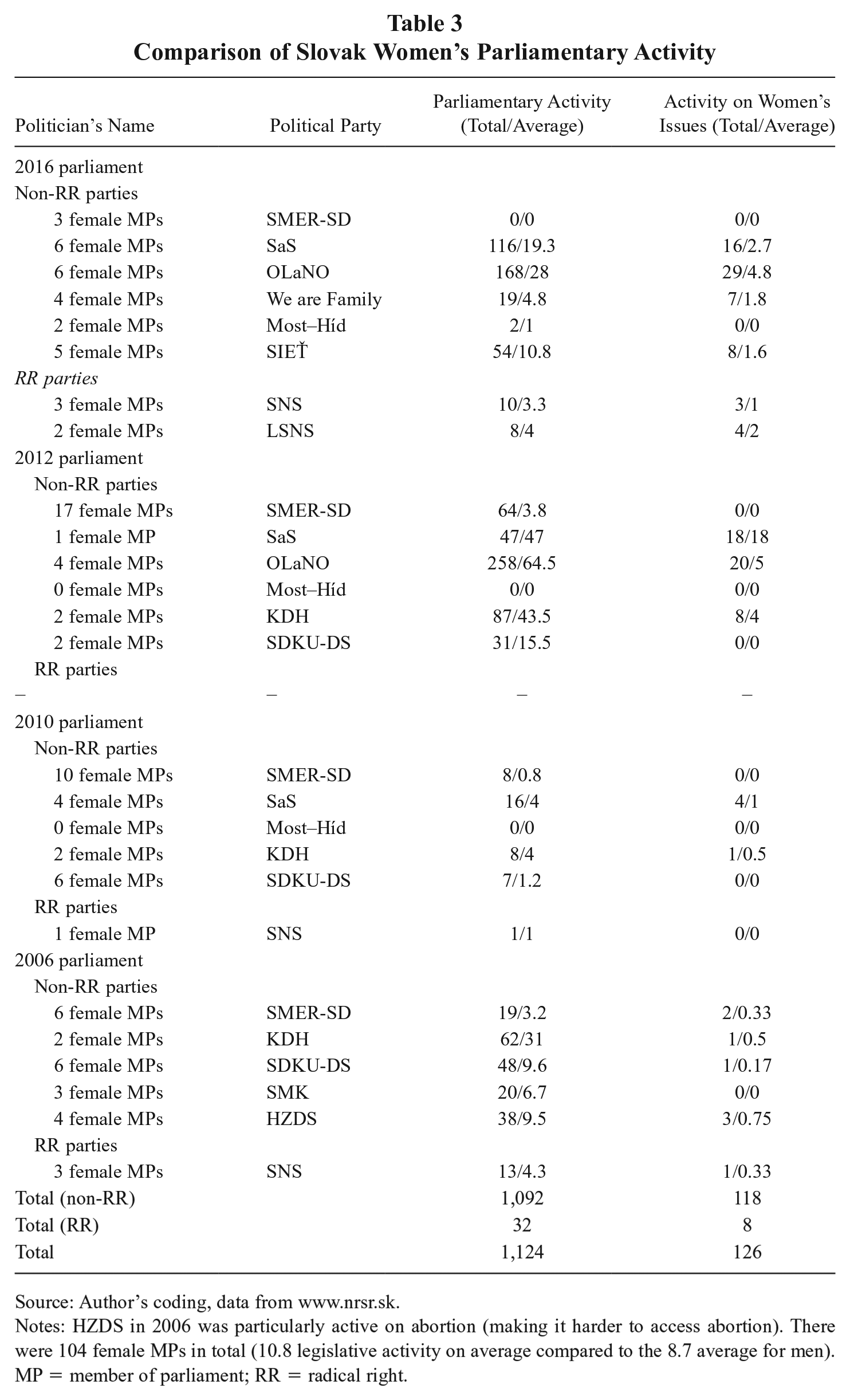
Source: Author’s coding, data from www.nrsr.sk.
Notes: HZDS in 2006 was particularly active on abortion (making it harder to access abortion). There were 104 female MPs in total (10.8 legislative activity on average compared to the 8.7 average for men). MP = member of parliament; RR = radical right.
What are RRP women active on related to women’s issues? In the current parliament, both the representatives of the Slovak National Party (SNS) have been active on the education of hearing-impaired children—they have submitted a draft act for the amendment of Act 149/1995, which according to them “fails to respect their disability, is disproportionate, ineffective, with a negative impact on their intellectual and personal development.” The women representatives from Kotleba, on the other hand, have been active on health care issues, in particular promoting the need for ability of parental decision for or against vaccination for children, and on parental allowance, trying to increase the state’s contribution for each child born. Unlike what we may generally expect from representatives from RRPs, whose activity on gender issues may prove to be “negative” once one looks into what exactly they are representing, the Slovak RR women are indeed offering “positive” women’s representation. 36 Consequently, we need to acknowledge that the label “radical right” does not necessarily equate to negative women’s representation, despite the still low number of women representatives, and the general rhetoric that RRPs are known for.
Regarding the second part of the hypothesis that the substantive representation of women grows over time (hypothesis 2a), the data show confirmative evidence as well. According to the data in Table 2, SNS is the only RRP which has participated in several parliaments, and we see that the instances of representation of women’s issues have increased from one of thirteen, or 7.7 percent, in 2006 to three of ten, or 30 percent, in 2016. L’SNS’s women MPs are even more active on women’s issues, as they have up to the point of the data collection (April 2017), had eight legislative activities altogether, four of which (50 percent) were devoted to women’s issues. Is this trend unique to RRPs? Table 3 shows evidence that all substantive representation on women (SRW) has been increasing over time, from the scant eight instances of legislative initiative on women’s issues in 2006 to forty-six in 2012 and sixty-seven in 2016. Similar comparative data on men’s parliamentary activity and the amount of times male MPs raised women’s issues, confirms an increasing trend from 3 and 7 in 2006 and 2010 to more than 30 in subsequent parliaments. The year 2010 has seen only five instances of legislative initiative on women’s issues but this can be attributed to the fact that this parliament was dissolved early. In addition, the data in Table 4, on the legislative activity of RRPs’ men, shows that RRPs’ women were more active on women’s issues, not only in comparison to all other female MPs, but also to male MPs from both RR and non-RR parties.
Slovak Radical Right Men—Parliamentary Activity
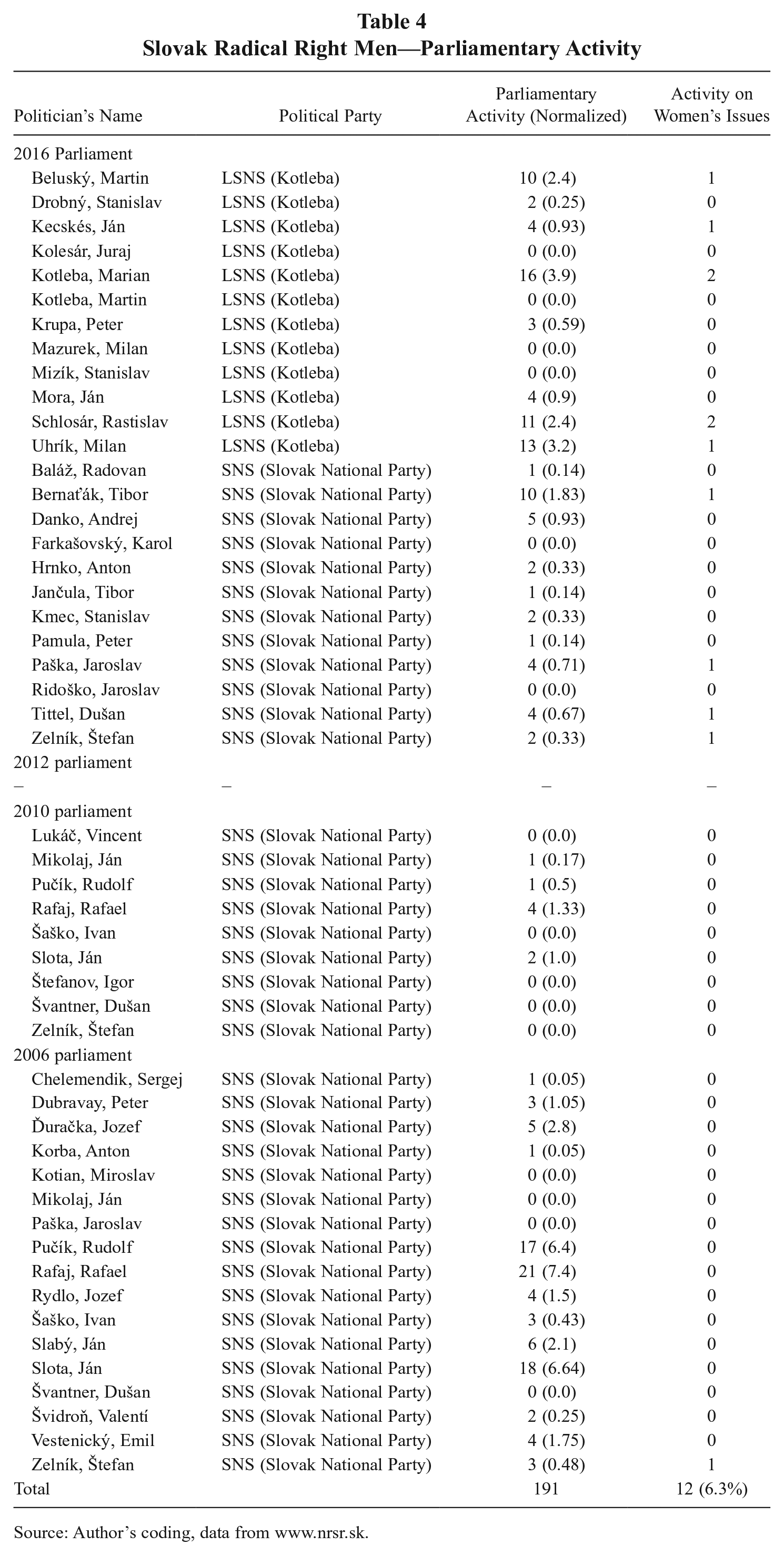
Source: Author’s coding, data from www.nrsr.sk.
Comparison of Slovak Men’s Parliamentary Activity in RR and Non-RR Parties
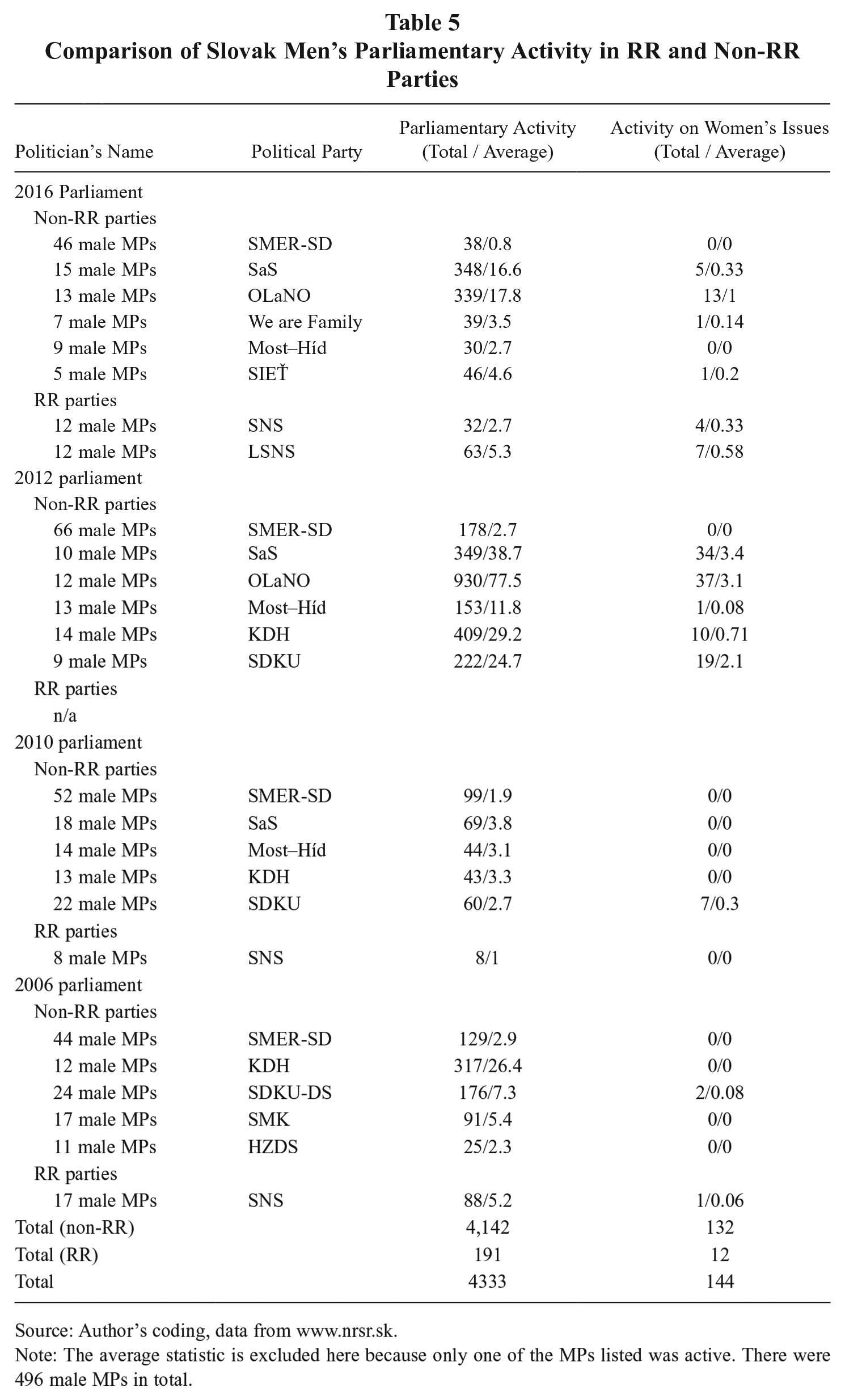
Source: Author’s coding, data from www.nrsr.sk.
Note: The average statistic is excluded here because only one of the MPs listed was active. There were 496 male MPs in total.
What explains this higher rate of activity? Furthermore, what explains the fact that some RRP women, for example those that we see in Slovakia, bring up women’s issues that are not directly related to their parties’ agendas? One explanation could stem from the hierarchical structure and patriarchal culture of these parties, where the role and voice of women is allocated only to women-related spheres of governance (usually those related to social issues and ones that male politicians consider of less importance or value). This can also explain the low overall activity of RRP women. Additionally, the size of the minority group against which RRPs rally and the place of the RRP vis-à-vis the rest of the political parties may play a role as well. A smaller against-group and a more centrist position of the party may be generating an environment in which RRPs are not trying to use all of their legislative time in support of their extreme ideology, but also be devoting time to gaining wider support—both within and outside the legislature. The findings about the type of representation RRP women in Slovakia engage with are different from what Rashkova and Zankina find for Bulgaria, where most of the representation on women’s issues by RR women MPs is “negative” representation targeting Roma women. In addition to pushing theoretical boundaries further, this implies that in order for us to be able to make any further generalizations about the link between gender and the radical right, gender scholars need to first increase the number of countries for which there is data on parliamentary activity of female politicians, and then look deeper into what this activity actually entails. Only after we have produced a number of such studies can we confirm or disconfirm the assumption that RRPs are dominated by men and those parties’ representation of women is overt and with double-meaning.
Conclusion
Research on RRPs has increased significantly in recent years, yet the link between gender and radical right politics has received little attention. Moreover, the study of the substantive representation of women within RRPs is even more rare. Building on recent work, this study revisits the question of the substantive representation of women by female radical right MPs and it retests the finding of Rashkova and Zankina, 37 who showed that in Bulgaria, an East European state, radical right women behave differently than expected by Western scholarship; namely, they found that RR women in Bulgaria are comparatively most active on women’s issues, yet, the questions they raise are negatively affecting the large Roma population in the country. This article puts this finding to an additional test, in a country that also has flourishing RRPs and a relatively large, but proportionally smaller, Roma minority. To do that, the article looks at the difference between RRPs and other political parties and tests assumptions built on our knowledge of the West. Similarly to Rashkova and Zankina, the representation of women’s issues is done across the board, examining all political parties and all MPs. Further, the substantive representation of women is examined and the extent to which gender is used to back up party anti-immigrant and other anti-rhetoric is put to a test. These questions are examined within the context of the Slovak National Parliament with originally collected data on legislative activity from 2006 to 2016. The study shows a number of new insights. First, it confirms the fact that speaking in terms of number, that is, looking at the descriptive representation of women, RRPs continue to be dominated by men. In this respect, the hypothesis that RRPs are Männerparteien still holds, but RRPs are not distinctly different from any other parties, given that all political parties in Slovakia are dominated by men. In terms of representation of women, however, RRP women in Slovakia are shown to be more active on women’s issues than other Slovak female MPs and both RR and non-RR male MPs. These results confirm a similar trend found in Bulgaria and solidify the finding that the role of women in party politics in the post-communist region differs vastly from what we know to be happening in the West. Furthermore, this study shows that the representation of RRP women on women’s issues is “positive” representation—one that actually favors women and is not particularly targeting a subset of women. As a result of these findings, this study points to three important implications: First, there are clear differences in the connection between gender and politics in Eastern and Western Europe, where some aspects overlap, while others show entirely different patterns; second, we can only make general claims about the relationship between gender and radical right politics once we look into the type of representation, and thus far the evidence is mixed, and third, we have a dire need for more data. Lastly, when such data become more readily available, we can attempt to explain the amount, content, and the direction of activity on women’s issues, which may lead to fascinating new findings. Thus, in addition to offering some new insights and a rich empirical resource, this research carves out an agenda for further research into the substantive representation of women in RRPs.
Footnotes
Declaration of interest
The authors report no declarations of interest.
