




Abstract
In the light of a series of right-wing populist successes, some observers concluded that there is a kind of populist contagion going on and that the global wave of radical right populism (RRP) has finally reached Latin America. Yet, a premature categorization based on outward similarities eventually leads to omitting important differences. The aim of this article is a typological assessment of four recent cases of right-wing populism in Latin America—Jair Bolsonaro (Brazil), José António Kast (Chile), Guido Manini Ríos (Uruguay), and Javier Milei (Argentina)—to clarify their correspondence with Cas Mudde’s concept of RRP. The questions to be addressed are the following: Are these four leaders and their parties radically right? Are they right-wing in cultural terms (nativist and authoritarian)? Are they populist? And do they have sufficient features in common to speak of a right-wing populist wave?
Introduction
The far right is on the rise in Latin America. In 2018, Jair Bolsonaro, a polarizing outsider from the right fringe of the political spectrum, was elected president in Brazil. Since then, a number of other right-wing candidates and parties have emerged, notably José Antonio Kast in Chile, Guido Manini Ríos and his party Cabildo Abierto (CA) in Uruguay, and Javier Milei in Argentina. In particular, Bolsonaro and Kast are seen by academic observers as part of a global autocratic resurgence and a backlash against libertarianism, universalism, and globalization (Haggard and Kaufman, 2021; Hunter and Power, 2019; Sanahuja and López Burian, 2021).
Indeed, there are substantial similarities between the new right-wing populists in Latin America, as I call them for a first approximation, as well as parallels between them and right-wing radicals elsewhere. 1 Brazilian president Jair Bolsonaro is frequently referred to as a kind of “tropical Trump” and often mentioned in the same breath as Hungary’s Victor Orban or Italy’s Matteo Salvini (Weizenmann, 2019). In Chile, the far-right first round winner of the 2021 presidential election, José Antonio Kast, shows strong sympathies not just for Bolsonaro, but also for other right-wing extremists like the Spanish party Vox, and his positions include the typical topics from the right-wing populist agenda (Rama et al., 2021). His success in 2021 was commented enthusiastically by the Argentine populist outsider Javier Milei, who declared himself a natural ally of Donald Trump and adopted the claim “Don’t tread on me” known from the Tea Party movement in the United States (Figueiredo, 2021). The fourth example of the new RWP in Latin America is Uruguay’s Guido Manini Ríos, who claims to bring about a moral renewal of his country and, like other right-wing populists, opposes universalism and the politics of inclusion. These features and commonalities suggest that there is a kind of populist diffusion or contagion going on, leading some observers to conclude that the new right-wing populism in Latin America fits the category of radical right populism known from Europe and North America (Cannon and Rangel, 2020; Luna and Rovira Kaltwasser, 2021; Zanotti and Roberts, 2021).
Radical right populism (RRP) is a sub-category of right-wing populism. It is specified by Mudde (2007, 2017) through the ideological features of nativism, authoritarianism, and populism as well as the criterion of radicalism (defined as “opposition to some key features of liberal democracy” [2007: 25]). Initially, this sub-category was applied mainly to European cases, but with the rise of such figures as Rodrigo Duterte in the Philippines, Donald Trump in the United States, and Jair Bolsonaro in Brazil, RRP seems to have become a global phenomenon (Zanotti et al., 2021). With view on José Antonio Kast’s impressive vote share, a Chilean academic commented to CNN: “I see this as part of the global penetration of a populist speech similar to Jair Bolsonarós in Brazil and Donald Trump´s in the USA […] They have an anti-globalist message and promote the exaltation of patriotic values that seem threatened by the left´s drive to drastically change everything. We are seeing a Chilean interpretation of the Make America Great Again” (Mohor, 2020).
Yet, a premature categorization based on outward similarities eventually leads to omitting important differences. As Karin Priester (2016) notes, populism is a relational phenomenon and strongly influenced by its specific context. This also seems to be the case with RRP, which has so far been described mainly as an outgrowth of cleavage structures typical for post-industrial societies and as a counter-movement against the so-called silent revolution—the rise of post-materialist values—in Western Europe and the United States since the 1960s (Betz, 1994; Bornschier, 2010; Decker, 2004; Donovan and Redlawsk, 2018; Heinisch and Mazzoleni, 2016; Ignazi, 1992, 2003). 2 In Latin America, the cultural shift toward post-materialism was more recent, more uneven, and less pronounced. Most of the time, materialist values prevailed, while value change remained confined to a few countries and social sectors (Inglehart, 2018; Pettersson and Esmer, 2007; Rovira Kaltwasser, 2019). Moreover, there are regional specificities such as presidentialism, left wing dominance during most of the past two decades and a legacy of military dictatorship that eventually affect the typological characteristics of RWP (Lauth, 2019). Therefore, describing Latin American cases as RRP entails the risk of stretching the concept unduly. To avoid this, it is required to reflect on its theoretical foundations in the Latin American context as well as to look closer at the typological features of relevant cases to make sure that they meet the definitional criteria of radicalism, nativism, authoritarianism, and populism in Mudde’s sense.
The aim of this article is a typological assessment of four recent cases of RWP in Latin America—Bolsonaro, Kast, Manini, and Milei—to clarify their correspondence with Mudde’s concept of RRP. The questions to be answered are the following: Are these four leaders and their parties radically right? Are they right-wing in cultural terms (nativist and authoritarian)? Are they populist? And do they have sufficient features in common to speak of a right-wing populist wave?
To approach these questions, the concept of RRP is broken down along its component parts into two dimensions, right-wing radicalism and populism, because both features can vary independently (Mudde, 2007: 31). Right-wing radicalism is defined by its position within the two-dimensional cleavage space and conceptually distinguished from the neighboring categories of conservatism and right-wing extremism. Populism is treated in line with Mudde as an ideological feature based on the antagonism between a “morally pure people” and a “corrupt elite.” The attributes of RRP in both dimensions are specified for the Latin American context to fit the particular manifestations of nativism, authoritarianism, and populism in the region. On the basis of this conceptualization, the four cases are assessed qualitatively for their family resemblance to the concept of RRP and categorized as fully, partially or not meeting the criteria of RRP along the two dimensions of right-wing radicalism and populism.
In the following section, the concept of RRP is discussed in the Latin American context. The section Recent Cases of RWP in Latin America outlines the four cases and their characteristics. In the section Right-wing populist, yes, but how right-wing and how populist?, the typological criteria are assessed and the four cases are categorized along the two dimensions of RRP. The article concludes with a summary and an outlook.
What Does Radical Right-Wing Populism Mean in the Latin American Context?
Right-wing populism is a rather broad category, which includes different Latin American varieties such as authoritarian populism (Dix, 1978), so-called “punitive populism” (Bonner, 2019) or neoliberal populism (Roberts, 1995). By contrast, RRP is a narrower category and its application to Latin America is quite recent. Mudde proposes a minimum definition of RRP based on the core feature of nativism, which he describes as “an ideology, which holds that states should be inhabited exclusively by members of the native group (‘the nation’) and that non-native elements (persons and ideas) are fundamentally threatening to the homogenous nation-state” (2007: 19). A key element of nativism is ethnopluralism—“the notion that different cultures should not coexist in as much as each of them has a unique character that should be preserved and respected”, as Rueda (2021) puts it.
Yet, with view on Latin America, this criterion is problematic. Nativism and ethnopluralism seem to be out of place in a region where the concept of a homogenous nation-state never took hold and where mestizaje is a cultural ideal. Even countries like Uruguay and Argentina, which come closest to the European model of the nation-state, are immigrant societies and as such hardly compatible with nativist ideas. This is not to say, however, that nativism has to be dropped as a definitional criterion for RWP in Latin America. In fact, there are notable ideological overlaps with the European and North American far right, for example with regard to immigration, which is a controversial issue in Latin America, too, and where some elements of the rightist rhetoric in that regard sound like echoes of Trumpism. Especially in Chile and Uruguay, where immigration is increasingly perceived as a threat to public security, the new populist right was keen to capitalize on this issue. There are also offenses against ethnic and cultural minorities and nationalist rhetoric is pervasive. Yet, nativism in Latin America is specific insofar as it is, so to say, inverted. Instead of the native population like Chile’s Mapuche or Brazil’s indigenous people, it exalts the society of European immigrants, thereby evoking the 19th century debate about an antagonism between “civilization” and “barbarism.” For example, Bolsonaro provoked fierce protests by denouncing the indigenous communities of Brazil as backward and “evolving” (Reuters, 2020). Thus, although the ideology of nativism and ethnopluralism does not fit the Latin American context, there are observable features in the cases under consideration that can be regarded as functional equivalents, as suggested by Mudde (2016). Still, to integrate these features into the concept of RRP, some further considerations are needed.
To bring the criterion of nativism in line with the Latin American context, the notion of natural order—a hallmark of rightist and conservative ideology, dating back to Edmund Burke and Joseph de Maistre—can serve as a common denominator and as an umbrella concept from which nativism as well as other elements of rightist ideology are derived. Mudde (2007) refers to this concept to point out the right’s vindication of social inequality, in line with Norberto Bobbio’s (1996) account of the left-right distinction. Yet, the concept of natural order exceeds the aspect of equality/inequality. It entails the idea of a natural or religious origin of society and a person’s essential rootedness in her social environment. In the words of Alain de Benoist, the main theorist of the French Nouvelle Droite, ‘everyone inherits a constituent community, which precedes him and which will constitute the roots of his values and norms’ (cited in Rose, 2021: 100). The assumption of a natural order governing human relations is fundamentally antagonistic to the voluntaristic, egalitarian, and universalist ideas of the left, and it expresses itself in different forms, including not just the notion of natural hierarchies or inequalities among humans, but also nationalism, religious fundamentalism, and communitarianism. Natural order, therefore, constitutes a higher level concept that allows integrating nativism in Mudde’s terms as well as other ideological elements from the rightist menu such as traditional ethical and religious values, which are, according to Mudde (2007: 28) ‘not a defining feature of the populist radical right party family’ in Europe, but important elements of right-wing ideology in Latin America and also in the United States. Therefore, the concept of natural order is better suited for dealing with RRP in Latin America than the narrower concepts of nativism and ethnopluralism.
In addition to the minimum definition based on nativism, Mudde also proposes a maximum definition of right-wing radicalism by adding the ideological features of authoritarianism and populism. In the context of right-wing ideology, radicalism describes a position between conservatism and right-wing extremism, which is defined by its degree of ideological rigidity. While conservatives are patriotic, right-wing radicals are nationalist; while conservatives are traditionalist, right-wing radicals are reactionary (Bobbio, 1996; Mudde, 2007: 27–28). Right-wing radicals accept democracy and popular sovereignty in principle, but, unlike conservatives, they reject the pluralistic elements of liberal democracy. Extremists, by contrast, oppose the democratic system tout court and seek a revolutionary path of social change (Bobbio, 1996: 20). This differentiation is also valid in the Latin America context.
Authoritarianism, in turn, requires further reflection because there are facets in its Latin American manifestations that differentiate it from most populist radical right parties in Europe. Mudde’s definition of authoritarianism derives from Adorno and the notion of an authoritarian personality. Authoritarianism, therefore, is mainly regarded as an attitudinal trait including conventionalism, conformism, the submission to and the defence of established authorities (Altemeyer, 1988; Mudde, 2010). Radical right populists seek to appeal to such a type of personality through a rhetoric of law and order and a policy of security and punishment of criminals. The corresponding kind of “tough on crime” policy is also a typical feature of RWP in Latin America. Yet, its roots are different and it usually involves strong militarist undertones, which are largely absent in the European radical right. The main difference lies in the Latin American history of military rule and the continuing salience of the transformation cleavage between democratic reformers and victims of the past dictatorship on the one side and supporters, nostalgics, and beneficiaries of the authoritarian regime, on the other (Pereira, 2005). Another specificity is the fact that insecurity in Latin America is indeed a pressing issue for many people—not just a question of personality and subjective perceptions, as in most cases of right-wing party supporters in Europe (Cafferata and Scartascini, 2021). Latin America is among the most violent regions on earth and the question of security has become a major concern for Latin American voters, some of whom came to glorify the dictatorial past as a period of relative public order. Moreover, a series of high-profile corruption scandals in several countries has provoked strong anti-establishment sentiments in recent years. This explains the success of former militaries with mano dura-appeals like Guatemala’s Otto Pérez Molina, of strong man leaders like Álvaro Uribe in Columbia or outsiders promising to root out corruption like Nayib Bukele in El Salvador. In short, authoritarianism in Latin America is not just a question of attitudinal predispositions, but it is conditioned by the historical and social context.
Together, nativism, radicalism, and authoritarianism constitute the right-wing dimension of RRP, which can be described as an area within the well-known two-dimensional cleavage space (Bornschier, 2010). Right-wing radicalism represents the cultural backlash against libertarian and universalist values, which are located on the lower side of the cultural cleavage axis. On the upper side of this axis, right-wing radicalism is located between the more moderate category of conservatism, on the one hand, and right-wing extremism, on the other (see Figure 1). The dividing line between conservatism and right-wing radicalism is marked by the latter’s quest for national homogeneity and its anti-pluralistic stance. In contrast, right-wing extremism is distinguished by its anti-democratic, “revolutionary,” and often violent orientation. Right-wing radicalism, therefore, is defined by its location on the cultural cleavage axis, while its position on the horizontal, economic cleavage axis is of secondary importance (Mudde, 2007: 21, 22). On economic issues, both a position closer to the state or closer to the market are compatible with RRP.
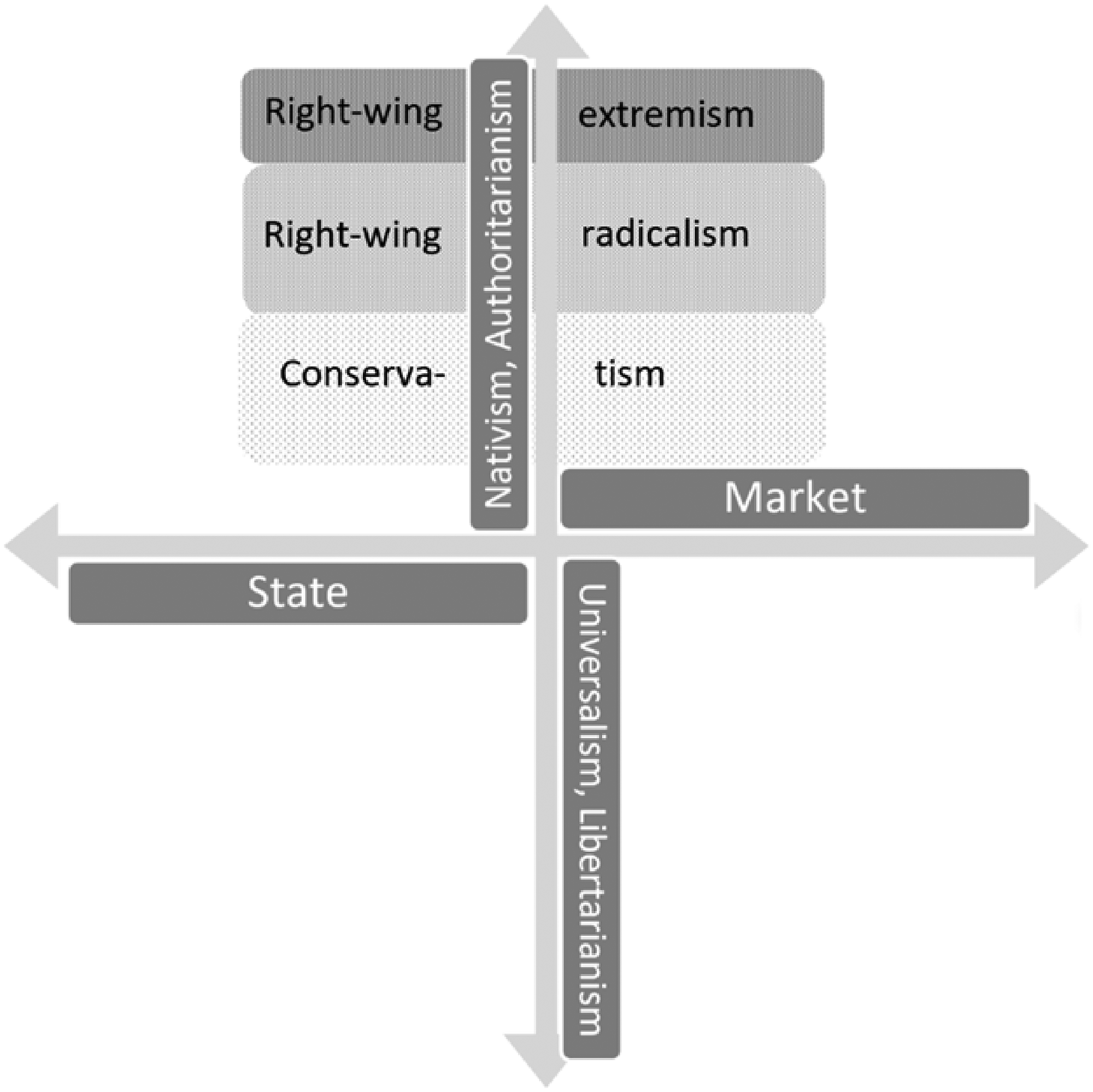
Right-wing positions within the two-dimensional cleavage space.
Right-wing radicalism, however, is not necessarily at the same time populist. There are also elitist nationalists, who eventually occupy a right-wing radical position, without falling into the category of populism. In fact, populism is not bound to a political ideology and, therefore, cannot be pinned down to a specific position within the cleavage space. As Mudde (2004) or Stanley (2008) note, populism is ideologically “thin centered” and can attach itself to different host ideologies, which means that any ideological position within the cleavage space can be expressed in a populist as well as in non-populist mode. Admittedly, radical positions are more likely to come along with populism, but there are also centrist varieties of populism, as Heinisch and Saxonberg (2017) show. According to Mudde (2004, 2007), the definitional core of populism is constituted by the notion of an antagonism between two homogeneous and antagonistic groups, “the pure people” versus “the corrupt elite.” The exaltation of the pure people entails an identitary, Rouseauian view of democracy and the idea of a “general will,” represented by the populist party or leader. Beyond that “thin centered” ideological core, populism is highly versatile in ideological terms, even within individual cases. Especially in Latin America, an impressively broad range of populist varieties can be observed, including military populists like Juan Velasco Alvarado in Peru, radical left-wing populists like Hugo Chávez in Venezuela, neoliberal populists like Carlos Menem in Argentina, or ethnic populists like Evo Morales in Bolivia (Conniff, 2012; Hawkins and Rovira Kaltwasser, 2017). Yet, radical right-wing populism has so far been absent from Latin America, supposedly because of its limited popular appeal and the fact that party competition was defined mainly by the economic cleavage (Roberts, 2014; Zanotti and Roberts, 2021). Recently, however, this variety seems to have found its way to Latin America, too.
Populism, therefore, is not bound to a specific position within the cleavage space, but it rather constitutes its own dimension, which has to be assessed separately, according to Mudde’s definition of populism as a thin-centered ideology based on the antagonism elite vs. the people. 3 For assessing the degree of populism in the four cases under consideration, the presence and quality of corresponding motifs—references to the morally pure people, the vilified elite, and the idea of popular sovereignty embodied by the populist leader—have to be examined. Depending on the context and the kind of populism, the concrete content and interpretation of these motifs can vary. For example, the category “elite” is filled by classical and leftist populists with the notion of a treacherous elite, aloof toward ordinary people, and making common cause with foreign “imperialist” powers (see e.g. Hawkins, 2010). Neoliberal populists, by contrast, accuse a rent-seeking elite within the bureaucracy, the parties and public enterprises of having colonized the state at the expense of the poor (e.g. Rochabrun, 1996). Radical right populists, in turn, denounce an alleged hegemony of left parties, academic elites and a left-leaning media establishment. Thus, although the basic category of a “self-serving elite” is observable in all cases, there is a considerable variation in its concrete expression, which needs to be factored in when assessing cases of RWP in Latin America.
Recent Cases of RWP in Latin America
RWP is not a new phenomenon in Latin America. Earlier examples include former Colombian president Álvaro Uribe, Guatemala’s Otto Perez Molina, or Peru’s Alberto Fujimori (Doyle, 2011; Gamboa Gutiérrez, 2019; Levitsky and Loxton, 2012). So far, however, RWP appeared either in an authoritarian, a punitive, or a neoliberal variety (see e.g. Bonner, 2019; Roberts, 1995). According to Giordano (2014), right-wing populist’s main claim was to pursue a “post-ideological” agenda and to address the “real problems” of citizens, especially the problem of public insecurity. They promised a determined crack-down on criminals and corrupts, often in defiance of legal provisions and with the help of the military. In periods of economic crisis, the fight against inflation was another hallmark of right-wing populist appeals. Yet, nativism, the core feature of RRP, was largely missing in earlier cases of RWP in Latin America.
Lately, however, a new breed of right-wing populists has emerged which seems to be closer to its European and North American counterparts, especially Jair Bolsonaro and José Antonio Kast. The latter has recently become the new star of the Latin American right. Kast stems from a conservative family of German descent that was close to the military dictatorship of Augusto Pinochet and he was a long-time member of parliament for the conservative Union Demócrata Independiente (UDI). In 2016, he left the UDI to run as an independent candidate for the presidential election in 2017 on a far-right platform. He surprisingly won almost 8 percent of the votes. Building on this modest success, Kast founded a conservative movement and turned it into a party, the Partido Republicano (PR), in 2020. In the following year’s presidential election, he tried again and, after a steep rise in popularity, he came out top in the first round in November. In the runoff three weeks later against the leftist candidate Gabriel Boric, he failed by a considerable margin, but still reached 44 percent of the votes. This surprising success can be regarded as a backlash against the leftist Zeitgeist in Chile and as a reaction to conservative moderation in the years before 2017 (Madariaga and Rovira Kaltwasser, 2020; Rovira Kaltwasser, 2020). In 2021, he benefitted from increasing popular exasperation in the face of student protests, continuing riots and concerns about far reaching reforms planned by a Constitutional Assembly dominated by the left (see e.g. The Economist, 2021).
Kast is a good example of the new, nationalist, populist right in Latin America, as a journalist from the America’s Quarterly observed (Funk, 2021). His program featured typical right-wing elements: economic freedom, law and order, tradition, morality, and a valuation of the classical family. It included cutting taxes, abolishing abortion, and reinforcing the police (Mohor, 2020). His mano dura-credentials became evident during a protest wave in 2019, when he criminalized the protest movement and called for a strict crackdown by the police forces (Campos, 2021). Like Bolsonaro, he blamed immigrants for increasing insecurity and called for allowing civilians to carry arms to defend themselves. Similar to Donald Trump, whom he admired, Kast suggested building a “physical barrier” at the border with Peru and Bolivia. There is also a strong militarist component in Kast’s discourse, which vindicates the military dictatorship of Augusto Pinochet (1973–1990) as “beneficial for Chile’s development” (Montes, 2017).
Yet, Kast is also a product of the specific historical and political context in Chile. As Madariaga and Rovira Kaltwasser (2020) observe, the Chilean political system underwent a far-reaching transformation in recent years. The bipolar pattern of competition between the two party blocks on the left and on the right, economic liberalism and the informal arrangements that had shaped the country during the 30 years since re-democratization have come to be regarded as outdated and unrepresentative. The protest movement of 2019 was a consequence of the perceived exhaustion of the transición pactada. As a concession to the protesters, President Sebastián Piñera agreed to draft a new constitution to renew the democratic consensus and to recast the political system—a decision fiercely criticized by Kast. Although his PR participated in the election to the Constitutional Convention as part of the conservative block, Kast despised the protest movement and opposed the constitutional process. Instead, he defended the liberal and conservative order that had prevailed in Chile in the decades after the end of the dictatorship and that still seems to be strongly rooted in the Chilean electorate.
A similar resurgence of the past happened in Brazil with the election of Jair Bolsonaro, who represents the most notorious case of the new RWP in Latin America. During the presidential campaign of 2018, Bolsonaro stressed religious values, attacked the “corrupt establishment,” announced his goal to liberalize gun laws and justified police violence against supposed criminals. His discourse also featured homophobic and racist elements, especially when referring to Brazil’s indigenous communities. Bolsonaro emphasized his (modest) military career and, when in office, filled many of his cabinet posts with active or retired military officers. This militaristic attitude not only served to underscore his resolve in fighting crime, but also his sympathies with the military dictatorship from 1964 through 1985. Economically, he took a liberal stance with the appointment of Paulo Guedes, a renowned liberal economist, as minister of the economy. Yet, when it turned out during the Covid-19 crisis that increases in social assistance translate into public approval, Bolsonaro proved willing to put economic orthodoxy aside (Bennech et al., 2021). Thus, cultural issues and the transformation cleavage clearly dominated Bolsonaro’s discourse and his political agenda, which earned him the attribute “radical right-wing populist” (Zanotti and Roberts, 2021).
Nonetheless, Bolsonaro is as much a symptom of a broader trend as he is a consequence of recent Brazilian history. His rise to the presidency was the outcome of what Hunter and Power (2019) described as a perfect storm: “an economic crisis caused by a prolonged recession, a political crisis of rising polarization and falling trust in established parties, a corruption crisis brought to the fore by the Lava Jato investigation, and the deterioration of an already dismal public-security environment” (71). As in the case of José Antonio Kast, Bolsonaro’s election was a backlash against the left, and specifically against the Workers’ Party (PT), that had ruled the country between 2003 and 2016. Anti-PT sentiment had already grown before, in the wake of a corruption scandal in 2005 and a protest movement in 2013. With the Lava Jato scandal of 2014 and the impeachment of President Dilma Rousseff in 2016, the climate of confrontation and hostility toward the PT increased further. Bolsonaro drew on this antipathy to foster the notion of a communist threat and to present himself as the saviour of religious and traditional Brazilian values. In essence, his promise was to turn back the clock and to undo 13 years of PT government.
The pattern of a right-wing reaction against leftist dominance can also be observed in the case of the Uruguayan party Cabildo Abierto (CA), founded in 2019, and its prominent leader Guido Manini Ríos, the former Chief Commander of the Uruguayan army, who had been removed from his position by the then president Tabaré Vásquez in March 2019. In the same year’s general elections—only seven months after its foundation—CA gained 11 percent of the votes and joined the center-right coalition of the newly elected president Luis Lacalle Pou. The context of the party’s rise was similar to Brazil’s insofar as CA benefitted from a growing anti-establishment sentiment and disillusionment with the left-wing Frente Amplio (FA), which had ruled the country during the preceding 15 years. Two years before, a corruption scandal involving the governing FA (although of much smaller scale than the Brazilian Lava Jato scandal) was discovered. In addition, the issue of public security became increasingly salient and the universalistic, post-materialist left was perceived as having lost touch with real world issues (Silva, 2019). The ruling FA, although still firmly institutionalized, seemed to be exhausted and many of its adherents, especially among the lower social strata, looked for resolute leadership in the face of economic stagnation and rising insecurity (Bottinelli, 2019). Thus, although the protest potential and the perception of crisis were not comparable to the situation in Brazil, there was a window of opportunity for right-wing populist mobilization in Uruguay.
In programmatic terms, Manini and CA are more difficult to pin down than Kast and Bolsonaro. On the one hand, there are programmatic elements from the right-wing menu observable in this case, too. Manini described the country’s state as “chaotic” and stressed the need for security and public order, whereby his military background evoked the image of strong-man leadership. He pointed to Hungary and Poland as examples of successful family policies, criticized the so-called “rights agenda” of the left and raised suspicions about the influence of international networks like the Soros Foundation. Yet, there are no racist elements and with regard to the transformation cleavage, he recognized the crimes committed under the military dictatorship (although with some reservations) (Martínez, 2021). Moreover, there are ideational elements, which are rather atypical of RWP. Manini and CA describe their program as “artiguista,” referring to the Uruguayan hero of independence, José Gervasio Artigas (Moreno Barreneche, 2021). According to Manini, Artiguismo conveys a concern for the common people and the notion of strong, natural leadership, in line with the Latin American tradition of Caudillismo. In this regard, there are notable parallels to the Venezuelan left-wing populist Hugo Chávez, who used Simón Bolívar as a source of legitimization. As antidotes to external influence and cultural alienation this kind of historical reference serves for defining the in-group of the “real” or “original” people in opposition against an external threat. Like Chávez, Manini emphasized his country’s independence, criticized “imperialist” interference and stressed his preoccupation with the socially excluded (Lauro and García, 2020). Insofar, his economic program is leftist rather than neoliberal, which sets him apart from Kast and Bolsonaro. As a consequence of this ideological ambiguity, CA has not only been attacked from the left, but also from the right. According to Manini, a considerable number of former FA-adherents has joined the party. Still, as a member of the ruling conservative coalition, CA defines itself clearly as right-wing.
Finally, the most recent case of RWP can be found in Argentina with Javier Milei, who was elected to Congress in November 2021 as an outsider candidate with a radical libertarian program. Milei is an economist with a strong affection for the Austrian school of economics. In 2020, he joined a recently founded libertarian movement, which in 2021 formed an electoral coalition with minor conservative and libertarian parties, after talks with the major opposition parties about a broad electoral front had failed. To run for congress, Milei registered his candidacy for an electoral alliance in the city of Buenos Aires—La Libertad Avanza—and gained 13.6 percent of the city’s votes in the open primary elections in September 2021. In the general elections in November, his alliance gained 17 percent of the votes in the city of Buenos Aires or 1.5 percent on the national level, which translated into two seats in the Chamber of Deputies and turned Milei into a main figure in national politics (Infobae, 2021; Paladini, 2021).
Although Milei is frequently classified as far right and portrayed as a kind of “Argentine Bolsonaro” (Chrispim, 2021), he represents an ambiguous case with regard to his programmatic position. On the one hand, there is plenty of evidence of his radical right-wing inclinations. He shows strong sympathies for other right-wing populists in the region, and he practices the kind of anti-politics typical of populists like Donald Trump or Jair Bolsonaro. The latter’s son personally supported Milei’s electoral campaign. Also, some of his positions like the rejection of abortions, his pro-gun views, and the demonization of “big government” conform to the radical right agenda. On the other hand, however, some of his positions like his support for drug legalization or his liberal views on issues of family, sexuality, and marriage are hardly indicative of right-wing radicalism. For example, he regards marriage not as an institution, but as a contract, and as such, as a matter of free choice. Milei considers himself religious, but he takes a critical stance vis-à-vis the church as an institution. With view on drug use, he asserted that anyone should be free to damage his or her own health, but should not expect others to pay the bill (Barcia, 2021; El Cronista, 2021). Unlike other right-wing populists in the region, he does not vindicate the military dictatorship, but rather the period of neoliberal reforms under President Carlos Menem during the 1990s. Generally, he puts great emphasis on the issue of economic freedom and private property. On the economic cleavage axis, he is positioned closer to the pole of radical market liberalism than is usually expected of radical right populists.
Thus, while there is clearly some family resemblance between the four right-wing populists under consideration, there are also significant differences, which raises the question whether the label RRP is justified in all cases and whether there are sufficient communalities between them to speak of a right-wing populist wave. In the following section, the four cases will be discussed and categorized with reference to the criteria of right-wing radicalism and populism outlined in the section What does radical right-wing populism mean in the Latin American Context?.
Right-Wing Populist, Yes, but How Right-Wing and How Populist?
From the preceding overview it becomes clear that all four cases are located on the right side of the political spectrum and that they all show to some degree populist elements. Still, this does not mean that they can all be classified as instances of RRP. To clarify their correspondence with the typological characteristics of RRP, two aspects need to be addressed more systematically: first, their position on the cultural cleavage axis, and second, their degree of populism.
With regard to the right-wing dimension, there is considerable variation between the four cases, with Bolsonaro being apparently the most radical one. Bolsonaro not only maintained strong ties to the military, but on several occasions he also threatened to close the Congress and the Supreme Court and declared that he would leave power only when dead, which even puts him close to the category of right-wing extremism (BBC, 2021; Hunter and Vega, 2021; Stuenkel, 2021). The second criterion of right-wing radicalism, nativism, is also clearly met, given Bolsonaro’s offenses against the indigenous population. The picture is completed by a series of racist, homophobic and misogynist remarks. In addition, Bolsonaro strongly emphasized morality and religious principles to mobilize the important evangelical vote, which may be regarded as a Latin American specificity of right-wing radicalism. 4
On the dimension of populism, Bolsonaro is clearly positioned within the range of RRP, too (see Table 1). The antagonism between “the pure people” versus “the corrupt elite” is evident in Bolsonaro’s discourse, although in a typical right-wing interpretation, reflecting the ideology of producerism. This ideology rests on the opposition between an unproductive, parasitic, “verbalist” elite on the one side and the category of tax paying, productive, ordinary people, on the other. It is rooted in 19th century US-American populism and it is still a cornerstone of conservative ideology in the United States (Berlet and Lyons, 2000). In Bolsonaro’s case, the “elite” is defined as the left-wing, mostly academic establishment, epitomized by the PT, while “the people,” according to a campaign speech from 2018, are conceived as “good citizens, workers, conservatives, Christians that preserve family values” (Tamaki and Fuks, 2020: 114). Although Bolsonaro has served for many years as a member of Congress, he fashioned himself as an outsider and claimed to defend these decent people against “gender ideology” and the “political correctness” of the left elite. Thus, there is little doubt that Bolsonaro fits the definition of RRP as proposed by Mudde.
Location of the four cases on the right-wing dimension and on the populism dimension of RRP.
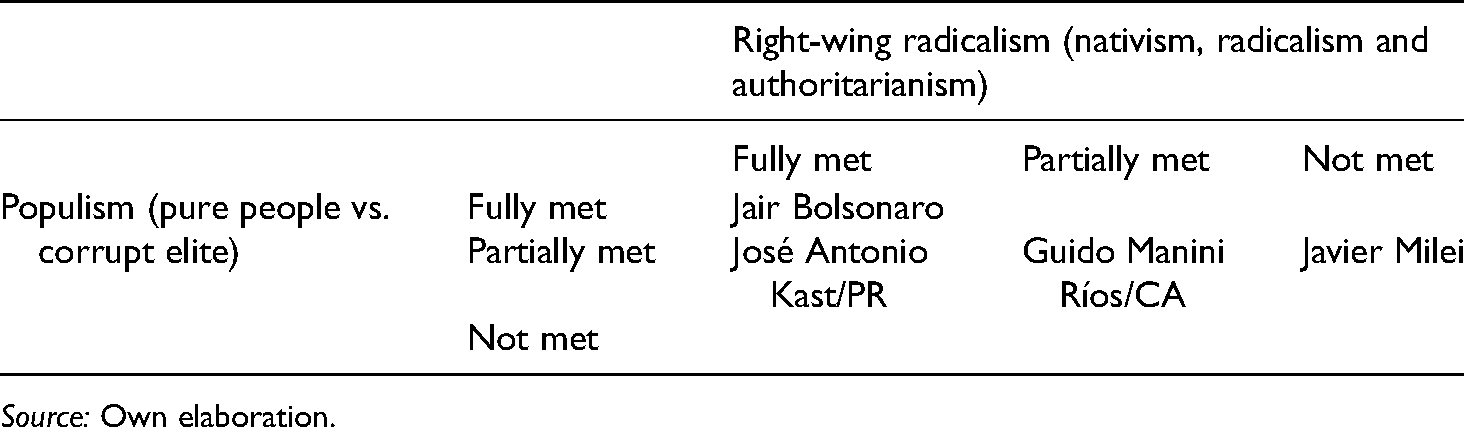
Source: Own elaboration.
This is also the case with Kast in Chile, at least in the right-wing dimension. Kast’s positions mirror a worldview based on the notion of natural order: defence of “family values,” public order, military strength, nationalism, and traditionalism. Religion is essential for Kast, who opposes abortion and same-sex marriage. Although there are no signs of open racism, as in Bolsonaro’s case, Kast’s posture toward immigrants and indigenous people is regarded by Campos (2021) as indicative of nativist and authoritarian inclinations. The idea of a homogeneous people is implicitly recognizable in these positions. With view on street protests and the rebellious Mapuche in the country’s South, he spoke of “terrorism” and called for military intervention (Barría, 2021; Jara, 2017), which reveals his authoritarian attitudes as well as a nativist bent. Further confirmatory observations include his call for expanded competences of the executive and for a permanent installation of the National Security Council to fight “terrorism.” However, despite his authoritarian rhetoric and his sympathies for the Pinochet dictatorship, Kast has not crossed the line from radicalism to extremism. His commitment to democratic principles is sufficiently credible and his party has adopted a somewhat less radical profile when its most extremist members changed over to the newly founded right-wing extremist party Fuerza Nacional (Bruna and Cossio, 2021). Thus, Kast and his party can be clearly categorized as radical right.
In the populism dimension, however, his position is less clearly located within the area of RRP. On the one hand, Campos (2021) sees sufficient evidence for classifying him as populist. She points to Kast’s use of common sense arguments and his claims about representing the “real problems” of the people. Kast also tried to mobilize the protest vote through provocative messages and he presents himself as political outsider who represents the true voice of the people. On the other hand, however, this is still insufficient to meet Mudde’s narrower definition of populism. Kast’s attacks on the left may be regarded as anti-elitism, but also as normal campaign discourse. At the same time, his references to a morally pure people are mostly implicit. Moreover, his ideology is not “thin-centered,” but quite elaborate and rooted in the Chilean conservative tradition of Chicago-gremialismo—a synthesis of neoliberalism and corporatism stemming from UDI-founder Jaime Guzmán (Campos, 2021; Huneeus, 2000). In the dimension of populism, therefore, Kast scores moderately and meets the criteria of RRP only partially (see Table 1).
Similar reservations are in place in the third case, Guido Manini Ríos and the party CA in Uruguay. Although, according to Luna and Rovira Kaltwasser (2021), CA belongs to the same category of moral conservatism as Kast’s Partido Republicano, its ideological position is not as clearly located within the range of RRP. Manini refers to the somewhat diffuse concept of Artiguismo, which is usually not associated with the right, but rather with classical liberalism. Yet, in Manini’s interpretation, the emphasis is on traditional morality and on the country’s foundational myth (Lauro and García, 2020; Moreno Barreneche, 2021). Thus, Artiguismo may be understood as an ideology of natural order. In other respects, Manini’s positions more clearly reflect a right-wing orientation. During the 2019 electoral campaign, he criticized social assistance benefits for immigrants, promised to take measures against illegal immigration and to restore public order (El Observador, 2019a, 2019b). In the same vein, he opposed drug legalization and liberal abortion laws (El Observador, 2019c, 2021). Regarding the criterion of authoritarianism, Manini’s military background, his objective to strengthen the armed forces and the strong presence of military personnel within CA may be considered as confirmatory evidence. Yet, it remains up to debate if these features add up to right-wing radicalism. After all, openly racist remarks are not observable and with view on the dictatorial past, Manini shows at least some eagerness to take a balanced position. 5 At the same time, his anti-pluralistic conception of politics and his invocation of a crisis that can only be averted by a great turnaround keeps him from falling into the category of conservatism (El País, 2019). In all, this case may be regarded as right-wing radical, but to a significantly lower degree than the preceding two cases, which means that Manini and CA are categorized as partially meeting the criteria of right-wing radicalism.
On the populism dimension, the picture is equally mixed. On the one hand, Manini and other CA leaders nurtured the image of outsiders breaking up the cartel of established parties and pretended to bring the country back to its proper track. They upheld the principle of national sovereignty and denounced the country’s sell out by an alleged “Soros-left” (Demaría, 2021). There is also a strong focus on the fight against corruption, which is mentioned as one of the principal objectives in the party program (Cabildo Abierto, 2020). On the other hand, however, the antagonism between a corrupt elite and a morally pure people is only weakly observable in that case, at best After the 2019 election, CA willingly joined the center-right government of President Lacalle Pou, thus becoming itself part of the political establishment. Insofar, Manini and CA are located on the lower end of the populism dimension, but still within the category of RRP.
Finally, there is the case of Javier Milei, which is the most difficult to fit into the category of RRP. As seen above, some of Milei’s positions, for example with regard to abortion or gun laws, are consistent with RRP. Yet, these positions are derived from a radical libertarian ideology. His opposition to abortion, for example, is justified by reference to John Locke’s principle of the right to life, liberty, and property, not in the radical right vein by the concept of natural or divine order (A24.com, 2021). Libertarianism is different from right-wing radicalism. Although there are some overlaps, as the conservative movement in the United States shows, there are also significant frictions between these currents, especially with regard to ‘moral issues’ such as marriage and homosexuality. Ideological overlaps exist on the surface of policy preferences in some areas, but they fundamentally diverge on the deeper levels of ideological core convictions. Libertarianism is characterized by its skepticism toward any kind of authority. Libertarians do not just criticize the welfare state and economic interventionism, as right-wing radicals do, but they also reject the state as such, in accordance with Hayek’s conception of radical individualism. Accordingly, the criterion of authoritarianism does not apply to Javier Milei and the libertarian movement in Argentina. Therefore, this case is located outside the category of RRP on the cultural cleavage dimension.
With view on populism, this case is ambivalent. At first sight, hardly anyone would deny Milei’s populist characteristics. He appears as the classical outsider, fiercely attacking established politicians as a “caste” and denouncing the current president as “tyrant” (Centenera, 2021; Niebieskikwiat, 2021). In his writings, a producerist ideology becomes plainly apparent: “What one has to understand is that the true cleavage is between those who work in the creation of riches, on the one hand, and, on the other hand, the parasites from the political class, which by force appropriate for themselves what is not their fair share” (Milei, 2017; Milei and Giacomini, 2019). Therefore, the Leitmotiv of a corrupt, parasitic elite is clearly observable. Yet, its counterpart, the notion of a morally pure people, is lacking. Consistent with his anti-collectivist world view, Milei takes a strictly individualistic position, which is hardly compatible with the notion of a homogeneous people. He is critical about the idea of majority rule and speaks of liberating the “lion” in each citizen instead of the “collectivist lamb.” The populist idea of an identitary relationship between a charismatic leader and a mass of followers is entirely alien to his thinking. 6 Thus, Mudde’s definition of populism is only partially met in this case, too.
Table 1 shows the categorization of the four cases with regard to right-wing radicalism and populism. The four cells at the top and left part of the table mark the definitional boundaries of RRP and include cases that fully or partially meet the criteria of radicalism, nativism, authoritarianism, and populism. Although there is some degree of variation between the three cases that fall into this category, the family resemblance is strong enough to categorize them as radical right-wing populist. One case, Javier Milei, is located outside the boundaries of this category, although he shares some ideological affinity with the other cases. In all, considering these results, Zanotti and Roberts (2021) are right in stating that the recent wave of populism in Latin America is “ideologically characterized by radical right-wing populism, similar to the majority of populist parties in Western Europe” (25).
Conclusion
Do recent cases of RWP in Latin America fall into the category of RRP, as some observers maintain? Has the global wave of RRP, therefore, reached Latin America? To answer these questions, the concept of RRP was disaggregated into its component parts and brought into accordance with the Latin American context. The criteria of authoritarianism and nativism were adapted to accommodate regional specificities such as militarism and the transformation cleavage. The more inclusive concept of natural order proved suitable for identifying functional equivalents of nativism and ethnopluralism. It allowed integrating a broader variety of ideological elements of right-wing radicalism such as traditional ethical and religious values or references to national mythologies like Artiguismo. Populism was treated as a separate dimension and defined, in line with Mudde, as a “thin centered ideology” based on the antagonism between a morally pure people and a corrupt elite. Its Latin American manifestations turned out to be similar to European RWP, but with stronger elements of producerism, which is also a typical feature of RWP in the United States.
Taking regional specificities into consideration and adapting the definitional criteria correspondingly, the concept of RRP could be fruitfully applied beyond its original European context. Regarding the populism dimension, all four recent cases of RWP met the definitional criteria at least partially. With regard to the right-wing dimension of RRP, three out of four cases were classified as partially or fully right-wing radical. Insofar, it is with some reservations justified to speak of a wave of RRP in Latin America. Javier Milei does not fit this category as his libertarian positions lack sufficient resemblance to right-wing radicalism. Still, as the North American Tea Party movement shows, libertarians often act as strategic allies of right-wing radicals. Thus, Milei can be regarded also as part of the recent wave of RRP in Latin America.
Does this mean that there is indeed a kind of contagion going on that has finally affected Latin America? Should we, therefore, expect RRP in the region to become a “pathological normalcy” as in Europe (Mudde, 2010)? Although it is still too early to tell, there are regional specificities that speak against such an assumption. Unlike Europe, the recent cases of RWP in Latin America were not to the same degree as in Europe and North America a consequence of a long-term value change in the course of structural shifts and social movement mobilization, but rather a reaction to leftist dominance since the year 2000. This leftist domination itself was a result of exceptional economic conditions during the first decade of the new millennium. If RRP in Latin America is not so much the result of long-term structural shifts as of recent political and economic trends, it may turn out to be a conjunctural phenomenon, just like earlier populist waves in the region.
Footnotes
Declaration of Conflicting Interests
The author(s) declared no potential conflicts of interest with respect to the research, authorship, and/or publication of this article.
Funding
The author(s) received no financial support for the research, authorship, and/or publication of this article.