




Abstract
The conventional wisdom holds that party leaders punish women legislators who advocate for gender equality. We test this assumption using the Argentine case, asking two questions. First, who counts as a feminist legislator and how do we know? Second, do feminist legislators have career trajectories that indicate marginalisation or penalisation? We use bill authorship data and expert surveys to identify legislators of both sexes who champion feminist causes and who adopt a gendered, though not necessarily feminist, perspective. Comparing these categories of legislators to those in the general population, we find no meaningful differences in political careers by either legislators’ gender or policy profile. In fact, many feminist champions hold prestigious positions while in congress, but this political capital results neither in punishment nor reward after congress. Women who represent women do not go on to the top posts after congress, but neither do they disappear from public life.
Women’s presence in the lower or unicameral chambers of Latin America’s legislatures increased from 9 per cent in 1990 to just under 30 per cent in 2019. 1 Women’s presence has transformed politics and policy in the region, with women lawmakers introducing and winning policies that expand women’s rights (Barnes, 2012, 2016; Franceschet and Piscopo, 2008; Htun et al., 2013; Miguel, 2012; Piscopo, 2014a; Schwindt-Bayer, 2010). At the same time, women lawmakers report that representing women carries a price. In the words of an Argentine deputy who supported gender equality policies, “Taking the feminist flag creates costs within the party […] women with feminist commitments are dangerous for the party.” 2 Her colleague, a prominent feminist lawyer, suggested that women politicians wishing to advocate for women’s rights “face two options: to break with party structures or to stay with the party, but without a gender commitment.” 3 The presumption that women legislators committed to gender equality will be stigmatised as feminists and punished by party leaders appears across Latin America and the globe, because many feminist platforms challenge entrenched religious or class interests (Htun and Weldon, 2010). Even left parties do not consistently support women’s rights: left presidents predominated in Latin America between 1999 and 2016, but many of these pink tide governments resisted and even rolled back gender equality policies (Blofield et al., 2017).
Despite the qualitative and circumstantial evidence that political parties marginalise or punish feminist lawmakers, no studies have explored whether feminist legislators in fact follow career paths that differ from those of the typical politician. Most evidence for feminist legislators’ stigmatisation comes from interviews with current or former lawmakers, especially but not exclusively from interviews with women in Latin America (Franceschet and Piscopo, 2008; Kantola and Rolandsen Agustín, 2019; Marx et al., 2007; Rincker, 2009). Alternatively, most studies of women politicians’ careers assess their paths to the legislature, but without distinguishing between women with and without feminist profiles (Beer and Ai Camp, 2016; Franceschet and Piscopo, 2014; Murray, 2012; O’Brien, 2012; Saint-Germain, 1993; Schwindt-Bayer, 2011). This article links these two research agendas, asking two questions. First, who counts as a feminist legislator and how do we know? Second, do feminist legislators have professional trajectories – operationalised as their posts before, during, and after congress – that indicate stigmatisation?
Argentina was the first country in the modern era to adopt gender quotas for legislative candidates, passing a 30 per cent quota law in 1991. For this reason, Argentina has informed pathbreaking studies of women’s legislative representation (Barnes, 2012, 2016; Franceschet and Piscopo, 2008; Htun et al., 2013; Jones, 1997; Marx et al., 2007, Schwindt-Bayer, 2010). We extend this research, comparing the policy focuses and political careers of Argentine men and women elected during the pink tide. Our data cover four cohorts of lower house deputies: those serving the electoral periods of 2001 to 2005, 2003 to 2007, 2005 to 2009, and 2007 to 2011.
We combine bill introduction data with expert survey ratings to identify a group of “women-focused legislators.” We define “women-focused legislators” as those who push initiatives that would expand the legal protections or social benefits available to women constituents. Yet not all issues benefiting from women pose the same threat to the status quo and not all women are feminists (Celis and Childs, 2014; Htun and Weldon, 2010). To generate better comparisons, we sort women-focused legislators into one of two categories: those who champion feminist causes nearly exclusively (defined as supporting policies that challenge doctrinal or religious values), and those who adopt a gendered, but not necessarily feminist, perspective (defined as supporting policies that benefit women constituents without challenging traditional values or roles). The methodology itself makes an important contribution to the study of women’s representation, offering more precise ways of disaggregating women’s issues and classifying the legislators who support them. Once the “feminist champions” are separated from the “gender supporters,” we draw on existing studies of typical career paths in Argentina (Franceschet and Piscopo, 2014; Jones et al., 2002; Micozzi, 2014a, 2014b; Schwindt-Bayer, 2011) to compare the professional trajectories of the men and women in each category to the “typical” men and women legislators.
Our women-focused group is small, which is itself a relevant finding. Of about 900 legislators seated between 2001 and 2011, only forty-six (5 per cent) spent an above-average amount of time writing bills that targeted women’s issues. Parties are not faced with large-scale feminist rebellions, which might diminish party leaders’ interest in policing this behaviour. Looking at women and men within our women-focused group, we do find sex differences in the types and prestige of posts held before, during, and after congress, but these differences mirror those found between women and men politicians in Argentina overall. Consequently, we find few career differences between legislators who advocate for women and those who do not. Looking at the women lawmakers only, we find that some feminist champions actually enjoy prestigious posts while in congress, suggesting that their prestige gives them the freedom to represent women. Yet while these women are not punished, neither are they rewarded. After congress, neither women feminist champions nor women gender supporters disappear from public life. Yet they also do not receive the most prized posts, no matter whether they held high-profile posts in Congress or not. Overall, we find that women-focused legislators of both genders, including feminist champions, enter and leave congress with respectable political resumes. Feminist legislators may report facing resistance, but such resistance does not damage their long-term careers.
Our work shows that party leaders do not marginalise or punish feminist lawmakers. True, our data cannot account for those legislators who support feminist policies but remain silent, meaning legislators who do not act on their preferences precisely because they fear the consequences. Reassuringly, however, we show that legislators can speak out, because neither feminist champions nor gender supporters have careers that differ much from those of a regular politician. As more women enter Latin America’s legislatures, they should feel emboldened to represent women and women’s concerns.
Representing Women – or not – in Latin America
Many empirical studies from Latin America conclude that women legislators advocate for women’s issues more than men legislators (Barnes, 2012, 2016; Franceschet and Piscopo, 2008; Htun et al., 2013; Miguel, 2012; Piscopo, 2014a; Schwindt-Bayer, 2010). These findings hold across varied conceptualisations of women’s interests, whether scholars define women’s interests narrowly, by looking just at measures that would upend traditional gender roles (e.g. abortion liberalisation) or broadly, by considering any measures related to domestic or social affairs (e.g. child welfare). Though most legislators push women’s rights in a progressive direction (Piscopo, 2014a), not all legislators who advocate for women are feminists. To acknowledge the heterogeneity among women and women’s issues, we follow Celis and Childs (2014) in distinguishing between feminist issues – those that challenge traditional roles – and gendered issues – those that invoke women’s interests or well-being without challenging traditional roles.
Feminist issues aim to challenge the patriarchal status quo whereas gendered issues do not, but both sets of issues are women-focused. Gender and politics scholars long have noted that women’s issues, broadly conceived, are devalued by male-dominated legislatures. Parliaments, parties, and policies privilege male norms and masculine interests (Lovenduski, 2005; Miller, 2018). Latin American legislatures follow this pattern (Barnes, 2016). Women remain excluded from parties’ leadership positions and power structures (Hinojosa, 2012; Wylie, 2018) and do not occupy the most prestigious legislative committees, which deal with the “hard” policies of finance, defence, and foreign affairs (Heath et al., 2005).
Legislators challenging men’s political dominance may face consequences. Female legislators confront generalised backlash as their numbers grow, with women’s bodies, voices, and styles facing hostility and contempt from men legislators (O’Brien and Piscopo, 2019). All women in parliament may endure systematic harassment simply for being women (Krook and Restrepo Sanín, 2016), but the costs may be especially high for women promoting feminist causes (Lovenduski, 2005). Conventional wisdom holds that political parties sideline or silence women expressing feminist ideas – particularly because these ideas demand a more equitable distribution of political, social, or economic power (Htun and Ossa, 2013; Rincker, 2009). A woman deputy in Uruguay who pushed for abortion decriminalisation found herself isolated, even though her party had no formal stance against liberalisation (Barnes, 2016: 197). Women deputies in Brazil who transcended the ritualised praising of women’s mothering roles and promoted abortion liberalisation were classified as misfits or deviants (Miguel, 2012). Even in the more egalitarian Scandinavian countries, women parliamentarians fear being denounced as “angry feminists” (Kantola and Rolandsen Agustín, 2019).
Such stigmatisation and marginalisation occur even though most Latin American countries have implemented gender quotas, which raise the proportion of women parliamentarians. On the one hand, quotas may generate mandates for women legislators to represent women, legitimising women legislators’ work on women’s issues. On the other hand, gender quotas may create perceptions that women are tokens, unqualified and undeserving of their posts, delegitimising women legislators’ presence and work (Franceschet and Piscopo, 2008; Krook and Childs, 2012). If the latter occurs, promoting gender issues becomes especially costly, as doing so reinforces perceptions about women as troublesome, threatening to the status quo, and unable to take up “serious” policy matters. Congresswomen in Latin America repeatedly stress the conflict between supporting their party and advocating for women (Barnes, 2016; Borner et al., 2009), bolstering notions that women legislators committed to representing women face a trade-off between their policy priorities and their political careers. Yet no scholars have used quantitative data to explore whether representing women has actual career consequences.
Any such assessment must first recognise that political careers are already gendered. The structural division of labour that assigns women greater domestic responsibilities means that women politicians have fewer children and are less likely to be married when compared to men (Black and Erickson, 2000; Franceschet and Piscopo, 2014; Marx et al., 2007; Saint-Germain, 1993). Women legislators often begin their careers in grass roots party or community organisations, and have backgrounds in education, public service, and the non-profit sector – while men have backgrounds in law and business (Black and Erickson, 2000; Franceschet and Piscopo, 2014; Marx et al., 2007; Saint-Germain, 1993; Schwindt-Bayer, 2011). To reach congress, women aspirants often need more lower-level political experience than men (Beer and Ai Camp, 2016): these earlier posts establish competence, but are not highly valued enough to place women inside parties’ elite inner circles (Franceschet and Piscopo, 2014; Murray, 2010; Verge, 2011). Once in congress, women remain excluded from the most prestigious positions, such as committee chairs (Barnes, 2016; Schwindt-Bayer, 2010). Differences may become less pronounced as gender quotas bring more women into legislatures (Barnes and Holman, 2018; Beer and Ai Camp, 2016), but no studies have examined whether legislators’ careers diverge based on the policy issues they represent. Do the careers of women who represent women conform to these already-gendered patterns, or do they diverge in significant ways?
Why Argentina?
Argentina is an ideal case for answering this question. The national quota law, adopted in 1991 and applied in 1993, significantly increased women’s numerical representation. As shown in Figure 1, women’s presence in the Chamber of Deputies climbed above 25 per cent in 1995, remained above 30 per cent from 2001 to 2005, and then rose above 40 per cent in 2017. Argentine women legislators advocate for gender equality more than male legislators, especially in the areas of violence against women, sexual and reproductive health, access to contraception and abortion, and the well-being of children and families (Barnes, 2016; Htun et al., 2013; Jones, 1997; Marx et al., 2007; Piscopo, 2014b; Schwindt-Bayer, 2010). For example, from 1989 to 2007, women legislators from parties across the ideological spectrum authored approximately three-quarters of women’s rights proposals, and the frequency of their efforts increased as the quota elected more women to congress (Franceschet and Piscopo, 2008: 410–412).
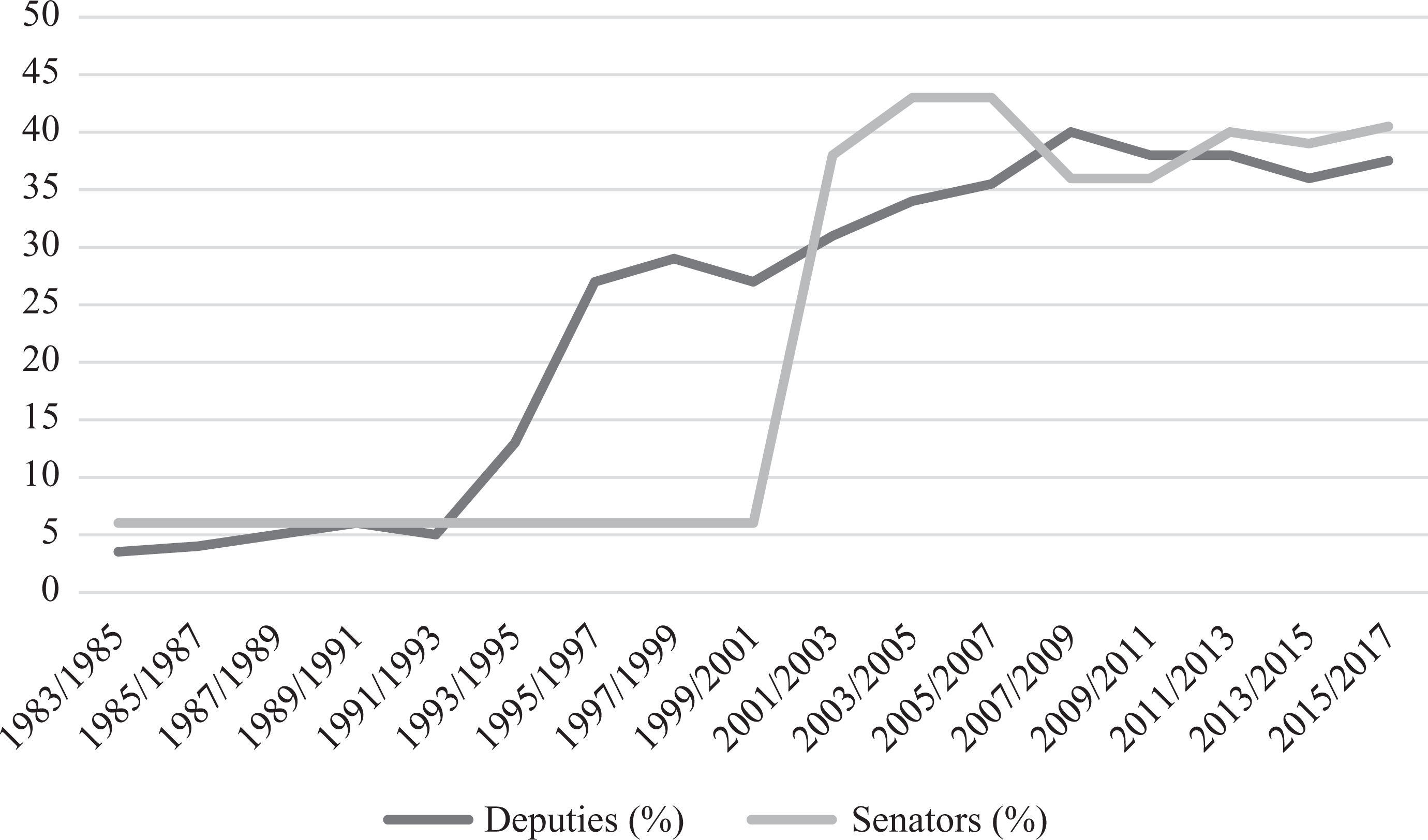
Women in the Argentine Congress (1983–2017).
Yet the Argentine Congress – like its counterparts in Latin America and beyond – remains functionally adapted to male norms. The introduction rate of women’s rights bills has increased, but approval rates have declined (Htun et al., 2013). Women deputies tell scholars that women and women’s interests are devalued (Franceschet and Piscopo, 2008; Marx et al., 2007). Nonetheless, women legislators in Argentina are professional politicians with similar levels of ambition as men (Schwindt-Bayer, 2011), in a context where parties are highly disciplined and party leaders exercise considerable control over lawmakers’ careers (Jones, 2008; Jones and Hwang, 2005; Jones et al., 2002). Given these trends, how does specialising in feminist or gendered interests affect legislators’ career paths? Do feminist legislators in particular have different and lesser career trajectories?
Answering this question requires two steps: knowing which career paths are valued in Argentina, and identifying legislators who represent women. To categorise high- and low-status career paths, we rely on the literature, validated by our expert survey. To identify women-focused legislators, we combine quantitative bill introduction data with experts’ qualitative assessments of legislators’ reputation. The next section establishes our expectations for the Argentine case and explains our method for identifying women-focused legislators. Because our expert survey informs both steps, we explain the survey methodology first.
Gendered Pathways to Power
Our expert survey was fielded in June 2016. We asked about legislators’ reputations for feminist or gendered advocacy and about political parties’ expectations regarding legislators’ career paths, party discipline, and behaviour. We hand-picked sixty-seven respondents: academics working at universities or think tanks, activists and leaders of civil society organisations, journalists, and former congressional staffers. The invitation told experts that the survey explored political careers, legislative activity, and gender, with no mention of feminist advocacy.
Thirty-two respondents completed the survey, for a response rate of 47.7 per cent. Our experts were predominantly women (72 per cent of respondents), Argentine citizens (97 per cent), employed by universities (70 per cent), holders of doctorate degrees (73 per cent), and focused on gender or women’s issues in their current activism or research (76 per cent). Our expert pool was therefore highly knowledgeable about gender politics in Argentina, making them more reliable than regular citizens. Also, given that expert respondents with close professional ties to the survey topic are often the most exacting when judging political actors on that topic (Maestas, 2016), we expect that our respondents were discerning when assessing legislators’ commitment to women’s issues. Indeed, we note that most experts were left-leaning: on a five-point ideological scale where one = most left, 70 per cent of respondents chose one or two and the remaining 30 per cent chose three.
Institutions and Career Paths
Argentina’s lower house is elected using closed-list proportional representation, with provincial-level lists. The 257-member chamber renews by halves every two years, with each deputy sitting for a four-year term. For the period of our study, 2005–2011, the 30 per cent quota required that one woman appear among every three candidates on the list, or one in every two candidates when parties or coalitions contest elections for the first time. This period also saw increasing fragmentation of the party system. The two parties that had dominated since the return to democracy in 1983 – the Partido Justicialista (PJ) and the Unión Cívica Radical (UCR) – fractured and new parties emerged. The number of party delegations in the Chamber of Deputies was twenty-nine in the 2005–2007 term, thirty-three in the 2007–2009 term, and thirty-five in the 2009–2011 term (Directorio Legislativo, 2012).
Argentina permits indefinite re-election to both legislative chambers, but the re-election rate is 17 per cent, the lowest in Latin America (Jones and Micozzi, 2011: 51). Turnover occurs not because voters wish to throw the rascals out, but because party leaders do not renominate most incumbents (Rossi and Tomassi, 2012: 4). Consequently, few legislators have seniority, and congress does not cap legislators’ political careers. Argentine politicians rotate among legislative and executive positions at the federal, provincial, and municipal levels. The most prized positions are provincial-level executive posts, which allow access to clientelistic resources (Franceschet and Piscopo, 2014; Jones and Micozzi, 2011; Jones et al., 2002; Lodola, 2009). In fact, politicians treat congress as a short-term stop on a path aimed towards executive posts (Lucardi and Micozzi, 2016; Micozzi, 2014b). Argentine lawmakers are thus amateur legislators but professional politicians (Jones et al., 2002).
Individual legislators thus depend on party leaders for their current and future appointments to other political and party offices (Alemán et al., 2009; Jones and Hwang, 2005; Jones et al., 2002; Lodola, 2009; Micozzi, 2014b). Party discipline is high, but adherence to the party line appears most important in roll-call votes (Alemán et al., 2009). Legislators use bill authorship and co-sponsorship activity to invest in careers outside the legislature, by writing bills that target pork to their home provinces, even crossing party lines to do so (Micozzi, 2014a,b). Generally, legislators are free to express their individual views – and build their current and future reputations – through bill authorship and co-sponsorship.
Our expert survey respondents validated these research findings. Only half believed that party leaders would punish deputies who presented bills outside the parties’ agenda or cosigned bills introduced by opposition party members. By contrast, 100 per cent agreed that party leaders would punish deputies for voting against the party in the plenary. Our experts believed that leaders would punish disloyal deputies by denying prestigious committee appointments (87 per cent), blocking re-election bids (83 per cent), and withholding valuable post-congress positions (80 per cent). Since bill introduction offers legislators’ greater initial freedom, we use bill authorship and not roll call voting to identify legislators advocating for feminist or gendered interests. We then track their careers by examining their access to leadership posts in congress as well as their re-election or ascension to valuable executive positions post-congress.
Gender and Political Careers
Importantly, trends in Argentine legislators’ political careers already vary by gender. Women are far less likely than men to arrive at congress having held prestigious executive posts (governors, mayors, or cabinet ministers) and are far more likely to have held legislative posts, typically at the provincial level (Borner et al., 2009; Franceschet and Piscopo, 2014). Provincial-level legislative quotas partly explain this pattern (Borner et al., 2009), as does parties’ preference to distribute higher-value executive positions to men rather than women (Franceschet and Piscopo, 2014). Yet gendered differences in types of posts do not mean differences in overall political experience, as women have as much previous political experience as men upon entering the Chamber of Deputies (Franceschet and Piscopo, 2014). Low re-election rates further mean both sexes are newcomers to congress, but not politics.
Women legislators in Argentina may adjust their career expectations to fit the gendered opportunity structure. For example, women and men are equally likely to seek re-election to the federal congress, but women are less likely to aspire to higher posts after congress (Schwindt-Bayer, 2011). For women, lacking progressive ambition may constitute a rational response to limited opportunity. Further, leadership opportunities in congress and executive opportunities after congress also vary by political party, as not all parties have such spoils to distribute. Women and men depend on party leaders’ favour for their future careers, but women’s position is especially precarious: already outside elite networks, they may not risk certain stances in the legislature. On a five-point scale where one = no punishment and five = definitely punishment, experts rated advocating for women’s equality a three and demanding abortion liberalisation a four. 4
In summary, legislators can express their preferences through bill introduction. Ambitious women legislators might eschew women’s issues in order to remain in party leaders’ good graces. Alternatively, women legislators may understand their second-class status, and may not see representing women as making this status any worse, especially with mandate effects at work. Therefore, we expect women legislators to be more likely than men legislators to initiate bills addressing feminist or gendered issues. However, we also expect that these women legislators, and especially those women legislators adopting a feminist lens, will occupy the most marginal and least prestigious posts before, during, and after their congressional tenure.
Identifying Feminist Legislators in Argentina
In Argentina beginning in 2015, movements demanding an end to gender-based violence (Ni Una Menos) and seeking liberalised abortion (Campaña Nacional por el Derecho al Aborto Legal, Seguro y Gratuito) gained public prominence and received congressional attention. We examine a period during which possibilities to promote gender equality were decidedly more mixed. Our data reflects congressional activity during the pink tide, the wave of left-wing governments that swept Latin America from 1999 to 2016. We examine the first and only presidential term of left-wing president Néstor Kirchner, from the Peronists’ Frente para la Victoria (2003–2007), and the first of two presidential terms of his wife and co-partisan, Cristina Fernández de Kirchner (2007–2011). The Kirchners pushed human rights and redistribution, and the Congress expanded access to contraception and penalised violence against women. Yet neither Kirchner adopted a gender equality plan in the executive branch; the national women’s agency lost status and funding (Rodríguez Gustá et al., 2017); and Fernández curtailed the health ministry’s programme to distribute contraceptives and tabled legislative measures that would decriminalise abortion (Pérez Betancur, 2019; Piscopo 2014b; Tabbush et al., 2016). These developments reflected the pink tide’s overall approach to women’s issues: left-wing governments promoted class equality while remaining neutral or hostile to dismantling patriarchy (Blofield et al., 2017). Indeed, experts named the Frente para la Victoria as among those parties likely to punish deputies for advocating for women’s equality broadly and abortion liberalisation specifically.
We focus on the legislator cohorts elected to serve the following terms: 2001–2005, 2003–2007, 2005–2009, and 2007–2011. These four-year electoral terms are distinct from the two-year congressional terms: congressional terms only represent one-half of legislators’ four-year electoral terms. The Argentine convention of expressing electoral terms in four-year increments obscures how deputies only sit for three years. Elections take place in October, but deputies do not sit until March (for instance, a deputy serving 2001–2005 was elected in October 2001, but not seated until March 2002). We draw our career pathway data from the Directorio Legislativo, a political yearbook published by an Argentine non-governmental organisation between 1999 and 2011. The Directorio Legislativo covers politicians’ pre-congress careers, as well as their leadership positions and committee assignments during the congress, and constitutes the standard source for studies of Argentine legislators’ career pathways (Barnes and Holman, 2018; Franceschet and Piscopo, 2014; Micozzi, 2014a, b). To identify women-focused legislators, we used a database generated by Piscopo (2011, 2014c), which covers all bills introduced in the Argentine Chamber of Deputies between 1999 and 2011. We isolated those bills introduced by legislators seated in our four electoral terms (about 15,000 bills). We then identified the bills focused on women, generated a list of authors, and asked experts to validate the list by qualitatively rating each author’s advocacy on women’s issues.
Generating a List
We first identified which bills addressed a feminist or gendered issue. To do so, we read the title and summary of every bill. Bill authors write the title and summaries themselves, and summaries contain strategic pitches about the bill’s aim. To make the first cut, the title or the summary had to include the word “women” or “girls.” To make the second cut, the title or summary had to mention the bill’s intention to improve women’s status or well-being, following Htun and Weldon (2010). However, following Piscopo (2014a), we excluded bills exclusively aiming to improve child welfare, unless the title or the summary explicitly linked helping children to helping women. For instance, this coding process included bills that gave cash assistance to mothers with handicapped children, but excluded measures to prosecute sex crimes affecting only children.
We then classified the bills as feminist or gendered. Feminist issues meant treating women as autonomous, rights-bearing subjects in three ways: (i) liberalising access to contraception or abortion, (ii) promoting equal rights generally (i.e. non-discrimination laws or gender quotas for the judiciary), and (iii) penalising violence against women or the sex trafficking of women. Gendered issues meant addressing non-doctrinal topics or treating women as relational subjects, in four ways: (i) addressing women’s health outside of reproduction (i.e. breast cancer and anorexia), (ii) expanding employment benefits, typically maternity leave, (iii) protecting women’s family roles (i.e. conditional cash transfers based on the number of children), and (iv) expanding the welfare benefits available to pregnant women and mothers. Importantly, legislators writing gendered bills may not be feminists. Bills written to expand prenatal healthcare may have anti-abortion motivations, for instance. Yet because such bills would still provide women with social assistance, we only excluded bills that explicitly stated their anti-abortion aims.
Our coding yielded 671 discrete women-focused initiatives, both feminist and gendered, introduced by 202 individual legislators, 103 men and 99 women. Consistent with Argentina’s low re-election rates, only ten of these legislators (two men and eight women) served more than once across the four terms. Counting each deputy per election term – which we do throughout this analysis – yields 213 legislators (105 men and 108 women). 5 Women-focused legislators comprise 22 per cent of the roughly 900 legislators who served between 2001 and 2011. Yet not all 213 legislators show equal amounts of attention to feminist or gendered issues. The vast majority of men legislators (65 per cent) entered because they introduced just one women-focused bill per electoral term. Women legislators averaged 4.1 feminist or gendered bills per term, whereas men legislators averaged 2.2 feminist or gendered bills per term.
Given the relative freedom Argentine legislators experience vis-à-vis bill introduction, one women-focused bill – whether feminist or gendered – seems unlikely to build a legislator’s reputation. Most legislators author between five and ten bills per year, with a modal value of six. 6 Since every four-year electoral term corresponds to three years seated in Congress, a typical lawmaker thus authors eighteen bills. Men and women Argentine legislators have similar rates of bill authorship but different emphases, with women dedicating more time to authoring bills on women (Franceschet and Piscopo, 2008; Htun et al., 2013; Marx et al., 2007; Schwindt-Bayer, 2010). Our data reflect this trend. Assuming a modal productivity for our women-focused legislators, a woman legislator who authors eighteen bills per electoral term, 4.1 of which are women-focused, dedicates about 20 per cent of her total bill authorship time to feminist or gendered issues. By contrast, the typical man legislator who authors eighteen bills, 2.2 of which are women-focused, dedicates 12 per cent of his total bill authorship time to feminist or gendered issues.
We propose that legislators who stand out for representing women – and thus those positioned to receive punishment, if it occurs – will be legislators whose women-focused activity is above the average. Said another way, we identified five women-focused (feminist or gendered) bills per electoral term as the minimum number needed to classify the legislator as actively promoting women’s issues. Imposing this minimum reduced our data set to forty-five legislators, thirty-three women and twelve men (Supplemental Material Appendix 1). Importantly these forty-five legislators are not necessarily typical: nearly all write more than the modal number of bills, with about half introducing as many as thirty or forty bills per year. For active lawmakers, representing women is just one of many priorities.
Sorting Feminist Champions from Gender Supporters
Our forty-five legislators collectively wrote 249 feminist initiatives, compared to 153 gendered initiatives. Nineteen of the forty-five legislators focused on feminist initiatives two-thirds or more of the time, and twenty-six focused on feminist initiatives more than 50 per cent of the time. 7 Overall, the division of attention varies widely, from legislators with three feminist bills and two gendered bills (lower end) to those with 20 feminist bills and three gendered bills (upper end).
Given that legislators author both feminist and gendered initiatives, quantitative data alone cannot sort the legislators into the categories of “feminist champions” or “gender supporters.” Bill introduction is not the sole method of feminist advocacy – nor may it draw party leaders’ attention on its own. We asked our experts to rate legislators’ advocacy on women’s issues, to identify which legislators had reputations for supporting feminist and gendered issues.
Experts rated legislators in two ways. First, to elicit respondents’ ratings without priming, we asked experts to name up to five legislators, men or women, serving in the Kirchner era whom they viewed as “promoting feminist demands.” For each named legislator, respondents were then shown the list of feminist and gendered issues (gender equality, contraception and abortion, violence against women, women’s health, maternal health, employment protection, and general well-being) and asked to rate the frequency for which the legislator “advocated for” each issue, using a four-point scale. We defined “advocate for” as “undertaking any of the following activities: presenting or cosigning bills, participating in public activities, speaking in the media, and debating and voting for bills in committees and in the chamber.”
Second, we asked experts to rate the legislators from our quantitative list according to whether they advocated for feminist areas (defined as “the autonomy of women, defying traditional gender roles”) or gendered areas (defined as “women’s well-being, without defying traditional gender roles”). Here, we asked about the categories of feminist and gendered rather than listing the specific issues because we did not expect experts would know the exact priorities of dozens of individual deputies. To further avoid respondent fatigue, we determined that legislators introducing ten or more feminist bills – double our minimum – were clearly feminist champions, and eliminated these names from the survey. Experts therefore rated thirty-four of our forty-five women-focused legislators.
Our survey responses provided important validation of our constructs of feminist and gendered issues. We first examined whom experts named in the open-ended question. Twenty-two different legislators were named (twenty women and two men), with an average of three or fewer mentions. 8 Seven legislators received an above-average number of mentions (four or higher), all of whom were women. When asked for which specific issues these seven legislators advocated, 100 per cent of respondents chose “a lot” or “sometimes” for the feminist issues, and “little” or “never” for the gendered issues. Experts thus named legislators for their feminist stances. Turning to experts’ ratings of legislators from our quantitative list, we find that legislators recognised by at least one-third of our respondents (ten legislators, all women) were associated with feminist advocacy (four legislators) or gendered advocacy (six legislators). Recall, however, that experts were not shown the names of the clear feminist champions emerging from the quantitative list.
Combining our two methodologies, we sort feminist champions from gender supporters by using the expert survey ratings to validate the quantitative list. We group as feminist champions those legislators introducing ten or more feminist bills; those receiving an above-average number of expert mentions in the open-response question; or those from the quantitative list whom one-third or more experts rated as undertaking feminist advocacy. Considerable overlap existed across these criteria. Legislators introducing ten or more feminist bills also received feminist ratings from our experts, for instance. Only four legislators – Fernanda Gil Lozano, Juliana Di Tullio, Vilma Ibarra, and Victoria Donda – were categorised as feminist champions based on expert ratings alone. 9 Of these, only Donda authored no women-focused bills. Donda’s inclusion raised our total number of women-focused legislators to forty-six, with fifteen categorised as feminist champions and thirty-one categorised as gender supporters, as shown in Table 1 (for full names and bill counts, see Supplemental Material). Importantly, our categorisations mean that gender supporters advocate for gendered issues more than they advocate for feminist issues – but not necessarily that gender supporters are antifeminist. Our gender supporters likely represent women from differing ideological perspectives.
Counts of Women-Focused Legislators by Category.
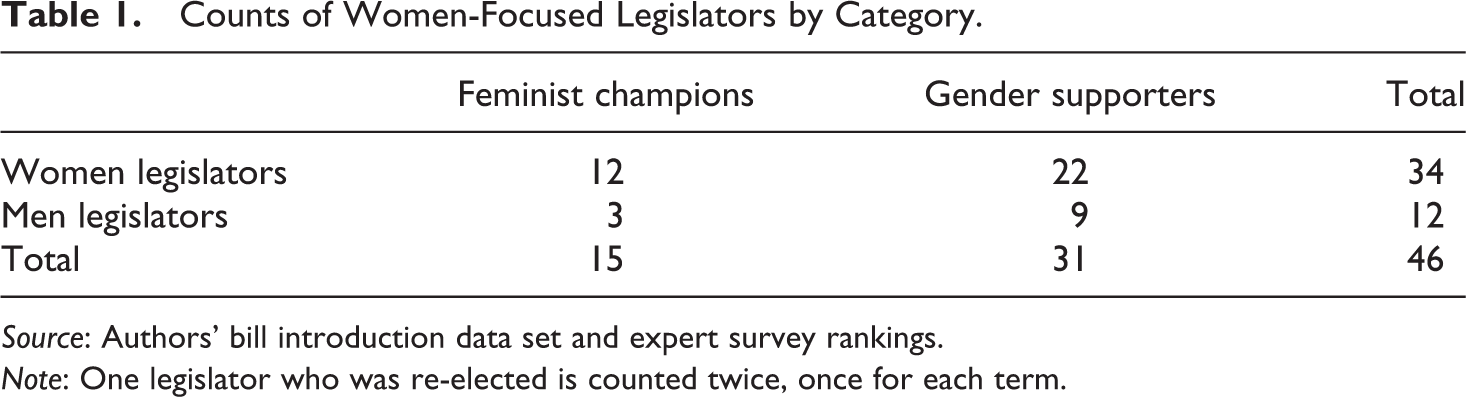
Source: Authors’ bill introduction data set and expert survey rankings.
Note: One legislator who was re-elected is counted twice, once for each term.
The Paucity of Feminist Legislators
The scarcity of feminist champions is itself an important finding. Across four legislative cohorts seated during ten years, only fifteen lawmakers take enough action on women’s rights to stand out as feminists. An overwhelming proportion of feminist champions are women: twelve of fifteen (80 per cent).
Feminist champions come from all major political parties, namely the Peronist parties (especially the Kirchners’ wing, Frente para la Victoria) and the UCR, as well smaller left parties such as ARI (which later joined the Civic Coalition), the Socialist Party, and Encuentro Popular. Feminist champions do not come from smaller right parties, though a few gender supporters belong to these parties, namely Renovador de Salta and Peronismo Federal. Peronist parties account for roughly half the legislators adopting a gender perspective, reflecting their usually left-leaning platforms and greater numbers in the chamber during this period.
The scarcity of feminist legislators, combined with the fact that women-focused legislators generally write more bills than their peers, dampens expectations about systematic differences in careers. True, feminist lawmakers will stand out, becoming more readily identifiable to party leaders. At the same time, these legislators are active on many issues, and there are not enough of them to reorient parties’ agendas and to destabilise the status quo. Party leaders likely have little incentive to treat feminist legislators differently. Moreover, feminist champions from left-leaning parties, especially those from the Socialist Party, ARI/Civic Coalition, and Encuentro Popular, do not contradict their parties’ ideological principles. Latin America’s left parties may not move aggressively on feminist interests (Blofield et al., 2017), but lukewarm enthusiasm does not necessarily translate into retribution. Having some party members active on feminist issues may even serve left-leaning parties’ interests: parties may deliberately outsource feminist issues to (a few) women, thus reaping the benefits of being seen to care, without actually changing policies. Though we cannot test this hypothesis directly, the scarcity of women-focused legislators, especially feminist champions, suggests that marginalisation may not be detectable in legislators’ careers.
The Career Paths of Women-Focused Legislators
We compare the career paths of our feminist champions and gender supporters, men and women, to the “typical” career paths for men and women legislators. For typical career paths, we use trends identified by Franceschet and Piscopo (2014) and Borner et al. (2009), focusing especially on Argentine politicians’ prioritisation of executive-branch posts both before and after the federal congress (Micozzi, 2014a; Jones et al., 2002).
Pathways to Congress
Our women-focused lawmakers – like most Argentine deputies – are professional politicians but amateur legislators. Both the women and the men held previous partisan or political posts. Some also had past experience in civil society organisations, but their party resumes are clear. Though congress is not prized among Argentina’s professional politicians (Lucardi and Micozzi, 2016; Micozzi, 2014b), differences in men’s and women’s pathways to the legislature still reflect the gendered opportunity structure. Women hold legislative posts more frequently than men (Franceschet and Piscopo, 2014), and this pattern repeats among our women-focused lawmakers, with more women than men arriving to the Chamber of Deputies from immediate prior service in either the federal or provincial legislatures. However, more women (fourteen) than men (six) also arrived with immediate prior service in either the federal or provincial executive, including more women (eight) who arrived having held executive posts that would have managed budgetary or clientelistic resources. This trend suggests that women may need political capital to make them attractive candidates, and that women coming directly from prestigious political positions may have the political capital available to invest in representing women.
Looking at the data proportionally, however, reveals that sex differences among women-focused legislators resemble sex differences among legislators as a whole. Between 1999 and 2009, only 33 per cent of women deputies arrived at the federal chamber having held a resource-rich post at any government level, compared to nearly 50 per cent of men deputies (Franceschet and Piscopo, 2014: 103). In our more limited data set of women-focused legislators, 24 per cent of women (eight of thirty-four) previously controlled a resource-rich post, compared to 51 per cent of men (seven of twelve). Women deputies’ ranking on the electoral lists, an assignment that reflects their overall stature in the party, reveals similar trends. Generally, women deputies rarely head lists: between 1999 and 2009, women occupied just 17 per cent of list-header positions (Franceschet and Piscopo, 2014: 96). Similarly, among the women-focused legislators, only 15 per cent of women (five of thirty-four ) headed their parties’ lists. The proportion was higher for men, at 33 per cent (four of twelve).
An important difference does appear when looking within the group of women-focused legislators, however. All women and men deputies with past access to clientelistic resources are gender supporters. Of the list headers, four of five women were gender supporters and three of four men were gender supporters. Here, we find suggestive evidence that feminist champions are more frequently outside the parties’ inner circles than gender supporters.
Positions in Congress
Are women-focused legislators disadvantaged or marginalised once in the Chamber of Deputies? We cannot compare the timing of bill introduction to power shifts within party delegations, but we can ask whether our gender supporters and our feminist champions occupy the “mega-seats,” meaning the leadership positions in congress (Carroll et al., 2006). We define mega-seats as membership in the Mesa Directiva (leadership table), which consists of the chamber president and the first, second, and third vice-presidents; leaders of the political party delegations (often referred to as “delegation presidents”); and chairs of legislative commissions (also called “presidents”). These mega-seats are limited in their availability, with the majority party having control over many of them, and so they are highly prized – but also unavailable to most legislators (Micozzi, 2014b), not just women-focused ones.
Since Argentina’s return to democracy, no woman has served as president of the Chamber of Deputies. Women attained this position first during the 2003–2005 congressional term. Seven women served as vice-presidents between 2003 and 2011. Of these seven women, two appeared in our data set, one feminist champion (Marcela Rodríguez) and one gender supporter (Graciela Camaño). No men in our data set held these positions.
These trends continue when looking at delegation and commission presidents. Historically, very few women have led their parties’ delegation: of the 135 delegations seated between 2001 and 2011, only 27 per cent (thirty-seven) had women presidents (Directorio Legislativo, 2012). Two of these women appear in our data set, both feminist champions (Juliana Marino and Silvia Augsburger). An additional three women, two feminist champions and one gender supporter, became delegation presidents in a future congressional period (discussed below). By contrast, no men legislators focusing on women’s issues appeared as delegation presidents in a current or future congressional period. Turning to committees, eight women in our data set led commissions during their tenure, compared to just three men. Five of the eight (two feminist champions and three gender supporters) presided over prestigious commissions, including the most important – Constitutional Affairs – as well as General Legislation, Penal Legislation, Judicial Politics, and Freedom of Expression. 10 Overall, we find evidence that women active on women’s issues, especially feminist champions, held prestigious posts, but that men active on women’s issues did not. Said another way, men legislators who represent women occupy lower ranks in the chamber.
Taken together, access to chamber, delegation, and committee presidencies echoes the patterns uncovered in women-focused legislators’ antecedents. Argentine women deputies remain under-represented in the most prestigious posts, as do women feminist champions and women gender supporters. However, several women legislators in each category do manage to access clientelist resources, head electoral lists, or occupy prestigious leadership positions. These posts are distributed among different women in our data set, meaning the prizes do not accrue to the same one or two individuals over time.
We thus find little evidence of stigmatisation or penalisation across the thirty-four women legislators who represent women. Men legislators who represent women are also not marginalised, but in the chamber they occupy absolutely and relatively fewer positions of power when compared to women legislators who represent women. Men legislators, whether feminist champions or gender supporters, do not appear among the most powerful men deputies. We thus conclude that some prestigious women deputies do represent women, perhaps because they have the political capital to do so. Most prestigious men deputies, however, do not represent women.
Representing Women without Penalisation
The most important test of whether legislators representing women experience marginalisation or stigmatisation comes from their post-congress trajectories. Party leaders determine members’ future careers, and will reward or punish their deputies based on their congressional records. We focused on deputies’ immediate post-congress position, as this position would be the one most directly affected by their behaviour and actions in the congress.
First, women-focused legislators, both women and men, continue in politics. Twenty-one of the thirty-four women, and seven of the twelve men – roughly 60 per cent for both genders – assumed a political post immediately upon the conclusion of their electoral term. This figure includes seven of the twelve women feminist champions, and all three men feminist champions. We thus find scant evidence to suggest that promoting feminist or gendered issues in the Argentine Congress disproportionately harms women’s political careers.
Second, gendered career patterns persist. Of the seven men continuing in politics, four (57 per cent) received legislative posts; the remaining three entered the executive branch (one governor, one mayor, and one non-cabinet level provincial post). By contrast, of the women continuing in politics, eighteen of the twenty-one (86 per cent) received legislative posts: twelve were re-elected to the Chamber of Deputies, two were elected to the Senate, and four entered subnational legislatures. This outcome reflects the reservation of executive posts for men. Since Argentina’s re-democratisation in 1983, only seven women have served as provincial governors and just 10 per cent of mayors have been women. 11 The inability of women legislators representing women to become governors, mayors, and provincial cabinet ministers reflects men’s dominance of the executive generally, not the penalisation of feminist champions or gender supporters generally.
While we find no evidence that women deputies representing women are penalised after the congress, we also find no evidence that women deputies go on to occupy high-status posts. Yet we previously concluded that several women deputies representing women held high-profile leadership posts during their electoral terms. In other words, the political capital that women feminist champions and women gender supporters have in congress – as evidenced by their position as chamber vice-presidents, delegation leaders, or commission presidents – does not translate into powerful positions after congress. The inverse is true for men. Among men, very few feminist champions or gender supporters held high-level posts during their electoral terms, but the vast majority attained executive posts after exiting the Chamber of Deputies. Men politicians lack formal leadership in congress but still receive rewards after congress, whereas women politicians exercise formal leadership roles without receiving future benefits. Women legislators representing women are not penalised, but neither are they promoted.
Nonetheless, the vast majority of women legislators who represent women developed long-term resumes worthy of respect. Many women feminist champions, including those who lacked an immediate post-congress position, eventually attained executive (but not cabinet) posts. María José Lubertino directed the National Institute against Xenophobia and Racism and later the Observatory for Peoples with Disabilities. Paula Cecilia Merchán led the National Committee against Trafficking and the Exploitation of Persons. Juliana Marino became ambassador to Cuba. These positions did not give access to clientelistic resources, but did offer influence over the human rights policies central to the Kirchners’ agenda. Similarly, women continuing in the legislative branch attained decent positions. Several women entered the Buenos Aires city legislature, one of the most relevant lawmaking bodies in the country. Four women, three feminist champions and one gender supporter, were re-elected to the federal chamber and later became leaders of their parties’ delegation. One feminist champion – Juliana di Tullio – had challenged her government’s opposition to abortion decriminalisation while presiding over the Women and Family Commission. Despite her open disagreement, she later became the first woman to lead the Peronist delegation in congress.
The remaining feminist champions also found themselves, at moments beyond their initial post-congress period, occupying or running for significant offices. For instance, Margarita Stolbizer ran for governor of Buenos Aires province three times. Though she lost, her candidacy to govern the most populous and important province signified her high rank within her party (first UCR and then GEN).
Overall, feminist champions had opportunities after congress. Executive-branch initiatives on disability, racism, or human trafficking might hold less value, precisely because institutional hierarchies privilege issues associated with men and masculinity, but these offices remain relevant and visible. Other feminist champions moved into more institutionally prominent posts, leading congressional delegations and running for governor. Women who represent women do not overly prejudice their long-term careers, neither at the national nor the subnational level.
Conclusion
As women have entered Latin America’s legislatures in significant numbers, they have reported experiencing stigmatisation or marginalisation based on their feminist advocacy. Their stories inform the longstanding assumption that, for women lawmakers, representing women’s issues carries political costs. Much of this conventional wisdom comes from work conducted on Argentina (Franceschet and Piscopo, 2008; Marx et al., 2007), and we test this assumption on this case. We compare the career trajectories of men and women “women-focused” legislators to the career trajectories of the average men and women legislators. Earlier research showed significant gendered patterns in Argentine deputies’ careers (Franceschet and Piscopo, 2014), but without tying patterns to legislators’ policy profiles.
We begin by carefully identifying which legislators take up the feminist flag, offering a method of identifying women-focused legislators that relies on objective measures of bill introduction and subjective ratings by case experts. Because we propose that career penalties are most likely experienced by legislators who present the largest challenge to the status quo, we compare legislators active on feminist issues to legislators active on gendered issues. This method itself makes an important contribution, as it recognises the heterogeneity among women and women’s issues. We conclude that while many legislators, especially many women legislators, take modest actions to represent women (i.e. writing one women-focused bill), only a small subgroup of legislators dedicate significant portions of their time to representing women. An even smaller portion dedicates this time to championing feminist issues. Overall, challenging the patriarchal status quo occupies very little space on the legislative agenda. Perhaps feminist issues are rarely addressed precisely because legislators fear punishment. At the same time, the scant number of feminist legislators indicates that expectations of punishment may be overblown.
Indeed, our analysis of career pathways reveals no systematic differences between women-focused legislators and “typical” legislators. We compare along gender (women versus men) and along policy profile (feminist champions versus gender supporters), finding only small differences. Feminist champions arrive to congress without any earlier access to clientelism, but many feminist champions hold high-profile leadership posts once in congress, and attain executive-branch positions after congress. Feminists are outside parties’ inner circles before congress, but incorporated once they arrive. Prominent men deputies do not push women’s issues, while prominent women deputies do represent women. This trend, though based on a small sample size, raises the question of whether deeply committed feminists forge careers to attain the political capital necessary to represent women, or whether their accumulated political capital allows them to openly express their preferences. This question urges future researchers to design their interview questions with an eye to disentangling causality.
Overall, we find that the gendered career paths of women and men do not diverge based on legislative specialisation. This finding holds for both feminist champions and gender supporters. Women politicians’ careers are marked by more service in the legislative branch than the executive, and women remain excluded from the resource-rich executive positions that allow officeholders to control clientelism. We thus conclude that women legislators who represent women are neither systematically penalised nor systemically rewarded. Women legislators who represent women confront and overcome the same gendered barriers as their women peers.
This conclusion suggests that gender equality policies in Latin America may stall or fail, but not necessarily because feminist advocates face backlash – at least not any backlash detectable in career consequences. Yet the question remains why women politicians report experiencing marginalisation and punishment for representing women. This finding, which largely results from qualitative interviews with sitting lawmakers, may depend on varied understandings of penalisation. Legislators may conflate the pushback they receive on particular policy proposals with prejudice against their long-term career prospects. Legislators may emphasise penalisation in interviews with researchers, especially when legislators know the researchers are focused on barriers to feminist advocacy. More careful ethnographic research and interview techniques could deepen scholars’ understanding of how backlash obstructs women’s political careers.
Such research must also account for changing times. We studied a period when left-wing governments dominated Latin America, when the context towards advancing gender equality policies appeared, if not welcoming, at least not inhospitable. With the end of the pink tide and the rise of right-wing governments, scholars and commentators now fear the arrival of a more conservative era, in which hostility towards women, women lawmakers, and women’s rights is more visible, pronounced, and aggressive (Blofield et al., 2017; Restrepo Sanín, 2019). Future work should compare the present moment to the pink tide, asking whether Latin America’s turn to the right has made the possibility of punishment more real in the present day.
Supplemental Material
Supplemental Material, Neither_Penalized_nor_Prized_Appendix_(1) - Neither Penalised nor Prized: Feminist Legislators, Women’s Representation, and Career Paths in Argentina
Supplemental Material, Neither_Penalized_nor_Prized_Appendix_(1) for Neither Penalised nor Prized: Feminist Legislators, Women’s Representation, and Career Paths in Argentina by Mariana Caminotti and Jennifer M. Piscopo in Journal of Politics in Latin America
Footnotes
Acknowledgements
The authors thank all the experts who responded to the survey. They also thank the editors and reviewers of this manuscript. Tiffany Barnes, Juan Pablo Micozzi, Ana María Mustapic, Cristian Norocel, Iñaki Sagarzazu, and Javier Zelaznik provided helpful comments on earlier drafts.
Declaration of Conflicting Interests
The author(s) declared no potential conflicts of interest with respect to the research, authorship, and/or publication of this article.
Funding
The author(s) received no financial support for the research, authorship, and/or publication of this article.
Supplemental Material
Supplemental material for this article is available online.
Notes
References
Supplementary Material
Please find the following supplemental material available below.
For Open Access articles published under a Creative Commons License, all supplemental material carries the same license as the article it is associated with.
For non-Open Access articles published, all supplemental material carries a non-exclusive license, and permission requests for re-use of supplemental material or any part of supplemental material shall be sent directly to the copyright owner as specified in the copyright notice associated with the article.
